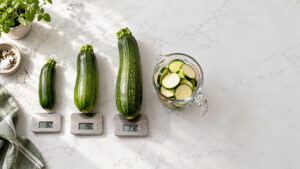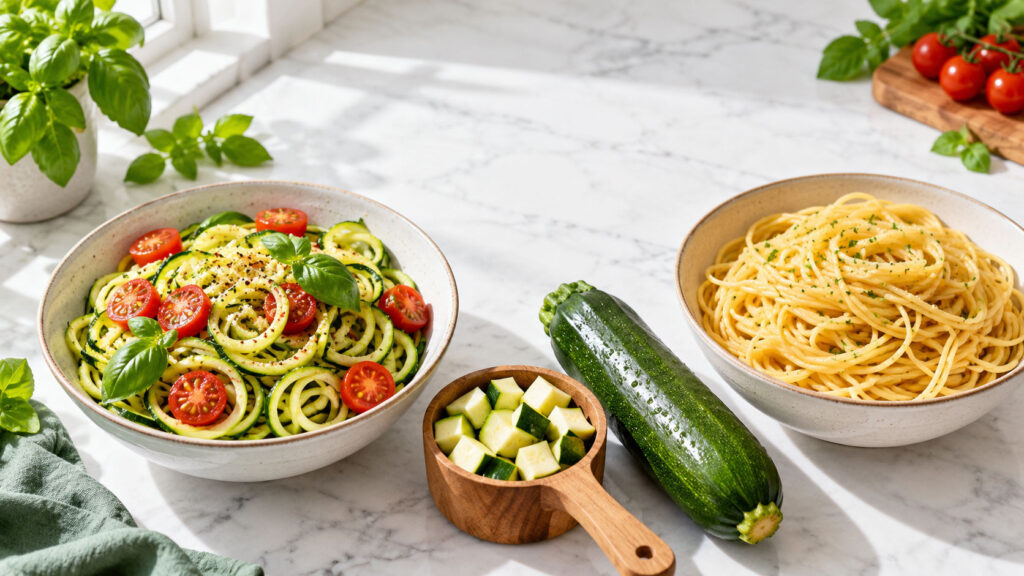
Picture someone who eats grilled zucchini almost every night for three months and doesn’t lose a single pound. Our team hears versions of this story often. The zucchini isn’t the problem; what happens around it is.
Table of Contents
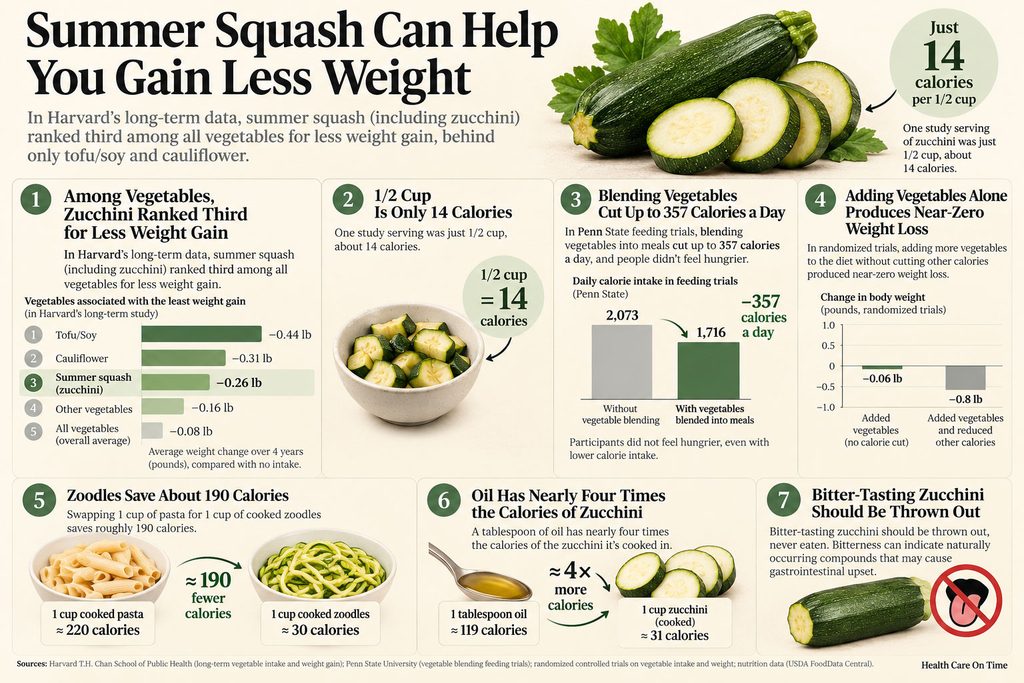
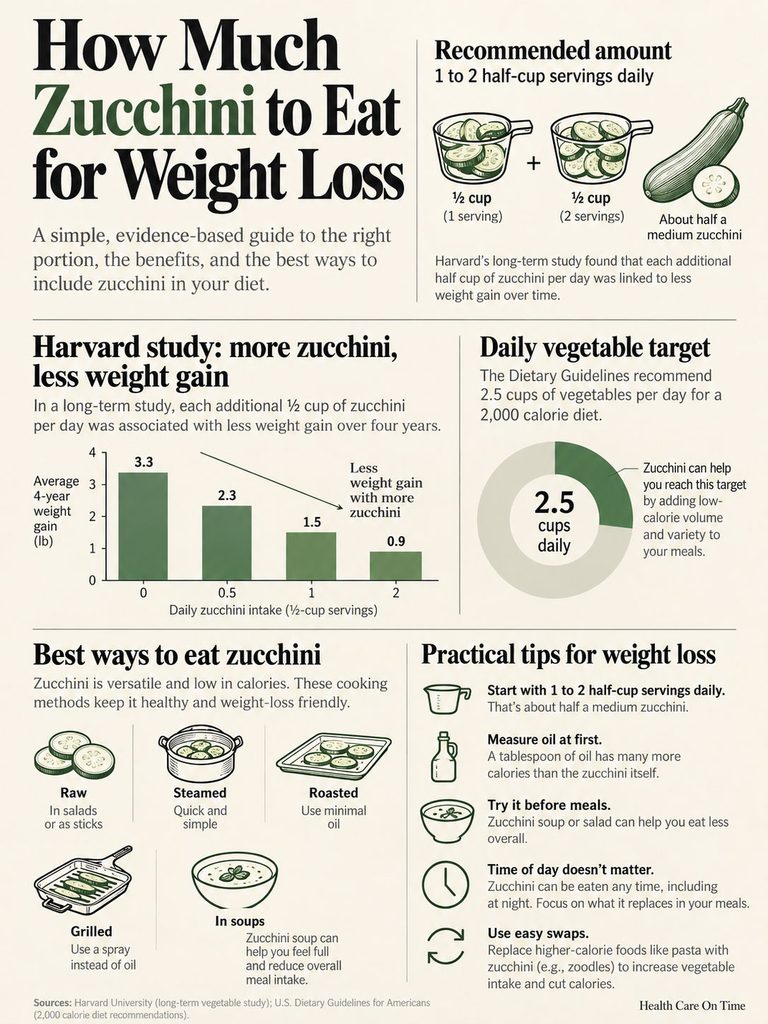
Here’s what most zucchini articles never mention. In a Harvard analysis that followed more than 133,000 American adults for up to 24 years, one extra half cup of summer squash a day was linked to about a pound less weight gain every four years. That’s a stronger result than broccoli, carrots, or peppers.
So zucchini can work. This guide shows when it does, when it doesn’t, and how to use it the way the research suggests.
Quick Answer: Yes, zucchini is good for weight loss. A medium zucchini has about 33 calories and is roughly 95% water, with fiber and a near-zero glycemic load. In a 24-year Harvard study, each extra daily half cup of summer squash was linked to about 1 pound less weight gain per four years. Zucchini helps most when it replaces higher-calorie foods like pasta, rice, or chips, not when it’s added on top.
At a Glance
- In Harvard’s long-term data, summer squash (including zucchini) ranked third among all vegetables for less weight gain, behind only tofu/soy and cauliflower.
- One study serving was just 1/2 cup, about 14 calories.
- Penn State feeding trials cut up to 357 calories a day by blending vegetables into meals, and people didn’t feel hungrier.
- Adding vegetables without cutting other calories produced near-zero weight loss in randomized trials.
- Swapping 1 cup of pasta for 1 cup of cooked zoodles saves roughly 190 calories.
- A tablespoon of oil has nearly four times the calories of the zucchini it’s cooked in.
- Bitter-tasting zucchini should be thrown out, never eaten.
What the Studies Actually Show About Zucchini and Weight
No large clinical trial has tested zucchini by itself for weight loss. Anyone claiming otherwise is overselling.
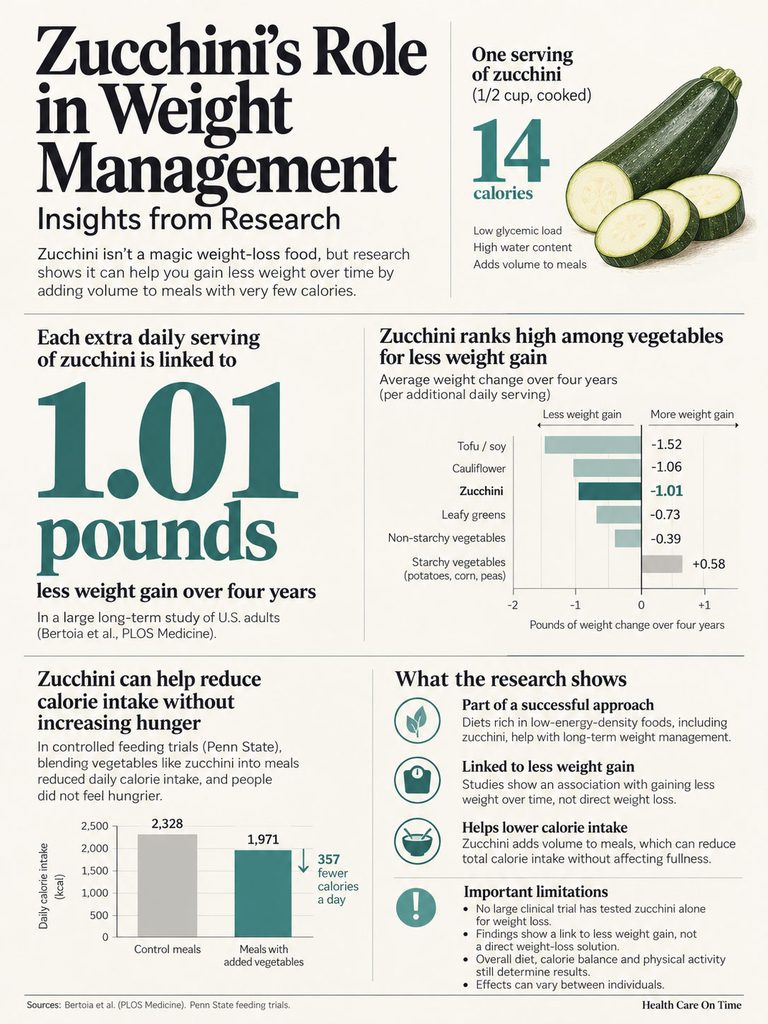
What does exist is better than most people realize. There’s long-term cohort data that tracks zucchini specifically, and there are controlled feeding trials that used zucchini as a calorie-cutting ingredient. Our medical review team went through the original supplementary tables, not just the press summaries, to pull out the zucchini numbers.
The Harvard 24-Year Data
The key study is Bertoia and colleagues in PLOS Medicine. The researchers matched changes in specific fruits and vegetables against changes in weight across three US cohorts totaling 133,468 men and women.
They measured weight change in 4-year blocks from 1986 to 2010. They adjusted for smoking, physical activity, and other diet changes, then pooled the three cohorts.
The overall vegetable result was modest. Each extra daily vegetable serving tracked with only 0.25 pounds less gain over four years.
The individual vegetables told a far more useful story.
Where Zucchini Ranked Against Other Vegetables
Summer squash gets its own line in the study’s supplementary table. The pooled result was roughly 1.01 pounds less gain per extra daily serving over four years, with a confidence range of 0.61 to 1.41 pounds. The two older cohorts showed 0.88 and 1.37 pounds. The younger women’s cohort showed 0.68 pounds, with a range that crossed zero.
Only two vegetables did better. Tofu/soy came in at 2.47 pounds less gain, and cauliflower at 1.37 pounds. Summer squash beat string beans, peppers, broccoli, and carrots.
Starchy vegetables went the opposite direction. Extra daily servings of potatoes, peas, and corn were tied to gains of 0.74, 1.13, and 2.04 pounds over four years.
What “One Serving” Meant
This is the detail almost every summary misses. The questionnaire defined one serving of eggplant, zucchini, or other summer squash as just 1/2 cup.
That half cup carried about 14 calories, 1.3 grams of fiber, and a glycemic load of 0.4. In kitchen terms, it’s roughly a quarter of a medium zucchini.
Table 1: Zucchini vs Other Vegetables in the Harvard Weight-Change Data
| Vegetable | Study serving | Calories per serving | Glycemic load | Weight change per extra daily serving (4 years) |
| Summer squash (incl. zucchini) | 1/2 cup | 14 | 0.4 | -1.01 lb |
| Cauliflower | 1/2 cup | 14 | 0.2 | -1.37 lb |
| Peppers | 1/4 pepper | 3 | 0.1 | -0.76 lb |
| Broccoli | 1/2 cup | 27 | 0.5 | -0.74 lb |
| Carrots | 1/2 cup cooked | 21 | 1.8 | -0.41 lb |
| Potatoes (baked, boiled, mashed) | 1 potato or 1 cup mashed | 144 | 22.5 | +0.74 lb |
| Peas | 1/2 cup | 73 | 6.0 | +1.13 lb |
| Corn | 1 ear or 1/2 cup | 66 | 9.7 | +2.04 lb |
Source: Bertoia et al., PLOS Medicine (supplementary tables 3, 5, 7 and 13). Negative numbers mean less weight gain.
The pattern is hard to miss. The vegetables tied to less weight gain were low in calories and low in glycemic load, and zucchini sits squarely in that group.
The Feeding Trials: Zucchini as a Calorie Cutter
Cohort data shows a link. Feeding trials show what happens when researchers control the plate.
At Penn State, nutrition scientist Barbara Rolls has spent decades studying energy density, meaning calories per gram of food. Her team ran a hidden-vegetable trial in adults that blended puréed vegetables into entrées at breakfast, lunch, and dinner.
People ate about the same weight of food either way, so daily calories dropped by 202 in the moderate condition and 357 in the higher-vegetable condition. Hunger and fullness ratings didn’t change, and the dishes were rated as equally tasty.
A companion study in preschool children used zucchini directly. Researchers lowered energy density by swapping zucchini, cauliflower, broccoli, tomatoes, and squash in for richer ingredients.
Patients who ask our team how to “eat less without feeling deprived” are often surprised by this result. The method isn’t eating less food. It’s eating food that carries fewer calories per bite.
The Year-Long Trial
Feeding studies last days. The longer test came from a Penn State trial in 97 women with obesity.
One group was told to cut fat. The other was told to cut fat and eat more water-rich foods, especially fruits and vegetables. After a year, both groups lost weight, but the vegetable group lost it in a different pattern.
That group ate a greater weight of food, yet their overall diet was lower in energy density. The researchers concluded the approach helps manage weight while keeping hunger in check.
What the Studies Can’t Prove
Our medical reviewers flag four limits before anyone treats zucchini as a weight-loss tool.
- It’s observational. The Harvard data shows a link, not proof that zucchini caused less weight gain. People who start eating more zucchini may change other habits too.
- Zucchini shares a line with eggplant. The questionnaire grouped eggplant, zucchini, and other summer squash into a single item.
- The diet measure was rough. The questionnaire’s validity score for eggplant/zucchini was just 0.20, among the weakest of any item.
- The cohort was narrow. Participants were 97% to 99% white health professionals, so results may not apply equally to everyone.
None of this cancels the finding. It means the honest phrasing is “linked to less weight gain,” not “melts fat.”
Why Zucchini Helps: The Mechanisms
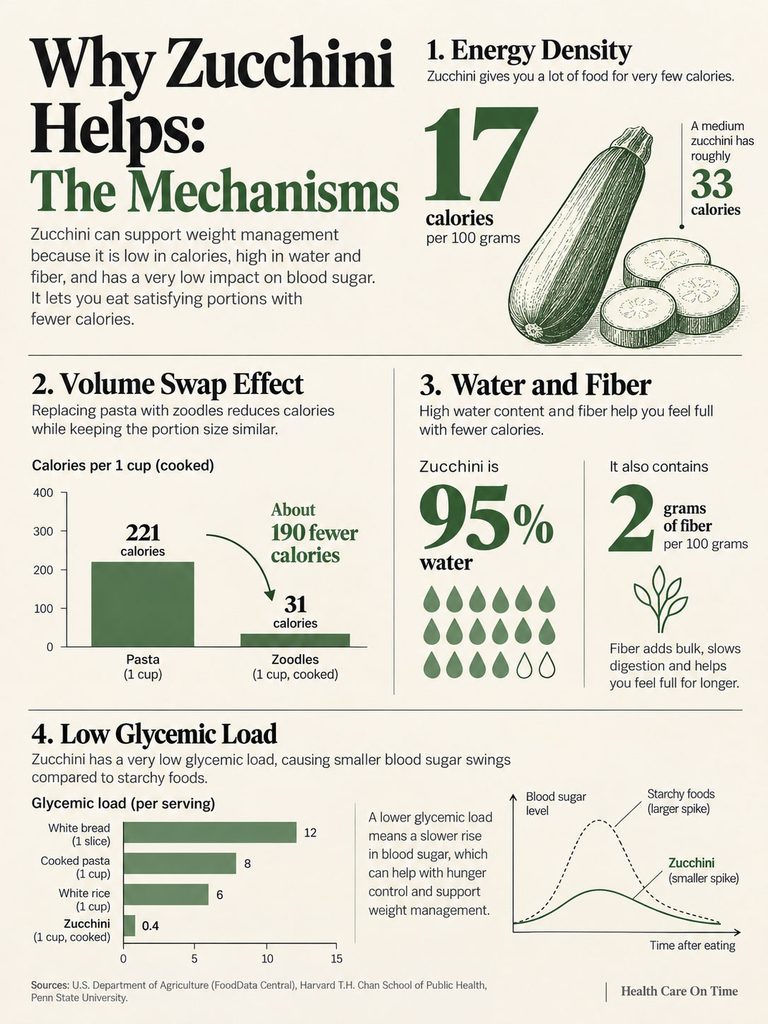
Zucchini doesn’t contain a fat-burning compound. Its effect comes from simple physics on your plate.
Energy Density: More Food, Fewer Calories
Raw zucchini has about 17 calories per 100 grams in USDA FoodData Central. A medium zucchini (about 196 grams, or 7 ounces) comes to roughly 33 calories.
Cooked pasta runs about 1.6 calories per gram, and cheddar about 4 calories per gram. Zucchini fills space in your stomach and on your plate for almost no calorie cost.
For the full USDA breakdown by size and cooking method, see our guide on how many calories are in zucchini.
Water and Fiber for Fullness
Zucchini is about 95% water. Rolls’ research found that water built into food tends to fill you up more than the same amount of water drunk alongside a meal.
A medium zucchini also delivers about 2 grams of fiber, including some soluble fiber. That’s not a lot, but fiber slows digestion and adds bulk without adding calories.
Low Glycemic Load
In the Harvard data, a serving of zucchini had a glycemic load of 0.4. Potatoes scored 22.5.
The researchers suggested that low-glycemic-load vegetables cause smaller blood sugar swings, which may reduce later hunger. The non-starchy group consistently tracked with weight loss, while the starchy group tracked with gain.
The Volume Swap Effect
The biggest benefit is what zucchini pushes off your plate. Zoodles in place of pasta, or grated zucchini stirred into ground beef, cuts calories while the portion looks the same.
Readers who write to our team often describe this as the first diet change that didn’t leave them hungry an hour later. That fits the Penn State data: the swap works because the plate still looks full.
Why Zucchini Alone Won’t Make You Lose Weight
This is the section most zucchini articles leave out. Our medical team considers it the most important one.
The Add-On Trap
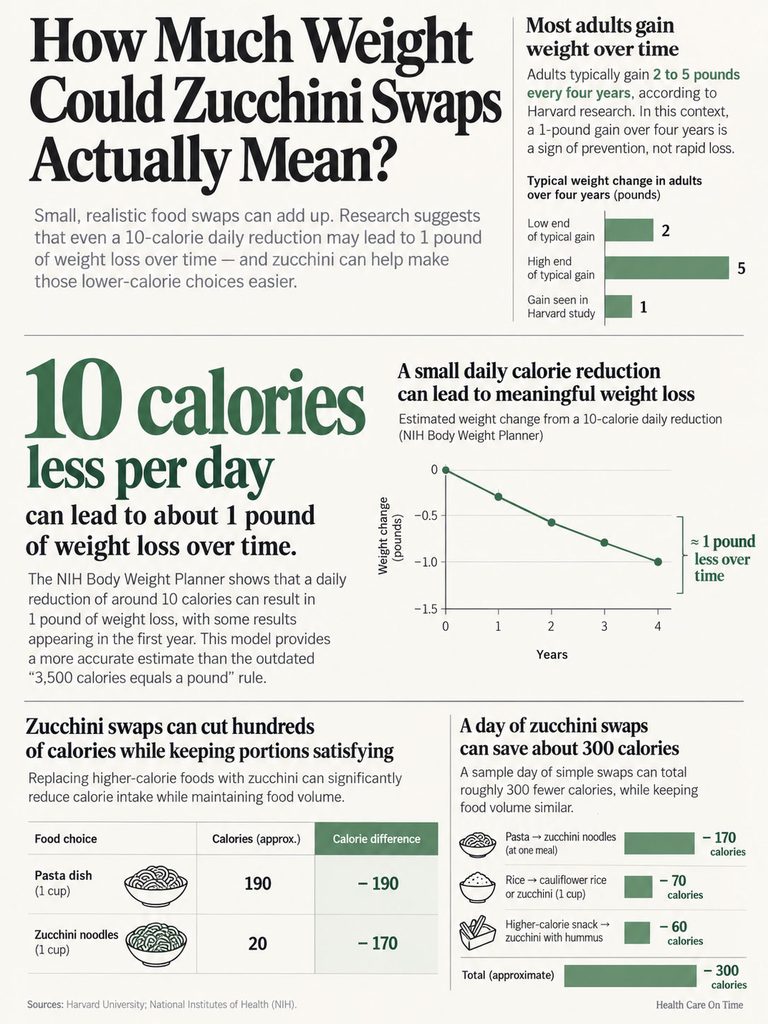
A University of Alabama at Birmingham review in the American Journal of Clinical Nutrition examined seven randomized trials with more than 1,200 people. Advice to eat more produce, or home delivery of fruits and vegetables, produced no significant weight change over 8 to 16 weeks.
The lead researcher’s explanation was simple. Adding vegetables on top of an unchanged diet does little, because losing weight still requires eating fewer calories overall.
The same review found that extra produce didn’t cause weight gain either. Zucchini won’t hurt you, but it helps only when it replaces something.
How a 33-Calorie Vegetable Becomes a 300-Calorie Side
Cooking method decides whether zucchini helps or hurts. Per USDA data, a tablespoon of olive oil has about 120 calories, nearly four times the zucchini itself.
Table 4: How Preparation Changes a Zucchini Side Dish
| Preparation (1 medium zucchini) | Approximate calories | What changed |
| Raw or steamed, plain | 33 | Nothing added |
| Grilled with cooking spray | About 40 | Minimal fat |
| Sautéed in 1 tablespoon olive oil | About 155 | Oil adds ~120 |
| Oil plus 1/4 cup grated Parmesan | About 240 | Cheese adds ~85 |
| Breaded and deep-fried | Often 300 or more (varies widely) | Batter soaks up oil |
First four rows calculated from USDA FoodData Central values. Fried values vary by recipe, batter, and frying time.
Olive oil isn’t the enemy. A small amount helps your body absorb zucchini’s fat-soluble carotenoids. The goal is to measure it rather than pour it.
Zucchini Bread Is Not Zucchini
Zucchini bread, muffins, and brownies are still desserts. The base is flour, sugar, and oil, and a single bakery slice can easily carry several hundred calories.
The shredded zucchini adds moisture, not a weight-loss effect. Patients sometimes tell our team they “eat zucchini daily” when it’s baked into a muffin. That doesn’t match the pattern the Harvard study tracked.
Zoodles vs Pasta: Does the Swap Really Work?
Zucchini noodles are the best-known zucchini weight-loss move. The math supports them, with a few caveats.
The Calorie Math
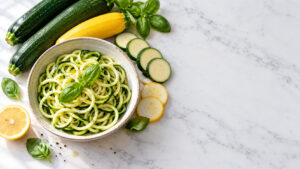
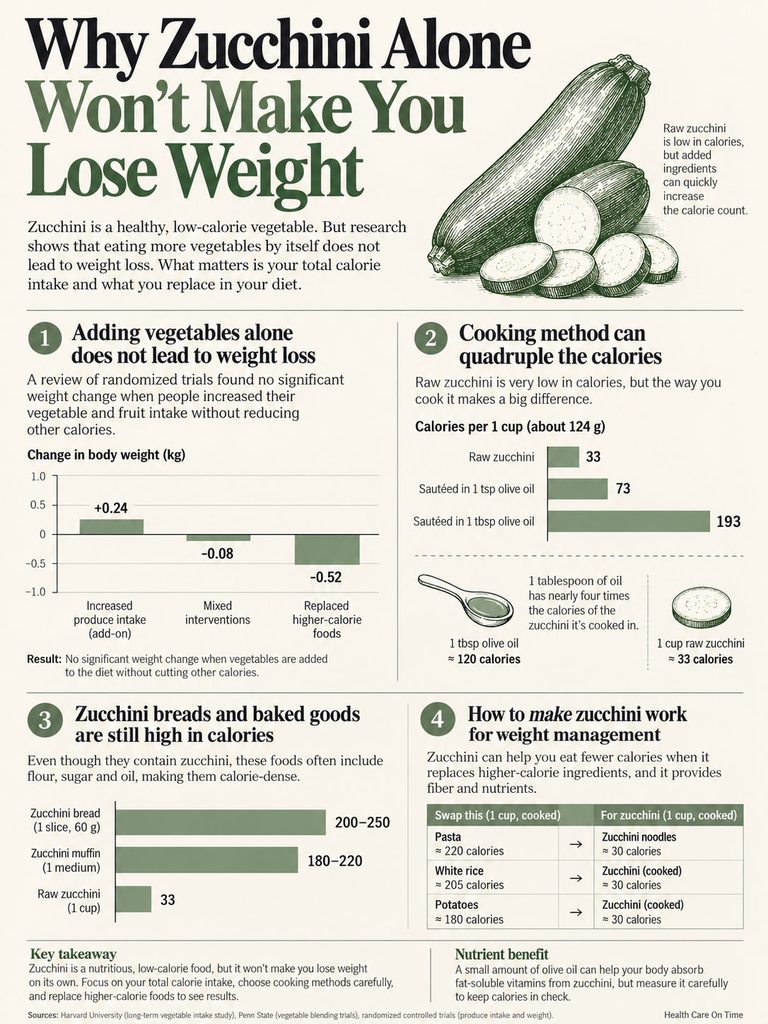
A cup of cooked spaghetti runs about 200 to 220 calories and roughly 40 grams of carbohydrate. A cup of cooked zucchini noodles runs about 27 calories.
That’s a saving of about 190 calories per cup. At two cups, a typical restaurant portion, the gap approaches 400 calories.
Spaghetti does win on protein, with roughly 7 to 8 grams per cup against about 2 grams for zoodles. If you switch fully, add protein elsewhere in the meal: chicken, shrimp, beans, or lentils.
The Half-and-Half Method
Many people find a full zoodle bowl unsatisfying. Mixing half pasta and half zoodles keeps the familiar texture while cutting about 95 calories per cup.
This blending approach mirrors the Penn State trials. People ate the same volume, the food tasted the same, and they took in fewer calories without noticing.
Keeping Zoodles From Turning Watery
Watery zoodles are the top reason people give up on them. These fixes help:
- Salt raw spirals, let them sit 15 minutes, then pat them dry.
- Cook them for only 2 to 3 minutes over high heat.
- Add sauce at the end, not during cooking.
- Choose thicker spirals, which hold their shape better.
- Store-bought frozen spirals release more water, so drain them well.
How Much Weight Could Zucchini Swaps Actually Mean?
This is the question our team gets most, so here’s a realistic answer instead of a promise.
The Harvard Number Is About Prevention
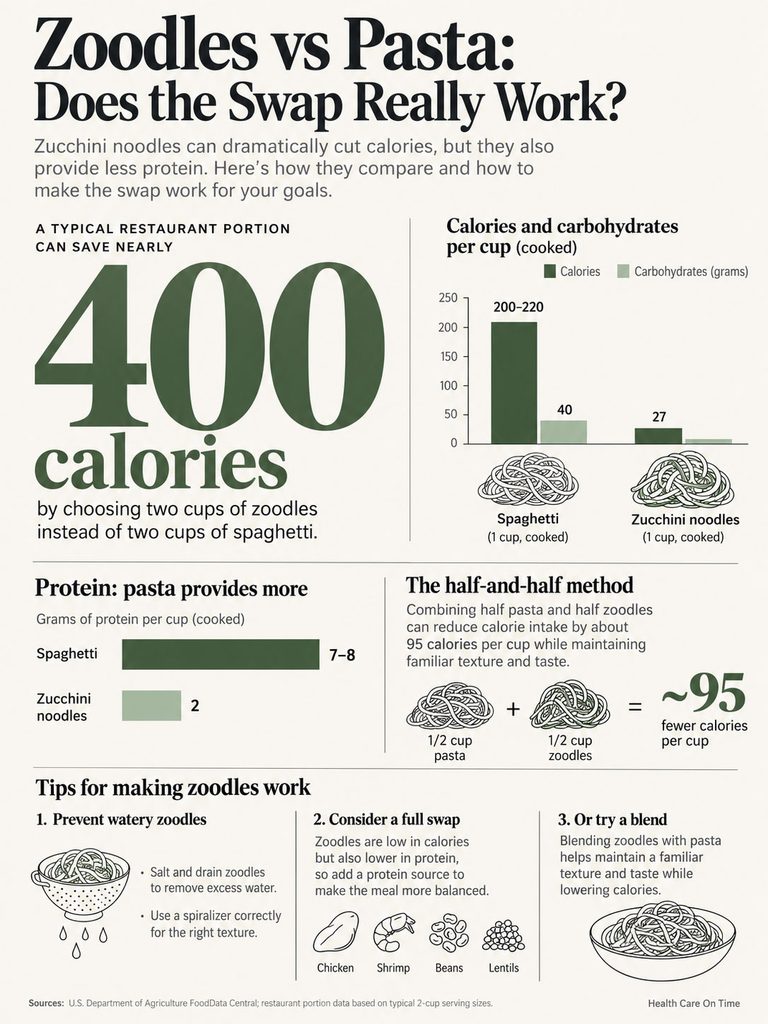
The 1-pound figure describes less weight gain over four years, not rapid loss. Adults in the study gained an average of 2 to 5 pounds every four years. For many people, holding steady is already a win.
The Swap Math Is About Loss
Swaps are where meaningful loss comes from. Researchers at the National Institutes of Health built the NIH Body Weight Planner because the old “3,500 calories equals a pound” rule overestimates long-term results.
Their modeling suggests a lasting cut of about 10 calories a day leads to roughly 1 pound of eventual loss, with about half showing up in the first year. A daily 190-calorie pasta swap could mean meaningful loss over time, but gradually, not in weeks. Plug in your own numbers to see a personal estimate.
A Sample Day of Zucchini Swaps
Here’s how small changes add up across one day.
- Breakfast: Fold 1/2 cup diced zucchini into a two-egg scramble instead of a side of toast. You save roughly 60 to 70 calories.
- Lunch: Add raw zucchini coins to your sandwich plate in place of a 1-ounce bag of chips. You save about 130 calories.
- Dinner: Do half-and-half spaghetti and zoodles. You save about 95 calories per cup.
That’s roughly 300 fewer calories with the same amount of food on the plate. It’s the energy-density principle in practice.
How Much Zucchini to Eat for Weight Loss
Servings That Match the Research
The Harvard finding was per extra daily half cup. One to two half-cup servings a day, roughly half a medium zucchini, is a practical target that lines up with the data.
The Dietary Guidelines for Americans recommend about 2.5 cups of vegetables a day for most adults eating 2,000 calories. Zucchini can cover a solid share of that.
Best Cooking Methods for Weight Loss
The lowest-calorie options are raw, steamed, roasted with a measured teaspoon of oil, grilled with spray, or simmered in soups and sauces. Our nutrition reviewers suggest measuring oil with a spoon for the first two weeks, until you can judge portions by eye.
Best Times to Eat It
Rolls’ research found that a large, low-calorie first course leads people to eat less over the whole meal. A cup of zucchini soup or a raw zucchini salad before dinner applies that directly.
Time of day matters far less than what the zucchini replaces. Zucchini at night is perfectly fine.
7 Easy Zucchini Swaps
- Replace half your spaghetti with zoodles.
- Mix 1 cup grated zucchini into every pound of ground beef or turkey.
- Use zucchini “boats” in place of buns for sloppy joes or tuna salad.
- Slice zucchini into coins for dips instead of chips or crackers.
- Blend zucchini into pasta sauce to thicken it without cream.
- Layer thin zucchini planks in place of half the lasagna noodles.
- Stir diced zucchini into omelets and scrambled eggs.
Zucchini in Popular US Weight-Loss Plans
Weight matters for many Americans. According to CDC’s National Center for Health Statistics, 40.3% of adults had obesity during August 2021 to August 2023, and 9.4% had severe obesity.
Vegetable intake lags well behind. A CDC report found that in 2019 only 10.0% of adults met vegetable recommendations, ranging from 5.6% in Kentucky to 16.0% in Vermont.
Table 2: Key US Data on Vegetables and Weight
| Measure | Figure | Source |
| US adults with obesity | 40.3% | CDC NCHS Data Brief 508 (NHANES Aug 2021 to Aug 2023) |
| US adults with severe obesity | 9.4% | CDC NCHS Data Brief 508 |
| US adults meeting vegetable recommendations | 10.0% | CDC MMWR, BRFSS 2019 |
| Weight change per extra daily serving of summer squash (4 years) | -1.01 lb | Bertoia et al., PLOS Medicine |
| Weight change per extra daily serving of all vegetables (4 years) | -0.25 lb | Bertoia et al., PLOS Medicine |
| Daily calorie drop with vegetable-blended entrées | -202 to -357 kcal | Blatt et al., American Journal of Clinical Nutrition |
| Weight effect of adding produce without cutting calories | Near zero (7 trials, 1,200+ people) | Kaiser et al., American Journal of Clinical Nutrition |
Keto and Low-Carb
Zucchini is one of the most keto-friendly vegetables. Raw zucchini has about 3.1 grams of carbohydrate per 100 grams, with about 1 gram of fiber, so roughly 2 grams of net carbs.
A whole medium zucchini carries about 4 net carbs. That makes zoodles one of the few pasta replacements that fit strict carb limits.
GLP-1 Medications
Many Americans now take GLP-1 medications such as semaglutide or tirzepatide. These drugs shrink appetite, so every bite needs to count.
Zucchini makes a good side, but it shouldn’t crowd out protein. Our clinical reviewers suggest eating protein first, then vegetables. Cooked zucchini is often easier on the stomach than raw when nausea is a side effect.
Diabetes and Prediabetes
With a glycemic load near zero, zucchini barely moves blood sugar. Swapping starchy sides for zucchini may support steadier glucose over time.
If you’re tracking progress, an HbA1c test and a fasting glucose test show the bigger picture better than any single meal.
Who Should Be Careful With Zucchini
Bloating and IBS
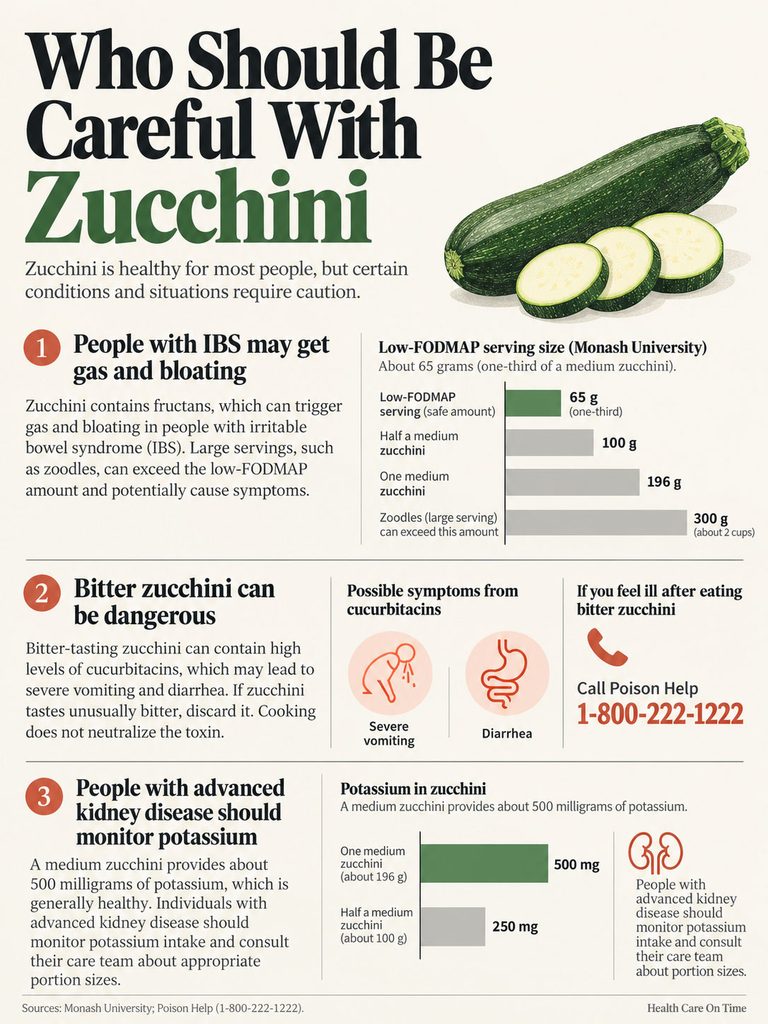
Zucchini contains fructans, a type of FODMAP that can trigger gas and bloating in people with irritable bowel syndrome. Monash University rates about 65 grams of zucchini as a low-FODMAP serving.
That’s only about a third of a medium zucchini. A big bowl of zoodles can be roughly three times that amount. If you have IBS, start small and track symptoms.
Bitter Zucchini Warning
Rarely, zucchini builds up high levels of cucurbitacins, natural bitter compounds that can cause severe vomiting and diarrhea. A French poison-center study (Le Roux, Clinical Toxicology, 2018) reviewed 353 such cases, most from store-bought squash.
The rule is simple. If a zucchini tastes unusually bitter, spit it out and throw away the whole squash. Cooking doesn’t destroy the toxin. If you feel sick, call Poison Help at 1-800-222-1222.
Kidney Disease and Potassium
A medium zucchini carries about 500 milligrams of potassium. That’s healthy for most people. Those with advanced kidney disease on potassium limits should check portions with their care team, and a kidney function panel can show where you stand.
Your Zucchini Weight-Loss Action Plan
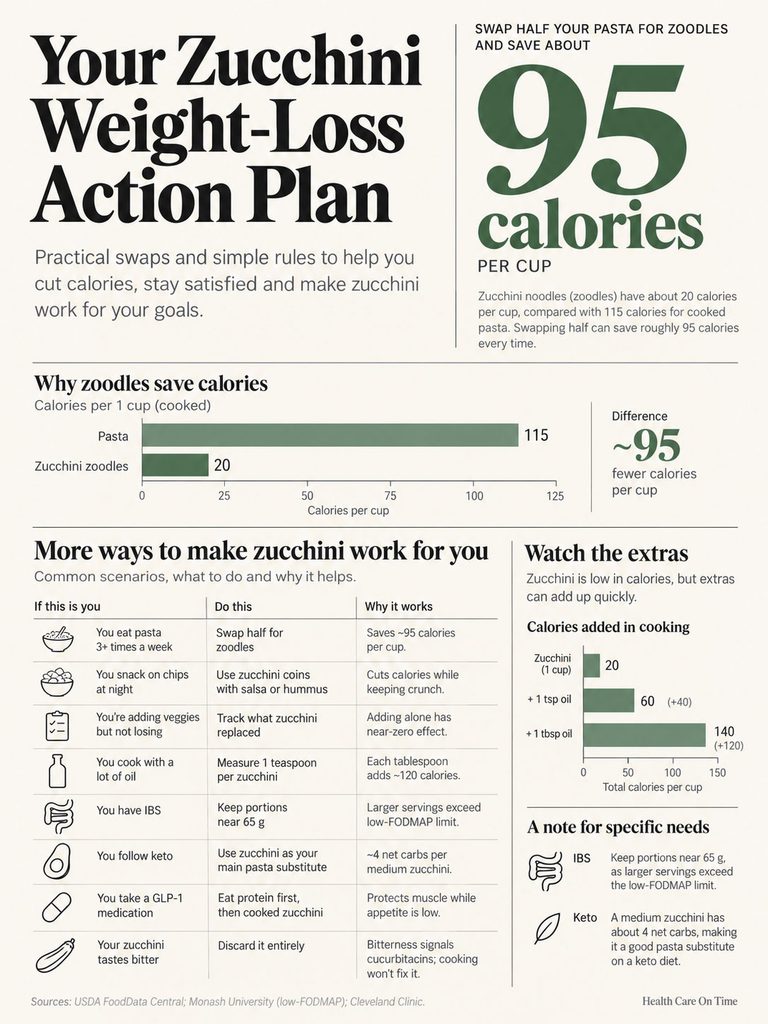
Table 3: Scenario and Recommended Action
| Scenario | Recommended action | Why it works |
| You eat pasta 3+ times a week | Swap half of each serving for zoodles | Saves ~95 calories per cup with the same portion size |
| You snack on chips at night | Use zucchini coins with salsa or hummus | Cuts calories while keeping crunch and volume |
| You’re adding veggies but not losing | Track what the zucchini replaced, not what you added | Trials show adding alone has near-zero effect |
| You cook with a lot of oil | Measure 1 teaspoon per zucchini | Each tablespoon adds ~120 calories |
| You have IBS | Keep portions near 65 g (about 1/3 zucchini) | Larger servings exceed the low-FODMAP limit |
| You follow keto | Use zucchini as your main pasta and rice substitute | ~4 net carbs per medium zucchini |
| You take a GLP-1 medication | Eat protein first, then cooked zucchini | Protects muscle while appetite is low |
| Your zucchini tastes bitter | Discard it entirely | Bitterness signals cucurbitacins; cooking won’t fix it |
Our medical team’s verdict: zucchini is one of the better vegetables for weight control, backed by long-term data and controlled trials. Its job is to replace denser food, not to sit on top of it.
Frequently Asked Questions
Does zucchini burn belly fat?
No food burns fat from one specific area. Zucchini can support overall fat loss by helping you eat fewer total calories while staying full. When your body loses fat, your belly is included, but no study shows zucchini targets belly fat directly. Calorie balance and activity decide where results show up.
How much zucchini should I eat a day to lose weight?
One to two half-cup servings a day match the Harvard data, where each extra daily half cup tracked with about one pound less gain over four years. That’s roughly half a medium zucchini. Larger amounts are fine if they replace higher-calorie foods and don’t cause bloating.
Can I eat zucchini every day?
Yes. For most healthy adults, daily zucchini is safe and helps meet vegetable goals. People with IBS should keep portions modest because of fructans. Those with advanced kidney disease should check their potassium limits. Always throw out any zucchini that tastes bitter, since bitterness can signal a natural toxin.
Is zucchini good for weight loss at night?
Yes. Zucchini’s low calorie count makes it a smart dinner or late-evening choice, especially in place of pasta, rice, or chips. Timing matters much less than total daily calories. A zucchini-based dinner can help you finish the day lower in calories without going to bed hungry.
Are zucchini noodles good for weight loss?
Yes. A cup of cooked zoodles has about 27 calories, compared with roughly 200 to 220 for a cup of spaghetti. That saves about 190 calories per cup. Keep sauces light and add protein, since zoodles have little. Heavy cream sauces can erase most of the savings.
Is zucchini better than cucumber for weight loss?
Both work well. Cucumber is slightly lower in calories, while zucchini is easier to cook into meals in place of pasta, rice, and bread. Zucchini also has stronger long-term data, since summer squash appeared in the Harvard study. See our cucumber vs zucchini comparison for details.
Is zucchini keto friendly?
Yes. Raw zucchini has about 2 grams of net carbs per 100 grams, and a medium zucchini has around 4 net carbs. That makes it one of the most popular keto vegetables, especially as a substitute for pasta, lasagna noodles, and bread. Watch for added flour in breaded zucchini recipes.
Does cooking zucchini add calories?
Cooking itself doesn’t add calories, though water loss makes cooked zucchini denser per cup. Fat is what adds calories. A tablespoon of oil adds about 120 calories, and cheese or breading adds more. Steaming, roasting with measured oil, and grilling with spray keep calories lowest.
Is zucchini bread good for weight loss?
Usually not. Most zucchini bread is a sweet quick bread made with flour, sugar, and oil, and one slice can carry several hundred calories. The zucchini adds moisture but not a weight-loss benefit. If you enjoy it, treat it as dessert and keep the slice small.
Can zucchini cause bloating or gas?
It can, especially with IBS. Zucchini contains fructans, and Monash University testing puts the low-FODMAP limit at about 65 grams per serving. Larger portions, like a full bowl of zoodles, may cause gas or bloating. Starting with small amounts helps you find your personal comfort level.
Is raw or cooked zucchini better for weight loss?
Both work. Raw zucchini keeps more vitamin C and adds crunch to salads and snacks. Cooked zucchini is easier to eat in larger amounts and swap into pasta dishes. For weight loss, the cooking fat matters far more than raw versus cooked. Pick whichever you’ll eat consistently.
Is yellow squash as good as zucchini for weight loss?
Yes. Yellow squash and zucchini are both summer squash, with very similar calories, fiber, and water content. The Harvard study grouped them in the same questionnaire item. Use whichever you prefer or rotate them. Winter squash like butternut is starchier and higher in calories, though.
Disclaimer: This article is for general education and isn’t a substitute for personalized medical or nutrition advice. Weight-loss needs vary with health conditions, medications, and goals. Talk with your doctor or a registered dietitian before major diet changes, especially if you have diabetes, kidney disease, or IBS, or take GLP-1 medications. If you eat bitter squash and feel sick, call Poison Help at 1-800-222-1222.
References
- Bertoia ML, et al. Changes in Intake of Fruits and Vegetables and Weight Change in United States Men and Women Followed for Up to 24 Years. PLOS Medicine.
- Bertoia ML, et al. Full text with supplementary tables. Harvard DASH repository.
- Harvard T.H. Chan School of Public Health. Can certain fruits and vegetables prevent weight gain?
- Blatt AD, Roe LS, Rolls BJ. Hidden vegetables: an effective strategy to reduce energy intake and increase vegetable intake in adults. American Journal of Clinical Nutrition.
- Spill MK, et al. Hiding vegetables to reduce energy density. American Journal of Clinical Nutrition.
- Ello-Martin JA, et al. Dietary energy density in the treatment of obesity: a year-long trial. Penn State.
- Kaiser KA, et al. Increased fruit and vegetable intake has no discernible effect on weight loss. American Journal of Clinical Nutrition.
- CDC NCHS. Obesity and Severe Obesity Prevalence in Adults: United States, August 2021 to August 2023.
- CDC MMWR. Adults Meeting Fruit and Vegetable Intake Recommendations, United States, 2019.
- NIH NIDDK Body Weight Planner.
- USDA FoodData Central.
- Dietary Guidelines for Americans.
- Monash University FODMAP.
- Le Roux G, et al. Poisoning by non-edible squash: retrospective series of 353 patients from French Poison Control Centers. Clinical Toxicology. 2018;56(8):790-794.