Colace is one of the most handed-out constipation pills in American hospitals. Nurses give it after surgery, alongside pain medicine, and on discharge.
Table of Contents
Yet a major evidence review found it worked about as well as a sugar pill. If that surprises you, you’re in good company. Here’s what doctors want you to know before you reach for that bottle.
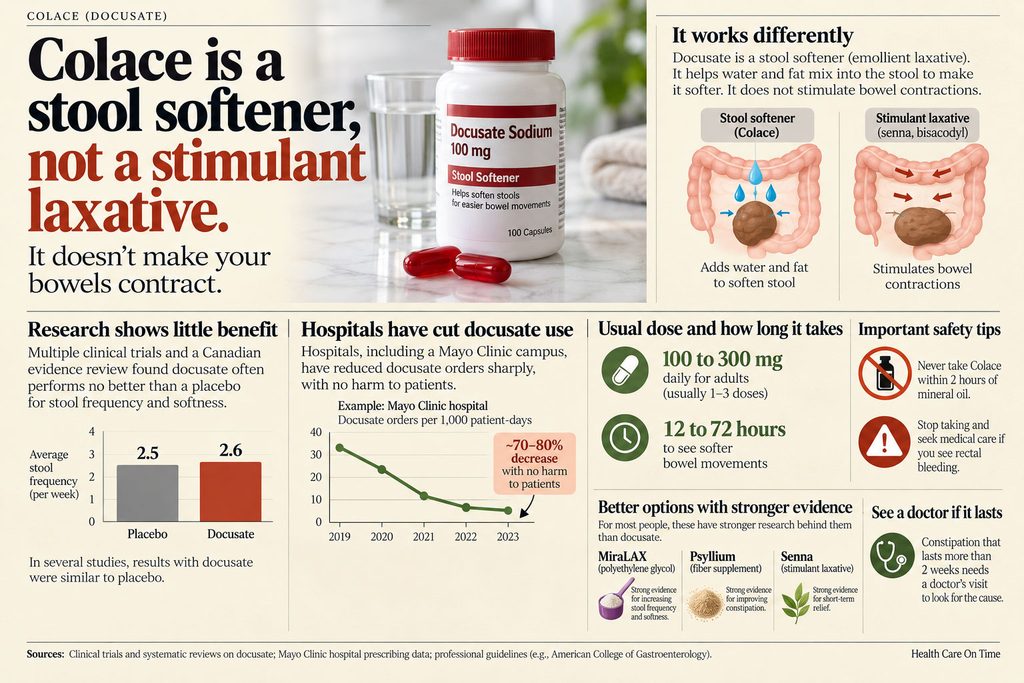
Quick Answer: Colace (docusate sodium) is an over-the-counter stool softener that helps water and fat mix into hard stool. Adults usually take 100 to 300 mg a day, and it can take 12 to 72 hours to work. Don’t use it longer than 7 days without a doctor’s advice. Studies show it often works no better than a placebo, so many doctors now prefer MiraLAX, psyllium, or senna.
At a Glance
- Colace is a stool softener, not a stimulant laxative. It doesn’t make your bowels contract.
- Research shows docusate often performs no better than a placebo.
- Hospitals, including a Mayo Clinic campus, have cut docusate orders sharply with no harm to patients.
- The usual adult dose is 100 to 300 mg daily, and relief takes 12 to 72 hours.
- Never take Colace within 2 hours of mineral oil, and stop if you see rectal bleeding.
- MiraLAX, psyllium, and senna have stronger evidence behind them.
- Constipation that lasts more than 2 weeks needs a doctor’s visit.
The 5 Things Doctors Want You to Know About Colace
Short on time? Here’s the whole article in five lines.
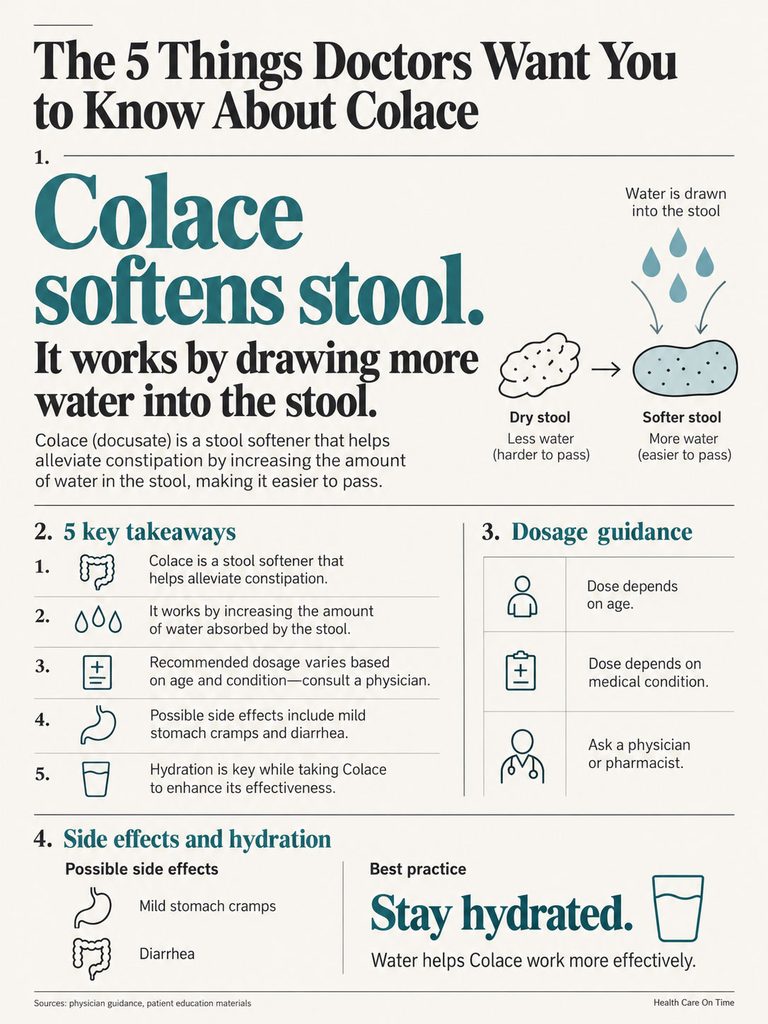
- The evidence is weak. Docusate often works no better than a placebo.
- Take it correctly. Use 100 to 300 mg daily with water, expect 12 to 72 hours for results, and stop after 7 days unless a doctor says otherwise.
- Watch for interactions. Keep it at least 2 hours apart from mineral oil, and expect mild cramps or loose stools now and then.
- Some people need extra care. This includes pregnant people, children, older adults, and anyone on opioids.
- Know when to stop. Rectal bleeding, severe pain, or constipation lasting more than 2 weeks means it’s time to see a doctor.
Each point is explained in detail below.
What Colace Is and How It’s Supposed to Work
Many people assume every constipation product works the same way. They don’t, and that difference explains a lot about Colace.
Docusate Sodium in Plain English
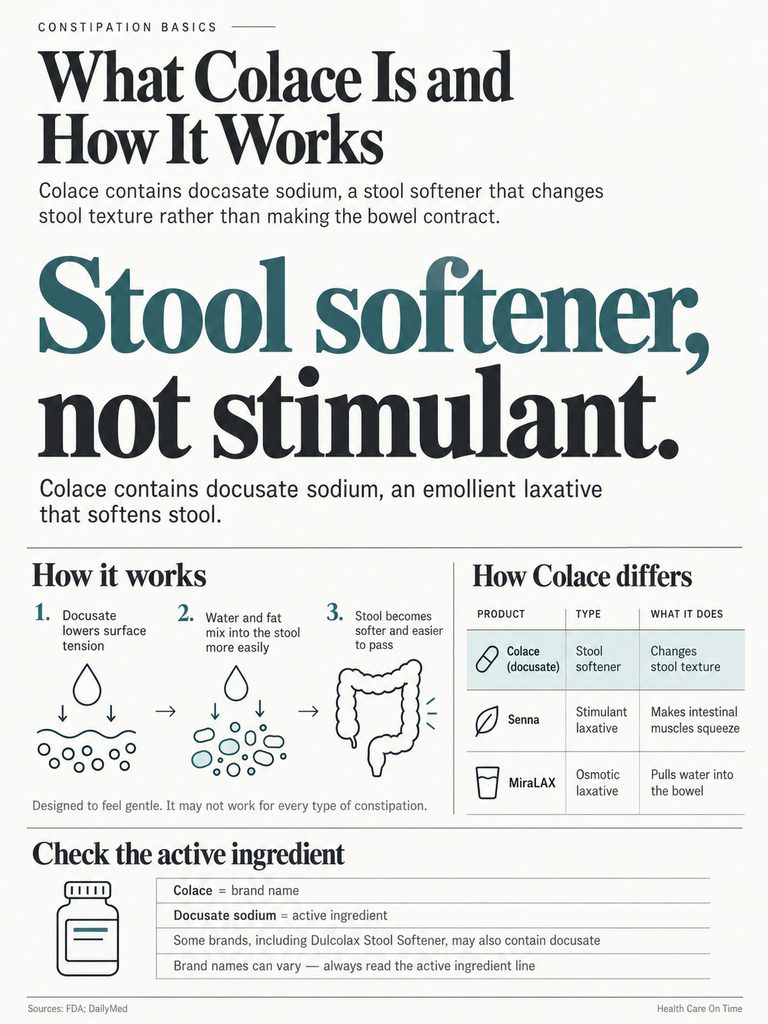
Colace’s active ingredient is docusate sodium. It is a surfactant, which is a soap-like substance. In theory, it lowers the surface tension of stool so water and fat can soak in.
Softer stool should be easier to pass. That’s the whole idea. Doctors call this type of product an “emollient laxative” or stool softener.
Stool Softener vs. Laxative: The Key Difference
Stimulant laxatives like senna and bisacodyl make your intestinal muscles squeeze harder. Osmotic laxatives like MiraLAX pull water into your bowel.
A stool softener only tries to change the texture of stool. It doesn’t push anything along. That’s why Colace feels “gentle,” and also why it often falls short when your bowels are slow to move.
Brand Names You’ll See on US Shelves
Docusate is sold under many names in American pharmacies. The Memorial Sloan Kettering patient guide lists brands including:
- Colace
- Dulcolax Stool Softener
- Fleet Stool Softener
- Pedia-Lax
- Many store-brand “stool softener” products
Patients who reach out to HealthCareOnTime are often surprised by one detail. “Dulcolax Stool Softener” is docusate, while regular Dulcolax laxative tablets contain bisacodyl, a different drug. Always check the active ingredient, not just the brand.
Thing #1: The Evidence Is Weaker Than Most People Think
This is the point most drugstore labels skip. It’s also the one doctors talk about most among themselves.

What the Clinical Trials Found
Docusate has been prescribed for decades, but the research behind it is thin. A review by the Canadian Agency for Drugs and Technologies in Health (CADTH) found docusate no better than a placebo at increasing bowel movements or softening stool.
The same review found no clear effect on cramps or on how complete bowel movements felt.
One of the most cited trials, from 1998, followed 170 adults with chronic constipation. Psyllium (the fiber in Metamucil) raised stool water content by 2.33%. Docusate raised it by just 0.01%, according to a Journal of Hospital Medicine review.
The “softener,” in other words, barely softened anything.
End-of-life care research tells the same story. A University of Alberta study found no difference in stool frequency or volume between palliative patients who took docusate and those who didn’t.
Why Hospitals Are Cutting Back
US hospitals are now acting on this evidence. At the Mayo Clinic campus in Florida, a quality project cut docusate orders for internal medicine patients from 9.7% to 2.4%. Hospital stays didn’t get longer, as reported in Quality Management in Health Care.
Jefferson Health went further. It removed docusate from 500 admission order sets across 12 hospitals and swapped in polyethylene glycol and senna. Docusate doses fell 53%, from 140,619 to 75,180 over matched six-month periods, per a Society of Hospital Medicine abstract.
The Journal of Hospital Medicine even put docusate in its “Things We Do for No Reason” series. It advises using laxatives with proven benefit instead.
So Why Do Doctors Still Recommend It?
Habit plays a big role. Docusate is cheap, easy to find, and rarely causes serious harm, so it has stayed on hospital order sets for years.
A study in the American Journal of Medicine found that 15% of internal medicine patients at two urban hospitals received docusate. Only 13% of people already taking it had it stopped during their stay.
What This Means for You
Our medical team’s take is balanced. Colace is unlikely to hurt you, but it may not do much either.
If you only want to avoid straining for a few days, it’s a reasonable choice. If you’re truly backed up, a better-studied option usually gets you relief faster.
Thing #2: How to Take Colace the Right Way
If you and your doctor decide Colace is worth trying, using it correctly gives it the best chance to work.
Standard Adult and Child Doses
Always follow the label on your specific product. Strengths vary across 50 mg and 100 mg capsules, liquids, and syrups.
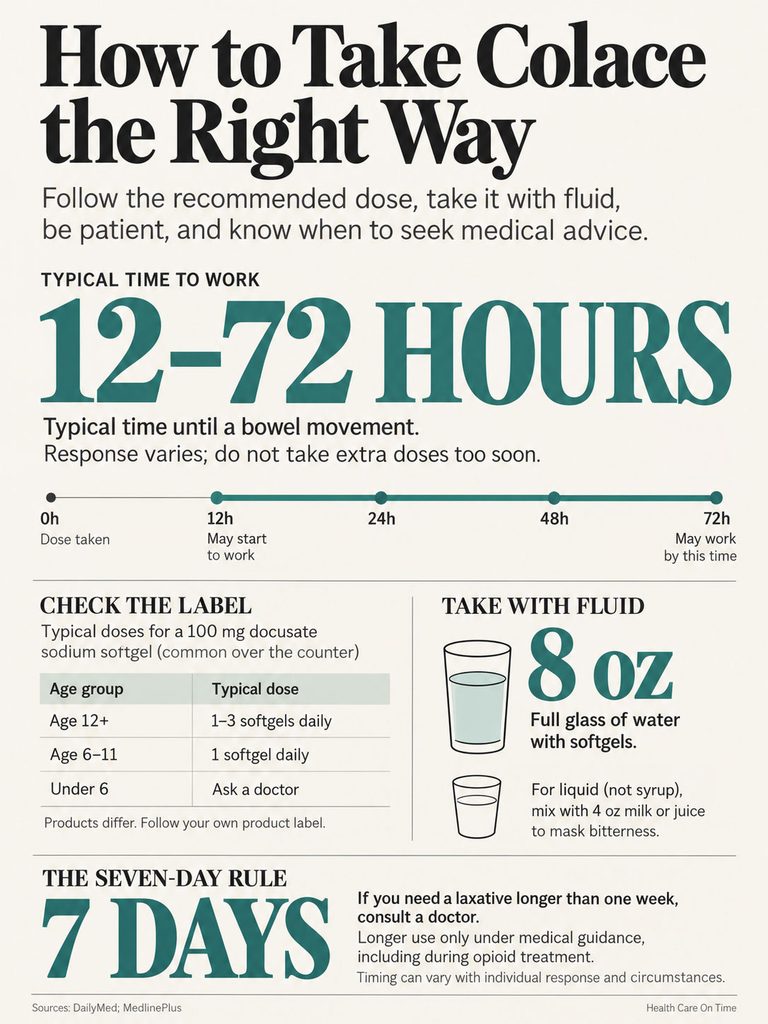
For the common 100 mg capsule, typical OTC label directions are:
- Adults and children 12 and older: 1 to 3 capsules (100 to 300 mg) daily, as one dose or split doses
- Children 2 to under 12: 1 capsule daily
- Children under 2: ask a doctor first
Take each dose with a full 8-ounce glass of water. Liquid forms taste bitter and can sting the throat, so mixing them with milk or juice helps.
How Long Colace Takes to Work
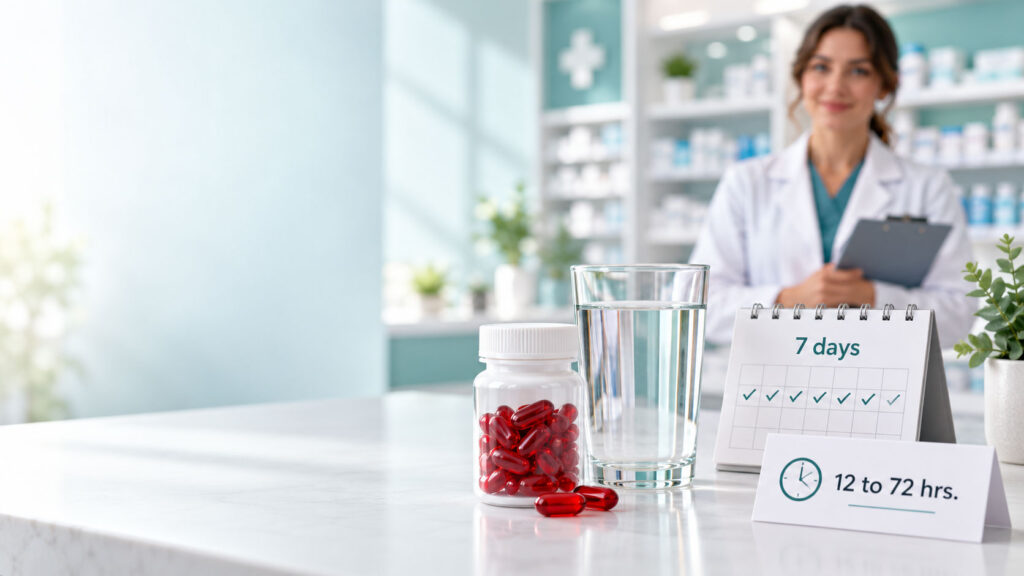
Colace is slow. Most people get a softer bowel movement within 12 to 72 hours, according to MedlinePlus.
People who book appointments with us often say they took a second or third dose after a few hours because “nothing happened.” That’s normal timing, not a sign you need more.
What Speeds It Up or Slows It Down
Several everyday factors change how fast Colace works:
- Water intake: a softener can’t add water your body doesn’t have
- Fiber: stool needs bulk to move well
- Physical activity: walking stimulates the gut
- Other medicines: opioids, iron pills, and some antacids slow the bowels
- Bed rest: recovering patients often see slower results
The 7-Day Rule
FDA-regulated OTC laxative labels, such as those on DailyMed, tell users to stop and ask a doctor if they need a laxative for more than one week. Weeks of self-treatment can hide a problem that needs real attention.
Your doctor may approve longer use in certain cases, such as during opioid therapy. Get that guidance first rather than guessing.
Thing #3: Side Effects and Interactions to Watch
Colace has a strong safety record, which is a big reason it’s so popular. Still, “safe” doesn’t mean “free of side effects.”
Common, Mild Side Effects
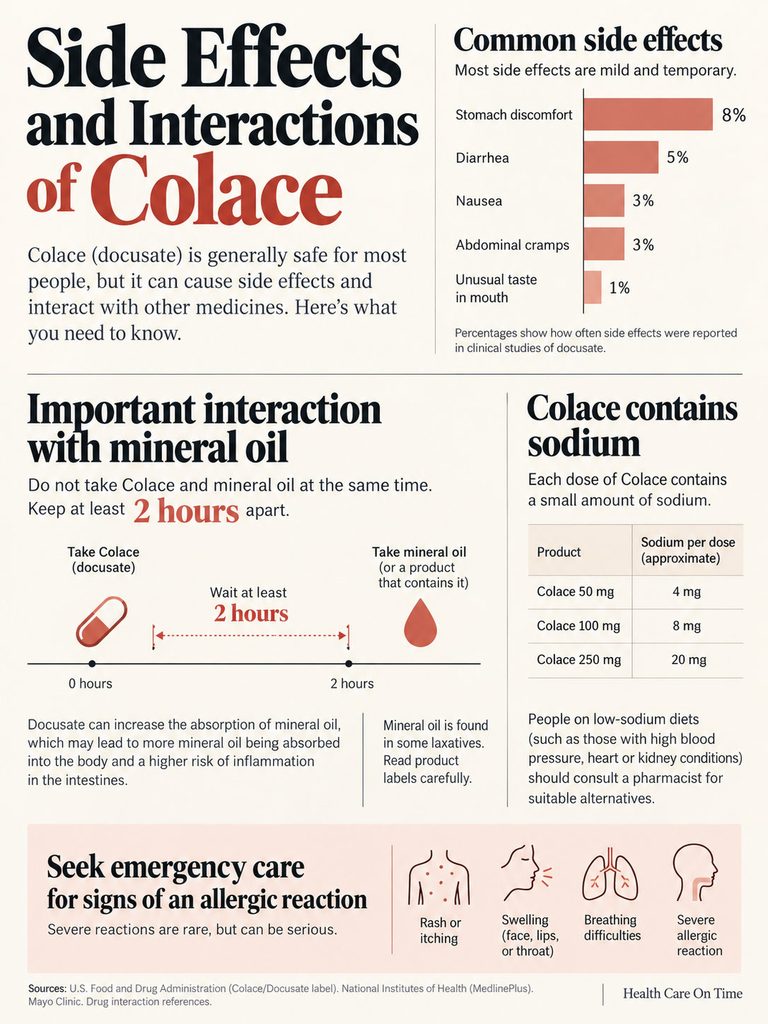
Most side effects are mild and fade once you stop:
- Mild stomach cramps
- Loose stools or diarrhea
- Throat irritation (mostly from liquid forms)
- Bitter taste
- Nausea
Rare allergic reactions, such as a rash, itching, facial swelling, or trouble breathing, need emergency care right away. Call 911 if breathing is affected.
The Mineral Oil Warning
This is the interaction doctors most want you to remember. Keep Colace and mineral oil at least 2 hours apart.
Docusate can raise how much mineral oil your body absorbs. That can cause inflammation where the oil builds up in tissues. Mineral oil is sold as a lubricant laxative and shows up in some combination products, so read labels closely.
Sodium Content and Liquid Forms
Each dose contains a small amount of sodium. For most people, it doesn’t matter.
If you follow a strict low-sodium diet for heart failure, kidney disease, or high blood pressure, ask your pharmacist whether another product fits better.
Thing #4: Who Should Be Careful With Colace
Your overall health shapes whether Colace is a good fit. These are the groups our medical reviewers flag most often.

Pregnancy and Breastfeeding
Constipation is very common in pregnancy because of hormones and iron supplements. Docusate is barely absorbed into the bloodstream, so many OB-GYNs view it as a lower-risk choice.
Fiber and MiraLAX are often preferred because their evidence is stronger. Talk to your OB-GYN before starting any laxative, and mention every supplement you take.
During breastfeeding, very little docusate is expected to reach breast milk. Your OB-GYN or pediatrician can confirm it’s right for you.
Children
Kids under 2 should never get docusate without a doctor’s direction. For older children, pediatricians usually start with diet changes, more fluids, and regular bathroom routines.
Childhood constipation can hint at other issues, so a checkup is a smart first step.
Older Adults and People on Opioids
About one-third of US adults over 60 report constipation symptoms. Many also take several medicines that slow the bowels.
If you take opioid pain medicine, this point matters most: docusate alone usually isn’t enough. Opioids slow the muscles of the gut, and a softener doesn’t fix that. Doctors more often recommend senna or polyethylene glycol, sometimes with docusate added.
People With Heart, Kidney, or Bowel Conditions
Ask a doctor before using Colace if you have:
- Stomach pain, nausea, or vomiting
- A sudden change in bowel habits lasting more than 2 weeks
- A known or suspected bowel blockage
- Rectal bleeding
- A strict sodium restriction
Across the patients we serve, these symptoms sometimes point to bowel obstruction, inflammatory bowel disease, or colorectal cancer. Those need a diagnosis, not a softener.
When Colace Can Make Sense
Weak evidence doesn’t make Colace useless in every case. Doctors still reach for it in a few specific situations.
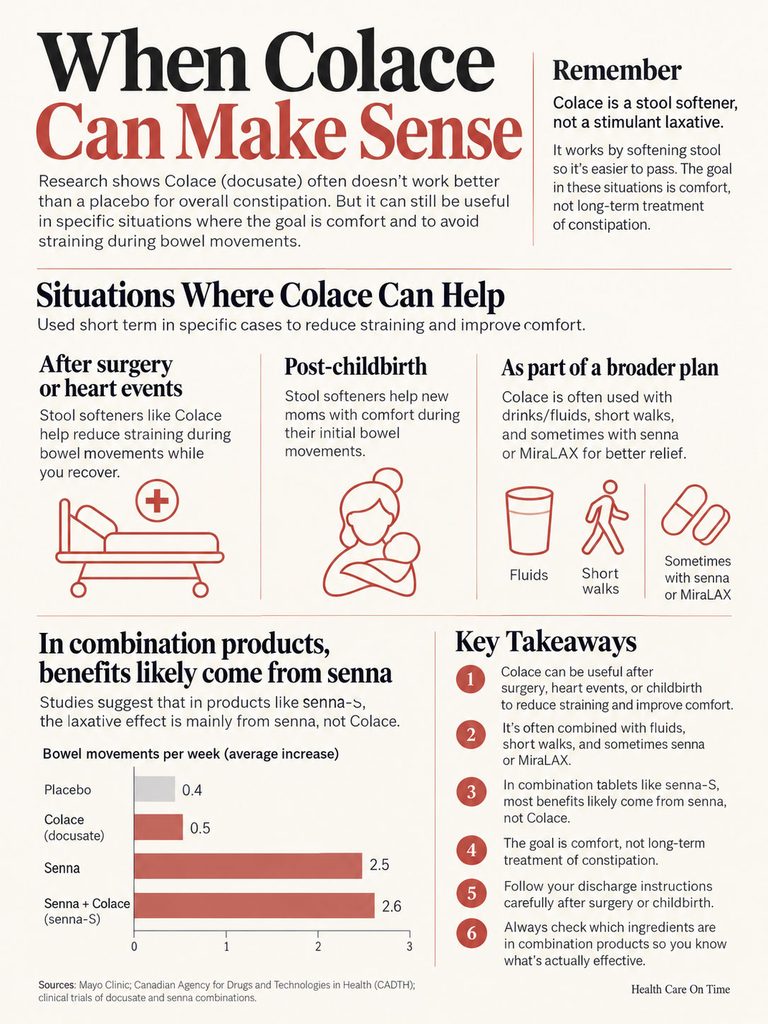
After Surgery or a Heart Event
After heart surgery, a heart attack, hernia repair, or hemorrhoid surgery, straining on the toilet can strain your body too. A softener may make stool slightly easier to pass while you heal.
In these cases, doctors usually pair it with fluids, short walks, and often senna or MiraLAX. Follow your discharge instructions exactly.
After Childbirth
Many new moms get a stool softener after delivery, especially after stitches or a C-section. The goal is comfort during the first few bowel movements, not treating long-term constipation.
As an Add-On, Not a Fix
Docusate is sometimes combined with senna in one tablet, sold as “senna-S” or under store names. Most of the benefit likely comes from the senna. If a combo tablet works for you, that’s fine; just know which ingredient is doing the work.
Colace vs. Other Constipation Treatments
Since the evidence for Colace is thin, comparing it with other options is the smartest move. This table puts the most common US choices side by side.
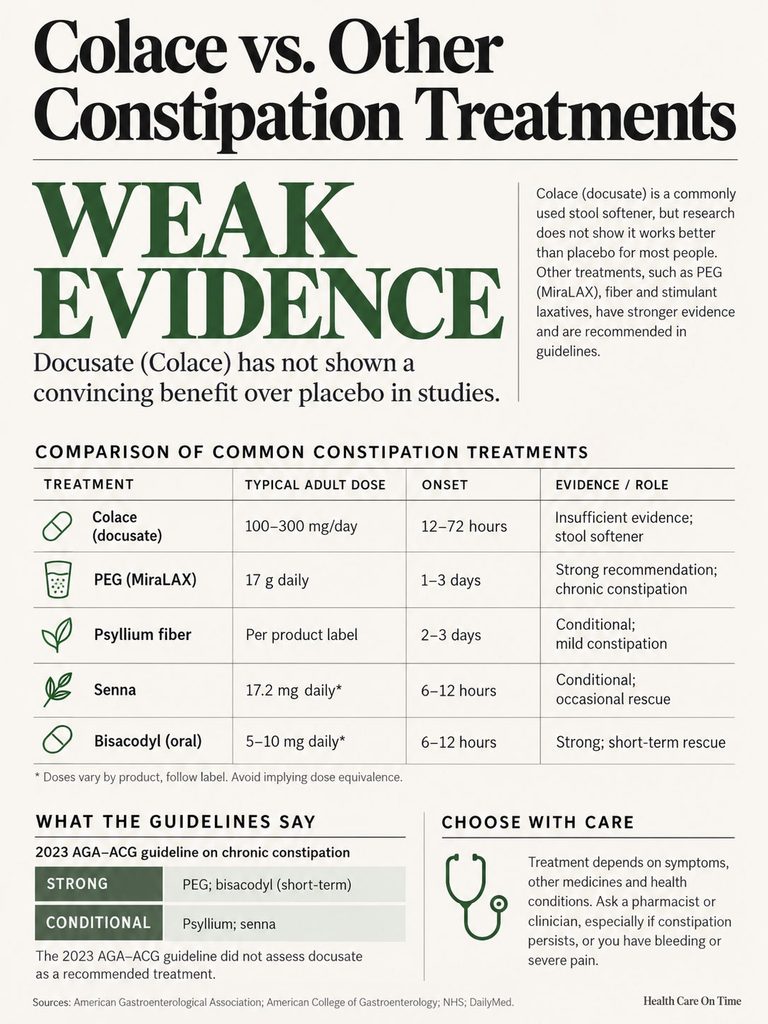
| Treatment | Type | Typical Adult Dose | Onset | Evidence Strength | Best For |
| Colace (docusate) | Stool softener | 100 to 300 mg daily | 12 to 72 hours | Weak (often equal to placebo) | Avoiding straining after surgery, if a doctor advises |
| MiraLAX (polyethylene glycol) | Osmotic laxative | 17 g in 4 to 8 oz liquid daily | 1 to 3 days | Strong | Occasional and chronic constipation |
| Senna (Senokot) | Stimulant laxative | 8.6 to 17.2 mg at bedtime | 6 to 12 hours | Moderate | Opioid-related or short-term constipation |
| Psyllium (Metamucil) | Bulk-forming fiber | About 3.4 g fiber, 1 to 3 times daily | 12 to 72 hours | Moderate to strong | Long-term regularity, low-fiber diets |
| Bisacodyl (Dulcolax laxative) | Stimulant laxative | 5 to 15 mg oral once daily | 6 to 12 hours | Strong (short-term) | Fast relief of occasional constipation |
| Lactulose (Rx) | Osmotic laxative | 15 to 30 mL daily | 24 to 48 hours | Moderate to strong | Chronic constipation under a doctor’s care |
Doses reflect general label ranges. Your product label and your doctor’s advice come first.
The gap in evidence explains why the Journal of Hospital Medicine recommends polyethylene glycol, lactulose, psyllium, or senna over docusate. The 2023 chronic constipation guideline from the American Gastroenterological Association and American College of Gastroenterology also puts fiber, PEG, and stimulant laxatives at the center of treatment. It does not list docusate among its recommended options.
Thing #5: When Colace Isn’t Enough (and When to Call a Doctor)
Constipation is usually harmless. Sometimes, though, it signals something serious, and knowing the difference protects your health.
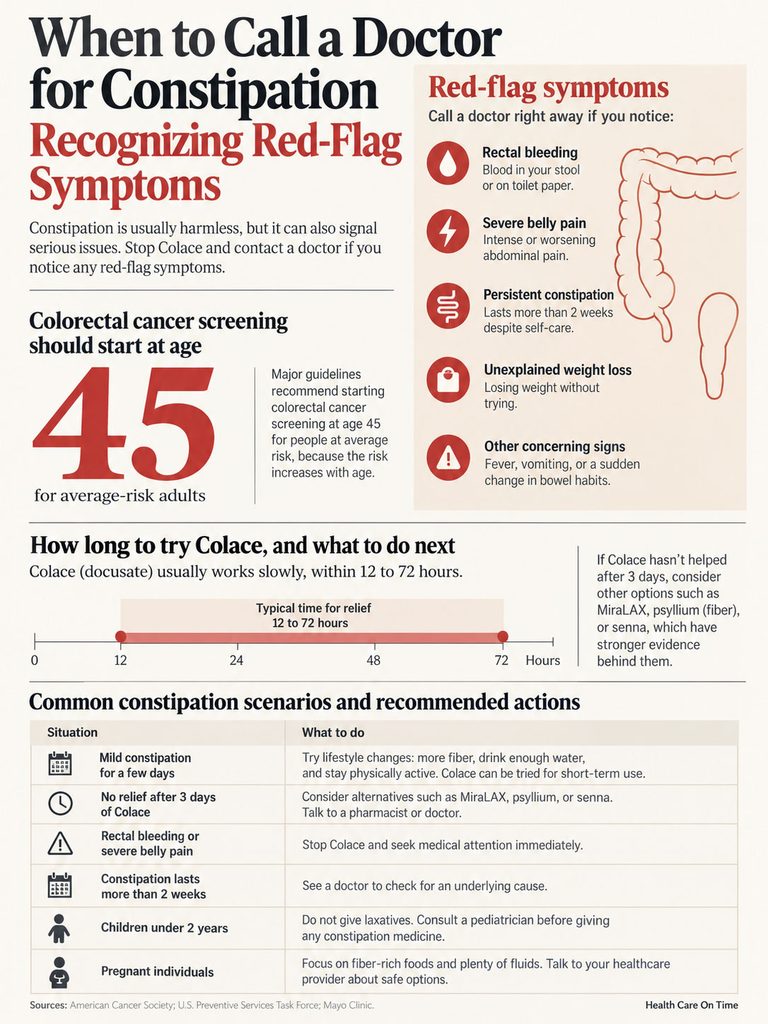
Red-Flag Symptoms
Stop Colace and contact a doctor if you notice:
- Rectal bleeding or black, tarry stools
- Severe or worsening belly pain
- No bowel movement after a week of laxative use
- Unexplained weight loss
- Vomiting with a swollen belly
- A new change in bowel habits after age 45
- Constipation lasting more than 2 weeks
Doctors in our diagnostic network stress that last pair. The US Preventive Services Task Force now recommends colorectal cancer screening starting at 45 for average-risk adults. New bowel changes deserve a closer look.
Next Steps If Colace Isn’t Working
If Colace hasn’t helped after 3 days, more capsules rarely solve it. Use this guide to decide what to do.
| Scenario | Recommended Action | Why |
| No bowel movement after 3 days on Colace | Ask a pharmacist about switching to MiraLAX or senna | These have stronger evidence than docusate |
| Taking opioid pain medicine | Ask your doctor about senna or PEG, not docusate alone | Opioids slow the gut; a softener doesn’t fix that |
| Pregnant and constipated | Raise fiber and water, then ask your OB-GYN about PEG or docusate | Both are lower-risk, but get approval first |
| Recovering from surgery and told not to strain | Take Colace as directed plus fluids and short walks | Softer stool may reduce straining |
| Constipation lasting over 2 weeks | Book a doctor visit | It may signal thyroid, medication, or bowel issues |
| Rectal bleeding or severe belly pain | Stop laxatives and seek care the same day | It could mean a blockage or other serious problem |
| Taking mineral oil | Keep Colace at least 2 hours apart from it | Docusate can raise mineral oil absorption |
| Child under 2 is constipated | Call the pediatrician before any laxative | Infant dosing needs medical guidance |
Constipation in America: The Numbers
Constipation is one of the most common digestive complaints in the US. Here’s how it plays out, and how often docusate gets used.

| Statistic | Figure | Source |
| US adults with constipation symptoms | About 16 in 100 | NIDDK |
| US adults 60+ with constipation symptoms | About 33 in 100 | NIDDK |
| Medical inpatients given docusate | 15% (1,169 of 7,581) | American Journal of Medicine |
| Prior docusate users who had it stopped in hospital | 13% | American Journal of Medicine |
| Docusate orders before and after Mayo Clinic Florida project | 9.7% to 2.4% | Quality Management in Health Care |
| Docusate dose drop after Jefferson Health order-set change | 53% across 12 hospitals | Society of Hospital Medicine |
| Stool water increase: psyllium vs. docusate (1998 trial) | 2.33% vs. 0.01% | Journal of Hospital Medicine |
The NIDDK notes that constipation is more common in women (especially during and after pregnancy) and in older adults. It is also more common in people who eat little fiber or take certain medicines.
Docusate’s popularity crosses borders too. At one Canadian teaching hospital, it made up 64% of all laxative doses, adding up to more than 165,000 doses and 2,065 hours of nursing time in a single year, per JAMA Internal Medicine.
Simple Habits That Work Better Than Any Softener
Medicine helps, but daily habits do the heavy lifting for most people. Our medical team recommends starting here.
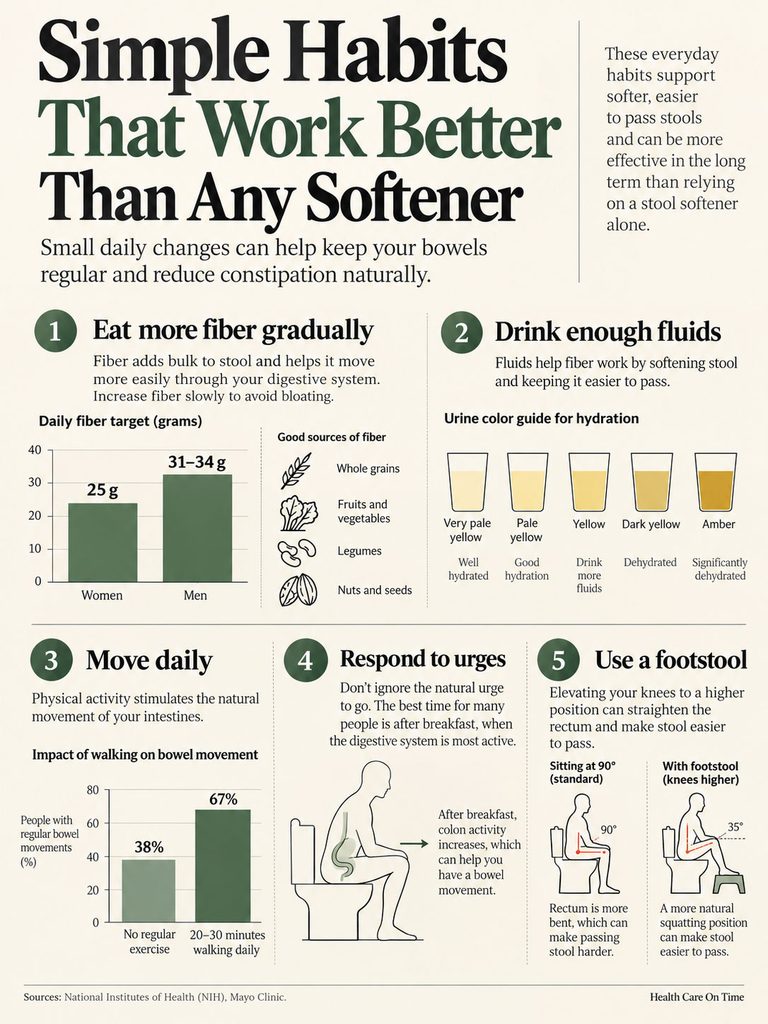
Eat more fiber, slowly. The Dietary Guidelines for Americans suggest about 14 grams of fiber per 1,000 calories. That’s roughly 25 grams for many women and 31 to 34 grams for many men. Increase it over two to three weeks to limit gas.
Good sources include:
- Beans and lentils
- Oatmeal
- Pears and raspberries
- Prunes
- Chia seeds
- Whole-grain bread
Drink enough fluid. Water helps fiber do its job. Pale-yellow urine is a simple sign you’re well hydrated.
Move every day. A 20- to 30-minute walk can get sluggish bowels going.
Don’t ignore the urge. Go when you feel it. Many people find that about 30 minutes after breakfast works best, since the gut naturally wakes up after a meal.
Use a footstool. Raising your knees above your hips straightens the rectum and makes passing stool easier.
Common Colace Mistakes to Avoid
Across patients we serve, the same handful of mistakes come up again and again. Each one can make Colace less useful or delay the care you need.
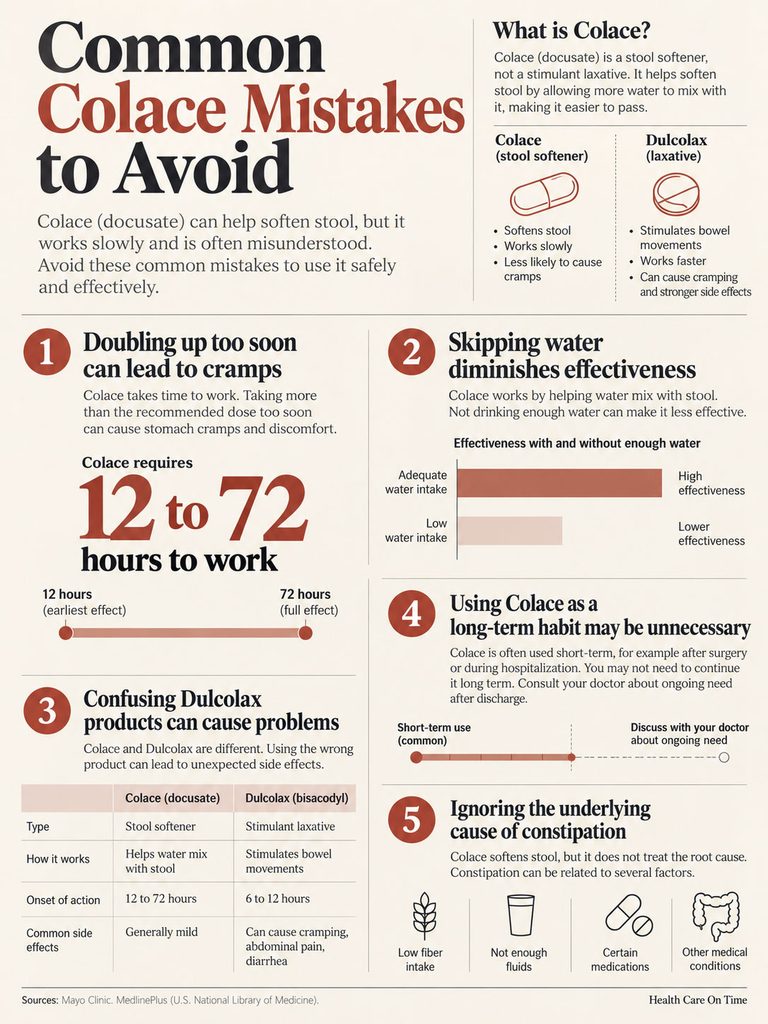
Doubling Up Too Soon
Colace needs 12 to 72 hours. Taking extra capsules after a few hours won’t speed things up, and it raises the odds of cramps and loose stools later.
Skipping the Water
A softener can only work with the water it has. Taking capsules with a sip of coffee, then drinking little the rest of the day, leaves stool just as hard as before.
Confusing the Dulcolax Products
“Dulcolax Stool Softener” is docusate. “Dulcolax Laxative” tablets are bisacodyl, a stimulant that works in 6 to 12 hours. Grabbing the wrong box can mean surprise cramps or no relief at all.
Using It as a Long-Term Habit
Some people keep taking Colace for months simply because a hospital started it. If you’re still on it weeks after discharge, ask your doctor whether you still need it. Hospital research shows this is one of the most common missed chances to stop a medicine.
Ignoring the Cause
Constipation often has a reason: low fiber, too little fluid, iron pills, opioids, an underactive thyroid, or a change in routine. Treating the cause usually works better than any softener.
Questions to Ask Your Doctor or Pharmacist
A short conversation can save you days of discomfort. Patients commonly ask us what to say, so here’s a simple list to bring to your next visit or pharmacy counter:
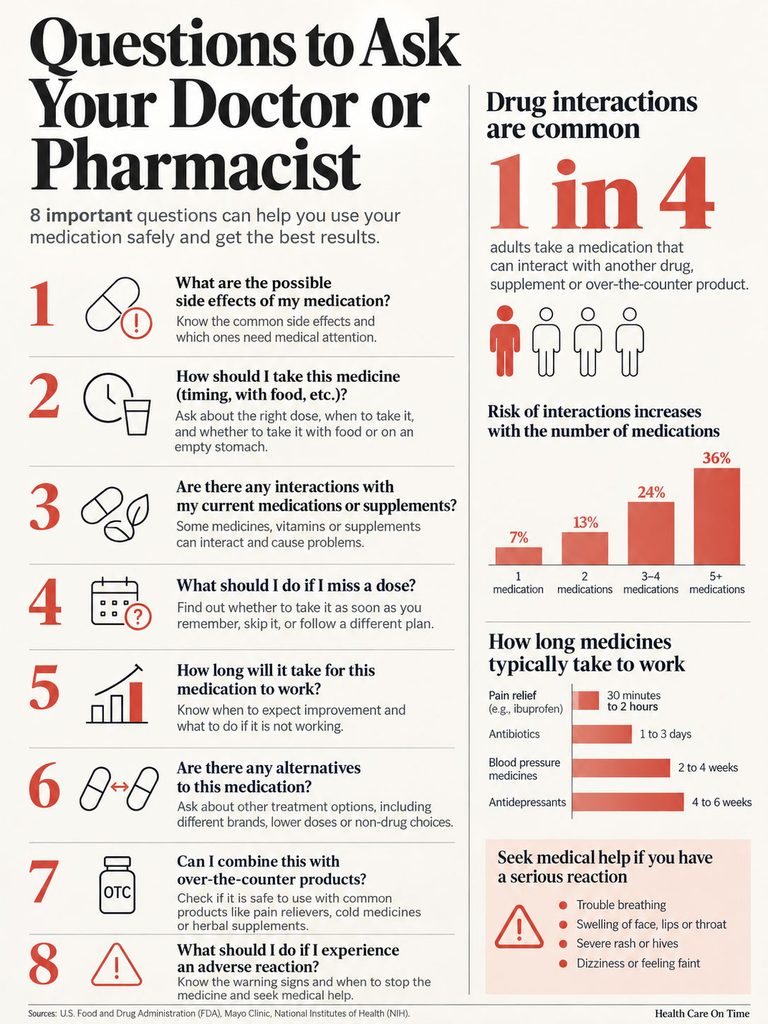
- Is Colace the best choice for this type of constipation, or would MiraLAX, psyllium, or senna work better?
- Could any current medicines be causing the problem?
- How many days should it take to work before calling the office?
- Is it safe with a heart, kidney, or blood pressure condition?
- Is it safe during pregnancy or breastfeeding?
- Which symptoms mean stopping it and coming in right away?
- Once things improve, when is it safe to stop taking it?
Pharmacists can answer most of these on the spot, at no cost, and they can check every medicine you take for interactions. Bring a written list of your prescriptions, vitamins, and supplements so nothing gets missed. If you see more than one doctor, a single pharmacy that fills everything makes these checks far more reliable.
Frequently Asked Questions
Does Colace actually work?
For many people, not very well. Several clinical trials and a Canadian evidence review found docusate worked about as well as a placebo for stool frequency and softness. Some people still report relief. If Colace isn’t helping, MiraLAX, psyllium, or senna have much stronger research behind them.
How long does Colace take to work?
Colace usually produces a softer bowel movement within 12 to 72 hours. It acts slowly because it only changes stool texture and doesn’t make the bowels contract. Plenty of water and light activity can help. If nothing happens after 3 days, ask a pharmacist about a different option.
Can you take Colace every day?
OTC labels advise against using it longer than one week without a doctor’s advice. Your doctor may approve daily use during opioid therapy or after surgery. Ongoing self-treatment can hide a problem that needs medical care, so check in with a doctor if constipation keeps returning.
Is Colace a laxative?
Colace is technically an emollient laxative, but it’s better described as a stool softener. Unlike stimulant laxatives such as senna or bisacodyl, it doesn’t make your intestines contract. It’s meant only to help water and fat mix into stool, which is why it works slowly and gently.
Can you take Colace and MiraLAX together?
Many doctors consider the combination fine, and some hospital bowel plans use it. Since MiraLAX has much stronger evidence, adding Colace may not bring extra benefit. Ask your pharmacist or doctor before combining laxatives, especially if you take other medicines or have kidney or heart concerns.
Is Colace safe during pregnancy?
Docusate is barely absorbed into the bloodstream, so many OB-GYNs view it as a lower-risk choice in pregnancy. Fiber, fluids, and polyethylene glycol are also common picks. Always check with your OB-GYN first, and mention prenatal vitamins with iron, since they often cause constipation.
Can Colace cause diarrhea?
Yes, though it’s uncommon at normal doses. Loose stools are more likely if you take more than the label allows or combine Colace with other laxatives. If diarrhea starts, stop taking it and drink extra fluids. Call a doctor if it lasts more than two days or you feel dizzy.
Should you take Colace at night or in the morning?
Timing matters less than with stimulant laxatives, because Colace takes 12 to 72 hours to work. Many people take it at bedtime with a full glass of water. If you split your daily dose, take it at the same times each day so it becomes a habit.
Why do hospitals give Colace after surgery?
Surgery, anesthesia, opioid pain medicine, and bed rest all slow the bowels. Hospitals have long used docusate to reduce straining, especially after heart or abdominal surgery. Many US hospitals now replace it with senna or polyethylene glycol because those options have stronger evidence behind them.
Is Colace safe for kids?
Children under 2 should never take docusate without a doctor’s direction. Labels list smaller doses for older kids, but pediatricians usually start with diet, fluids, and bathroom routines. Childhood constipation can signal other problems, so see your child’s doctor before using any laxative.
Can you take Colace with opioid pain medicine?
You can, but docusate alone usually isn’t enough. Opioids slow the muscles that move stool, and a softener doesn’t fix that. Doctors more often recommend senna or polyethylene glycol for opioid-related constipation, sometimes with docusate added. Ask your prescriber which bowel plan fits you best.
What should you do if Colace isn’t working?
Don’t keep raising the dose. After 3 days without relief, ask a pharmacist about MiraLAX, psyllium, or senna, and boost your fiber, water, and activity. If constipation lasts over 2 weeks or comes with bleeding, severe pain, or weight loss, see a doctor promptly.
Disclaimer: This article is for general information only and is not medical advice. It does not replace a visit with a licensed healthcare provider. Always read and follow product labels, and talk to your doctor or pharmacist before starting, stopping, or combining any medicine, especially if you’re pregnant, breastfeeding, giving medicine to a child, or managing a chronic condition.
References
- NIDDK: Definition and Facts for Constipation
- MedlinePlus: Docusate
- DailyMed: FDA Drug Labels
- Memorial Sloan Kettering Cancer Center: Docusate Patient Information
- CADTH: Docusate for the Prevention or Management of Constipation
- Journal of Hospital Medicine: Things We Do for No Reason, Prescribing Docusate
- American Journal of Medicine: Missed Opportunity to Deprescribe Docusate
- Quality Management in Health Care: Reducing Docusate Use at Mayo Clinic Florida
- Society of Hospital Medicine: Cancel Colace Quality Improvement Study
- JAMA Internal Medicine Research Letter on Laxative Use (Healio summary)
- AGA and ACG: Chronic Idiopathic Constipation Guideline
- US Preventive Services Task Force: Colorectal Cancer Screening
- Dietary Guidelines for Americans