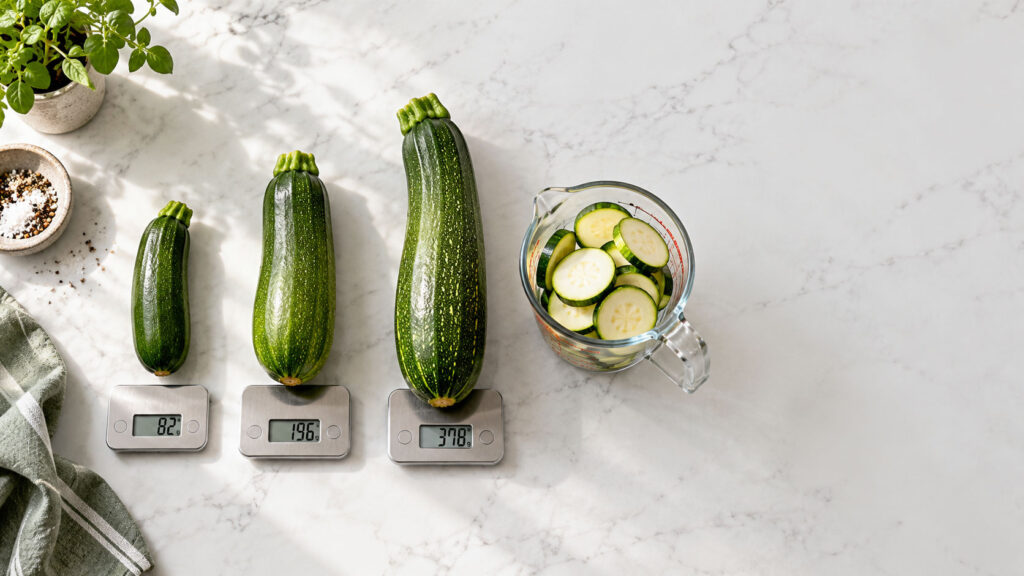
Search “calories in zucchini” and page one gives you 17, 19, 27, 33, or even “30 to 40 per cup.” That’s five answers to one simple question.
Table of Contents
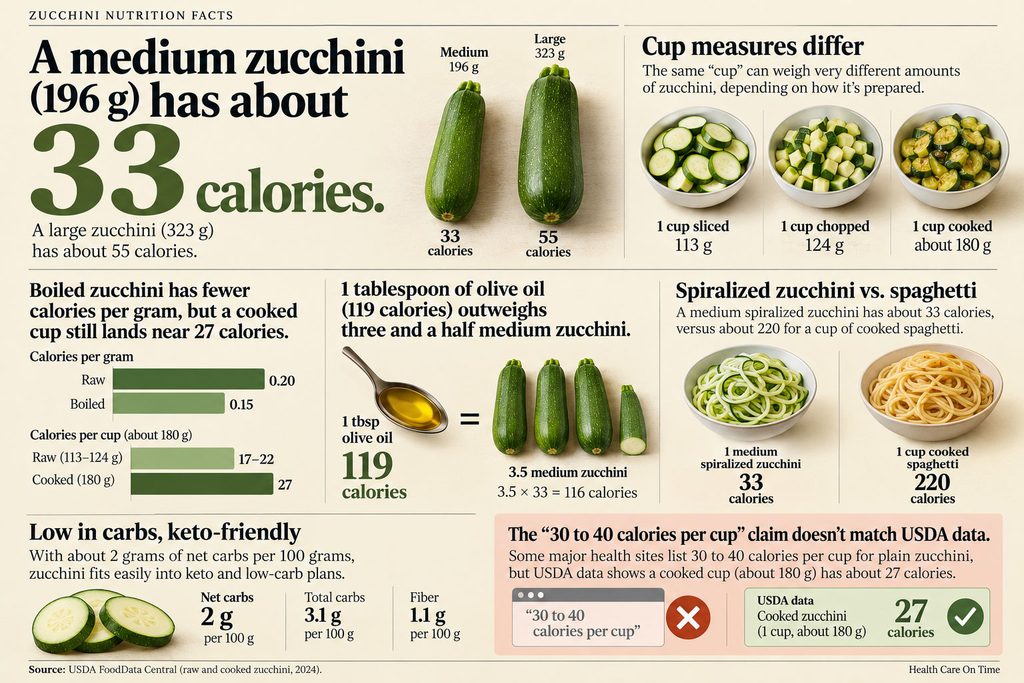
Most of those numbers are correct for something. The trouble is that few sites tell you which zucchini, which cup, or which USDA record they used. This guide fixes that, with gram weights for every figure.
Quick Answer: A medium raw zucchini (196 grams, about 7 ounces) has about 33 calories, based on USDA FoodData Central. One cup of sliced raw zucchini has about 19 calories, and one cup of cooked zucchini has about 27. Raw zucchini contains 17 calories per 100 grams, 6 grams of carbs per medium squash, and about 4 grams of net carbs. Cooking oil, not the squash, drives most of the calories in a zucchini dish.
At a Glance
- A medium zucchini (196 g) has about 33 calories; a large one (323 g) has about 55.
- Cup measures differ: a sliced cup weighs 113 g, a chopped cup 124 g, and a cooked cup about 180 g.
- Boiled zucchini has fewer calories per gram than raw, but a cooked cup packs more squash, so it lands near 27 calories.
- One tablespoon of olive oil (119 calories) outweighs three and a half medium zucchini.
- A medium spiralized zucchini has about 33 calories, versus about 220 for a cup of cooked spaghetti.
- With about 2 grams of net carbs per 100 grams, zucchini fits easily into keto and low-carb plans.
- The “30 to 40 calories per cup” figure on some major health sites doesn’t match USDA data for plain zucchini.
How Many Calories Are in Zucchini? The USDA Numbers
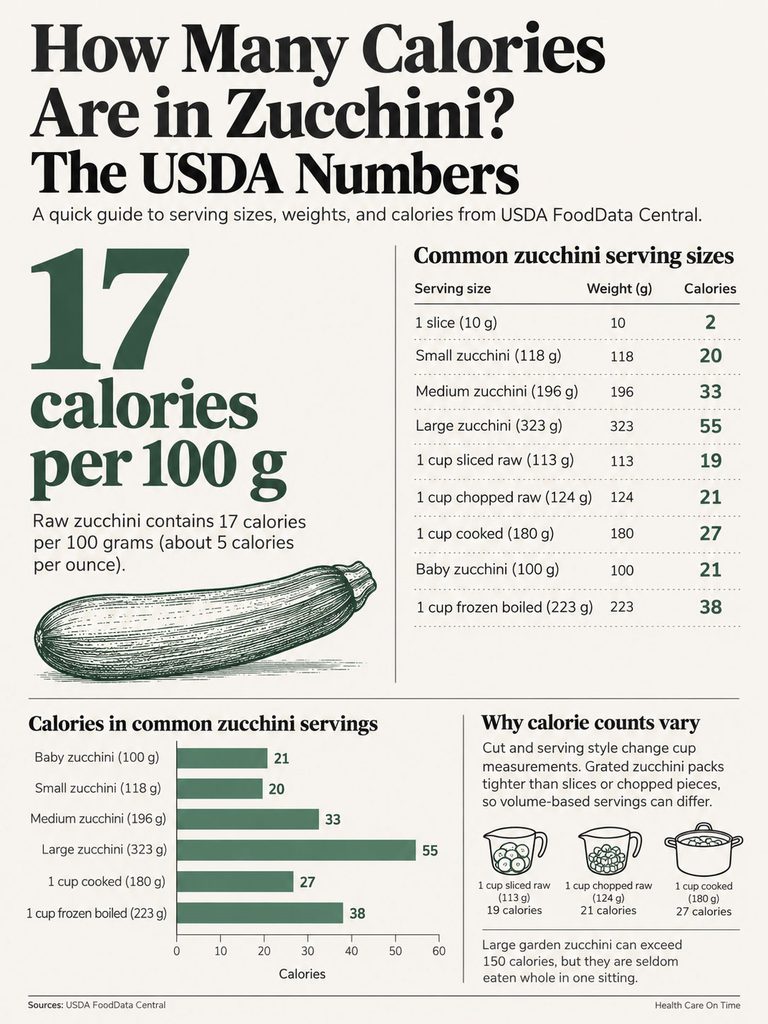
Raw zucchini with the skin on contains 17 calories per 100 grams, according to USDA FoodData Central (FDC 169291). That’s about 5 calories per ounce.
Our nutrition reviewers checked every serving below against the USDA record and its official gram weights. When you see a different number elsewhere, the serving weight is almost always the reason.
Calories by Size: Small, Medium, Large, and Baby
Zucchini size varies a lot from store to garden. Here is zucchini calories by size, using USDA standard weights:
- Small zucchini (118 g, about 4 oz): about 20 calories
- Medium zucchini (196 g, about 7 oz): about 33 calories
- Large zucchini (323 g, about 11.4 oz): about 55 calories
- Baby zucchini (100 g, about 3.5 oz): about 21 calories
Baby zucchini has its own USDA record, at 21 calories and 2.7 grams of protein per 100 grams. Young squash holds slightly less water and a higher share of solids, which nudges both numbers up.
Garden zucchini that grow past a foot long can easily top 2 pounds. At that size, a single squash can hit 150 calories or more, though few people eat one in a sitting.
Per Cup: Sliced vs Chopped vs Cooked
A cup is a volume, not a weight. How you cut zucchini changes how much fits in the cup.
- 1 cup sliced, raw (113 g): about 19 calories
- 1 cup chopped, raw (124 g): about 21 calories
- 1 cup cooked, sliced (about 180 g): about 27 calories
Grated zucchini packs even tighter, often 130 grams or more per cup once pressed down. If you’re baking, weigh it instead of scooping.
Per 100 Grams and Per Ounce
For anyone using a tracking app or a kitchen scale, these are the cleanest numbers:
- Per 100 grams, raw: 17 calories
- Per ounce, raw: about 5 calories
- Per 100 grams, boiled and drained: 15 calories (FDC 169292)
The table below pulls every common serving into one place.
| Serving | Weight | Calories | Total Carbs | Fiber | Net Carbs |
| 1 slice, raw | 10 g (0.35 oz) | 2 | 0.3 g | 0.1 g | 0.2 g |
| Small, raw | 118 g (4.2 oz) | 20 | 3.7 g | 1.2 g | 2.5 g |
| Medium, raw | 196 g (6.9 oz) | 33 | 6.1 g | 2.0 g | 4.1 g |
| Large, raw | 323 g (11.4 oz) | 55 | 10.0 g | 3.2 g | 6.8 g |
| 1 cup sliced, raw | 113 g (4.0 oz) | 19 | 3.5 g | 1.1 g | 2.4 g |
| 1 cup chopped, raw | 124 g (4.4 oz) | 21 | 3.9 g | 1.2 g | 2.7 g |
| 1 cup cooked, boiled | 180 g (6.3 oz) | 27 | 4.8 g | 1.8 g | 3.0 g |
| Baby zucchini, raw | 100 g (3.5 oz) | 21 | 3.1 g | 0.5 g | 2.6 g |
| 1 cup frozen, boiled | about 223 g (7.9 oz) | 38 | 7.9 g | 2.9 g | 5.0 g |
Values calculated from USDA FoodData Central SR Legacy records for raw (169291), boiled (169292), baby (168565), and frozen boiled zucchini. Net carbs = total carbs minus fiber.
Why Every Website Shows a Different Zucchini Calorie Number
Patients often ask us why their app says one thing and a health site says another. With zucchini, three things cause almost all of the confusion.
Two USDA Energy Values (16 vs 17 per 100 Grams)
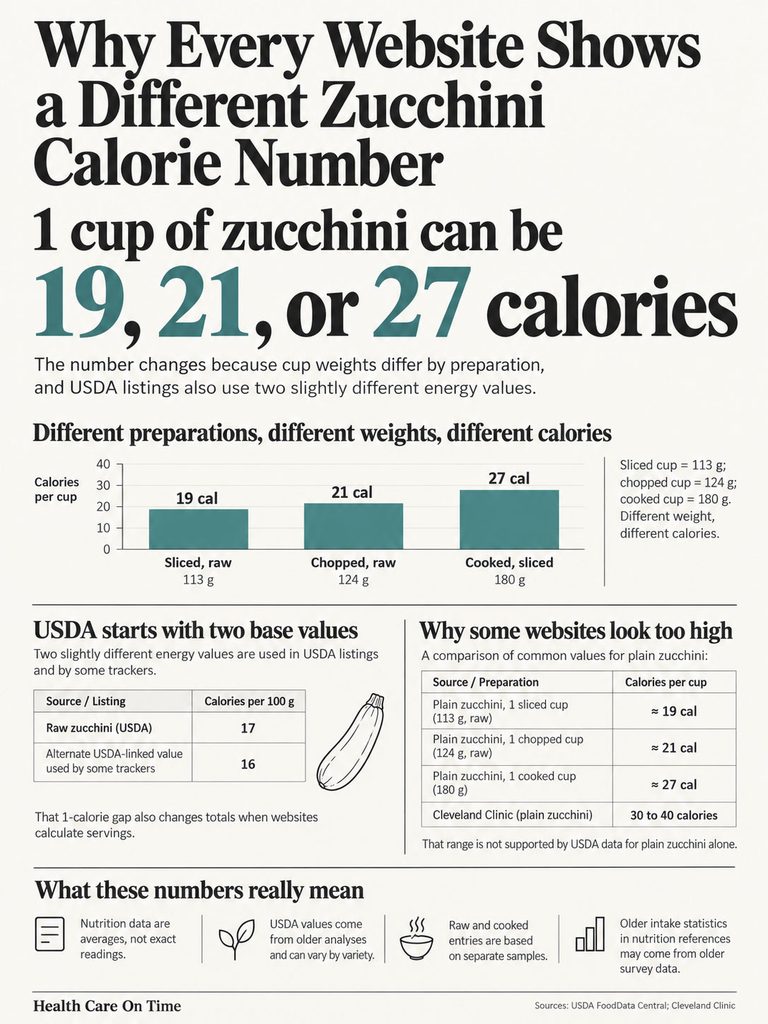
USDA data for raw zucchini appears in more than one form. The SR Legacy record lists 17 calories per 100 grams. Some exports of the same data, used by hospital nutrition libraries and apps, work out to 16.
That one-calorie gap sounds tiny. Multiply it across a 196-gram squash, though, and you get about 31 calories on one site and about 33 on another. Both trace back to USDA.
The Cup-Weight Trap
A cup of sliced zucchini weighs 113 grams. A cup of chopped zucchini weighs 124 grams. A cup of cooked zucchini weighs about 180 grams, because heat softens the squash and it settles into the cup.
That’s why “one cup of zucchini” can mean 19, 21, or 27 calories. None of those numbers is wrong. They just describe different cups.
Where the “30 to 40 Calories per Cup” Figure Goes Wrong
Cleveland Clinic’s zucchini page lists a medium zucchini at 33 calories, which matches USDA. The same page also says a 1-cup serving has about 30 to 40 calories.
For plain zucchini, USDA data doesn’t support that per-cup range. Raw cups land at 19 to 21 calories and a cooked cup at about 27. A figure in the 30s only fits frozen zucchini or a cup prepared with some added fat.
| Number You’ll See | What It Actually Describes | Source Type |
| 16 per 100 g | Alternate USDA energy value for raw | Hospital nutrition libraries |
| 17 per 100 g | USDA SR Legacy raw record (169291) | USDA, most databases |
| 19 per cup | 1 cup sliced raw (113 g) | USDA gram weight |
| 21 per cup | 1 cup chopped raw (124 g) | USDA gram weight |
| 27 per cup | 1 cup boiled (about 180 g) | Healthline, USDA |
| 31 vs 33 per medium | Same 196 g squash at 16 vs 17 per 100 g | FatSecret vs most others |
| 30 to 40 per cup | Not a plain-zucchini USDA value | Cleveland Clinic |
| 55 per squash | 1 large raw zucchini (323 g) | WebMD, USDA |
Compiled by HealthCareOnTime’s nutrition team from USDA FoodData Central and the published pages named above.
What These Numbers Can and Can’t Tell You
Every figure in this guide comes from USDA, but USDA data has limits worth knowing.
First, the SR Legacy zucchini records are older lab analyses. They aren’t retested each season, and real zucchini varies by variety, soil, and how long it sat after picking.
Second, the raw and cooked entries come from separate samples. They are not a before-and-after test of the same squash.
Third, a few US intake statistics in this article rest on survey data that is several years old. Our reviewers treat all of these as reliable averages, not exact readings for the squash on your counter.
Full Zucchini Nutrition Facts (Beyond Calories)
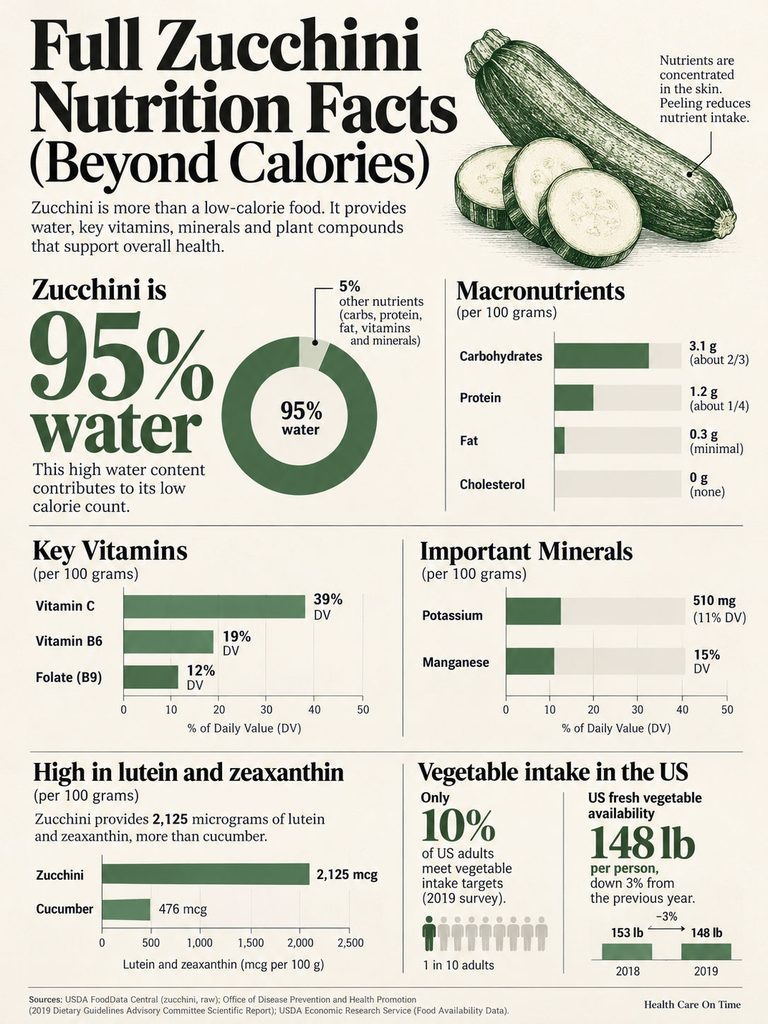
Zucchini is about 95% water by weight (94.79 grams per 100). That water explains the low calorie count. The rest of the squash still carries a useful set of nutrients.
Macros: Carbs, Fiber, Protein, Fat
Per 100 grams of raw zucchini, USDA lists:
- Carbohydrates: 3.11 g
- Fiber: 1.0 g
- Sugars: 2.5 g (naturally occurring)
- Protein: 1.21 g
- Fat: 0.32 g
About two-thirds of zucchini’s calories come from carbohydrate, roughly a quarter from protein, and the rest from fat. There’s no cholesterol and almost no sodium (8 mg per 100 grams).
Vitamins: C, B6, Folate, A, and K
Vitamin C is the standout. A medium zucchini delivers about 35 mg, or about 39% of the FDA Daily Value of 90 mg.
The same medium zucchini also provides about 19% of the Daily Value for vitamin B6 and about 12% for folate. Vitamin A is modest in raw zucchini, and vitamin K is low at about 8 mcg per medium squash.
Minerals: Potassium, Manganese, Magnesium
A medium zucchini supplies about 510 mg of potassium, roughly 11% of the 4,700 mg Daily Value. Most Americans fall short on potassium, so small wins like this add up.
Manganese comes in around 15% of the Daily Value per medium zucchini. Magnesium and phosphorus show up in smaller amounts.
Lutein and Zeaxanthin: Zucchini’s Quiet Strength
Zucchini is surprisingly rich in lutein and zeaxanthin, the two carotenoids that collect in the retina. USDA lists 2,125 mcg per 100 grams of raw zucchini, or about 2,400 mcg in a sliced cup.
That’s far more than cucumber, at just 23 mcg per 100 grams. It doesn’t put zucchini in spinach or kale territory, but it beats most “watery” vegetables by a wide margin.
Why You Should Keep the Skin On
USDA’s main zucchini record is for zucchini with the skin. Much of the color, carotenoids, and fiber sit in or near the green peel.
Peeling zucchini barely changes calories. It does strip out some of the nutrients that make those calories worth eating.
| Nutrient or Stat | Value | %DV or Context | Source |
| Calories, raw | 17 kcal per 100 g | 33 kcal per medium (196 g) | USDA FDC 169291 |
| Water | 94.79 g per 100 g | About 95% of weight | USDA FDC 169291 |
| Vitamin C | 17.9 mg per 100 g | About 39% DV per medium | USDA FDC; FDA DV 90 mg |
| Potassium | 261 mg per 100 g | About 11% DV per medium | USDA FDC; FDA DV 4,700 mg |
| Lutein + zeaxanthin | 2,125 mcg per 100 g | About 92x cucumber per 100 g | USDA FDC 169291, 168409 |
| Vitamin K | 4.3 mcg per 100 g | About 7% DV per medium | USDA FDC; FDA DV 120 mcg |
| US adults meeting vegetable targets | 10% | Only 1 in 10 adults (2019 survey) | CDC MMWR, BRFSS |
| US fresh vegetable availability | About 148 lb per person (2024) | Down 3% from prior year | USDA ERS |
Raw vs Cooked Zucchini: What Changes
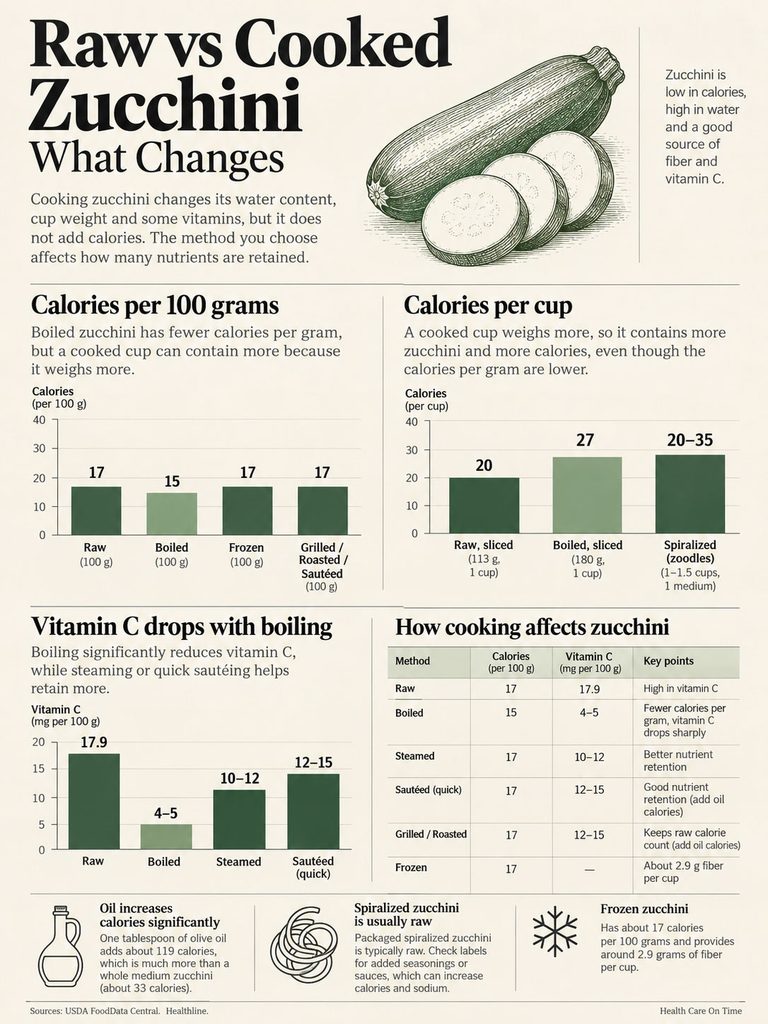
Cooking zucchini doesn’t add calories on its own. It changes water content, cup weight, and a few vitamins.
Boiled: Fewer Calories per Gram, More per Cup
Here’s the paradox that confuses people. Boiled zucchini is listed at 15 calories per 100 grams, slightly less than raw. Yet a cup of boiled zucchini has more calories than a cup of raw slices.
The reason is weight. Boiled slices soften and settle, so a cup holds about 180 grams instead of 113. More squash per cup means about 27 calories instead of 19.
Grilled, Roasted, Sautéed: The Oil Math
Plain grilling, roasting, or air frying keeps zucchini near its raw calorie count, minus a little water loss. The fat is what moves the number.
In meal logs reviewed by our nutrition team, oil is the single most common reason a “light zucchini side” comes in far over its expected count. Here’s how it adds up:
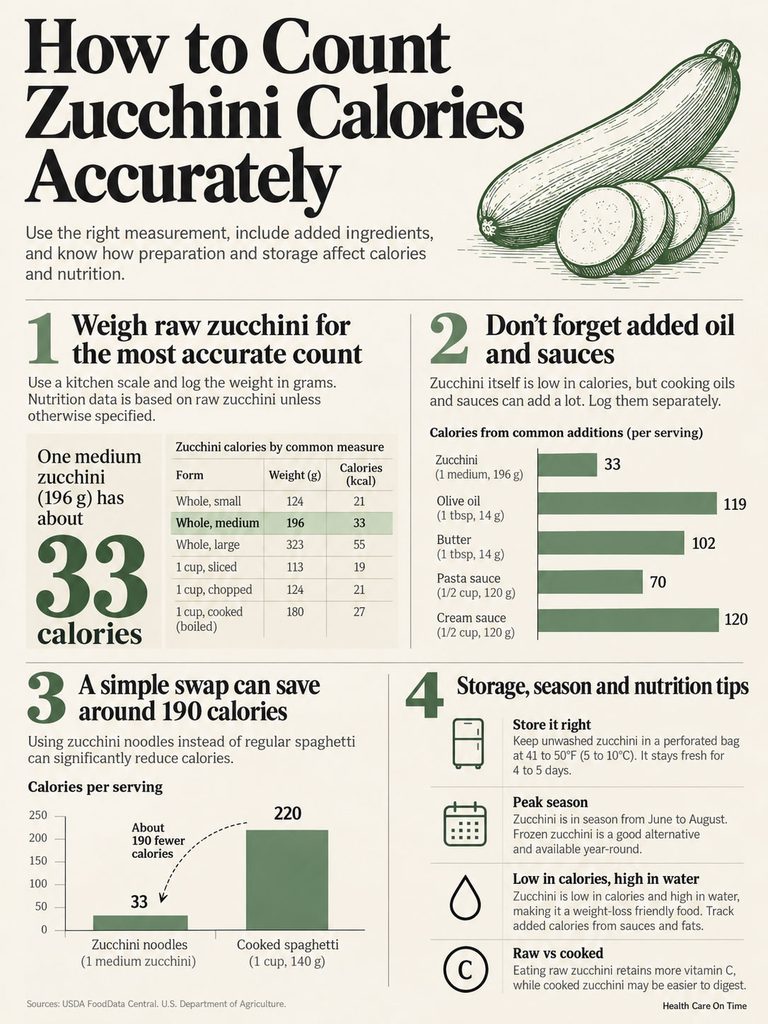
- 1 tablespoon olive oil: about 119 calories
- 1 tablespoon butter: about 102 calories
- 1 medium zucchini, sautéed in 1 tablespoon olive oil: about 152 calories total
In that sauté, roughly 78% of the calories come from the oil. A light coating of oil (about 1 teaspoon, 40 calories) keeps the dish closer to 73 calories.
Vitamin C Losses When You Boil
Vitamin C dissolves in water and breaks down with heat. USDA’s boiled zucchini data shows vitamin C falling from 17.9 mg to roughly 4 to 5 mg per 100 grams, a loss of about three-quarters.
Steaming, quick sautéing, or eating zucchini raw keeps more of it. If you boil zucchini for soup, some of the vitamin C that leaches out stays in the broth.
Frozen and Spiralized Zucchini
Frozen zucchini, cooked and drained, comes in around 17 calories per 100 grams. A cup weighs more than a fresh cooked cup, so it lands near 38 calories with about 2.9 grams of fiber.
Packaged spiralized zucchini (“zoodles”) is just raw zucchini cut differently. Check the label only if it comes seasoned or with a sauce packet.
Zucchini Noodles vs Pasta: The Real Calorie Gap
This is where zucchini earns its reputation. A medium zucchini, spiralized, makes about 1 to 1.5 cups of noodles and has about 33 calories.
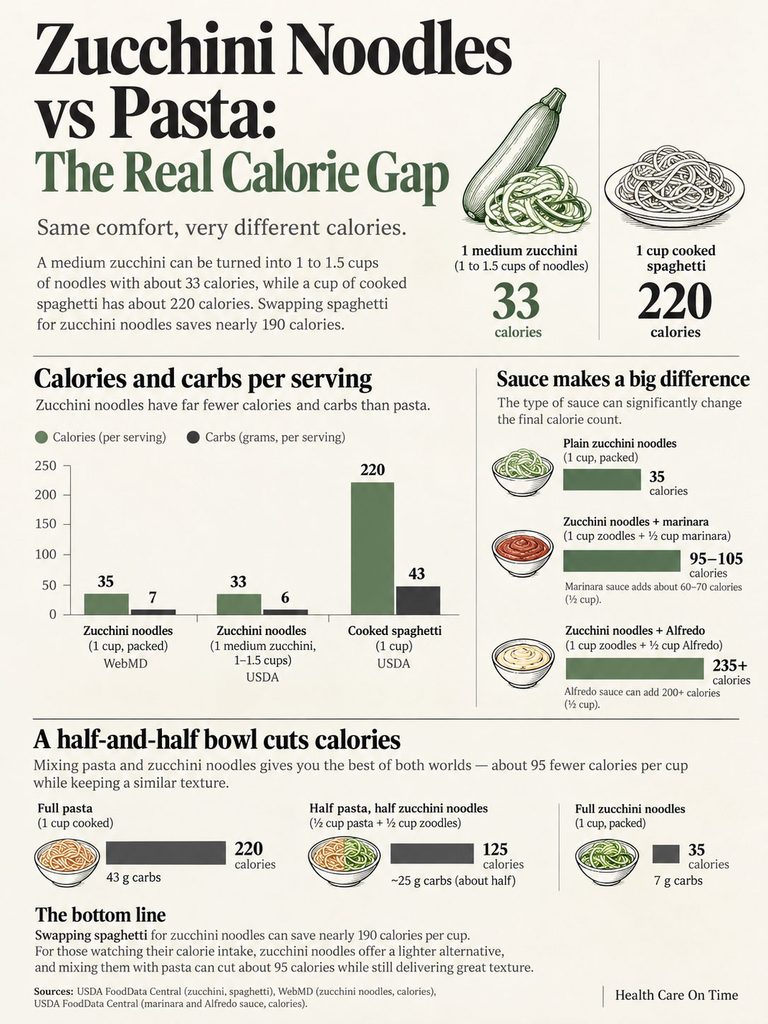
One cup of cooked spaghetti (about 140 grams) has about 220 calories and around 43 grams of carbs, based on USDA data. Swapping one for the other saves close to 190 calories.
WebMD’s figure of about 35 calories per cup of zucchini noodles is in the right range for a packed cup. Our reviewers note that the sauce usually decides the final count. Half a cup of marinara adds roughly 60 to 70 calories; a creamy Alfredo can add 200 or more.
A half-and-half bowl (half pasta, half zoodles) is a popular middle ground. It cuts about 95 calories per cup while keeping the texture many people miss most.
Is Zucchini Good for Weight Loss, Keto, and Diabetes?
Zucchini is a strong fit for all three, mostly because of how much food you get for very few calories.
Energy Density and Volume Eating
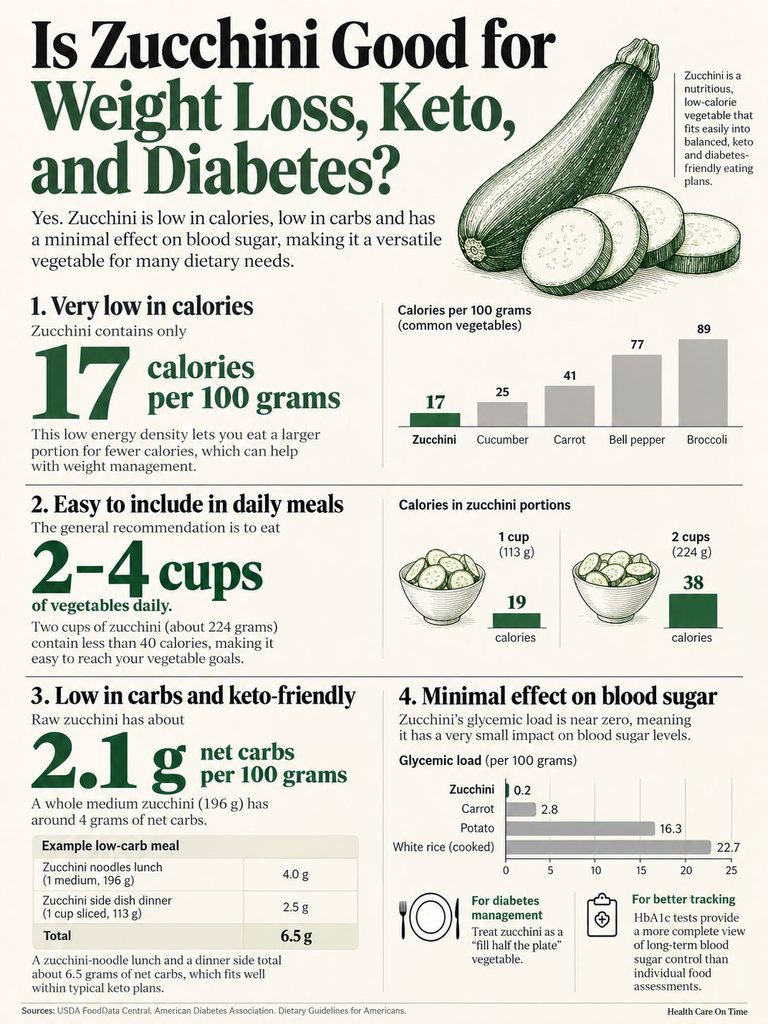
At 17 calories per 100 grams, zucchini has one of the lowest energy densities of any vegetable. Foods like this let you eat a large, filling plate while keeping calories down.
The Dietary Guidelines for Americans recommend that most adults eat 2 to 4 cups of vegetables a day. Zucchini makes that target easy, since a full 2 cups of raw slices costs under 40 calories.
Net Carbs and Keto Fit
Raw zucchini has about 2.1 grams of net carbs per 100 grams. A whole medium squash comes in near 4 grams.
People following keto plans often ask us whether zucchini “counts.” It does, but a typical serving uses only a small slice of a 20 to 50 gram daily carb budget.
Here’s a simple example. A zucchini-noodle lunch (1 medium squash) plus a dinner side of grilled zucchini (1 cup sliced) totals about 6.5 grams of net carbs. That leaves plenty of room under a 20-gram limit.
Blood Sugar: A Glycemic Load Close to Zero
Most glycemic index tables don’t list zucchini. Testing requires a portion with 50 grams of available carbs, which would mean eating over 3 pounds of squash.
What matters more is glycemic load, which looks at a normal serving. A cup of zucchini has so few digestible carbs that its glycemic load sits near zero.
For people managing diabetes, our clinical team suggests treating plain zucchini as a “fill half the plate” vegetable. If you’re tracking blood sugar closely, an HbA1c test shows your three-month average and is a better guide than any single food.
How Zucchini Compares to Other Low-Calorie Vegetables
Zucchini sits near the bottom of the calorie range for common vegetables. Here’s how it compares per 100 grams, raw, using USDA records:
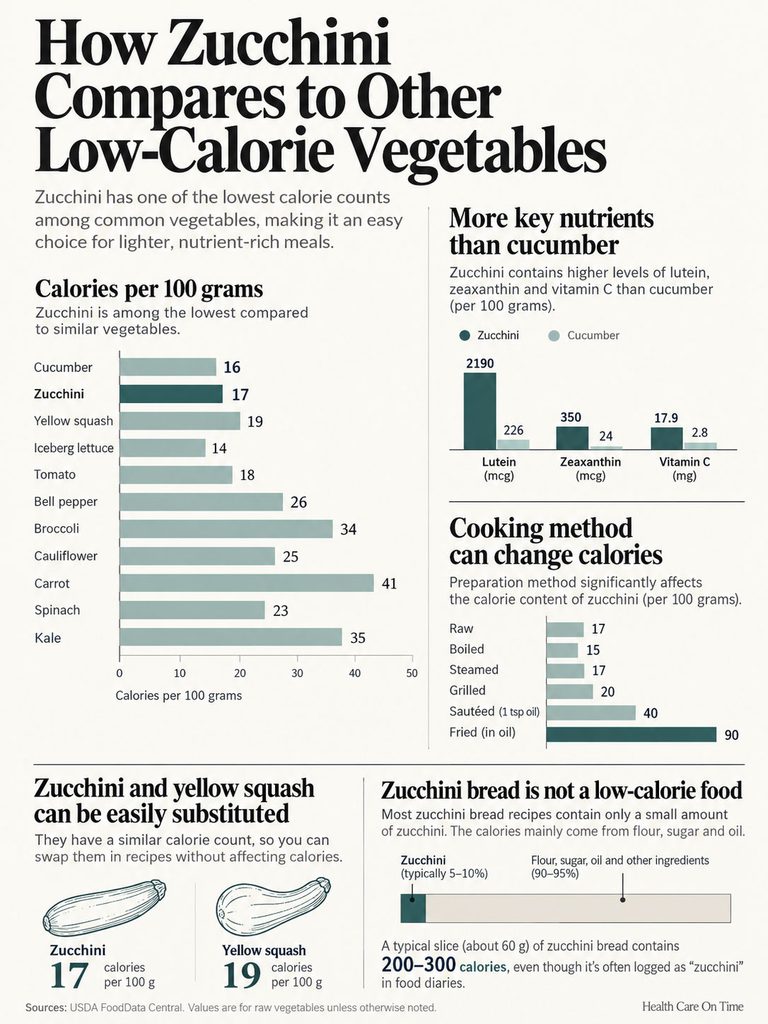
- Cucumber, with peel: 15 calories
- Zucchini: 17 calories
- Yellow summer squash: about 19 calories
- Green bell pepper: 20 calories
- Spinach: 23 calories
- Cauliflower: 25 calories
- Green cabbage: 25 calories
- Red bell pepper: 26 calories
- Kale: 35 calories
- Carrot: 41 calories
Zucchini and cucumber are near twins on calories, but zucchini carries far more lutein, zeaxanthin, and vitamin C. Our Cucumber vs Zucchini comparison covers that matchup in detail.
Zucchini vs Yellow Squash: Close Cousins
Yellow summer squash and zucchini are both varieties of Cucurbita pepo, so their numbers sit close together. Yellow squash runs about 19 calories per 100 grams, a couple of calories above zucchini.
In recipes, you can swap one for the other cup for cup without changing your calorie count in any way you’d notice. Patients who ask us which one to buy usually get a simple answer: pick the firmer, fresher squash, since freshness matters more than color.
The bigger calorie difference comes from how either one is cooked. A breaded, fried squash slice can carry five to ten times the calories of the same slice grilled plain, so the cooking method is the number worth watching.
Zucchini vs Zucchini Bread: Not the Same Food
A slice of zucchini bread usually contains only a few tablespoons of squash. The flour, sugar, and oil supply nearly all of its 150 to 250 or more calories.
Across the food diaries our team reviews, zucchini bread is the item most often logged as “zucchini.” If you bake it, log it as a baked good.
For full breakdowns of other vegetables, see our guides on calories in spinach, cauliflower, kale, cabbage, and bell peppers.
Smart Cautions Before You Eat More Zucchini
Zucchini is safe for nearly everyone. Our medical reviewers flag three situations worth a quick note.
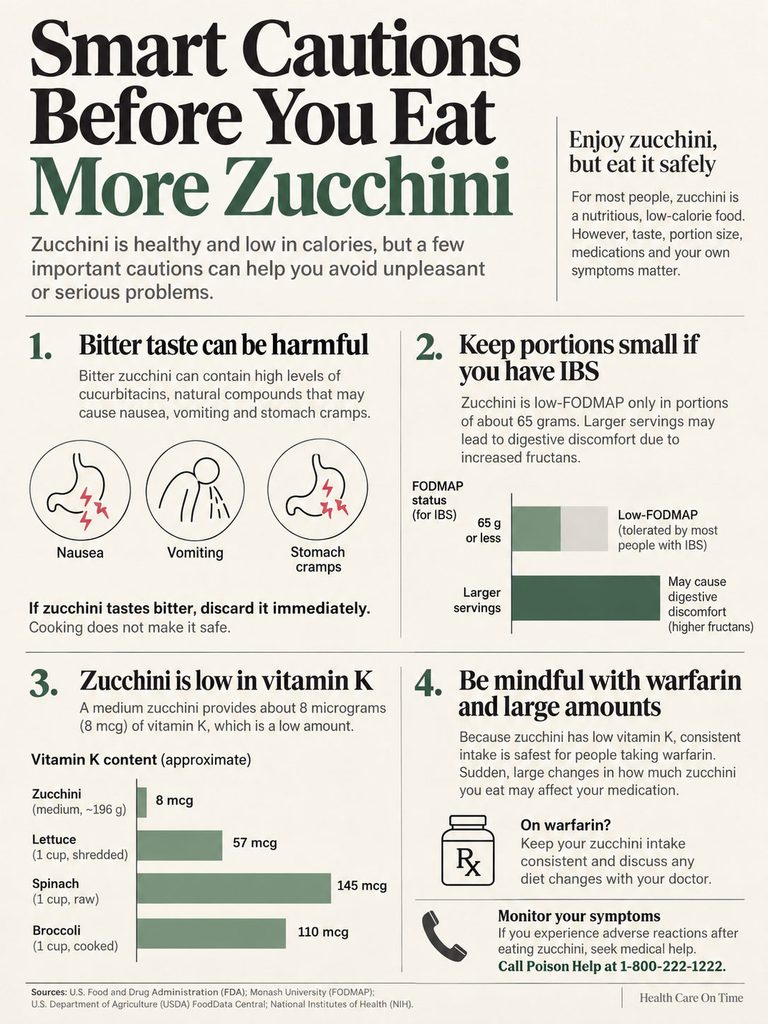
Bitter zucchini. Rarely, zucchini builds up high levels of cucurbitacins, natural compounds that taste very bitter. Eating a bitter squash can cause vomiting, diarrhea, and stomach cramps.
If a bite tastes bitter, spit it out and throw the squash away. Cooking does not make it safe. Call Poison Help at 1-800-222-1222 if symptoms start.
IBS and FODMAPs. Monash University lists zucchini as low-FODMAP at about 65 grams (roughly half a cup). Larger portions contain more fructans and may trigger symptoms in people with IBS. A big bowl of zoodles can be several times that amount.
Warfarin. Zucchini is low in vitamin K, at about 8 mcg per medium squash. It’s unlikely to affect warfarin much, but steady intake is still the safest habit while your INR is being monitored.
How to Count Zucchini Calories Accurately
For most people, zucchini calories barely matter. If you track closely, a few habits keep your numbers honest.
Kitchen Scale vs Cup Measure
A scale removes the cup-weight problem. Weigh raw zucchini in grams, multiply by 0.17, and you have your calories. A 250-gram squash is about 43 calories.
If you use cups, choose the entry that matches your cut: sliced, chopped, or cooked. Picking a generic “1 cup zucchini” entry without checking the weight can be off by 40% or more.
| If You… | Then Do This | Calorie Impact |
| Track zucchini in an app | Log by grams using the USDA raw entry (17 kcal per 100 g) | Avoids 30 to 40% cup errors |
| Sauté with oil | Measure the oil and log it separately | 1 tbsp adds about 119 kcal |
| Swap pasta for zoodles | Use 1 medium zucchini per serving | Saves about 190 kcal per cup of pasta |
| Bake zucchini bread or muffins | Log the baked good, not the squash | Bread runs 150 to 250+ kcal per slice |
| Eat zucchini raw with dip | Count the dip; zucchini is about 19 kcal per cup | 2 tbsp ranch adds about 130 kcal |
| Follow a keto plan | Budget about 4 g net carbs per medium zucchini | Fits easily under a 20 g daily limit |
| Have IBS | Start with about 65 g (half a cup) | Lowers fructan load |
Buying and Storing Zucchini
Look for small to medium zucchini (6 to 8 inches) with glossy, firm skin and no soft spots. Smaller squash tend to be sweeter, with fewer seeds.
Store zucchini unwashed in a perforated bag in the crisper drawer. It keeps best around 41 to 50°F and lasts about 4 to 5 days. Colder spots in the fridge can cause pitting and soft patches.
Zucchini is in peak season across most of the US from June through August, though it’s sold year-round. Frozen zucchini works well in soups, stir-fries, and baking.
Frequently Asked Questions
How many calories are in one medium zucchini?
A medium raw zucchini weighs about 196 grams (7 ounces) and has about 33 calories, based on USDA FoodData Central. Some apps show 31 calories, which comes from an alternate USDA energy value of 16 calories per 100 grams. Either figure is fine for daily tracking.
How many calories are in 1 cup of cooked zucchini?
One cup of boiled, sliced zucchini weighs about 180 grams and has about 27 calories. That’s more than a raw cup because cooked slices pack tighter. If you cook with oil or butter, add those calories separately, since one tablespoon of olive oil adds about 119.
How many calories are in zucchini noodles?
One medium zucchini, spiralized, makes about 1 to 1.5 cups of noodles and contains about 33 calories. A packed cup of zoodles runs about 20 to 35 calories, depending on weight. Compare that with about 220 calories for a cup of cooked spaghetti. Sauce usually adds more than the noodles.
Does cooking zucchini add calories?
No. Cooking without fat doesn’t add calories, and boiled zucchini actually lists slightly fewer calories per 100 grams than raw. Calories rise only when you add oil, butter, cheese, breading, or sauce. A medium zucchini sautéed in 1 tablespoon of oil comes to about 152 calories.
How many carbs are in a zucchini?
A medium raw zucchini has about 6.1 grams of total carbohydrate and 2 grams of fiber, giving about 4.1 grams of net carbs. Per 100 grams, that’s 3.11 grams of carbs and about 2.1 grams net. Most of the carbs come from natural sugars and fiber.
Is zucchini keto friendly?
Yes. With about 2 grams of net carbs per 100 grams, zucchini is one of the most popular keto vegetables. A whole medium zucchini uses only about 4 grams of a typical 20 to 50 gram daily carb limit. Zucchini noodles and boats are common keto swaps for pasta and bread.
Is zucchini good for weight loss?
Zucchini supports weight loss because it is very low in calories and high in water, so it fills your plate without adding much energy. It works best as a swap, such as zoodles instead of pasta. Watch the oil, cheese, and sauces, since those add far more calories than the squash.
How many calories are in sautéed zucchini with olive oil?
It depends almost entirely on the oil. A medium zucchini (33 calories) sautéed in 1 tablespoon of olive oil (119 calories) totals about 152 calories. Using 1 teaspoon of oil instead brings it to about 73 calories. A nonstick pan or oil spray cuts the total further.
Is it better to eat zucchini raw or cooked?
Both are healthy. Raw zucchini keeps more vitamin C, since boiling can cut it by roughly three-quarters. Cooked zucchini is easier to digest for some people and lets you eat a larger amount. Steaming or quick sautéing is a good middle ground for keeping nutrients.
How much protein is in zucchini?
Raw zucchini has about 1.2 grams of protein per 100 grams, or about 2.4 grams in a medium squash. Baby zucchini is slightly higher at 2.7 grams per 100 grams. Zucchini isn’t a meaningful protein source, so pair it with chicken, fish, beans, eggs, or tofu.
Can you eat too much zucchini?
For most people, no. Very large amounts may cause gas or bloating, especially in people with IBS, because of fructans. The one real danger is bitter zucchini. If a zucchini tastes unusually bitter, stop eating it, throw it out, and call Poison Help at 1-800-222-1222 if you feel sick.
Is zucchini a fruit or a vegetable?
Botanically, zucchini is a fruit, because it grows from the flower and contains seeds. In cooking and nutrition, it’s treated as a vegetable. The USDA Dietary Guidelines count zucchini in the “other vegetables” group, so it counts toward your daily vegetable target.
Disclaimer: This article is for general educational purposes and is not a substitute for advice from a doctor or registered dietitian. Nutrition values come from USDA FoodData Central and may vary by variety, size, and growing conditions. If you have diabetes, IBS, kidney disease, or take blood thinners, talk with your healthcare provider before making major diet changes.
References
- USDA FoodData Central: Squash, summer, zucchini, includes skin, raw (FDC 169291)
- USDA FoodData Central: Squash, summer, zucchini, includes skin, cooked, boiled, drained, without salt (FDC 169292)
- USDA FoodData Central: Squash, zucchini, baby, raw (FDC 168565)
- FDA: Daily Value on Nutrition and Supplement Facts Labels
- CDC MMWR: Adults Meeting Fruit and Vegetable Intake Recommendations
- USDA ERS: Food Availability (Per Capita) Data System
- Dietary Guidelines for Americans
- Monash University FODMAP Program
- America’s Poison Centers / Poison Control
- Cleveland Clinic: Is Zucchini Good for You?