
You can give someone the flu a full day before you feel the first chill. By the time you reach for a thermometer, you may have already shared a car, a desk or a kitchen with them.
Table of Contents
That timing matters more than usual. CDC estimates the 2025-2026 season caused at least 32 million illnesses, 390,000 hospitalizations and 24,000 deaths. Knowing exactly when you’re contagious is one of the simplest ways to protect the people you live and work with.
Quick Answer: Most healthy adults are contagious with the flu from about 1 day before symptoms start until 5 to 7 days after. Spread peaks in the first 3 days. Young children often shed virus longer, averaging closer to 8 days, and people with weakened immune systems can stay contagious for weeks. Stay home until you’ve felt better and been fever-free for 24 hours without medicine, then take extra precautions for 5 more days.
At a Glance
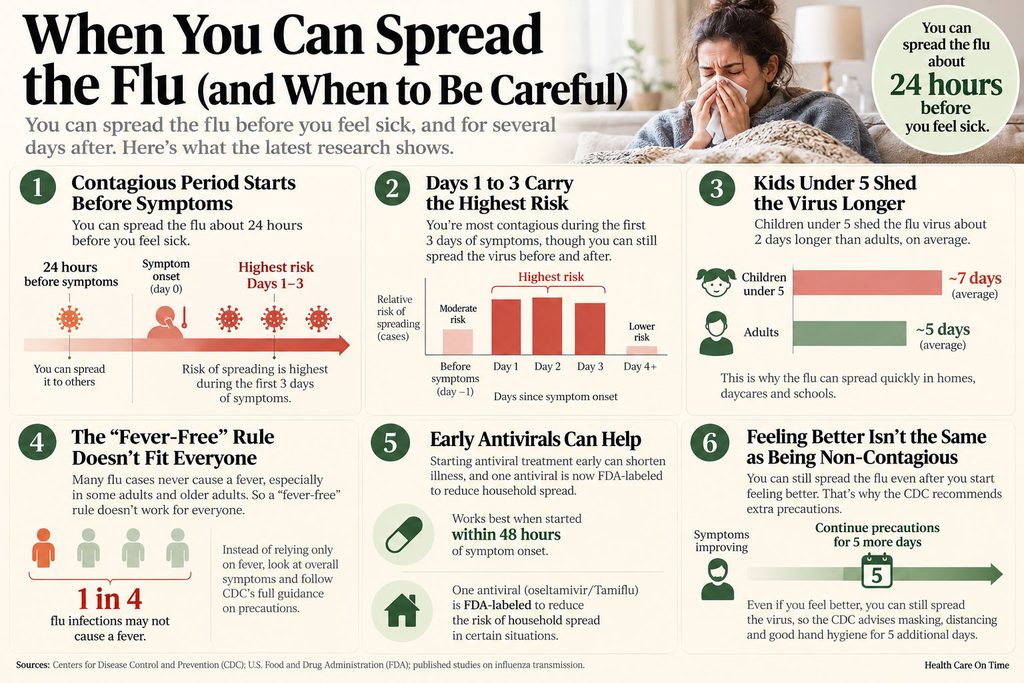
- The flu contagious period starts about 24 hours before you feel sick.
- Days 1 to 3 of symptoms carry the highest risk of spreading it.
- Kids under 5 shed the virus about 2 days longer than adults, on average.
- The “fever-free” rule doesn’t fit everyone, because many flu cases never cause a fever.
- Early antivirals can shorten illness, and one is now FDA-labeled to reduce household spread.
- Feeling better isn’t the same as being non-contagious, which is why CDC adds 5 days of precautions.
The Flu Contagious Timeline, Day by Day
Here’s how a typical flu infection plays out in a healthy adult:
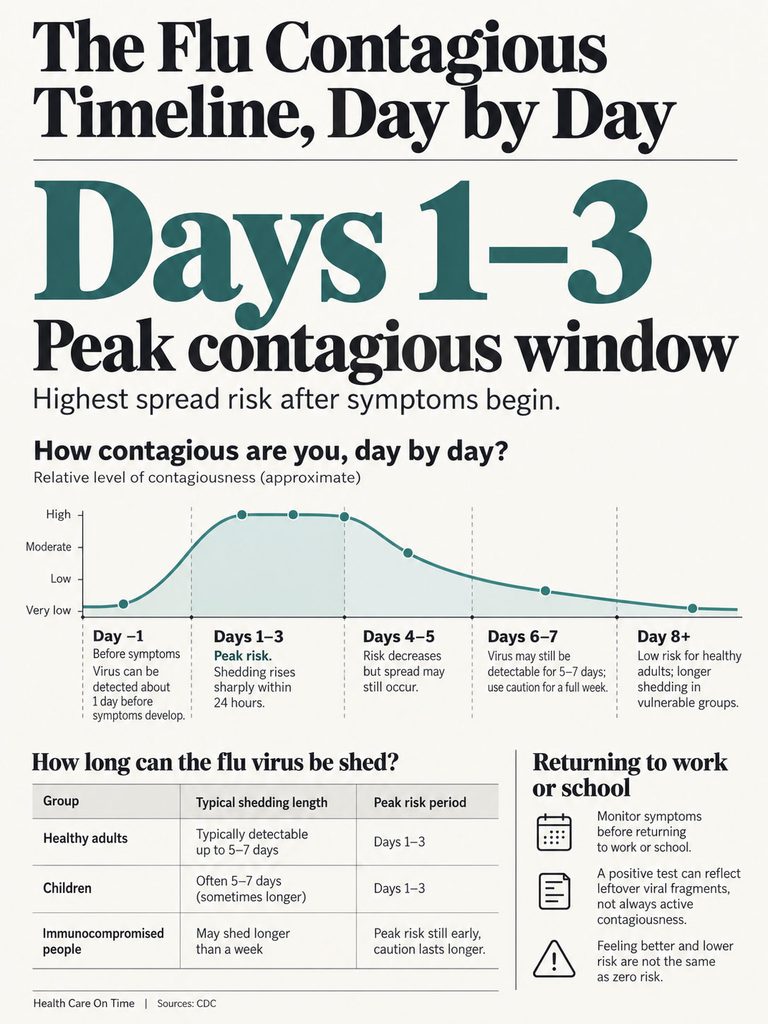
- Exposure to 1 day before symptoms: The virus is multiplying, and you can already spread it.
- Days 1 to 3 of symptoms: Peak contagious window.
- Days 4 to 5: Spread risk drops steadily but isn’t zero.
- Days 6 to 7: Most healthy adults are winding down.
- Day 8 and beyond: Mainly young children and people with weakened immune systems are still shedding.
Before Symptoms: Spreading Without Knowing
Symptoms usually begin about two days after the flu virus infects your airways, though the range runs from one to four days. During that quiet stretch, the virus is already copying itself in your nose and throat.
CDC notes the virus can be detected in most infected people from one day before symptoms develop. That’s why flu sweeps through offices and classrooms so quickly. Nobody knows to stay home yet.
Days 1 to 3: The Peak Contagious Window
This is when you’re most likely to infect others. CDC’s current guidance says people are most contagious during the first three days of illness.
You’ll see “three to four days” on other sites. An archived 2021 version of the same CDC page said the first three to four days, which explains the mismatch across page one. Our medical team treats days 1 through 4 as high risk, to be safe.
Volunteer research backs this up. A review of 56 challenge studies with 1,280 healthy adults found shedding rose sharply within a day of infection and consistently peaked on day 2.
Days 4 to 5: Dropping, but Still Present
After day 3 or 4, the amount of virus you shed falls quickly. In those challenge studies, shedding lasted an average of 4.80 days.
If you feel well enough to work by day 4, this is the stretch where the CDC rule matters most. Check whether you’ve truly been fever-free for 24 hours without medicine before going back.
Days 6 to 7: The Tail End for Most Adults
An average of 4.8 days hides plenty of people who shed longer. CDC says the virus can be detected for up to five to seven days after becoming sick. That’s why a full week is the safer planning window.
Day 8 and Beyond: Who Is Still Shedding
For healthy adults, day 8 usually means very low risk. For toddlers, adults with obesity and anyone with a weakened immune system, the clock runs longer. Each group gets its own section below.
Why a Positive Test Doesn’t Always Mean You’re Contagious
Patients booking flu tests with us often ask why they still test positive after they feel fine. PCR tests detect viral genetic material, not necessarily live virus.
A Hong Kong study of natural flu found that live, culturable virus disappeared earlier after illness onset than the viral RNA picked up by PCR. A late positive PCR often reflects leftover fragments rather than a high risk of spread.
| Group | When Spread Can Start | Typical Shedding Length | Peak Risk | What It Means for You |
| Healthy adults (18 to 64) | About 1 day before symptoms | 5 to 7 days after onset; average about 5.5 days | Days 1 to 3 | Plan on a full week of caution |
| Children 0 to 4 | Often earlier than adults | Average about 7.7 days; can exceed 10 | Days 1 to 4 | Expect at least a week out of daycare |
| Children 5 to 17 | About 1 day before symptoms | Average about 7.2 days | Days 1 to 3 | School return depends on fever and symptoms |
| Adults with obesity (flu A) | About 1 day before symptoms | About 5.2 days vs 3.7 days without obesity | Days 1 to 3 | Add 1 to 2 days of caution |
| Older adults (65+) | About 1 day before symptoms | Not well studied; plan for 7+ days | Days 1 to 3 | Protect others and watch for complications |
| Weakened immune systems | About 1 day before symptoms | Weeks to months in some cases | Variable | Ask a doctor before ending precautions |
Why Kids Stay Contagious Longer
Children are the flu’s most efficient carriers. They pick it up at school, bring it home and keep shedding it after adults would have stopped.
What Household Studies Show
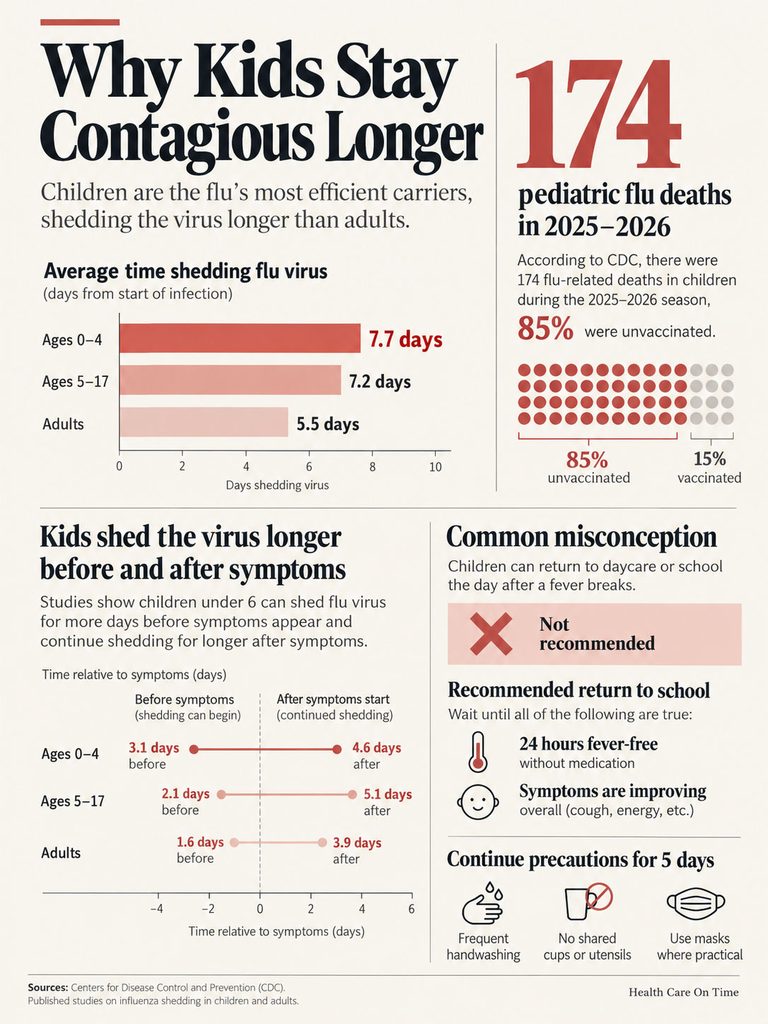
In a University of Michigan-led cohort, children up to age 4 shed influenza 40% longer than adults, and kids aged 5 to 17 shed it 30% longer. Average shedding was 7.7 days for ages 0 to 4, 7.2 days for ages 5 to 17 and 5.5 days for adults.
A separate household study in Nicaragua found the same pattern at both ends. Children under 6 shed the virus longer before symptoms appeared, and the youngest children also shed longest after illness began.
Newer work holds up even after accounting for prior immunity. A three-season household study found children under 5 shed viral RNA 3 to 5 days longer than older adults after adjusting for pre-season antibody levels.
Daycare and School: What Parents Should Do
Across the families we serve, the most common mistake is sending a child back the morning after a fever breaks. A child who was at 102°F last night isn’t ready, even if they’re bouncing off the walls today.
Use the same rule adults follow: 24 hours fever-free without Tylenol or Motrin, plus symptoms clearly improving. For the next 5 days, keep up handwashing, no shared cups and a mask where practical. Many daycares have stricter written policies, so check yours.
This matters because flu can be deadly for kids. CDC counted 174 pediatric flu deaths in the 2025-2026 season, and about 85% of eligible children who died weren’t fully vaccinated.
Who Else Stays Contagious Longer
Weakened Immune Systems
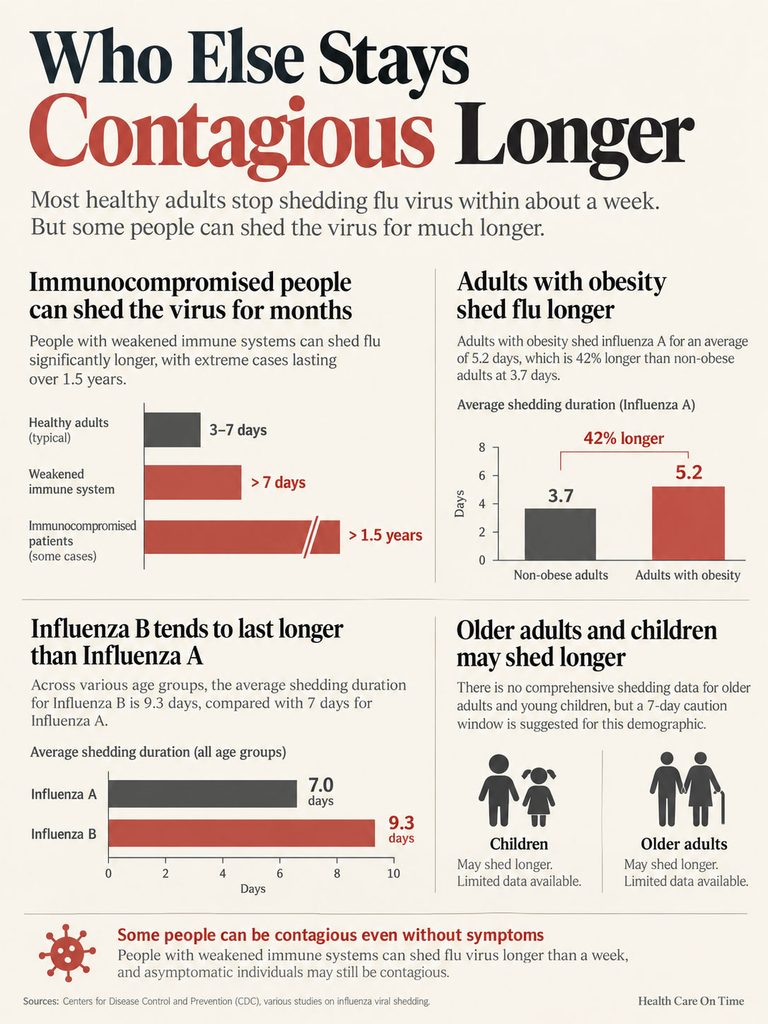
People on chemotherapy, organ or stem cell transplant recipients, and anyone on strong immune-suppressing drugs can shed flu far longer than a week. In one comparison study, severely immunocompromised patients had longer viral shedding and more antiviral resistance, yet showed fewer obvious symptoms.
That last point is the danger. Someone can look well and still be contagious. In one extreme case, an immunocompromised child shed influenza A from the airways for more than 1.5 years. Cases like that are rare, but they show why a fixed number of days doesn’t work for this group.
Adults With Obesity
This risk factor rarely shows up in flu articles. In adults with two or more flu A symptoms, those with obesity shed the virus for 5.2 days versus 3.7 days for those without obesity, about 42% longer.
The study was run in Nicaragua, so US data would strengthen it. Still, adding a day or two of caution is a low-cost step.
Influenza B vs Influenza A
Influenza B tends to linger. In the Michigan cohort, influenza B shedding averaged 9.3, 8.8 and 6.4 days across the three age groups, versus 7, 6.4 and 5.1 days for influenza A.
Older Adults
There’s an honest data gap here. The major challenge-study review notes that no such data exist for children or elderly volunteers. Until better evidence arrives, a 7-day caution window plus close watch for complications is the sensible default.
When Can You Go Back to Work or School? The CDC Rule
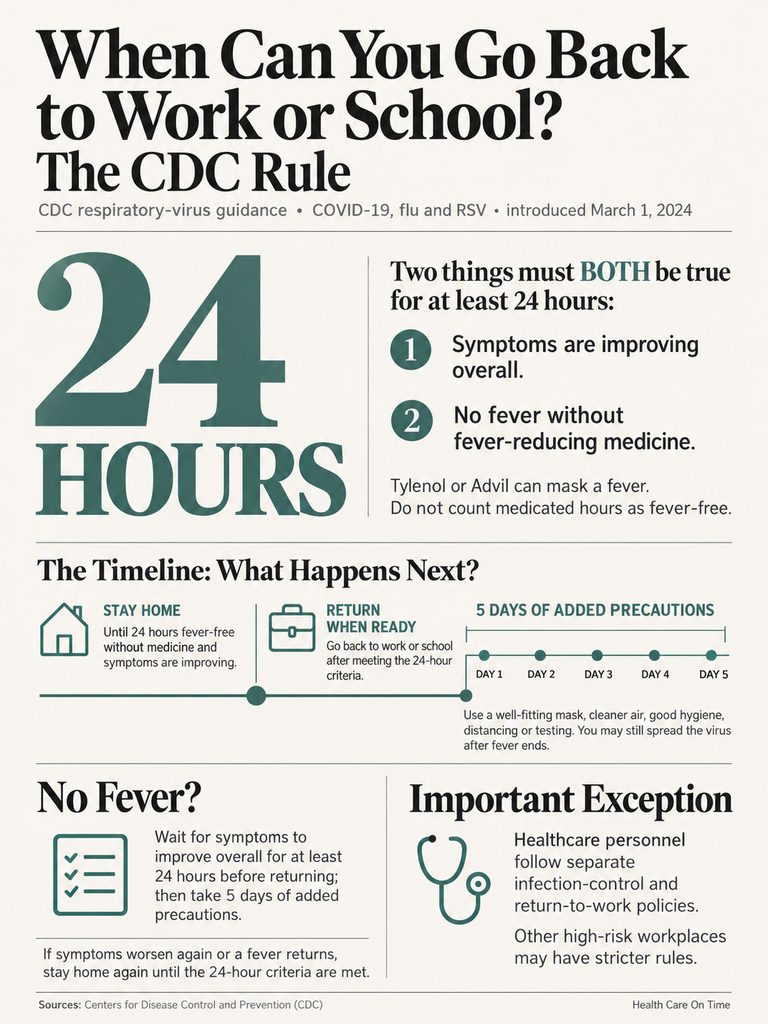
In March 2024, the CDC simplified its advice. The Respiratory Virus Guidance released March 1, 2024 uses one approach for COVID-19, flu and RSV. It has two steps.
Step 1: 24 Hours Better and Fever-Free Without Medicine
Stay home and away from others until you feel better overall and have been fever-free for 24 hours without fever-reducing medicine. Both conditions count. A normal temperature with a worsening cough doesn’t pass.
Why Tylenol and Advil Can Fool the Rule
Acetaminophen and ibuprofen can hold your temperature down for 4 to 8 hours, which makes a thermometer reading meaningless. Start your 24-hour clock only after your last dose. If you’re unsure how much acetaminophen is safe during recovery, see our guide on how many Tylenol 500mg you can take in a day.
Step 2: Five Days of Added Precautions
Once you’re back to normal activities, take precautions for 5 more days: a well-fitting mask, hand and cough hygiene, and outdoor or distanced social plans.
This step exists because the virus doesn’t vanish with the fever. CDC has long noted that many people keep shedding virus for 24 hours after their fever goes away, though at lower levels.
What If You Never Had a Fever?
This is the gap almost every flu article skips. Many people with flu never run a fever. In challenge studies, fever showed up in 37.0% of A/H1N1 infections, 40.6% of A/H3N2 and just 7.5% of influenza B.
If you never had a fever, go by symptoms. Wait until your cough, aches and fatigue have been clearly improving for at least 24 hours, then follow the 5-day precaution window. Counting 5 to 7 days from your first symptom is a reasonable backstop.
Healthcare Workers and High-Risk Jobs
The general rule doesn’t cover everyone. CDC’s updated guidance doesn’t apply to healthcare personnel, who follow separate CDC recommendations. Nurses, aides and nursing home staff should follow their employer’s infection-control policy, which is often stricter.
Flu by the Numbers
| Statistic | Figure | Source |
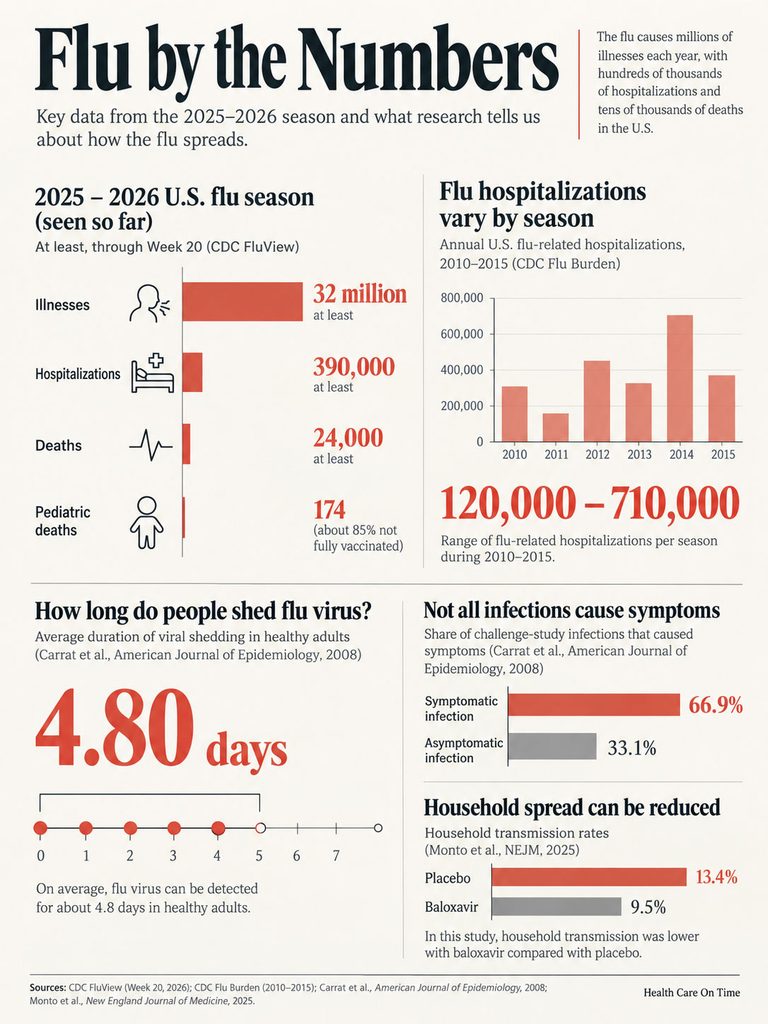
| Flu illnesses, 2025-2026 season | At least 32 million | CDC FluView, Week 20, 2026 |
| Flu hospitalizations, 2025-2026 | At least 390,000 | CDC FluView, Week 20, 2026 |
| Flu deaths, 2025-2026 | At least 24,000 | CDC FluView, Week 20, 2026 |
| Pediatric flu deaths, 2025-2026 | 174 (about 85% not fully vaccinated) | CDC FluView, Week 20, 2026 |
| Seasonal hospitalization range, 2010-2025 | 120,000 to 710,000 | CDC Flu Burden |
| Average viral shedding, healthy adult volunteers | 4.80 days | Carrat et al., Am J Epidemiol 2008 |
| Share of challenge infections that caused symptoms | 66.9% | Carrat et al., Am J Epidemiol 2008 |
| Household transmission, placebo vs baloxavir | 13.4% vs 9.5% | Monto et al., NEJM 2025 |
Two things stand out. About one in three challenge-study infections caused no symptoms (66.9% were symptomatic), so some spread happens with no warning at all.
Real-world data softens that worry. In a community study, only 14% of infections with detectable shedding had no symptoms, and those people shed little virus. People with active symptoms do most of the spreading.
Can Antivirals Shorten How Long You’re Contagious?
Yes, if they’re started early. Timing is everything.
Tamiflu (Oseltamivir): The 48-Hour Window
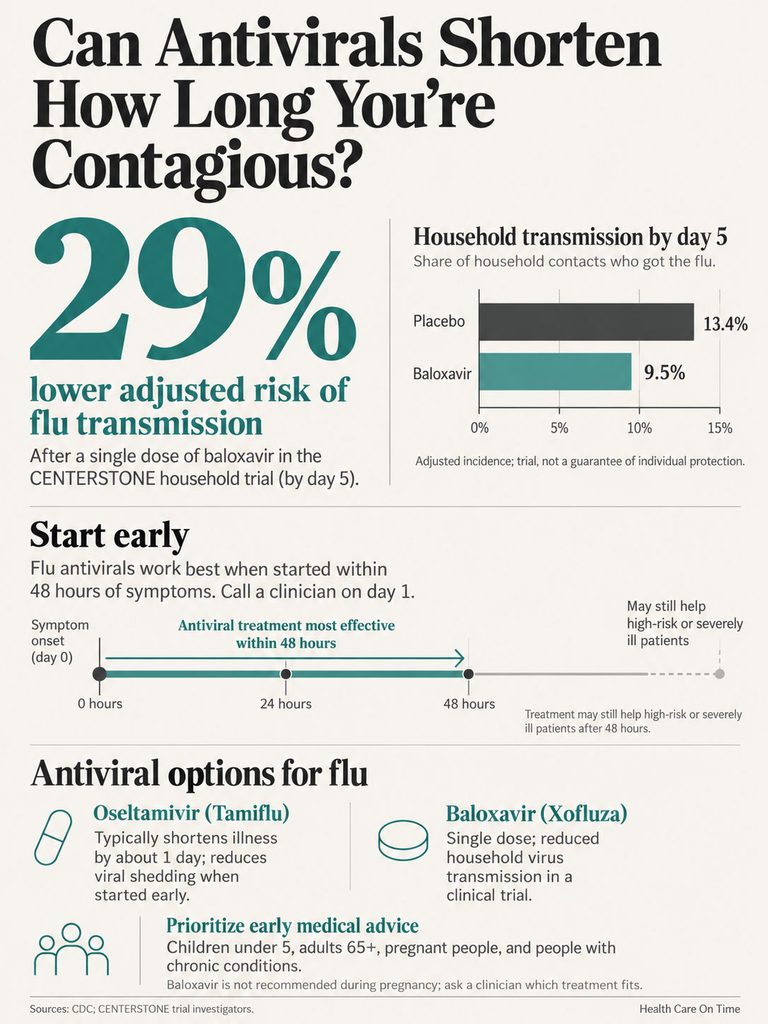
CDC says antiviral treatment should start as soon as possible, ideally within 48 hours of symptom onset. Taken within that window, flu antivirals can shorten illness by 1 to 2 days and reduce virus shedding.
A systematic review of the 2009 pandemic strain also found shorter shedding when oseltamivir was given within 48 hours of onset. Tamiflu won’t make you non-contagious overnight, though. Keep following the stay-home rule.
Xofluza (Baloxavir): The First Drug Shown to Cut Household Spread
Xofluza is a single-dose pill. The CENTERSTONE trial enrolled 1,457 flu-positive patients and 2,681 household contacts in 15 countries from 2019 to 2024.
Transmission to household members fell from 13.4% with placebo to 9.5% with baloxavir, a 32% drop in the odds of spread. The FDA label now includes reducing flu transmission from patients 5 and older who have had symptoms for no more than 48 hours.
Two honest caveats. The drug’s maker, Roche, funded the trial. And the 25% drop in symptomatic transmission did not reach statistical significance.
Who Should Ask for an Antiviral
CDC recommends antiviral treatment as early as possible for anyone with confirmed or suspected flu who is at higher risk of complications. It can also be considered for healthy outpatients if started within 48 hours.
Higher-risk groups include children under 5, adults 65 and older, pregnant people, and anyone with asthma, diabetes, heart disease or a weakened immune system. Our medical team suggests calling your doctor on day 1, not waiting to see if things get worse.
Testing and Treatment in the US: What It Costs
Home Tests
You don’t need a clinic visit to find out what you have. In 2023, the FDA authorized the first over-the-counter home test that detects influenza A, influenza B and COVID-19 from one nasal swab.
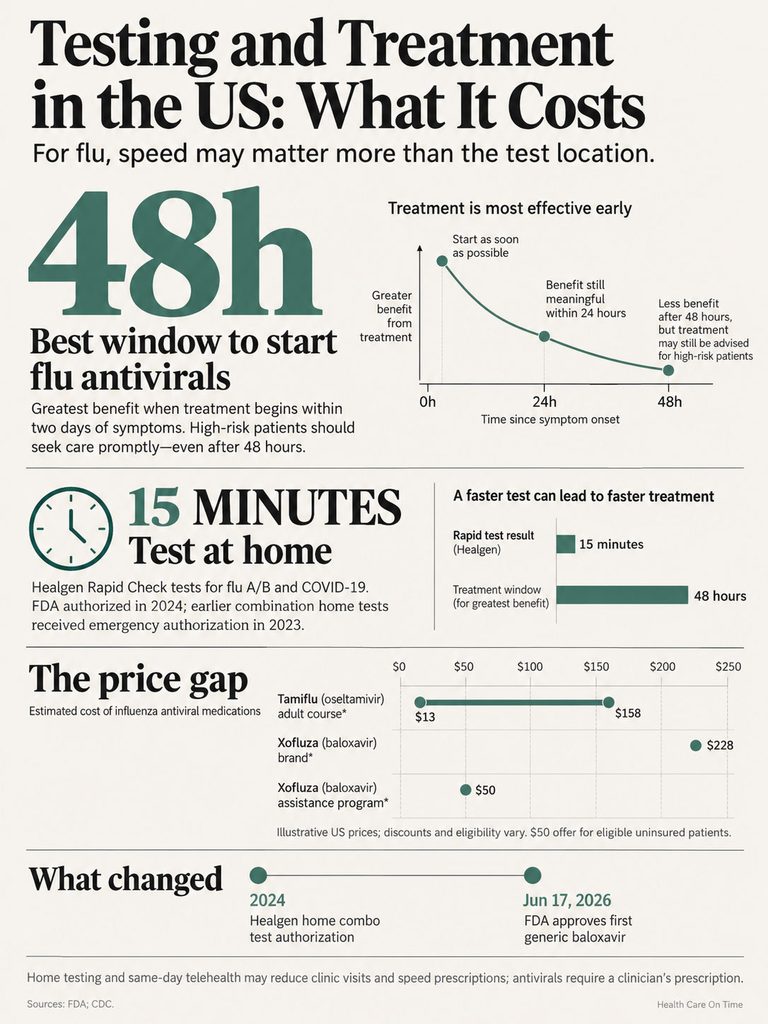
Since then, the FDA has granted full marketing authorization to the Healgen Rapid Check COVID-19/Flu A&B test, which gives results in about 15 minutes. A positive result is a good reason to call your doctor quickly, especially if you’re high risk.
What Antivirals Cost
A standard adult Tamiflu course is 75 mg twice a day for 5 days, or 10 capsules. Price snapshots from early October 2026 showed generic oseltamivir at about $13 to $30 with discount coupons, versus “full” prices of about $46 to $158.
Brand Xofluza costs more. GoodRx lists one 40 mg tablet at about $228 without insurance. Genentech announced a $50 cash price in October 2025 for eligible uninsured or underinsured patients, and the FDA approved the first generic baloxavir on June 17, 2026.
Many telehealth services can test, diagnose and prescribe the same day. When every hour of the 48-hour window counts, a virtual visit is often the fastest route to an antiviral.
How to Keep Flu From Spreading at Home
Home is where most of your spread risk lives. Roche estimates about one-third of all flu transmission happens within households. Treat that as a manufacturer figure, but the point stands.
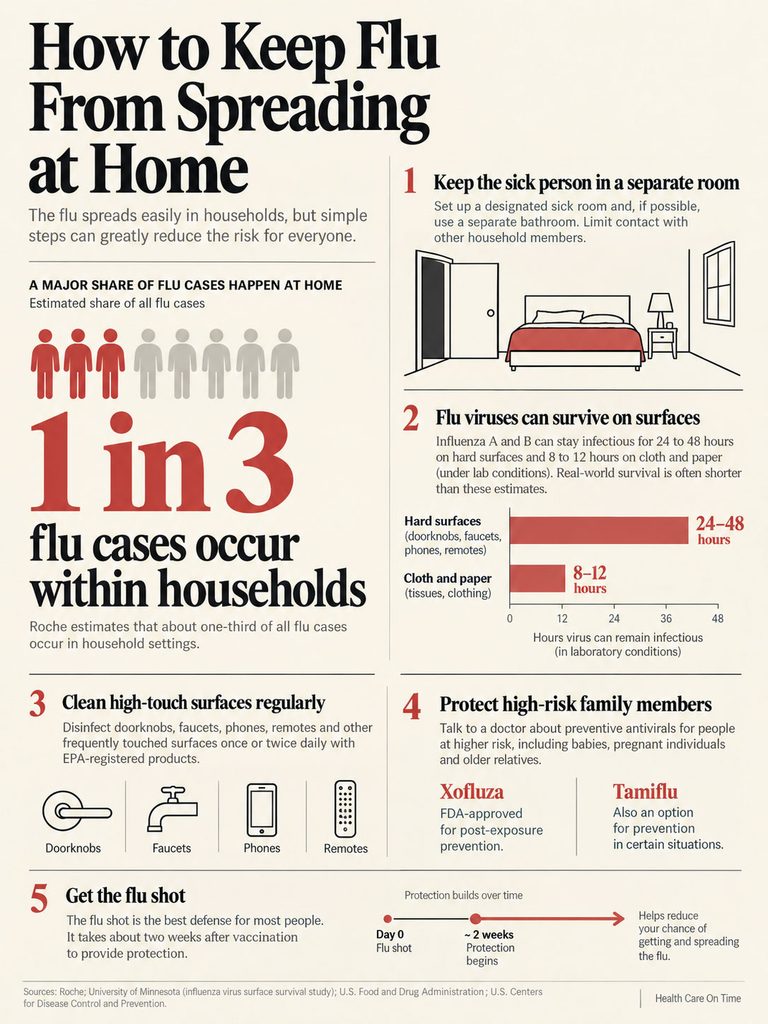
Set Up a Sick Room
- Keep the sick person in one room with the door closed.
- Use a separate bathroom if possible.
- Open a window or run a HEPA air purifier.
- Have the sick person wear a mask when others come in.
- Wash hands with soap for 20 seconds after every contact.
- Don’t share cups, utensils, towels or pillows.
How Long Flu Survives on Surfaces
Most flu spreads through the air, but surfaces play a smaller role. A University of Minnesota study found influenza A and B survived 24 to 48 hours on hard surfaces like steel and plastic, and under 8 to 12 hours on cloth, paper and tissues.
That study dates to 1982, and newer research suggests real-world survival is often shorter. Wiping doorknobs, faucets, phones and remotes once or twice a day with any EPA-registered disinfectant is cheap insurance.
Protecting High-Risk Family Members
If a baby, pregnant family member or older relative lives with you, ask your doctor about preventive antivirals. The FDA approved Xofluza for post-exposure prevention based on a household trial of 607 people aged 12 and older. Tamiflu is also prescribed for prevention.
The flu shot remains everyone else’s best defense. It takes about 2 weeks to build protection, so get it before the next exposure, not after.
4 Flu Contagion Myths
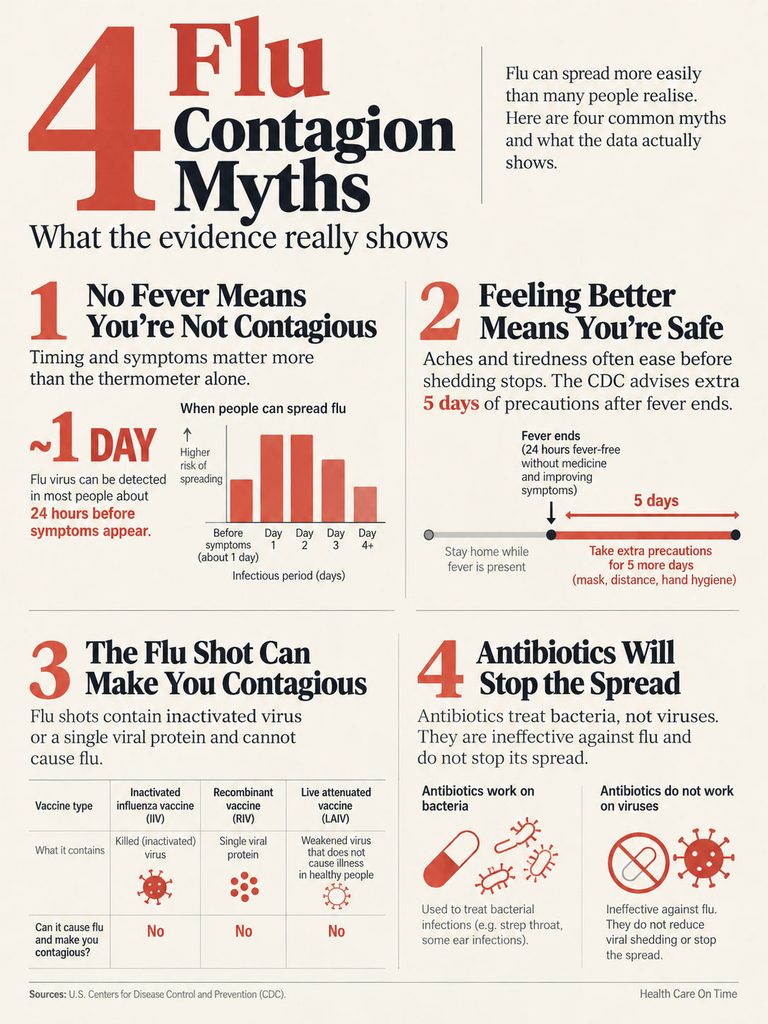
Myth 1: No Fever Means You’re Not Contagious
Most challenge-study flu infections didn’t cause a fever. Timing and symptoms matter more than the thermometer alone.
Myth 2: Feeling Better Means You’re Safe
Aches and tiredness often ease before shedding stops. That’s exactly why CDC added the 5-day precaution window.
Myth 3: The Flu Shot Can Make You Contagious
Flu shots contain inactivated virus or a single viral protein. They can’t cause the flu. A sore arm or mild aches afterward are immune responses, not infection.
Myth 4: Antibiotics Will Stop the Spread
Antibiotics treat bacteria, not viruses. They do nothing for flu itself unless a doctor finds a secondary bacterial infection like pneumonia or an ear infection.
What the Evidence Can’t Tell You Yet
Our medical reviewers want to be upfront about three limits:
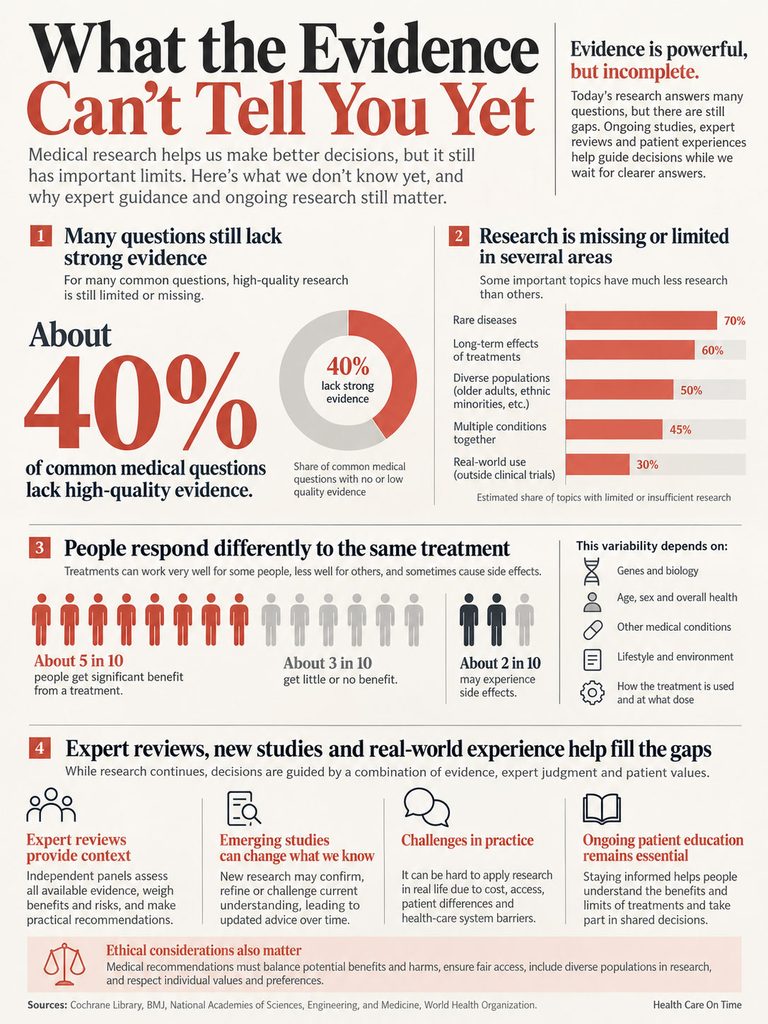
- Much of the shedding data is from outside the US. The age and obesity data come from Nicaragua; the PCR-vs-live-virus data from Hong Kong. The patterns are consistent, but US cohorts are smaller.
- Older adults are understudied. Challenge studies enroll healthy young volunteers, so exact shedding times for people 65 and up aren’t well defined.
- Shedding isn’t the same as spreading. Detecting virus doesn’t prove you’ll infect someone. The day ranges in this article are conservative on purpose.
When to Call a Doctor
Most healthy people recover at home in a week or two. Some symptoms need care right away.
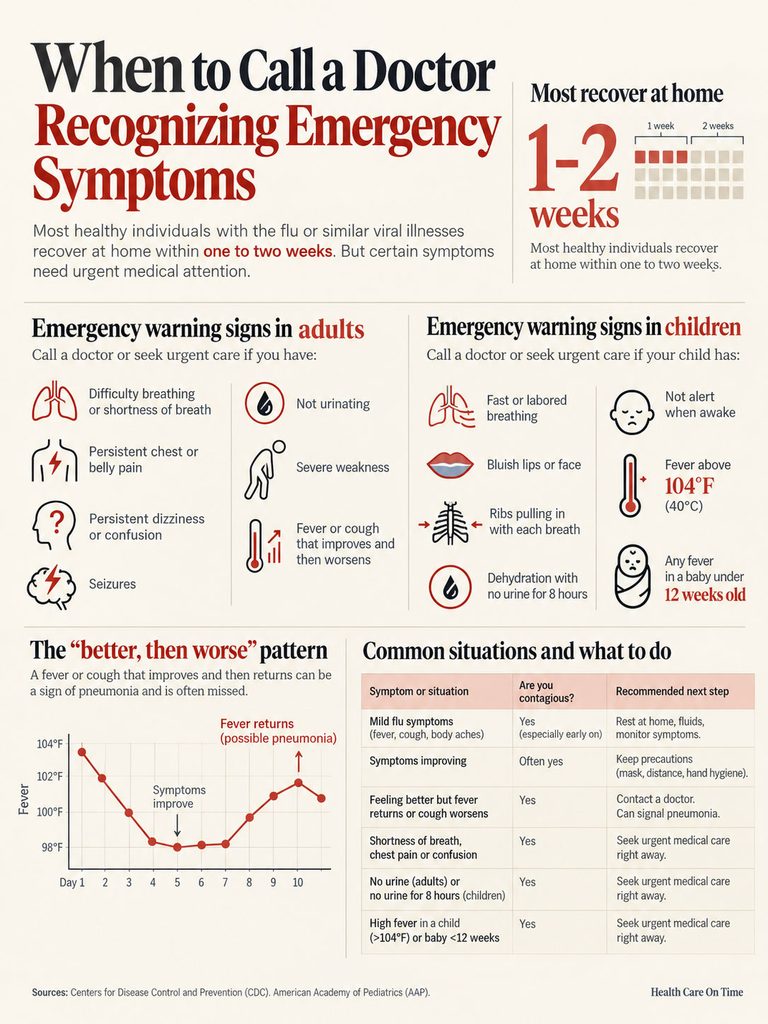
Emergency warning signs in adults: difficulty breathing or shortness of breath, persistent chest or belly pain or pressure, persistent dizziness or confusion, seizures, not urinating, severe weakness, and fever or cough that improve and then return or worsen.
Emergency warning signs in children: fast or labored breathing, bluish lips or face, ribs pulling in with each breath, dehydration with no urine for 8 hours, not alert when awake, fever above 104°F, and any fever in a baby under 12 weeks old.
In cases reviewed by our medical team, the “better, then worse” pattern is the one families most often miss. A fever that returns after a day or two of improvement can signal pneumonia and needs a same-day visit.
| Scenario | Still Contagious? | Recommended Action |
| Woke up with chills and aches today | Yes, entering peak window | Stay home; take a home test; call a doctor within 48 hours if high risk |
| Day 3, fever of 101°F, coughing | Yes, peak risk | Stay home; isolate from others in the household |
| Fever gone 24 hours without meds, feeling better | Possibly, at lower levels | Return to normal activities; mask and distance for 5 days |
| Fever gone, but took Advil 6 hours ago | Unknown | Restart the 24-hour clock from the last dose |
| Never had a fever, symptoms improving on day 5 | Likely low | Return with 5 days of precautions |
| Toddler, day 6, still runny nose | Possibly, kids shed longer | Keep home until fever-free 24 hours and clearly improving |
| On chemotherapy or post-transplant | May shed for weeks | Ask the care team before ending precautions |
| Feeling better, then fever and cough return | Possibly, plus complication risk | Seek same-day medical care |
Frequently Asked Questions
Are you contagious with the flu before symptoms start?
Yes. CDC says flu virus can be detected in most people about 1 day before symptoms appear, and young children may start shedding even earlier. This is why flu spreads so quickly through homes and schools: people pass it on before anyone knows to stay home.
How long is the flu contagious after a fever breaks?
You can still shed virus for a day or more after your fever goes away, though at lower levels. CDC advises waiting 24 hours fever-free without medicine, with improving symptoms, then taking extra precautions like masking and distancing for 5 more days.
Can you go back to work 24 hours after a flu fever?
Yes, if your fever has been gone 24 hours without Tylenol or ibuprofen and you feel better overall. Plan on masking and frequent handwashing for the next 5 days. Healthcare workers should follow their employer’s stricter infection-control rules instead.
How long is the flu contagious in toddlers and kids?
Longer than in adults. One large cohort found kids aged 0 to 4 shed flu for about 7.7 days on average, and ages 5 to 17 for about 7.2 days, compared with 5.5 days in adults. Keep children home until fever-free for 24 hours and clearly improving.
Is the flu still contagious after 7 days?
For most healthy adults, risk is very low after day 7. Young children, adults with obesity, people with influenza B and anyone with a weakened immune system may shed longer. People on chemotherapy or transplant drugs can stay contagious for weeks and should check with their doctor.
Does Tamiflu make you less contagious?
It can help. Started within 48 hours of symptoms, flu antivirals can shorten illness by 1 to 2 days and reduce viral shedding. Xofluza, a single-dose antiviral, cut the odds of spreading flu to household members by 32% in a large trial. Neither drug replaces staying home.
Can you spread flu if you had a flu shot?
Yes, if you still catch the flu. The vaccine lowers your odds of infection and often makes illness milder, but vaccinated people who get sick can still pass the virus on. The shot itself can’t give you the flu, because it contains no live virus.
How long does the flu virus live on surfaces?
Lab studies found flu viruses survived 24 to 48 hours on hard surfaces like stainless steel and plastic, and under 12 hours on cloth, paper and tissues. Real-world survival is often shorter. Disinfect doorknobs, faucets and phones daily while someone in the house is sick.
Can you spread flu with no symptoms at all?
It’s possible but less common. In challenge studies, about one in three infections caused no symptoms. In community studies, only 14% of detectable infections were symptom-free, and those people shed little virus. People with active symptoms do most of the spreading.
Is influenza B contagious longer than influenza A?
Studies suggest it often is. In one cohort, influenza B shedding averaged 6.4 days in adults versus 5.1 days for influenza A, with longer times in children. Influenza B also causes fever less often, which makes the fever-based return rule less reliable.
How soon after exposure do flu symptoms start?
Usually about 2 days after the virus enters your airways, with a range of 1 to 4 days. You may be contagious roughly a day before symptoms show. If you’ve been exposed and you’re high risk, ask your doctor about preventive antivirals.
Can you catch the flu twice in one season?
Yes. More than one flu strain often circulates in the same season, such as influenza A and B. Recovering from one strain doesn’t fully protect you from another. A yearly flu shot covers several strains at once and remains the best protection.
Disclaimer: This article is for general information and doesn’t replace advice from a licensed healthcare provider. Contagious periods vary by person, age, health status and flu strain. Drug prices shown are point-in-time snapshots and will change. If you or your child has trouble breathing, chest pain, confusion, a seizure or signs of dehydration, call 911 or go to the nearest emergency room. If you’re at high risk for flu complications, contact your doctor as soon as symptoms start.
References
- CDC: How Flu Spreads
- CDC: Weekly US Influenza Surveillance Report, Week 20, 2026
- CDC: Preliminary Estimated Flu Disease Burden 2025-2026
- CDC: Respiratory Virus Guidance
- CDC: Flu Symptoms and Emergency Warning Signs
- CDC: Summary of Influenza Antiviral Recommendations for Clinicians
- Carrat F, et al. Time Lines of Infection and Disease in Human Influenza. Am J Epidemiol 2008
- Monto AS, et al. Efficacy of Baloxavir Treatment in Preventing Transmission of Influenza. NEJM 2025
- Timeline of Influenza Virus Shedding in Children and Adults, Managua, Nicaragua
- Lau LLH, et al. Viral Shedding and Clinical Illness in Naturally Acquired Influenza. J Infect Dis 2010
- Natural History of Influenza in Severely Immunocompromised vs Nonimmunocompromised Hosts
- Pinsky BA, et al. Long-term Shedding of Influenza A Virus in an Immunocompromised Child. Emerg Infect Dis 2010
- Children and Obese Adults Shed Influenza Longer (University of Michigan study summary)
- Systematic Review of Influenza A(H1N1)pdm09 Virus Shedding
- Survival of Influenza Viruses on Dry Surfaces, Review Table
- FDA: First Over-the-Counter Home Test for Flu and COVID-19
- GoodRx: How Much Does Xofluza Cost Without Insurance?