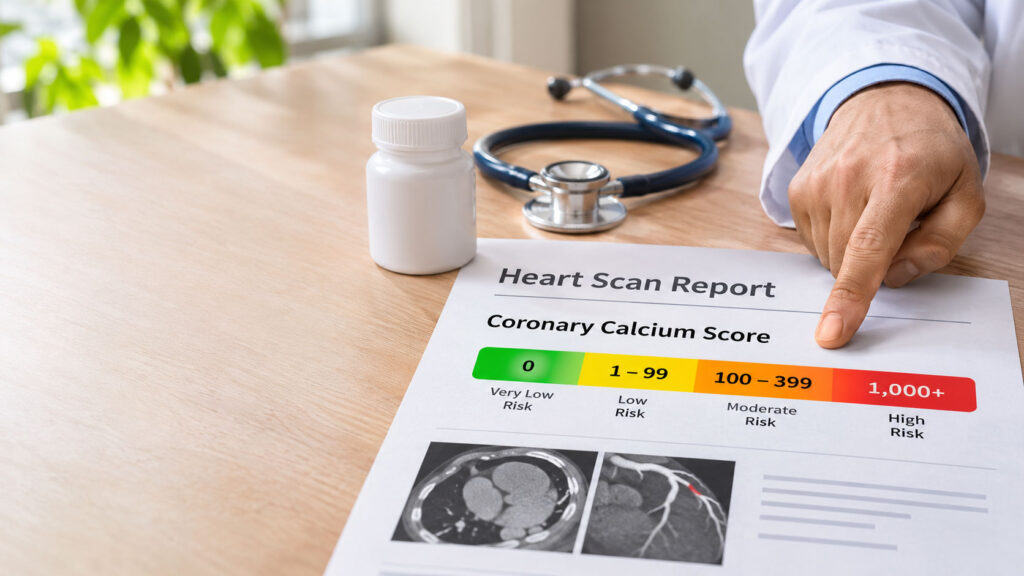
Any calcium at all now tilts the decision toward a statin, and the higher your coronary artery calcium score climbs, the lower the LDL cholesterol target your doctor will set. A zero gives many people room to wait, though smokers, people with diabetes, people with very high LDL and those with a strong family history of early heart disease usually don’t get that pass.
Table of Contents
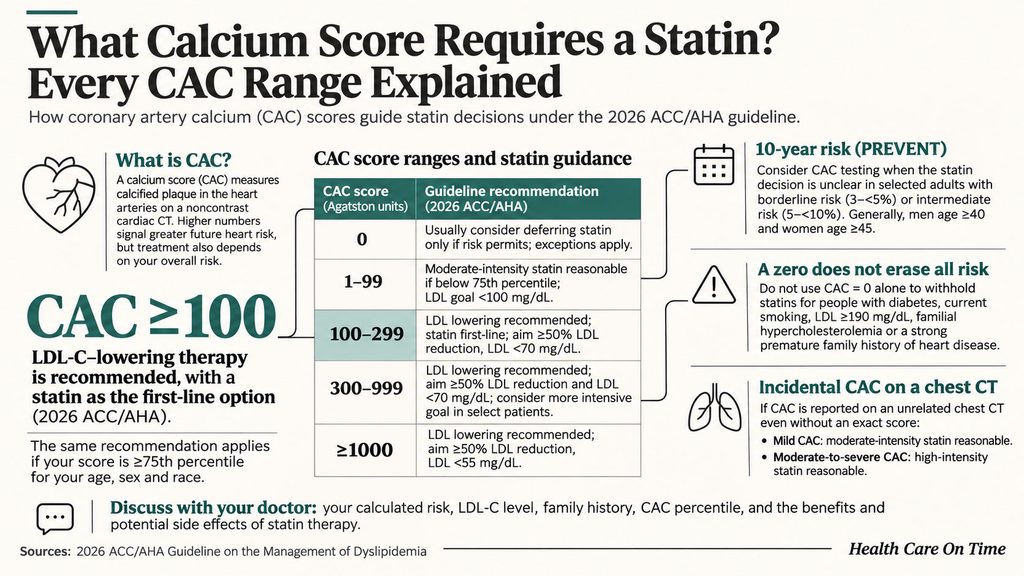
Quick Answer: Under the 2026 ACC/AHA dyslipidemia guideline, a calcium score of 1 to 99 makes a moderate-intensity statin reasonable, with an LDL goal under 100 mg/dL. A score of 100 to 299, or at the 75th percentile or higher, calls for a statin and an LDL goal under 70 mg/dL. Scores of 300 and up need stronger LDL lowering. A score of 0 usually allows you to defer, with a repeat scan in 3 to 7 years, unless higher-risk conditions apply.
What a Calcium Score Actually Measures
A coronary artery calcium (CAC) scan is a quick, non-contrast CT picture of the heart. The software finds bright spots of calcium in the walls of the coronary arteries and adds them up into an Agatston score. Older plaque tends to harden, so the number works as a stand-in for how much plaque has built up over the years. Results can run past 1,000, and higher scores mean a higher chance of a heart attack or stroke in the coming years.
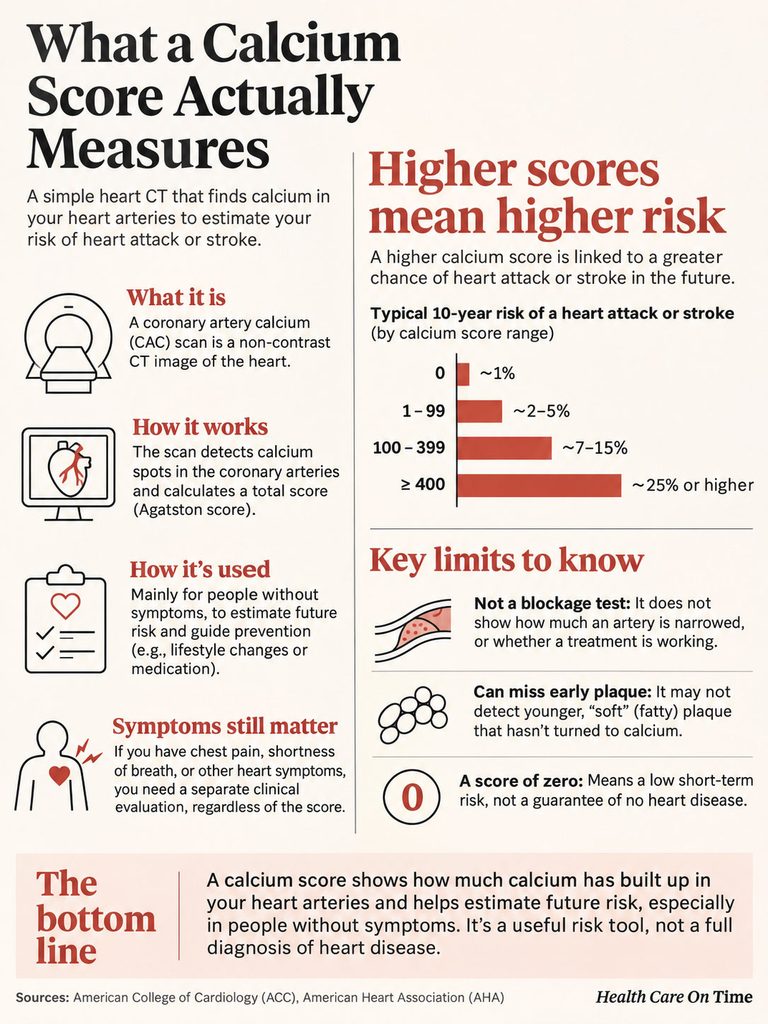
The scan has blind spots worth knowing before you book one. It doesn’t show whether an artery is narrowed or blocked, and it can’t tell you how well a treatment is working, so cardiologists treat it as a risk estimate for people without symptoms. Chest pain or shortness of breath with effort calls for a different kind of evaluation altogether.
Young, fatty plaque is the other blind spot: plaque that hasn’t calcified yet doesn’t show up, so a person can have some atherosclerosis and still score 0. Doctors usually read a zero as “low risk right now” rather than “no disease at all.”
Your Risk Estimate Comes First
A calcium score rarely makes the statin decision on its own. Doctors start with a 10-year risk estimate, and the scan is meant for people whose estimate leaves the answer unclear.
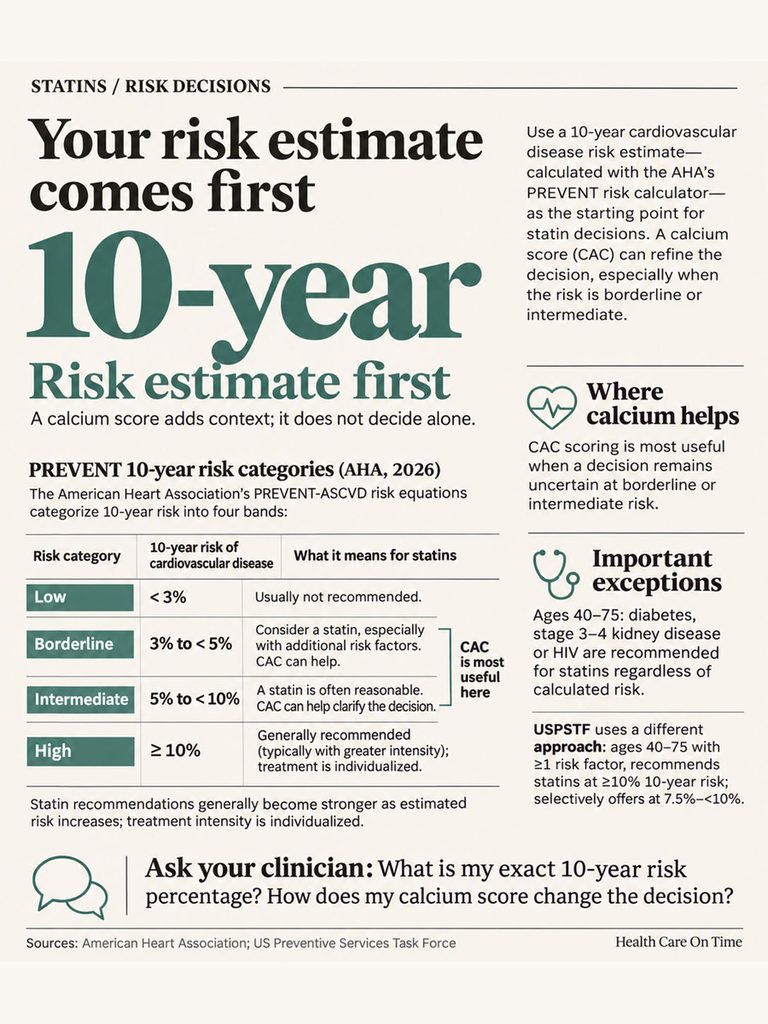
Since 2026, that estimate comes from PREVENT, the American Heart Association’s newer risk calculator. The result falls into one of four PREVENT categories: low (under 3%), borderline (3% to under 5%), intermediate (5% to under 10%) and high (10% or more). Your doctor can usually run it in a few minutes with numbers from a recent checkup and blood work. Ask for the actual percentage. Without it, a calcium score is much harder to put in context, and you won’t know whether you were in the uncertain middle to begin with. The higher the band, the stronger the push toward a statin and the higher the suggested dose.
People in the high band usually get a statin without needing a scan, and people in the low band usually don’t need one either, unless their LDL is persistently between 160 and 189 mg/dL. A calcium score is most useful in the two middle bands, where a person could reasonably go either way and a picture of the actual arteries can move them up or down.
A few groups don’t need the calculator to decide. For adults aged 40 to 75 who have diabetes, stage 3 or 4 chronic kidney disease or HIV, the guideline recommends at least a moderate-intensity statin regardless of calculated risk, so a calcium scan usually won’t change their plan.
The US Preventive Services Task Force uses a different cutoff, and the two systems don’t line up perfectly. Its 2022 recommendation advises a statin for adults 40 to 75 with at least one risk factor (high cholesterol, diabetes, high blood pressure or smoking) and a 10-year risk of 10% or higher, and says clinicians can selectively offer one when the risk is 7.5% to under 10%.
Both systems frame the statin decision as a conversation, not an order. You can ask questions, push back, or ask to wait and recheck. A calcium score gives that conversation something concrete to work with.
The Statin Decision by CAC Range
In March 2026 the American College of Cardiology and the American Heart Association published a new guideline on the management of dyslipidemia, which retires their 2018 cholesterol guideline. The old rule was simple: 0 means you can usually wait, 1 to 99 favors a statin mainly if you’re 55 or older, and 100 or more means treat. The new version keeps the spirit of that rule but ties each calcium band to a specific level of treatment and an LDL cholesterol goal, and it gives each band a name: 0 is absent, 1 to 9 is minimal, 10 to 99 is mild, 100 to 299 is moderate, 300 to 999 is severe, and 1,000 or more is extensive.
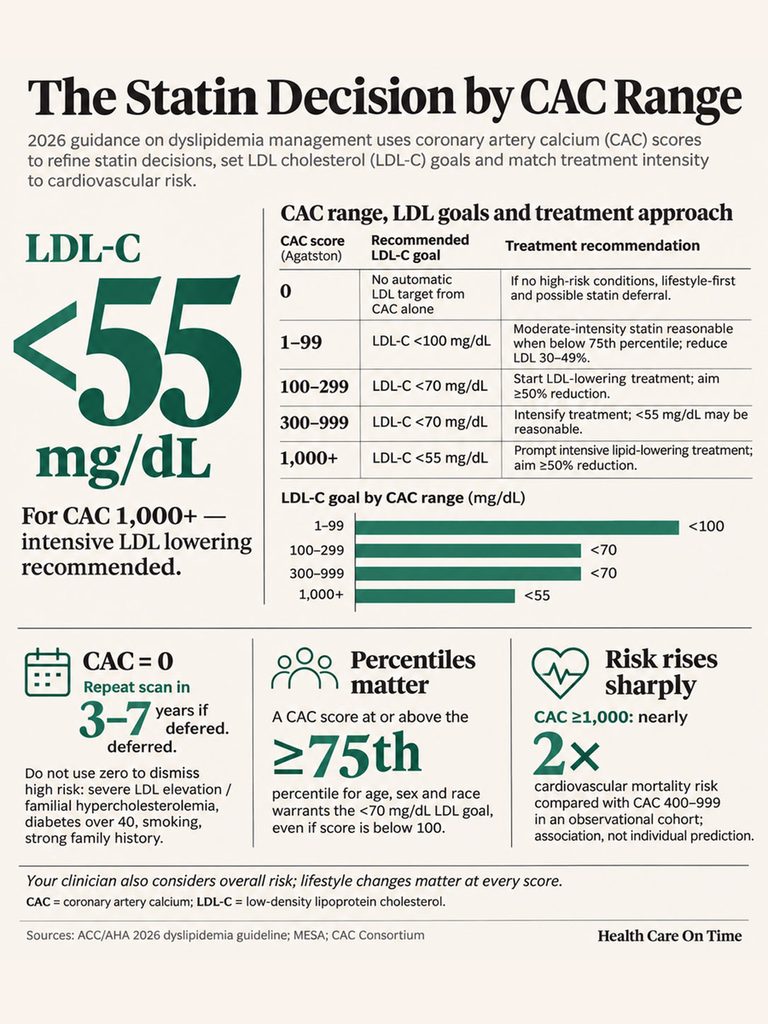
| CAC score (Agatston units) | Guideline label | What the 2026 guideline says | LDL-C goal | Worth knowing |
| 0 | Absent | Reasonable to defer therapy if you prefer lifestyle first and have no higher-risk conditions | No drug goal set; repeat scan in 3 to 7 years | Does not apply with LDL 190+ or familial hypercholesterolemia, diabetes over age 40, current smoking or strong family history |
| 1 to 99 and below 75th percentile | Minimal (1 to 9) or mild (10 to 99) | Treatment advised for any score above 0; moderate-intensity statin reasonable (Class 2a) | Under 100 mg/dL; non-HDL under 130 | Target a 30% to 49% LDL drop; over 75, a score of 1 to 10 may be treated like 0 |
| 100 to 299, or 75th percentile or higher | Moderate | LDL-lowering therapy recommended, statin first (Class 1) | Under 70 mg/dL; non-HDL under 100 | The percentile rule can apply even when the raw score is under 100 |
| 300 to 999 | Severe | Statin first, with at least a 50% LDL drop (Class 1) | Under 70 mg/dL; may intensify to under 55 | Risk calculators are no longer used at this level |
| 1,000 or higher | Extensive | Statin first, with at least a 50% LDL drop (Class 1) | Under 55 mg/dL; non-HDL under 85 | Outcomes resemble high-risk patients with known heart disease |
A Score of 0
When the CAC score is 0 and you’re at intermediate risk (or at borderline risk with doubts about treatment), the guideline says it is reasonable to put off cholesterol medicine, focus on diet, activity and blood pressure, and repeat the scan in 3 to 7 years. Deferring is a choice you make with your doctor, and several conditions take it off the menu for you.
A Score of 1 to 99
Any measurable calcium means plaque has started to form, and the 2026 guideline recommends starting cholesterol-lowering treatment for any score above 0 in people whose risk was uncertain. For scores of 1 to 99 that sit below the 75th percentile for your age and sex, a moderate-intensity statin is the reasonable choice, aiming to cut LDL by 30% to 49% and get it under 100 mg/dL. The old age-55 condition is gone from the main recommendation, so a 48-year-old with a score of 40 now gets roughly the same advice as a 60-year-old with the same score.
Calcium is so common after 75 that the guideline makes an exception: it calls it reasonable to treat older adults with minimal calcium (a score of 1 to 10) much like those with none, and to avoid starting medicine if the rest of the picture is reassuring. A score of 6 at age 79 sits near the bottom for that age, while the same 6 at 45 is more calcium than most people that age have.
A Score of 100 to 299, or the 75th Percentile and Up
With a score of 100 to 299, or any score at or above the 75th percentile for people like you, LDL-lowering therapy is a Class 1 recommendation, a statin is the first choice, and the LDL goal drops to under 70 mg/dL. The dose depends largely on where your LDL starts, since getting under 70 from a starting level in the 150s takes a much bigger drop than getting there from a level that is already close to the goal. Your prescriber does that math at the first visit.
Younger people are the ones the percentile clause usually catches. A 42-year-old woman with a score of 25 may be well above the 75th percentile for her age, sex and race, because most women her age have no calcium at all. If your report doesn’t list a percentile, the MESA reference tool can estimate it from your age, sex, race and score.
A Score of 300 to 999
A score in the severe range moves you into a group the guideline treats with more urgency. Statin therapy should lower LDL by at least half, with a goal under 70 mg/dL, and it’s reasonable to push further toward under 55 mg/dL by raising the statin dose or adding ezetimibe, a PCSK9 antibody or bempedoic acid. At this level the guideline also stops using the PREVENT risk calculator, because a score of 300 or more already places you at high risk, whatever an estimate built on age, blood pressure and cholesterol might say. People in this group can expect closer follow-up of their LDL, since reaching the goal often takes more than one adjustment.
A Score of 1,000 or Higher
In a study of 66,636 adults without symptoms followed for about 12 years, the 2,869 people with scores of 1,000 or more had about 5 times the risk of dying from cardiovascular disease and almost 3 times the risk of dying from any cause, compared with people who scored 0. The researchers concluded that this group’s outcomes resemble those of high-risk patients who already have heart disease.
The LDL goal here is under 55 mg/dL, the same one used for very high-risk patients with known heart disease.
Four Examples of How the Ranges Play Out
The four people below are composites of situations that come up often in primary care.
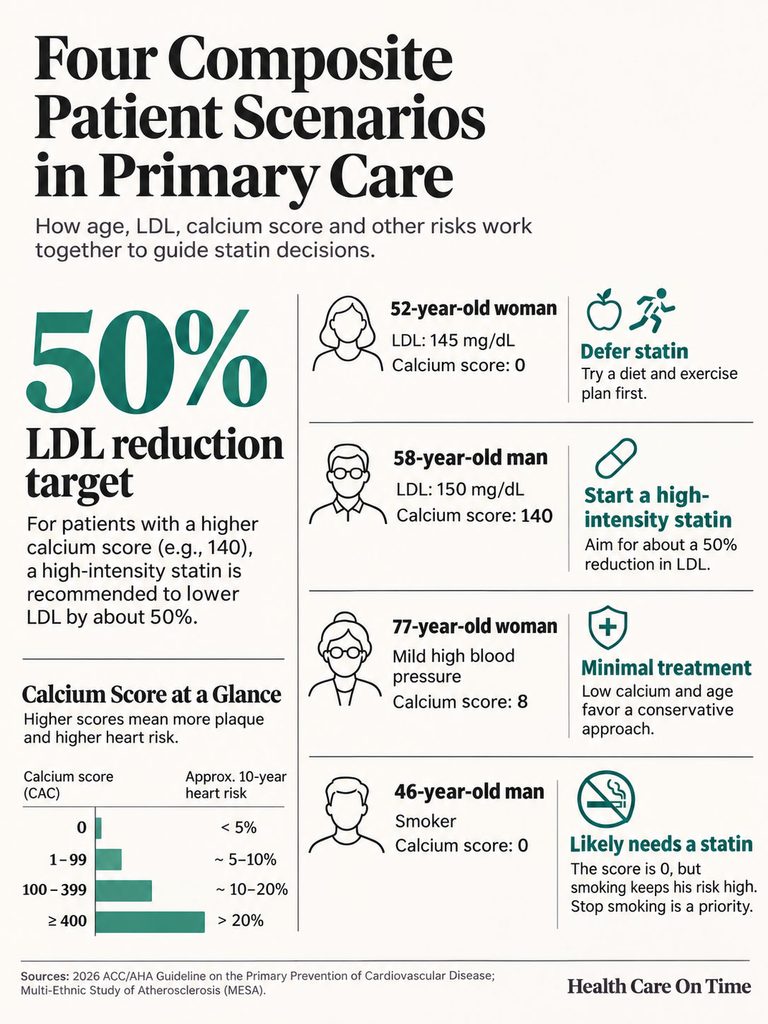
A 52-year-old woman has an LDL of 145 mg/dL, normal blood pressure, no diabetes and no tobacco use, and PREVENT puts her 10-year risk in the intermediate band. She’d rather not take a pill if she doesn’t need one, so she gets a calcium scan, and it comes back 0. Because she has none of the higher-risk conditions, deferring a statin is reasonable. She works on diet and exercise, rechecks her cholesterol, and plans a repeat scan within the 3-to-7-year window. If her LDL climbs or her blood pressure starts to rise in the meantime, the plan gets revisited sooner.
A 58-year-old man is in the same intermediate band, but his scan shows a score of 140. That puts him in the moderate category, where the guideline recommends a statin with an LDL goal under 70 mg/dL. His starting LDL of 150 means he’ll need roughly a 50% drop, which usually means a high-intensity statin. Before the scan, his doctor could have argued either way.
A 77-year-old woman with mild high blood pressure scores 8. In a 50-year-old, any calcium would favor treatment. At her age a score of 1 to 10 is minimal, so she and her doctor can reasonably treat it much like a zero if she has no other strong risk factors and prefers to avoid another daily medicine.
A 46-year-old man who smokes a pack a day scores 0 and hopes that settles it. It settles very little, because current smoking overrides a zero score, so his doctor is still likely to recommend a statin along with help to quit, and the scan mainly says his plaque hasn’t hardened yet.
How Age and Percentile Change What Your Number Means
Calcium builds with age in almost everyone, so a raw score only makes full sense next to your age and sex. A score of 80 is unusual for a 45-year-old woman and fairly ordinary for a 72-year-old man.
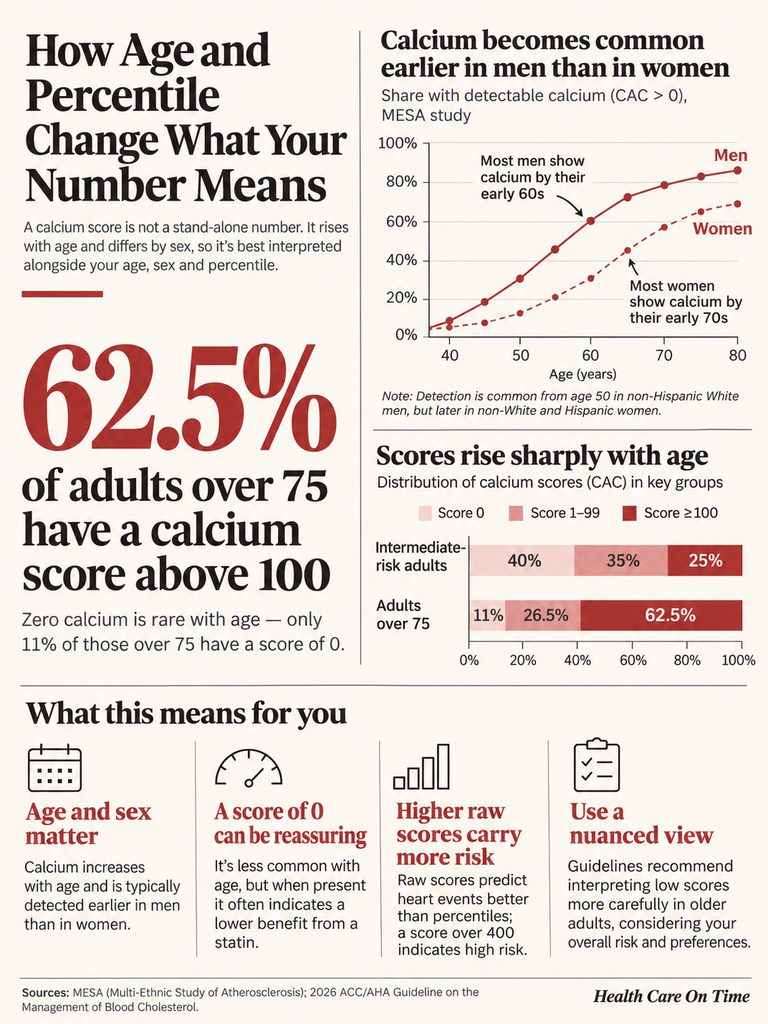
The largest US source of reference values is MESA, the Multi-Ethnic Study of Atherosclerosis, which scanned 6,814 adults aged 45 to 84 without known heart disease. A 2023 analysis of that group found that detectable calcium became the majority finding as early as ages 50 to 54 in non-Hispanic White men, while in non-White and Hispanic women it didn’t pass 50% until after 70. Across all groups, most men had some calcium by their early 60s, and most women by their early 70s.
| Group | What the scans showed | Source |
| Intermediate-risk adults (PREVENT 5% to under 10%) | Up to 40% score 0; about 25% score 100 or more | 2026 ACC/AHA guideline |
| Non-Hispanic White men | Over half have calcium by ages 50 to 54 | MESA, JAMA Internal Medicine, 2023 |
| White men aged 70 to 74 | About 90% have calcium | MESA, JAMA Internal Medicine, 2023 |
| Black women aged 70 to 74 | About 50% have calcium | MESA, JAMA Internal Medicine, 2023 |
| Adults 75 and older (median age 80) | 11% score 0; 62.5% score over 100 | ARIC and MESA, Circulation: Cardiovascular Imaging, 2023 |
| Low-risk adults starting at 0 | 20% to 25% develop calcium within 5 to 7 years | MESA data cited in the 2026 guideline |
Among people whose risk calculator lands in the uncertain middle, as many as 40% have a score of 0 and about 25% have 100 or more, which is why one test can steer some of them away from a statin and others firmly toward one.
Past 75, calcium is close to universal. In a combined ARIC and MESA study of 2,886 people aged 75 and older, only 11% had no calcium, and 62.5% scored above 100. Zero CAC was rarest in White men (4%) and most common in Black women (18%).
For an older adult who does score 0, the 2026 guideline reads that as a sign that the benefits of cholesterol drugs are unlikely to outweigh their risks. Zeros still turn up, though, and in the BioImage study of older people, one-third scored 0. If the 100 cutoff were applied without judgment, most people over 75 would be labeled high risk, which is one reason the guideline allows a softer reading of low scores in this age group and the US Preventive Services Task Force calls the evidence insufficient to judge starting a statin after 75.
In MESA, the raw score predicted heart events better than the percentile, and anyone with a score over 400 was high risk regardless of percentile rank. So a 70-year-old man with a score of 450 is at high risk even if plenty of men his age score higher.
When a Zero Score Doesn’t Rule Out a Statin
A score of 0 is the best result a calcium scan can give, and for many people it does justify waiting. Large studies behind the guideline found no statin benefit over about 10 years in people with a score of 0. Several higher-risk conditions override a zero score:
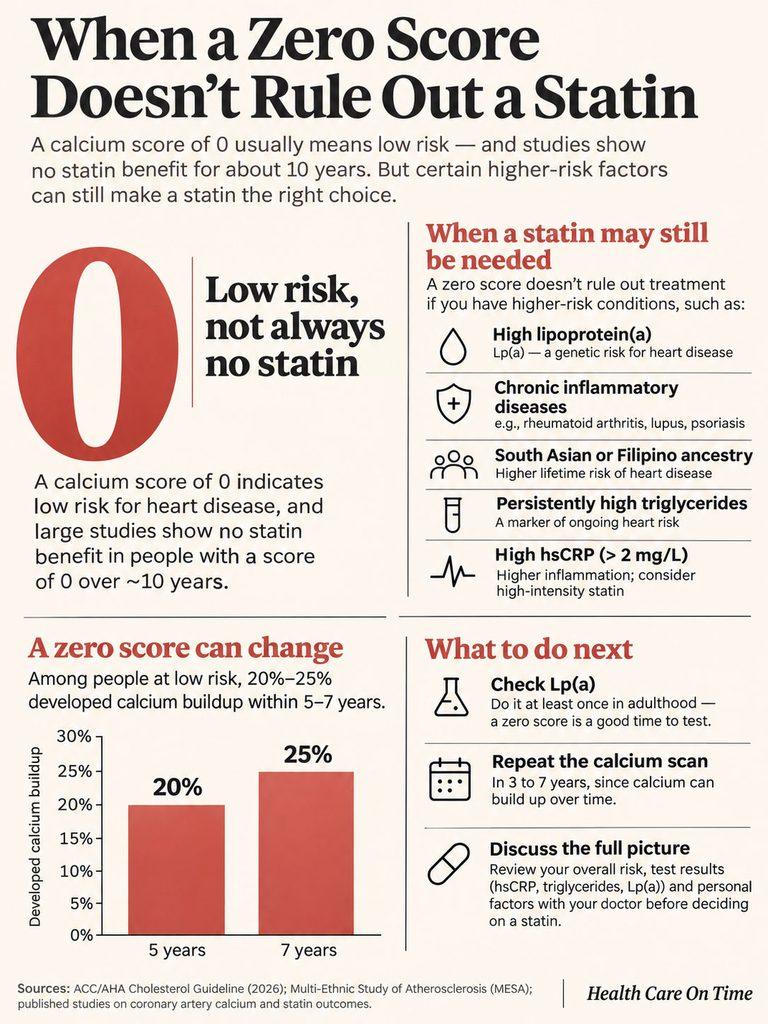
- LDL cholesterol of 190 mg/dL or higher, or familial hypercholesterolemia. People with inherited high cholesterol carry high lifetime risk regardless of what the scan shows today, and the guideline says calcium scoring isn’t even indicated for them.
- Diabetes after age 40. Diabetes raises heart risk enough on its own that a zero score can’t cancel it.
- Current cigarette smoking. Smoking keeps risk high enough that a clean-looking scan doesn’t justify waiting.
- A strong family history of premature heart disease, usually defined as a heart attack or stroke in a father or brother before 55 or a mother or sister before 65.
Other risk enhancers can tip a borderline case even with a low or zero score. They include lipoprotein(a) of 125 nmol/L or 50 mg/dL or higher, chronic inflammatory diseases such as lupus, rheumatoid arthritis or advanced psoriasis, South Asian or Filipino ancestry, persistently high triglycerides, and pregnancy-related markers like preeclampsia, gestational diabetes and early menopause. A high-sensitivity C-reactive protein (hsCRP) of 2 mg/L or more on more than one test, with no other cause, also counts, and for someone at borderline risk it can be enough to consider a high-intensity statin.
Lp(a) should be checked at least once in adulthood under the new rules, so a zero score is a good moment to ask whether yours has been done.
A zero can also change over time. In low-risk MESA participants, 20% to 25% developed calcium within 5 to 7 years, which is why deferral comes paired with a repeat scan in 3 to 7 years instead of a permanent answer.
Calcium Found on a Chest CT Done for Something Else
Many people learn about their coronary calcium by accident. A radiologist reading a chest CT for a cough, a lung nodule or lung cancer screening notes “coronary artery calcification” in the report, often with a word like mild, moderate or severe instead of a number.
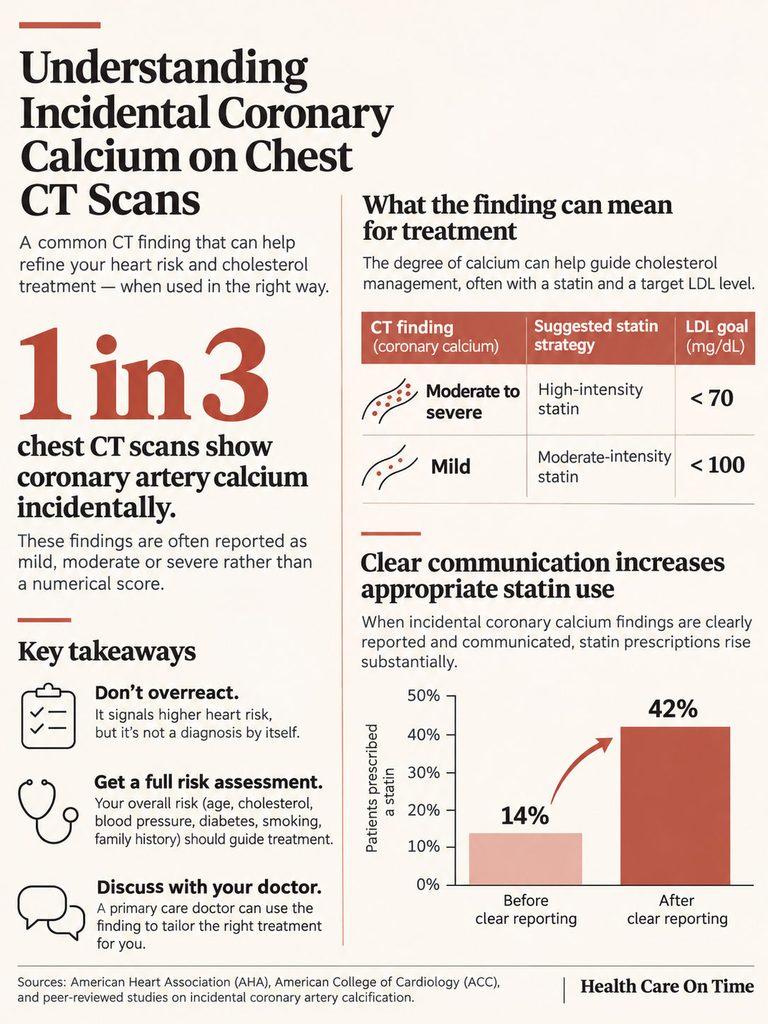
Doctors aren’t supposed to ignore that finding. Incidental coronary calcium should be considered when deciding whether to start or step up cholesterol treatment, and for moderate or severe calcification on a noncardiac CT, a high-intensity statin is reasonable with an LDL goal under 70 mg/dL. Mild calcification points toward a moderate-intensity statin and an LDL goal under 100 mg/dL. A word on the report can feed straight into that decision, so a separate calcium scan isn’t always needed just to turn the description into a number. Reporting the finding seems to change care, too: when a randomized quality project called NOTIFY-1 simply told clinicians and patients about incidental calcium, appropriate statin prescriptions rose significantly compared with usual care.
Because calcium is so common in older adults, the MESA researchers also warned against overreacting, arguing that an incidental finding should lead to a full heart risk review and a talk about your preferences, not an automatic referral or prescription, and that it shouldn’t cause needless worry. Your primary care doctor can put the CT report together with your latest lipid panel results and a risk estimate to decide what, if anything, to do.
Who Should Get a Calcium Score, and Who Can Skip It
A scan makes the most sense when the statin decision is genuinely uncertain. The new guideline aims it at men 40 and older and women 45 and older who fall in the borderline or intermediate PREVENT range, when the result would actually change whether a statin is prescribed.
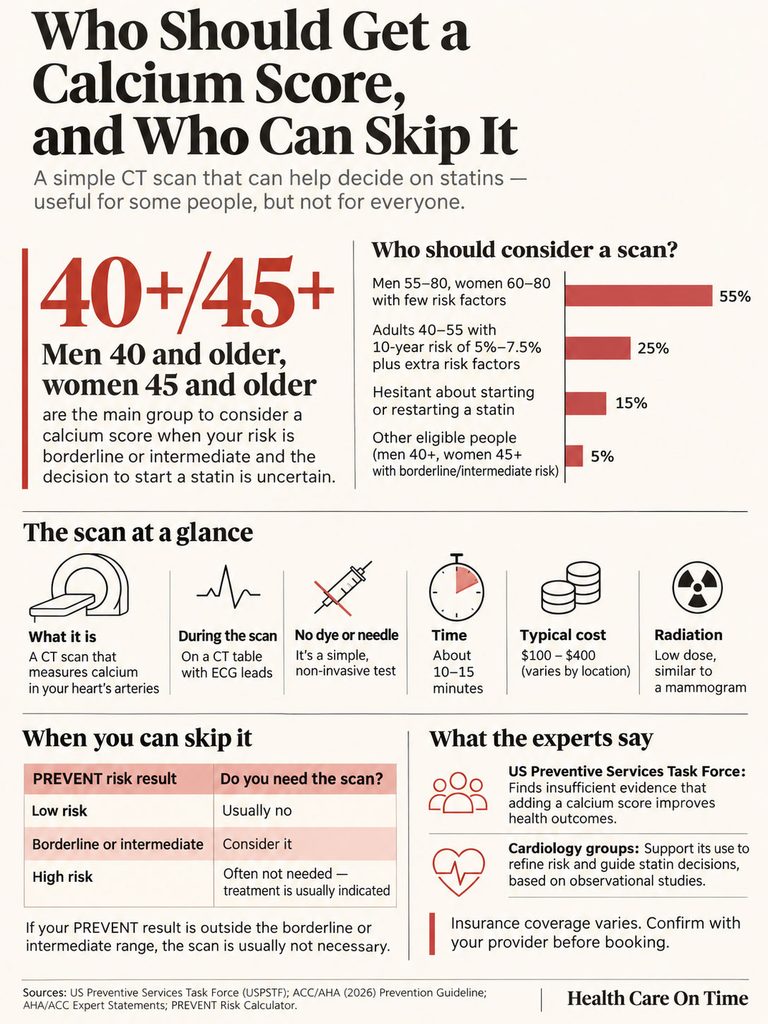
Other people who tend to benefit include men 55 to 80 and women 60 to 80 with few risk factors who aren’t sure a statin would help them, adults 40 to 55 whose 10-year risk is around 5% to 7.5% and who have extra risk factors, and anyone who is hesitant to start a statin or unsure about restarting one after side effects.
If your PREVENT result falls outside the borderline or intermediate range, ask what the scan would change before you book it.
Some people gain little from the test:
- Anyone who has already had a heart attack, stroke, stent or bypass surgery, because a statin is indicated anyway.
- People with familial hypercholesterolemia or LDL of 190 mg/dL or higher.
- Adults at clearly low risk with no family history, since a high score would be unlikely and a zero wouldn’t change anything.
- Anyone with symptoms, who needs a diagnosis that this scan can’t give.
You lie on your back on a CT table, often with ECG leads on your chest, and no dye or needle is needed. Scanning takes about 10 to 15 minutes, the usual cost is about $100 to $400, and the radiation dose is close to that of a mammogram.
Insurance doesn’t always cover it, so it’s worth calling your plan and the imaging center before you book.
The US Preventive Services Task Force is less convinced. It has found insufficient evidence that adding a calcium score improves patient outcomes, while the cardiology groups lean on large observational studies showing that the score sorts risk better than traditional risk factors alone.
Why Statins Can Make Your Calcium Score Go Up
A higher calcium score after a few years on a statin can look like the drug failed, though usually it hasn’t.
One explanation researchers have offered is that treated plaque tends to harden as it settles down, and denser calcium may go along with more stable plaque, so the count can rise without the disease getting worse. The practical rule in the 2026 guideline is blunt: once you’re on cholesterol-lowering therapy, repeat calcium testing is not indicated, because statin therapy often increases CAC scores.
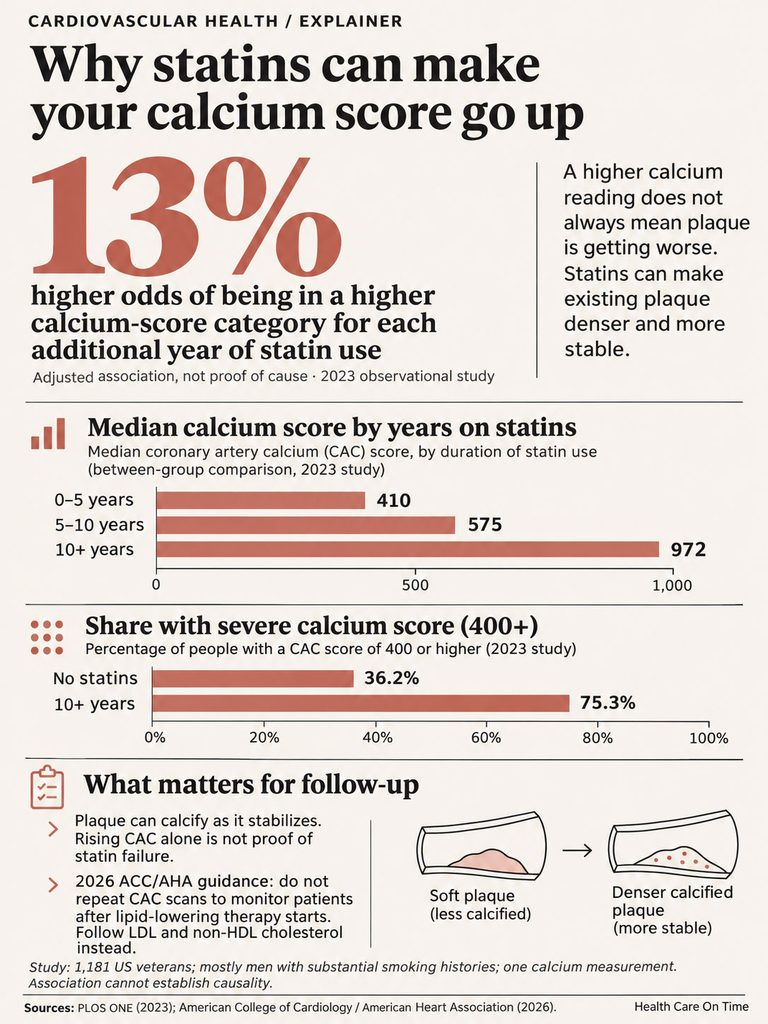
In a 2023 study of 1,181 US veterans without known heart disease, the median calcium score was 225 in people who had never taken a statin, compared with 410 in those who had taken one for up to 5 years, 575 for more than 5 to 10 years, and 972 for more than 10 years. Severe scores of 400 or higher appeared in 36.2% of non-users and 75.3% of people with more than 10 years of statin use. Each extra year of use raised the odds of being in a higher score category by about 13% (odds ratio 1.13).
The study was observational, though, and the group was 95.5% male with a heavy smoking history, and it measured each person only once, so it can’t prove that statins caused the extra calcium or show whether the plaques became more stable. Its authors concluded only that a calcium score may need to be read differently in someone who has been on a statin for years.
A common misstep is a repeat scan done out of curiosity a few years into treatment, followed by alarm at the higher number and a decision to quit a drug that was doing its job. Knowing that scores often rise on a statin makes that mistake less likely.
If you’re already on a statin, track your LDL and non-HDL cholesterol with blood tests instead of repeat calcium scans, and don’t treat a rising score in that setting as a reason to stop the drug.
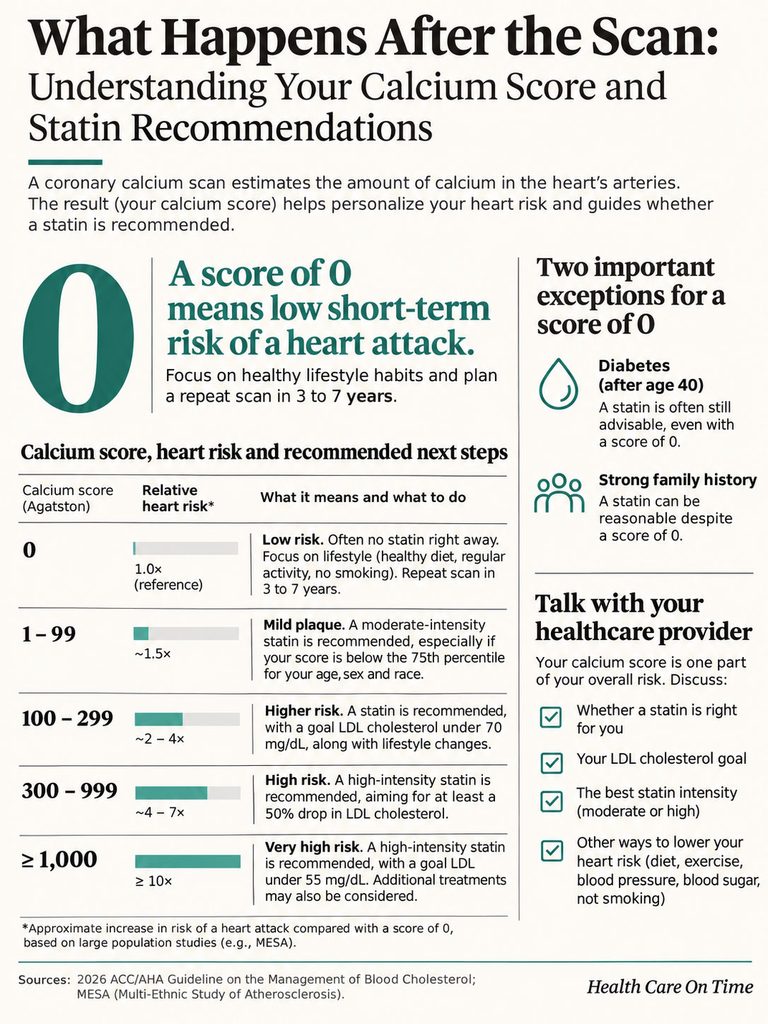
What Happens After the Scan
| Your situation | What usually comes next | A question to ask |
| Score 0, no higher-risk conditions | Lifestyle focus; statin deferred; repeat scan in 3 to 7 years | When should the scan be repeated? |
| Score 0 with diabetes, smoking, LDL 190+ or strong family history | Statin still usually advised | Which of these outweighs the zero? |
| Score 1 to 99, below 75th percentile | Moderate-intensity statin reasonable; LDL goal under 100 | Is lifestyle alone an option at this percentile? |
| Score 100 to 299 or 75th percentile and up | Statin recommended; LDL goal under 70 | What dose, and when is LDL rechecked? |
| Score 300 to 999 | At least 50% LDL drop; goal under 70, possibly under 55 | Does ezetimibe or another add-on make sense? |
| Score 1,000 or higher | Very high risk; LDL goal under 55 | Is a stress test or other testing needed? |
| Already on a statin, score went up | Usually no change; LDL is the measure to follow | Why aren’t repeat scans useful now? |
The 2018 guideline had dropped numeric LDL targets in favor of percentage drops, and the 2026 version restores them: under 100 mg/dL for borderline or intermediate risk, under 70 mg/dL for high risk, and under 55 mg/dL for people with very high-risk heart disease. Non-HDL cholesterol goals sit 30 mg/dL higher than the matching LDL goal, so an LDL goal of 70 pairs with a non-HDL goal of 100.
Statin intensity is defined by how much the drug lowers LDL. A moderate-intensity statin cuts it by 30% to 49%, which usually means atorvastatin 10 to 20 mg or rosuvastatin 5 to 10 mg. High intensity cuts it by 50% or more, typically atorvastatin 40 to 80 mg or rosuvastatin 20 to 40 mg. Your prescriber picks the drug and dose and later rechecks your cholesterol blood test against the goal.
Side effects are the most common reason people stop. Muscle aches and statin fatigue get the most attention, and blood tests can help sort out whether the statin is really to blame. Switching drugs or doses works for many people, and non-statin options exist for those who truly can’t tolerate any statin. Diet, activity and not smoking stay part of the plan at every score, with or without medicine.
If you’d rather not take a statin even with a score above 0, say so plainly. Your doctor may suggest working harder on blood pressure and diet, rechecking cholesterol, and coming back to the question later. Waiting is a legitimate path at low scores, as long as the follow-up actually happens and the question gets revisited.
Questions to Ask Your Doctor
Bring the full report, including the percentile, to the appointment. Some questions to take along:
- Where does this score fall for people of the same age and sex, and does that change your advice?
- Heart disease runs in the family. Does a zero still mean waiting on a statin?
- What LDL number are we aiming for, and when do we check it?
- If a statin starts now, should a higher calcium score later worry us?
- Has Lp(a) been tested? If not, should it be?
- Is this score enough, or do you want a stress test or another heart test too?
Frequently Asked Questions
If your calcium score is zero, do you need a statin?
Often not right away. Under the 2026 ACC/AHA guideline, a score of 0 makes it reasonable to defer a statin if you’re at borderline or intermediate risk, prefer lifestyle changes first and have no higher-risk conditions. Those conditions are LDL of 190 mg/dL or more, familial hypercholesterolemia, diabetes after age 40, current smoking and a strong family history of early heart disease. Plan on a repeat scan in 3 to 7 years.
What is the average calcium score for a 65-year-old?
There isn’t one average that fits everyone, because calcium varies by sex and race. MESA data show most men have some calcium by their early 60s, while most women don’t reach that point until their early 70s. So a typical 65-year-old man has a score above 0, and many 65-year-old women still score 0. Your report’s percentile compares you with people of the same age, sex and race. A score at or above the 75th percentile is treated like a score of 100 or more, even if the raw number is lower, so ask about the percentile and skip comparing raw numbers with friends.
Do cardiologists recommend a calcium score test?
The 2026 ACC/AHA guideline supports it for men 40 and older and women 45 and older at borderline or intermediate risk when the result would change the statin decision.
Do cardiologists still recommend statins?
They do. The 2026 guideline keeps statins as the first-line cholesterol drug and brings back specific LDL goals, which are lower for people with more calcium.
Is a calcium score of 100 bad?
A score of 100 to 299 means a moderate amount of calcified plaque, and the guideline recommends a statin with an LDL goal under 70 mg/dL. The result deserves action, but it isn’t an emergency and doesn’t mean an artery is blocked.
Does insurance cover a calcium score?
Coverage isn’t consistent, so check with your plan first. The American Heart Association lists a typical cost of $100 to $400.
Do you need a statin with a score between 1 and 10?
Under 75, the guideline treats any score above 0 as a reason to consider a moderate-intensity statin, so a score of 4 or 8 still counts. After 75, a minimal score of 1 to 10 may be handled like a zero, especially when other risks are low.
How often should a calcium score be repeated?
After a score of 0 with treatment deferred, the guideline suggests repeating in 3 to 7 years. Once you’re on a statin, repeat scans aren’t recommended, because statins often raise the score.
Medical disclaimer: This article is for general information and does not replace advice from your own doctor. Calcium score results should be interpreted alongside your full medical history, cholesterol levels and other risk factors. If you have chest pain, shortness of breath or other heart symptoms, seek medical care promptly.
References
- Blumenthal RS, Morris PB, et al. 2026 ACC/AHA/AACVPR/ABC/ACPM/ADA/AGS/APhA/ASPC/NLA/PCNA Guideline on the Management of Dyslipidemia. JACC, March 13, 2026: https://www.jacc.org/doi/10.1016/j.jacc.2025.11.016
- White L. Updated Guidelines on the Management of Dyslipidemia. AFP Community Blog, AAFP, April 6, 2026: https://www.aafp.org/afp/afp-community-blog/updated-guidelines-on-the-management-of-dyslipidemia
- Lin K. Coronary Artery Calcium Is a Common Finding in Older Adults. AFP Community Blog, AAFP, October 2, 2023: https://www.aafp.org/afp/afp-community-blog/coronary-artery-calcium-is-a-common-finding-in-older-adults
- CardioSmart, American College of Cardiology. Coronary Artery Calcium (CAC) Scoring: https://www.cardiosmart.org/topics/high-cholesterol/exams-and-tests/coronary-artery-calcium-scoring
- American Heart Association, Go Red for Women. Coronary Artery Calcium (CAC) Test: https://goredforwomen.org/es/health-topics/heart-attack/diagnosing-a-heart-attack/cac-test
- Harvard Health Publishing. Should I get a calcium score? April 1, 2023: https://www.health.harvard.edu/heart-health/should-i-get-a-calcium-score
- US Preventive Services Task Force. Statin Use for the Primary Prevention of Cardiovascular Disease in Adults. August 23, 2022: https://www.uspreventiveservicestaskforce.org/uspstf/recommendation/statin-use-in-adults-preventive-medication
- Ngamdu KS, et al. Long-term statin therapy is associated with severe coronary artery calcification. PLoS One, 2023: https://pmc.ncbi.nlm.nih.gov/articles/PMC10374064/
- Peng AW, et al. Long-Term All-Cause and Cause-Specific Mortality in Asymptomatic Patients With CAC 1,000 or Higher: Results From the CAC Consortium. JACC: Cardiovascular Imaging, 2019: https://pmc.ncbi.nlm.nih.gov/articles/PMC6745300
- Defining Demographic-Specific Coronary Artery Calcium Percentiles in the Population Aged 75 and Older: The ARIC Study and MESA. Circulation: Cardiovascular Imaging, 2023: https://escholarship.org/uc/item/1vt5h0t0
- HCPLive. Coronary Artery Calcium Prevalence Differs Among People Without Known ASCVD (Tattersall MC, et al., JAMA Internal Medicine), September 25, 2023: https://www.hcplive.com/view/coronary-artery-calcium-prevalence-differs-people-without-ascvd
- Budoff MJ, et al. Coronary Calcium Predicts Events Better With Absolute Calcium Scores Than Age-Sex-Race/Ethnicity Percentiles: MESA. Journal of the American College of Cardiology, 2009: https://scholars.houstonmethodist.org/en/publications/coronary-calcium-predicts-events-better-with-absolute-calcium-sco/
- MESA. CAC Score Reference Values: https://mesa-nhlbi.org/node/51
- EBSCO DynaMed EBM Focus. Top Takeaways From the Updated ACC/AHA Guideline on the Management of Dyslipidemia, 2026: https://about.ebsco.com/clinical-decisions/dynamed-solutions/about/ebm-focus/top-takeaways-updated-accaha-guideline