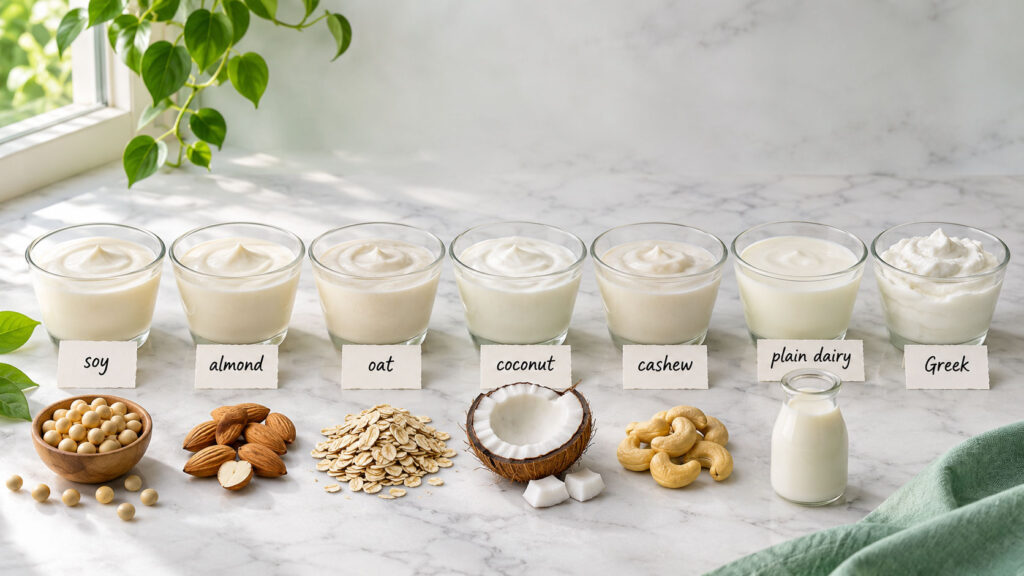
Dairy-free yogurt can be a healthy food, but the plant it’s made from and the label on the cup decide how healthy. Soy versions come close to dairy on protein and calcium, while many coconut and cashew cups are closer to a dessert than a protein snack.
Table of Contents
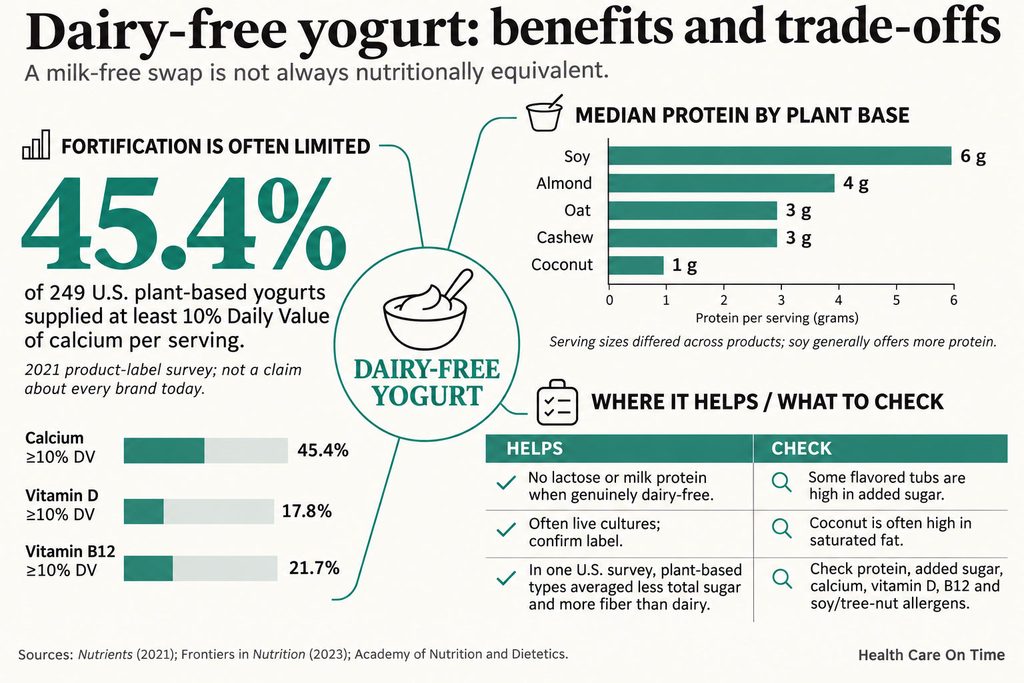
Quick Answer: The main health benefits of dairy-free yogurt are no lactose, no milk protein, more fiber and less total sugar on average than dairy yogurt, plus live cultures in most cups. The trade-off is lower protein, calcium and potassium unless the product is fortified. Unsweetened soy yogurt is the closest match to dairy; coconut yogurt carries the most saturated fat. Read the protein, Added Sugars and calcium lines before you buy.
A plain soy yogurt and a vanilla coconut yogurt can sit side by side in the cooler, both labeled dairy-free and both listing live cultures, and for someone who can’t have milk either one is safe to eat, yet nutritionally they’re barely the same food. The health benefits of dairy-free yogurt are real, but they depend on which cup you pick far more than they do with dairy yogurt, where milk supplies protein and calcium no matter the brand.
What Dairy-Free Yogurt Does Well
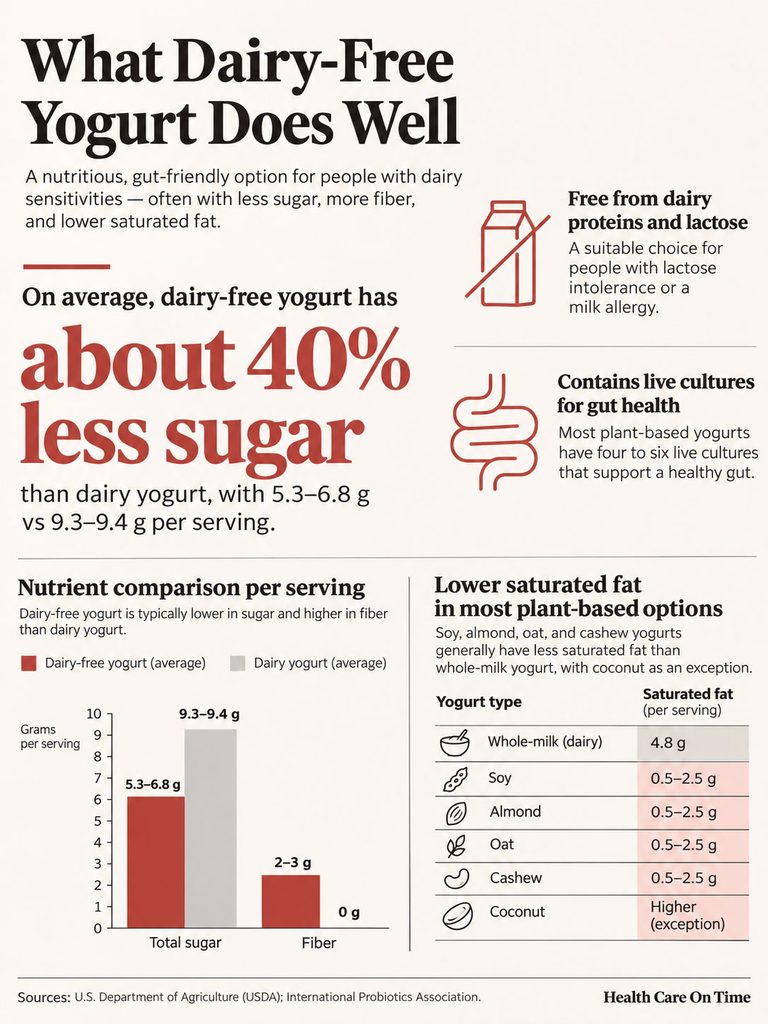
No lactose and no milk protein
For two groups of people the biggest benefit is simple: the food doesn’t make them sick. Lactose intolerance comes from too little lactase, the enzyme that breaks down milk sugar, and it shows up as gas, cramps, bloating and diarrhea. A milk allergy is an immune reaction to milk proteins, and it can run from hives to trouble breathing. Every plant-based yogurt is lactose-free, and one made only from plants has no cow’s milk protein in it.
Lactose-free dairy yogurt solves the sugar problem but keeps the protein. For a milk allergy, lactose-free milk is still off limits, and so is goat’s milk, whose protein is close enough to cow’s milk to cause reactions.
Less sugar and more fiber, on average
When researchers compared 612 regular-style yogurts launched in the US between 2016 and 2021, using the nutrition panels on the packages, the plant-based ones had significantly less total sugar and sodium and more fiber than the dairy ones (D’Andrea and colleagues, 2023). Total sugar averaged 5.3 to 6.8 grams per 100 grams across the plant types, compared with 9.3 to 9.4 grams in dairy.
Part of the dairy figure is lactose, the sugar milk brings with it, so the gap in added sugar is smaller than the gap in total sugar. Fiber is the clearer win: dairy yogurt has essentially none, and many almond yogurts carry 2 to 3 grams a serving.
Live cultures in most cups
Plant-based yogurts are fermented with the same kinds of bacteria that make dairy yogurt tangy, and a label survey of 249 US products counted four to six live cultures per cup on average, among them Streptococcus thermophilus, Lactobacillus acidophilus, Bifidobacterium species, L. rhamnosus and L. casei (Craig and Brothers, 2021).
Fats that are easier on your heart, except coconut
Soy, almond, oat and cashew yogurts are generally low in saturated fat. Median values run from 0.5 gram per serving for soy and 1 gram for almond up to 1.5 grams for cashew and 2.5 grams for oat, while an 8-ounce cup of plain whole-milk yogurt has 4.8 grams in USDA data. The median coconut cup tops even that.
Where Dairy-Free Yogurt Falls Short
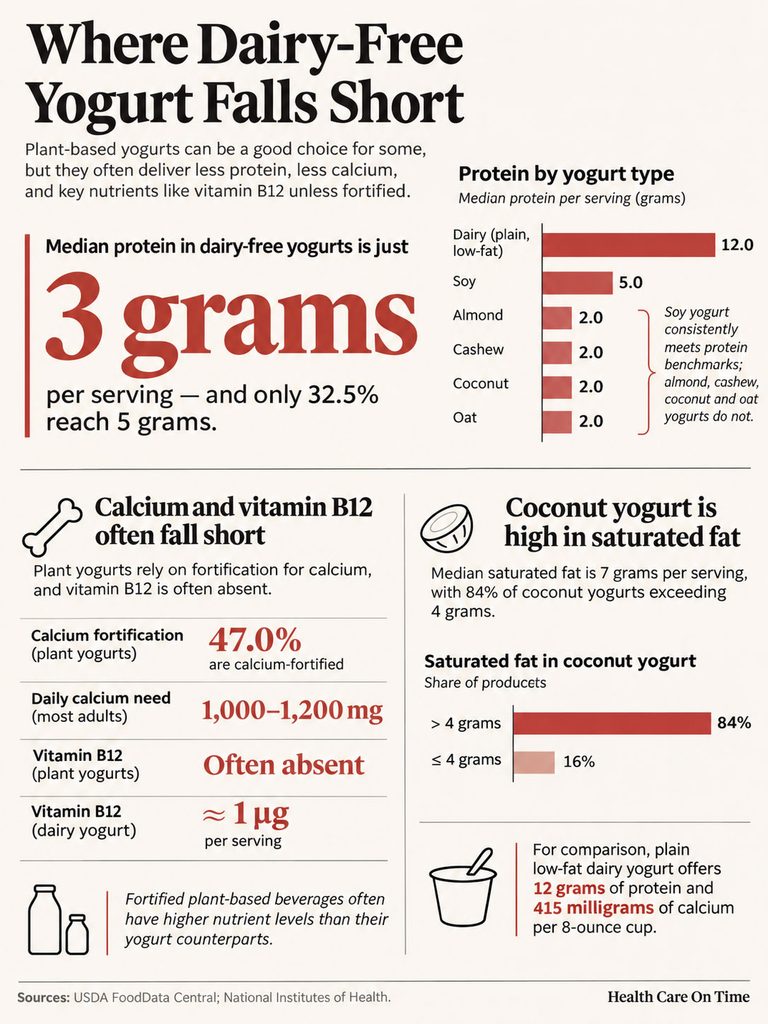
Across those 249 products, median protein was just 3 grams per serving, and only 32.5% reached 5 grams; every soy yogurt cleared that line, 42% of almond yogurts did, and no cashew, coconut or oat yogurt got there. A plain low-fat dairy yogurt gives 12 grams in an 8-ounce cup, and whole-milk yogurt, which the 2025–2030 Dietary Guidelines now welcome as long as it has no added sugars, gives 8 grams along with more saturated fat.
The protein in most plant yogurts is also lower in quality. Soy is the exception among plant proteins, and pea protein has a similar essential amino acid profile, but nut, oat and coconut proteins come up short on some essential amino acids, so they don’t count as complete proteins.
Calcium depends almost entirely on fortification. Milk has it built in, plants mostly don’t, and in the same label survey only 47.0% of plant yogurts were calcium-fortified, 30.9% had vitamin D added and 21.7% had vitamin B12. If you buy a brand’s fortified soy or almond milk, don’t assume its yogurt matches. The beverages were fortified about twice as often as the yogurts, and at higher levels.
An 8-ounce cup of plain low-fat yogurt supplies 415 milligrams of calcium, 32% of the Daily Value. Most adults aged 19 to 50 need 1,000 milligrams a day, and women over 50 and everyone over 70 need 1,200, and people who avoid dairy usually need fortified foods or supplements to get there, with calcium-rich vegan foods such as calcium-set tofu, greens and beans doing the rest.
Vitamin B12 is easy to miss. A serving of dairy yogurt carries about 1 microgram, around 40% of the Daily Value, while most plant yogurts have none unless it’s added, and for vegans that’s one less source in a diet that already has few.
The median coconut yogurt had 7 grams of saturated fat per serving, with a range of 5 to 11.5 grams, and 84% had at least 4 grams; one Greek-style coconut cup checked in January 2026 had 10 grams in 5.3 ounces, half a day’s worth.
Dairy-Free vs Dairy Yogurt, Serving by Serving
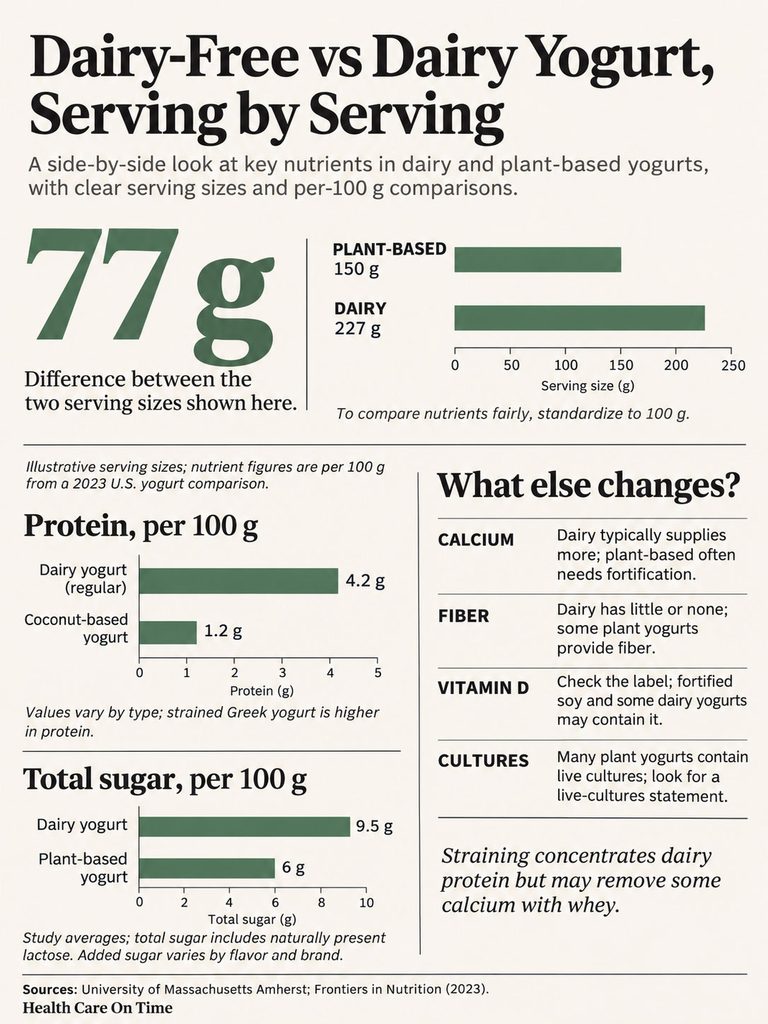
The plant rows in this table are median values per labeled serving from 249 US products. Two-thirds of those labels used a 150-gram serving, about 5.3 ounces, and most of the rest used 170 or 120 grams. The dairy rows use an 8-ounce (227-gram) cup from USDA data. Sugar in the plant rows is total sugar across plain and flavored cups, so an unsweetened cup of the same base will usually come in lower.
| Yogurt type | Serving used | Protein | Calcium | Vitamin D | Fiber | Sugars | Saturated fat | Live cultures |
| Soy (n = 11) | Label serving, mostly 150 g | 6 g | 15% DV | 10% DV | 2 g | 16 g total | 0.5 g | Usually listed (4 to 6 strains on average) |
| Almond (n = 62) | Label serving, mostly 150 g | 4 g | 10% DV | 0% DV | 3 g | 12.5 g total | 1 g | Usually listed |
| Oat (n = 20) | Label serving, mostly 150 g | 3 g | 10% DV | 0% DV | 1 g | 9 g total | 2.5 g | Usually listed |
| Coconut (n = 79) | Label serving, mostly 150 g | 1 g | 6% DV | 0% DV | 2 g | 10 g total | 7 g | Usually listed |
| Cashew (n = 13) | Label serving, mostly 150 g | 3 g | 2% DV | 0% DV | 1 g | 12 g total | 1.5 g | Usually listed |
| Plain whole-milk dairy | 8 oz (227 g) | 8 g | 274 mg (21% DV) | Usually not added | 0 g | 11 g carbs, no added sugar | 4.8 g | Must be made with L. bulgaricus and S. thermophilus |
| Plain low-fat dairy | 8 oz (227 g) | 12 g | 415 mg (32% DV) | Usually not added | 0 g | 16 g carbs, no added sugar | 2.3 g | Same as above |
| Plain Greek dairy | Label serving | 15 to 20 g | Less than regular yogurt | None in Chobani, Siggi’s or Fage plain | 0 g | A few grams less natural sugar than regular | Depends on milk fat | Same as above |
Sources: Craig and Brothers, Nutrients 2021 (plant medians, Greek protein); USDA ARS Home and Garden Bulletin 72 (dairy rows); NIH ODS (calcium Daily Value of 1,300 mg); CSPI 2026 (Greek calcium, sugar and vitamin D brands).
On the dairy side, Greek yogurt has two to three times the protein of regular yogurt, but straining sends some calcium off with the whey, so regular yogurt keeps slightly more. Most dairy yogurt has no vitamin D added at all, even though most milk does, which means switching from dairy yogurt to a fortified soy cup can actually raise your vitamin D intake.
Each Plant Base, One by One
Soy yogurt
Soy is the only plant base that sits near dairy on protein, and the only one whose median cup had vitamin D added. Its protein is the highest quality among common plant proteins, every soy yogurt in the sample had at least 5 grams of it, and the median cup carried 15% of the Daily Value for calcium. In CSPI’s 2026 shelf check, Silk’s soy yogurts had 6 grams of protein and 15% DV calcium, with 4 grams of added sugar in plain and 11 to 12 grams in the flavored cups.
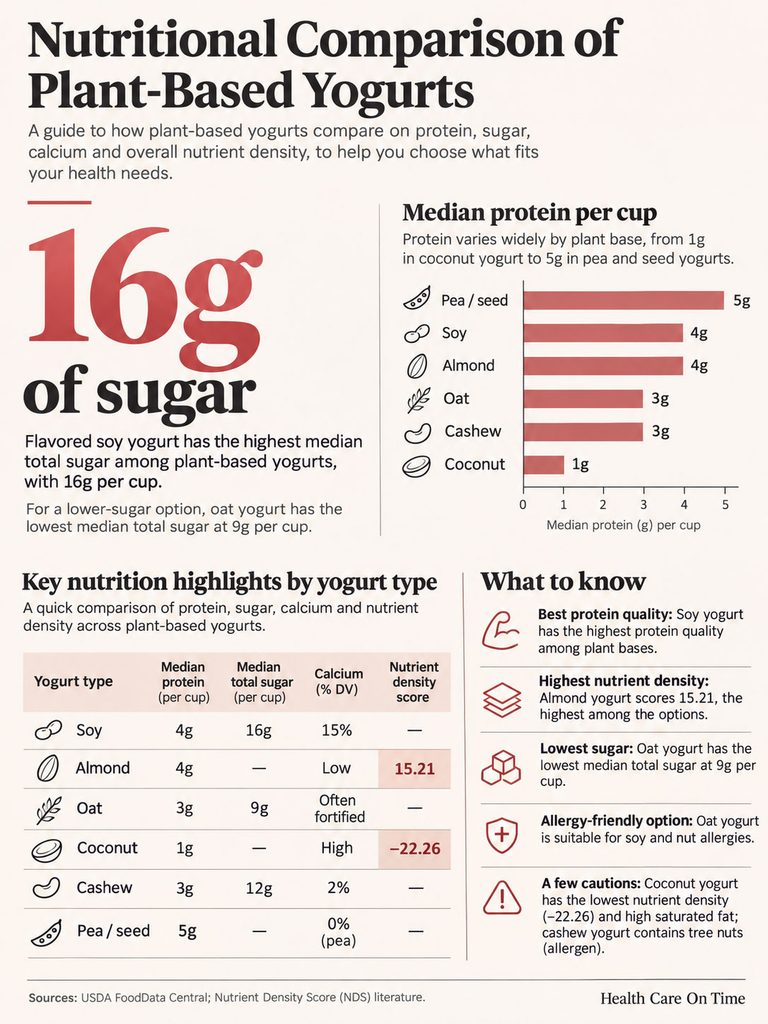
Flavored soy is where the sugar piles up. At 16 grams, soy had the highest median total sugar of any base, which says more about vanilla and fruit cups than about soy itself, and it’s the reason plain soy belongs at the top of the list while flavored soy doesn’t. Anyone with a soy allergy will have to look elsewhere.
Almond yogurt
On a nutrient density score called the Nutrient Rich Foods index, which rewards protein, fiber, calcium and vitamin D and penalizes saturated fat, sugar and sodium, almond yogurt came out on top of every yogurt type in the 2023 comparison, dairy included. It scored 15.21, against 9.95 for oat and 4.79 for low-fat or nonfat dairy, mostly thanks to its fiber and low saturated fat.
Protein is another matter: the median almond cup had 4 grams, fewer than half reached 5, and the “Greek style” almond yogurts that do better often get there with added protein; Kite Hill adds soy protein isolate to its Greek-style line, so read the ingredients if soy is a problem for you, as well as the tree nut warning almond carries.
Oat yogurt
Oat yogurt is lower in fat and calories than almond, and its median total sugar, 9 grams, was the lowest of the main bases. Two-thirds of the oat yogurts were calcium-fortified, but median protein was 3 grams and not one oat cup in the sample reached 5.
Brands that add pea protein get much closer. Icelandic Provisions Oatmilk Skyr reaches 12 grams of protein, while still carrying up to 9 grams of added sugar and coming up short on calcium. For a household avoiding both soy and nuts, oat is often the easiest base to work with.
Coconut yogurt
Coconut yogurt is rich and creamy, and it works against a heart-healthy diet more than any other base. Median protein was 1 gram, median calcium 6% DV, and saturated fat far above the rest; in the 2023 comparison it had the lowest nutrient density score of the six types, negative 22.26.
The 2025–2030 Dietary Guidelines for Americans keep saturated fat at no more than 10% of daily calories, and a coconut cup with 7 to 10 grams uses a big share of that before lunch. Blends of coconut with legumes are a better bet, with median protein of 6 grams and a median of 20% DV calcium, with vitamin D and B12 often added too.
In January 2025 the FDA dropped coconut from the tree nuts that must be declared as a major allergen, so “tree nuts” will gradually disappear from the “Contains” line on coconut yogurt, although coconut still has to be named in the ingredient list and the change doesn’t mean coconut can’t cause a reaction.
Cashew yogurt
Like almond, cashew carries a tree nut allergen warning, and it was among the least fortified bases on the shelf. The median cup had 3 grams of protein, 2% DV calcium, no vitamin D and 12 grams of sugar. Only four cashew products had enough label data to be scored for nutrient density in 2023, and their average landed near full-fat dairy rather than near almond.
Pea and seed bases
Pea protein yogurts and seed-based yogurts were a small slice of the market, yet all of them reached 5 grams of protein. Median calcium in the pea yogurts was 0% DV, so the protein comes without the mineral unless the label says otherwise.
What the Numbers Show Across US Products
The 2021 survey counted fortification and nutrients in 249 plant-based products from US stores, while the 2023 study scored plant and dairy yogurts side by side.
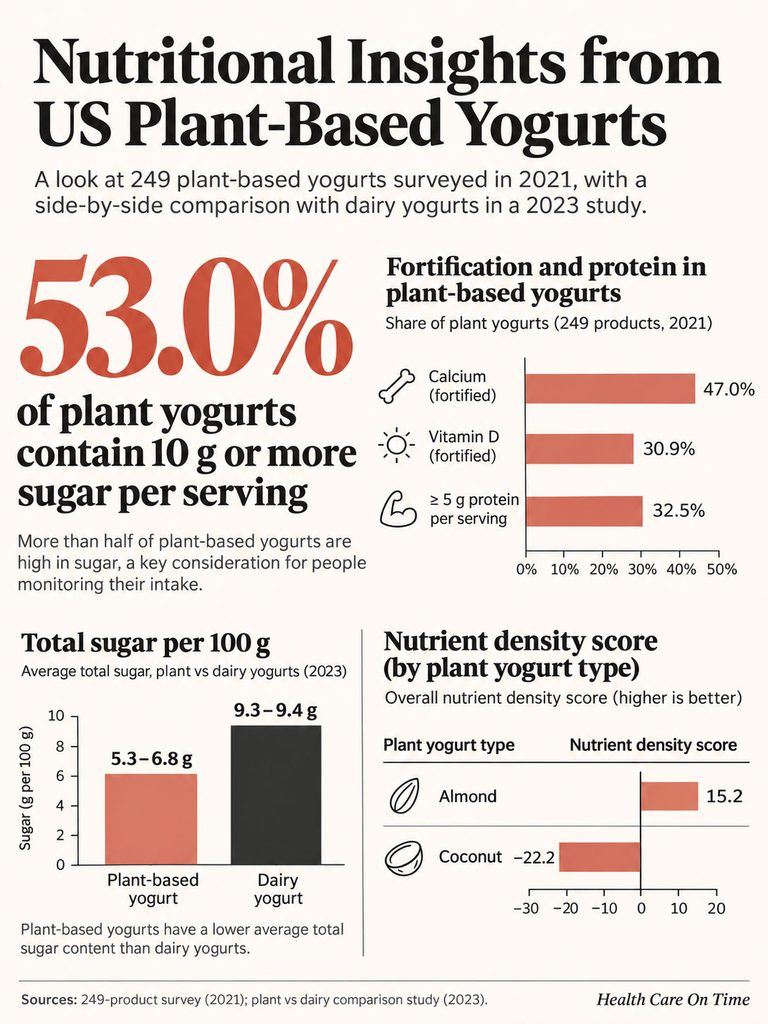
| Finding | Number | Source |
| Plant yogurts fortified with calcium | 47.0% of 249 | Craig and Brothers, Nutrients 2021 |
| Plant yogurts fortified with vitamin D | 30.9% of 249 | Craig and Brothers, Nutrients 2021 |
| Plant yogurts fortified with vitamin B12 | 21.7% of 249 | Craig and Brothers, Nutrients 2021 |
| Plant yogurts with at least 5 g protein per serving | 32.5% | Craig and Brothers, Nutrients 2021 |
| Plant yogurts with 10 g or more sugar per serving | 53.0% | Craig and Brothers, Nutrients 2021 |
| Plant yogurts with 5 g or less sugar per serving | 15.3% | Craig and Brothers, Nutrients 2021 |
| Coconut yogurts with 4 g or more saturated fat | 84% | Craig and Brothers, Nutrients 2021 |
| Average total sugar per 100 g, plant vs dairy | 5.3 to 6.8 g vs 9.3 to 9.4 g | D’Andrea et al., Frontiers in Nutrition 2023 |
| Nutrient density score, highest and lowest | Almond 15.21, coconut negative 22.26 | D’Andrea et al., Frontiers in Nutrition 2023 |
Neither survey tested yogurt in a lab; both read labels and product databases. The 2023 study had to leave 45% of products out of its scoring because their labels lacked vitamin D or potassium values, which US labels didn’t have to show before 2020, and the 2021 survey found online nutrition details sometimes differed from the package, especially for fortification. When the website and the cup disagree, go by the cup.
Live Cultures and Gut Health
Most of what people expect from yogurt’s gut benefits comes from fermentation and the bacteria still alive afterward. Plant-based yogurts use the same kinds of starter cultures, and many add probiotic strains such as L. acidophilus or Bifidobacterium, but some protections on the dairy side don’t carry over.
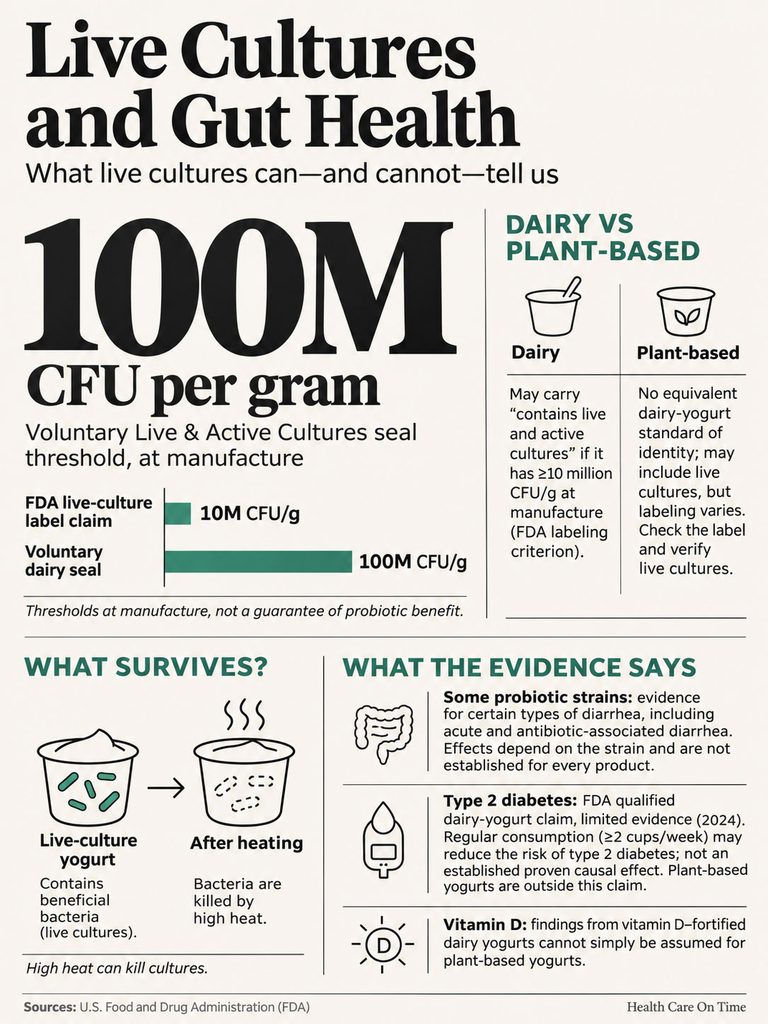
The FDA’s standard of identity for yogurt covers only products made from milk. A dairy yogurt that claims “contains live and active cultures” needs at least 10 million colony-forming units per gram at manufacture and should keep at least 1 million per gram through its shelf life, and one that’s heat-treated after culturing has to say “does not contain live and active cultures” (FDA compliance guide). A plant-based cup sits outside those rules, so its culture list tells you which bacteria went in, not how many are alive on the day you eat it, and keeping cultures alive can be harder in a non-dairy base to begin with.
The Live & Active Cultures seal from the International Dairy Foods Association sets an even higher bar, 100 million cultures per gram at manufacture, but it’s voluntary and built around dairy products, so plenty of good yogurts go without it. Heat kills cultures as well, so a dairy-free yogurt baked into muffins or stirred into a hot curry keeps its protein and calcium but loses its live bacteria.
As for what the bacteria can do, certain probiotics have some evidence behind them for acute diarrhea, antibiotic-associated diarrhea and atopic eczema, while for most other uses strong evidence is lacking and different strains have different effects. Even the evidence on whether yogurt helps diarrhea comes mostly from dairy products with specific strains, so a plant cup with different bacteria can’t borrow those results.
Since March 2024, yogurts that meet the FDA standard may say that eating yogurt regularly, at least 2 cups (3 servings) per week, may reduce the risk of type 2 diabetes, with wording that the evidence is limited; plant-based yogurts don’t meet that standard, so they can’t use the claim.
Studies cited in the 2021 review found vitamin D-fortified yogurt improved vitamin D status, blood lipids and blood glucose, and while that work doesn’t prove a plant yogurt will do the same, it’s one more reason to choose a cup with vitamin D added.
How to Read a Dairy-Free Yogurt Label
The Nutrition Facts panel and the ingredient list answer almost every question you’ll have, in roughly this order.
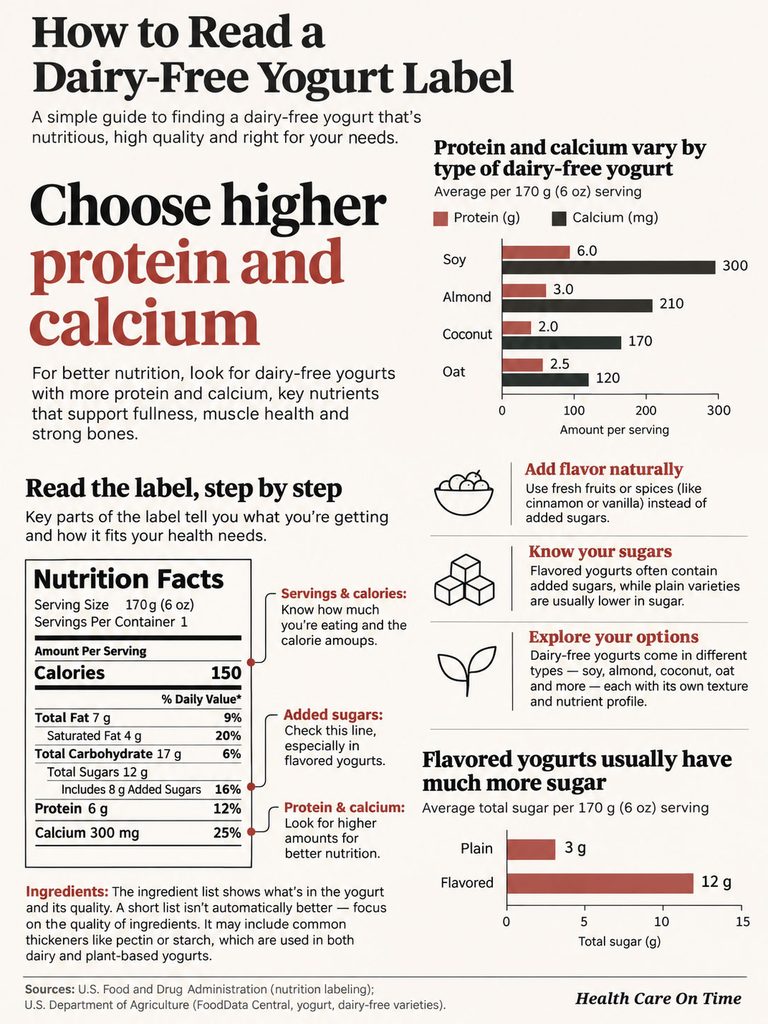
- Serving size. Most cups list 150 grams (about 5.3 ounces), but some use 170 or 120 grams. Compare products at the same serving before you compare anything else.
- Protein. Aim for at least 5 grams, the level that puts a plant cup in line with low-fat dairy in CSPI’s ratings. Soy, pea and legume blends usually clear it, and coconut, oat and cashew usually don’t unless protein is added.
- Added Sugars. Look under Total Sugars for “Includes X g Added Sugars.” The Daily Value for added sugars is 50 grams; 5% DV or less is low and 20% DV or more is high. Top-rated yogurts have 0 grams, a second tier allows up to 8 grams (about 2 teaspoons), and for dairy snacks such as yogurt the 2025–2030 Dietary Guidelines point to no more than 2.5 grams per 2/3-cup equivalent. With diabetes, the best yogurt for diabetics is usually the one with 0 grams here, whatever it’s made from.
- Calcium and vitamin D. Find each %DV near the bottom of the panel. Treat 8% DV calcium as the floor and 10% DV or more as better, and soy cups often reach 15%. A 0% for vitamin D means getting it somewhere else.
- Saturated fat. A limit of 2.5 grams or less per serving rules out most coconut yogurts and also whole-milk dairy.
- Vitamin B12. If you eat no animal foods at all, a cup with B12 added helps.
- Cultures. Look for named strains in the ingredients, such as S. thermophilus, L. bulgaricus, L. acidophilus or Bifidobacterium, remembering that the FDA culture-count rule covers dairy yogurt only.
- Allergens. Check the “Contains” statement for soy and tree nuts, and with a milk allergy watch for lines like “made in a facility that also processes milk.” Coconut now shows up only in the ingredient list.
- Sweeteners and dyes. Skip cups sweetened with sucralose or acesulfame potassium, or colored with food dyes. CSPI accepts stevia, monk fruit and allulose for adults but recommends no low-calorie sweetener for children.
Thickeners such as pectin and starches turn up in dairy and plant yogurts alike, so a short ingredient list in a dairy-free yogurt isn’t automatically better than a longer one with more protein and calcium. If plain soy or almond tastes too sour at first, stirring in fresh berries, sliced banana or a little cinnamon adds flavor without the added sugar of a vanilla cup.
Dairy-Free, Lactose-Free and Greek: Not the Same Thing
Dairy-free yogurt contains no milk at all; it’s made from soy, nuts, oats, coconut, peas or seeds and fermented with cultures.
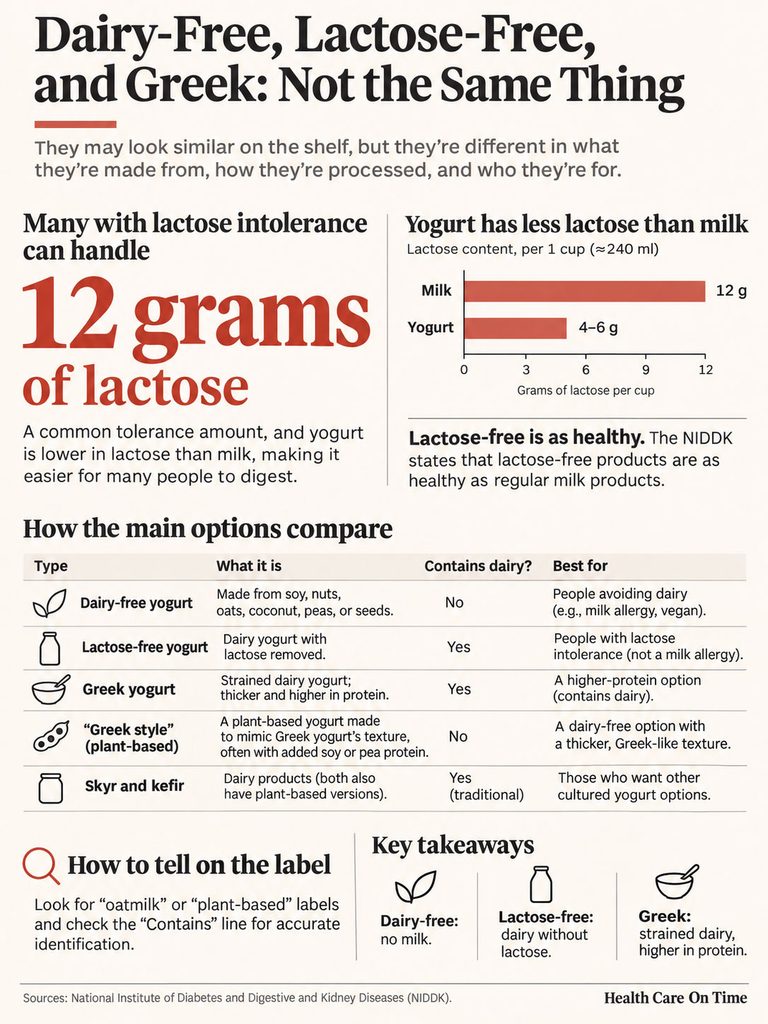
Lactose-free yogurt is real dairy yogurt with the lactose broken down or removed, so it still contains milk protein and works for lactose intolerance but not for a milk allergy. The NIDDK calls lactose-free and lactose-reduced products just as healthy as regular milk products. Many people with lactose intolerance can handle 12 grams of lactose, about what’s in a cup of milk, with mild symptoms or none, and yogurt is lower in lactose than milk, so plain dairy yogurt is often worth a careful try.
Greek yogurt is dairy yogurt strained to remove whey. It’s thicker, higher in protein and a little lower in lactose than regular yogurt, but it’s made from milk and isn’t dairy-free. On a plant-based cup, “Greek style” describes the texture, and those products are often boosted with soy or pea protein to match it.
Skyr, the strained Icelandic-style yogurt, and kefir, a drinkable fermented milk, are dairy foods too, even when the package looks nothing like a regular yogurt cup. Plant-based versions of both exist (the oat skyr mentioned earlier is one), so words like “oatmilk” or “plant-based” on the front, and the “Contains” line on the back, are what tell you which kind you’re holding.
Which Yogurt Fits Your Situation
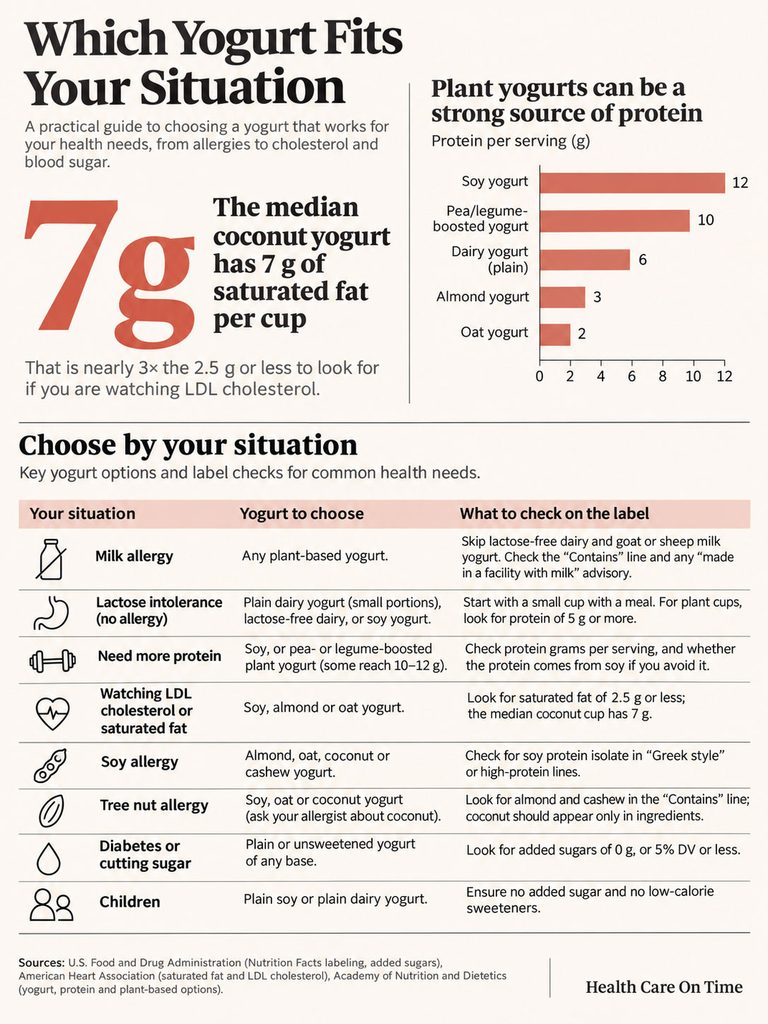
| Your situation | Best fit | What to check on the label |
| Milk allergy | Any plant-based yogurt; skip lactose-free dairy and goat or sheep milk yogurt | “Contains” line and any “made in a facility with milk” advisory |
| Lactose intolerance, no allergy | Plain dairy yogurt in small portions, lactose-free dairy, or soy yogurt | Start with a small cup with a meal; for plant cups, protein of 5 g or more |
| Need more protein | Soy, or pea- or legume-boosted plant yogurt (some reach 10 to 12 g) | Protein grams per serving, and whether protein comes from soy if you avoid it |
| Watching LDL cholesterol or saturated fat | Soy, almond or oat yogurt | Saturated fat of 2.5 g or less; the median coconut cup has 7 g |
| Soy allergy | Almond, oat, coconut or cashew yogurt | Soy protein isolate in “Greek style” or high-protein lines |
| Tree nut allergy | Soy, oat or coconut yogurt (ask your allergist about coconut) | Almond and cashew in the “Contains” line; coconut appears only in ingredients |
| Diabetes or cutting sugar | Plain or unsweetened yogurt of any base | Added Sugars of 0 g, or 5% DV or less |
| Children | Plain soy or plain dairy yogurt | No added sugar and no low-calorie sweeteners |
When to Talk to a Doctor or Dietitian
Trading one yogurt for another carries little risk, but giving up dairy altogether is a bigger change, especially for children, pregnant women, older adults and anyone with bone loss. The 2025–2030 Dietary Guidelines recommend three servings of dairy a day for most people and advise periodic checks for vegans, whose diets may fall short in calcium and vitamin D, and because fortification varies so much from cup to cup, a dietitian can help if most of your yogurt, milk and cheese now come from plants.
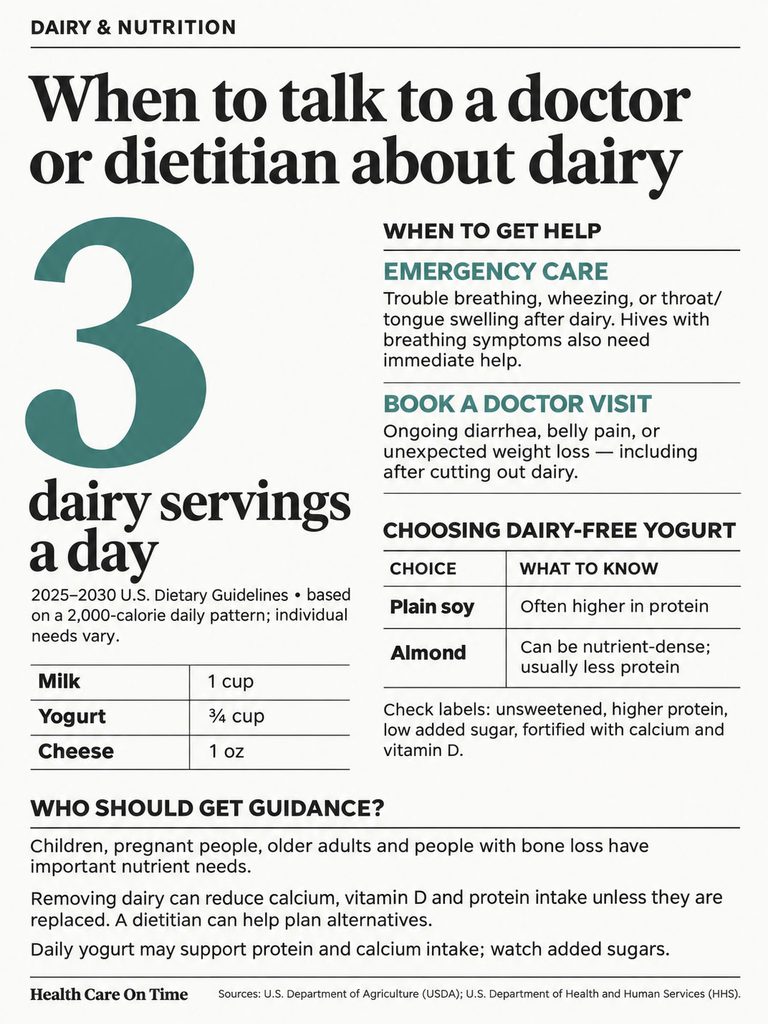
Get emergency care for hives, swelling of the lips or tongue, wheezing or trouble breathing after eating, since a milk or nut allergy can be life-threatening. Diarrhea, belly pain or weight loss that continues after cutting dairy deserves a visit too, because those symptoms can come from something other than lactose intolerance.
Some questions to take along:
- Is a lactose breath test worth doing, or is cutting dairy for a while enough?
- Are “may contain milk” yogurts off limits for a child with a milk allergy?
- Once dairy is gone, how much calcium and vitamin D should come from other foods or pills?
- Does a fully vegan diet mean taking a B12 supplement?
- Is coconut yogurt safe with a tree nut allergy, or is allergy testing needed first?
Frequently Asked Questions
Is dairy-free yogurt actually good for you?
Yes, when the label checks out. Unsweetened soy yogurt, or any plant yogurt with at least 5 grams of protein, low added sugar and added calcium and vitamin D, gives you live cultures and some fiber along with real nutrition. Many flavored coconut and cashew cups are low in protein and calcium and high in sugar or saturated fat, so the label decides.
What is the healthiest dairy-free yogurt to eat?
For most people, plain soy yogurt fortified with calcium and vitamin D is the closest match to dairy. Almond yogurt ranked highest on one nutrient density score thanks to its fiber and low saturated fat, but its protein is lower. If you avoid soy, look for an almond or oat yogurt boosted with pea protein and fortified with calcium.
What happens if you start eating yogurt every day?
You’ll add protein, calcium (if it’s dairy or fortified) and live cultures to your diet. For dairy yogurt, the FDA allows a qualified claim that at least 2 cups a week may lower type 2 diabetes risk, based on limited evidence. A daily cup with 10 or more grams of added sugar adds up to a large share of the 50-gram Daily Value over a week, so plain is the better habit.
What does cutting out dairy do to your body?
If lactose or milk protein bothers you, cutting dairy usually stops the gas, cramps, bloating or allergic symptoms. The risk is falling short on calcium, vitamin D, protein, potassium and B12, all of which dairy supplies easily. Fortified plant foods, calcium-set tofu, leafy greens and beans can fill those gaps, and a dietitian can help you check your intake.
Is Greek yogurt dairy-free?
No. Greek yogurt is strained cow’s milk yogurt, so it has milk protein and some lactose. It isn’t safe with a milk allergy, though some lactose-intolerant people handle it well.
Does dairy-free yogurt have probiotics?
Most plant-based yogurts are fermented with live cultures and list four to six strains on average. The FDA’s live-culture rule applies to dairy yogurt only, so a plant label doesn’t promise a minimum count by the time you eat it.
Is coconut yogurt bad for you?
Coconut yogurt is the weakest base nutritionally, though a cup now and then isn’t harmful. The median cup has 7 grams of saturated fat and 1 gram of protein, and it ranked lowest on nutrient density in a 2023 study. Keep it occasional, or pick a coconut-legume blend with more protein.
Is dairy-free yogurt better for weight loss?
Plant yogurts aren’t lower in calories across the board. The median plant yogurt in the 2021 survey had 150 calories per serving, and coconut types were the most energy dense in 2023. Compare calories, protein and added sugar per serving rather than the plant pictured on the front of the cup.
Medical disclaimer: This article is for general information only and isn’t a substitute for advice from your doctor, allergist or registered dietitian. Food allergies can cause severe reactions. Always read the current product label, since formulas and fortification change, and talk with a health professional before making major changes to your diet.
References
- Craig WJ, Brothers CJ. Nutritional Content and Health Profile of Non-Dairy Plant-Based Yogurt Alternatives. Nutrients. 2021;13(11):4069. https://pmc.ncbi.nlm.nih.gov/articles/PMC8619131/
- D’Andrea AE, Kinchla AJ, Nolden AA. A comparison of the nutritional profile and nutrient density of commercially available plant-based and dairy yogurts in the United States. Frontiers in Nutrition. 2023;10:1195045. https://www.frontiersin.org/journals/nutrition/articles/10.3389/fnut.2023.1195045/full
- Center for Science in the Public Interest. The best dairy and plant-based yogurt: 10 things to know (updated January 2026). https://www.cspi.org/article/best-dairy-and-plant-based-yogurt-10-things-know
- US Department of Agriculture, Agricultural Research Service. Nutritive Value of Foods, Home and Garden Bulletin 72. https://www.canr.msu.edu/uploads/236/66640/hg72_2002.pdf
- NIH Office of Dietary Supplements. Calcium: Fact Sheet for Health Professionals. https://ods.od.nih.gov/factsheets/Calcium-Healthprofessional/
- US Food and Drug Administration. Yogurt standard of identity: Small Entity Compliance Guide. https://fda.gov/media/174050/download
- US Food and Drug Administration. FDA Announces Qualified Health Claim for Yogurt and Reduced Risk of Type 2 Diabetes (March 1, 2024). https://www.fda.gov/food/hfp-constituent-updates/fda-announces-qualified-health-claim-yogurt-and-reduced-risk-type-2-diabetes
- US Food and Drug Administration. Added Sugars on the Nutrition Facts Label. https://www.fda.gov/food/nutrition-facts-label/added-sugars-new-nutrition-facts-label
- US Departments of Agriculture and Health and Human Services. Dietary Guidelines for Americans, 2025–2030. https://sandovalextension.nmsu.edu/documents/Dietary-Guidelines-for-Americans-2025-2030.pdf
- National Institute of Diabetes and Digestive and Kidney Diseases. Eating, Diet, and Nutrition for Lactose Intolerance. https://www.niddk.nih.gov/health-information/digestive-diseases/lactose-intolerance/eating-diet-nutrition
- Food Allergy Research and Education. Milk Allergy vs. Lactose Intolerance. https://www.foodallergy.org/resources/milk-allergy-vs-lactose-intolerance
- Food Allergy Research and Education. Update to FDA Guidance for Food Allergen Labeling (February 2025). https://www.foodallergy.org/fare-blog/update-fda-guidance-food-allergen-labeling
- Institute of Child Nutrition. Family Child Care Food Allergy Fact Sheets: Milk Allergies (2024). https://theicn.org/resources/1797/family-child-care-food-allergy-fact-sheets/123135/family-child-care-food-allergy-fact-sheets-milk-allergies.pdf
- International Dairy Foods Association. Live and Active Cultures Seal. https://idfa.org/live-active-cultures-seal
- National Center for Complementary and Integrative Health. 5 Things To Know About Probiotics. https://nccih.nih.gov/health/tips/probiotics