Most babies have no side effects at all from the RSV shot, and the ones who do usually get a little redness or swelling on the thigh, or a mild rash that fades on its own. Serious reactions are rare. What helps most is knowing which product your baby is getting, because the infant shot and the pregnancy vaccine behave differently.
Table of Contents
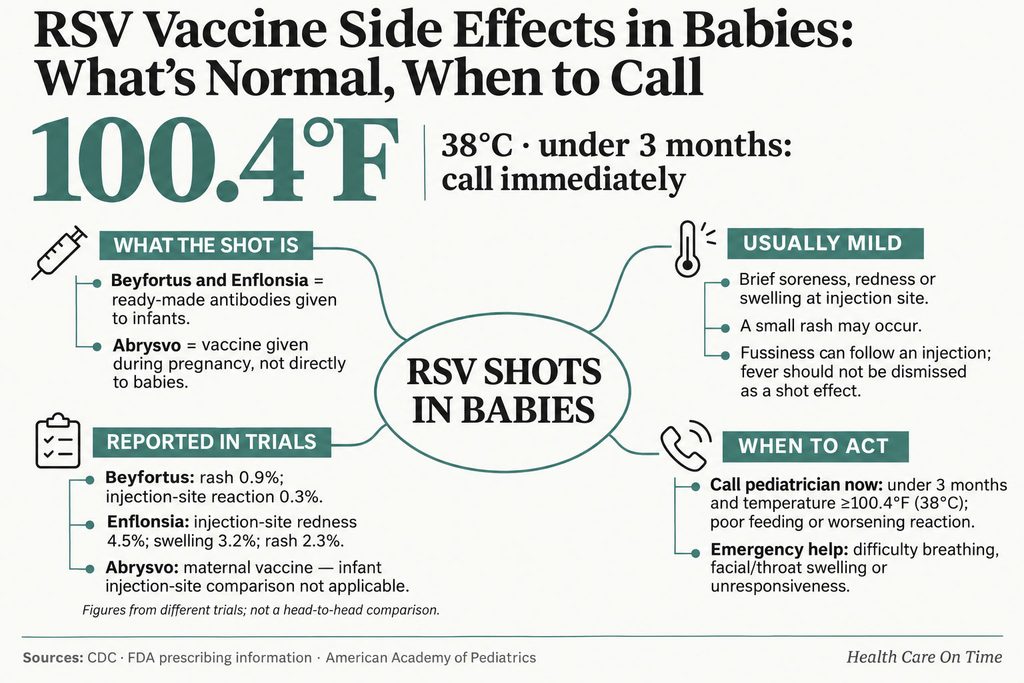
Quick answer: In US babies, the “RSV vaccine” is usually an antibody shot, Beyfortus (nirsevimab) or Enflonsia (clesrovimab). In FDA trials, rash showed up in 0.9% to 2.3% of babies and redness or swelling in under 4%, close to placebo rates. Fussiness and sleepiness were just as common after a placebo shot. Call your pediatrician for a fever of 100.4°F or higher in a baby 3 months or younger, and call 911 for hives with trouble breathing.
First, Which “RSV Vaccine” Your Baby Actually Gets
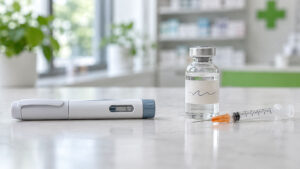
Plenty of parents and even clinic staff call it the RSV vaccine, but the shot given to babies in the United States is a long-acting monoclonal antibody. A vaccine teaches the body to make its own antibodies. An antibody shot skips that step and hands the baby ready-made antibodies, a process called passive immunization: the baby receives protection instead of building it.
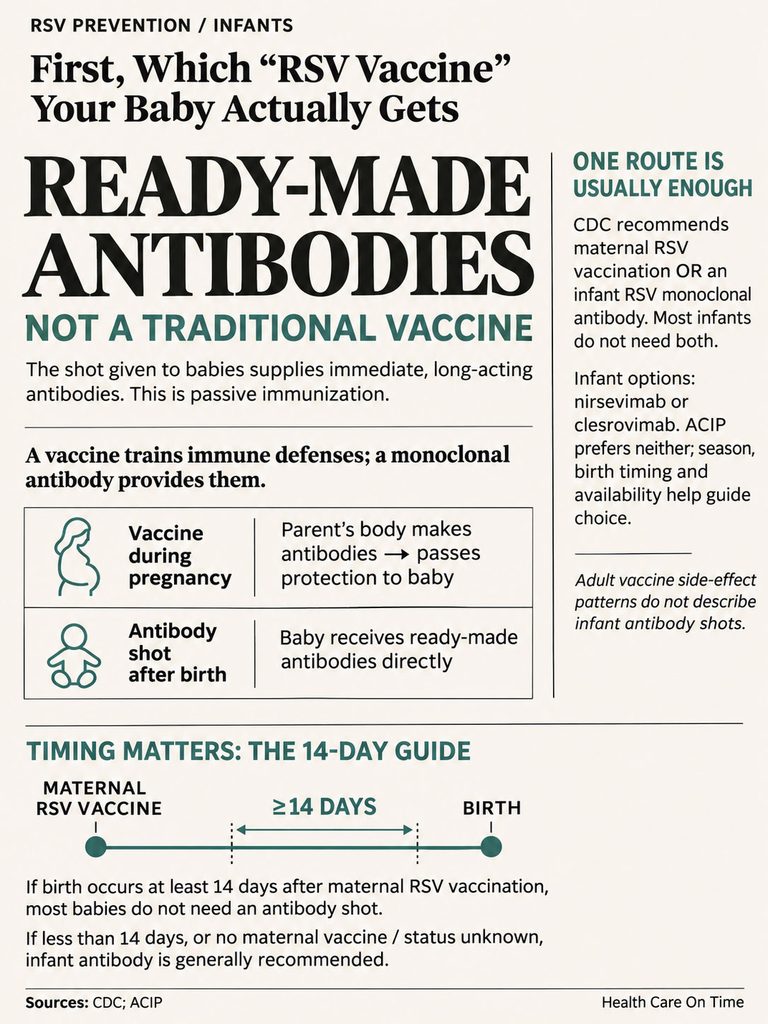
Because the baby’s immune system isn’t being trained, the typical “vaccine day” symptoms adults get after their own RSV shots (headache, tiredness, aching muscles) mostly don’t apply to a baby getting the antibody.
Every baby can be protected by either a vaccine given during pregnancy or an antibody given after birth, and CDC recommends one route or the other for all infants. In the US that means one of these:
- Beyfortus (nirsevimab), approved by FDA in 2023. It’s the only antibody also used for some higher-risk toddlers in their second RSV season.
- Enflonsia (clesrovimab), made by Merck. FDA licensed it in June 2025, and the CDC’s vaccine advisers recommended it on June 26, 2025 as an equal alternative.
- Abrysvo, Pfizer’s vaccine, given to the pregnant parent at 32 through 36 weeks so antibodies cross the placenta.
Most babies need only one. If the vaccine was given at least 14 days before birth, the baby generally doesn’t need the antibody shot.
No single product is preferred under the ACIP recommendation, so the choice usually comes down to your due date, the season and what your clinic stocks.
Side Effects Side by Side: Beyfortus, Enflonsia and Abrysvo
A sore, red spot after a placebo injection is common, so the only fair way to see what a product adds is to put its rate next to the placebo rate from the same trial, as the FDA labels do. For Abrysvo, the parent’s own reactions are listed apart from the preterm-birth caution, since only the caution concerns the baby.
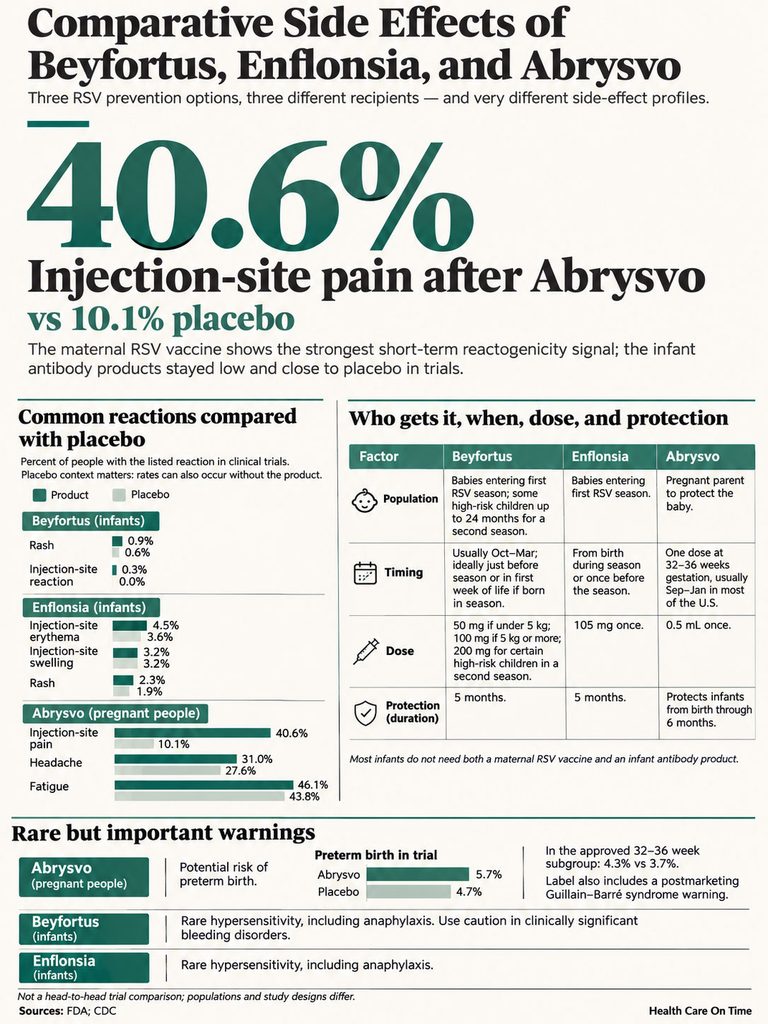
| What to compare | Beyfortus (nirsevimab) | Enflonsia (clesrovimab) | Abrysvo (pregnancy vaccine) |
| Who gets it | Babies under 8 months in their first RSV season; some higher-risk children 8 to 19 months in their second | Babies under 8 months in their first RSV season | Pregnant parent at 32 through 36 weeks |
| Usual timing in most of the US | October through March, or within 1 week of birth for babies born in that window | October through March, or within 1 week of birth for babies born in that window | September through January |
| Dose | 50 mg if under 5 kg (about 11 pounds), 100 mg if 5 kg or more; 200 mg in a second season | One 105 mg shot at any weight | One dose |
| Common side effects, product vs placebo | Rash within 14 days: 0.9% vs 0.6%. Injection-site reaction within 7 days: 0.3% vs 0% | Redness 3.8% vs 3.3%. Swelling 2.7% vs 2.6%. Rash within 14 days: 2.3% vs 1.9% | In the parent: arm pain 40.6% vs 10.1%, fatigue 46.1% vs 43.8%, headache 31.0% vs 27.6%, muscle pain 26.5% vs 17.1% |
| Window in which reactions were counted | Site reactions 7 days, rash 14 days | Site reactions days 1 to 5, rash 14 days | 7 days after the shot |
| Rare but serious risk | Serious allergic reactions reported after approval (hives, trouble breathing, bluish skin, floppiness); caution with bleeding disorders | Allergic reactions seen with similar antibodies; can cause a false-negative rapid RSV antigen test | For the baby: preterm births 5.7% vs 4.7% in the main trial, the reason for the 32 to 36 week window. For the parent: a Guillain-Barré syndrome warning based on data in adults 65 and older |
| How long protection lasts | At least 5 months | At least 5 months | About 6 months after birth |
Sources: Beyfortus label, Enflonsia label, Abrysvo label, and CDC for timing and protection.
Most babies who get the antibody have no reaction at all, or a red spot on the leg. The larger percentages in that table belong to the pregnant parent getting Abrysvo.
Normal Reactions After the Baby RSV Shot
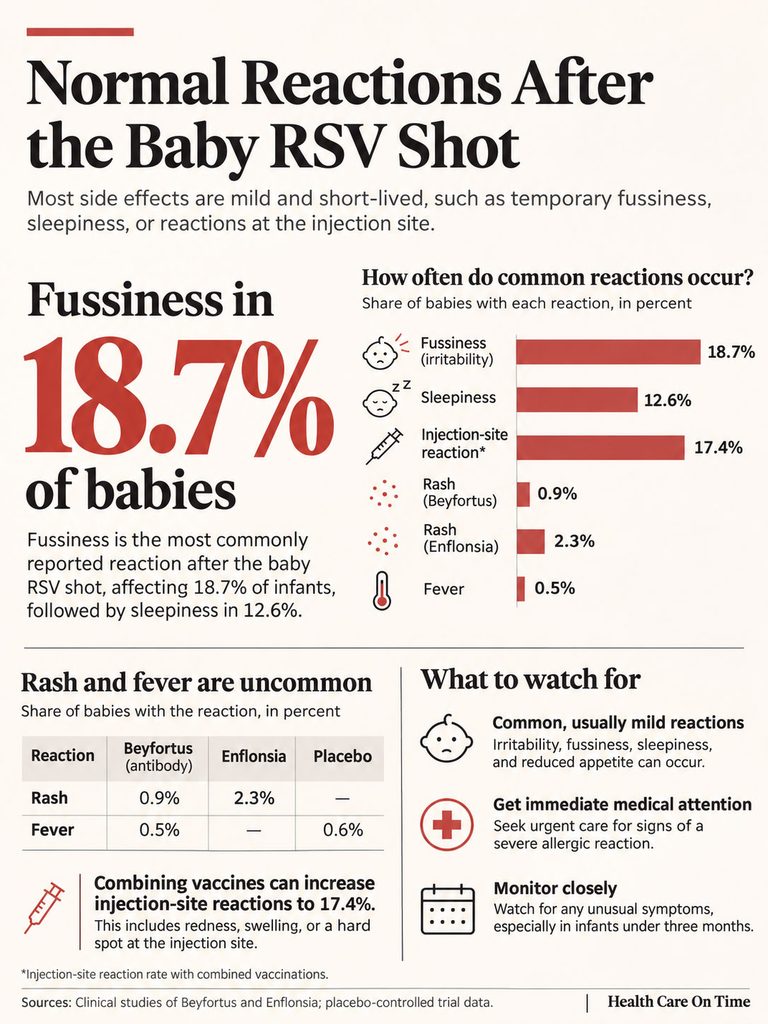
The antibody is injected into a muscle, usually in the thigh, and nearly everything parents notice afterward is one of the reactions below. Other vaccines given at the same visit change the picture a little.
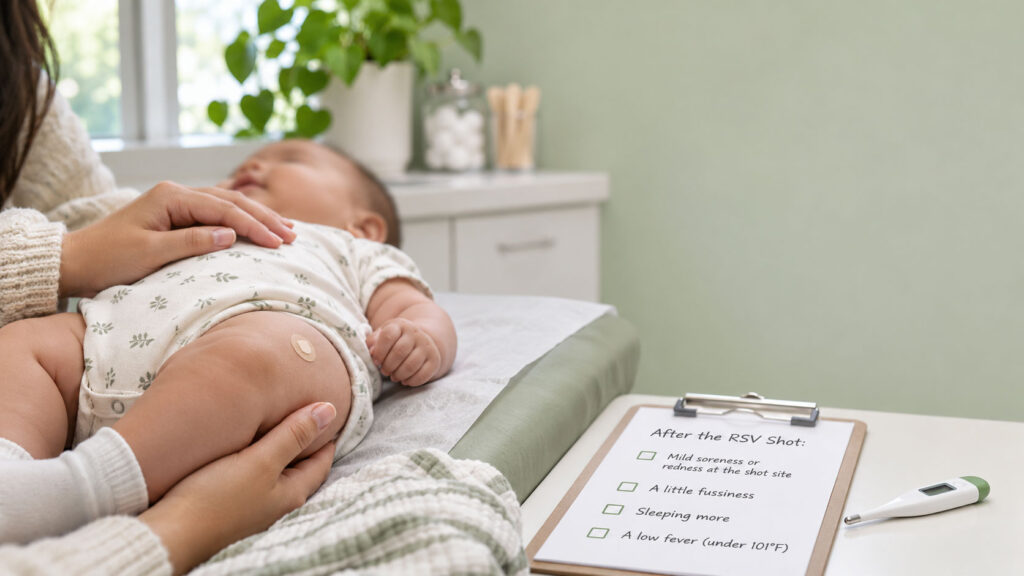
Redness, swelling or a hard spot on the thigh
A pink patch, mild puffiness or a firm little bump where the needle went in is the most common thing parents see. In the Beyfortus trials, an injection-site reaction was recorded in 0.3% of babies within a week, against none in the placebo group. Enflonsia’s label lists redness in 3.8% and swelling in 2.7% during the first five days, with placebo rates of 3.3% and 2.6%; nearly all of that redness comes from the needle and the fluid, since babies given a dummy shot had almost as much.
CDC’s safety page names “pain, redness, hardness, or swelling where shot is given” as the usual local effects. A baby can’t point to a sore leg, so you may notice it as crying when you change a diaper or press on that thigh.
A loose diaper and a cool, clean washcloth for a few minutes can make the area more comfortable.
Rash
Rash is the side effect that shows up most clearly in the antibody data. With Beyfortus it appeared within 14 days in 0.9% of babies versus 0.6% on placebo; with Enflonsia it was 2.3% versus 1.9%. These rashes are usually flat, pink or red, and mild.
A rash that is spreading, raised like welts, or paired with swelling of the face or any breathing change is a different situation. Hives, puffy eyes or lips and a change in breathing are the classic signs of an allergic reaction in a baby, whatever set it off, and they need help fast.
Fever
Fever after the antibody is uncommon: 0.5% of healthy babies in the pooled nirsevimab trials ran a fever, compared with 0.6% on placebo. In the large Enflonsia trial published in the New England Journal of Medicine, fever in the first five days was 0.5% with the antibody and 1.2% with placebo.
So a fever after the RSV shot is more likely to come from something else, such as a cold or the flu going around the house, or the other vaccines given that day. For babies 3 months and younger, any rectal temperature of 100.4°F (38°C) or higher deserves a call to the pediatrician right away, no matter what you suspect.
Fussiness and sleepiness
Plenty of babies have a cranky evening after the visit, and the trial data show how often that happens after a dummy shot too. In the Enflonsia trial, irritability in the first five days was reported in 18.7% of babies who got clesrovimab and 19.7% of babies who got placebo; sleepiness was 12.6% versus 14.2%, and eating less was 4.4% versus 5.1%.
About one baby in five is fussy after a needle and a clinic visit, even when the syringe holds nothing active. A day of extra crying, longer naps or a slightly smaller appetite is ordinary. A baby who won’t feed, is hard to wake, or has far fewer wet diapers than usual needs a call.
When the RSV shot is given with other vaccines
Babies born outside the RSV season often get the antibody at a well visit, alongside routine shots, and the ACIP recommendation allows RSV antibodies to be given at the same visit as routine childhood vaccines.
Canada tracked this closely during the 2024 to 2025 season. Parents of 1,559 infants filled out questionnaires a week after the shot (the study was later published in Human Vaccines & Immunotherapeutics). Injection-site reactions showed up in 5.5% of babies who got nirsevimab alone and in 17.4% of those who also got routine vaccines the same day, and fever was 1.4% versus 2.0%. Cough, congestion, diarrhea and vomiting were about twice as common with the combined visit, which fits with more shots producing more reactions.
How Long RSV Shot Side Effects Last
The trials only tracked site reactions for 5 to 7 days and rash for 14 days, because these reactions are expected to start and settle inside that window. In the Canadian study, the largest share of new symptoms began 2 to 3 days after the shot, and the short-lived ones, lasting up to 3 days, were mostly fever. The longer ones were mostly respiratory, which points to the colds babies catch in winter rather than to the shot.
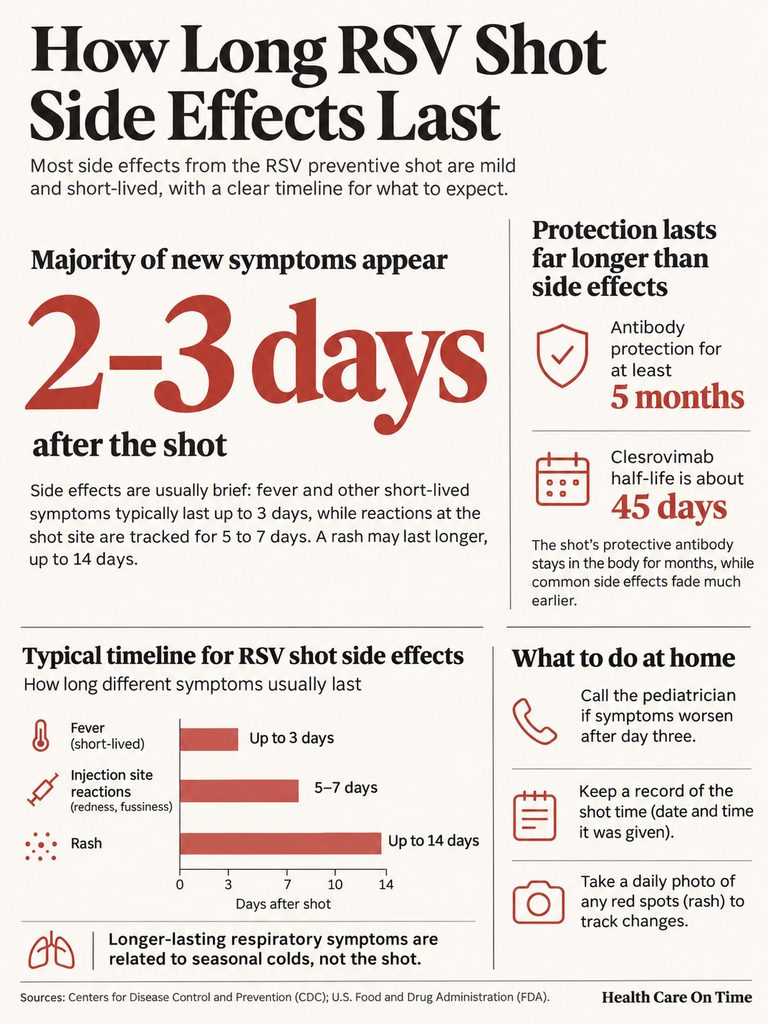
Because the antibody protects for at least 5 months, some parents assume a side effect could last that long too. Clesrovimab has a half-life of about 45 days, meaning the level in the blood drops by half every six weeks or so, but redness and fussiness are reactions to the injection itself, and they fade within days while the antibody keeps working.
Call the pediatrician if anything is getting worse after the third day, if a red area keeps growing, or if a rash appears and then spreads.
A little record keeping helps here. Write down the time of the shot. Then take a quick phone photo of any red spot each morning, so that when you talk to the pediatrician you can say whether it’s shrinking or spreading instead of guessing from memory.
Rare but Serious Risks of the RSV Shot for Babies
Allergic reactions are the main serious risk. In February 2024, FDA updated the Beyfortus label after serious hypersensitivity reactions were reported following its use in real-world practice. The Beyfortus label describes what those reactions looked like: hives, labored breathing, bluish skin (cyanosis) and floppiness (hypotonia). Enflonsia’s label carries a similar warning because severe allergic reactions, including anaphylaxis, have occurred with other antibodies of the same type.
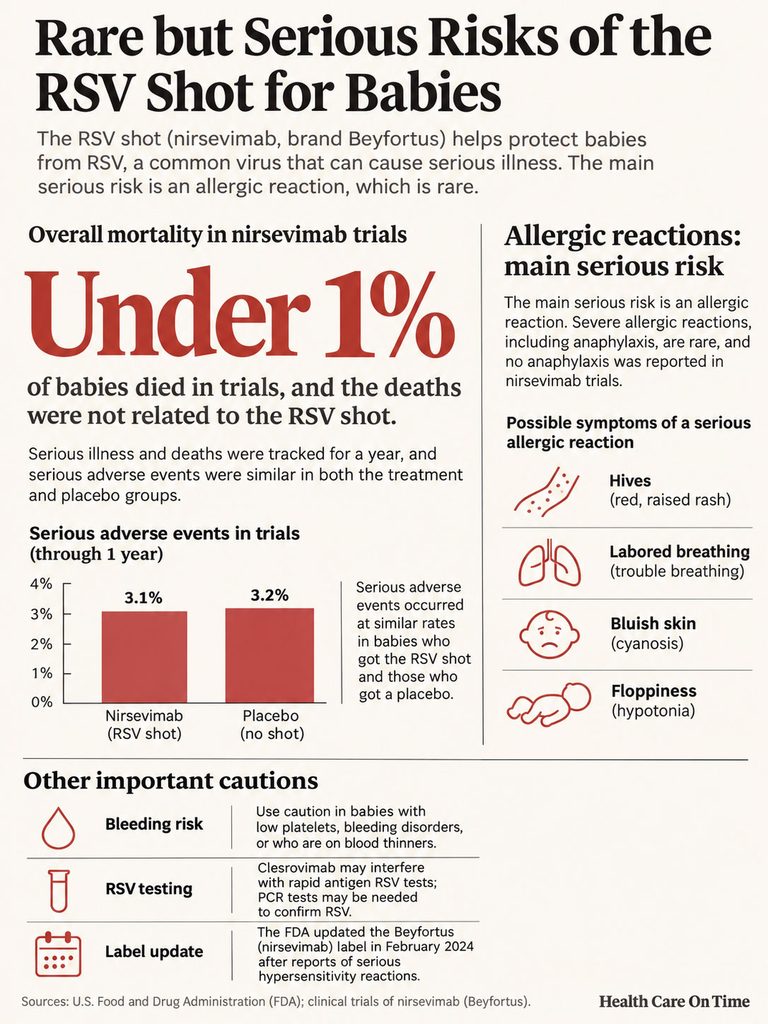
These reactions are uncommon. In the pooled nirsevimab trials, no anaphylaxis was attributed to the antibody, and in the Canadian study of 1,559 babies there was no anaphylaxis; one 2-month-old who got nirsevimab with routine vaccines developed facial swelling and a rash about an hour later, which cleared within 10 hours without specific treatment. At home, the same signs call for 911 right away.
A baby with a known serious allergic reaction to either antibody, or to any of its ingredients, shouldn’t get that product again.
The labels also carry narrower cautions. Beyfortus calls for care in babies with low platelets, a bleeding disorder or who are on blood thinners, because any shot into a muscle can cause bleeding or bruising in those children. Clesrovimab can also interfere with rapid antigen RSV tests, so if your baby gets sick later and a quick RSV test comes back negative, the doctor may confirm with a PCR test.
Serious illness and deaths were tracked for a full year. In the Enflonsia trial, serious adverse events over the following year happened in 11.5% of babies on the antibody and 12.4% on placebo; since the placebo group had slightly more, those events reflect the ordinary illnesses of a first year rather than the product. There were 7 deaths in the clesrovimab group and 3 in the placebo group, and none was judged related to the product or to RSV. Across the nirsevimab trials, deaths stayed under 1% in every group and none was considered treatment-related.
Preemies, Heart or Lung Conditions, and Second-Season Toddlers
Babies born very early, or with chronic lung disease of prematurity or a significant heart defect, face the highest risk from RSV, and their parents often ask whether the shot is harder on them. Both antibodies were tested in these groups, partly against the older antibody palivizumab, and the side-effect picture looked much the same as in healthy babies.
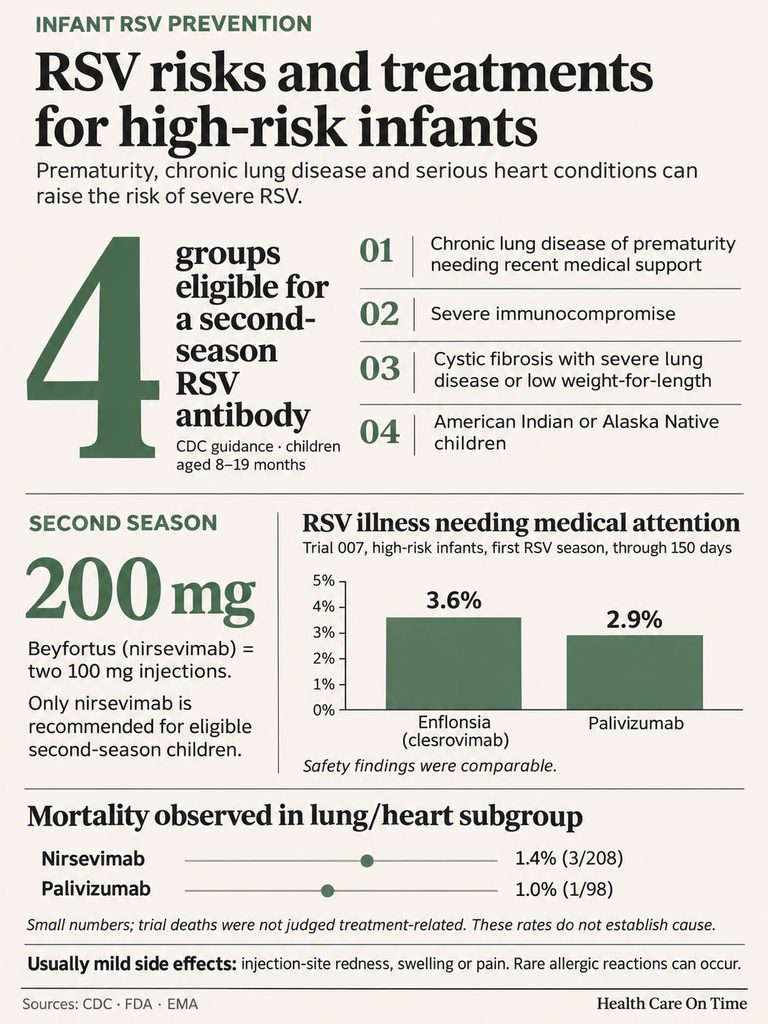
For Beyfortus, a trial in higher-risk infants found a safety profile consistent with the healthy-infant trials, and children with lung or heart disease who got a second-season dose showed the same pattern over 150 days of follow-up. That second-season dose is 200 mg, given as two 100 mg injections, so a toddler gets two shots, and parents may see a red spot in two places. For Enflonsia, a trial in infants born at 35 weeks or earlier or with lung or heart disease found safety “similar to palivizumab,” with medically attended RSV infections at 3.6% versus 2.9% and hospitalization at 1.3% versus 1.5%.
Deaths in these fragile groups were higher than in healthy babies, as expected from their underlying conditions; in the nirsevimab trials they were 1.4% with nirsevimab and 1.0% with palivizumab in babies with heart or lung disease, and none was considered treatment-related.
Only nirsevimab is recommended for a second season. CDC lists four groups of children 8 to 19 months old who should get it shortly before their second RSV season: children born prematurely with chronic lung disease, children with severe immunocompromise, children with severe cystic fibrosis, and American Indian and Alaska Native children. Babies who have heart surgery with a heart-lung bypass machine may need an extra dose after surgery, under either label.
What the Safety Studies Counted
A number quoted in a parenting group may come from a label, a journal trial or a parent survey, and those counted different things over different windows.
| Measure | Result | Source and who was studied |
| Rash within 14 days, Beyfortus | 0.9% vs 0.6% placebo | FDA label, pooled trials, 2,570 vs 1,284 infants |
| Injection-site reaction within 7 days, Beyfortus | 0.3% vs 0% placebo | FDA label, same trials |
| Fever, nirsevimab | 0.5% vs 0.6% placebo | Pooled pivotal trials, healthy preterm and term infants |
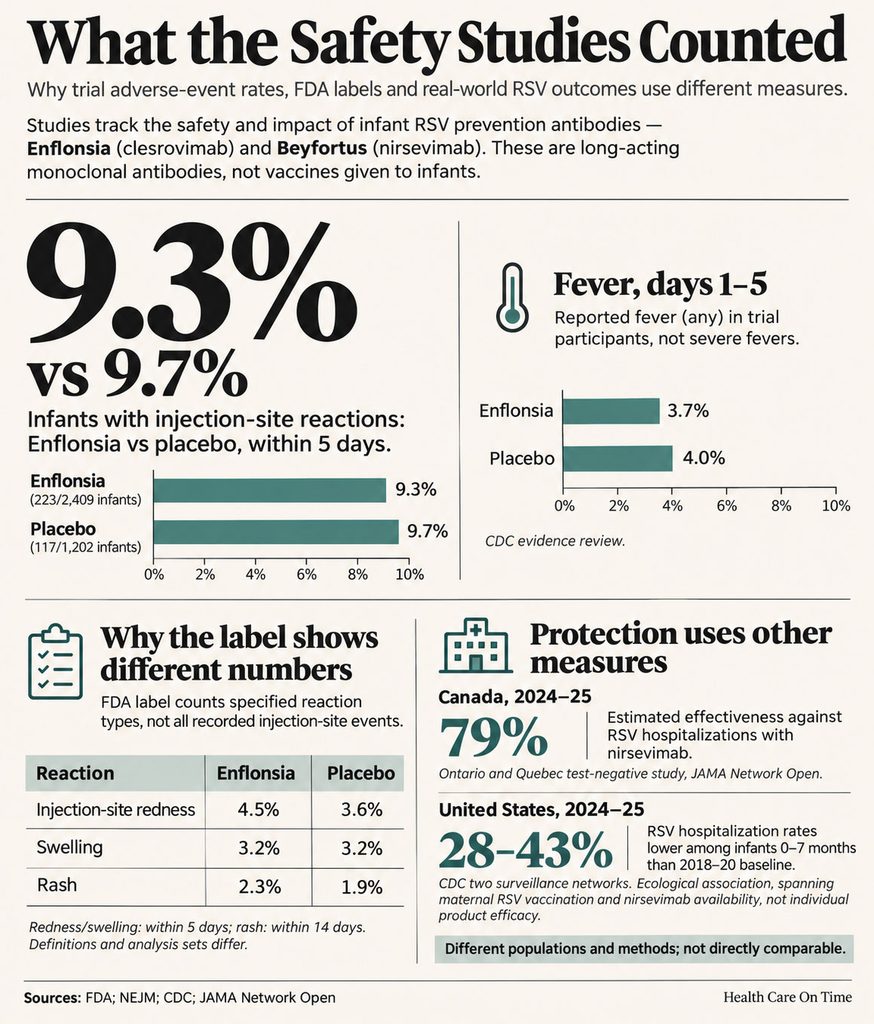
| Any injection-site reaction, days 1 to 5, Enflonsia | 9.3% vs 9.7% placebo | NEJM CLEVER trial, 2,409 vs 1,202 infants |
| Irritability, days 1 to 5, Enflonsia | 18.7% vs 19.7% placebo | NEJM CLEVER trial |
| Fever, days 1 to 5, Enflonsia | 0.5% vs 1.2% placebo | NEJM CLEVER trial |
| Serious adverse events through 1 year, Enflonsia | 11.5% vs 12.4% placebo | NEJM CLEVER trial |
| Site reactions, nirsevimab alone vs with routine vaccines | 5.5% vs 17.4% | Canadian CANVAS study, 1,559 infants, parent reports |
| Emergency department visit within 7 days | 0.6% (10 of 1,559) | Canadian CANVAS study |
| Infant RSV hospitalization, 0 to 7 months, 2024 to 2025 vs pre-pandemic seasons | 43% lower in one CDC network, 28% lower in the other | CDC MMWR, May 2025 |
The Enflonsia injection-site figure from the trial (9.3%) is higher than the label’s redness figure (3.8%) because the trial counted any site reaction, while the label lists redness and swelling separately; in both, the placebo rate is nearly the same.
The Pregnancy Vaccine: Side Effects for You, the Caution for Your Baby
If you’re pregnant and weighing Abrysvo against the baby antibody, start with how you’d feel in the days after the shot, then look at what it means for the baby’s birth.
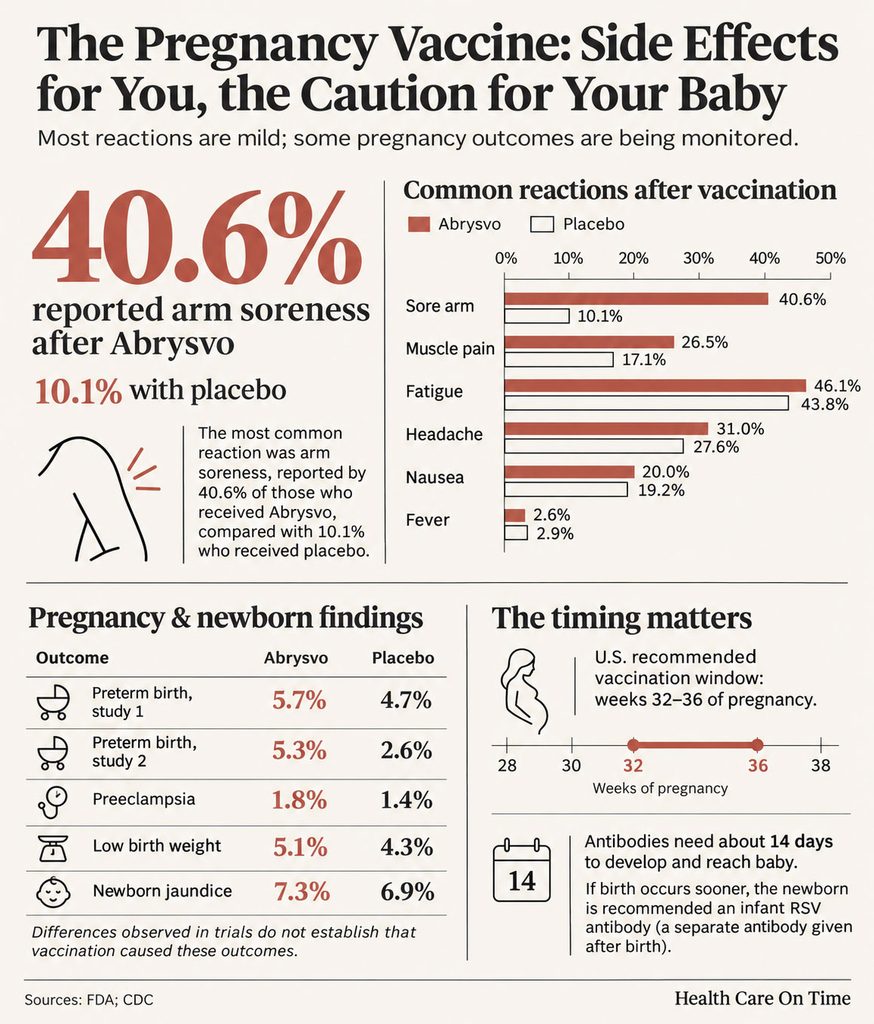
Your side effects look like those of a typical adult vaccine, and the clearest one is a sore arm: in Pfizer’s main trial, 40.6% of vaccinated pregnant participants had arm pain within a week, against 10.1% on placebo, and a smaller number had redness (7.2%) or swelling (6.2%). Muscle pain was also more common with the vaccine, at 26.5% versus 17.1%.
Tiredness, headaches and nausea came up a lot in both groups (fatigue 46.1% vs 43.8%, headache 31.0% vs 27.6%, nausea 20.0% vs 19.2%), since late pregnancy brings plenty of those on its own. Fever was 2.6% with the vaccine and 2.9% with placebo.
For the baby, the issue is timing of birth. The Abrysvo label reports more preterm births among vaccinated participants in two trials: 5.7% versus 4.7% in the large study, and 5.3% versus 2.6% in a smaller one. The label states that the data can’t establish or rule out a cause, and FDA limited use to 32 through 36 weeks of pregnancy to avoid the possible risk of a birth before 32 weeks. Preliminary findings from CDC’s Vaccine Safety Datalink found that vaccination in that window wasn’t linked to higher rates of preterm birth or of babies born small for their gestational age.
Newborns in the main trial had low birth weight slightly more often in the vaccine group (5.1% versus 4.3%) and jaundice at similar rates (7.3% versus 6.9%).
On the parent’s side, pre-eclampsia was 1.8% with the vaccine and 1.4% with placebo, and high blood pressure disorders of pregnancy remain under study at CDC.
Abrysvo is a one-time vaccine. If you had it in an earlier pregnancy, CDC doesn’t currently recommend a second dose; your new baby should get the antibody instead. And because it takes about two weeks for your antibodies to build and cross to the baby, a baby born less than 14 days after your shot should still get nirsevimab or clesrovimab. If you run a temperature after the shot, call your obstetrician, because a fever in pregnancy from any cause is something they’ll want to hear about.
What Is the “New Warning” on the RSV Vaccine?
The warning that made headlines came on January 7, 2025, when FDA required a new Guillain-Barré syndrome warning on two adult RSV vaccines, Abrysvo and GSK’s Arexvy. GBS is a rare nerve condition that causes muscle weakness, and the signal came from older adults: Medicare claims pointed to about 9 extra cases per million doses in people 65 and older during the 42 days after Abrysvo, a link the evidence couldn’t prove was causal. No GBS signal has been seen in people vaccinated during pregnancy, and neither baby antibody carries this warning.
The February 2024 Beyfortus label update about serious allergic reactions, described above, sometimes gets called the new warning too. It does apply to babies, and it’s why clinics watch for hives or breathing changes after the shot.
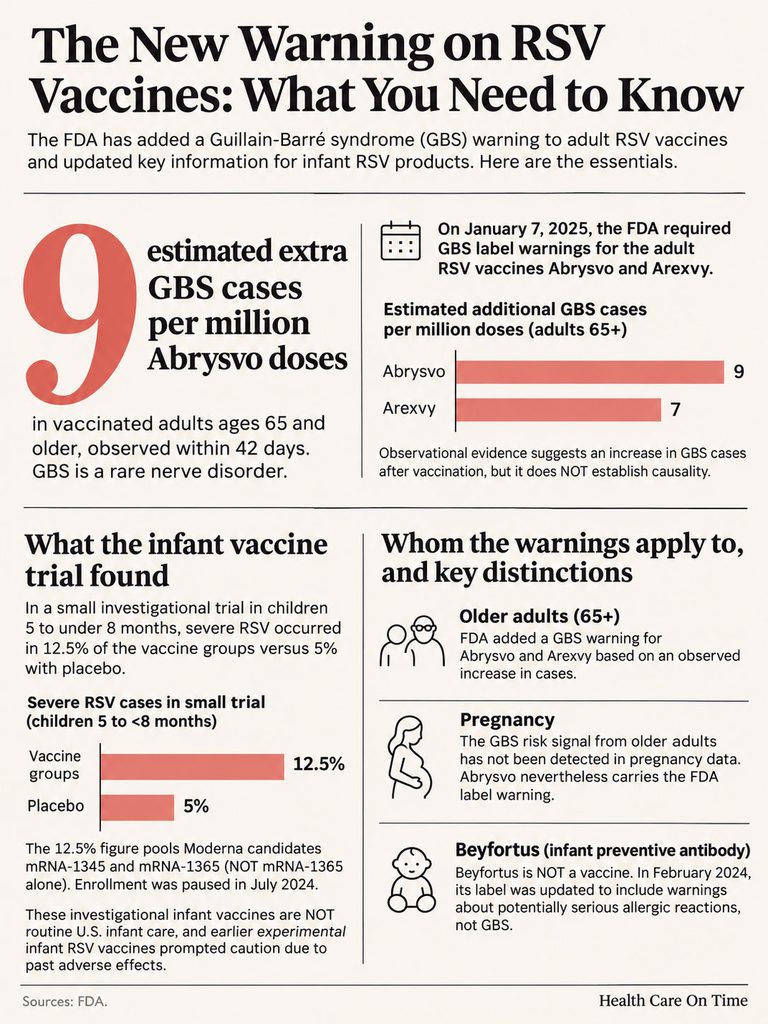
Then there’s the news about a true infant RSV vaccine that was never approved. Moderna tested an mRNA vaccine, mRNA-1365, in babies 5 to 8 months old, and 12.5% of vaccinated infants developed clinically significant or severe RSV compared with 5% on placebo, with five severe cases against one. Moderna stopped the study in July 2024, and an FDA advisory committee reviewed the data that December. Infant RSV vaccine research has been cautious since the 1960s, when an experimental inactivated vaccine made later RSV illness worse in some babies, and that history is part of why antibody protection was developed for infants. No baby in routine US care gets that experimental product.
Long-Term Side Effects and How New These Products Are
Beyfortus and Abrysvo were both approved in 2023, and Enflonsia in 2025, so the long-term record covers a few seasons rather than decades, and what’s known comes from how the products work and how long babies were followed.
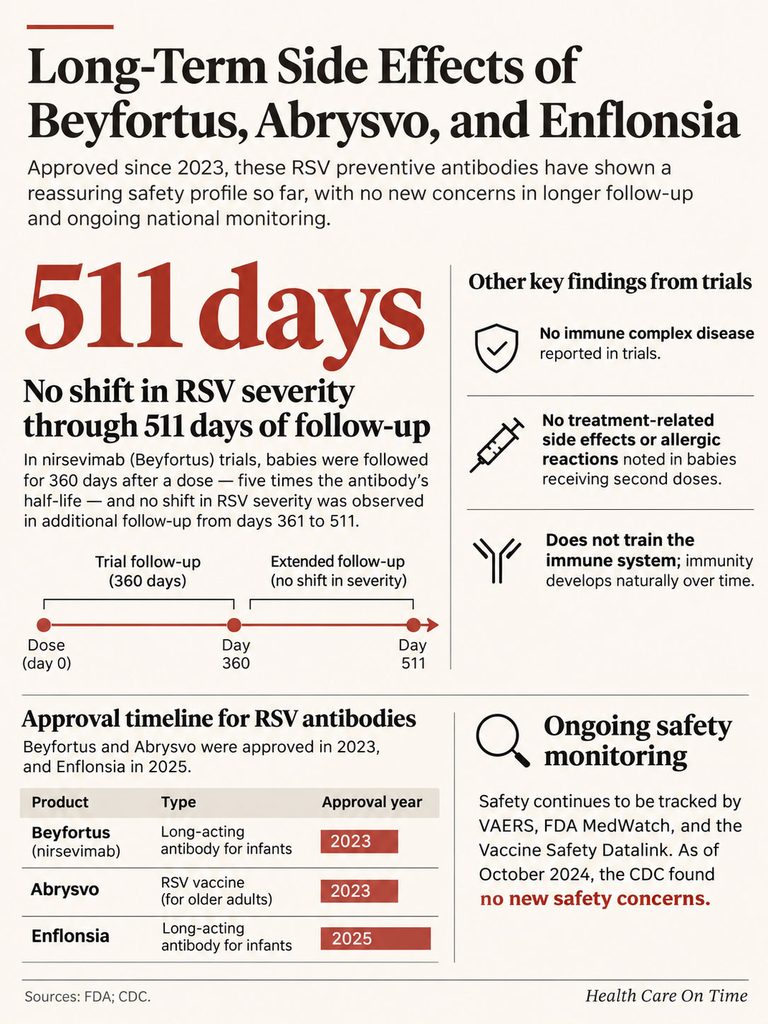
The nirsevimab trials tracked babies for 360 days after the dose, about five times the antibody’s elimination half-life, by which point very little antibody is left in the body. The trial team also checked whether protected babies simply got severe RSV later instead, and earlier data from the main trial showed no shift of disease into days 361 to 511. No immune complex disease was reported. For children given a second dose the next season, there were no treatment-related side effects and no allergic reactions in the second season.
Because the antibody doesn’t train the immune system, it can’t leave a lasting imprint on it the way a vaccine is designed to. As the antibody fades, babies meet RSV in the normal course of life and build their own immunity, and that’s why the protection is timed to the first season, when babies are most vulnerable. Safety monitoring through VAERS, FDA’s MedWatch and the Vaccine Safety Datalink continues, and as of October 2024, CDC had found no new safety information that changed the overall balance of benefit and risk for nirsevimab.
Why RSV Is So Hard on Babies, and What the Shot Prevents
RSV was the leading cause of hospital stays among US infants before these products arrived, and babies are most likely to be hospitalized between 6 weeks and 6 months of age. Roughly 1 or 2 of every 100 children are hospitalized with an RSV lung infection in the first six months of life, and 58,000 to 80,000 US children under 5 are hospitalized each year.
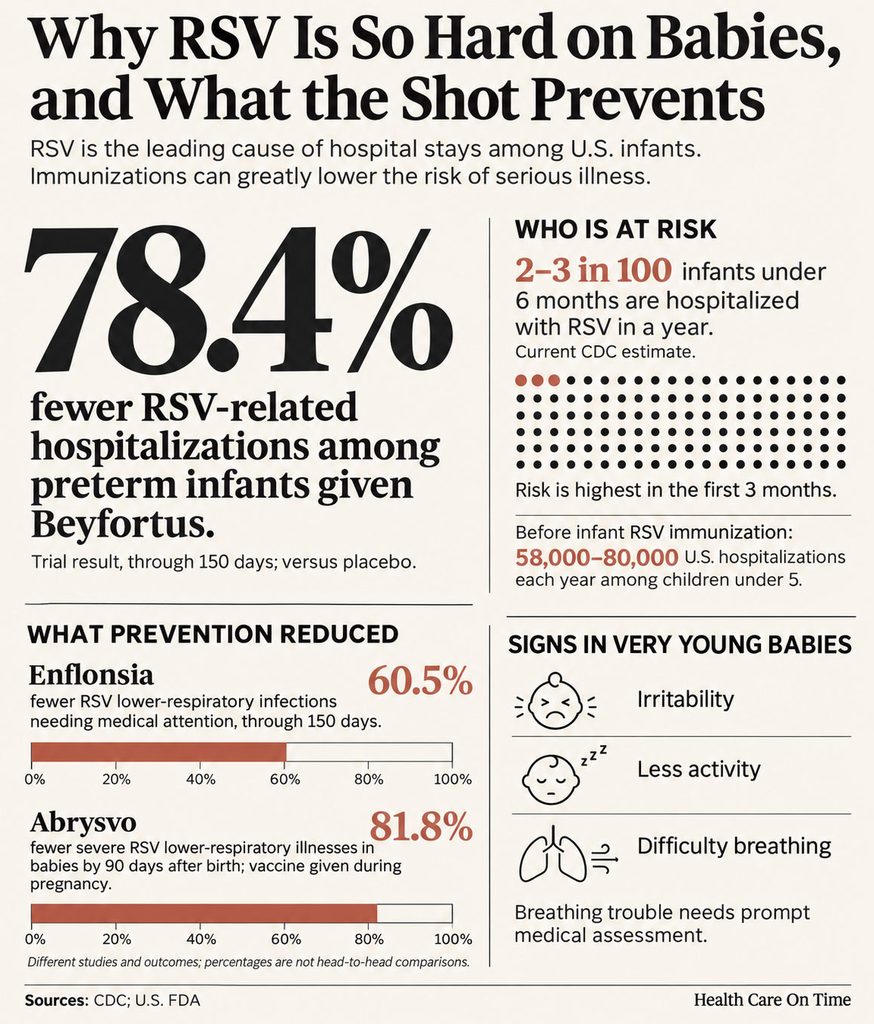
Babies’ airways are tiny, so the swelling and mucus that give an adult a bad cold can block a baby’s breathing. Very young infants may not even show classic cold symptoms; CDC lists irritability, decreased activity and breathing difficulty as possibly the only signs. Its advice for any sick child is to call your health care professional if breathing is hard, your baby isn’t drinking enough, or symptoms keep getting worse.
All three products prevented a large share of serious RSV in their trials. Hospitalization fell by 78.4% with Beyfortus in preterm babies and by 84.3% with Enflonsia over 150 days, while doctor visits for RSV lung infections dropped by 70.1% and 74.9% in the two Beyfortus trials and by 60.5% with Enflonsia. With Abrysvo given in pregnancy, severe RSV lung disease in babies was 81.8% lower in the first 90 days, and still 69.4% lower through 6 months.
The drop showed up outside trials, too. In the first season with wide use of both the antibody and the maternal vaccine, RSV hospitalization rates among infants up to 7 months old were 43% and 28% lower than in pre-pandemic seasons in two CDC surveillance networks, and the biggest drops, 52% and 45%, were in babies 0 to 2 months old.
Weighing the Pros and Cons
The antibody gives protection right away, lasts at least 5 months, and in trials it sharply cut the RSV infections that send babies to the doctor or the hospital. Side effects were uncommon and mostly ran close to placebo, and the shot can be given at the same visit as routine vaccines. For the pregnancy vaccine, the baby gets no shot at all and is protected from birth, as long as the vaccine went in at least two weeks before delivery.
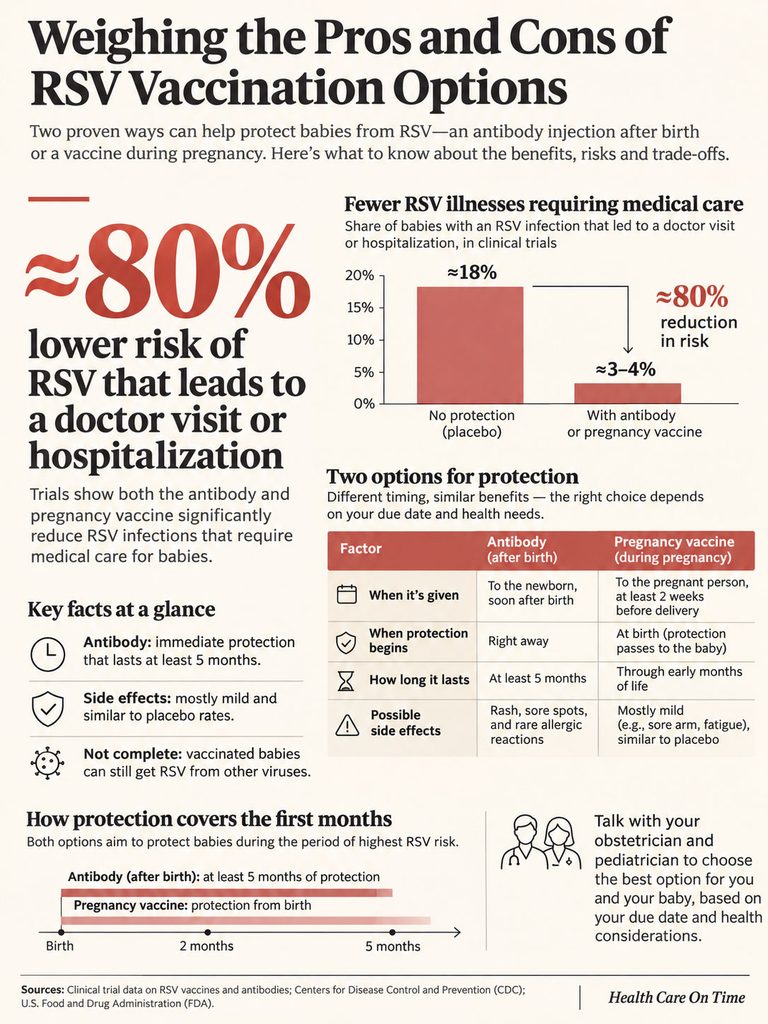
Against that, your newborn gets one more injection, with a small chance of a rash or a sore spot and a rare chance of a serious allergic reaction. Protection isn’t complete either, so a protected baby can still catch RSV; a cold a few weeks later comes from a virus caught somewhere else, since the antibody contains no virus. Some parents also weigh how new the products are, a few seasons old, and with clesrovimab a doctor needs to know the shot was given, because it can make a rapid RSV test read falsely negative. With Abrysvo, the trade-offs shift to the parent: a sore arm and achiness in the week after the shot, and the preterm-birth question that limits it to 32 through 36 weeks.
CDC doesn’t rank the options. If you’d rather your newborn skip an injection, the pregnancy vaccine does that. If you’re already past 36 weeks, missed the seasonal window, or would rather avoid your own side effects late in pregnancy, the antibody after birth is the route. Either one is enough for most babies in their first season, and your obstetrician and pediatrician can help you match the choice to your due date.
After the Shot: Normal, Call the Pediatrician, or Call 911
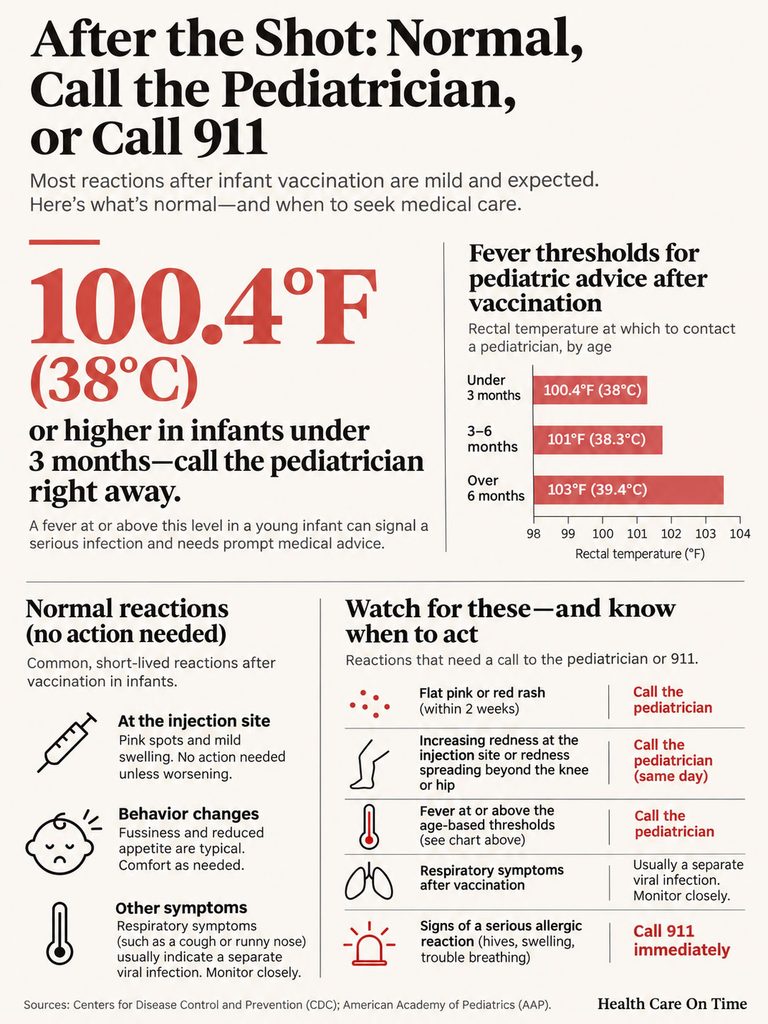
Most reactions in the first week look like the first two rows.
| What you notice | What it most likely means | What to do |
| Pink spot, mild swelling or a firm bump on the thigh in the first few days | Normal injection-site reaction | Cool washcloth, loose diaper; no call needed unless it grows |
| Extra fussy, sleepier or eating a bit less for a day or two | Common after any shot visit; seen as often with placebo | Comfort, cuddle and feed on demand |
| Rectal temperature of 100.4°F (38°C) or higher in a baby 3 months or younger | Needs an exam to rule out infection, whatever the cause | Call the pediatrician right away, even if the baby seems fine |
| Temperature of 101°F (38.3°C) or higher at 3 to 6 months, or 103°F (39.4°C) or higher after 6 months | Fever that may need a doctor’s input | Call the pediatrician; ask for the correct infant acetaminophen dose for your baby’s weight |
| Flat pink or red rash within 2 weeks | A known, usually mild side effect | Call the pediatrician to have it looked at; a photo helps |
| Redness that keeps growing after day 3 or spreads past the knee or hip | Larger-than-usual site reaction that a doctor should see | Call the pediatrician the same day |
| Cough, runny nose or wheezing a few days later | A virus caught elsewhere; the shot contains no virus | Call the pediatrician; watch breathing closely |
| Bleeding or a spreading bruise at the site in a baby with a bleeding disorder or on blood thinners | Label caution for these babies | Call the pediatrician promptly |
| Hives, swelling of the face, lips or eyes, trouble breathing, bluish lips or a limp, floppy baby | Possible serious allergic reaction | Call 911 |
The fever thresholds come from the American Academy of Pediatrics’ HealthyChildren.org, which advises checking with your pediatrician before giving any fever medicine, especially to babies under 6 months. Infant acetaminophen, one of the usual ways to bring a fever down safely, is dosed by weight, so ask the pediatrician or pharmacist for the right amount for your baby instead of guessing from the box.
If something happens after the shot that worries you, the pediatrician can report it. Reactions after the antibody given alone go to FDA MedWatch; if the antibody was given with vaccines, the report goes to VAERS and should name the RSV antibody.
Questions to ask at the visit
Some questions are easier to ask in the exam room than at 2 a.m. These cover the ones parents tend to need once they’re home.
- “If the pregnancy vaccine was given at 34 weeks, does the baby still need the antibody?”
- “Which antibody do you have, Beyfortus or Enflonsia, and is there any reason to choose one for our baby?”
- “Can the RSV shot be given with the 2-month vaccines, or would it be easier on the baby to split them?”
- “What temperature should make us call you, at our baby’s age?”
- “If the baby is uncomfortable tonight, how much infant acetaminophen is right for this weight?”
- “Our baby was born early. Will there be another dose next fall?”
Frequently Asked Questions
What are the risks of getting an RSV shot for babies?
The common risks are mild: a red or swollen spot on the thigh in up to about 4% of babies and a short-lived rash in 1% to 2%, rates close to placebo. The serious risk is an allergic reaction, which is rare and has been reported mainly as hives and breathing changes. Babies with bleeding disorders need extra care with any injection. Trials also showed RSV hospitalizations cut by 78.4% with Beyfortus in preterm babies and 84.3% with Enflonsia.
Do babies feel bad after the RSV vaccine?
Some do for a day. About one in five babies is fussy and some are sleepier, but the Enflonsia trial found the same rates after a placebo shot, so the needle and the visit explain most of it.
What is the new warning on the RSV vaccine?
It’s a January 2025 FDA warning about Guillain-Barré syndrome for two adult RSV vaccines, Abrysvo and Arexvy, based mainly on data from adults 65 and older. It doesn’t apply to the baby antibody shots, and no GBS signal has been seen in pregnancy. Separately, the Beyfortus label added serious allergic reactions in 2024.
Why is RSV so hard on babies?
Their airways are very small, so inflammation and mucus block airflow quickly, and young infants tire out from the work of breathing. Babies from 6 weeks to 6 months are most likely to be hospitalized, and very young infants may show only irritability, low energy and breathing trouble.
Can the RSV shot give my baby RSV?
No. Beyfortus and Enflonsia are lab-made antibodies with no virus in them, so they can’t cause an RSV infection.
Are there long-term side effects of the RSV shot?
None has been identified. Trials followed babies for 360 days, by which time the antibody has left the body, and found no later surge of severe RSV and no immune complex disease. Because the antibody doesn’t train the immune system, there’s no lasting immune effect to wear off. The products are only a few seasons old, though, and monitoring continues through VAERS, MedWatch and the Vaccine Safety Datalink.
Is Beyfortus or Enflonsia safer?
They haven’t been compared head to head, and CDC states that no product is preferred. Both had side-effect rates close to placebo. Beyfortus is weight-dosed and can be used in a second season for some higher-risk toddlers; Enflonsia is a single 105 mg dose for the first season only.
Does the baby need the RSV shot if the mother got the vaccine in pregnancy?
Usually not, as long as Abrysvo was given at least 14 days before birth. Babies born sooner than that, babies whose mother’s vaccine status is unknown, and some high-risk babies should still get nirsevimab or clesrovimab, because maternal antibodies need about two weeks to build and pass across the placenta.
Medical disclaimer: This article is for general information and isn’t a substitute for advice from your pediatrician, obstetrician or other health care provider. Decisions about RSV immunization, fever medicine and doses should be made with a clinician who knows your baby’s health history. If your baby has trouble breathing, turns blue or becomes limp, call 911.
References
- Beyfortus (nirsevimab-alip) Prescribing Information, FDA, revised 02/2024
- Enflonsia (clesrovimab-cfor) Prescribing Information, FDA, revised 06/2025
- Abrysvo Prescribing Information, Pfizer, revised 12/2025
- Clesrovimab for Prevention of RSV Disease in Healthy Infants (CLEVER trial). N Engl J Med. 2025;393:1292-1303
- Comprehensive Summary of Safety Data on Nirsevimab in Infants and Children from All Pivotal Randomized Clinical Trials. Pathogens. 2024
- Post-Licensure Safety of Nirsevimab from the Canadian National Vaccine Safety (CANVAS) Network, 2025 (preprint full text; later published in Human Vaccines & Immunotherapeutics)
- CDC. Respiratory Syncytial Virus (RSV) Vaccine Safety
- CDC. Immunizations to Protect Infants
- CDC MMWR. Use of Clesrovimab for Prevention of Severe RSV-Associated Lower Respiratory Tract Infections in Infants: ACIP Recommendations, 2025
- CDC MMWR. Interim Evaluation of RSV Hospitalization Rates Among Infants and Young Children After Introduction of RSV Prevention Products, May 2025
- CDC. Symptoms and Care of RSV
- FDA. FDA Requires Guillain-Barré Syndrome (GBS) Warning in the Prescribing Information for RSV Vaccines Abrysvo and Arexvy, January 7, 2025
- Immunize.org. Ask the Experts: RSV Safety
- Pediatric Infectious Diseases Society. In the News: RSV Vaccine Research in Infants May Proceed With Caution, January 8, 2025
- Children’s Hospital of Philadelphia Vaccine Education Center. RSV Vaccines and Monoclonal Antibody
- HealthyChildren.org (American Academy of Pediatrics). Fever and Your Baby