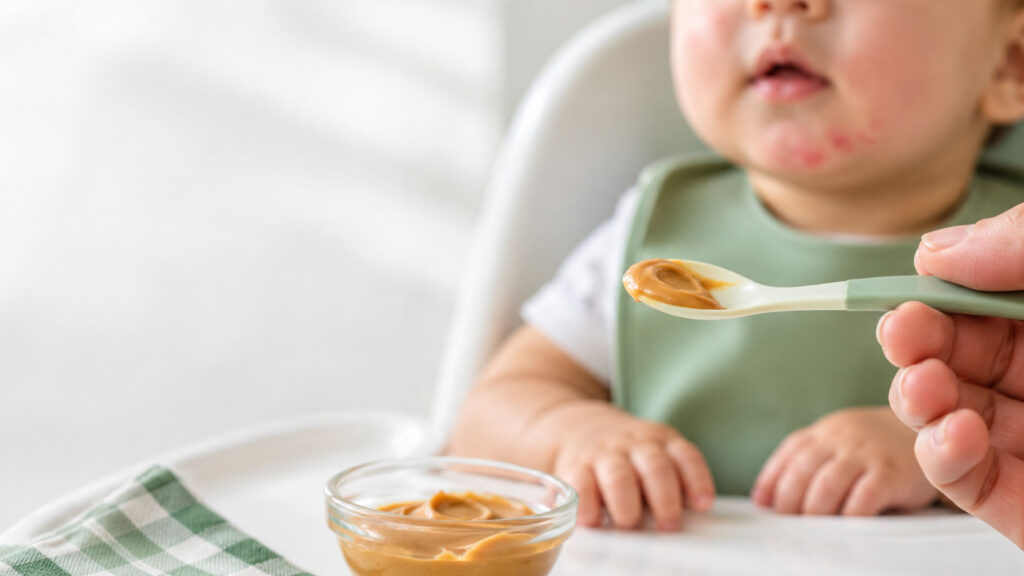
Peanut reactions in babies are usually fast and usually start on the skin, so the first feeding and the couple of hours after it are when you’re most likely to see one.
Table of Contents
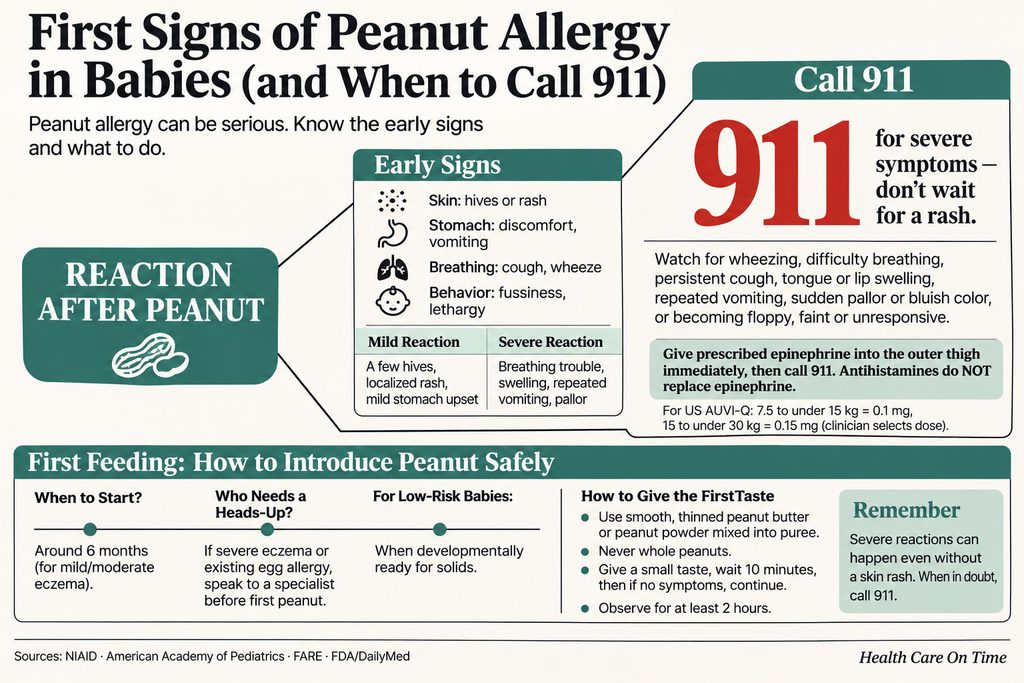
Quick answer: The first signs of peanut allergy in a baby usually appear within minutes to 2 hours of eating peanut. Watch for hives or redness around the mouth, swelling of the lips or eyes, vomiting, and sudden fussiness. One mild sign, like a few hives near the mouth, means stop the food and call your pediatrician. Signs in two body areas, repeated vomiting, coughing, wheezing, a hoarse cry, paleness, or limpness mean call 911.
What the First Signs of Peanut Allergy Usually Look Like
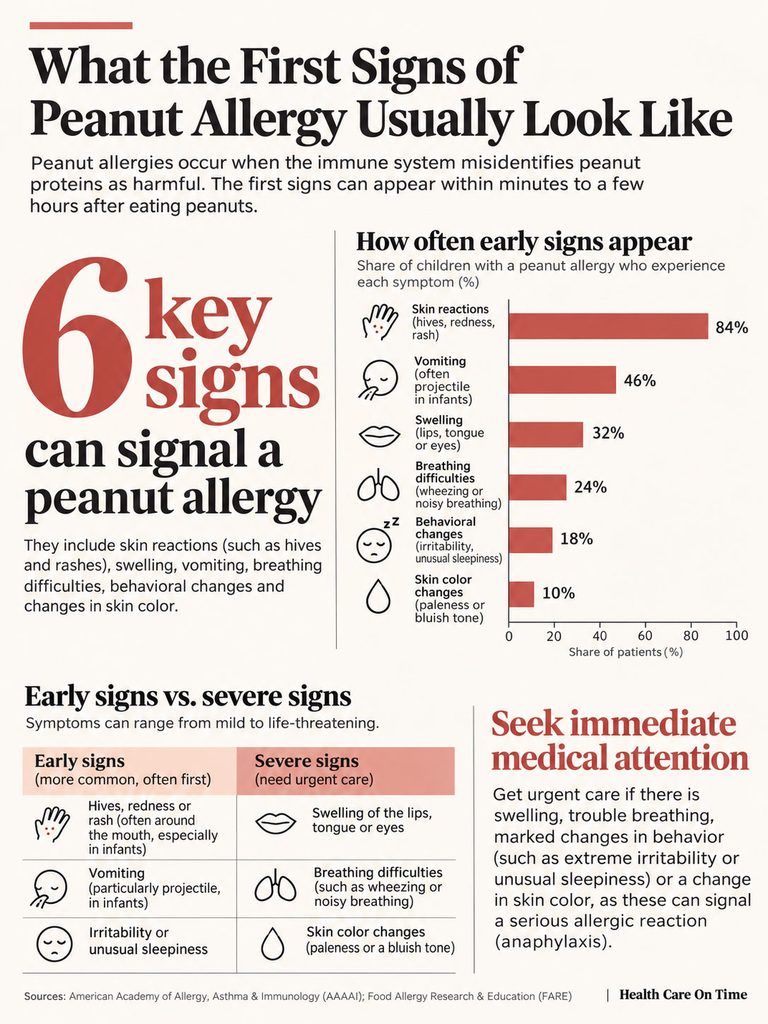
A peanut allergy happens when the immune system treats peanut proteins as harmful and releases histamine and other chemicals that act on the skin, gut, airways, and blood vessels. Adults with a severe reaction often notice a tight throat first. In babies, skin symptoms are the most common, followed by stomach and then breathing symptoms, and a drop in blood pressure is rarely reported in infants at all.
Skin
Hives are raised, red, itchy welts, and on a baby they often start around the mouth, chin, and cheeks, right where the peanut touched, before spreading to the neck, chest, or whole body within minutes. Check under the bib. Some babies get plain redness or a blotchy flush instead of distinct welts, and some get a red rash around the mouth that looks like scattered polka dots. Speed is the giveaway with allergic hives: a rash that wasn’t there before the first spoonful and is spreading ten minutes later points to the food.
Many babies at higher risk for peanut allergy already have eczema, and that makes reading the skin harder. Eczema patches are usually dry, rough, and there for days. What matters after a peanut feeding is change: new raised welts, new swelling, or redness that suddenly moves past the area that touched food.
Lips, Tongue, Eyes, and Face
Swelling of the lips, the tongue, or the skin around the eyes often shows up early. Watch how far it goes. A little puffiness in one lip can be watched while you call the pediatrician, but swelling that spreads across the cheeks and eyelids needs 911.
An itchy or tingly mouth may show up as scratching at the tongue, pushing the tongue in and out, or chewing hard on fingers and toys.
Stomach and Gut
Vomiting is one of the most common peanut allergy symptoms in infants, especially vomiting that is projectile or keeps going. A small spit-up after a new texture happens all the time and isn’t the same thing. Vomiting more than once after peanut, though, counts as a severe sign. Diarrhea can show up too. Belly cramping in a baby usually looks like crying with the knees pulled up to the chest or the back arched.
Nose, Breathing, and Voice
Sneezing, a runny nose, and watery or red eyes can appear with a reaction, and on their own they’re usually mild. Coughing that won’t stop, wheezing, noisy breathing, or a hoarse cry are another matter. A change in your baby’s cry can mean swelling near the voice box, and sudden drooling can mean swallowing has become hard.
Behavior and Color
Babies often show a serious reaction through behavior before anything else. The American Academy of Pediatrics lists irritability, fussiness, inconsolable crying, sudden drooling, and unusual sleepiness as infant signs of anaphylaxis. Pale or bluish skin, floppiness, and poor head control mean the circulation is affected. Call 911.
How a Reaction Looks in a Baby Who Can’t Talk Yet
Most symptom lists were written for older kids and adults, who can say that their throat feels tight or their mouth itches. A 7-month-old can’t, so the same reaction comes out as body language. An itchy baby may scratch the tongue, put fingers in the ears, or rub against the carpet. Shortness of breath looks like harder work, with the nostrils, ribs, and belly moving more than usual.
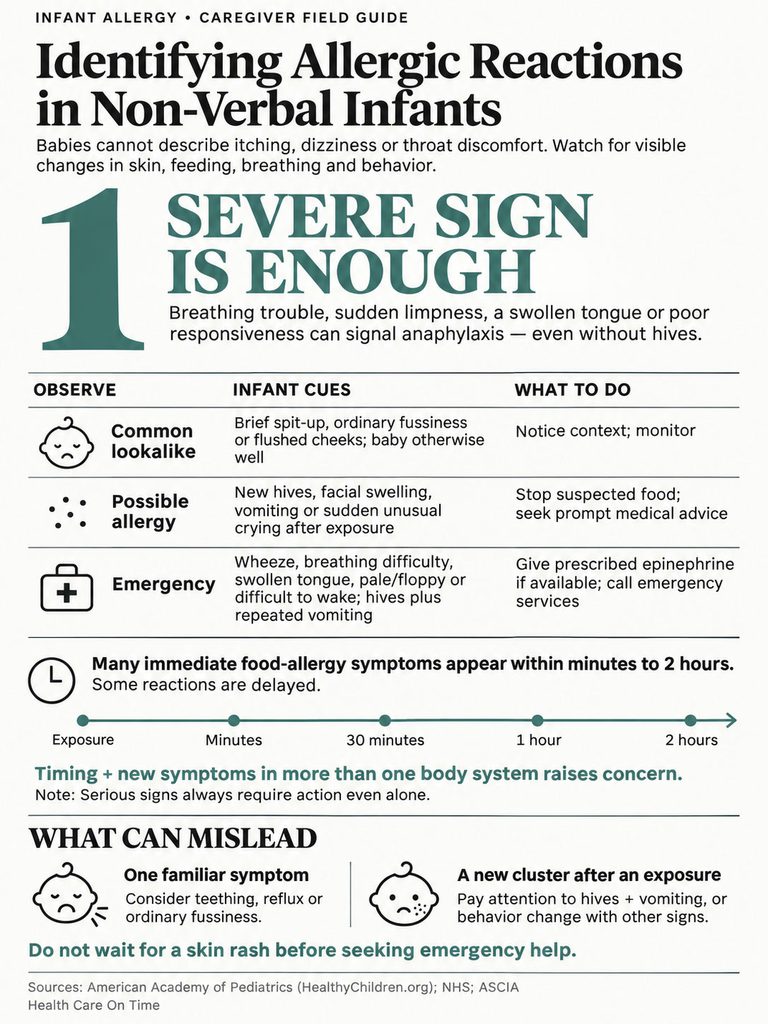
Parents who have been through a reaction describe the same thing. When the Asthma and Allergy Foundation of America surveyed 374 caregivers, infants and toddlers turned out to be more likely than older children to have hives, vomiting, diarrhea, a hoarse voice or cry, and sudden behavior changes. They were less likely to show obvious trouble breathing. Half the caregivers saw signs that they only recognized later as part of the reaction.
| What’s happening inside | What you may see in your baby | How serious | What to do |
| Itchy mouth or throat | Scratching at the tongue, pushing the tongue out, chewing on hands | Mild if it’s the only sign | Stop the food, stay with your baby, call your pediatrician |
| Itchy skin | Rubbing the face, rubbing against your shoulder or the carpet, eye rubbing, fingers in the ears | Mild if it’s the only sign | Stop the food, watch closely for 2 hours |
| Hives | A few welts around the mouth (mild) or welts over most of the body (severe) | Mild to severe | Few: call pediatrician. Widespread: call 911 |
| Swelling | One lip slightly puffy (mild) or large lip, tongue, or face swelling (severe) | Mild to severe | Large or facial swelling: epinephrine if prescribed, call 911 |
| Belly pain | Knees pulled up, back arched, crying that’s hard to settle | Mild alone; severe with other signs | Count it as a second body system if hives are present |
| Vomiting | One episode (mild) or more than one, or projectile (severe) | Mild to severe | Repeated vomiting: call 911 |
| Airway or breathing | Hoarse or changed cry, nonstop cough, wheeze, nostrils flaring, ribs pulling in | Severe | Epinephrine if prescribed, call 911 |
| Circulation | Pale, gray, or bluish skin, limp body, poor head control, sudden sleepiness, hard to wake | Severe | Epinephrine if prescribed, call 911, lay your baby flat |
Normal Baby Behavior That Can Fool You
Babies do a lot of these things on an ordinary day. Clinging to a parent, stopping play, crying, spitting up after a feed, loose stools, getting drowsy after eating, flushing during a crying spell, scratching, and general crankiness can all look like a reaction. They can also hide one.
Timing and clustering are what separate them. A baby who spits up a little, as usual, and then goes back to smiling and reaching for the spoon is behaving like a baby. A baby who vomits forcefully 10 minutes after a first taste of peanut butter, then develops welts on the chest and won’t settle, is showing a pattern. Sleep works the same way. Dozing off after a full meal is normal, while going suddenly limp, pale, and hard to wake is not. If you can’t tell which you’re seeing, call your pediatrician.
How Soon After Eating Peanut a Reaction Starts
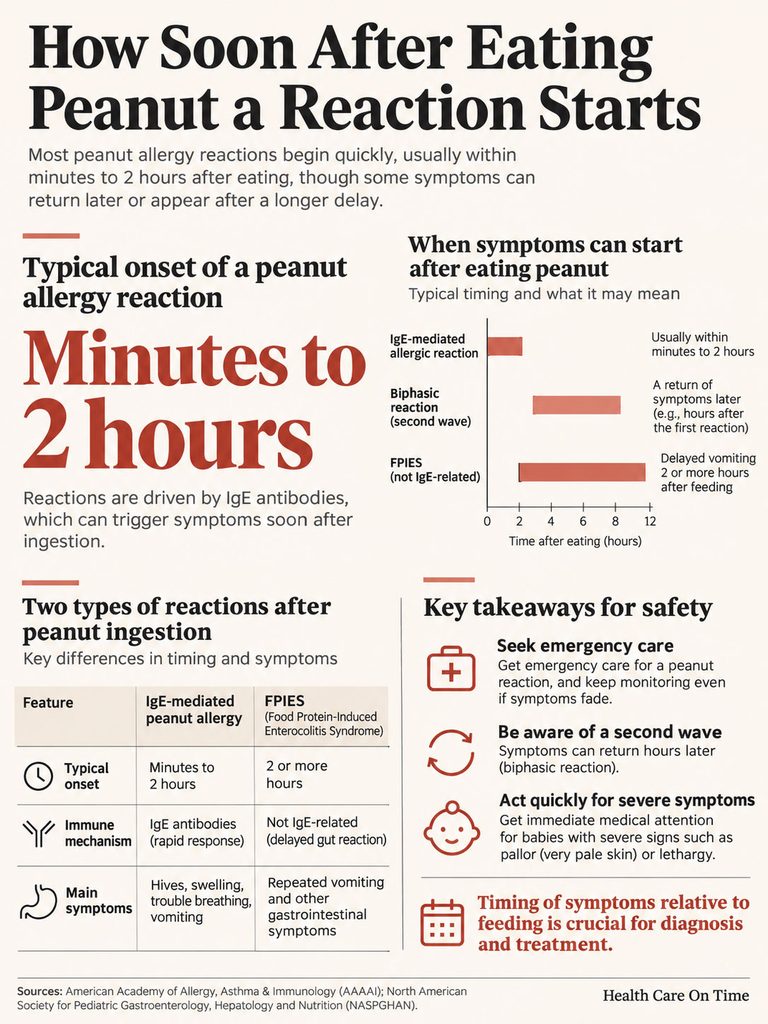
Classic peanut allergy runs on IgE antibodies, and IgE reactions are quick. They usually begin within minutes, and nearly all start within 1 to 2 hours of eating. That window is why you stay close by for a couple of hours after the first feeding.
A Second Wave Can Follow
A reaction can also come back after it seems to be over. This is a biphasic reaction, and it’s why a baby who has received epinephrine still goes to the emergency room, where staff keep watch for several hours, even when the symptoms have faded.
Vomiting That Starts Hours Later Is a Different Problem
Repeated vomiting that starts two or more hours after a new food, with no hives and no swelling, may not be IgE allergy at all. Food protein-induced enterocolitis syndrome (FPIES) is a delayed food allergy of the gut, with reactions that come within hours of eating the trigger and vomiting and diarrhea that can lead to dehydration and even shock. It usually starts in infancy, often when a baby begins solids or formula.
A baby with repeated vomiting who becomes pale, floppy, or very sleepy needs emergency care no matter which kind of reaction it is. Otherwise, call your pediatrician the same day and give the exact time the vomiting started relative to the feeding. Write it down. That one detail helps the doctor sort out whether this was FPIES, IgE allergy, or a food intolerance.
How to Tell Mild From Severe in the Moment
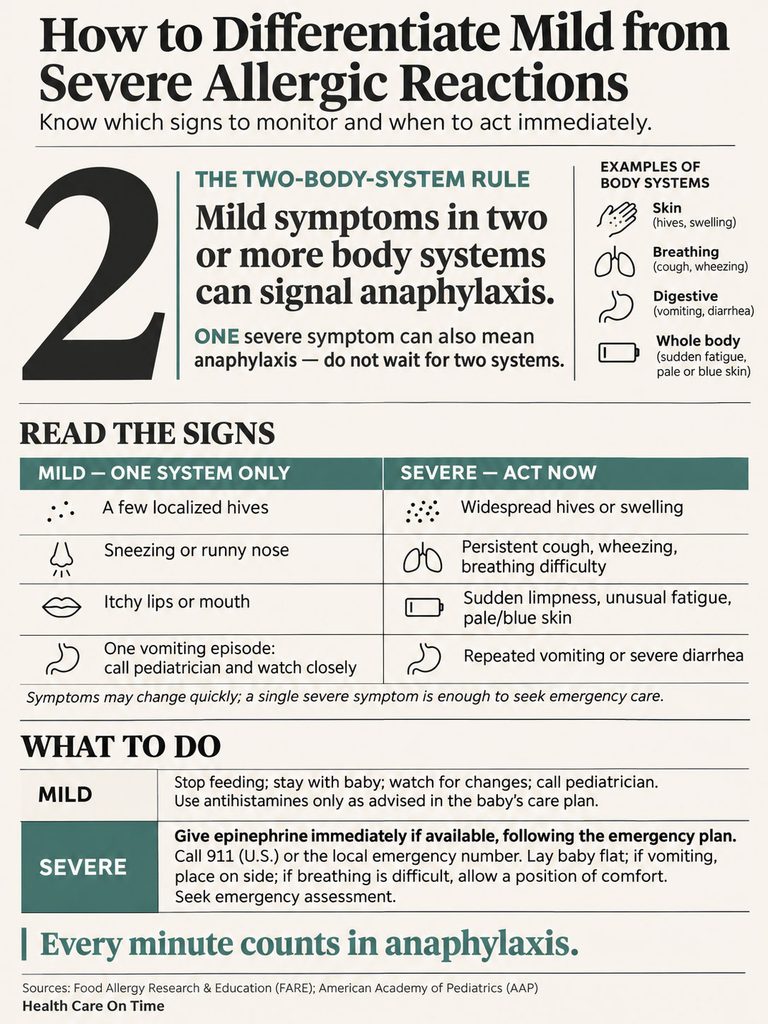
The fastest way to judge a reaction is to count the body systems involved.
The Two-Body-System Rule
Skin is one system and the gut is another; breathing, circulation, and alertness count as others. Symptoms in any two body systems may mean anaphylaxis, and epinephrine is recommended when more than one is involved. A single severe symptom counts as anaphylaxis by itself.
In practice, hives plus vomiting is anaphylaxis even though neither sign looks frightening by itself. So are lip swelling plus a cough, or a rash plus sudden floppiness.
On their own, these usually count as mild: hives on one part of the body, a runny nose with a few sneezes, vomiting once, or an itchy tongue or lips. Hives over most of the body, a cough that keeps going, wheezing, sudden tiredness, pale or blue skin, and repeated vomiting or diarrhea are severe.
If It Looks Mild
Stop feeding the peanut food and keep watching, because mild reactions can grow over the next hour. Call your pediatrician or the after-hours line with what you saw and when it started; a photo of the rash helps. Keep the jar or package, too.
Advice for mild reactions differs. Some pediatric allergy programs tell parents to have diphenhydramine (Benadryl) ready before the first feeding, with a weight-based dose from the pediatrician, and treat a rash around the mouth, slight swelling of one lip, or a single vomit as mild. Others advise going to the nearest urgent care or emergency room for any reaction at all. Since the advice varies, ask your pediatrician before the first feeding which plan they want you to follow and what antihistamine dose, if any, fits your baby’s weight. An antihistamine can ease itching and hives, but it never replaces epinephrine in a serious reaction.
If It Looks Severe
Every minute counts, so act in this order:
- If your baby has a prescribed epinephrine auto-injector, use it right away in the outer thigh. Hold the leg firmly so your baby can’t kick during the injection. It can go through clothing.
- Call 911 and say your baby is having an allergic reaction. If you’re alone, give the epinephrine first and then call; if another adult is there, have them call while you inject. Keep track of the time of the dose and tell the paramedics when they arrive.
- Lay your baby on their back. If your baby is vomiting or struggling to breathe, turn them onto their side.
- Give a second dose if symptoms get worse, continue, or don’t improve within 5 minutes.
- Go to the emergency room even if your baby looks better.
If this is the first peanut feeding and you have no epinephrine at home, call 911 right away and ask for an ambulance that carries epinephrine.
| Situation after a peanut feeding | What to do now | Why |
| A few hives around the mouth only, baby otherwise happy | Stop the food, watch for at least 2 hours, call your pediatrician | One mild sign in one body area; it can still progress |
| One lip slightly puffy, nothing else | Stop the food, call your pediatrician, watch closely | Localized swelling is listed as mild |
| Vomited once, then playing normally | Stop the food, call your pediatrician the same day | A single episode is mild; repeated vomiting is not |
| Hives on the face and chest plus vomiting | Epinephrine if prescribed, call 911 | Two body systems may mean anaphylaxis |
| Hoarse cry, nonstop cough, or wheezing | Epinephrine if prescribed, call 911 | Airway swelling can worsen quickly |
| Pale, limp, poor head control, hard to wake | Epinephrine if prescribed, call 911, lay baby flat | Signs that circulation is affected |
| Repeated vomiting starting 2 or more hours later, no hives | Call your pediatrician; go to the ER if pale, floppy, or very sleepy | Delayed vomiting fits FPIES, which can cause dehydration |
| Symptoms improved after epinephrine | Go to the ER anyway | A second wave can occur hours later |
Epinephrine Doses and Devices for Babies
Epinephrine is the first-line treatment for anaphylaxis, and the usual intramuscular dose for children is 0.01 mg per kilogram of body weight. Auto-injectors come in fixed strengths, each meant for a weight range. For Auvi-Q, the FDA-approved label sets them out like this:
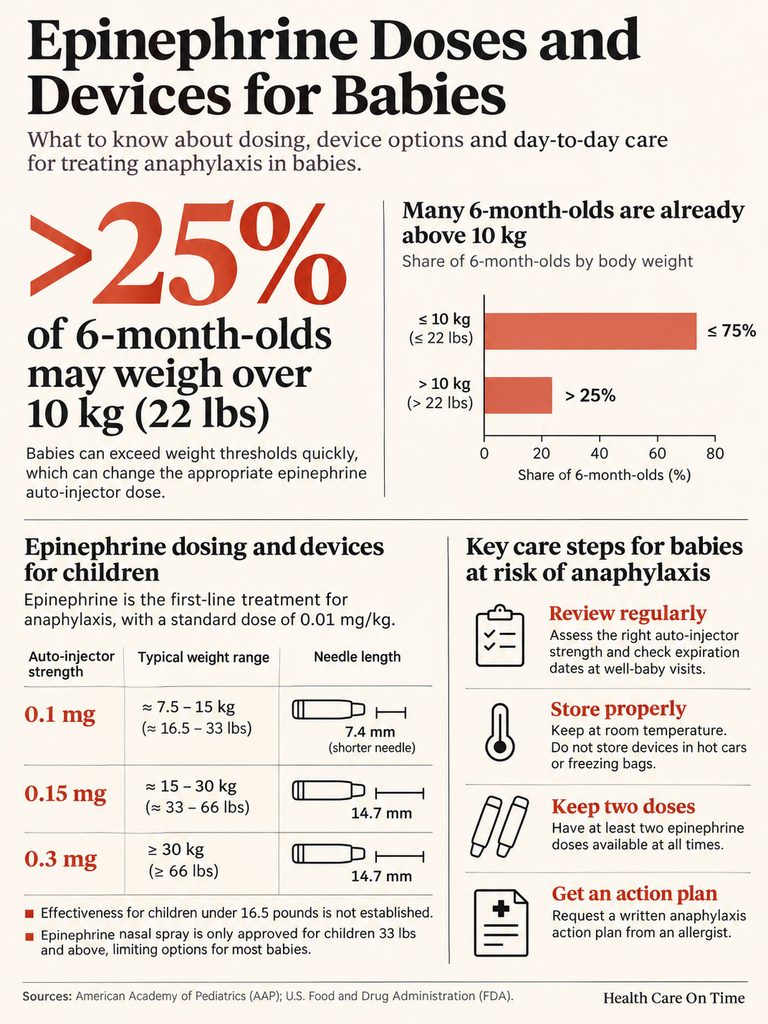
- 0.1 mg for babies and toddlers who weigh 16.5 to 33 pounds (7.5 to 15 kg)
- 0.15 mg for children from 33 to 66 pounds
- 0.3 mg from 66 pounds up
Below 16.5 pounds, the label says safety and effectiveness aren’t established, and other injectable forms of epinephrine may be needed for doses lower than 0.1 mg. The 0.1 mg device also has a shorter needle, about 7.4 mm of exposed needle against 14.7 mm on the larger devices.
Babies gain weight quickly. A prescription can be out of date within months; more than 25% of 6-month-olds are expected to weigh over 10 kg (about 22 pounds). Bring up the strength at every well-baby visit once your baby has a diagnosis, and check the expiration date on each device while you’re at it. Auto-injectors shouldn’t be left in a hot car or a freezing diaper bag, since extreme heat or cold can damage the medicine. Epinephrine nasal spray is only approved for children who weigh 33 pounds or more, which rules it out for most babies. Whatever device your baby has, the AAP advises keeping at least two doses with your child at all times.
Ask your allergist for a written anaphylaxis action plan, too. In the AAFA caregiver survey, 89% of children with a diagnosed food allergy and a plan received epinephrine during a reaction, against 50% of those without one.
Which Babies Are Most Likely to React
Any baby can be allergic to peanut, but the main risk factors are young age, an existing food allergy or another allergy such as hay fever, a family history of allergies, and atopic dermatitis, which is the medical name for eczema.
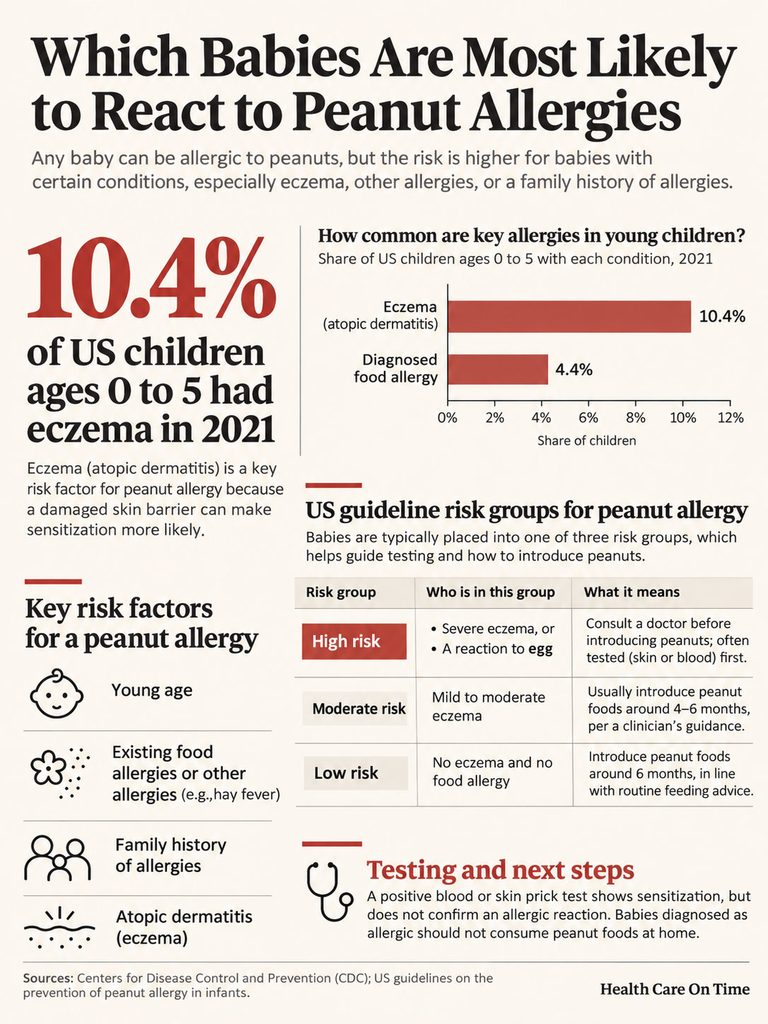
The US early-introduction guidelines from the National Institute of Allergy and Infectious Diseases sort babies into three risk groups:
- High risk (severe eczema, egg allergy, or both): introduce peanut at 4 to 6 months, working with a doctor, and strongly consider allergy testing first.
- Moderate risk (mild to moderate eczema): introduce peanut around 6 months, at home or in the doctor’s office.
- Low risk (no eczema, no egg allergy): peanut foods can go in along with other solids, though not as the very first solid food.
Eczema is common at this age. In 2021, 10.4% of US children ages 0 to 5 had it, and 4.4% had a diagnosed food allergy, according to a CDC survey. Plenty of babies with eczema never develop peanut allergy, but a damaged skin barrier is one of the clearest warning flags, and it’s why high-risk babies are often tested before their first taste. If your baby has severe eczema or has already reacted to egg, bring it up at the next checkup before peanut goes on the menu, because those are the two findings that put a baby in the high-risk group and change how the first feeding is done.
A positive blood or skin prick test shows sensitization, meaning the immune system has made antibodies to peanut. It doesn’t prove the baby will react, and a doctor needs to interpret the result. A baby who has already been diagnosed as allergic should not be given peanut foods at home.
Setting Up the First Peanut Feeding So You Can Spot a Reaction
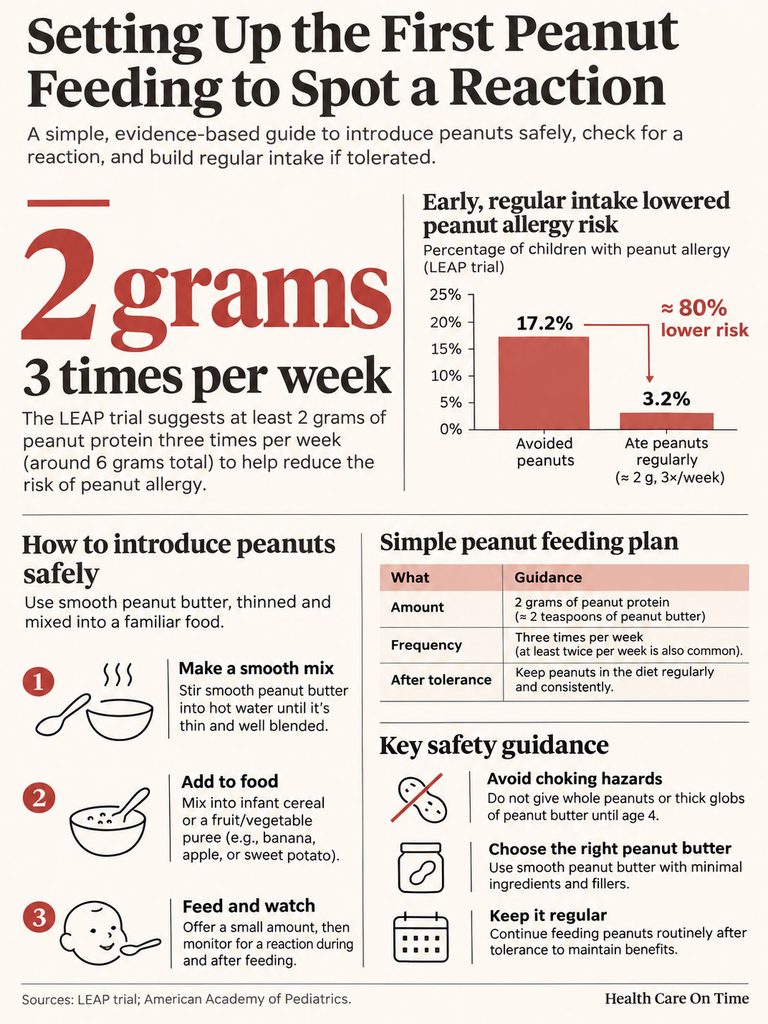
How you set up the first feeding decides how quickly you’ll catch a problem, and pediatric allergy programs give nearly the same instructions:
- Pick a day when your baby is healthy. A cold, recent vomiting, or diarrhea makes a reaction hard to read.
- Do it at home rather than at day care or a restaurant, at a time when one adult can focus only on the baby.
- Offer a small amount on the tip of a spoon and wait about 10 minutes (some programs say 15 to 20 minutes) before giving more.
- If nothing happens, give the rest slowly at your baby’s usual pace.
- Stay nearby for at least 2 hours afterward.
Never give a baby whole peanuts, raw or roasted. They’re a choking hazard, and whole peanuts aren’t recommended until at least age 4. Thick globs of peanut butter carry the same risk. One common recipe is 2 teaspoons of smooth peanut butter stirred with 2 to 3 teaspoons of hot water, cooled, and mixed into a cereal your baby already eats. Another is 1 teaspoon of peanut flour or peanut butter powder mixed into 2 tablespoons of a fruit or vegetable puree your baby has eaten before, store-bought or homemade. For the peanut butter itself, pick a smooth one with a short ingredient list and few fillers.
Once your baby tolerates peanut, keep it in the diet regularly. In the LEAP trial, the protective regimen was at least 2 grams of peanut protein three times a week, or about 6 grams a week, and the 2-teaspoon recipe above is sized to deliver about 2 grams. Pediatric guidance varies a little on frequency, from about 2 teaspoons three times a week to 2 teaspoons at least twice a week.
How Common Peanut Allergy Is, in Numbers
| Measure | Figure | Source |
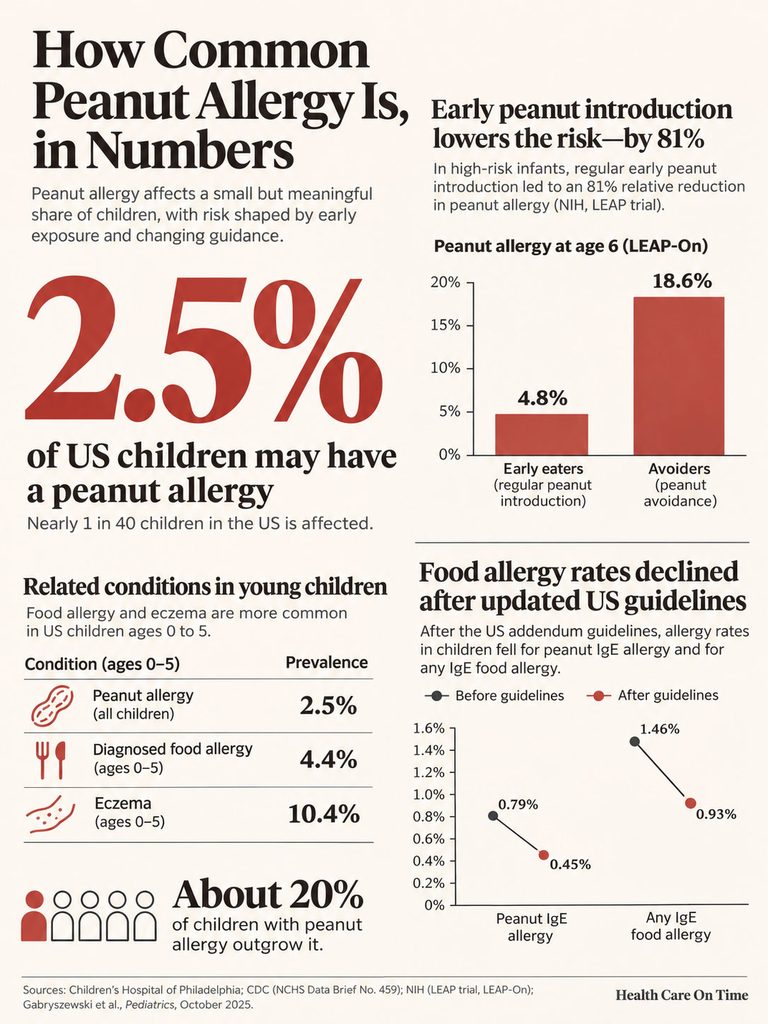
| US children who may have peanut allergy | Nearly 2.5% | Children’s Hospital of Philadelphia |
| US children ages 0 to 5 with a diagnosed food allergy (2021) | 4.4% | CDC, NCHS Data Brief No. 459 |
| US children ages 0 to 5 with eczema (2021) | 10.4% | CDC, NCHS Data Brief No. 459 |
| Drop in peanut allergy with regular early peanut in high-risk infants | 81% relative reduction | NIH, LEAP trial (640 infants) |
| Peanut allergy at age 6 after one year of avoidance | 4.8% of early eaters vs 18.6% of avoiders | NIH, LEAP-On (556 children) |
| Peanut IgE allergy in children, before vs after the US addendum guidelines | 0.79% vs 0.45% | Gabryszewski et al., Pediatrics, October 2025 |
| Any IgE food allergy, before vs after the addendum guidelines | 1.46% vs 0.93% | Gabryszewski et al., Pediatrics, October 2025 |
| Children with peanut allergy who outgrow it | About 20% | Children’s Hospital of Philadelphia |
The LEAP trial enrolled infants ages 4 to 11 months, and its LEAP-On follow-up showed that the protection held even after children stopped eating peanut for a full year. In US pediatric health records, peanut allergy became less common after the 2017 addendum guidelines told parents to start peanut early, a drop reported in Pediatrics in October 2025.
Testing and Treatment After a Reaction
Any reaction after peanut, even a mild one, is worth a call to your pediatrician and usually leads to a referral to a pediatric allergist. One mild reaction doesn’t predict that the next one will be mild too.
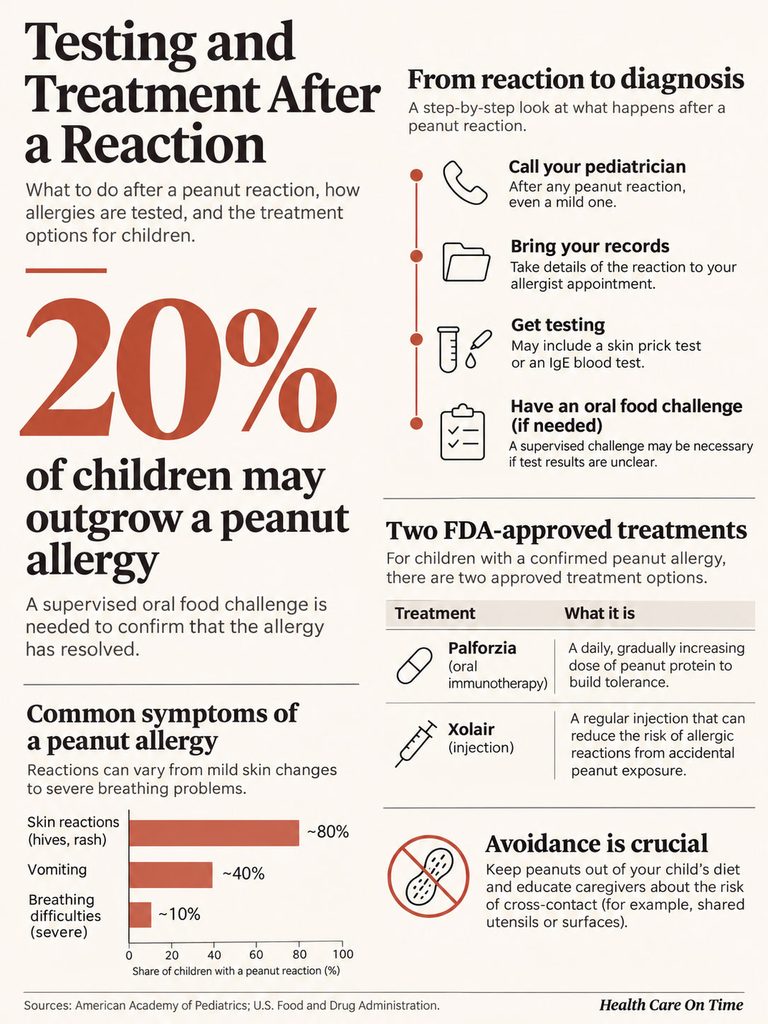
Bring your photos, your notes on timing, and the product you used to the allergist appointment, since a clear record of what your baby ate, how much, and exactly when each symptom appeared makes the test results easier to interpret. Testing usually means a skin prick test, an allergen-specific IgE blood test, or both. When the results are unclear, the allergist may do a supervised oral food challenge, giving gradually larger amounts of peanut in the office where a reaction can be treated on the spot. Don’t try peanut again at home to “double-check” unless the allergist tells you to. About 20% of children outgrow peanut allergy, and even then, a supervised food challenge is how it gets confirmed.
If the allergy is confirmed, avoidance comes first. Read every label. Watch for cross-contact (peanut getting into a product by accident during processing or handling). Make sure every babysitter, grandparent, and day care worker knows the plan. Peanut flour and peanut dust can trigger reactions too, and peanuts show up in a long list of packaged foods.
Treatments Approved for Young Children
Two FDA-approved treatments are now available for children from their first birthday. Palforzia, a peanut allergen powder used for oral immunotherapy, is approved for confirmed peanut allergy, with the first dose escalation given to children ages 1 through 17, and it’s used alongside a peanut-avoidant diet.
Xolair (omalizumab) is a shot that makes an accidental bite less likely to cause a serious reaction, and the FDA approved it for food allergy in people 1 year and older on February 16, 2024. In the peanut part of its study, 68% of patients on Xolair could eat 600 mg or more of peanut protein without moderate to severe symptoms, compared with 6% on placebo. Your child still has to avoid peanut, Xolair is no substitute for epinephrine, and because it carries a boxed warning for anaphylaxis, treatment starts in a medical setting. Neither treatment cures the allergy.
Frequently Asked Questions
What are the symptoms of a peanut allergy in babies?
Most babies show it on the skin first, as welts or redness near the mouth, and many vomit. Breathing changes, a hoarse cry, or a limp, pale baby mean the reaction is severe and you should call 911.
Is 7 months too late to introduce peanuts?
No. Introducing peanut in the first year of life lowers the chance of peanut allergy, and for moderate-risk babies with mild to moderate eczema, the guideline target is around 6 months, so a few weeks past that is fine. A 7-month-old with no eczema and no food allergies can start peanut along with other solids. If your baby has severe eczema or an egg allergy, talk to your pediatrician first, because testing may come before the first taste.
Is there a vaccine for peanut allergies?
No. There’s no vaccine, and no cure. For children who are already allergic and at least 1 year old, the options are treatments that lower the risk of a serious reaction after an accidental bite: oral immunotherapy with Palforzia, or Xolair injections. Both are used together with peanut avoidance, and neither replaces epinephrine in an emergency. For babies under 1, early peanut introduction is the best way to lower the risk in the first place.
How hard is it to live with a peanut allergy?
It takes planning, and the first months after diagnosis are usually the hardest. Families get used to checking labels, asking about cross-contact when eating out, and teaching every caregiver how to use epinephrine. Many children’s hospital allergy programs also offer counseling or support groups, since the worry can weigh on parents and kids.
My baby already has eczema on the cheeks. How do I tell if a new red patch is from the peanut?
Check timing and texture. Eczema is usually dry and rough and was there before the feeding. A peanut reaction shows up within minutes to a couple of hours, and the spots are raised welts or fresh swelling that can spread past the cheeks. Take a photo before the feeding so you have something to compare against.
What does a peanut allergy rash look like on a baby?
Usually raised red welts or blotchy redness around the mouth, chin, and cheeks within minutes of eating, sometimes in a polka-dot pattern. If it spreads beyond the face or comes with vomiting, coughing, or swelling, treat it as severe.
Can I give the first taste of peanut in the morning before day care?
It’s better not to. Plan the first feeding for a time when you can stay home and watch your baby for at least 2 hours, so you’re the one who sees any reaction.
Should I give Benadryl if my baby reacts to peanut?
Only if your pediatrician has told you to and given you a dose based on your baby’s weight. It can ease a few hives. For hives with vomiting or any breathing symptoms, skip straight to epinephrine if you have it, and call 911.
Medical disclaimer: This article is for general information and isn’t a substitute for advice from your child’s pediatrician or allergist. If your baby has trouble breathing, swelling of the face or tongue, repeated vomiting, or becomes pale, limp, or hard to wake after eating, call 911 right away.
References
- Children’s Hospital of Philadelphia. Peanut Allergies in Children.
- Mayo Clinic. Peanut allergy: Symptoms and causes. Updated March 25, 2025.
- Texas Children’s. Introducing peanut butter to infants. October 25, 2024.
- FARE. Peanut Early Introduction Guidelines.
- American Academy of Pediatrics, HealthyChildren.org. Anaphylaxis in Infants and Children. Updated October 8, 2026.
- Carlisle A, Lieberman J. Clinical Management of Infant Anaphylaxis. Journal of Asthma and Allergy. 2021;14:821-827.
- American College of Allergy, Asthma and Immunology. Does anaphylaxis look different in infants and toddlers?
- Asthma and Allergy Foundation of America, Kids With Food Allergies. Food Allergy Anaphylaxis in Infants (ITA study).
- GIKids (NASPGHAN). Introducing Peanuts. November 2024.
- Nationwide Children’s Hospital. Peanut Feeding Guidelines.
- American Academy of Allergy, Asthma and Immunology. Food Protein-Induced Enterocolitis Syndrome (FPIES) Defined.
- KidsHealth (Nemours). Anaphylaxis. Reviewed October 2024.
- CDC National Center for Health Statistics. Diagnosed Allergic Conditions in Children Aged 0-17 Years: United States, 2021 (Data Brief No. 459).
- National Institutes of Health. Early peanut introduction nutritionally safe (LEAP secondary analysis). June 10, 2016.
- National Institutes of Health. Benefits of early peanut consumption persist (LEAP-On). March 4, 2016.
- Gabryszewski SJ, et al. Pediatrics, 2025, as summarized in News-Medical. October 21, 2025.
- US Food and Drug Administration. AUVI-Q (epinephrine injection) prescribing information. 2024.
- US Food and Drug Administration. Palforzia.
- US Food and Drug Administration. FDA Approves First Medication to Help Reduce Allergic Reactions to Multiple Foods After Accidental Exposure. February 16, 2024.
- USDA WIC Works. Peanut Allergy.