Here’s something that feels backward when you’re shivering under three blankets. A fever is not your enemy. It’s your immune system turning up the heat on purpose, and the goal is rarely to crush it, just to stay safe and comfortable while it works.
Table of Contents
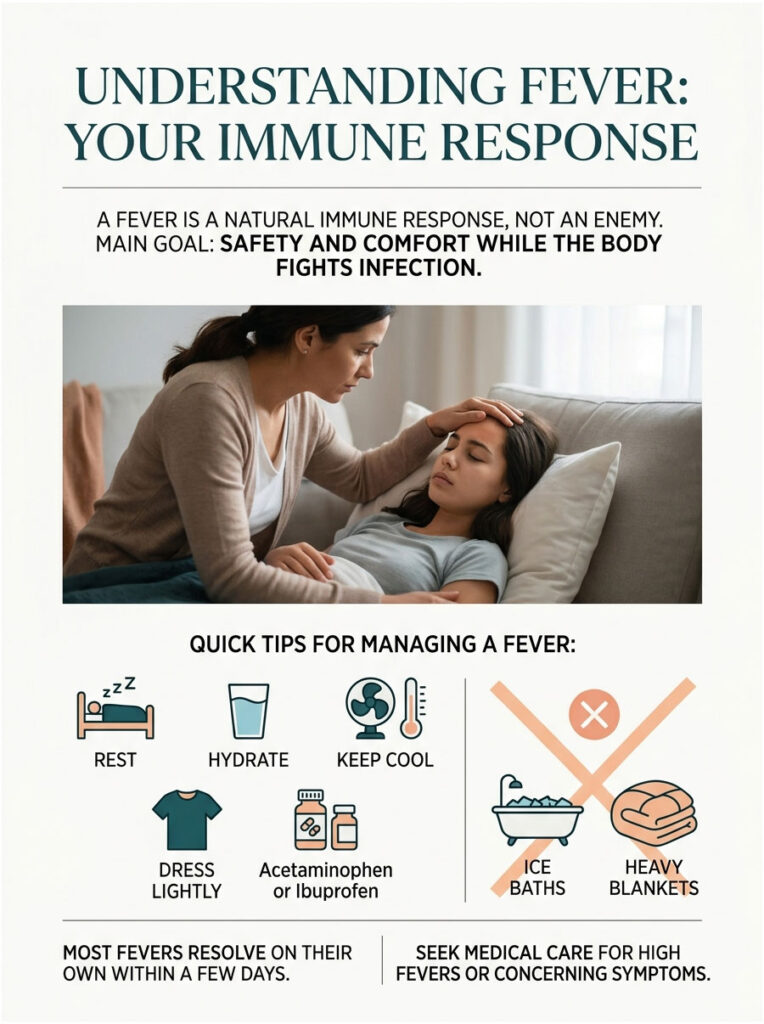
Quick Answer: To break a fever fast and safely, rest, drink plenty of fluids, keep the room cool, and dress lightly. Take an appropriate dose of acetaminophen or ibuprofen if you’re uncomfortable. Avoid ice baths, alcohol rubs, and heavy blankets. Most fevers ease on their own within a few days. Seek medical care for very high readings, a fever in a young infant, or worrying symptoms.
At a Glance
- A fever is the body’s natural defense, not an illness itself.
- 100.4 degrees Fahrenheit (38 degrees Celsius) is the standard threshold for a true fever.
- Rest, fluids, light clothing, and a cool room do most of the work.
- Acetaminophen and ibuprofen help comfort; aspirin is never for children.
- Ice baths, alcohol rubs, and bundling up can backfire.
- Any fever in an infant under 3 months is an immediate medical matter.
What a Fever Actually Is and When It Needs Treating
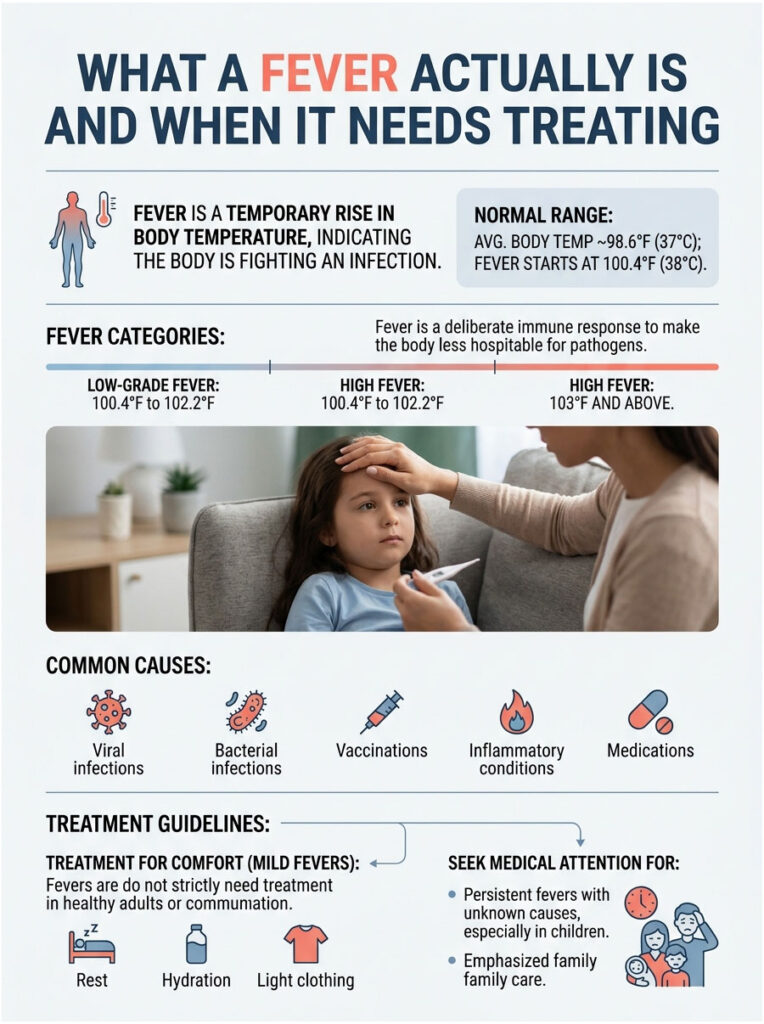
That number on the thermometer means more once you know what’s behind it. A fever is a temporary rise in body temperature, usually a sign your body is fighting an infection.
What Counts as a Fever
Normal body temperature hovers around 98.6 degrees Fahrenheit (37 degrees Celsius), though it varies by person, time of day, and how it’s measured. A reading of 100.4 degrees Fahrenheit (38 degrees Celsius) or higher is the standard clinical definition of a fever.
Temperatures between 100.4 and 102.2 degrees Fahrenheit are generally considered low-grade to moderate. Anything at or above 103 degrees Fahrenheit in an adult is a high fever worth closer attention. Our medical reviewers note that how a person feels and acts often matters more than the exact decimal on the thermometer.
The way you measure changes the number. Rectal and temporal artery readings tend to run slightly higher than oral readings, and armpit readings tend to run lower. A small difference between methods is normal, so consistency matters more than chasing a perfect figure.
Why Your Body Raises Its Temperature
A fever is deliberate. When your immune system detects an invader, it signals the brain’s hypothalamus to raise your internal thermostat.
That higher temperature makes your body a tougher place for many viruses and bacteria to thrive, and it speeds up immune activity. This is why a mild fever, left to run its course, can actually help you recover. The chills and aches are uncomfortable side effects of that process.
Common Causes of a Fever
Most fevers trace back to infections. Viral illnesses like colds, the flu, and COVID-19 are the most frequent triggers, followed by bacterial infections such as strep throat, ear infections, and urinary tract infections.
Less commonly, fevers follow a routine vaccination, a flare of an inflammatory condition, heat exposure, or certain medications. A fever with no obvious cause, especially one that lingers, is a reason to see a clinician rather than to keep guessing at home.
When a Fever Does and Doesn’t Need Treating
A mild fever in an otherwise healthy adult or older child often needs no treatment beyond rest and fluids. According to the Cleveland Clinic, a fever below 101 degrees Fahrenheit frequently does not need to be actively brought down.
Treatment becomes reasonable when the fever causes real discomfort, interferes with sleep or hydration, or climbs high. Fever is also a leading reason for pediatric emergency visits; one national study found that young children with fever accounted for a notable share of US emergency department encounters over an 11-year period. In cases reviewed by our medical team, the decision to treat is about comfort and safety, not the number alone.
There is also a practical reason not to over-treat. Lowering a fever right before a medical visit can mask a useful clue, since a clinician often wants to see the true pattern of an illness. Treat for genuine comfort, not to erase the evidence.
How to Break a Fever Fast: Step-by-Step
When a fever is making you or your child miserable, a handful of safe, well-tested steps bring relief. None of them require anything exotic.
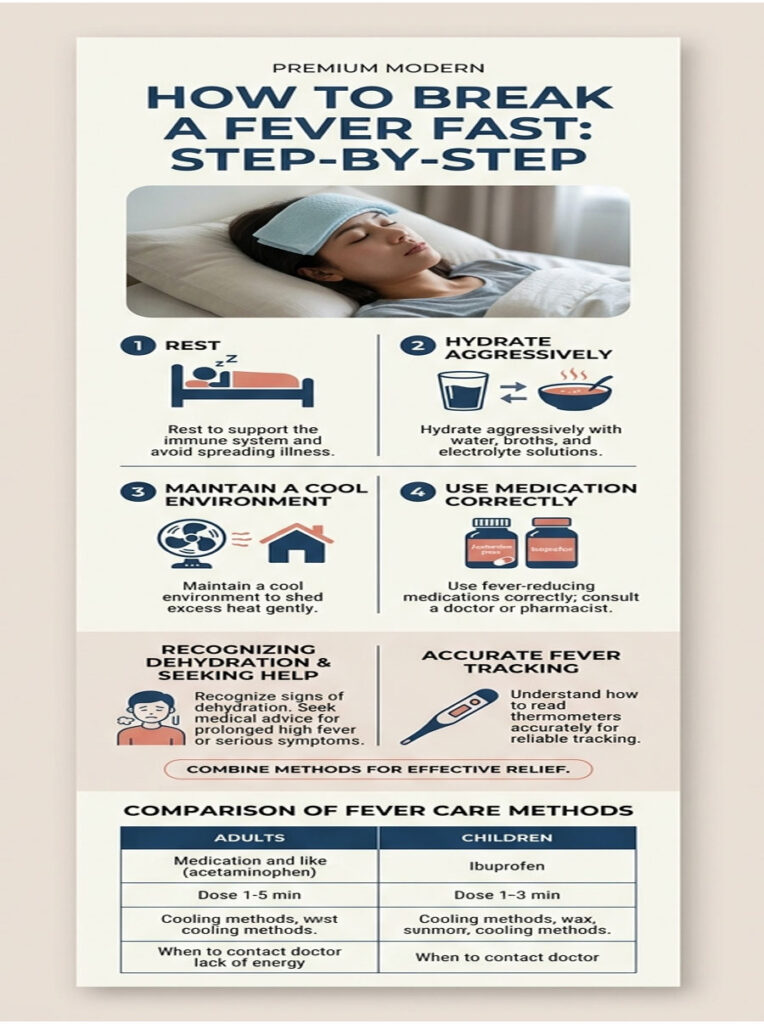
It helps to think of these steps as working together rather than competing. Fluids and rest support the body from the inside, a cool environment eases it from the outside, and medication smooths the worst of the discomfort. Used in combination, they bring relief faster than any single step alone.
Rest and Let the Body Work
Rest is not a throwaway tip. Fighting an infection is demanding work, and sleep is when much of the immune response happens.
Pushing through a fever to work or run errands tends to prolong the illness and spreads it to others. Most illnesses stay contagious for at least 24 hours after a fever breaks on its own. Patients commonly ask us whether they can power through, and the honest answer is that rest usually shortens the whole episode.
Rest also means scaling back screen time and stimulation, not just staying home. A quiet, dim room helps the body settle. For a feverish child, that can mean swapping active play for calm activities like reading together or quiet shows.
Hydrate Aggressively
A fever speeds up fluid loss through sweat and faster breathing, so dehydration is a real risk. Steady fluids are one of the fastest ways to feel better.
Water is the foundation, but broths, herbal teas, and oral rehydration solutions all help. For children, an electrolyte solution like Pedialyte is useful if they aren’t drinking well. Cool fluids can also nudge body temperature down slightly.
Watch for signs that fluids are not keeping up. Dark urine, a dry mouth, dizziness, or in children fewer wet diapers and crying without tears all point to dehydration. If someone cannot keep fluids down at all, that is a reason to call a clinician.
Cool the Environment, Not Shock the Body
The aim is to shed excess heat gently. Keep the room at a comfortable temperature, use a fan for airflow, and dress in light, breathable clothing.
A lukewarm sponge bath can help an uncomfortable person cool down. A cool, damp cloth on the forehead, neck, or wrists offers relief too. The key word is lukewarm; anything cold can trigger shivering, which raises core temperature.
Room temperature plays a quiet role too. A space that is too warm makes it harder for the body to release heat, while one that is too cold invites shivering. Aim for comfortable and steady rather than deliberately cold.
Use Fever-Reducing Medication Correctly
Medications that lower a fever are called antipyretics, and the two mainstays are acetaminophen and ibuprofen. According to GoodRx, both can be used safely in adults and children when dosed correctly.
Acetaminophen typically works within 30 to 60 minutes. Ibuprofen lasts longer and also eases inflammation, but it should be taken with food and is not used in infants under 6 months. Aspirin lowers fever in adults but must never be given to anyone under 18 because of the risk of Reye’s syndrome.
Timing helps too. Acetaminophen is generally dosed every four to six hours and ibuprofen every six to eight, never exceeding the daily limit on the label. Keeping a written log of what was given and when prevents accidental double dosing, one of the most common medication errors at home.
Choosing between the two often comes down to the situation. Acetaminophen is gentle on the stomach and widely usable, while ibuprofen lasts longer and helps when body aches are prominent. Either is a fine first choice for most people; the one to avoid is using both at once without a clinician’s specific instructions.
The table below compares the main fever-breaking methods side by side so you can see what fits an adult versus a child.
| Method | How It Helps | For Adults | For Children | Speed of Relief |
| Rest | Lets the immune system work | Essential | Essential | Gradual |
| Fluids | Prevents dehydration, aids cooling | Water, broth, tea | Water, milk, Pedialyte | Gradual, ongoing |
| Cool environment | Helps shed excess heat | Light clothing, fan | Light layers, fan | Mild, supportive |
| Lukewarm sponge bath | Surface cooling for comfort | Optional, if hot | Optional, never cold water | Temporary |
| Acetaminophen | Lowers the body’s set point | Per label dosing | By weight, from infancy | 30 to 60 minutes |
| Ibuprofen | Lowers fever, eases aches | Per label, with food | By weight, 6 months and up | 30 to 60 minutes |
Reading the Thermometer Correctly
A fast, accurate reading starts with the thermometer itself. Rectal readings are the most accurate for infants, while oral, temporal artery, and ear thermometers work well for older children and adults.
Different methods can read slightly differently, so note which one you used when tracking a fever or reporting it to a clinician. Avoid taking a temperature right after a hot drink, a bath, or exercise, since each can skew the result for a while.
Digital thermometers have largely replaced older glass models, which could break and release mercury. If an old mercury thermometer is still sitting in a drawer somewhere, it is worth replacing with a modern digital one for both safety and speed.
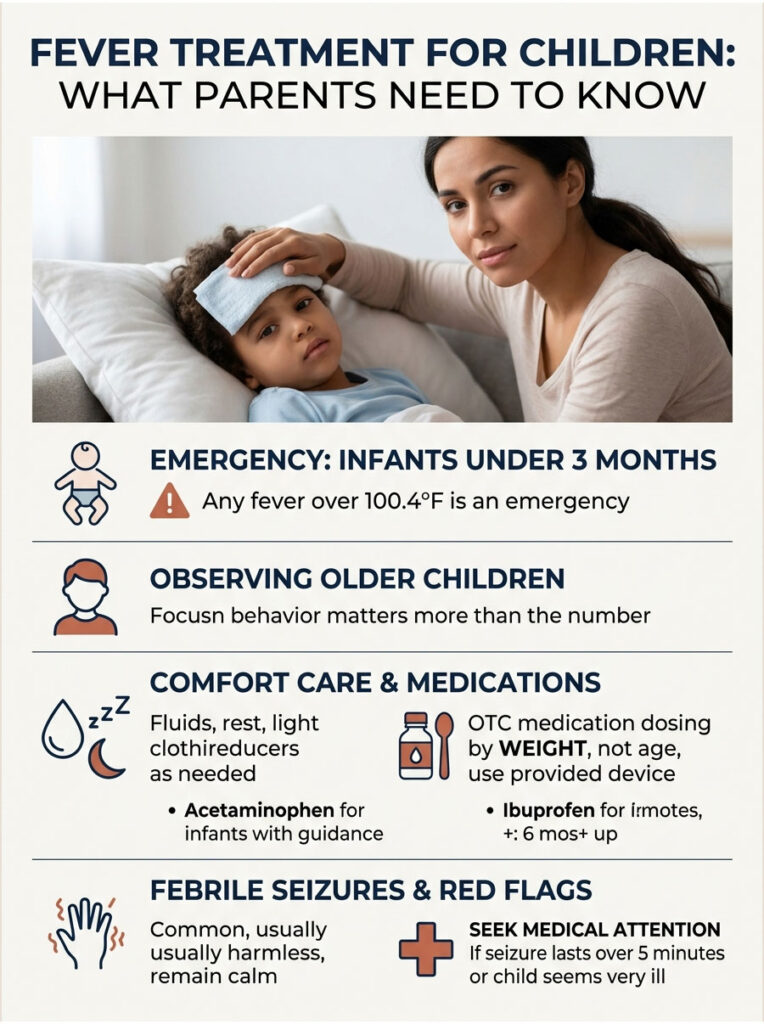
Fever Treatment for Children: What Parents Need to Know
A child’s fever sets off a particular kind of worry. The reassuring truth is that most childhood fevers are caused by routine infections and resolve on their own, but age changes the rules.
Age-by-Age Guidance
For children, the right response depends heavily on age. Older children with a mild fever who are still drinking, playing, and alert usually need only comfort care.
Watch behavior closely. A child who is responsive, taking fluids, and resting comfortably is generally doing fine, even with a fever. A child who is unusually drowsy, limp, or inconsolable needs prompt medical attention regardless of the temperature.
Infants Under 3 Months
This age group is the clear exception to wait and watch. Any rectal temperature of 100.4 degrees Fahrenheit or higher in a baby younger than 3 months is a medical emergency.
Young infants can have serious infections without obvious symptoms, so they need same-day evaluation. Do not give fever medication to a young infant before speaking with a doctor. Across patients we serve, this is the single most important fever rule for new parents.
Toddlers and Older Children
Past the infant stage, the temperature number matters less than how the child looks and acts. A toddler with a 102-degree fever who is still drinking, playing between rests, and making eye contact is usually weathering a routine illness.
Comfort care is the focus: fluids, light clothing, rest, and a fever reducer if the child is clearly miserable. Treating to make a child comfortable is reasonable; treating just to chase the number lower is not necessary. Trust changes in behavior over changes in the thermometer.
Choosing and Dosing OTC Medication Safely
For children, fever medication is dosed by weight, not age, which is where mistakes happen. Always use the dosing device that comes with the product and the current weight of the child.
Acetaminophen can be used from infancy under medical guidance, while ibuprofen is for ages 6 months and up. Dosing errors are common; research has found that a significant share of caregivers give children an inaccurate dose. Never give a child aspirin, and check that other cold or flu products don’t already contain a fever reducer.
Liquid formulations for children come in different concentrations, so never assume two bottles are interchangeable. Read the concentration on each label, use the syringe or cup provided with that specific product, and measure in milliliters rather than household spoons for accuracy.
Febrile Seizures, Explained Calmly
A febrile seizure is one of the most frightening things a parent can witness, so it helps to understand it in advance. These are convulsions triggered by fever in young children.
According to the CDC, up to 5% of young children will have a febrile seizure, most between 6 months and 5 years of age. Nearly all children recover quickly and completely, with no lasting harm and no increased risk of epilepsy. Fever-reducing medicine does not reliably prevent them. If a seizure lasts more than five minutes, call 911.
If a febrile seizure happens, the response is simple. Stay calm, place the child on their side on a soft surface, clear the area of hard objects, and do not put anything in their mouth. Time the seizure. Most stop within a couple of minutes, after which the child should still be seen by a doctor that day.
Mistakes That Make a Fever Worse
Some popular fever remedies are not just useless; they can backfire. Knowing what to skip is as valuable as knowing what to do.
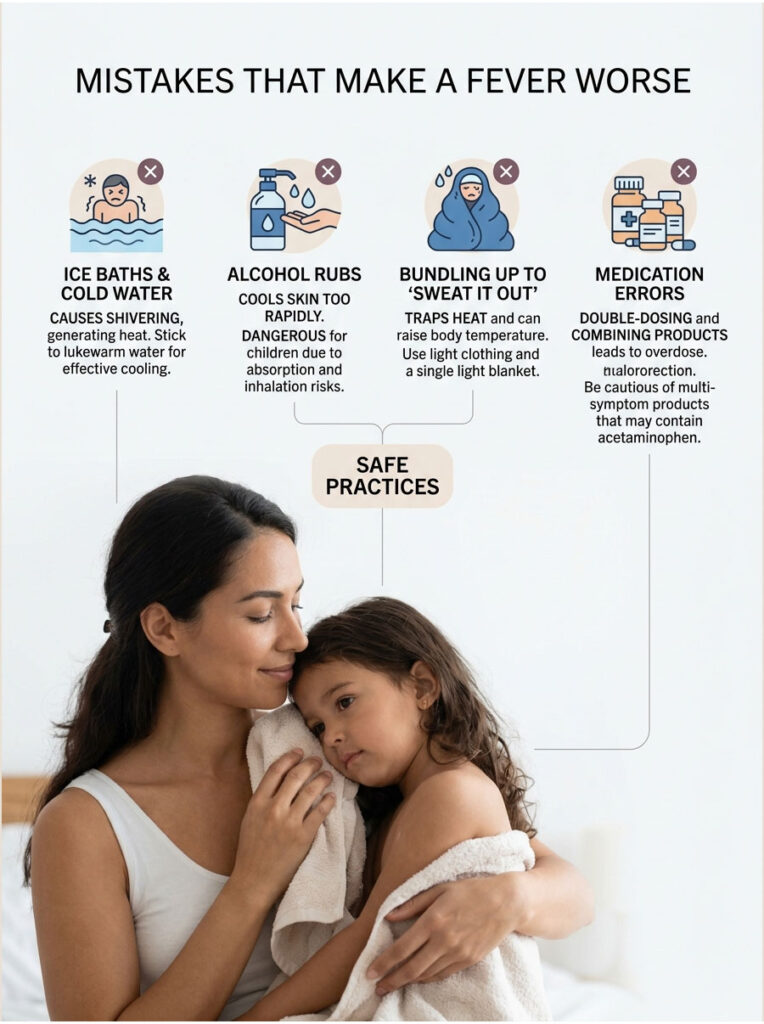
Many of these mistakes come from good intentions and old advice passed down through families. There is no shame in having tried them. What matters is switching to the gentler, evidence-based approach once you know it works better.
Ice Baths and Cold Water
Plunging a feverish person into cold water or applying ice packs feels logical, but it often worsens things. Sudden cold makes the body shiver.
Shivering is the body generating heat, which can push core temperature higher, not lower. Surface cooling also does little to change the deep core temperature that actually matters. Stick to lukewarm water and gentle methods.
Alcohol Rubs
Rubbing alcohol on the skin to cool a fever is an old practice that should be retired. It can cool the skin too rapidly and trigger shivering.
More seriously, alcohol can be absorbed through the skin or inhaled as vapor, which is dangerous, especially for children. Our medical reviewers strongly advise against alcohol rubs for anyone.
Bundling Up and Sweating It Out
The idea that you should pile on blankets and sweat a fever out is a myth. Heavy blankets and layers trap heat the body is trying to release.
For a child, over-bundling can push the temperature higher. Light clothing and a single light blanket are enough. Sweating can happen as a fever breaks, but forcing it does not speed recovery.
Medication Errors and Double-Dosing
Fever-reducer mistakes send people to the emergency room every year. The most common errors are taking doses too close together, exceeding the daily maximum, and unknowingly combining products.
Many multi-symptom cold and flu medicines already contain acetaminophen, so stacking them risks an overdose. The data below shows why careful dosing matters.
| Metric | US Figure | Source |
| Young children with fever as a share of US ED visits (11-year span) | About 2.1% of all encounters | West J Emerg Med / NIH |
| Young children who experience at least one febrile seizure | Up to 5% | CDC |
| Children whose febrile seizure recurs later in childhood | About 1 in 3 | CDC |
| Standard clinical threshold for a fever | 100.4 F (38 C) | NIH StatPearls |
| Simple febrile seizures as a share of all febrile seizures | About 80 to 85% | NIH |
When to Call a Doctor or Go to the ER
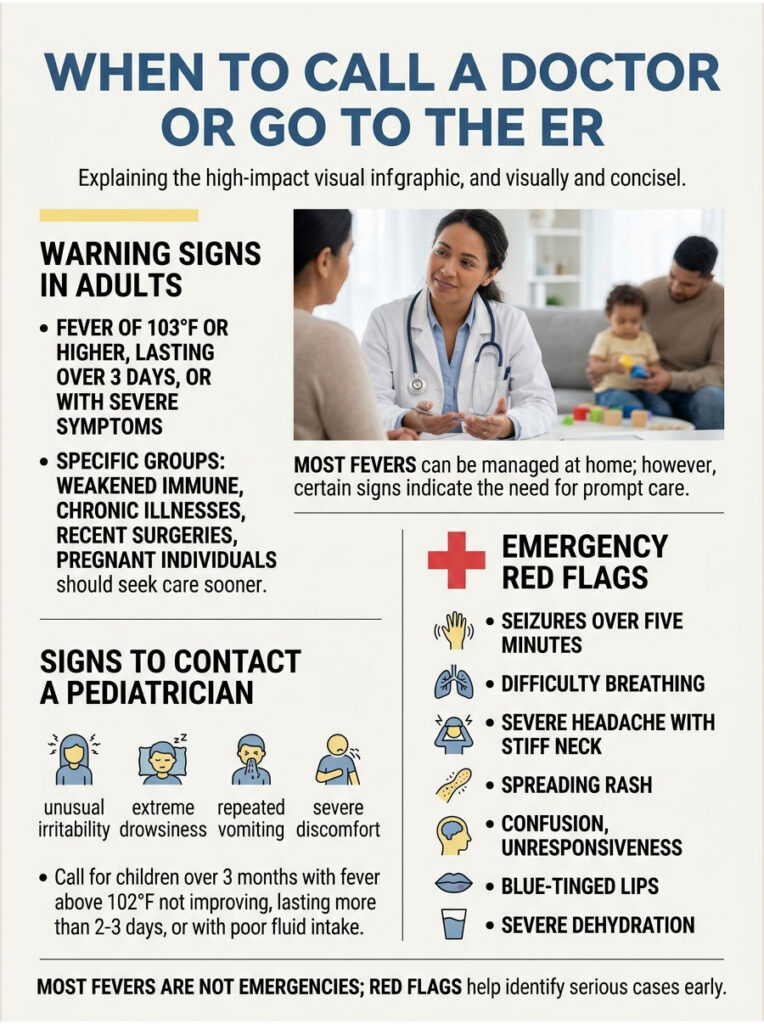
Most fevers are managed safely at home, but a smaller share signals something that needs prompt care. Knowing the warning signs turns guesswork into a clear decision.
Warning Signs in Adults
For adults, contact a healthcare provider for a fever that climbs to 103 degrees Fahrenheit or higher, or one that lasts more than three days.
Also seek care if a fever comes with a severe headache, a stiff neck, a rash, chest pain, shortness of breath, persistent vomiting, confusion, or trouble staying awake. Patients commonly ask us where the line is, and the rule of thumb is that worrying symptoms matter more than the temperature itself.
Certain people should reach out sooner than the general rules suggest. Anyone with a weakened immune system, a serious chronic illness, or a recent surgery, and anyone who is pregnant, should contact a clinician early rather than waiting out a fever at home.
Warning Signs in Children
For children over 3 months, call a pediatrician for a fever above 102 degrees Fahrenheit that does not improve, a fever lasting more than two to three days, or a fever with poor fluid intake.
Reach out promptly if a child is unusually irritable, extremely drowsy, vomiting repeatedly, or showing severe discomfort. A child who cannot be soothed, or who seems to be getting worse rather than better, needs evaluation.
Emergency Red Flags at Any Age
Some signs mean call 911 or go to the emergency room now. These include a seizure lasting more than five minutes, difficulty breathing, a stiff neck with a severe headache, or a purple or spreading rash.
Confusion, unresponsiveness, blue-tinged lips, or signs of severe dehydration also belong in this group. The decision table below brings these tiers together.
One reassurance helps balance these warnings. The vast majority of fevers, even uncomfortable ones, never approach this emergency tier. The red flags exist to catch the rare serious case early, not as a reason to expect the worst from an ordinary illness.
| Scenario | Age Group | Recommended Action |
| Any fever of 100.4 F or higher | Infant under 3 months | Seek same-day medical care immediately |
| Fever above 102 F not improving | Child 3 months to 3 years | Call a pediatrician |
| Fever lasting more than 3 days | Older child or adult | Contact a healthcare provider |
| Fever of 103 F or higher | Adult | Contact a healthcare provider |
| Fever with stiff neck, rash, or confusion | Any age | Go to the ER now |
| Seizure lasting more than 5 minutes | Any age | Call 911 |
| Trouble breathing or blue lips | Any age | Call 911 |
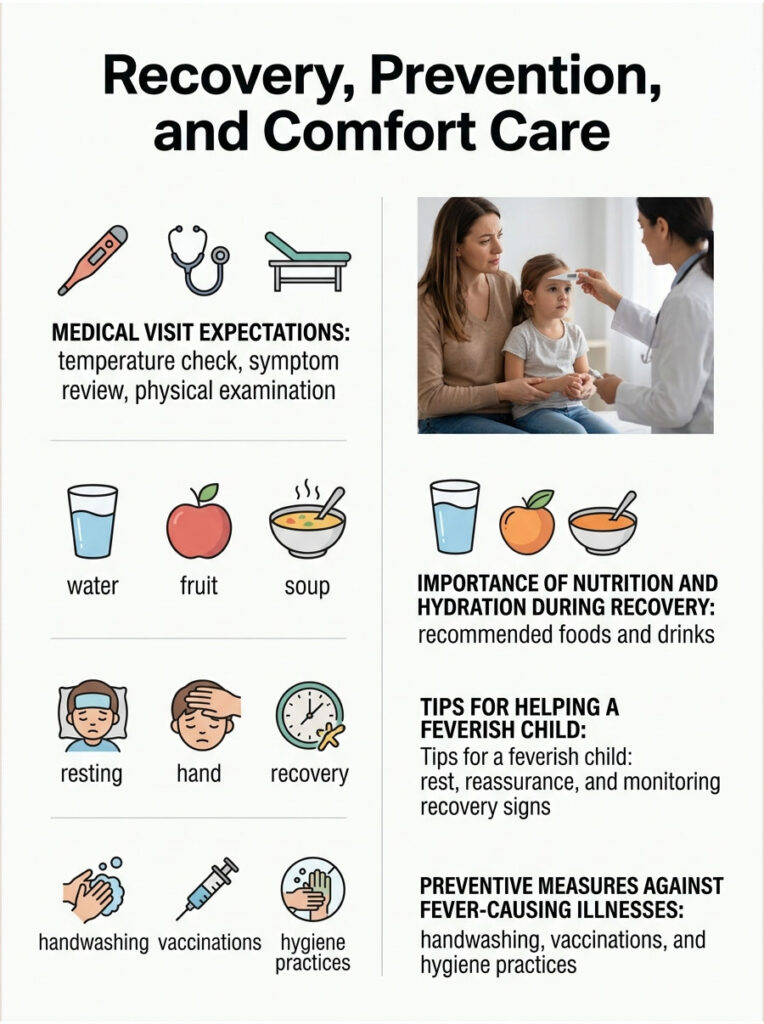
Recovery, Prevention, and Comfort Care
Breaking a fever is only part of the picture. How you recover, and how you avoid the next illness, matters just as much.
What to Expect at a Medical Visit
Knowing what a visit involves takes some of the worry out of going. A clinician will check the temperature, review the symptoms and their timeline, and examine the ears, throat, chest, and abdomen for a source.
Depending on the findings, simple tests such as a throat swab, a urine sample, or basic blood work may be ordered to pinpoint the cause. Many fevers turn out to be viral and need only supportive care, but ruling out a treatable infection is exactly what the visit is for.
What to Eat and Drink
The old saying feed a cold, starve a fever is not sound advice. The body needs energy and fluids to fight infection.
Appetite often dips with a fever, and that’s fine; do not force food. Offer easy, gentle options like broth, soup, toast, bananas, and plenty of fluids. Steady hydration remains the top priority throughout recovery.
Cold or soft foods can be easier to manage when a sore throat rides along with a fever. Yogurt, smoothies, applesauce, and frozen fruit pops add both fluids and a little energy without demanding much of a tired body. Avoid alcohol and heavily caffeinated drinks while feverish, since both can worsen dehydration rather than ease it.
Helping a Child Rest and Recover
A feverish child recovers best with calm, quiet rest and reassurance. Keep them in light clothing in a comfortable room.
Offer fluids frequently in small amounts, and let them sleep as much as they need. It also helps to stay calm yourself, since children read a parent’s worry quickly; a steady, comforting presence makes the whole episode easier for both of you. A child’s energy and mood, not the thermometer, are the real recovery signals.
Plan for the fever to outlast a single good moment. A child may perk up after a dose of medication and then dip again as it wears off, which is normal. Judge recovery over a full day or two, not over one hopeful hour.
Preventing the Illnesses Behind Fevers
Most fevers come from infections you can reduce your odds of catching. Regular handwashing is one of the most effective everyday defenses.
Staying current on recommended vaccines lowers the risk of several fever-causing illnesses, and the CDC notes that timely vaccination can prevent some febrile seizures by preventing the illnesses behind them. If fevers are frequent or unexplained, a checkup and basic lab work can help identify a cause; patients can book routine diagnostic tests through HealthCareOnTime to follow up.
A few everyday habits stack up: covering coughs and sneezes, not sharing cups or utensils during illness, keeping frequently touched surfaces clean, and staying home while contagious. None is dramatic on its own, but together they cut the number of fevers a household sees in a year.
Common Fever Myths, Cleared Up
Fever generates more myths than almost any everyday symptom. Sorting fact from folklore makes it easier to respond calmly and correctly.
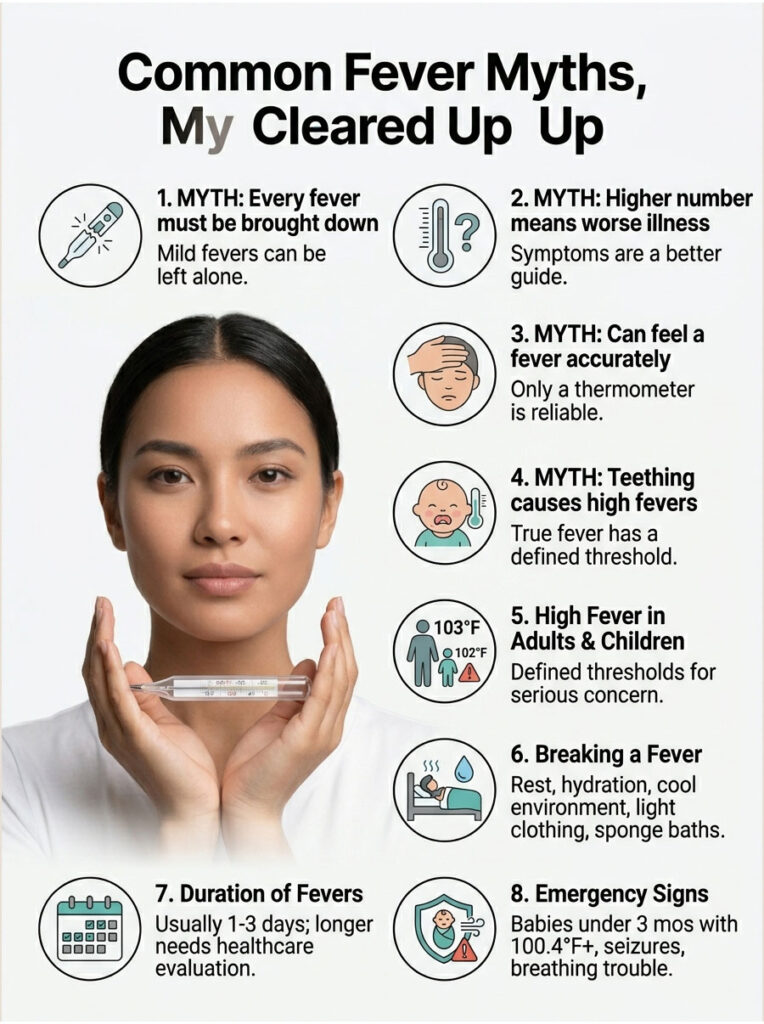
Myth: Every Fever Must Be Brought Down
A fever is part of the body’s defense, not a problem to erase. A mild fever in a comfortable person can be left alone. The reason to treat is discomfort, poor sleep, or dehydration, not the simple fact that a thermometer reads high.
Myth: A Higher Number Means a Worse Illness
The height of a fever does not reliably predict how serious the illness is. A minor virus can spike a high temperature, while some serious infections cause only a modest one. How the person looks and behaves is the better guide.
Myth: You Can Feel a Fever Accurately by Touch
A hand on the forehead is a rough hint at best. Skin can feel warm or cool for many reasons unrelated to core temperature. A thermometer is the only reliable way to know whether a true fever is present and how high it is.
Myth: Teething Causes High Fevers
Teething may raise a baby’s temperature very slightly, but it does not cause a true fever. If a teething infant has a temperature of 100.4 degrees Fahrenheit or higher, treat it as a fever from another cause and watch the child accordingly.
Frequently Asked Questions
What temperature is considered a high fever?
A fever starts at 100.4 degrees Fahrenheit (38 degrees Celsius). In adults, a temperature of 103 degrees Fahrenheit or higher is considered a high fever and warrants closer attention. In children, a reading above 102 degrees Fahrenheit that won’t come down, or any fever with worrying symptoms, deserves a call to a doctor.
How can I break a fever fast without medication?
Rest, drink plenty of fluids, keep the room cool, dress in light clothing, and use a lukewarm sponge bath or a cool damp cloth for comfort. These steps support your body’s natural cooling. Medication is optional for comfort, not always necessary for a mild fever.
How long does a fever usually last?
Most fevers from common viral infections last about one to three days, though some run a bit longer. A fever that lasts more than three days, keeps climbing, or returns after improving should be evaluated by a healthcare provider to rule out a treatable cause.
Should I starve a fever or feed it?
Neither. The phrase starve a fever is a myth. Your body needs fluids and energy to fight infection. Eat light, gentle foods if you have an appetite, never force food, and keep fluids steady throughout the illness as the top priority.
Can I break a fever overnight?
Sometimes. Rest, fluids, and a dose of fever reducer before bed can lower a fever within an hour and help you sleep. But fevers often spike again overnight, so a single good night does not always mean the illness is over. Keep monitoring.
Why does a fever get worse at night?
Body temperature naturally rises in the evening as part of your daily rhythm, and the cortisol that helps suppress inflammation dips at night. With fewer distractions, symptoms also simply feel more noticeable. A nighttime spike is common and usually not a cause for alarm by itself.
Is it safe to sleep with a fever?
Yes. Sleep is one of the best things for recovery, since the immune system does much of its work during rest. Keep the room cool, wear light clothing, stay hydrated, and use a light blanket. Check on a feverish child periodically through the night.
Can adults take aspirin for a fever?
Adults can use aspirin to reduce a fever, but it is not the first choice for everyone. It should never be given to anyone under 18 because of the risk of Reye’s syndrome, a rare but serious condition. Acetaminophen and ibuprofen are usually preferred.
When is a child’s fever an emergency?
Any fever of 100.4 degrees Fahrenheit or higher in a baby under 3 months is an emergency. At any age, a seizure over five minutes, trouble breathing, a stiff neck, a spreading rash, blue lips, or unresponsiveness all require 911 or an immediate ER visit.
Should I alternate acetaminophen and ibuprofen?
Some clinicians suggest alternating the two for a stubborn, uncomfortable fever, but this raises the risk of dosing errors. Do not do it on your own without guidance. Ask your pediatrician or doctor for a specific schedule, and write down every dose and the time given.
Does sweating mean a fever is breaking?
Often, yes. Sweating can happen as the body releases heat and the fever comes down. But it is not a reliable signal on its own, and forcing sweat with heavy blankets does not help. Track temperature and how the person feels instead.
Can a fever cause brain damage?
Fevers from ordinary infections do not cause brain damage. The body limits its own fever response well below a dangerous level. Brain injury is linked to extreme heat from outside sources, such as heatstroke, not a typical fever. Febrile seizures, while scary, do not cause lasting harm.
Medical Disclaimer: This article is for general educational purposes only and does not replace professional medical advice, diagnosis, or treatment. HealthCareOnTime.com does not diagnose conditions or recommend specific treatments. Medication dosing varies by age, weight, and health status, so always follow product labels and consult a qualified healthcare provider, and seek emergency care for the warning signs described above.