You’re on day three of a cold, you just took a DayQuil at lunch, and now it’s 2 p.m. and you feel miserable again. Can you take another one now, or do you wait? That pause is where most dosing mistakes happen. People guess, split the difference, or stack DayQuil on top of a Tylenol they took at breakfast. Roughly 56,000 Americans land in emergency rooms every year from accidental acetaminophen overdose, and the bulk of those visits cluster in cold-and-flu season. DayQuil sits right in the middle of that risk.
Table of Contents
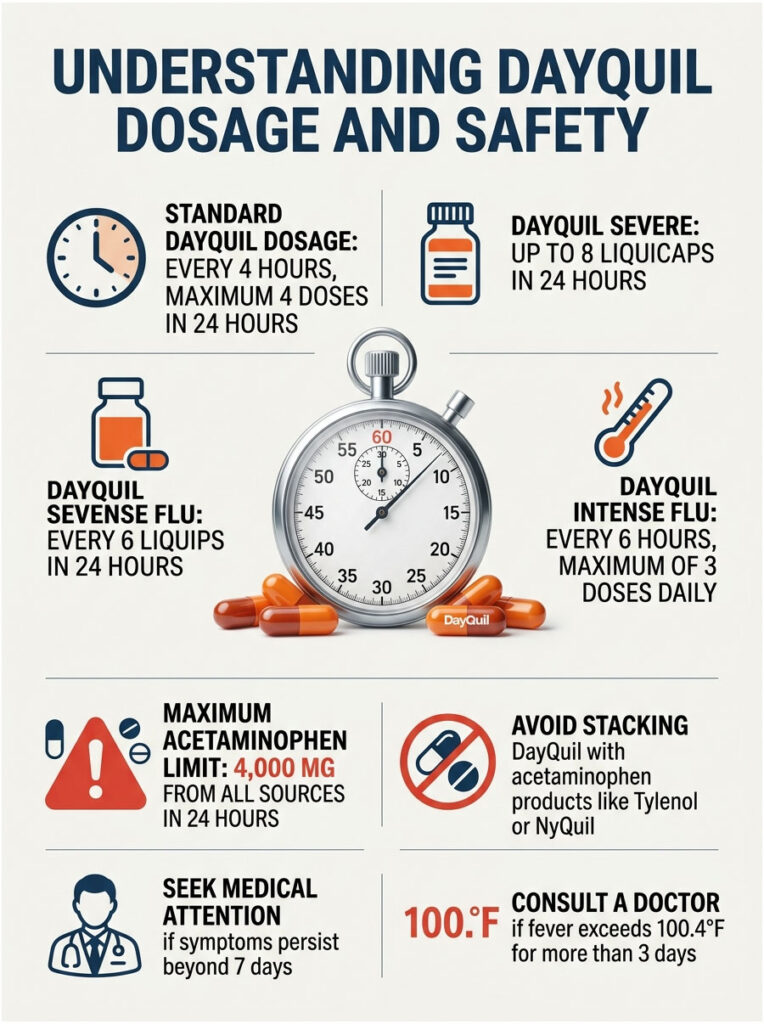
Quick Answer: For most DayQuil products, adults and kids 12 and older take 2 LiquiCaps or 30 mL of liquid every 4 hours, with a maximum of 4 doses in 24 hours. DayQuil SEVERE allows up to 8 LiquiCaps per day. DayQuil Intense Flu uses a 6-hour interval with a 3-dose daily cap. Never exceed 4,000 mg of acetaminophen from all sources combined in a 24-hour window.
At a Glance
• Standard DayQuil: every 4 hours, up to 4 doses per 24-hour day
• DayQuil SEVERE LiquiCaps: up to 8 LiquiCaps in 24 hours
• DayQuil Intense Flu: every 6 hours, 3 doses maximum per day
• Combined daily acetaminophen ceiling: 4,000 mg, per FDA guidance
• Never stack DayQuil with Tylenol, NyQuil, or any other acetaminophen product
• Stop and see a doctor if symptoms last more than 7 days, or if fever stays above 100.4°F for 3+ days
The Short Answer on DayQuil Timing and Dosing
You can take DayQuil every 4 hours. That’s the rule printed on every standard Vicks DayQuil bottle and blister pack sold in the US, and it’s what any pharmacist will tell you word-for-word if you call and ask.
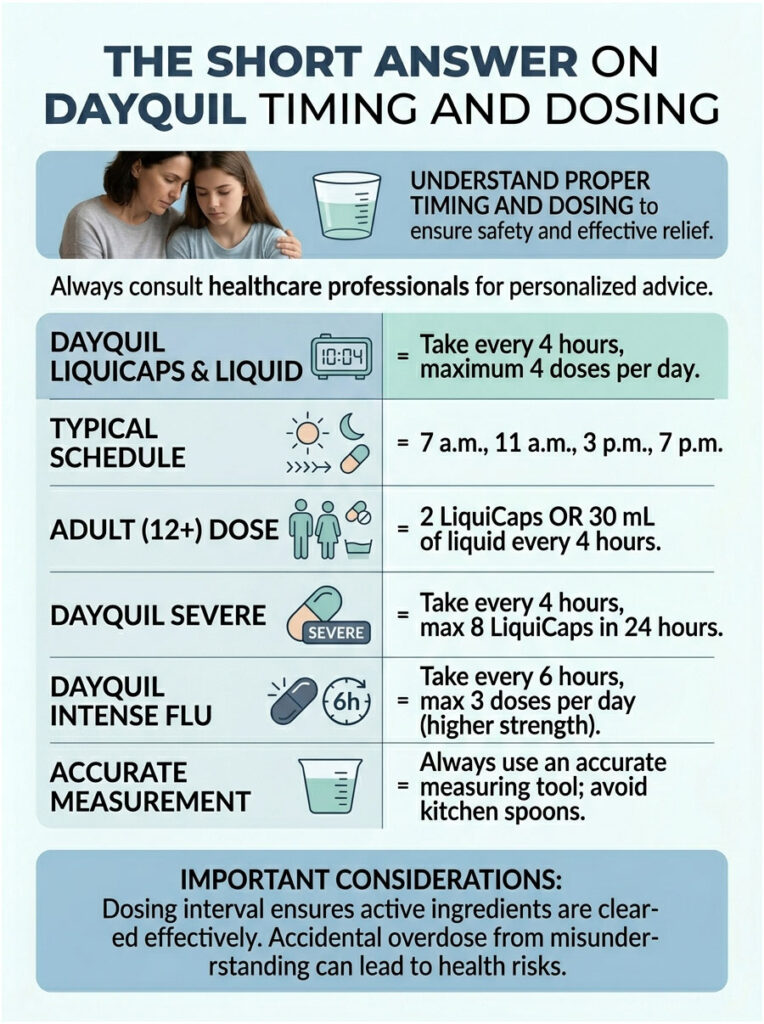
In practice, that gives you 4 possible doses across a day. A typical pattern looks like 7 a.m., 11 a.m., 3 p.m., 7 p.m. The last dose clears before bedtime, which is when you’d switch to NyQuil if you still feel rough.
The Standard Rule for Regular DayQuil
For Vicks DayQuil Cold & Flu LiquiCaps, the label is direct: adults and children 12 and over take 2 LiquiCaps with water every 4 hours, not to exceed 4 doses per 24 hours.
Liquid DayQuil follows the same schedule at 30 mL every 4 hours, measured with the dosing cup in the box. I’ve seen families over-dose by an ounce or more using kitchen spoons, and that error multiplies quickly when you’re cycling through 4 doses a day.
The SEVERE and Intense Flu Exceptions
DayQuil SEVERE works on the same 4-hour schedule but has different LiquiCap strengths. Per the DailyMed label from Procter & Gamble, the 24-hour cap is 8 LiquiCaps, taken as 2 every 4 hours. The addition of guaifenesin is what makes SEVERE the product to grab when your cough has turned wet and chesty.
DayQuil Intense Flu is the outlier most people miss. Because it uses higher-strength active ingredients, the interval stretches to every 6 hours with a 3-dose daily cap. In my work helping readers untangle dosing confusion, this is the single most mistimed product on US pharmacy shelves. People follow the 4-hour rhythm they remember from regular DayQuil and double-expose themselves by mid-afternoon.
Why the 4-Hour Gap Isn’t Arbitrary
The 4-hour interval lines up with how fast your body clears the active ingredients. Acetaminophen has a half-life of roughly 2 to 3 hours in healthy adults. By hour 4, about half of your previous dose is gone, leaving room to safely layer the next one.
Dextromethorphan and phenylephrine follow similar clearance curves. That’s why taking a dose at hour 3 instead of hour 4 isn’t “close enough.” It’s an extra 25% drug load on top of what’s still circulating, and over a day, that’s how the liver gets hit.
What’s Actually in a DayQuil Dose (and Why It Matters)
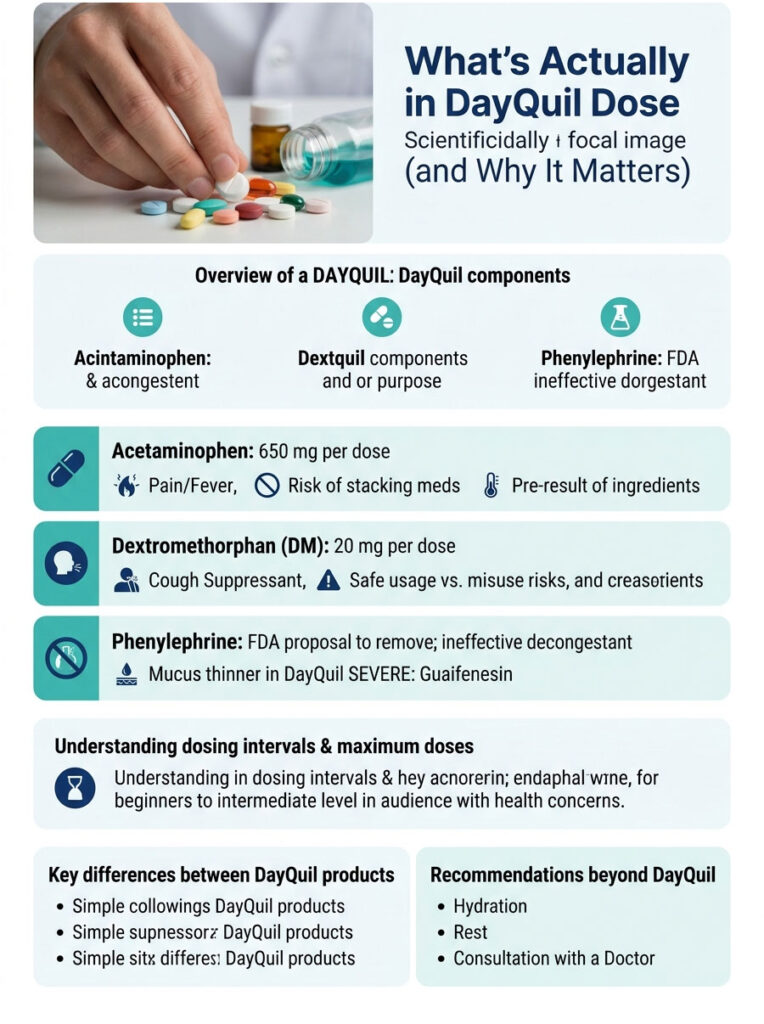
Every time you swallow 2 DayQuil LiquiCaps, you’re taking three or four different medications at once. Understanding what each one does changes how you think about timing and stacking.
Acetaminophen (the Real Ceiling)
A 2-LiquiCap dose of regular DayQuil Cold & Flu delivers 650 mg of acetaminophen. Four doses a day equals 2,600 mg, well under the FDA’s 4,000 mg daily ceiling, as long as you aren’t also taking Tylenol, Excedrin, Midol, NyQuil, or any of the 600-plus US products containing acetaminophen.
The FDA has warned that unintentional overdose from stacking acetaminophen products is a leading cause of acute liver failure in the US. One cited study found 40% of acetaminophen-related liver-failure patients were taking two or more acetaminophen products simultaneously.
Dextromethorphan (the Cough Suppressant)
DM, as pharmacists call it, quiets a dry, tickly cough. Each 2-LiquiCap dose contains 20 mg. At recommended dosing it’s safe; at high doses it causes hallucinations and cardiac problems, which is why teen misuse appears on CDC watch lists.
Here’s a usage point most articles skip: don’t use DayQuil on a productive, mucus-filled cough. That cough is trying to clear your airways. Suppressing it can drag out the infection.
Phenylephrine and the FDA’s 2024 Proposal
This is the biggest shift in cold-medicine guidance in a decade. On November 7, 2024, the FDA proposed removing oral phenylephrine from the OTC monograph after concluding it simply doesn’t work as a nasal decongestant when swallowed.
A 16-0 unanimous vote by the FDA’s Nonprescription Drug Advisory Committee in September 2023 set this in motion. The issue is bioavailability: your gut metabolizes phenylephrine before meaningful amounts reach the nasal tissue. The final FDA order is expected in May 2026, after which manufacturers will reformulate or pull products.
What this means for you right now: DayQuil’s cough suppressant and pain reliever still work as advertised. The stuffy-nose relief you thought you were getting was largely placebo. If congestion is your worst symptom, saline spray or behind-the-counter pseudoephedrine (Sudafed) is a better bet, per recent JAMA coverage.
Guaifenesin in DayQuil SEVERE
Guaifenesin is the mucus-thinner in Mucinex and in DayQuil SEVERE. At 200 to 400 mg per adult dose, it helps loosen chest congestion. SEVERE is the right pick once your cold has moved from dry cough into a wet, heavy-chest phase.
Table 1: DayQuil Product-by-Product Dosing Guide
| Product | Active Ingredients per Adult Dose | Dose Interval | Max Doses/24 hr | Acetaminophen per Dose | Minimum Age |
| DayQuil Cold & Flu LiquiCaps | Acetaminophen 650 mg, Dextromethorphan 20 mg, Phenylephrine 10 mg | Every 4 hours | 4 doses (8 LiquiCaps) | 650 mg | 12 years |
| DayQuil Cold & Flu Liquid (30 mL) | Acetaminophen 650 mg, Dextromethorphan 20 mg, Phenylephrine 10 mg | Every 4 hours | 4 doses | 650 mg | 12 years |
| DayQuil SEVERE LiquiCaps | Acetaminophen 650 mg, DM 20 mg, Phenylephrine 10 mg, Guaifenesin 400 mg (per 2-cap dose) | Every 4 hours | 8 LiquiCaps | 650 mg | 12 years |
| DayQuil SEVERE Liquid (30 mL) | Acetaminophen 650 mg, DM 20 mg, Phenylephrine 10 mg, Guaifenesin 400 mg | Every 4 hours | 4 doses | 650 mg | 12 years |
| DayQuil Intense Flu LiquiCaps | Higher-strength acetaminophen and dextromethorphan combo | Every 6 hours | 3 doses | See label | 12 years |
| DayQuil Kids Cough & Congestion (10 mL) | Dextromethorphan 5 mg, Phenylephrine 2.5 mg; no acetaminophen | Every 4 hours | 6 doses | None | 6 years |
Source: DailyMed FDA product labels and Vicks/Procter & Gamble official packaging.
DayQuil Dosage by Age and Product Line
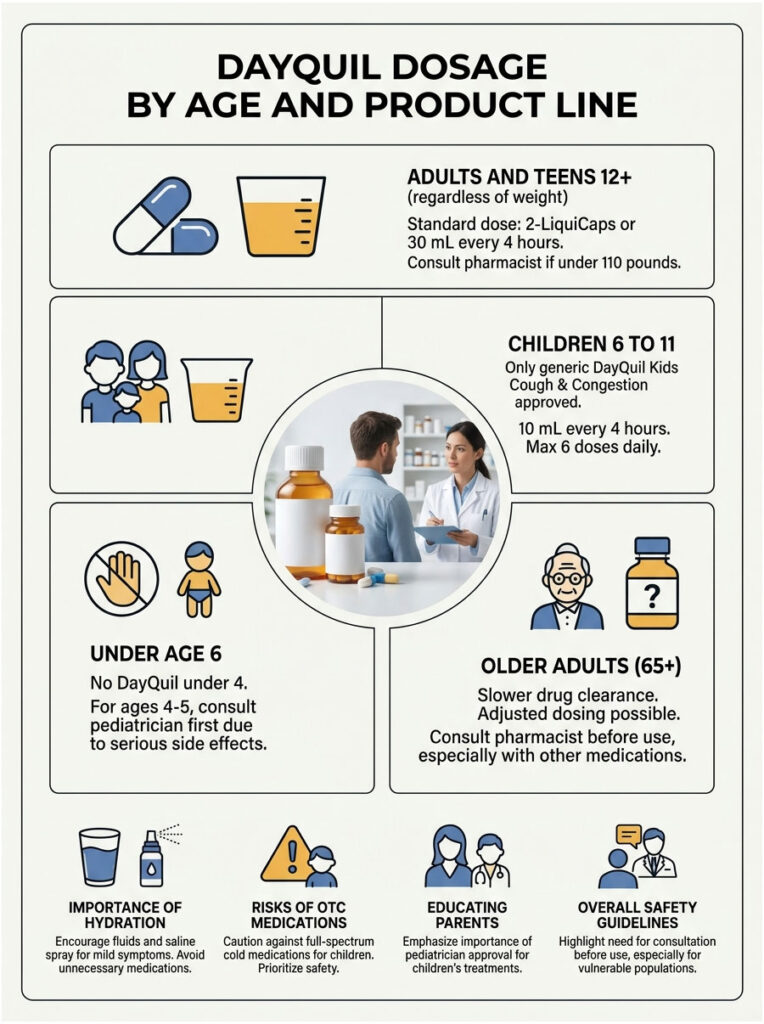
Adults and Teens 12+
The standard 2-LiquiCap or 30-mL dose every 4 hours applies to anyone 12 and up, regardless of body weight. DayQuil labeling, unlike pediatric Tylenol or children’s Motrin, doesn’t use weight-based dosing.
If you’re an adult weighing under 110 pounds, talk to a pharmacist before the first dose. Standard amounts can hit harder, especially the phenylephrine (blood pressure fluctuations) and dextromethorphan (dizziness).
Children 6 to 11
Most adult DayQuil formulations are not approved for children under 12. The one pediatric option, DayQuil Kids Cough & Congestion, doses at 10 mL every 4 hours, with a 6-dose daily cap.
Parents often ask me what to give a 9-year-old with a cold. The honest answer: a pediatrician’s OK first, plenty of fluids, saline spray, and if symptoms are mild, children’s acetaminophen or ibuprofen for fever only. Full-spectrum cold combinations aren’t the automatic right call for this age group.
Under Age 6
Don’t give any DayQuil product to a child under 4 years old. For ages 4 to 5, call the pediatrician first. The FDA and American Academy of Pediatrics have discouraged OTC cough and cold medications in children under 6 for years because of serious side-effect risk, including seizures and heart rhythm issues.
Older Adults: Why Standard Dosing May Be Too Much
Adults 65 and older often have slower drug clearance, reduced kidney function, or a stack of daily medications. I’ve seen otherwise stable patients on blood pressure meds tip into hypertensive spikes after two DayQuil doses because the phenylephrine amplified their existing load.
If you’re over 65, ask your pharmacist before the first dose, especially if you take anything for blood pressure, heart rhythm, thyroid, or diabetes. Sometimes saline and a cough drop are enough.
The Real Safety Ceiling: 4,000 mg of Acetaminophen
This is the single most important number in the article, and most people taking DayQuil don’t know it.
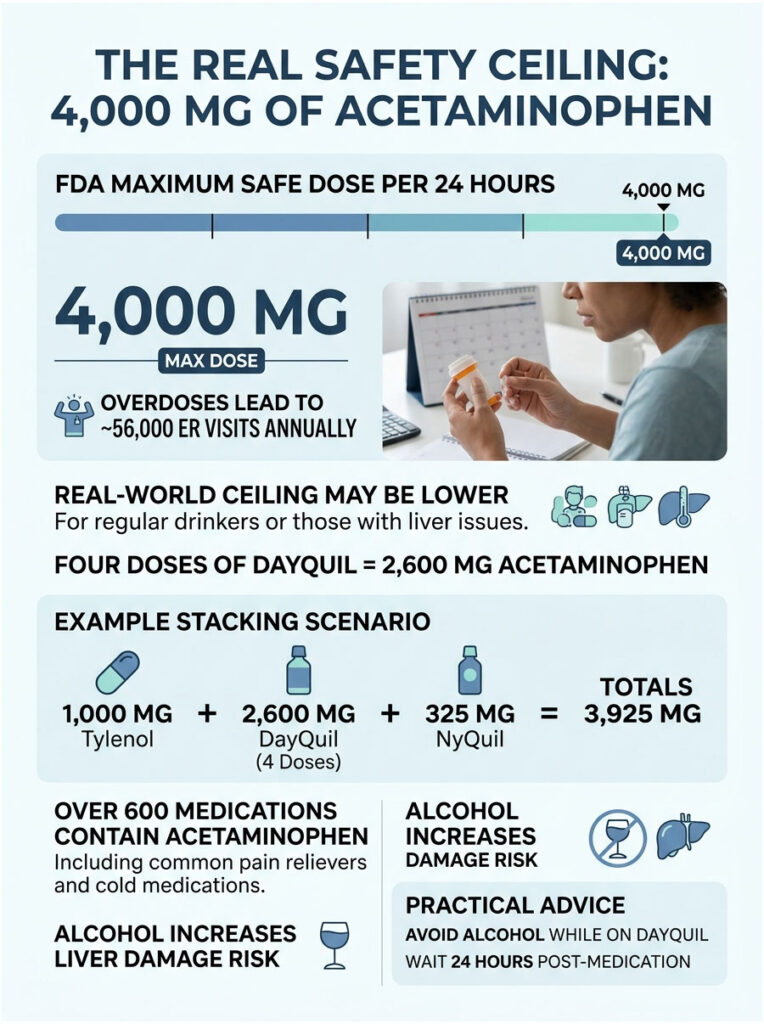
The 4,000 mg Daily Limit
The FDA sets the maximum safe 24-hour adult dose of acetaminophen at 4,000 mg. Some hepatologists argue the real-world ceiling should be 3,000 mg, or even 2,600 mg, for people who drink regularly or have underlying liver issues.
Four full doses of regular DayQuil put you at 2,600 mg, leaving about 1,400 mg of headroom in a perfect world. But most real-world scenarios aren’t perfect. Someone also took a Tylenol for a morning headache, or they’re on a prescription combo that contains acetaminophen.
The Hidden-Stacking Trap
Over 600 US medications contain acetaminophen. That includes prescription painkillers like Percocet and Vicodin, combo cold meds like NyQuil and Theraflu, menstrual products like Midol, and migraine pills like Excedrin.
Here’s the math nobody prints on the box. Two Extra Strength Tylenol (1,000 mg) + 4 full doses of DayQuil (2,600 mg) + a single NyQuil capsule at night (325 mg) = 3,925 mg in 24 hours. You’re right at the ceiling without feeling like you did anything risky.
Alcohol + DayQuil: The Liver’s Worst Day
The label is clear: if you have 3 or more alcoholic drinks per day, ask a doctor before taking any acetaminophen product. The combination is a known trigger for acute liver damage because alcohol depletes glutathione, the compound your liver needs to process acetaminophen safely.
A practical rule I give readers: if you’re sick enough to need DayQuil, you’re too sick for a drink. Wait until you’ve been off the medication for at least a full 24 hours before resuming alcohol.
Table 2: Acetaminophen Safety by the Numbers
| Metric | Value | Source |
| FDA maximum daily acetaminophen (adults) | 4,000 mg per 24 hours | FDA |
| Annual US ER visits for acetaminophen overdose | ~56,000 | Drugwatch / FDA-cited data |
| US medications containing acetaminophen | 600+ prescription and OTC | FDA |
| Acetaminophen in 2 DayQuil Cold & Flu LiquiCaps | 650 mg | Vicks / DailyMed |
| Americans catching a cold each year | ~1 billion cases | CDC / FDA consumer update |
| Unanimous FDA panel vote on oral phenylephrine (Sept 2023) | 16-0 | University of Florida College of Pharmacy |
DayQuil vs NyQuil vs Tylenol: How to Stack Safely
Most cold-meds questions I get come down to: can I combine X with Y? Here’s the short answer for the combinations that come up most.
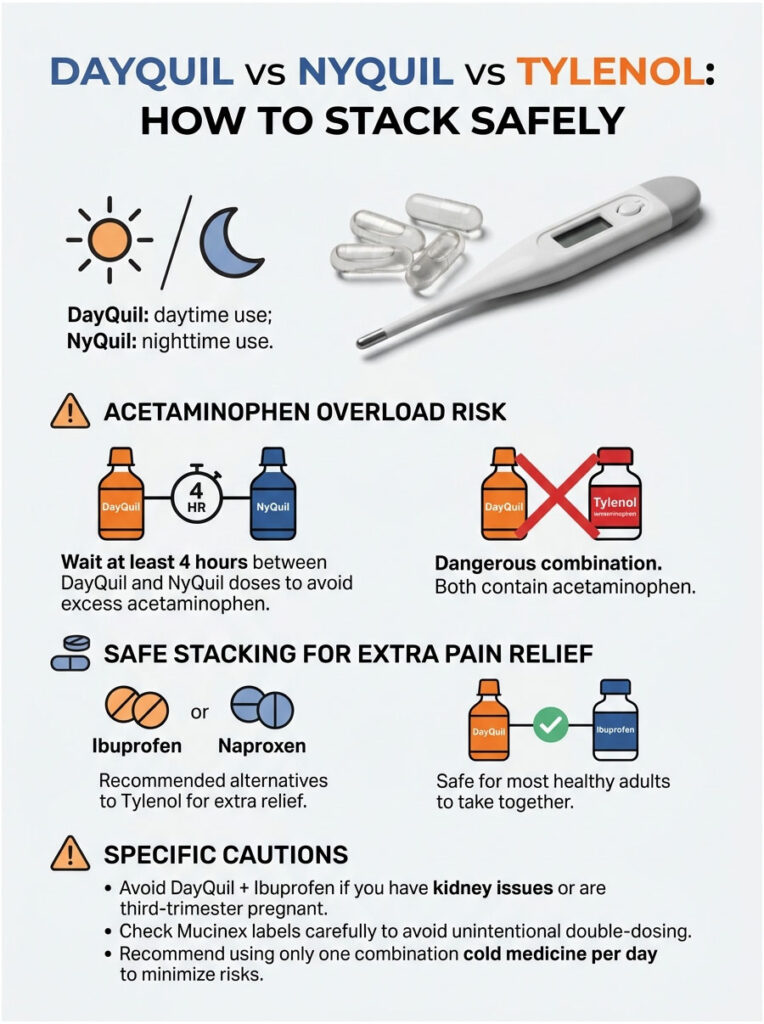
DayQuil During the Day, NyQuil at Night
This is the one combination Vicks actually markets as a pair. It works, with timing caveats. Take your last DayQuil dose at least 4 hours before your first NyQuil to avoid stacking acetaminophen.
If you take DayQuil at 3 p.m. and 7 p.m., wait until at least 11 p.m. for NyQuil. Count your totals: 4 DayQuil doses (2,600 mg) + 1 NyQuil dose (650 mg) = 3,250 mg, which is safe but firmly in the caution zone. If you already took Tylenol, skip the NyQuil.
DayQuil + Plain Tylenol: Usually a Bad Idea
Don’t. DayQuil already contains acetaminophen (Tylenol is just acetaminophen under a different brand name). Doubling up is the #1 way people land in the ER during flu season.
If you need more pain relief than DayQuil gives you, reach for ibuprofen (Advil, Motrin) or naproxen (Aleve). They work through a different pathway, so they don’t stack with acetaminophen. They come with their own stomach and kidney considerations, but the acetaminophen math stays clean.
DayQuil + Ibuprofen, Advil, Aleve
Safe for most healthy adults. Ibuprofen and DayQuil share zero overlapping ingredients, so you can use ibuprofen for extra pain or fever relief without worrying about acetaminophen stacking.
Skip this combo if you have kidney disease, ulcers, a GI bleeding history, or you’re pregnant in the third trimester. Always take with food.
DayQuil + Mucinex
Read labels carefully. Many Mucinex products contain guaifenesin (same as DayQuil SEVERE), dextromethorphan (same as DayQuil), or acetaminophen. You can easily double-dose without realizing.
GoodRx pharmacists give sound advice here: pick one combination cold medicine per day. If DayQuil SEVERE is already handling mucus and cough, adding Mucinex is redundant and risky.
When DayQuil Isn’t Safe For You
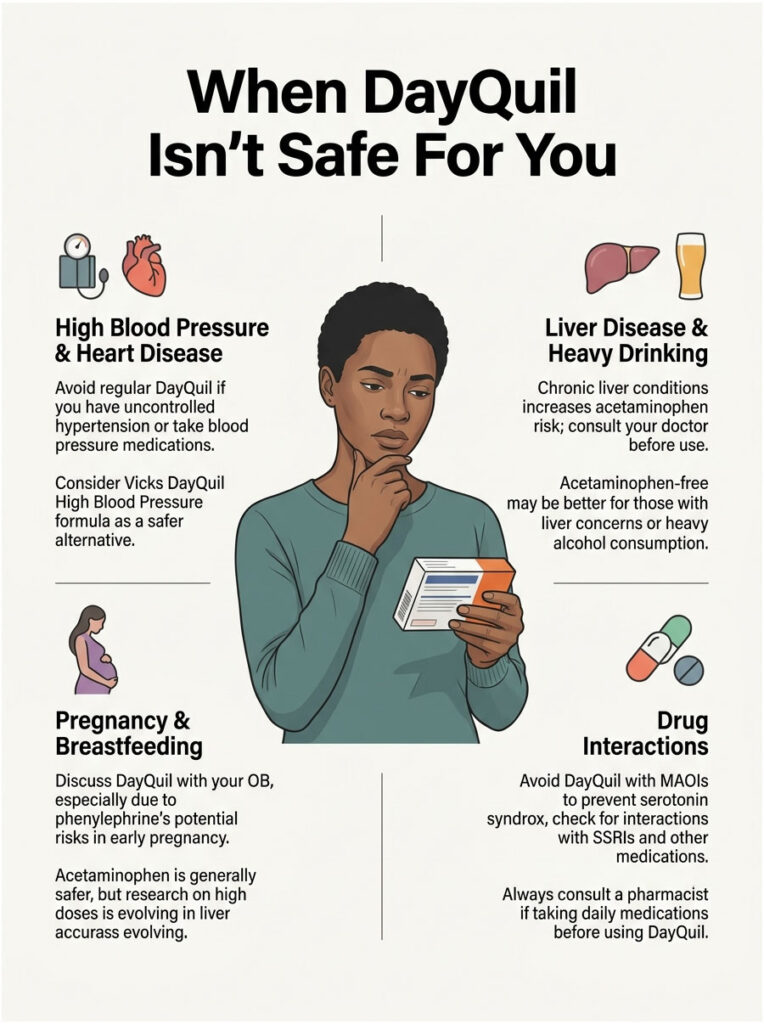
High Blood Pressure and Heart Disease
Phenylephrine constricts blood vessels and can nudge blood pressure upward, even if the decongestant benefit is minimal. If you have uncontrolled hypertension, an arrhythmia, a recent heart attack, or you take blood pressure medication, skip regular DayQuil.
Vicks makes a DayQuil High Blood Pressure formula that removes phenylephrine. It is a better choice for anyone managing cardiovascular risk, and any US pharmacy can point you to it.
Liver Disease, Hepatitis, Heavy Drinking
Any chronic liver condition (hepatitis B or C, cirrhosis, fatty liver disease) changes acetaminophen risk dramatically. Talk to your doctor before taking DayQuil, and consider acetaminophen-free alternatives entirely.
The same applies if you routinely drink 3 or more alcoholic drinks per day. Your liver is already working harder than most, and DayQuil adds to that load.
Pregnancy and Breastfeeding
Acetaminophen alone (plain Tylenol) has historically been considered the safer fever and pain option in pregnancy, though recent research has raised questions about high-dose or chronic use. DayQuil is a different story because it also contains dextromethorphan and phenylephrine.
Phenylephrine in particular isn’t recommended in pregnancy, especially the first trimester, because it can reduce placental blood flow. Always check with your OB before using any DayQuil product while pregnant or breastfeeding.
MAOIs, SSRIs, and Other Drug Interactions
Do not take DayQuil if you’re on a monoamine oxidase inhibitor (MAOI) like phenelzine, selegiline, or tranylcypromine, or if you stopped an MAOI less than 2 weeks ago. The combination with dextromethorphan can trigger life-threatening serotonin syndrome.
Be cautious with SSRIs (Prozac, Zoloft, Lexapro, Paxil), warfarin (Coumadin), and diabetes medications. Call your pharmacist before the first dose if you take anything daily. I’ve watched a single phone call to the pharmacy counter catch a dangerous interaction more than once.
What an Overdose Looks Like (and What to Do)
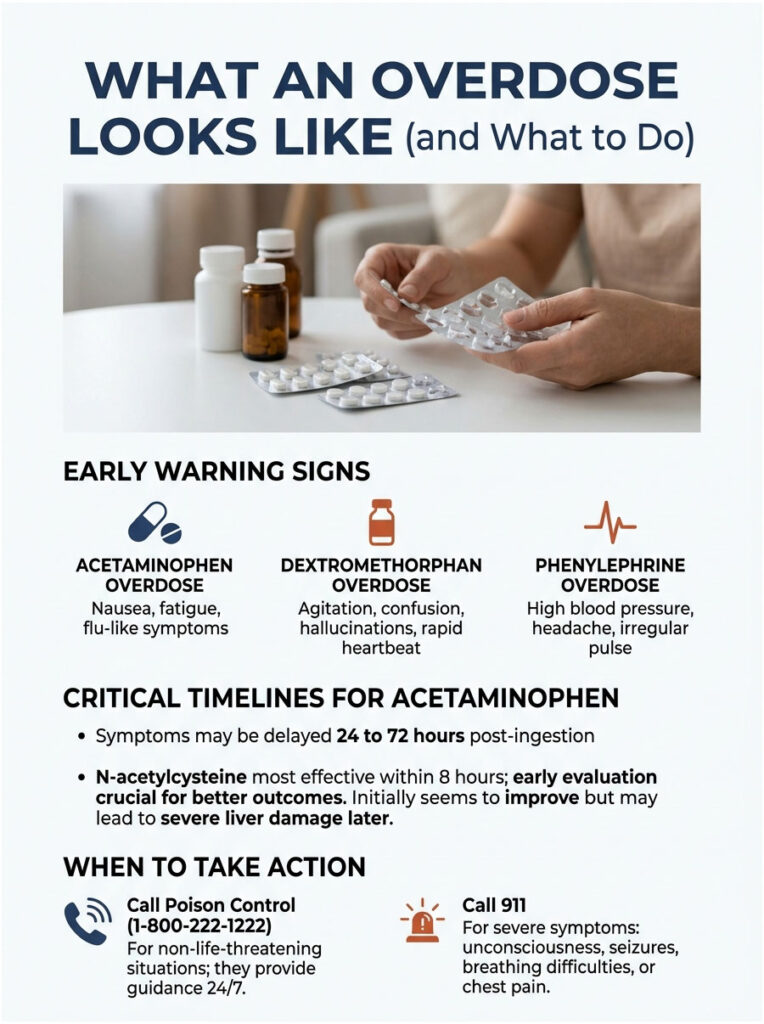
Early Warning Signs
Acetaminophen overdose is sneaky. In the first 24 hours you might feel nauseated, tired, or slightly off, which overlaps exactly with the flu you’re already fighting. That’s what makes it dangerous.
Dextromethorphan overdose looks more dramatic: agitation, confusion, hallucinations, rapid heartbeat, loss of coordination. Phenylephrine overdose can cause a sudden spike in blood pressure, pounding headache, and irregular pulse.
When to Call Poison Control (1-800-222-1222) vs 911
Call Poison Control at 1-800-222-1222 if you or a family member took too much DayQuil but is conscious and breathing normally. The line is free, open 24/7, and staffed by pharmacists and toxicologists who can walk you through next steps.
Call 911 if the person is unconscious, having seizures, struggling to breathe, has chest pain, or shows any severe neurological symptom. Don’t wait to see if it gets better. Acetaminophen damage can be silent early and irreversible later.
Why Symptoms May Be Delayed 24 to 72 Hours
Here’s the part most articles skip. Acetaminophen toxicity can feel like it’s resolving after day 1, only to return as severe liver injury 48 to 72 hours later when the body has finished metabolizing the overdose into a toxic byproduct.
If you suspect any overdose, even a small one, get evaluated. The antidote (N-acetylcysteine) works best when given within 8 hours. Hospitals use blood levels to decide treatment, so the earlier the draw, the better the outcome.
Smart Scenarios: When to Take, When to Skip
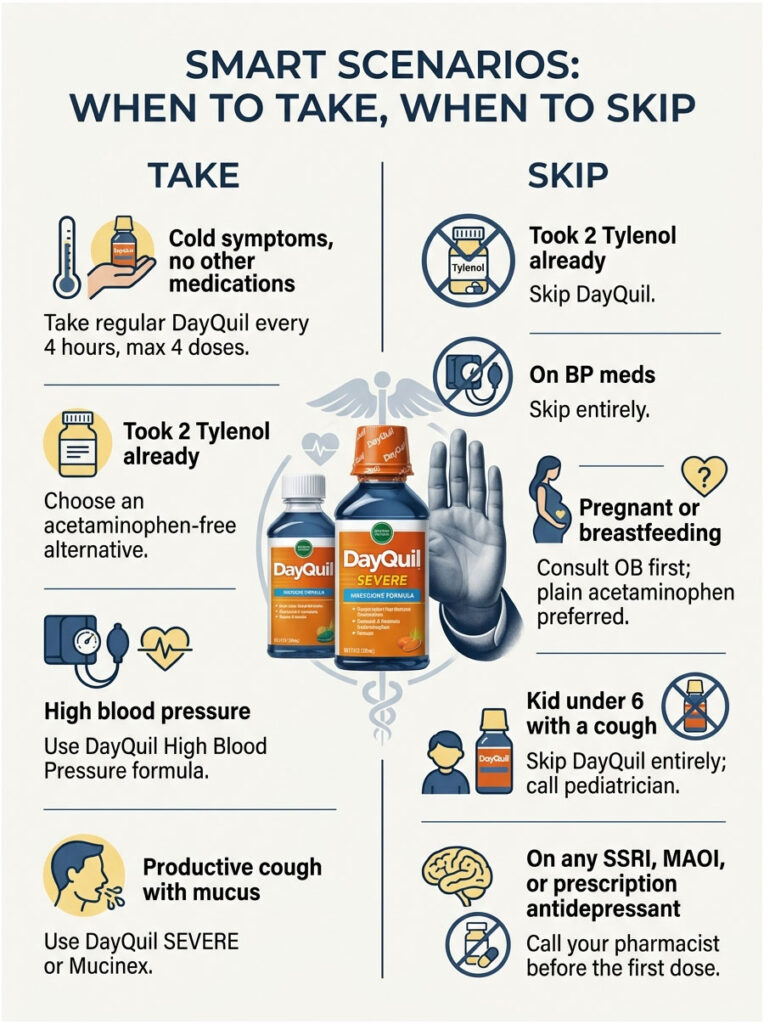
Table 3: Real-World DayQuil Decision Matrix
| Scenario | What to Do | Why |
| Cold symptoms, no other meds, healthy adult | Take regular DayQuil every 4 hours, max 4 doses | Standard, safe use case |
| Took 2 Tylenol already this morning | Skip DayQuil, or pick an acetaminophen-free alternative | Stacking risk against 4,000 mg daily ceiling |
| High blood pressure or on BP meds | Use DayQuil High Blood Pressure formula, or skip entirely | Phenylephrine may raise BP and interact with meds |
| Pregnant or breastfeeding | Ask OB first; plain acetaminophen often preferred | DM and phenylephrine safety in pregnancy isn’t fully established |
| Productive, wet cough with mucus | Use DayQuil SEVERE (guaifenesin) or Mucinex, not regular DayQuil | Regular DayQuil suppresses a cough you actually need |
| Kid under 6 with a cough | Skip DayQuil entirely; call pediatrician | Serious side-effect risk in this age group |
| On any SSRI, MAOI, or prescription antidepressant | Call your pharmacist before the first dose | DM-serotonin interaction can be fatal |
When DayQuil Stops Helping: The 7-Day Rule
DayQuil is a symptom-relief tool. It doesn’t cure colds or flu. Most viral upper respiratory infections resolve in 7 to 10 days. If yours doesn’t, something else is in play.
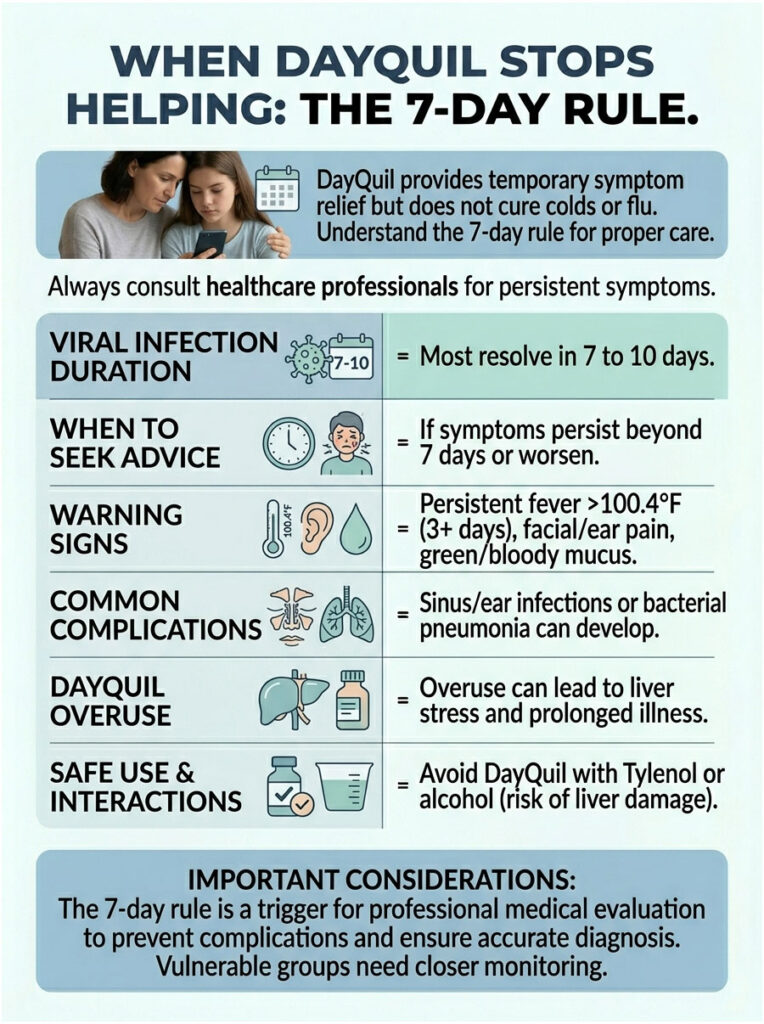
Stop DayQuil and call your doctor if symptoms last more than 7 days, fever stays above 100.4°F for 3+ days, symptoms improve and then suddenly worsen, you develop facial or ear pain, or you cough up green or bloody mucus.
Signs of Bacterial Infection or Flu Complication
Sinus infections, ear infections, bacterial pneumonia, and secondary bacterial flu complications can all look like “a cold that won’t quit.” Antibiotics don’t touch a virus, but they’re needed if a bacterial infection piggybacks on top.
In my work with readers during cold season, the #1 mistake I see is pushing through with OTC meds for 10 to 14 days because “it’ll break eventually.” Sometimes it does. Sometimes it turns into walking pneumonia. Both Mayo Clinic and the CDC recommend medical evaluation past the 1-week mark, especially if you’re over 65, immunocompromised, or have asthma.
Frequently Asked Questions
Can I take DayQuil every 3 hours instead of 4?
No. The 4-hour gap is set by how your body clears the active ingredients. Taking doses at 3-hour intervals can increase toxicity risk. If symptoms aren’t controlled, switch to a longer-acting formulation instead.
How many DayQuil LiquiCaps can I take at once?
Two LiquiCaps equal one adult dose. Do not exceed 2 at a time or 8 in 24 hours. If it’s not effective, consider switching products instead of increasing the dose.
Can I take DayQuil and Tylenol together?
Generally no, because both contain acetaminophen. Combining them can lead to overdose. Use ibuprofen instead if additional pain relief is needed.
Can I take DayQuil with NyQuil on the same day?
Yes, but space doses properly. Ensure at least a 4-hour gap and track total acetaminophen intake to stay within safe limits.
Is DayQuil still effective after phenylephrine concerns?
Partially. Pain and cough ingredients still work, but phenylephrine may not be effective for congestion. Alternatives like saline or pseudoephedrine work better.
How long does DayQuil last?
Relief typically lasts about 4 hours. Most ingredients clear from the body within 24 hours in healthy adults.
Can pregnant women take DayQuil?
Consult a doctor first. Some ingredients are not recommended during pregnancy.
Can I take DayQuil on an empty stomach?
Yes, but it may cause nausea. Taking it with food can help reduce discomfort.
What if I take DayQuil for 10 days?
If symptoms last more than 7 days, consult a doctor. It may indicate a different condition.
Can I drink alcohol with DayQuil?
Avoid alcohol. It increases the risk of liver damage due to acetaminophen.
Disclaimer: This article is for educational purposes only and is not medical advice. It doesn’t replace guidance from a licensed pharmacist, physician, or other qualified healthcare provider. Always read the Drug Facts label on your DayQuil product before dosing. If you think you’ve taken too much DayQuil, call Poison Control at 1-800-222-1222 immediately. Call 911 for any emergency symptom including loss of consciousness, difficulty breathing, seizures, or chest pain. Dosage guidance applies to US-sold Vicks DayQuil products and may differ from international versions.
References
- U.S. Food and Drug Administration. “Don’t Overuse Acetaminophen.” https://www.fda.gov/consumers/consumer-updates/dont-overuse-acetaminophen
- U.S. Food and Drug Administration. “FDA Proposes Ending Use of Oral Phenylephrine.” Nov 7, 2024. https://www.fda.gov/news-events/press-announcements/fda-proposes-ending-use-oral-phenylephrine-otc-monograph-nasal-decongestant-active-ingredient-after
- DailyMed. Vicks DayQuil Cold and Flu product label. https://www.dailymed.nlm.nih.gov/dailymed/drugInfo.cfm?setid=efb982d4-93d0-815f-e053-2995a90a82dd
- DailyMed. Vicks DayQuil Severe Cold and Flu LiquiCaps product label. https://dailymed.nlm.nih.gov/dailymed/drugInfo.cfm?setid=6f013cc1-7885-5025-e053-2a91aa0afe11
- Vicks. DayQuil Cough, Cold & Flu Daytime Relief LiquiCaps. https://vicks.com/en-us/shop-products/dayquil/dayquil-cold-flu-relief-liquicaps
- GoodRx. DayQuil Dosage Guide for Adults and Children. https://www.goodrx.com/dayquil/dayquil-dosage-adults-kids
- Drugs.com. How often can you take DayQuil? Safe dosage guide. https://www.drugs.com/medical-answers/how-often-you-take-dayquil-safe-dosage-guide-3580982/
- Healthline. DayQuil: Info to Know. https://www.healthline.com/health/cold-flu/dayquil
- University of Florida College of Pharmacy. FDA panel rules popular nasal decongestant is ineffective. https://pharmacy.ufl.edu/2023/09/26/fda-panel-rules-popular-nasal-decongestant-is-ineffective/
- JAMA Network. FDA Seeks to Remove Oral Phenylephrine From Decongestants. https://jamanetwork.com/journals/jama/fullarticle/2828512
- Kaiser Permanente. Vicks DayQuil Severe Cold-Flu Drug Information. https://healthy.kaiserpermanente.org/health-wellness/drug-encyclopedia/drug.vicks-dayquil-severe-cold-flu-5-mg-10-mg-325-mg-200-mg-15-ml-liquid.579483
- American Association of Poison Control Centers: 1-800-222-1222