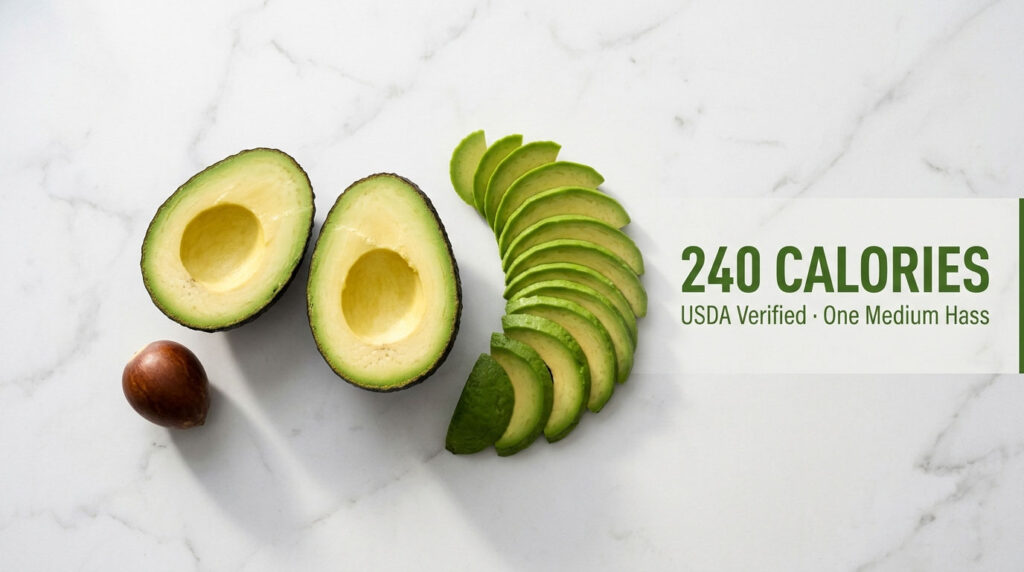
Half an avocado on toast feels modest. A whole one feels indulgent. The number behind both portions, according to USDA FoodData Central, is calmer than the diet apps suggest. One medium Hass avocado carries roughly 240 calories of mostly heart-healthy fat, not the kind you need to apologize for. The real story is not the calorie count alone; it is what those 240 calories displace on your plate, and how they behave once they reach your bloodstream.
Table of Contents
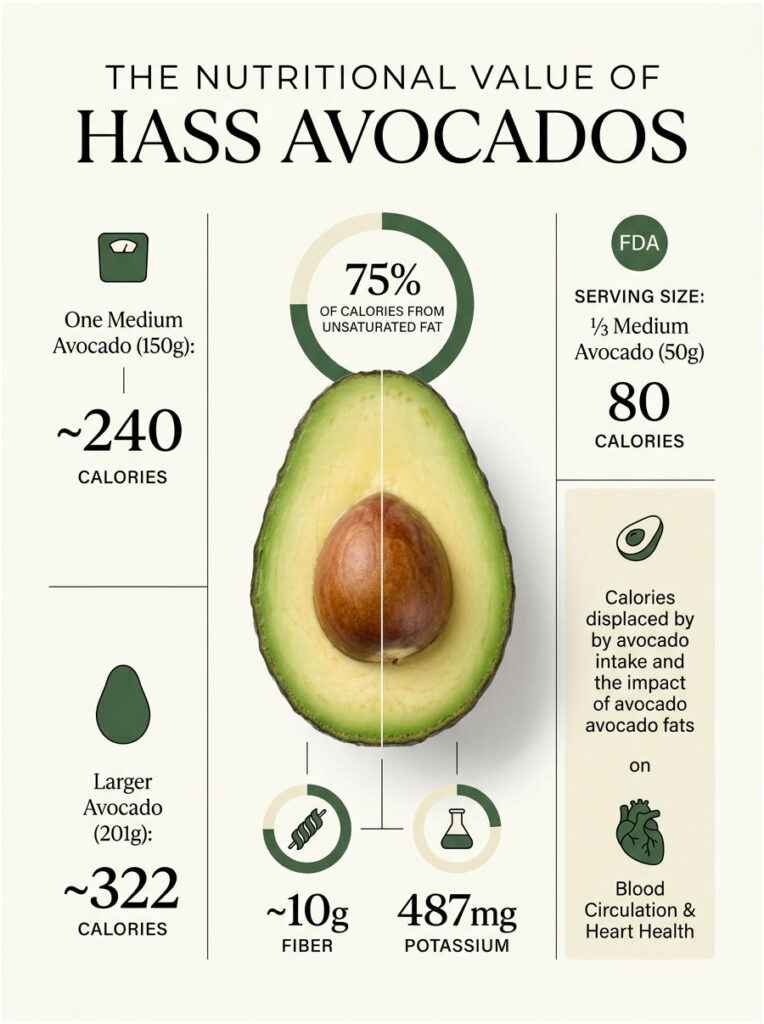
Quick Answer: One medium Hass avocado (150g of edible flesh) contains about 240 calories, per USDA FoodData Central (entry 171705). A larger Hass at 201g of flesh totals about 322 calories. The FDA serving size, one-third of a medium fruit (50g), is 80 calories. Roughly 75% of those calories come from unsaturated fat, alongside 10g of fiber and 487mg of potassium per half fruit.
At a Glance
- Medium Hass avocado (whole): about 240 calories from 150g of edible flesh
- Large Hass avocado (whole): about 322 calories from 201g of flesh
- FDA serving (1/3 medium, 50g): 80 calories
- Half a medium avocado: about 120 calories
- About 75% of those calories are heart-healthy unsaturated fat
- Florida (“slimcado”) avocado runs roughly 25% lower in calories per gram than Hass
- US per capita consumption hit 9.22 lbs in 2022; the market is on track to top 3 billion lbs in 2025
The Straight Answer: USDA Calorie Counts for One Avocado
“One avocado” is a slippery phrase. The calorie answer depends on three variables: size, variety, and the share of the fruit you actually eat. A medium Hass at the grocery store weighs about 200g whole. Only 150g of that is the creamy green flesh you eat. The pit and skin take the rest.
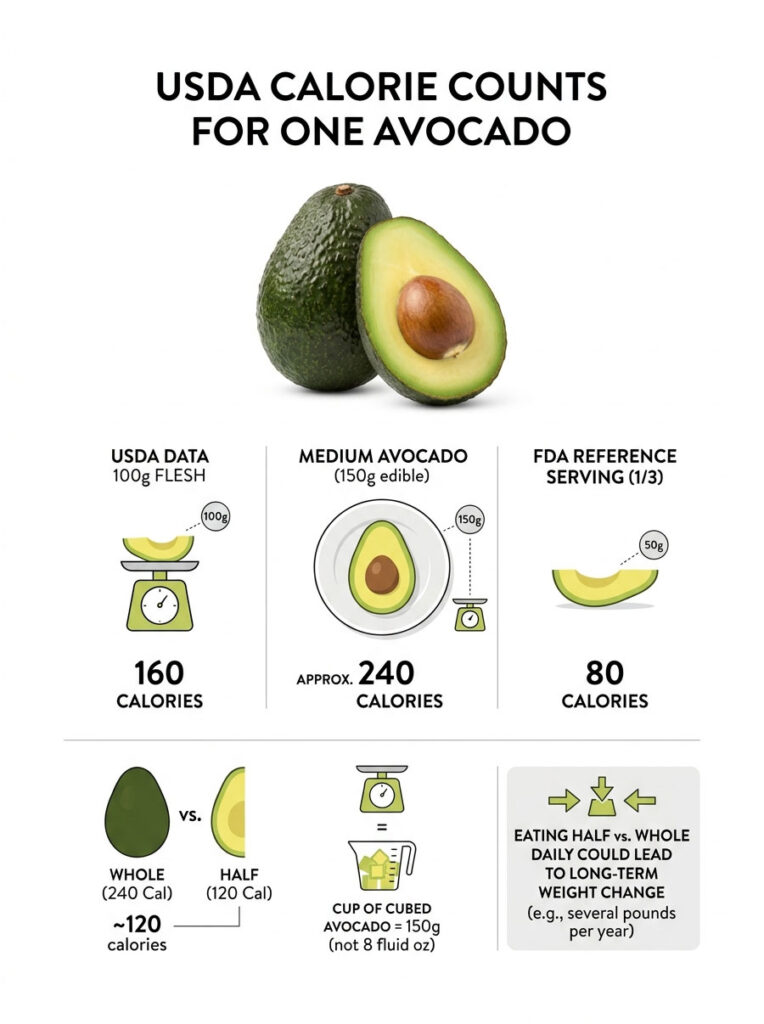
USDA FoodData Central (entry 171705, raw avocado, all commercial varieties) lists 160 calories per 100g of edible flesh. From that anchor, the math for every common portion drops out cleanly. A medium fruit at 150g of flesh works to roughly 240 calories. A larger fruit at 201g of flesh hits 322 calories. The FDA’s reference serving, set at one-third of a medium avocado or 50g, lands at 80 calories.
Patients booking nutrition consults through HealthCareOnTime ask the half-or-whole question often. The math says it matters. The difference between half and whole on a single piece of toast is about 120 calories. Spread that across five toasts a week for a year and you have roughly 31,000 calories of additional intake, which according to standard energy-balance modeling (Hall et al., NIH-published research on the calorie-deficit model) could translate to several pounds of weight change if no other variable shifts.
Table 1. USDA Calorie and Nutrient Breakdown by Portion (Raw Hass Avocado, Edible Flesh Only)
| Portion | Weight (g) | Weight (oz) | Calories | % DV (2,000 cal) |
| 1 oz | 28g | 1.0 oz | 45 | 2% |
| 1/4 medium | 37g | 1.3 oz | 60 | 3% |
| 1/3 medium (FDA serving) | 50g | 1.7 oz | 80 | 4% |
| 1/2 medium | 75g | 2.6 oz | 120 | 6% |
| 1 medium (whole) | 150g | 5.3 oz | 240 | 12% |
| 1 large (whole) | 201g | 7.1 oz | 322 | 16% |
| 1 cup, cubed | 150g | 5.3 oz | 240 | 12% |
Source: USDA FoodData Central NDB 171705; California Avocado Commission; FDA Reference Amounts Customarily Consumed.
Two notes from the table worth flagging. First, one ounce and one cup are not interchangeable; people often confuse weight ounces with fluid ounces, and a cup of cubed avocado weighs about 150g (5.3 weight oz), not 8 fluid oz. Second, the FDA’s 50g serving is a labeling reference, not a clinical recommendation. The American Heart Association points to half a medium fruit as a more realistic everyday portion for heart health.
Macro Breakdown: Where the Calories Actually Come From
The 240-calorie label tells you almost nothing without the macro split. This fruit behaves nothing like an apple or a banana, and the difference shows up at the metabolic level, not just on the food scale.
Fat: the dominant macro
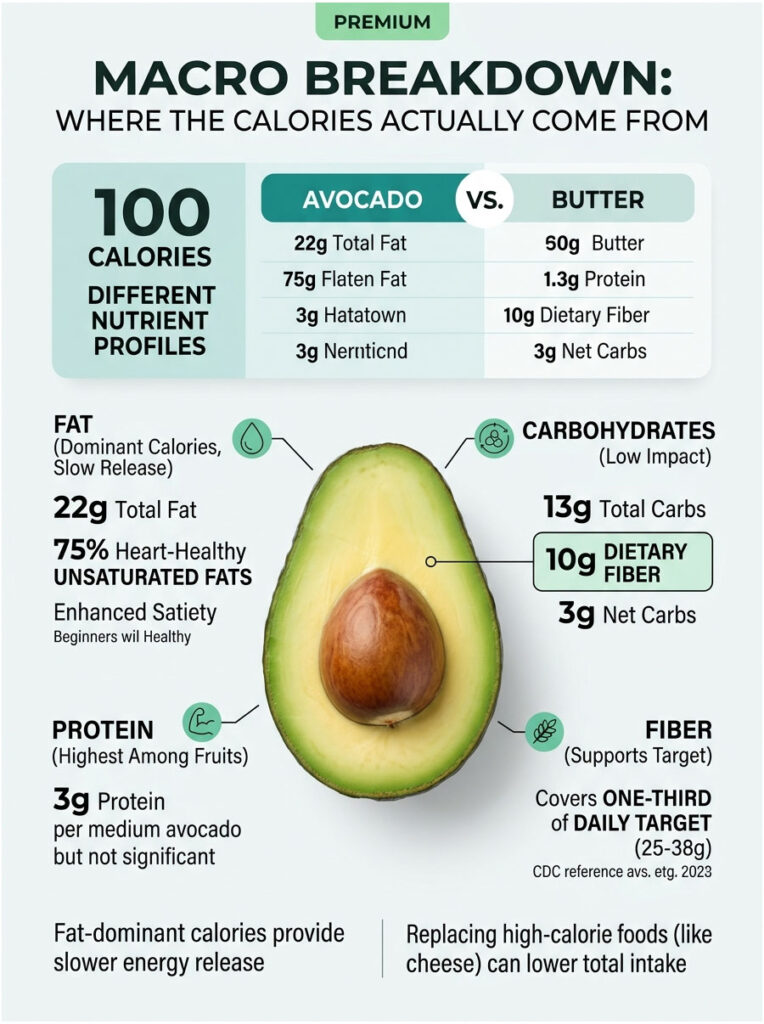
One medium avocado carries about 22g of fat. That sounds high until you read the breakdown:
- 15g monounsaturated fat (mostly oleic acid, the same fatty acid that gives olive oil its reputation)
- 4g polyunsaturated fat (a mix of omega-6 and a small amount of omega-3)
- 3g saturated fat (primarily palmitic acid)
Roughly 75% of the fat in an avocado is unsaturated. The American Heart Association classifies monounsaturated fat as a heart-friendly swap for saturated fats like butter, lard, and the fat in fatty cuts of red meat. Our medical reviewers note that avocado’s calorie density looks alarming next to a tablespoon of butter on first glance; both deliver around 100 calories, but only one is built around oleic acid plus fiber and potassium.
Carbohydrates: mostly fiber, very little sugar
A medium avocado has about 13g of total carbohydrate, but 10g of that is dietary fiber. That leaves only 3g of net carbs and less than 1g of natural sugar per fruit. For a ketogenic or low-carb plan, this is the rare fruit that fits. For a fiber-focused plan, 10g out of a single piece of produce covers roughly one-third of an adult’s daily target, which the CDC pegs at 25 to 38g depending on age and sex.
Protein: modest but the highest among fruits
Avocados carry about 3g of protein per medium fruit. That is the highest of any common fruit, but still small in absolute terms; a single large egg has roughly twice the protein. Treat avocado as a fat-and-fiber food, not a protein source.
Why fat-dominant calories behave differently
Calories from fat hit the bloodstream more slowly than calories from refined carbohydrates. A randomized clinical trial published in the Journal of the American Heart Association found that eating half an avocado at lunch increased feelings of fullness and reduced the desire to eat for up to five hours afterward. That satiety pattern is part of why the 240 calories in a medium avocado don’t typically lead to overeating later in the day.
Patients tracking weight through the diagnostic network HealthCareOnTime serves often see this in real life: when the avocado replaces a slice of cheese or a tablespoon of mayonnaise, total daily intake tends to drop, not climb.
Hass vs Florida: Why the Variety in Your Cart Changes the Math
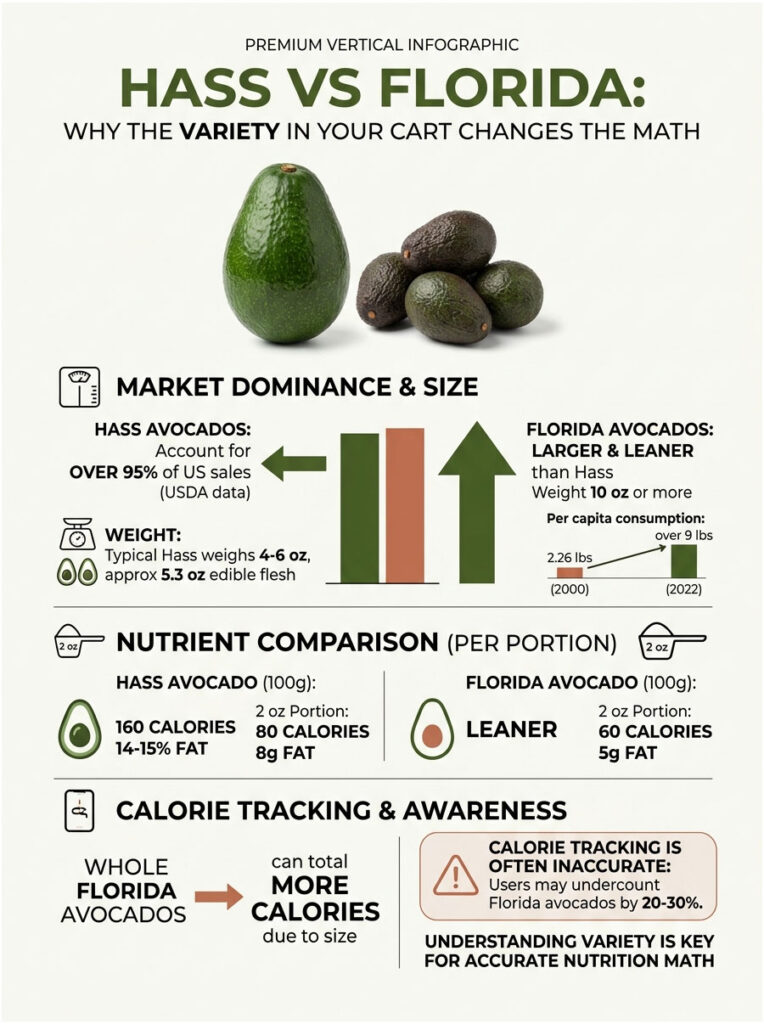
The avocado in your basket is almost certainly a Hass, the dark, pebbly-skinned variety that accounts for over 95% of US grocery sales according to USDA data. The other variety you will see, mainly in the Southeast and Northeast, is the Florida avocado: larger, smoother, brighter green, and noticeably leaner.
The Hass (California-style) avocado
A typical Hass weighs 4 to 6 oz whole, with about 5.3 oz of edible flesh in a medium specimen. The flesh is dense, creamy, and roughly 14 to 15% fat by weight. That density is what gives Hass its 160 calories per 100g.
The Florida (“slimcado”) avocado
Florida avocados, sometimes labeled Dominican or West Indian, weigh 10 oz or more whole, often topping a pound. The flesh is paler, watery, and considerably leaner. Per California Avocado Commission and CalorieKing data, a 2 oz portion of Hass carries about 80 calories and 8g of fat. The same 2 oz portion of a Florida avocado has about 60 calories and 5g of fat.
Side by side per typical half fruit
- Half medium Hass: 144 calories, 13.3g fat, 1.7g protein
- Half Florida avocado: 182 calories, 15.3g fat, 3.4g protein (for a much larger physical portion)
Here is the catch most calorie trackers miss. Per gram, Florida is lighter. But because a Florida avocado is physically larger, a whole one can still total more calories than a whole Hass. Weighing the edible flesh is the only way to be certain. In tests reviewed across the diagnostic network, patients who simply log “1 avocado” without weighing tend to undercount by 20 to 30% when they are holding a Florida fruit.
Table 2. US Avocado Market and Consumption Data
| Metric | Value | Source |
| US per capita consumption (2022) | 9.22 lbs | Statista / USDA |
| US per capita consumption (2000 baseline) | 2.26 lbs | Hass Avocado Board |
| Projected US market volume (2025) | over 3 billion lbs | Hass Avocado Board, Dec 2025 |
| US retail avocado market value (2021) | over $7 billion | Hass Avocado Board |
| Mexico share of US avocado imports | about 90% | Statista 2023/24 |
| Hass share of US avocado sales | over 95% | USDA via BusinessWire |
Sources: Hass Avocado Board press releases (2022, 2025); Statista US per capita data; USDA Foreign Agricultural Service reports.
Per capita consumption has multiplied more than fourfold since 2000, climbing from 2.26 lbs to over 9 lbs at peak. With the average medium Hass weighing about 5.3 oz of flesh, 9 lbs a year works out to roughly 27 medium fruits per American per year, or about one avocado every 13 days. At 240 calories per fruit, that pattern adds up to about 6,500 calories per person per year from avocado alone.
One Avocado in Real Meals: Calorie Math for Toast, Salads, and Guac
The 240-calorie figure for a medium Hass is the wholesale number. Retail eating, in actual breakfasts and lunches, looks different. Most people don’t sit down to a single fruit. They smear, slice, scoop, and blend.
Avocado toast
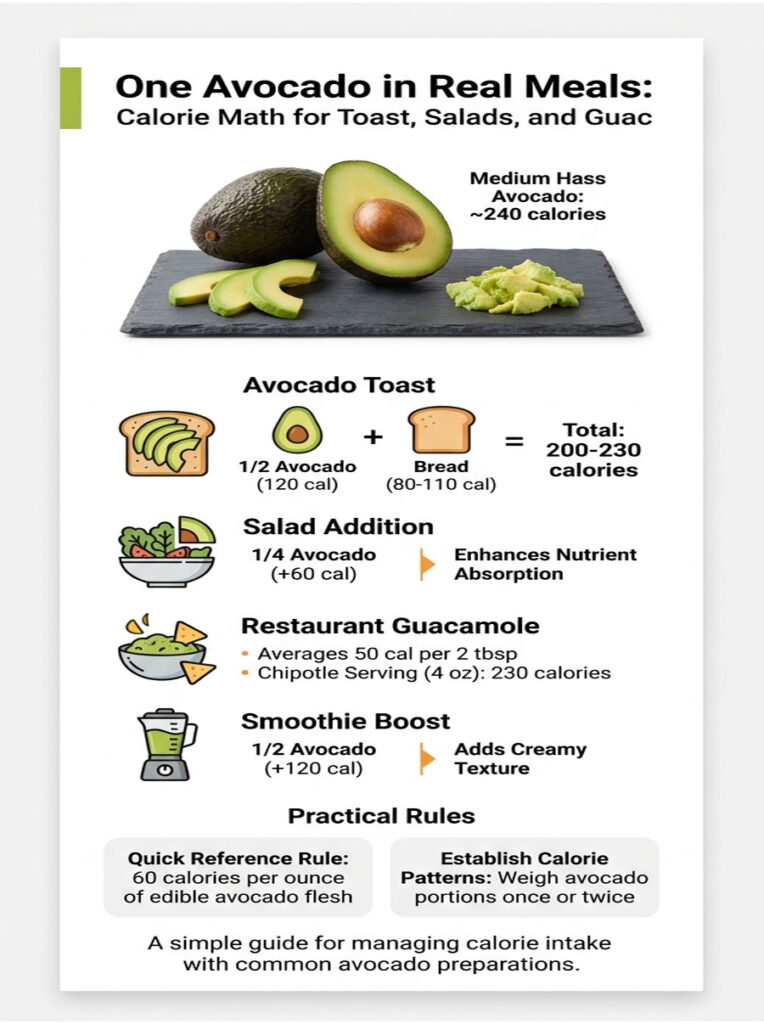
A standard avocado toast in a US cafe uses about half a medium Hass on one slice of whole-grain bread. That is roughly 120 calories from the avocado plus 80 to 110 calories from the bread, for a total of 200 to 230 calories before you add an egg, salt, chili flakes, or a drizzle of olive oil. Patients commonly ask whether the avocado at lunch was “the problem,” and the honest answer depends on the spread, not the slice.
Guacamole
Restaurant guacamole varies more than any other prep. A typical 2-tablespoon scoop (about 30g) is closer to 50 calories because the avocado is diluted with lime juice, onion, tomato, and cilantro. Chipotle’s published guacamole serving (4 oz) lands around 230 calories, which is essentially a full Hass plus a teaspoon of lime and salt.
Cobb salad or grain bowl
A quarter of a medium avocado, sliced into a salad, adds about 60 calories. That is a meaningful but modest addition to a 400 to 600 calorie bowl, and it pulls double duty by helping the body absorb fat-soluble vitamins from leafy greens and tomatoes.
Smoothie or smoothie bowl
Half a medium avocado, blended into a smoothie, adds 120 calories plus a creamy texture that lets you cut back on yogurt or banana. Net calorie change depends on what you are swapping.
A practical rule
Across these formats, a useful shorthand is 60 calories per ounce of edible avocado flesh. Weigh once or twice on a kitchen scale, and the pattern becomes automatic.
Quick reference for common preps
- Avocado toast (1 slice, 1/2 avocado): 200 to 230 cal total
- 2 tbsp guacamole: about 50 cal
- 1/4 avocado on salad: about 60 cal
- 1/2 avocado in smoothie: about 120 cal
- 4 oz Chipotle-style guacamole: about 230 cal
- Stuffed avocado half with chicken salad filling: 250 to 350 cal depending on dressing
Heart Health Payoff: What 30 Years of US Data Show
The calorie question rarely lives alone. Most people asking how many calories are in one avocado are also asking, indirectly, “Is this worth it?” The strongest answer comes from the Harvard cohort data, two of the longest-running nutrition studies in the United States.
The 30-year Harvard finding
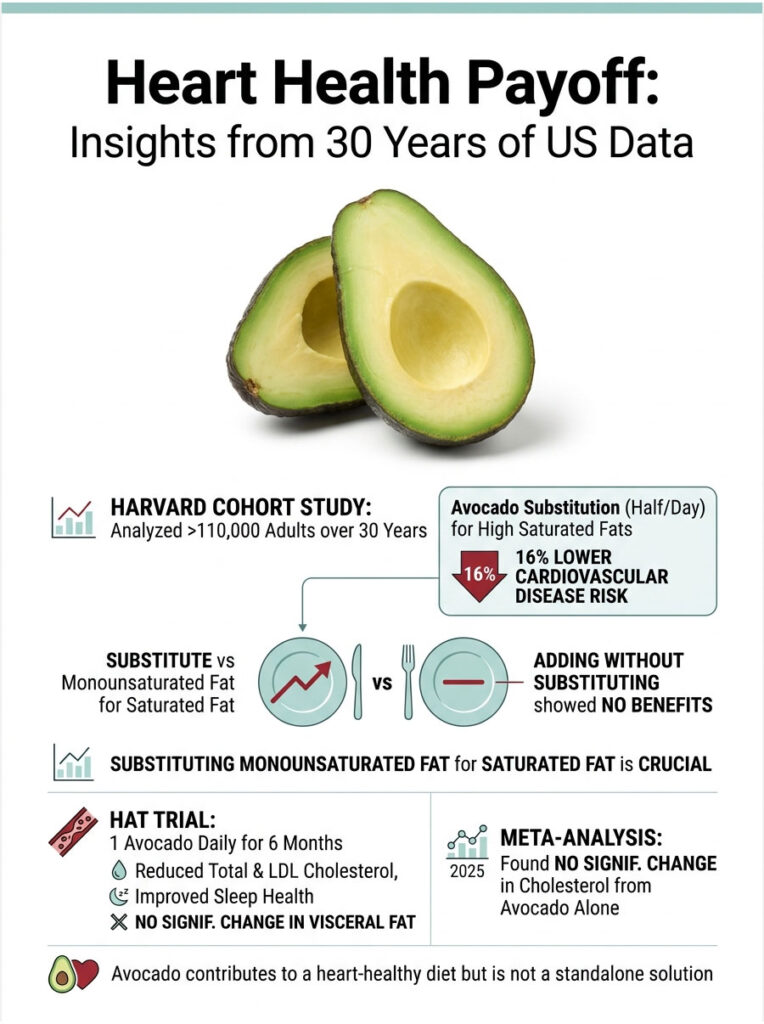
In 2022, Pacheco and colleagues published a 30-year analysis in the Journal of the American Heart Association combining the Nurses’ Health Study and the Health Professionals Follow-up Study, covering more than 110,000 US adults. The headline finding: substituting half an avocado for equivalent servings of high-saturated-fat foods (butter, cheese, processed meats) was associated with a 16% lower risk of cardiovascular disease and a 21% lower risk of coronary heart disease over the follow-up period.
The keyword in that finding is “substituting.” Adding half an avocado on top of an unchanged Western diet did not show the same benefit. The calories came along for the ride, and the cardiovascular signal disappeared.
The HAT trial: one avocado a day, for six months
A 2022 randomized controlled trial, the HAT (Habitual Diet and Avocado Trial), tested whether one avocado per day for 26 weeks would reduce visceral fat in adults with abdominal obesity. The primary outcome was negative; visceral fat did not change significantly. The secondary outcomes were more interesting.
In a follow-up Life’s Essential 8 analysis, the avocado-supplemented group showed modest reductions in total cholesterol and LDL cholesterol versus the habitual-diet group, plus a small improvement in sleep-health scores. Adding 240 calories of avocado per day did not cause weight gain in the trial population, which countered the worry that the dense calorie load would tip the scale.
Why the swap matters more than the addition
The AHA points to monounsaturated fat as a substitute, not a supplement. Across patients in the diagnostic network running annual lipid panels, the swap (saturated fat out, avocado in) tends to move LDL more than adding avocado on top of an already-rich diet. The clinical takeaway: if the avocado is replacing cheese, butter, or processed meat, the 240 calories are doing structural work. If it is piling on top of those foods, the calories are mostly just calories.
A 2025 meta-analysis tempers the enthusiasm
A 2025 GRADE-assessed meta-analysis in Food Science & Nutrition pooled 10 randomized controlled trials and found no significant change in triglycerides or total cholesterol from avocado intake alone. The same review noted that the cardiovascular signal in observational data is stronger than the lipid signal in short-term controlled trials. The honest reading: avocado is a useful tool in a heart-healthy pattern, not a standalone fix. Given that the CDC reports cardiovascular disease causes 1 in every 5 US deaths, even a modest dietary lever like an avocado swap carries population-level weight.
Are 240 Calories a Day “Too Many” From One Avocado?
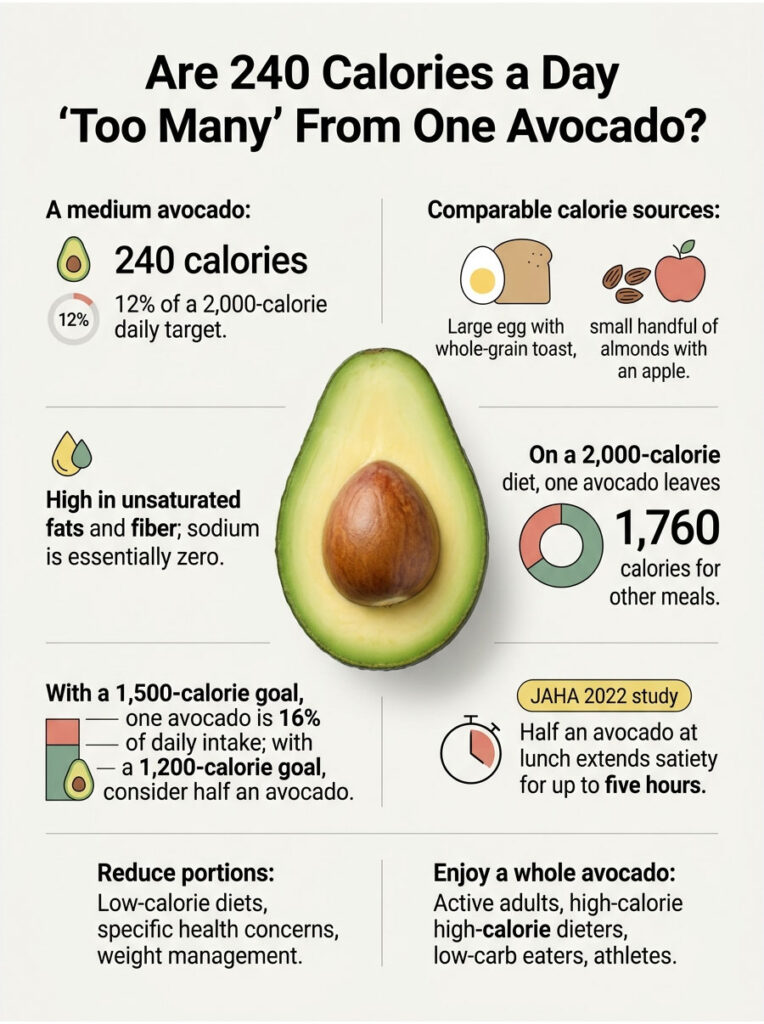
The short answer for most adults: no. A medium avocado at 240 calories represents 12% of a 2,000-calorie target, which is in the same range as a large egg with a slice of whole-grain toast or a small handful of almonds with an apple. The fat is mostly unsaturated. The fiber is high. The sodium is essentially zero.
How avocado fits a 2,000-calorie day
At 240 calories per medium fruit, one avocado leaves 1,760 calories for everything else. That is room for three balanced meals and a snack without breaking a daily target. The math gets tighter on a 1,500-calorie cut (avocado would be 16% of the day) and tighter still on a 1,200-calorie aggressive deficit (20%), where a half avocado may serve better than a whole one.
The satiety dividend
The JAHA 2022 lunch study found half an avocado at midday extended satiety for up to five hours and reduced subsequent calorie intake in many participants. The mechanism appears tied to monounsaturated fat triggering the release of fullness-signaling gut hormones. In practical terms, 120 calories of avocado at lunch may save 150 to 200 calories at the afternoon snack window, which is a net win.
Who should portion down
Three groups should be more conservative with whole-avocado portions:
- People on potassium-restricted diets (advanced kidney disease, certain medications). One medium avocado carries about 700mg of potassium, more than a medium banana.
- People on warfarin or other vitamin-K-sensitive blood thinners. Avocado contains vitamin K; the issue is consistency of intake, not avoidance.
- People in aggressive calorie deficits below 1,300 cal/day. Half a medium fruit usually fits better than a whole one.
Who can enjoy a whole one
Active adults, those on higher-calorie maintenance targets, low-carb and ketogenic eaters, and athletes refueling after long sessions can typically eat a whole medium avocado without disrupting balance. The HAT trial’s 26-week safety record on one fruit per day supports this in healthy adults.
How to Match Your Avocado to Your Calorie Goal: A Decision Guide
The same fruit serves different goals at different portions. Use the table below as a starting point, then adjust to total daily intake.
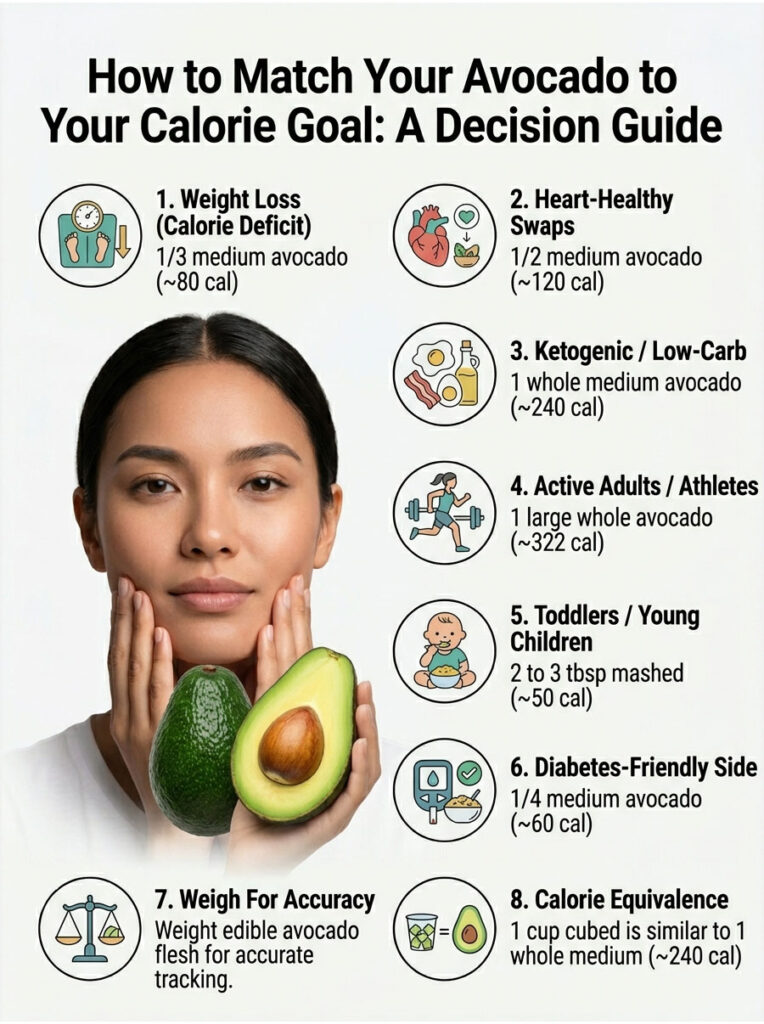
Table 3. Avocado Portion Decision Guide by Goal
| Scenario | Recommended Portion (Hass) | Why |
| Calorie deficit, weight loss | 1/3 medium (about 80 cal) | Matches FDA serving; preserves heart-healthy fat without crowding the calorie budget |
| Heart-healthy swap (replacing cheese, butter, mayo) | 1/2 medium (about 120 cal) | Aligned with Harvard 30-year evidence on CVD risk reduction |
| Ketogenic or low-carb plan | 1 whole medium (about 240 cal) | High MUFA, 10g fiber, only 3g net carbs; built for fat-as-fuel meals |
| Active adult or athlete refuel | 1 large whole (about 322 cal) | Dense fuel plus 1,000mg+ potassium for electrolyte recovery |
| Toddler or young child | 2 to 3 tbsp mashed (about 50 cal) | California Avocado Commission and AAP-aligned starter portions |
| Type 2 diabetes friendly side | 1/4 medium (about 60 cal) | Low net carbs, high fiber, monounsaturated fat may improve insulin sensitivity |
Source: California Avocado Commission portion guide; American Diabetes Association food list; American Heart Association serving guidance.
Two notes for trackers
First, the calorie totals on most fitness apps default to “1 medium” or “1 cup” without asking which variety or how much pit-and-skin you discarded. Weighing the edible flesh, even just once a week, calibrates the daily log. Second, the calorie figure for “1 cup cubed” (about 240 cal) and “1 whole medium” (about 240 cal) is roughly the same; one cup of cubed avocado is essentially one medium fruit.
Common Calorie-Tracking Mistakes With Avocado
Five errors show up repeatedly in nutrition consults across the HealthCareOnTime network.
1. Logging “1 serving” without weighing. App defaults rarely match the fruit on the counter. The FDA serving (50g) is small; the actual half people slice for toast is often 100g or more. Calories logged at 80 may really be 160.
2. Forgetting the pit-and-skin discount. A 200g whole Hass yields about 140 to 150g of edible flesh, per University of California, Riverside research showing avocados are 60 to 70% edible. Weighing the whole fruit and using “100g raw” calorie data overstates calories; weighing the flesh only is accurate.
3. Confusing avocado calories with avocado oil calories. A tablespoon of avocado oil is 124 calories of pure fat, with no fiber. Slicing the fruit and drizzling the oil on top doubles the fat load fast.
4. Treating Hass and Florida as interchangeable. Per gram, Hass is denser. Per whole fruit, Florida is often larger and can still total more calories. Logging “1 Florida avocado” as “1 medium avocado” can undercount by 50 to 100 calories.
5. Ignoring guacamole add-ins. Restaurant guacamole frequently includes mayo, sour cream, or oil to stabilize texture. A 4 oz scoop can range from 180 calories (lime and salt only) to 280 calories (mayo-stabilized). Read the menu nutrition data when it is published.
Frequently Asked Questions
How many calories are in one whole Hass avocado?
A medium whole Hass with about 150g of edible flesh carries roughly 240 calories. A larger fruit at 201g of flesh hits about 322 calories. The USDA baseline is 160 calories per 100g of raw edible avocado, all commercial varieties, and Hass sits right at that figure. Weighing the flesh is the most accurate way to log.
How many calories are in half an avocado?
Half a medium Hass avocado (about 75g of edible flesh) contains roughly 120 calories. Half a larger Hass can reach 160 calories. Half a Florida avocado, despite its larger size, still runs about 180 calories because the variety is leaner per gram. For tracking, weigh the half on a kitchen scale and multiply by 1.6 calories per gram.
Is one avocado a day too many calories?
For most healthy adults, no. The 240 calories in a medium Hass equal about 12% of a 2,000-calorie target, and the HAT trial showed that one avocado per day for 26 weeks did not cause weight gain. The bigger question is what the avocado replaces. Swapping it for cheese or butter is generally a net win; adding it on top of an unchanged diet adds calories without the heart-health benefit.
How many calories are in 1 oz of avocado?
One ounce (28g) of raw Hass avocado flesh carries about 45 calories, per USDA FoodData Central. That is the smallest practical tracking unit and a useful conversion: figure roughly 1.6 calories per gram of edible flesh. For 1 oz of Florida avocado, the count drops to about 35 calories because the variety is leaner.
How many calories in 1 cup of cubed avocado?
One cup of cubed Hass avocado weighs about 150g and totals roughly 240 calories, essentially the same as one medium whole fruit. Sliced avocado packs slightly less densely; a cup of sliced Hass runs about 234 calories. Pureed avocado fills the cup more efficiently at about 368 calories per cup, since there is no air gap.
Are Florida avocados lower in calories than Hass?
Yes, per gram. A 2 oz portion of Florida avocado has about 60 calories versus 80 calories for the same 2 oz of Hass, a 25% reduction. The fat content drops too: 5g per 2 oz versus 8g for Hass. Per whole fruit, the picture can flip because Florida avocados are physically larger, so a whole one may still total more calories than a whole Hass.
How many carbs are in one avocado?
A medium Hass avocado has about 13g of total carbohydrate, with 10g of that being dietary fiber. That leaves only 3g of net carbs and less than 1g of natural sugar, which is why avocado fits ketogenic, low-carb, and diabetes-friendly plans. The fiber-to-carb ratio is among the highest in the produce aisle.
How much potassium does one avocado have?
About 700 to 730mg per medium Hass, more than the 422mg in a medium banana. Half an avocado delivers 487mg, which is roughly 10% of the daily value. People on potassium-restricted diets for kidney disease or certain blood pressure medications should discuss daily intake with their clinician before making avocado a regular habit.
Are avocados good for weight loss?
Research is mixed but leans positive. The HAT trial showed no weight gain over 26 weeks of daily avocado consumption, and the JAHA lunch study found half an avocado at midday increased fullness for up to five hours. Avocados are unlikely to cause weight loss on their own, but they tend to fit weight-loss patterns well when they replace higher-saturated-fat foods rather than adding to them.
How many calories in avocado toast with one egg?
Standard avocado toast (1 slice whole-grain bread, 1/2 medium Hass, 1 large egg) totals about 290 to 320 calories: 80 to 110 from the bread, 120 from the avocado, and 78 from the egg. Add salt, pepper, and chili flakes for negligible calories. A pat of butter or a teaspoon of oil drizzle adds another 35 to 45 calories.
Does ripeness change the calorie count?
No, not meaningfully. A perfectly ripe avocado and an under-ripe one have essentially the same calorie content per gram because the fat content stays stable through ripening. What changes is water distribution and texture, not energy density. The 160 calories per 100g figure applies to firm, ripe, and slightly overripe fruit alike.
What does the FDA list as one serving of avocado?
The FDA’s Reference Amount Customarily Consumed for avocado is one-third of a medium fruit, about 50g or 1.7 oz of edible flesh, which equals 80 calories. This is the figure printed on packaged avocado products in the United States. It is a labeling reference, not a clinical portion target; the AHA points to half a medium fruit as a more realistic everyday portion.
Disclaimer: This article is for general nutrition education and is not a substitute for personalized medical or dietetic advice. People with chronic kidney disease, those taking warfarin or other vitamin-K-sensitive medications, anyone with documented food allergies, or those managing complex metabolic conditions should consult their physician or registered dietitian before changing avocado intake.
References
- USDA FoodData Central, Avocados, raw, all commercial varieties (NDB 171705)
- Harvard T.H. Chan School of Public Health, The Nutrition Source: Avocados
- Pacheco LS, et al. Avocado Consumption and Risk of Cardiovascular Disease in US Adults. Journal of the American Heart Association, 2022;11:e024014.
- Lichtenstein AH, et al. Effect of Incorporating 1 Avocado Per Day Versus Habitual Diet on Visceral Adiposity (HAT Trial). Journal of the American Heart Association, 2022.
- Lichtenstein AH, et al. Effect of Daily Avocado Intake on Cardiovascular Health Assessed by Life’s Essential 8. Journal of the American Heart Association, 2024.
- Hamednia et al. Effects of Avocado Products on Cardiovascular Risk Factors in Adults: A GRADE-Assessed Systematic Review and Meta-Analysis. Food Science & Nutrition, 2025.
- Hass Avocado Board, US Avocado Market Poised to Surpass 3 Billion Pounds for the First Time in History, December 2025.
- California Avocado Commission, How Many Calories Are in an Avocado.
- Statista, US per capita avocado consumption 2000-2022.
- CDC, Heart Disease Facts.
- US FDA, Reference Amounts Customarily Consumed Per Eating Occasion.