A single cup of cubed papaya and a whole Maradol papaya both get called “a papaya” at the grocery store, yet one carries about 62 calories and the other can top 400. That gap is exactly why the calorie question trips people up. The fruit itself is one of the lightest tropical options on the shelf, but portion size changes the math completely, and most online sources never make that clear.
Table of Contents
| Quick answer: Papaya has about 43 calories per 100 grams. A standard 1-cup serving of cubed papaya (145 g) runs roughly 62 calories, and a whole small papaya (about 152 g) comes to around 68 calories. Ripe papaya is naturally low in calories, high in water and vitamin C, and nearly fat-free, making it one of the leaner tropical fruits available, per USDA FoodData Central. |
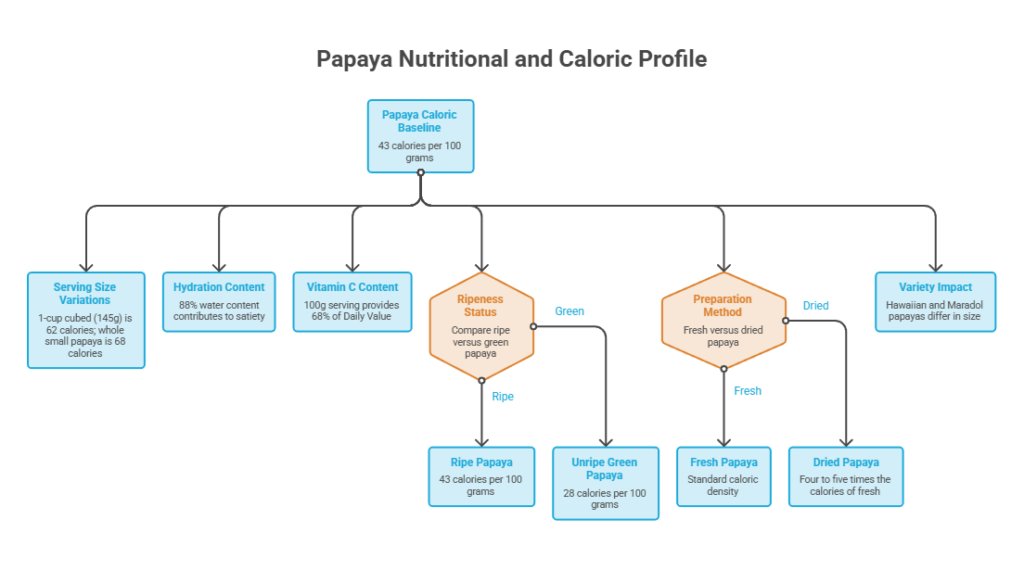
| At a Glance Papaya delivers about 43 calories per 100 grams, making it a genuinely low-calorie fruit.A 1-cup cubed serving (145 g) is roughly 62 calories; a whole small papaya lands near 68 calories.It’s about 88% water, which is why it fills you up for so few calories.One 100-gram serving covers 68% of the Daily Value for vitamin C.Ripe vs. green matters: unripe (green) papaya runs closer to 28 calories per 100 g.Dried papaya is a different story, packing four to five times the calories of fresh.The whole-fruit count swings wildly because Hawaiian and Maradol papayas differ enormously in size. |
How Many Calories Are in Papaya? The Direct Answer
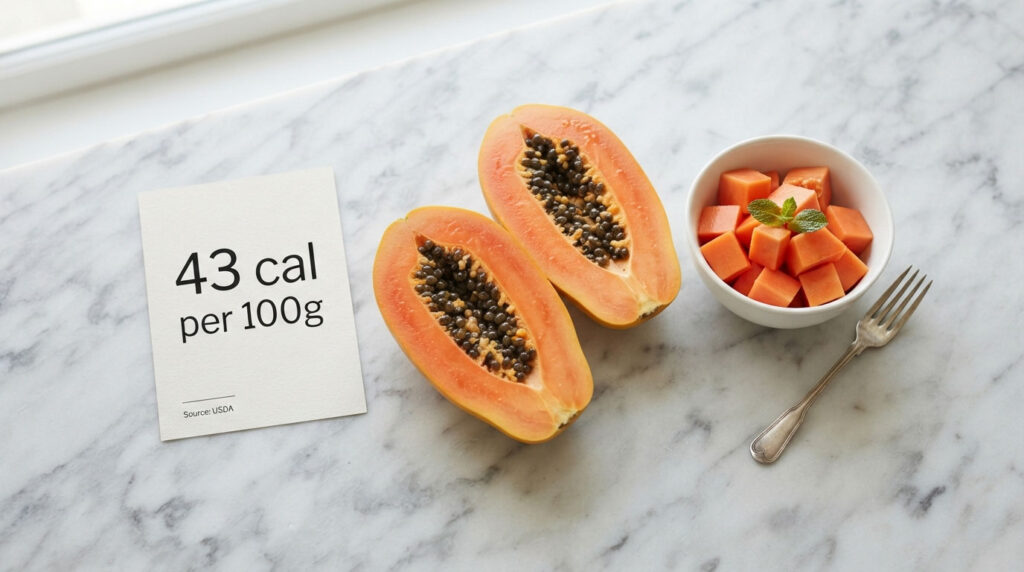
Papaya is a low-calorie fruit no matter how you slice it. The USDA lists raw papaya at 43 calories per 100 grams, and that single figure anchors every other portion you’ll encounter online.
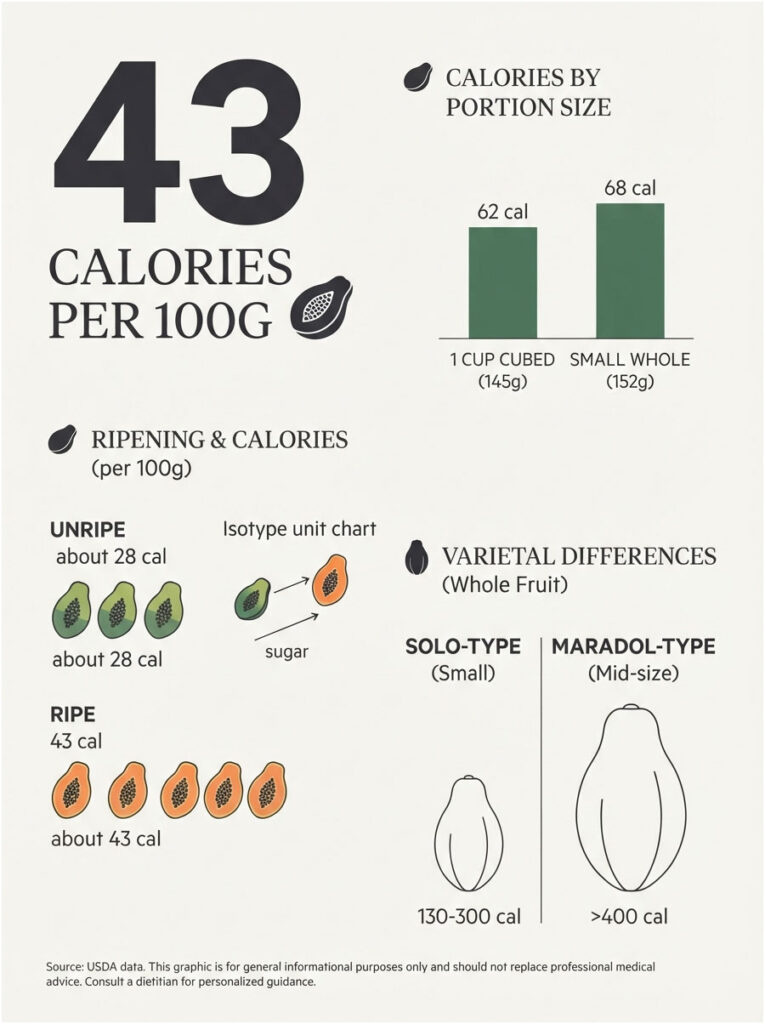
From there, the numbers scale with weight. A cup of cubed papaya, one of the most common ways Americans eat it, weighs about 145 grams and delivers roughly 62 calories. A full small papaya, closer to 152 grams of edible flesh, comes to about 68 calories.
Readers often ask our team how something this sweet can be so light. The answer sits in the water content, which we’ll get to shortly, and in the fact that papaya carries almost no fat or protein to bulk up the calorie total.
Here’s the calorie count broken down by the portions and papaya types you’ll actually run into at the store:
| Portion / papaya type | Edible weight | Calories | Carbs | Sugar | Fiber |
| Per 100 g (USDA baseline) | 100 g | 43 | 10.8 g | 7.8 g | 1.7 g |
| 1 cup, cubed | 145 g | 62 | 15.7 g | 11.3 g | 2.5 g |
| Small whole papaya | 152 g | 68 | 17.0 g | 12.0 g | 2.6 g |
| Medium Hawaiian papaya (flesh) | 300 g | 129 | 32.4 g | 23.5 g | 5.1 g |
| Half a large Maradol (flesh) | 350 g | 151 | 37.8 g | 27.4 g | 6.0 g |
| Whole mid-size Maradol (flesh) | ~950 g | ~410 | 103 g | 74 g | 16 g |
Notice how the calories climb steadily with weight while the per-gram value never budges. Only the amount on your plate changes. That’s the single most useful thing to remember about papaya calories, and it resolves most of the contradictions you’ll find between different websites.
In the nutrition questions our team fields most often, papaya portion size is the biggest source of confusion by a wide margin. People compare one database’s “one cup” figure against a friend’s “whole papaya” claim and assume one of them is wrong. Usually both are right; they’re just measuring different amounts of the same fruit.
A quick tip for accuracy: if you’re tracking calories, weigh your papaya or measure it in cups rather than counting whole fruit. A kitchen scale removes the guesswork entirely, because a “medium” papaya to one person is a “large” to another.
Ripe vs. Green (Unripe) Papaya Calories
Ripeness quietly changes the calorie count in a way most calorie pages skip. Ripe orange-fleshed papaya sits at that familiar 43 calories per 100 grams. Green, unripe papaya, the kind used in Thai som tam salad and Indian sabzi, runs closer to 28 calories per 100 grams.
The difference comes down to sugar. As papaya ripens, its starches convert to natural sugars, so the sweet ripe fruit carries more carbohydrate energy than the firm green version. That same process is why a green papaya tastes bland and a ripe one tastes like candy.
Green papaya also holds more of the enzyme papain, which fades as the fruit softens. So if you’re logging food carefully, note which form you ate. Ripe papaya behaves like a sweet fruit; green papaya behaves more like a low-calorie vegetable.
Why “One Papaya” Is a Trick Question
Ask how many calories are in a whole papaya and the honest answer is: which papaya? American grocery stores stock two very different fruits under the same name, and the size gap is dramatic.
The University of Florida describes the small Solo-type papayas, often labeled Hawaiian, as weighing between 1.1 and 2.2 pounds each. The large Maradol-type papayas, grown mainly in Mexico, can reach up to 10 pounds per fruit.
Do the math and a whole Hawaiian papaya might hold 130 to 300 calories of edible flesh, while a whole mid-size Maradol can run 400 calories or more. Nobody eats an entire Maradol in one sitting, which is exactly why serving size, not fruit count, is the number that matters. When you see a scary “papaya calories” figure online, check whether someone quietly measured a giant Mexican papaya.
The Full USDA Nutrition Breakdown of Papaya
Beyond calories, papaya earns its reputation on what those calories carry. Our review of the USDA FoodData Central entry for raw papaya (FDC #169926) shows a fruit that’s mostly water and vitamin C, with very little fat or protein and a surprisingly rich carotenoid profile.
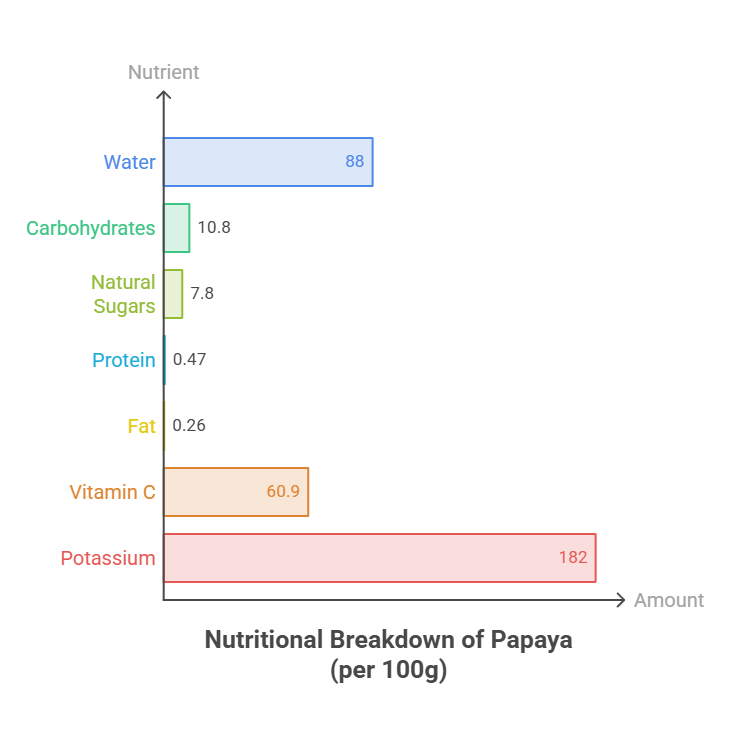
Here’s the full per-100-gram picture, straight from the USDA numbers, followed by what each part actually means for you.
Macronutrients
Carbohydrates do the heavy lifting in papaya’s calorie count. A 100-gram serving holds 10.8 grams of carbs, of which 7.8 grams are natural sugars and 1.7 grams are dietary fiber. That’s a light carb load next to starchy fruits like banana.
Papaya’s sugar profile is a little unusual. It’s made almost entirely of glucose and fructose, with essentially no sucrose, which is uncommon among fruits. That 7.8 grams of sugar per 100 grams is modest, and it’s the reason papaya tastes sweet without being calorie-dense.
Protein and fat barely register. Papaya has just 0.47 grams of protein and 0.26 grams of fat per 100 grams, so it’s virtually fat-free. The real headline is water: raw papaya is about 88% water by weight, which explains the low energy density and the fresh, hydrating bite.
Vitamins, Minerals, and Antioxidants
Vitamin C is where papaya shines. A single 100-gram serving delivers about 60.9 milligrams, roughly 68% of the Daily Value, according to the USDA and the NIH Office of Dietary Supplements. That’s more vitamin C than an equal weight of orange, and your body can’t make or store much of this vitamin, so daily food sources like papaya genuinely help.
The fruit also brings a spread of carotenoids: lycopene, beta-carotene, and beta-cryptoxanthin, the pigments behind its orange-red flesh. Beta-carotene and beta-cryptoxanthin are provitamin A compounds, meaning your body converts a portion of them into active vitamin A, which supports vision and immune function. Lycopene, the same antioxidant that colors tomatoes, is unusually well absorbed from papaya.
On the mineral side, 100 grams of papaya provides around 182 milligrams of potassium, plus smaller amounts of folate (about 37 micrograms), calcium (20 milligrams), and magnesium (21 milligrams). None of these are megadoses, but they add up meaningfully when papaya replaces a less nutritious snack.
| Nutrient | Per 100 g | Per 1 cup (145 g) | % Daily Value (per cup) |
| Calories | 43 | 62 | 3% |
| Carbohydrates | 10.8 g | 15.7 g | 6% |
| Sugar | 7.8 g | 11.3 g | — |
| Fiber | 1.7 g | 2.5 g | 9% |
| Protein | 0.47 g | 0.68 g | 1% |
| Fat | 0.26 g | 0.38 g | 0% |
| Vitamin C | 60.9 mg | 88 mg | 98% |
| Potassium | 182 mg | 264 mg | 6% |
| Folate | 37 mcg | 54 mcg | 14% |
A single cup of papaya covers nearly your entire day’s vitamin C for about 62 calories. Across the readers we serve, that value ratio is the detail that surprises people most, and it’s the strongest argument for keeping papaya in your rotation.
Calories in Dried Papaya, Juice, and Smoothies
Fresh papaya is light, but processing changes everything. This is where a lot of calorie tracking goes sideways, because the same fruit can carry very different numbers depending on how it reaches your plate.
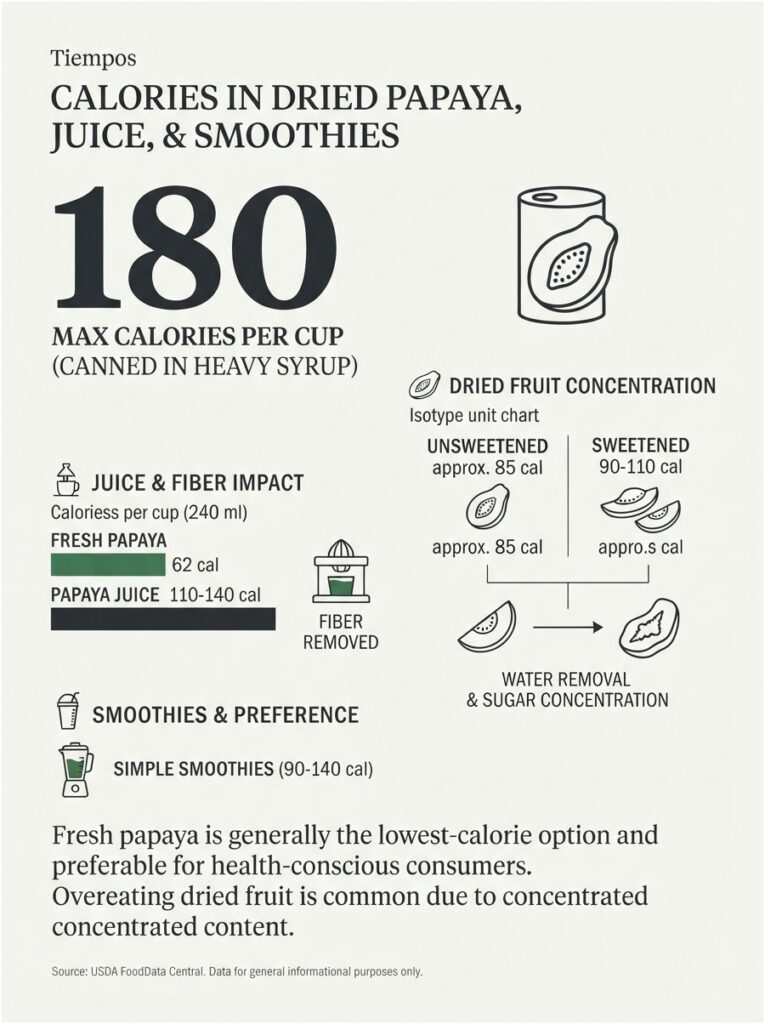
Dried papaya is the big trap. Removing the water concentrates the sugar and shrinks the volume, so dried papaya runs roughly 300 or more calories per 100 grams, four to five times the fresh figure. Many commercial dried papaya products are also sweetened with added sugar, pushing the total higher still. A small handful is easy to overeat because it no longer fills you up the way fresh fruit does.
Papaya juice sits in the middle. Straining out the pulp removes most of the fiber that made fresh papaya so filling, and a cup of juice concentrates the sugar of several pieces of fruit. Smoothies land wherever your recipe puts them: papaya plus water and ice stays light, while papaya blended with banana, honey, yogurt, and juice can climb past 300 calories quickly.
Canned papaya depends on the packing liquid. Fruit in juice or water stays close to fresh, but fruit in heavy syrup can nearly double the calorie count from the added sugar alone. Reading the label is the only reliable way to know.
| Papaya form | Serving | Calories (approx) | Why it differs |
| Fresh, cubed | 1 cup (145 g) | 62 | Full water and fiber intact |
| Dried, unsweetened | 1 oz (28 g) | ~85 | Water removed, sugar concentrated |
| Dried, sweetened | 1 oz (28 g) | ~90–110 | Added sugar on top of concentration |
| Papaya juice | 1 cup (240 ml) | ~110–140 | Fiber removed, sugar of several fruits |
| Canned in heavy syrup | 1 cup | ~120–180 | Added syrup boosts calories |
| Simple papaya smoothie | 1 cup | ~90–140 | Depends on added ingredients |
The takeaway is simple. If you want papaya’s low-calorie advantage, fresh and whole beats processed almost every time. When our team reviews food logs, dried fruit is one of the most common reasons a “healthy” day quietly runs over on calories.
Why Papaya’s Calories Punch Above Their Weight
Low calories only matter if they come with something useful, and papaya’s calories arrive with a lot of it. The reason ties back to that 88% water content.
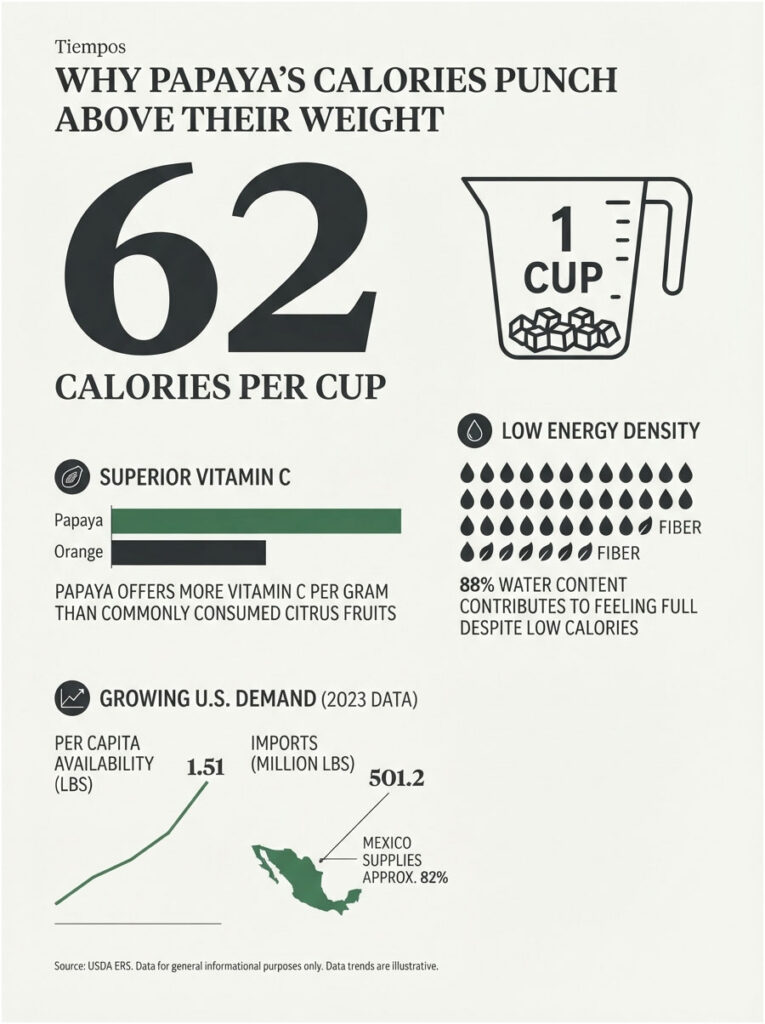
Water and fiber add volume and weight to food without adding calories. Foods built this way are described as having low energy density, and they tend to satisfy hunger faster than dense, dry foods. That’s why a cup of papaya feels more filling than its 62 calories would suggest, and why fruit like this helps people eat fewer calories overall without feeling deprived.
Then there’s the vitamin C payoff. Gram for gram, papaya delivers more vitamin C than any commonly eaten citrus fruit, a genuinely useful trait for so few calories. Among everyday fruits, only guava and kiwi meaningfully outperform it.
The carotenoids add a second layer. Papaya is one of the few non-tomato fruits that supplies a meaningful amount of lycopene, the antioxidant studied for its role in cardiovascular and cell health. You get that alongside the low calorie count, not in exchange for it, which is why dietitians tend to rate papaya’s nutrient density so highly.
Papaya in the American Diet
Papaya used to be a specialty item in the United States. Not anymore. Consumption has climbed steadily for years, driven almost entirely by imports rather than domestic growing.
Per capita availability reached a record 1.51 pounds per person in 2023, roughly double the figure from two decades earlier, according to reporting on the USDA Fruit and Tree Nuts Outlook. Fresh papaya imports crossed half a billion pounds that same year, a first for the category.
| US papaya metric | Latest figure | Source |
| Per capita availability | 1.51 lb per person (2023 record) | USDA / Fruit & Tree Nuts Outlook |
| Per capita, two decades earlier | ~0.75 lb per person | USDA |
| Fresh papaya imports | 501.2 million lb (2023) | USDA |
| Share supplied by Mexico | ~82% (5-year average) | USDA / Fruit & Tree Nuts Outlook |
| Average retail price | $1.09 per lb (first half 2024) | USDA |
| Vitamin C per 100 g | 60.9 mg (68% DV) | USDA FoodData Central |
That growth matters for the calorie conversation because more of the papaya on American plates is now the large Maradol type from Mexico, not the small Hawaiian Solo. Bigger fruit means bigger portions, and one more reason to measure by the cup instead of by the fruit.
Papaya, Calories, and Weight Loss: Does It Actually Help?
Papaya shows up on nearly every “fruits for weight loss” list, and the calorie math backs part of that reputation. It’s genuinely low in calories, high in water, and reasonably filling. Still, it’s worth being honest about what a single fruit can and can’t do.
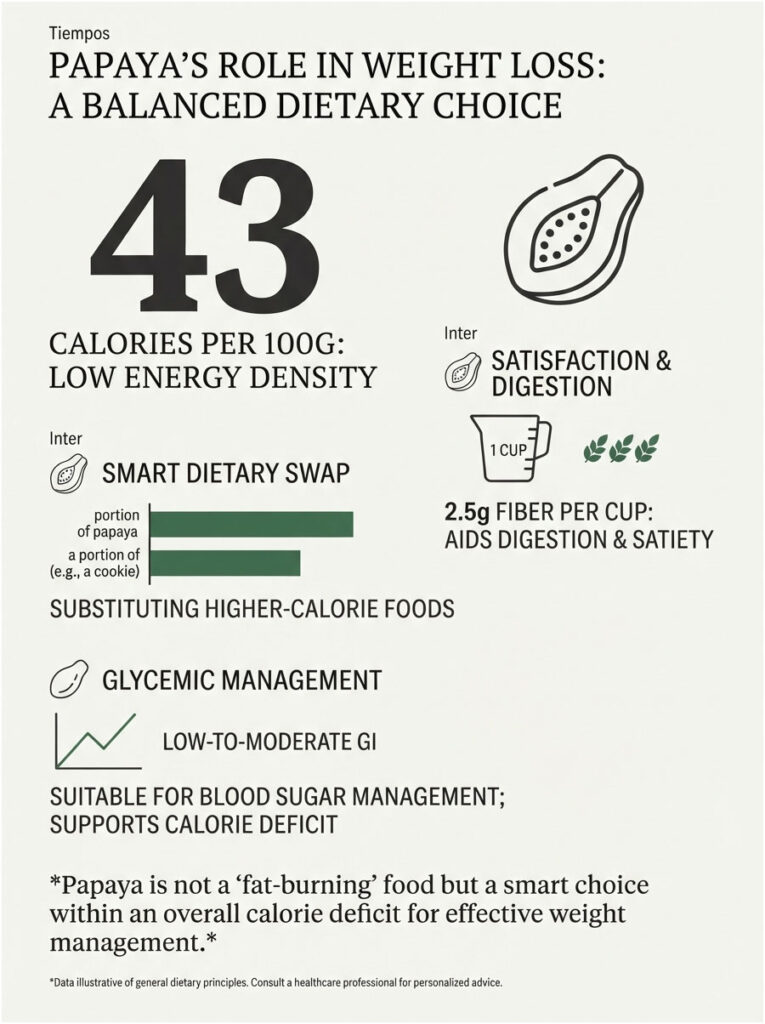
The strongest case for papaya is its low energy density. At 43 calories per 100 grams, it lets you eat a satisfying volume of food for a small calorie cost, which helps you feel full while keeping your daily total in check. Swapping a cookie for a cup of papaya is a real, repeatable calorie savings.
Fiber helps too. The 2.5 grams in a cup won’t transform your digestion on its own, but combined with the high water content, it supports fullness and regularity. Papaya also carries papain, a proteolytic enzyme that helps break down protein, which is where its reputation as a “digestive fruit” comes from.
Protein pairing is the practical upgrade. Because papaya is almost entirely carbohydrate and water, eating it alongside a protein source such as cottage cheese, Greek yogurt, or a handful of nuts steadies the calorie release and keeps you full longer than fruit alone. That small habit turns a light snack into one that actually holds off the next craving.
Blood sugar is a fair concern for anyone watching calories through a diabetic lens. Papaya’s glycemic index is generally reported in the low-to-moderate range, so it raises blood sugar more gently than high-GI foods, especially when eaten with a meal rather than alone.
Here’s the honest limitation our medical reviewers stress: no single fruit causes weight loss. Papaya helps when it replaces higher-calorie foods within an overall calorie deficit. Eaten on top of everything else you already consume, even a low-calorie fruit adds calories. Readers often ask us for the one “fat-burning” food, and the truthful answer is that papaya is a smart swap, not a shortcut.
How Papaya Compares to Other Popular Fruits
One of the fastest ways to judge whether papaya is truly “low calorie” is to line it up against the fruits people usually eat instead. It holds up well.
Papaya is lighter than mango and banana, roughly on par with orange, and carries less sugar than most tropical options. Where it pulls decisively ahead is vitamin C per calorie, beating every fruit in this comparison.
| Fruit (per 100 g) | Calories | Sugar | Vitamin C |
| Papaya | 43 | 7.8 g | 60.9 mg |
| Orange | 47 | 9.2 g | 53.2 mg |
| Pineapple | 50 | 9.9 g | 47.8 mg |
| Apple | 52 | 10.4 g | 4.6 mg |
| Mango | 60 | 13.7 g | 36.4 mg |
| Banana | 89 | 12.2 g | 8.7 mg |
If your priority is the most nutrition for the fewest calories, papaya is one of the strongest picks on this list. It trails only the very lowest-calorie fruits while delivering standout vitamin C for the calories.
That said, banana’s higher count isn’t a flaw; it reflects more carbohydrate energy, which is useful before a workout. Papaya and banana simply serve different jobs. The right choice depends on what you need from the snack, not on which number is smaller.
How to Fit Papaya Into Your Day
Because papaya is so low in calories, the main decision isn’t whether to eat it but how much and when. A little planning makes it work for almost any goal.
Portion-wise, a cup of cubed papaya (about 62 calories) is a sensible default. It covers nearly a full day of vitamin C, keeps calories modest, and works as a snack, a breakfast topping, or a light dessert. Even two full cups stay under 130 calories.
Timing is flexible. Papaya digests easily, so many people enjoy it in the morning or as a mid-afternoon snack. Pairing it with a protein source, such as Greek yogurt or cottage cheese, slows digestion and turns a light snack into something that carries you to the next meal.
Preparation keeps it interesting. A squeeze of lime brightens the flavor and adds even more vitamin C, and a pinch of chili is a classic pairing in Mexican street food. Frozen papaya cubes blend into a light smoothie base without the calorie creep of added juice.
Batch prep helps you stay honest with portions. Cubing a whole papaya at once and storing it in the fridge lets you scoop a measured cup instead of grazing straight from a giant Maradol, where the calories quietly add up before you notice. A sealed container keeps cut papaya fresh for about three to four days.
Use this quick reference to match papaya to what you’re actually trying to do:
| If your goal is… | Recommended papaya serving | Why |
| Weight loss / calorie control | 1 cup cubed (145 g, ~62 cal) | High water and fiber, low energy density, keeps you full |
| A lower-sugar option | ½ cup (~70 g) or green papaya | Caps sugar while keeping vitamin C |
| Post-workout refuel | 1 cup plus a protein source | Carbs replenish glycogen; papaya alone is low in protein |
| Managing blood sugar | ½ to 1 cup with a meal, not solo | Moderate GI; pairing blunts the glucose rise |
| Constipation relief | 1 cup ripe plus water | Fiber, papain, and high water support regularity |
| Pregnancy | Ripe papaya only, skip green | Unripe latex may trigger contractions; ripe is safe |
Safety Notes
A few groups should read the label a little more carefully. Unripe or green papaya is high in latex, which may stimulate uterine contractions, so pregnant readers are generally advised to eat only fully ripe papaya and avoid the green form.
People with a latex allergy can sometimes react to papaya, because the fruit contains latex-like proteins, a pattern called latex-fruit syndrome. Reactions range from mild itching to more serious symptoms, so anyone with a known latex sensitivity should introduce it cautiously.
Readers on blood-thinning medication occasionally ask us about papaya, since the papain enzyme may interact with certain drugs. In the health queries we see across our network, this comes up often enough to flag: if you take anticoagulants, check with your doctor before adding large amounts.
Frequently Asked Questions
How many calories are in one whole papaya?
It depends entirely on size. A small whole papaya (about 152 g) has roughly 68 calories, a medium Hawaiian papaya can hold around 130 calories of flesh, and a whole mid-size Maradol may reach 400 or more. Measuring by the cup gives a far more reliable number than counting whole fruit.
How many calories in a cup of papaya?
A 1-cup serving of cubed papaya weighs about 145 grams and contains roughly 62 calories, per USDA data. That same cup delivers nearly a full day’s worth of vitamin C, about 88 milligrams, making it one of the best nutrition-per-calorie snacks among common fruits.
How many calories in a medium papaya?
“Medium” is where sources disagree most. Using a medium Hawaiian papaya of about 300 grams of edible flesh, you’re looking at roughly 129 calories. Larger Maradol papayas run much higher, so weighing your portion or measuring it in cups gives a far more dependable figure.
Is papaya good for weight loss?
Papaya can support weight loss because it’s low in calories, high in water, and reasonably filling. It works best as a swap for higher-calorie foods within an overall calorie deficit. On its own it won’t burn fat, but replacing a sugary snack with a cup of papaya is a genuine calorie savings.
How many calories in green (unripe) papaya?
Green papaya is lighter than ripe, at roughly 28 calories per 100 grams versus 43 for ripe. Because ripening converts starch into sugar, the firm green fruit carries less sugar and fewer calories. Green papaya behaves more like a low-calorie vegetable, which is why it stars in savory salads.
How many calories in dried papaya?
A lot more than fresh. Dried papaya runs roughly 300 or more calories per 100 grams, four to five times the fresh figure, because removing water concentrates the sugar. Many commercial versions add sugar too. A one-ounce handful can hit 85 to 110 calories, so portion it carefully.
Does papaya have a lot of sugar?
Not really. Papaya holds about 7.8 grams of sugar per 100 grams, modest for a sweet-tasting fruit. That’s noticeably less than mango (13.7 g), banana (12.2 g), or grapes. Its sugar is almost entirely glucose and fructose, with virtually no sucrose, an unusual profile among fruits.
How many carbs are in papaya?
Raw papaya contains about 10.8 grams of carbohydrates per 100 grams, including 7.8 grams of sugar and 1.7 grams of fiber. A full cup (145 g) comes to roughly 15.7 grams of carbs. That makes papaya a light-to-moderate carb fruit, lower than banana but higher than most berries.
Is papaya keto-friendly?
Papaya is tricky on strict keto. At about 10.8 grams of carbs per 100 grams, a normal serving can eat up a meaningful share of a tight daily carb limit. Small portions, such as a half cup, can fit a more relaxed low-carb plan, but it isn’t an ideal keto staple.
Which has fewer calories, papaya or mango?
Papaya wins. Papaya has about 43 calories per 100 grams versus roughly 60 for mango, so papaya is around 28% lighter by weight. Papaya also carries far less sugar (7.8 g vs. 13.7 g). If you’re choosing a tropical fruit purely on calories, papaya is the leaner pick.
Can people with diabetes eat papaya?
In most cases, yes, in moderate portions. Papaya has a low-to-moderate glycemic index and a modest sugar load, so it raises blood sugar more gently than many sweets. Eating a half-cup to one-cup serving alongside a meal, rather than alone, helps blunt the glucose response. Personal guidance from your doctor still applies.
How much papaya should I eat per day?
A cup or two of cubed papaya (roughly 62 to 130 calories) suits most people and covers your vitamin C needs comfortably. There’s no strict limit for healthy adults, but keeping portions to one or two cups helps manage total sugar and calories, especially if you’re tracking either one.
Does papaya burn belly fat?
No food burns belly fat on its own, papaya included. What papaya does well is fill you up for very few calories, which makes it easier to hold an overall calorie deficit, the actual driver of fat loss. Pairing that with regular activity beats relying on any single fruit.
How many calories are in half a papaya?
It depends on the type. Half a small Hawaiian papaya (around 150 g of flesh) runs about 65 calories, while half a large Maradol can hold 150 to 200 calories or more. Because Maradol papayas are so much bigger, check the weight rather than assuming half a fruit is a small portion.
Is it OK to eat papaya at night?
Yes, papaya is a light, low-calorie choice that works fine in the evening. Its modest calorie count and easy digestibility make it a reasonable late snack, and the fiber may support overnight regularity. If you’re sensitive to sugar close to bed, keep the portion to about a cup.
| Disclaimer: This article is for general informational and educational purposes only and is not a substitute for professional medical or nutritional advice. Nutrient values are based on USDA FoodData Central and can vary by variety, ripeness, and growing conditions. If you have diabetes, a latex allergy, are pregnant, or take medication, consult a qualified healthcare provider before making significant dietary changes. |
References
- USDA FoodData Central, Papayas raw (FDC #169926)
- USDA Economic Research Service, Fresh Papaya Imports and Consumption
- USDA Fruit and Tree Nuts Outlook, US papaya imports reach record high
- University of Florida IFAS, Overview of Global Papaya Production
- NIH Office of Dietary Supplements, Vitamin C Fact Sheet
- Cleveland Clinic, Papaya Benefits and Nutrition