
It’s 2 a.m., you’ve taken your Zofran, and the queasiness still won’t let go. You’re left wondering whether the pill is even working, or whether something more serious is brewing.
Table of Contents
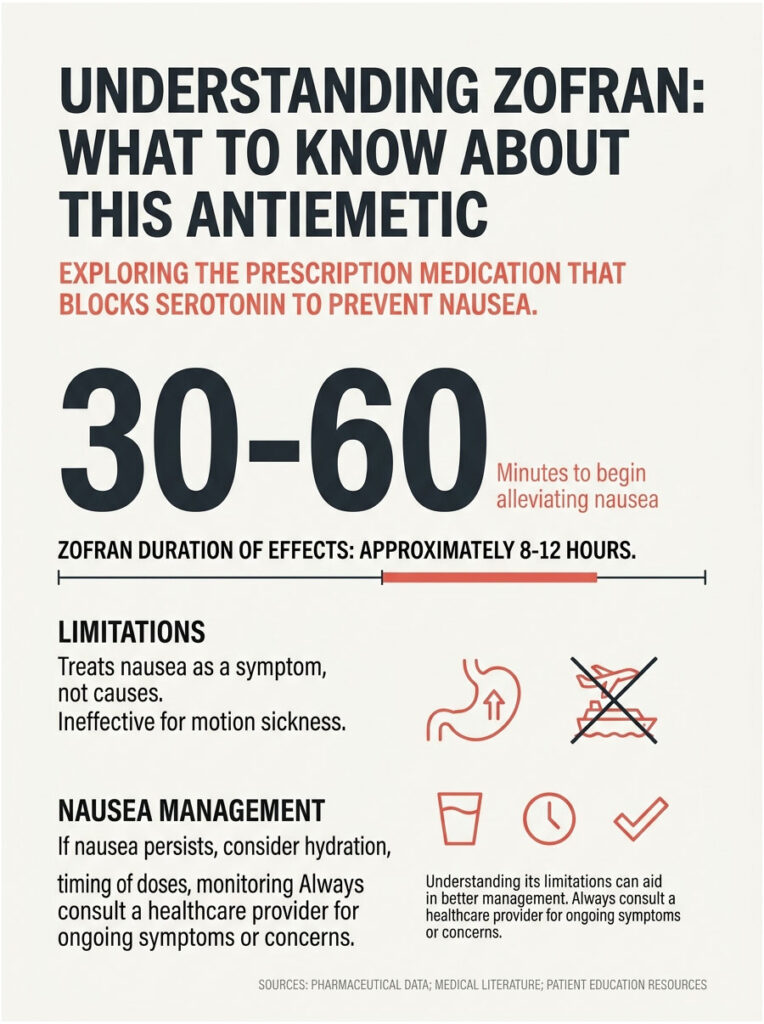
Quick Answer: Zofran (ondansetron) is a prescription antiemetic that blocks serotonin from triggering the brain’s vomiting center. It usually starts easing nausea within 30 to 60 minutes and lasts about 8 to 12 hours. It treats the symptom, not the cause, and it does not help motion sickness. If nausea keeps returning, hydration, dose timing, and checking for red flags are the right next steps.
At a Glance
- Zofran is a 5-HT3 receptor antagonist that blocks serotonin signals from the gut and brain.
- It works within 30 to 60 minutes and lasts roughly 8 to 12 hours per dose.
- The standard adult oral dose is 8 mg, with no more than 24 mg in a day.
- It does nothing for motion sickness, which travels a different nerve pathway.
- The main safety concern is a rare heart-rhythm change called QT prolongation.
- Persistent nausea means it’s time to treat the cause, not just the symptom.
What Zofran Is and Why Doctors Reach for It
Zofran is the brand name for ondansetron, one of the most widely prescribed anti-nausea medications in the United States. When queasiness turns serious, it’s often the first prescription a clinician reaches for.
It belongs to a drug class called antiemetics, medications built specifically to stop nausea and vomiting. Patients booking lab work with us mention it by name constantly, usually after a surgery, a stomach bug, or a hard week of treatment.
What sets Zofran apart is how cleanly it targets the nausea signal without the heavy sedation that older drugs often bring. That balance of strength and tolerability is why it became a default choice.
The 5-HT3 Receptor Antagonist Family
Ondansetron belongs to a group called 5-HT3 receptor antagonists. The “5-HT3” names a specific type of serotonin receptor that, once activated, fires off the urge to vomit.
According to NIH StatPearls, ondansetron is one of four FDA-approved drugs in this class, alongside granisetron, dolasetron, and the longer-acting palonosetron.
These medications act in two places at once, the gut and the brain. That dual action helps explain why they handle nausea from so many different triggers.
What Zofran Is FDA-Approved to Treat
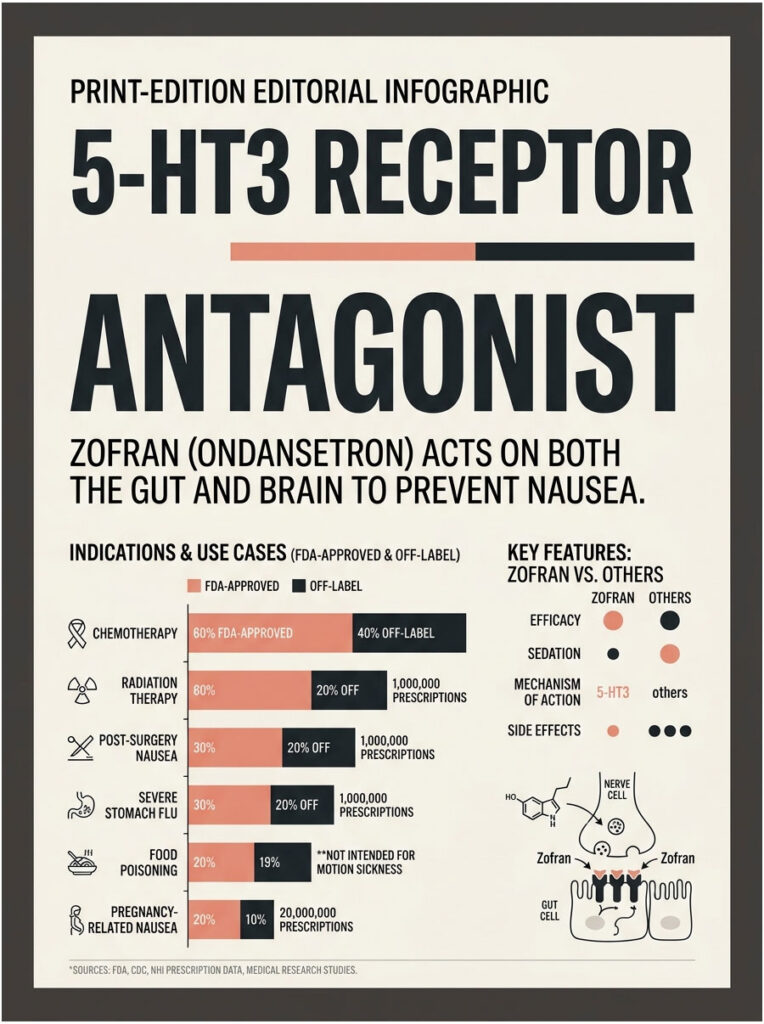
Zofran earned FDA approval for three core situations: nausea and vomiting from chemotherapy, from radiation therapy, and after surgery. Those were the problems it was designed to solve.
Doctors later began prescribing it off-label for other causes, including severe stomach flu, food poisoning, and pregnancy-related nausea. Our medical reviewers note that off-label prescribing is both common and legal when a clinician judges it appropriate.
One boundary is firm, though. Zofran was never meant for everyday motion sickness or mild, passing queasiness, a distinction that matters more than most people expect.
How Zofran Works in Your Body
The mechanism explains both why Zofran shines against some nausea and why it can miss completely against other kinds. It all traces back to serotonin.
A common surprise among the patients we serve is that nausea often begins in the gut, not the head. Zofran was built around exactly that biology.
The Serotonin and Vomiting-Center Connection
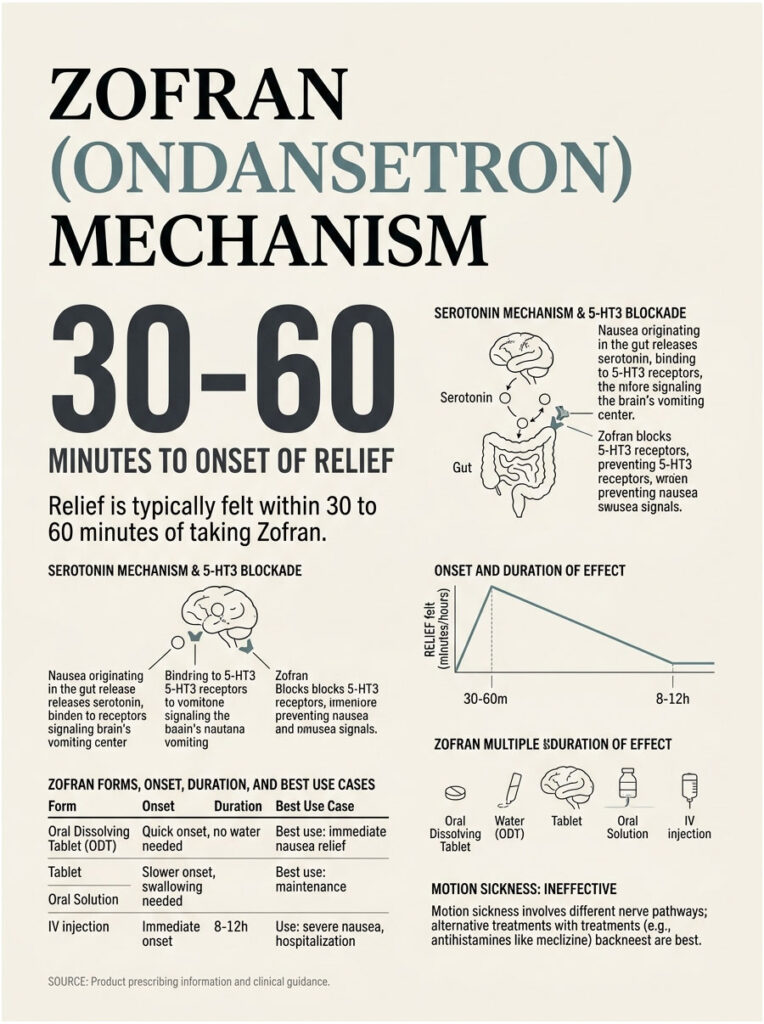
When your stomach or intestines are irritated, by chemotherapy, infection, or surgery, the gut releases serotonin. That serotonin latches onto 5-HT3 receptors on nearby nerves.
Those nerves then send an alarm to a brainstem region often called the vomiting center. Once that center lights up, the wave of nausea and the urge to vomit follow close behind.
Cleveland Clinic describes how Zofran blocks those 5-HT3 receptors. With the receptors occupied, serotonin can’t deliver its message, and the vomiting signal never reaches full volume.
How Fast It Works and How Long It Lasts
Most people feel relief within 30 to 60 minutes of an oral dose. The orally disintegrating tablet, which melts on the tongue, can feel quicker simply because it’s easier to keep down when swallowing is rough.
A single dose generally lasts 8 to 12 hours, which is why Zofran is often dosed every 8 to 12 hours as needed. Its oral bioavailability sits near 60 percent, per NIH StatPearls, because the liver breaks down part of it before it reaches your bloodstream.
Taken a dose and feel nothing after an hour? That’s worth noting. It often points to a cause that Zofran simply cannot reach.
Why Zofran Does Nothing for Motion Sickness
This fact catches many people off guard. Zofran is largely useless against motion sickness, and that’s not a fluke or a dosing error.
Motion sickness springs from a mismatch between your inner ear and your eyes, routed through nerve centers that don’t depend on those 5-HT3 receptors. NIH StatPearls confirms ondansetron has minimal effect on motion-related nausea.
For car, boat, or plane queasiness, antihistamine options like meclizine (Dramamine, Bonine) or a scopolamine patch are the right tools. Patients often ask us about this after a Zofran dose flops on a road trip.
Table 1: Zofran Forms, Onset, and Best Use
| Form | How It’s Taken | Onset | Duration | Typical Use |
| Oral tablet | Swallowed | 30 to 60 min | 8 to 12 hr | General nausea, chemo, post-op |
| Orally disintegrating tablet (ODT) | Melts on tongue | 30 to 60 min | 8 to 12 hr | When swallowing is hard |
| Oral solution | Liquid, measured | 30 to 60 min | 8 to 12 hr | Children, swallowing trouble |
| Oral soluble film (Zuplenz) | Dissolves on tongue | 30 to 60 min | 8 to 12 hr | Convenience, no water needed |
| IV / injection | Given by a clinician | Within minutes | 4 to 12 hr | Hospital, severe cases |
Source: Mayo Clinic; FDA prescribing label; NIH StatPearls.
Zofran Dosage and How to Take It
Getting dose and timing right often decides whether Zofran works. Too little, taken too late, and the medication can feel like a failure when the real issue was the schedule.
In tests booked through HealthCareOnTime, patients sometimes mention reaching for Zofran only after vomiting has already started. It performs far better taken ahead of the peak, as a preventive.
Standard Adult Oral Dosing
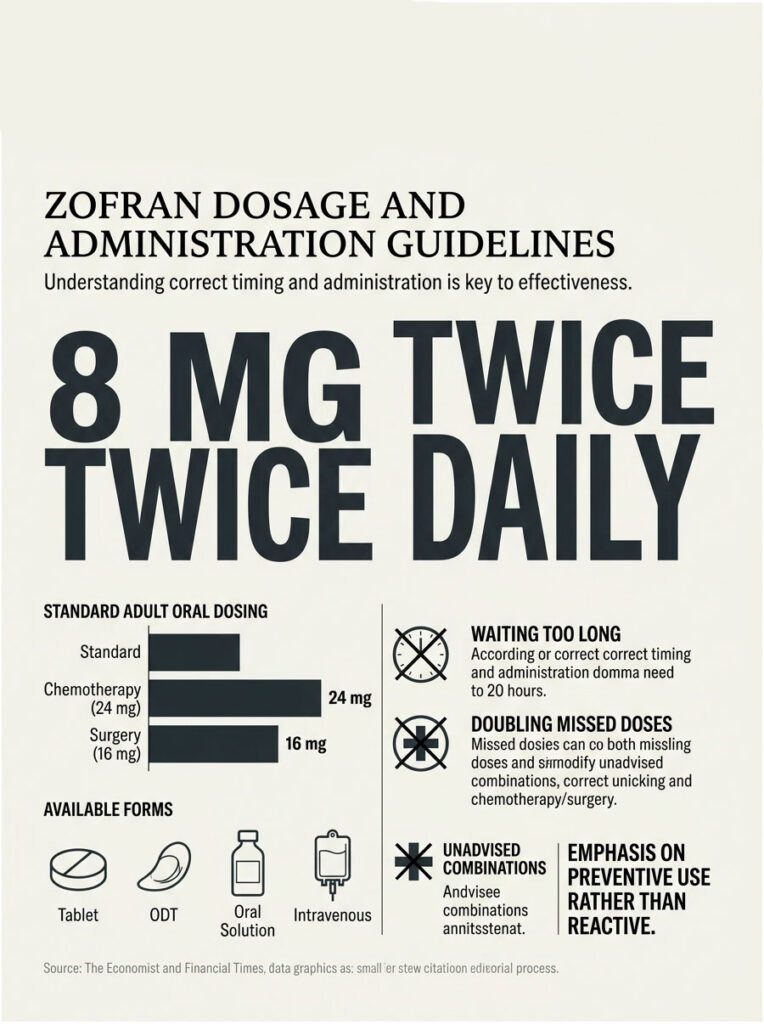
For most adults, the standard oral dose is 8 mg, often taken twice daily, roughly every 12 hours. The Mayo Clinic lists 8 mg as the common starting point across many uses.
Chemotherapy calls for higher amounts, sometimes a single 24 mg dose before treatment, while surgery may use a 16 mg dose an hour before anesthesia. Either way, total daily intake should not pass 24 mg by mouth.
Going above that ceiling adds little benefit and raises the side-effect risk. Our medical reviewers put it simply: with this medication, more is not better.
Forms: Tablet, ODT, Oral Solution, and IV
Zofran comes in several formats to fit different needs. The standard tablet suits anyone who can swallow comfortably.
The orally disintegrating tablet and the oral soluble film dissolve without water, made for people who can’t keep a pill down. The oral solution works well for children and anyone who struggles with solids.
In the hospital, the intravenous form delivers the fastest relief, acting within minutes. That route is saved for severe cases or when nothing stays down.
Common Dosing Mistakes
Waiting too long is the most frequent slip. Zofran prevents nausea more reliably than it rescues you mid-episode, so timing it before expected triggers pays off.
Doubling up after a missed dose is another. That pushes you toward the daily ceiling and the heart-rhythm risk tied to higher exposure.
Combining Zofran with other anti-nausea drugs without guidance also backfires. Some pairings stack the same side effects or drive serotonin too high.
Side Effects and the FDA Heart Warning
Most people tolerate Zofran well, a big reason for its popularity. Even so, no effective medication is risk-free, and a few of Zofran’s risks deserve genuine attention.
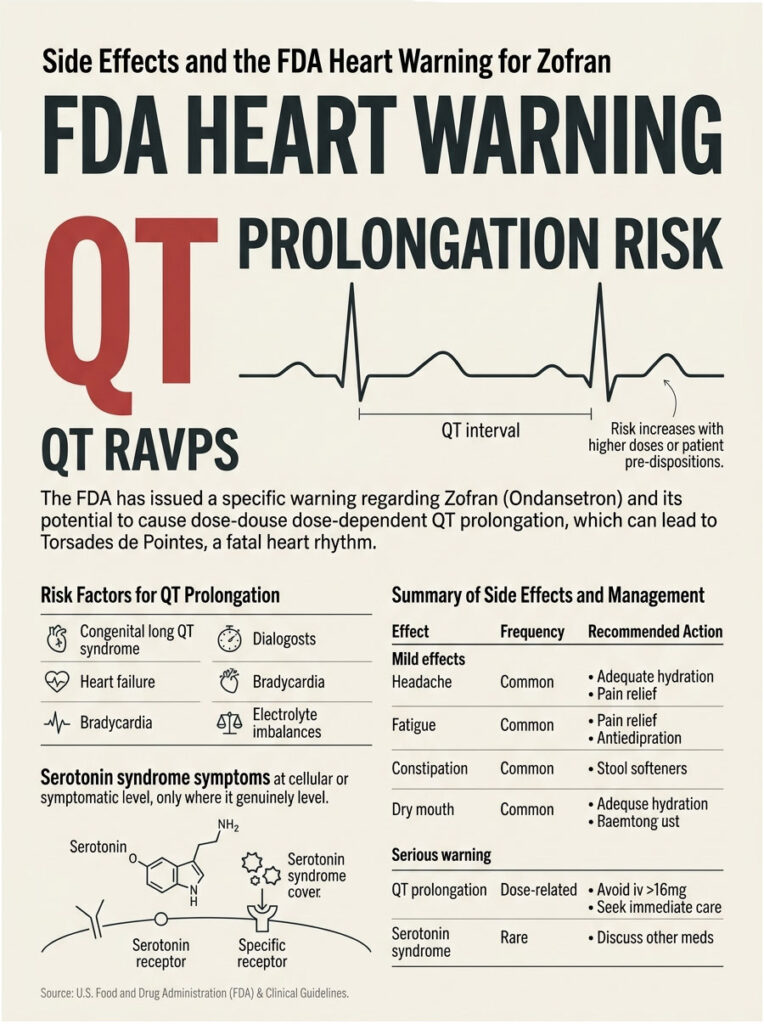
Our medical team has reviewed the safety profile closely. For short-term use in healthy people, the picture is reassuring; the cautions matter most for specific groups.
Common, Mild Side Effects
The usual side effects stay mild and brief. Headache leads the list, trailed by tiredness, constipation, and sometimes diarrhea, with dry mouth showing up for some.
These rarely force anyone to stop the medication. Water, light movement, and a little extra fiber usually handle the constipation Zofran can cause.
A side effect that lingers or worsens is worth a call to your prescriber. A small dose adjustment often clears it up.
The QT Prolongation and Torsades de Pointes Risk
The most serious concern is a heart-rhythm change called QT prolongation. In rare cases it can trigger a dangerous arrhythmia known as Torsades de Pointes.
Back in 2012, the FDA issued a safety communication and pulled the single 32 mg intravenous dose from the label, because that high dose stretched the QT interval too far. No single IV dose should now top 16 mg.
The risk climbs with dose and is far greater with IV use than with normal oral doses. People with congenital long QT syndrome should avoid Zofran, and those with heart conditions or on other QT-affecting drugs may need an ECG first.
Serotonin Syndrome and Drug Interactions
Since Zofran acts on serotonin, pairing it with other serotonin-raising drugs can occasionally push levels too high. The result, serotonin syndrome, can become serious.
The drugs that matter most are antidepressants such as SSRIs and SNRIs, plus certain opioids and migraine medications. Zofran is also contraindicated with apomorphine, a Parkinson’s drug, because the combination can cause a steep drop in blood pressure.
A frequent question we hear is whether an antidepressant rules Zofran out. Usually it doesn’t, but the prescriber needs your full medication list to judge it safely.
Table 2: Zofran Side Effects, Frequency, and What to Do
| Side Effect | How Common | What to Do |
| Headache | Very common | Hydrate, rest; usually passes |
| Constipation | Common | Add water and fiber; tell prescriber if severe |
| Fatigue or drowsiness | Common | Avoid driving until you know your response |
| Dry mouth | Common | Sip water, chew sugar-free gum |
| QT prolongation / arrhythmia | Rare | Seek urgent care for palpitations or fainting |
| Severe allergic reaction | Rare | Call 911 for swelling or breathing trouble |
Source: WebMD; FDA prescribing label; NIH StatPearls.
Is Zofran Safe During Pregnancy?
Few questions surface more often, and the honest response calls for nuance rather than a flat yes or no. Pregnancy nausea can be severe, and the decision is a real one.
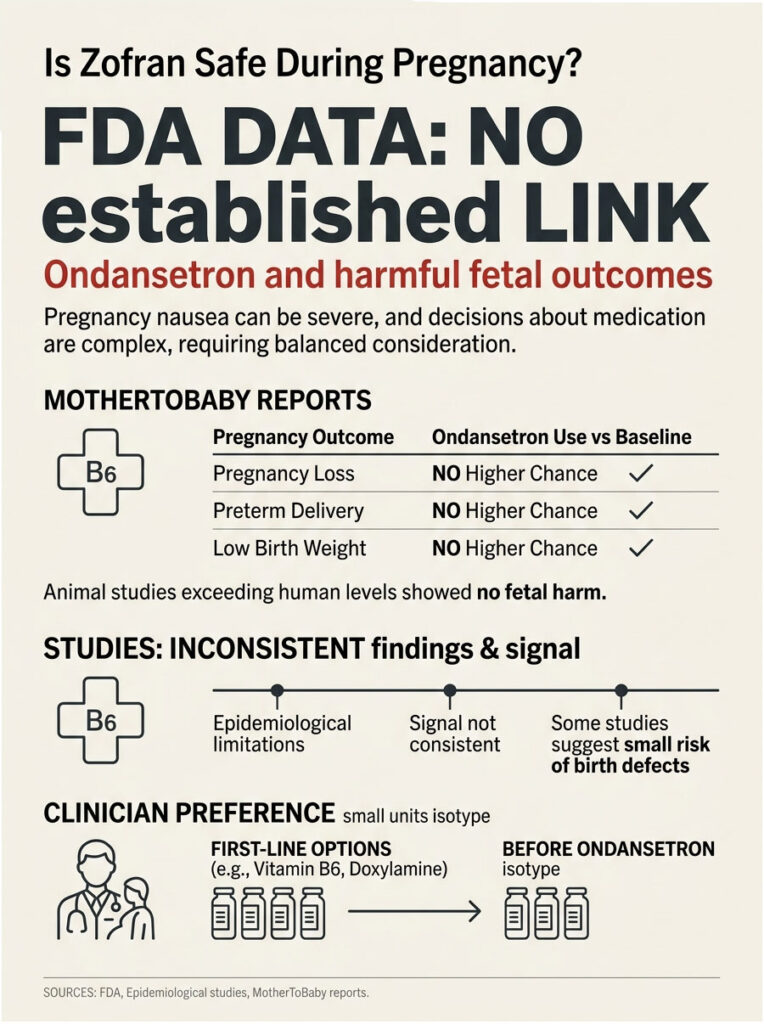
Because this is a sensitive, high-stakes topic, it deserves calm, sourced information. The plain truth is that the data are mixed.
What the Research Actually Shows
The FDA label states that available data do not reliably establish a link between ondansetron and harmful fetal outcomes. Epidemiological studies have produced inconsistent findings with notable limitations.
MotherToBaby, a trusted resource on pregnancy exposures, reports that studies did not find a higher chance of pregnancy loss, preterm delivery, or low birth weight with ondansetron use. A few studies have raised questions about a small possible risk of certain birth defects, but that signal has not held up consistently.
Animal studies at several times the human dose showed no fetal harm. The remaining uncertainty is why no one can promise complete safety either way.
How Doctors Weigh the Decision
For severe pregnancy nausea, the calculation balances competing risks. Uncontrolled vomiting can cause dehydration and weight loss that themselves endanger a pregnancy.
Many clinicians begin with first-line options such as vitamin B6 (pyridoxine) and doxylamine, the pair sold as Diclegis. Ondansetron is often held in reserve for cases that don’t respond, and the choice stays individualized.
The consistent guidance across the patients we serve is straightforward: never start or stop Zofran in pregnancy without your obstetrician’s input. The right call depends on severity and on what’s already been tried.
Why Your Nausea Won’t Stop (Even on Zofran)
Taking Zofran correctly and still feeling sick is a signal, not a drug failure. It usually traces to one of a few specific reasons.
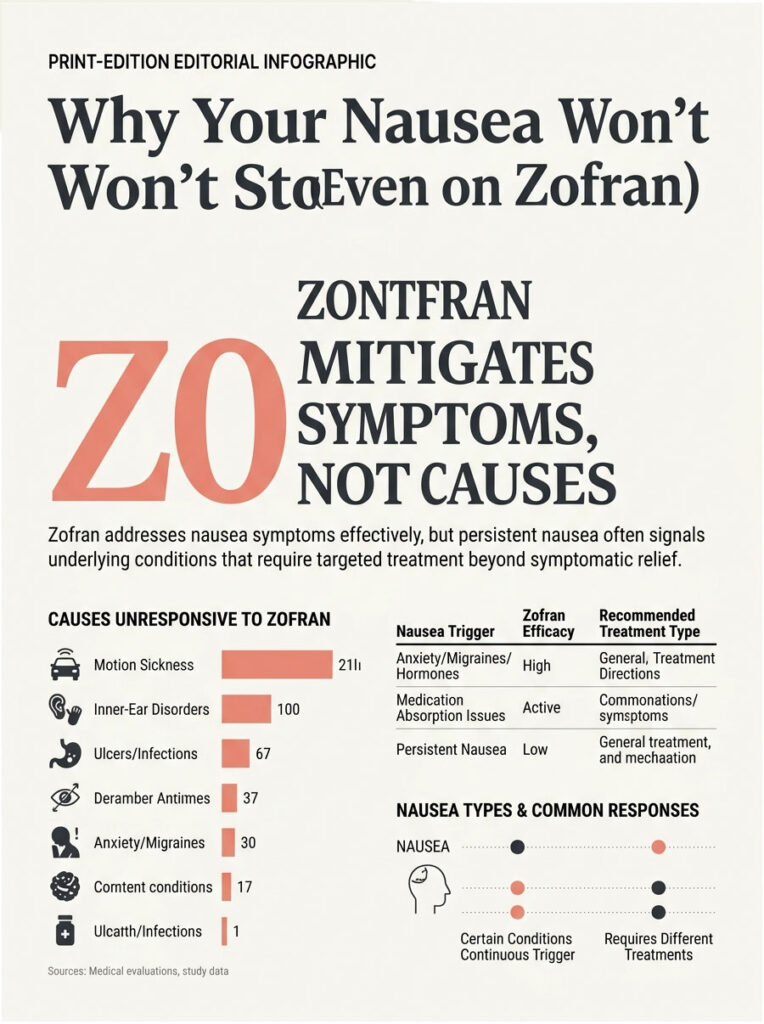
Our lab partners report that stubborn nausea ranks among the more common reasons people end up needing further testing. The medication is doing its part; the cause may need its own attention.
It Treats Symptoms, Not the Cause
Zofran quiets the nausea signal, but it doesn’t fix whatever generates that signal. If an ulcer, infection, blocked bowel, inner-ear problem, or other condition is driving the queasiness, the source keeps firing.
Picture turning down a smoke alarm without putting out the fire. The relief is real but temporary while the source goes unaddressed.
That’s precisely why persistent nausea calls for a real diagnosis. The goal shifts from masking the symptom to finding and treating the trigger.
Wrong Type of Nausea
Motion sickness and some inner-ear conditions like vertigo don’t respond to Zofran, since they bypass the 5-HT3 pathway entirely. Taking more won’t change the outcome.
Nausea from anxiety, migraines, or certain hormonal shifts may also respond poorly. These often need a different class of medication aimed at the true mechanism.
If your nausea fits one of these patterns, a clinician can match you to a treatment that targets the right pathway.
Dosing, Timing, or Absorption Issues
Sometimes the medication is right but the delivery isn’t. Vomit soon after swallowing a tablet and you may not have absorbed it, which is where the dissolving forms earn their place.
A dose taken too late, after nausea has fully escalated, also blunts the effect. And if your dose sits at the low end for a strong trigger, your prescriber can adjust within safe limits.
These problems are fixable. A quick call to your provider often resolves them faster than waiting it out.
Medically Approved Next Steps
When Zofran alone isn’t enough, a clear sequence helps. The aim is to protect your hydration, rule out dangerous causes, and find a treatment that fits.
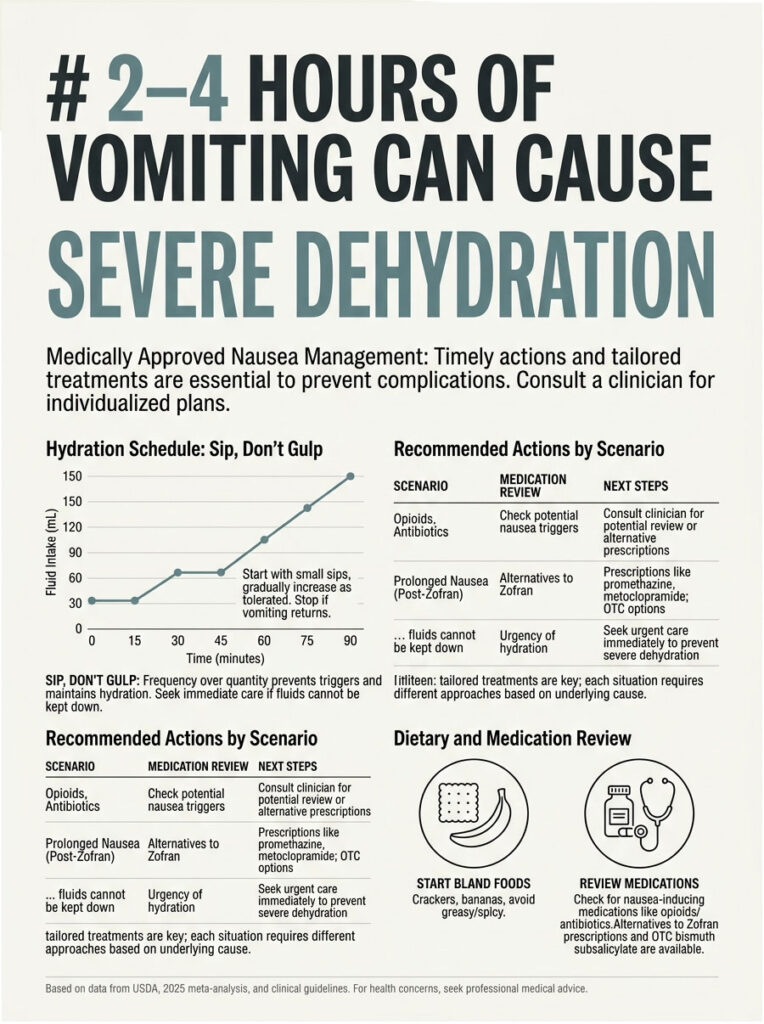
Our medical reviewers follow a practical order of operations here, starting with the basics that prevent complications.
Hydration and Diet Steps
Vomiting drains fluids fast, and dehydration can quickly become the bigger danger. Sip small amounts of water or an oral rehydration solution often, instead of gulping large volumes that can restart the nausea.
Move to bland, light foods once you can tolerate them. The familiar mix of crackers, toast, rice, and bananas is gentle on an unsettled stomach.
Hold off on greasy, spicy, or heavy meals until you feel steadier. Sitting upright rather than lying flat can ease the queasiness too.
Review Your Other Medications
Plenty of drugs list nausea as a side effect, so a new prescription may be the hidden culprit. Opioids, antibiotics, iron supplements, and some diabetes medications come up often.
Bring your full medication and supplement list to your provider. Sometimes the fix is adjusting or swapping the drug making you sick rather than piling on another.
Easy to overlook, this step is frequently the most revealing. It costs nothing and can solve the problem outright.
Alternatives If Zofran Isn’t Enough
When Zofran can’t control the nausea, several prescription options work through different mechanisms. Promethazine (Phenergan) blocks histamine and dopamine and helps with motion-related and post-op nausea, though it brings notable drowsiness.
Metoclopramide (Reglan), a dopamine antagonist, suits slow stomach emptying and migraine-related nausea, but carries a small risk of movement side effects with long use. Prochlorperazine (Compazine) is another dopamine blocker, and scopolamine patches target motion sickness specifically.
For milder cases, over-the-counter options include bismuth subsalicylate (Pepto-Bismol) for stomach-bug nausea and meclizine (Dramamine) for motion. A clinician can match the alternative to your cause.
Table 3: Persistent Nausea, Recommended Action
| Your Situation | Recommended Action | Why |
| Zofran taken, no relief after 1 hour | Call your prescriber | May need a different drug class |
| Vomiting up the tablet | Ask about ODT or IV form | Improves absorption |
| Motion or inner-ear nausea | Try meclizine or scopolamine | Targets the right pathway |
| Nausea after a new medication | Review meds with provider | The drug may be the cause |
| Can’t keep any fluids down | Seek urgent care | Dehydration risk |
| Pregnancy nausea, Zofran not enough | Contact your OB | Needs individualized plan |
| Nausea with red-flag signs | Go to the ER | Could signal a serious condition |
Guidance is general; your clinician tailors it to your situation.
When Nausea Is an Emergency (Red Flags)
Most nausea is miserable but not dangerous. A handful of warning signs, though, mean you should stop managing it at home and get medical care right away.
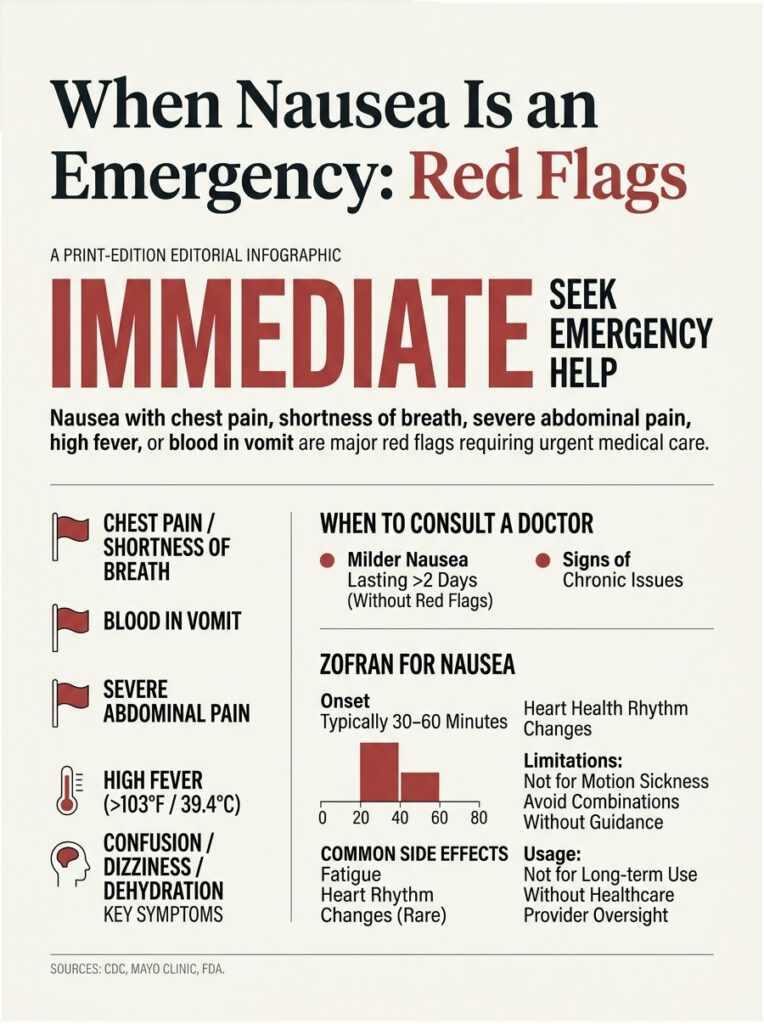
Our medical team treats these red flags as non-negotiable reasons to seek urgent or emergency help:
- Signs of severe dehydration, such as very little urination, confusion, or extreme weakness
- Chest pain, a racing or irregular heartbeat, or fainting
- Severe or worsening abdominal pain
- A stiff neck combined with a headache and fever
- Vomit that looks like coffee grounds, or bright red blood
- Nausea and vomiting lasting more than 48 hours, or an inability to keep any fluids down
If any of these appear, don’t wait to see whether the next Zofran dose helps. They can point to bleeding, infection, a blockage, or a heart problem that needs prompt evaluation.
For milder but stubborn nausea that runs more than a couple of days without red flags, a regular doctor’s visit is the right move. Persistent symptoms deserve a diagnosis.
Frequently Asked Questions
How long does Zofran take to work?
Zofran usually starts easing nausea within 30 to 60 minutes of an oral dose. The orally disintegrating tablet may feel faster because it’s easier to keep down. Intravenous Zofran, given in a hospital, works within minutes. If you feel no change after an hour, tell your provider.
Why isn’t Zofran working for my nausea?
Zofran treats the nausea signal, not its cause, so an untreated infection, ulcer, or blockage can keep symptoms going. It also fails against motion sickness and inner-ear nausea, which use different nerve pathways. Vomiting up the tablet or taking it too late can also limit its effect.
How often can you take Zofran?
For most adults, the standard oral dose is 8 mg every 8 to 12 hours as directed. Total daily intake should not exceed 24 mg by mouth. Taking more doesn’t improve relief and raises the risk of heart-rhythm side effects. Always follow your prescriber’s specific instructions.
Can you take Zofran while pregnant?
It’s sometimes prescribed off-label for severe pregnancy nausea, but the decision belongs to your obstetrician. The FDA says the data don’t reliably establish fetal harm, while some studies raise small, inconsistent concerns. Doctors often try vitamin B6 and doxylamine first and reserve ondansetron for cases that don’t respond.
Does Zofran help motion sickness?
No, Zofran has minimal effect on motion sickness. That nausea comes from a conflict between your inner ear and eyes, processed through nerve centers that don’t rely on the serotonin receptors Zofran blocks. For motion, antihistamines like meclizine (Dramamine) or a scopolamine patch work better.
Can Zofran cause heart problems?
Rarely, Zofran can cause a heart-rhythm change called QT prolongation, which can lead to a dangerous arrhythmia. The risk is dose-dependent and greater with high IV doses. People with congenital long QT syndrome should avoid it, and those with heart conditions may need an ECG before use.
What’s stronger than Zofran for nausea?
“Stronger” depends on the cause. Promethazine and prochlorperazine are dopamine-blocking options for some nausea types, and metoclopramide helps with slow stomach emptying. None is universally stronger; each works on a different pathway. A clinician matches the medication to your specific cause rather than to raw potency.
Can you take Zofran with other nausea meds?
Sometimes, but only under medical guidance. Combining Zofran with other antiemetics can stack side effects, and mixing it with serotonin-raising drugs like SSRIs or certain opioids risks serotonin syndrome. Give your provider a full list of your medications so the combination can be checked for safety.
Does Zofran make you sleepy?
Zofran causes less drowsiness than older anti-nausea drugs like promethazine, which is part of its appeal. Some people do feel tired, however. If fatigue is significant, avoid driving until you know how you respond, and mention it to your prescriber for a possible adjustment.
Can you build a tolerance to Zofran?
Tolerance is not a typical problem with short-term use. If Zofran seems to stop working, the likelier explanation is that the underlying cause has changed or intensified, or that the nausea type doesn’t respond to it. Persistent or worsening nausea should prompt a medical evaluation rather than a self-increased dose.
What should you eat when taking Zofran?
Stick to bland, easy foods like crackers, toast, rice, bananas, and broth. Eat small amounts slowly, and sip fluids rather than gulping. Avoid greasy, spicy, or very sweet foods until your stomach settles. There are no known food interactions with Zofran, so timing around meals is flexible.
How long is it safe to take Zofran?
Zofran is generally used short-term for acute nausea or around treatments like chemotherapy or surgery. Long-term use should be supervised by a doctor, since persistent nausea usually signals an underlying condition that needs its own treatment. Your prescriber can advise how long is appropriate for you.
Disclaimer: This article is for general educational purposes and does not replace professional medical advice. Zofran is a prescription medication, and dosing, safety, and suitability vary by individual, especially during pregnancy or with heart conditions. Always consult a qualified healthcare provider before starting, stopping, or changing any medication, and seek emergency care for the red-flag symptoms described above.