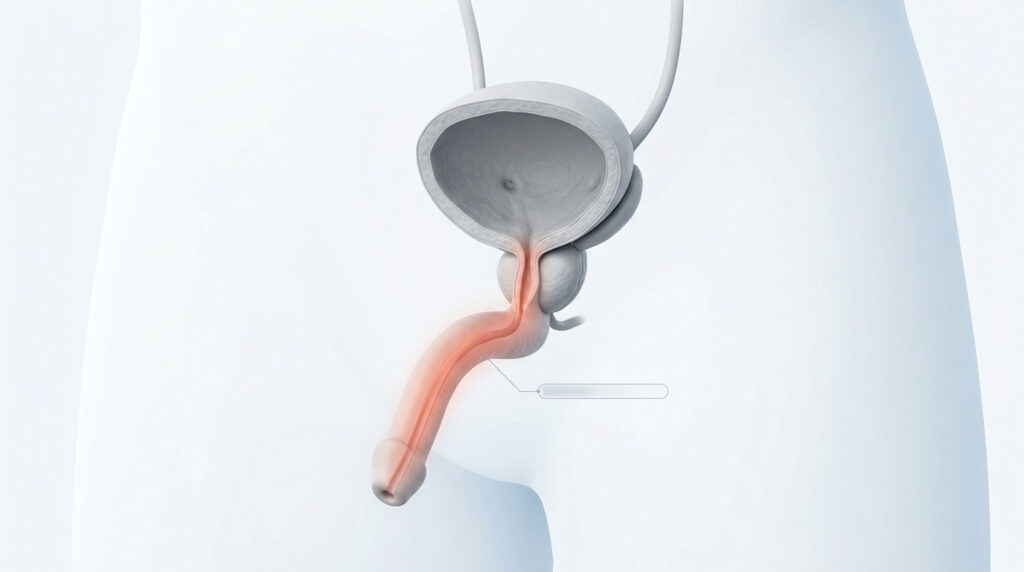
That sharp sting every time you pee, sometimes with an odd discharge, is hard to ignore. For many people it’s the first sign of urethritis, and the worry about what’s behind it can feel worse than the symptom itself.
Table of Contents
Quick Answer: Urethritis is inflammation of the urethra, the tube that carries urine out of your body. The main symptom is painful urination (dysuria), often with discharge. Most cases come from sexually transmitted infections like chlamydia or gonorrhea, though irritants and trauma can also trigger it. Treatment is usually a short course of antibiotics, and partners often need treatment too.

At a Glance
- Urethritis means inflammation of the urethra, most often from an infection.
- Painful urination and discharge are the hallmark symptoms.
- It’s split into gonococcal urethritis and nongonococcal urethritis (NGU).
- Both men and women can get it, though symptoms differ and women are often asymptomatic.
- Antibiotics usually cure it, with doxycycline and ceftriaxone as CDC mainstays.
- Untreated urethritis can lead to serious complications, so prompt care matters.
What Urethritis Actually Is
Urethritis is the medical term for inflammation of the urethra. That’s the thin tube carrying urine from your bladder out of your body, and in men it also carries semen.

When that tube gets irritated or infected, it swells and turns painful, especially during urination. Patients booking tests with us often describe a burning or stinging they simply can’t shake.
The condition is common, and most cases trace back to an infection. The reassuring part is that urethritis is usually very treatable once the cause is pinned down.
The Urethra and What Inflammation Does
Your urethra is lined with delicate tissue that reacts sharply to irritation. When bacteria, a virus, or a physical irritant reaches it, the immune system answers with inflammation.
That inflammation narrows and irritates the passage, which is why peeing suddenly hurts. It can also produce discharge as the body works to flush out whatever’s bothering it.
The urethra’s sensitivity is exactly why even a minor infection there causes such outsized discomfort. Small problem, big symptom.
Gonococcal vs Nongonococcal Urethritis (NGU)
Doctors sort urethritis into two main buckets by cause. Gonococcal urethritis is caused specifically by the gonorrhea bacterium, Neisseria gonorrhoeae.
Everything else falls under nongonococcal urethritis, or NGU. According to Cleveland Clinic, there are roughly 3 million new cases of NGU each year in the United States.
This split matters because it shapes treatment. Knowing which type you have helps your provider pick the right antibiotic the first time.
Urethritis Symptoms (and How They Differ by Sex)
The symptoms of urethritis revolve around urination, but they don’t show up the same way for everyone. Sex, anatomy, and the underlying cause all shift the picture.
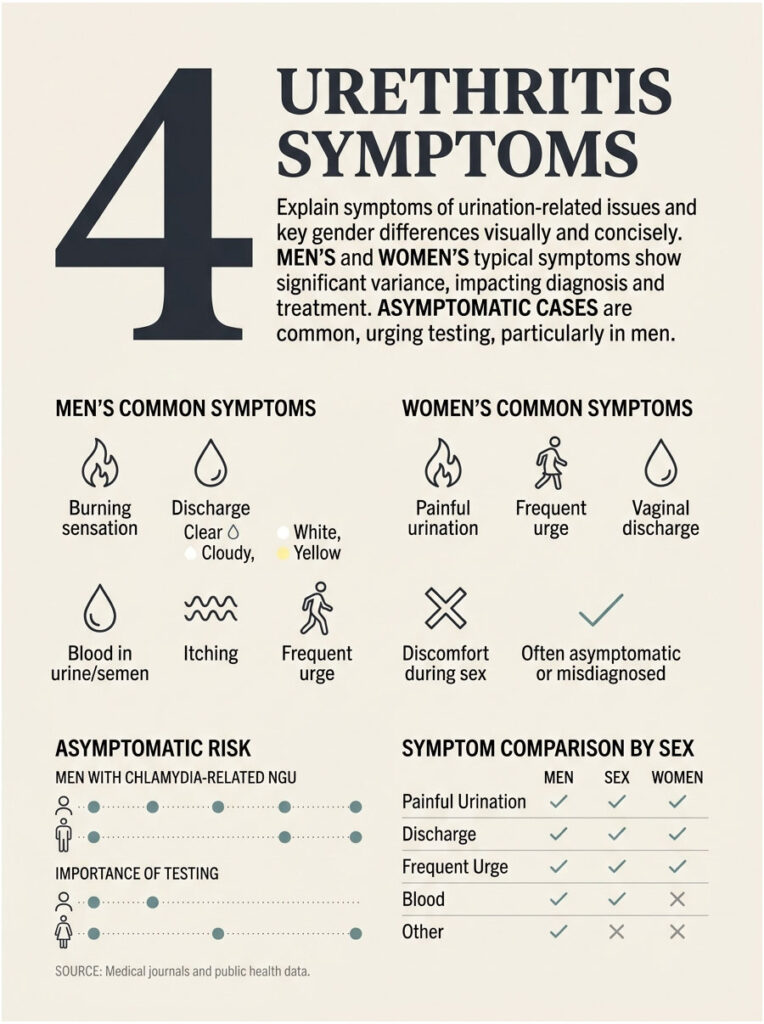
The most consistent complaint, across the patients we serve, is pain or burning when peeing. Beyond that, the experience varies quite a bit from person to person.
Common Symptoms in Men
In men, urethritis tends to announce itself clearly. The classic signs are a burning sensation during urination and a discharge from the tip of the penis.
That discharge may be clear, cloudy, white, or yellow, and some men notice blood in the urine or semen. Itching, irritation, or a frequent urge to urinate often come along too.
Men are also more likely than women to actually feel symptoms, which tends to push them toward testing sooner rather than later.
Common Symptoms in Women
In women, urethritis is sneakier. Many have no symptoms at all, or mistake the signs for a urinary tract infection or ordinary vaginal irritation.
When symptoms do surface, they include painful urination, a frequent urge to pee, and sometimes vaginal discharge. Discomfort during sex can happen as well.
Because these signs overlap so heavily with other conditions, women are frequently diagnosed later. That delay is what raises the risk of the infection spreading to the reproductive organs.
When Urethritis Has No Symptoms
Silent urethritis is more common than most people expect. The WebMD overview and clinical sources note that up to half of men with chlamydia-related NGU feel nothing at all.
That’s a real problem, since someone without symptoms can still pass the infection to a partner. It also means an infection can quietly do damage over time.
Testing matters even when you feel fine, especially after a new sexual partner. Patients commonly ask us whether “no symptoms” means “no infection,” and the honest answer is no.
Table 1: Urethritis Symptoms in Men vs Women
| Symptom | In Men | In Women | What It May Signal |
| Painful urination (dysuria) | Very common | Common | Inflammation of the urethra |
| Discharge | Common, from penis tip | Sometimes, vaginal | Likely infection (STI) |
| Frequent urge to urinate | Common | Common | Urethral or bladder irritation |
| Blood in urine or semen | Possible | Rare | Significant inflammation |
| Itching or irritation | Common | Common | Irritant or infection |
| No symptoms at all | Up to ~50% (chlamydia) | Very common | Silent infection, still contagious |
Source: Cleveland Clinic; WebMD; CDC STI Treatment Guidelines.
What Causes Urethritis
Urethritis has many possible triggers, and they divide neatly into infectious and non-infectious causes. Knowing which one is in play changes everything about treatment.
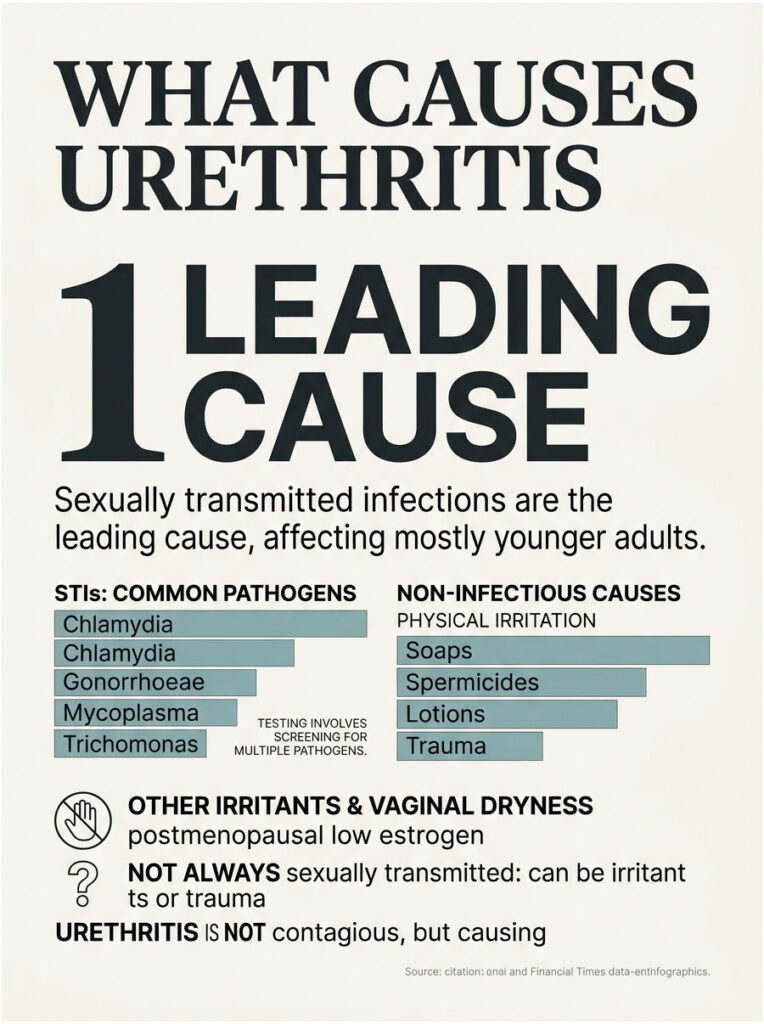
Most cases, especially in younger, sexually active adults, come from an infection. Our medical team has reviewed many cases where the cause turned out to be a treatable STI the person never suspected.
STI-Related Causes
Sexually transmitted infections are the leading cause of urethritis. Chlamydia (Chlamydia trachomatis) is the most common driver of NGU, with gonorrhea close behind.
Other sexually transmitted organisms contribute as well. The CDC STI Treatment Guidelines name Mycoplasma genitalium and Trichomonas vaginalis as frequent NGU causes, and herpes simplex virus can trigger it too.
Since these infections often travel together, testing usually screens for several at once. A single swab or urine sample can check for multiple organisms.
Non-STI Causes
Not every case comes from sex. Physical irritation and trauma can inflame the urethra just as effectively as an infection.
Common non-infectious triggers include harsh soaps, spermicides, lotions, and even tight clothing that creates friction. Trauma from a urinary catheter or a medical procedure can also be the culprit.
In postmenopausal women, low estrogen and vaginal dryness can lead to urethral irritation, per NIH StatPearls. These cases call for a different approach than antibiotics.
Is Urethritis Always an STI?
Here’s the reassurance most people are looking for: no, urethritis is not always sexually transmitted. Irritants, trauma, and other infections can all set it off.
Even so, because STIs are the most common cause, doctors usually test for them first. Ruling out chlamydia and gonorrhea is a standard, sensible move.
One more distinction worth knowing: urethritis itself isn’t contagious, but the infections that cause it often are. Patients ask us about this constantly, and it’s an important nuance.
Table 2: Urethritis vs Urinary Tract Infection (UTI)
| Feature | Urethritis | Urinary Tract Infection (UTI) |
| What’s inflamed | The urethra only | Bladder, kidneys, or urinary tract |
| Most common cause | STIs (chlamydia, gonorrhea) | Gut bacteria like E. coli |
| Typical discharge | Common, especially in men | Uncommon |
| Fever or back pain | Rare | More common (kidney involvement) |
| New U.S. gonorrhea cases/year | ~1,568,000 (CDC) | Not applicable |
| Usual treatment | Targeted antibiotics, partner care | Antibiotics, no partner care |
Source: CDC; Cleveland Clinic; NIH StatPearls.
How Urethritis Is Diagnosed
Getting the right diagnosis is straightforward but important, since it directs the whole treatment plan. The process starts with a conversation and a quick exam.

In tests booked through HealthCareOnTime, the diagnostic path usually runs from history to lab confirmation in a single visit. The lab work is what locks down the cause.
Medical History and Exam
Your provider will ask about your symptoms, sexual history, recent partners, and any products or activities that might irritate the area. This context narrows the list of likely causes quickly.
A physical exam checks for discharge, redness, or tenderness around the urethral opening. In men, the provider may gently examine the penis and check for swelling.
This step alone often points strongly toward urethritis. Lab tests then confirm the specific organism behind it.
Lab Tests (NAAT, Urine, Swab)
The most accurate tests are nucleic acid amplification tests, or NAATs, which detect the DNA of organisms like chlamydia and gonorrhea. The CDC recommends testing everyone with suspected urethritis for both.
Samples can come from a first-catch urine specimen or a swab of the urethra. A urinalysis may also reveal white blood cells, a marker of inflammation.
These tests are quick and reliable. Pinpointing the exact cause lets your provider choose the most effective antibiotic instead of guessing.
How Urethritis Is Treated
Treatment for urethritis is usually simple, short, and highly effective. The aim is to clear the infection, ease symptoms, and stop it spreading to others.
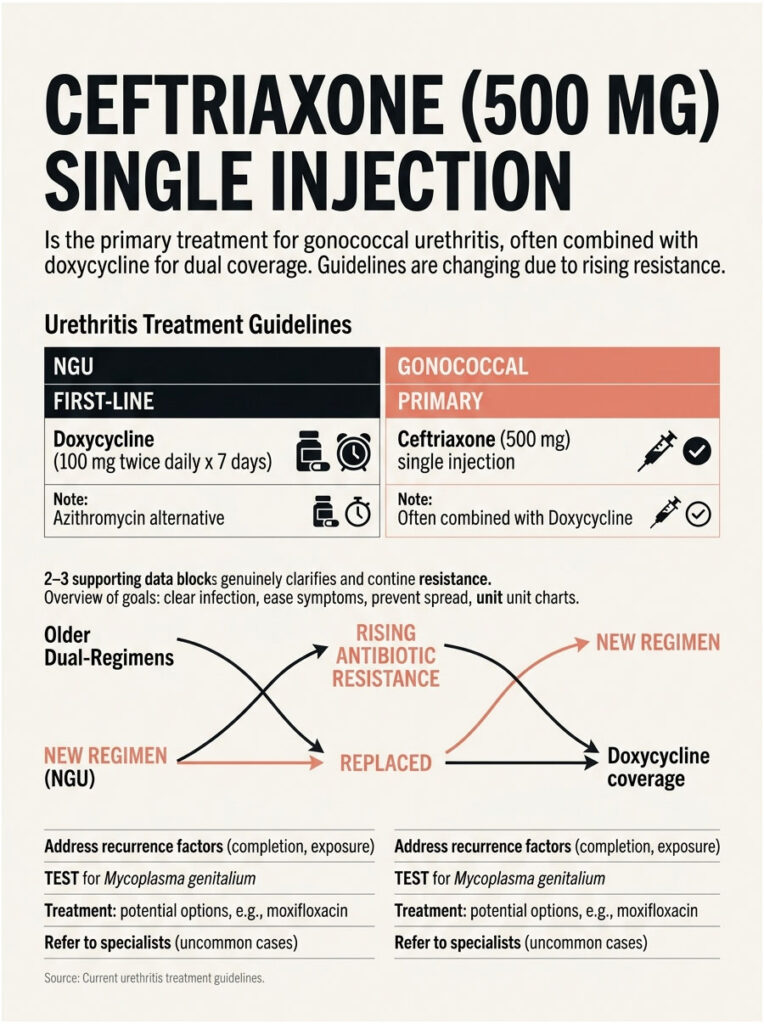
Finishing the full course of antibiotics is non-negotiable, even once symptoms fade. Our medical reviewers see stopping early as the single most common reason an infection comes roaring back.
Treatment for Nongonococcal Urethritis (NGU)
For NGU, the CDC 2021 STI Treatment Guidelines recommend doxycycline, 100 mg by mouth twice a day for 7 days. This is now the preferred first-line option.
Azithromycin, given as a single 1 gram dose or a short course, serves as an alternative when doxycycline isn’t suitable. Your provider weighs which fits your situation.
If chlamydia is the confirmed cause, doxycycline covers it well. The same regimen also handles many of the common NGU organisms.
Treatment for Gonococcal Urethritis
When gonorrhea is the cause, the approach shifts. The CDC now recommends a single intramuscular injection of ceftriaxone, 500 mg for most adults, as the treatment of choice.
Because chlamydia and gonorrhea so often occur together, doxycycline is usually added unless chlamydia has been ruled out. This dual coverage is a standard precaution.
AAFP guidance notes that ceftriaxone monotherapy replaced older dual-antibiotic regimens for gonorrhea itself, reflecting concerns about rising antibiotic resistance.
Persistent or Recurrent Urethritis
Sometimes symptoms linger or return after treatment. The first questions are whether you finished the medication and whether an untreated partner re-exposed you.
If the infection genuinely persists, providers test for Mycoplasma genitalium, a stubborn organism that may need a different regimen such as moxifloxacin. Resistance is a growing worry here.
Persistent cases occasionally get referred to a urologist or infectious disease specialist. That’s uncommon, but it’s the right call when standard treatment falls short.
Complications of Untreated Urethritis
Urethritis is very treatable, yet ignoring it carries real risks. The infections behind it don’t simply stay put; they can spread and cause lasting harm.

The most serious complications nearly always trace back to delayed or skipped treatment, our lab partners report. Catching it early heads off almost all of them.
In Men
In men, untreated urethritis can lead to epididymitis, a painful inflammation of the tube at the back of the testicle. Left unchecked, it can affect fertility.
Other possible complications include urethral strictures, which are scars that narrow the urethra, and, rarely, abscesses. These are uncomfortable and sometimes need a procedure to fix.
The encouraging flip side is that prompt antibiotic treatment usually prevents all of it. Most men treated early recover fully.
In Women
In women, the larger danger is the infection climbing into the reproductive organs. That can cause pelvic inflammatory disease (PID), a serious condition.
PID can lead to chronic pelvic pain, ectopic pregnancy, and infertility. Because women are more often asymptomatic, these complications can build silently.
This is precisely why testing and treatment matter even without obvious symptoms. When patients ask whether a mild case is worth treating, the answer is a firm yes.
Prevention and Next Steps
Preventing urethritis overlaps heavily with preventing STIs, since infections cause most cases. A handful of consistent habits cut your risk dramatically.
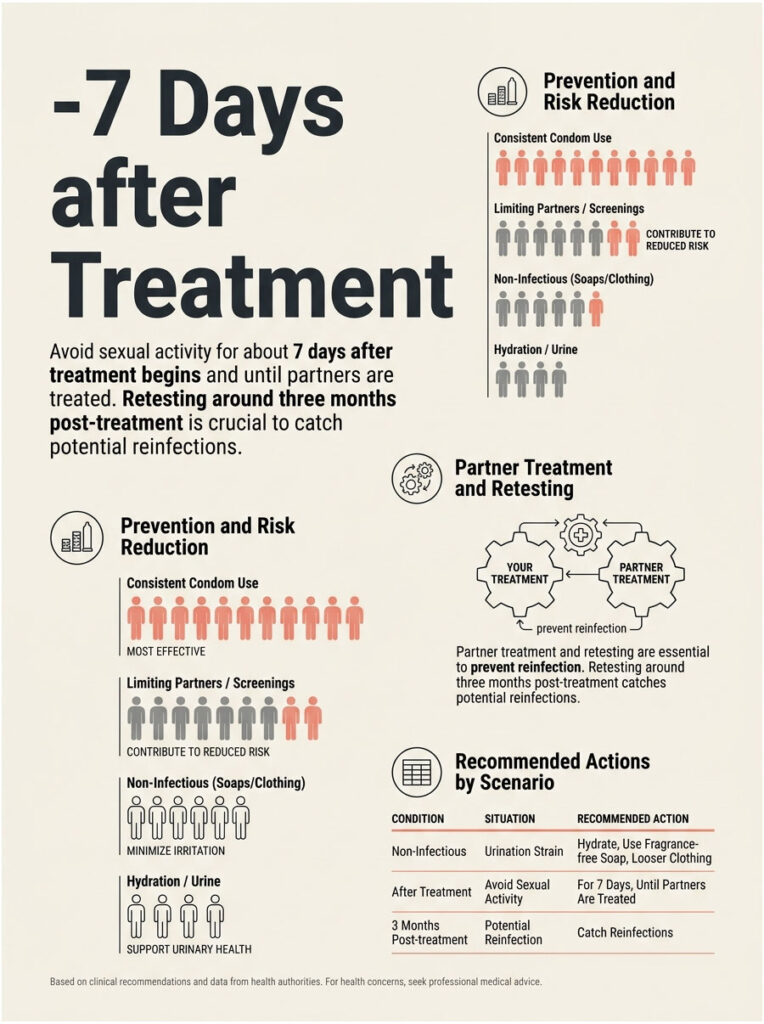
The people who avoid repeat infections are usually the ones who treat partners and retest on schedule. Prevention turns out to be as much about follow-through as precaution.
Safer-Sex and Hygiene Steps
Using condoms consistently and correctly is the single most effective way to prevent STI-related urethritis. Limiting partners and getting regular STI screening help too.
For non-infectious cases, simple swaps work. Switching to fragrance-free soaps, dropping spermicides that irritate you, and wearing looser clothing can prevent a recurrence.
Staying hydrated and not holding urine for long stretches supports urinary health overall. These small habits add up over time.
Partner Treatment and Retesting
If an STI caused your urethritis, your sexual partners need testing and treatment as well. Otherwise you’ll simply pass the infection back and forth.
The CDC advises avoiding sex for about 7 days after treatment starts, and until partners are treated. Retesting around 3 months later catches reinfection.
This is the step people skip most, and it’s the leading reason urethritis returns. Treating partners closes the loop for good.
Table 3: Urethritis, What to Do Next
| Your Situation | Recommended Action | Why |
| Burning urination plus discharge | See a provider for STI testing | Likely infectious urethritis |
| Diagnosed with NGU | Take full doxycycline course | Clears chlamydia and common causes |
| Diagnosed with gonorrhea | Get ceftriaxone injection | First-line per CDC |
| Symptoms after a new partner | Get tested even if mild | Many cases are silent |
| Symptoms persist after treatment | Return for re-evaluation | May need M. genitalium testing |
| Recently treated | Avoid sex ~7 days, treat partners | Prevents reinfection |
| Non-STI irritation suspected | Stop irritants, see provider | Different treatment path |
Guidance is general; your clinician tailors it to your situation.
When to See a Doctor
Urethritis rarely becomes an emergency, but certain signs mean you should be seen promptly rather than waiting it out. There’s no benefit to riding out an infection.

Our medical team flags these as reasons to seek care without delay:
- Painful urination that lasts more than a day or two
- Any discharge from the penis, or unusual vaginal discharge
- Blood in your urine or semen
- Pain or swelling in the testicles
- Fever, chills, or lower abdominal or pelvic pain
- Symptoms that return after finishing antibiotics
Fever and significant pain in particular can signal the infection has spread beyond the urethra. That warrants prompt evaluation.
Even mild but persistent symptoms deserve a visit. Urethritis is so treatable early and so much harder once complications set in that getting checked is always the safer choice.
Frequently Asked Questions
Is urethritis an STI?
Not always, but often. Sexually transmitted infections like chlamydia and gonorrhea are the most common causes of urethritis, so doctors test for them first. However, irritants, trauma, catheters, and low estrogen can also cause it. Urethritis itself isn’t contagious, but the infections behind it usually are.
Can urethritis go away on its own?
Sometimes symptoms fade without treatment, but this can take months and the underlying infection may still be present. That means you can keep spreading it and risk complications. Because urethritis is easily cured with antibiotics, doctors strongly recommend treatment rather than waiting it out.
How long does urethritis last?
With proper antibiotic treatment, symptoms usually start improving within a few days, and most infections clear within one to two weeks. Untreated, urethritis can linger for months and lead to complications. Finishing the full course of antibiotics, even after you feel better, is important for a complete cure.
What’s the difference between urethritis and a UTI?
Urethritis is inflammation of the urethra alone, most often from STIs. A urinary tract infection usually involves the bladder or kidneys and typically comes from gut bacteria like E. coli. UTIs more often cause fever and back pain, while urethritis more often causes discharge.
What does urethritis discharge look like?
Discharge from urethritis can be clear, cloudy, white, or yellow, and its appearance sometimes hints at the cause. Thicker, yellow-green discharge may suggest gonorrhea, while clearer discharge can point to chlamydia or other NGU causes. Only lab testing can confirm the specific organism responsible.
Can women get urethritis?
Yes, women can absolutely get urethritis, though they’re more likely than men to have no symptoms. When symptoms appear, they include painful urination and sometimes vaginal discharge. Because the signs overlap with UTIs and vaginal infections, women are often diagnosed later, which raises the risk of complications.
How is urethritis diagnosed?
Diagnosis starts with your symptoms, sexual history, and a physical exam. Lab tests confirm the cause, usually a nucleic acid amplification test (NAAT) on a urine sample or urethral swab to detect chlamydia and gonorrhea. A urinalysis may show white blood cells indicating inflammation.
What happens if urethritis goes untreated?
Untreated urethritis can lead to serious complications. In men, it may cause epididymitis and urethral strictures, affecting fertility. In women, the infection can spread to cause pelvic inflammatory disease, chronic pain, and infertility. Prompt antibiotic treatment prevents nearly all of these outcomes, which is why early care matters.
Can you get urethritis without an STI?
Yes. Non-infectious urethritis can result from irritants like harsh soaps, spermicides, or lotions, from physical trauma such as a catheter, or from low estrogen in postmenopausal women. These cases are treated by removing the irritant rather than with antibiotics, so identifying the true cause is key.
How soon after treatment do symptoms improve?
Most people notice improvement within a few days of starting the correct antibiotic. Complete relief usually follows within a week or two. If symptoms don’t improve or return, it may signal reinfection, an untreated partner, or a resistant organism, and you should return to your provider for re-evaluation.
Can urethritis come back after antibiotics?
Yes, urethritis can recur, most often from reinfection by an untreated partner or incomplete treatment. Sometimes a stubborn organism like Mycoplasma genitalium is responsible. Treating all partners, finishing the full medication course, and retesting as advised are the best ways to keep it from returning.
Is urethritis contagious?
Urethritis itself isn’t passed person to person, but the infections that cause it usually are. Chlamydia, gonorrhea, and similar organisms spread through sexual contact. That’s why partner testing and treatment are part of the plan, and why avoiding sex during treatment helps stop the cycle of reinfection.
Disclaimer: This article is for general educational purposes and does not replace professional medical advice. Urethritis symptoms can overlap with other conditions, and proper diagnosis requires testing by a qualified healthcare provider. Always consult a clinician for diagnosis and treatment, and complete any prescribed antibiotics fully even if symptoms improve.