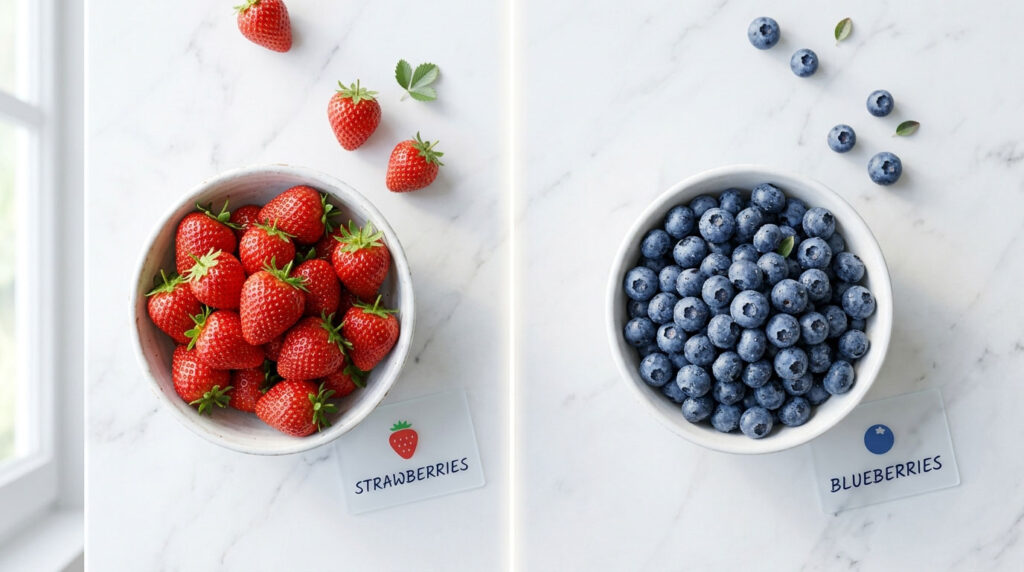
Ask ten people which berry is healthier and most will say blueberries without blinking. The word superfood has been stamped on that little blue orb for two decades.
Table of Contents
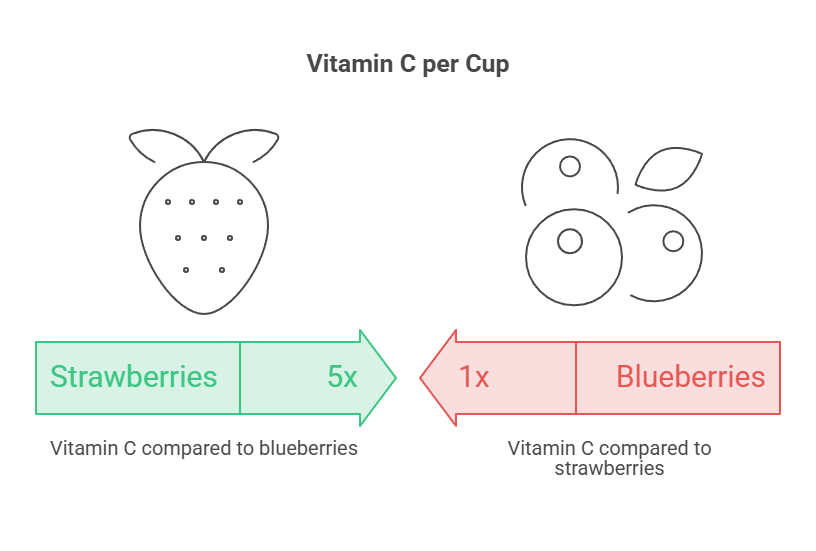
Here’s the twist. A single cup of strawberries delivers more vitamin C than a whole orange, while blueberries quietly win a different race entirely. The healthier berry isn’t a fixed answer, and it depends on what you’re trying to do with your body.
That’s the part most comparisons skip. So this guide settles it goal by goal, with real USDA numbers, the latest US research, and a clear verdict for weight loss, blood sugar, heart, and brain.
Quick Answer: It’s a tie until you name a goal. Strawberries win on calories, sugar, vitamin C, and a lower glycemic index, making them better for weight loss and blood sugar. Blueberries win on fiber, vitamin K, and antioxidants, with the strongest heart and brain research. For most people, eating both berries delivers the widest health benefit.
At a Glance
- Strawberries have fewer calories and less sugar per cup than blueberries.
- Strawberries pack roughly five times the vitamin C of blueberries.
- Blueberries offer more fiber, vitamin K, and manganese.
- Blueberries top the antioxidant charts thanks to anthocyanins.
- Strawberries have a lower glycemic index, a small edge for blood sugar.
- Blueberries carry the strongest heart and brain research record.
- Eating both berries gives you the broadest mix of nutrients.
Strawberries vs Blueberries, the Short Answer
There’s no single champion here, and any article claiming otherwise is oversimplifying. Both berries rank among the healthiest foods you can put on your plate.
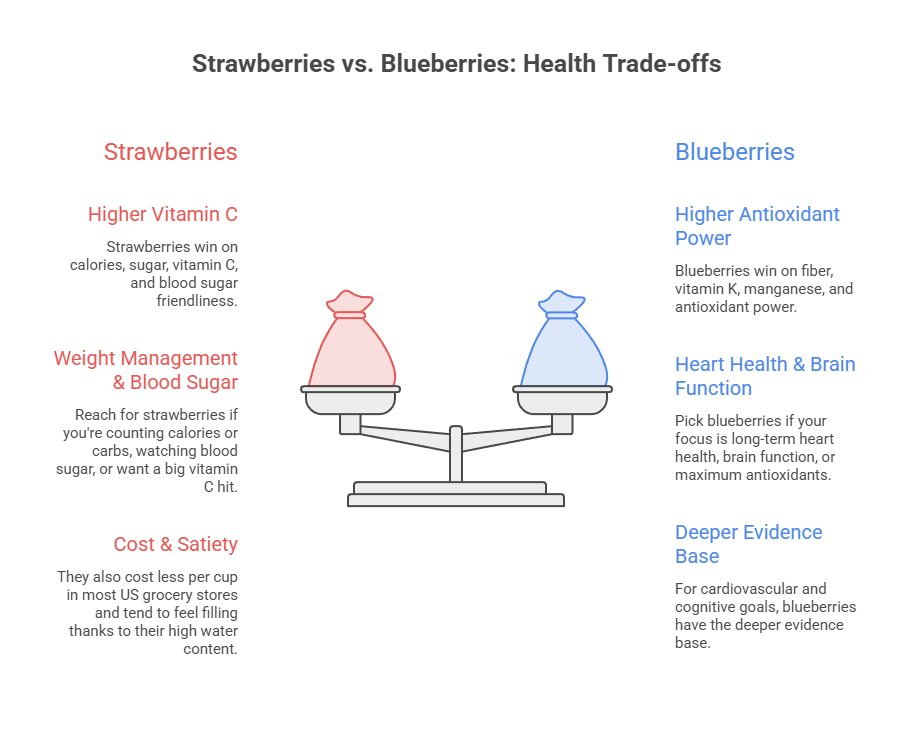
Strawberries win on calories, sugar, vitamin C, and blood sugar friendliness. Blueberries win on fiber, vitamin K, manganese, and antioxidant power. The right pick comes down to your priority.
Our medical reviewers note that the which is better question usually hides a better one: better for what? Once you name the goal, the winner becomes obvious.
When strawberries win
Reach for strawberries if you’re counting calories or carbs, watching blood sugar, or want a big vitamin C hit. They’re lighter, sweeter per calorie, and gentler on glucose.
They also cost less per cup in most US grocery stores and tend to feel filling thanks to their high water content. For weight management, that combination is hard to beat.
When blueberries win
Pick blueberries if your focus is long-term heart health, brain function, or maximum antioxidants. The deep blue color signals anthocyanins, the compounds behind much of the research buzz.
Blueberries also edge ahead on fiber and vitamin K. Patients who book tests through HealthCareOnTime often ask which berry is best, and for cardiovascular and cognitive goals, blueberries have the deeper evidence base.
Nutrition Face-Off, Side by Side
Numbers cut through the marketing fast. Once you see the two berries lined up cup for cup, the trade-offs are clear.
Calories, carbs, and sugar
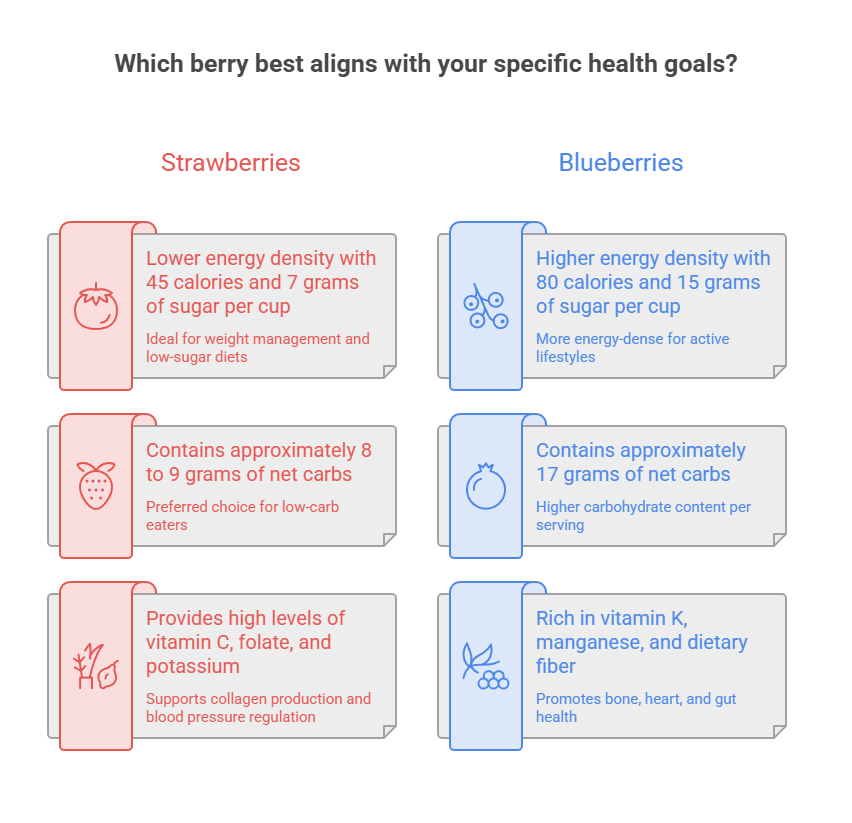
This is strawberries’ home turf. According to Mayo Clinic Health System, one cup of strawberries has about 45 calories and only 7 grams of natural sugar.
A cup of blueberries, by comparison, runs closer to 80 calories with around 15 grams of sugar. That’s nearly double the calories and sugar of strawberries.
For anyone tracking carbs, strawberries are the lighter option. Blueberries aren’t unhealthy here, they’re just more energy-dense, which matters more for weight loss than for general health.
Net carbs tell a similar story. After subtracting fiber, a cup of strawberries lands near 8 to 9 grams of net carb, while blueberries sit closer to 17 grams. That gap is why low-carb eaters tend to reach for strawberries first.
Fiber, vitamins, and minerals
Now the tables turn. Blueberries deliver about 4 grams of fiber per cup versus roughly 3 grams in strawberries, a small but real edge for gut and heart health.
Blueberries are also a standout source of vitamin K and manganese, two nutrients strawberries provide in smaller amounts. Vitamin K supports bone and blood-vessel health, while manganese helps drive antioxidant enzymes.
Strawberries counter with more folate and potassium. Across patients we serve, the people who eat a mix of berries tend to cover more of these micronutrient gaps than those loyal to just one.
Those minerals matter more than they get credit for. Folate supports cell growth and is especially important in pregnancy, while potassium helps regulate blood pressure. Strawberries deliver both, which is easy to overlook next to their vitamin C headline.
Vitamin C vs vitamin K and manganese
The single biggest nutrient gap is vitamin C. One cup of strawberries supplies roughly 98 mg, more than a full day’s worth and far above blueberries.
Blueberries answer with vitamin K and manganese rather than vitamin C. The deep-blue fruit covers about a quarter of your daily vitamin C in a cup, solid but nowhere near the strawberry.
That vitamin C edge has real payoffs. Vitamin C drives collagen production for skin and joints, supports the immune system, and helps your body absorb iron from plant foods. For anyone chasing those benefits, strawberries are the berry to pick.
So the choice is partly about which micronutrients your diet is missing. The table below lays out the head-to-head per one cup of fresh berries.
| Per 1 cup (fresh) | Strawberries | Blueberries | Winner |
| Calories | ~46 | ~80 | Strawberries |
| Sugar (g) | ~7 | ~15 | Strawberries |
| Fiber (g) | ~3 | ~4 | Blueberries |
| Vitamin C (mg) | ~98 | ~14 | Strawberries |
| Vitamin K | Low | High (~30% DV) | Blueberries |
Strawberries take three of five categories on this chart, but blueberries’ wins (fiber and vitamin K) carry real long-term weight. Our nutrition team flags this as the clearest sign that healthier is a tie until you add a goal.
The Antioxidant Question
For many people, antioxidants are the deciding factor, and this is where blueberries earn their reputation. But the full picture is more interesting than blueberries win.
What anthocyanins actually do
Anthocyanins are the pigments that give blueberries their deep blue and strawberries their red. They’re a type of flavonoid linked to lower inflammation and better blood-vessel function.
These compounds are why berries show up in so much heart and brain research. They help arteries stay flexible and may slow some of the cellular wear that comes with aging.
In the body, anthocyanins seem to work partly through the gut, where they interact with healthy bacteria. That gut connection is one reason researchers are so interested in berries beyond their vitamin content.
It helps to separate lab numbers from real life. A high antioxidant score in a test tube doesn’t automatically translate to the same effect in your body, since absorption varies. What matters is the measurable change in things like blood pressure and inflammation, and berries deliver there.
Why blueberries top the antioxidant charts
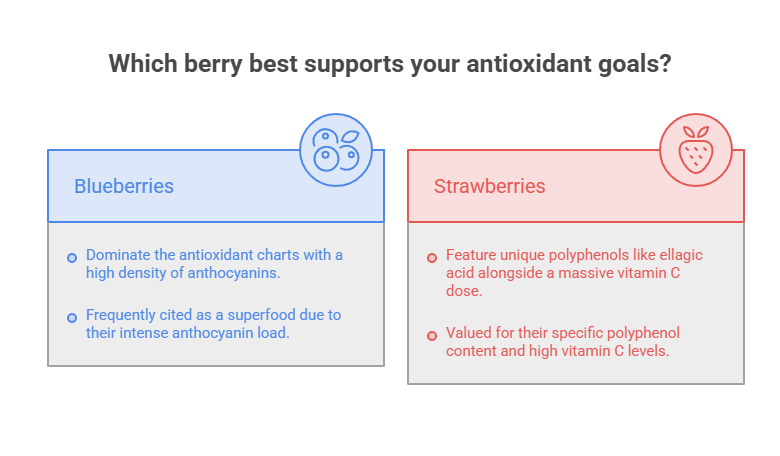
Blueberries consistently rank among the highest-antioxidant fruits. Older lab comparisons of blueberries, blackberries, and strawberries found blueberries had the highest total antioxidant capacity of the group.
That density is why blueberries dominate the superfood conversation. Gram for gram, their anthocyanin load is hard for most fruits to match.
Wild (lowbush) blueberries tend to pack even more anthocyanins than the larger cultivated kind. If antioxidants are your priority, the smaller wild berries, often sold frozen, are a strong choice.
Strawberries’ polyphenol strengths
Strawberries are far from antioxidant slouches. They carry their own polyphenols, including ellagic acid, plus that massive vitamin C dose, which itself acts as an antioxidant.
Newer thinking favors variety over picking one. Research increasingly points to a synergy effect, where eating different berry types together provides broader protection than any single berry alone.
So the antioxidant crown goes to blueberries, but the smartest antioxidant strategy isn’t loyalty. It’s rotation, mixing berries so you get a wider spread of protective compounds.
What the Research Says About Each Berry
Reputation is one thing, evidence is another. Both berries have solid science, but they shine in different areas.
Blueberries, heart and brain
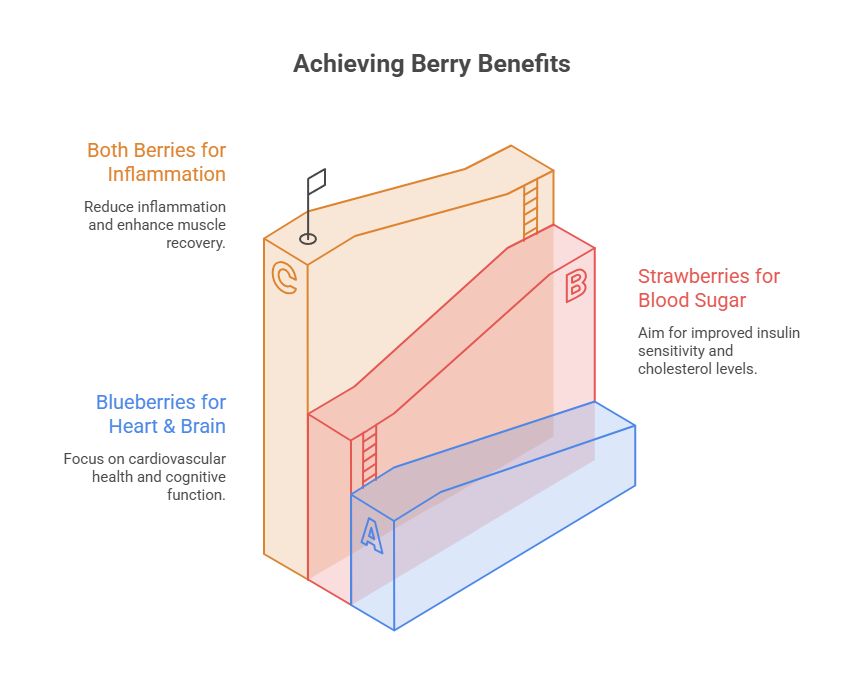
Blueberries have the deeper cardiovascular record. A widely cited UEA trial, published in the American Journal of Clinical Nutrition, found that eating about 150 grams of blueberries a day was linked to up to a 15 percent lower risk of cardiovascular disease in adults with metabolic syndrome.
The brain benefits are notable too. A 2023 King’s College London study found that daily wild blueberry powder over 12 weeks improved memory and reaction times in healthy adults.
More recent reviews keep building the case. Analyses of anthocyanin-rich berries through 2024 link them to lower total cholesterol and reduced inflammation markers, though researchers are clear that more long-term data is still needed.
One of the strongest pieces of evidence came from a six-month trial in 138 adults with metabolic syndrome, among the longest of its kind. Daily blueberry intake improved markers of heart health, reinforcing why doctors increasingly point at-risk patients toward the fruit.
A 2024 review of randomized trials also found blueberries improved endothelial function, the ability of blood vessels to widen and keep blood flowing smoothly. Better endothelial function is an early signal of lower cardiovascular risk.
Strawberries, blood sugar and cholesterol
Strawberries have built their own evidence, especially around blood sugar. Trials in adults with prediabetes have linked daily strawberries to better insulin sensitivity and improved cholesterol.
Those trials used realistic amounts, roughly one to two and a half servings a day, the kind of portion any American could manage. The benefit showed up in fasting glucose and insulin resistance, not just in lab markers nobody feels.
The big Harvard cohorts add population-level support. In the Nurses’ Health Study and Health Professionals Follow-Up Study, people eating the most anthocyanins, found mainly in blueberries and strawberries, were 8 percent less likely to develop high blood pressure.
So both berries support heart health through anthocyanins. The effect in that research was stronger for blueberries, but strawberries still pulled their weight, and they did it with a fraction of the sugar.
The statistics below put the berry boom in a US context. Americans are eating more of both, with blueberries growing fastest.
| US Berry Statistic | Figure | Source |
| Blueberry consumption growth (2011 to 2022) | Up 97% (1.2 to 2.3 lbs per person) | USDA / The Packer |
| Strawberry consumption (per capita) | 6.7 lbs, up 45% since 2011 | USDA / The Packer |
| Blueberries and CVD risk (150g/day) | Up to 15% lower risk | UEA / AJCN |
| Anthocyanin intake and high blood pressure | 8% lower risk (highest vs lowest) | Harvard / UEA |
| Recommended daily fiber (US adults) | 25 to 38 g | TODAY |
| US fresh berry consumption | ~10+ lbs per person | USDA / Statista |
Both berries, inflammation and recovery
There’s a shared benefit worth naming. The anthocyanins in both berries have anti-inflammatory effects, and some studies suggest berry intake can ease muscle soreness and speed recovery after hard exercise.
That makes a post-workout bowl of mixed berries more than a treat. Pairing them with protein, like Greek yogurt or a shake, supports both muscle repair and steady energy.
Which Berry for Your Goal?
This is the section the other comparisons forget. Instead of one verdict, here’s the berry that wins for each common health goal.
Weight loss and low calories
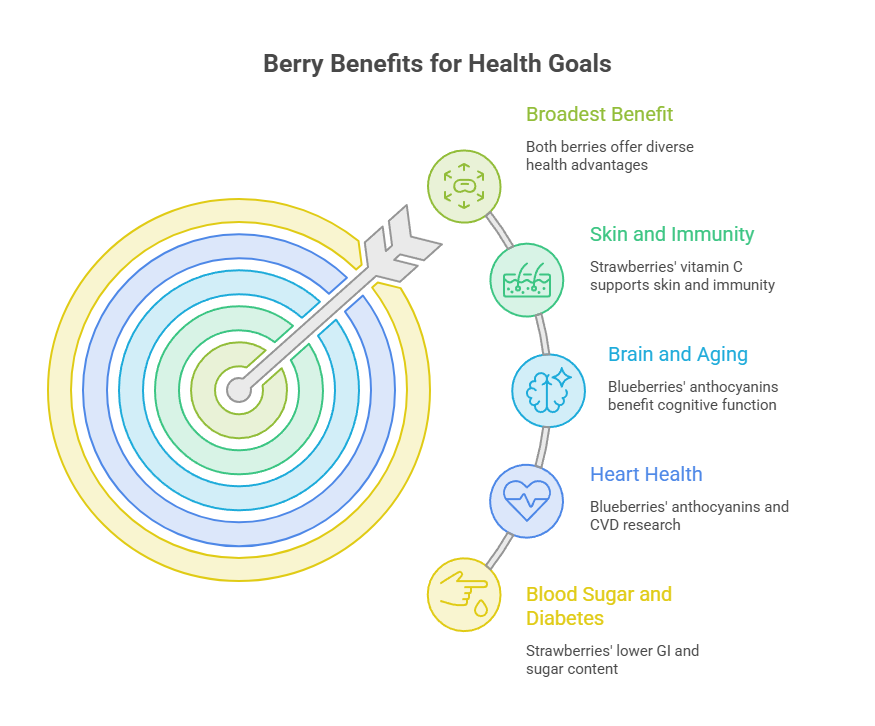
Strawberries win for weight loss. With about half the calories and sugar of blueberries, they let you eat a bigger, more satisfying portion for fewer calories.
Their high water and vitamin C content adds to the appeal. Swapping a calorie-dense snack for a cup of strawberries is an easy way to trim intake without feeling deprived.
Blood sugar and diabetes
Strawberries edge this one too, thanks to a lower glycemic index and less sugar per cup. Both berries are diabetes-friendly, but strawberries nudge glucose a little less.
That said, blueberries’ fiber and anthocyanins also support blood sugar control over time. Patients commonly ask us which to choose, and for tight day-to-day glucose management, strawberries have the slight edge.
Heart health
Blueberries take the heart category on the strength of their research. The anthocyanin and cardiovascular data is deeper and more consistent for blueberries than for any other common berry.
Strawberries still help, especially through their effect on cholesterol and blood pressure. For a heart-focused diet, leaning blueberry while keeping strawberries in rotation is a smart play.
Brain and aging
Blueberries win for brain health. The cognitive research, from memory to reaction time, is strongest for blueberries among the berries.
The anthocyanins that protect blood vessels appear to benefit the brain’s blood supply too. For older adults focused on staying sharp, blueberries are the evidence-backed pick.
Skin and immunity
Strawberries take this one on the strength of their vitamin C. That single nutrient fuels collagen, the protein that keeps skin firm and helps wounds heal, while also supporting immune defense.
Blueberries chip in with their own antioxidants, which help protect skin cells from daily oxidative stress. For a glow-and-immunity focus, though, the strawberry’s vitamin C load is hard to top.
The table below turns goals into quick picks. Our educators use this kind of cheat sheet when patients ask which berry to prioritize.
| If your goal is… | Pick… | Why |
| Weight loss / fewer calories | Strawberries | Half the calories and sugar per cup |
| Steady blood sugar | Strawberries | Lower GI and less sugar |
| Maximum vitamin C | Strawberries | About 5x the vitamin C of blueberries |
| Heart health | Blueberries | Strongest anthocyanin and CVD research |
| Brain and memory | Blueberries | Best cognitive study record |
| Glowing skin / immunity | Strawberries | Vitamin C fuels collagen and immune defense |
| Most fiber / vitamin K | Blueberries | More of both per cup |
| Broadest benefit | Both | Berry variety beats any single fruit |
Sugar, Glycemic Index, and Diabetes
Blood sugar deserves its own look, since it’s one of the most common reasons people compare these two berries. Both are safe choices, with a small edge to one side.
How each berry affects blood sugar
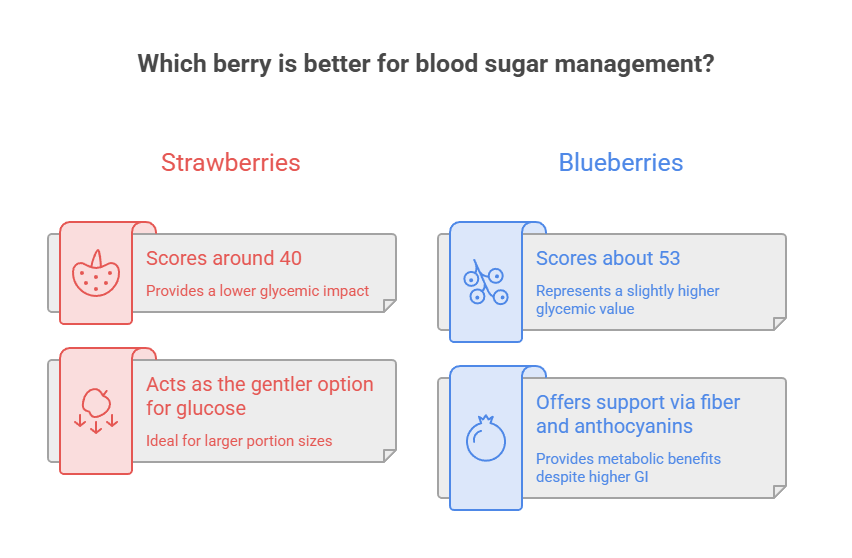
Strawberries have a glycemic index around 40, while blueberries score about 53. Both sit in the low-GI range, so neither causes a sharp spike.
The difference is modest but real. Strawberries’ lower sugar and GI make them the slightly gentler option for glucose, especially in larger portions.
The lower-GI choice
For people with diabetes or prediabetes, either berry fits a healthy plan. Strawberries are the marginally safer pick by the numbers, but blueberries’ fiber and anthocyanins offer their own blood-sugar support.
For a deeper breakdown of portions and timing, see our guide on whether strawberries are good for diabetics. The short version: both berries belong on a diabetes-friendly plate, in sensible servings.
Fresh, Frozen, Cost, and Everyday Use
The healthiest berry is the one you actually eat, so practical factors matter. Here’s how the two compare beyond the nutrition label.
Are frozen berries just as healthy
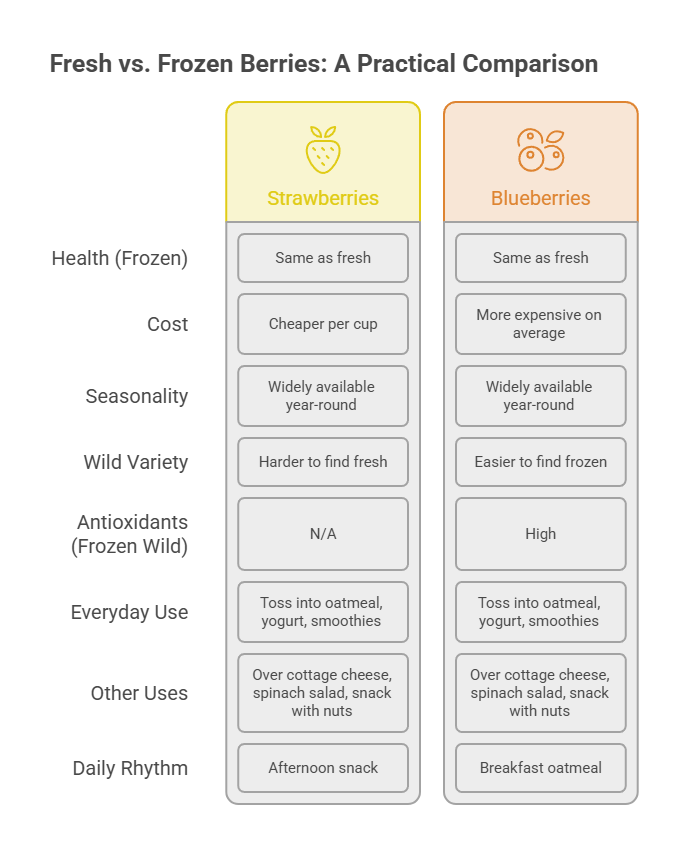
Yes, for both. Freezing locks in most vitamins and antioxidants, and frozen berries are often picked at peak ripeness, so they can rival or beat out-of-season fresh fruit.
The only rule is to buy plain frozen berries with no added sugar or syrup. Plain frozen blueberries and strawberries keep the same carb and nutrient math as fresh.
Frozen also unlocks the wild blueberry, which is harder to find fresh and tends to carry more anthocyanins. For antioxidants on a budget, a bag of frozen wild blueberries is a quiet winner.
Cost and seasonality
Strawberries are usually cheaper per cup and widely available year-round in US stores. Blueberries cost a bit more on average, though frozen brings the price down.
Blueberry consumption has surged partly because year-round imports made them affordable. Both are now easy to find in any season, fresh or frozen.
Easy ways to eat more of both
The simplest move is to stop choosing. Toss a handful of each into oatmeal, yogurt, or a smoothie and you get the best of both.
Other easy options include berries over cottage cheese, in a spinach salad, or as a grab-and-go snack with nuts. Pairing berries with protein or fat keeps you fuller and steadies blood sugar.
A simple daily rhythm could be blueberries in breakfast oatmeal and strawberries as an afternoon snack. You hit two fruit servings, a big vitamin C dose, and a steady stream of antioxidants without much effort.
How to Pick and Store Each Berry
The healthiest berry is also the freshest one, and the two fruits behave differently at the store and in your fridge. A few quick rules keep them at their best.
Choosing the best strawberries
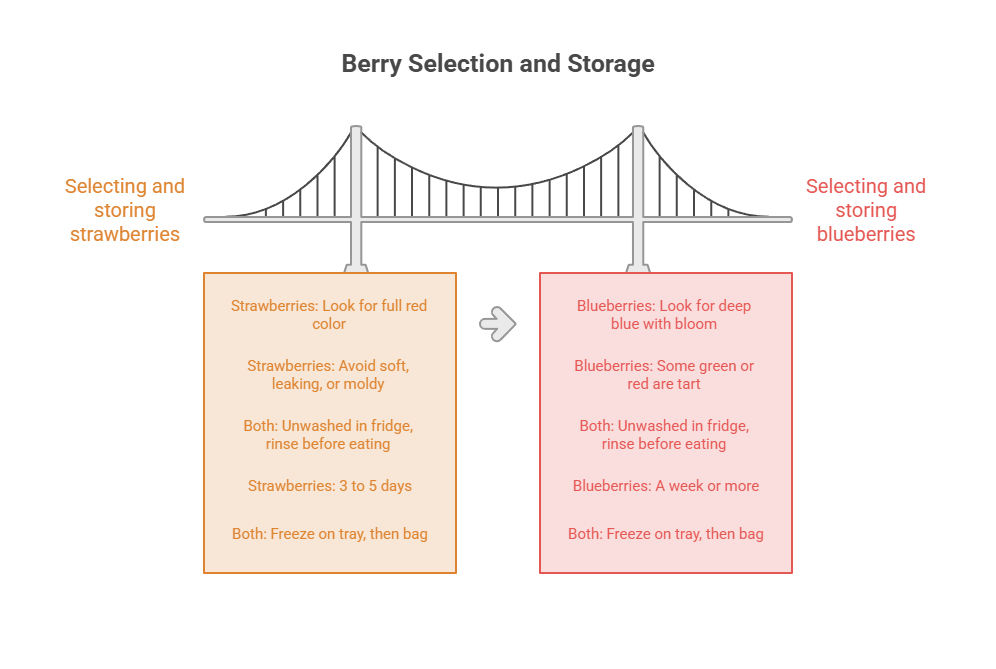
Look for berries that are fully red, firm, and fragrant, with fresh green caps. Strawberries don’t ripen further after picking, so the color you see at the store is what you get.
Skip cartons with soft, leaking, or moldy berries, since mold spreads fast from one berry to the next. A quick peek at the bottom of the container saves you from a mushy surprise at home.
Choosing the best blueberries
Pick blueberries that are deep blue with a silvery, dusty coating called the bloom, which signals freshness. They should feel firm and roll freely when you tilt the carton.
A few green or reddish berries are simply underripe and will taste tart, since blueberries also stop ripening once picked. Plump and uniformly blue is what you want.
Storing both for maximum freshness
Keep both berries unwashed in the fridge and rinse only just before eating, since extra moisture speeds spoilage. Strawberries usually last 3 to 5 days, while blueberries can hold for a week or more.
For longer storage, freeze them. Spread berries on a tray until solid, then move them to a bag, and you’ll have nutrient-packed fruit ready for smoothies and oatmeal for months.
Can You Just Eat Both?
For most people, the smartest answer to which berry is both. Variety beats loyalty when it comes to plant foods.
The case for berry variety
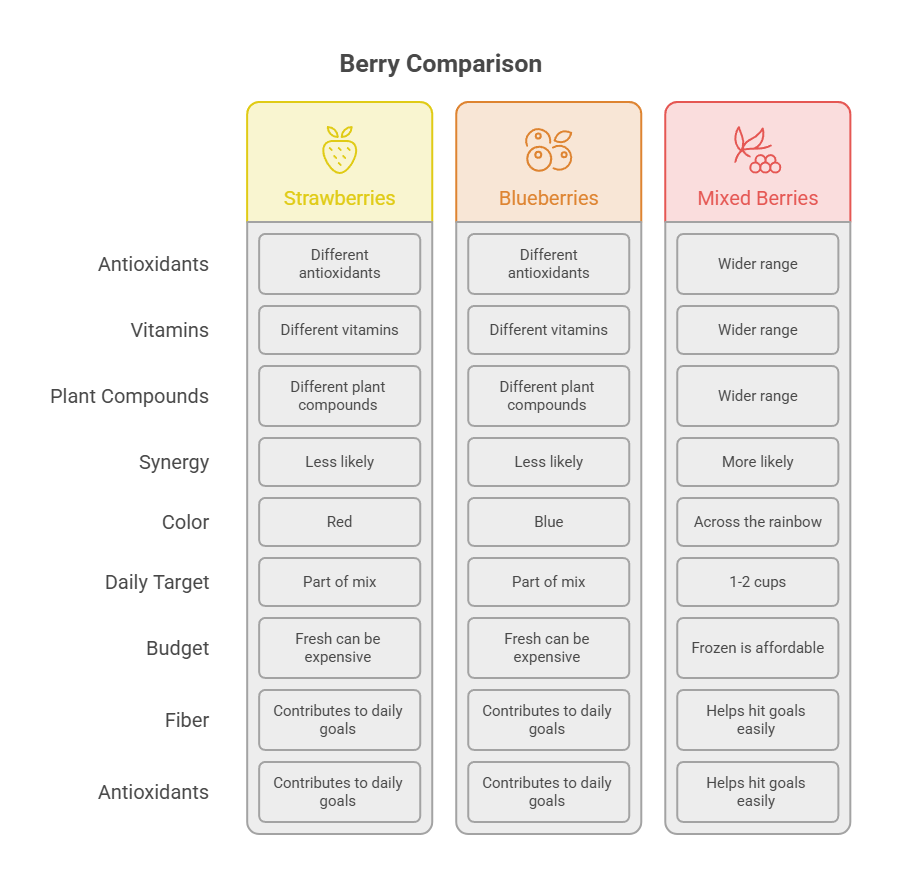
Different berries bring different antioxidants, vitamins, and plant compounds. Eating a mix gives your body a wider toolkit than doubling down on one berry ever could.
The synergy idea, where combining berry types boosts the protective effect, is one researchers find compelling. A bowl of mixed berries may do more than the same amount of a single type.
Color is a useful guide here. Red strawberries and blue blueberries carry different pigments, so eating across the rainbow of berries naturally widens the range of protective plant compounds you take in.
A simple daily approach
A practical target is one to two cups of berries a day, mixing strawberries and blueberries based on what’s fresh, affordable, or in your freezer.
Across the patients our diagnostic network serves, the people who treat berries as a daily habit, not an occasional treat, tend to hit their fiber and antioxidant goals more easily.
If budget is tight, frozen mixed berries are your friend. A single bag covers weeks of smoothies and oatmeal toppings at a fraction of the fresh price, with the nutrition kept intact by freezing.
Limits and Things to Watch
Berries are overwhelmingly healthy, but a few honest caveats apply to both. Being clear about them is part of using any food well.
Pesticides and washing
Strawberries often top the Dirty Dozen list for pesticide residue, and blueberries can carry residue too. Buying organic when possible and rinsing well under running water reduces exposure.
This is a reason to wash, not to avoid. The health benefits of eating berries far outweigh the residue concern for most people.
Added sugar in products
Whole berries are the goal. Strawberry jam, blueberry muffins, sweetened dried berries, and berry-flavored products are mostly added sugar with little of the fruit’s benefit.
Always check the added sugars line on the Nutrition Facts panel. A measured amount of a sweetened product should be counted toward your daily carbs.
Portion and carb counting
For anyone managing blood sugar, both berries count as carbohydrate. A cup of strawberries is roughly 11 to 12 grams of carb; a cup of blueberries is closer to 20 grams.
Logging portions keeps insulin or medication dosing accurate. The fruit is friendly, but it isn’t carb-free, especially blueberries.
Frequently Asked Questions
Which is healthier, strawberries or blueberries?
Neither is a clear overall winner; it depends on your goal. Strawberries have fewer calories, less sugar, and more vitamin C, while blueberries offer more fiber, vitamin K, and antioxidants. For the widest range of benefits, eating both berries is the smartest choice.
Which berry has more antioxidants?
Blueberries generally have more antioxidants, largely due to their high anthocyanin content, the pigment behind their deep blue color. They consistently rank among the highest-antioxidant fruits. Strawberries still provide plenty of polyphenols and vitamin C, so both are strong antioxidant sources.
Do blueberries have more sugar than strawberries?
Yes. A cup of blueberries has about 15 grams of sugar, roughly double the 7 grams in a cup of strawberries. Both are natural sugars wrapped in fiber, so neither spikes blood sugar sharply, but strawberries are the lower-sugar option.
Which berry has more vitamin C?
Strawberries win by a wide margin. One cup supplies about 98 mg of vitamin C, more than a full day’s worth and roughly five times what blueberries provide. That makes strawberries an excellent choice for immune support and collagen production.
Which is better for diabetics, strawberries or blueberries?
Both are good, low-GI choices, but strawberries have a slight edge with a lower glycemic index and less sugar per cup. Blueberries’ fiber and anthocyanins also support blood sugar control. Either fits a diabetes-friendly plan in sensible, carb-counted portions.
Which berry has more fiber?
Blueberries have slightly more, with about 4 grams per cup versus roughly 3 grams in strawberries. Both help you move toward the recommended 25 to 38 grams of daily fiber, and both fall short of raspberries, which lead the berry group on fiber.
Are strawberries or blueberries better for weight loss?
Strawberries are the better pick for weight loss, with about half the calories and sugar of blueberries per cup. Their high water content helps you feel full. Blueberries still fit a weight-loss diet; they’re just more calorie-dense, so portion size matters more.
Which berry is best for your brain?
Blueberries have the strongest research for brain health, with studies linking daily intake to better memory and reaction times. The anthocyanins that protect blood vessels appear to benefit the brain too. Strawberries help as well, but blueberries lead on cognitive evidence.
Are frozen berries as healthy as fresh?
Yes. Freezing preserves most vitamins and antioxidants, and berries are often frozen at peak ripeness. Plain frozen strawberries and blueberries keep the same carb and nutrient profile as fresh. Just avoid frozen berries packed in syrup or labeled sweetened.
Which berry is better for your heart?
Blueberries have the deeper heart-health research, with daily intake linked to lower cardiovascular risk in clinical trials. Strawberries also support heart health through effects on cholesterol and blood pressure. For a heart-focused diet, blueberries lead, but both belong in rotation.
Can I eat strawberries and blueberries every day?
Absolutely, and it’s an excellent habit. One to two cups of berries daily gives you fiber, vitamin C, and antioxidants. Mixing both types provides the broadest mix of nutrients. Just watch added sugar in processed berry products and count carbs if you have diabetes.
Which berry is lower in carbs?
Strawberries are lower in carbs, at roughly 11 to 12 grams per cup compared with about 20 grams in blueberries. For low-carb or blood-sugar-conscious eating, strawberries are the lighter choice, though both are far lower in carbs than most other fruits.
Disclaimer: This article is for general information only and is not medical advice. Nutritional needs are individual, and your response to any food can differ from the averages described here. Talk with your doctor or a registered dietitian before making major changes to your diet, especially if you manage diabetes or another health condition.
References
- Mayo Clinic Health System, Strawberries, A Nutrient Powerhouse
- Mayo Clinic Health System, The Nutritional Power of Blueberries
- Healthline, Blueberries 101, Nutrition Facts and Health Benefits
- TODAY, Strawberries vs. Blueberries, Fiber, Protein, Antioxidants
- NutritionInsight / UEA, Blueberries and Cardiovascular Risk
- ScienceDaily / Harvard / UEA, Berries and Blood Pressure
- The Packer / USDA, Berry Per Capita Availability Growth
- Statista / USDA, US Fresh Berry Consumption Per Capita
- USHBC, Replacing Common Fruits With Berries May Reduce CVD Risk