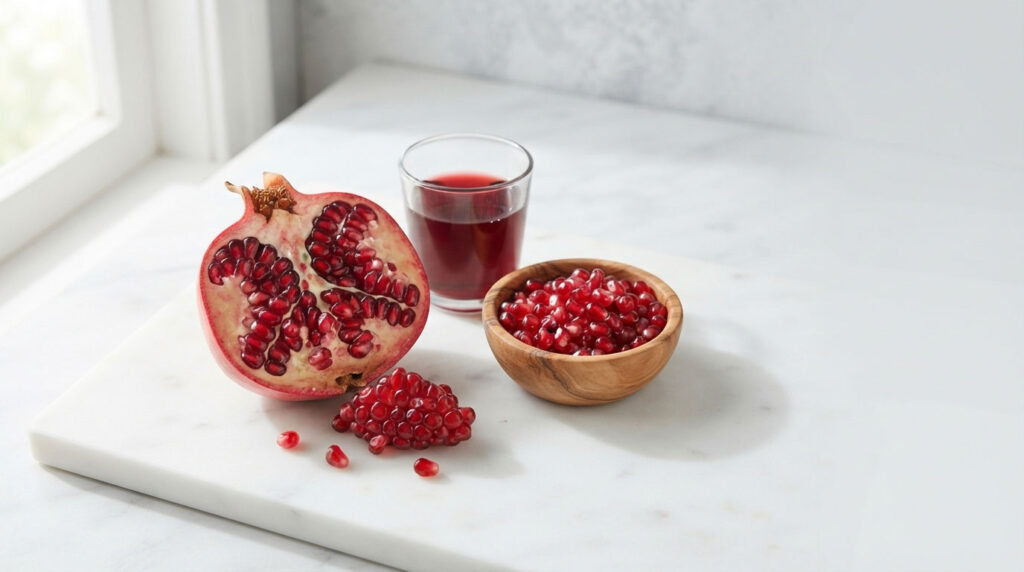
Ancient Persian doctors prescribed it. Today, American cardiologists study it. In January 2026, researchers pooled 33 clinical trials covering 1,490 adults and found this ruby-red fruit measurably dropped blood pressure. Not bad for something sitting in the produce aisle for three dollars.
Table of Contents
Pomegranate is a nutrient-dense fruit rich in antioxidants called punicalagins and anthocyanins. Research links regular intake to lower blood pressure, reduced inflammation, healthier arteries, sharper memory, and better digestion. Most benefits show up with about a half cup to one cup of arils, or up to 8 ounces of 100% pomegranate juice daily. People with diabetes, kidney disease, or on certain medications should ask a doctor first.
At a Glance
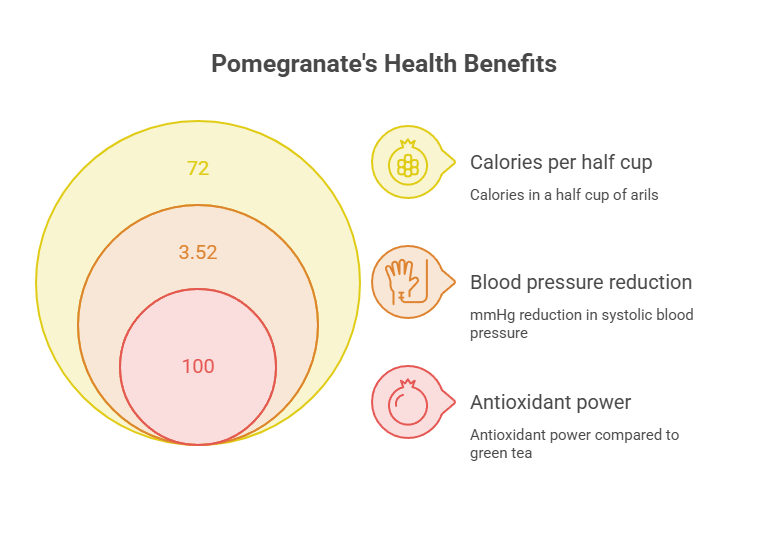
- Pomegranate arils pack fiber, vitamin C, vitamin K, and potassium for roughly 72 calories per half cup.
- A January 2026 review of 33 trials found pomegranate cut systolic blood pressure by about 3.52 mmHg.
- Punicalagins hand pomegranate antioxidant power that beats green tea and red wine in lab tests.
- Juice concentrates the polyphenols; whole arils add fiber. Both deserve a spot in your diet.
- The blood-pressure benefit usually appears within about two months of daily intake.
- High sugar and potassium mean diabetics and kidney patients should keep portions modest.
What Is a Pomegranate? Nutrition at a Glance
The pomegranate (Punica granatum) is a round, leathery-skinned fruit hiding hundreds of edible seeds. Those jewel-toned seeds, called arils, are the part you eat. One fruit can hold anywhere from 200 to more than 1,400 of them.
Botanically it counts as a berry, though it looks like a red apple wearing a crown. The thick rind is bitter and inedible. The arils inside are sweet, tart, and juicy.
What’s Actually Inside the Arils
Each aril wraps a small seed in a burst of sweet-tart juice. Eat the whole thing, seed included, and you get fiber plus a satisfying crunch. The spongy white pith around the arils is bitter and gets tossed.
Pomegranates hit US shelves from October through January, which is why they show up around the holidays. Seasonal produce tends to arrive at peak ripeness, and pomegranate is no exception.
The Nutrition Breakdown
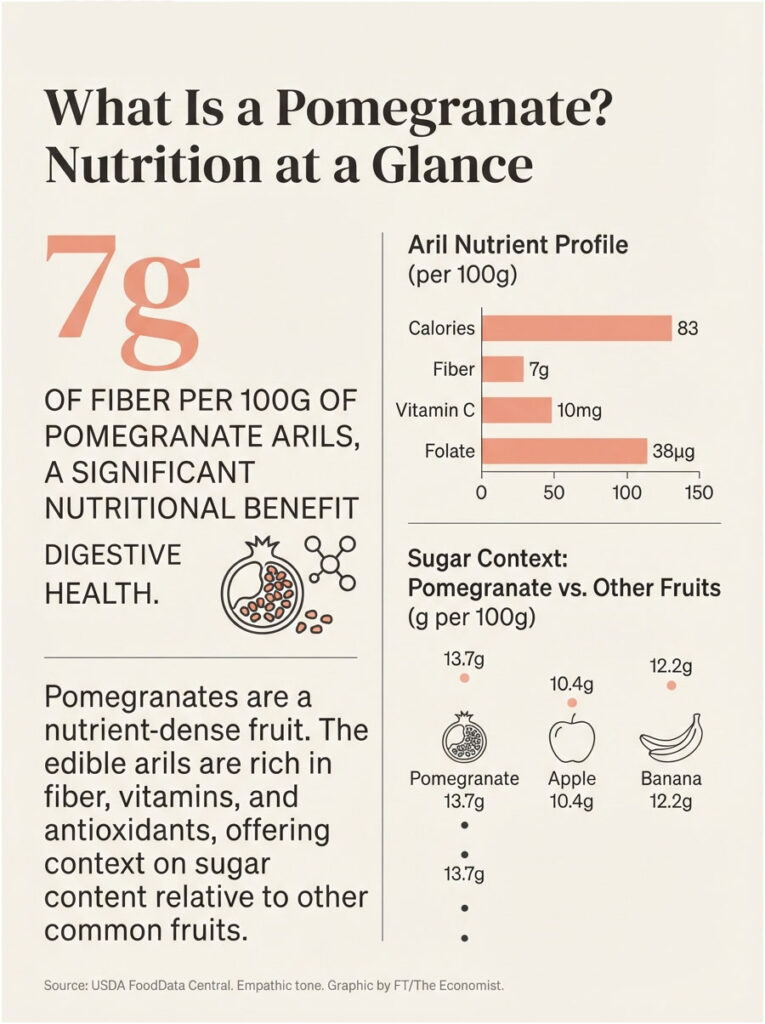
Pomegranate arils stay low in calories while carrying a serious nutrient load. A half-cup serving (about 87 grams) runs roughly 72 calories, delivers 3.5 grams of fiber, and covers about 10% of your daily vitamin C. USDA FoodData Central.
You also get vitamin K, folate, and potassium alongside the natural sugars that make the fruit taste like dessert. Here is how a typical serving measures up.
| Nutrient | Per 1/2 Cup Arils (87 g) | Per 1 Cup Arils (174 g) | % Daily Value (1 Cup) | Source |
| Calories | 72 | 144 | — | USDA FoodData Central |
| Fiber | 3.5 g | 7 g | 25% | USDA FoodData Central |
| Vitamin C | 8.9 mg | 17.8 mg | 20% | USDA FoodData Central |
| Vitamin K | 14 mcg | 28.5 mcg | 24% | USDA FoodData Central |
| Folate | 33 mcg | 66 mcg | 16% | USDA FoodData Central |
| Potassium | 205 mg | 411 mg | 9% | USDA FoodData Central |
Fiber is the quiet standout. One cup of arils supplies about 7 grams, a real dent in the roughly 28 grams most American adults fall short of every day.
Calories and Sugar in Context
A half cup of arils lands around 72 calories with about 12 grams of natural sugar. That is more sugar than a cucumber and less than a banana, squarely in the middle of the fruit pack.
The difference from candy is the packaging. In whole pomegranate, that sugar arrives wrapped in fiber, vitamins, and antioxidants, which is exactly why the whole fruit behaves so differently in the body than a spoonful of table sugar.
The Powerhouse Compounds Behind the Benefits
Pomegranate’s reputation runs deeper than its vitamin panel. The fruit is loaded with polyphenols, plant compounds that behave as antioxidants in the body and drive nearly every benefit on this list.

Punicalagins and Ellagitannins
Punicalagins sit among the most potent antioxidants found in any food. They concentrate in the juice and the peel, and they explain much of pomegranate’s disease-fighting muscle.
The ellagitannins in pomegranate convert into a compound called urolithin A once gut bacteria go to work on them. Because that conversion depends on your individual microbiome, the same glass of juice can help one person more than another, which is part of why study results vary.
Here is a twist: the peel most people discard holds a large share of these compounds. That is why pomegranate extract supplements, made partly from peel, can carry a concentrated antioxidant punch.
Urolithin A and the Gut Connection
The urolithin A that gut bacteria make from pomegranate has become a research story of its own. Early work links it to healthier mitochondria, the tiny power plants inside your cells, which may partly explain the fruit’s effects on energy and aging.
Not everyone produces urolithin A efficiently, though. Your gut bacteria decide how much you make, which is one reason the same amount of pomegranate helps some people more than others.
Anthocyanins and Why the Color Matters
The deep crimson of pomegranate comes from anthocyanins, the same pigments coloring blueberries and red cabbage. These compounds fight oxidative stress, the slow cellular wear tied to aging and chronic disease.
The “superfood” label gets thrown around loosely, but pomegranate earns it. Its measured antioxidant activity outperforms green tea and red wine across several published lab comparisons.
A Fruit With Ancient Roots and Modern Science
Pomegranate is one of the oldest cultivated fruits on earth, grown across Persia and the Mediterranean for thousands of years. It appears in ancient medical texts, religious writing, and folk remedies long before anyone could measure a polyphenol.

What changed is the science. Over the past two decades, researchers have run hundreds of trials on pomegranate, and the pace has picked up sharply. The January 2026 review pulling together 33 randomized studies would have been unthinkable a generation ago.
That surge matters for one reason: it moves pomegranate from folklore into evidence. When a benefit shows up across dozens of controlled trials, not just tradition, it earns a place in a real health conversation.
12 Proven Health Benefits of Pomegranate
The list below reflects what human research actually supports, ordered by evidence strength. Some benefits rest on large pooled trials. Others are promising but early. Flagging that difference honestly is what separates useful health content from hype.
1. Loaded With Antioxidants
Antioxidants neutralize free radicals, the unstable molecules that chip away at cells over time. Pomegranate’s punicalagins and anthocyanins place it near the top of the antioxidant fruit rankings.
Why care? Oxidative stress feeds heart disease, cancer, and cognitive decline. Building meals around antioxidant-dense foods like pomegranate hands your body’s defenses more ammunition.
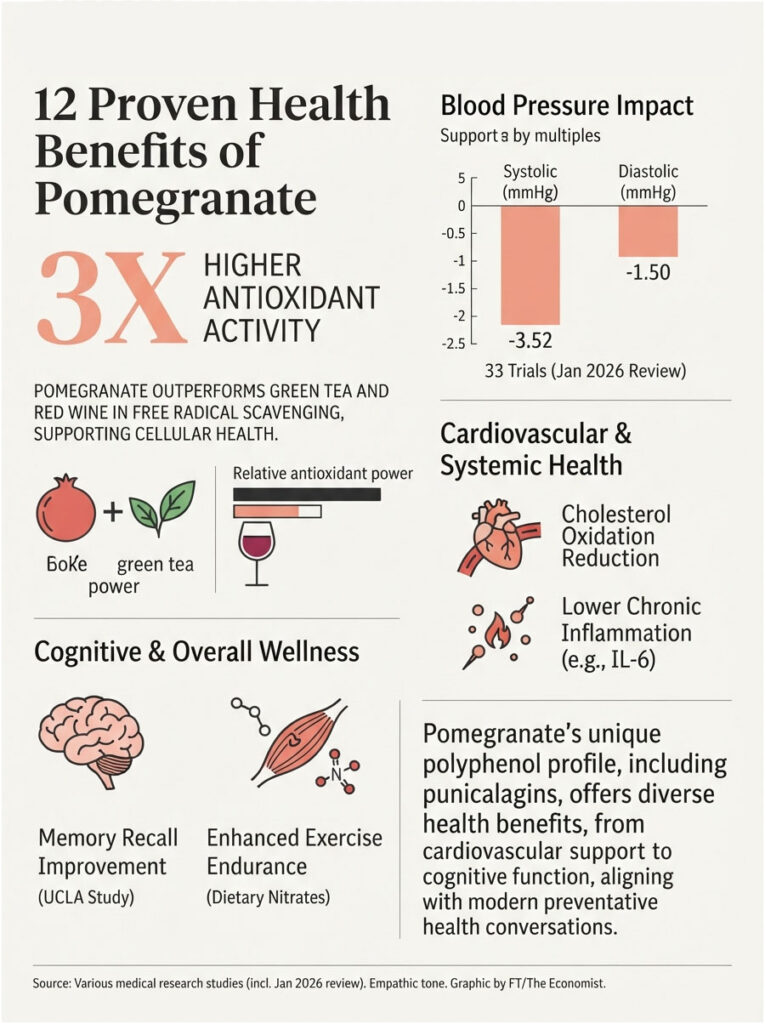
Lab tests put numbers on it. Pomegranate juice has shown antioxidant activity roughly three times that of green tea or red wine by some measures, driven mostly by its punicalagin content. Few everyday foods come close.
2. May Lower Blood Pressure
This is pomegranate’s best-documented benefit by a wide margin. A January 2026 review pooled 33 randomized controlled trials covering 1,490 adults and found pomegranate lowered systolic blood pressure by about 3.52 mmHg and diastolic by 1.50 mmHg.
Earlier research backs it firmly. A 2021 analysis of 22 trials reported an even steeper drop, with systolic pressure falling nearly 8 mmHg, and the effect ran strongest in people who started above 130 mmHg. Pomegranate and blood pressure, 2021 review.
A few points off the top number sounds small until you scale it. With nearly half of US adults living with hypertension, a population-wide nudge downward means fewer heart attacks and strokes.
Patients booking blood-pressure panels through HealthCareOnTime often ask whether food can genuinely move their readings. Pomegranate juice is one of a handful of fruits with repeated trial data saying yes, though it works beside medication and a healthy diet, never as a substitute for either.
Dose matters more than volume here. Trials found that drinking around 300 mL (about 10 ounces) or less per day drove the strongest systolic drop, while larger amounts added no extra benefit. A modest daily glass beats chugging the whole bottle.
3. Supports Heart and Artery Health
Blood pressure aside, pomegranate seems to guard the arteries themselves. Studies suggest the juice reduces oxidation of LDL cholesterol, an early trigger for plaque buildup.
The same January 2026 review recorded lower inflammatory markers tied to vessel damage. Cholesterol oxidation and low-grade inflammation are two of the quietest heart-trouble drivers, often working silently years before any symptom surfaces, which is why a periodic lipid panel matters.
Some research also points to more flexible, better-functioning blood vessels with steady intake. Supple vessels let the heart move blood with less strain.
4. Fights Inflammation
Chronic, low-grade inflammation underlies a long roster of conditions, from heart disease to metabolic disorders. Pomegranate’s polyphenols help quiet the body’s inflammatory signaling.
In the pooled 2026 data, markers such as interleukin-6 fell after pomegranate intake. Calming these signals may explain why one fruit turns up across so many separate health benefits at once.
5. May Help Protect Against Certain Cancers
Lab and early human studies suggest pomegranate compounds can slow the growth of some cancer cells. The most cited human work centers on the prostate.
What the UCLA Research Found
Researchers at UCLA found that pomegranate juice appeared to slow the rise of PSA, a prostate cancer marker, in men already treated for the disease. A slower PSA climb can point to slower progression. Pomegranate benefits, Cleveland Clinic.
Encouraging, yes, but far from settled, and much of the cancer evidence remains lab-based. Pomegranate belongs in the supportive column of a plant-forward diet, never as a stand-in for oncology care.
6. Supports Brain Health and Memory
Pomegranate may help keep the mind sharp. In one study, older adults with memory complaints who drank about 8 ounces of juice daily posted measurable gains in verbal and visual recall.
A 2023 systematic review concluded that regular intake supported cognitive function in healthy people. The antioxidant activity protecting the heart appears to shield brain cells from the same oxidative wear.
Preliminary work even links pomegranate compounds to slowing the brain-cell loss seen in conditions like Alzheimer’s disease. That research sits at an early stage, so read it as a hint, not a promise.
One practical note: the brain benefits in these studies came from steady daily intake, not a one-off glass. As with blood pressure, consistency across weeks appears to be what moves the needle.
7. Aids Digestion and Gut Health
The fiber in pomegranate arils feeds beneficial gut bacteria and keeps things moving. One cup delivers about 7 grams, a meaningful step toward the daily goal.
One point trips people up: that fiber lives in the arils, not the juice. Straining removes the fibrous seeds and leaves the sugar behind, so if digestion is your aim, eat the arils whole.
8. May Improve Exercise Endurance
Pomegranate is a natural source of dietary nitrates, which widen blood vessels and improve oxygen delivery to working muscles. That is the logic behind athletes sipping it before a session.
Small trials suggest a pre-workout dose can extend endurance and speed recovery, with roughly 1.5 ounces of juice enough to register an effect in some studies. The gain is modest, but for weekend athletes it is a low-cost edge worth a try.
9. Supports Urinary and Kidney Health
Compounds in pomegranate may help block kidney stone formation by rebalancing urinary chemistry. Its antioxidants also support healthy kidney tissue.
A caveat rides along, though. Anyone with existing kidney disease should tread carefully, since pomegranate is high in potassium, which struggling kidneys cannot always filter out.
10. Antibacterial and Antifungal Effects
Pomegranate compounds fight several harmful bacteria and yeasts, including Candida albicans. That gives the fruit a genuine role in oral health.
Research ties pomegranate to protection against gum conditions like gingivitis and periodontitis. A handful of natural mouth rinses now fold in pomegranate extract for exactly this reason.
11. May Help Blood Sugar Regulation
Despite its sweetness, pomegranate carries a moderate glycemic index of about 53. Its fiber and polyphenols may soften blood sugar spikes rather than set them off.
Still, the sugar is real, around 12 grams per half cup. Among patients managing diabetes, the ones who fare best pair small portions of arils with a little protein or fat and keep an eye on their glucose readings.
12. Supports Skin Health
Pomegranate’s antioxidant reach extends to the skin. A 2022 placebo-controlled study found that oral pomegranate extract softened the look of deep wrinkles and improved the skin’s microbiome.
The same research noted lower skin oil production. Both effects trace back to the fruit’s knack for fighting the oxidative stress that ages skin from the inside out.
| Benefit | What Research Shows | Evidence Strength | Best Form | Amount Studied |
| Lower blood pressure | Systolic down ~3.5 to 8 mmHg across trials | Strong | Juice | 50 to 300 mL daily |
| Reduced inflammation | Lower IL-6 and related markers | Moderate to strong | Juice or extract | 240 mL or 450 to 1,000 mg |
| Heart / artery health | Less LDL oxidation, better vessel function | Moderate | Juice | 240 mL daily |
| Memory support | Better verbal and visual recall | Moderate | Juice | 237 mL daily |
| Prostate support | Slower PSA rise after treatment | Early | Juice | 240 mL daily |
How Pomegranate Compares to Other Superfruits
Pomegranate rarely competes alone. Blueberries, cranberries, acai, and red grapes all carry their own reputations. Here is how they line up on the compounds and benefits that matter most.
| Fruit | Standout Compound | Key Benefit Focus | Antioxidant Note |
| Pomegranate | Punicalagins, anthocyanins | Blood pressure, heart, inflammation | Beats green tea and red wine in lab tests |
| Blueberries | Anthocyanins | Brain and memory support | High antioxidant score, studied for cognition |
| Cranberries | Proanthocyanidins | Urinary tract health | Strong antibacterial activity |
| Acai | Anthocyanins | General antioxidant support | High antioxidant, limited human trials |
| Red grapes | Resveratrol | Heart and vessel health | Antioxidant tied to the Mediterranean diet |
No single fruit does everything. The smartest move is variety, rotating pomegranate with berries and grapes so your diet pulls from several antioxidant families rather than leaning on one.
Juice vs Arils vs Extract: Which Form Is Best?
No single form wins outright. Each carries a trade-off worth knowing before you shop.
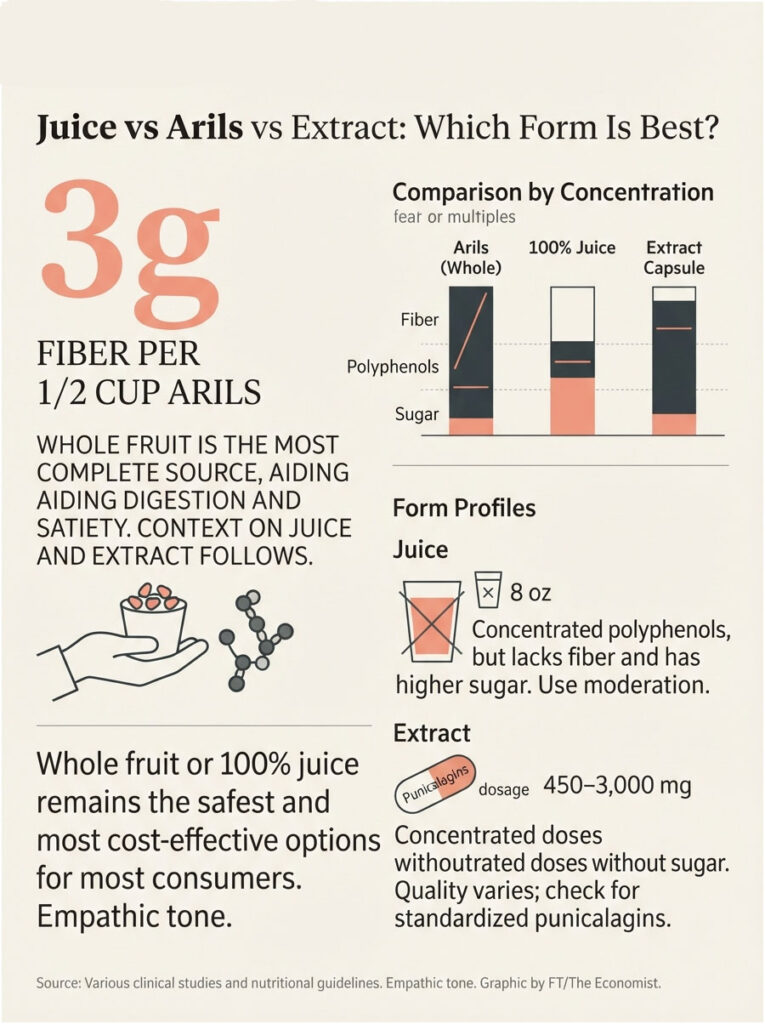
Whole Arils (Fiber Advantage)
Eating arils whole hands you fiber, which juice cannot touch. Fiber slows sugar absorption, feeds gut bacteria, and keeps you full longer.
Arils also make portion control easy. A half cup is a filling, low-calorie snack that slots into almost any eating plan.
100% Juice (Concentrated Polyphenols)
Most blood-pressure research used juice, because pressing the fruit concentrates the polyphenols. If the cardiovascular payoff is your goal, 100% juice owns the strongest track record.
Sugar is the trade. Juice strips the fiber and packs more natural sugar per glass, so cap servings near 8 ounces and reach for “100% juice” with nothing added.
Supplements and Extracts
Extract capsules deliver punicalagins in a concentrated dose minus the sugar. Trials have used anywhere from 450 to 3,000 mg daily.
Some people simply prefer a capsule to a glass. Quality swings hard between brands, so scan for standardized punicalagin content and third-party testing on the label before you buy.
One caution on supplements: they are not regulated as tightly as medications, so potency and purity vary between brands. Whole fruit or 100% juice stays the safest bet for most people, with extracts reserved for those who cannot get enough of either.
How Much Pomegranate Should You Eat or Drink?
More is not better here, and the research draws a clear line rather than a “load up” green light.
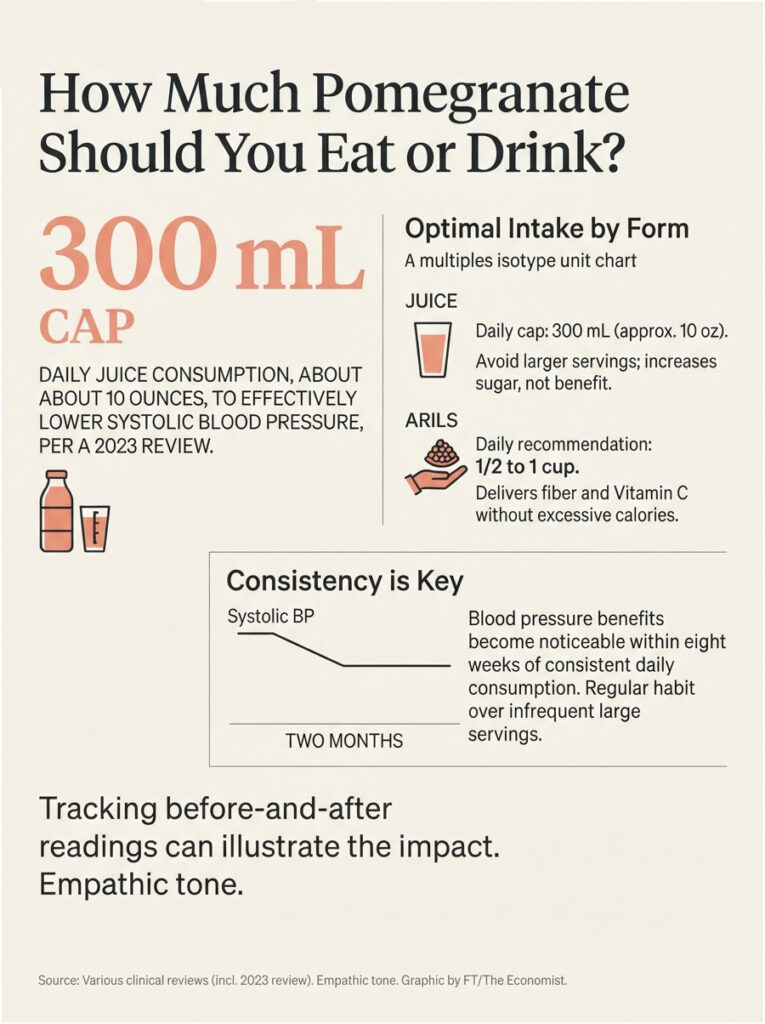
Daily Amounts Backed by Studies
For blood pressure, trials found that 300 mL (about 10 ounces) or less of juice per day produced the strongest systolic drop. Larger pours added no benefit and only stacked on sugar. Pomegranate juice and blood pressure, 2023 review.
For whole fruit, a half cup to one cup of arils daily suits most healthy diets. That covers real fiber and vitamin C without a calorie penalty.
When to Expect Results (the 2-Month Window)
Timing surprises people. Pooled data shows the blood-pressure benefit tends to surface within about two months of daily intake, then plateau. Pomegranate juice and blood pressure (ScienceDirect).
Consistency beats volume every time. A steady daily habit across eight weeks outperforms the occasional oversized serving, so if you want to track the change, a before-and-after blood-pressure reading tells the story.
Who Should Be Cautious With Pomegranate
Pomegranate is safe for most people, but a few groups should ease off. This is exactly where individual medical judgment earns its keep.
Diabetes and Blood Sugar
Pomegranate carries natural sugar, roughly 12 grams per half cup of arils, and its glycemic index of 53 lands in moderate territory, not low.
People with diabetes can usually fit small portions in, but they should watch how the fruit moves their numbers. Pairing arils with protein or fat steadies the blood-sugar response.
Kidney Disease and Potassium
Pomegranate is high in potassium. Healthy kidneys clear it without trouble; damaged ones often cannot.
Anyone with chronic kidney disease should check with a nephrologist before adding juice, which squeezes a lot of potassium into a small glass.
Medication Interactions
Pomegranate can interact with several common drugs. It may amplify blood-pressure medication, and it can interfere with how the body processes some statins and blood thinners like warfarin.
The complaint that surfaces most often is an unexpected pressure drop when patients stack daily juice on top of their medication. Tell your doctor about any regular pomegranate habit so the two can be balanced safely.
| If You… | Recommended Action | Why |
| Take blood-pressure medication | Talk to your doctor before daily juice | Pomegranate can add to the drug’s effect |
| Have diabetes | Stick to 1/2 cup arils, pair with protein | Natural sugar affects blood glucose |
| Have chronic kidney disease | Ask your nephrologist first | High potassium can strain weak kidneys |
| Take statins or warfarin | Check for interactions before regular use | May change how the drug is processed |
| Are a healthy adult | Enjoy 1/2 to 1 cup arils or 8 oz juice daily | Full benefit, minimal risk |
Easy Ways to Add Pomegranate to Your Diet
Working more pomegranate into your week takes no recipe and no effort. The arils go almost anywhere.
Quick Everyday Ideas
Scatter arils over yogurt, oatmeal, or a green salad for crunch and color. Drop them into a smoothie, or spread them across avocado toast for a bright, tart finish.
For juice, cut 4 ounces with sparkling water for a lower-sugar refresher. Arils freeze well too, so stock up while the season lasts.
A Simple Daily Routine
Keeping it consistent is easier with a small habit. Sprinkle a handful of arils on breakfast, or pour a 6 to 8 ounce glass of juice with one meal a day.
If fresh fruit is out of season, frozen arils or a bottle of 100% juice work fine. The research rewards showing up daily far more than picking the perfect form.
Buying, Storing, and Season
Pick fruit that feels heavy for its size with taut, unbroken skin. Heavier usually means juicier arils inside. US pomegranate season runs October through January.
Whole pomegranates keep up to two months in the fridge. Once opened, arils last about five days chilled or several months frozen. To deseed cleanly, halve the fruit and tap the back with a spoon over a bowl of water; the arils sink while the pith floats.
Frequently Asked Questions
Is it OK to eat pomegranate every day?
Yes, for most healthy people, daily pomegranate is safe and useful. A half cup to one cup of arils, or up to 8 ounces of 100% juice, fits a balanced diet well. People with diabetes, kidney disease, or on certain medications should check with a doctor first.
How much pomegranate juice should you drink a day?
Research points to about 8 to 10 ounces (240 to 300 mL) of 100% juice daily for blood-pressure benefits. More than that adds sugar without extra reward. Choose juice with no added sugar and count it toward your daily fruit and calorie intake.
Who should not eat pomegranate?
People on blood-pressure medication, blood thinners like warfarin, or certain statins should consult a doctor first, since pomegranate can interact with these drugs. Those with chronic kidney disease need caution because of the high potassium. Diabetics should mind portion sizes due to natural sugar.
Is pomegranate good for high blood pressure?
Yes, this is its strongest benefit. Multiple trial reviews show pomegranate juice lowers systolic blood pressure by roughly 3.5 to 8 mmHg, with the biggest effect in people starting above 130 mmHg. It works best inside a heart-healthy diet, not as a medication swap.
Can diabetics eat pomegranate?
Usually yes, in moderation. Pomegranate has a moderate glycemic index of 53 plus fiber and antioxidants. Diabetics should keep portions small (about a half cup of arils), pair them with protein or fat, and monitor blood sugar. Whole arils beat juice for this group.
Does pomegranate lower cholesterol?
Evidence suggests pomegranate may reduce oxidation of LDL cholesterol, a step in artery plaque formation, and support healthier vessel function. Effects on total cholesterol numbers run less consistent across studies. It works best as one piece of a heart-protective eating pattern.
Are pomegranate seeds good for you?
Yes. The seeds inside each aril are edible and add fiber. Eating whole arils, seed included, gives you more fiber than juice, which supports digestion and gut health. The seeds are safe to chew and swallow and carry beneficial plant compounds.
Is pomegranate juice or the whole fruit healthier?
Both have merit. Whole arils give fiber and easier portion control, while juice concentrates the polyphenols behind most blood-pressure research. For everyday nutrition, arils win on fiber; for the cardiovascular benefit specifically, 100% juice has more trial support. Sugar runs higher in juice.
Does pomegranate interact with medications?
Yes. Pomegranate can strengthen the effect of blood-pressure drugs and may interfere with how the body processes some statins and blood thinners such as warfarin. If you take any daily medication, tell your doctor before making pomegranate a regular habit.
What are the side effects of eating too much pomegranate?
Most people tolerate it well. Overdoing juice mainly means excess sugar and calories. In sensitive people, large amounts may cause digestive upset or, combined with medications, unexpected drops in blood pressure. One serving a day sidesteps these issues.
Is pomegranate good for men?
Pomegranate may support men’s health, especially the prostate. UCLA research found the juice slowed the PSA rise in men treated for prostate cancer. Its antioxidants also back heart health, a leading concern for American men. Treat it as supportive, not a treatment.
Is pomegranate good for women?
Yes. Beyond general antioxidant and heart benefits, early research suggests pomegranate extract may support hormonal balance and skin health in women. Its folate content is useful during reproductive years. As with any food, the payoff comes from regular, moderate intake within a balanced diet.
Is pomegranate juice high in sugar?
Yes, relatively. An 8-ounce glass of 100% pomegranate juice can carry around 30 grams of natural sugar, with no fiber to slow it down. That is why a smaller glass, or eating whole arils instead, is often the better call.
Is pomegranate good for weight loss?
Pomegranate is not a weight-loss food on its own, but it fits a weight-conscious diet well. A half cup of arils is filling, low in calories, and high in fiber, which helps curb snacking. Watch juice, though, since the calories add up quickly.
When is the best time to eat pomegranate?
Any time works, but many people prefer it with breakfast or before a workout for the natural nitrate boost. There is no proven “best” time; the bigger factor is eating it consistently rather than timing it to a specific hour.
Medical Disclaimer: This article is for informational purposes only and does not replace professional medical advice. Pomegranate can interact with medications and may not suit everyone. Talk to your doctor or a registered dietitian before making significant dietary changes, especially if you have a health condition or take prescription drugs.
References
- Pomegranate nutrition data, USDA FoodData Central
- Effects of pomegranate consumption on blood pressure, 2021 meta-analysis (Wiley)
- Impact of pomegranate juice on blood pressure, 2023 meta-analysis (PubMed)
- Pomegranate juice and blood pressure, meta-analysis (ScienceDirect)
- The health benefits of pomegranates (Cleveland Clinic)
- Health benefits of pomegranate (Healthline)
- Pomegranate extract for women’s reproductive health, review (NCBI)