Your left eyelid has been fluttering for three days. Somewhere between typing “what does this mean” into Google and landing on a page about omens, a quieter question surfaced: is my body trying to tell me something?
It probably is. Just not the thing you were told.
Table of Contents
Quick Answer: Left eyelid twitching in women is almost always eyelid myokymia, a harmless flutter of the muscle that closes your eye. Medically, the left side carries no special meaning; the twitch simply lands where it lands. Female sex, though, does matter. Women face roughly double the rate of dry eye disease, five to eight times the rate of thyroid disorders, and higher rates of the two rarer spasm conditions that can mimic a simple twitch.
At a Glance
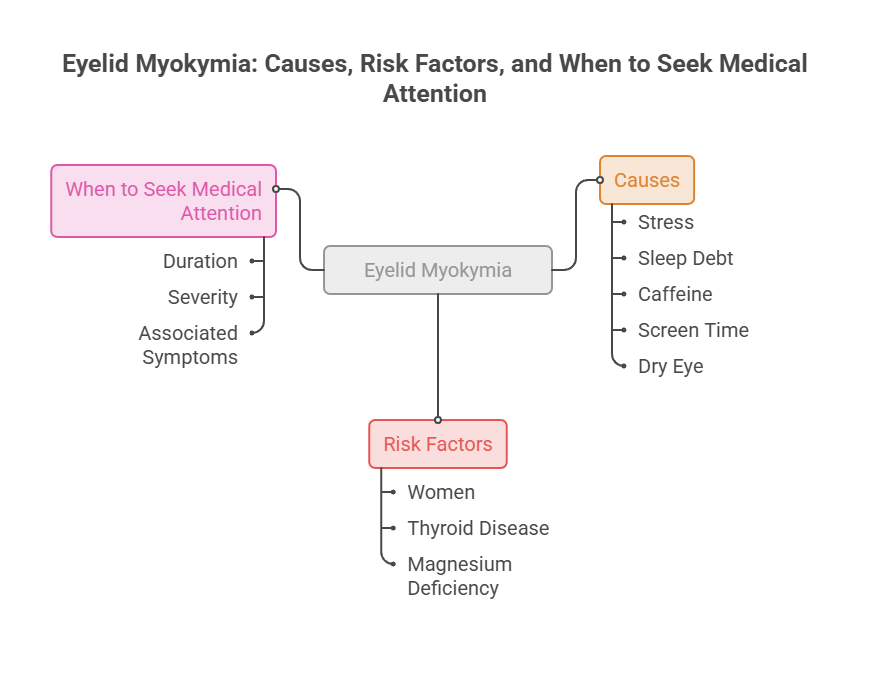
- “Left” is folklore. “Female” is epidemiology. Only one of those shows up in the medical data.
- The clinical name is eyelid myokymia, and most episodes resolve within days to a few weeks.
- Stress, sleep debt, caffeine, screen time, and dry eye account for the overwhelming majority of cases.
- US women carry roughly twice the dry eye rate of men (8.8% versus 4.5%) and are 5 to 8 times more likely to have thyroid disease.
- Around half of American adults fall short of the magnesium requirement. Among women aged 51 to 70, that figure reaches 64%.
- A twitch that stops when you sleep is benign. One that continues through sleep is not, and that single question separates the two.
- See a clinician if it runs past two to three weeks, forces the eye shut, spreads across your face, or arrives with drooping, vision changes, or weakness.
What’s Actually Happening When Your Left Eyelid Twitches
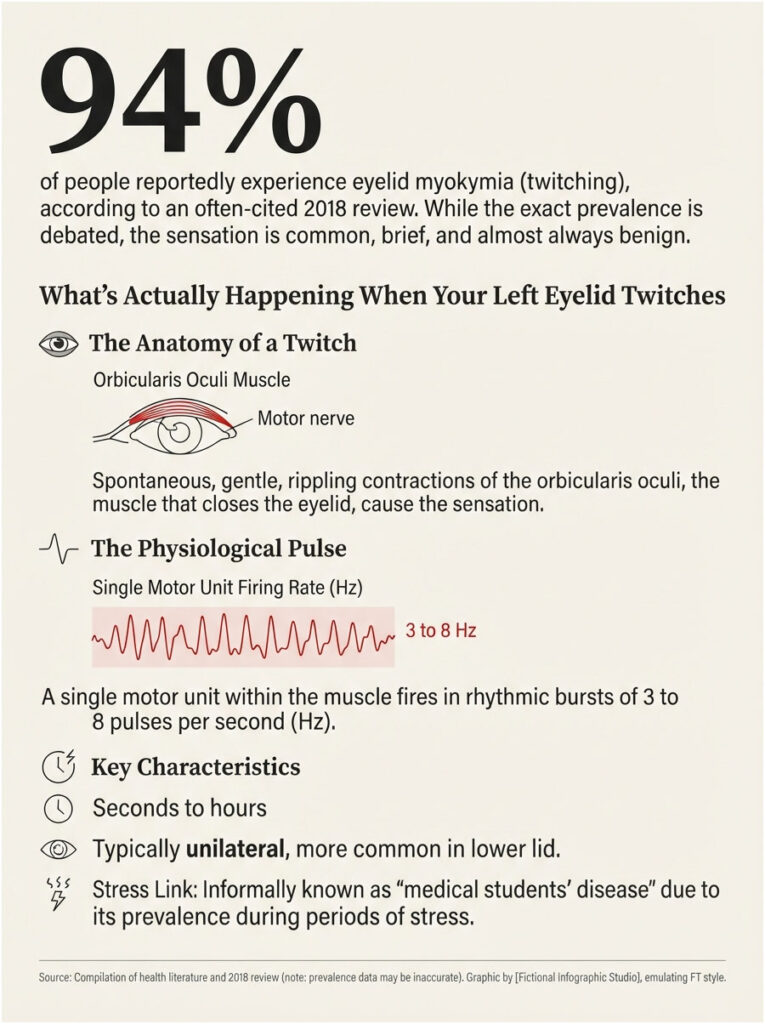
There is a thin ring of muscle wrapped around your eye. It is called the orbicularis oculi, and its only job is to close the lid. Every blink you have ever taken came from it.
When a twitch starts, a small cluster of fibers inside that ring begins firing on its own, without any instruction from your brain. The muscle is not damaged. It is not weak. It is misfiring.
Eyelid Myokymia, Defined Properly
The clinical term is eyelid myokymia. According to StatPearls at the NIH, it consists of spontaneous, gentle, rippling contractions that spread through the muscle, almost always on one side, and far more often in the lower lid than the upper.
Electrically, a single motor unit fires in rhythmic bursts at roughly 3 to 8 Hz, with gaps of 100 to 200 milliseconds between them. That rhythm is the flutter you feel. The bursts are not synchronized across the muscle, which is why the movement stays small and local rather than pulling the whole lid shut.
Episodes are self-limited. They last seconds to hours, come and go over days, and resolve on their own in the large majority of cases.
Why It Feels So Much Bigger Than It Looks
Patients booking tests with us often describe a twitch so loud inside their own head that they are stunned nobody across the table can see it. That gap is real, and it is not imagination.
The eyelid carries an unusually dense supply of sensory nerves, and it sits directly in your field of view. A movement of one or two millimeters registers as an event. The same movement in your calf would go entirely unnoticed.
That mismatch is also why the symptom breeds anxiety out of proportion to its seriousness. It feels like something is happening to your face, and faces are the part of the body people worry about most.
How Common Is It, Really?
Here a widely repeated number needs correcting. Several pages currently ranking for this exact query claim a 2018 review found eyelid myokymia affects “up to 94% of people at some point.”
StatPearls, the NIH-hosted clinical reference, says the opposite: the literature on eyelid myokymia prevalence is scarce. It notes the condition is common enough among stressed students to have earned the nickname “medical students’ disease,” but nobody has counted it properly in a general population.
Our medical reviewers treat statistics like that 94% figure as a warning sign rather than a fact. When a number appears on a dozen pages and traces back to none of them, it is decoration.
Does the Left Side Actually Mean Anything?
You did not search “eye twitching.” You searched “left eye twitching, female.” That specificity came from somewhere real, and it deserves a straight answer instead of a lecture.
Where the Belief Comes From
Across a surprising number of cultures, the two sides of the body were assigned different meanings, and the meaning often flipped depending on whether the body was male or female.
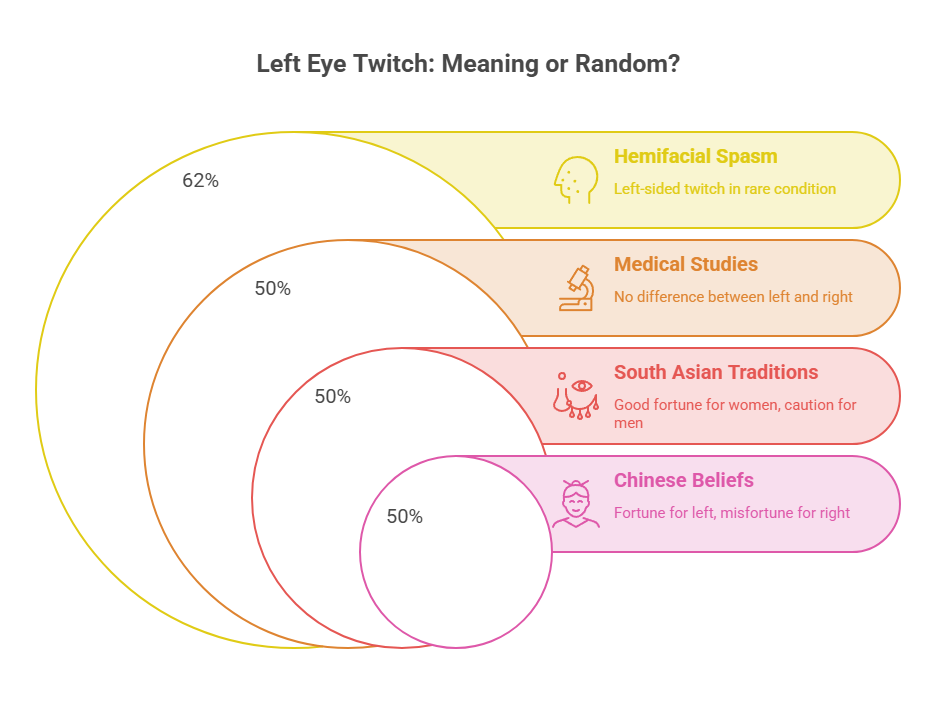
In traditions drawing on Samudrika Shastra, a South Asian body-reading system, a twitching left eye in a woman is typically read as auspicious, a sign of incoming good fortune. The same twitch in a man is read as a caution.
Chinese folk belief runs a separate version, sometimes keyed to the hour of the day, with the left eye signaling fortune and the right signaling misfortune. Various European and West African traditions carry their own readings, some of which reverse the polarity entirely.
The Contradictions Are the Tell
Line these traditions up and they cancel each other out. What is lucky in one system is a warning in another. What applies to women in one reading applies to men in the next.
If the left eyelid genuinely encoded a message, the message would not change when it crossed a border. Traditions that disagree this fundamentally are describing the human need for meaning, not a property of the eyelid.
Why the Belief Still Feels True
This part matters, because dismissing it does not actually help anyone. The reason these beliefs persist is not stupidity. It is how memory works.
Your eyelid twitches dozens of times a year. On the day something notable happens, you remember the twitch. On the hundred days nothing happens, you forget it entirely. That asymmetry builds a conviction that feels like evidence and is not.
Across the readers HealthCareOnTime serves, this is the most common quiet worry behind the search: a fear that the body knows something the mind does not. The reassuring news is that it does. It knows you are tired.
What the Medicine Says About Left vs Right
For ordinary eyelid myokymia, no study has found a difference between the left eye and the right. No mechanism predicts one. No clinical guideline distinguishes them.
Your twitch landed on the left the way a coin lands heads. Whichever cluster of fibers happened to get irritable is the one that fired.
The One Place Where “Left” Shows Up in Real Data
This is worth reading carefully, because it is genuinely interesting and it is also easy to misuse.
There is a rarer condition called hemifacial spasm, in which an artery presses on the facial nerve where it exits the brainstem, causing twitching across one entire side of the face. In a population cohort of 279 hemifacial spasm patients published in the Journal of the Neurological Sciences, the spasm was left-sided in 62% of cases.
Why That Almost Certainly Does Not Describe You
Hemifacial spasm is not eyelid myokymia. It has a structural cause, it recruits the cheek and mouth over time, it does not stop when you sleep, and it affects roughly 14.5 per 100,000 women. That is rare.
One cohort in one country also does not establish a universal rule, and nobody has replicated it as one. The finding is a footnote in a specialist literature, not an explanation for a three-day lid flutter.
The honest summary: for the twitch you almost certainly have, left means nothing. For a condition you almost certainly do not have, there is one cohort with an unexplained left-side tilt. Both are true at once.
Why “Female” Is the Part of This Question That Actually Matters
Here is the turn nobody else in this search result makes. The “left” in your query carries no medical weight. The “female” carries quite a lot.
| Condition | Rate in Women | Rate in Men | Female Skew | What It Means for Your Twitch |
| Chronic eyelid myokymia | Female sex listed as a risk factor (StatPearls) | Lower | Documented, not quantified | The twitch is more likely to persist rather than pass |
| Eyelid myokymia (student cohort) | 2.46x the odds of male peers | Reference group | About 2.5:1 | Even short-term twitching skews female under equal stress |
| Dry eye disease (US adults) | 8.8% (about 11.1 million) | 4.5% (about 5.3 million) | About 2:1 | The most treatable cause, and women carry double the load |
| Thyroid disease (US) | 1 in 8 women in her lifetime | Far lower | 5:1 to 8:1 | Up to 60% of cases are undiagnosed |
| Benign essential blepharospasm | Higher | Lower | 1.8:1 to 4:1 | The condition an ordinary twitch is most often confused with |
| Hemifacial spasm | 14.5 per 100,000 | 7.4 per 100,000 | About 2:1 | Rare, but women are twice as likely to develop it |
| Magnesium below requirement | 64% of women aged 51 to 70 | Lower | Meaningful gap | The most-blamed deficiency, and the intake gap is real |
Female Sex Is a Documented Risk Factor for Chronic Twitching
This is not a soft claim borrowed from a wellness blog. A PubMed-indexed clinical review of eyelid myokymia names female gender and cold weather as risk factors for the chronic form, meaning a twitch that runs for days or weeks rather than minutes.
A survey of 100 medical students during exam season found 44% had eyelid myokymia in the week before testing. Female students carried 2.46 times the odds of their male classmates under identical academic pressure.
Hormones, Cycles, and the Perimenopause Window
The mechanism here is less settled than the internet implies, and honesty requires saying so. Estrogen influences nerve excitability and tear film stability, so cyclical shifts plausibly change how twitchy a small muscle becomes.
What is better established is the downstream route. Falling estrogen in perimenopause reduces tear production, and dry eye is one of the strongest triggers for eyelid twitching there is. That is a real pathway, not a hand-wave.
Pregnancy and the postpartum months stack fatigue, fluid shifts, and broken sleep on top of one another. Twitching in that window is common and almost never sinister.
The Nutrient Gap Menstruating Women Carry
Heavy periods drain iron. Restrictive eating patterns, which are common and often invisible, drain magnesium. Both matter for neuromuscular signaling.
NHANES analysis cited by the NIH Office of Dietary Supplements indicates roughly half of Americans consume less magnesium than the Estimated Average Requirement. Among women aged 51 to 70, published analysis puts that shortfall at 64%.
In cases reviewed by our medical team, the pattern that repeats is not exotic. It is a woman sleeping six hours, drinking three coffees, working across two screens, eating lunch at her desk, and wondering why her eyelid will not sit still.
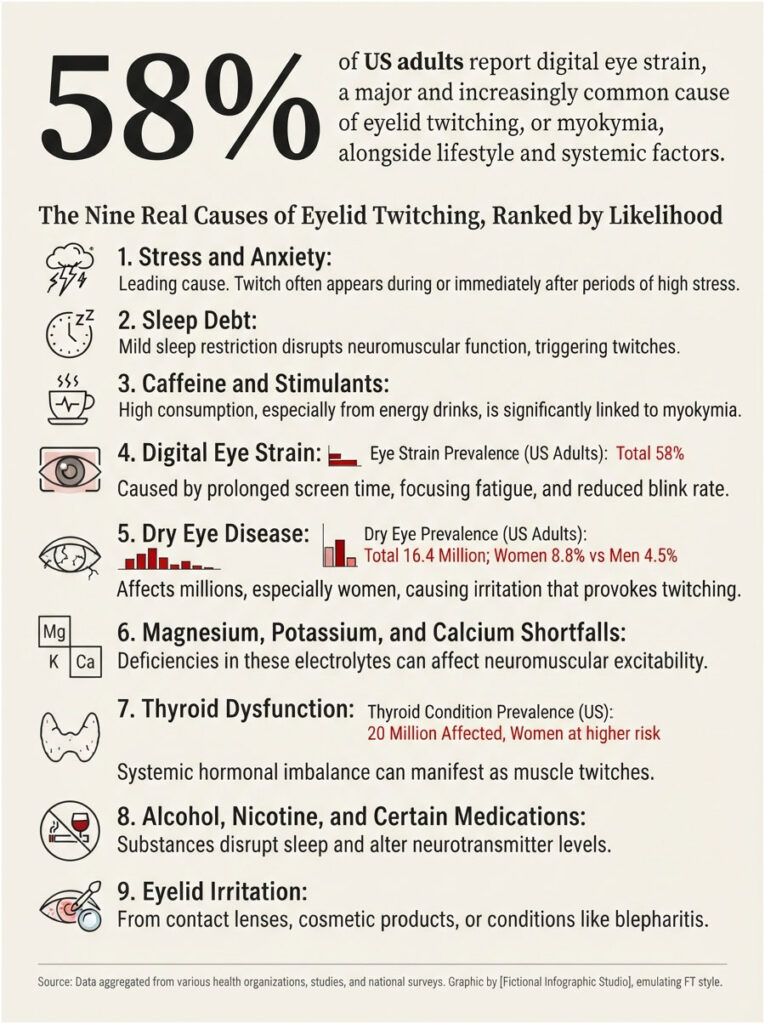
The Nine Real Causes, in Order of How Likely They Are
Most women arriving at this page have two or three of these running at once. The twitch is rarely caused by one thing; it is caused by a stack.
1. Stress and Anxiety
Sustained stress raises baseline sympathetic activity, which lowers the threshold at which small motor units fire spontaneously. That is the whole mechanism, and it is the leading cause by a wide margin.
The cruel timing detail: the twitch often shows up not at the peak of a hard stretch but in the days after it, when your body finally stands down. Women commonly report it during a caregiving crisis, a deadline week, or the exhausted week that follows both.
2. Sleep Debt
Even mild sleep restriction alters nerve signaling. Two or three short nights in a row is enough to trigger a lid twitch in someone who has never had one before.
If your twitch started within a week of a genuinely bad sleep stretch, you probably have your diagnosis and your prescription in the same sentence.
3. Caffeine and Stimulants
Coffee, tea, energy drinks, pre-workout powders, and several over-the-counter cold remedies pull the same lever. The medical student survey found energy drink consumption was a statistically significant predictor of eyelid myokymia.
There is no universal cutoff, and there never will be. Track your own intake against your own twitch for a week and the relationship usually announces itself.
4. Digital Eye Strain
The American Optometric Association reports that 58% of US adults have experienced digital eye strain, with the average worker logging around seven hours a day at a computer.
Screens cut your blink rate by more than half without you noticing. Fewer blinks means a drier ocular surface, a drier surface irritates the lid margin, and an irritated lid margin irritates the muscle underneath it.
5. Dry Eye Disease
This is the most under-recognized cause on the list and the most fixable. Roughly 16.4 million US adults have diagnosed dry eye disease, and women outnumber men two to one: 8.8% versus 4.5%.
The symptoms confuse people because they are not always dryness. Dry eye can present as grittiness, burning, light sensitivity, or watering, since the eye overcompensates. It can also present as nothing at all except a twitchy lid.
Contact lenses, LASIK history, antihistamines, isotretinoin, and hormone therapy all raise the risk. Our lab partners report that dry eye is frequently the answer sitting in plain sight when a twitch has run for weeks and nothing else adds up.
6. Magnesium, Potassium, and Calcium Shortfalls
Magnesium stabilizes neuromuscular excitability, so the association is biologically reasonable. Low potassium and low calcium destabilize it through different routes.
The caveat matters more than the claim. Frank deficiency severe enough to cause twitching on its own is uncommon in healthy people. Marginal intake plus stress plus sleep loss is a far more likely combination than a single mineral acting alone.
7. Thyroid Dysfunction
The American Thyroid Association estimates 20 million Americans have thyroid disease, that up to 60% do not know it, and that women are five to eight times more likely than men to be affected. One woman in eight will develop a thyroid disorder in her lifetime.
Both an overactive and an underactive thyroid can produce muscle twitching, alongside fatigue, temperature intolerance, weight change, mood shifts, and irregular cycles. Thyroid eye disease can also cause lid retraction and surface dryness, which loops straight back to cause number five.
If your twitch has company, a thyroid panel is the highest-value test on this page.
8. Alcohol, Nicotine, and Certain Medications
Alcohol wrecks sleep architecture and depletes magnesium, even on nights it helps you fall asleep faster. Nicotine is a stimulant. Both are easy to test by removing them for ten days.
On the medication side, stimulants, some antidepressants, some antipsychotics, and Parkinson’s disease drugs can all provoke eyelid movement. Never stop a prescription to test a theory. Ask the prescriber.
9. Eyelid Irritation: Lenses, Makeup, and Blepharitis
Sometimes a twitch is an irritated lid margin doing what irritated tissue does. Contact lens overwear, expired mascara, waterline eyeliner, lash extensions, and blepharitis all sit in this bucket.
Women who write to us about this often mention the twitch started within a week of switching a product or extending lens wear. That timeline is a clue worth taking seriously before booking anything.
How to Tell What You Actually Have
This table is the fastest self-triage on the page. One question separates the benign from the not: does it stop when you sleep?
| Feature | Eyelid Myokymia | Benign Essential Blepharospasm | Hemifacial Spasm | Facial Tic |
| What it feels like | Fine flutter or ripple | Forceful squeezing, eye closes | Pulling across one side of the face | Sudden, repetitive movement |
| Which eye | One, usually lower lid | Usually both | One side only, spreads to cheek and mouth | Variable |
| Stops during sleep? | Yes | Yes | No | Yes |
| Can you suppress it? | No, but it passes | No | No | Briefly, with effort |
| Typical duration | Days to 2 to 3 weeks | Progressive, months to years | Progressive, months to years | Waxes and wanes |
| Female skew | Documented for chronic form | 1.8:1 to 4:1 | About 2:1 | Roughly even |
| Who treats it | Nobody; it resolves | Ophthalmologist, botulinum toxin | Neurologist, MRI, possible surgery | Neurologist |
Benign Essential Blepharospasm
Benign essential blepharospasm (BEB) is a focal dystonia in which the muscles that close the eye contract forcefully. Per Medscape and NORD, there are roughly 50,000 US cases, about 2,000 new diagnoses per year, and a prevalence near 5 per 100,000.
The American Academy of Ophthalmology puts the female-to-male ratio between 1.8:1 and 4:1, with mean onset around age 56. It worsens in bright light, wind, and stress, and it does not resolve on its own.
The distinguishing word is squeeze. An ordinary twitch flutters. BEB shuts the eye.
Hemifacial Spasm
Hemifacial spasm involves one whole side of the face, not just the lid. It usually starts around the eye and gradually recruits the cheek and the corner of the mouth.
StatPearls reports prevalence at 14.5 per 100,000 women against 7.4 per 100,000 men. MRI is the investigation of choice, and treatment is botulinum toxin or, in selected cases, microvascular decompression surgery.
The feature most people notice first: hemifacial spasm does not stop during sleep. If a partner tells you your face is still moving at night, that is the detail to bring to a neurologist.
Red Flags: When to Stop Waiting and Book
Book an appointment if any of the following apply:
- The twitching has continued past two to three weeks without easing
- Your eyelid closes completely with each spasm
- The movement spreads to your cheek, mouth, or neck
- Your upper eyelid droops (ptosis)
- You have redness, swelling, discharge, or pain in the eye
- Your vision changes: blurring, double vision, or new light sensitivity
- You notice facial weakness, numbness, or asymmetry
- The twitching continues while you sleep
- You have a known neurological condition or new neurological symptoms
Seek emergency care for sudden facial drooping, sudden vision loss, severe headache, or weakness on one side of the body. Those are not eye-twitch symptoms. They are stroke symptoms, and they belong in an emergency room, not a search bar.
What Eye Twitching Is Almost Never a Sign Of
An isolated eyelid twitch is not a stroke sign. Strokes produce sudden weakness and drooping, not fine fluttering that builds over days.
It is not a brain tumor. It is not, on its own, multiple sclerosis. Facial myokymia in MS follows a different pattern, spreading across the face rather than sitting in one lid, and it arrives with other neurological findings.
The anxiety spiral does more damage here than the twitch. Stress worsens the twitch, the twitch drives you to search, the search raises your anxiety, and the loop closes. Naming that loop is often enough to break it.
What to Do This Week: The Seven-Day Reset
| Your Scenario | What to Do | Timeline | Why It Works |
| Started this week, you slept badly | Protect 7 to 9 hours for five nights straight | 3 to 7 days | Sleep restores the firing threshold that fatigue lowered |
| You drink 3+ caffeinated drinks daily | Cut to one, before noon | 5 to 10 days | Removes the most common single amplifier |
| You work 6+ hours on screens | 20-20-20 rule, lower brightness, screen at arm’s length | 7 to 14 days | Restores blink rate and reduces surface dryness |
| Eyes feel gritty, burn, or water oddly | Preservative-free artificial tears 4x daily plus warm compress | 7 to 14 days | Treats dry eye, the most fixable underlying cause |
| Twitch tracks with your cycle | Log it against your cycle for two months | 2 cycles | Establishes a pattern worth showing a clinician |
| Fatigue, cold intolerance, or cycle changes too | Request a thyroid panel (TSH and free T4) | Book now | Thyroid disease is 5 to 8x more common in women, often undiagnosed |
| Past 3 weeks despite the reset | See an optometrist or ophthalmologist | Book now | Rules out blepharospasm, dry eye disease, lid pathology |
| Spreads across your face or persists in sleep | See a neurologist | Book now | Hemifacial spasm needs MRI and different treatment |
Days 1 to 3: Pull the Obvious Levers
Sleep is the highest-leverage change and the one people skip because it is inconvenient. Give it five consecutive nights, not two.
Cut caffeine to a single cup before noon. Drop alcohol entirely for the week. Both of those feel harder than they are, and both do more than any supplement on the shelf.
Days 4 to 7: Fix the Ocular Surface
Preservative-free artificial tears, four times daily, whether or not your eyes feel dry. A large share of women with dry eye report no dryness sensation at all, which is exactly why it goes unfixed.
Add a warm compress for five minutes each evening. Take your contacts out two hours earlier than usual. Replace any mascara older than three months.
Set a 20-20-20 timer: every 20 minutes, look at something 20 feet away for 20 seconds. Only about one in five adults actually does this, which is why it remains underrated rather than overrated.
Keep a Twitch Diary
Log five things daily: hours slept, caffeinated drinks, screen hours, stress on a 1 to 10 scale, and cycle day. Note when the twitch appears and how long it runs.
Two weeks of that data will tell you more than any article, this one included. It is also the single most useful thing you can put in front of a clinician, and it turns a vague complaint into a pattern.
What Does Not Work
Blue-light glasses have thin evidence for eye strain and none at all for twitching. Eye exercises do nothing for myokymia. Rubbing or pressing the lid tends to make irritation worse.
Magnesium supplements are reasonable to try if your diet is genuinely poor. They are not a fix for a sleep problem wearing a mineral costume.
When It Doesn’t Stop: The Tests Worth Asking For
| Statistic | Figure | Population | Source |
| Diagnosed dry eye disease | 8.8% of women vs 4.5% of men (16.4 million adults) | US adults 18+ | American Journal of Ophthalmology |
| Thyroid disease, undiagnosed share | Up to 60% | US adults with thyroid disease | American Thyroid Association |
| Thyroid disease, female skew | 5 to 8 times more likely than men | US adults | American Thyroid Association |
| Lifetime thyroid disorder risk | 1 in 8 women | US women | American Thyroid Association |
| Magnesium intake below requirement | About 48% to 50% of adults; 64% of women aged 51 to 70 | US adults, NHANES | NIH Office of Dietary Supplements |
| Benign essential blepharospasm | About 50,000 US cases; about 2,000 new per year | US population | NORD and Medscape |
| Hemifacial spasm prevalence | 14.5 per 100,000 women vs 7.4 per 100,000 men | Worldwide estimate | StatPearls, NIH |
| Digital eye strain | 58% of adults; about 7 hours/day computer use | US workers | American Optometric Association |
Thyroid Panel (TSH and Free T4)
This is the highest-yield test on the list and the one most often skipped. TSH is the screening test; free T4 clarifies what an abnormal TSH actually means.
Add thyroid antibodies (anti-TPO) if there is a family history of Hashimoto’s or Graves’ disease. Our lab partners report that TSH is the test women most often have to request rather than being offered.
Serum Magnesium, and Why It Lies
Serum magnesium reflects roughly 1% of your body’s total magnesium. Your level can read perfectly normal while tissue stores are depleted.
That does not make the test useless. It makes it a screen for real deficiency, not a verdict on your intake. A normal result does not prove your diet is fine, and anyone who tells you otherwise is overreading a number.
CBC and Ferritin
If your periods are heavy, run a complete blood count with ferritin. Iron deficiency without anemia is common in menstruating women and produces the fatigue that feeds every other trigger on this page.
Basic Metabolic Panel
This covers calcium, potassium, and sodium. Genuine electrolyte disturbance is an uncommon cause of eyelid twitching in a healthy person, but it is inexpensive to rule out and it matters if you take diuretics, have kidney disease, or have been vomiting.
What Your Doctor Will Actually Do
Expect a slit-lamp examination of the eye surface and lid margin, a check for dry eye and blepharitis, and questions about sleep, caffeine, stress, and medications.
Imaging is not routine. It is reserved for suspected hemifacial spasm or genuine neurological red flags. Nobody is sending you for an MRI over a two-week lid flutter, and that is the correct call rather than a brush-off.
The Verdict: What Your Left Eye Is Actually Telling You
If It’s Been Under Two Weeks
Run the seven-day reset. Sleep, caffeine, screens, artificial tears. That resolves the large majority of cases, and no blood test is needed yet.
If It’s Been Over Three Weeks
Book an eye exam and request a thyroid panel. Bring the twitch diary. Three weeks is the point where a workup earns its place, and you are not being dramatic by asking for one.
If It’s Spreading or Forcing Your Eye Shut
Do not wait out another week. A spasm that closes the eye or crosses the face is a different clinical picture and needs a neurologist or an oculoplastic specialist.
The Honest Summary
Your left eye is not delivering a message about money, marriage, or fortune. It is delivering a message about magnesium, melatonin, and megapixels, which is less romantic and far more actionable.
The side it landed on is chance. The fact that you are a woman is the part with real medical weight behind it, and it points somewhere useful: check your tears, check your thyroid, check your sleep. In that order.
Frequently Asked Questions
What does left eye twitching mean for a female?
Medically, the left side carries no special meaning. The twitch is eyelid myokymia, a benign muscle flutter that lands wherever a cluster of fibers happens to misfire. Being female does matter: women have higher rates of dry eye, thyroid disease, and chronic myokymia, all of which make twitching more likely.
Is there a medical difference between left and right eye twitching?
For ordinary eyelid twitching, no. No study has found a left-versus-right pattern and no guideline distinguishes them. One cohort of hemifacial spasm patients found 62% had left-sided spasms, but that is a rare, structurally caused condition, not a common lid flutter.
How long should an eye twitch last before I worry?
Most resolve within days to two weeks. Past two to three weeks without improvement, book an eye exam. Seek care sooner if the eyelid closes completely, the spasm spreads across your face, your eyelid droops, or you develop vision changes or facial weakness.
Can stress alone cause my left eye to twitch for days?
Yes. Stress is the leading cause and commonly produces twitching that lasts days rather than minutes. It often appears after a stressful stretch ends rather than during it. Sustained stress lowers the threshold at which small muscle fibers fire on their own.
Does magnesium deficiency really cause eye twitching?
Magnesium stabilizes nerve and muscle excitability, so the link is biologically plausible. But deficiency severe enough to cause twitching by itself is uncommon in healthy people. Marginal intake combined with poor sleep, high caffeine, and stress is the far more likely explanation.
Can thyroid problems cause eyelid twitching?
Yes. Both overactive and underactive thyroid can cause muscle twitching, and thyroid eye disease can dry the ocular surface. Women are five to eight times more likely than men to have thyroid disease, and up to 60% of US cases go undiagnosed. A TSH test is worth requesting.
Why does my eye twitch before my period?
Cyclical estrogen shifts influence nerve excitability and tear film stability, and premenstrual sleep tends to be worse. Both push in the same direction. Logging your twitch against your cycle for two months will confirm or rule out the pattern better than any general explanation.
Is eye twitching common during pregnancy?
Fairly common. Pregnancy stacks fatigue, fluid shifts, disrupted sleep, and hormonal change on top of one another, and each independently triggers eyelid myokymia. It is almost always benign. Mention it at a prenatal visit if it persists past a few weeks or comes with vision changes.
Can eye twitching be a sign of a stroke?
An isolated eyelid twitch is not a stroke sign. Strokes cause sudden weakness, drooping, or vision loss, not fine fluttering that builds over days. Seek emergency care for sudden facial droop, one-sided weakness, sudden vision loss, or severe headache. Those are different symptoms entirely.
Why does only one eye twitch and not both?
Eyelid myokymia is characteristically one-sided because it originates in a single motor unit within one muscle, not in a central signal that would drive both eyes. If both eyelids squeeze forcefully and repeatedly, that pattern points toward blepharospasm and warrants an ophthalmology evaluation.
Does caffeine cause eye twitching, and how much is too much?
Caffeine is a well-established trigger, and energy drink consumption was a statistically significant predictor of eyelid myokymia in one student study. There is no universal threshold. Cut to one caffeinated drink before noon for ten days and watch what your twitch does.
What blood tests should I ask for if my eye keeps twitching?
Four are worth discussing with a clinician: TSH with free T4 for thyroid function, serum magnesium (understanding it reflects only about 1% of body stores), CBC with ferritin if your periods are heavy, and a basic metabolic panel covering calcium, potassium, and sodium.
Medical Disclaimer: This article is for general informational purposes and does not replace medical advice, diagnosis, or treatment from a qualified healthcare provider. Eyelid twitching has many overlapping causes, and only a clinician who can examine you is positioned to determine yours. Seek prompt medical care for twitching that persists beyond two to three weeks, spreads across the face, closes the eye, or occurs alongside vision changes, eyelid drooping, facial weakness, pain, or discharge. Call emergency services for sudden facial drooping, sudden vision loss, or one-sided weakness.
References
- Eyelid Myokymia, StatPearls, NCBI Bookshelf, NIH
- Eyelid Myokymia, PubMed clinical review
- Hemifacial Spasm, StatPearls, NCBI Bookshelf, NIH
- Incidence and prevalence of hemifacial spasm, Journal of the Neurological Sciences
- Diagnosis and Management of Benign Essential Blepharospasm, American Academy of Ophthalmology
- Benign Essential Blepharospasm, NORD
- Benign Essential Blepharospasm, Medscape
- Prevalence of Diagnosed Dry Eye Disease in the United States, American Journal of Ophthalmology
- Dry Eye Disease: Consideration for Women’s Health, PubMed Central
- General Information and Statistics, American Thyroid Association
- Magnesium Fact Sheet for Health Professionals, NIH Office of Dietary Supplements
- Subclinical magnesium deficiency, PubMed Central
- Most Americans Experience Digital Eye Strain, American Optometric Association
- Eye Twitching: Causes, Associated Conditions and Treatment, Cleveland Clinic
- Epidemiology of benign essential blepharospasm, PubMed Central
- Thyroid Testing, HealthCareOnTime