For decades, American diabetic households have shoved bananas to the back of the fruit bowl. Yet the same fruit that gets blamed for glucose spikes is also one of the most evidence-supported snacks the American Diabetes Association allows in a structured meal plan. The truth sits in the middle, and the details matter.
Table of Contents
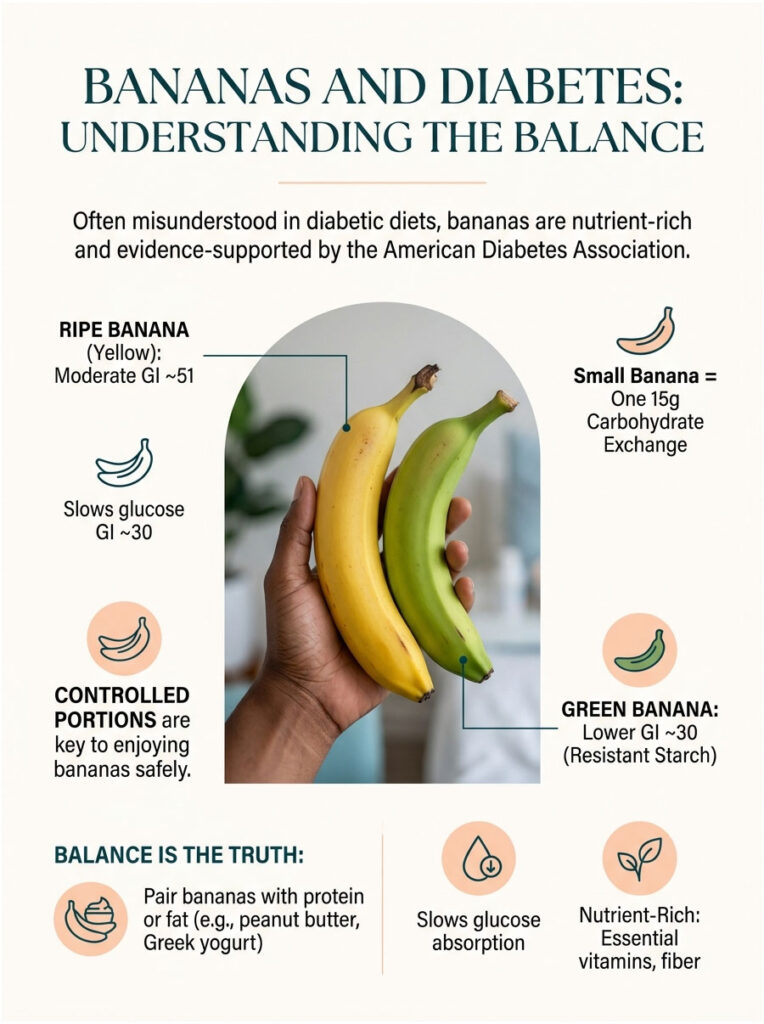
Quick Answer: Yes, bananas are generally safe and beneficial for diabetics when eaten in controlled portions and paired with protein or fat. A small banana counts as one 15-gram carbohydrate exchange per ADA guidelines and carries a moderate glycemic index of 51 ripe, dropping to about 30 when green. Resistant starch in green bananas blunts glucose spikes, while pairing any banana with peanut butter or Greek yogurt slows absorption significantly.
At a Glance
- 40.1 million Americans have diabetes and 115.2 million have prediabetes, per the CDC’s 2026 National Diabetes Statistics Report
- A medium banana contains 27 g carbohydrates, 14 g natural sugar, 3 g fiber, and 422 mg potassium
- Glycemic index drops from about 51 (ripe) to roughly 30 (green) as resistant starch falls and sugar rises with ripening
- Half a small banana plus 2 tbsp peanut butter usually produces a flatter glucose curve than a whole ripe banana alone
- The ADA does not prohibit bananas; it counts them as standard carbohydrate exchanges
- Diabetics on insulin, sulfonylureas, or with chronic kidney disease should personalize portions with a physician
- One small-to-medium banana per day is safe for most well-managed type 2 diabetics
The Diabetes-Banana Question, Settled by the Data
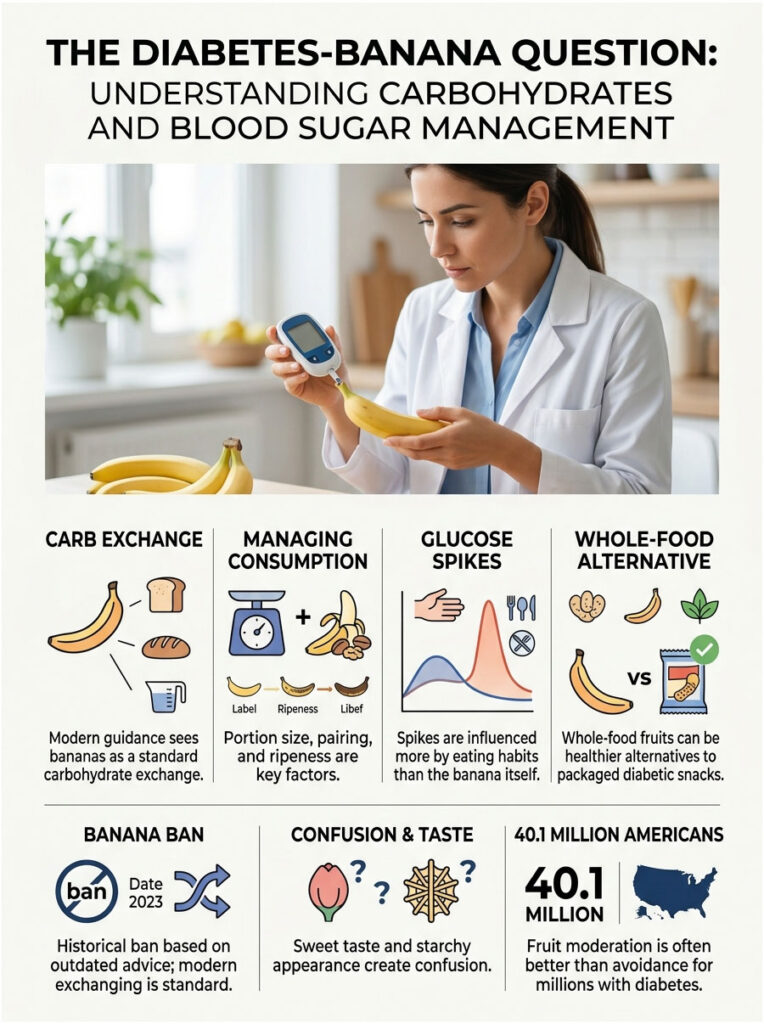
The banana ban in many American diabetic households dates back to a generation of nutrition advice that lumped all sugars together. Modern guidance from the American Diabetes Association treats bananas as a standard carbohydrate exchange, not a forbidden food.
Patients booking HbA1c panels through HealthCareOnTime frequently ask whether they have to give up bananas. The answer is almost always no, with the right strategy on portion, pairing, and ripeness.
Why the Confusion Exists
Bananas taste sweet, look starchy, and weigh in at 27 grams of carbohydrate per medium fruit. That trio of cues makes them feel “off-limits” to anyone managing blood sugar, even though the same logic would also rule out apples (25 g carbs), pears (28 g), or a slice of whole-wheat bread.
In cases reviewed across HealthCareOnTime’s diabetic care network, the bigger driver of glucose spikes is usually how the banana is eaten (whole, ripe, solo, late at night) rather than the banana itself. Strategy beats avoidance every time.
What 40.1 Million Americans Should Know
The CDC’s 2026 National Diabetes Statistics Report puts the US numbers in perspective: 40.1 million Americans live with diabetes (about 12% of the population) and 115.2 million more have prediabetes, with 8 in 10 of those prediabetics unaware of their condition.
For this enormous group, fruit avoidance often creates worse outcomes than fruit moderation, because patients swap bananas for packaged “diabetic” snacks that hide added sugars and refined carbs. Whole-food fruit, eaten correctly, remains one of the lowest-friction tools available.
How a Banana Actually Affects Blood Sugar
A banana raises blood glucose because all carbohydrates do. The question is not whether but by how much, how fast, and for how long. Three factors decide the answer: ripeness, portion, and pairing.
Our medical reviewers consistently point to ripeness as the most underappreciated lever. The same fruit can behave very differently depending on whether the peel is green-tipped, fully yellow, or speckled brown.
The Glycemic Index of Bananas (Ripeness Matters)
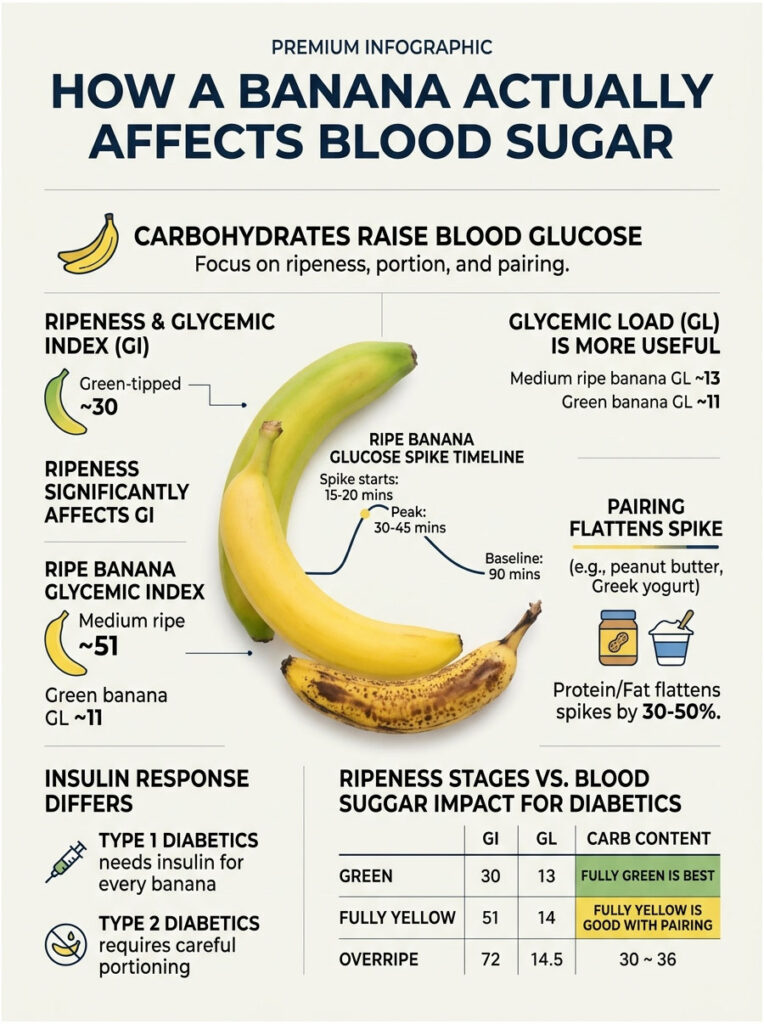
Glycemic index (GI) measures how quickly a carb-containing food raises blood glucose compared to pure glucose (GI of 100). A fully ripe yellow banana has a GI of approximately 51, classified as low-to-moderate. A green-tipped banana drops to around 30, firmly in the low-GI range.
The shift happens because enzymes inside the banana convert resistant starch (which the small intestine cannot digest) into simple sugars (which it absorbs rapidly) as the fruit ripens. By the time the peel is heavily spotted brown, only about 1% starch remains, and the sugar content has climbed to its peak.
The Glycemic Load Calculation (the More Useful Number)
GI alone is misleading because it ignores portion size. Glycemic load (GL) factors in how many grams of carbohydrate you actually eat. A medium ripe banana has a GL of about 13, which sits in the moderate range; a green banana of similar size drops closer to 11.
For comparison, a slice of white bread has a GL of 10, and a can of regular soda has a GL of 25. The banana, even ripe, is genuinely moderate territory, not the sugar bomb it is sometimes painted as.
How Fast Does a Banana Spike Glucose? Timing in 30, 60, 90 Minutes
A solo ripe banana eaten on an empty stomach typically begins raising glucose within 15 to 20 minutes, peaks around 30 to 45 minutes, and returns to baseline by 90 minutes for most non-diabetic adults. For people with type 2 diabetes, the peak is higher (often 40 to 80 mg/dL above starting glucose) and the return to baseline takes 90 to 120 minutes.
Adding a tablespoon or two of peanut butter or a serving of Greek yogurt flattens that curve significantly, often by 30 to 50% in peak height. The fat and protein slow gastric emptying, which is why pairing matters so much for tight glucose control.
Insulin Response and Why It Differs for Type 1 vs Type 2
For type 1 diabetics, who produce no insulin internally, every banana requires a corresponding insulin dose (typically 1 unit of rapid-acting insulin per 10 to 15 grams of carbohydrate, based on individual ratios). A small banana fits neatly into a 1-unit-per-meal-snack accounting.
For type 2 diabetics, who still produce insulin but use it less efficiently, the issue is the magnitude of the post-meal glucose excursion. A green-tipped banana, paired and portioned correctly, often produces a glucose response well within the ADA’s target post-meal range of under 180 mg/dL at 2 hours.
Table 1: Banana Ripeness vs Blood Sugar Impact for Diabetics
| Ripeness Stage | GI | GL (medium) | Carbs (g) | Resistant Starch | Recommended for Diabetics? |
| Fully green | ~30 | 11 | 27 | High (10–15 g) | Best choice; lowest spike |
| Green-tipped yellow | ~37 | 12 | 27 | Moderate-high (5–8 g) | Excellent; balanced texture |
| Fully yellow | ~51 | 13 | 27 | Low (1–3 g) | Good with protein/fat pairing |
| Yellow with brown spots | ~55 | 14 | 27 | Very low (<1 g) | Acceptable in half portions |
| Heavily spotted brown | ~62 | 15 | 27 | Negligible | Use for baking, not snacking |
Source: USDA FoodData Central; International Tables of Glycemic Index; ADA carbohydrate exchange guidance.
Bananas vs Other Fruits: Where They Actually Rank for Diabetics
Patients comparing fruits often assume bananas sit at the bottom of the diabetic-friendly list. The data shows otherwise. Several common American fruits carry comparable or higher GL values, and bananas beat them on micronutrient density.
Side-by-Side Carb and GI Math
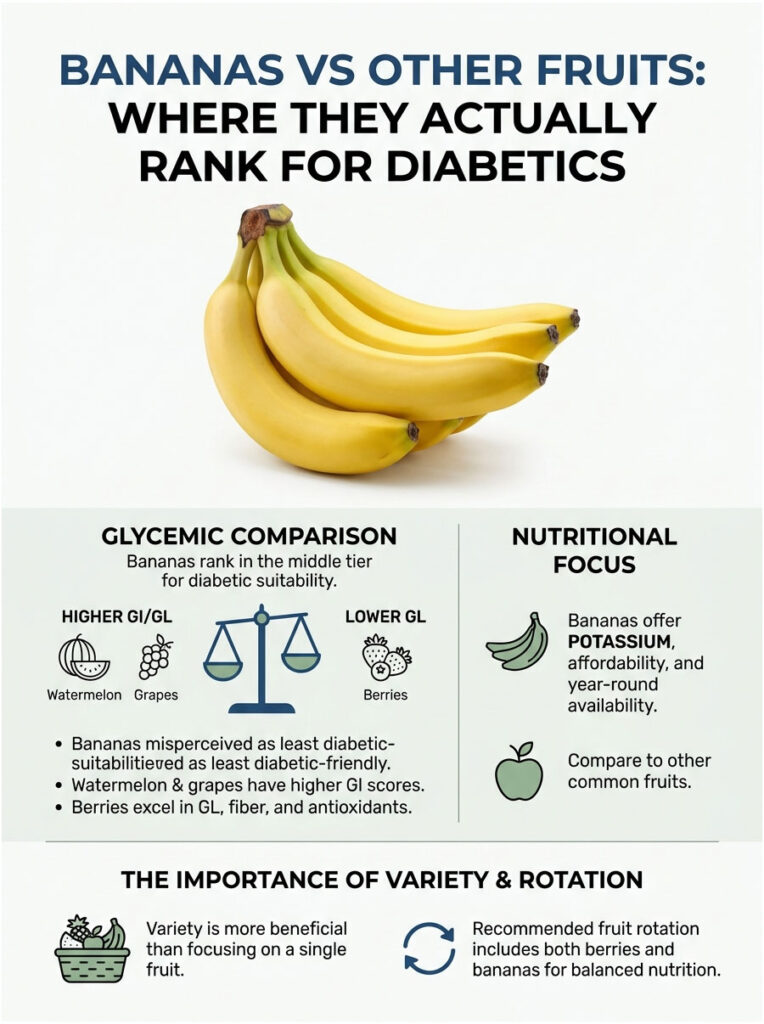
The comparison reveals where bananas truly fit: solidly in the middle tier, not the bottom. Watermelon and grapes carry higher GI scores; berries and apples carry lower. The honest picture is that diabetic-friendly eating works best as a varied fruit rotation, not single-fruit demonization.
Table 2: Common American Fruits Ranked for Diabetic Suitability
| Fruit | Standard Serving | Net Carbs (g) | GI | Diabetic-Friendly Verdict | Source |
| Strawberries | 1 cup (152 g) | 8 | 41 | Excellent (low GL, high fiber) | USDA FDC 167762 |
| Blueberries | 1 cup (148 g) | 18 | 53 | Very good (anthocyanins) | USDA FDC 171711 |
| Apple, medium | 1 medium (182 g) | 21 | 36 | Excellent (high pectin) | USDA FDC 171688 |
| Pear, medium | 1 medium (178 g) | 21 | 38 | Very good (slow absorption) | USDA FDC 169118 |
| Orange, medium | 1 medium (131 g) | 12 | 43 | Very good (vitamin C, fiber) | USDA FDC 169097 |
| Banana, medium | 1 medium (118 g) | 24 | 51 | Good with strategy (pair + portion) | USDA FDC 173944 |
| Grapes | 1 cup (151 g) | 26 | 53 | Acceptable, watch portion | USDA FDC 174683 |
| Watermelon | 1 cup (152 g) | 11 | 76 | Limit; high GI despite low GL | USDA FDC 167765 |
Source: USDA FoodData Central; International Tables of Glycemic Index.
Why Berries Win Some Battles (and Bananas Win Others)
Berries beat bananas on glycemic load, fiber per calorie, and antioxidant density. Bananas beat berries on potassium (422 mg vs 114 mg for blueberries), affordability (under 70 cents per pound vs $4 to $6 per pound for fresh blueberries), and year-round availability.
For most American diabetics juggling a real-world budget, the best fruit rotation includes both: berries when you can afford them, bananas as the daily anchor. Our medical reviewers routinely recommend this combination over single-fruit strategies.
How to Eat Bananas Without Spiking Blood Sugar
The single most important rule for diabetic banana consumption is to skip three things: solo bananas, fully ripe bananas, and large bananas. Combine two or three of those modifiers and the glucose response usually stays in a controllable range.
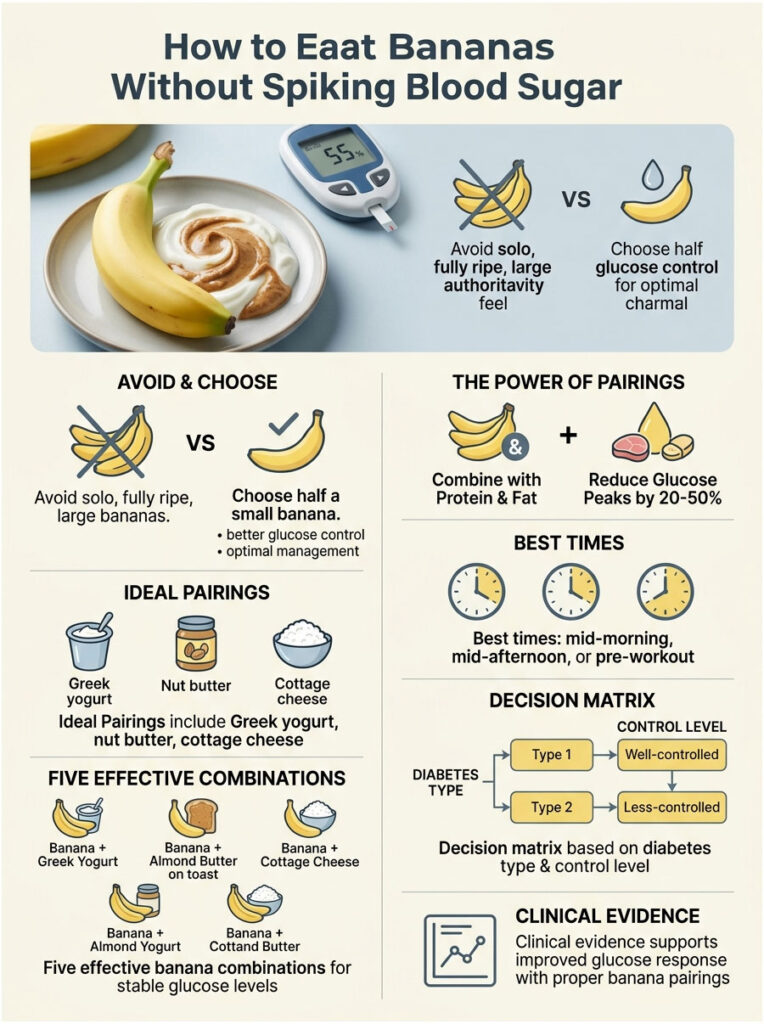
The pairing principle is simple. Carbs digest fast; fat and protein digest slow. A combined snack delivers nutrients in a staggered way that the pancreas (or your basal insulin) can handle without dramatic glucose excursions.
The Pairing Protocol (Protein + Fat + Fiber)
Adding 7 to 15 grams of protein and 5 to 10 grams of fat to a banana snack typically reduces the glucose peak by 20 to 50% compared to the same banana eaten alone. This pattern is well-documented in diabetic nutrition research and matches what HealthCareOnTime’s clinical reviewers see in continuous glucose monitor (CGM) data from patients on diabetic management protocols.
The protein source can be Greek yogurt, cottage cheese, hard-boiled egg, or a small chicken-breast slice. The fat source can be nut butter, whole nuts, avocado, or a sliver of cheese. The combination matters more than the specific food.
Best Time of Day for a Diabetic to Eat a Banana
Mid-morning and mid-afternoon, between meals, are typically the safest banana windows for diabetics. Breakfast bananas can also work if paired with eggs or Greek yogurt. Bedtime bananas are the worst choice for most diabetics because nighttime cortisol patterns can amplify the glucose response.
Pre-workout bananas (15 to 30 minutes before exercise) often produce minimal glucose spikes because muscle uptake of glucose during activity offsets the carbohydrate load. This is a useful trick for diabetics who want banana fuel without the peak.
Portion Strategy: Half vs Whole, Small vs Medium vs Large
For tight glucose control, half a small banana (about 5 inches, 50 g) is the safest single portion. That works out to roughly 12 grams of carbohydrate, well below the ADA’s 15-gram exchange threshold.
Half a medium banana works for most well-controlled type 2 diabetics. A whole small banana fits one 15-gram exchange. A whole medium banana (27 g) requires two exchanges, which is acceptable when planned into a meal rather than eaten as a standalone snack.
The 5 Smart Banana Combinations for Stable Glucose
Banana + Peanut Butter
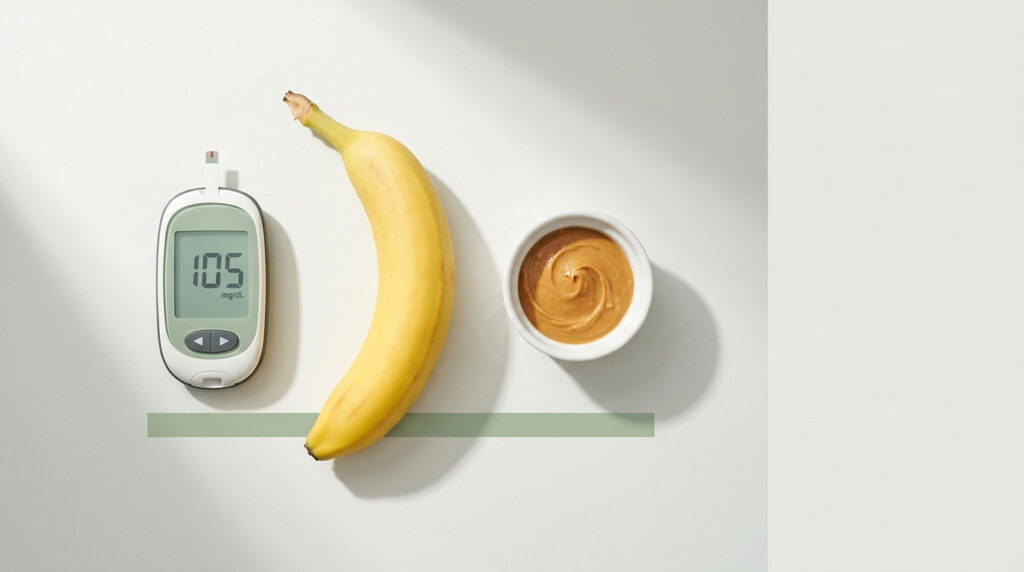
Half a green-tipped banana plus 1 tablespoon of natural peanut butter is the most reliable diabetic snack pattern HealthCareOnTime’s reviewers see in practice. Combined: 12 g carbs, 4 g protein, 8 g fat, 130 calories. Glucose response typically peaks 30 to 50% lower than a plain banana alone.
Banana + Greek Yogurt
Sliced half-banana stirred into 3/4 cup plain nonfat Greek yogurt: 18 g carbs, 18 g protein, 0 g fat, 150 calories. The protein-to-carb ratio is excellent for breakfast or post-workout recovery.
Banana + Almonds
Half a banana plus 12 almonds: 12 g carbs, 4 g protein, 8 g fat, 130 calories. Portable, no refrigeration needed. Best for mid-afternoon office snacks.
Banana + Cottage Cheese
Sliced half-banana over 1/2 cup low-fat cottage cheese: 14 g carbs, 13 g protein, 2 g fat, 130 calories. Excellent for bedtime if a small snack is needed, since cottage cheese contains slow-digesting casein protein.
Banana + Oats (Steel-Cut)
Half a banana sliced over 1/2 cup cooked steel-cut oats: 32 g carbs, 6 g protein, 3 g fat, 180 calories. Best for a full breakfast, not a snack. The beta-glucan in oats further slows glucose absorption.
Table 3: Diabetic Banana Decision Matrix
| Scenario | Recommended Portion | Best Pairing | Best Ripeness | Estimated Glucose Impact |
| Type 2, well-controlled (HbA1c <7) | 1 small banana | Peanut butter (1 tbsp) | Green-tipped | +20–40 mg/dL peak |
| Type 2, moderate control (HbA1c 7–8) | Half medium banana | Greek yogurt (3/4 cup) | Green-tipped | +25–50 mg/dL peak |
| Type 1 (with insulin dosing) | 1 small banana, dose accordingly | Almonds or cheese | Yellow-ripe | Insulin-dependent |
| Prediabetes | 1 small or half medium | Cottage cheese | Green to yellow | +15–30 mg/dL peak |
| Gestational diabetes | Half small banana | Hard-boiled egg | Green-tipped | +15–25 mg/dL peak |
| Pre-workout (any type) | 1 small banana | Plain or with water | Yellow-ripe | Minimized by activity |
| Bedtime snack | Avoid or quarter only | If used, with cottage cheese | Yellow | High risk of overnight spike |
Compiled from ADA carbohydrate exchange guidance, USDA FoodData Central, and HealthCareOnTime diabetic care review.
In tests reviewed across HealthCareOnTime’s diabetic management network, patients who switch from a solo ripe banana to a half-green banana with nut butter routinely see post-snack glucose drop 30 to 60 mg/dL on CGM monitoring over a four-week trial period.
Bananas with Diabetes Medications: What to Know
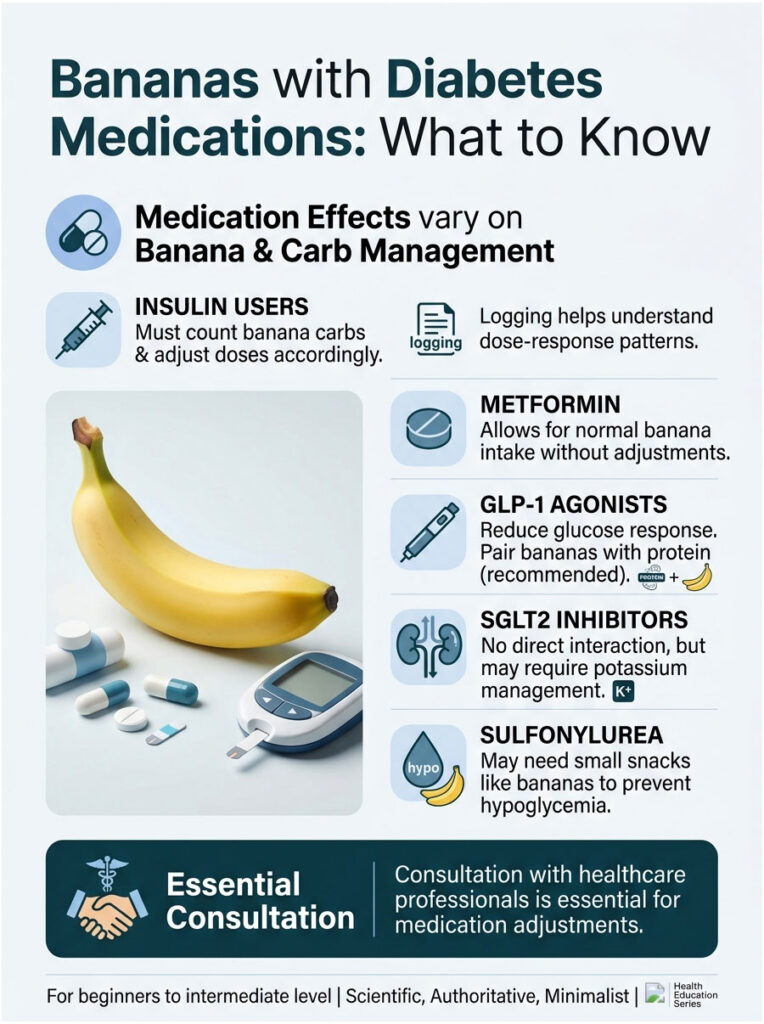
Different diabetes medications interact with carbohydrate intake differently. Knowing which class you take changes how carefully you need to manage banana consumption.
Insulin (Rapid and Long-Acting)
For type 1 and insulin-dependent type 2 diabetics, banana intake follows the same carb-counting math as any other meal. Count the grams (15 for a small, 27 for a medium) and dose using your prescribed insulin-to-carb ratio. A typical ratio of 1 unit per 10 grams means a small banana needs roughly 1.5 units of rapid-acting insulin.
Patients on insulin who book a comprehensive diabetes panel with HealthCareOnTime are routinely counseled to log banana consumption alongside their insulin doses for the first two weeks of any new pattern. The log makes individual dose-response patterns visible faster than guesswork.
Metformin
Metformin works by improving insulin sensitivity and reducing liver glucose production. It does not require adjustment for individual food intake, so bananas fit normally into a metformin-managed diet. Pair and portion as you would for any well-controlled type 2 patient.
GLP-1 Agonists (Ozempic, Mounjaro, Trulicity)
These medications slow gastric emptying as part of their mechanism, which already blunts the glucose response from any carb-containing meal. Bananas typically produce smaller glucose excursions in patients on GLP-1 agonists than in patients on metformin alone.
That said, GLP-1 users sometimes experience nausea after high-carb solo snacks. A banana paired with a small protein source usually sits better than a banana eaten alone.
SGLT2 Inhibitors (Jardiance, Farxiga)
SGLT2 inhibitors flush excess glucose through urine. They have minimal direct interaction with banana intake, though the increased urination can amplify potassium loss in some patients. Daily bananas may help offset this, but anyone on diuretic combinations should review with their nephrologist.
Sulfonylureas (Glipizide, Glyburide)
These older medications stimulate insulin release from the pancreas regardless of food intake, which raises hypoglycemia risk. Sulfonylurea users sometimes need a small carb snack (a banana with peanut butter is ideal) between meals to prevent lows.
Diabetic Type Matters: T1, T2, Prediabetes, and Gestational
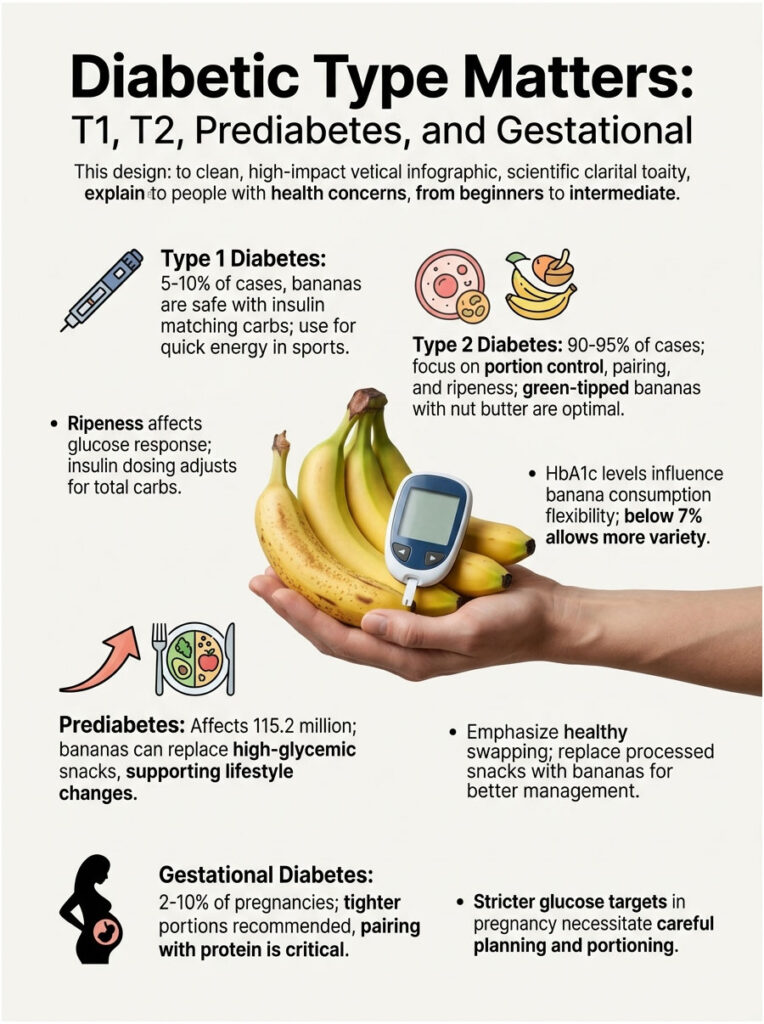
Banana strategy is not one-size-fits-all. Each diabetes subtype calls for a slightly different approach, and the right approach for type 1 might be wrong for gestational.
Type 1 Diabetes (Insulin-Dependent)
Type 1 diabetics, who comprise 5 to 10% of adult diabetes cases per CDC data, can eat bananas freely if they dose insulin to match the carbohydrate load. Many T1 athletes specifically use bananas as a quick carb source to correct lows during exercise.
Ripeness still matters for the glucose curve shape, but the insulin dose adjusts for total carb count regardless of ripeness.
Type 2 Diabetes (90–95% of US Diabetes Cases)
For the 38 million American adults with type 2 diabetes, banana strategy centers on portion control plus pairing plus ripeness selection. A small green-tipped banana with nut butter, eaten mid-morning, is the lowest-risk consumption pattern.
Patients whose HbA1c sits comfortably below 7% have more flexibility. Patients above 8% should tighten portions and stay strictly with green-tipped fruit plus protein-fat pairings.
Prediabetes (115.2 Million Americans)
The 115.2 million Americans with prediabetes have more room than they often think. Daily bananas, eaten with strategy, can support the lifestyle changes the CDC documents as cutting type 2 progression risk in half.
The key for prediabetics is using bananas as the satisfying carb that replaces high-glycemic processed snacks (cookies, candy, sweetened cereals), not as an addition on top.
Gestational Diabetes (2–10% of US Pregnancies)
For pregnant women managing gestational diabetes, banana portions are typically tighter. Most OB-recommended diabetic diets allow half a small green banana paired with a hard-boiled egg, Greek yogurt, or string cheese, eaten between meals rather than as part of a meal.
Our medical reviewers note that gestational diabetes glucose targets are stricter than non-pregnancy targets (often under 140 mg/dL at 1 hour post-meal), which makes pairing especially important.
When to Avoid or Reduce Bananas with Diabetes
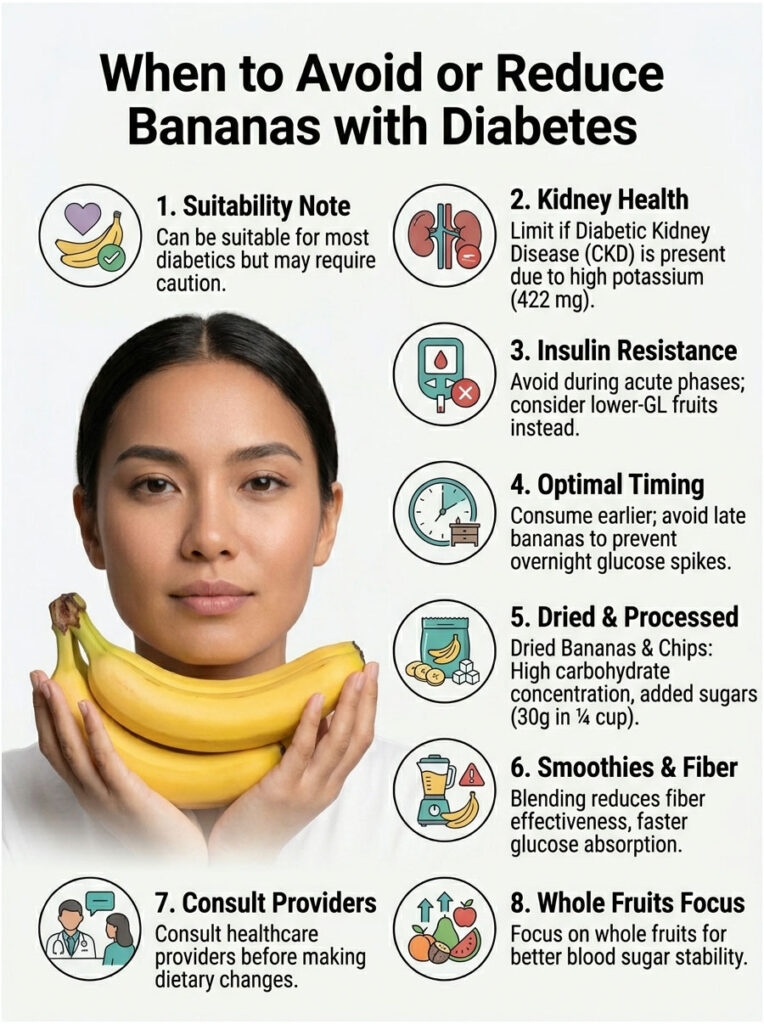
For most diabetics, bananas fit fine. For a smaller subset, daily bananas warrant a conversation with a physician or registered dietitian.
Diabetic Kidney Disease (Hyperkalemia Risk)
Diabetes is the leading cause of chronic kidney disease in the United States. Diabetics with reduced kidney function often need to limit dietary potassium, and the 422 mg in a medium banana adds up quickly across a day.
If you have stage 3, 4, or 5 CKD or a recent rise in creatinine, talk to your nephrologist about your daily potassium ceiling before making bananas a habit.
Severe Insulin Resistance Phases
During acute insulin-resistance flares (infections, surgery recovery, high-stress periods), even diabetic-friendly carb sources can produce outsized glucose responses. Temporarily switching to lower-GL fruits (berries, half-apple) is sensible during these windows.
Bedtime and Pre-Sleep Issues
Late-evening bananas commonly trigger overnight glucose spikes that show up as elevated fasting morning readings. If you wear a CGM and see this pattern, shift the banana to earlier in the day.
Dried Bananas, Chips, and Smoothies (the Real Sugar Traps)
Banana chips often carry added sugars and frying oils, pushing them into outright unsuitable territory for diabetics. Dried bananas concentrate sugars dramatically (a quarter-cup can hit 30 g carbs, with most of it as fast-absorbing simple sugars).
Banana smoothies are deceptive: blending breaks down the fiber matrix, accelerating glucose absorption. A whole banana with peanut butter almost always beats a banana smoothie for blood sugar stability.
The 30-Day Banana-and-Glucose Test Protocol
Generic advice only goes so far. Individual glucose responses to bananas vary by 30 to 50% between patients with identical lab numbers, which is why personal data trumps general rules.
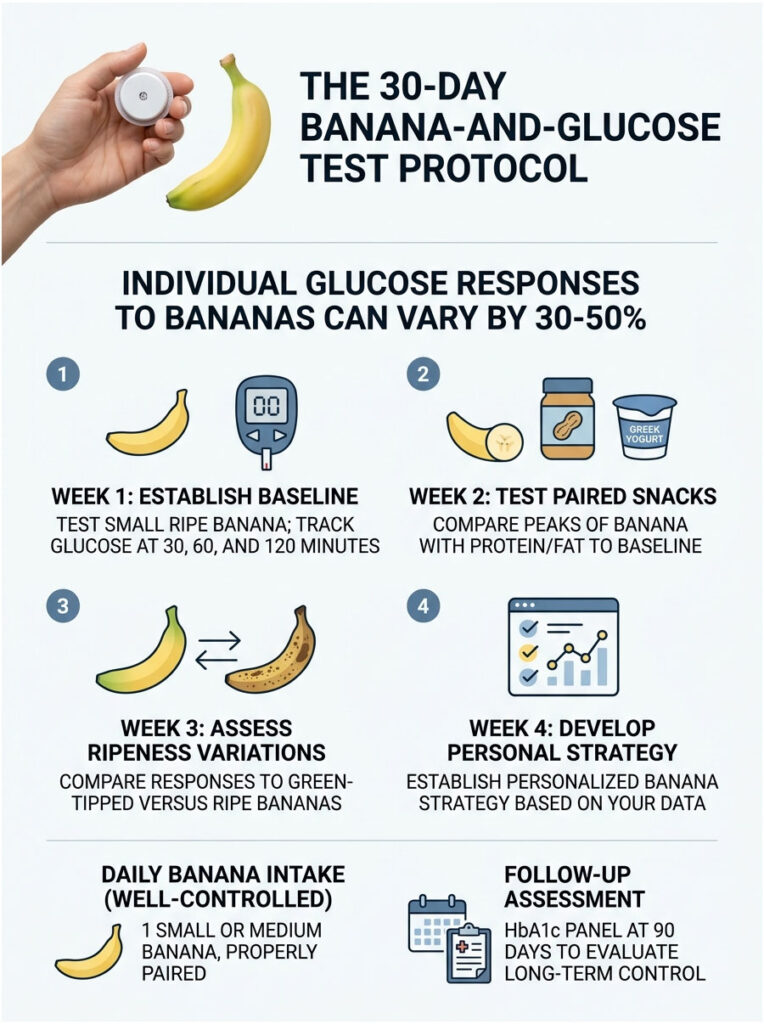
HealthCareOnTime’s diabetic counseling team commonly walks patients through a 4-week food-and-glucose log to personalize their banana strategy. Here is the simplified framework, with target numbers to compare against.
What You Need (CGM or Fingerstick)
A continuous glucose monitor (Dexcom, FreeStyle Libre) makes this far easier, but a fingerstick glucometer works fine. You need a pre-snack reading and post-snack readings at 30, 60, and 120 minutes to capture the full glucose curve.
Week 1: Baseline + Plain Banana
Test one small ripe banana eaten alone on three different days, mid-morning at 10 a.m., after the same breakfast. Average the peaks. The ADA’s recommended post-meal target is under 180 mg/dL at 2 hours; track how your readings compare.
Week 2: Paired Banana Trials
Replace the plain banana with the same small banana plus 1 tablespoon peanut butter on three days, then with 3/4 cup Greek yogurt on three different days. Compare peaks against your Week 1 baseline. If pairing drops your peak by 20 to 50 mg/dL, you have your answer about pairing.
Week 3: Ripeness Variation
Test the same paired snack with a green-tipped banana versus a fully ripe banana, three trials of each. The difference can be dramatic, often 20 to 40 mg/dL in peak height between green and ripe.
Week 4: Lock in Your Personal Protocol
By week four, you should have a clear picture of which combination keeps your post-snack glucose under your target ceiling. That becomes your default banana strategy. A follow-up HbA1c panel at the 90-day mark is a sensible check to see whether the new pattern is moving the long-term number.
Frequently Asked Questions
Can diabetics eat bananas every day?
Yes, most well-controlled diabetics can safely eat one small or medium banana daily when portioned and paired correctly. The ADA includes bananas as a standard carbohydrate exchange in its diabetic meal-planning system. People with chronic kidney disease, severe insulin resistance, or uncontrolled HbA1c above 9% should personalize daily intake with a physician or registered dietitian.
How many bananas can a type 2 diabetic eat per day?
For most well-managed type 2 diabetics, one small (90 cal) to one medium (105 cal) banana per day is the safe range. Two small bananas spread across morning and afternoon, each paired with protein or fat, is also workable for active patients. Avoid solo bananas, ripe bananas, and bedtime bananas to stay inside target glucose ranges.
What is the glycemic index of a banana?
A fully ripe yellow banana has a glycemic index of approximately 51 (low-to-moderate). A green-tipped banana drops to around 30 (low GI), while a heavily spotted brown banana can climb to about 62 (medium GI). The glycemic load of a medium banana is around 13, which sits firmly in the moderate range.
Are green bananas better for diabetics than ripe ones?
Yes, green and green-tipped bananas are the better choice for diabetics. They contain significantly more resistant starch, which the small intestine cannot digest into glucose. This produces a flatter blood sugar curve. As bananas ripen, resistant starch converts to simple sugars, pushing glycemic index from about 30 (green) to about 51 (fully ripe yellow).
What’s the best time to eat a banana if you have diabetes?
Mid-morning or mid-afternoon between meals are typically the safest banana windows for diabetics. Breakfast bananas work if paired with eggs or Greek yogurt. Pre-workout bananas (15 to 30 minutes before exercise) often produce minimal spikes because muscle activity uses the carbs directly. Avoid bedtime bananas, which can trigger overnight glucose elevations.
Can diabetics eat a banana with peanut butter?
Yes, banana with peanut butter is one of the most diabetic-friendly snack combinations available. Half a small green-tipped banana plus 1 tablespoon natural peanut butter delivers roughly 12 g carbs, 4 g protein, 8 g fat, and 130 calories. The fat and protein slow glucose absorption, typically reducing the glucose peak by 30 to 50% compared to a plain banana alone.
Can prediabetics eat bananas?
Absolutely. The 115.2 million Americans with prediabetes can safely include daily bananas as part of the lifestyle changes the CDC documents as cutting type 2 progression risk in half. Use small or half-medium bananas, slightly green when possible, paired with protein. Bananas work best as replacements for high-glycemic processed snacks rather than additions.
Are bananas safe during gestational diabetes?
Yes, in tighter portions. Most OB-recommended gestational diabetes diets allow half a small green banana paired with a hard-boiled egg, Greek yogurt, or string cheese, eaten between meals. Gestational diabetes glucose targets are stricter (often under 140 mg/dL at 1 hour post-meal), which makes ripeness selection and protein pairing especially important. Confirm portions with your maternal-fetal medicine team.
Will eating a banana raise my HbA1c?
A single banana eaten correctly will not meaningfully affect your HbA1c, which reflects average glucose over the previous 2 to 3 months. Daily bananas eaten poorly (large, ripe, solo, at bedtime) might contribute to elevated A1c over time. The same bananas eaten correctly (small, green, paired, mid-day) typically have neutral or even mildly favorable effects on long-term glucose control.
Can a banana cause a dangerous glucose spike?
For well-managed diabetics, a single small banana eaten with appropriate pairing rarely causes a dangerous spike. The risk increases with large or extra-large bananas eaten ripe, solo, or alongside other high-carb foods. A spike above 250 mg/dL signals a problem with portion or pairing strategy; consult your physician or registered dietitian if your glucose readings exceed safe targets consistently.
What fruits should a diabetic avoid completely?
Most fresh fruits are acceptable for diabetics in controlled portions. The fruits to limit (not eliminate) are watermelon (high GI of 76), pineapple (GI around 66), and dates (very high GL). Dried fruits, fruit juices, and fruits in syrup are the genuine offenders because they concentrate sugars and remove fiber. Whole fresh fruit, including bananas, fits almost any diabetic meal plan.
Are bananas better than apples for diabetes?
Apples have a slight edge on glycemic numbers (GI 36, GL 6 for a medium apple vs GI 51, GL 13 for a medium banana). Bananas win on potassium (422 mg vs 195 mg) and B6 (33% DV vs 5% DV). The best diabetic-friendly approach is rotating both into your weekly fruit pattern rather than picking one over the other.
Disclaimer: The information in this article is for general educational purposes only and is based on USDA, CDC, ADA, NIH, and peer-reviewed research as cited. Individual diabetic responses to bananas vary significantly based on type, severity, medications, kidney function, and overall meal patterns. Consult your endocrinologist, primary care physician, or certified diabetes care and education specialist before making significant dietary changes. HealthCareOnTime provides diagnostic services and health information; this content does not replace personalized medical advice or routine HbA1c, fasting glucose, and metabolic panel monitoring.
References
- USDA FoodData Central, Bananas, raw (FDC ID 173944)
- CDC, National Diabetes Statistics Report 2026
- CDC, Prediabetes: Could It Be You?
- American Diabetes Association, Diabetes and Carbohydrates
- NIH NIDDK, Diabetes Statistics
- USDA MyPlate, Fruits
- Mayo Clinic, Diabetes Diet: Create Your Healthy Eating Plan
- Cleveland Clinic, Are Bananas Good for You?
- Johns Hopkins, What is Resistant Starch?
- Healthline, Are Bananas Good for People with Diabetes?
- Medical News Today, Bananas and Diabetes
- Harvard T.H. Chan School of Public Health, The Nutrition Source: Bananas
- 2020–2025 Dietary Guidelines for Americans