
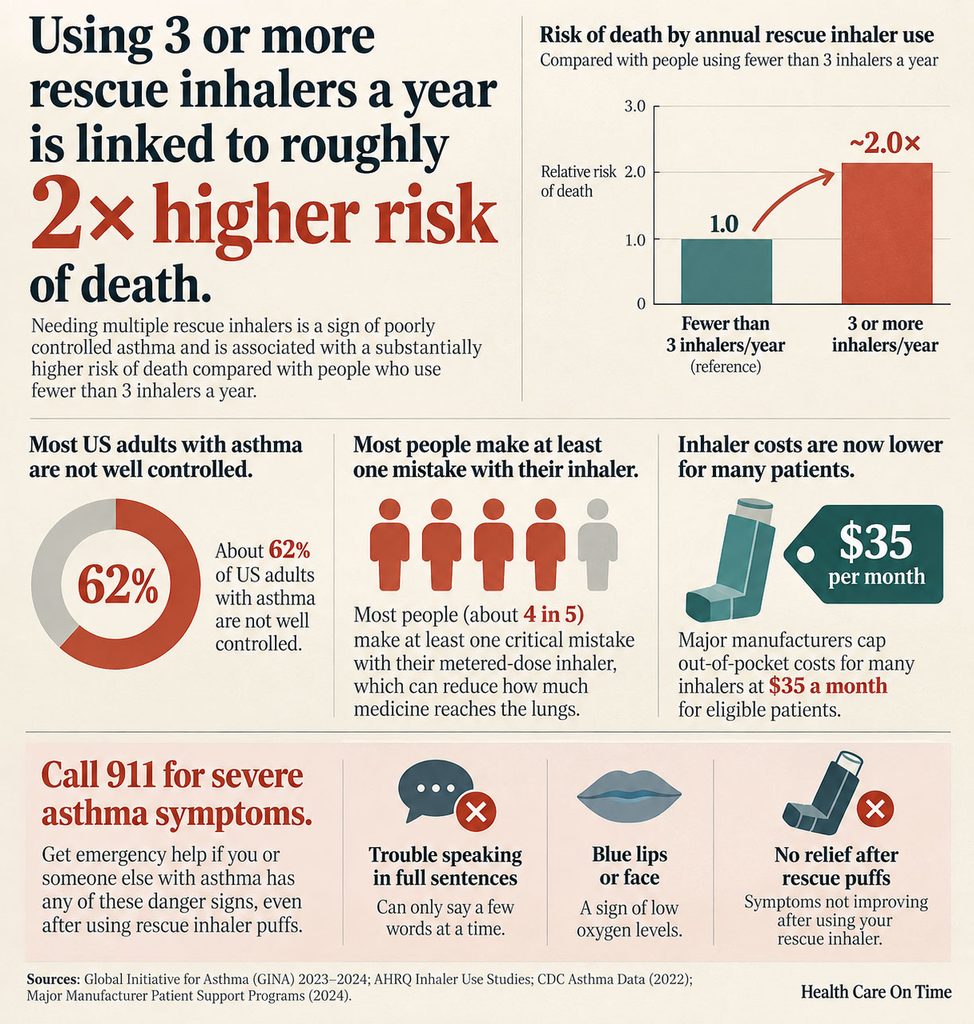
If your albuterol inhaler works every time, it’s easy to believe your asthma is under control. For most American adults with asthma, that belief is wrong. CDC researchers estimate asthma is uncontrolled in about half of children and 62% of adults, and many of those people feel “fine” between puffs.
Table of Contents
The quick-relief inhaler is doing exactly what it was built to do. The problem is what it was never built to do: calm the swelling inside your airways that sets up the next attack.
Quick Answer: Asthma management is the daily plan that keeps your airways calm, prevents attacks, and tells you what to do when symptoms flare. Current guidelines rest on four pillars: an inhaled-steroid-containing medicine (not a rescue inhaler alone), a written asthma action plan, correct inhaler technique, and control of triggers and related conditions like allergies, reflux, and smoking.
The 9 rules of modern asthma management:
- Use an inhaled corticosteroid in some form, even if your asthma is mild.
- Get a written asthma action plan with green, yellow, and red zones.
- Track how often you reach for your rescue inhaler.
- Treat 3 or more rescue canisters a year as a warning sign.
- Have your inhaler technique checked at every visit.
- Control the triggers that matter most: smoke, viruses, and work exposures.
- Treat allergies, reflux, and sleep problems that make asthma worse.
- Get a flu shot every year.
- See your doctor soon after any ER visit or steroid course.
At a Glance
- Every teen and adult with asthma should have a steroid-containing inhaler in their plan, not albuterol alone.
- Using 3 or more rescue inhalers a year is linked to roughly double the risk of death.
- About 62% of US adults with asthma are not well controlled.
- Most people make at least one mistake with their metered-dose inhaler.
- Major manufacturers cap out-of-pocket inhaler costs at $35 a month for eligible patients.
- Trouble speaking in full sentences, blue lips, or no relief after rescue puffs means calling 911.
What Asthma Management Really Means Now
Asthma is a long-term inflammatory disease of the airways. The lining stays swollen and twitchy even on good days, which is why cold air or a cold virus can tighten things so fast.
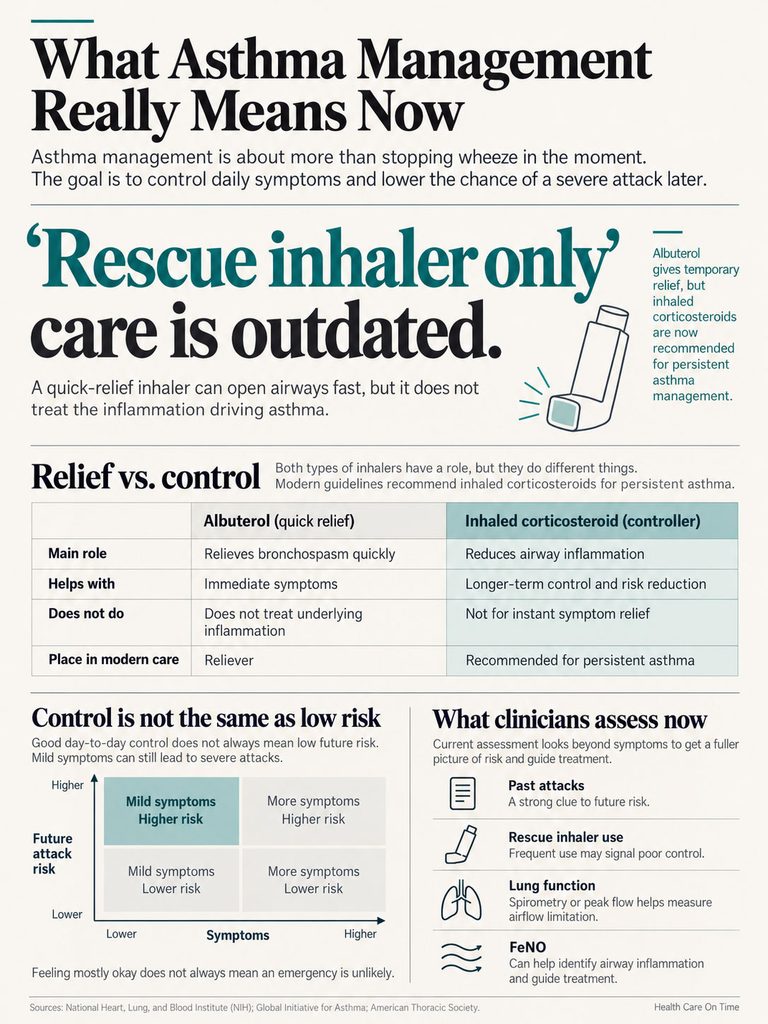
Good asthma management has two separate goals. The first is control: few symptoms, normal activity, and sleep without waking. The second is risk reduction: preventing severe attacks, ER visits, lasting lung damage, and death.
Control and Risk Are Not the Same Thing
People often assume that feeling okay means low risk. That’s not always true. Someone can have mild day-to-day symptoms and still land in the ER during a bad cold.
That’s why guidelines look past “how do you feel this week” and ask about attacks in the past year, rescue inhaler refills, and lung function. Our medical team weighs these risk signals alongside symptoms, because together they tell a much clearer story than either one alone.
Why “Rescue Inhaler Only” Care Was Retired
For decades, people with mild asthma were told to use albuterol when needed and nothing else. That has changed. The Global Initiative for Asthma (GINA) now advises that all adults and adolescents with asthma get a medicine containing an inhaled corticosteroid rather than a short-acting reliever alone.
The reason is simple. Albuterol opens tight airways for a few hours but does nothing for the inflammation underneath. Repeated relief without treatment lets the swelling build until a trigger tips it into a serious attack.
US guidance moved the same way. The NHLBI 2020 focused updates endorse inhaled corticosteroids used as needed for persistent asthma, long-acting muscarinic agents added to inhaled steroids, and FeNO testing to help guide care.
Confirming the Diagnosis First
Good asthma management starts with being sure it’s asthma. Chronic cough, wheezing, and breathlessness can also come from COPD, heart failure, reflux, vocal cord problems, or anxiety.
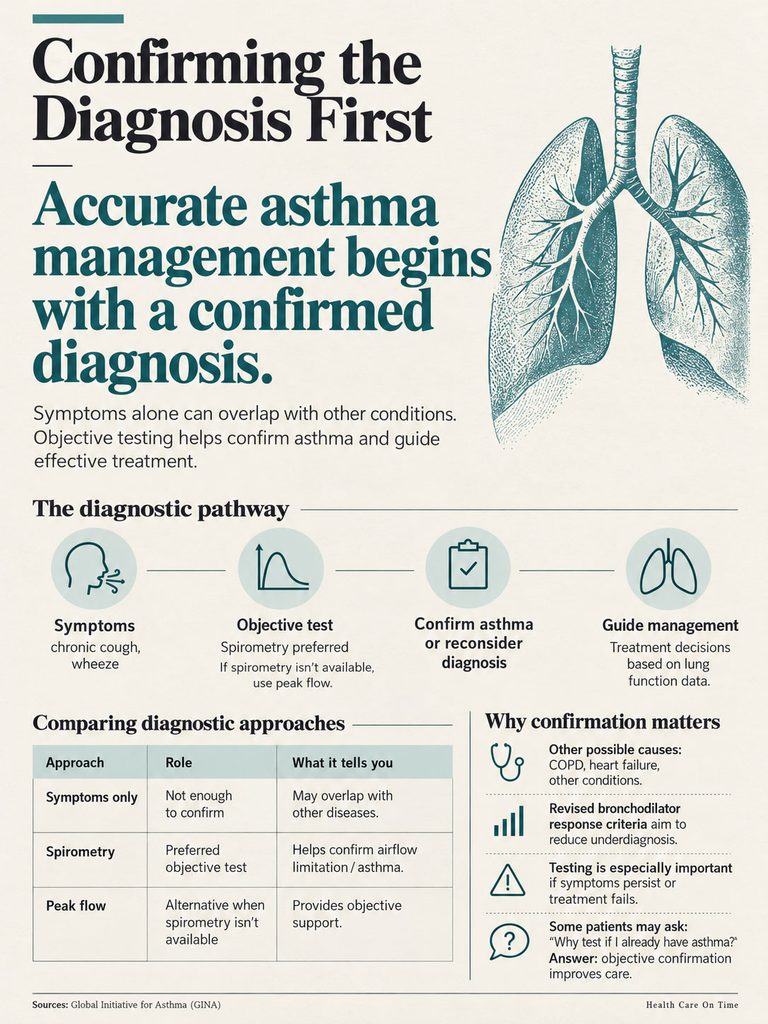
GINA 2026 stresses objective confirmation of asthma, ideally with spirometry, or peak flow where spirometry isn’t available. The 2026 report also revised its bronchodilator response criteria after large datasets showed asthma was being underdiagnosed.
Tests That Help
- Spirometry: You blow hard into a tube before and after a reliever. A clear improvement after the reliever points to asthma.
- FeNO (fractional exhaled nitric oxide): A simple breath test. Higher levels suggest allergic-type airway inflammation that usually responds well to inhaled steroids.
- CBC with differential: Shows your blood eosinophil count, a key marker for choosing biologic treatments in severe asthma.
- Total IgE and allergy testing: Identifies which allergens, if any, actually drive your symptoms.
Patients booking lung function tests with us often ask whether they need testing if they “already know” they have asthma. If you were diagnosed years ago from symptoms alone, or your treatment isn’t working, confirming the diagnosis is worth it.
The Medicines That Do the Work
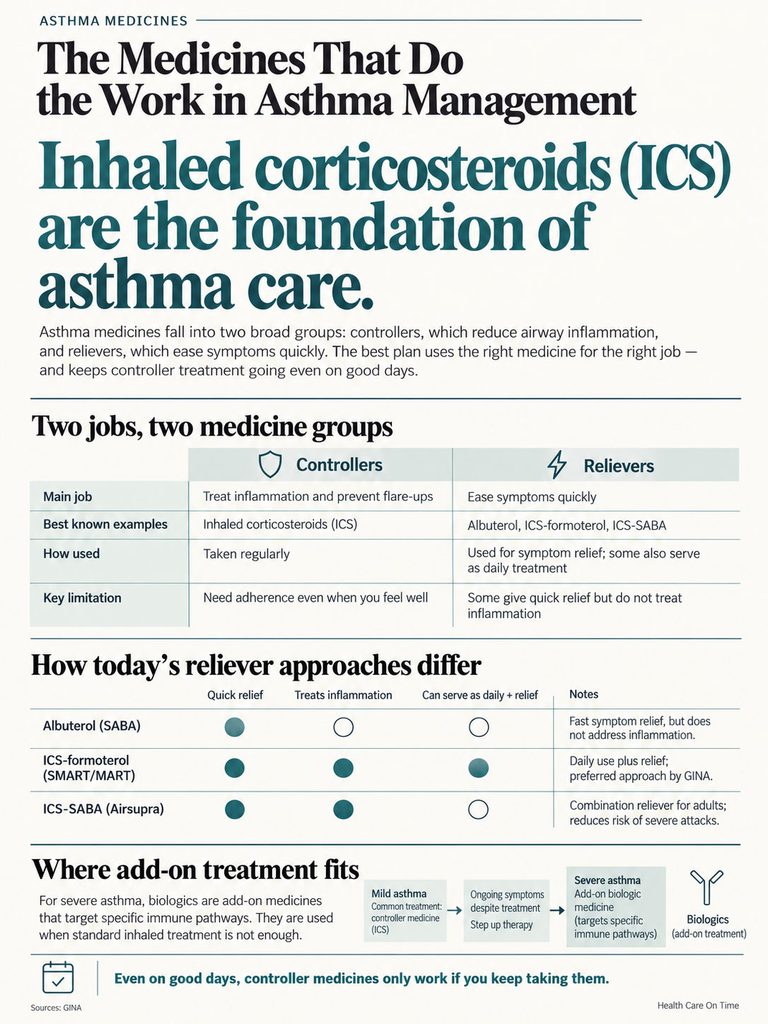
Asthma medicines fall into a few clear groups. Knowing which group each of your inhalers belongs to is the first step in using them well.
Controllers: Inhaled Corticosteroids
Inhaled corticosteroids (ICS) are the backbone of asthma care. Common examples include budesonide, fluticasone, beclomethasone, and mometasone.
These are not the steroids athletes misuse, and only a small dose reaches your bloodstream. They work slowly, over days to weeks, by calming airway swelling. Skipping them on “good days” quietly raises your risk.
Feeling well is the result of the controller working, not proof you don’t need it.
Relievers: Three Options, Not One
Relievers treat symptoms when they show up. There are now three kinds worth knowing.
Albuterol (SABA)
Albuterol, sold as ProAir, Ventolin, and generics, relaxes airway muscles within minutes. It stays an important backup in many plans. Used alone, though, it leaves inflammation untouched.
ICS-Formoterol (SMART or MART)
Some inhalers combine budesonide with formoterol, a long-acting bronchodilator that also starts working fast. With this approach, called SMART or MART, you use one inhaler daily and again whenever symptoms appear. Each relief puff also delivers steroid.
GINA lists this as its preferred approach (Track 1) for adults and teens. The GINA 2026 report keeps it first because it cuts severe attacks and oral steroid courses.
ICS-SABA (Airsupra)
Airsupra combines albuterol and budesonide in one rescue inhaler for adults 18 and older.
In the MANDALA trial of 2,940 adults with moderate to severe asthma, a first severe attack occurred in 20% of patients on the approved albuterol-budesonide dose versus 26% on albuterol alone. In mild asthma, the updated label shows a 46% lower risk of a first severe attack compared with albuterol.
The label caps use at 6 doses (12 inhalations) in 24 hours. Needing more is a red flag, not a reason to keep puffing.
Add-On Medicines
When an inhaled steroid alone isn’t enough, doctors may add:
- A long-acting bronchodilator (LABA), usually in the same inhaler as the steroid.
- A long-acting muscarinic antagonist (LAMA), such as tiotropium, for more airway opening.
- Montelukast (Singulair), a daily pill. It’s weaker than inhaled steroids, and the FDA added a boxed warning in 2020 about serious mood and behavior changes.
Biologics for Severe Asthma
Biologics are injections that block specific parts of the immune response. Examples include Dupixent, Fasenra, Nucala, Xolair, and Tezspire.
They’re for people with severe asthma who still have attacks despite high-dose inhaled treatment. The choice usually depends on blood eosinophils, total IgE, and FeNO results. In cases reviewed by our medical team, a high eosinophil count on a routine CBC is often the first lab clue that someone with hard-to-control asthma may qualify.
| Approach | How It Works | Best Fit | Effect on Severe Attacks | US Notes |
| Albuterol alone (SABA only) | Opens airways for 4 to 6 hours; no effect on inflammation | No longer advised alone for teens and adults | 3+ canisters a year tied to about 2x death risk | Cheap generic; still a backup in many plans |
| Daily ICS plus albuterol as needed | Steroid calms swelling daily; albuterol for symptoms | Mild to moderate persistent asthma | Long-standing standard; cuts attacks when taken daily | Generic budesonide and fluticasone available |
| ICS-formoterol (SMART/MART) | One inhaler for daily use and relief | Teens and adults; NAEPP also lists for ages 4+ at Steps 3 to 4 | GINA’s preferred track; fewer severe attacks and steroid bursts | Symbicort and generics; ask your doctor about reliever use |
| ICS-SABA reliever (Airsupra) | Albuterol plus budesonide in every rescue puff | Adults 18+ | 20% vs. 26% first severe attack (MANDALA); 46% lower risk in mild asthma (BATURA) | Included in AstraZeneca’s $35 cap |
| Montelukast pill | Blocks leukotrienes | People who can’t use inhalers; asthma plus nasal allergies | Weaker than inhaled steroids | FDA boxed warning for mood changes (2020) |
| Biologic injections | Target IgE, IL-5, IL-4/13, or TSLP | Severe asthma with type 2 markers | Fewer attacks and less oral steroid use | Specialist care; prior authorization common |
Your Written Asthma Action Plan
An asthma action plan is a one-page set of instructions written with your doctor. It tells you what to take every day, what to do when symptoms build, and when to get emergency help.
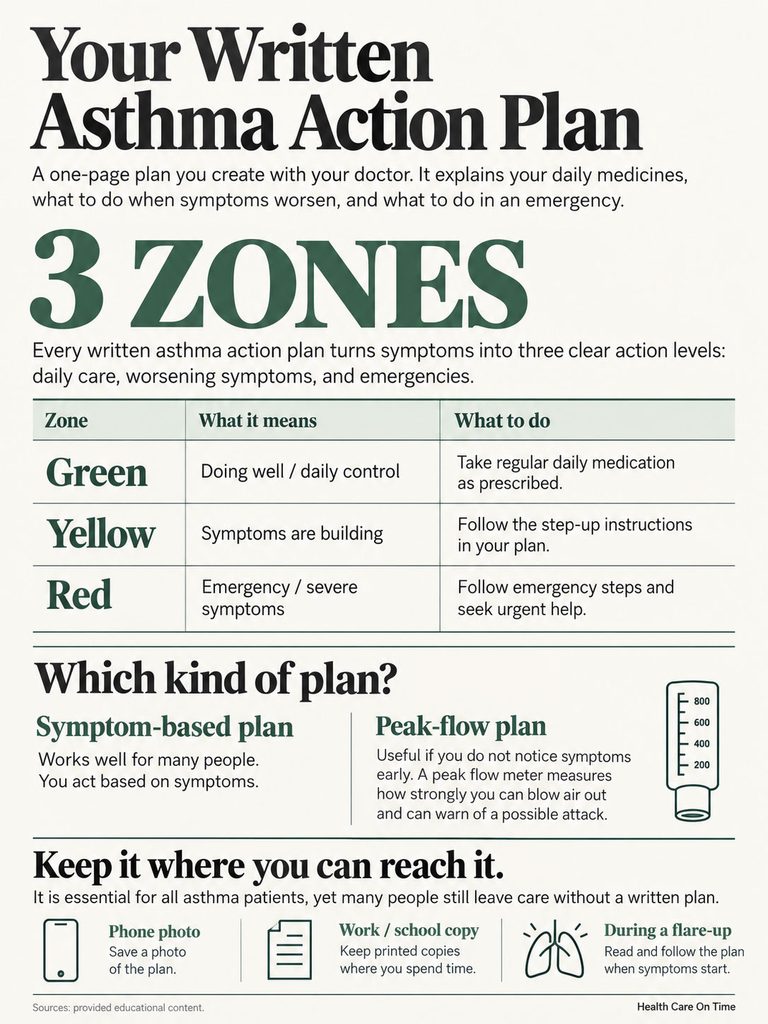
Everyone with asthma should have one. Yet many adults leave appointments with a prescription and no plan at all.
The Three Zones
- Green zone (doing well): No cough, wheeze, or night waking. Peak flow is 80% or more of your personal best. Take your daily controller as prescribed.
- Yellow zone (getting worse): Cough, wheeze, chest tightness, or waking at night. Peak flow is 50% to 79%. Use your reliever and follow your step-up instructions.
- Red zone (medical alert): Very short of breath, rescue medicine not helping, or peak flow under 50%. Take your reliever and call 911 or go to the ER.
What to Fill In Before You Leave the Office
- The name and dose of each inhaler, and which one is your reliever.
- Your personal best peak flow, if you use a meter.
- Exactly how many extra puffs to take in the yellow zone, and for how long.
- When to start an oral steroid, if your plan includes one.
- The point at which you must call the office or 911.
Keep a photo on your phone and a printed copy at work or school.
Peak Flow vs. Symptom-Based Plans
A peak flow meter is a small handheld tube that measures how hard you can blow air out. NHLBI notes a low reading can warn of an attack before you notice symptoms.
Peak flow plans help people who don’t sense their symptoms well, such as some older adults. Symptom-based plans work for many others. Either way, the plan only helps if you actually read it during a flare.
How to Tell If Your Asthma Is Controlled
Many people grow used to symptoms and stop noticing them. A quick self-check every few weeks catches slipping control early.
The “Rule of 2s” Self-Check
Your asthma may not be well controlled if you:
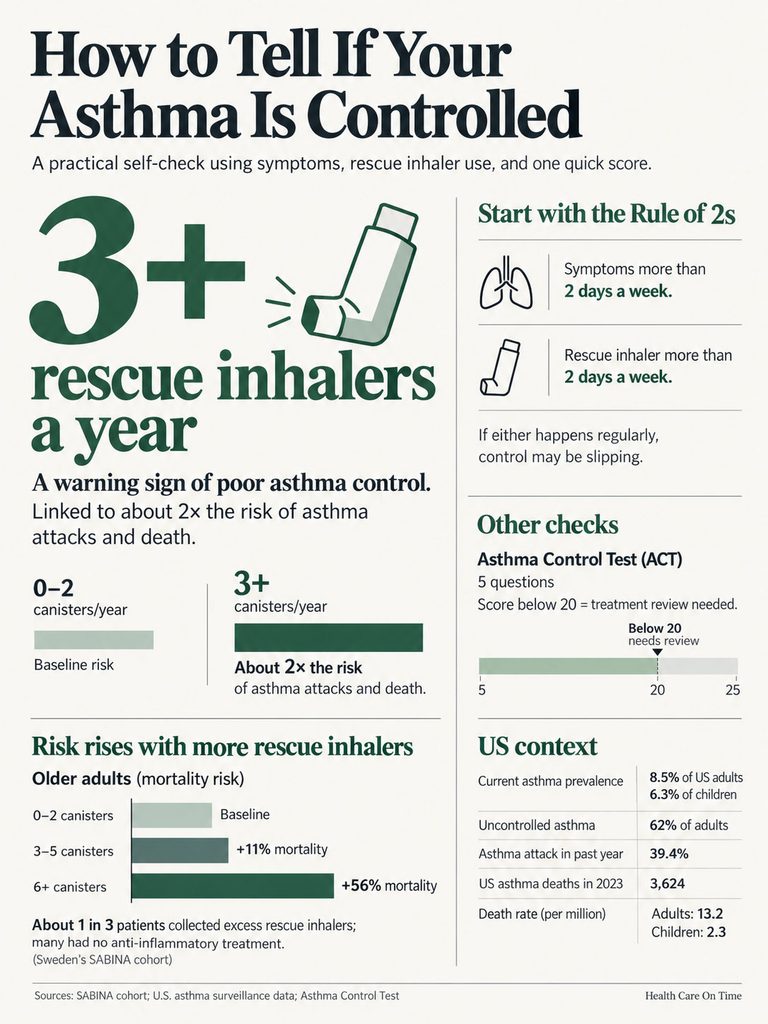
- Use your rescue inhaler more than 2 days a week.
- Wake up at night with asthma more than 2 times a month.
- Refill your rescue inhaler more than 2 times a year.
Hitting any of these is a reason to book a visit, not to buy more albuterol.
The 3-Canister Warning Sign
Rescue inhaler refills are one of the clearest risk signals in asthma care. In Sweden’s national SABINA cohort of 365,324 patients, one in three collected three or more rescue canisters a year, and 28% of those overusers had no anti-inflammatory medicine at all.
The risk climbs with each canister. A meta-analysis of 27 studies found 3 or more canisters a year was linked to about twice the risk of death and about twice the rate of attacks.
Older adults are not exempt. In an Ontario study, 3 to 5 canisters a year was tied to an 11% higher risk of death, and 6 or more to a 56% higher risk.
The Asthma Control Test
The Asthma Control Test (ACT) is a free, five-question quiz about the past four weeks. A score of 20 to 25 suggests good control. A score of 19 or lower means your treatment likely needs a review.
Bring your score to your next visit. It turns “I’m okay, I guess” into a number your doctor can act on.
| Measure | Figure | Source |
| US adults with current asthma | 8.5% (2025) | CDC FastStats, NHIS |
| US children with current asthma | 6.3% (2025) | CDC FastStats, NHIS |
| Asthma deaths in the US | 3,624 in 2023 (10.8 per million) | CDC Most Recent Asthma Data |
| Adult vs. child death rate | 13.2 vs. 2.3 per million (2023) | CDC Most Recent Asthma Data |
| Adults whose asthma is uncontrolled | About 62% | CDC Preventing Chronic Disease, 2024 |
| People with asthma who had an attack in the past year | 39.4% | CDC Preventing Chronic Disease, 2024 |
| Women vs. men with current asthma | 9.8% vs. 6.2% | CDC Preventing Chronic Disease, 2024 |
| Adult asthma that is work-related | 15.7% (about 1.9 million cases) | AAAAI, citing CDC NHIS |
| US patients making 1+ metered-dose inhaler error | 86.7% | Meta-analysis of US studies |
The pattern is clear. CDC counted 3,624 asthma deaths in 2023, with adults dying at 13.2 per million versus 2.3 per million for children. Adults are the group most at risk and the group most likely to be under-treated.
Can You Ever Step Down?
Asthma treatment isn’t a one-way escalator. Once your asthma has been well controlled for about three months, your doctor may lower your controller dose to the smallest amount that keeps you stable.
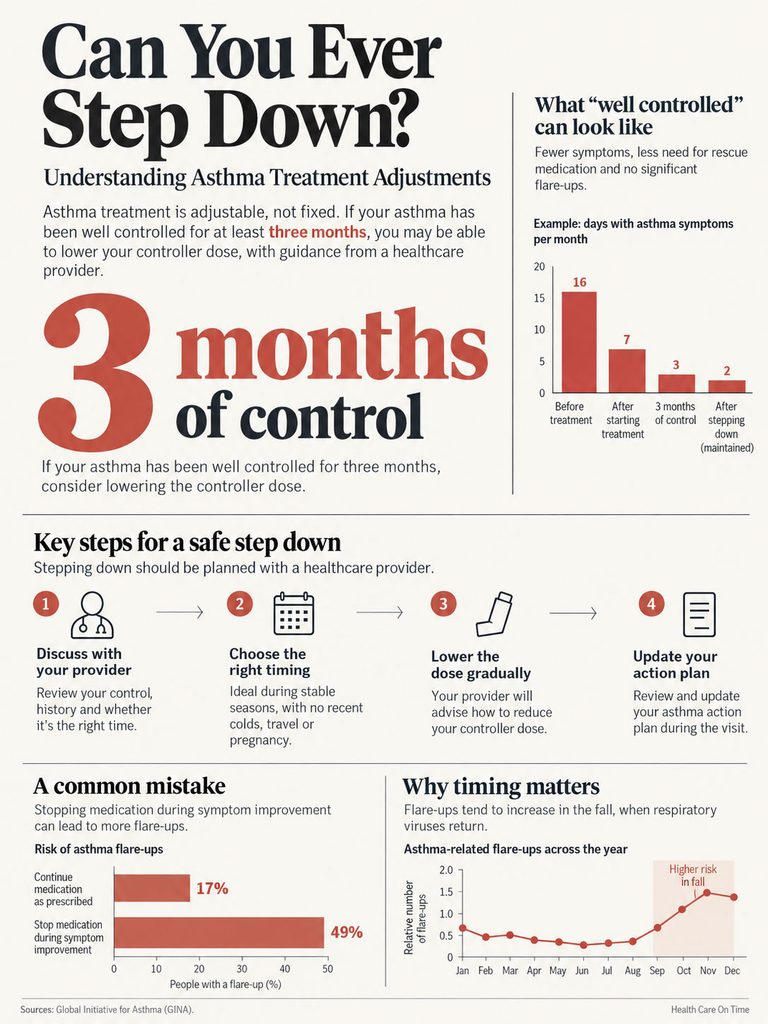
Stepping down should be planned, not done on your own. Good timing is a stable season with no recent colds, travel, or pregnancy. Your action plan should be updated at the same visit so you know what to do if symptoms return.
Across patients we serve, the most common mistake is the “summer break”: stopping a controller when symptoms fade, then flaring in the fall when viruses return.
Inhaler Technique: The Fix Nobody Checks
The best medicine won’t help if it lands on your tongue instead of in your lungs. Poor technique is one of the most common, and most fixable, reasons asthma stays uncontrolled.
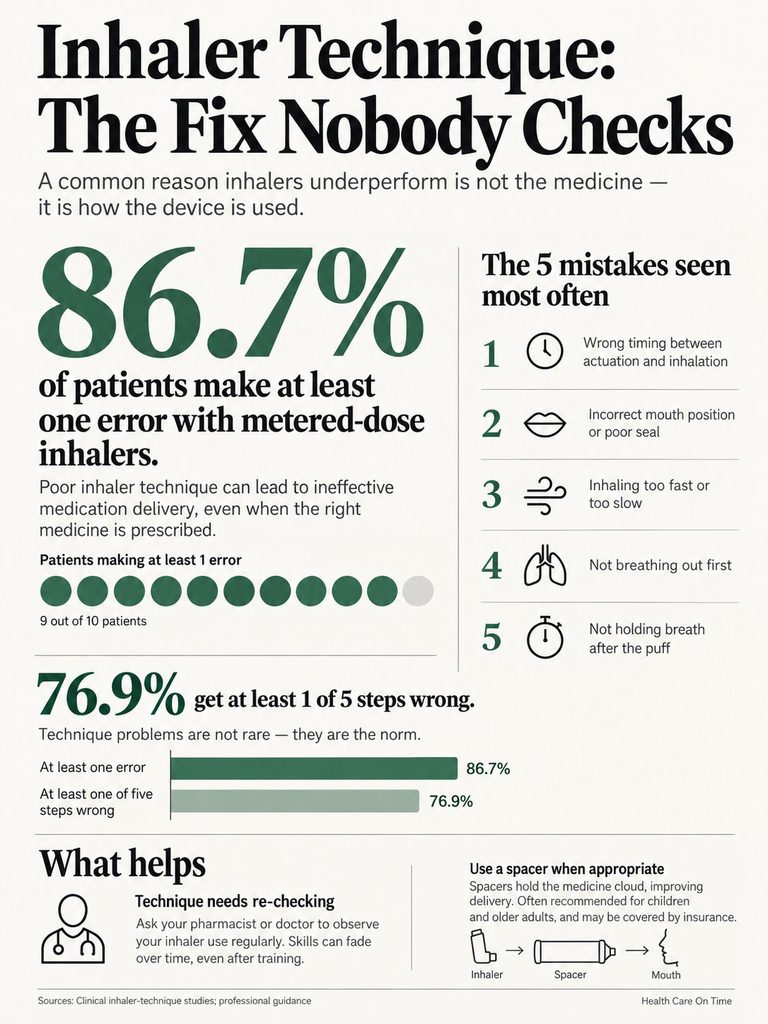
A meta-analysis of US studies found 86.7% of patients made at least one metered-dose inhaler error, and 76.9% got at least one in five steps wrong.
The 5 Most Common Mistakes
- Not shaking a metered-dose inhaler before each puff.
- Poor timing: pressing the canister before or after you start breathing in.
- Wrong breathing speed: a metered-dose inhaler needs a slow, steady breath; a dry-powder inhaler needs a quick, deep one.
- Not holding your breath for about 10 seconds afterward.
- Not rinsing your mouth after a steroid inhaler, which raises the risk of thrush and hoarseness.
Ask your pharmacist or doctor to watch you use your inhaler at every visit. Skills fade, even after good training.
Spacers and When You Need One
A spacer (valved holding chamber) attaches to a metered-dose inhaler and holds the medicine cloud so you can breathe it in without perfect timing. Spacers help almost everyone using this type of inhaler and are strongly advised for children and older adults. Many plans cover them with a prescription.
Triggers, Other Conditions, and Daily Habits
Medicine is the center of asthma management, but what’s around it matters too. The goal is to target the triggers and health problems that actually affect you, not to live in a bubble.
Triggers Worth Controlling
- Tobacco smoke and vaping, including secondhand smoke.
- Respiratory viruses, the most common cause of serious attacks. Start yellow-zone steps early when you catch a cold.
- Air quality: wildfire smoke, ozone, and pollution. Check the EPA’s AirNow and move exercise indoors on bad days.
- Cold, dry air, especially during winter workouts.
- Work exposures: dust, fumes, cleaning chemicals, flour, and latex.
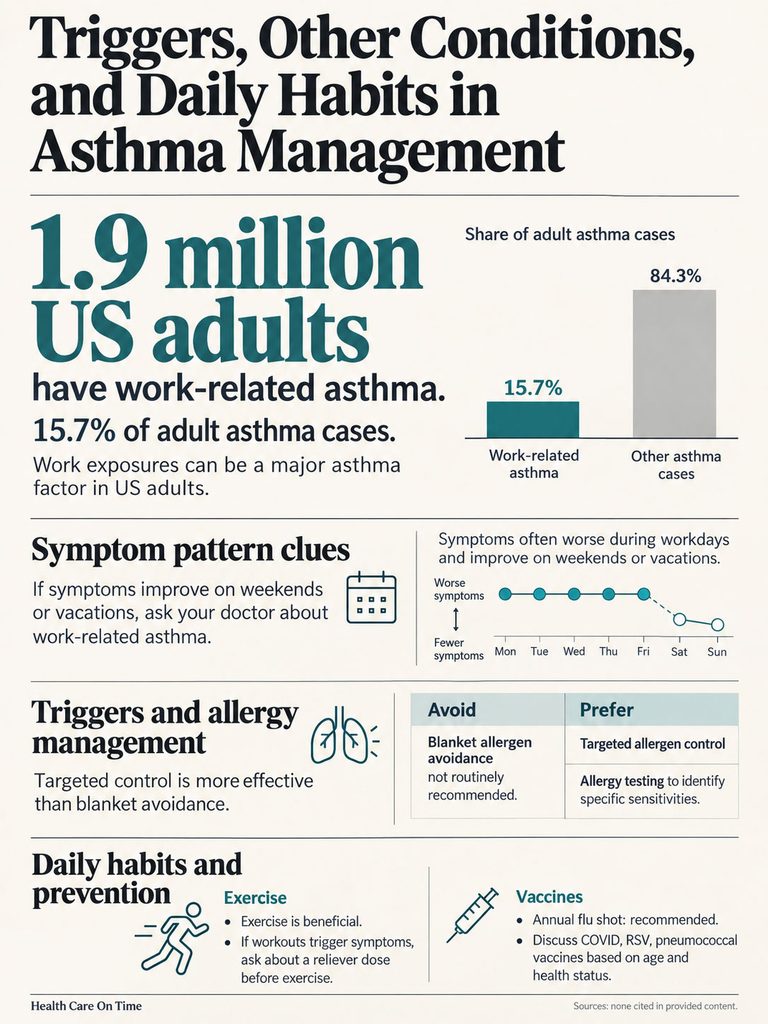
Work-related asthma is common. An estimated 1.9 million US adult asthma cases are work-related, about 15.7% of current adult cases, peaking among adults aged 45 to 64. If symptoms ease on weekends or vacations, tell your doctor.
Why Blanket Allergen Avoidance Isn’t Advised
It’s tempting to strip your home of rugs, pets, and plants. Guidelines don’t support that for everyone. Allergen control helps when testing shows you’re sensitive to a specific allergen that worsens your asthma.
Our lab partners regularly run total IgE and allergy panels for exactly this reason: they separate the changes that help from wasted effort.
Conditions That Make Asthma Harder to Control
- Allergic rhinitis (hay fever): treating nasal allergies often improves asthma.
- GERD (acid reflux): can trigger night coughing and wheezing.
- Obesity: linked with more severe asthma. NHLBI notes that reaching a healthy weight can make asthma easier to manage.
- Sleep apnea: worsens night symptoms and daytime fatigue.
- Anxiety and depression: can blur the line between panic and breathlessness.
Exercise and Vaccines
Exercise is good for asthma. If workouts trigger symptoms, your doctor can adjust your plan, often with a reliever dose 5 to 15 minutes beforehand.
A yearly flu shot is recommended for everyone with asthma. Ask whether COVID, RSV, and pneumococcal vaccines fit your age and health.
What Changed in GINA 2026
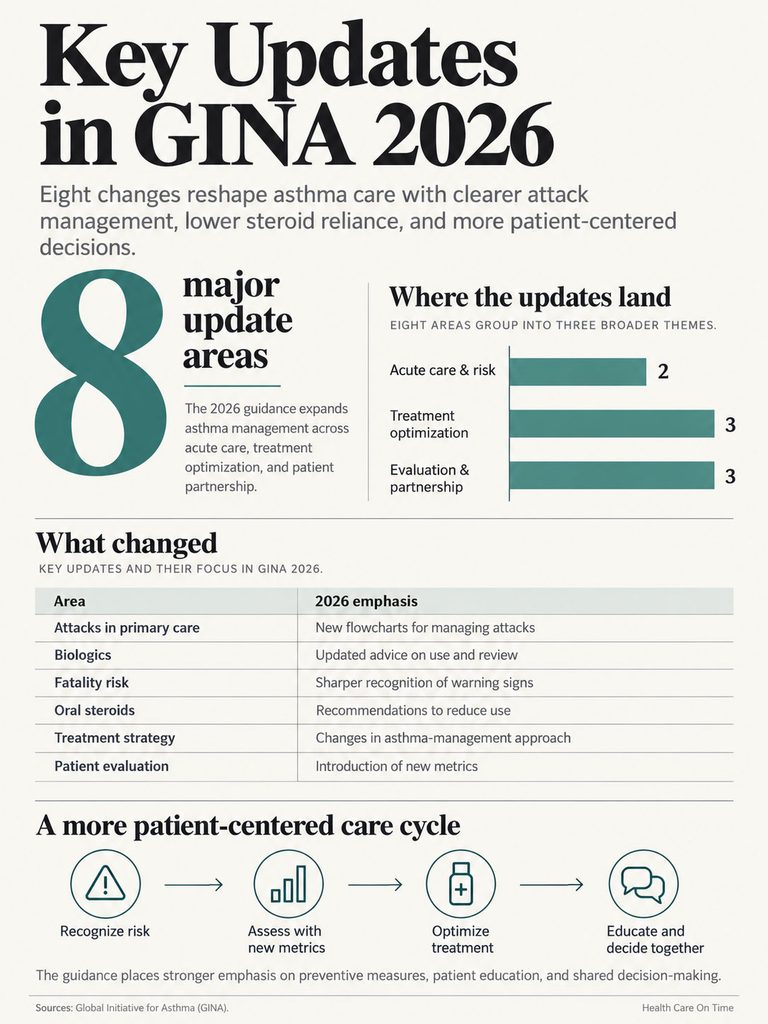
GINA updates its strategy every year. The 2026 report added new flowcharts for managing attacks in primary care, plus updated advice on biologics, fatality risk signs, and reducing oral steroid use.
Other changes worth knowing:
- ICS-SABA at Step 1. A combined ICS-SABA reliever was added at Step 1 of GINA Track 2, giving inhalers like Airsupra a formal place in mild asthma care.
- Epinephrine first in anaphylaxis. If someone shows both anaphylaxis and asthma, the new flowcharts say to give epinephrine first and then bronchodilators.
- Oral steroid stewardship. Each oral steroid course adds up over a lifetime, raising risks like bone loss, diabetes, and cataracts.
- GLP-1 medicines. GINA noted observational data suggesting a possible future role for GLP-1 drugs in improving asthma outcomes. This is early evidence, not a reason to start one for asthma.
Special Situations
Asthma During Pregnancy
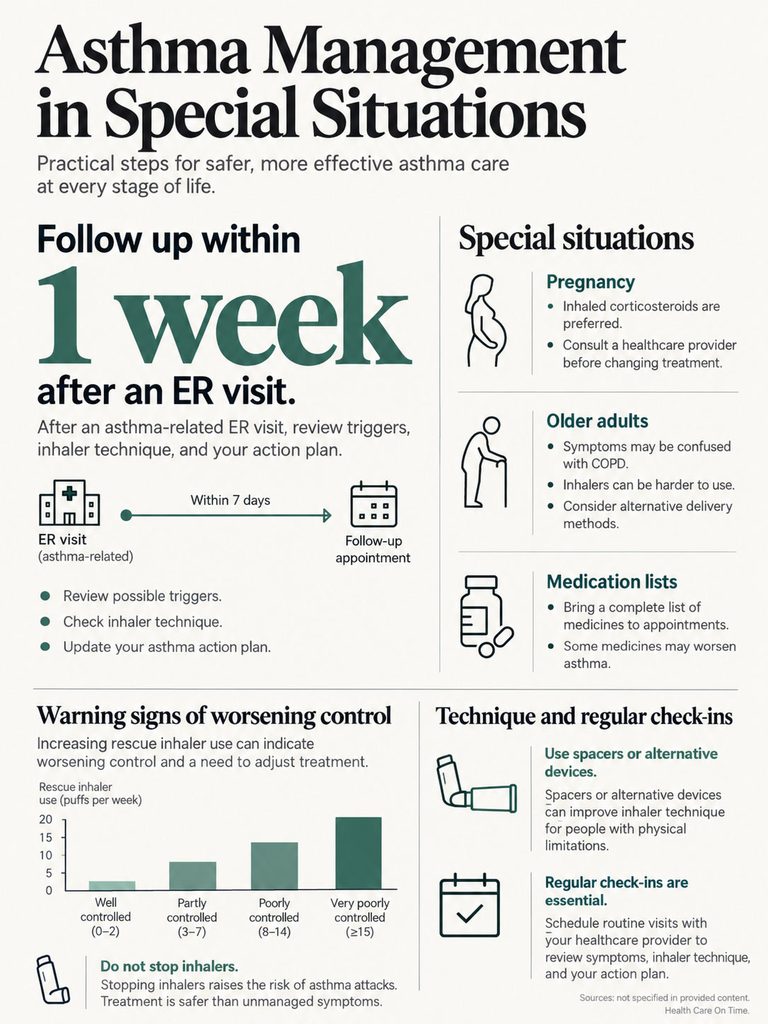
Some people stop their inhalers when they find out they’re pregnant. That instinct is understandable but risky. Inhaled corticosteroids are preferred for persistent asthma in pregnancy, and treating with medicine is safer than living with symptoms and attacks. Talk with your OB and asthma doctor before changing anything.
Older Adults
Asthma in older adults is often missed or confused with COPD or heart problems. Arthritis, weaker grip, and memory changes can make inhalers harder to use; a spacer, a dry-powder device, or a one-inhaler regimen can help. Some medicines, especially non-selective beta-blockers, can worsen asthma, so bring a full medicine list to every visit.
After an ER Visit or Hospital Stay
An ER visit for asthma means your current plan isn’t working. See your regular doctor soon afterward, ideally within a week.
Review what triggered the attack, check technique, update your action plan, and ask whether your controller needs to step up. Our medical team often sees the same pattern: weeks of rising rescue inhaler use before the attack that sent someone to the ER.
Cost, Insurance, and Getting Care in the US
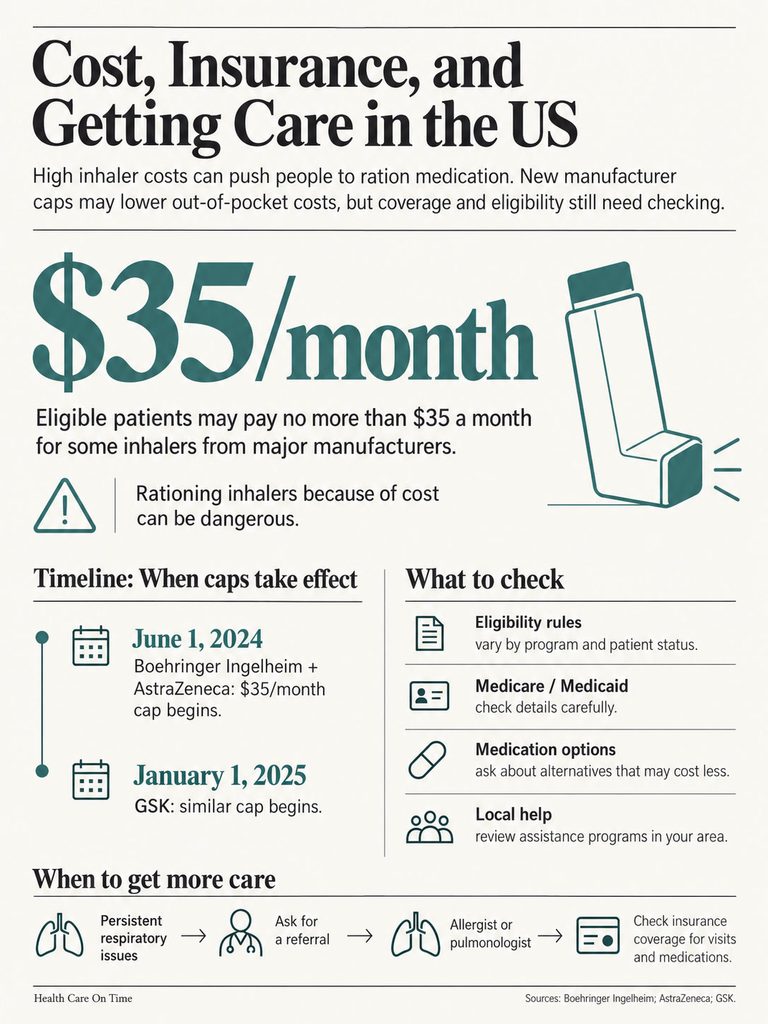
Cost is a real reason people ration inhalers, and rationing controllers is dangerous. Boehringer Ingelheim,
AstraZeneca, and GSK cap out-of-pocket costs for their inhalers at $35 a month for eligible patients. Boehringer and AstraZeneca started June 1, 2024, and GSK committed to a similar cap by January 1, 2025. Eligibility varies, especially for Medicare and Medicaid.
Other ways to cut costs:
- Ask for generic budesonide, fluticasone, or budesonide-formoterol.
- Use your insurer’s preferred inhaler.
- Look into manufacturer patient assistance programs if you’re uninsured.
- Ask about 90-day mail-order supplies.
When to See a Specialist
Ask for a referral to an allergist or pulmonologist if you:
- Had 2 or more oral steroid courses in the past year.
- Still have symptoms on a medium- to high-dose controller.
- Were hospitalized or intubated for asthma.
- Aren’t sure your diagnosis is right.
- Might qualify for a biologic.
When to Get Help Fast
Most flares can be handled at home with a good action plan. Some cannot.
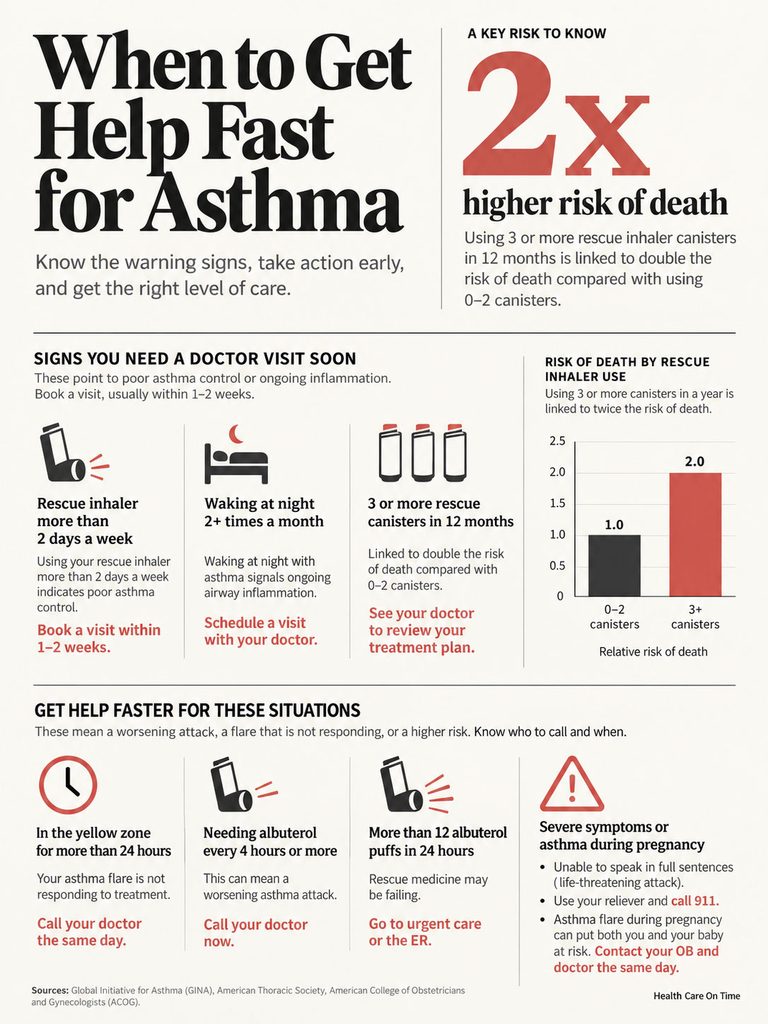
| Scenario | What It Means | What to Do |
| Rescue inhaler used more than 2 days a week | Asthma is not well controlled | Book a visit within 1 to 2 weeks to review your controller |
| Waking at night with asthma 2+ times a month | Ongoing airway inflammation | Schedule a visit; ask about stepping up treatment |
| 3 or more rescue canisters in 12 months | Linked to about 2x risk of death | See your doctor; ask about an ICS-containing reliever plan |
| In the yellow zone for more than 24 hours | Flare not responding to step-up | Call your doctor the same day |
| Needing albuterol every 4 hours or more often | Attack is worsening | Call your doctor now; seek urgent care if no quick answer |
| More than 12 albuterol puffs in 24 hours | Rescue medicine is failing | Go to urgent care or the ER |
| Can’t speak in full sentences, lips or nails bluish, chest pulling in | Severe, life-threatening attack | Use reliever and call 911 now |
| Asthma flare during pregnancy | Risk to both parent and baby | Call your OB and doctor the same day |
| Any ER visit or hospital stay for asthma | Plan needs a review | See your doctor within about a week |
The 12-puff threshold comes from standard guidance: UpToDate advises seeking care if you need more than 12 rescue inhalations in 24 hours.
Frequently Asked Questions
How often should you use a rescue inhaler?
If your asthma is well controlled, you should need it no more than 2 days a week, not counting puffs before exercise. More often signals inflammation your controller isn’t handling. Refilling it more than twice a year is another sign your plan needs a review with your doctor.
What are the 3 zones of an asthma action plan?
Green means you feel well and peak flow is 80% or more of your best. Yellow means symptoms are building and peak flow is 50% to 79%, so follow your step-up plan. Red means severe symptoms or peak flow under 50%; use your reliever and call 911.
Is it safe to use a steroid inhaler every day?
Yes, for most people. Inhaled corticosteroids deliver a small dose straight to the lungs, so far less reaches the body than with steroid pills. Common side effects are hoarseness and thrush, which rinsing your mouth after each use helps prevent. Untreated asthma carries far greater risks.
How many albuterol inhalers a year is too many?
Three or more rescue canisters a year is considered overuse. Large studies link this level to more severe attacks and roughly double the risk of death. If you’re at or near that number, ask your doctor about adding or changing a steroid-containing inhaler rather than buying more albuterol.
Can asthma be managed without medication?
Not safely for most people. Avoiding triggers, quitting smoking, staying active, and keeping a healthy weight all help, but they don’t replace anti-inflammatory medicine. Even mild asthma can cause severe attacks. Some people with very mild disease may use an ICS-containing reliever only as needed instead of daily.
What is SMART or MART therapy?
SMART (or MART) means using one combination inhaler, usually budesonide-formoterol, for both daily control and quick relief. Every relief puff also delivers steroid, so inflammation is treated exactly when symptoms rise. GINA lists it as its preferred approach for teens and adults, and US guidelines endorse it for many patients.
Do you need a spacer with an inhaler?
If you use a metered-dose inhaler, a spacer almost always helps. It holds the medicine cloud so more reaches your lungs, even with imperfect timing. Spacers are strongly advised for children and older adults. Dry-powder inhalers don’t use spacers because they rely on your own quick, deep breath.
Can asthma go away in adults?
Asthma can quiet down for long stretches, and some children seem to outgrow it. In adults, airway sensitivity usually remains even when symptoms fade. If you’ve been symptom-free for months, your doctor may lower your dose carefully. Don’t stop your controller medicine on your own.
Does losing weight help asthma?
For many people with obesity, it can. Extra weight is linked to more severe asthma and weaker response to inhaled steroids, and NHLBI notes that reaching a healthy weight can make asthma easier to manage. Ask your doctor about safe, supported options that fit your overall health.
When should you go to the ER for asthma?
Go to the ER or call 911 if you can’t speak in full sentences, your lips or fingernails look blue or gray, your chest pulls in with each breath, or your rescue inhaler isn’t helping. Needing more than 12 albuterol puffs in 24 hours is also a reason for urgent care.
How much do asthma inhalers cost with the $35 cap?
For eligible patients, Boehringer Ingelheim, AstraZeneca, and GSK cap monthly out-of-pocket costs at $35 for their branded inhalers. Eligibility depends on your insurance, and government plans often follow different rules. Generic inhalers and insurer-preferred brands can also lower costs, so ask your pharmacist to compare.
What tests confirm asthma?
Spirometry is the main test: you blow into a tube before and after a reliever, and clear improvement points to asthma. A FeNO breath test measures airway inflammation, and a blood eosinophil count or IgE test can help guide treatment. Peak flow tracking is used when spirometry isn’t available.
Disclaimer: This article is for general education and does not replace advice from your own doctor. Asthma treatment must be tailored to each person. Never stop or change an asthma medicine without talking to your healthcare provider. If you have severe trouble breathing, call 911 right away.
References
- CDC: Most Recent Asthma Data
- CDC FastStats: Asthma
- CDC Preventing Chronic Disease: The Status of Asthma in the United States (2024)
- NHLBI: Asthma Management Guidelines, 2020 Focused Updates
- NHLBI: Living With Asthma
- Global Initiative for Asthma: 2026 Strategy Report
- Pulmonology Advisor: GINA 2026 Update
- Guideline Central: 2026 GINA Guideline Update
- PMC: Update on Asthma Management Guidelines
- European Respiratory Journal: SABINA SABA Overuse Cohort
- ERJ Open Research: Reconsidering SABA Overuse (2025)
- PMC: SABA Overreliance in Older Adults (Ontario)
- PMC: Metered-Dose Inhaler Technique Errors in US Studies
- The Medical Letter: Airsupra and the MANDALA Trial
- Pulmonology Advisor: Airsupra Label Update (BATURA)
- VA Formulary Monograph: Albuterol/Budesonide
- FDA: Boxed Warning for Montelukast
- Medscape: Asthma Treatment and Management
- UpToDate: Initiating Asthma Therapy in Adolescents and Adults
- AAAAI: Asthma Statistics
- Allergy & Asthma Network: Inhaler Price Caps
- EPA AirNow