Only 6 out of every 100 American adults eat enough fiber, according to a report in the Journal of the American College of Cardiology. Plenty of people trying to fix that grab a jar of sauerkraut “for their gut.”
Table of Contents
Here’s the problem: the jar on the shelf may hold almost no live bacteria. Cabbage can do a lot for your digestion, but only when you eat the right kind, in the right amount, at the right pace.
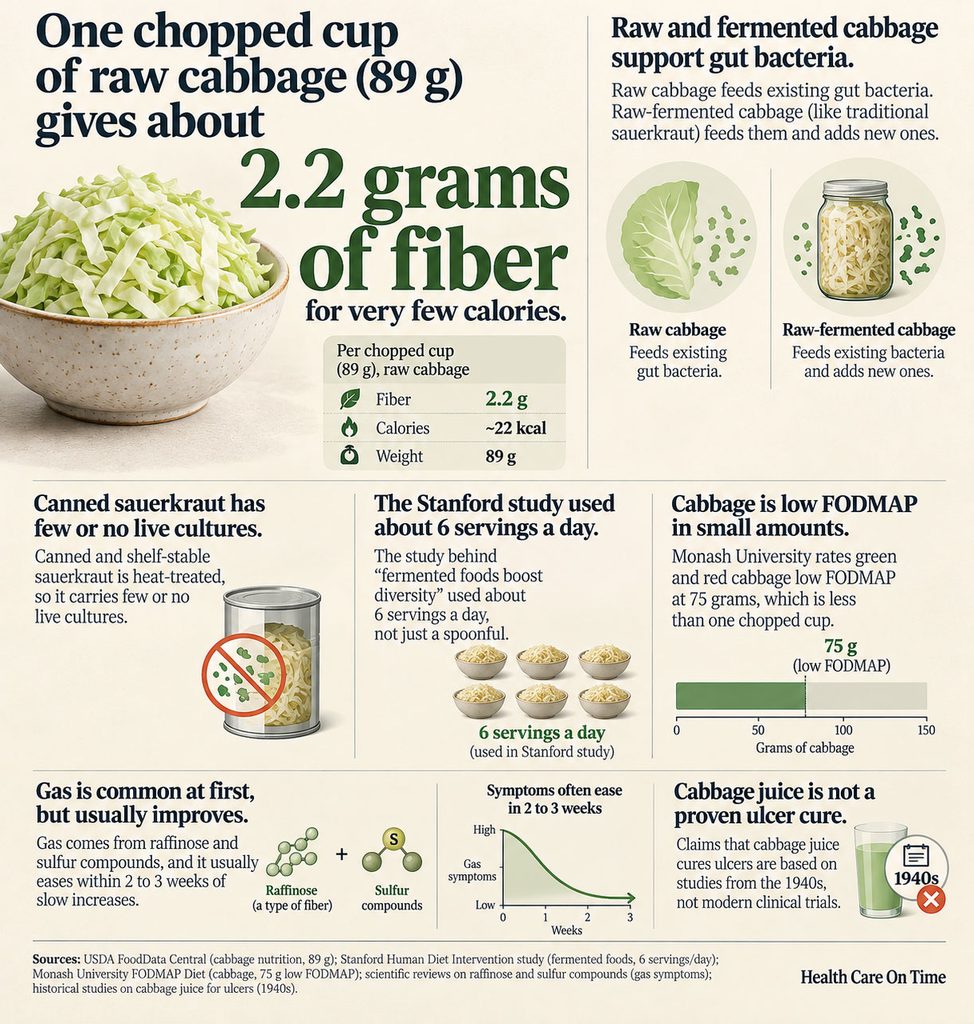
Quick Answer: Yes, cabbage is good for gut health and digestion. Its insoluble fiber adds bulk and keeps stools regular, while its fermentable fiber feeds the bacteria that make short-chain fatty acids for your colon. Raw, refrigerated sauerkraut and kimchi add live microbes too. There are three catches: shelf-stable sauerkraut is pasteurized, portions above about 3/4 cup can trigger IBS symptoms, and some extra gas is normal while your gut adjusts.
At a Glance
How Cabbage Affects Your Gut (What Happens After You Eat It)
Cabbage works on your digestion in layers. Some parts pass through you untouched and some get eaten by bacteria. A smaller group of plant compounds gets transformed along the way.
Our medical team reviewed the research on each layer separately. Lumping it all into “cabbage is healthy” hides which benefit you actually get from which form.
Insoluble Fiber and Regularity
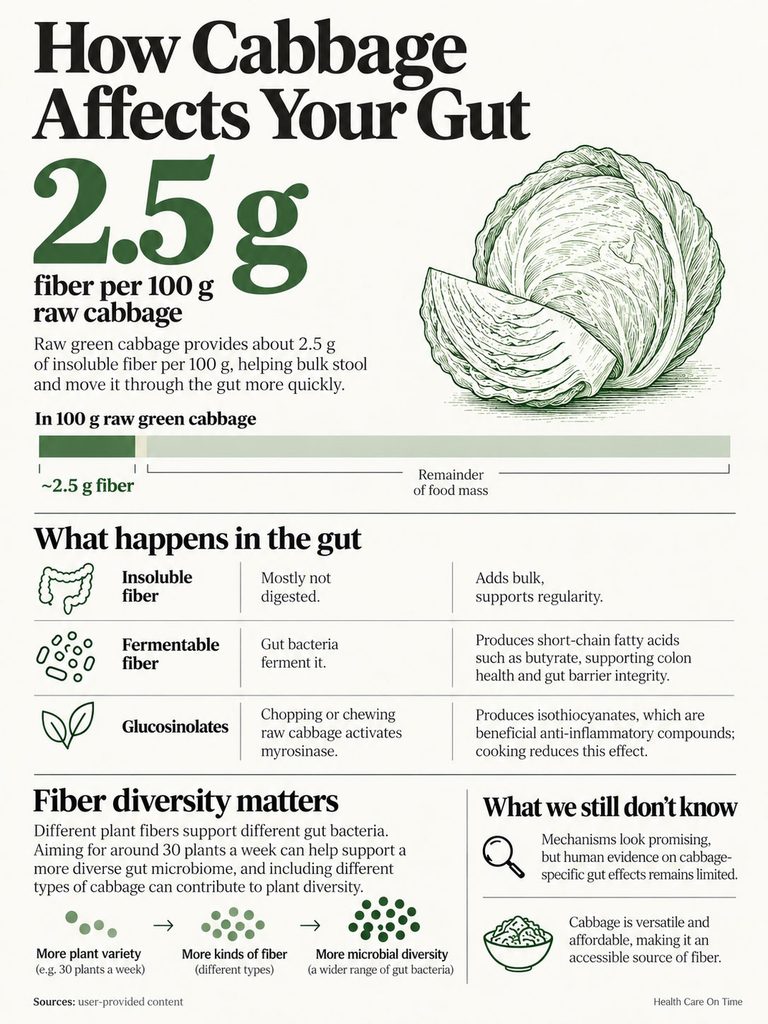
Most of cabbage’s fiber is insoluble. Your body can’t break it down, so it holds water and adds bulk to stool, which helps it move along faster.
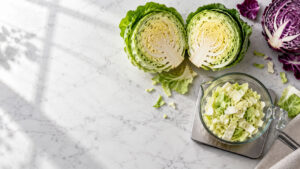
According to USDA FoodData Central, raw green cabbage has about 2.5 grams of fiber per 100 grams. That’s roughly 2.2 grams in a chopped cup or 1.8 grams in a shredded cup. Our cabbage calories breakdown covers portion weights in detail.
That isn’t a huge amount on its own. But cabbage costs little, keeps for weeks in the fridge, and fits into slaws, soups, stir-fries, and tacos. That makes it one of the easiest ways to chip at a large fiber gap.
Fermentable Fiber, Gut Bacteria, and Short-Chain Fatty Acids
A smaller share of cabbage fiber is fermentable. When it reaches your colon, bacteria break it down and release short-chain fatty acids such as butyrate.
Butyrate is the main fuel for the cells lining your colon, and it helps keep the gut barrier tight. That’s why this kind of fiber is called “prebiotic”: it feeds the microbes you already have.
Glucosinolates and What Your Gut Bacteria Do With Them
Cabbage belongs to the cruciferous family, along with broccoli, kale, and Brussels sprouts. These vegetables carry sulfur-based compounds called glucosinolates.
When you chop or chew raw cabbage, a plant enzyme called myrosinase converts glucosinolates into isothiocyanates. Lab and animal research links these compounds to anti-inflammatory effects.
Cooking destroys most myrosinase. Some gut bacteria can still do part of the conversion on their own, so cooked cabbage delivers a share. Human data on gut outcomes specifically remains thin, and that deserves an honest label.
Where Cabbage Fits in the “30 Plants a Week” Idea
You may have seen the “30 plants a week” target. It comes from the American Gut Project at UC San Diego. Participants eating more than 30 plant types weekly had more diverse gut microbiomes than those eating 10 or fewer.
There’s a caveat most articles skip. That comparison involved just 41 people versus 44 people inside a much larger volunteer study, and it shows a link, not cause and effect.
The logic still holds up. Different plants carry different fibers, and different bacteria eat different fibers. Green, red, savoy, and napa cabbage can each count as a separate plant toward your weekly variety.
Raw vs. Cooked vs. Fermented Cabbage: Which Is Best for Digestion?
Patients who book digestive panels with us often ask which form of cabbage is “best.” The honest answer is that each does a different job. The right pick depends on what your gut needs right now.
Raw Cabbage: Most Fiber, Most Gas
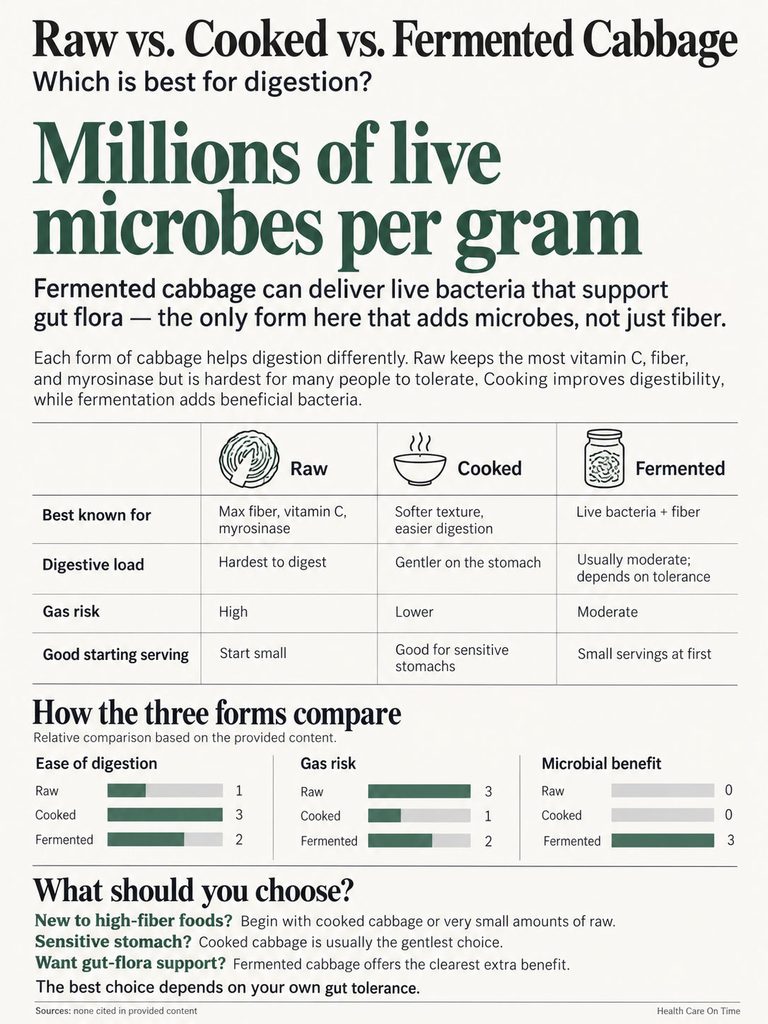
Raw cabbage keeps its fiber, vitamin C, and myrosinase fully intact. It’s also the toughest form to digest, because the cell walls stay firm and the gas-forming sugars arrive in full.
If you’re new to high-fiber eating, a big bowl of raw coleslaw is a fast route to bloating. Start small and chew well.
Cooked Cabbage: Gentler, Still Fibrous
Cooking softens cell walls, and the fiber stays put. Steamed, braised, or soup-simmered cabbage is easier on sensitive stomachs while still adding bulk.
You lose some vitamin C into the cooking water, and most of the myrosinase is gone. For people with touchy digestion, that trade usually pays off.
Fermented Cabbage: Sauerkraut and Kimchi
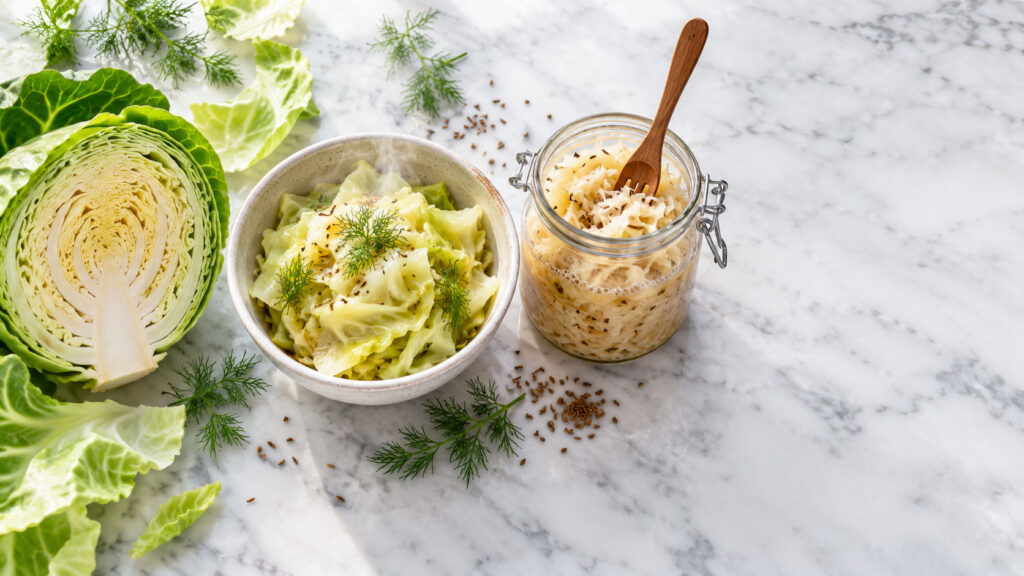
Fermentation lets lactic acid bacteria eat cabbage sugars and produce lactic acid. In a raw, unpasteurized ferment, those bacteria stay alive and reach your gut along with the fiber.
Lab work on commercial sauerkraut fermentation shows bacteria climbing to 100 million to 1 billion colony-forming units per gram. That number only holds if the product is never heated afterward.
Here’s how the main forms compare.
| Cabbage Form | Fiber Effect | Live Microbes | Gas Risk | Low FODMAP Serving (Monash) | Best For |
| Raw green cabbage | Full fiber, about 2.2 g per chopped cup | None | High | 75 g (about 3/4 cup) | Regularity, people with strong digestion |
| Raw red cabbage | About 2.1 g per 100 g, plus anthocyanins | None | High | 75 g | Slaws, color, antioxidant variety |
| Cooked green cabbage | Same fiber, softer texture | None | Moderate | About 1/2 cup cooked | Sensitive stomachs, soups |
| Shelf-stable or canned sauerkraut | Fiber kept | Few or none (heat-treated) | Moderate | 75 g (pasteurized fermented red) | Flavor only, not probiotics |
| Refrigerated raw sauerkraut | Fiber kept | Yes, often millions per gram | Moderate | Varies; start at 1 to 2 tbsp | Adding live microbes |
| Kimchi (refrigerated) | Fiber kept, plus garlic and pepper | Yes | Moderate to high | 47 g (about 1/4 cup) | Microbe variety, if spice and garlic sit well |
Is Sauerkraut Actually Good for Your Gut? The Dose and Label Problem
Sauerkraut gets more gut-health credit than any other cabbage form. Some of that credit is earned. Some depends on details almost nobody checks.
What the Stanford Fermented-Food Trial Really Used
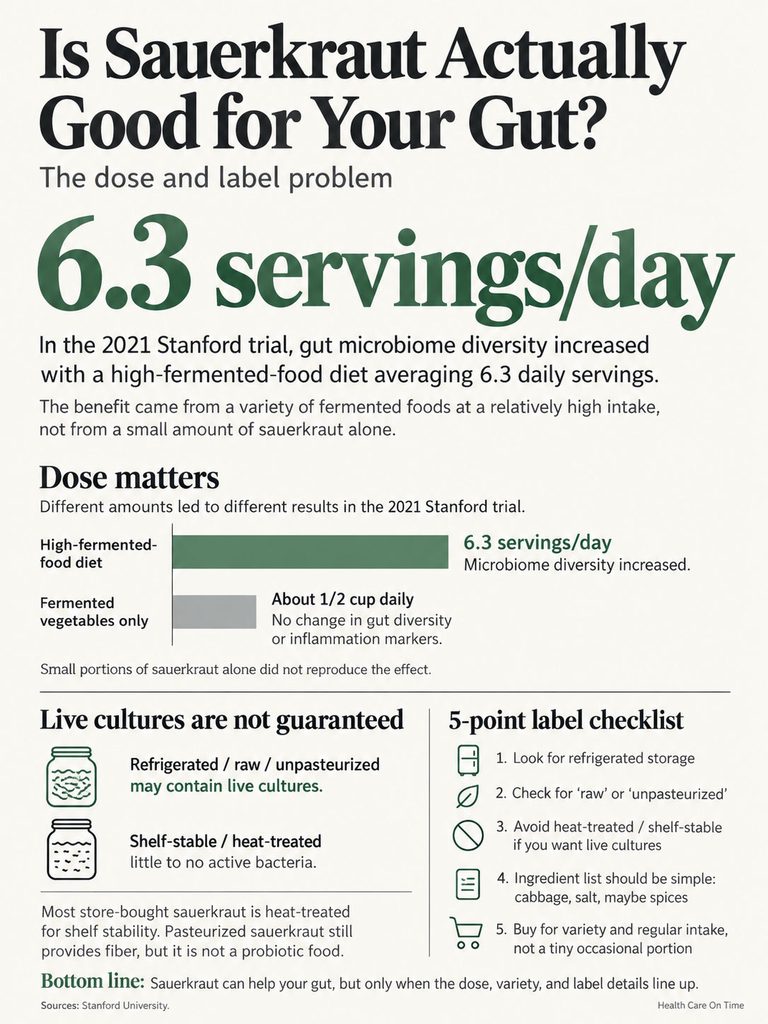
The study cited most often is a 2021 Stanford trial published in Cell. It randomized 36 healthy adults to a high-fiber diet or a high-fermented-food diet for 10 weeks.
The fermented-food group’s microbiome diversity rose steadily. 19 of 93 inflammatory markers dropped, including interleukin-6, as summarized in a later analysis. The high-fiber group saw no diversity jump in that time frame.
The headline leaves out the dose. Participants averaged about 6.3 servings of fermented foods daily, a mix of yogurt, kefir, kombucha, kimchi, and fermented vegetables. That is far more than a forkful of kraut on a hot dog.
Why Half a Cup a Day Didn’t Move the Needle
A follow-up trial tested half a cup of fermented vegetables daily for two months in adults at risk for heart disease. Gut diversity and inflammation markers didn’t change.
That doesn’t make sauerkraut useless. It means a small daily portion alone probably won’t reshape your microbiome; variety plus volume seem to matter. Across the cases our clinicians review, people who notice real change usually combine several fermented foods with more fiber overall.
Why Most Store-Bought Sauerkraut Has No Live Cultures
Most sauerkraut in US grocery aisles sits at room temperature, in cans or glass jars. To be shelf-stable, it has been heat-treated, and that heat kills the lactic acid bacteria.
One university lab set out to compare store-bought and homemade sauerkraut. It found the shelf-stable product had little to no bacteria to count. A 2024 athlete study measured pasteurized organic sauerkraut at about 4,800 lactic acid bacteria per milliliter, a tiny fraction of active-ferment levels.
Pasteurized kraut still gives you fiber and flavor. It just isn’t a probiotic food in any meaningful sense.
A 5-Point Label Checklist
Use this quick check at the store:
- Refrigerated case only. Live sauerkraut has to stay cold. If it sits next to canned beans, it’s been heated.
- “Raw” or “unpasteurized” on the label. “Naturally fermented” alone doesn’t guarantee live cultures.
- Short ingredient list. Look for cabbage, salt, and maybe spices. Vinegar high on the list often signals a quick pickle, not a true ferment.
- Cloudy brine, slight fizz. Both are signs of active bacteria.
- Read “live cultures” claims carefully. Stanford Medicine has noted that some products are pasteurized and then have spore-forming bacteria added back so they can carry the claim.
The Numbers: Cabbage, Fiber, and US Gut Health Data
The case for cabbage is mostly a case about the American fiber gap. These are the figures our editorial team checks before recommending any gut-health food.
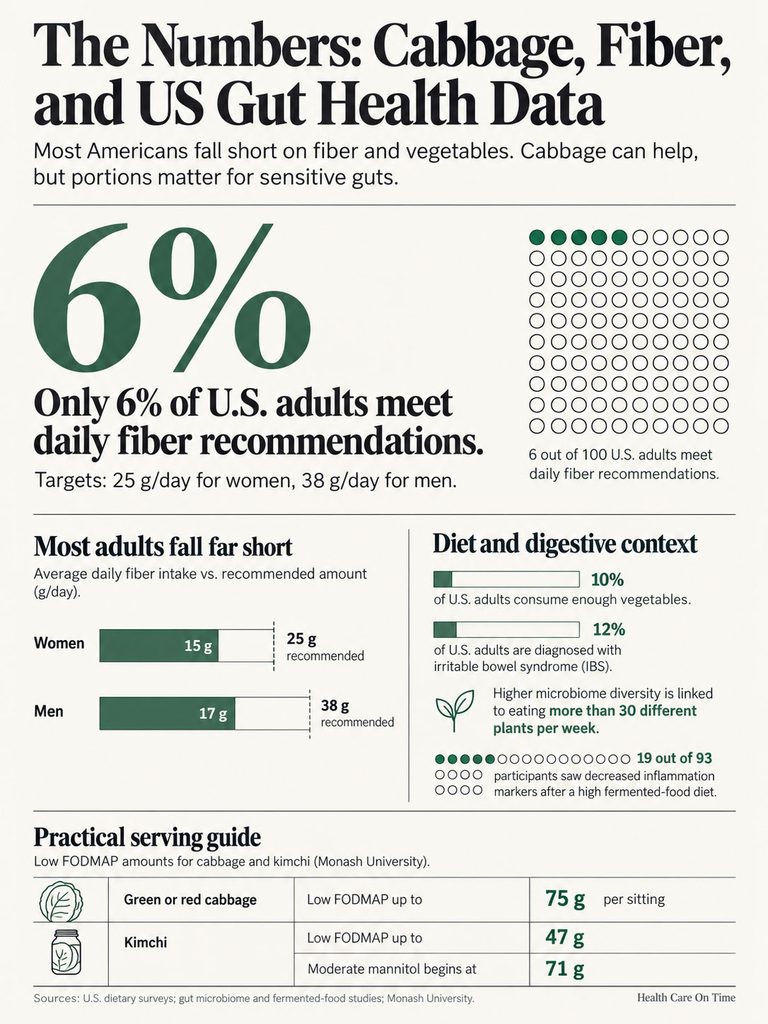
| Statistic | Figure | Source |
| US adults meeting daily fiber recommendations | 6% | Journal of the American College of Cardiology, report published Sept. 30 |
| Average daily fiber intake | Women about 15 g, men about 17 g (targets: 25 g and 38 g for ages 19 to 50) | JACC report; Dietary Guidelines for Americans |
| US adults eating enough vegetables | About 10% | CDC, BRFSS data published in MMWR |
| US adults with irritable bowel syndrome | About 12% | NIH, National Institute of Diabetes and Digestive and Kidney Diseases |
| Microbiome diversity by plant variety | More than 30 plants per week (41 people) had higher diversity than 10 or fewer (44 people) | American Gut Project, UC San Diego, mSystems |
| Inflammation markers after a high fermented-food diet | 19 of 93 decreased over 10 weeks at about 6.3 servings per day | Wastyk et al., Cell, Stanford Medicine |
| Low FODMAP limit, green and red cabbage | 75 g per sitting (about 3/4 cup) | Monash University FODMAP |
| Low FODMAP limit, kimchi | 47 g; moderate mannitol from 71 g | Monash University FODMAP |
A cup of cabbage won’t close a 10-to-20-gram daily gap alone. It is still one of the cheapest, longest-lasting vegetables in an American grocery store, which makes it a practical piece of the fix.
What the Research Can and Can’t Tell You
Our medical reviewers flag three limits before anyone builds a gut plan around cabbage.
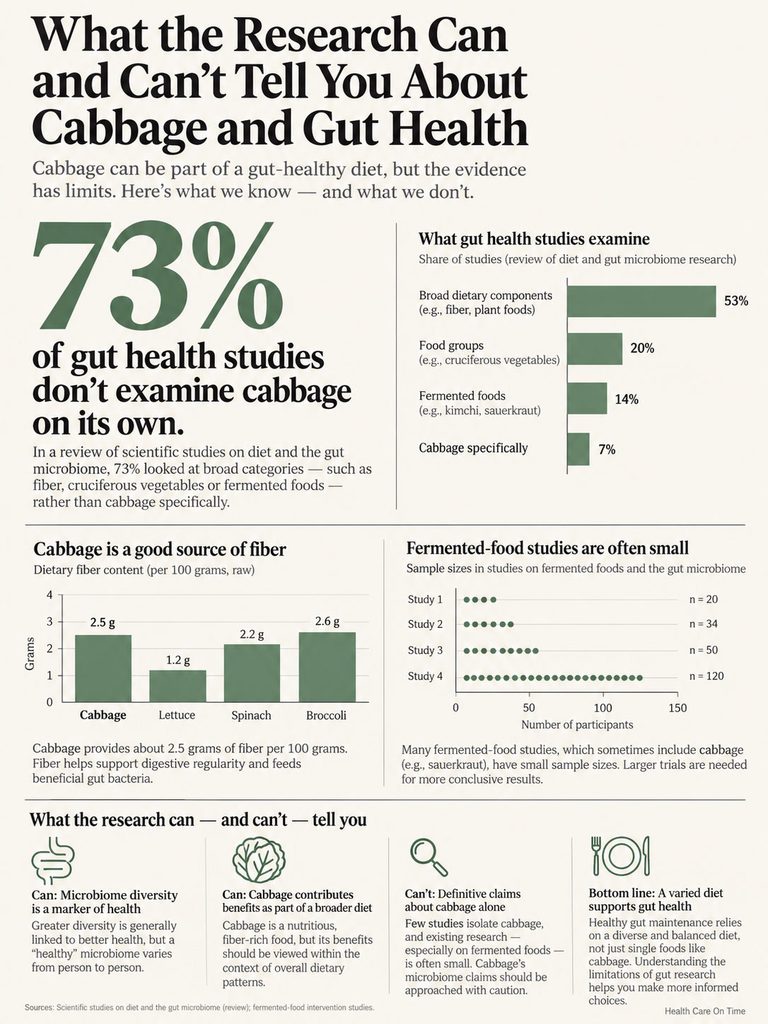
First, few studies test cabbage alone. Most gut research looks at fiber, cruciferous vegetables, or fermented foods as groups. The benefits above are well supported for those groups, but cabbage-only human trials are rare.
Second, microbiome diversity is a marker, not a diagnosis. Higher diversity is linked with better health, yet researchers still can’t say exactly what a “healthy” microbiome looks like for any one person.
Third, fermented-food results come from small samples. The Stanford trial had 18 people per group, and the half-cup trial found no change at all. Both are honest signals that dose and variety matter, and that bigger trials are still needed.
None of this cancels cabbage’s value. Fiber’s role in regularity is settled science, and cabbage delivers that fiber. The fancier microbiome claims simply deserve a lighter grip.
Why Cabbage Causes Gas and Bloating (and How to Stop It)
Gas after cabbage is real, common, and usually harmless. It’s also the top reason people give up on the vegetable too soon.
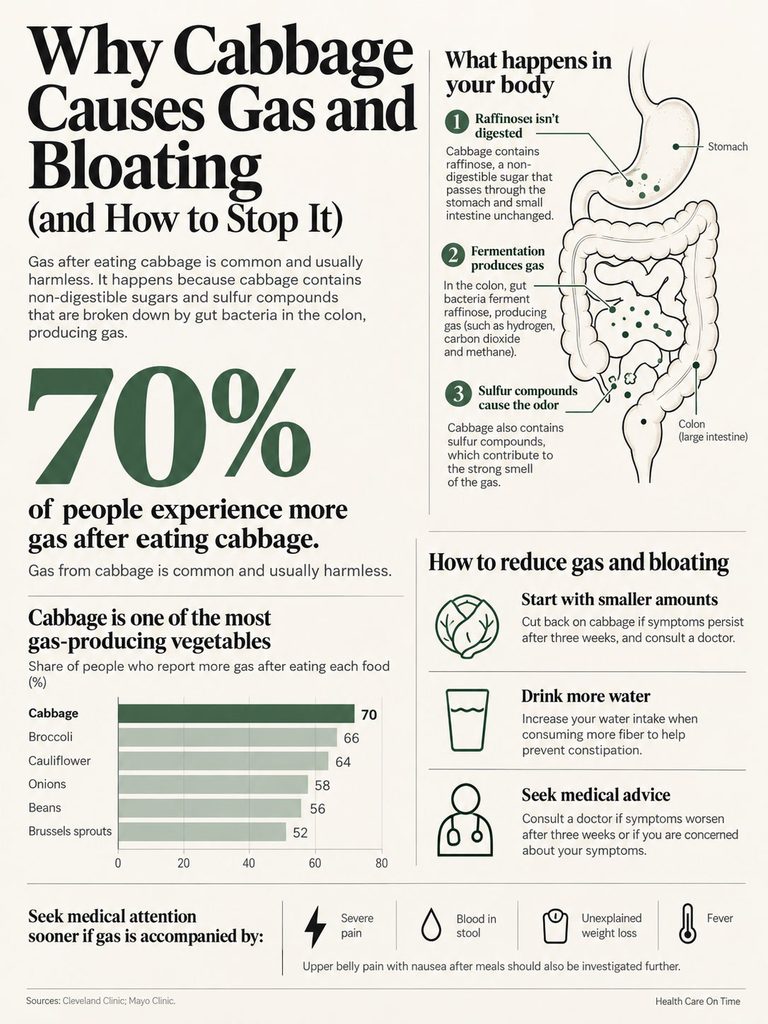
Raffinose, Sulfur, and Normal Fermentation
Cabbage contains raffinose, a sugar humans can’t digest because we lack the enzyme alpha-galactosidase. Raffinose reaches the colon whole, and bacteria ferment it into gas.
The sulfur compounds that give cruciferous vegetables their bite also explain why that gas can smell strong. Neither signals a problem. It’s the same fermentation that makes helpful short-chain fatty acids.
6 Ways to Eat Cabbage With Less Gas
- Start at 1/4 cup. Increase by a couple of tablespoons every few days.
- Cook it first. Steaming or braising softens fibers and often eases symptoms.
- Chew thoroughly. Smaller pieces give your gut less work and less trapped air.
- Ramp over 2 to 3 weeks. Gut bacteria adapt to steady fiber intake, and gas usually settles.
- Try an alpha-galactosidase product (sold as Beano and store brands) with your first bites. It breaks down raffinose before bacteria can.
- Pair with ginger, fennel, or caraway. Traditional sauerkraut recipes add caraway for a reason, though the support here is mostly kitchen experience.
Drink more water as you add fiber. More fiber without more fluid can make constipation worse, not better.
What to Expect Week by Week
- Week 1: More gas and a fuller feeling are common, especially with raw cabbage.
- Week 2: Gas usually drops as your bacteria adjust; stools often become more regular.
- Week 3 and beyond: Most people tolerate their target portion with little discomfort.
If symptoms are getting worse instead of better by week three, cut back and talk with your doctor.
When Gas Is a Sign of Something Else
Gas with pain that wakes you up, blood in your stool, unplanned weight loss, fever, or ongoing diarrhea is not a cabbage problem. See a clinician.
Upper belly pain with nausea after meals deserves its own workup. Our guide to upper stomach pain and nausea walks through the causes ranked by urgency.
Cabbage, IBS, and Other Gut Conditions
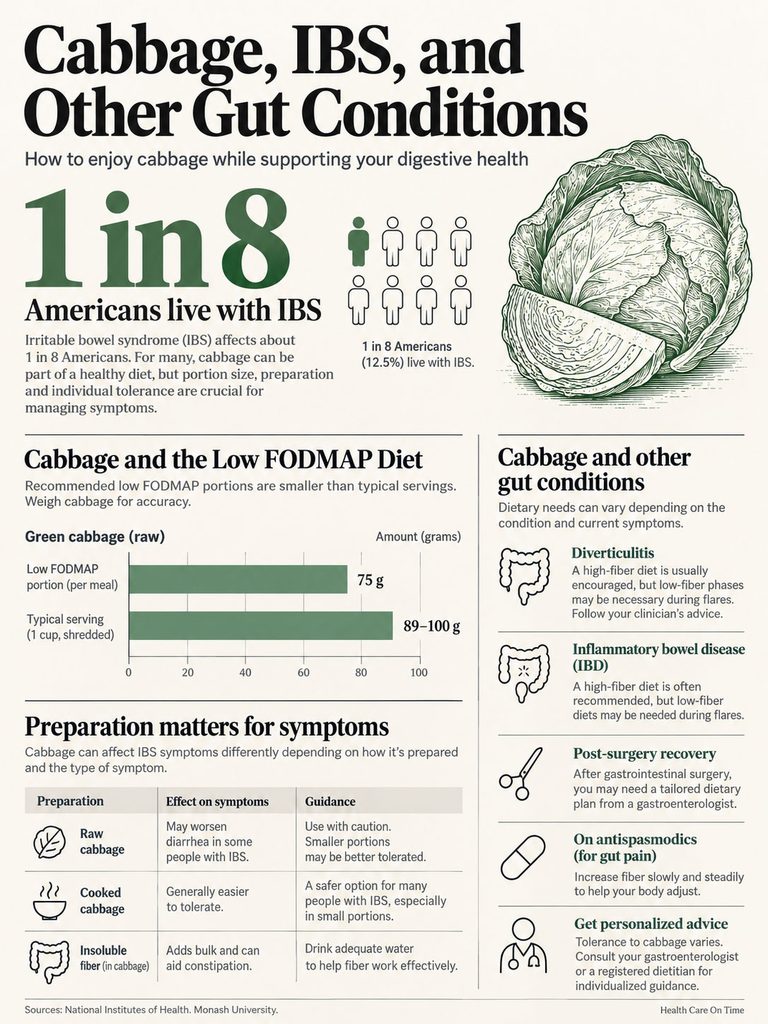
For the roughly 1 in 8 Americans living with IBS, cabbage portions matter far more than they do for everyone else.
Low FODMAP Portions by Cabbage Type
FODMAPs are fermentable carbs that can trigger IBS bloating, pain, and urgency. Monash University lab-tests foods and publishes portion limits.
- Green (common) cabbage: low FODMAP at 75 g. Larger amounts add sorbitol, a sugar alcohol.
- Red cabbage: low at 75 g, with fructans reaching moderate levels around 150 g.
- Savoy cabbage: older Monash data listed only 40 g as low, while updated figures list 75 g. Test it carefully if you have IBS.
- Napa (Chinese) cabbage: low at 75 g and far more forgiving at larger portions.
- Kimchi: low at 47 g, moderate for mannitol from 71 g.
A standard chopped cup weighs 89 grams, so one “cup” of green cabbage already passes the tested limit. A $10 kitchen scale for the first few weeks takes the guesswork out.
Constipation vs. Diarrhea
If constipation is your main issue, cabbage’s insoluble fiber can help, as long as you drink enough water.
If loose stools are the problem, raw cabbage and large ferment portions may make things worse at first. Cooked cabbage in small amounts is the safer test.
Diverticulitis, IBD Flares, and Recent GI Surgery
Between diverticulitis flares, a higher-fiber diet is generally encouraged, and cabbage can fit in. During an active flare, doctors often recommend a short low-fiber phase instead.
The same applies to inflammatory bowel disease flares and recovery after bowel surgery. In these cases, your gastroenterologist’s plan comes first.
Antispasmodics and Gut Pain
If you take medicine for IBS cramping, keep fiber changes slow and steady so you can tell what’s helping. Our article on dicyclomine for severe gut pain explains when that drug fits and when it doesn’t.
Myths About Cabbage and Digestion
In questions our team fields about digestive health, these four myths come up again and again.
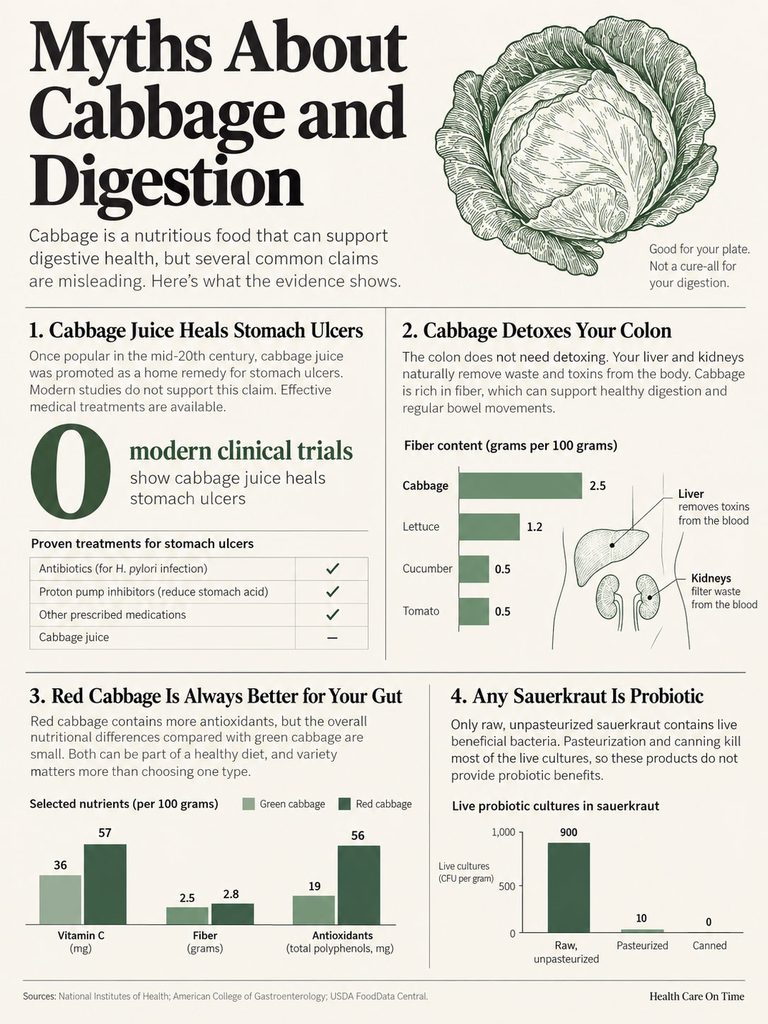
“Cabbage Juice Heals Stomach Ulcers”
This claim traces back to Dr. Garnett Cheney at Stanford in the late 1940s. In 1949, he gave 13 ulcer patients large daily amounts of fresh cabbage juice and reported faster healing than expected.
He called the unknown factor “vitamin U,” later identified as S-methylmethionine, which isn’t a true vitamin. A 2026 critical review graded Cheney’s studies at evidence level D, the lowest tier.
Medicine has also learned that most peptic ulcers come from H. pylori infection or NSAID pain relievers. Modern care, including H. pylori testing, antibiotics, and acid-reducing drugs, has real trial evidence behind it. Cabbage juice doesn’t.
“Cabbage Detoxes Your Colon”
Your liver and kidneys handle detox. Cabbage’s fiber helps stool move along, which some people feel as being “cleaned out,” but it doesn’t flush toxins in any measurable way.
“Red Cabbage Is Always Better for Your Gut”
Red cabbage has more anthocyanins and vitamin C than green. For your gut, fiber content is similar, and the FODMAP limits are about the same.
Eating both, plus savoy and napa, gives you more plant variety than crowning a single winner.
“Any Sauerkraut Is Probiotic”
As covered above, shelf-stable and canned sauerkraut is heated. Only refrigerated, raw, unpasteurized versions or homemade batches reliably carry live cultures.
Buying, Storing, and Fermenting Cabbage for Your Gut
How you buy and store cabbage affects both its fiber quality and, for ferments, how many live bacteria survive.
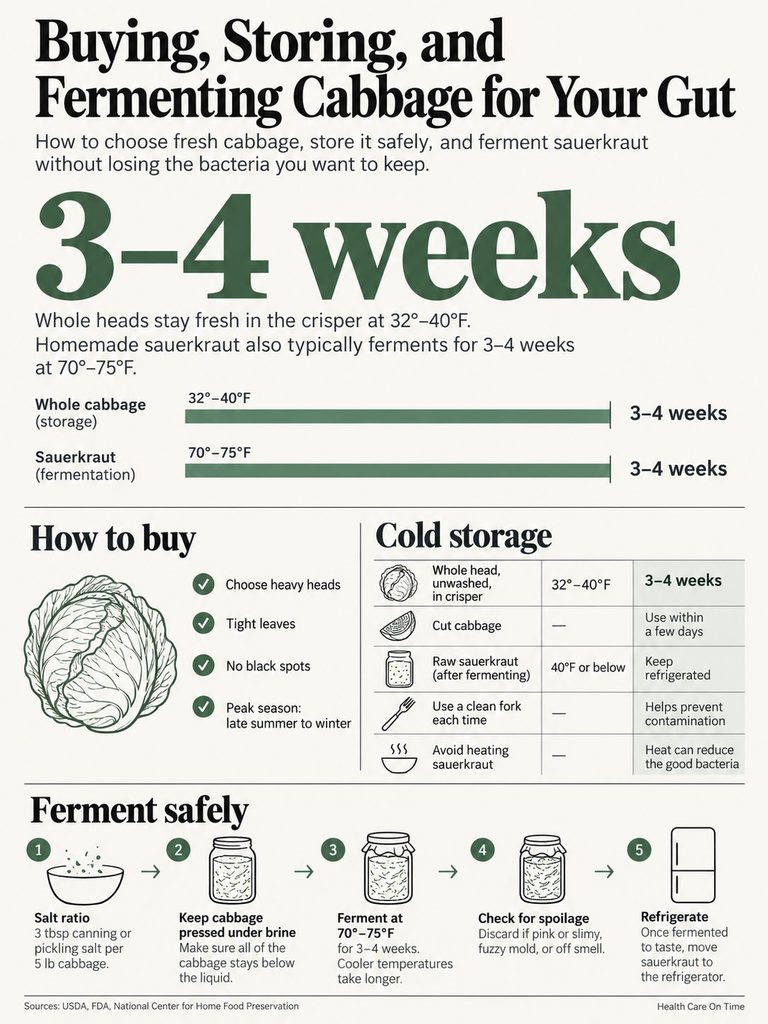
Choosing and Storing Fresh Cabbage
Pick heads that feel heavy for their size, with tight, crisp leaves and no black spots. Cabbage is in peak season across much of the US from late summer through winter.
Store whole heads unwashed in the crisper drawer at 32°F to 40°F. A whole head often keeps 3 to 4 weeks, while cut cabbage is best used within a few days.
Keeping Store-Bought Sauerkraut Alive
Keep raw sauerkraut refrigerated at 40°F or below and use a clean fork every time. Never heat it if you want the bacteria; add it to warm dishes at the end, off the burner.
Making Sauerkraut at Home Safely
Homemade sauerkraut is simple and reliably live. The National Center for Home Food Preservation recommends about 3 tablespoons of canning or pickling salt per 5 pounds of shredded cabbage.
Ferment at 70°F to 75°F for about 3 to 4 weeks, or at 60°F to 65°F for 5 to 6 weeks. Below 60°F, fermentation may stall, and above 75°F, the kraut can turn soft.
Keep the cabbage pressed under its brine the whole time. Throw out any batch with pink or slimy texture, fuzzy mold, or an off smell. Once it tastes right, move it to the fridge.
Who Should Be Careful With Cabbage
Cabbage is safe for most people, but some groups should adjust how they eat it. Our medical reviewers flag these five most often.
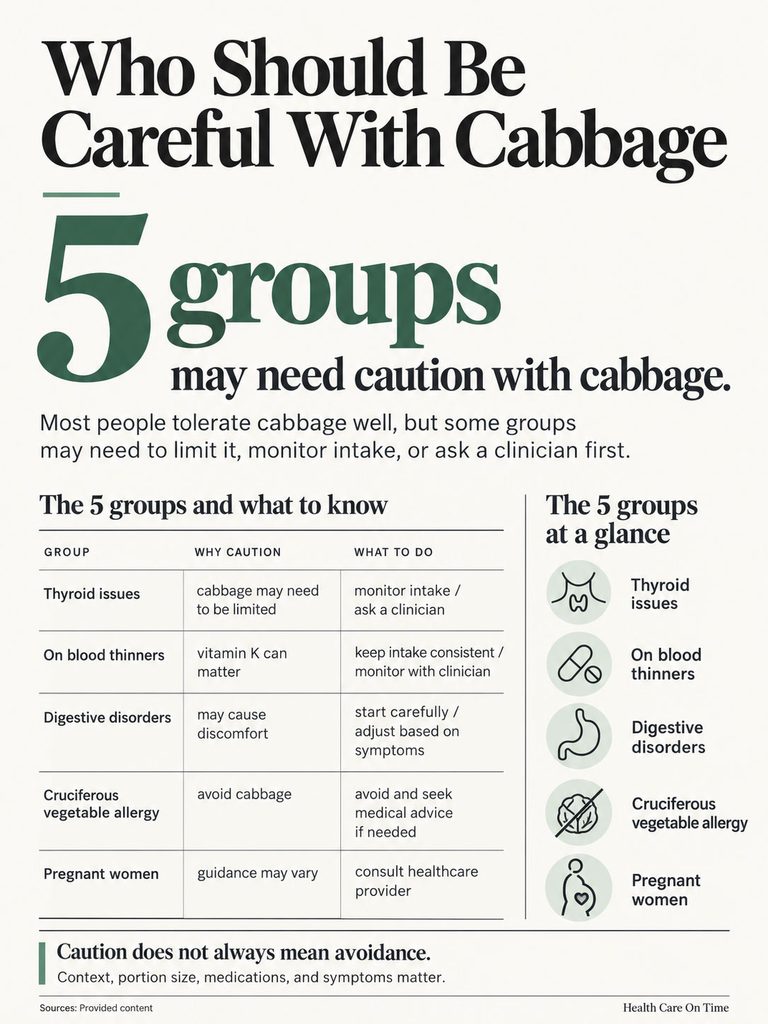
- People on warfarin. A chopped cup of raw cabbage has about 68 mcg of vitamin K, and a cup of boiled cabbage has well over 100 mcg. You don’t need to avoid it; keep intake steady week to week so your INR stays stable. See our warfarin and vitamin K guide.
- People with thyroid concerns. Cruciferous vegetables contain goitrogens, but normal food amounts are rarely a problem with adequate iodine. Our article Is Kale Good for Thyroid Health? explains the thresholds.
- People watching sodium. Canned sauerkraut has about 940 mg of sodium per cup, based on USDA data. That’s roughly 40% of the 2,300 mg daily limit in the Dietary Guidelines. Rinse it, or use a few tablespoons instead of a cup.
- Pregnant or immunocompromised people. Unpasteurized refrigerated ferments carry a small food-safety risk. Ask your clinician whether they fit your situation.
- People with histamine sensitivity. Fermented foods are high in histamine and may trigger headaches, flushing, or hives.
How to Add Cabbage for Better Digestion: A 2-Week Plan
Our medical reviewers recommend matching your cabbage approach to your main gut goal. Start with the row that fits you.
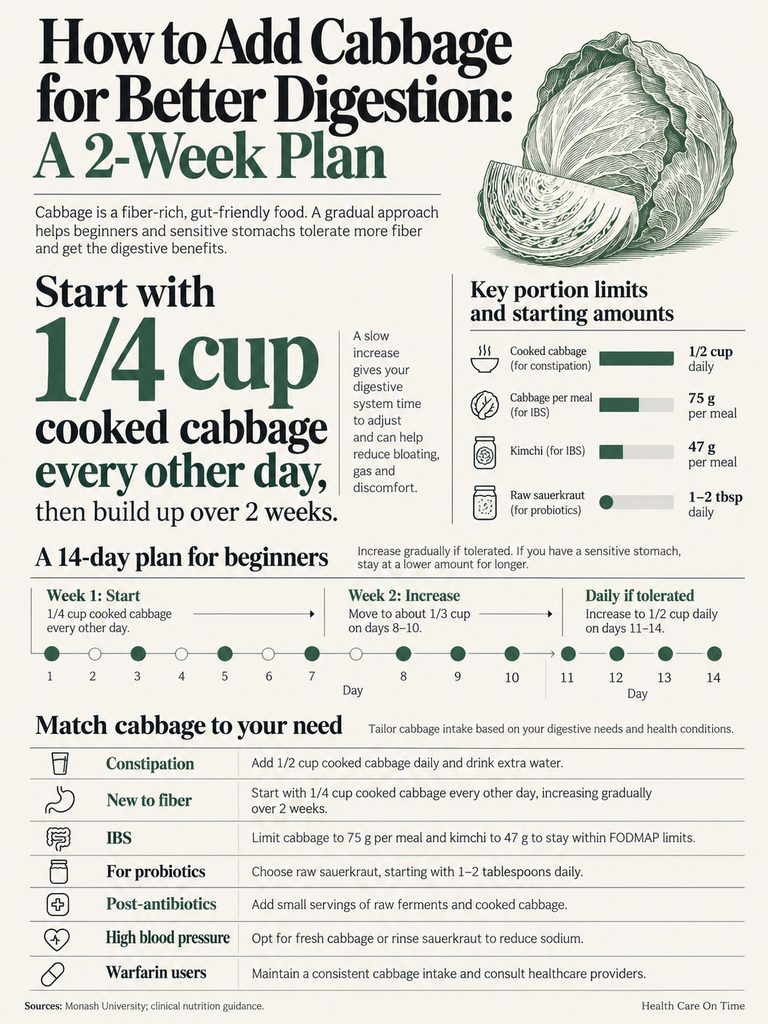
| Your Situation | What to Do | Why It Helps |
| Constipated, low-fiber diet | Add 1/2 cup cooked cabbage daily, plus 2 extra glasses of water | Insoluble fiber adds bulk; water keeps stool soft |
| New to fiber, gets gassy easily | Start with 1/4 cup cooked cabbage every other day; increase over 2 to 3 weeks | Bacteria adapt gradually; less raffinose at once |
| Diagnosed IBS | Keep green or red cabbage to 75 g per meal; kimchi to 47 g | Stays under Monash-tested FODMAP limits |
| Taking warfarin | Eat a similar cabbage amount each week; tell your care team before big changes | Steady vitamin K keeps INR stable |
| Want live probiotics | Buy refrigerated raw sauerkraut; start at 1 to 2 tablespoons daily, then add other fermented foods | Pasteurized kraut lacks live cultures; variety and volume drive results |
| Just finished antibiotics | Add small servings of raw ferments plus cooked cabbage for fiber | Supplies microbes and food for regrowing bacteria |
| High blood pressure or kidney disease | Prefer fresh cabbage; rinse sauerkraut or keep it to 2 tablespoons | Cuts sodium sharply |
A simple ramp looks like this:
- Days 1 to 3: 1/4 cup cooked cabbage with one meal.
- Days 4 to 7: 1/2 cup cooked, plus 1 tablespoon raw refrigerated sauerkraut.
- Days 8 to 11: Add 1/4 cup raw cabbage in a slaw or taco topping.
- Days 12 to 14: Settle on what feels good, up to about 3/4 cup total daily, with 2 to 3 tablespoons of ferment.
If symptoms spike at any step, drop back one step for a few days before moving forward again.
Easy Ways to Work Cabbage Into Everyday Meals
Families who ask our team for gut-friendly swaps usually want ideas that fit meals they already make. These need no special shopping:
- Taco night: swap half the lettuce for finely shredded red cabbage. It holds its crunch under warm fillings.
- Soups and chili: stir 1/2 cup chopped cabbage into the pot for the last 15 minutes of simmering.
- Sandwiches and burgers: add 1 to 2 tablespoons of raw refrigerated sauerkraut after cooking, so the heat doesn’t kill the cultures.
- Stir-fries: toss in napa cabbage at the end. It cooks in about 2 minutes and is the gentlest type for IBS.
- Grain bowls: top rice or quinoa with a small scoop of kimchi, staying near 47 grams if you’re FODMAP-sensitive.
- Sheet-pan dinners: roast cabbage wedges at 425°F for 20 to 25 minutes with olive oil and salt until the edges brown.
Rotating between these keeps the habit easy and adds plant variety across your week, which matters as much for your gut as any single serving.
Frequently Asked Questions
Is cabbage good for constipation?
Yes, for most people. Cabbage’s insoluble fiber adds bulk and helps stool move faster through your colon. The key is fluid: add water alongside the fiber, or constipation can get worse. Start with cooked cabbage and increase slowly over two to three weeks.
Why does cabbage make you so gassy?
Cabbage contains raffinose, a sugar your body can’t digest, so gut bacteria ferment it into gas. Sulfur compounds add the smell. This is normal and usually eases within a few weeks as your gut adjusts. Cooking cabbage and starting with small portions helps a lot.
Is raw or cooked cabbage easier to digest?
Cooked cabbage is easier for most people. Heat softens the tough cell walls while keeping the fiber. Raw cabbage keeps more vitamin C and the myrosinase enzyme but tends to cause more gas. If your stomach is sensitive, begin with steamed or braised cabbage.
Does store-bought sauerkraut have probiotics?
Usually not. Shelf-stable and canned sauerkraut is heat-treated, which kills the beneficial bacteria. For live cultures, buy sauerkraut from the refrigerated case labeled “raw” or “unpasteurized.” Be cautious with products listing added spore-forming bacteria, since those microbes didn’t actually ferment the cabbage.
How much sauerkraut should you eat a day?
There’s no official serving for gut health. Start with 1 to 2 tablespoons of raw refrigerated sauerkraut daily and work up slowly. Research suggests small portions alone may not change your microbiome much, so mix sauerkraut with other fermented foods like yogurt and kefir.
Is kimchi or sauerkraut better for gut health?
Both deliver live bacteria when unpasteurized. Kimchi adds garlic, ginger, and chili, which bring more plant variety but also more FODMAPs; Monash rates only 47 grams as low FODMAP. Sauerkraut is milder. Choose based on your tolerance, and rotating both works well.
Can people with IBS eat cabbage?
Yes, in measured amounts. Monash University rates green and red cabbage as low FODMAP at 75 grams per meal, about 3/4 cup. Larger portions add sorbitol or fructans that can trigger symptoms. Napa cabbage is more forgiving. Savoy has conflicting test results, so try it carefully.
Is cabbage juice good for stomach ulcers?
The evidence is weak. The idea comes from small 1940s studies by Dr. Garnett Cheney, which a 2026 review graded at the lowest evidence level. Most ulcers are caused by H. pylori or NSAIDs and respond to proven medical treatment. Don’t replace ulcer care with cabbage juice.
Is red cabbage better than green for digestion?
Not really. Red cabbage has more anthocyanin antioxidants and vitamin C, but the fiber and FODMAP limits are about the same as green. For your gut, variety matters more than color, so eating both is a smart choice.
Can cabbage cause diarrhea?
It can, especially in large raw portions or when you jump from little fiber to a lot. Big servings of sauerkraut or kimchi may also loosen stools at first. If diarrhea lasts more than a few days or comes with blood or fever, contact a doctor.
Is cabbage soup good for an upset stomach?
Plain, well-cooked cabbage soup can be gentle because heat softens the fiber and the broth adds fluids. Skip heavy spices and large portions while your stomach is upset. For vomiting, severe pain, or signs of dehydration, get medical care instead of relying on soup.
Is it OK to eat cabbage every day?
For most healthy adults, yes. Daily cabbage adds fiber, vitamin C, and vitamin K for very few calories. Keep portions reasonable, rotate types, and stay consistent if you take warfarin. People with IBS should keep portions within the tested low FODMAP limits.
Disclaimer: This article is for general education and is not a substitute for medical advice. Talk with your doctor or a registered dietitian before major diet changes, especially if you have IBS, inflammatory bowel disease, diverticulitis, thyroid disease, kidney disease, or take blood thinners such as warfarin. Seek care right away for severe abdominal pain, bloody stools, persistent vomiting, or unexplained weight loss.
References
- USDA FoodData Central: Cabbage, raw (FDC 169975)
- Wastyk HC et al. Gut-microbiota-targeted diets modulate human immune status. Cell, 2021
- Stanford Medicine: Fermented-food diet increases microbiome diversity
- The effects of fermented vegetables on the gut microbiota for prevention of cardiovascular disease (PMC)
- UC San Diego: American Gut Project findings
- JACC fiber report coverage, Good Morning America
- Stanford Report: Are you getting enough fiber?
- Monash FODMAP: FODMAP stacking
- FODMAP Everyday: Cabbage FODMAP data
- DNA fingerprinting of lactic acid bacteria in sauerkraut fermentations (PMC)
- Short-term sauerkraut supplementation in athletes (PMC)
- Functional Foods in Health and Disease: Sauerkraut CFU study
- S-Methylmethionine (Vitamin U): A critical narrative review, 2026 (PMC)
- NIDDK: Irritable bowel syndrome
- CDC MMWR: Adults meeting fruit and vegetable intake recommendations
- National Center for Home Food Preservation
- Dietary Guidelines for Americans