Search “calories in grapes” right now and you’ll find answers ranging from 62 to 104 calories per cup. Both numbers come from the USDA. Neither is wrong. Confused yet?
Table of Contents
That spread exists because the USDA tracks several grape types and serving weights, and most websites quote one number without telling you which. This guide fixes that. You’ll get every serving size, every grape color, and the full micronutrient profile, all pulled from USDA FoodData Central, plus exactly how grapes fit into weight loss, diabetes, and keto plans.
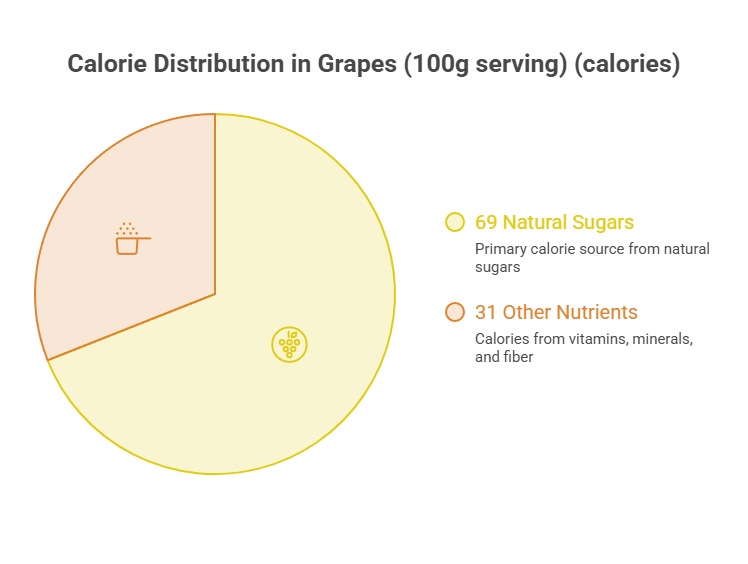
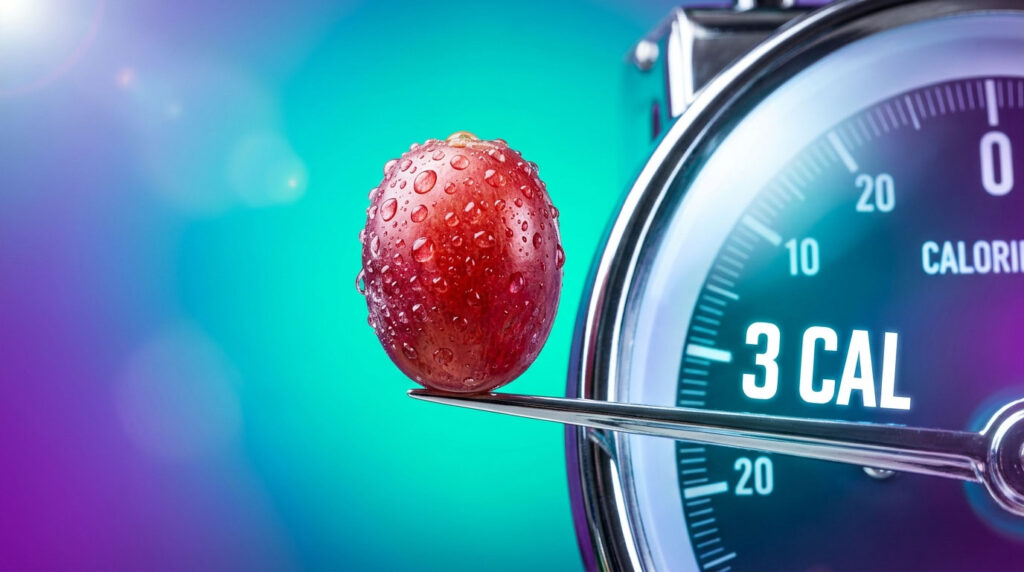
Quick Answer: One cup of red or green grapes (151 grams) contains 104 calories, according to the USDA. Per 100 grams, grapes provide 69 calories. A single grape has about 3 calories, and 10 grapes contain roughly 34 calories. Grapes are fat-free, cholesterol-free, and nearly sodium-free, with most calories coming from natural sugars.
At a Glance
- 1 cup of grapes (151 g) = 104 calories; half a cup = 52 calories
- 1 grape = about 3 calories; 10 grapes = about 34; a handful = roughly 50
- 100 g of grapes = 69 calories with 15.5 g natural sugar
- Red, green, and black grapes differ by only 2 to 3 calories per cup
- 1 pound of grapes = roughly 313 calories
- Grape juice and raisins pack 2 to 4 times more calories per serving than fresh grapes
- Grapes fit most weight-loss plans but need portion limits on keto and diabetic diets
What the USDA Says About Calories in Grapes
The USDA’s FoodData Central database is the reference standard for food nutrition in the United States. Food labels, dietitian software, and every calorie-tracking app on your phone trace back to it.
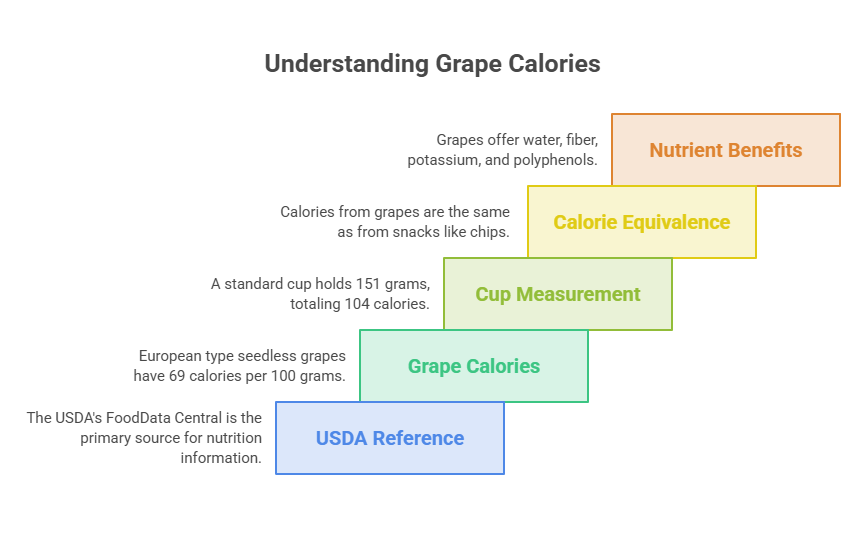
For the grapes most Americans buy, the seedless red and green table grapes classified as European type (Thompson seedless and similar varieties), the USDA lists 69 calories per 100 grams. A standard measuring cup holds 151 grams of these grapes, which works out to 104 calories.
Patients booking metabolic panels through HealthCareOnTime often ask whether fruit calories “count” differently than snack calories. They don’t. A calorie from grapes carries the same energy as a calorie from chips. What changes is the company it keeps: water, fiber, potassium, and polyphenols instead of sodium and refined oils.
Calories Per Serving Size
Real life doesn’t measure grapes in cups. You grab a handful at your desk, drop 15 into a kid’s lunchbox, or work through half a Costco bag during a movie. Here is what each portion actually costs you.
Table 1: Grape Calories by Serving Size (USDA-Based Values)
| Serving Size | Weight | Calories | Carbs (g) | Sugar (g) | Fiber (g) |
| 1 grape | 5 g | 3 | 0.9 | 0.8 | 0.05 |
| 10 grapes | 49 g | 34 | 8.9 | 7.6 | 0.4 |
| Small handful (about 15 grapes) | 75 g | 52 | 13.6 | 11.6 | 0.7 |
| 1/2 cup | 76 g | 52 | 13.7 | 11.7 | 0.7 |
| 1 cup | 151 g | 104 | 27.3 | 23.4 | 1.4 |
| FDA standard serving (RACC) | 140 g | 97 | 25.3 | 21.7 | 1.3 |
| 1 pound | 453 g | 313 | 82 | 70 | 4.1 |
Two practical takeaways. First, the “one grape won’t hurt” logic is true; at 3 calories, a single grape is a rounding error. Second, the bag is the danger zone. A typical 2-pound clamshell from the grocery store holds about 626 calories, and grapes are engineered by nature for continuous hand-to-mouth eating.
For context, a 30-minute walk at a brisk pace burns roughly 130 to 150 calories for a 155-pound adult, per Harvard Medical School estimates. That covers a generous cup and a half of grapes. It does not cover the bag.
Why Different Websites Show Different Numbers
The calorie confusion around grapes has a simple explanation: the USDA maintains multiple grape entries, and websites cherry-pick without labeling which one they used.
The legacy USDA entry for European-type red or green grapes shows 69 calories per 100 grams. The entry for American slip-skin grapes (Concord and similar) shows 67 calories per 100 grams. Newer USDA Foods analyses list red seedless grapes at 86 calories and green seedless at 80 calories per 100 grams, reflecting modern varieties bred sweeter and denser.
Portion size compounds the mess. The American-type cup weighs only 92 grams because those grapes pack loosely, producing the famous “62 calories per cup” figure. The European-type cup weighs 151 grams, producing 104 calories. Same database, different cups.
Our medical reviewers recommend a simple working rule: count 100 calories per cup or 70 calories per 100 grams for any table grape sold in US grocery stores. The variance between varieties is smaller than the variance in how full you pack the cup.
Full USDA Nutrition Breakdown of Grapes
Calories tell you the energy cost. The rest of the label tells you what you’re buying with it. Here is the complete picture for 1 cup (151 g) of red or green grapes.
Macronutrients
Grapes are essentially a carbohydrate delivery system wrapped in water. About 81 percent of a grape’s weight is water, which is why a full cup feels substantial for only 104 calories.
- Carbohydrates: 27.3 g (10% Daily Value). Nearly all from glucose and fructose in roughly equal amounts.
- Sugar: 23.4 g, all naturally occurring, zero added sugar.
- Fiber: 1.4 g (5% DV). This is grapes’ weak spot; berries deliver 2 to 4 times more.
- Protein: 1.1 g. Negligible for daily targets.
- Fat: 0.2 g, with no saturated fat and no cholesterol.
- Sodium: 3 mg, effectively sodium-free.
The macronutrient split lands at about 94 percent carbs, 4 percent protein, 2 percent fat. That profile makes grapes excellent quick fuel before a workout and a poor choice as a stand-alone meal.
Vitamins and Minerals
Grapes won’t top any micronutrient chart, but two minerals stand out in ways most shoppers never hear about.
- Vitamin K: 22 mcg (18% DV). Supports blood clotting and bone health.
- Copper: 0.2 mg (21% DV). Needed for energy production, iron metabolism, and nerve function.
- Thiamin: 0.1 mg (9% DV)
- Vitamin B6: 0.13 mg (8% DV)
- Potassium: 288 mg (6% DV). Helpful for blood pressure regulation.
- Vitamin C: 5 mg (5% DV)
- Manganese: 0.1 mg (5% DV)
- Vitamin A, calcium, iron, magnesium: small amounts, each under 5% DV.
In lab panels reviewed across our diagnostic network, copper deficiency appears more often than most people expect, particularly in patients on restrictive diets. A daily cup of grapes quietly covers a fifth of that requirement.
Resveratrol and Polyphenols
Grape skins contain resveratrol, the polyphenol that made red wine famous. Research compiled by the NIH links resveratrol to antioxidant and anti-inflammatory activity, though the strongest evidence still comes from animal and cell studies.
Grapes also deliver flavonoids like quercetin and catechins, plus anthocyanins in dark varieties. None of these appear on a nutrition label, yet they’re a major reason researchers keep studying grapes despite the sugar content. A human trial at UCLA found grape consumption preserved metabolic activity in brain regions tied to early memory decline.
How Grapes Fit US Dietary Guidelines
The Dietary Guidelines for Americans recommend 2 cups of fruit daily for most adults on a 2,000-calorie diet. One cup of grapes counts as exactly one cup-equivalent under USDA MyPlate rules, so grapes alone can cover half your daily fruit target for 104 calories.
That math matters for budgeting calories across a full day. Two cups of fruit from grapes costs about 208 calories; the same two cups from bananas costs around 270, and from mango closer to 200. Grapes land squarely in the affordable middle of the fruit aisle, both in calories and in dollars per serving at most US grocery chains.
One nuance the guidelines flag: at least half your fruit intake should come from whole fruit rather than juice. Grapes make that easy. A cup of whole grapes satisfies the whole-fruit recommendation; a glass of grape juice does not carry the same weight, and several school nutrition programs have tightened juice allowances for exactly this reason.
Our medical reviewers point out a practical angle here for lab patients: people preparing for fasting blood work sometimes assume fruit “doesn’t count” the night before. It does. A late bowl of grapes is still 100-plus calories of fast-absorbing carbohydrate, and timing matters when glucose and triglyceride panels are on the schedule.
Red vs Green vs Black Grapes: Calorie and Nutrient Differences
Standing in the produce aisle wondering which color saves you calories? Stop wondering. Color barely matters for calories.
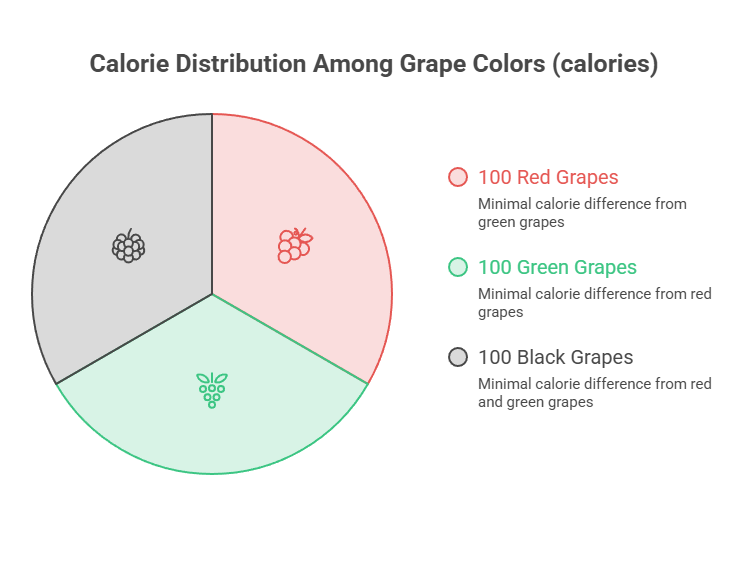
Calorie Comparison by Color
Red, green, and black seedless grapes all land between 100 and 110 calories per cup in USDA data. Black grapes occasionally test 2 to 3 calories higher per cup because they run slightly sweeter, a difference too small to matter even for strict macro trackers.
Seeded varieties match their seedless cousins almost exactly. The seeds add trace fat and fiber but shift the calorie count by less than 2 percent.
Antioxidant Differences
The real difference between grape colors lives in the skin pigments. Red and black grapes get their color from anthocyanins, potent antioxidants that green grapes lack entirely. Black grapes carry the highest concentration, followed by red.
Red and black grapes also contain meaningfully more resveratrol. Green grapes still provide catechins and other flavonoids, so they’re far from empty, just less concentrated. Our nutrition reviewers put it simply: pick by taste for calories, pick dark for antioxidants.
Cotton Candy Grapes and Specialty Varieties
Cotton candy grapes, the hybrid that tastes like carnival sugar, run about 100 calories per cup, nearly identical to standard grapes. The flavor comes from cross-breeding done in California, not added sugar, though their sugar content sits at the high end of the range, near 28 grams per cup.
Moon Drops, Concords, and muscadines all stay within roughly 60 to 110 calories per cup. Muscadines, a Southern US native, actually deliver more fiber per serving thanks to thicker skins.
Grapes vs Other Fruits and Grape Products
Context turns a number into a decision. Here is how grapes stack up against common US fruits and against their own processed forms, using USDA data throughout.
Table 2: Grapes vs Other Fruits and Grape Products (USDA Data)
| Food | Serving | Calories | Sugar (g) | Fiber (g) | Source |
| Grapes, fresh | 1 cup (151 g) | 104 | 23 | 1.4 | USDA FoodData Central |
| Strawberries | 1 cup (152 g) | 53 | 8 | 3.0 | USDA FoodData Central |
| Watermelon, diced | 1 cup (152 g) | 46 | 9 | 0.6 | USDA FoodData Central |
| Apple | 1 medium (182 g) | 95 | 19 | 4.4 | USDA FoodData Central |
| Banana | 1 medium (118 g) | 105 | 14 | 3.1 | USDA FoodData Central |
| Raisins | 1/4 cup (40 g) | 120 | 26 | 1.6 | USDA FoodData Central |
| Grape juice, 100% | 8 fl oz (253 g) | 160 | 35 | 0.5 | USDA FoodData Central |
Read the table top to bottom and a pattern emerges. Fresh grapes sit mid-pack among fruits: pricier in calories than berries and melon, comparable to apples and bananas, but with less fiber than nearly everything else listed.
The bottom two rows are where people sabotage themselves without realizing it.
Fresh Grapes vs Raisins vs Grape Juice
Raisins are grapes with the water removed and nothing else changed. That concentration means a quarter cup of raisins matches a full cup of fresh grapes in calories while occupying a fraction of the stomach space. Raisins remain a legitimate fiber source in measured amounts; they’re just easy to overpour into oatmeal or trail mix.
Grape juice loses on every metric. An 8-ounce glass delivers 160 calories and 35 grams of sugar with almost no fiber and none of the satisfaction of chewing. Testing by Consumer Reports has also flagged concerning heavy metal levels in some grape juice brands.
The whole-fruit advantage shows up in national data too. CDC figures show only about 1 in 10 American adults meets daily fruit recommendations, and liquid sugar consistently fails to trigger the fullness signals whole fruit provides.
Do Grapes Fit Your Diet? Weight Loss, Diabetes, and Keto
A food’s calorie count means nothing until you map it onto your actual goal. Here is the honest assessment for the three diet questions Americans search most.
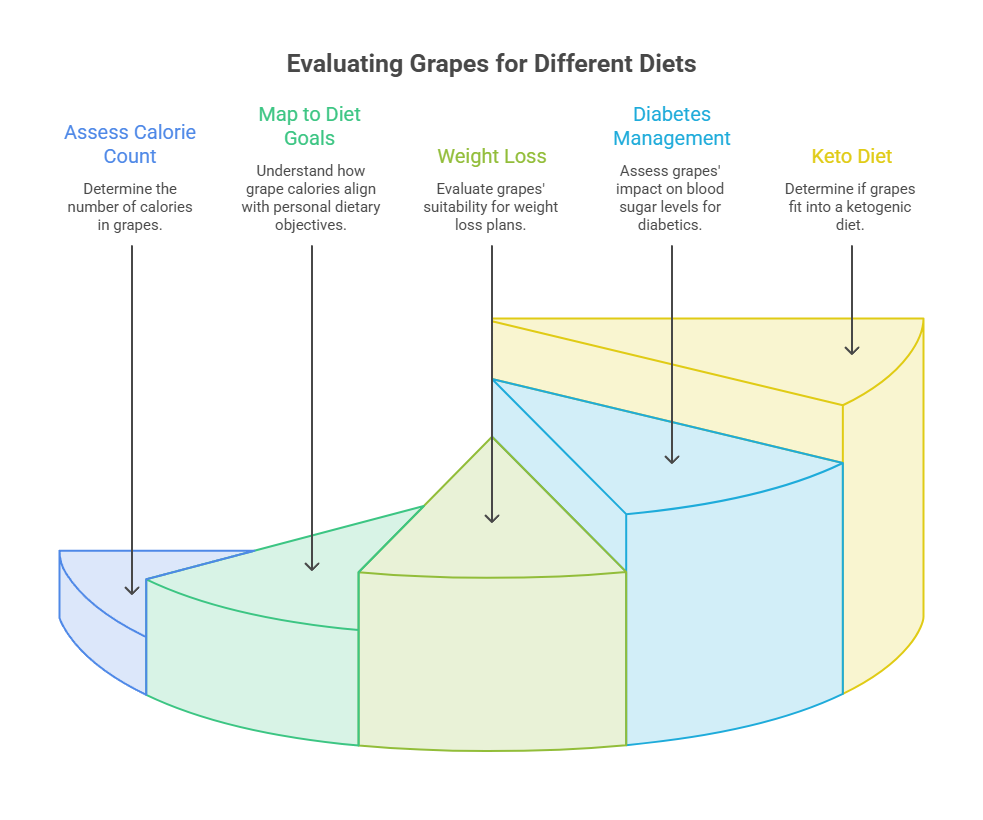
Grapes and Weight Loss
Grapes work for weight loss with one condition: portion awareness. At 104 calories per cup with 81 percent water content, they offer real volume per calorie and crush sugar cravings that might otherwise end in a 250-calorie candy bar.
Their weakness is satiety. With only 1.4 grams of fiber and 1 gram of protein per cup, grapes leave quickly, and the snackable format invites grazing. A cup of grapes is a smart snack; a bag of grapes is 300-plus unplanned calories.
Across patients we serve who are working on weight management, the strategy that sticks is pre-portioning: wash the bunch on grocery day, split it into 1-cup containers, and freeze half. Frozen grapes take longer to eat, which reliably slows total intake.
Grapes and Blood Sugar
Grapes carry a glycemic index of roughly 49 to 53, which classifies as low. The fructose-glucose mix, the water content, and the intact fruit structure all moderate the blood sugar response compared with juice, candy, or refined carbs.
The American Diabetes Association includes grapes among fruits people with diabetes can eat, with carb counting as the guardrail. A practical diabetic portion is 17 small grapes, about 15 grams of carbohydrate, the standard one-carb-serving exchange used by US dietitians.
Our medical team notes one pattern from clinical experience: continuous glucose monitor users often see sharper spikes from grapes eaten alone on an empty stomach than from grapes paired with cheese, nuts, or yogurt. Protein and fat slow absorption.
Timing helps too. Grapes eaten as dessert after a mixed meal produce a flatter glucose curve than the same grapes eaten as a stand-alone mid-morning snack, because the meal’s fiber, fat, and protein are still slowing gastric emptying. For anyone tracking post-meal readings, that ordering trick costs nothing and often shaves 15 to 30 points off the peak.
Grapes on Keto and Low-Carb Plans
Here grapes hit a wall. One cup contains about 26 grams of net carbs, which consumes most or all of a standard 20-to-30-gram daily keto allowance in a single serving.
Strict keto followers should treat grapes as off-plan or cap intake at 5 or 6 individual grapes, about 5 grams of net carbs. Moderate low-carb eaters targeting 50 to 100 grams daily can fit half a cup without trouble. Berries remain the better low-carb fruit at roughly half the net carbs per serving.
Table 3: Grape Portion Decisions by Goal
| Your Situation | Recommended Portion | Action |
| Weight loss (1,500–1,800 cal/day) | 1 cup (104 cal) | Pre-portion into containers; pair with string cheese or nuts |
| Type 2 diabetes or prediabetes | 17 small grapes (15 g carbs) | Count as one carb exchange; pair with protein; monitor response |
| Strict keto (under 20 g net carbs) | 5–6 grapes max, or skip | Swap for 1/2 cup raspberries (3.5 g net carbs) |
| Athlete needing quick pre-workout fuel | 1–2 cups, 30–60 min before | Use the fast glucose-fructose blend; hydration bonus |
| Packing kids’ lunches (under age 4: choking risk) | 1/2 cup, halved lengthwise | Cut grapes in half for children under 4 per AAP guidance |
| Mindless evening snacker | 1 cup frozen | Freezing slows eating speed and stretches the portion |
Smart Ways to Eat Grapes Without Overdoing Calories
The difference between grapes helping your diet and hurting it comes down to mechanics, not willpower. A few small habits do the work.
Portion Tricks That Actually Work
Freeze them. Frozen grapes turn into tiny sorbet bites that take 3 to 4 times longer to eat, and slower eating reliably reduces total intake. They also stand in for ice cream at a fraction of the cost; a cup of frozen grapes saves roughly 170 calories versus a half cup of premium vanilla.
Pair them. Grapes plus a protein source (a cheese stick, a small handful of almonds, plain Greek yogurt) blunts the blood sugar curve and extends fullness. Classic American chicken salad with halved grapes works on the same principle.
Pre-portion on shopping day. Sixty seconds with a few containers eliminates the open-bag problem for the entire week. Patients commonly ask us for complicated tracking systems when this single habit solves most of the overage.
Common Mistakes
Eating from the bag is mistake number one. A standard 2-pound grocery clamshell holds over 600 calories, and nothing about the eating experience signals when you’ve crossed from snack to meal.
Swapping whole grapes for juice is mistake number two; you inherit more calories, concentrated sugar, and almost zero fiber. Mistake three is assuming green grapes are “diet grapes.” As the USDA numbers show, color changes antioxidants, not calories.
Buying and Storing Grapes to Protect Nutrition
Calories don’t change with storage, but polyphenol content and eating quality do. Grapes stop ripening the moment they’re picked, so what you buy is as sweet as they’ll ever get. Look for plump berries firmly attached to flexible green stems; brown, brittle stems signal age.
Store grapes unwashed in the refrigerator in their ventilated bag, where they hold quality for one to two weeks. Washing before storage traps moisture and speeds mold. Rinse only what you’re about to eat, or wash and fully dry a batch before pre-portioning into containers.
The white powdery coating on grape skins is bloom, a natural protective wax, not pesticide residue. It’s harmless and actually a freshness indicator. Grapes do appear on produce pesticide-residue watchlists most years, so a 30-second rinse under running water is worthwhile; the FDA recommends plain water over commercial produce washes.
For freezing, wash, dry completely, pull grapes off the stems, and spread them on a sheet pan before bagging. Frozen flat first, they won’t clump, and a one-cup scoop stays an honest one-cup portion.
What a Day of Grape Snacking Looks Like in Calories
Numbers stick better attached to a real day. Here is how grapes slot into a typical American eating pattern without blowing the budget.
Breakfast: a half cup of halved grapes stirred into plain Greek yogurt adds 52 calories and turns 100 calories of yogurt into a 150-calorie breakfast with protein, calcium, and sweetness, no added sugar required.
Lunchbox: a half-cup portion alongside a sandwich adds 52 calories and covers a quarter of a child’s daily fruit recommendation. For kids under 4, halve every grape lengthwise; whole grapes remain one of the leading choking hazards for toddlers, per American Academy of Pediatrics guidance.
Afternoon slump: a 15-grape handful at the desk runs about 50 calories, against 250 for the vending machine candy bar it replaces. Make that swap three afternoons a week and the difference compounds to roughly 31,000 calories a year, the equivalent of nearly 9 pounds of body weight.
Evening: one cup of frozen grapes during a show costs 104 calories and takes 20 minutes to finish. The same 20 minutes with a pint of ice cream can clear 600. Across patients we serve, this single evening swap is the most common success story in food diaries.
Total grape contribution for that day: about 260 calories for two full cup-equivalents of fruit, the entire daily recommendation, with vitamin K, copper, and potassium riding along.
Frequently Asked Questions
How many calories are in 10 grapes?
Ten average seedless grapes contain about 34 calories, based on USDA per-grape weights of roughly 5 grams each. Larger varieties like Moon Drops can push that to 40 to 45 calories. Either way, 10 grapes carry fewer calories than half a granola bar.
How many calories are in a handful of grapes?
A small handful holds about 15 grapes, or roughly 50 calories with 12 grams of natural sugar. A generous adult handful approaches 20 grapes and 70 calories. It remains one of the cheapest sweet snacks in calorie terms available in any US grocery store.
How many grapes equal 100 calories?
Roughly 29 to 30 average grapes equal 100 calories, just under one full cup. That makes grapes a generous 100-calorie snack; the same budget buys only about 14 potato chips or half a standard candy bar.
Are grapes high in sugar?
Grapes sit at the higher end for fruit, with 23 grams of natural sugar per cup versus 8 grams in strawberries. All of it occurs naturally, with zero added sugar, and the low glycemic index (around 49 to 53) means a gentler blood sugar effect than the gram count suggests.
Which grape color has the fewest calories?
None meaningfully. Red, green, and black grapes all provide 100 to 110 calories per cup in USDA data, with differences of 2 to 3 calories at most. Choose dark grapes for higher anthocyanin and resveratrol content, not for calorie savings.
Are grapes good for weight loss?
Yes, in controlled portions. At 104 calories per cup and 81 percent water, grapes deliver sweetness and volume cheaply. Their low fiber means weak satiety, so pre-portion a cup rather than eating from the bag, and pair with protein for staying power.
Can diabetics eat grapes?
Yes. The American Diabetes Association includes grapes in diabetes-friendly eating patterns. A standard portion is 17 small grapes, equal to one 15-gram carb exchange. Pairing grapes with protein or fat slows the glucose response. Anyone managing diabetes should confirm portions with their care team.
Are grapes keto friendly?
Not really. One cup contains about 26 grams of net carbs, which exceeds most strict keto daily limits in a single serving. Keto followers can fit 5 to 6 individual grapes, about 5 grams net carbs, or choose raspberries and blackberries instead.
How many calories are in cotton candy grapes?
Cotton candy grapes contain about 100 calories per cup, nearly identical to regular table grapes. Their signature flavor comes from California cross-breeding, not added sugar, though they sit at the sweeter end of the spectrum at around 28 grams of sugar per cup.
Is it OK to eat grapes every day?
For most healthy adults, yes. A daily cup adds 104 calories, useful vitamin K and copper, and skin polyphenols. People on blood thinners like warfarin should keep vitamin K intake consistent and discuss it with their doctor, since grapes supply 18 percent of the daily value per cup.
Are grapes fattening if eaten at night?
No food becomes more caloric after dark. A cup of grapes is 104 calories at noon or midnight; total daily intake determines weight change. The real nighttime risk is portion creep during screen time, which pre-portioning solves better than any clock-based rule.
How many grapes should I eat a day?
One to two cups daily fits comfortably within the 2-cup fruit recommendation in the Dietary Guidelines for Americans. That’s roughly 30 to 60 grapes, or 104 to 208 calories. People managing blood sugar or carb intake should stay closer to the 17-grape exchange portion per sitting.
Do frozen grapes have fewer calories?
No. Freezing changes texture, not energy content; a cup of frozen grapes still contains 104 calories. The advantage is behavioral. Frozen grapes take 3 to 4 times longer to eat, which slows intake and makes a single portion feel more satisfying than the same grapes eaten fresh.
How many calories are in a pound of grapes?
One pound of grapes (453 grams) contains about 313 calories, with 82 grams of carbohydrates and 70 grams of sugar. That matters because a pound is a realistic single-sitting amount for an absent-minded snacker, equal to three full cup servings.
Disclaimer: This article is for informational purposes only and does not replace professional medical advice, diagnosis, or treatment. Nutritional needs vary by individual. Consult a physician or registered dietitian before making significant dietary changes, particularly if you have diabetes, take blood-thinning medication, or manage any chronic condition.
References
- USDA FoodData Central: Grapes, red or green (European type), raw
- USDA FoodData Central database
- USDA MyPlate: Fruits
- FDA: Selecting and serving fresh produce safely
- CDC: Nutrition and fruit/vegetable intake data
- American Diabetes Association: Food and blood sugar
- NIH Office of Dietary Supplements
- Consumer Reports: Are Grapes Good for You?
- Harvard Medical School: Calories burned in 30 minutes
- Mayo Clinic: Nutrition and healthy eating
- UCLA Health