Most people assume stool color reports on what they ate. It reports more accurately on how fast it moved.
Our medical reviewers field this question more often than almost any other stool-related concern, and the honest answer surprises people: green usually means your digestion ran ahead of schedule, not that anything went wrong.
Table of Contents
Quick Answer
Green stool is almost always bile that ran out of time. Bile leaves the liver yellow-green, and gut bacteria convert it to brown over roughly 30 to 40 hours. Speed that trip up, or eat enough chlorophyll or dye, and the green survives. Most cases clear within 24 to 72 hours. Green paired with fever, blood, severe pain, or diarrhea past three days needs medical attention.
At a Glance
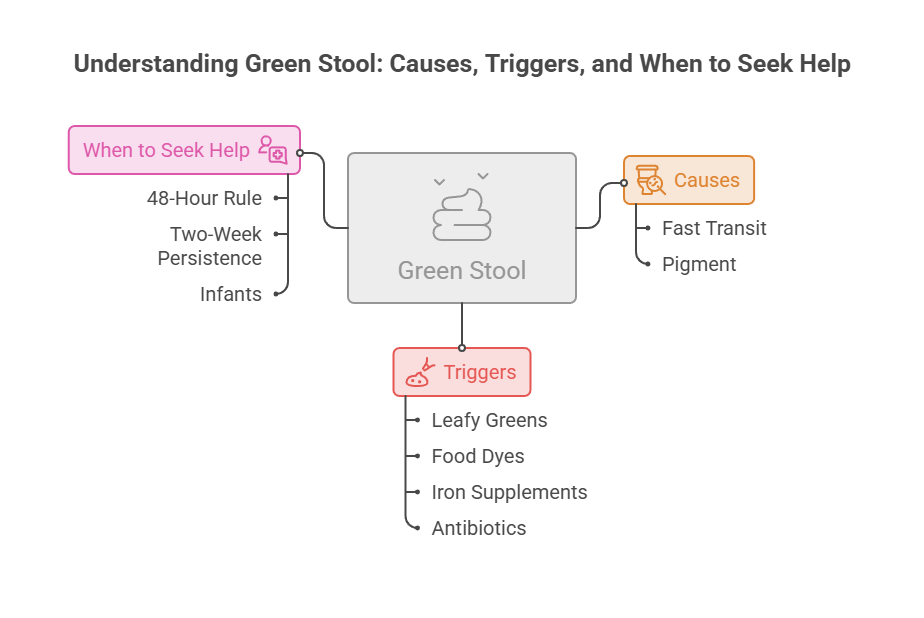
• Green stool usually means fast transit or pigment, not disease
• Bile chemistry, not blood, produces the color
• Leafy greens, food dyes, iron supplements, and antibiotics top the trigger list
• Red, black, and white stool matter far more than green
• The 48-hour rule: no other symptoms and gone in two days means no action needed
• Green stool persisting past two weeks earns a stool workup
• In infants, green is common enough that pediatricians rarely flag it alone
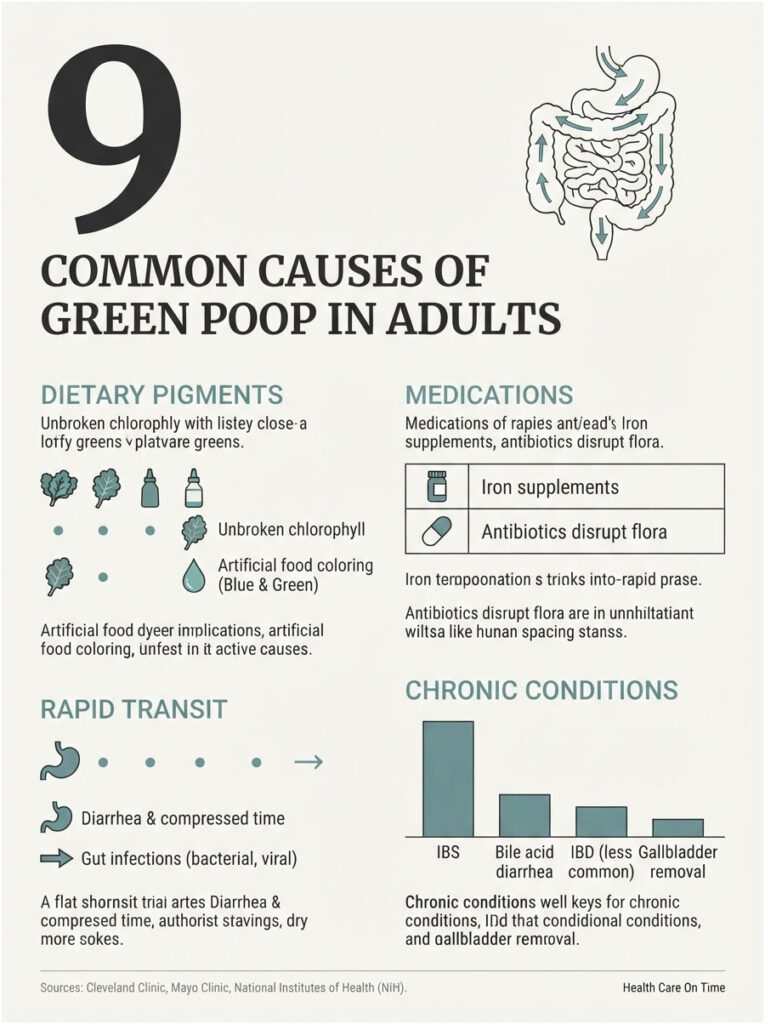
The nine causes, ranked by how often they explain it:
- Leafy greens and chlorophyll
- Food dye and artificial coloring
- Iron supplements and iron-rich foods
- Antibiotics and gut flora disruption
- Diarrhea and rapid transit
- Gut infections, including norovirus, Salmonella, and Giardia
- IBS and bile acid diarrhea
- Inflammatory bowel disease
- Gallbladder removal and altered bile flow
What Green Poop Actually Means Inside Your Gut
Stool color is a byproduct of bile chemistry, not a readout of your plate. Understanding the pigment cycle answers roughly 80% of the question before you reach any cause list.
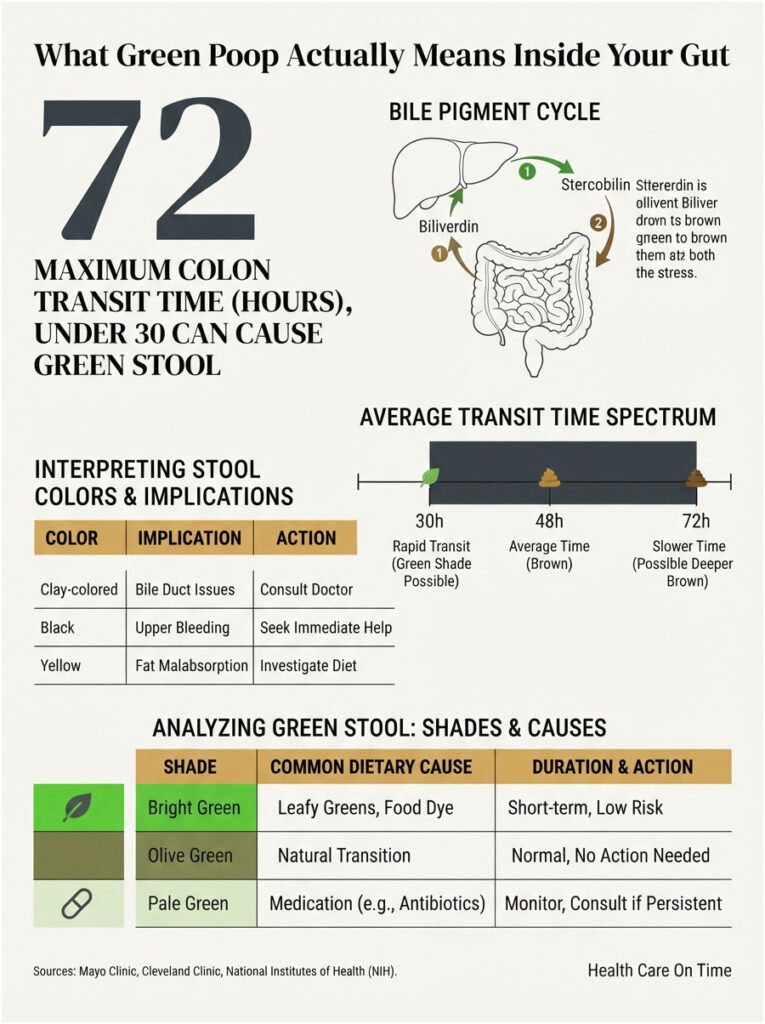
The Bile Pigment Cycle, Green to Brown
Your liver produces bile, a yellow-green fluid that breaks down dietary fat. The gallbladder stores it and releases it into the small intestine whenever a meal containing fat arrives.
The green tint comes from biliverdin, which the body converts to bilirubin. As bile moves down the intestinal tract, gut bacteria transform bilirubin into urobilinogen, then into stercobilin, the brown pigment behind normal stool color.
That final conversion is bacterial work, and bacterial work takes hours. Cut the hours short and the pigment never finishes changing.
Mayo Clinic frames stool color as a product of diet plus the amount of bile present, with enzymes shifting the color from green to brown along the way. That single mechanism explains most green stool anyone will ever see.
Transit Time Is the Real Variable
Here is the number nobody puts in front of readers. According to UCSF Health, average transit through the colon in a person who is not constipated runs 30 to 40 hours, with up to 72 hours still considered normal, and transit in women sometimes reaching around 100 hours.
Bile needs a meaningful share of that window to finish converting. When stool clears the colon in under 24 hours, the bacteria never complete their shift.
Our medical team explains it to patients this way: brown is the finished product, green is the work in progress. Diarrhea is the fastest route to green stool because it compresses a 36-hour process into a handful of hours.
This also explains why the same person can pass brown stool in the morning and green stool that evening. Transit speed fluctuates with meals, stress, caffeine, sleep, and activity across a single day.
Where Green Sits on the Stool Color Spectrum
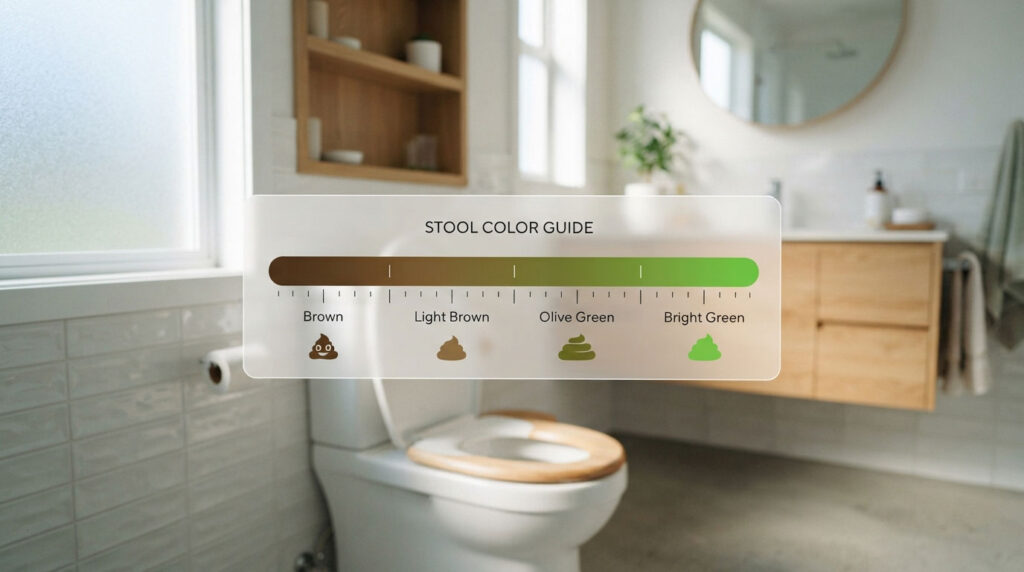
Green ranks among the least concerning colors a person can find in the toilet. It shares the low-risk band with brown, tan, and yellow-brown.
Color anxiety runs high because people rarely look, then look once and panic. A single unusual bowel movement carries almost no diagnostic weight on its own.
Green vs. Yellow vs. Clay vs. Black
Yellow, greasy, floating stool suggests fat malabsorption. Clay-colored, pale, or white stool suggests bile is not reaching the intestine at all, which is a bile duct question and warrants prompt evaluation.
Black, tarry stool can indicate bleeding higher in the digestive tract. Bright red suggests bleeding lower down. Green belongs to none of those categories.
Patients booking stool tests through HealthCareOnTime frequently arrive worried about color when the finding that actually matters on their panel turns out to have nothing to do with what they saw.
Table 1. Green Stool Shade Decoder
| Shade You See | Most Likely Cause | Typical Duration | Companion Symptoms | What to Do |
| Bright grass green | Chlorophyll from spinach, kale, matcha, greens powder | 12 to 48 hours | None | No action; recheck in two days |
| Neon or teal green | Artificial dye (blue #1, green #3, frosting, sports drinks) | 12 to 36 hours | None | No action; clears with the dye |
| Dark olive or forest green | Iron supplement, fortified formula, high red meat intake | 2 to 7 days while dosing | Constipation, mild nausea | Continue iron; split the dose with food |
| Green, loose, or watery | Rapid transit, viral gastroenteritis, bile acid diarrhea | 1 to 3 days | Cramping, urgency, low fever | Hydrate; call a doctor past day 3 |
| Green with visible mucus | Gut inflammation, IBS flare, bacterial infection | Variable | Cramping, urgency, incomplete emptying | Book a stool test if past one week |
| Green, greasy, foul-smelling | Fat malabsorption, giardiasis, altered bile flow | Over one week | Bloating, weight loss, floating stool | Physician visit plus ova and parasite testing |
| Green during or after antibiotics | Gut flora disruption | Course length plus 1 to 2 weeks | Mild cramping, gas | Monitor; urgent care if watery with fever |
9 Common Causes of Green Poop in Adults
The list runs from most frequent to least. In cases reviewed by our medical team, the first three explain the large majority of green stool reports in people with no other symptoms.
1. Leafy Greens and Chlorophyll
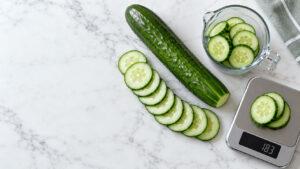
Chlorophyll is the pigment that makes plants green, and the human gut does not fully break it down. Spinach, kale, Swiss chard, broccoli, arugula, and collards each deliver enough to tint stool.
Greens powders and matcha catch people off guard. A single scoop of a spirulina or wheatgrass blend can outcolor an entire salad, because the pigment is concentrated by a factor of several.
Green fruits contribute as well: avocado, green apple, honeydew, kiwi, and pistachios. Blueberries and other deep purple produce sometimes push stool toward green when digestive fluids mix with the pigment.
Expect the color to clear within a day or two of the food clearing your system.
2. Food Dye and Artificial Coloring
Blue and green food dyes pass through largely intact. St. Patrick’s Day cupcakes, blue sports drinks, birthday cake frosting, blue raspberry candy, and grape popsicles all reappear later.
Blue dye combined with normal yellow-brown bile produces a striking green that alarms people more than the natural version. The shade skews brighter, closer to teal or emerald.
Our lab partners report that dye-driven color changes resolve faster than any other cause, usually inside 24 to 36 hours, because no absorption or metabolism is involved.
3. Iron Supplements and Iron-Rich Foods
Ferrous sulfate and other oral iron formulations commonly darken stool to olive, dark green, or near black. This is expected pharmacology, not a warning sign.
Prenatal vitamins carry enough iron to do it. So do iron-fortified breakfast cereals and iron-fortified infant formula.
A typical adult iron dose delivers far more elemental iron than the gut absorbs, and the unabsorbed remainder darkens what comes out. If you take iron for diagnosed anemia, the color change is not a reason to stop.
Splitting the dose or taking it with food eases the stomach upset that often travels with it.
4. Antibiotics and Gut Flora Disruption
Antibiotics reduce the bacterial populations responsible for converting bilirubin into brown stercobilin. Fewer bacteria means less conversion, and green makes it through.
Amoxicillin, azithromycin, ciprofloxacin, and clindamycin appear frequently in this pattern. The effect often persists one to two weeks past the final dose while the gut repopulates.
The concerning version looks different. Watery diarrhea with fever and cramping during or after an antibiotic course can signal Clostridioides difficile, which requires testing rather than watchful waiting.
5. Diarrhea and Rapid Transit
Any diarrhea compresses transit time, and compressed transit produces green. This mechanism sits behind most green stool that arrives with symptoms attached.
Triggers include a stomach bug, food that disagreed with you, heavy caffeine intake, sugar alcohols such as sorbitol and xylitol, and magnesium supplements.
The color here is a passenger, not the problem. Track the diarrhea, not the shade.
6. Gut Infections
Bacterial, viral, and parasitic infections all accelerate transit sharply. Salmonella, E. coli, Campylobacter, norovirus, and Giardia each produce green diarrhea.
The scale deserves perspective. The CDC estimates roughly 1 in 6 Americans, about 48 million people, gets sick from a foodborne pathogen each year, resulting in 128,000 hospitalizations and 3,000 deaths.
Norovirus alone drives about 2,500 reported outbreaks annually in the United States, concentrated between November and April, and accounts for nearly 1 million pediatric medical visits per year according to CDC surveillance data.
Giardia is the leading parasitic cause of enteric infection in the country, with an estimated 1.2 million cases each year. It produces a distinctive greasy, foul-smelling, greenish stool that tends to persist rather than resolve on its own.
How to Tell an Infection From a Dye Tint
Infection brings company. Fever, cramping, nausea, vomiting, urgency, and a sense of feeling genuinely unwell all point away from a dietary explanation.
Timing separates them further. Dye clears within a day, while infection typically escalates over 24 to 48 hours before it begins improving.
Exposure history shifts the odds sharply. Recent travel, well water, a swimming pool, a daycare contact, or a shared meal where others also got sick each move the needle toward a pathogen.
7. IBS and Bile Acid Diarrhea
Irritable bowel syndrome with diarrhea predominance keeps transit chronically fast. Green stool that comes and goes across months, without weight loss or bleeding, frequently traces here.
A Cedars-Sinai survey of 89,000 US adults found IBS prevalence at 6.1% under Rome IV criteria, above the 4.7% to 5.3% range earlier and smaller studies reported.
Bile acid diarrhea is a related and underdiagnosed cause. When excess bile acids reach the colon, they pull in water and speed transit at the same time, delivering green stool by both routes at once.
8. Inflammatory Bowel Disease
Crohn’s disease and ulcerative colitis can produce green stool, though color is rarely how they announce themselves. Blood, mucus, urgency, night-time bowel movements, and unintended weight loss carry the diagnostic weight.
Research published in Clinical Gastroenterology and Hepatology estimated about 2.39 million Americans carry a physician diagnosis of IBD, roughly 721 per 100,000 population.
That prevalence makes IBD an uncommon but real explanation for chronic green stool paired with other symptoms.
9. Gallbladder Removal and Bile Flow Changes
After cholecystectomy, bile drips continuously into the small intestine instead of releasing in timed batches. For some people the result is more bile, faster transit, and greener stool.
This usually settles within three to six months as the biliary system adapts. A subset of people notice it long-term, particularly after fatty meals.
Newer Triggers Our Reviewers See Often
GLP-1 medications including semaglutide and tirzepatide alter gastric emptying and bowel habits. Green stool during dose escalation has become a common report.
Ketogenic and high-fat eating patterns increase bile production, and greater bile output raises the odds of green stool. The same applies to very high-fat carnivore-style diets.
Daily greens powders explain a growing share of cases. Across the diagnostic network we work with, this trigger has climbed noticeably as the supplement category has expanded.
The Numbers Behind Green Stool in the United States
Statistics turn a vague worry into a probability. Here is where the risk actually sits.
Table 2. US Data Points Behind Green Stool
| Factor | US Figure | What It Means for Green Stool | Source |
| Normal colonic transit time | 30 to 40 hours average; up to 72 hours normal | Green signals bile spent well under a day in transit | UCSF Health |
| Foodborne illness burden | ~48 million cases, 128,000 hospitalizations, 3,000 deaths yearly | Infection is real but a minority cause of green stool | CDC (via AAFP) |
| Norovirus outbreaks | ~2,500 reported outbreaks per year, peaking November to April | Green diarrhea clusters seasonally in winter months | CDC |
| Giardia infection | ~1.2 million estimated US cases annually | Leading parasitic cause of greasy, foul green stool | CDC / Epidemiology and Infection |
| IBS prevalence | 6.1% of 89,000 US adults met Rome IV criteria | Chronic on-and-off green stool often traces to IBS | Cedars-Sinai / Gastroenterology |
| IBD prevalence | ~2.39 million diagnosed Americans (721 per 100,000) | Rare cause; usually joined by blood, pain, or weight loss | Clinical Gastroenterology and Hepatology |
| Economic cost of foodborne illness | ~$75 billion annually in 2023 dollars | Scale of the infection category behind green diarrhea | GAO / USDA Economic Research Service |
How Often Is Green Stool Actually Serious?
No registry tracks green stool specifically, so exact percentages do not exist. What the surrounding data supports is a clear hierarchy.
Diet, dye, and supplements explain most isolated green stool in people who otherwise feel fine. Infection and inflammatory conditions cluster almost entirely among people carrying additional symptoms.
Our medical team applies a simple filter when patients call: green plus nothing else is a diet question, and green plus something else is a medical question.
Seasonality: Why Green Diarrhea Spikes in Winter
CDC outbreak data shows norovirus activity concentrated from November through April, and years featuring a new circulating strain can bring 50% more illness.
If green watery stool arrives in January alongside a household stomach bug, the explanation is usually obvious and self-limiting. The same presentation in July, with no sick contacts, deserves a closer look at food, water, and travel history.
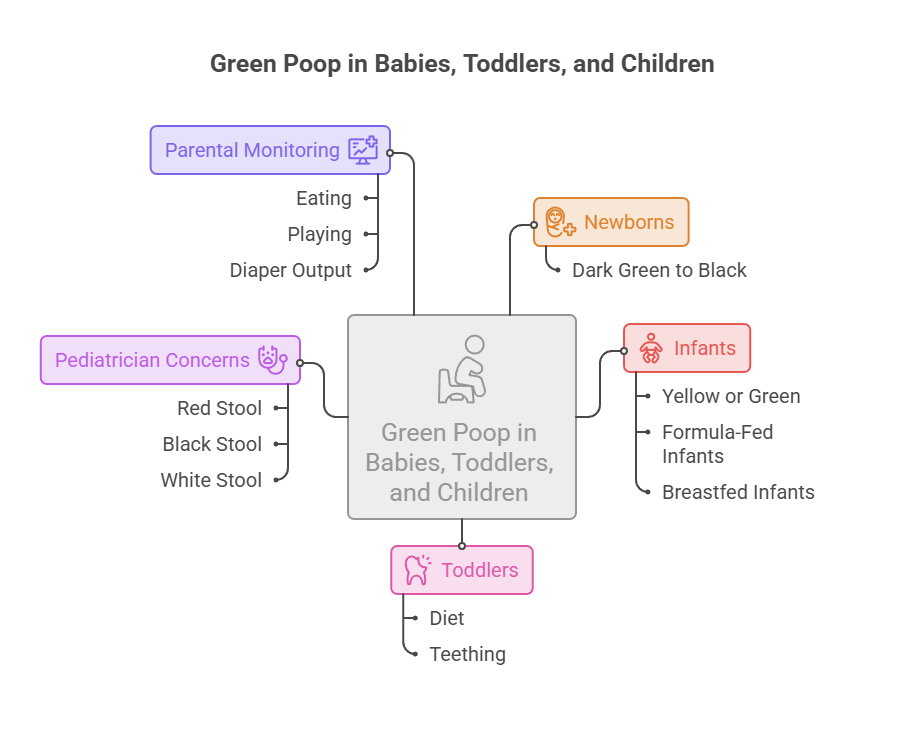
Green Poop in Babies, Toddlers, and Children
Parents search this at 2 a.m. more than any other group. The reassuring answer is that green is common and normal across most of childhood.
Meconium and the First Week of Life
A newborn’s first stools are meconium: thick, sticky, and dark green to black. This material accumulated in the intestine before birth.
The color lightens across the first several days. Some infants pass yellow stool flecked with green granules during the transition, which is expected and healthy.
Breastfed vs. Formula-Fed Stool
HealthyChildren.org, the American Academy of Pediatrics parent resource, notes that most dark green stools come from bile, that green stools occur more often in formula-fed than breastfed infants, and that they can be normal in both.
Iron-fortified formula reliably produces green or greenish-brown stool. That reflects unabsorbed iron rather than any feeding problem.
Foremilk and Hindmilk Balance
Breastfed babies who take mostly foremilk, which runs higher in lactose and lower in fat, sometimes pass frothy green stool. Letting the infant finish one breast before switching usually corrects it within a few feeds.
Weight gain is the measure that matters, not color. A thriving baby with green stool needs no intervention.
Toddlers, Teething, and Stomach Bugs
Toddlers eat spinach, drink blue slushies, and collect viruses at daycare. All three routes lead straight to green stool.
Teething increases swallowed saliva, which can loosen stool and modestly speed transit. The effect is small but real.
Parents contacting us about toddler stool color are usually reassured by a single question: is the child eating, playing, and producing wet diapers as usual?
The Three Colors Pediatricians Actually Worry About
Pediatric guidance based on AAP positioning holds that the only stool colors pointing to a problem are red, black, and white; green is not among them.
Call a pediatrician promptly for blood in the stool, white or clay-colored stool, or signs of dehydration. Also call right away for a fever of 100.4 degrees Fahrenheit or higher in an infant under three months old.
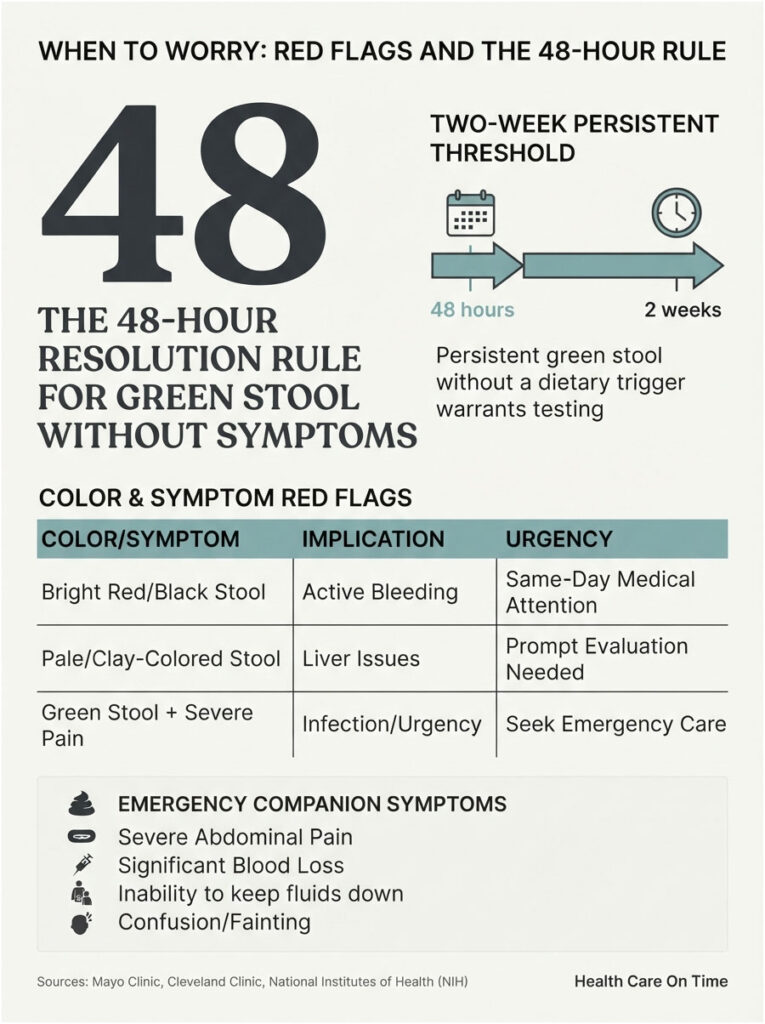
When to Worry: Red Flags and the 48-Hour Rule
Color alone almost never determines urgency. Companion symptoms do.
Symptoms That Change the Answer
Seek medical evaluation if green stool arrives alongside any of the following:
- Fever above 102 degrees Fahrenheit
- Blood in the stool, or black, tarry stool
- Severe or worsening abdominal pain
- Vomiting that prevents keeping fluids down
- Signs of dehydration: dizziness, very dark urine, reduced urination
- Unexplained weight loss
- Jaundice, meaning yellowing of the skin or eyes
- Diarrhea that wakes you from sleep
- Diarrhea lasting more than three days
Colors More Concerning Than Green
Bright red or black stool can indicate bleeding and needs same-day attention. Pale, clay-colored, or white stool suggests bile is not reaching the intestine and warrants prompt evaluation of the liver and bile ducts.
Green does not belong in that tier. Patients commonly ask us whether green stool can signal colon cancer, and the accurate answer is that color change is not among the recognized warning signs; blood, persistent habit change, and unexplained weight loss are.
The 48-Hour, 2-Week, and Same-Day Thresholds
Three timelines cover nearly every scenario. Forty-eight hours is the diet-clearance window: green with no symptoms should resolve inside it.
Two weeks is the workup threshold: persistent green stool with no identifiable dietary trigger deserves testing. Same-day care applies whenever a red flag from the list above appears.
Write down when the color started. Our reviewers find that patients who arrive with a date and a short food log get to an answer far faster than those describing it from memory.
When Green Stool Becomes an Emergency Room Visit
Go to an emergency room for green stool combined with severe abdominal pain, significant blood loss, inability to keep any fluids down, confusion, or fainting. Those symptoms reflect the underlying illness, not the color.
Table 3. Scenario to Action Reference
| Your Scenario | Most Likely Cause | Recommended Action | Timeframe |
| Green stool, feeling fine, ate greens or a greens powder | Chlorophyll | Nothing; recheck the next bowel movement | Resolves within 48 hours |
| Green stool, started an iron supplement this week | Oral iron | Continue; take with food if uncomfortable | Normalizes after stopping |
| Green watery stool, cramping, no fever, day 1 or 2 | Viral gastroenteritis or fast transit | Oral rehydration, bland foods, rest | Reassess at 72 hours |
| Green diarrhea continuing past 3 days | Infection or bile acid diarrhea | Call a primary care provider; stool testing likely | Within 24 hours |
| Green stool plus fever over 102F or visible blood | Bacterial infection or inflammation | Same-day medical care | Today |
| Green stool plus unexplained weight loss or night symptoms | IBD, malabsorption, other | Physician evaluation, calprotectin, blood work | Within 1 week |
| Green stool persisting past 2 weeks, no diet trigger | Chronic cause needing investigation | Book a stool panel plus blood work | Within 2 weeks |
| Infant with green stool, feeding well, no fever | Normal bile plus formula iron | Routine; mention at the next well visit | No urgency |
| Infant under 3 months, green stool plus fever 100.4F or higher | Possible infection | Call the pediatrician right away | Immediately |
Which Tests a Doctor May Order
If green stool persists or arrives with symptoms, testing moves the situation from guesswork to answers. Here is what a physician typically requests and why.
Stool Studies
A stool culture identifies bacterial pathogens including Salmonella, Shigella, and Campylobacter. Results usually return within two to three days.
A gastrointestinal PCR panel screens for bacteria, viruses, and parasites at once, often inside 24 hours. It has largely replaced sequential single-target testing in busy practices.
Ova and parasite examination targets Giardia and similar organisms, particularly after travel, camping, or well water exposure. C. difficile toxin testing applies after recent antibiotics.
Inflammation Markers
Fecal calprotectin measures neutrophil activity inside the gut and helps separate inflammatory bowel disease from IBS. An elevated result pushes toward colonoscopy; a normal result is reassuring.
C-reactive protein and erythrocyte sedimentation rate measure systemic inflammation from a blood draw. Neither is specific on its own, but both add shape to the picture.
Blood Work
A complete blood count checks for anemia and infection-related changes. A comprehensive metabolic panel covers electrolytes, which matter after prolonged diarrhea.
A liver function panel evaluates bile production and flow when jaundice or pale stool enters the picture. Celiac serology screens for gluten-driven malabsorption.
Patients booking these panels through HealthCareOnTime often pair a stool study with a CBC and metabolic panel in a single visit, which compresses the diagnostic timeline considerably.
When Imaging or Colonoscopy Enters the Picture
Abdominal ultrasound evaluates the gallbladder and bile ducts. CT imaging applies in acute pain or suspected complications.
Colonoscopy follows abnormal calprotectin, bleeding, or persistent symptoms without an explanation. It remains the definitive tool for diagnosing IBD and ruling out structural disease.
What to Bring to the Appointment
Bring a list of every supplement and medication, including doses. Iron, magnesium, and bismuth products explain a large share of color complaints and are frequently forgotten during visits.
Bring three to seven days of food notes, with attention to greens, greens powders, and anything dyed blue or green. Note travel, well water, sick contacts, and antibiotic use within the past month.
How to Get Your Stool Color Back to Normal
For the diet-driven and supplement-driven majority, the fix is fast and requires no prescription.
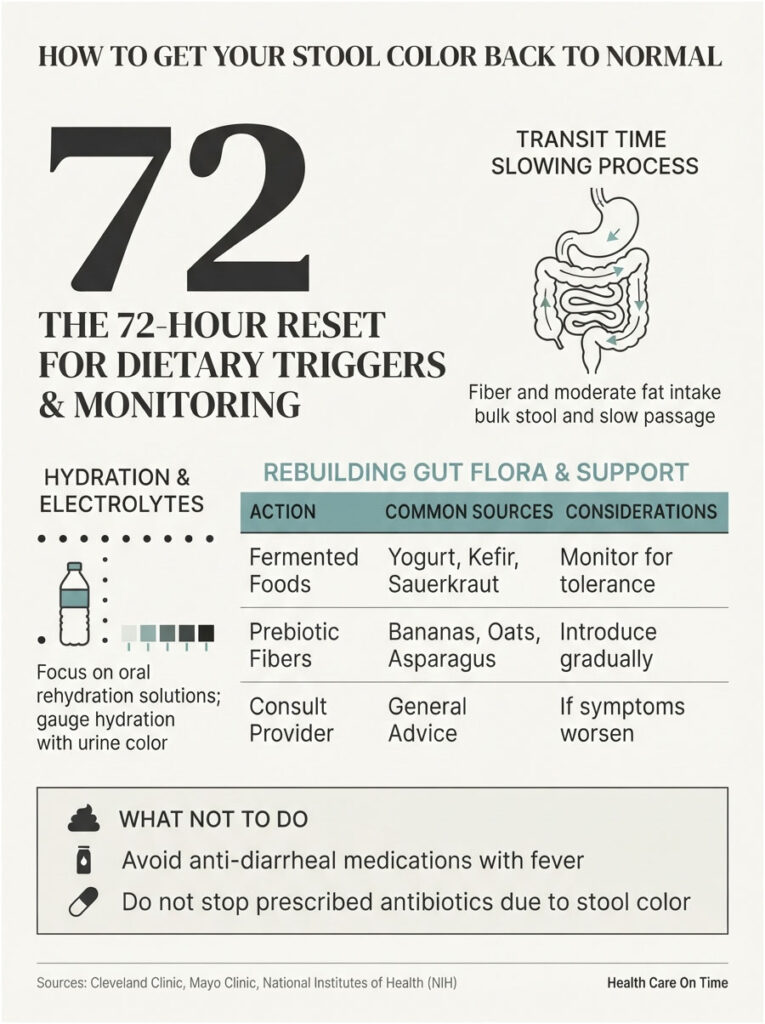
The 72-Hour Reset
Remove the suspected trigger and give it three days. Cut greens powders, drop blue and green dyed foods, and pause non-essential supplements if your physician agrees.
Keep a short log of what you eat and what you see. Two or three data points across three days almost always identify the culprit.
If the color persists past 72 hours with the trigger removed, the cause is not dietary and the next step is testing.
Hydration and Electrolytes
If diarrhea drives the color, fluid replacement matters more than anything else. Oral rehydration solutions outperform plain water because they replace sodium and potassium alongside volume.
Aim for small, frequent sips rather than large volumes at once, which tend to trigger another bowel movement. Two to three liters daily is a reasonable adult target during active diarrhea, adjusted for body size and output.
Sports drinks work in a pinch but carry roughly twice the sugar of a purpose-built rehydration solution. Broth, diluted juice, and rehydration packets are better choices.
Urine color is a usable gauge. Pale yellow means you are keeping up; dark amber means you are behind.
Fiber, Fat, and Slowing Transit
Soluble fiber from oats, bananas, applesauce, and psyllium adds bulk and slows transit, giving bile the hours it needs to finish converting. One to two teaspoons of psyllium daily is a common starting point.
Reduce insoluble fiber temporarily during a flare. Raw salads, bran, nuts, and seeds all speed things up at exactly the wrong moment.
Very high-fat meals trigger a larger bile release. Moderating fat intake for a few days often shifts color back toward brown without any other change.
Timing Supplements and Medications
Take iron with food and split the daily dose if it causes distress. Never stop prescribed iron without checking with your physician first, since anemia carries far more risk than stool color.
Magnesium citrate and high-dose vitamin C both accelerate transit. Consider a lower dose, a different form such as magnesium glycinate, or a different time of day.
Bismuth subsalicylate, sold as Pepto-Bismol, turns stool black rather than green. People sometimes confuse the two, so check what you actually took before assuming a new cause.
Rebuilding Gut Flora After Antibiotics
Green stool after antibiotics reflects a thinned bacterial population, and rebuilding takes weeks, not days. Most people see normal color return one to two weeks after the final dose.
Fermented foods including yogurt with live cultures, kefir, sauerkraut, and kimchi supply live organisms. Prebiotic fiber from onions, garlic, oats, and bananas feeds what survives.
Probiotic supplements may help, though evidence quality varies considerably by strain and by condition. Discuss product selection with a pharmacist or physician rather than choosing by shelf placement.
Call your prescriber instead of waiting if diarrhea turns watery, frequent, or feverish during or after an antibiotic course.
What Not to Do
Do not use anti-diarrheal medication if you have a fever or blood in the stool. Slowing transit during a bacterial infection can extend the illness.
Do not stop a prescribed antibiotic because of stool color. Call the prescriber and describe what you are seeing.
Do not buy a colon cleanse or detox product to correct the color. Our medical reviewers regularly see these products create the exact symptom people bought them to fix.
Green Poop in Specific Situations
During Pregnancy
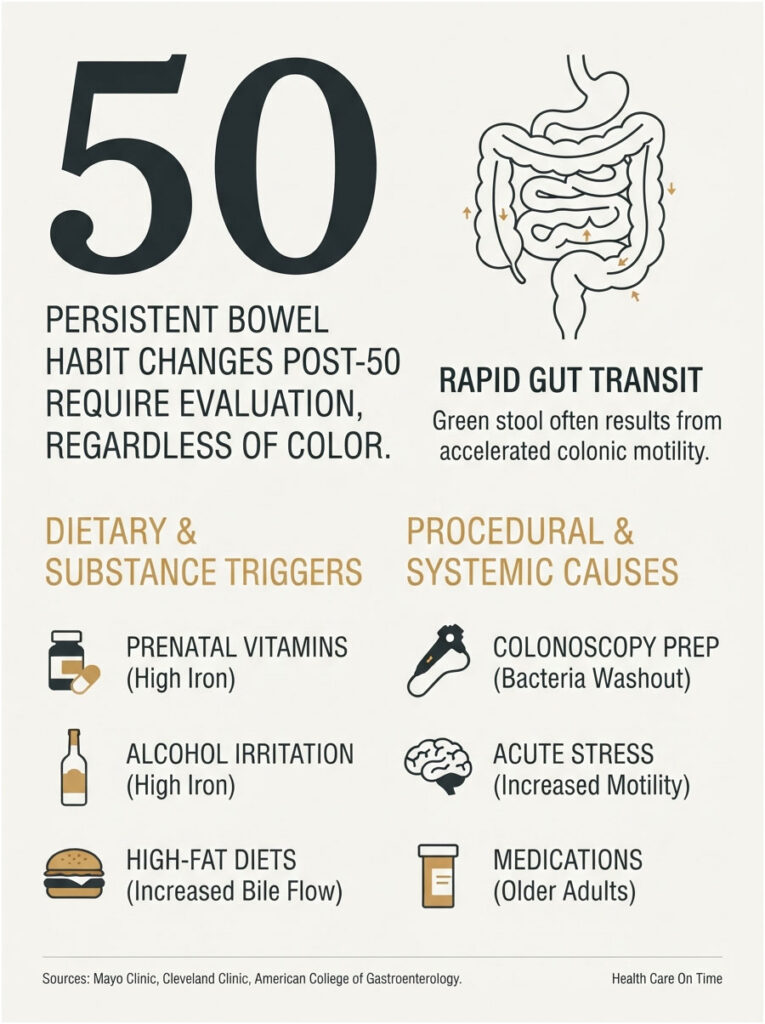
Prenatal vitamins carry substantial iron, which is the single most common reason for green stool in pregnancy. Most prenatal formulations deliver well above the elemental iron the gut can absorb in one dose.
Hormonal changes shift transit speed in both directions across the trimesters, and progesterone-driven slowing in later pregnancy sometimes flips to faster transit near term.
Deliberately increased leafy green intake adds chlorophyll on top. Mention persistent changes at a prenatal visit, though green alone rarely indicates a complication.
After Drinking Alcohol
Alcohol irritates the gut lining and accelerates transit, particularly at higher volumes. Green stool the morning after a heavy night is common and self-limiting.
Colored cocktails, liqueurs, and blue-tinted drinks layer dye on top of the transit effect. Hydration usually resolves both within a day.
After Colonoscopy Prep
Bowel prep solutions clear the colon completely and wash out the bacteria that perform pigment conversion. Green or yellow-green output during and immediately after prep is expected.
Normal color typically returns within three to five days as the gut refills and the bacterial population recovers.
Under Stress and Anxiety
The gut-brain axis is well documented. Acute stress accelerates colonic motility in many people, the same mechanism behind pre-exam and pre-flight bathroom urgency.
Faster motility means less bile conversion time. Stress does not create green pigment; it shortens the clock that would otherwise turn it brown.
Chronic stress producing chronic loose green stool is worth raising with a physician, since it overlaps heavily with IBS presentations.
On a Keto or High-Fat Diet
Higher fat intake triggers larger bile releases at each meal. More bile entering the intestine means more pigment available to survive the trip.
Green stool during the first few weeks of a ketogenic transition is common and typically settles as the body adjusts. Persistent greasy, floating, foul-smelling stool suggests fat malabsorption instead and deserves evaluation.
In Adults Over 60
Older adults take more medications, and polypharmacy raises the odds of a stool color change. Iron, antibiotics, and antacids appear frequently in this age group.
Any new persistent change in bowel habits after age 50 deserves evaluation regardless of color, particularly when screening colonoscopy is overdue. Across patients we serve in this age band, color is usually the least informative part of the history.
Frequently Asked Questions
Why is my poop green when I haven’t eaten anything green?
Green stool does not require green food. Bile begins yellow-green and only turns brown after bacteria work on it for many hours. Fast transit from diarrhea, stress, antibiotics, iron supplements, or a stomach bug cuts that time short and leaves the original green intact.
How long should green poop last?
Diet-related and dye-related green stool clears within 24 to 48 hours once the source leaves your system. Iron-related green persists as long as you take the supplement. Infection-related green typically lasts three to seven days. Anything past two weeks without a clear trigger deserves a stool test.
Is green poop a sign of infection?
It can be, but usually only when other symptoms come with it. Infection typically brings fever, cramping, nausea, urgency, and a general sense of illness. Green stool with none of those, in a person who feels well, points strongly toward diet or supplements rather than a pathogen.
Can stress or anxiety turn your poop green?
Indirectly, yes. Stress activates the gut-brain axis and speeds colonic motility, reducing the time bile has to convert from green to brown. The stress does not create the pigment; it shortens the window that would normally hide it. The effect resolves as the stressor passes.
Why is my poop green but I feel completely fine?
That combination is the most reassuring version of this question. Feeling well strongly suggests diet, food dye, a supplement, or a brief transit change. Review the last two days of eating for leafy greens, greens powders, blue or green dyes, and iron, then recheck in 48 hours.
Does green stool mean a liver or gallbladder problem?
Rarely. Liver and bile duct problems more often produce pale, clay-colored, or white stool because bile is not reaching the intestine at all. Green means bile is present and moving quickly. Gallbladder removal can cause greener stool temporarily as bile flow becomes continuous rather than timed.
Can green poop be a sign of colon cancer?
Green stool is not a recognized warning sign for colorectal cancer. The signals that matter are blood in the stool, persistent change in bowel habits, unexplained weight loss, and iron deficiency anemia. If any of those accompany green stool, schedule an evaluation rather than focusing on color.
Why is my poop green after taking antibiotics?
Antibiotics reduce the gut bacteria that convert bilirubin into brown stercobilin. Fewer bacteria means less conversion and more green making it through. The effect usually lasts through the course plus one to two weeks. Watery diarrhea with fever during or after antibiotics needs testing for C. difficile.
Is dark green poop normal in adults?
Dark olive or forest green is normal and commonly reflects iron supplements, iron-rich foods, or heavy leafy green intake. Dark green becomes a concern only when it looks black and tarry, which suggests bleeding, or when it arrives with pain, fever, or weight loss.
What does green poop mean in a breastfed baby?
Usually nothing worrying. Green stool in breastfed infants can reflect normal bile, a foremilk-heavy feed, or a passing bug. Formula-fed babies get green from fortified iron. Watch feeding, wet diapers, and weight gain instead of color, and call a pediatrician for fever, blood, or lethargy.
Can green poop happen during pregnancy?
Yes, and it is common. Prenatal vitamins contain enough iron to darken stool toward green regularly. Increased leafy green intake and hormone-driven changes in transit speed both contribute. Raise it at a prenatal appointment if it persists, though green alone rarely indicates a complication.
Should I go to the emergency room for green stool?
Not for the color by itself. Go to an emergency room if green stool comes with severe abdominal pain, significant bleeding, inability to keep fluids down, confusion, fainting, or signs of serious dehydration. Those symptoms drive the decision, not the shade of what you see.
Medical Disclaimer
This article is provided for general information and does not substitute for professional medical advice, diagnosis, or treatment. Stool color is only one data point among many, and self-diagnosis based on color alone can miss serious conditions or create unnecessary alarm. Always consult a qualified healthcare provider about symptoms that concern you, particularly if they persist or worsen. Never disregard or delay professional medical advice because of something read here.
References
- Stool color: When to worry, Mayo Clinic
- Bowel transit time, UCSF Health
- Norovirus facts and statistics, Centers for Disease Control and Prevention
- Giardia infection data and publications, Centers for Disease Control and Prevention
- Giardiasis outbreaks in the United States, 1971 to 2011, Epidemiology and Infection via PubMed Central
- Diagnosis and management of foodborne illness, American Academy of Family Physicians
- Study: Prevalence of IBS exceeds previous estimates, Cedars-Sinai
- Prevalence and burden of illness of Rome IV irritable bowel syndrome in the United States, Gastroenterology04889-8/fulltext)
- Incidence, prevalence, and racial and ethnic distribution of inflammatory bowel disease in the United States, PubMed Central
- Stools, unusual color, HealthyChildren.org, American Academy of Pediatrics
- Food safety: Status of foodborne illness in the US, U.S. Government Accountability Office
- Bowel transit time, UF Health