Your pediatrician glances at the scale and says the words every exhausted new parent wants to hear. “She’s a great eater.”
Table of Contents
Six months later the growth curve has climbed two percentile lines, and nobody is smiling.
Here is the part that stings. When researchers examined how American parents actually feed and handle their babies, they did not find a small group getting it wrong. They found that every parent in the study had adopted at least one infant feeding or activity behavior tied to obesity later in life.
Not most of them. All of them.
Quick Answer
Parents raise infant obesity risk mainly through non-responsive feeding habits (bedtime bottles, propped bottles, pressuring a baby to finish milk, feeding to stop crying), starting solid foods before 4 months, and low daily activity paired with early screen exposure. The most effective fixes are responsive feeding based on hunger and fullness cues, delaying solids to about 6 months, 30 to 60 minutes of daily floor time, and no screen media before 18 to 24 months.
At a Glance
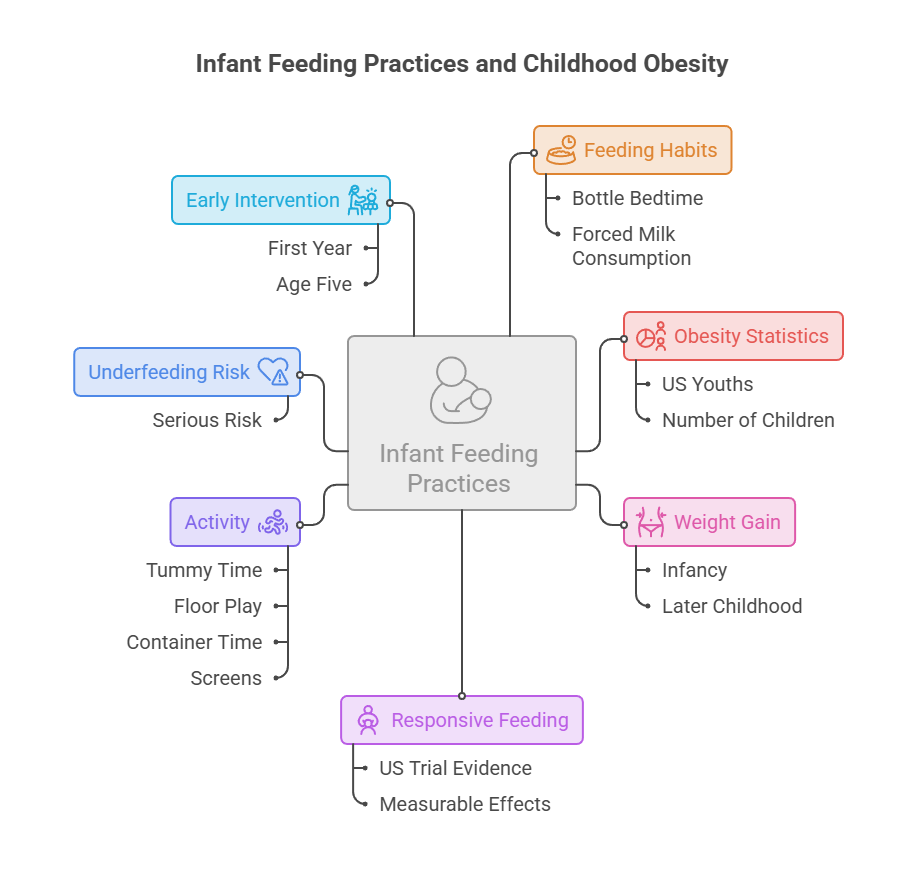
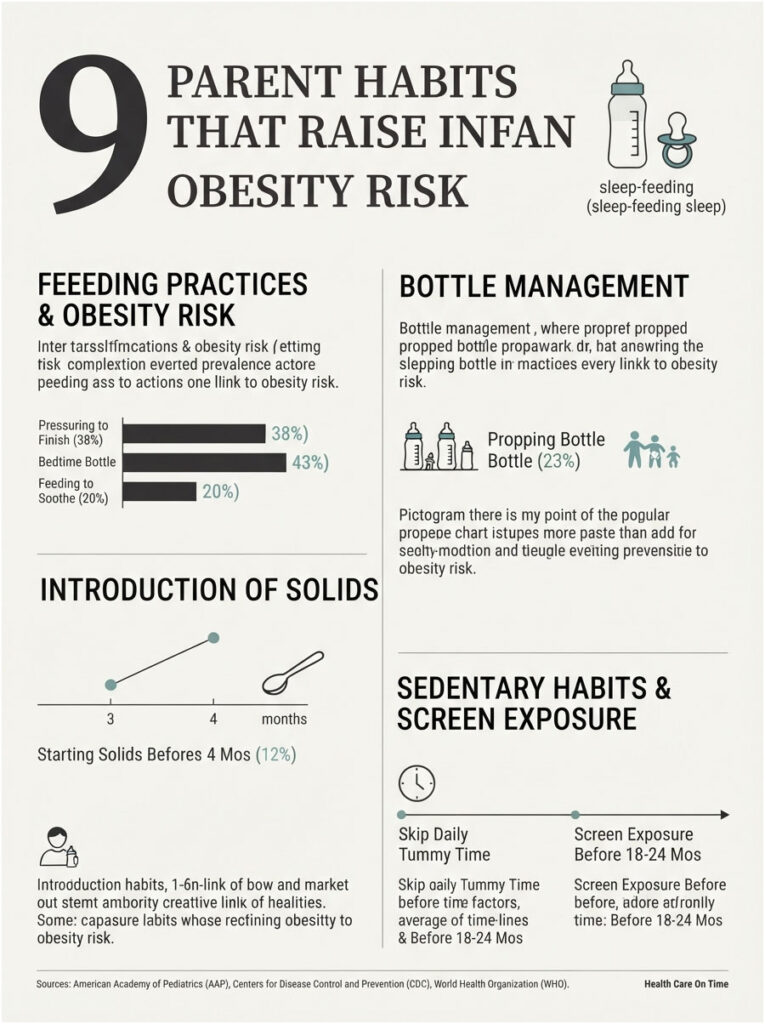
• In the Greenlight study of 863 low-income parents and infants, 43% put babies to bed with a bottle and 38% always pushed babies to finish their milk.
• CDC puts childhood obesity at 19.7% among US youths aged 2 to 19, roughly 14.7 million children.
• Rapid weight gain during infancy predicts later childhood obesity better than any single feeding choice does.
• Responsive feeding has the strongest US trial evidence behind it, including measurable effects at ages 1 and 3.
• The activity side (tummy time, floor play, container time, screens) is almost never covered and matters more than most parents realize.
• None of this means restricting a baby’s food. Underfeeding is a far more serious risk.
• Changes made in the first year cost less effort than the same changes attempted at age five.
The 9 Habits, in One Screen
- Putting baby to bed with a bottle
- Propping the bottle instead of holding it
- Pushing the baby to finish every ounce
- Feeding as the default response to crying
- Starting solid foods before 4 months
- Adding cereal to bottles
- Offering juice or sweetened drinks in the first year
- Skipping daily tummy time and floor play
- Screen exposure before 18 to 24 months
Each one is broken down below, with prevalence data and a specific replacement.
First, Read This Before You Read Anything Else
If you already do three or four things on that list, you are the normal case, not the cautionary tale.
The Greenlight researchers did not find a handful of outliers. Across 863 parents, every one of them used at least one behavior on the list.
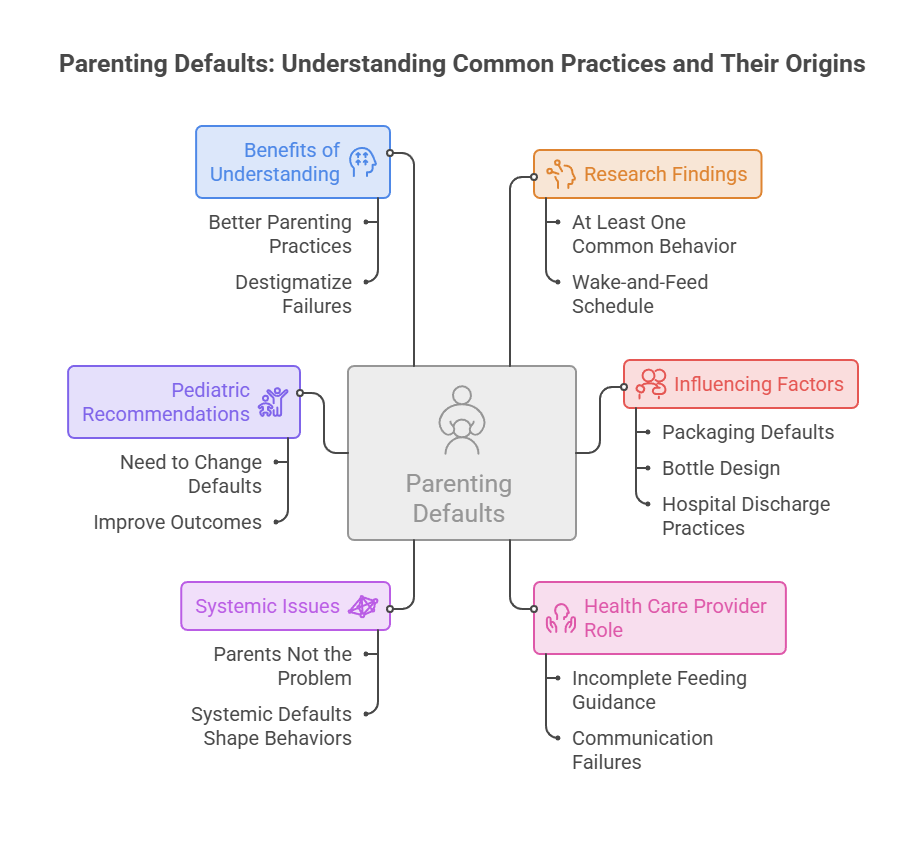
That statistic is the most useful thing in this entire article, because it reframes the problem. These are not parenting failures. They are the defaults built into how formula is packaged, how bottles are shaped, how hospitals discharge families, and how advice gets handed down.
Pediatric researchers have pointed out that health care providers themselves contribute from a baby’s first days, correctly telling parents to wake newborns every 3 to 4 hours to feed but often neglecting to say when to stop once the baby regains birth weight and settles into healthy gain.
Nobody tells you the second half of that instruction. Then a family runs a wake-and-feed schedule for four months, and the growth chart reflects it.
Our medical reviewers make this point in almost every pediatric conversation: parents are rarely the problem, defaults usually are. Change the defaults and the behavior follows without anyone needing to try harder.
What “Infant Obesity Risk” Actually Means (and What It Does Not)
Before anyone panics over a round-cheeked six-month-old, the terminology needs sorting out.
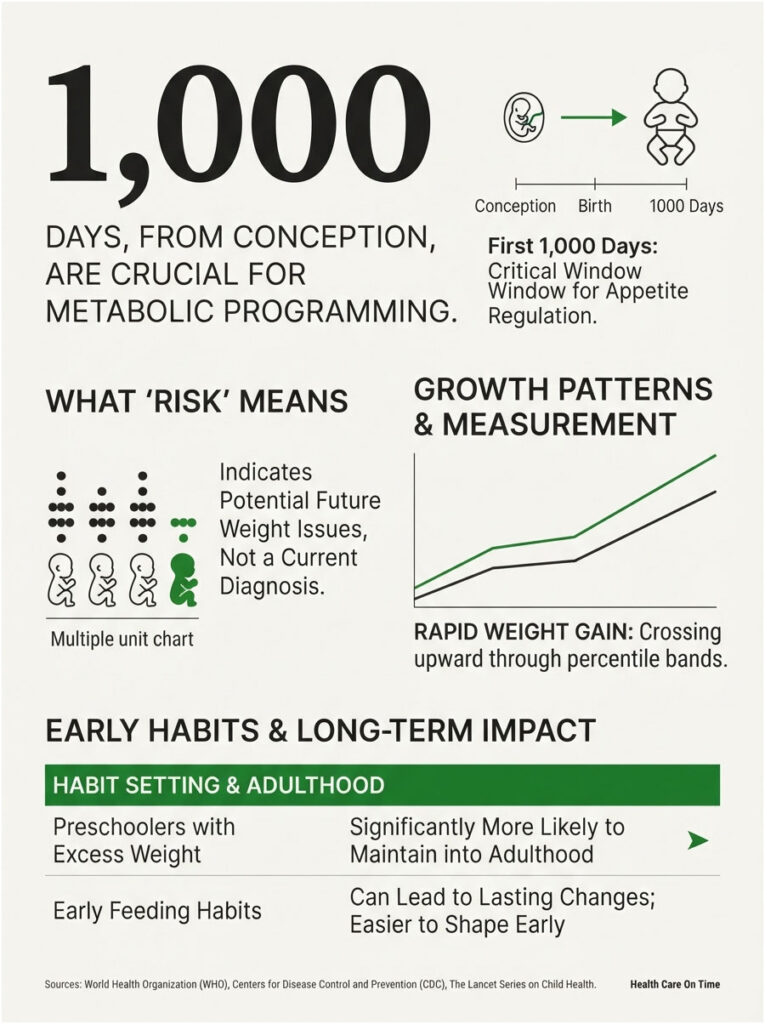
Infant obesity risk is not a diagnosis. It describes the likelihood that a baby’s current growth pattern and feeding environment will lead to excess weight later in childhood and beyond.
Why Doctors Use Weight-for-Length, Not BMI, Before Age 2
Body mass index does not apply to babies. Pediatricians plot weight-for-recumbent-length instead, comparing a baby’s weight against other babies of the same length rather than the same age.
A single high reading means very little on its own. A baby who moves from the 40th percentile to the 90th over four months is telling a completely different story than a baby who has tracked at the 90th since birth.
Patients booking pediatric growth panels through HealthCareOnTime ask about percentile numbers more than almost any other pediatric topic. The answer is nearly always the same: the direction of the line matters more than the number on it.
How Percentile Crossing Is Actually Measured
Clinicians do not eyeball the chart. They convert weight to a z-score, which expresses how far a baby sits from the median in standard deviations.
Rapid infant weight gain is commonly defined as an increase of more than 0.67 in weight z-score between two time points. In practical terms that translates to crossing upward through one full percentile band on the standard chart, for example moving from the 25th to the 50th, or the 50th to the 75th.
Crossing one band in the first few months is common and often normal, especially for babies born small who are catching up. Crossing two or more bands quickly is the pattern that draws attention.
Downward crossing gets the same scrutiny for the opposite reason. Both directions are signals, not verdicts.
The First 1,000 Days and Why Timing Matters
The stretch from conception to a child’s second birthday is often called the first 1,000 days. Appetite regulation, taste preferences, and metabolic set points are all being calibrated during it.
Animal research on metabolic programming has shown that early-life feeding habits can produce lasting changes in hormone balance and metabolism.
CDC surveillance found that preschoolers carrying excess weight are five times as likely as their peers to carry it into adulthood.
Healthy Eating Research describes the link between rapid infant weight gain and later childhood obesity as strong and consistent, which is exactly why identifying the drivers of excess intake matters this early.
Habits set at four months are easier to shape than habits defended at four years.
The 9 Parent Habits That Raise Infant Obesity Risk
None of these come from carelessness. Every one comes from love, exhaustion, or advice from someone who meant well.
1. Putting Baby to Bed With a Bottle
This is the most common habit in the data, reported by 43% of parents in the Greenlight cohort.
A baby falling asleep on a bottle is not eating for hunger. The bottle has become a sleep tool, and milk calories go down on autopilot well past the point of fullness.
There is a dental cost too. Milk pooling around emerging teeth overnight is the leading driver of early childhood caries.
The fix is a 10 to 15 minute gap. Feed, burp, brief quiet activity, then settle. The order matters more than the timing.
2. Propping the Bottle Instead of Holding It
Around 23% of parents propped bottles rather than holding them, a practice linked to excessive feeding.
When nobody holds the bottle, nobody notices the baby slowing down, turning away, or pushing back with the tongue. Gravity keeps the milk coming regardless.
AAP guidance is direct on this point: hold your baby upright when feeding a bottle.
3. Pushing the Baby to Finish Every Ounce
About 38% of parents said they always tried to get their baby to finish the milk.
Formula arrives in fixed volumes and bottles carry measurement lines, so an unfinished bottle feels like something went wrong. It did not.
Babies arrive with working appetite regulation. Override it enough times and they learn to eat to an external cue instead of an internal one, which is the pattern that persists into childhood.
4. Feeding as the Default Response to Crying
Roughly 20% of parents fed their infants whenever the baby cried.
Babies cry from hunger, but also from tiredness, overstimulation, discomfort, boredom, temperature, and plain need for contact. Feeding resolves all of them temporarily, because sucking is soothing regardless of hunger.
The pattern this builds is the one that lasts: distress equals food.
5. Starting Solids Before 4 Months
Early solids were reported by 12% of parents, and earlier research linked solids before 4 months to higher odds of obesity by age 3.
The Dietary Guidelines for Americans, the AAP, and the WHO all point to exclusive breast milk for about the first 6 months, with complementary foods introduced around 6 months.
Child care licensing standards in many states set the same floor: no solid foods sooner than 4 months, preferably around 6.
6. Adding Cereal to Bottles
This one survives because grandparents swear by it and because desperate parents will try anything at 3 a.m.
Cereal in a bottle adds calories without adding satiety signals, raises choking risk, and does not reliably improve sleep.
If reflux was the reason someone suggested it, that is a conversation for your pediatrician rather than a kitchen decision.
7. Juice and Sweetened Drinks in the First Year
Juice before 12 months adds sugar calories and displaces breast milk or formula. It also builds an early preference for sweet liquids that carries into toddlerhood.
Babies do not need juice at all. Small amounts of water become appropriate once solids start, and even then milk stays the main drink through the first year.
8. Skipping Daily Tummy Time and Floor Play
Movement in infancy is not exercise in the adult sense. It is muscle development, energy expenditure, and the groundwork for crawling and walking.
A baby who spends most waking hours reclined in a seat has both lower daily energy use and slower gross motor progress.
9. Screen Exposure Before 18 to 24 Months
Sedentary behavior including screen time has been tied to higher overweight risk, and the INSIGHT trial specifically built screen-time reduction and lower household television exposure into its obesity prevention package.
Background television counts. A show playing in the room cuts parent-baby talk and interactive play even when the baby is facing the other way.
In cases reviewed by our medical team, background TV is the exposure parents are most surprised to hear about, because it never felt like a decision.
Table 1: Habit, Prevalence, Risk Weight, and the Better Alternative
| Parent Habit | How Common in US Parents | Why It Raises Infant Obesity Risk | Risk Weight | Do This Instead |
| Bottle in bed at sleep time | 43% | Calories consumed past fullness; sleep-feeding association; dental decay | High | Feed, then burp, then settle. Separate the bottle from sleep onset by 10 to 15 minutes |
| Bottle propped, not held | 23% | Caregiver misses stop cues; flow continues regardless of baby’s signals | High | Hold baby semi-upright, hold the bottle, pause every 1 to 2 ounces |
| Pressuring baby to finish milk | 38% | Overrides internal fullness regulation; trains external cue eating | High | Let the baby leave milk. An unfinished bottle is a normal bottle |
| Feeding at every cry | 20% | Builds distress-equals-food pattern; adds non-hunger calories | Moderate to high | Run a 60-second checklist first: diaper, temperature, tiredness, contact, stimulation |
| Solids started before 4 months | 12% | Added calories before readiness; linked to higher obesity odds by age 3 | Moderate to high | Wait for about 6 months and for readiness signs (head control, sitting supported, interest) |
| Cereal added to bottle | Common but under-reported | Calorie density without satiety signaling; choking risk | Moderate | Skip it. Address sleep with routine, not calories |
| Juice before 12 months | Common | Sugar calories displace milk; sets sweet-drink preference | Moderate | No juice in year one. Small water sips once solids start |
| Little or no tummy time | Widespread | Lower energy expenditure; delayed motor milestones | Moderate | Build to 30 to 60 minutes daily by 3 months, spread across short sessions |
| Screens before 18 to 24 months | Rising | Displaces active play and parent interaction; sedentary conditioning | Moderate | Keep screens off, including background TV. Substitute floor play and face-to-face time |
Why This Matters More Now Than It Did a Decade Ago
The habits above are not new. What changed is the environment they land in.
The National Picture
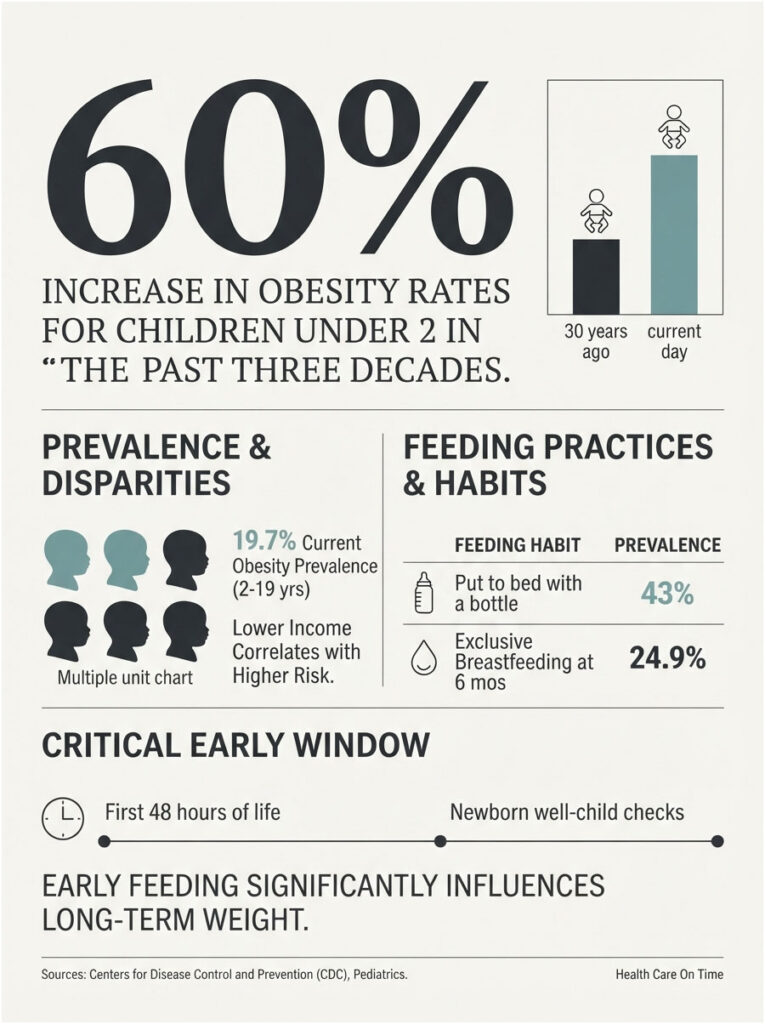
CDC reports childhood obesity prevalence at 19.7% among US children and adolescents aged 2 to 19, about 14.7 million young people.
Among children under 2 specifically, obesity prevalence climbed by more than 60% across three recent decades.
That trend line is why pediatric prevention has moved out of the school gym and into the newborn nursery.
The Income and Access Gap
Infant obesity risk is not spread evenly across American families.
CDC data show prevalence rising as household income falls, with 11.5% among children in families above 350% of the Federal Poverty Level.
Formula cost, WIC package composition, parental leave length, night-shift work, and access to safe indoor floor space all shape feeding decisions in ways that have nothing to do with how much a parent knows.
Why the First 48 Hours Set the Tone
A Loyola University Medical Center chart review found that overfeeding newborns five or more times on the first day of life significantly raised the risk of overweight or obesity at the 4-year well-child check.
The same research noted that many newborns receive 2 to 3 ounces every 3 hours in their first weeks, considerably more than the literature recommends for the first day.
Those early volumes anchor a family’s sense of what a normal feed looks like, and that anchor tends to hold for months.
Table 2: Current US Infant Feeding and Weight Data
| Metric | Current US Figure | What It Signals | Source |
| Infants who ever received breast milk | 83.2% (2019 births) | Most US families start breastfeeding | CDC Breastfeeding Report Card |
| Infants receiving any breast milk at 6 months | 55.8% | Nearly half have stopped by the half-year mark | CDC Breastfeeding Report Card |
| Infants exclusively breastfed at 6 months | 24.9% | Only 1 in 4 reaches the AAP and Dietary Guidelines target | CDC Breastfeeding Report Card |
| Obesity prevalence, ages 2 to 19 | 19.7% (2017 to March 2020) | About 14.7 million US youths | CDC Childhood Obesity Facts (NHANES) |
| Obesity prevalence, families above 350% FPL | 11.5% | Prevalence rises as household income falls | CDC Childhood Obesity Facts |
| Greenlight parents using at least one obesity-linked habit | 100% of the 863-parent cohort | A default-pattern problem, not a minority-of-parents problem | Pediatrics (Perrin et al.) |
| Parents putting baby to bed with a bottle | 43% | The most common single modifiable habit | Pediatrics (Perrin et al.) |
| Parents pressuring baby to finish milk | 38% | Direct override of infant appetite regulation | Pediatrics (Perrin et al.) |
Responsive Feeding, the Single Best-Supported Fix
If you change one thing after reading this, change this one.
What Responsive Feeding Actually Means
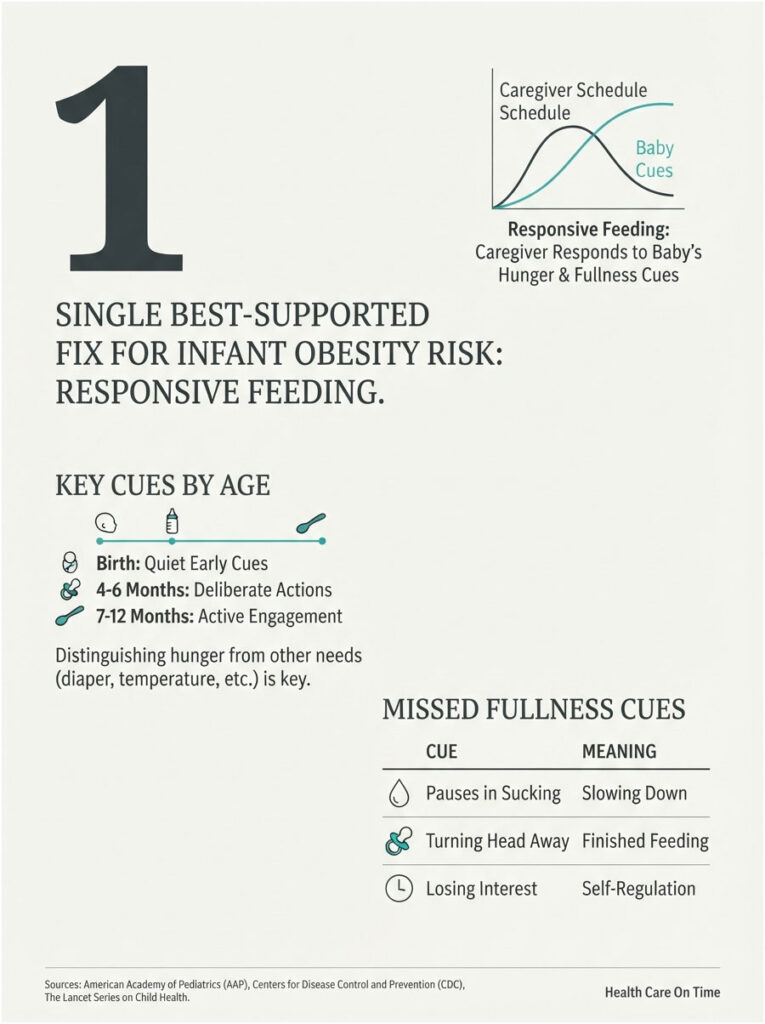
The baby signals, the caregiver reads the signal, and the caregiver responds appropriately. Feeding starts on hunger cues and stops on fullness cues.
Harvard Health states the AAP position plainly: parents should approach feeding based on signs of hunger and fullness, with obesity prevention as an explicit goal.
The caregiver decides what is offered and when it is offered. The baby decides how much goes in. That split is the entire method.
Reading Hunger Cues by Age
Birth to 3 months. Early cues are quiet. Stirring, mouth opening, head turning toward touch on the cheek, hands to mouth, rising alertness.
Crying is a late cue. A baby fed at the crying stage is already distressed and will usually feed too fast to register fullness in time.
4 to 6 months. Cues get deliberate. Reaching toward the bottle or breast, sustained eye contact during the feed, excited leg kicking at the sight of preparation.
7 to 12 months. Pointing at food, opening the mouth as the spoon approaches, leaning forward, vocalizing at mealtimes.
Reading Fullness Cues, the Ones Parents Miss
Fullness signals are softer than hunger signals, which is exactly why they get overridden.
Watch for a slowing suck rate, a pause that does not resume, releasing the nipple, turning the head away, pushing the bottle away with hands, closing lips, arching back, and losing interest in favor of looking around the room.
Our medical reviewers note that the missed cue is rarely the head turn. It is the pause. A baby who stops sucking for five or six seconds and does not restart is frequently finished, and the reflexive adult response is to jiggle the bottle.
Bottle-Feeding Specifics
Paced bottle feeding slows the flow so satiety signals have time to arrive.
Hold the baby semi-upright rather than flat. Keep the bottle closer to horizontal so milk does not pour in by gravity. Pause every 1 to 2 ounces and let the baby decide whether to continue.
A feed that runs 15 to 20 minutes gives the body time to catch up. A feed that finishes in five minutes does not.
As a rough anchor, formula intake tends to settle around 2 to 2.5 ounces per pound of body weight across 24 hours, capping near 32 ounces daily for most babies. That is a reference point for your pediatrician to adjust, never a target to hit.
Breastfeeding Specifics
Breastfeeding has a documented protective role against obesity, and research by Harder and colleagues found a dose-dependent pattern where each additional month of breastfeeding lowered a child’s obesity risk.
Breastfed babies self-regulate more easily because they control the flow and there is no measurement line to finish.
Supply anxiety is the main thing that disrupts this. Wet diapers (six or more daily after day five) and steady weight gain are better reassurance than pumped volume, which correlates poorly with what a baby actually takes at the breast.
When the Crying Is Not Hunger
Build a 60-second checklist before reaching for a feed.
Check the diaper. Check temperature, since overheating is more common than being cold. Count how long the baby has been awake against a typical wake window (roughly 45 to 60 minutes at 1 month, 1.5 to 2 hours at 4 months, 2.5 to 3.5 hours at 8 months).
Then try skin contact, movement, or a change of room before offering milk.
If your baby fed within the last 90 minutes and is showing no hunger cues, hunger is unlikely to be the cause.
The Activity Half Nobody Talks About
Search this topic and you will find feeding guidance almost exclusively. The activity side is where the real content gap sits, and where the easiest wins are.
Tummy Time by Age, in Real Minutes
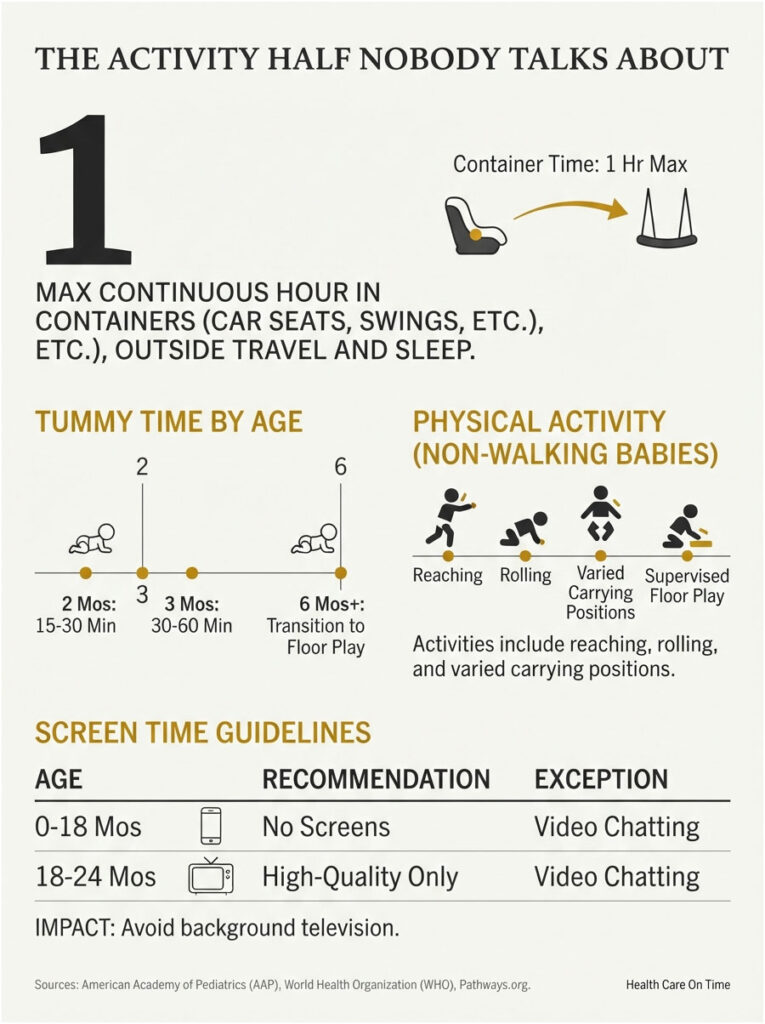
Start from day one with three to five minutes, two or three times daily.
By 2 months, aim for 15 to 30 minutes total across the day. By 3 months, work toward 30 to 60 minutes total, split into as many short sessions as your baby tolerates.
From 6 months on, general floor time replaces structured tummy time. Rolling, pivoting, sitting, and crawling all count.
Crying during early tummy time is normal and fades with consistency. Two minutes on a parent’s chest counts as a session.
Container Time and the Math Nobody Does
Car seats, swings, bouncers, jumpers, and carriers are all containers. Each one is useful. Added together they can swallow most of a baby’s waking hours.
Run a typical day: two car trips at 25 minutes each, 40 minutes in the carrier at the store, 45 minutes in the swing while a parent cooks, 30 minutes in the bouncer during a work call. That is over three hours before anyone made a choice about it.
A workable target is no more than one continuous hour outside of travel and sleep, with the floor as the default position.
Screens Before Age Two
AAP guidance restricts screen media before 18 to 24 months, with video chatting with family as the standard exception.
The INSIGHT trial delivered messages on minimizing screen time, cutting household television exposure, and promoting parent-child engagement through interactive play at infant ages 3, 16, 28, and 40 weeks.
Background television is the piece most families overlook, and it is also the easiest to change. Turning it off costs nothing and immediately increases the talking and moving that fill the gap.
What Physical Activity Means for a Baby Who Cannot Walk
Reaching for a toy just out of range. Rolling toward a sound. Kicking against a caregiver’s hands. Being carried in varied positions instead of one.
Supervised floor play in a safe, uncluttered space outperforms any product marketed as developmental equipment.
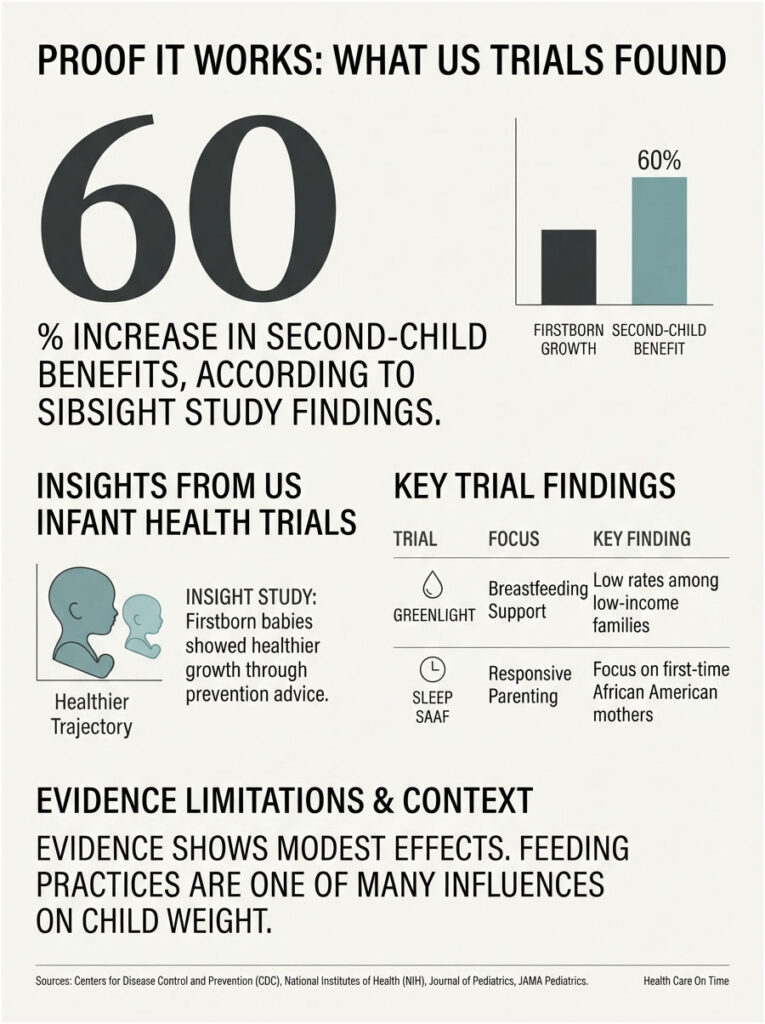
Proof It Works: What US Trials Found
Prevention advice is worth following only if somebody tested it. Several American trials did.
INSIGHT and the Sibling Effect
The Intervention Nurses Start Infants Growing on Healthy Trajectories study randomized 316 participants, delivering responsive parenting guidance built to prevent rapid weight gain in infancy and overweight at age 3.
Firstborn babies in the program showed healthier growth: slower weight gain through the first six months, lower rates of overweight at age 1, and lower BMI at age 3 compared with babies whose parents did not receive the training.
The follow-up study, SIBSIGHT, found the benefits carried to second children even without additional training for the parents.
That spillover finding matters. It suggests parents absorbed a method rather than following a script for one baby.
Greenlight and the Baseline Problem
The Greenlight analysis of 863 low-income parent-infant pairs found 45% exclusively formula feeding and only 19% exclusively breastfeeding.
Greenlight was not built to shame anyone. It established how far ordinary practice sits from published guidance, which is the starting line any intervention has to work from.
Sleep SAAF and Higher-Risk Groups
The Sleep SAAF trial enrolled 300 first-time African American mothers and their full-term infants to test whether a responsive parenting intervention focused on infant sleeping and self-soothing could prevent rapid weight gain during the first 16 weeks postpartum.
Extending this research into the populations facing the heaviest early obesity burden addresses one of the clearest weaknesses in the earlier literature.
What the Evidence Does Not Prove
Honesty about limits builds more trust than overselling.
Responsive feeding trials show real effects on infant weight trajectory, but the effect sizes are modest and follow-up past early childhood remains limited.
Prospective studies on coercive feeding practices, meaning restriction, pressure, and monitoring, have generally not found consistent associations with children’s later weight, though rewarding correct behavior with food has been linked to higher weight over time.
Evidence on early complementary food introduction is described as inconsistent across studies.
Genetics, birth weight, maternal health in pregnancy, sleep, and the wider food environment all contribute. Feeding practice is one modifiable input among several, not the whole equation.
Common Pitfalls, Myths, and Well-Meaning Advice That Hurts
“A Chubby Baby Is a Healthy Baby”
This was sound advice a century ago, when infant undernutrition was the dominant threat. It has not updated since.
Baby fat at 6 months is developmentally normal. A steep upward percentile crossing at 6 months is a different signal, and the two get conflated constantly.
“Cereal in the Bottle Helps Them Sleep”
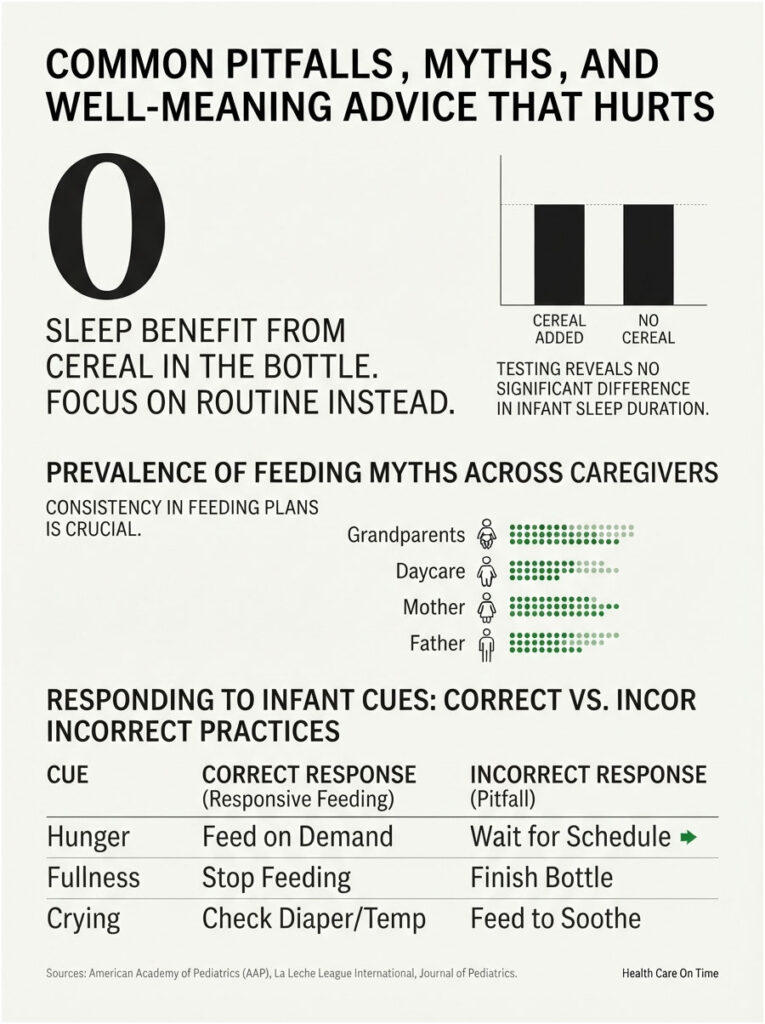
The sleep benefit does not hold up under testing. The added calories, choking risk, and displaced nutrition do.
Infant sleep improves with routine, appropriate wake windows, and a consistent settling process, not calorie density.
“Finish the Bottle So It Doesn’t Go to Waste”
Formula is expensive and the instinct makes sense. Prepared formula can be refrigerated up to 24 hours if the baby has not fed from that bottle.
Once a baby has fed from it, discard the leftover within an hour. Mixing smaller volumes more often wastes less than pressuring a baby to finish.
“Formula-Fed Babies Just Gain More, Nothing You Can Do”
Breastfed infants do tend to gain less weight than formula-fed infants beyond the first few months.
But the volume a formula-fed baby consumes is a modifiable risk factor, which is exactly what makes it something a parent can act on.
Paced feeding, upright holding, and respecting stop cues work regardless of what is in the bottle.
Grandparents, Daycare, and Split Households
A responsive feeding plan followed by one caregiver and ignored by three others will not move anything.
Write the approach down in five plain lines and hand it to everyone who feeds your baby. Frame it as your pediatrician’s guidance rather than a personal preference, which tends to end the debate quickly.
The Opposite Error: Restricting a Baby’s Intake
This deserves emphasis, because articles like this one can trigger exactly the wrong reaction.
Never restrict a baby’s milk intake to manage weight. Infants have high energy needs relative to body size, and underfeeding carries risks to brain development and growth that dwarf everything discussed here.
Responsive feeding means following cues in both directions. A hungry baby gets fed.
Your First-Year Action Plan
Patients commonly ask us for a checklist rather than a philosophy, so here it is by stage.
Month 0 to 3
- Feed on cues rather than the clock, once your baby has regained birth weight and gain is established. Confirm that timing with your pediatrician.
- Hold the bottle. Pause every 1 to 2 ounces. Let feeds run 15 to 20 minutes.
- Begin tummy time on day one and build toward 30 minutes total daily by month three.
- Run the 60-second non-hunger checklist before feeding a crying baby who ate recently.
Month 4 to 6
- Hold the line on solids until about 6 months and until readiness appears: steady head control, sitting with support, and active interest in food.
- Separate the bottle from sleep onset. If your baby currently falls asleep feeding, shift that feed 10 to 15 minutes earlier in the routine.
- Keep screens off, background television included.
Month 7 to 12
- Offer solids on a schedule you set, in amounts your baby controls. Expect refusals. Ten or more exposures to a new food before acceptance is normal.
- No juice. Small sips of water alongside meals.
- Floor time becomes the default position. Crawling, cruising, and supported standing all count.
- Stop using food to end distress. Substitute contact, movement, and distraction.
When to Call Your Pediatrician
Any upward crossing of two or more percentile lines on weight-for-length, or any downward crossing. Feeds that consistently finish in under five minutes or stretch past 45.
Also call if feeding itself is making you anxious. That anxiety changes feeding behavior on its own, and it is worth naming out loud.
Table 3: If You See This, Do This
| Scenario You Are Seeing | What It Likely Means | Recommended Action | When to Involve Your Pediatrician |
| Baby crossed two weight-for-length percentile lines upward in under 4 months | Rapid infant weight gain pattern | Audit feeding method before changing volume. Check pacing, holding position, and stop-cue response | At the next scheduled visit, or sooner if the crossing exceeds three lines |
| Baby drains every bottle in under 5 minutes, then fusses | Flow too fast; fullness signals arriving after the milk is gone | Switch to a slower-flow nipple, hold more upright, pause every ounce | If fussing continues after 2 weeks of paced feeding |
| Baby pauses or turns away but caregiver keeps offering | Non-responsive feeding pattern | Stop the feed at the pause. Track leftover volume across one week | Bring the week’s notes to the next well visit |
| Family pressure to start solids before 4 months | Cultural and generational advice, not clinical guidance | Delay to about 6 months. Share the AAP and Dietary Guidelines position | Ask for written guidance you can hand to relatives |
| Baby spends 6 or more waking hours daily in seats, swings, or carriers | Excessive container time reducing activity | Set floor time as the default. Cap continuous container use at 1 hour outside travel | If motor milestones are also lagging |
| Baby consistently falls asleep on the bottle | Sleep-feeding association plus overfeeding risk | Move the feed 10 to 15 minutes earlier in the bedtime routine | If night waking rises sharply after the change |
| Parent worried baby is not getting enough | Possible under-response to hunger cues | Track wet diapers (6 or more daily after day 5) and the weight gain trend | Same week, if diaper output or gain has dropped |
What Actually Matters, and What You Can Let Go
Reading a list of nine habits can leave a parent feeling like everything is a test. It is not.
Three things carry most of the weight: hold the bottle and pace the feed, stop when your baby stops, and give the floor more waking hours than the seat. A family that gets those three right is doing the bulk of what the research supports.
The rest are smaller adjustments that get easier once the big three are habit.
What you can let go: a single high percentile reading, one bottle finished on a hard night, the relative who fed your baby a spoonful of mashed banana at five months, and the guilt attached to any of it.
Patients booking pediatric follow-ups through HealthCareOnTime often arrive convinced they have already caused permanent harm. Infant growth is far more responsive than that. The trajectory that matters is the one over the next three months, not the one behind you.
Frequently Asked Questions
Can you overfeed a formula-fed baby?
Yes. Formula volume is a modifiable risk factor, and research has connected high day-one feeding volumes with later overweight. Bottles carry visible measurement lines that encourage finishing, and flow continues when a baby pauses. Paced feeding and respecting stop cues prevent most overfeeding.
Is it really that bad to put my baby to bed with a bottle?
It is the most common habit linked to infant obesity risk, and it carries a separate dental decay risk. The issue is timing rather than the milk itself, since calories taken during sleep onset bypass fullness signaling. Feed first, settle separately, with a 10 to 15 minute gap.
When should solid foods start to lower obesity risk?
The Dietary Guidelines for Americans, the AAP, and the WHO all point to about 6 months, alongside continued breast milk or formula. Before 4 months is associated with higher obesity odds by age 3. Wait for readiness signs, not just a date on the calendar.
Does breastfeeding actually lower childhood obesity risk?
Research shows a protective effect with a dose-dependent pattern, where each additional month of breastfeeding lowers obesity risk. The effect is real but modest, and it is one factor among many. Formula-fed babies grow well when feeding is responsive and paced.
My baby is in the 90th percentile. Should I worry?
Not on its own. A baby tracking steadily at the 90th since birth is following their own curve. Concern comes from crossing upward through multiple percentile bands quickly. Bring the growth chart trend, not a single reading, to your pediatrician.
How much tummy time does my baby need each day?
Start with three to five minutes, two or three times daily from birth. Build toward 30 minutes total by 2 months and 30 to 60 minutes total by 3 months, spread across short sessions. Early crying is normal and improves with consistency.
Is a chubby baby going to become an overweight child?
Not necessarily. Preschoolers with excess weight are five times as likely to carry it into adulthood, but infancy is far more fluid than the preschool years. Most babies redistribute weight once they become mobile. Trajectory matters more than any single snapshot.
Can I put cereal in the bottle to help my baby sleep?
No. The sleep benefit is unsupported, and the practice adds calories without satiety signals while raising choking risk. Sleep improves through consistent routines and appropriate wake windows. If reflux prompted the suggestion, discuss it with your pediatrician instead.
Should babies watch TV or tablets before age two?
Screen media is not recommended before 18 to 24 months, with video chat as the standard exception. Screen time has been linked to higher overweight risk, and obesity prevention trials have specifically targeted reducing it in infancy. Background television counts and displaces interaction.
How do I tell hunger crying from other crying?
Hunger usually announces itself before crying, through rooting, hands to mouth, and mouth opening. If your baby fed within the last 90 minutes and skipped straight to crying without those cues, check diaper, temperature, wake window, and stimulation level first.
Does my baby need water or juice in the first year?
No juice in the first year. Water is not needed before solids begin, and after that only small sips with meals. Breast milk or formula supplies all necessary hydration. Extra liquids displace nutrition and establish early sweet-drink preferences.
Can I do anything if my baby already gained weight fast?
Yes, and the answer is never restriction. Change how you feed rather than how much: hold the bottle, pace the feed, stop at fullness cues, and separate feeding from soothing. Add daily floor time. Then track the trajectory with your pediatrician across three months.
Medical Disclaimer
This article is for general educational purposes and does not replace individualized medical advice. Infant growth and feeding decisions should be discussed with your pediatrician or a qualified health care provider, who can evaluate your baby’s growth chart, medical history, and specific circumstances. Never restrict an infant’s food intake to manage weight without direct medical supervision. If you have concerns about your baby’s growth, feeding, or development, contact your health care provider.
References
- CDC: Childhood Obesity Facts
- CDC: Breastfeeding Report Card
- CDC: About Breastfeeding Data and Recommendations
- CDC: Preventing Childhood Obesity, 6 Things Families Can Do
- CDC: NIS-Child Breastfeeding Data Results
- Medical News Today: Coverage of the Greenlight study (Perrin et al., Pediatrics)
- NIH MedlinePlus Magazine: INSIGHT and SIBSIGHT responsive parenting findings
- ClinicalTrials.gov: INSIGHT trial record (NCT01167270)
- PMC: INSIGHT responsive parenting intervention and infant screen time
- PMC: Sleep SAAF responsive parenting trial protocol
- PMC: Newborn feeding practices and risk of overweight and obesity
- PMC: Early infant feeding practices and growth in childhood (Upstate KIDS)
- PMC: Maternal physical activity, infant feeding, and infant adiposity
- PMC: Food parenting practices and early child obesity risk
- Harvard Health Publishing: Why parents should use responsive feeding with their babies
- Healthy Eating Research: Feeding Guidelines for Infants and Young Toddlers
- Encyclopedia on Early Childhood Development: Obesity Prevention During Infancy