Roughly 86 million American adults are walking around with a total cholesterol number above 200 mg/dL, and about 25 million sit above 240, the line clinicians call “high.” Most have heard that avocado is a “good fat” worth adding. The question worth pinning down is whether the research actually supports that, or whether you’d get the same result swapping out butter for almost any plant fat.
Table of Contents
The honest answer, after weighing five major US-relevant studies and three recent meta-analyses, is that avocado does lower LDL cholesterol modestly, but not for the reason most influencers claim. The mechanism that matters is what you’re replacing, not what you’re adding.
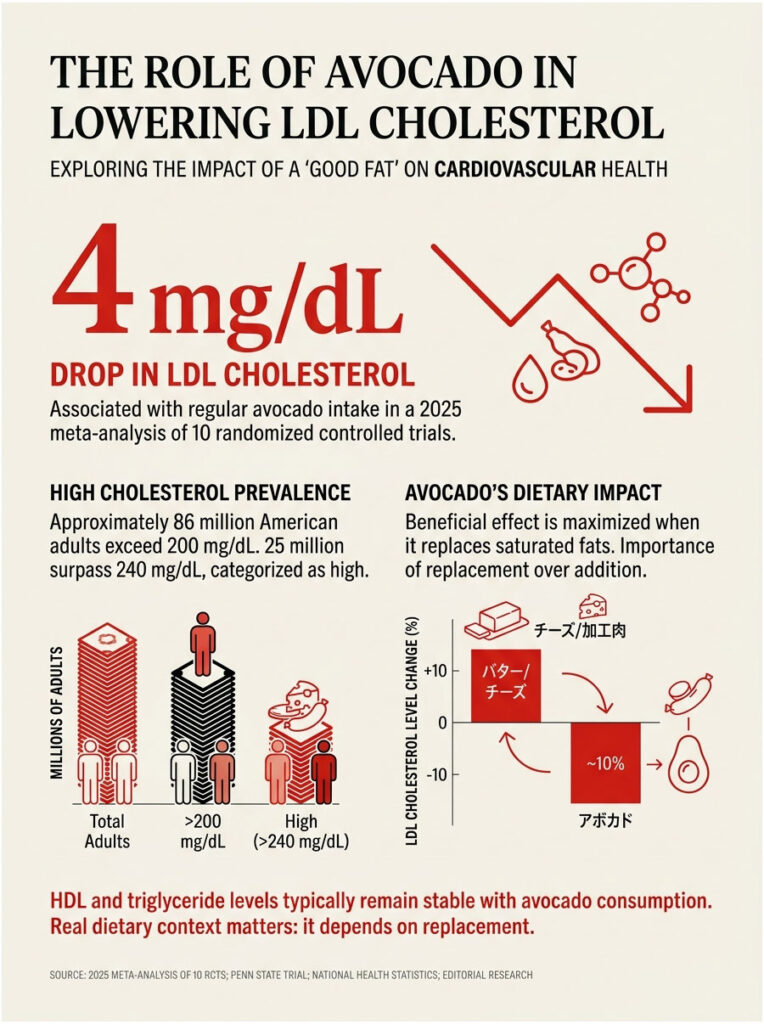
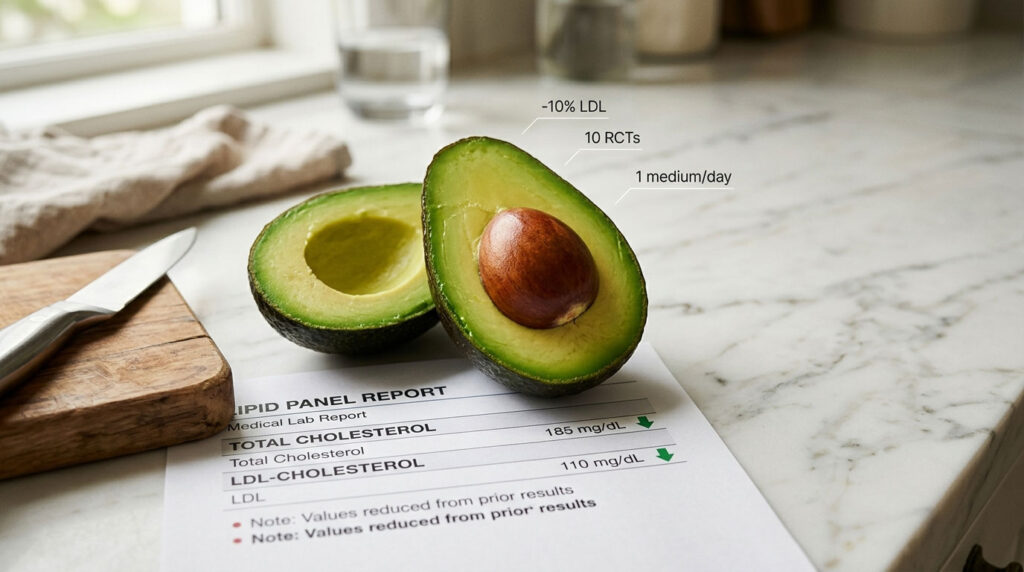
Quick Answer: Yes, avocado can modestly lower LDL cholesterol, but only when it replaces saturated fats like butter, cheese, or processed meats. A 2025 meta-analysis of 10 randomized controlled trials found LDL drops of around 4 mg/dL with regular avocado intake, and a Penn State trial showed a ~10% LDL reduction on a moderate-fat diet with one avocado per day. HDL and triglycerides usually hold steady.
At a Glance
- 10 RCTs meta-analyzed in 2025 show an average LDL drop of -3.75 mg/dL
- Penn State 2019 (JAHA) trial: ~10% LDL drop with one avocado per day for 5 weeks
- The benefit comes mostly from replacing saturated fats, not from avocado alone
- One medium avocado supplies 10 g fiber, 19 g monounsaturated fat, ~100 mg phytosterols
- Bigger LDL drops appear at intakes above 250 g/day for over 23 weeks
- Safe with most US statins; CKD and warfarin patients should personalize the plan
How Common Is High Cholesterol in the USA?
Across patients booking lipid panels through HealthCareOnTime, high cholesterol shows up more often than any other single concern in the cardiac category. The CDC data confirms why: it’s a problem hiding inside roughly one in nine American adults.
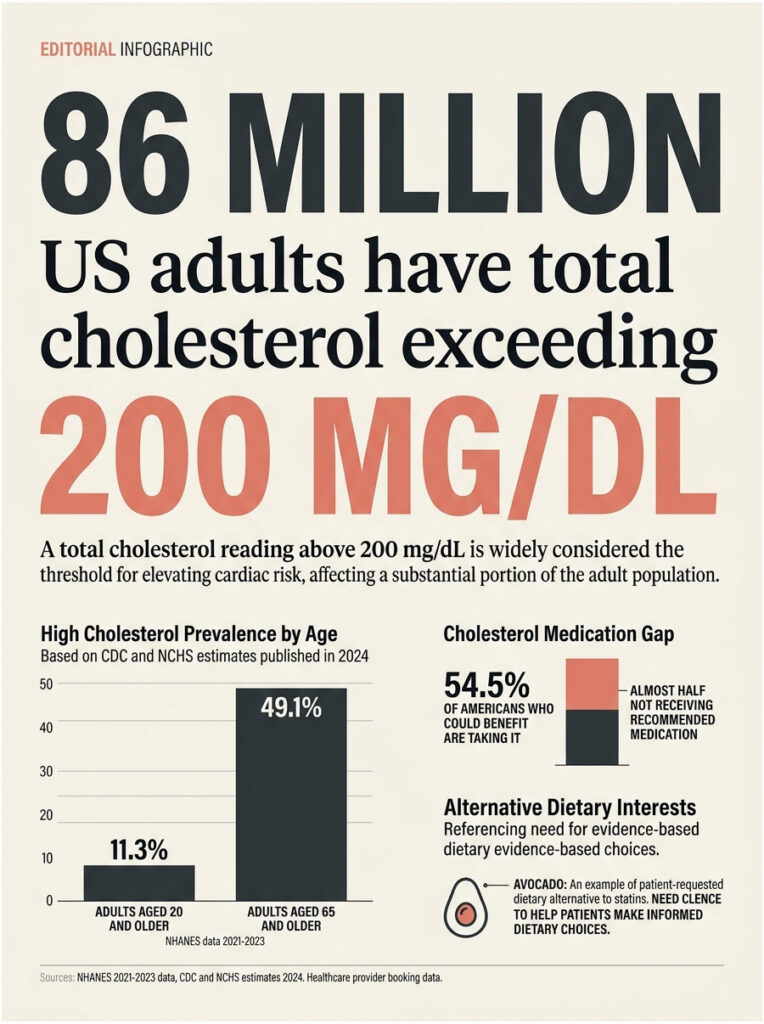
CDC’s most recent high cholesterol facts report that nearly 25 million US adults have a total cholesterol level above 240 mg/dL, and around 86 million sit above 200 mg/dL. NHANES data from August 2021 to August 2023 estimates the prevalence of high total cholesterol at 11.3% of adults 20 and older.
The numbers climb fast with age. Self-reported high cholesterol prevalence reaches 49.1% among adults 65 and older, per CDC and NCHS estimates published in 2024. About 54.5% of Americans who could benefit from cholesterol medication are currently taking it, which means almost half are not.
That gap is part of why dietary questions about foods like avocado matter. Patients want options that complement, supplement, or in some cases delay the need for medication, and a fair read of the evidence helps them make that call.
What’s in Avocado That Could Affect Cholesterol Levels
Our medical reviewers point to four components inside a Hass avocado with plausible mechanisms for lowering LDL. Each one matters, but they vary widely in real-world impact.
Monounsaturated Fat and Oleic Acid Effect
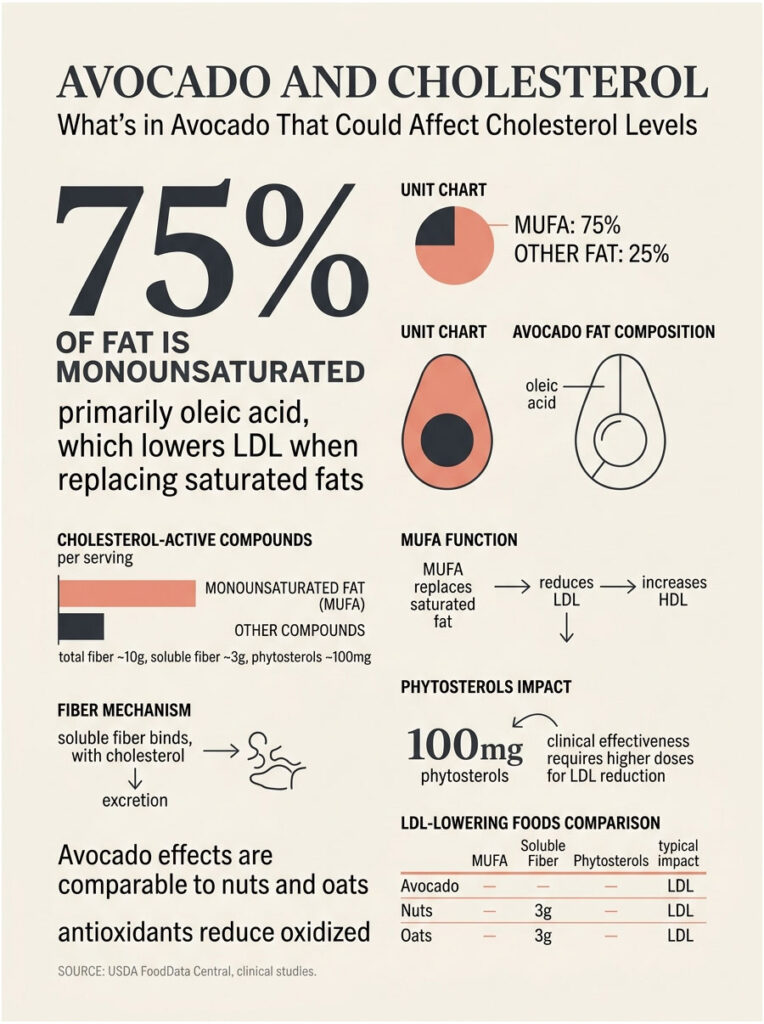
About 75% of the fat in an avocado is monounsaturated, with oleic acid as the dominant species. Oleic acid is the same fat that drives the cardiovascular reputation of olive oil and the Mediterranean diet.
When monounsaturated fat replaces saturated fat, the American Heart Association and decades of feeding trials show LDL falls. The effect is real, but it’s not unique to avocado.
Soluble Fiber and Bile Acid Binding for LDL Reduction
A medium avocado supplies roughly 10 g of total fiber, with about 30% in the soluble form. Soluble fiber binds bile acids in the gut, forcing the liver to pull cholesterol out of circulation to make more bile.
This is the same mechanism that makes oats and psyllium work for LDL. Avocado’s contribution is meaningful but smaller than a serving of steel-cut oats on a per-gram basis.
Phytosterols in Avocado: Real but Modest
Avocados contain plant sterols, which compete with cholesterol for absorption in the gut. One medium avocado supplies about 100 mg of phytosterols.
Here’s the catch: clinical trials that show meaningful LDL drops from phytosterols use doses of 2,000 mg or more per day. That’s the equivalent of about 20 avocados. The phytosterol angle is biologically real but quantitatively weak.
Polyphenols, Antioxidants, and Oxidized LDL
Avocados carry polyphenols and carotenoids that act as antioxidants. The 2019 Penn State trial specifically measured oxidized LDL particles, the form of LDL most strongly tied to plaque formation, and found significant reductions on the avocado diet.
Oxidized LDL is a more clinically important marker than total LDL in some contexts, so this finding adds depth beyond the standard lipid panel.
Table 1: Cholesterol-Active Compounds in Avocado vs. Other LDL-Lowering Foods
| Food (typical serving) | MUFA (g) | Soluble Fiber (g) | Phytosterols (mg) | Typical LDL Impact |
| Avocado, 1 medium (150 g) | 19.0 | 3.0 | 100 | -4 to -10 mg/dL replacing sat. fat |
| Olive oil, 2 tbsp (28 g) | 19.6 | 0 | 30 | -5 to -8 mg/dL replacing butter |
| Oats, 1 cup cooked (234 g) | 1.2 | 4.0 | 35 | -3 to -7 mg/dL (FDA-recognized claim) |
| Almonds, 1 oz (28 g) | 9.0 | 1.0 | 35 | -5 to -7 mg/dL replacing snacks |
| Walnuts, 1 oz (28 g) | 2.5 | 0.5 | 20 | -5 to -8 mg/dL daily intake |
| Fatty fish (salmon), 4 oz | 4.5 | 0 | 0 | Lowers TG; small LDL effect |
Data compiled from USDA FoodData Central, the AHA dietary guidance, and the studies cited below. Avocado earns its place, but it isn’t uniquely powerful: the LDL effect is comparable to nuts and oats serving for serving.
What the Cholesterol Studies Actually Show
Most of the headlines about “an avocado a day” trace back to a handful of well-conducted US trials and three systematic reviews. Walking through them in order of weight gives you the real picture.
Penn State 2019: One Avocado a Day, LDL Down 10%
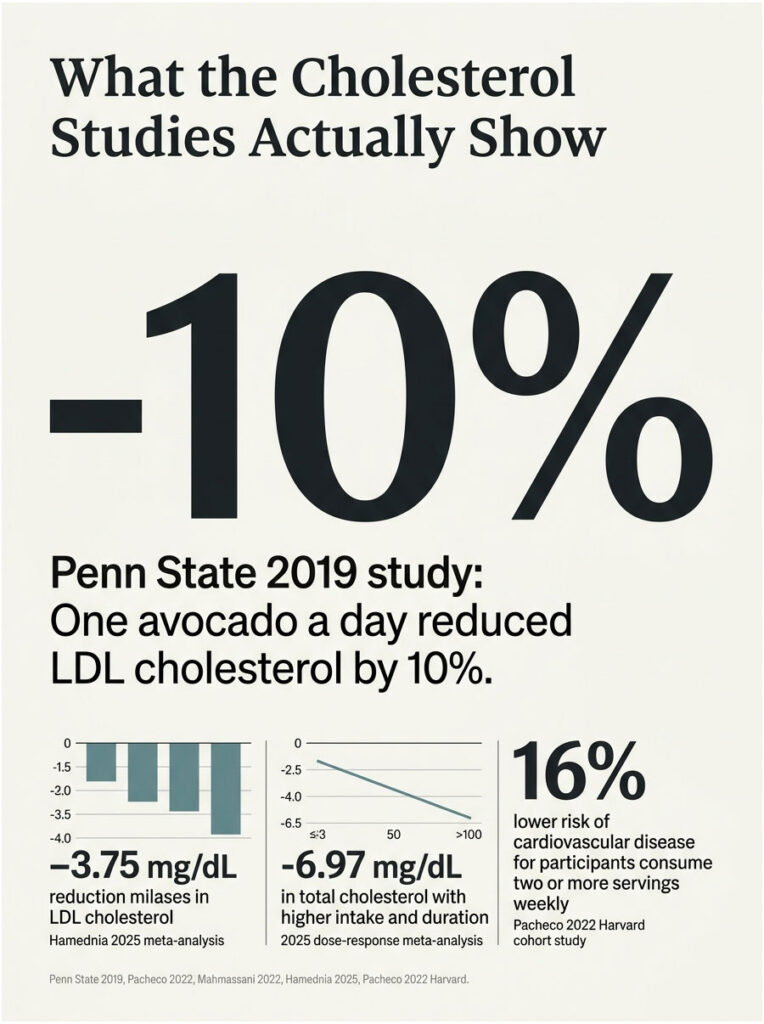
The Kris-Etherton lab at Penn State enrolled 45 adults with overweight or obesity into a tightly controlled crossover trial published in the Journal of the American Heart Association. Each participant cycled through three diets: a low-fat diet, a moderate-fat diet matched for monounsaturated fat from other plant oils, and a moderate-fat diet that included one Hass avocado per day.
After five weeks on the avocado diet, participants showed significantly lower oxidized LDL than at baseline and on the other two diets. LDL cholesterol fell by roughly 10%, with the largest reduction in small, dense LDL particles, the most atherogenic subtype. Lutein levels rose alongside the antioxidant effect.
Mahmassani 2022 Systematic Review of Avocado and Lipids
A systematic review in the Journal of the Academy of Nutrition and Dietetics pooled nine randomized controlled trials with 503 total participants plus one prospective cohort with 55,407 adults. The pooled analysis found small, statistically significant reductions in total cholesterol and LDL cholesterol when avocado-containing diets were compared to control diets.
The authors’ summary line is worth quoting: avocado consumption may reduce TC and LDL-C in people with hypercholesterolemia, and does not negatively impact body weight. That weight-neutrality finding pushed back on the long-running concern that adding a 240-calorie fruit would sabotage cholesterol goals through weight gain.
Hamednia 2025 Meta-Analysis: 10 RCTs on Lipid Outcomes
A GRADE-assessed meta-analysis published in Food Science & Nutrition in 2025 pooled 10 RCTs of avocado on cardiovascular risk factors. The pooled analysis found a significant reduction in LDL cholesterol of -3.75 mg/dL (p<0.001) and a small drop in systolic blood pressure of -1.15 mmHg.
Importantly, the same analysis found no significant change in total cholesterol, HDL, triglycerides, fasting glucose, BMI, or C-reactive protein. Avocado’s lipid effect is real but narrow, and it shows up most clearly in LDL, the metric clinicians treat with statins.
2025 Dose-Response Meta-Analysis: How Much and How Long
A dose-response meta-analysis in Critical Reviews in Food Science and Nutrition, also published in 2025, pulled together RCTs through May 2024. The pooled findings: total cholesterol fell by -6.97 mg/dL and LDL-C fell by -6.16 mg/dL in avocado groups compared to controls.
The dose-response curve carried the most useful insight: bigger LDL reductions appeared at intakes above 250 g/day (one whole medium avocado) and durations beyond 23 weeks. Short-duration, half-avocado studies tended to show smaller effects.
Pacheco 2022 Harvard Cohort: Real Heart Disease Outcomes
LDL drops are a surrogate marker. The harder question is whether eating avocado actually reduces heart attacks and strokes in real US adults.
The 2022 Pacheco study in JAHA followed 110,487 US health professionals for 30 years. Participants who ate two or more servings of avocado per week had a 16% lower risk of cardiovascular disease and a 21% lower risk of coronary heart disease compared to non-consumers. Substituting half a daily serving of margarine, butter, egg, yogurt, cheese, or processed meats with avocado was tied to a 16% to 22% lower CVD risk.
Across patients we serve who request a follow-up lipid panel after a diet change, the ones who report swapping butter for avocado are typically the same ones whose LDL trends downward on the second test. The observational pattern lines up with the trial data.
The Replacement Rule: Why Avocado Alone Won’t Save Your LDL
This is the angle that separates a careful read of the evidence from generic “avocado lowers cholesterol” content. The replacement rule is what most ranking articles glide past.
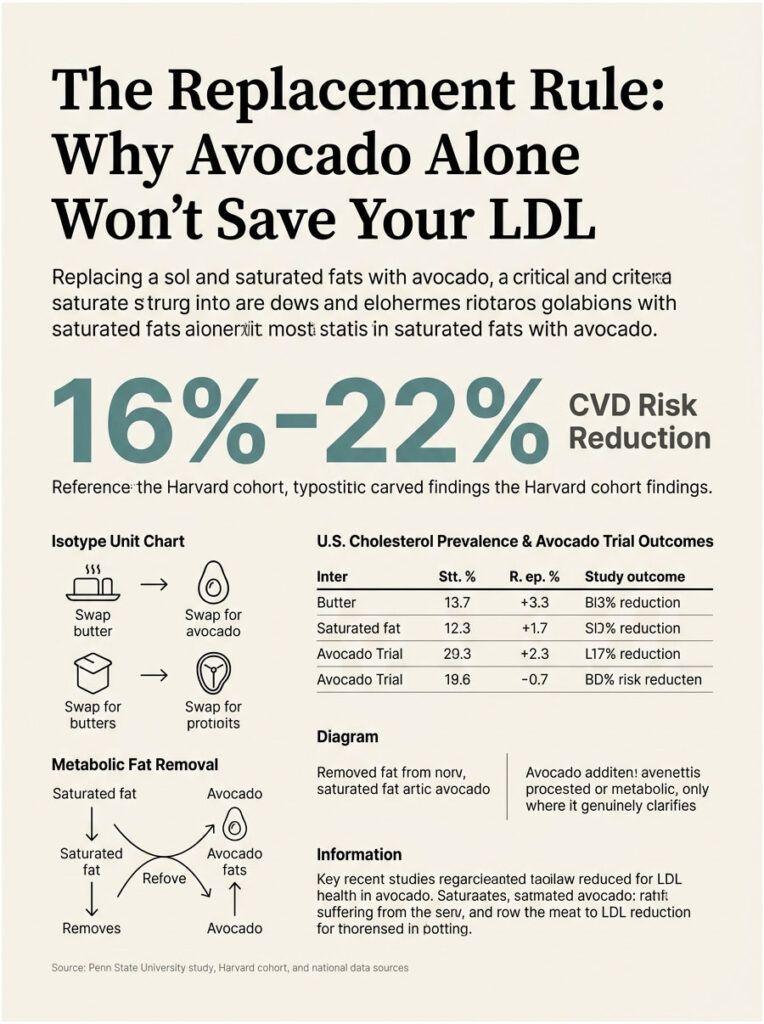
Adding Avocado vs. Replacing Saturated Fat: The Critical Difference
Dr. Michael Greger at NutritionFacts.org has argued that the cholesterol drops in avocado studies are largely the result of removing saturated fat, not adding avocado. He’s partly right, and the trial designs back him up.
In the Penn State study, the avocado diet replaced specific saturated fats from the baseline. The matched moderate-fat control diet (with plant oils instead of avocado) also lowered LDL, just less so. The avocado outperformed it, but only because the polyphenols and oxidized-LDL effect added something on top.
The practical math: if you spread a 240-calorie avocado on top of buttered toast, bacon, and cheese, expect minimal LDL change and possibly weight gain. If you swap 2 tbsp of butter (200 calories of saturated fat) or 2 slices of cheese for half an avocado on that same toast, expect a measurable drop.
What to Swap Out: Specific US Food Examples
The Harvard cohort’s 16% to 22% CVD risk reduction came from specific food swaps. Concrete US examples that our medical team suggests in nutrition follow-ups:
- Butter on toast swapped for smashed avocado, 1 tbsp at a time
- Mayonnaise in sandwiches swapped for thin avocado slices
- Processed deli meats replaced or thinned with avocado in wraps
- Cheese on burgers swapped for half an avocado
- Cream-based dressings swapped for an avocado-lime blend
Patients struggle less with these swaps than with cutting saturated fat outright, because the avocado preserves the richness and mouthfeel that drives food satisfaction.
Table 2: High Cholesterol in the USA + Avocado Trial Outcomes
| Metric | Value | Source |
| US adults with TC >240 mg/dL | ~25 million | CDC High Cholesterol Facts, 2024 |
| US adults with TC >200 mg/dL | ~86 million | CDC High Cholesterol Facts, 2024 |
| NHANES prevalence of high TC (≥240) | 11.3% | NCHS Data Brief No. 515, 2024 |
| Prevalence in adults 65+ (self-reported) | 49.1% | CDC / NCHS, 2024 |
| Eligible adults taking cholesterol medication | 54.5% | CDC, 2024 |
| Penn State 2019 trial LDL reduction | ~10% (avocado diet) | JAHA 2019, Kris-Etherton et al. |
| 2025 meta-analysis LDL reduction (pooled) | -3.75 mg/dL | Hamednia et al., Wiley 2025 |
| Pacheco cohort CHD risk reduction | 21% lower at ≥2 servings/week | JAHA 2022 |
How Much Avocado Per Day to Lower Cholesterol
This is the highest-volume voice search query in the topic, and the existing top results tend to bury the answer in vague “moderation” language. A useful answer pulls from trial-tested doses.
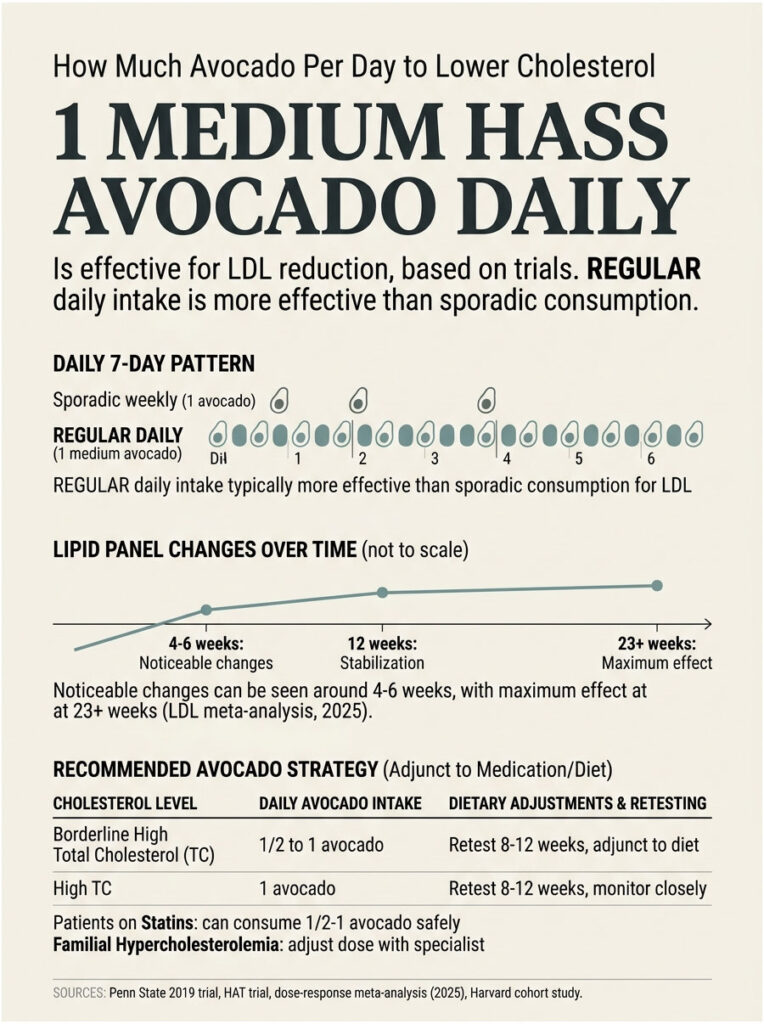
The Trial-Tested Daily Dose for LDL Reduction
One medium Hass avocado per day, roughly 150 g of flesh, is the dose used in the Penn State 2019 trial and the HAT trial. That’s the amount that produced measurable LDL drops over 5 to 26 weeks across multiple studies.
The 2025 dose-response meta-analysis sharpened this further: intakes above 250 g/day (about one and a half medium avocados) for longer than 23 weeks were tied to the largest LDL reductions. Most readers don’t need to push that high; one medium daily is well-supported.
Realistic Weekly Targets for Cardiovascular Risk
The Harvard cohort showed cardiovascular benefit starting at just two servings per week, where one serving equals half a medium avocado. That translates to one whole medium avocado per week as the floor for measurable CVD risk reduction.
For active LDL lowering, daily intake is more reliable than scattered weekly intake. The fiber and antioxidant exposure stays more consistent.
How Long Does Avocado Take to Lower Cholesterol?
Lipid panels respond gradually to diet. Most US trials show LDL changes detectable at 4 to 6 weeks, stable patterns around 12 weeks, and maximum dose-response effect at 23+ weeks per the 2025 meta-analysis.
In tests booked through HealthCareOnTime after a 60- to 90-day dietary change, the most common pattern is a 5 to 15 mg/dL LDL drop when patients report consistent saturated-fat swaps that include avocado. Patients who only “add” avocado without removing other fats tend to see flat numbers.
Table 3: Avocado Strategy by Cholesterol Status
| Your Lipid Profile | Recommended Daily Avocado Action | What to Swap Out |
| Borderline high TC (200–239 mg/dL) | 1/2 to 1 medium avocado daily | Butter, mayo, full-fat cheese |
| High TC (240+ mg/dL) | 1 medium avocado daily + lipid panel at 8–12 weeks | Processed meats, fried foods, butter |
| Elevated LDL only | 1 medium avocado daily for 12+ weeks | Saturated-fat-heavy breakfast items |
| High triglycerides | 1/2 medium avocado; re-test triglycerides at 8 weeks | Refined carbs, sugary drinks |
| On a statin | 1/2 to 1 medium daily (no statin interaction) | Sat-fat snacks; coordinate with prescriber |
| Familial hypercholesterolemia | 1/2 medium as adjunct only; diet alone won’t suffice | Sat fats, but don’t delay medication |
| Normal TC with family CVD history | 2+ servings/week (Harvard threshold) | Whatever sat fat you eat most often |
Can You Eat Avocado With Statins and Other Cholesterol Drugs?
This question gets asked in nearly every cardiology consult, and almost none of the top-ranked articles answer it directly. Our medical reviewers see it constantly from patients newly prescribed atorvastatin or rosuvastatin who don’t want to disrupt their statin’s effect.
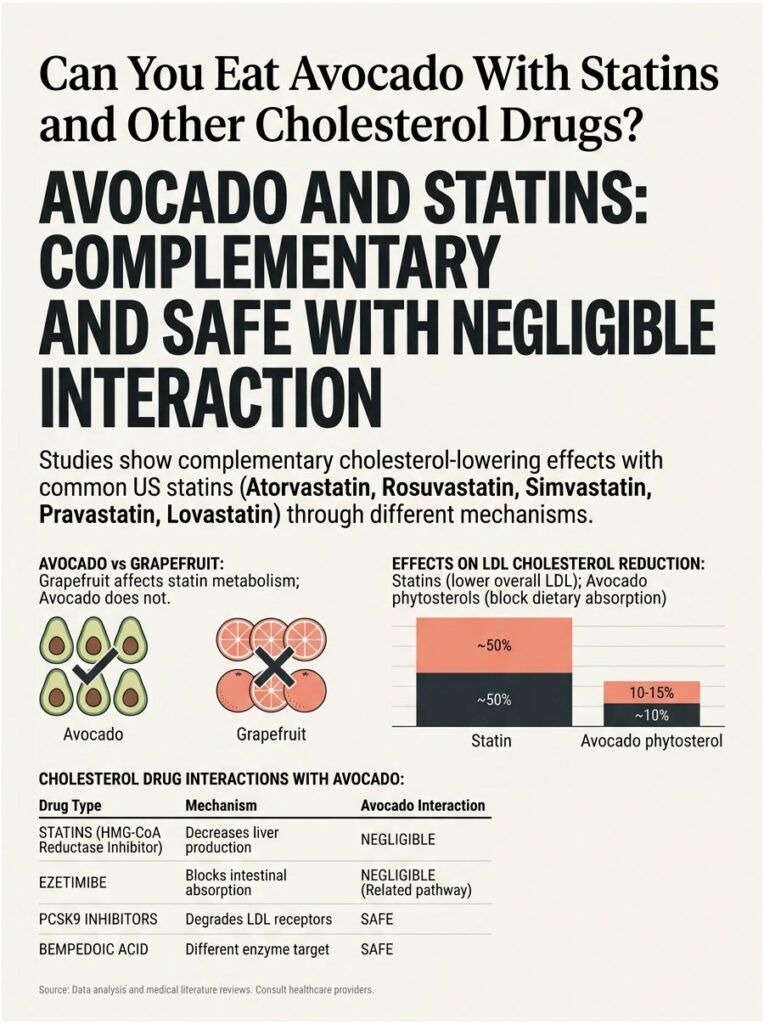
Are Avocados Safe With Statins?
There is no clinically meaningful interaction between avocado and the common US statins: atorvastatin (Lipitor), rosuvastatin (Crestor), simvastatin (Zocor), pravastatin, or lovastatin. Unlike grapefruit, which inhibits CYP3A4 and can raise statin blood levels, avocado does not alter statin metabolism.
The relationship is complementary. Statins lower LDL by inhibiting cholesterol synthesis in the liver; avocado lowers LDL by reducing dietary saturated fat absorption and binding bile acids. The two mechanisms stack additively, which is why guideline-based care pairs both.
Avocado With Ezetimibe, PCSK9 Inhibitors, and Bempedoic Acid
Ezetimibe (Zetia) blocks intestinal cholesterol absorption, and avocado’s phytosterols use a related pathway. The doses overlap so little (avocado at 100 mg, clinical sterol supplements at 2,000 mg+) that there’s no meaningful interaction concern.
PCSK9 inhibitors like alirocumab (Praluent) and evolocumab (Repatha), plus bempedoic acid (Nexletol), work through different mechanisms entirely. Avocado is safe alongside all three, with no documented adverse interaction.
When to Talk to Your Cardiologist First
Three populations should personalize the plan with their clinician before adding daily avocado:
- Warfarin patients: Vitamin K in avocado can shift INR if portions swing widely; consistency matters more than amount.
- Stage 3+ CKD: The 485 mg of potassium per 100 g may exceed renal restrictions; check with your renal dietitian.
- Latex-fruit allergy: Documented cross-reactivity; avoid until allergist testing.
Side Effects and Risks: When Avocado Could Hurt Your Lipid Goals
A balanced article admits the trade-offs. Three honest concerns deserve airtime, because we see all three derail otherwise-motivated patients.
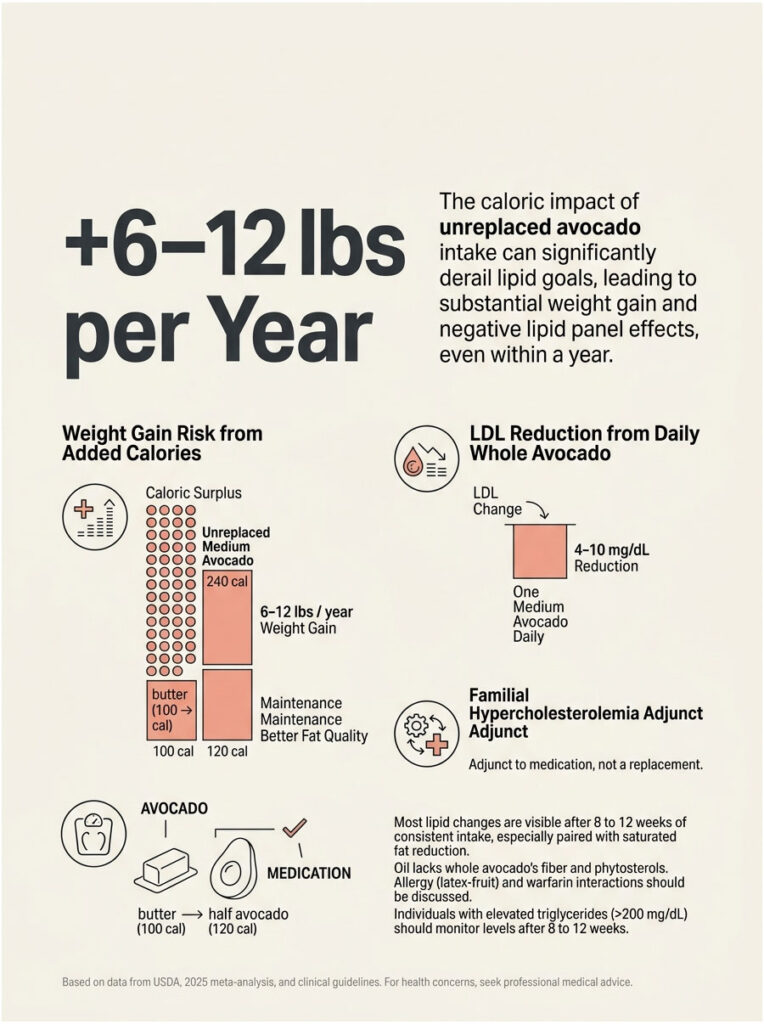
The Weight Gain Risk: Real Math, Real Numbers
A medium avocado is roughly 240 calories. If you simply add it to your daily intake without removing other fats, the extra calories work out to about 1,680 calories per week, or roughly a 0.5 lb monthly weight gain at average US activity levels. Over a year, that’s 6 to 12 lb, and for some patients it’s higher.
Weight gain itself raises LDL and triglycerides, so the net effect of “adding avocado without swapping” can be a flat or worse lipid panel. This is the failure mode our team sees most often when patients return for a follow-up panel disappointed in their numbers.
A practical check: if your daily routine includes butter on toast (about 100 calories of saturated fat) and you swap it for half an avocado (about 120 calories of mostly monounsaturated fat), the calorie load stays close to even and the fat-type swap is what does the work.
Triglyceride Watch-Outs
The 2025 meta-analysis found no average change in triglycerides across pooled trials. But individual response varies, and patients who already have elevated triglycerides (>200 mg/dL) should re-test after 8 to 12 weeks of regular avocado intake.
Triglycerides respond more to refined-carb intake and alcohol than to fat type, so the bigger lever is usually elsewhere.
Allergy and Drug Interaction Recap
Latex-fruit syndrome cross-reactivity, warfarin INR sensitivity, and the rare MAOI tyramine concern from overripe fruit. Each is uncommon but worth flagging in screening conversations with patients adjusting their cardiac diet.
Frequently Asked Questions
Is it OK to eat avocado every day if you have high cholesterol?
Yes, for most adults with high cholesterol, eating half to one medium avocado daily is safe and supported by US trial data. The Penn State 2019 study and the HAT trial both used a daily avocado for 5 weeks to 6 months without adverse effects. People with stage 3+ CKD, latex allergy, or on warfarin should personalize the plan with a clinician.
How many avocados a week are recommended for lowering LDL?
For measurable LDL lowering, daily intake of one medium avocado works best, based on trial data. For cardiovascular risk reduction, the Harvard cohort found two or more servings per week (one whole avocado) was the floor for a 16% lower CVD risk. Daily is more reliable than scattered weekly intake for active LDL reduction.
How long does avocado take to lower cholesterol?
Lipid panels typically reflect dietary changes after 4 to 6 weeks of consistent intake, with stable patterns at 12 weeks and maximum effect by 23+ weeks per the 2025 dose-response meta-analysis. Most patients we serve who track lipid panels through HealthCareOnTime see meaningful changes at the 8 to 12 week mark when they pair avocado with saturated-fat reduction.
Does avocado lower triglycerides too?
The 2025 Hamednia meta-analysis of 10 RCTs found no significant change in triglycerides with avocado intake. The 2025 Tandfonline meta-analysis reported a modest TC drop but didn’t single out triglycerides as a winning outcome. Avocado is primarily an LDL-lowering food. For triglycerides, reducing refined carbs and alcohol matters more.
Is avocado better than oatmeal for cholesterol?
Both work, through different mechanisms. Oats lower LDL mainly through beta-glucan soluble fiber, with an FDA-recognized health claim. Avocado lowers LDL through monounsaturated fat displacing saturated fat. Per-serving LDL effects are similar (-3 to -7 mg/dL each). Most cardiologists recommend both rather than picking one. The synergy matters more than the contest.
Can you eat avocado while taking a statin?
Yes. There is no clinically meaningful interaction between avocado and atorvastatin, rosuvastatin, simvastatin, or other common US statins. Unlike grapefruit, avocado doesn’t inhibit the CYP3A4 enzyme that metabolizes statins. The two work complementarily: statins block cholesterol synthesis; avocado reduces absorption and provides bile-binding fiber.
Does avocado raise HDL (“good”) cholesterol?
The 2025 meta-analysis found no significant change in HDL across pooled trials. Some earlier smaller studies suggested a modest HDL increase, but the larger pooled data don’t support a meaningful effect. Avocado’s primary benefit is on LDL and oxidized LDL, not HDL. Raising HDL responds better to exercise and weight loss than to specific foods.
Why did my cholesterol go up after eating more avocado?
The most common explanation is “addition without replacement.” If you added a 240-calorie avocado to your daily intake while continuing to eat butter, cheese, and processed meats, the extra calories can drive modest weight gain, which raises LDL. Genetic factors, recent dietary changes, and lab variability also contribute. Re-test after 8 to 12 weeks with consistent saturated-fat swaps.
Is avocado oil as good as whole avocado for cholesterol?
Avocado oil delivers monounsaturated fat similar to whole avocado but loses the fiber, phytosterols, and intact carotenoid matrix. For pure LDL lowering through fat replacement, both work. For broader lipid benefits including oxidized LDL reduction and fiber-driven bile binding, the whole fruit edges ahead. Avocado oil’s advantage is its high smoke point for cooking.
Can avocado replace a statin for borderline high cholesterol?
For most patients on a statin, no. Statins typically lower LDL by 30% to 55%, while avocado lowers LDL by roughly 4 to 10 mg/dL (around 3% to 8%). For borderline cholesterol without other risk factors, lifestyle changes that include avocado may be tried first under your clinician’s guidance. Never stop a prescribed statin without consulting your cardiologist.
Are avocados safe for people with familial hypercholesterolemia?
Yes, avocados are safe and a reasonable diet addition for familial hypercholesterolemia (FH). However, FH typically requires medication because LDL levels are genetically elevated to a degree diet cannot fully correct. Treat avocado as an adjunct to, not a replacement for, statin or PCSK9 therapy. Re-test annually and follow your lipidologist’s plan.
Is guacamole as good as plain avocado for cholesterol?
Plain guacamole made with avocado, lime, cilantro, onion, and tomato delivers the same cholesterol benefits as plain avocado. Commercial guacamole with added sour cream, mayo, or seed oils can dilute or reverse the benefit, depending on the recipe. Read labels carefully. Homemade is usually the cleaner choice for patients tracking LDL trends.
Medical Disclaimer: This article is for general educational purposes and does not replace personalized cardiology, lipidology, or nutrition advice. Patients with familial hypercholesterolemia, chronic kidney disease, latex-fruit allergy, or those on warfarin, MAO inhibitors, or other prescription medications should consult their physician or a registered dietitian before making significant dietary changes. Patients can also book a lipid panel or advanced lipid panel through HealthCareOnTime to establish a baseline before adjusting their diet.
References
- CDC: High Cholesterol Facts (US Adults, 2024 data)
- NCHS Data Brief No. 515: Total and HDL Cholesterol in US Adults, August 2021–August 2023
- American Heart Association: An Avocado a Day May Help Keep Bad Cholesterol at Bay (Penn State 2019 study summary)
- Pacheco LS, et al. Avocado Consumption and Risk of Cardiovascular Disease in US Adults. Journal of the American Heart Association, 2022
- Mahmassani HA, et al. Avocado Consumption and Cardiometabolic Health: A Systematic Review and Meta-Analysis. Journal of the Academy of Nutrition and Dietetics, 2022
- Hamednia S, et al. Effects of Avocado Products on Cardiovascular Risk Factors: A GRADE-Assessed Meta-Analysis. Food Science & Nutrition, 2025
- Critical Reviews in Food Science and Nutrition: Avocado Lipid Profile Modulation Dose-Response Meta-Analysis, 2025
- Effect of Avocado Consumption on Cardiovascular Risk Factors: Systematic Review and Meta-Analysis, PMC 2023
- NutritionFacts.org: Are Avocados Good for Your Cholesterol?
- USDA FoodData Central: Avocado, Raw, All Commercial Varieties
- American Heart Association: Monounsaturated Fats