
Here’s a detail most people miss. The milk of magnesia label tells you to stop and call a doctor if you have no bowel movement after using it. Most people do the opposite and pour a bigger dose.
Table of Contents
There’s a second surprise. The 2023 US guideline that gives magnesium laxatives their credibility tested magnesium oxide tablets, not the milk of magnesia in your cabinet. This guide covers what that means for you and what to try next, in the order doctors actually follow.
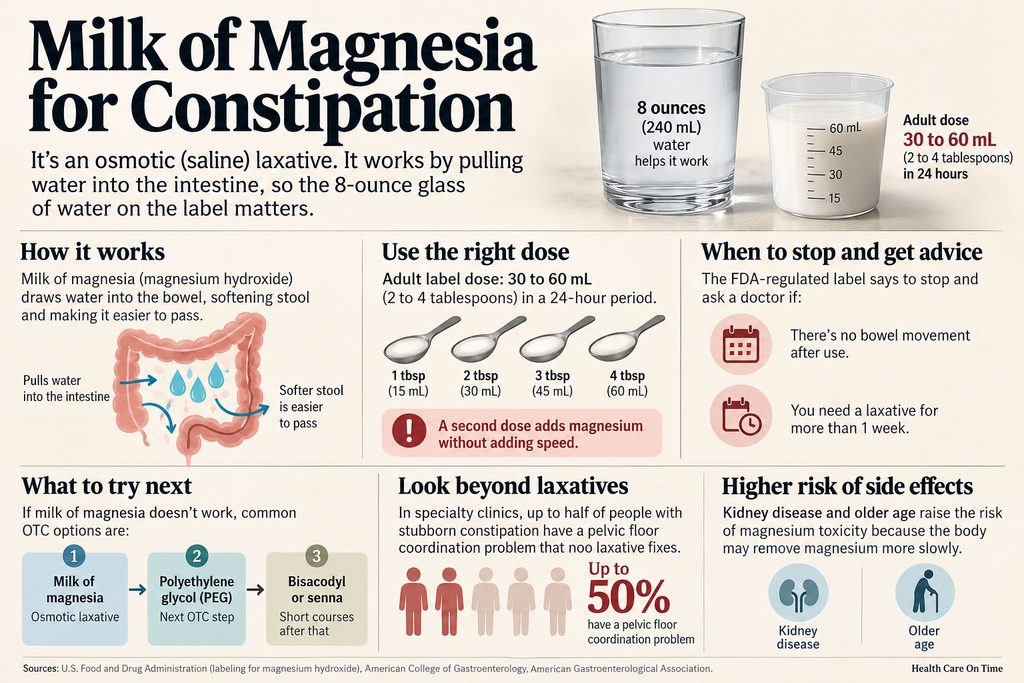
Quick Answer: Milk of magnesia (magnesium hydroxide) pulls water into your bowel and usually works within 30 minutes to 6 hours. If nothing happens by the next morning, don’t double the dose. Drink fluids, then try polyethylene glycol (MiraLAX), the only over-the-counter laxative with a strong US guideline recommendation. Call a doctor right away for no gas, vomiting, severe belly pain, rectal bleeding, or kidney disease.
What to do if milk of magnesia didn’t work:
- Don’t take a second dose the same day.
- Drink 2 to 3 glasses of water over the next few hours.
- Walk for 15 to 20 minutes, then sit on the toilet after your next meal.
- Switch to polyethylene glycol, 17 grams daily.
- If stool feels stuck low in the rectum, use a glycerin suppository.
- Call a doctor if there’s still no bowel movement after 2 to 3 days, or sooner with red flags.
At a Glance
- Milk of magnesia is an osmotic (saline) laxative. It needs water to work, so the 8-ounce glass on the label matters.
- The adult label dose is 30 to 60 mL (2 to 4 tablespoons) in a 24-hour period. A second dose adds magnesium without adding speed.
- The FDA-regulated label says to stop and ask a doctor if there’s no bowel movement after use, or if you need a laxative for more than 1 week.
- Polyethylene glycol is the next OTC step. Short courses of bisacodyl or senna come after that.
- In specialty clinics, up to half of people with stubborn constipation have a pelvic floor coordination problem that no laxative fixes.
- Kidney disease and older age raise the risk of magnesium toxicity.
What Milk of Magnesia Is (And What It Isn’t)
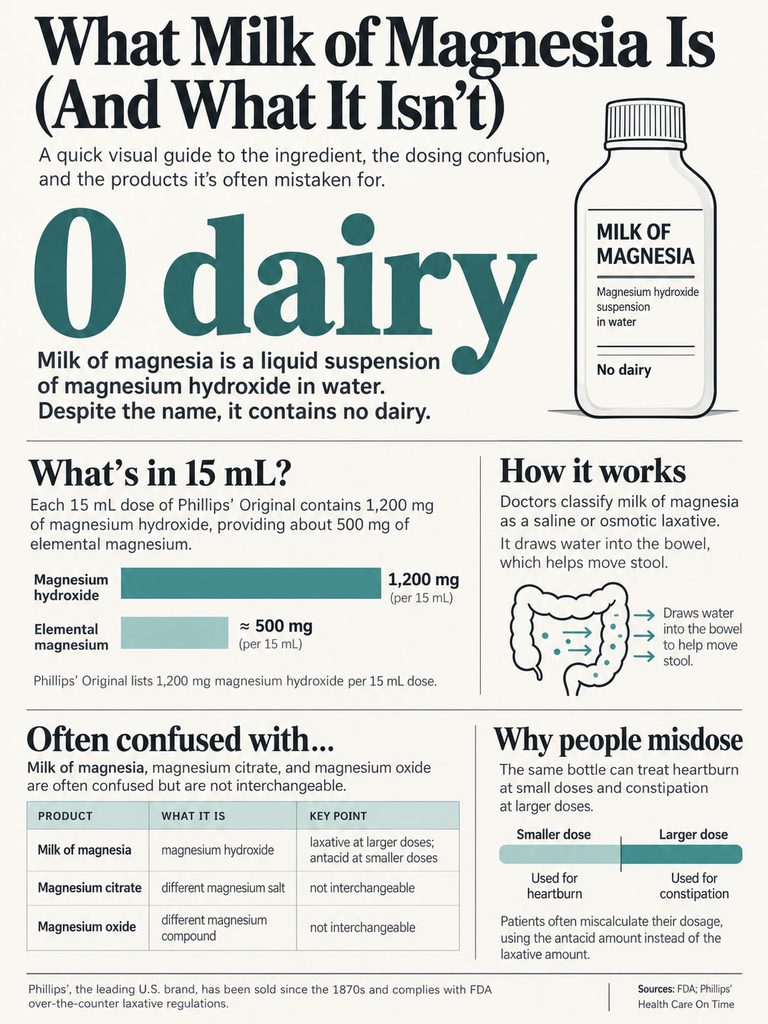
Milk of magnesia is a liquid suspension of magnesium hydroxide in water. The name comes from its chalky white look. It contains no dairy.
The leading US brand, Phillips’, has been sold since the 1870s. It falls under the FDA’s over-the-counter laxative monograph, so its dose and warnings follow federal rules.
Magnesium Hydroxide, the “Saline” Laxative
Each 15 mL (1 tablespoon) of Phillips’ Original contains 1,200 mg of magnesium hydroxide, delivering about 500 mg of elemental magnesium, according to its Drug Facts label.
Doctors call it a saline or osmotic laxative. Both words describe how it moves water.
Milk of Magnesia vs Magnesium Citrate vs Magnesium Oxide
These three get mixed up constantly. They aren’t interchangeable.
- Milk of magnesia (magnesium hydroxide): a liquid. You take it at bedtime and it works within hours.
- Magnesium citrate: usually a 10-ounce bottle. It’s stronger, faster, and often used for bowel prep.
- Magnesium oxide: a tablet taken daily in smaller doses. This is the form US guidelines actually studied for chronic constipation.
Laxative Dose vs Antacid Dose
The same bottle treats heartburn at small doses and constipation at larger ones. If you’ve only ever used it for heartburn, a teaspoon won’t move your bowels.
Patients who book digestive panels with us often say they took “the dose on the spoon,” and it turned out to be the antacid amount.
How Milk of Magnesia Works in Your Body
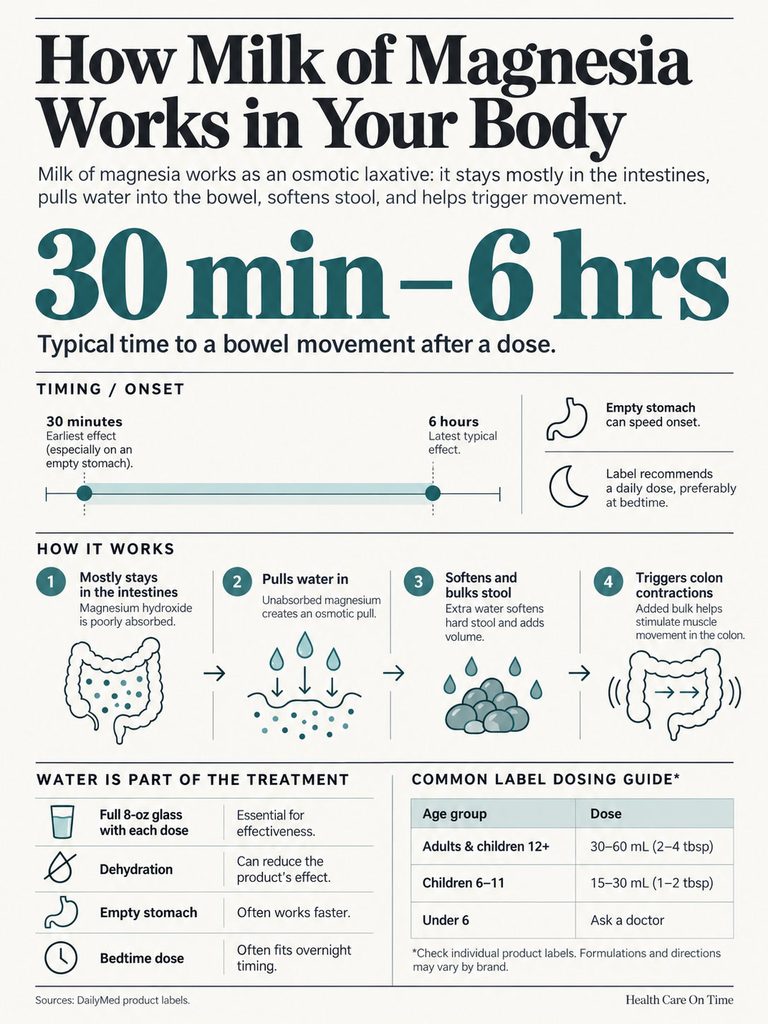
Magnesium hydroxide is poorly absorbed. Most of it stays in your intestines, and that’s the point.
The Osmotic Pull
Unabsorbed magnesium acts like a sponge. Through osmosis, it draws water from your body into your bowel.
That water softens hard stool and adds volume. The extra volume stretches the colon wall, which triggers the muscle contractions that push stool forward.
The Timeline
Most people have a bowel movement 30 minutes to 6 hours after an adult dose. An empty stomach usually speeds it up.
The label suggests one daily dose, preferably at bedtime. A bedtime dose often works by morning, which beats a midday dose that fires during your commute.
Why the 8-Ounce Glass Isn’t Optional
The label tells you to drink a full 8-ounce glass of liquid with each dose. That water is part of how the product works.
If you’re already dehydrated, there’s less spare water for the magnesium to pull in. Our medical review team sees this often in older adults, who tend to drink less and take more water pills.
The Label Dose at a Glance
| Age | Label dose | Tablespoons | Elemental magnesium |
| Adults and children 12+ | 30 to 60 mL | 2 to 4 tbsp | About 1,000 to 2,000 mg |
| Children 6 to 11 | 15 to 30 mL | 1 to 2 tbsp | About 500 to 1,000 mg |
| Children under 6 | Ask a doctor | None without advice | Not applicable |
Based on Phillips’ Original (500 mg magnesium per 15 mL). Store brands may differ, so check your bottle.
Why You’re Still Constipated: 7 Common Reasons
If milk of magnesia didn’t work, the cause usually falls into one of seven buckets. Some take a glass of water to fix. Others need a doctor.

1. Not Enough Fluid
This is the most common miss. Without water, the osmotic effect stalls, and you may just get cramps and gas.
2. The Dose Was Too Low or Taken After a Big Meal
Two tablespoons is the floor of the adult range. A heavy dinner beforehand can slow things down. Check the label range before deciding the product failed.
3. A Medication Is Fighting It
Many common drugs slow the gut, and milk of magnesia often can’t overpower them alone:
- Opioid pain relievers (oxycodone, hydrocodone, tramadol)
- Iron and calcium supplements
- Calcium channel blockers such as verapamil
- Anticholinergic drugs (some bladder, allergy, and older antidepressant medicines)
- Antipsychotics and some anti-nausea drugs
4. Fecal Impaction (and the “Overflow” Trap)
When hard stool packs the rectum, liquid stool can leak around it. That leakage can look like the laxative “worked” while the blockage stays put.
Signs include constant urge with little result, a heavy rectum, and small watery stools with nothing formed. This needs a clinician and usually a rectal treatment, not more oral laxative.
5. Pelvic Floor Dyssynergia: Soft Stool, Stuck Outlet
In dyssynergic defecation, the muscles that should relax during a bowel movement tighten instead. Softer stool doesn’t help a door that won’t open.
Studies from specialty clinics find this problem in 27% to 59% of people with chronic constipation. It’s a leading reason laxatives seem to “stop working.”
Clues include heavy straining even with soft stool, a feeling of blockage, and needing to press near the anus or vagina to finish.
6. Slow-Transit Constipation
Some colons simply move slowly. People with slow transit may go days without any urge. They often need a stimulant or a prescription option rather than an osmotic alone.
7. An Underlying Condition
Constipation can be a symptom of something else:
- Underactive thyroid (hypothyroidism)
- Diabetes affecting gut nerves
- High blood calcium
- Irritable bowel syndrome with constipation (IBS-C)
- Parkinson’s disease or multiple sclerosis
- A narrowing or growth in the colon
Patients who order a TSH or metabolic panel through HealthCareOnTime for stubborn constipation sometimes find the answer there, not in the laxative aisle.
Can You Take Another Dose? The Safety Rules
This is the question that brings most readers here. The short answer: not the same day, and not past the label limits without a doctor.
What the Drug Facts Label Says
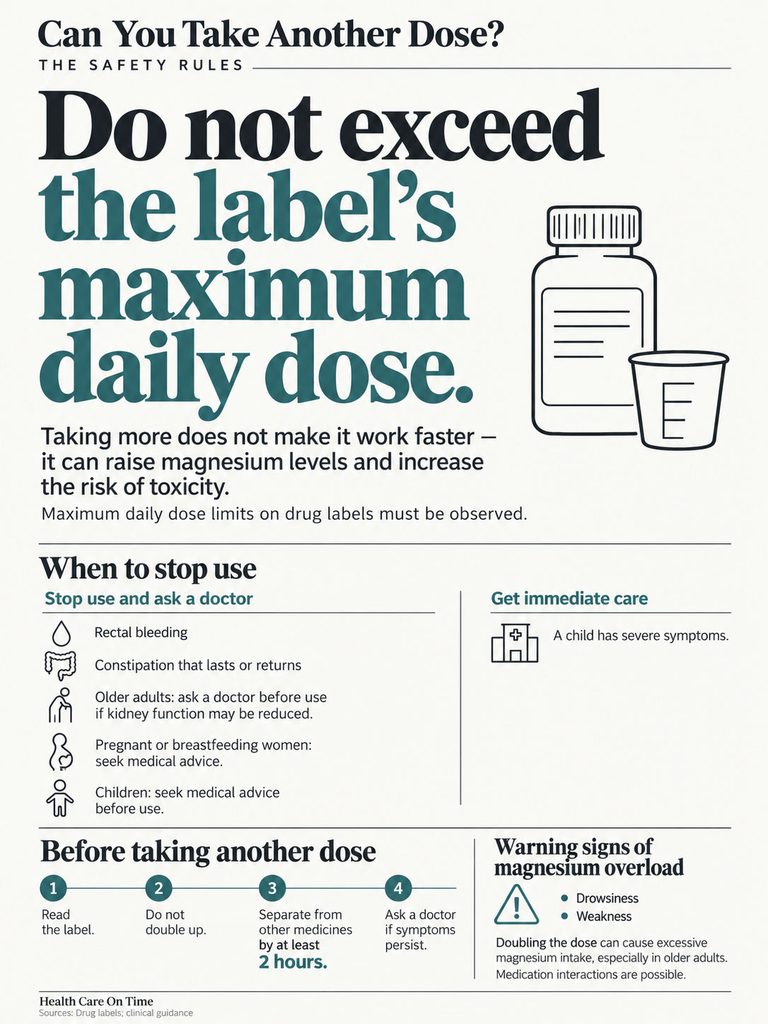
The Phillips’ label tells you not to exceed the maximum daily dose in 24 hours. You can take it once a day or in divided doses.
The “stop use” section is the part most people skip. It says to stop and ask a doctor if you have rectal bleeding or no bowel movement after using the product, because these could be signs of a serious condition. It also says to stop if you need a laxative for more than 1 week.
Why “Doubling Up” Is the Wrong Move
At the top of the label range, 60 mL delivers about 2,000 mg of magnesium. Stacking a second full dose pushes that toward 4,000 mg in a day.
The NIH Office of Dietary Supplements links magnesium toxicity to very large doses of magnesium-containing laxatives and antacids. Healthy kidneys clear most of the excess, but that margin shrinks fast for some people.
Who Should Ask a Doctor First
The label lists these situations:
- Kidney disease
- A magnesium-restricted diet
- Stomach pain, nausea, or vomiting
- A sudden change in bowel habits lasting over 14 days
Older adults deserve extra caution. Kidney function often declines with age without obvious symptoms.
Warning Signs of Too Much Magnesium
Watch for these after repeated doses, especially in an older family member:
- Nausea, vomiting, and flushing
- Unusual drowsiness or confusion
- Muscle weakness
- Low blood pressure or a slow heartbeat
- Trouble breathing
This isn’t theoretical. BMJ Case Reports described a 73-year-old man with end-stage kidney disease on daily milk of magnesia. He went into cardiac arrest in the ambulance with blood magnesium over four times normal.
Constipation itself raises the risk, because stool that sits longer lets more magnesium get absorbed. Our clinical reviewers flag a serum magnesium test for any older adult on regular magnesium laxatives who turns drowsy or weak.
Drug Interactions and the 2-Hour Rule
Magnesium binds some medicines in the gut and blocks their absorption. Space milk of magnesia at least 2 hours from:
- Tetracycline and doxycycline antibiotics
- Fluoroquinolone antibiotics (ciprofloxacin, levofloxacin)
- Levothyroxine (thyroid hormone)
- Osteoporosis drugs such as alendronate
- Iron supplements
Ask your pharmacist if you take any prescription drug. The label itself warns that the product may interact with prescription medicines.
Pregnancy, Breastfeeding, and Children
The label says to ask a health professional before use if you’re pregnant or breastfeeding. Let your OB pick the laxative and the plan.
For kids, stick to the age-based dose and call the pediatrician for children under 6. A constipated child with belly pain, vomiting, or blood needs same-day care.
Why Sources Disagree About Milk of Magnesia
If you’ve searched this already, you’ve probably found conflicting numbers. Here’s where they come from.
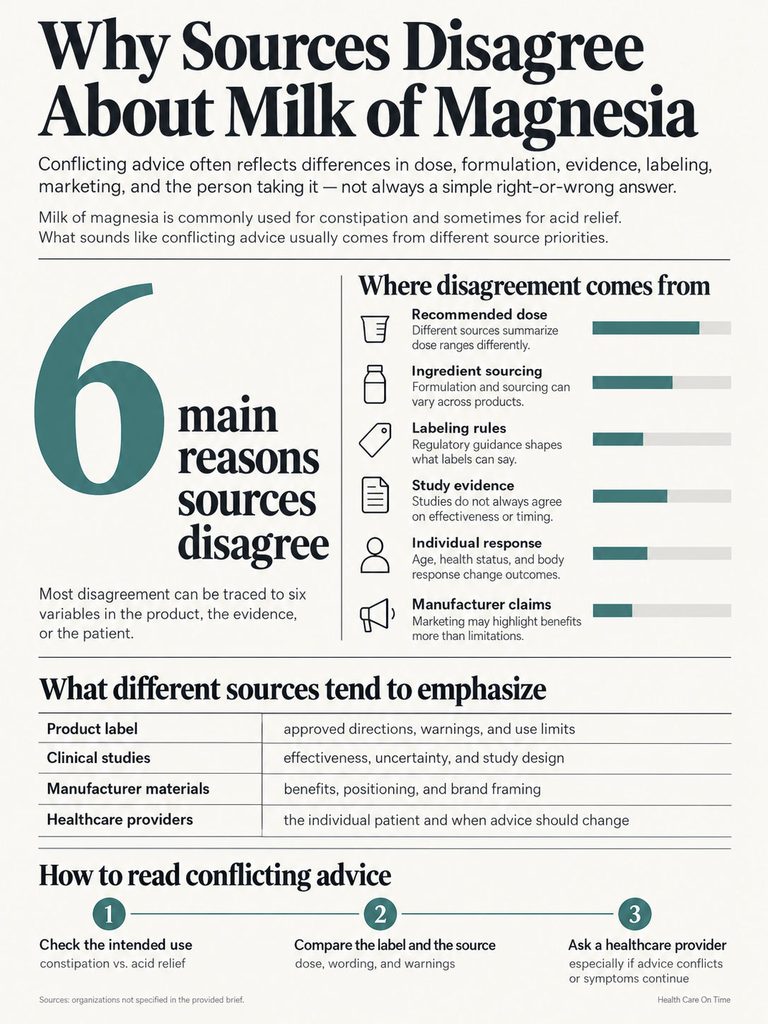
- “3 days” vs “1 week”: The US Drug Facts label says 1 week. Some UK and international sources say 3 days for constipation. Follow your US label, and treat “needing it more than a few days” as a reason to see a doctor either way.
- “30 minutes to 3 hours” vs “30 minutes to 6 hours”: Both are rough ranges. The wider 6-hour range is more realistic, especially with a bedtime dose or a full stomach.
- “It causes dependence” vs “dependence is rare”: The evidence favors the second. Osmotic laxatives move water and don’t train the colon to stop working. More on that below.
Medically Approved Next Steps: The Laxative Ladder
Before climbing the ladder, here’s how the main options compare. The guideline column reflects the 2023 joint guideline from the American Gastroenterological Association (AGA) and the American College of Gastroenterology (ACG).
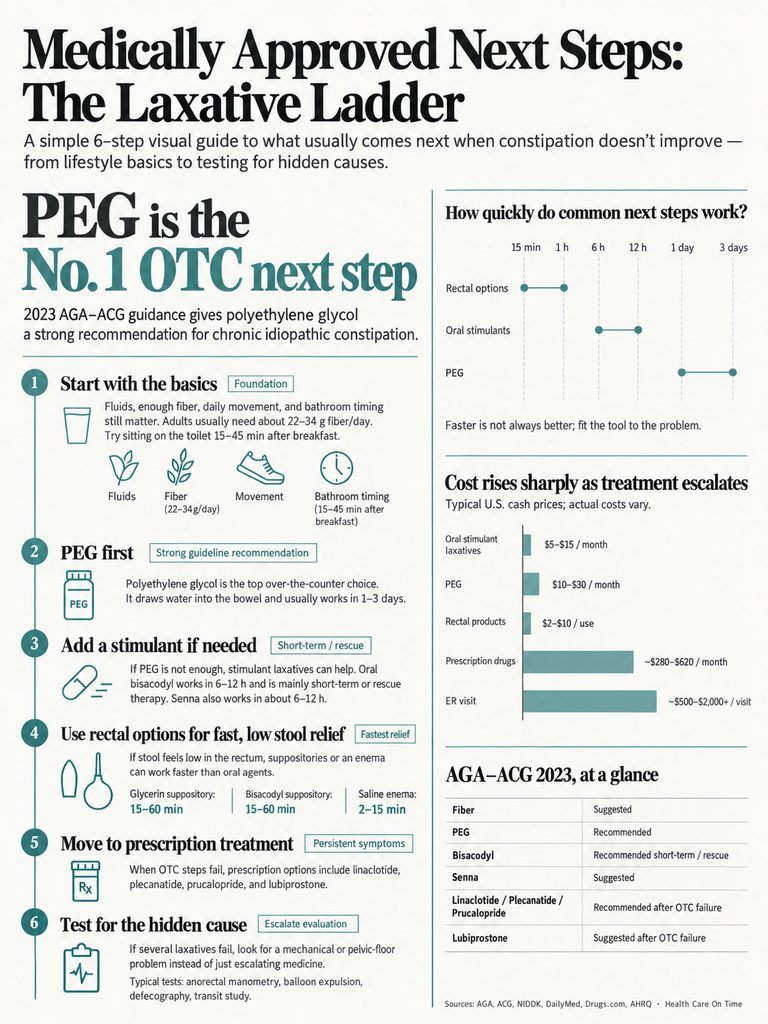
| Option | Type | Typical onset | AGA-ACG 2023 status | Best for | Key caution |
| Milk of magnesia (magnesium hydroxide) | Osmotic (saline) | 30 min to 6 hours | Not separately graded | Occasional constipation, short term | Kidney disease, drug interactions |
| Magnesium oxide tablets | Osmotic | 1 to 3 days with daily use | Conditional, very low certainty | Daily use in chronic constipation | Same magnesium risks |
| Polyethylene glycol (MiraLAX) | Osmotic | 1 to 3 days | Strong, moderate certainty | First OTC choice for chronic use | Bloating; slow to start |
| Senna (Senokot) | Stimulant | 6 to 12 hours | Conditional | Short courses, overnight relief | Cramping |
| Bisacodyl tablet (Dulcolax) | Stimulant | 6 to 12 hours | Strong, short-term or rescue use | Rescue when osmotics fail | Cramping, diarrhea |
| Glycerin or bisacodyl suppository | Rectal | 15 to 60 minutes | Not graded | Stool stuck low in rectum | Rectal irritation |
| Magnesium citrate | Osmotic (saline) | 30 min to 6 hours | Not graded | One-time cleanout | Large magnesium dose |
Step 1: Fluids, Fiber, Movement, and Timing
Start here even if you move on to medicine. Drink water through the day, walk, and sit on the toilet 10 to 15 minutes after breakfast, when your gut’s natural “go” reflex is strongest.
Raise your feet on a small footstool. The squat-like angle straightens the rectum and makes passing stool easier.
Step 2: Polyethylene Glycol, the Top OTC Choice
Polyethylene glycol (PEG 3350, sold as MiraLAX and store brands) is the next move. In the 2023 AGA-ACG guideline, PEG was the only over-the-counter therapy to get a strong recommendation for chronic use.
The usual adult dose is 17 grams (one capful) stirred into 4 to 8 ounces of liquid, once daily. It’s gentler than milk of magnesia but slower, often taking 1 to 3 days. The guideline notes its benefit holds up over 6 months.
PEG contains no magnesium. That makes it the better pick for many older adults and people with kidney concerns.
Step 3: A Short Stimulant Course
If PEG isn’t enough, stimulant laxatives come next. They make the colon muscles contract.
- Bisacodyl (Dulcolax tablets) and sodium picosulfate earned strong recommendations, mainly for short-term or rescue use.
- Senna earned a conditional recommendation. It’s cheap and widely used.
Take stimulants at bedtime for a morning result. The guideline defined short-term use as daily use for up to 4 weeks.
Step 4: Rectal Options When Stool Is “Right There”
If stool feels stuck low but won’t pass, oral laxatives are working from the wrong end. A glycerin or bisacodyl suppository acts within about 15 to 60 minutes.
Enemas act faster still. Use sodium phosphate enemas (Fleet and store brands) exactly as labeled. The FDA warns that more than one dose in 24 hours can cause rare but serious kidney and heart harm, and even death. If one dose doesn’t work, don’t take a second.
Step 5: Prescription Options
When OTC options fail, doctors can prescribe drugs that work differently:
- Linaclotide (Linzess) and plecanatide (Trulance) draw fluid into the gut through a different pathway. Both earned strong recommendations.
- Prucalopride (Motegrity) speeds colon movement. It also earned a strong recommendation.
- Lubiprostone (Amitiza) earned a conditional recommendation.
- Naloxegol (Movantik) and methylnaltrexone (Relistor) target opioid-induced constipation.
Step 6: Testing When Nothing Works
If two or more laxative types fail, it’s time to look for a mechanical cause. A gastroenterologist may order:
- Anorectal manometry and a balloon expulsion test to check for pelvic floor dyssynergia
- A colon transit study to measure how fast stool moves
- Colonoscopy if you have red flags or are due for screening
- Blood tests for thyroid, calcium, glucose, and kidney function
If dyssynergia shows up, the fix is retraining. In one US clinical-practice cohort, 69.8% of patients with this problem responded to biofeedback therapy, though a smaller share (45.3%) reported clear symptom relief. A pelvic floor physical therapist usually runs it.
What This Costs in the US
OTC milk of magnesia, PEG, senna, and suppositories are usually inexpensive, especially store brands. HSA and FSA cards cover OTC laxatives.
Brand prescription drugs like Linzess, Trulance, and Motegrity can run several hundred dollars a month without coverage, and many insurers require prior authorization. Ask about manufacturer savings cards and whether a generic is available.
Compare that with the ER. A 2015 study put the average constipation ER visit at $2,306 (in 2014 dollars). A primary care or telehealth visit after 2 to 3 failed days is usually the cheaper, faster route.
What the Evidence Actually Shows
Milk of magnesia has been sold for over 150 years, so it’s easy to assume it’s been carefully studied. The research record is thinner than its reputation.

The Magnesium Oxide vs Milk of Magnesia Gap
The 2023 AGA-ACG panel reviewed 28 studies, and the guideline was developed without industry funding. For magnesium, the trials it relied on tested magnesium oxide tablets, and the panel rated that evidence as very low certainty.
Magnesium hydroxide, the active ingredient in milk of magnesia, didn’t get its own grade. Doctors extend the magnesium oxide data to it because both are osmotic magnesium salts. That’s reasonable, but it’s an assumption. No large modern trial has compared milk of magnesia head to head with PEG in American adults.
The Dependence Myth
Some websites warn that milk of magnesia makes your bowel “lazy.” For osmotic laxatives, there’s little evidence for that. They move water and don’t weaken colon muscles.
The real risk with repeated use is magnesium buildup. If you need it often, the issue is an unfound cause, not dependence, and that’s a reason to see a doctor.
US Constipation by the Numbers
Constipation is often brushed off as minor. The national data says otherwise.
| Metric | Figure | Source |
| Median US prevalence of chronic constipation | 16% of adults | PMC review |
| Prevalence in adults aged 60 to 101 | 33.5% | PMC review |
| US adults with chronic idiopathic constipation | About 35 million | Prucalopride burden study, PMC |
| Constipation ER visits, 2006 vs 2011 | 497,034 vs 703,391 (up 41.5%) | Sommers, Am J Gastroenterol 2015 |
| Average cost per constipation ER visit, 2011 | $2,306 (2014 dollars) | Sommers, Am J Gastroenterol 2015 |
| National cost of constipation ER visits, 2011 | About $1.62 billion | Sommers, Am J Gastroenterol 2015 |
| Hospitalized constipation patients readmitted (2013) | About 32% of 24,026 | Healio, Nationwide Readmissions Database |
| Dyssynergia among chronic constipation patients | 27% to 59% | Springer review |
Many of those ER visits could have been avoided with an earlier step up the ladder. In cases reviewed by our medical team, the pattern repeats: several days of repeated milk of magnesia, no result, then a midnight ER trip.
Evidence Limits, Stated Plainly
- The ER cost figures come from 2006 to 2011. Today’s costs are likely higher.
- US prevalence estimates range from 3.4% to 19.4% because studies define constipation differently.
- Most dyssynergia data come from specialty clinics, where harder cases cluster. The rate in primary care is probably lower.
When Constipation Is an Emergency
Most constipation is uncomfortable, not dangerous. A few signs mean you shouldn’t wait for the next laxative.

Red Flags That Need Same-Day Care
Go to urgent care or the ER if constipation comes with:
- No gas passing at all
- Vomiting, especially if it smells like stool
- A swollen, hard, or tender belly
- Severe or worsening abdominal pain
- Fever
- Heavy rectal bleeding or black, tarry stool
- Confusion, weakness, or a slow heartbeat after repeated magnesium doses
These can point to a bowel obstruction, perforation, or magnesium toxicity. Don’t take more laxatives with these symptoms. Pushing a blocked bowel can make things worse.
New Constipation After 45
A lasting change in bowel habits is worth a doctor visit at any age. If you’re 45 or older, ask whether you’re due for colorectal cancer screening. The US Preventive Services Task Force recommends starting at 45 for average-risk adults.
Unexplained weight loss, a family history of colon cancer, or iron-deficiency anemia raise the priority.
Older Adults and Caregivers
If you care for an aging parent, keep a simple log of each laxative dose and each bowel movement. It makes the doctor’s job far easier.
Families who order kidney function and magnesium tests through HealthCareOnTime often do so after a parent’s drowsiness turns out to be laxative-related.
Your Situation, Your Next Move
| Your situation | What to do | How fast |
| No bowel movement 12 hours after one label dose | Drink fluids, walk, start PEG 17 g daily. No second dose today. | Same day, at home |
| No result after 2 days of label use | Stop milk of magnesia. Call your doctor or pharmacist. | Within 24 to 48 hours |
| Constant urge, only liquid leakage, no formed stool | Possible impaction. See a clinician for an exam and rectal treatment. | Same or next day |
| Constipation began after a new opioid or iron pill | Ask your prescriber about PEG plus a stimulant, or opioid-specific drugs. | Within a few days |
| You have kidney disease or are on dialysis | Avoid milk of magnesia unless your nephrologist approves. Use PEG instead. | Before the next dose |
| Vomiting, swollen belly, no gas | Go to the ER. Take no more laxatives. | Now |
| Blood in stool or black stool | Same-day medical visit. ER if heavy or with dizziness. | Same day |
| Constipated 3+ weeks despite OTC use | Book a primary care or GI visit. Ask about testing. | Within 1 to 2 weeks |
How to Prevent the Next Round
Rescue fixes don’t solve the cause. A few habits cut down how often you reach for the bottle.

The Dietary Guidelines for Americans set fiber at about 14 grams per 1,000 calories, roughly 25 to 34 grams a day for most adults. Psyllium is the best-studied fiber supplement for constipation. Raise fiber over 1 to 2 weeks and drink more as you go.
Spread water through the day, move daily, and keep a footstool by the toilet. Don’t ignore the urge to go; holding it lets the colon pull more water out of stool.
Finally, bring your full medicine list to your pharmacist and ask one question: “Could any of these be causing my constipation?” Patients commonly ask us whether they need a test or a medicine change. Often the medicine list holds the answer.
Frequently Asked Questions
How long does milk of magnesia take to work?
Most adults have a bowel movement within 30 minutes to 6 hours. A bedtime dose often works by morning. Taking it with a full 8-ounce glass of water and on an empty stomach usually speeds things up. If nothing happens by the next day, don’t repeat it. Move to the next step or call your doctor.
Can you take a second dose of milk of magnesia the same day?
The label limits you to the maximum daily dose within 24 hours, which is 60 mL for adults. Another full dose on top of that raises your magnesium intake and the risk of toxicity. If one dose didn’t work, drink fluids and try polyethylene glycol instead of doubling up.
Why didn’t milk of magnesia make me poop?
Common reasons include too little water, too small a dose, a constipating medication, hard stool impacted in the rectum, or pelvic floor muscles that don’t relax. An underlying condition such as an underactive thyroid can also play a role. If it fails more than once, ask a doctor to look for the cause.
How many days in a row can you take milk of magnesia?
The US Drug Facts label says to stop and ask a doctor if you need a laxative for more than 1 week. Some non-US sources say 3 days. If you need it more than a few days running, the better question is why, and that calls for a medical review.
Is MiraLAX better than milk of magnesia?
For ongoing constipation, yes. Polyethylene glycol (MiraLAX) is the only over-the-counter laxative with a strong recommendation in the 2023 AGA-ACG guideline. It contains no magnesium, so it’s safer for many older adults and people with kidney problems. Milk of magnesia works faster but is meant for occasional use.
Can milk of magnesia make constipation worse?
Not directly, but it can hide a problem. Watery leakage around impacted stool can look like success while the blockage remains. Frequent use can leave you dehydrated, which hardens stool later. In people with kidney trouble, magnesium buildup can slow the gut. If symptoms worsen, stop and see a clinician.
Is it safe to take milk of magnesia with kidney disease?
Not without your doctor’s approval. Healthy kidneys clear extra magnesium, but weakened kidneys can’t, and toxicity can cause a dangerously slow heartbeat. The label tells people with kidney disease to ask a doctor first. Polyethylene glycol is usually a safer choice. Ask your nephrologist before using any magnesium product.
Should you take milk of magnesia at night or in the morning?
The label suggests once a day, preferably at bedtime. Because it works within 30 minutes to 6 hours, a bedtime dose usually brings a bowel movement by morning. A morning dose can kick in during your day, which many people find inconvenient. Pick a time when you can stay near a bathroom.
Can you take milk of magnesia and MiraLAX together?
Stacking two osmotic laxatives usually isn’t needed and can cause diarrhea, cramping, and dehydration. Most doctors suggest switching from milk of magnesia to polyethylene glycol rather than combining them. If you think you need both, check with your doctor or pharmacist first, especially if you’re older or have kidney concerns.
Does milk of magnesia cause dependence?
There’s little evidence that osmotic laxatives like milk of magnesia make your bowel dependent. They move water and don’t weaken colon muscles. The bigger concerns with frequent use are magnesium buildup and an untreated underlying cause. If you need it often, a medical evaluation makes more sense than worrying about dependence.
What is the strongest over-the-counter laxative?
Stimulants such as bisacodyl and senna, along with magnesium citrate, act strongly. Suppositories and enemas act fastest for stool stuck low in the rectum. Strongest isn’t always best, though. For repeated constipation, polyethylene glycol has the best evidence for steady, safe relief.
When should you go to the ER for constipation?
Go to the ER if you can’t pass gas, are vomiting, have a hard or swollen belly, severe pain, fever, or heavy rectal bleeding. Also go if someone becomes confused, very weak, or has a slow heartbeat after repeated magnesium laxatives. Don’t take more laxatives while you wait for care.
Disclaimer: This article is for general education and doesn’t replace advice from your own doctor or pharmacist. Laxative choice depends on your age, kidney function, medications, and medical history. If you have severe pain, vomiting, inability to pass gas, rectal bleeding, or confusion, seek emergency care. For a possible overdose, call Poison Help at 1-800-222-1222.
References
- AGA-ACG Clinical Practice Guideline: Pharmacological Management of Chronic Idiopathic Constipation (Gastroenterology, 2023)
- American College of Gastroenterology: Guideline review by Philip Schoenfeld, MD
- ACP Gastroenterology: Guidance on pharmacologic treatment of chronic idiopathic constipation
- Phillips’ Original Milk of Magnesia Drug Facts (FDA structured label)
- FDA Drug Safety Communication: Exceeding the Recommended Dose of OTC Sodium Phosphate Products
- NIH Office of Dietary Supplements: Magnesium Fact Sheet for Health Professionals
- NIDDK: Constipation
- Dietary Guidelines for Americans
- Sommers et al., Emergency Department Burden of Constipation in the United States, 2006 to 2011
- Economic Burden of Chronic Idiopathic Constipation in the USA (PMC)
- Efficacy of Biofeedback Therapy in Clinical Practice (PMC)
- Dyssynergic Defecation: Diagnosis and Treatment Review (Springer)
- Biofeedback for Dyssynergic Defecation and US Prevalence Data (PMC)
- BMJ Case Reports coverage: Near death by milk of magnesia
- Healio: Rehospitalization common among patients admitted for constipation
- US Preventive Services Task Force: Colorectal Cancer Screening