Spinach spent most of the last century famous for the wrong reason. Generations of American kids were told it built cartoon muscles, and generations of adults quietly decided the whole thing was marketing.
Table of Contents
Then the research caught up. Over the past fifteen years spinach has appeared in blood pressure trials, eye disease studies funded by the National Institutes of Health, and long-running cohort work on memory and walking speed.
The real health benefits of spinach turned out to be less cartoonish and more useful than the myth ever promised.
Quick Answer: The science-backed health benefits of spinach include lower blood pressure, healthier arteries, slower age-related vision loss, stronger legs, and slower cognitive decline. One cup of raw spinach delivers 145 mcg of vitamin K, 3,659 mcg of lutein and zeaxanthin, and 58 mcg of folate for about 7 calories. Most adults do well eating spinach every day at one to one and a half cups.
At a Glance
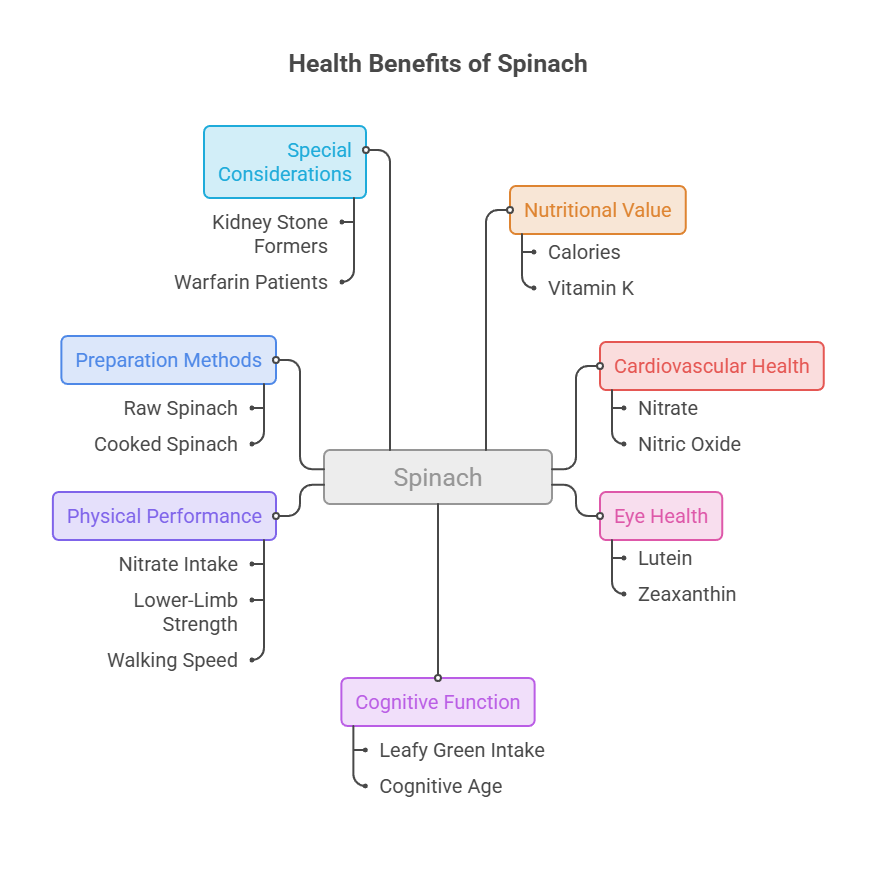
- One cup of raw spinach costs about 7 calories and covers over 120% of the daily vitamin K target.
- Nitrate in spinach converts to nitric oxide, which relaxes blood vessels and lowers systolic pressure.
- Lutein and zeaxanthin concentrate in the retina and slow progression of age-related macular degeneration.
- Adults with the highest leafy green intake scored cognitively equal to being 11 years younger.
- High nitrate intake tracked with 11% stronger lower-limb strength and up to 4% faster walking speed.
- Raw vs cooked spinach is not a contest: cooked wins on minerals, raw wins on vitamin C and folate.
- Kidney stone formers and warfarin patients need a specific approach, not blanket avoidance.
Why Spinach Keeps Turning Up in Real Research
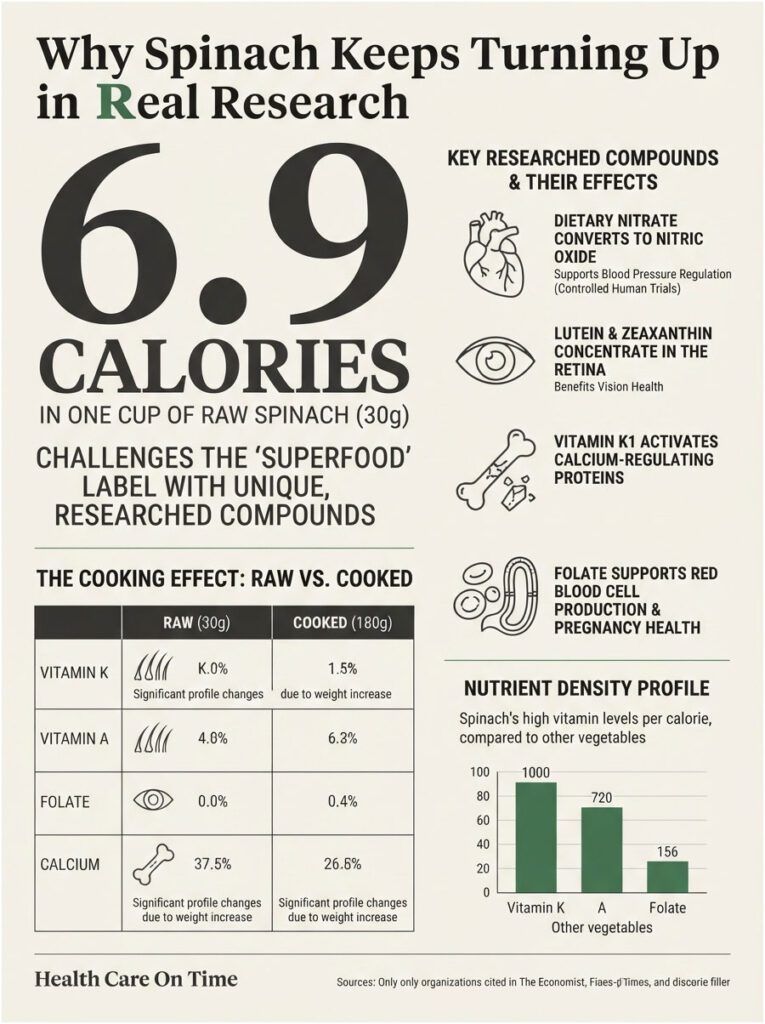
Most vegetables are good for you in a general, hard-to-measure way. Spinach is unusual because several of its compounds have been isolated, dosed, and tested in controlled human trials.
That gap separates a food that sounds healthy from one with a measurable effect. Our medical reviewers draw that line in every nutrition piece, because readers deserve to know which claims come from trials and which come from packaging copy.
What One Cup of Spinach Nutrition Actually Delivers
USDA nutrient data makes the picture concrete. A standard cup of raw spinach weighs about 30 grams, roughly one loose handful, and contains 6.9 calories, 144.9 mcg of vitamin K, 140.7 mcg of vitamin A as RAE, 3,659 mcg of lutein plus zeaxanthin, 58.2 mcg of folate, 8.4 mg of vitamin C, 0.81 mg of iron, 23.7 mg of magnesium, and 167 mg of potassium.
Cooking rewrites that math. Heat collapses the leaves, so one cup of boiled and drained spinach weighs about 180 grams and delivers roughly 41 calories, 888 mcg of vitamin K, 6.4 mg of iron, 245 mg of calcium, 157 mg of magnesium, 263 mcg of folate, and 839 mg of potassium.
Same vegetable, two preparations, a sixfold difference in mineral load per cup. If the calorie arithmetic matters to you, our spinach calories and USDA nutrition breakdown covers the per-gram figures in detail.
The Five Compounds Doing the Work
Dietary nitrate
Spinach ranks among the richest food sources of inorganic nitrate. Bacteria in the mouth and gut convert that nitrate into nitrite and then into nitric oxide, a signaling molecule with vasodilatory properties.
This pathway explains why a leafy salad can move a blood pressure reading within hours. It is also why nitrate keeps appearing in sports nutrition research.
Lutein and zeaxanthin
These two carotenoids do not scatter randomly through the body. They concentrate in the macula, the small central region of the retina responsible for sharp detail vision.
Spinach is among the densest sources available in an American grocery store.
Vitamin K1
Also called phylloquinone, vitamin K1 activates proteins that direct where calcium ends up. Deposited in bone, calcium is useful. Deposited in artery walls, it stiffens them.
Folate
Folate drives red blood cell production and neural tube development in early pregnancy. A raw cup covers about 15% of the daily target; a cooked cup covers roughly 66%.
Magnesium and potassium
Both minerals participate in blood pressure regulation, muscle contraction, and nerve signaling. National intake surveys show most American adults fall short on both.
Why Superfood Is a Marketing Word, Not a Science Word
No regulatory body defines the term. The FDA does not recognize it, and no clinical trial has ever tested a superfood.
Spinach is a nutrient-dense vegetable with several well-studied compounds. That claim stands on its own, and inflating it past the evidence does readers no favors.
The 12 Benefits, Ranked by Strength of Evidence
Not every claim attached to spinach carries equal weight. Some rest on randomized human trials. Others rest on cell studies or population associations that cannot establish cause.
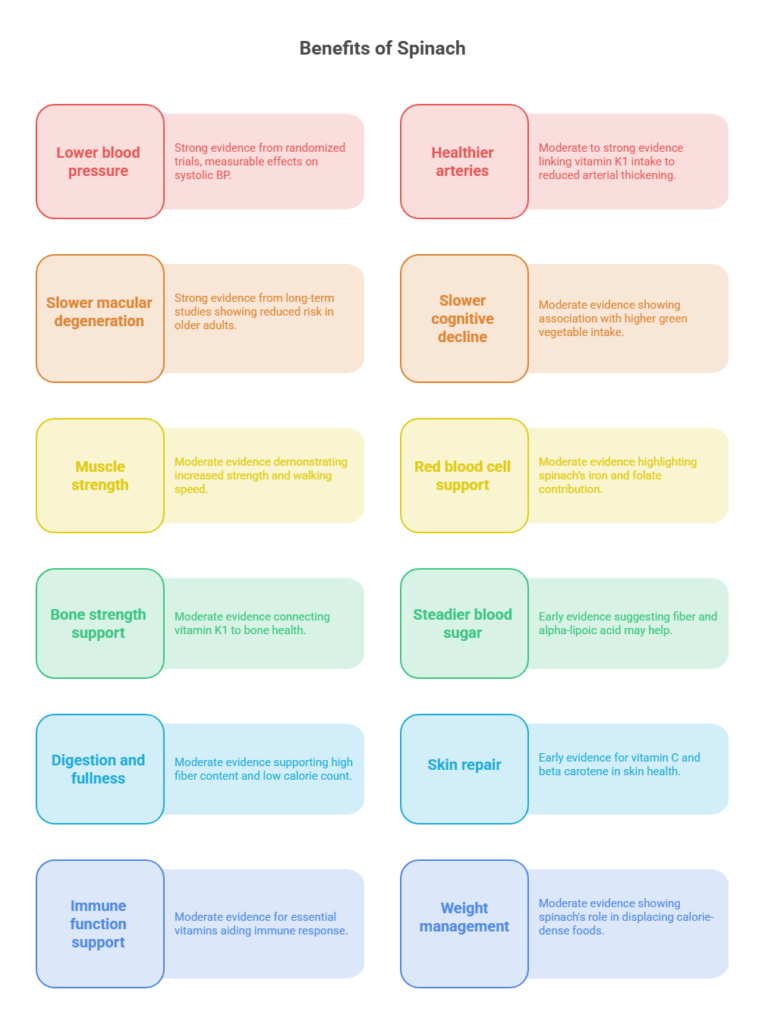
Here is the honest scorecard, which is where most spinach benefits articles stop short.
Table 1. Spinach Benefits Scorecard: What the Evidence Actually Shows
| Claimed Benefit | Evidence Strength | Key Study or Source | Measured Effect | What It Means for You |
| Lower blood pressure | Strong | Randomized crossover, 26 adults aged 38 to 69 (PubMed 24120618) | 220 mg spinach nitrate meal lowered systolic BP and pulse pressure | A real short-term drop you can measure at home |
| Healthier arteries | Moderate to Strong | ECU, UWA and Danish Cancer Institute, 1,436 older women | Higher vitamin K1 intake linked to less carotid thickening | A long-game benefit, not a quick fix |
| Slower macular degeneration | Strong | AREDS2 Report 28, 3,882 participants, 10-year data | Hazard ratio 0.85 for late AMD versus beta carotene | Matters most after age 50 |
| Slower cognitive decline | Moderate | Rush Memory and Aging Project, 960 adults, Neurology | Highest intake group equal to 11 years younger cognitively | Association, not proof, but consistent |
| Muscle strength and gait | Moderate | AusDiab, 3,759 adults over 12 years, Journal of Nutrition | 11% stronger lower limbs, up to 4% faster walking | Falls prevention value after 60 |
| Red blood cell support | Moderate | USDA folate and iron data plus absorption research | 263 mcg folate and 6.4 mg iron per cooked cup | Helpful, but not a treatment for anemia |
| Bone strength | Moderate | Vitamin K1 and osteocalcin activation research | 888 mcg vitamin K per cooked cup | Supports, does not replace calcium and vitamin D |
| Blood sugar steadiness | Early to Moderate | Fiber and alpha-lipoic acid studies, mostly small | 4 g fiber per cooked cup, modest post-meal effect | Useful within a meal, not a glucose drug |
| Digestion and fullness | Moderate | USDA fiber data, satiety research on leafy greens | 4 g fiber at 41 calories per cooked cup | High volume, low calorie, real satiety |
| Skin and collagen | Early | Vitamin C and beta carotene mechanistic data | 8.4 mg vitamin C per raw cup | Supportive nutrient, not a skincare claim |
| Immune function | Early to Moderate | Vitamin A, C and folate requirement data | Covers meaningful shares of three immune nutrients | Prevents deficiency, does not prevent colds |
| Weight management | Moderate | Energy density research on leafy vegetables | 7 calories per raw cup | Displaces higher-calorie foods on the plate |
1. Lower Blood Pressure, Sometimes Within Hours
This is the best-documented item on the list. In a randomized controlled crossover trial, 26 participants aged 38 to 69 ate two energy-matched meals, one delivering 220 mg of nitrate from spinach and one low in nitrate, and the nitrate-rich meal lowered systolic blood pressure and pulse pressure while increasing large artery compliance.
A longer study used a bigger dose. Twenty-seven healthy adults consumed either high-nitrate spinach soup at 845 mg of nitrate per day or low-nitrate asparagus soup for seven days, with the spinach arm producing an eightfold rise in salivary nitrite.
Patients booking cardiac risk panels with us often ask whether a vegetable can move a number their medication already manages. It can nudge it. The effect is real, measurable, and modest, and it does not replace prescribed therapy.
2. Arteries That Stay Flexible Longer
Blood pressure is a snapshot. Arterial stiffness is the trend line, and vitamin K1 appears to shape it.
Research from Edith Cowan University, the University of Western Australia and the Danish Cancer Institute found that women consuming roughly 30% more vitamin K1 than dietary guidelines recommend had lower long-term risk of atherosclerotic vascular disease, and those with higher K1 intake showed less thickening in the blood vessels of the neck.
The researchers put the practical dose at about a cup and a half of leafy green or cruciferous vegetables daily. In cases reviewed across our diagnostic network, carotid intima-media thickness is exactly the kind of quiet marker that shifts over years rather than weeks.
3. Slower Age-Related Vision Loss
Age-related macular degeneration is the leading cause of vision loss among older Americans, and the National Eye Institute has tested the relevant compounds directly.
In the AREDS2 trial begun in 2006, researchers compared a formula containing 10 mg of lutein and 2 mg of zeaxanthin against one containing beta carotene, and concluded after five years that the newer formula reduced AMD progression risk by about 26%.
What the 10-year follow-up added
A follow-up analysis covering 3,882 participants and 6,351 eyes found lutein and zeaxanthin associated with reduced progression to late AMD compared with beta carotene, while beta carotene nearly doubled lung cancer risk among former smokers.
The head-to-head comparison produced a hazard ratio of 0.85 for late AMD favoring lutein and zeaxanthin.
Why food and supplements are not the same conversation
Those trials tested pills at doses above what a normal diet supplies. Even so, one raw cup of spinach carries 3,659 mcg of combined lutein and zeaxanthin, and a cooked cup carries roughly 20,000 mcg.
Food also arrives with the fat-soluble absorption partners that make carotenoids usable, particularly when you cook spinach in olive oil. A capsule cannot replicate that.
4. Slower Cognitive Decline
This finding gets quoted constantly, usually stripped of its limits. A prospective study in Neurology followed 960 older adults and found those in the highest quintile of green leafy vegetable intake, a median of 1.3 servings per day, declined 0.05 standardized units slower per year, equal to being 11 years younger in age.
The nutrients that appeared to account for the association were folate, phylloquinone and lutein.
The lead researcher stated plainly that the study does not prove leafy greens slow brain aging; it shows an association. Our medical team holds that line on every diet-and-cognition topic we publish.
5. Stronger Legs and a Faster Walk
The Popeye idea turned out to have a mechanism, just not the one the cartoon suggested. Researchers examined 3,759 Australians in the AusDiab study over 12 years and found people with the highest regular nitrate intake had 11 percent stronger lower-limb strength and up to 4 percent faster walking speeds than those with the lowest intake.
The effect held independently of physical activity levels, and nitrate-rich vegetables including lettuce, spinach, kale and beetroot delivered the greatest benefit.
Walking speed is one of the strongest predictors of independence after 70. A 4% difference reads small on paper and looks very large across a decade.
6. Support for Healthy Red Blood Cells
A cooked cup of spinach carries about 6.4 mg of iron and 263 mcg of folate, both direct inputs to red blood cell production.
The decimal point behind the Popeye myth
Spinach iron is non-heme iron, the plant form, and the body absorbs it far less efficiently than the heme iron in red meat. Absorption from a plant source often lands in the single digits, against 15% to 35% from meat.
Oxalates in spinach bind part of that iron before it reaches the bloodstream. Spinach contributes iron; it does not correct a diagnosed deficiency by itself.
The vitamin C fix
Pairing non-heme iron with vitamin C in the same meal measurably improves uptake. Squeeze lemon over sauteed spinach, or build a salad with bell peppers, strawberries or orange segments.
Across the iron studies and CBC panels our lab partners process, patients frequently learn their fatigue traces to low ferritin rather than low dietary intake. An iron deficiency blood test settles that question in a way a diet change cannot.
7. Bone Strength Support
Vitamin K activates osteocalcin, the protein that binds calcium into bone matrix, and spinach is one of the densest K1 sources on the shelf at 888 mcg per cooked cup.
The catch is calcium itself. Spinach contains 245 mg per cooked cup, but oxalates bind most of it in the gut, so absorption sits near 5% compared with roughly 50% from kale or broccoli.
Treat spinach as a vitamin K contributor to bone health and get your calcium from dairy, fortified alternatives, sardines, or lower-oxalate greens. Patients tracking bone density with us are often surprised by this distinction, since spinach appears on nearly every calcium food list published online.
8. Steadier Blood Sugar
A cooked cup of spinach carries about 4 grams of fiber with roughly 3 grams of net digestible carbohydrate. Adding that to a meal slows gastric emptying and flattens the glucose curve that follows.
Spinach also contains alpha-lipoic acid, which has shown effects on glucose uptake and insulin sensitivity in animal and laboratory work. Human confirmation at dietary doses remains thin, so treat this as promising rather than established.
The practical version is simple: a cup of spinach alongside a carbohydrate-heavy plate does more for your post-meal reading than the same spinach eaten separately as a snack.
9. Digestion, Regularity, and Fullness
Volume drives appetite as much as calories do. A cooked cup of spinach occupies real space on a plate for 41 calories, which is roughly what a third of a slice of bread costs.
The 4 grams of fiber support regularity and feed gut bacteria that produce short-chain fatty acids. Readers who write to HealthCareOnTime about bloating consistently report that cooked spinach sits easier than raw, because heat has already broken down the tougher plant structures that would otherwise ferment.
10. Skin Repair and Collagen Support
Vitamin C is a required cofactor in collagen synthesis, and a raw cup of spinach supplies 8.4 mg, close to 9% of the daily target. Beta carotene converts to vitamin A, which regulates skin cell turnover and the integrity of the outer barrier.
These are supporting roles rather than dramatic ones. Our medical reviewers decline to frame any vegetable as a skincare intervention, because nothing in spinach outperforms sun protection, sleep, and not smoking on skin outcomes.
11. Immune Function Support
Vitamin A maintains the mucous membranes that form your first physical barrier against pathogens. Vitamin C supports white blood cell function, and folate powers the rapid cell division an immune response demands.
A raw cup covers about 16% of the daily vitamin A target and 15% of folate, with the cooked cup covering far more. Correcting a shortfall in any of these helps measurably.
Exceeding adequacy adds nothing extra, whatever the supplement aisle implies. Patients commonly ask us whether more is better here, and for these three nutrients the answer is no.
12. Weight Management at Almost Zero Calorie Cost
Nothing in spinach burns fat. What spinach does is displace calorie-dense food from the same plate.
Swapping half a cup of white rice for a cup of sauteed spinach removes roughly 60 calories while adding fiber, potassium, magnesium and vitamin K. Do that once a day and the annual arithmetic reaches about 22,000 calories, which is meaningful without a single act of willpower at the table.
How Much Spinach You Actually Need
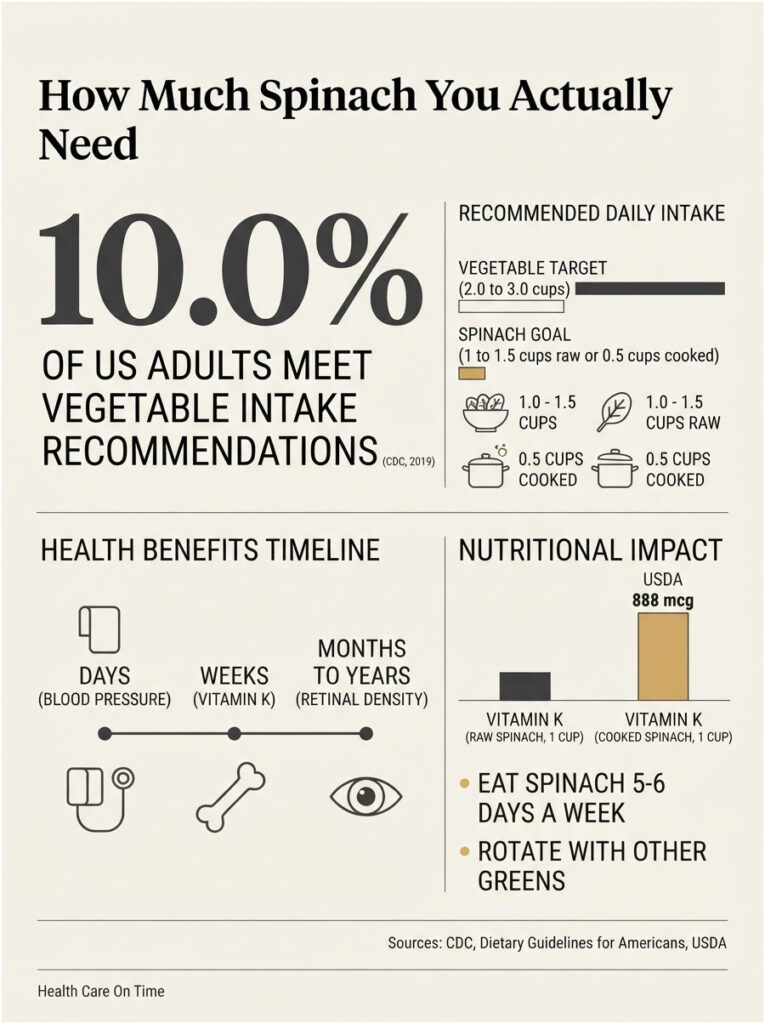
The American Vegetable Gap
All of this stays academic if the baseline is zero. CDC analysis of 2019 Behavioral Risk Factor Surveillance System data found only 10.0% of US adults met vegetable intake recommendations, ranging from 5.6% in Kentucky to 16.0% in Vermont.
Median reported vegetable intake frequency came to 1.6 times per day. Federal guidance calls for 2.0 to 3.0 cup equivalents of vegetables daily for adults.
Table 2. Spinach and Leafy Greens by the Numbers: US Data
| Metric | Figure | Population or Sample | Source |
| US adults meeting vegetable recommendations | 10.0% | Adults 18+, 49 states and DC | CDC MMWR, BRFSS 2019 |
| Daily vegetable target for adults | 2.0 to 3.0 cup equivalents | US adults | Dietary Guidelines for Americans |
| Vitamin K daily target | 120 mcg men, 90 mcg women | US adults | Mayo Clinic, NIH |
| Vitamin K in one cooked cup of spinach | 888 mcg | 180 g boiled, drained | USDA FoodData Central |
| AMD progression risk reduction | About 26% over 5 years | AREDS2 trial participants | National Eye Institute |
| Cognitive age advantage, highest greens intake | Equal to 11 years younger | 960 adults, mean age 81 | Neurology, Rush MAP |
| Lower-limb strength difference, highest nitrate intake | 11% stronger | 3,759 adults over 12 years | Journal of Nutrition, AusDiab |
| Oxalate load from a standard spinach portion | 500 to 1,000 mg | 50 to 100 g serving | NIH PMC dietary oxalate review |
A Realistic Daily and Weekly Target
One to one and a half cups of raw spinach daily, or about half a cup cooked, works for most healthy adults. That range lines up with both the cognition cohort data and the vitamin K1 vascular findings.
You do not need it seven days a week. Five to six days at a cup or so reaches the same weekly total the studies measured.
Rotating spinach with kale, arugula, romaine and bok choy beats eating spinach exclusively, since rotation spreads the oxalate load and widens the nutrient mix.
What Eating Spinach Every Day Changes Over 30 Days
Blood pressure responses can show up within days. Vitamin K status shifts within weeks, which is measurable on a coagulation panel.
Retinal pigment density, bone turnover markers and arterial changes move on timelines of months to years. Anyone promising visible vision improvement from a vegetable inside a month is selling something.
Raw vs Cooked Spinach: What Actually Changes
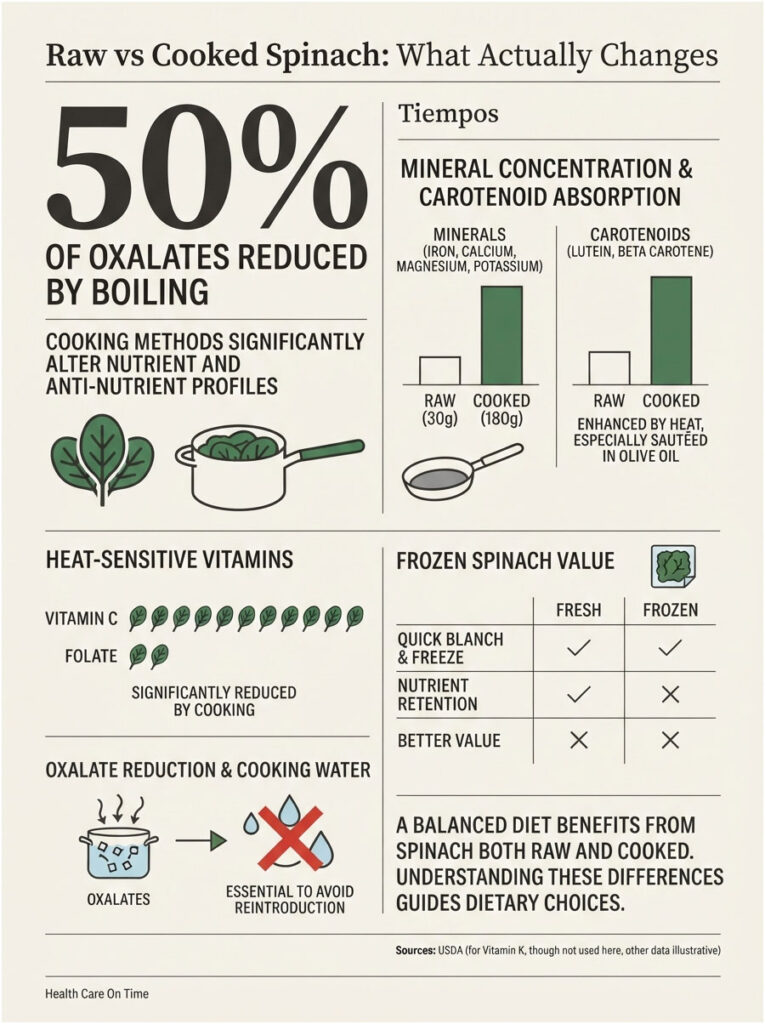
Nutrients That Survive Heat and Get Easier to Absorb
Cooking collapses spinach to roughly a sixth of its raw volume, concentrating minerals per serving. Iron, calcium, magnesium and potassium all climb sharply per cup.
Carotenoid absorption improves with heat and added fat. Sauteing in olive oil delivers more lutein and beta carotene into your bloodstream than eating the same leaves raw.
Nutrients That Do Not
Vitamin C is heat-sensitive and water-soluble, and boiling costs a substantial share of it. Folate takes a similar hit.
Raw spinach in a salad or smoothie protects both. That is the honest case for eating spinach both ways instead of declaring a winner in the raw vs cooked spinach debate.
Frozen Spinach Is Not the Downgrade People Assume
Spinach headed for the freezer is blanched and frozen close to harvest, locking in nutrients that fresh spinach sheds across days of transport and refrigeration. Frozen chopped spinach often delivers better value per nutrient.
It also arrives pre-portioned, which removes the main reason bagged spinach turns to sludge in the crisper drawer.
The Boiling Trick That Cuts Oxalates
Oxalates dissolve in water, which matters if you form kidney stones. Steaming spinach reduces oxalate levels by about 30 percent, boiling cuts them by more than half, and boiling high-oxalate greens sends around 60 percent of the oxalates into the cooking water.
The step people skip is discarding that water. Use the cooking liquid in a soup or a sauce and the oxalates come straight back to the plate.
How to Get More Out of Every Serving
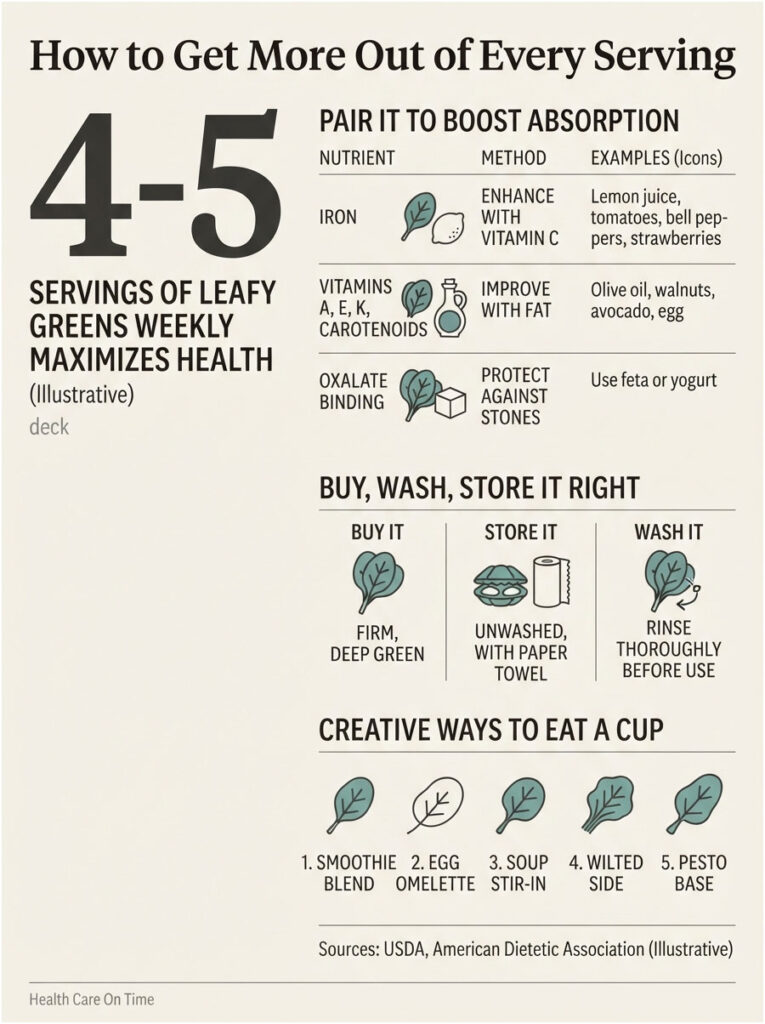
Pair It With Vitamin C
Lemon juice, tomatoes, bell peppers, strawberries or orange segments in the same meal improve non-heme iron absorption. It costs nothing and takes seconds.
Pair It With Fat
Vitamins A, E and K and the carotenoids are all fat-soluble. A drizzle of olive oil, a handful of walnuts, sliced avocado or a soft-boiled egg makes them available.
Pair It With Calcium if Stones Are a Concern
Calcium binds oxalate in the gut before it reaches the kidneys. Feta on a spinach salad, or yogurt served alongside a spinach side, is protective rather than competing.
Buy, Wash, and Store It Right
Look for firm, deep green leaves with no yellowing or sliminess. Store unwashed in the original clamshell with a paper towel to absorb condensation.
Triple-washed bagged spinach labeled ready to eat needs no rewashing, and rinsing it in a home sink can introduce contamination rather than remove it. Loose bulk spinach from a produce bin does need a thorough rinse.
Five Ways to Eat a Cup Without Noticing
- Stir two handfuls into soup or pasta sauce during the final minute of cooking.
- Fold chopped spinach into scrambled eggs or an omelet.
- Blend a cup into a fruit smoothie, where mango or pineapple hides the flavor completely.
- Layer raw leaves into a sandwich or wrap in place of lettuce.
- Saute with garlic and olive oil, finish with lemon, serve as a side.
Who Should Go Easy on Spinach
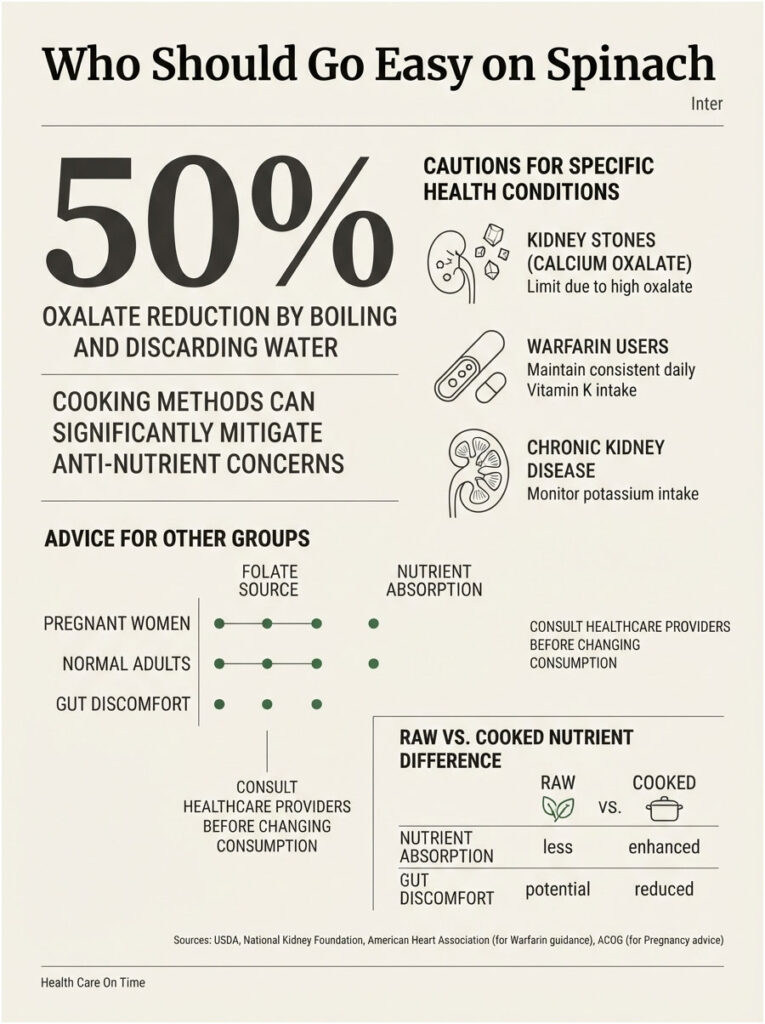
If You Have Had Calcium Oxalate Kidney Stones
This group needs genuine caution. A normal portion of spinach, 50 to 100 grams, delivers roughly 500 to 1,000 mg of dietary oxalate and significantly raises urinary oxalate excretion, and spinach has been identified as the largest single dietary oxalate source in large US cohorts.
Stone formers are typically advised to keep total daily oxalate well under 100 mg. That budget does not survive a daily spinach smoothie.
Boiled and drained spinach in small portions, paired with a calcium source, is the workable version. Kale, bok choy, arugula and romaine run far lower in oxalate and make better everyday greens here.
If You Take Warfarin
The old instruction to avoid greens has been retired. Mayo Clinic guidance sets the daily vitamin K target at 120 mcg for adult men and 90 mcg for adult women, and stresses not changing the amount of vitamin K-rich foods from day to day or week to week.
A randomized trial found patients counseled to increase vitamin K intake maintained stable anticoagulation 50 percent of the time, against 20 percent in the general-counseling group.
Consistency is the whole game. A cooked cup of spinach carries 888 mcg of vitamin K, so switching from none to daily will move an INR. Speak with your prescriber before you change the pattern, not after.
If You Have Chronic Kidney Disease
A cooked cup of spinach carries 839 mg of potassium. For anyone on a potassium-restricted renal diet, or taking potassium-sparing diuretics or ACE inhibitors with monitored potassium, that is a meaningful load.
Portion size and lab monitoring matter more than avoidance. This one belongs to your nephrologist.
Questions That Turn Out Not to Be Problems
Gritty teeth after spinach come from oxalic acid crystals binding calcium on tooth enamel. Harmless, and it rinses away.
Goitrogen concerns apply to cruciferous vegetables at very high intakes, not to normal spinach portions. Gout is driven by purines, and spinach purines sit in the low-risk range under current guidance.
Table 3. Your Spinach Decision Guide
| If This Describes You | Do This | Amount or Frequency | Why |
| Healthy adult, no conditions | Eat it raw and cooked, rotate with other greens | 1 to 1.5 cups raw daily, 5 to 6 days weekly | Matches intake levels in cognition and vascular studies |
| History of calcium oxalate stones | Boil and discard the water, pair with calcium, favor kale or arugula | 2 to 3 small cooked servings weekly | One 100 g portion can exceed a full day of oxalate budget |
| Taking warfarin | Keep the amount identical daily, tell your prescriber before changing | Fixed portion, same form, every day | 888 mcg vitamin K per cooked cup will move an INR if it swings |
| Low ferritin or iron deficiency | Add vitamin C to every spinach meal, get tested, follow clinical advice | Alongside treatment, never instead of it | Non-heme iron absorbs poorly and oxalates cut it further |
| Over 50 with family AMD history | Prioritize cooked spinach with olive oil, ask an eye doctor about AREDS2 | 1 cup cooked, 4 to 5 times weekly | Lutein and zeaxanthin absorb better with heat and fat |
| Chronic kidney disease | Confirm a potassium ceiling with your nephrologist first | Portion-controlled and monitored | 839 mg potassium per cooked cup |
| Pregnant or trying to conceive | Include it as one folate source among several | 1 cup cooked daily if tolerated | 263 mcg folate per cooked cup supports neural tube development |
| GERD, IBS, or frequent bloating | Choose cooked over raw and start small | Half cup cooked, build gradually | Heat pre-breaks structures that would ferment in the gut |
A Simple 7-Day Spinach Plan
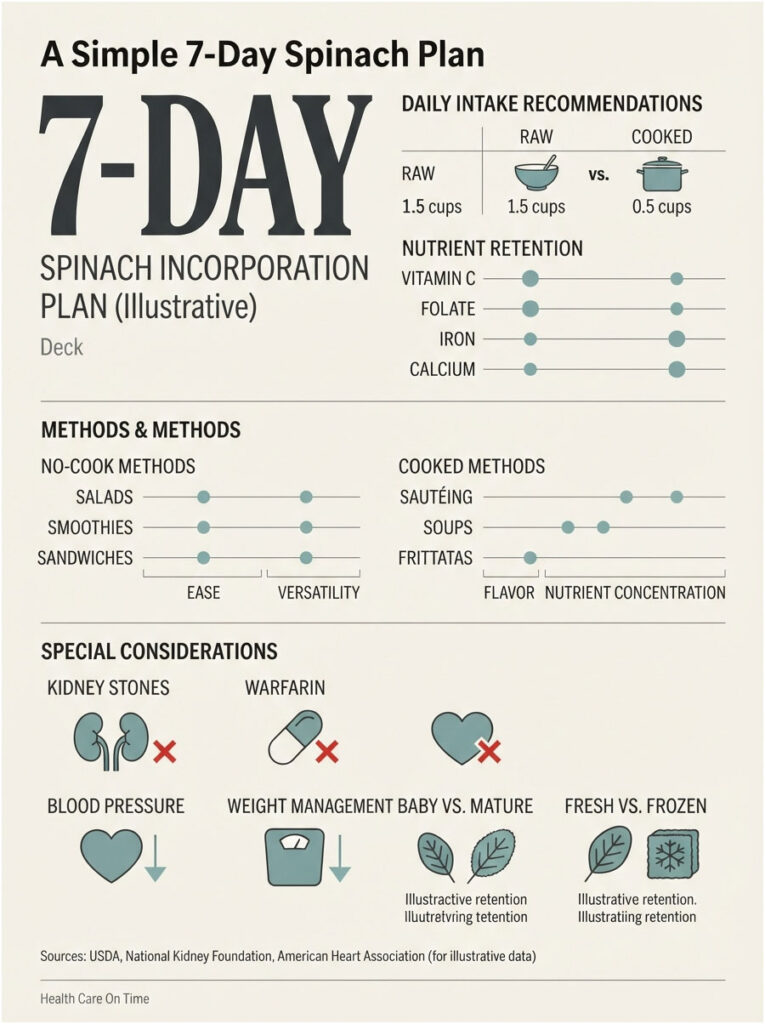
The Week at a Glance
- Monday: Two handfuls of raw spinach in a lunch wrap with turkey and tomato.
- Tuesday: One cup sauteed in olive oil with garlic, finished with lemon, as a dinner side.
- Wednesday: A smoothie with one cup raw spinach, frozen mango, banana and yogurt.
- Thursday: Chopped spinach folded into scrambled eggs with feta.
- Friday: Two large handfuls stirred into soup or pasta sauce in the last sixty seconds.
- Saturday: Spinach salad with strawberries, walnuts, red onion and citrus vinaigrette.
- Sunday: Rest day, or frozen spinach folded into a grain bowl.
Three No-Cook Ways
Raw leaves under a warm protein wilt slightly and taste better than a cold salad. Blended into smoothies, spinach vanishes behind any tropical fruit. Layered into sandwiches, it replaces iceberg lettuce with no textural complaint.
Three Cooked Ways
A garlic saute in olive oil takes four minutes start to finish. Wilted into soup at the end preserves color and most nutrients. Baked into a frittata or crustless quiche turns a full bag into four servings.
Frequently Asked Questions
Is it okay to eat spinach every day?
For most healthy adults, yes. One to one and a half cups raw daily sits within safe intake and matches the levels studied in cognition and vascular research. People with a history of calcium oxalate kidney stones, chronic kidney disease, or those on warfarin should set their amount with a clinician first.
How much spinach should you eat in a day?
About one to one and a half cups raw, or half a cup cooked, covers the daily target most research supports. Vascular studies on vitamin K1 placed the practical dose near a cup and a half of leafy greens. Rotating spinach with kale, arugula or romaine spreads the oxalate load.
Is raw or cooked spinach healthier?
Both, for different reasons. Cooked spinach concentrates iron, calcium, magnesium, potassium and vitamin K per cup and improves carotenoid absorption. Raw spinach preserves vitamin C and folate, which heat and water degrade. Eating spinach both ways across a week captures the full nutrient profile.
Does spinach really lower blood pressure?
Yes, modestly and in the short term. A controlled trial found a meal delivering 220 mg of nitrate from spinach lowered systolic blood pressure and pulse pressure and increased large artery compliance in adults aged 38 to 69. Nitrate converts to nitric oxide, which relaxes blood vessels.
Can spinach cause kidney stones?
It can contribute in susceptible people. A 50 to 100 gram portion delivers roughly 500 to 1,000 mg of dietary oxalate and raises urinary oxalate excretion. Stone formers should boil and drain spinach, keep portions small, pair with calcium, and favor lower-oxalate greens like kale or bok choy.
Can I eat spinach if I take warfarin?
Yes, if the amount stays consistent. Mayo Clinic guidance sets daily vitamin K at 120 mcg for men and 90 mcg for women and stresses not changing intake day to day. A cooked cup carries 888 mcg, so a sudden shift will affect your INR. Discuss any change with your prescriber.
Does spinach have more iron than beef?
Per 100 grams, cooked spinach carries more iron by weight than most cuts of beef. Absorption tells the real story. Spinach iron is non-heme and poorly absorbed, and oxalates bind part of it. Beef supplies heme iron at far higher absorption rates. Spinach contributes; it does not replace.
Is baby spinach as nutritious as mature spinach?
Effectively yes. Baby spinach is the same plant harvested 15 to 35 days after planting, with more tender leaves and stems and a sweeter flavor. Nutrition values are broadly identical. The practical difference is texture, which makes baby spinach the better pick for raw salads.
Is frozen spinach as good as fresh?
Often better. Spinach destined for freezing is blanched and frozen close to harvest, locking in nutrients fresh spinach loses over days of transport and storage. Frozen spinach is pre-portioned, cheaper per serving, and already cooked down, which concentrates minerals per cup.
Why do my teeth feel gritty after eating spinach?
Oxalic acid binds with calcium and forms microscopic crystals that coat tooth enamel. The sensation is harmless and disappears after rinsing or brushing. It occurs more with raw spinach than cooked, because boiling removes a share of the soluble oxalates first.
Does spinach help with weight loss?
Indirectly. Spinach burns nothing, but at roughly 7 calories per raw cup and 41 per cooked cup, it adds volume, fiber and satiety while displacing higher-calorie foods. Swapping half a cup of rice for a cup of sauteed spinach removes about 60 calories from a plate.
Do I need to wash pre-washed bagged spinach?
No. Triple-washed spinach labeled ready to eat was processed under controlled conditions, and rewashing in a home sink can introduce contamination rather than remove it. Loose bulk spinach from a produce bin does require a thorough rinse before eating.
Medical Disclaimer: This article is for general information and is not a substitute for professional medical advice, diagnosis, or treatment. Nutritional needs vary by individual, and dietary changes can interact with medications and existing conditions. Always consult a licensed physician, registered dietitian, or qualified healthcare provider before changing your diet, particularly if you take anticoagulants, have kidney disease, have a history of kidney stones, are pregnant, or manage a chronic condition. Never disregard or delay seeking medical advice because of something you read on this site.
References
- USDA FoodData Central, Spinach nutrient profiles
- CDC MMWR, Adults Meeting Fruit and Vegetable Intake Recommendations, United States, 2019
- National Eye Institute, NIH study confirms benefit of supplements for slowing age-related macular degeneration
- JAMA Ophthalmology, AREDS2 Report 28, 10-year outcomes
- Neurology, Nutrients and bioactives in green leafy vegetables and cognitive decline
- National Institute on Aging, Leafy greens linked with slower age-related cognitive decline
- Journal of Nutrition via ScienceDaily, Green leafy vegetables essential for muscle strength
- Edith Cowan University, Leafy greens could be good for the heart
- PubMed, Effects of a nitrate-rich meal on arterial stiffness and blood pressure in healthy volunteers
- NIH PMC, Dietary oxalate and kidney stone formation
- Mayo Clinic, Warfarin diet: What foods should I avoid?
- American Society for Nutrition, Eating more vitamin K found to help, not harm, patients on warfarin