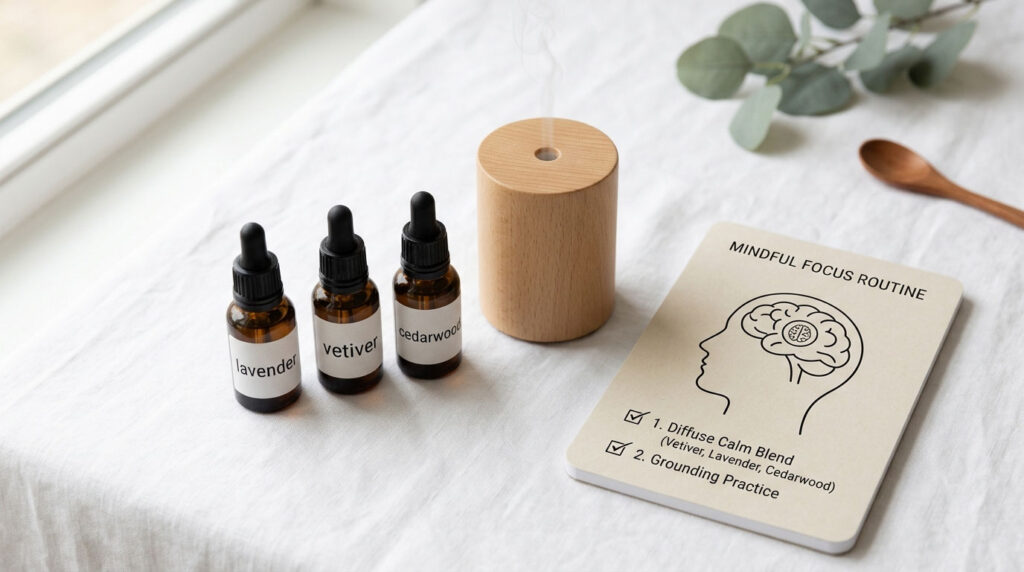
Walk into any wellness shop and the pitch sounds the same. A few drops of lavender or vetiver, and a restless mind settles. The bottles look gentle, and the promise is tempting.
Table of Contents
The reality is more tangled. During the same years searches for essential oils for ADHD climbed, US poison centers logged more young children swallowing those very oils.
That gap, between the marketing and the medicine, is what this guide closes. You will get the honest verdict, the real benefits, and the safety facts most pages leave out.
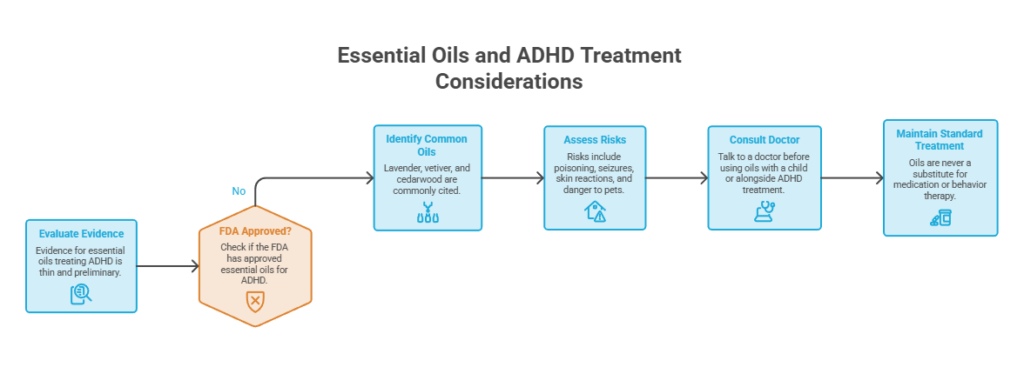
Quick Answer. Essential oils are not a proven treatment or cure for ADHD. The research is limited, mostly small or preliminary, and the FDA has not approved any oil for ADHD or its symptoms. Some families use oils like lavender or vetiver as a complementary calming or sleep aid alongside doctor-led care. Used carelessly, though, they carry real safety risks, especially for children.
At a Glance
- Evidence that essential oils treat ADHD is thin and mostly preliminary.
- The FDA has not approved any essential oil for ADHD or its symptoms.
- Lavender, vetiver, and cedarwood are the three most commonly cited oils.
- Real risks exist: poisoning, seizures, skin reactions, and danger to pets.
- Oils are never a substitute for medication or behavior therapy.
- Talk to a doctor before using oils with a child or alongside ADHD treatment.
What ADHD Is, and Why People Turn to Essential Oils
Attention-deficit/hyperactivity disorder is one of the most common neurodevelopmental conditions in the country. It shows up as some mix of inattention, impulsivity, and hyperactivity that gets in the way at school, at work, or at home.
It rarely travels alone. The symptoms spill into sleep, mood, friendships, and self-esteem, which is part of why families look so hard for anything that helps.
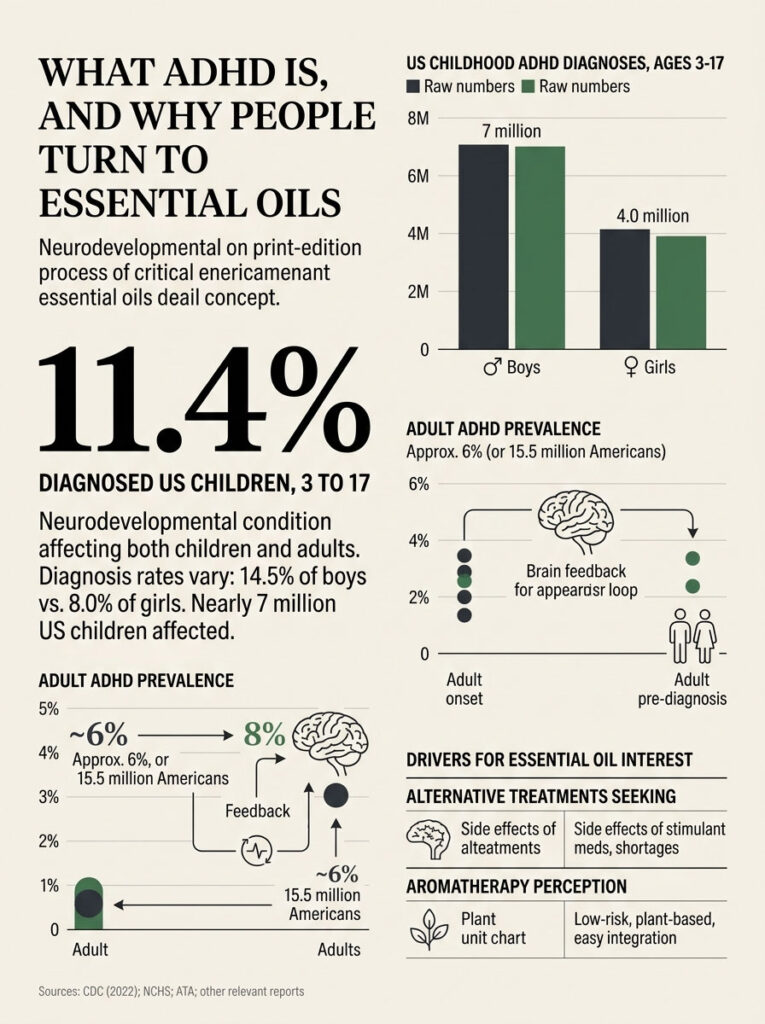
It is also far more widespread than many people assume. According to the CDC, an estimated 7 million US children aged 3 to 17, about 11.4 percent, have ever been diagnosed with ADHD based on 2022 data.
A quick refresher on who ADHD affects
This is not only a childhood story. CDC surveillance data puts current adult ADHD at roughly 6 percent, about 15.5 million Americans, or one in 16 adults.
More than half of those adults were not diagnosed until adulthood. So the audience reaching for natural options spans frazzled parents and grown adults trying to quiet a busy brain alike.
The numbers also vary by group. NCHS data shows that among children aged 5 to 17, boys carry a higher diagnosed rate, around 14.5 percent, than girls at 8.0 percent.
Why aromatherapy appeals to families
The appeal is easy to understand. Standard treatments work, but stimulant medications can mean appetite changes, sleep trouble, or a wait at the pharmacy.
On top of that, recent stimulant shortages have pushed some families to look for anything that helps in the meantime. Aromatherapy feels low-stakes, plant-based, and within a parent’s control.
Readers often ask our team a version of the same question. Is there something gentle they can add at home tonight? That instinct is reasonable. The work is matching the hope to what the science can actually support, which is exactly what the next section does.
What the Research Actually Shows
Here is the honest headline. The body of evidence for essential oils treating ADHD is small, dated, and mostly preliminary. That does not make it worthless, but it means the confident claims you see on product pages run well ahead of the data.
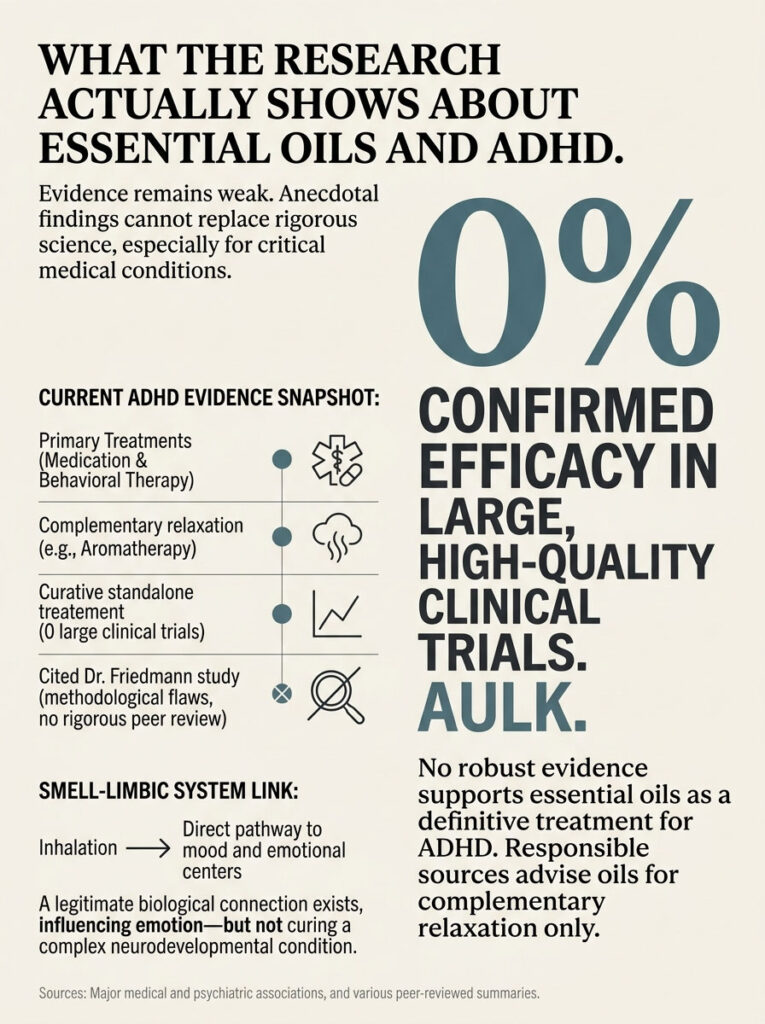
There is no large, high-quality clinical trial showing essential oils treat ADHD. There is no Cochrane-style review concluding they work. What exists is a thin scattering of small studies and a mountain of personal testimony.
The study everyone cites, and its limits
Nearly every oils help ADHD article traces back to one source, a small study by Dr. Terry Friedmann. Children inhaled lavender, vetiver, or cedarwood three times a day for 30 days, and researchers measured brain waves before and after.
The reported result was eye-catching, with vetiver said to raise certain brain-wave activity by around 30 percent. The catch is the method.
The sample was tiny, the design was weak, and the work was never published as a rigorous, peer-reviewed clinical trial. When our editorial team examined the studies behind the popular claims, this pattern kept repeating. A single thin study gets cited again and again until it sounds like settled fact. It is not.
Why strong studies are hard to come by
Part of the reason the evidence stays thin is practical. A proper trial needs a placebo, and hiding a smell from participants is genuinely difficult, which makes the blinding messy and the results easier to question.
Add small budgets, short study windows, and tiny samples, and you end up with findings that rarely hold up to scrutiny. Until larger, well-controlled trials exist, treat any single dramatic claim with healthy skepticism.
That uncertainty is not proof that oils do nothing. It simply means the honest answer today is that we do not yet know, rather than a confident yes.
How aromatherapy could plausibly affect the brain
There is a real biological pathway worth respecting, even without strong proof. Smell connects directly to the limbic system, the part of the brain tied to emotion and arousal.
That is why a scent can calm or alert you within seconds. Inhaled aroma molecules can also reach the bloodstream through the nasal lining, so a measurable shift in mood or alertness is plausible.
The leap that is not supported is from this smell can be calming to this oil treats the core attention and impulse problems of ADHD. Calm is a state. ADHD is a wiring difference. Easing one does not fix the other.
The honest verdict: complementary, not curative
Major health bodies land in the same place. The treatments with strong evidence are medication and behavior therapy, not aromatherapy.
Our medical reviewers note that responsible sources, from the CDC to pediatric specialists, describe oils as a possible add-on for relaxation or sleep, never a stand-alone fix.
Position them as a complement, and you are on solid ground. Position them as a cure, and you are not. That single distinction should guide every choice that follows.
| Approach | What It Is | Evidence Strength for ADHD | FDA Status for ADHD | Typical Role |
| Stimulant medication (methylphenidate, amphetamines) | Drugs that boost dopamine and norepinephrine | Strong, decades of trials | Approved | Core, first-line for most |
| Non-stimulant medication (atomoxetine, guanfacine) | Alternatives when stimulants are unsuitable | Strong | Approved | Core or alternative |
| Behavior therapy and parent training | Structured behavioral strategies and CBT | Strong, especially in young children | Not a drug | First-line, especially under age 6 |
| Essential oils and aromatherapy | Inhaled or diluted topical plant extracts | Very limited, preliminary | Not approved | Complementary only |
| Diet, sleep, and exercise | Daily routines and healthy habits | Moderate, supportive | Not a drug | Supportive complement |
The Essential Oils People Use for ADHD Symptoms
Most oils marketed for ADHD fall into two buckets. Those meant to calm a wound-up child, and those meant to lift focus and mood. None target ADHD directly, but several have a long history in aromatherapy.
Calming oils: lavender, Roman chamomile, vetiver
Lavender is the headliner. It is the most studied oil for relaxation and sleep, and it is the one most parents reach for first when bedtime is a battle.
Roman chamomile is the gentle cousin, used to soothe and comfort, often in blends aimed at winding down. Vetiver, an earthy root oil, is the one tied to that often-cited focus study and is popular in grounding mixes for homework time.
Focus and uplifting oils: cedarwood, sweet orange, bergamot, frankincense
Cedarwood gets paired with vetiver in many ADHD blends and is promoted for steadiness during focused work. Sweet orange and bergamot are bright citrus oils used to lift mood and energy when the afternoon drags.
Frankincense rounds out the list, valued in aromatherapy for a sense of calm and balance. Across the questions families send us, these are the names that surface again and again.
What each is claimed to do versus what is shown
The honest scorecard looks like this. Lavender has the most support, mostly for relaxation and sleep, not attention.
Vetiver and cedarwood ride almost entirely on that one weak study. The citrus oils and frankincense rest on tradition and anecdote, not clinical trials.
The pattern holds across the board: pleasant, possibly calming, and unproven for treating ADHD itself. That is not a reason to dismiss them outright. It is a reason to keep expectations honest and safety front of mind.
Benefits Worth Considering, Honestly
So is there any upside? For some families, yes, as long as expectations stay realistic and safety stays first. The benefits cluster around mood and routine, not around fixing core symptoms.
Sleep and bedtime routines
Sleep problems travel with ADHD constantly. About half of children with ADHD have at least one co-occurring condition, and disrupted sleep is one of the most common complaints families report.
A calming bedtime scent can become part of a wind-down routine. The oil may not be doing much pharmacologically, but a consistent, soothing ritual genuinely helps sleep, and better sleep improves next-day focus.
Calm and sensory regulation
For kids who get easily overstimulated, a familiar, pleasant smell can signal that it is time to settle. Some families weave diffusing into homework time or transitions between activities.
The aroma is not retraining attention. It is shaping the environment, and a calmer environment is easier for an ADHD brain to operate in.
Emotional anchoring for adults
Adults with ADHD use scent differently, often as a focus or stress cue at a desk. A specific smell tied to work time can become a small ritual that helps the brain switch gears.
With roughly 15.5 million US adults affected, this is a real and growing use case. It is reasonable as a stress-management habit, provided it sits alongside actual treatment rather than instead of it.
The ritual effect, and why that is not nothing
There is also the placebo and ritual effect, which deserves respect rather than a sneer. When a child believes a calming routine is coming, the brain often responds before any chemistry kicks in.
Our health editors point out that for low-risk supportive habits, that response can be a real, if modest, part of the benefit. The line to hold is simple. Use oils to support good habits, not to replace treatment that works.
The Risks Nobody Talks About
This is the section the product pages skip, and it is the one that matters most. Natural does not mean harmless. Essential oils are concentrated chemicals, and the people most likely to be harmed are the children these blends are marketed to help.
Poisoning and ingestion danger in kids
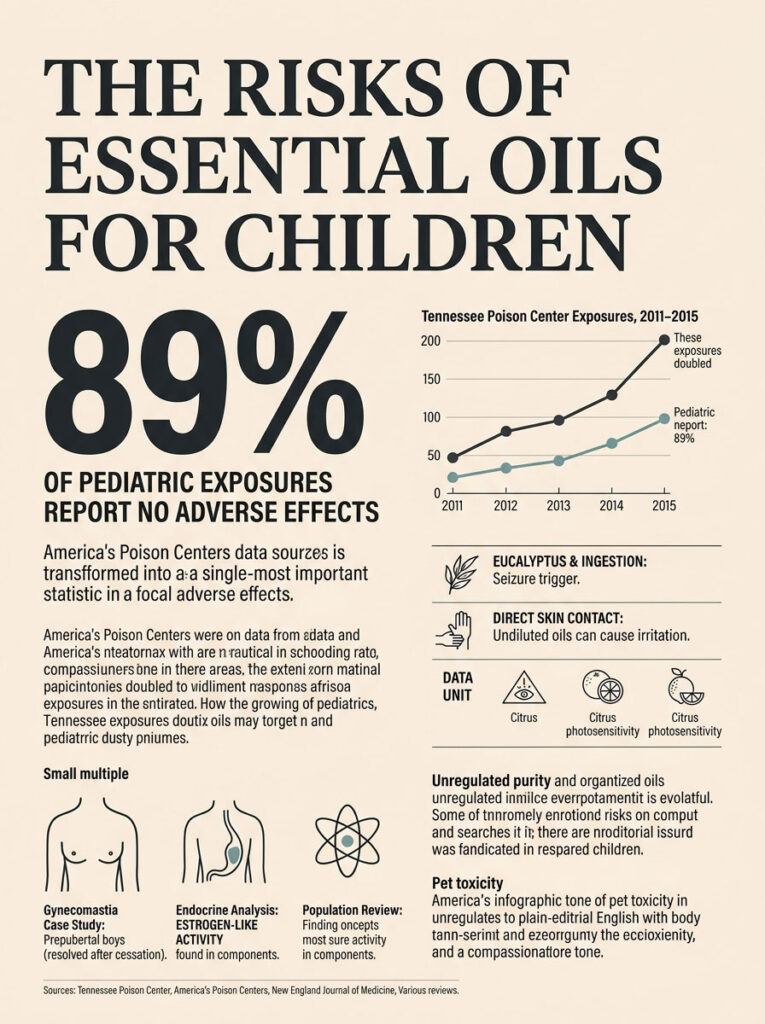
The Tennessee Poison Center at Vanderbilt reported that essential oil exposures doubled between 2011 and 2015, and roughly 80 percent of those cases involved children.
A tiny, colorful, sweet-smelling bottle is a magnet for a curious toddler. Swallowed oils can cause vomiting, drowsiness, and in serious cases, much worse.
For balance, most exposures do not turn into emergencies. National poison data shows around 89 percent of pediatric exposures in young children involve no reported adverse effect. The danger is real but uncommon, which is exactly why storage and supervision matter so much.
Seizure risk from certain oils
Some oils are outright dangerous if swallowed. According to Poison Control, eucalyptus oil can trigger seizures if ingested, and even a small amount of camphor can be dangerous, with seizures starting within minutes.
A clinical review of pediatric exposures to camphor and eucalyptus oils found symptoms ranging from vomiting and lethargy to coma and seizures, and one reviewed case involved a child who died.
Sage and rosemary can also lower the seizure threshold. Families managing epilepsy should be especially careful, and should not assume that topical use is automatically safe.
The lavender and tea tree hormone debate
This one is genuinely unsettled, and you deserve the full picture rather than one cherry-picked side. In 2007, the New England Journal of Medicine reported three healthy prepubertal boys who developed breast tissue, called gynecomastia, that resolved after they stopped using products with lavender and tea tree oils.
Later lab work added weight to the concern. A 2018 NIEHS and Endocrine Society analysis found eight chemical components of these oils showed estrogen-like and testosterone-blocking activity in cell tests.
The counterweight matters too. A US epidemiological study of 556 children found no population-level link between these oils and endocrine problems, and a 2024 review noted that limited skin absorption and unknown doses make the lab findings hard to apply to real life. The reasonable takeaway is caution with heavy, repeated use on young children, not panic.
Skin reactions, photosensitivity, and pets
Direct skin contact with undiluted oils can cause irritation, burns, and allergic sensitization that builds over time. Citrus oils like bergamot can make skin more sensitive to sunlight, raising the risk of a reaction after sun exposure.
Pets are another blind spot. Several oils that seem harmless to people are toxic to cats and dogs, and a diffuser running all day in a small room can affect them. Our medical reviewers flag this often, because the family pet rarely gets a vote.
Quality and purity are not guaranteed
There is also a quieter risk: you may not be getting what the label says. Because essential oils are sold as cosmetics or wellness products, they are not regulated by the FDA the way medicines are.
Purity and strength can vary from bottle to bottle, and terms like therapeutic grade are marketing language, not a certified standard. Some products are quietly diluted or blended with cheaper oils without clear labeling.
For a child, that uncertainty matters more, not less. An inconsistent product makes safe dosing harder and raises the odds of an unexpected skin or breathing reaction.
| Finding | Figure | Source |
| Essential oil exposures at one US poison center | Doubled, 2011 to 2015 | Tennessee Poison Center (Vanderbilt) |
| Share of those exposure cases involving children | About 80 percent | Tennessee Poison Center (Vanderbilt) |
| Young children’s exposures with no adverse effect | About 89 percent | America’s Poison Centers (national data) |
| Prepubertal boys in the NEJM lavender and tea tree report | 3, all resolved after stopping | New England Journal of Medicine (2007) |
| Children in the US study finding no population-level link | 556 | Franklin Health epidemiological study |
| US children ever diagnosed with ADHD (context) | About 7 million (11.4 percent) | CDC, 2022 data |
How to Use Essential Oils Safely, If You Choose To
If you decide oils have a place in your routine, the goal is simple. Capture any small benefit while removing the avoidable risk. These habits matter most for households with kids and pets.
Dilution and patch testing
Never apply an essential oil to skin undiluted. Mix a few drops into a carrier oil, such as coconut or jojoba, before any topical use.
Patch-test first. Apply a small diluted amount to the inner forearm and wait 24 hours to check for redness or irritation before using it more widely. A child’s skin is thinner and more reactive, so err lighter than you think you need to.
Diffusion guidelines for rooms with kids or pets
Favor inhalation over skin contact for children, and keep it brief and light. Diffuse in a well-ventilated room for short sessions rather than running a diffuser for hours.
Keep concentrations low, and do not diffuse continuously in a closed nursery or a small space shared with pets. Less is safer, and a faint scent does the same job as a heavy one.
Oils and ages to avoid
Store every bottle locked away and out of reach, treated exactly like medication. Avoid oils known to trigger seizures, including eucalyptus, camphor, sage, and rosemary, around young children.
Be cautious with lavender and tea tree on prepubertal children given the open endocrine questions. The younger the child, the more conservative the approach should be, and infants are best kept away from concentrated oils entirely.
Talk to your doctor first
Loop in a clinician before you start, especially for a child or for anyone on medication. Some oils interact with medications or can worsen asthma and other airway conditions.
In the resources we point readers toward, this step comes first for a reason. A two-minute conversation with a pediatrician can catch a problem before it ever starts.
Choosing a product with care
If you do buy, favor single-oil bottles that list the plant’s Latin name, the country of origin, and a batch or lot number. Reputable sellers often share third-party testing on request.
Skip anything that promises to cure or treat ADHD, and be wary of pushy multi-level marketing pitches. A plain, well-labeled bottle from a trusted brand beats a flashy one with big claims every time.
Store it in a cool, dark place, check the expiration date, and toss any oil that smells off, since oxidized oil is more likely to irritate skin.
| If This Is Your Situation | Recommended Action | Why |
| A child swallowed an essential oil | Call Poison Control (1-800-222-1222) right away; do not make the child vomit | Ingestion can cause seizures; inducing vomiting raises that risk |
| You want a diffuser for a child’s bedtime | Diffuse briefly in a ventilated room at low concentration, supervised | Limits overexposure and keeps bottles out of reach |
| Your child has asthma or a seizure disorder | Avoid diffusing and ask the pediatrician first | Some oils trigger airway symptoms or lower the seizure threshold |
| You are thinking about stopping ADHD medication for oils | Do not stop; discuss any change with the prescriber | No oil is proven to replace medication |
| You want to use an oil on the skin | Dilute in a carrier oil and patch-test for 24 hours | Undiluted oils cause burns and allergic reactions |
| A product claims to cure ADHD | Treat it as a red flag and skip it | The FDA has not approved any oil for ADHD |
Essential Oils Versus Proven ADHD Treatments
The most important comparison is not lavender versus vetiver. It is oils versus the treatments that actually move the needle. Getting this hierarchy right protects your child, or yourself, from wasted time and real harm.
What first-line care actually looks like
For most people, effective ADHD care combines medication with behavioral strategies. For young children, behavior therapy and parent training usually come first, with medication added when needed.
These approaches are backed by decades of evidence and ongoing monitoring. That is the standard any add-on should support, not replace.
Where oils can fit as a complement
Used wisely, oils can play a small supporting role. A calming scent at bedtime or during transitions can make a routine smoother, which indirectly helps focus the next day.
That is a fine place for aromatherapy to live, around the edges of a real treatment plan, never at the center of it. Patients commonly ask us how to combine the two. Keep the proven treatment primary, and let the oil be a comfort layer.
Red flags: when a natural ADHD cure is a scam
Be skeptical of any product or seller making big promises. Claims to cure, treat, or replace medication for ADHD are not allowed and not supported, since the FDA has approved no oil for this use.
Watch for pressure to stop prescribed treatment, miracle testimonials, and multi-level marketing sales tactics. When a pitch sounds too good to be true for a complex condition, it almost always is.
Frequently Asked Questions
Do essential oils really work for ADHD?
Not as a treatment. The evidence is limited and mostly preliminary, and no oil is FDA-approved for ADHD. Some people find oils like lavender calming or helpful for sleep, which can indirectly support focus, but oils do not treat the core symptoms of ADHD.
What is the best essential oil for ADHD focus?
Lavender, vetiver, and cedarwood are the most commonly suggested, with lavender having the most research behind it for relaxation. None is proven to improve attention directly. If you try one, use it as a calming aid alongside doctor-led treatment, not as a focus medicine.
Is lavender oil good for ADHD?
Lavender is the best-studied calming oil and may help with relaxation and sleep, which matter for many people with ADHD. It does not treat ADHD itself. Use caution with heavy, repeated topical use on young children, given unresolved questions about possible hormonal effects.
Does vetiver oil help with ADHD?
Vetiver is popular because of one small, weak study suggesting it changed brain-wave activity in children. That study was not a rigorous clinical trial, so the finding is not reliable proof. Vetiver may smell grounding and calming, but it is not an established ADHD treatment.
Are essential oils safe for children with ADHD?
They can be, with care. Keep oils diluted, diffuse only briefly in ventilated rooms, store bottles locked away, and avoid seizure-triggering oils like eucalyptus and camphor. US poison centers have seen rising child exposures, so supervision matters. Always check with a pediatrician first.
Can essential oils replace ADHD medication?
No. No essential oil is proven or approved to replace ADHD medication, and stopping a prescribed treatment can cause real harm. Oils may serve as a small complementary comfort, but any change to a medication plan should be made only with the prescribing clinician.
How do you use essential oils for a child with ADHD?
Favor light inhalation over skin contact. Diffuse a low concentration briefly in a ventilated room during calm-down times like bedtime. For any topical use, dilute in a carrier oil and patch-test first. Keep all bottles out of reach and talk to your pediatrician before starting.
Can adults with ADHD benefit from aromatherapy?
Adults may find certain scents relaxing or mood-lifting, which can support a calmer work routine. With around 15.5 million US adults affected, interest is high. Aromatherapy is reasonable as a stress and sleep aid, but it is not a substitute for evidence-based ADHD care.
Which essential oils should be avoided around kids?
Be especially careful with eucalyptus, camphor, sage, and rosemary, which can trigger or worsen seizures, particularly if swallowed. Use caution with lavender and tea tree on prepubertal children due to open hormone questions. When in doubt, keep oils away from infants and very young children.
Can you put essential oils directly on the skin?
Undiluted essential oils should not go directly on skin. They can cause irritation, chemical burns, and allergic sensitization. Always dilute in a carrier oil first, and patch-test on a small area for 24 hours. Citrus oils can also increase sun sensitivity, so apply with care.
Do essential oil diffusers actually help with focus?
There is no strong evidence that diffusers improve attention. A pleasant scent may make an environment feel calmer, which can make it easier to settle into a task. Treat any benefit as mild and environmental, not as a real boost to the underlying ability to focus.
Are essential oils safe to diffuse around pets?
Often not. Several common oils are toxic to cats and dogs, and continuous diffusing in a small space can affect them. Keep pets in mind before running a diffuser, provide ventilation and an exit route, and check with a veterinarian about which oils to avoid entirely.
Disclaimer. This article is for general information only and is not medical advice. It is not a substitute for diagnosis or treatment from a qualified healthcare professional. Talk to a doctor before using essential oils, especially for a child, during pregnancy, or alongside any medication. In a poisoning emergency, call Poison Control at 1-800-222-1222 or 911.
References
- CDC, Data and Statistics on ADHD: https://www.cdc.gov/adhd/data/index.html
- CDC NCHS, Data Brief No. 499 (ADHD in children 5 to 17): https://www.cdc.gov/nchs/products/databriefs/db499.htm
- CDC MMWR, ADHD Diagnosis and Treatment in US Adults: https://www.ncbi.nlm.nih.gov/pmc/articles/PMC11466376/
- NIMH, ADHD Statistics: https://www.nimh.nih.gov/health/statistics/attention-deficit-hyperactivity-disorder-adhd
- New England Journal of Medicine, Prepubertal Gynecomastia Linked to Lavender and Tea Tree Oils (Henley et al., 2007): https://www.nejm.org/doi/full/10.1056/NEJMoa064725
- Endocrine Society, Chemicals in Lavender and Tea Tree Oil Appear to Be Hormone Disruptors (2018): https://www.endocrine.org/news-and-advocacy/news-room/2018/chemicals-in-lavender-and-tea-tree-oil-appear-to-be-hormone-disruptors
- touchENDOCRINOLOGY review, Lavender and Tea Tree Oil and Endocrine Effects (2024): https://pubmed.ncbi.nlm.nih.gov/38187077/
- America’s Poison Centers / Poison Control, Essential Oils: Poisonous When Misused: https://www.poison.org/articles/essential-oils
- Vanderbilt Health, Tennessee Poison Center on Rising Essential Oil Exposures: https://news.vumc.org/2016/05/10/tennessee-poison-center-at-vanderbilt-sees-rise-in-children-ingesting-essential-oils/
- Paediatrics & Child Health, Unintentional Exposure of Young Children to Camphor and Eucalyptus Oils: https://pmc.ncbi.nlm.nih.gov/articles/PMC2804512/