Plant protein is a good choice for most people with diabetes, and swapping some animal protein for it has been linked to slightly better A1C and a lower risk of type 2 diabetes. What changes the picture from food to food is the carbohydrate that comes along with the protein.
Table of Contents
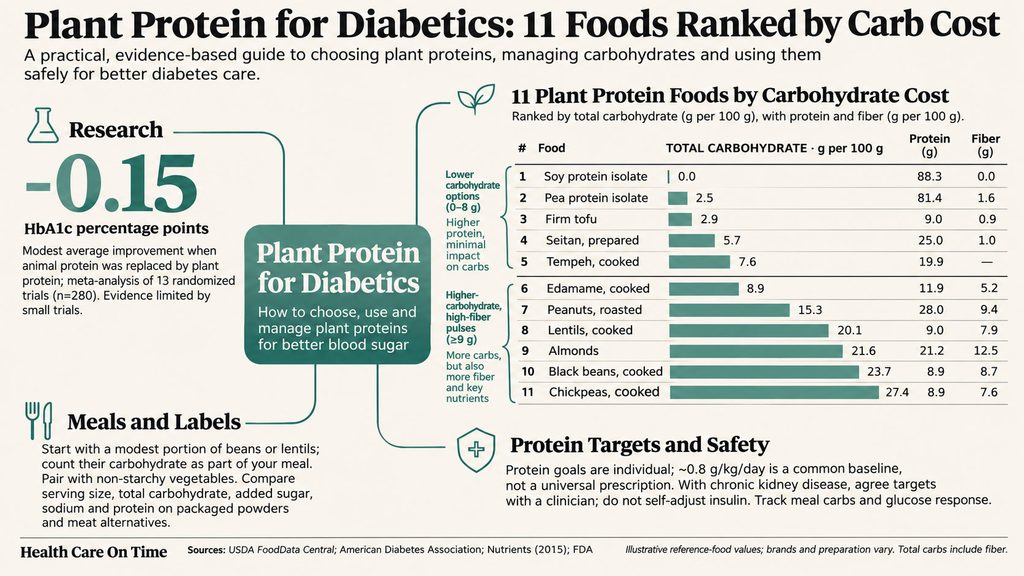
Quick Answer: Yes. Plant protein is good for most diabetics. In 13 controlled trials, replacing about a third of animal protein with plant protein lowered A1C by 0.15% and fasting glucose by 0.53 mmol/L. Protein itself barely raises blood sugar, but beans, lentils and chickpeas carry about 20 to 23 g of carbs per 1/2 cup. Tofu, tempeh, edamame, nuts, seitan and unsweetened protein isolates give the most protein for the fewest carbs.
Is Plant Protein Good for Diabetics?
For most people with type 1 or type 2 diabetes, yes. A 2015 meta-analysis of 13 randomized trials pooled 280 people with diabetes whose diets replaced a median of about 35% of daily animal protein with plant protein for at least three weeks; compared with their usual diets, A1C fell by 0.15 percentage points, fasting glucose by 0.53 mmol/L (about 10 mg/dL) and fasting insulin by about 10 pmol/L.
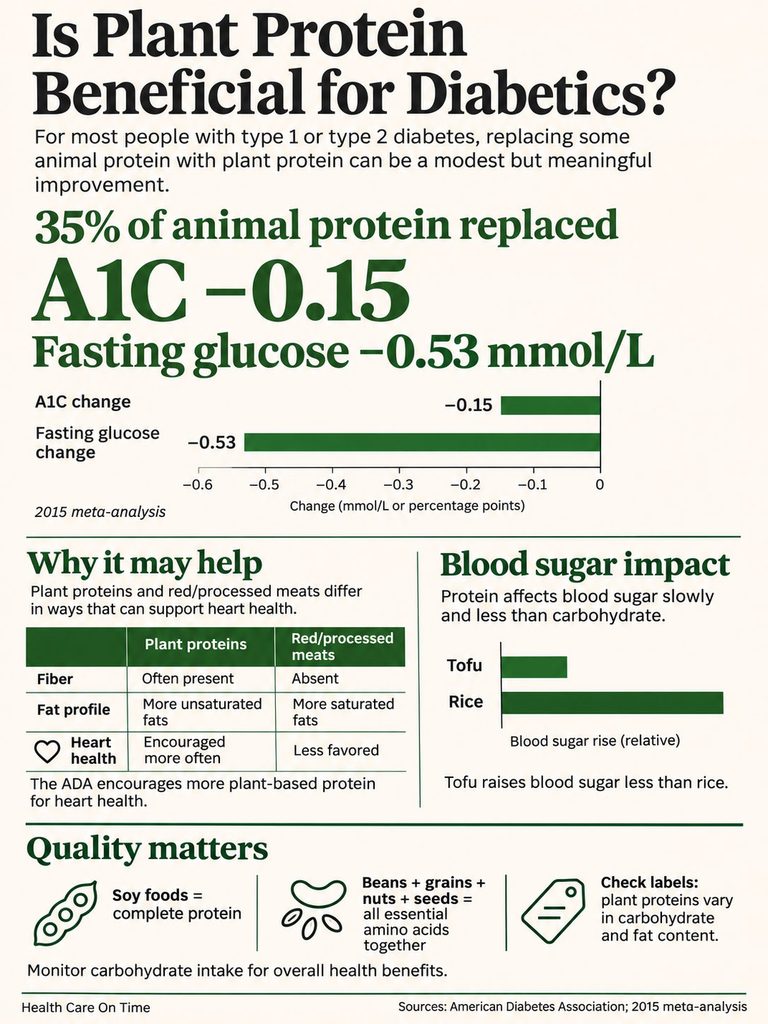
A drop that small won’t replace a medication, and the trial authors asked for larger, longer and better studies. Even so, the ADA’s 2026 Standards of Care calls the A1C effect small and still tells people with diabetes to eat more plant-based protein such as nuts, seeds and legumes, mostly for the heart. Heart disease is the main long-term threat in diabetes, and plant proteins tend to arrive with fiber and unsaturated fat instead of the saturated fat in fatty red and processed meat.
Protein on its own has a small, slow effect on glucose. Fat and protein can raise blood sugar later in the hours after a meal, and the effect grows with the amount eaten. In practice, a block of tofu raises blood sugar far less than a bowl of rice, and a bowl of lentils lands somewhere in between because lentils are mostly starch with protein mixed in.
Plant protein, then, helps both blood sugar and the heart, as long as you keep an eye on the carbohydrate in each food. Plant proteins vary widely in fat and carbohydrate, which is why the label matters more here than it does for chicken or fish.
Is plant protein “complete”? Soy foods contain all the essential amino acids, and a mix of beans, grains, nuts and seeds across the day covers the rest, so no single food has to do everything.
Plant Protein Foods Compared: Protein, Carbs and Fiber
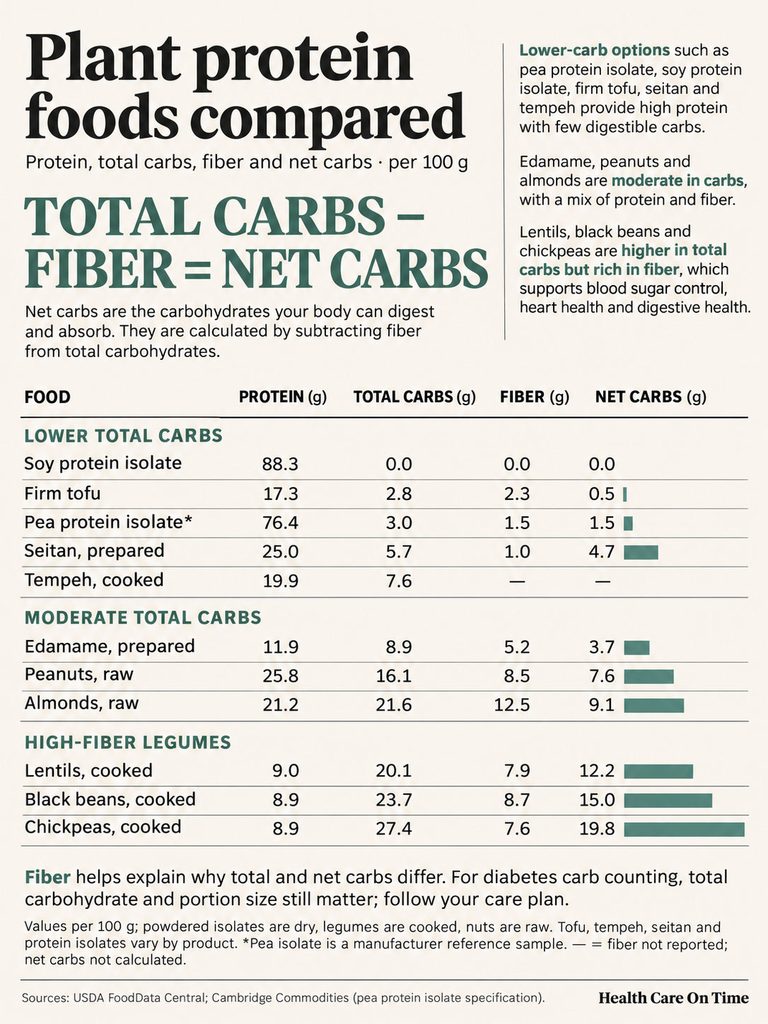
Every row below uses USDA nutrient data for a typical serving. The right-hand column shows how many grams of total carbohydrate come with each 10 grams of protein; the lower that number, the less a food costs you in carbs.
| Food | Typical serving | Protein (g) | Total carbs (g) | Fiber (g) | Net carbs (g) | Carbs per 10 g protein |
| Pea protein isolate, unflavored | 1 scoop (33 g) | 24 | 1 | 0 | 1 | 0.4 |
| Soy protein isolate | 1 oz | 22.9 | 2.1 | 1.6 | 0.5 | 0.9 |
| Firm tofu (set with nigari) | 1 cup | 10.3 | 2.1 | 1.1 | 1.0 | 2.1 |
| Seitan | 3.5 oz | 18 | 9 | 1 | 8 | 5.0 |
| Tempeh | 1/2 cup | 15.4 | 7.8 | Not listed | Not listed | 5.1 |
| Edamame, shelled, cooked | 1/2 cup | 9 | 7 | 4 | 3 | 7.8 |
| Peanuts, dry-roasted, unsalted | 1 oz | 6.7 | 6.1 | 2.3 | 3.8 | 9.1 |
| Almonds | 1 oz (23 nuts) | 6.0 | 5.6 | 3.4 | 2.2 | 9.3 |
| Lentils, boiled | 1/2 cup | 8.9 | 19.9 | 7.8 | 12.1 | 22.3 |
| Black beans, boiled | 1/2 cup | 7.6 | 20.4 | 7.5 | 12.9 | 26.8 |
| Chickpeas, boiled | 1/2 cup | 7.3 | 22.5 | 6.2 | 16.3 | 30.9 |
Sources: USDA values via University Hospitals nutrition tables for tofu, tempeh, lentils, black beans, chickpeas, peanuts, almonds and soy protein isolate; USDA entry for edamame; ADA Diabetes Food Hub for seitan; product label for pea protein isolate. Half-cup values are half of the USDA 1-cup values. Net carbs are total carbs minus fiber.
Tofu labels such as “soft,” “firm” and “extra firm” aren’t standardized, so protein per serving changes from brand to brand. The tempeh fiber cell is blank because USDA’s entry doesn’t report it, and seitan has only branded labels in USDA’s database, so its numbers swing more between products than any other row.
The low-carb group
Five foods give you 10 grams of protein for about 5 grams of carbs or less: pea and soy protein isolates, firm tofu, seitan and tempeh. If you’re counting carbs for insulin doses or trying to keep a meal under a set carb target, these are the easiest to work with. A cup of firm tofu has about 2 grams of carbohydrate, which is close to nothing for carb counting purposes.
Edamame is a step up in carbs but still low, and it brings 4 grams of fiber per half cup. Peanuts and almonds sit in the middle at roughly 9 grams of carbs per 10 grams of protein; the catch with nuts is calories, since an ounce of either is around 164 to 166 calories, mostly from fat.
The high-fiber, higher-carb group
Lentils, black beans and chickpeas look expensive by this measure, which surprises people who were told beans are a protein food. A half cup of cooked lentils gives about 9 grams of protein and about 20 grams of carbohydrate, so every 10 grams of protein comes with 22 grams of carbs, and chickpeas run highest at about 31.
They’re still good foods for diabetes. Few foods have more fiber, at 6 to 8 grams per half cup, and fiber lowers A1C on its own. The practical change is in how you count them: as a carb serving on the plate, closer to a small scoop of rice that happens to carry 9 grams of protein and nearly 8 grams of fiber.
What the Research Says About Plant Protein and Blood Sugar
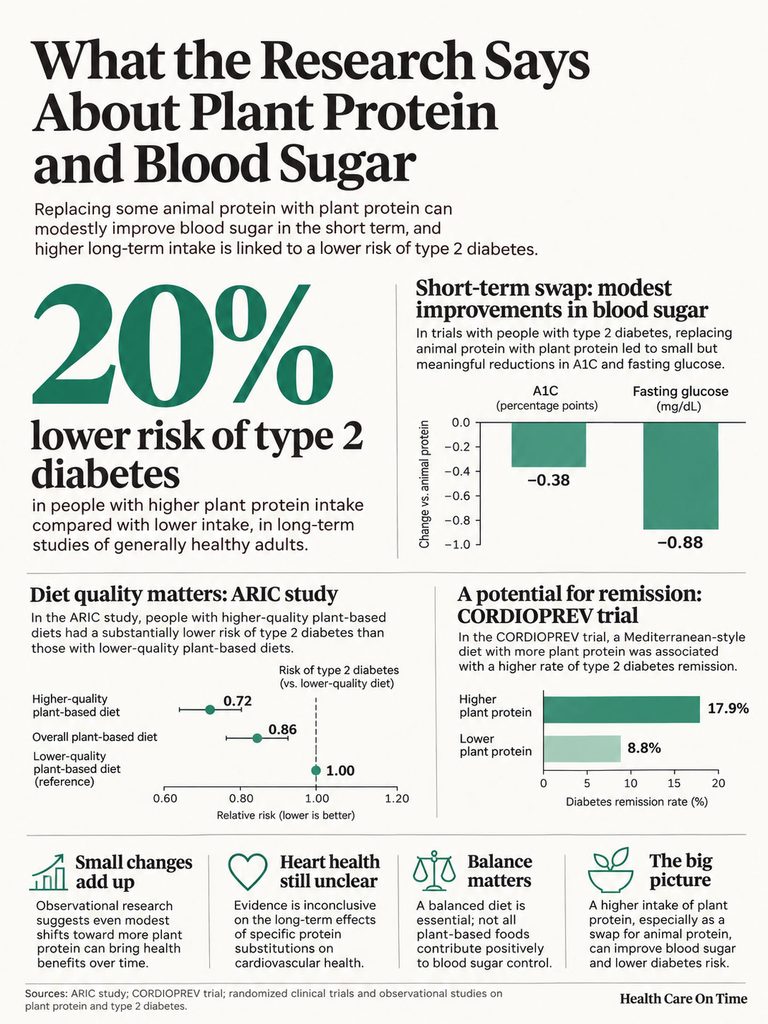
Short controlled trials in people who already have diabetes show small gains in glucose control when plant protein replaces animal protein. Long observational studies in people without diabetes add a second line of evidence, linking plant protein to a lower chance of developing type 2 diabetes at all.
| Study or source | Who was studied | Main result | What it means for you |
| Viguiliouk et al., Nutrients 2015 | 13 randomized trials, 280 adults with diabetes | Replacing about 35% of animal protein lowered A1C by 0.15% and fasting glucose by 0.53 mmol/L | Real but modest effect on A1C over weeks to months |
| Malik et al., American Journal of Epidemiology 2016 | 205,802 US nurses and health professionals, 15,580 new cases | Swapping 5% of calories from animal to plant protein: 23% lower type 2 diabetes risk | Long-term swaps matter for people at risk |
| ARIC study, Diabetes Care 2024 | About 12,000 US adults followed 22 years, 4,208 developed diabetes | Healthy plant-based diet: 15% lower risk; unhealthy plant-based diet: no link | Food quality decides the benefit |
| CORDIOPREV, European Journal of Nutrition 2023 | 177 adults with new type 2 diabetes and heart disease, 5 years | More plant protein: hazard ratio 1.71 for remission; A1C fell 0.35% vs 0.03% | Early, observational signal in newly diagnosed people |
| Reynolds et al., PLOS Medicine 2020 | 42 trials, 1,789 adults with prediabetes or diabetes | Higher fiber lowered A1C by 2.00 mmol/mol and fasting glucose by 0.56 mmol/L | Fiber in beans and lentils helps on its own |
| CDC National Diabetes Statistics Report, Sept 2026 | US population, 2023 data | 40.1 million Americans (12.0%) have diabetes; 115.2 million adults have prediabetes | Roughly 1 in 8 people in the US are living with diabetes |
The largest US dataset is the Harvard analysis of three long-running cohorts. Among 205,802 nurses and health professionals followed for more than four million person-years, those who ate the most animal protein had a 13% higher risk of type 2 diabetes after accounting for body weight, while those who ate the most vegetable protein had a 9% lower risk. Replacing 5% of daily calories from animal protein with vegetable protein was tied to a 23% lower risk. Food-level swaps told a similar story: one daily serving of plant protein foods such as whole grains, legumes, peanuts or nuts in place of animal protein foods, refined grains or potatoes was linked to 6% to 21% lower risk, with the biggest gain when the food replaced was processed meat.
These are associations, and people who eat more plant protein also tend to exercise more and smoke less. Researchers adjust for those habits but can’t remove them completely, which is why the ARIC results below matter: they come from a separate group of Americans and line up with the Harvard findings, so a fluke is less likely.
The trials and the cohorts measure different things. Trials tracked A1C over weeks in people who already had diabetes. Cohorts tracked who developed diabetes over decades. Neither proves the other on its own, though both lean the same way.
For people already living with type 2 diabetes, the most interesting recent data come from Spain. In the CORDIOPREV trial, 177 newly diagnosed patients who also had coronary heart disease were followed for five years on either a Mediterranean or a low-fat diet, with no weight-loss target and no glucose-lowering drugs. Those whose plant protein intake rose had about 1.7 times the rate of remission in the fully adjusted model (hazard ratio 1.71), and their A1C fell by 0.35 percentage points versus 0.03 in the group whose intake fell. The authors were clear about the limits: remission was a secondary outcome, the sample was small, physical activity wasn’t measured, and plant protein came packaged with more fiber, legumes and nuts, so the protein can’t be separated from the rest of the food.
A larger trial in people already taking diabetes medicines would answer the remission question far better than this one can.
What the research can’t tell you yet
The trials behind the A1C numbers were short, often a few weeks to a few months, and small, with 280 people across 13 studies. Most compared whole diets, so the protein swap came bundled with more fiber, less saturated fat and often some weight change. Nobody has run a large, years-long trial asking whether tofu instead of chicken, with everything else held equal, prevents heart attacks or kidney disease in people with diabetes.
The evidence supports something narrower: swapping some animal protein for plant protein is safe, tends to nudge A1C and fasting glucose down a little, and fits eating patterns the ADA already recommends. A few swaps a week still count, even if you never give up meat.
Why “plant-based” isn’t automatically better
The ARIC study, which followed nearly 12,000 US adults for 22 years, split plant-based eating into a healthy version and an unhealthy version. The healthy version, built on fruits, vegetables, nuts, legumes and whole grains, was tied to a 15% lower risk of diabetes. The unhealthy version, heavy in refined grains, potatoes, sweets and sugar-sweetened drinks, showed no protective link at all. About half of the benefit seemed to come simply from eating less red meat.
So a meatless diet built on white bread, fries and soda won’t help your blood sugar. For carbohydrate, the 2026 Standards ask people with diabetes to favor minimally processed, high-fiber sources, with at least 14 grams of fiber per 1,000 calories.
How to Fit Beans and Lentils Into a Carb Budget
Many people with diabetes are told to “eat more beans” and then watch their glucose meter climb after a big bowl of chili. Beans are good for you, and a large portion still delivers a lot of carbohydrate, so the portion is what needs managing.
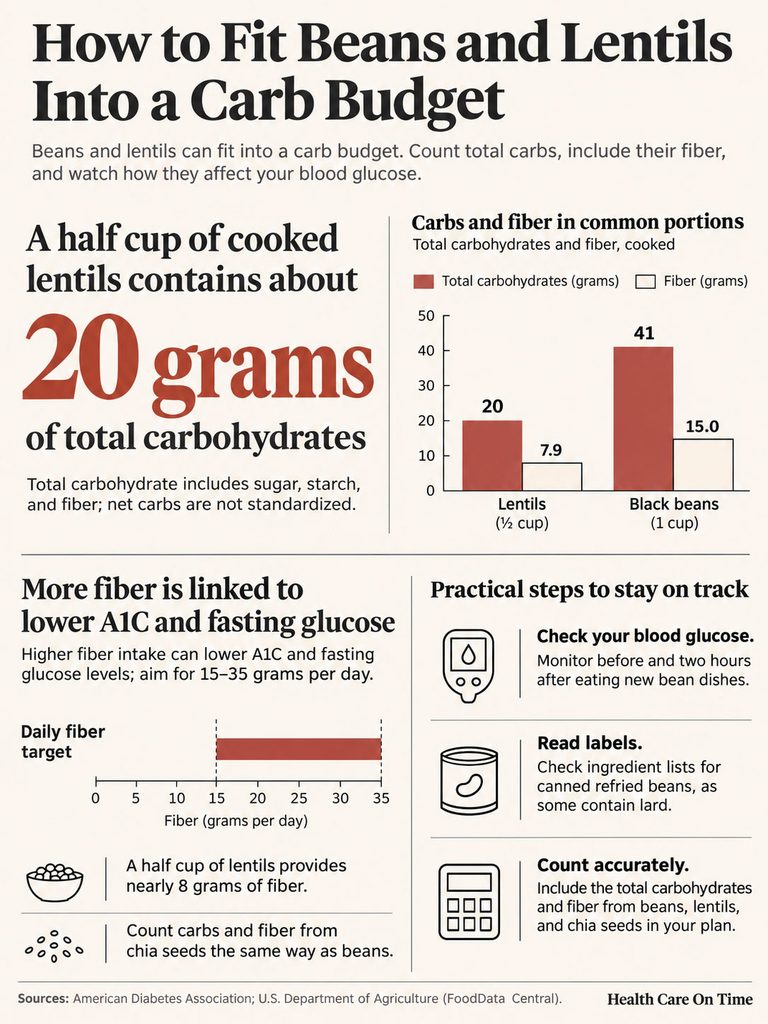
Count total carbohydrate from the label or the table. Total carbohydrate includes sugar, starch and fiber, while “net carbs” has no FDA definition and isn’t a term the ADA uses. The comparison table shows net carbs because many readers look for them, but if you dose insulin by carb count, use total carbs unless your diabetes care team has told you otherwise.
A half cup of cooked lentils, at about 20 grams of total carbohydrate, takes up a real share of a meal’s carbs. With a meal target of 45 grams, that leaves around 25 grams for vegetables, fruit, a tortilla or a small portion of grains, while a full cup of black beans, at about 41 grams, would use almost all of it.
These habits make legumes easier to fit:
- Pair beans with a low-carb protein. Half a cup of black beans plus a few ounces of tofu or tempeh doubles the protein without doubling the carbs.
- Use beans in place of a starch, not on top of it. Rice and beans together is two carb servings.
- Serve lentil or split pea soup by the measured cup, since both are easy to over-serve.
- Rinse canned beans, because the salt can be high and the ADA’s general sodium goal is under 2,300 mg a day.
- Hummus counts too. Two tablespoons is a modest carb load, but a whole tub with pita chips is not.
Check your own meter or CGM before the meal and again about two hours later the first few times you eat a new bean dish, and compare the rise with your usual meals. Responses vary a lot from person to person.
Canned refried beans deserve a quick look at the ingredient list as well, since some brands are made with lard.
Fiber helps here, and not only because it slows digestion. Across a 2020 review of 42 trials in adults with prediabetes or diabetes, higher fiber intakes lowered A1C by 2.00 mmol/mol (about 0.2 percentage points) and fasting glucose by 0.56 mmol/L, and a reasonable goal was raising fiber by 15 grams a day or to 35 grams a day. A half cup of lentils supplies close to 8 of those grams. If you also stir chia seeds into yogurt or oatmeal, count their carbs and fiber the same way you count beans.
A Day of Plant Protein, Counted
One day built only from foods in the comparison table looks like this, with protein and total carbohydrate added up from the same USDA values. Vegetables, fruit, grains and cooking oil are left out; you would add them to fill out each meal.
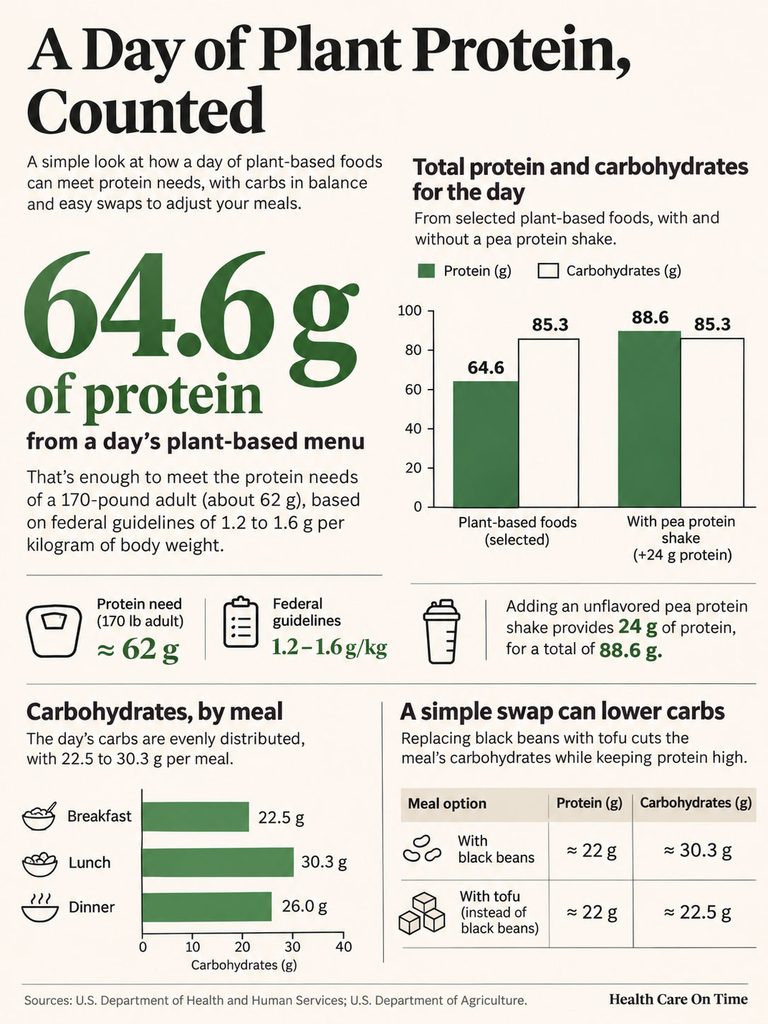
- Breakfast: a tofu scramble with 1 cup of firm tofu and 1/2 cup of black beans, for 17.9 g of protein and 22.5 g of carbs.
- Lunch: lentil soup with 1/2 cup of lentils, plus 1/2 cup of shelled edamame on the side, for 17.9 g of protein and 26.9 g of carbs.
- Snack: 1 oz of almonds, with 6.0 g of protein and 5.6 g of carbs.
- Dinner: a tempeh stir-fry with 1/2 cup of tempeh and 1/2 cup of chickpeas, for 22.7 g of protein and 30.3 g of carbs.
That adds up to 64.6 grams of protein and 85.3 grams of carbohydrate from the protein foods alone.
For a 170-pound adult, 64.6 grams already clears the 0.8 grams per kilogram level, which works out to about 62 grams. Reaching the 1.2 to 1.6 grams per kilogram range in the new federal guidelines would take more, and a scoop of unflavored pea protein in a morning shake adds 24 grams for about 1 gram of carbohydrate. The carbs spread across the day at 22.5 to 30.3 grams per meal, which leaves room for vegetables and a measured serving of fruit or whole grains inside a typical meal plan.
Swap the black beans at breakfast for more tofu, and that meal’s carbs drop by roughly 20 grams.
How Much Protein Do You Need With Diabetes?
The 2026 Standards set no ideal percentage of calories from carbohydrate, protein or fat for people with diabetes, and most people can aim for the general public’s recommended intake, typically 0.8 to 1.5 grams per kilogram of body weight a day, or 15% to 20% of calories. Some research supports slightly higher intakes of 20% to 30% of calories in type 2 diabetes, possibly because protein helps people feel full.
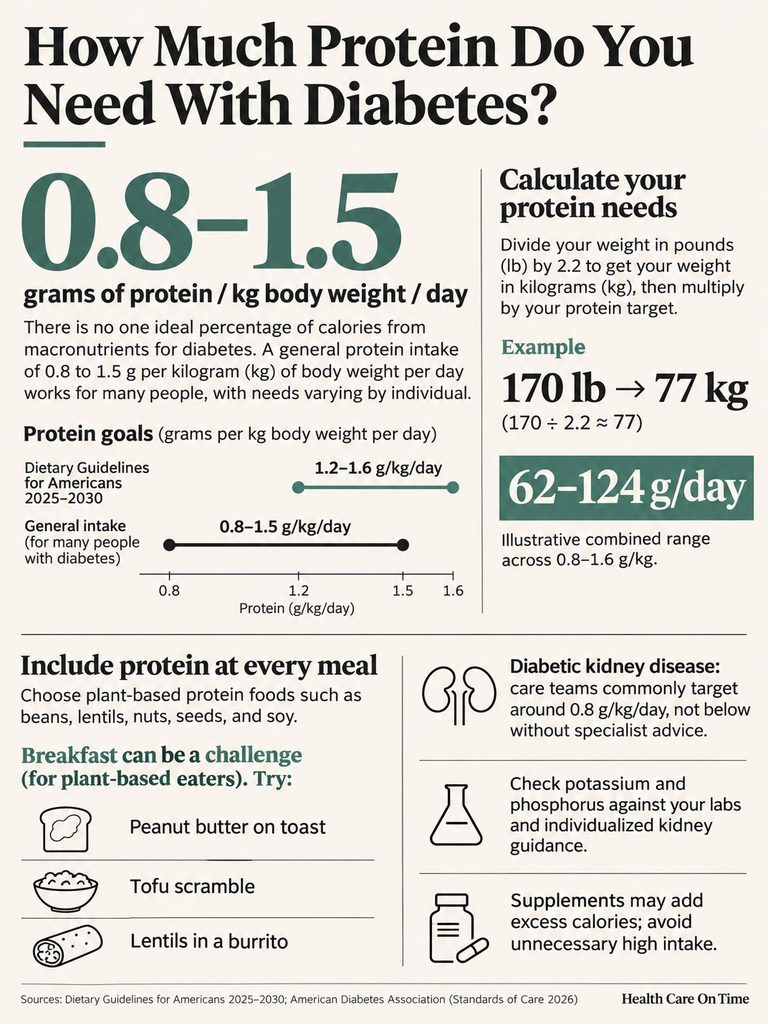
The federal Dietary Guidelines for Americans, 2025–2030 set a higher target of 1.2 to 1.6 grams per kilogram a day and ask people to include protein at every meal, listing beans, peas, lentils, nuts, seeds and soy alongside animal foods.
Protein at every meal sounds simple, but breakfast is where plant eaters usually fall short. Peanut butter on whole-grain toast is a familiar start. A tofu scramble gets quick once you’ve made it twice. Leftover lentils or edamame tucked into a breakfast burrito work too, as long as you count the tortilla.
To turn that into grams, divide your weight in pounds by 2.2. A person who weighs 170 pounds is about 77 kilograms, so 0.8 grams per kilogram is about 62 grams of protein a day, and 1.2 to 1.6 grams per kilogram is about 93 to 124 grams. Getting 30 grams at a meal from plant foods alone is realistic with tofu or tempeh; it’s harder with beans alone, because 30 grams of protein from black beans would mean about 2 cups and roughly 80 grams of carbohydrate.
More isn’t always better. Shakes added to full meals bring extra calories, and safe daily protein limits by body weight depend partly on kidney function, so talk with your care team before pushing intake well past the guideline range.
With diabetic kidney disease, the guidance is specific. Protein doesn’t need to be cut below the general recommendation, and going below 0.8 grams per kilogram a day is not recommended, because it doesn’t improve glucose, heart risk or the rate of kidney decline and can raise the risk of malnutrition. If you have kidney disease, your nephrologist or dietitian may also want to check potassium and phosphorus, since beans, lentils and nuts are rich in both.
Seitan, Meat Substitutes and Protein Powders
Seitan is made from vital wheat gluten, the protein part of wheat, and is essentially pure gluten. That gives it a low carb count and a meaty texture, and it also rules seitan out for anyone with celiac disease.
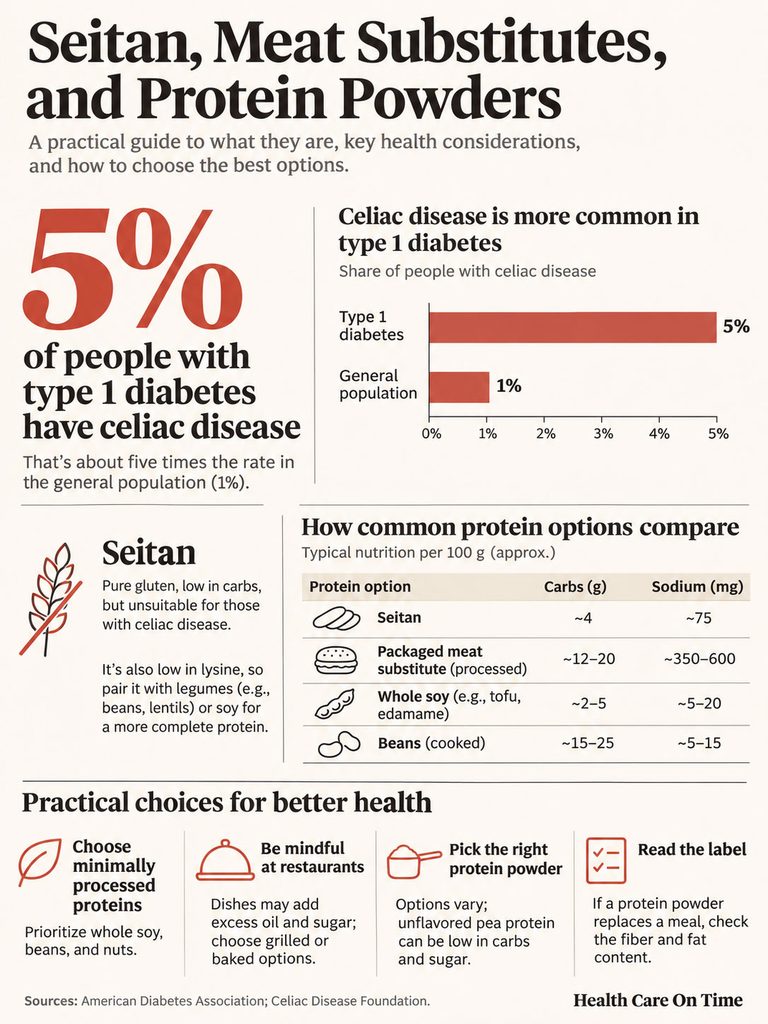
Celiac disease is more common in type 1 diabetes, at roughly 5% compared with about 1% in the general population, so if you have type 1 diabetes and plan to eat seitan often, ask whether celiac screening makes sense first. Seitan is also low in the essential amino acid lysine, which is one reason to eat legumes or soy on other days, and its sodium climbs when it’s seasoned with soy sauce; one brand has 340 mg in 2.5 ounces.
Packaged meat substitutes are a mixed group. Meatless nuggets, burgers, crumbles, bacon, sausage and hot dogs count as plant-based protein foods, but they’re processed products, and their breading, sauces and starches can add carbs and sodium. Compare the label of a veggie burger with a plain tofu steak and the difference is usually obvious. In the ARIC data, the benefit of plant-based eating came from minimally processed foods, so whole soy, beans and nuts should make up most of your plant protein.
Restaurant plant dishes need the same scrutiny. Fried tofu soaks up oil. Sweet glazes such as teriyaki or orange sauce add sugar, and a veggie burger often comes on a large white bun with fries. Ask for tofu baked or grilled, sauce on the side, and a salad or extra vegetables in place of the starch when you can. At a burrito chain, a Chipotle sofritas bowl with extra fajita vegetables and half the rice follows the same idea of pairing tofu with fewer starches.
Protein powders are where label reading matters most. An unflavored pea protein isolate can be almost carb-free: one widely sold product lists 24 grams of protein, 1 gram of carbohydrate and 0 grams of sugar per 33-gram scoop, along with 320 mg of sodium. Flavored blends and ready-to-drink shakes often add sugar or starch. The new Dietary Guidelines suggest keeping added sugars to no more than 10 grams per meal, which is a useful ceiling for a shake.
Compare powders on these lines of the label:
- Total carbohydrate per scoop
- Added sugars
- Protein per scoop (about 20 to 25 grams in many powders)
- Sodium, especially for blends with added salt
- The ingredient list, to see whether the protein is pea, soy, rice or a mix
If a shake is replacing a meal, it should also contain some fiber and fat, or you’ll be hungry soon after. Blending unflavored pea or soy powder with unsweetened soy milk, a handful of berries and a spoon of peanut butter gives a balanced drink you can count accurately.
Ready-to-drink plant shakes deserve a full read of the label too. Some use sugar alcohols or fiber syrups to cut the sugar line, which changes the total carbohydrate you count. Others are fine. The only way to know is the Nutrition Facts panel, checked against your own meter the first few times.
Making Tofu, Tempeh and Beans Easy to Eat
Firm or extra-firm tofu tastes bland and watery when it goes into the pan straight from the package. Press out the water first by wrapping the block in a towel under something heavy, then cut it into cubes and bake, air-fry or pan-sear it. It takes on marinades well, so a little soy sauce, garlic and ginger goes a long way. Watch the sodium in bottled sauces, though, since it adds up fast.
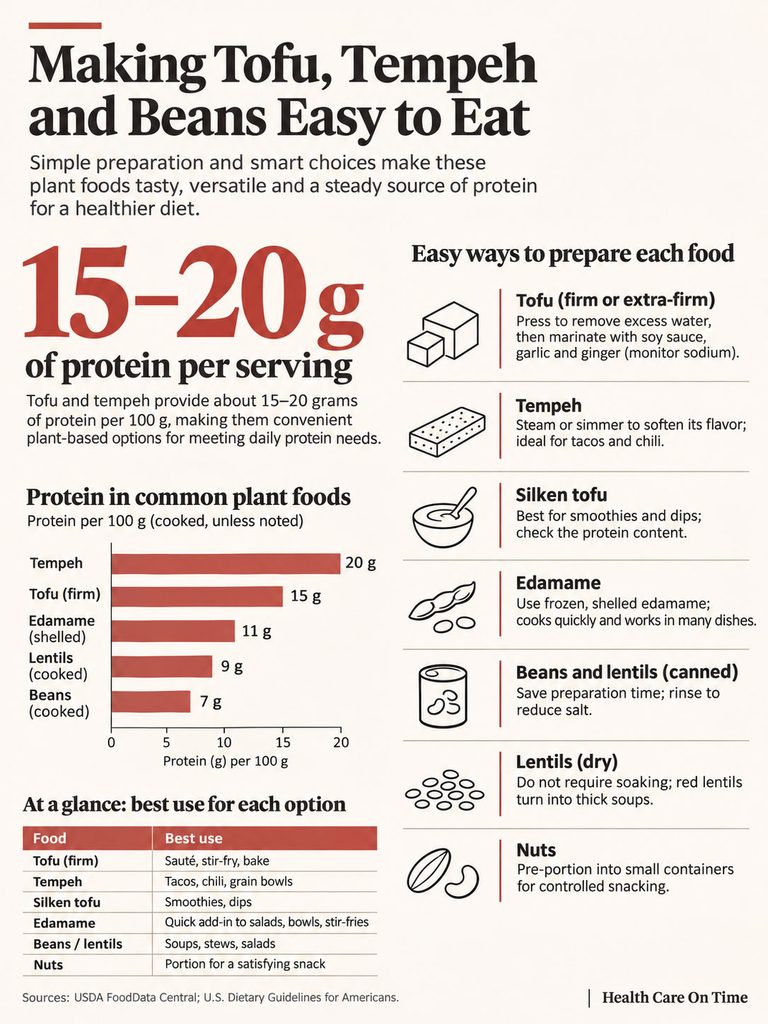
Tempeh has a firmer, nuttier texture and can taste slightly bitter straight from the package. Steaming or simmering it briefly before marinating softens the flavor, and crumbled tempeh works well in tacos, chili and pasta sauce where you would otherwise use ground meat.
Silken tofu is a different product. It’s soft and custard-like, so it blends into smoothies, dips and creamy sauces and falls apart in a frying pan. Check the label, because its protein per serving is usually lower than firm tofu’s. Buy the type that matches the recipe.
Frozen shelled edamame is one of the easiest options. It cooks in minutes, goes into salads, grain bowls and stir-fries, and makes a filling snack with a pinch of salt.
Canned beans and lentils save time, and rinsing them in a strainer lowers the salt. Dry lentils don’t need soaking. Red lentils break down into a thick soup or dal, while brown and green lentils hold their shape for salads.
With nuts, pre-portioning an ounce into small containers keeps a healthy snack from turning into a few hundred extra calories.
Safety Notes: Kidneys, Low Blood Sugar and Insulin Dosing
Protein-rich and high-fiber foods are poor choices for treating a low. Use the 15-15 rule instead: take 15 grams of fast-acting carbohydrate, wait 15 minutes and recheck, repeating if you’re still below 70 mg/dL. Beans, lentils and other high-fiber foods, along with high-fat foods, slow sugar absorption, so a handful of peanuts or a bean dip won’t bring a low up quickly. Below 55 mg/dL is considered severe, and glucagon may be needed.
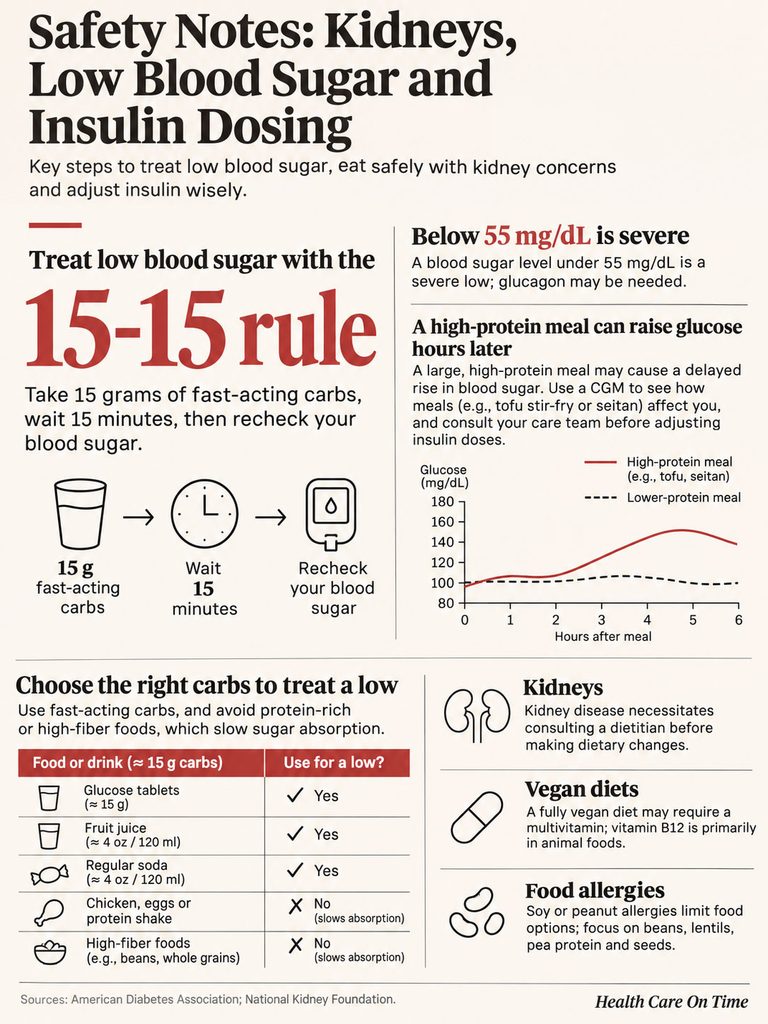
If you use insulin, a large high-protein plant meal can push glucose up several hours later. Raising insulin doses for high-fat, high-protein mixed meals calls for a cautious approach, so talk with your care team before changing doses. A CGM is the easiest way to see whether a tofu stir-fry or a seitan dinner causes a late rise for you.
If you eat a fully vegan diet, a multivitamin may be necessary. Vitamin B12 is found naturally almost only in animal foods, so ask your doctor or dietitian whether you need a supplement or a blood test.
Kidney disease is the other reason to involve a dietitian before making large changes.
A soy or peanut allergy narrows the table quickly, leaving beans, lentils, pea protein and seeds as your main options.
Which Plant Protein Fits Your Situation
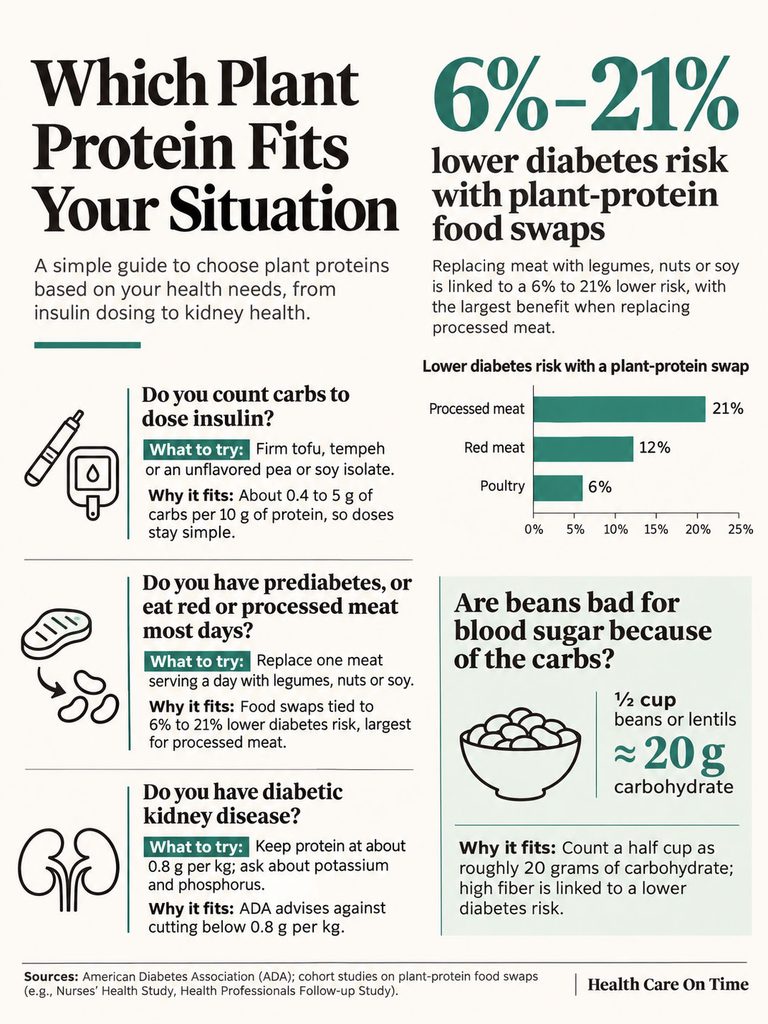
| Your question | What to try | Why it fits |
| Do you count carbs to dose insulin? | Firm tofu, tempeh or an unflavored pea or soy isolate | About 0.4 to 5 g of carbs per 10 g of protein, so doses stay simple |
| Do you have prediabetes, or eat red or processed meat most days? | Replace one meat serving a day with legumes, nuts or soy | Food swaps were tied to 6% to 21% lower diabetes risk, largest for processed meat |
| Do beans spike your blood sugar after meals? | Keep beans to 1/2 cup and pair with tofu; skip rice at the same meal | 1/2 cup of black beans is about 20 g of carbs |
| Do you have diabetic kidney disease? | Keep protein at about 0.8 g per kg; ask about potassium and phosphorus | ADA advises against cutting below 0.8 g per kg |
| Do you have type 1 diabetes and celiac disease? | Avoid seitan; use soy, beans, lentils and nuts | Seitan is essentially pure wheat gluten |
| Shopping for a protein shake? | Unflavored pea or soy isolate with under 10 g of added sugar per serving | Dietary Guidelines cap added sugar at 10 g per meal |
| Treating a low blood sugar right now? | Use 15 g of fast-acting carbs, not nuts or beans | CDC lists high-fiber and high-fat foods as slowing sugar absorption |
Frequently Asked Questions
Is plant protein better than animal protein for diabetes?
For most people, swapping some animal protein for plant protein is a modest improvement. Trials show a small A1C drop, and large US studies link the swap to lower diabetes risk, especially when processed meat is what gets replaced. Lean fish, eggs and dairy can still fit. Milk is the one to count carefully, since a cup of whole milk brings lactose along with its protein.
Is tofu good for diabetics?
Firm tofu is one of the best choices. A cup has about 10 grams of protein and only about 2 grams of carbohydrate, so it barely moves blood sugar and is easy to count.
Can too much protein raise A1C?
Protein has a much smaller effect on glucose than carbohydrate, but some effect shows up in the later hours after a big meal, and it grows with the amount eaten. People who use insulin may see late rises after very large high-protein meals, which can add up over time. Very high protein intakes are also a concern for anyone with kidney disease. For most people eating 15% to 20% of calories from protein, A1C is driven far more by carbohydrate quantity, weight, activity and medication than by protein.
What foods make A1C go down?
Eating patterns lower A1C more reliably than any one food. High-fiber foods such as beans, lentils, vegetables, whole grains and nuts lowered A1C in fiber trials, and swapping refined grains, sugary drinks and processed meat for those foods is linked to lower diabetes risk. Fruit fits too in measured portions. Regular activity, weight loss when needed and taking prescribed medication matter at least as much as food choices.
What is the best protein drink for people with type 2 diabetes?
Look for an unflavored or lightly sweetened shake with 20 to 25 grams of protein, low total carbohydrate and less than 10 grams of added sugar. Unflavored pea or soy isolate mixed with unsweetened soy milk is a simple, countable option.
Are beans bad for blood sugar because of the carbs?
Beans do raise blood sugar because they contain starch, but they also bring 6 to 8 grams of fiber per half cup and are linked to lower diabetes risk over time. Count a half cup of beans or lentils as roughly 20 grams of carbohydrate, use them in place of rice or bread instead of alongside it, and check your meter two hours after the meal to see your own response. Problems usually start with large servings, such as a full bowl of chili with cornbread.
Is pea protein good for diabetics?
Pea protein isolate is one of the lowest-carb protein sources available, with about 1 gram of carbs per scoop in unflavored versions. Check the label for added sugar and sodium.
What is the healthiest protein for a diabetic?
Several proteins fit. Meals built around fish, skinless poultry and plant proteins such as beans, lentils, tofu, tempeh, edamame and nuts, with red and processed meat kept low, match the ADA’s list of protein choices. For blood sugar, tofu, tempeh and edamame give the most protein for the fewest carbs, while beans and lentils add the most fiber.
Medical disclaimer: This article is for general information only and is not a substitute for advice from your doctor, registered dietitian or diabetes care team. If you take insulin or medicines that can cause low blood sugar, or if you have kidney disease, talk with your care team before making major changes to your diet or protein intake.
References
- American Diabetes Association. Protein Food for Diabetes.
- American Diabetes Association. Making Sense of Food Labels.
- American Diabetes Association Professional Practice Committee. 5. Facilitating Positive Health Behaviors and Well-being to Improve Health Outcomes: Standards of Care in Diabetes, 2026. Diabetes Care. 2026;49(Suppl 1):S89–S131.
- Viguiliouk E, et al. Effect of Replacing Animal Protein with Plant Protein on Glycemic Control in Diabetes: A Systematic Review and Meta-Analysis of Randomized Controlled Trials. Nutrients. 2015;7(12):9804–9824.
- Malik VS, Li Y, Tobias DK, Pan A, Hu FB. Dietary Protein Intake and Risk of Type 2 Diabetes in US Men and Women. American Journal of Epidemiology. 2016;183(8):715–728.
- Diabetes Care. Commentary on plant-based diets and diabetes risk in the ARIC study. 2024;47(5):787 (on Sullivan VK, et al. Diabetes Care 2024;47:803–809).
- Gutierrez-Mariscal FM, et al. Changes in quantity plant-based protein intake on type 2 diabetes remission in coronary heart disease patients: from the CORDIOPREV study. European Journal of Nutrition. 2023;62(4):1903–1913.
- Reynolds AN, Akerman AP, Mann J. Dietary fibre and whole grains in diabetes management: Systematic review and meta-analyses. PLOS Medicine. 2020;17(3):e1003053.
- Centers for Disease Control and Prevention. National Diabetes Statistics Report. Updated September 2026.
- Centers for Disease Control and Prevention. Treatment of Low Blood Sugar (Hypoglycemia).
- Elsayed S, Nelson M. Dietary Guidelines for 2025–2030: Recommendations From the USDA and HHS. American Family Physician. 2026;114(1):98–100.
- Craig ME, et al. Prevalence of Celiac Disease in 52,721 Youth With Type 1 Diabetes: International Comparison Across Three Continents. Diabetes Care. 2017;40(8):1034–1040.
- Today’s Dietitian. Article on seitan as a plant protein.
- University Hospitals Health Library. Nutrition Facts (USDA data): tofu, firm, nigari; tempeh; lentils, boiled; black beans, boiled; chickpeas, boiled; peanuts, dry-roasted; almonds; soy protein isolate.
- USDA National Nutrient Database entry 11212, Edamame, frozen, prepared.
- American Diabetes Association Diabetes Food Hub. Seitan.
- NOW Foods. Pea Protein, Pure Unflavored Powder: Nutrition Facts.