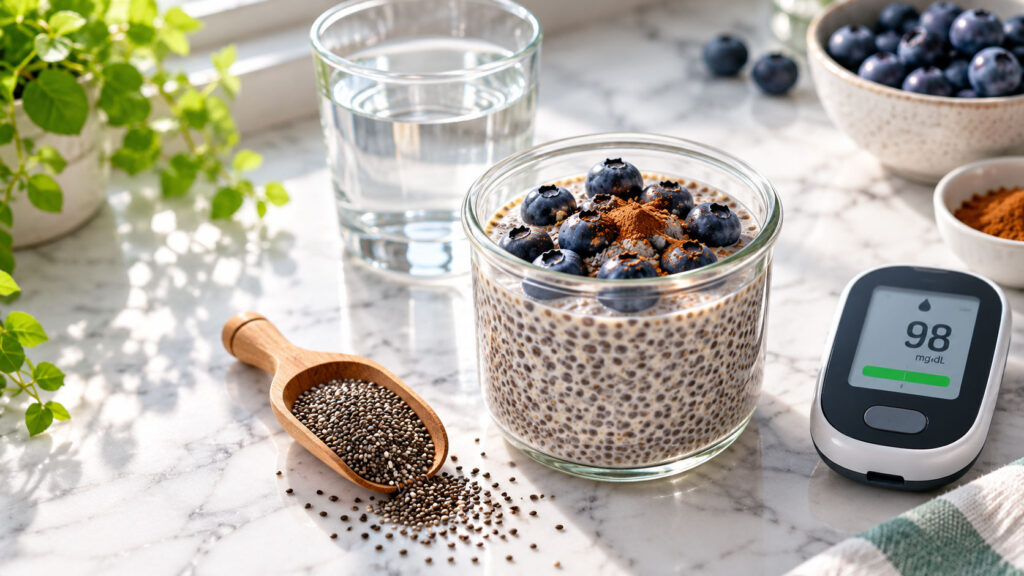
A single ounce of chia seeds carries almost 12 grams of carbohydrate. Yet nearly 10 of those grams are fiber your body can’t digest, which leaves only about 2 grams that can raise your blood sugar.
Table of Contents
That gap between “total carbs” and “carbs that count” is why chia seeds keep showing up on diabetes meal plans. It’s also why so many articles oversell them.
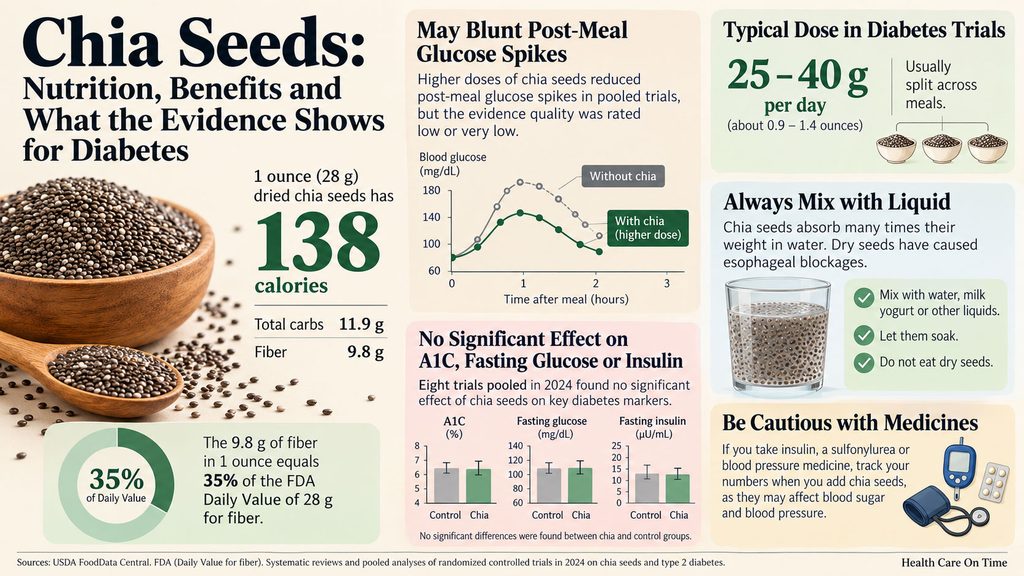
Quick Answer: Yes, people with diabetes can eat chia seeds. One ounce (28 grams) has 11.9 g of carbs, 9.8 g of fiber and about 2 g of net carbs, according to USDA data. Trials show chia can soften the blood sugar rise after a meal at higher doses, but a 2024 meta-analysis found no significant drop in A1C or fasting glucose. Soak them, start with 1 tablespoon and check your glucose.
At a Glance: the key takeaways
- One ounce of dried chia seeds has 138 calories, 11.9 g total carbs and 9.8 g fiber (USDA FoodData Central).
- That fiber equals 35% of the FDA Daily Value of 28 g.
- Higher doses blunted post-meal glucose spikes in pooled trials, but the evidence quality was rated low or very low.
- Eight trials pooled in 2024 showed no significant effect on A1C, fasting glucose or insulin.
- Diabetes trials used about 25 to 40 grams a day, usually split across meals.
- Always mix chia with liquid. Dry seeds have caused esophageal blockages.
- If you take insulin, a sulfonylurea or blood pressure medicine, track your numbers when you add chia.
What Chia Seeds Do to Blood Sugar
Chia seeds come from Salvia hispanica, a crop native to Mexico and grown across Mesoamerica for centuries. A 2023 review in *Molecules* traces its use back to pre-Hispanic times and pulls together 16 rodent studies, 13 clinical trials and 4 lab tests on chia and diabetes.
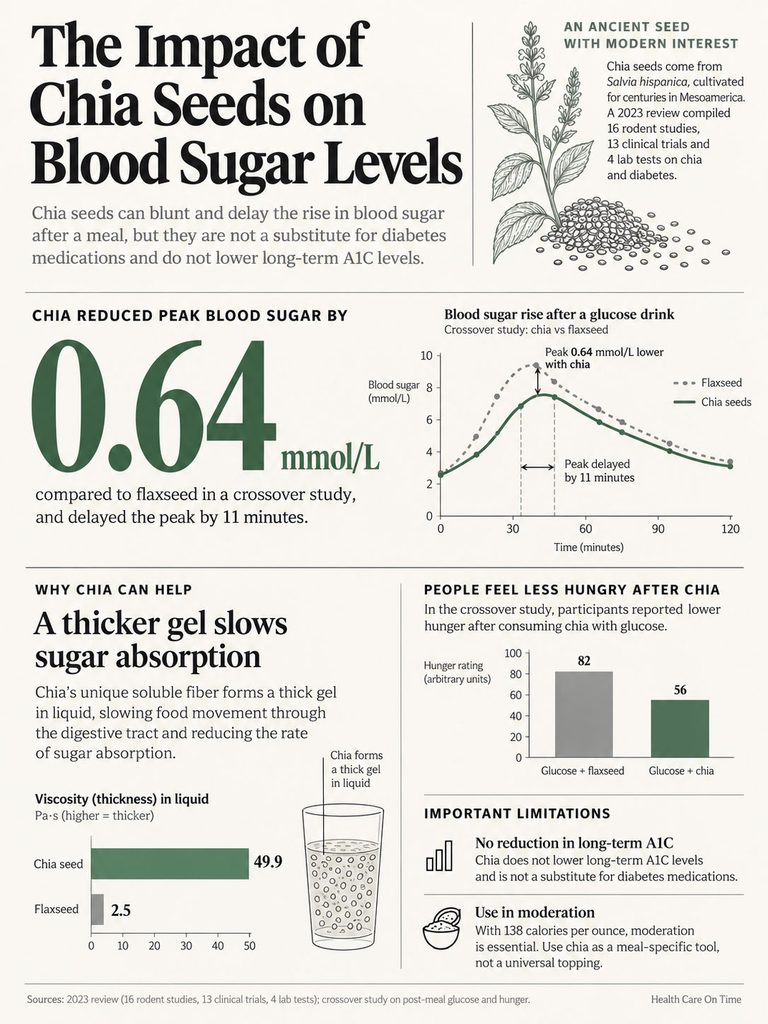
The main reason chia behaves differently from other carb foods is its fiber. When the seeds hit liquid, their outer layer forms a thick gel. That gel slows how fast food leaves your stomach and how quickly sugar reaches your bloodstream.
Why the gel matters
A 2017 crossover study in the *European Journal of Clinical Nutrition* measured that thickness directly. In lab tests, chia’s viscosity was 49.9 Pa·s, compared with 2.5 Pa·s for flaxseed, about 20 times thicker.
When 15 healthy adults drank a 50-gram glucose drink with 25 grams of ground chia, their peak blood sugar was 0.64 mmol/L (about 11.5 mg/dL) lower than with flax. The peak also came about 11 minutes later. Participants reported less desire to eat afterward, too.
What chia does not do
Chia isn’t a medicine. It doesn’t replace metformin, insulin or any other diabetes treatment, and no trial has shown it can reverse diabetes.
Readers often ask us whether chia “lowers blood sugar.” The honest answer is narrower: it can soften the spike after a meal, but it hasn’t been shown to lower long-term A1C in pooled trials. We’ll walk through that evidence below.
It also isn’t a free food. At 138 calories an ounce, chia can quietly add up if you sprinkle it on everything. Think of it as a tool for specific meals, not a topping for every bite.
Chia Seed Nutrition for Diabetes: The USDA Numbers
Our editors pulled every number in this section from USDA FoodData Central (FDC ID 170554, “Seeds, chia seeds, dried”). We converted the per-100-gram values to a standard 1-ounce (28.35 g) serving.
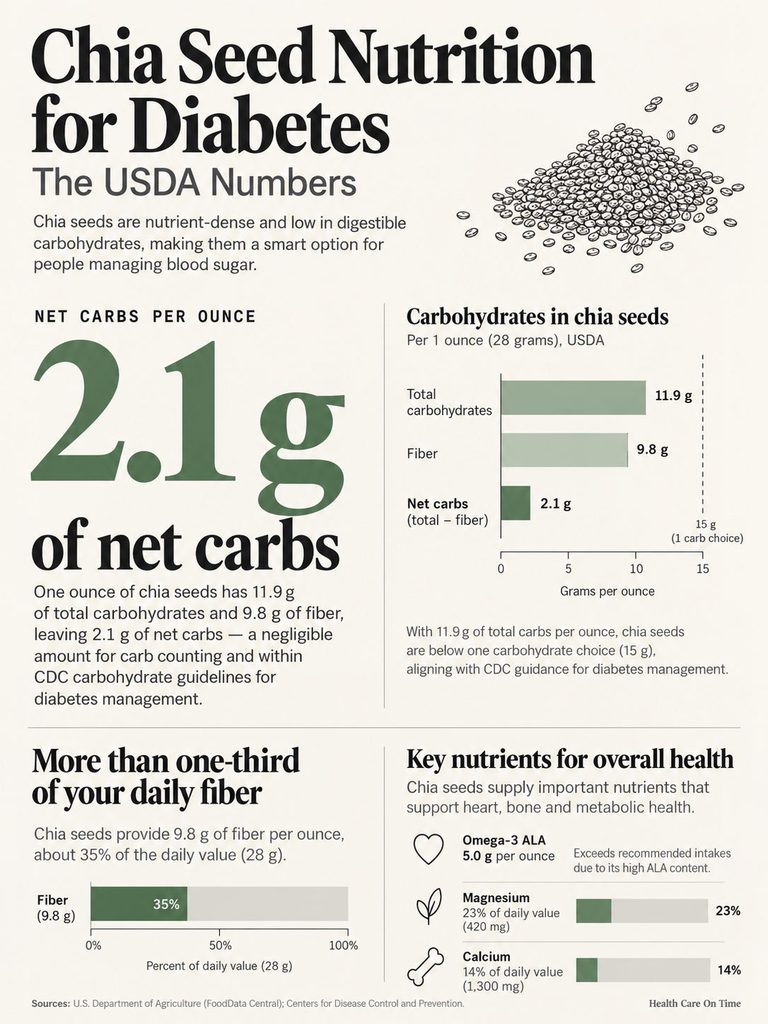
Per ounce, chia seeds provide:
- Calories: 138
- Total carbohydrate: 11.9 g
- Dietary fiber: 9.8 g
- Net carbs (total minus fiber): about 2.1 g
- Protein: 4.7 g
- Total fat: 8.7 g, including 5.0 g of the plant omega-3 ALA
- Calcium: 179 mg
- Magnesium: 95 mg
- Iron: 2.2 mg
WebMD’s nutrition breakdown lists the same 138 calories and 9.8 grams of fiber per ounce, so the figures line up across sources.
Net carbs and carb counting
The CDC’s carb choices list counts one “carb choice” as 15 grams of carbohydrate for most foods. A full ounce of chia, at 11.9 grams total, sits below one carb choice even before you subtract fiber.
If your care team uses net carbs, chia’s 2.1 grams per ounce is close to negligible. If you count total carbs for insulin dosing, ask your diabetes educator how to handle high-fiber foods, because fiber-rich carbs don’t act like sugar.
Omega-3 ALA, magnesium and calcium
That 5.0 grams of ALA is more than the NIH Office of Dietary Supplements adequate intake of 1.6 grams for men and 1.1 grams for women. One caveat: NIH notes your body turns only very small amounts of ALA into EPA and DHA, the omega-3s found in fish.
Using the FDA Daily Values, one ounce supplies about 35% of fiber (28 g DV), 23% of magnesium (420 mg DV) and 14% of calcium (1,300 mg DV).
Chia vs Flax vs Pumpkin vs Sunflower Seeds
People shopping for a “diabetes seed” usually compare chia with flax, pumpkin and sunflower. Our medical content team ran all four through the same USDA dataset so you can compare them fairly, ounce for ounce.
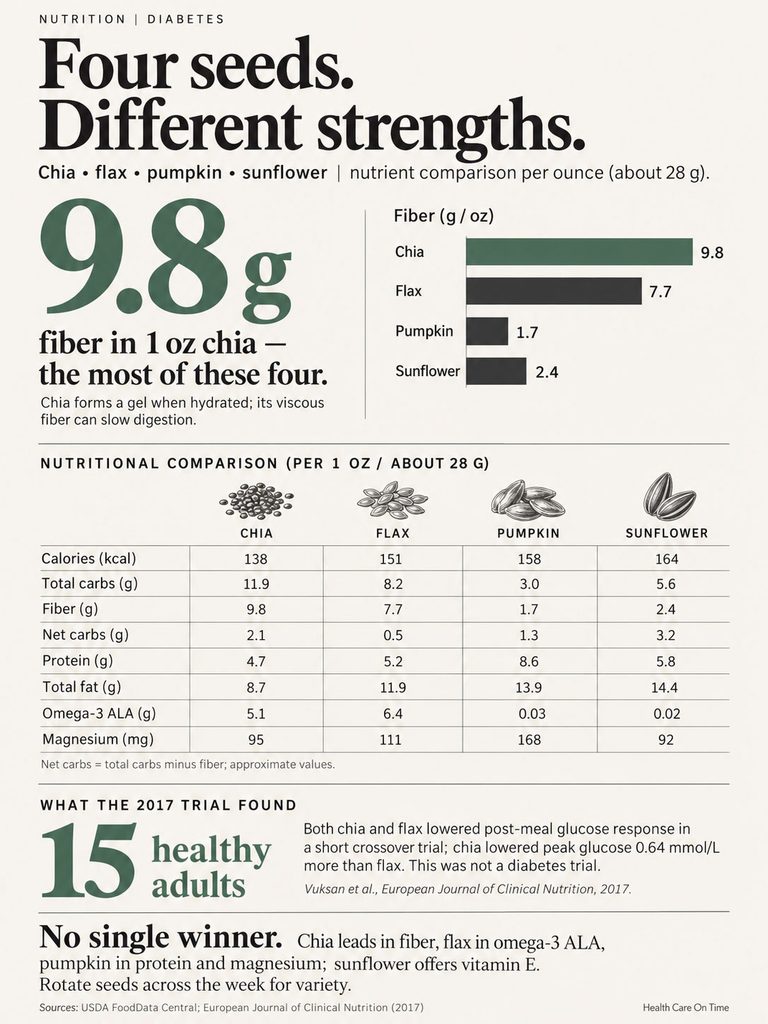
| Per 1 oz (28 g) | Chia seeds | Flaxseed | Pumpkin seed kernels | Sunflower seed kernels |
| Calories | 138 | 151 | 158 | 166 |
| Total carbs (g) | 11.9 | 8.2 | 3.0 | 5.7 |
| Fiber (g) | 9.8 | 7.7 | 1.7 | 2.4 |
| Net carbs (g) | 2.1 | 0.5 | 1.3 | 3.3 |
| Protein (g) | 4.7 | 5.2 | 8.6 | 5.9 |
| Total fat (g) | 8.7 | 12.0 | 13.9 | 14.6 |
| Omega-3 ALA (g) | 5.0 | 6.5 | 0.03 | 0.02 |
| Magnesium (mg) | 95 | 111 | 168 | 92 |
Source: USDA FoodData Central, SR Legacy FDC IDs 170554, 169414, 170556 and 170562, converted to 28.35 g. Flax ALA uses USDA’s total 18:3 value.
Which seed is best for diabetics?
There’s no single winner. Each seed wins a different category:
- Chia has the most fiber and the lowest calories of the four, plus it forms the thickest gel.
- Flaxseed has the most ALA and the fewest net carbs of the four.
- Pumpkin seeds lead on protein and magnesium, with very few carbs.
- Sunflower seeds are the most calorie-dense and offer the least fiber of the group.
For blood sugar specifically, chia’s edge is the gel. In the head-to-head 2017 study, chia beat flax on post-meal peak glucose and appetite. A practical approach is to rotate seeds through the week instead of picking just one.
What the Research Really Shows
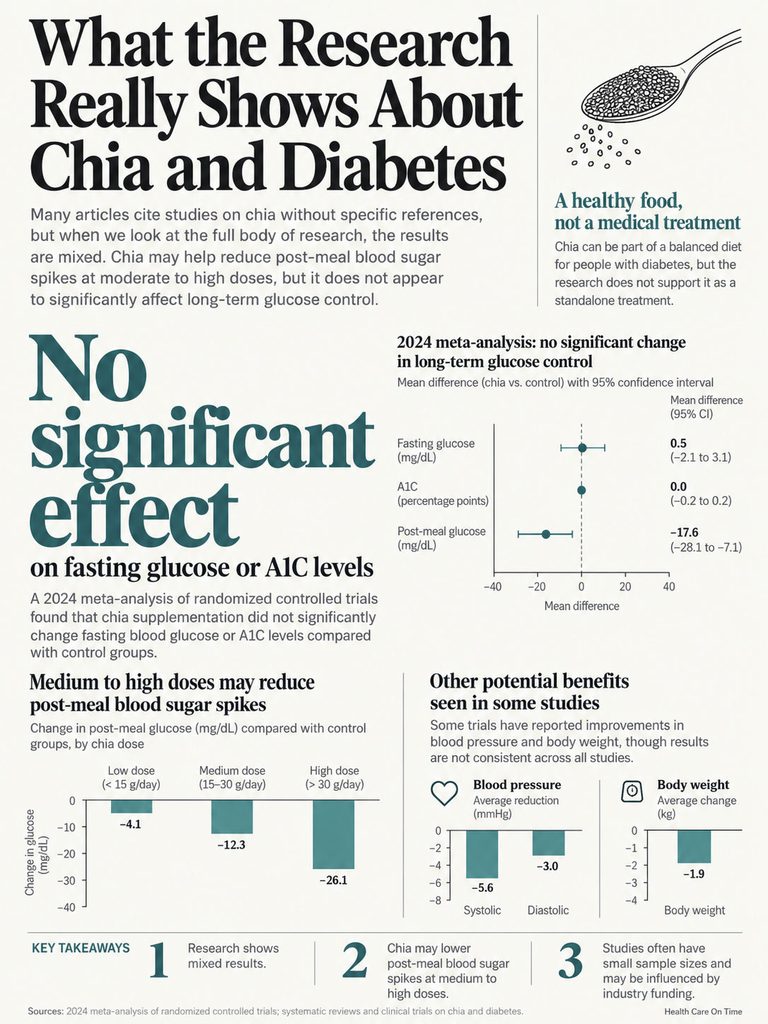
Most chia articles cite “studies” without naming them. Our editors checked this section against the original trial abstracts on PubMed, and the picture is more mixed than headlines suggest.
| Study | Who | Chia dose | Key glucose finding |
| Vuksan, Diabetes Care 2007 | 20 adults with well-controlled type 2 diabetes | 37 g/day for 12 weeks | A1C fell versus starting level, not versus control |
| Ho, EJCN 2013 | 13 healthy adults | 7, 15 or 24 g in bread | Bigger doses gave smaller spikes (p = 0.04) |
| Vuksan, NMCD 2017 | 77 overweight adults with type 2 diabetes | 30 g per 1,000 kcal, 6 months | Glycemic control held steady; weight fell 1.9 kg |
| Alwosais, Nutr Health 2021 | 42 adults with type 2 diabetes | 40 g/day for 12 weeks | No change in fasting glucose, A1C or insulin |
| Pam, meta-analysis 2024 | 8 trials, 362 people | Various | No significant effect on A1C, fasting glucose or insulin |
Post-meal spikes: where chia helps
A 2018 systematic review in *Nutrition Reviews* pooled 12 randomized trials. Overall, chia didn’t change most outcomes. But at medium and higher doses, it lowered the post-meal blood sugar curve.
That matches the dose-response trial by Ho and colleagues, where 7, 15 and 24 grams of chia baked into white bread reduced the glucose response in a dose-dependent way. Whole and ground seeds worked equally well, so you don’t need to grind chia.
A1C and fasting glucose: the 2024 meta-analysis
The newest pooled analysis, published in *Diabetes & Metabolic Syndrome* in 2024, included 8 randomized trials with 362 participants. Chia had no significant effect on fasting glucose, insulin or A1C.
The A1C result leaned in a helpful direction (a 0.12-point drop) but didn’t reach statistical significance (p = 0.09). The authors flagged the small number of studies and the wide differences between them.
Blood pressure, weight and inflammation
The stronger signals show up outside glucose. In the 2007 *Diabetes Care* trial, 37 grams a day cut systolic blood pressure by 6.3 mmHg and hs-CRP, an inflammation marker, by 40% compared with wheat bran.
A 2021 Kuwait trial of 42 adults with type 2 diabetes also found lower systolic pressure on 40 grams a day. In the 2017 weight trial, the chia group lost 1.9 kg (about 4.2 pounds) versus 0.3 kg on oat bran, and trimmed waist size by 3.5 cm versus 1.1 cm.
Limits of the evidence
Here’s what competing pages leave out. Most diabetes trials used one branded seed called Salba and came from one research group at St. Michael’s Hospital in Toronto. The 2017 flax comparison disclosed that Salba Corporation supplied the seeds and that several authors had industry ties.
Sample sizes were small, from 13 to 77 people. The 2018 review rated every finding as low or very low quality. None of the trials measured hard outcomes like heart attacks or kidney disease. Treat chia as a helpful food, not a treatment.
Why This Matters Now: Diabetes and Fiber by the Numbers
Diabetes is common enough that small, repeatable food choices add up. When our team reviews lab reports, a common question is what simple swap might nudge post-meal numbers. Fiber-rich foods like chia are near the top of that list.
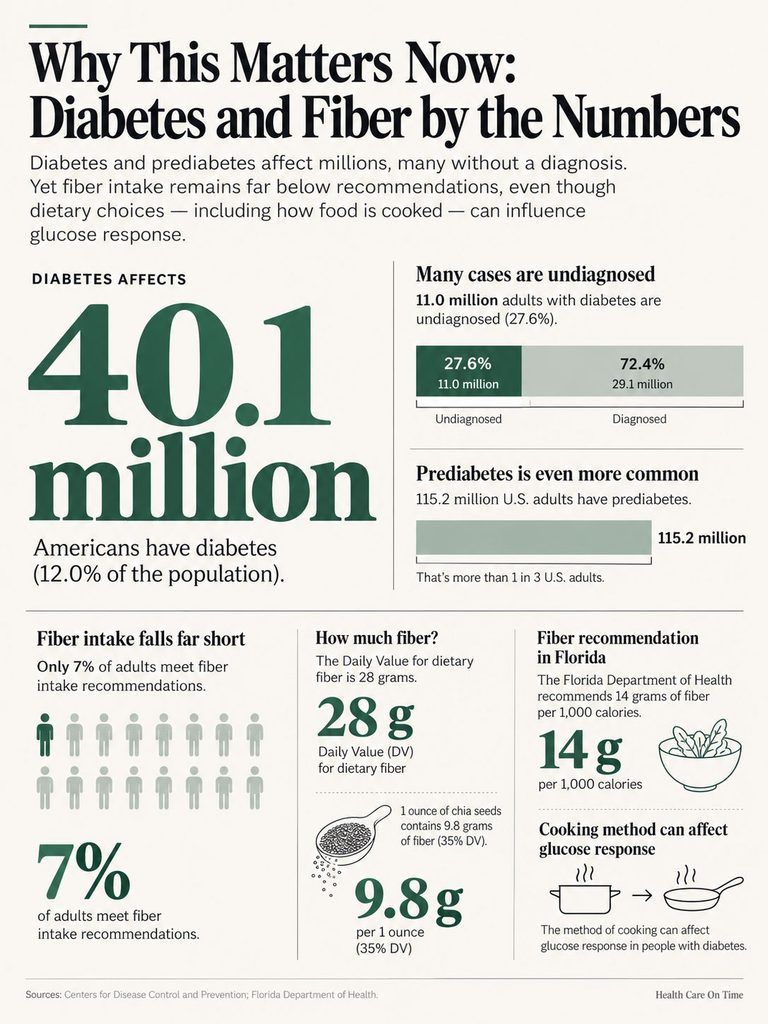
| Measure | Number | Source |
| Americans with diabetes (all ages, 2023 data) | 40.1 million (12.0%) | CDC, updated Sept 2026 |
| Adults with diabetes who are undiagnosed | 11.0 million (27.6%) | CDC |
| U.S. adults with prediabetes | 115.2 million | CDC |
| Adults meeting fiber goals | 7% (9% women, 5% men) | ASN preliminary data, 2013 to 2018 |
| Daily Value for dietary fiber | 28 g | FDA |
| Fiber in 1 oz chia seeds | 9.8 g (35% DV) | USDA FoodData Central |
Sources: [CDC National Diabetes Statistics](https://www.cdc.gov/diabetes/php/data-research/index.html), [HealthDay report on ASN data](https://www.healthday.com/health-news/cardiovascular-diseases/b-6-8-less-than-1-in-10-american-adults-are-getting-enough-dietary-fiber-2653195485.html), FDA Daily Values, USDA.
The CDC reports 40.1 million Americans have diabetes, and more than a quarter of adults with it don’t know it. Another 115.2 million adults have prediabetes.
Meanwhile, a large national analysis presented at the American Society for Nutrition found only 7% of adults met fiber recommendations. One common target, used by the Florida Department of Health, is 14 grams per 1,000 calories. A single ounce of chia covers more than a third of the 28-gram Daily Value.
If you’re comparing chia with starchy sides, our guide on whether sweet potatoes are good for diabetics shows how cooking method changes glucose response, another case where how you eat a food matters as much as what you eat.
How Much Chia Seed Per Day for Diabetes
There’s no official chia dose for diabetes. No FDA or ADA guideline sets one, because chia is a food rather than a drug.
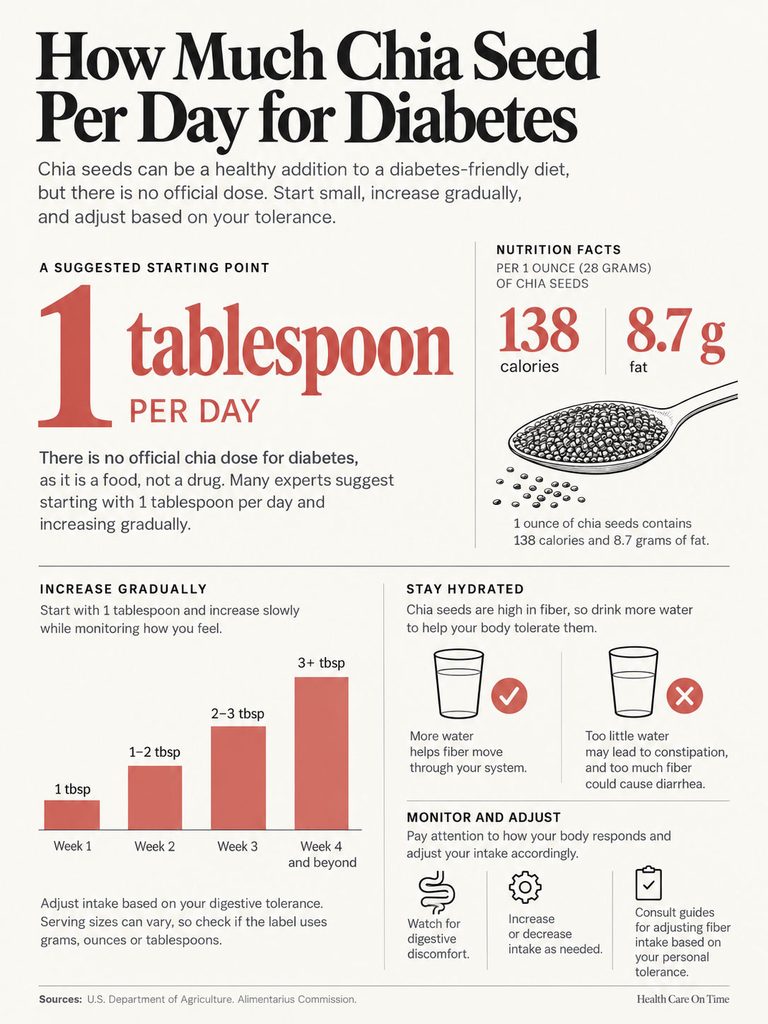
What we do have is what the trials used:
- Acute studies: 7 to 25 grams with a single meal or glucose drink.
- Longer diabetes trials: about 30 to 40 grams a day for 12 weeks to 6 months.
A practical starting point
WebMD suggests starting with about 1 tablespoon and building up slowly, cutting back if your stomach complains. That’s sensible, since jumping from low fiber to high fiber overnight often brings gas and bloating.
A reasonable path looks like this:
- Week 1: 1 tablespoon a day, soaked, with breakfast.
- Week 2: 2 tablespoons, split between two meals.
- Week 3 onward: work toward 1 ounce (28 g) a day if you tolerate it, and weigh it once on a kitchen scale so you know what your spoon holds.
Bag labels vary in how they define a serving, so check whether yours lists grams, ounces or tablespoons. Remember that 1 ounce still adds 138 calories and 8.7 grams of fat to your day.
Drink more water as you add fiber
Fiber pulls water into your gut. If you add chia without drinking more, you may end up constipated. If your stool turns loose instead, our guide on whether too much fiber can cause diarrhea explains what to adjust.
When to Eat Chia Seeds
Timing matters more than most people think. The trials that showed a benefit gave chia with a carb-containing meal or glucose drink, not on an empty stomach hours later.
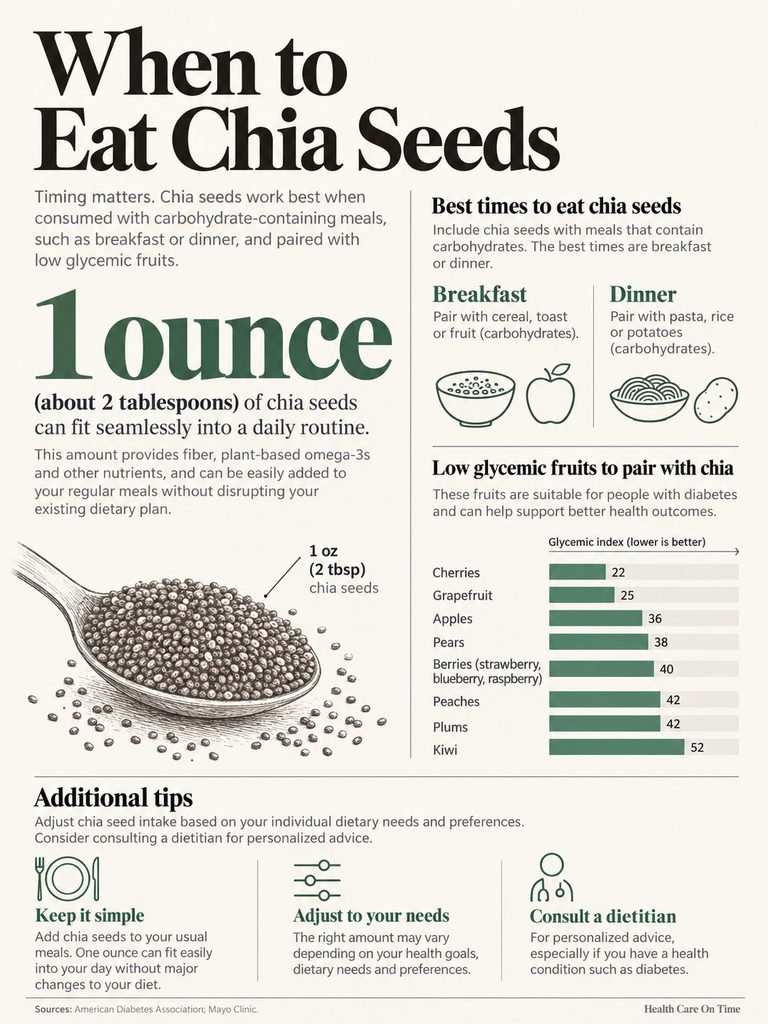
That suggests the best time to eat chia is alongside your highest-carb meal of the day. For many Americans that’s breakfast (cereal, toast, fruit) or dinner (pasta, rice, potatoes).
Good pairing ideas:
- Stir soaked chia into oatmeal or plain Greek yogurt.
- Add a tablespoon to a fruit smoothie to slow the sugar from the fruit.
- Have chia pudding as a snack instead of crackers or granola bars.
- Sprinkle soaked seeds over a salad that comes with a starchy side.
If you’re pairing chia with fruit, our list of fruits for diabetic patients shows which ones are lower on the glycemic scale. For more ideas, see our 20 low glycemic foods.
A sample chia day
Here’s how one ounce can fit into a normal day without forcing it:
- Breakfast: Half the day’s chia (about a tablespoon and a half) soaked into plain Greek yogurt with a handful of berries.
- Lunch: A salad with grilled chicken, beans and vegetables. No chia needed here if the meal is already high in fiber.
- Afternoon snack: A small chia pudding made with unsweetened almond milk and cinnamon instead of chips or a granola bar.
- Dinner: Your usual plate, with a glass of water and a side of non-starchy vegetables.
This pattern places chia next to the meals that tend to carry the most carbs, which is where the trials saw an effect. Adjust it to your own meal plan, and keep whatever your dietitian already has you doing.
How to Prepare Chia Seeds Safely
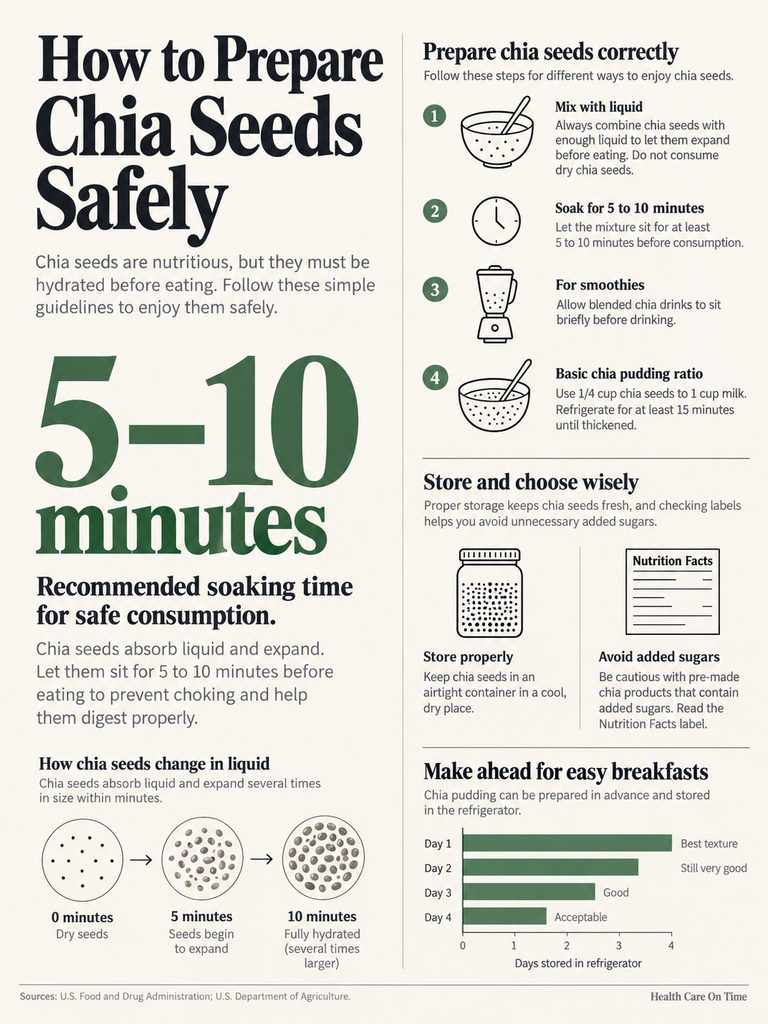
Chia is easy to use, but there’s one rule you shouldn’t break: don’t eat the seeds dry by the spoonful.
The American College of Gastroenterology has highlighted a case of chia seeds swelling and blocking the esophagus. The blockage needed an endoscopy to clear. ACG advises mixing chia with enough liquid to expand before eating, especially for anyone with swallowing problems or a narrowed esophagus.
Soaking basics
WebMD recommends soaking chia for 5 to 10 minutes before eating. The seeds soften and form their gel, which is the part linked to slower glucose absorption anyway.
For smoothies, let the blended drink sit a few minutes before you sip. For baking, the Ho trial found that chia baked into bread still blunted spikes.
Simple chia pudding ratio
Harvard Health suggests a quarter cup of chia seeds stirred into one cup of milk (almond, soy or dairy), refrigerated for at least 15 minutes. The American Diabetes Association’s Diabetes Food Hub uses the same ratio and splits it into three servings, chilled for two hours.
To keep pudding blood-sugar friendly:
- Use unsweetened milk or a plain milk alternative.
- Sweeten lightly with cinnamon, vanilla or a few berries.
- Skip honey, maple syrup and flavored yogurt, which can undo the benefit.
- Watch portion size, since toppings add carbs fast.
Buying and storing chia
Black and white chia seeds are both sold in U.S. grocery stores. Look for plain seeds with no added sugar or flavoring. Pre-made chia drinks and puddings often add sweeteners, so read the Nutrition Facts label and compare the added sugar line.
Store seeds in an airtight container in a cool, dry pantry. A batch of plain pudding keeps well in the fridge for a few days, which makes weekday breakfasts easy.
Side Effects, Medications and Who Should Be Careful
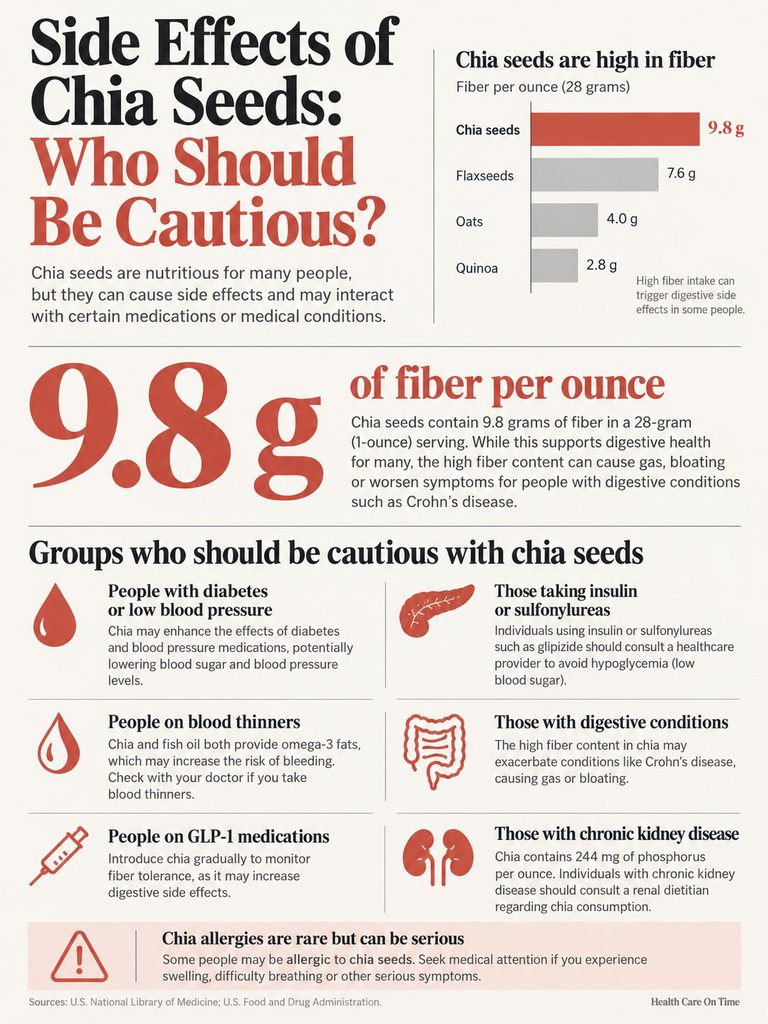
For most people, chia is safe as part of meals. Still, a few groups should talk with a doctor or registered dietitian first.
Diabetes and blood pressure medicines
WebMD warns that because chia may lower both blood sugar and blood pressure, it could add to the effect of medicines for either. That matters most if you use insulin or a sulfonylurea such as glipizide, which can push glucose too low.
The CDC defines low blood sugar as below 70 mg/dL and severe low as below 55 mg/dL. If you go low, the CDC’s 15-15 rule applies: take 15 grams of fast carbs, wait 15 minutes and recheck.
Blood thinners
WebMD also advises checking with your doctor if you take an anticoagulant, especially if you already use fish oil, since both supply omega-3 fats.
Digestive conditions
High fiber can cause gas, bloating, constipation or diarrhea, and WebMD notes chia may worsen flares of inflammatory bowel conditions like Crohn’s disease. If you’re on a GLP-1 medicine and already feel full fast, add chia slowly; our Mounjaro diet guide covers fiber tolerance on these drugs.
Kidney disease
USDA data puts phosphorus at 244 mg per ounce. If you have chronic kidney disease and follow a phosphorus or potassium limit, ask your renal dietitian before adding chia daily.
Allergy
Chia allergies are rare, but WebMD notes symptoms can include vomiting, diarrhea and itchy lips or tongue, and severe reactions can be life-threatening. Stop eating chia and get help if you notice swelling or trouble breathing.
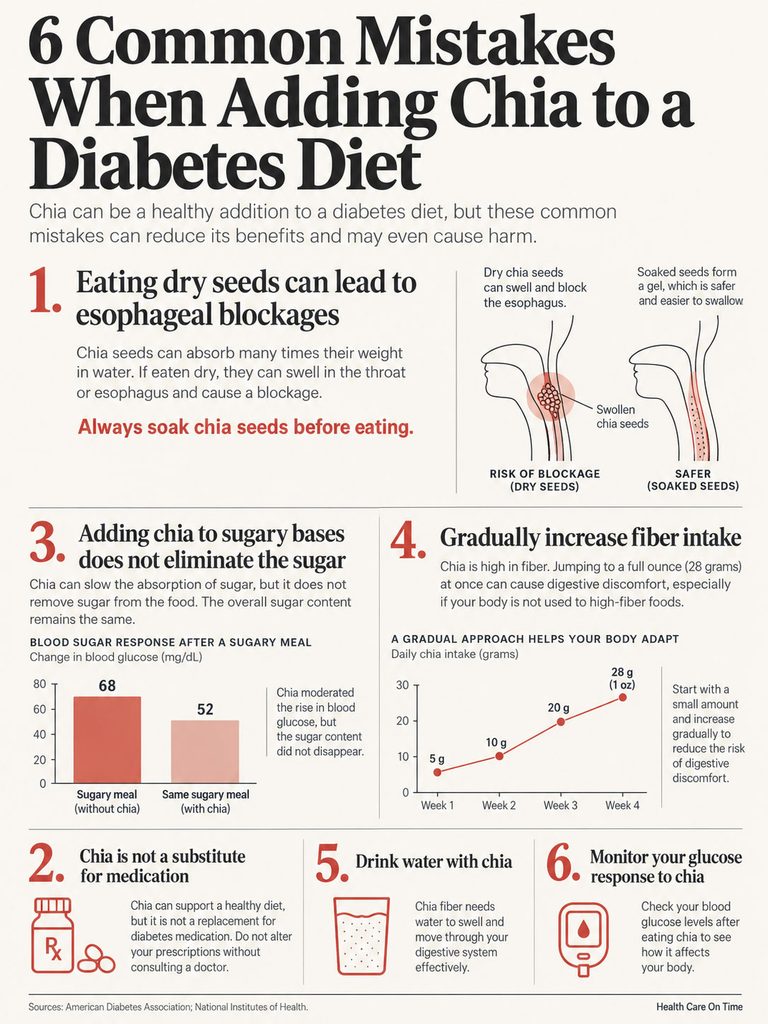
6 Common Mistakes When Adding Chia to a Diabetes Diet
When our editors compared top-ranking chia pages with the trial data, the same gaps kept showing up. These are the mistakes that most often cancel out the benefit.
1. Eating dry seeds
This is the one with real safety risk. Dry seeds swell after you swallow them, which is how esophageal blockages happen. Always soak first.
2. Treating chia as a medicine
The 2024 meta-analysis found no significant A1C effect. If you cut back on medicine because you started chia, your numbers can climb. Never change a prescription without your doctor.
3. Adding it to a sugary base
Chia stirred into sweetened yogurt, bottled smoothies or pudding made with syrup still delivers that sugar. The fiber softens the rise; it doesn’t erase it.
4. Going from zero to a full ounce
Ten grams of extra fiber in one day is a big jump if your usual diet is low in it. Most adults already fall short on fiber, so build up over two to three weeks.
5. Forgetting the water
Fiber needs fluid to work comfortably. Pair each chia serving with a glass of water, especially if you’re prone to constipation.
6. Not checking the result
Your body is the real test. Check your glucose two hours after a usual meal, then repeat with the same meal plus soaked chia on another day. If your meter or CGM shows a smaller rise, chia is earning its spot.
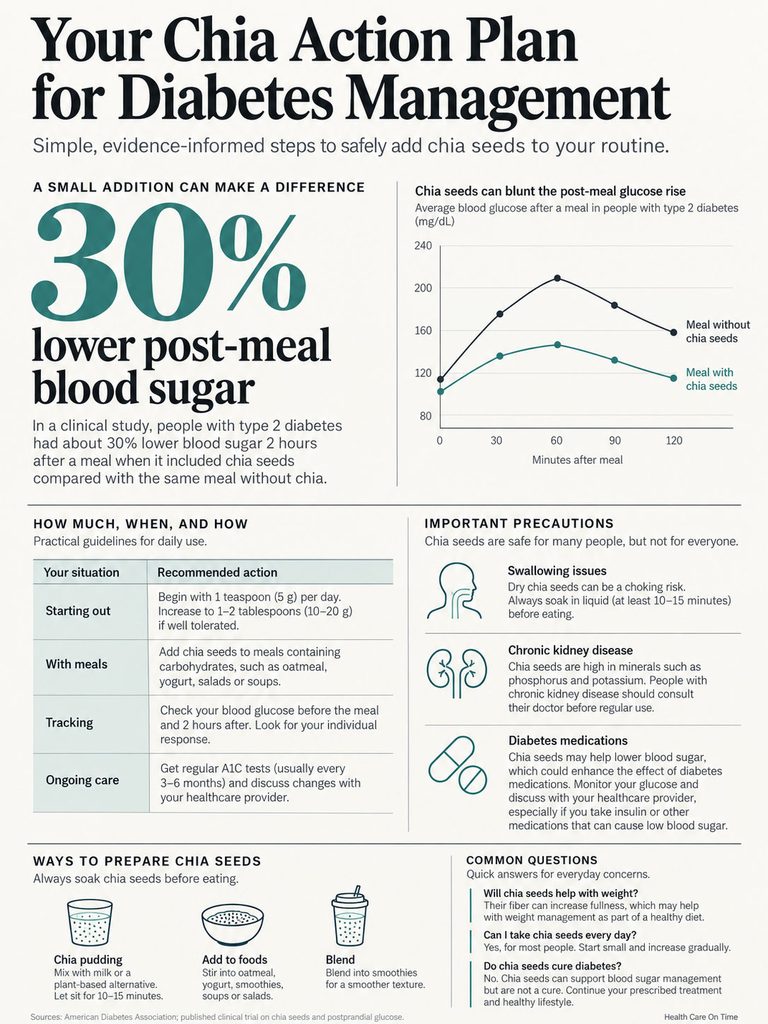
Your Chia Action Plan
Use this table to match your situation to a safe next step. Our medical content team built it from the trials and federal sources above.
| If this is you | Recommended action | Why |
| Type 2 diabetes managed with diet or metformin | Add 1 tbsp soaked chia to your biggest carb meal; build toward 1 oz over 3 weeks | Trials used 25 to 40 g/day; slow build limits GI upset |
| On insulin or a sulfonylurea | Check glucose 2 hours after chia meals for the first 2 weeks; tell your care team | Fiber can lower post-meal glucose; CDC low is below 70 mg/dL |
| On blood pressure pills | Track home readings for 2 weeks after starting | Two diabetes trials found lower systolic pressure on chia |
| Trouble swallowing or esophageal narrowing | Only eat chia fully soaked or as pudding, or skip it | ACG reports chia esophageal impaction |
| Chronic kidney disease | Ask your renal dietitian first | 244 mg phosphorus per ounce |
| Hoping to lower A1C | Don’t rely on chia alone; focus on overall diet, activity and medicines | 2024 meta-analysis: no significant A1C effect |
Track your progress with an A1C test every few months as your doctor advises. Our HbA1c test overview explains what the numbers mean.
When to see a doctor
Call your doctor if you have repeated lows after adding chia, ongoing stomach pain or changes in bowel habits. Seek urgent care right away if food feels stuck in your chest, you can’t swallow your saliva, or you have signs of a severe allergic reaction.
Frequently Asked Questions
Can diabetics eat chia seeds every day?
Yes, most people with diabetes can eat chia seeds daily as part of meals. Diabetes trials gave 30 to 40 grams a day for 12 weeks to 6 months, and the 2007 trial saw no changes in liver, kidney or clotting tests. Start with 1 tablespoon, build up slowly and track your glucose.
How much chia seeds per day for diabetes?
There’s no official dose. Trials in people with type 2 diabetes used about 30 to 40 grams a day, roughly 1 to 1.4 ounces. A safer approach is starting with 1 tablespoon and working up to 1 ounce over a few weeks. Weigh your spoon once so you know what you’re eating.
Do chia seeds raise blood sugar?
Chia seeds barely raise blood sugar on their own. One ounce has 11.9 grams of carbs, but 9.8 grams is fiber, leaving about 2 grams of net carbs. In trials, chia actually reduced the post-meal glucose rise when eaten with carbohydrate foods, with larger doses showing a bigger effect.
Can chia seeds lower A1C?
Not reliably. A 2024 meta-analysis of 8 randomized trials and 362 people found no significant effect on A1C, fasting glucose or insulin. The A1C change leaned slightly lower but wasn’t statistically significant. Chia works best as part of a fiber-rich diet, not as an A1C treatment.
When should diabetics eat chia seeds?
Eat chia with your highest-carb meal of the day, because trials that showed a benefit gave it alongside carbohydrate. Breakfast with oatmeal or fruit is a common choice. Eating chia by itself hours away from a meal is unlikely to change your post-meal blood sugar much.
How should diabetics prepare chia seeds?
Soak them in water, milk or yogurt for at least 5 to 10 minutes before eating, or make chia pudding with a quarter cup of seeds per cup of unsweetened milk. Never eat dry chia by the spoonful, since the seeds swell and have caused esophageal blockages.
Which seed is best for diabetics, chia or flax?
Both are good choices. Per ounce, chia has more fiber (9.8 g versus 7.7 g), while flax has more ALA omega-3 and fewer net carbs. In a 2017 head-to-head study, chia lowered peak post-meal glucose and appetite more than flax. Rotating both gives you the strengths of each.
Is chia pudding good for diabetics?
Chia pudding can be a smart snack if you make it with unsweetened milk and skip added sugar. The American Diabetes Association’s Diabetes Food Hub shares a version using a quarter cup of chia and one cup of milk. Sweeten with cinnamon, vanilla or berries, and keep portions to about a third of a cup.
Can chia seeds cause low blood sugar?
Chia alone is unlikely to cause low blood sugar. The risk comes when it adds to insulin or sulfonylurea drugs that already lower glucose. The CDC defines low blood sugar as below 70 mg/dL. Check your levels more often when you first add chia and tell your care team.
Do chia seeds interact with diabetes medications?
Chia doesn’t block how diabetes drugs work, but it may add to their glucose-lowering and blood pressure-lowering effects. WebMD advises extra caution for people on diabetes or blood pressure medicines and blood thinners. Talk with your doctor or pharmacist before eating chia daily.
Are chia seeds good for weight loss with diabetes?
They may help a little. In a 6-month trial of 77 overweight adults with type 2 diabetes, people eating chia lost 1.9 kg (about 4.2 pounds) versus 0.3 kg on oat bran, plus more waist reduction. That’s modest, and chia still adds 138 calories per ounce.
Do you need to grind chia seeds?
No. Unlike flaxseed, chia seeds can be eaten whole. A 2013 trial found whole and ground chia lowered post-meal blood sugar equally, with no difference between the two forms. Soaking matters more than grinding, both for safety and for the gel that slows sugar absorption.
Medical Disclaimer: This article is for general education and isn’t medical advice. HealthCareOnTime does not diagnose or treat any condition. Talk with your doctor, diabetes educator or registered dietitian before changing your diet, especially if you take insulin, sulfonylureas, blood pressure medicines or blood thinners, or have kidney disease or swallowing problems.
References
- USDA FoodData Central API, SR Legacy FDC IDs 170554, 169414, 170556, 170562
- Pam P, et al. The effectiveness of chia seed in improving glycemic status: a systematic review and meta-analysis. Diabetes Metab Syndr. 2024;18(6):103065
- Teoh SL, et al. Clinical evidence on dietary supplementation with chia seed: a systematic review and meta-analysis. Nutr Rev. 2018;76(4):219-242
- Vuksan V, et al. Supplementation of conventional therapy with the novel grain Salba improves cardiovascular risk factors in type 2 diabetes. Diabetes Care. 2007;30(11):2804-10
- Vuksan V, et al. Salba-chia in the treatment of overweight and obese patients with type 2 diabetes. Nutr Metab Cardiovasc Dis. 2017;27(2):138-146
- Alwosais EZM, et al. Chia seed supplementation in adults with type 2 diabetes improved systolic blood pressure. Nutr Health. 2021;27(2):181-189
- Ho H, et al. Effect of whole and ground Salba seeds on postprandial glycemia. Eur J Clin Nutr. 2013;67:786-788
- Vuksan V, et al. Comparison of flax and Salba-chia seeds on postprandial glycemia and satiety. Eur J Clin Nutr. 2017;71:234-238
- Tavera-Hernández R, et al. Chia, a pre-Hispanic food in the treatment of diabetes mellitus. Molecules. 2023;28(24):8069
- CDC: National Diabetes Statistics Report, At a Glance
- CDC: Treatment of Low Blood Sugar (Hypoglycemia)
- CDC: Carb Choices
- FDA: Daily Value on the Nutrition and Supplement Facts Labels
- NIH Office of Dietary Supplements: Omega-3 Fatty Acids
- American College of Gastroenterology: Esophageal Impaction With Chia Seeds
- WebMD: Health Benefits of Chia Seeds
- Harvard Health: Seed of the Month, Chia Seeds
- American Diabetes Association Diabetes Food Hub: Chocolate Peanut Butter Chia Seed Pudding
- HealthDay: Fewer Than 1 in 10 American Adults Get Enough Dietary Fiber
- Florida Department of Health: Dietary Fiber