
Brown is not a warning color. It is a clock.
The shade of what you find on your underwear tells you how long that blood sat inside your body before it left, not what put it there. Fresh blood moving fast looks red. Blood moving slowly meets oxygen, the iron in it oxidizes, and it turns rust, coffee, or nearly black.
Table of Contents
That one fact rules out most of what people panic about. It also points straight at the three questions that actually matter: when in your cycle it showed up, how long it lasted, and what came with it.
Quick Answer: Brown discharge with no period is old blood that left the uterus slowly enough to oxidize. The most common causes are the tail end of a light period, ovulation spotting, and breakthrough bleeding on hormonal birth control. Take a pregnancy test if a period is late. Any bleeding after menopause, or spotting with one-sided pelvic pain and a positive test, needs same-week evaluation.
At a Glance
- Brown reflects timing and flow speed, not blood quality, hygiene, or infection.
- Three questions narrow the cause fast: where in your cycle, how many days, and what else you feel.
- Abnormal uterine bleeding affects 10% to 30% of reproductive-age women, so this is common, not rare.
- Only about 4.8% of regularly cycling women record true mid-cycle bleeding, which makes ovulation spotting less common than the internet suggests.
- The strongest prospective study on implantation bleeding found no support for it as a cause.
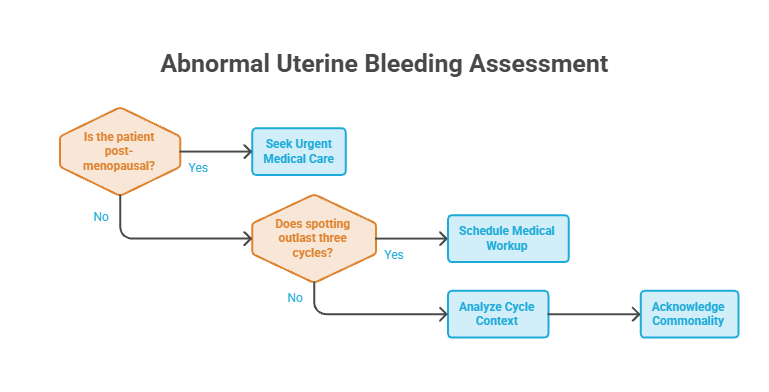
- One version of this symptom is always urgent: any bleeding after menopause.
- Spotting that outlasts three cycles has earned a workup, whatever your age.
What Brown Discharge Actually Is (And Why the Color Fools People)
Menstrual blood is red when it moves quickly. When flow slows to a trickle, blood lingers in the uterus or upper vagina and reacts with oxygen.
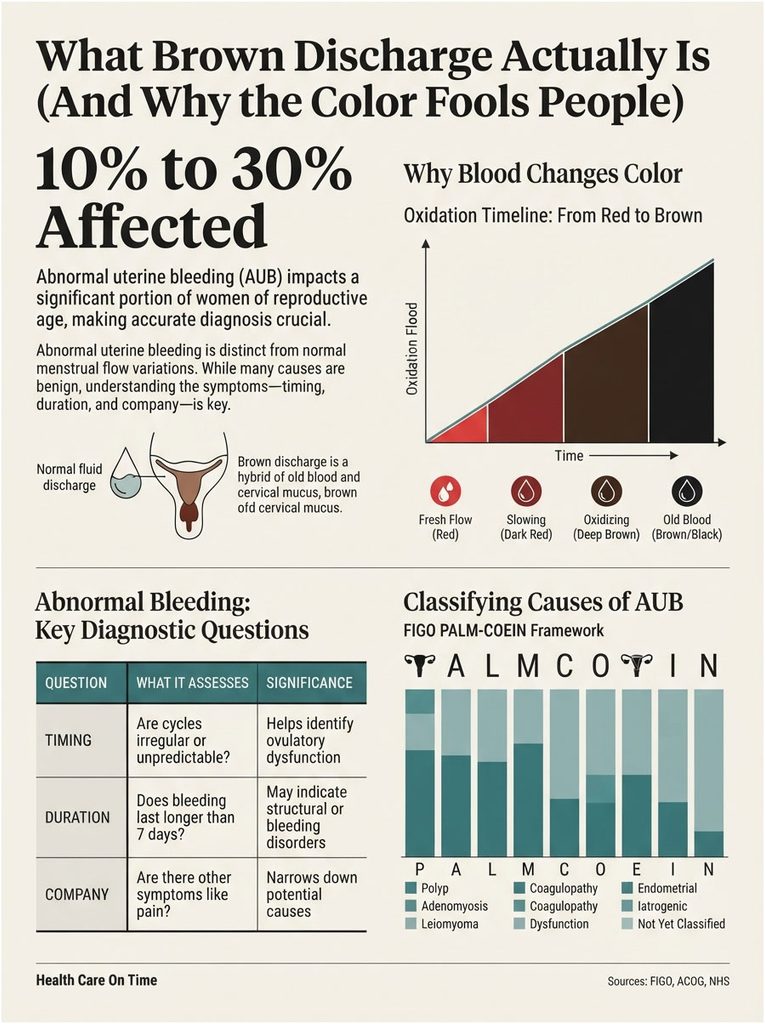
Hemoglobin darkens as it oxidizes, the same way a cut on your arm scabs from red to brown. Mixed with normal cervical mucus, a very small amount of that older blood produces the tan, rust, or chocolate streaks people describe.
The Oxidation Timeline
Think of it as a sliding scale rather than distinct categories. Blood that exits within a few hours stays bright red. Blood held for half a day turns dark red or maroon.
Blood held a full day or longer arrives brown. Blood held longest, often from a lining that has been shedding in slow patches, can look almost black.
Volume matters far more than color. A quarter-teaspoon of old blood can stain a liner dramatically and still represent almost no blood loss at all.
Discharge Versus Bleeding
Clinicians separate the two because they mean different things. Discharge is cervical and vaginal fluid, which is normal, cyclical, and shifts from clear and stretchy near ovulation to thick and white afterward.
Bleeding is blood. Brown discharge is a hybrid: normal fluid carrying a small amount of old blood.
Patients booking hormone panels through HealthCareOnTime often describe it as spotting that is not really spotting, which is a fair description of what they are seeing.
The Three Questions That Narrow It Fastest
Timing comes first. Brown in the two days before or after a period behaves very differently from brown on day 14, and both differ from brown three years after your last period.
Duration comes second. One or two days is a footnote. Seven days, or every month for four months running, is a pattern.
Company comes third. Odor, fever, pelvic pain, pain during sex, or bleeding after sex changes the shortlist immediately.
This is not a fringe complaint. The American Academy of Family Physicians reports that abnormal uterine bleeding affects 10% to 30% of women of reproductive age, and clinicians classify the causes using the FIGO PALM-COEIN framework, which splits them into structural problems you can image and non-structural ones you cannot.
Bleeding that happens between otherwise normal periods has its own name: intermenstrual bleeding. Naming it correctly matters, because it sends a clinician down a different diagnostic path than heavy periods would.
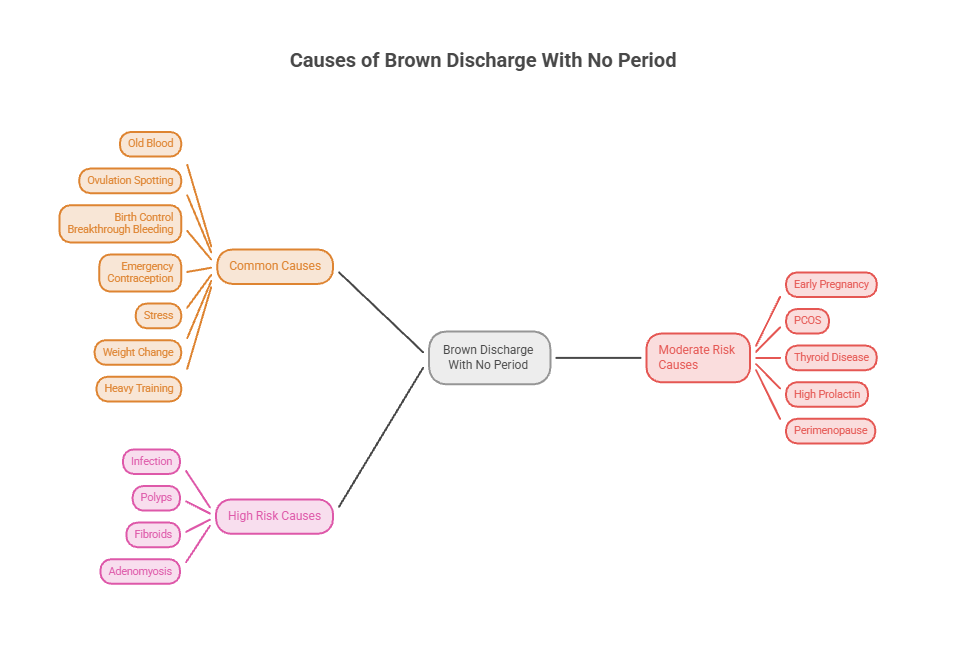
The 11 Causes of Brown Discharge With No Period
Our medical reviewers grouped these by how often they turn up in practice and how much attention each one deserves. Find your timing in the table, then read the matching section below it.
| Cause | Typical timing in cycle | How long it lasts | Other clues | How common | Risk level |
| 1. Old blood from a light or ending period | Days 1 to 2, or days 4 to 7 | 1 to 3 days | Cycle otherwise on schedule | Very common | Low |
| 2. Ovulation spotting | Days 12 to 16 | 1 to 2 days | One-sided twinge, stretchy mucus | 4.8% of cycling women | Low |
| 3. Birth control breakthrough bleeding | Any day, unpredictable | Days to weeks | Started or switched method within 3 to 6 months | Very common on LARC | Low |
| 4. Emergency contraception or missed pills | 3 to 10 days after the dose | 2 to 7 days | Next period early or late by up to a week | Common | Low |
| 5. Early pregnancy | Around the missed period | 1 to 3 days | Breast tenderness, nausea, fatigue | 25% have first-trimester bleeding | Low to moderate |
| 6. Stress, weight change, heavy training | Replaces a period entirely | 2 to 5 days | Cycle stretched past 35 days | Common | Low to moderate |
| 7. PCOS | Irregular, often 6 to 12 cycles a year | Variable | Acne, coarse hair growth, weight changes | 7% to 10% of US women | Moderate |
| 8. Thyroid disease or high prolactin | Irregular | Variable | Fatigue, weight shift, nipple discharge | Underdiagnosed | Moderate |
| 9. Perimenopause | Skipped then irregular cycles | Variable | Hot flashes, sleep changes, age 40+ | Near-universal in transition | Moderate |
| 10. Infection (BV, STI, cervicitis, PID) | Any day | Persistent | Odor, itching, pain, bleeding after sex | Common | Moderate to high |
| 11. Polyps, fibroids, adenomyosis, retained tampon | Any day, often after sex | Persistent or recurrent | Heavy periods, pressure, foul odor | Common after 35 | Moderate to high |
1. Old Blood Finishing or Starting a Very Light Period
This is the single most common answer, and the one people least often accept.
Menstrual flow does not switch on and off cleanly. It ramps up across a day or two and tapers across another two or three, and those slow phases at each end are exactly when oxidation happens.
If your period arrived roughly on schedule but amounted to three days of brown with barely any red, you most likely had a light period rather than no period at all.
Why Light Cycles Happen
A single light cycle rarely means anything. Illness in the previous month, long-haul travel, a stressful stretch at work, a new medication, or simple month-to-month variation all produce one.
The pattern that matters is repetition. Three or four consecutive brown-only cycles is a different signal from one.
2. Ovulation Spotting
Around day 14, estrogen dips briefly before progesterone takes over. In some women that dip destabilizes the uterine lining just enough to release a trace of blood, which oxidizes on its slow way out.
It is less common than the internet claims. In the BioCycle Study, which tracked 201 regularly menstruating American women across two consecutive cycles using daily diaries and pictograms, only 4.8% recorded mid-cycle bleeding.
Real ovulation spotting is brief, one to two days, and often arrives with a one-sided pelvic twinge and clear, stretchy cervical mucus. If your ovulation spotting runs five days or lands on wildly different cycle days each month, something else is driving it.
3. Hormonal Birth Control Breakthrough Bleeding
Any method that thins the uterine lining can produce unpredictable brown spotting. The thinner the lining gets, the less blood there is to expel quickly, and slow-moving blood turns brown.
The numbers here are far larger than most people are told at the pharmacy counter. Across the trials behind the etonogestrel implant, summarized in the FDA prescribing information, users averaged 17.7 days of bleeding or spotting per 90-day interval.
Broken down by pattern across any given 90 days, about 34% had infrequent bleeding, 22% had no bleeding at all, 18% had prolonged bleeding, and 7% had frequent bleeding. Irregular bleeding was the top reason users stopped the method, cited by 10.8%.
Method by Method
Combined pills, the patch, and the ring: spotting between periods is most likely during the first three cycles and after missed or late doses. Continuous and extended regimens spot more than cyclic ones.
Hormonal IUDs: expect irregular spotting for three to six months after insertion. Many users then stop bleeding entirely, with occasional brown streaks that mean nothing.
The implant and the shot: the least predictable of the group. The pattern you see in the first three months tends to predict the pattern you get later on.
When Adjustment Stops Being Adjustment
Our medical reviewers treat the three to six month window as the practical dividing line. Spotting that continues past six months, or that appears fresh after a year of stable use, deserves a conversation rather than more patience.
New bleeding on a method that had settled is not the method behaving badly. It is a reason to look for something else.
4. Emergency Contraception or Missed Pills
A high-dose progestin such as levonorgestrel delivers a hormonal jolt that can trigger a withdrawal bleed a few days later, often light and brown.
It can also shift the next period by up to a week in either direction, which is where most of the anxiety comes from. Missed or doubled-up combined pills produce a smaller version of the same effect.
The rule of thumb is simple. If a period is more than seven days late after emergency contraception, test for pregnancy rather than assuming the pill explains the delay.
5. Early Pregnancy
Bleeding in early pregnancy is common and usually not the disaster it feels like. In a prospective cohort of 5,425 pregnancies, 25.0% of participants reported first-trimester bleeding, and bleeding on its own was not linked to a higher risk of pregnancy loss.
That is reassuring, and it is also why a pregnancy test beats guesswork every time.
The Implantation Bleeding Myth, Corrected
Nearly every page on this topic states that implantation causes brown spotting six to twelve days after ovulation. The best prospective evidence does not support it.
Researchers running the North Carolina Early Pregnancy Study followed 221 women with daily diaries and daily urine hormone assays, which let them pinpoint the actual day of implantation rather than estimate it. Among 151 clinical pregnancies, 14 women (9%) recorded any bleeding in the first eight weeks, and that bleeding rarely fell on the implantation day itself.
The authors concluded they found no support for the idea that implantation produces vaginal bleeding. A separate study of 549 women trying to conceive went further, reporting that intermenstrual bleeding actually lowered the odds of conceiving in that cycle.
The practical takeaway: brown spotting before a due period is more likely to mean a period is coming than a pregnancy is starting. Test anyway, because a test costs less than the worry does.
When to Test, and Why Timing Beats Brand
Home urine tests detect hCG from roughly 20 to 25 mIU/mL. Testing on or after the day of a missed period, using first-morning urine, gives a reliable result for most people.
Testing four days early does not, regardless of what the box promises. If a first test reads negative and the period still has not arrived, repeat it in 48 to 72 hours before drawing any conclusion.
Patients commonly ask us whether an expensive brand tests earlier than a cheap one. In practice, the timing of the test matters far more than the price of it.
6. Stress, Rapid Weight Change, or Heavy Training
When the brain reads your body as being under strain, it dials down the signals that drive ovulation. No ovulation means no progesterone surge, and no progesterone surge means no organized shedding.
Instead the lining thickens unevenly and releases in patches, which produces several days of brown rather than a defined period. This is one of the most common reasons for brown discharge instead of a period in women under 35.
Typical triggers include a job change, a bereavement, a new marathon training block, a fast weight loss phase, an illness, or a long stretch of poor sleep.
Cycles usually reset within one to three months once the pressure eases. Cycles that stay absent for three months or longer should be investigated rather than waited out.
7. Polycystic Ovary Syndrome
PCOS interrupts ovulation, and the result is often long gaps between periods punctuated by brown spotting instead of clean monthly bleeds.
It is one of the most common endocrine conditions in the country and one of the most frequently missed. Estimates place PCOS at 7% to 13% of women globally with roughly 70% of cases undiagnosed, and US prevalence at 7% to 10%, about 5 million American women.
Other signals include acne persisting past the teen years, coarse hair growth on the face or torso, scalp hair thinning, weight gain that resists effort, and difficulty conceiving.
Across patients booking hormone panels with us, this exact combination arrives regularly with no prior workup attached to it. Diagnosis uses the Rotterdam criteria, which require two of three findings: irregular ovulation, clinical or laboratory evidence of high androgens, and polycystic ovarian morphology on ultrasound.
8. Thyroid Disease and Elevated Prolactin
Thyroid hormone and prolactin both sit upstream of the reproductive axis, so problems in either one show up downstream as cycle chaos.
An underactive thyroid tends to produce heavier, longer, or more frequent bleeding. An overactive thyroid tends to lighten periods or stop them, leaving brown spotting in their place.
Elevated prolactin suppresses ovulation directly and can cause milky nipple discharge in women who are not breastfeeding. Certain medications, including some antipsychotics and antinausea drugs, raise it as a side effect.
Both are inexpensive to check and straightforward to treat. Across the panels ordered through our diagnostic network, TSH and prolactin are among the highest-yield first tests for unexplained irregular bleeding in women under 40.
9. Perimenopause
The menopause transition typically begins in the mid-40s and runs four to eight years. Estrogen does not decline in a straight line during that stretch; it swings.
Ovulation becomes intermittent, so some months produce a real period and others produce three days of brown and nothing more. Cycles shorten, then lengthen, then skip entirely.
Accompanying signs include hot flashes, night sweats, disrupted sleep, mood shifts, and vaginal dryness.
Brown spotting in this window is expected. Heavy bleeding, bleeding between periods, or bleeding after sex is not, and each should be evaluated even when perimenopause explains everything else you are feeling.
10. Infection: Bacterial Vaginosis, STIs, Cervicitis, and PID
Inflamed cervical tissue bleeds easily, and a small volume of that blood mixes with discharge and oxidizes on the way out.
Bacterial vaginosis classically produces thin gray discharge with a fishy odor, sometimes tinged brown. Chlamydia and gonorrhea are frequently silent, but when they do announce themselves, spotting between periods and bleeding after sex are among the first signs.
The scale is significant. CDC surveillance recorded more than 2.2 million reported cases of chlamydia, gonorrhea, and syphilis in 2024. Chlamydia declined 8% from the prior year, but the total burden remains 13% above where it stood a decade earlier.
Untreated infection can ascend into pelvic inflammatory disease, which carries genuine risks to future fertility. Brown discharge with fever, pelvic pain, pain during sex, or foul odor should be tested rather than watched.
11. Polyps, Fibroids, Adenomyosis, Endometriosis, and Retained Objects
Structural causes climb sharply with age, which is why the same symptom means something different at 25 and at 45.
Endometrial and cervical polyps are soft, vascular growths that bleed on contact. That is why brown spotting after sex is such a useful clue, and why clinicians ask about it early.
Fibroids distort the uterine cavity and typically cause heavy periods plus spotting in between, often alongside pelvic pressure or urinary frequency. Adenomyosis, where lining tissue grows into the uterine muscle wall, produces painful heavy periods with brown spotting on either side of them.
Endometriosis can cause spotting in the days before a period along with pain that outpaces what the bleeding alone would explain.
A retained tampon or condom belongs on this list and is easy to overlook. It produces persistent brown or gray discharge with a strong, unmistakable odor, and it resolves within a day or two of removal.
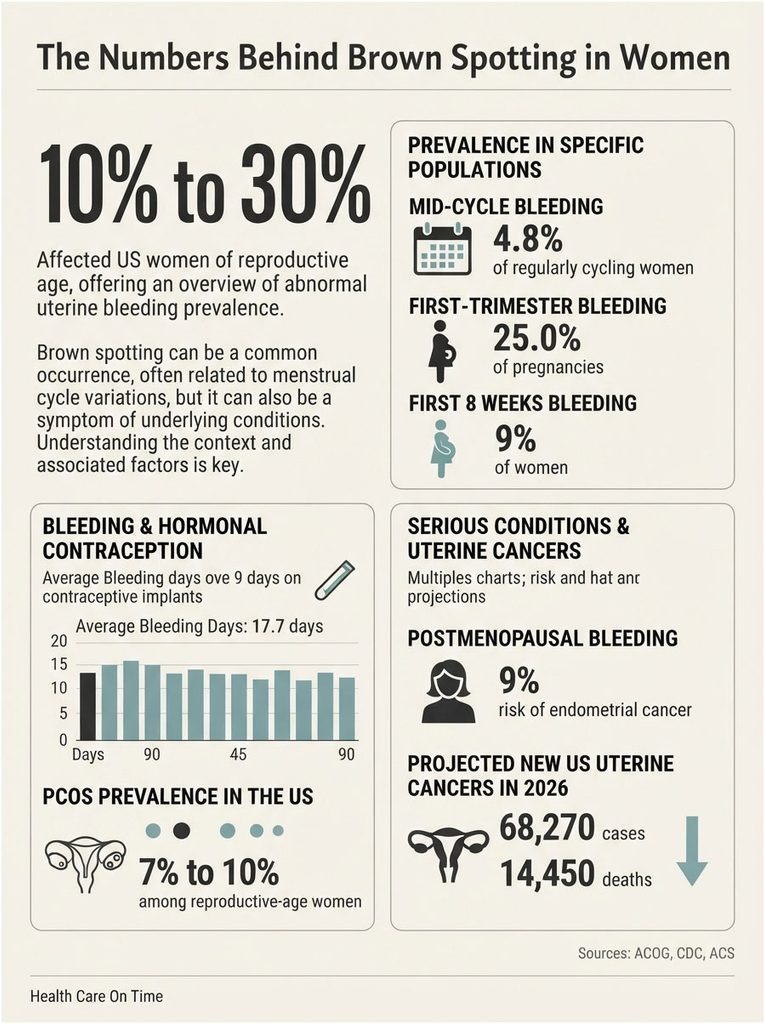
The Numbers Behind the Symptom
Most articles on this topic call brown spotting common without ever saying how common. Here is what the American data actually shows.
| Statistic | Figure | Population | Source |
| Abnormal uterine bleeding prevalence | 10% to 30% | US women of reproductive age | American Academy of Family Physicians clinical review |
| Mid-cycle bleeding recorded | 4.8% of women | 201 regularly cycling women, BioCycle Study, Buffalo NY | Dasharathy et al., Am J Epidemiol 2012;175(6):536-545 |
| First-trimester bleeding | 25.0% | 5,425 prospectively followed pregnancies | Obstetrics & Gynecology prospective cohort |
| Any bleeding in first 8 weeks of clinical pregnancy | 9% (14 of 151 women) | North Carolina Early Pregnancy Study | Harville et al., Hum Reprod 2003;18(9):1944-1947 |
| Bleeding days on the contraceptive implant | 17.7 days per 90 days | 780 trial participants, 3,315 intervals | Nexplanon US prescribing information, FDA |
| PCOS prevalence in the US | 7% to 10%, about 5 million women | US reproductive-age women | Peer-reviewed NHANES-linked analysis |
| Endometrial cancer risk with postmenopausal bleeding | 9% pooled | 34,432 women across 129 studies | Clarke et al., JAMA Intern Med 2018;178(9):1210-1222 |
| Projected new US uterine cancers | 68,270 cases, 14,450 deaths | United States, 2026 estimate | American Cancer Society, Cancer Facts & Figures 2026 |
Two rows deserve a second look.
The 4.8% figure means ovulation spotting is real but far less universal than commonly claimed. It should not be the default explanation for spotting that repeats month after month.
The 9% row is the one that changes decisions, and it gets its own section below.
When Brown Discharge Is a Red Flag
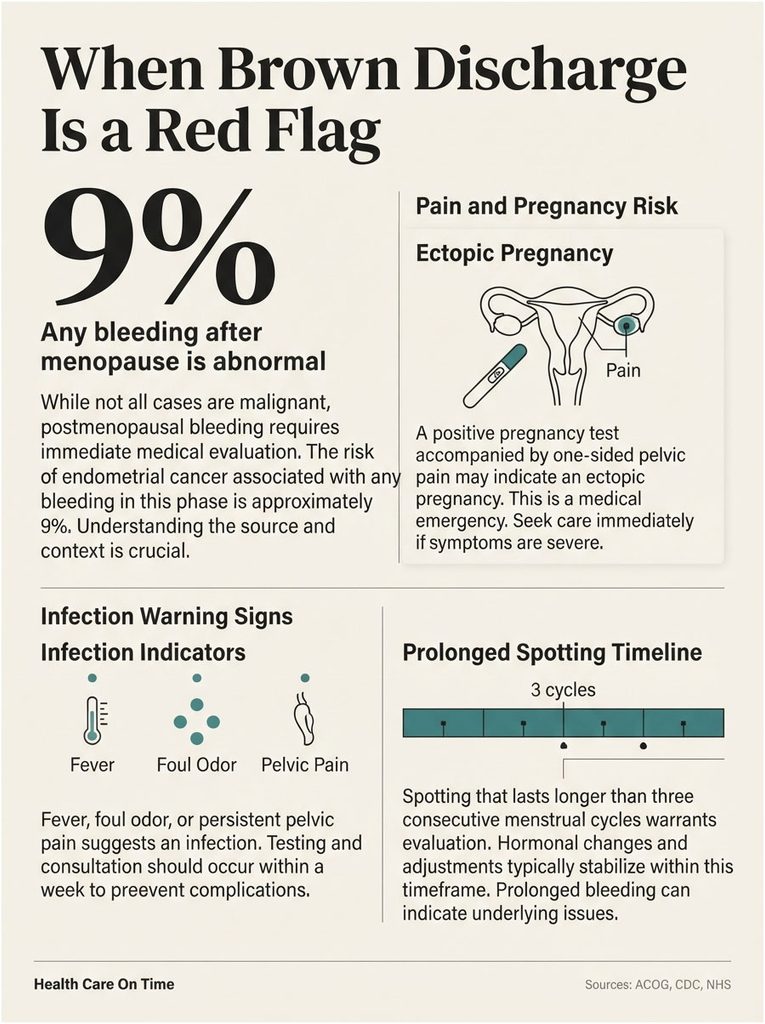
Four situations move this symptom out of the wait-and-watch category entirely.
Any Bleeding After Menopause
Menopause is defined as twelve consecutive months without a period. After that point there is no normal amount of bleeding, and brown counts just as much as red.
A National Cancer Institute meta-analysis of 129 studies covering 40,790 women found that postmenopausal bleeding carried a 9% pooled risk of endometrial cancer, and that 91% of women eventually diagnosed with endometrial cancer had reported it.
Read that pairing carefully, because both halves matter. Nine out of ten women with this symptom will not have cancer, and nine out of ten cancers announce themselves this way.
That is precisely why outcomes here are as good as they are. The American Cancer Society projects 68,270 new uterine cancers and 14,450 deaths in the United States in 2026, with an average diagnosis age of 60 and about 68% caught at an early stage, largely because bleeding sends people to a doctor.
Uterine cancer is also one of the few cancers with a rising death rate, up 1.6% per year from 2014 to 2023. The death rate in Black women is nearly double that in White women, a gap attributed largely to unequal access to timely, high-quality care. Delay is the enemy here, not the symptom.
A Positive Pregnancy Test With One-Sided Pain
Ectopic pregnancy accounts for roughly 1% to 2% of US pregnancies but 3% to 4% of pregnancy-related deaths, and about 90% implant in a fallopian tube.
The classic combination is a positive test, light brown spotting, and pain concentrated on one side of the pelvis.
Shoulder-tip pain, dizziness, or fainting alongside that picture means an emergency room now, not an appointment next week. Those signs suggest internal bleeding.
Fever, Foul Odor, or Pelvic Pain
This trio points toward infection, and infection in the upper reproductive tract does lasting damage when it is left alone.
Testing within the week is the right response. Same-day care is warranted if fever climbs or pain worsens quickly.
Spotting That Outlasts Three Cycles
Three months is the practical threshold most clinicians use. Hormonal adjustment, a stressful stretch, or a new contraceptive method should have settled by then.
In cases reviewed by our medical team, the patients who wait longest before seeking evaluation are almost always the ones who found a plausible explanation early and stopped asking questions.
What to Do Next, Step by Step
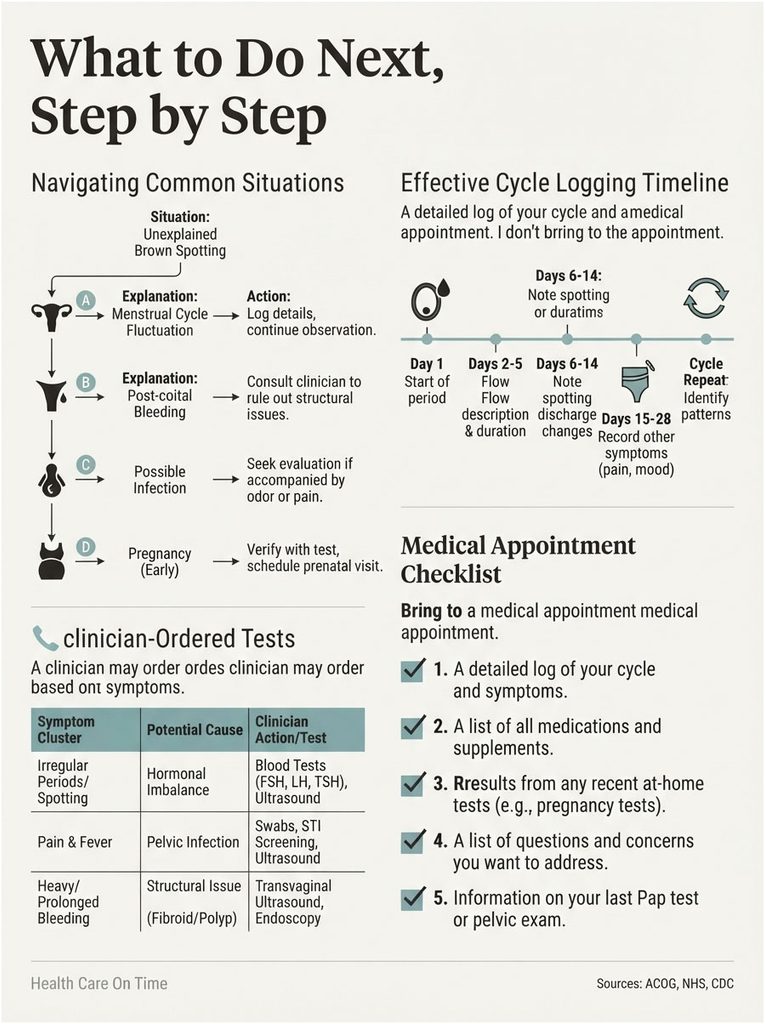
| Your situation | Most likely explanation | What to do | How soon |
| Brown for 1 to 2 days, period arrived on time | End or start of a light period | Log it, no action needed | Not urgent |
| Brown around day 14, one-sided twinge | Ovulation spotting | Track for two more cycles | Not urgent |
| Started a new birth control method within 3 months | Breakthrough bleeding | Continue the method, log the pattern | Review at 6 months |
| Period more than 7 days late, brown spotting only | Possible pregnancy or anovulation | Home pregnancy test with first-morning urine, repeat in 72 hours if negative | Within 3 days |
| Positive pregnancy test plus one-sided pelvic pain | Possible ectopic pregnancy | Emergency room or urgent care | Immediately |
| Brown discharge with odor, itching, fever, or pain after sex | Infection or retained object | Clinician visit, STI and BV testing | Within 1 week |
| Any bleeding 12+ months after your last period | Postmenopausal bleeding | Clinician visit for ultrasound and biopsy | Within 1 to 2 weeks |
| Irregular spotting across 3 or more cycles, no clear trigger | Hormonal or structural cause | Hormone panel plus pelvic ultrasound | Within 1 month |
The Five-Minute Cycle Log
Write down four things every time it happens: the date, the cycle day, the color, and anything else you felt that day. Add whether you had sex in the previous 48 hours.
Two or three months of that log answers more questions than any single test will. It also turns a vague ten-minute appointment into a productive one.
Cycle day means counting from the first day of your last real period, not from the spotting.
Tests a Clinician May Order
A urine or serum hCG comes first in anyone who could be pregnant, because a positive result changes every step that follows.
TSH and prolactin screen the two upstream hormone problems that most often disrupt cycles. A CBC with ferritin checks whether the bleeding has cost you iron, which matters more than people expect when spotting has run for months.
NAAT swabs test for chlamydia and gonorrhea, and a wet mount or vaginal pH check screens for bacterial vaginosis.
Transvaginal ultrasound images the uterine lining thickness, fibroids, and polyps. Endometrial biopsy samples the lining directly and is standard practice for postmenopausal bleeding and for persistent intermenstrual bleeding after age 45.
What to Bring to the Appointment
Bring your cycle log, a list of every medication and supplement you take including hormonal contraception and any blood thinner, the date of your last period, and the date of your last Pap or HPV test.
If you have taken a home pregnancy test, bring the date and the result. If you have had spotting after sex, say so without waiting to be asked, because it moves polyps and cervical causes up the list immediately.
Brown Discharge by Life Stage
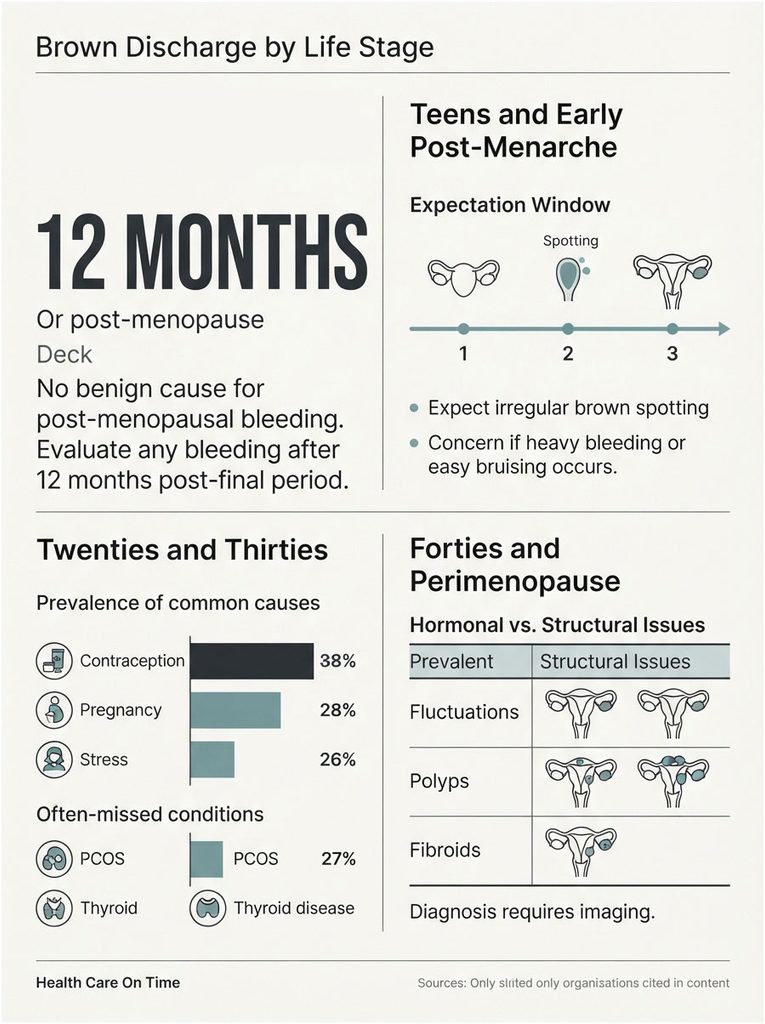
The same symptom carries different odds at different ages, which is why age is one of the first things a clinician asks about.
Teens and the First Few Years After a First Period
Cycles are commonly anovulatory for the first two to three years after menarche, so irregular brown spotting is expected rather than alarming.
Two things still warrant attention. Bleeding heavy enough to soak through protection hourly, and spotting alongside easy bruising or frequent nosebleeds, both point toward a possible clotting disorder that deserves testing.
Twenties and Thirties
Contraception, pregnancy, stress, and infection account for the large majority of cases in this window.
PCOS and thyroid disease are the two conditions most often missed here, partly because the symptoms get attributed to lifestyle. A basic hormone panel resolves the question quickly.
Forties and the Perimenopause Transition
Hormone swings dominate, and structural causes climb at the same time. Polyps and fibroids are common enough after 35 that they belong on the list by default.
This is the decade where it is probably just perimenopause becomes the most expensive assumption a woman can make without a scan to back it up.
After Menopause
There is no benign default here. Vaginal atrophy and hormone therapy are common and reassuring explanations, but each one is a diagnosis of exclusion, reached after evaluation rather than before it.
Anyone with bleeding twelve or more months after a final period should be seen, regardless of how light it was or how quickly it stopped.
What Does Not Cause Brown Discharge
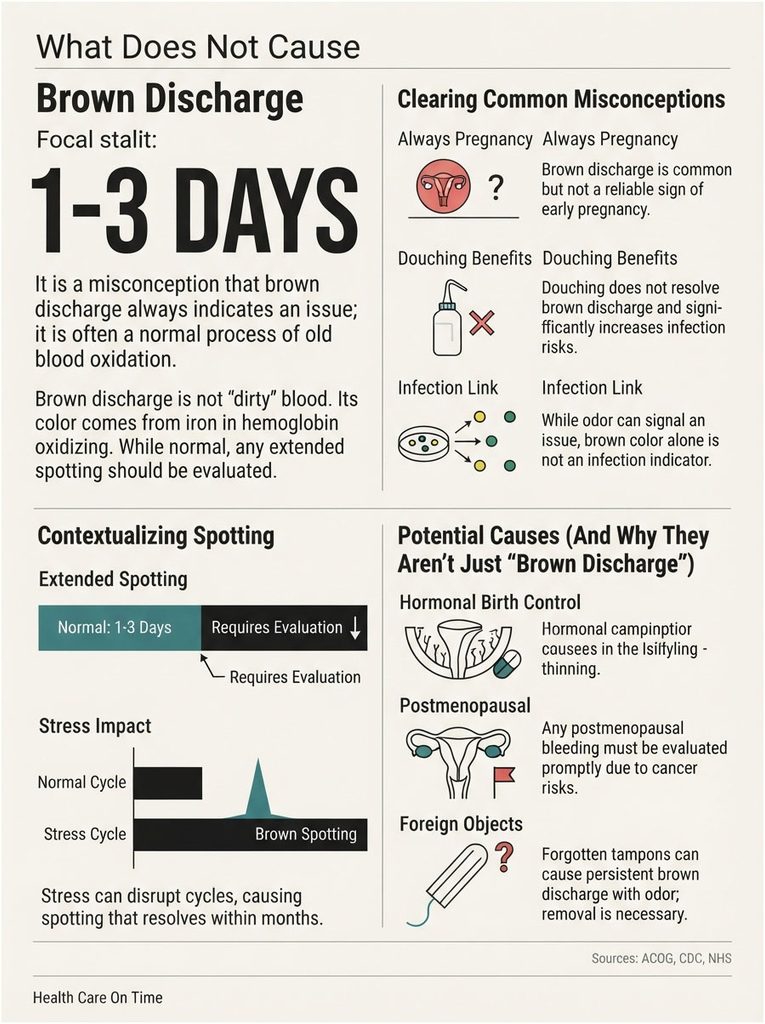
Brown Means the Blood Is Dirty
There is no such thing as dirty blood, and the uterus does not store waste between periods. Brown is oxidation and nothing more.
Brown Discharge Is Always an Early Pregnancy Sign
The prospective evidence points the other way, as covered above. Spotting in the days before a due period more often precedes a period than a positive test.
Douching Will Clear It Up
Douching strips protective vaginal bacteria and raises the risk of both bacterial vaginosis and pelvic inflammatory disease. It treats nothing and makes infection more likely, not less.
Frequently Asked Questions
Is brown discharge with no period a sign of pregnancy?
It can be, but it is a weak signal on its own. Roughly 25% of pregnancies involve first-trimester bleeding, yet spotting before a due period more often precedes a period than a positive test. Take a home test on or after the day your period was due, using first-morning urine.
How many days of brown discharge is normal?
One to three days at the start or end of a period is typical. One to two days mid-cycle can reflect ovulation. Spotting lasting more than seven days, or recurring across three or more cycles without a clear reason, has moved past normal and deserves evaluation.
Can stress cause brown discharge and a missed period?
Yes. Significant stress, rapid weight loss, or heavy training can suppress ovulation. Without a progesterone surge, the uterine lining sheds unevenly and produces brown spotting instead of a defined period. Cycles usually recover within one to three months. Three or more missed cycles warrants a hormone panel.
What if I have brown discharge and a negative pregnancy test?
Repeat the test in 48 to 72 hours if your period is still absent, since testing too early gives false negatives. If it stays negative, likely causes shift toward anovulation from stress, PCOS, thyroid problems, or contraception. Persistent spotting past three cycles needs a workup.
Why am I getting brown discharge instead of a period on birth control?
Hormonal methods thin the uterine lining, so there is less tissue to shed and what does shed moves slowly enough to oxidize. Implant users average 17.7 bleeding or spotting days per 90 days. Expect adjustment across three to six months before judging the method.
Can Plan B cause brown discharge and delay my period?
Yes. Levonorgestrel emergency contraception commonly triggers light brown spotting three to ten days after the dose and can shift the next period by up to a week in either direction. If your period is more than seven days late, take a pregnancy test rather than assuming.
Is brown discharge normal with a hormonal IUD?
Irregular brown spotting is expected for the first three to six months after insertion as the lining thins. Many users then stop bleeding entirely, with occasional brown streaks. New spotting after a year of stable use is a different situation and should be checked.
Does PCOS cause brown discharge instead of periods?
Frequently. PCOS disrupts ovulation, so the lining thickens without organized shedding and releases in patches, producing brown spotting rather than a clean period. Look for acne, coarse hair growth, scalp thinning, or difficulty conceiving alongside long gaps between cycles.
Is brown discharge with no period normal in your 40s?
Often, yes. Perimenopause brings intermittent ovulation, so some months produce a period and others produce only brown spotting. That said, heavy bleeding, bleeding between periods, or bleeding after sex is not part of normal perimenopause and needs imaging.
Should I worry about brown discharge after menopause?
Get it evaluated within one to two weeks. About 9% of women with postmenopausal bleeding turn out to have endometrial cancer, and 91% of endometrial cancers announce themselves this way. Most causes are benign, but the only way to know which is testing.
Can a forgotten tampon cause brown discharge?
Yes, and it happens more often than people expect. A retained tampon or condom produces persistent brown or gray discharge with a strong, unmistakable odor. Removal resolves it within a day or two. If you cannot remove it yourself, a clinician can, quickly and without judgment.
When should I stop waiting and call a doctor?
Call now for any bleeding after menopause, a positive pregnancy test with one-sided pain, or spotting with fever and foul odor. Call within a month for spotting that has persisted across three cycles, bleeding after sex, or new irregularity after 40.
Medical Disclaimer: This article is for general information and does not replace personalized medical advice. HealthCareOnTime does not diagnose conditions or recommend treatment. Bleeding patterns are shaped by your age, medications, pregnancy status, and medical history, and only a licensed clinician who can examine you and review your results can interpret yours. If you have bleeding after menopause, a positive pregnancy test with pelvic pain, heavy bleeding, or signs of infection, seek medical care promptly.
References
- American Academy of Family Physicians, Abnormal Uterine Bleeding in Premenopausal Women
- Dasharathy SS et al., Menstrual Bleeding Patterns Among Regularly Menstruating Women, American Journal of Epidemiology, 2012
- Harville EW et al., Vaginal bleeding in very early pregnancy, Human Reproduction, 2003
- First Trimester Bleeding and the Risk of Pregnancy Loss in a Prospective Cohort, Obstetrics & Gynecology
- Crawford NM et al., Prospective evaluation of the impact of intermenstrual bleeding on natural fertility, Fertility and Sterility, 2016
- NEXPLANON etonogestrel implant prescribing information, DailyMed, National Library of Medicine
- Unscheduled bleeding and contraceptive choice, National Library of Medicine
- Clarke MA et al., Association of Endometrial Cancer Risk With Postmenopausal Bleeding, JAMA Internal Medicine, 2018
- American Cancer Society, Key Statistics for Endometrial Cancer, 2026
- CDC, Sexually Transmitted Infections Surveillance, 2024 (Provisional)
- CDC, Ectopic Pregnancy Mortality, MMWR
- Association of Polycystic Ovarian Syndrome Features and Metabolic Syndrome Among Reproductive-Aged Women in the United States