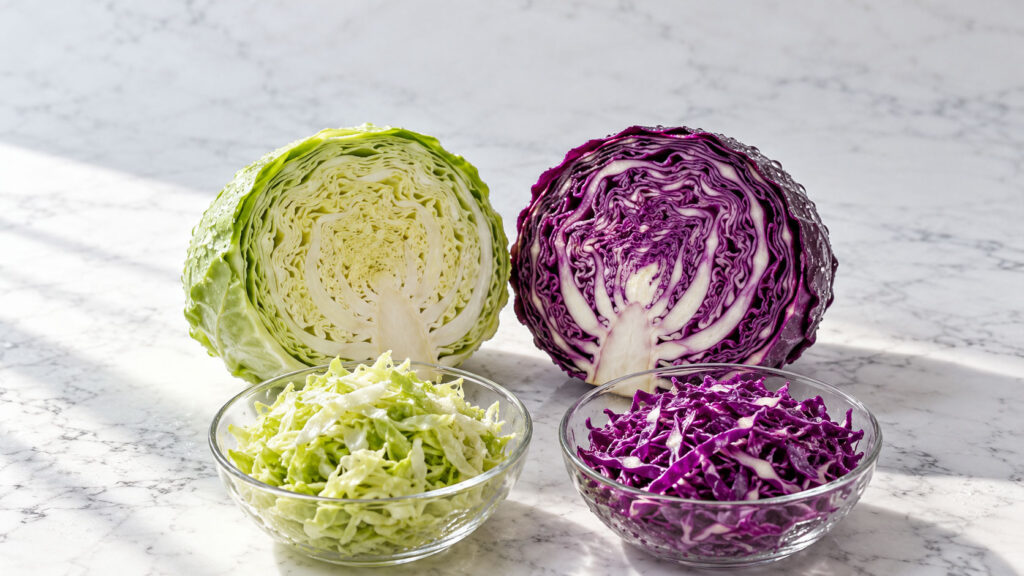
One cup of shredded red cabbage may give you more anthocyanins than the average American eats in an entire day. That sounds like an easy win for red.
Table of Contents
But the story changes if you take warfarin, if you’re pregnant, or if you just want the mildest slaw for your kids. Green cabbage wins more categories than most websites admit.
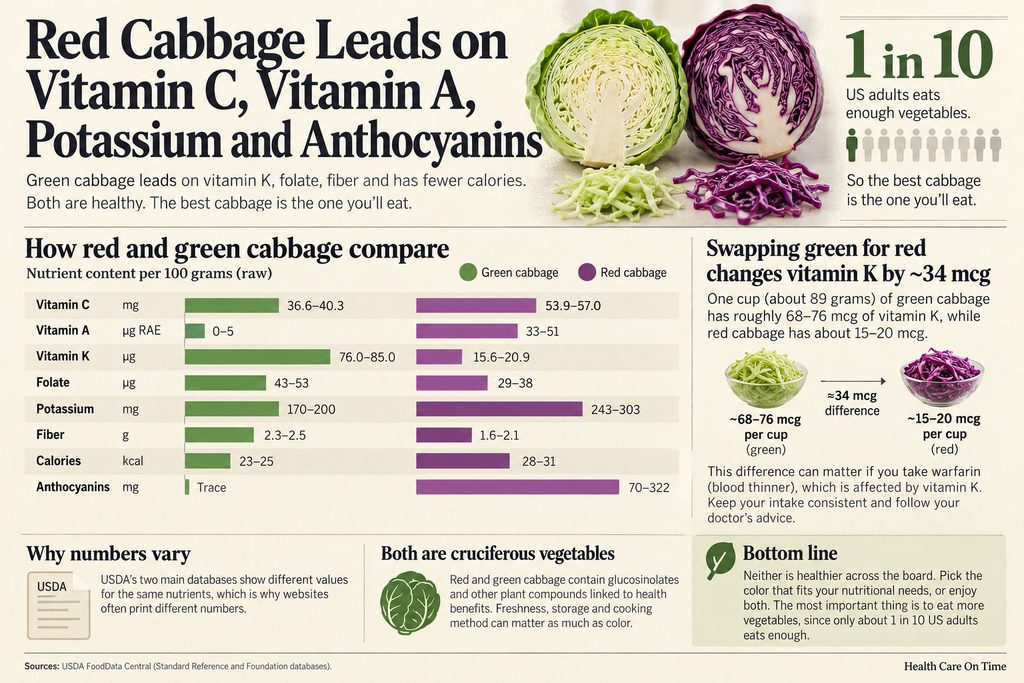
Quick Answer: Red cabbage has more vitamin C (about 1.3 to 1.6 times as much), about 11 times the vitamin A, more potassium, and anthocyanin pigments that green cabbage barely contains. Green cabbage has about twice the vitamin K, more than twice the folate, slightly more fiber, and fewer calories. Choose red for antioxidants. Choose green, or stay consistent, if you take warfarin.
Who wins what, in one list:
- Vitamin C: red, by 34% to 56%
- Vitamin K: green, by about 2x
- Folate: green, by about 2.4x
- Vitamin A: red, by about 11x (but still only about 6% of the Daily Value)
- Potassium: red, by about 30% to 43%
- Anthocyanins: red, with green at trace levels
- Calories and fiber: green, by small margins
At a Glance
- Red cabbage leads on vitamin C, vitamin A, potassium, and anthocyanins.
- Green cabbage leads on vitamin K, folate, fiber per 100 grams, and calories.
- USDA’s two main databases disagree, which is why websites print different numbers.
- Swapping one cup of green for red changes vitamin K by about 34 mcg, which matters on warfarin.
- Both are cruciferous vegetables with glucosinolates; freshness can matter as much as color.
- Only about 1 in 10 US adults eats enough vegetables, so the best cabbage is the one you’ll eat.
Green vs Red Cabbage: The Quick Verdict, Nutrient by Nutrient
Most articles say red cabbage is “more nutritious” and stop there. The real answer is a split decision, and the nutrient you care about decides the winner.
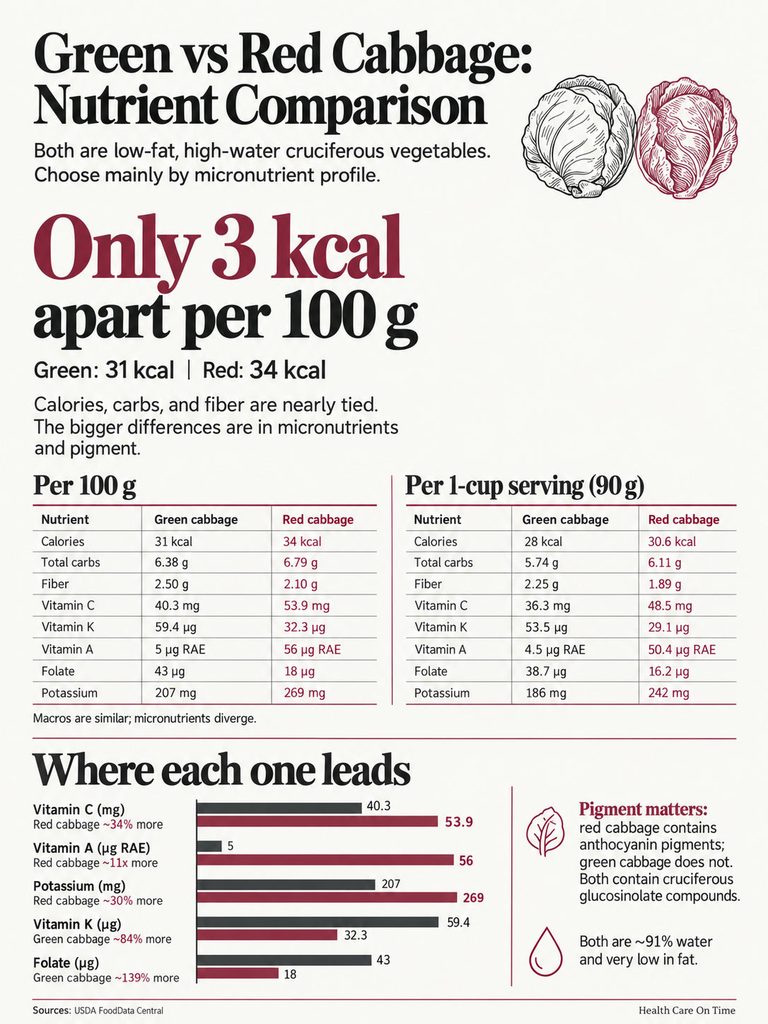
Our nutrition review team pulled both colors from USDA FoodData Central and lined them up per 100 grams (3.5 ounces) and per 89-gram cup (about 3.1 ounces, 1 cup chopped, raw).
| Nutrient (raw) | Green, per 100 g | Red, per 100 g | Per 1-cup (89 g): Green vs Red | Winner |
| Calories | 25 kcal | 31 kcal | 22 vs 28 kcal | Green (fewer) |
| Total carbs | 5.8 g | 7.4 g | 5.2 vs 6.6 g | Green (lower) |
| Fiber | 2.5 g | 2.1 g | 2.2 vs 1.9 g | Green |
| Vitamin C | 36.6 mg | 57.0 mg | 32.6 vs 50.7 mg | Red |
| Vitamin K | 76.0 mcg | 38.2 mcg | 67.6 vs 34.0 mcg | Green (about 2x) |
| Vitamin A (RAE) | 5 mcg | 56 mcg | 4.5 vs 50 mcg | Red (about 11x) |
| Folate | 43 mcg | 18 mcg | 38 vs 16 mcg | Green (about 2.4x) |
| Potassium | 170 mg | 243 mg | 151 vs 216 mg | Red |
| Anthocyanins | Trace | About 70 to 322 mg | Trace vs 62 to 287 mg | Red (by a mile) |
Source: USDA FoodData Central SR Legacy records 169975 (green) and 169977 (red); anthocyanin range from published lab studies cited below.
Where Red Cabbage Clearly Wins
Red cabbage pulls ahead on vitamin C, vitamin A, potassium, and pigments. USDA’s SR Legacy record lists raw red cabbage at 31 calories, 57.0 mg of vitamin C, 38.2 mcg of vitamin K, and 56 mcg RAE of vitamin A per 100 grams.
One cup covers just over half of the 90 mg Daily Value for vitamin C. Healthline puts it at 56% of the recommended intake per 89-gram cup, which matches the USDA math.
Where Green Cabbage Clearly Wins
Green cabbage is the vitamin K and folate pick. USDA’s SR Legacy record for raw green cabbage shows 25 calories, 2.5 grams of fiber, 36.6 mg of vitamin C, and 76.0 mcg of vitamin K per 100 grams.
That vitamin K figure is about double red cabbage’s. Folate is the quiet green win, at about 10% of the Daily Value per cup versus about 4% for red.
Where It’s Basically a Tie
Calories, carbs, and fiber differ by small amounts. Six extra calories per cup of red cabbage won’t change anyone’s weight.
Both colors are about 90% water and very low in fat, and both deliver cruciferous compounds. For most people, the pigment is the difference that matters, not the macros.
Why Websites Give Different Numbers for the Same Cabbage
If you’ve compared three nutrition pages and gotten three answers, you’re not imagining it. Patients who ask our team about produce labels often bring printouts that contradict each other line by line.
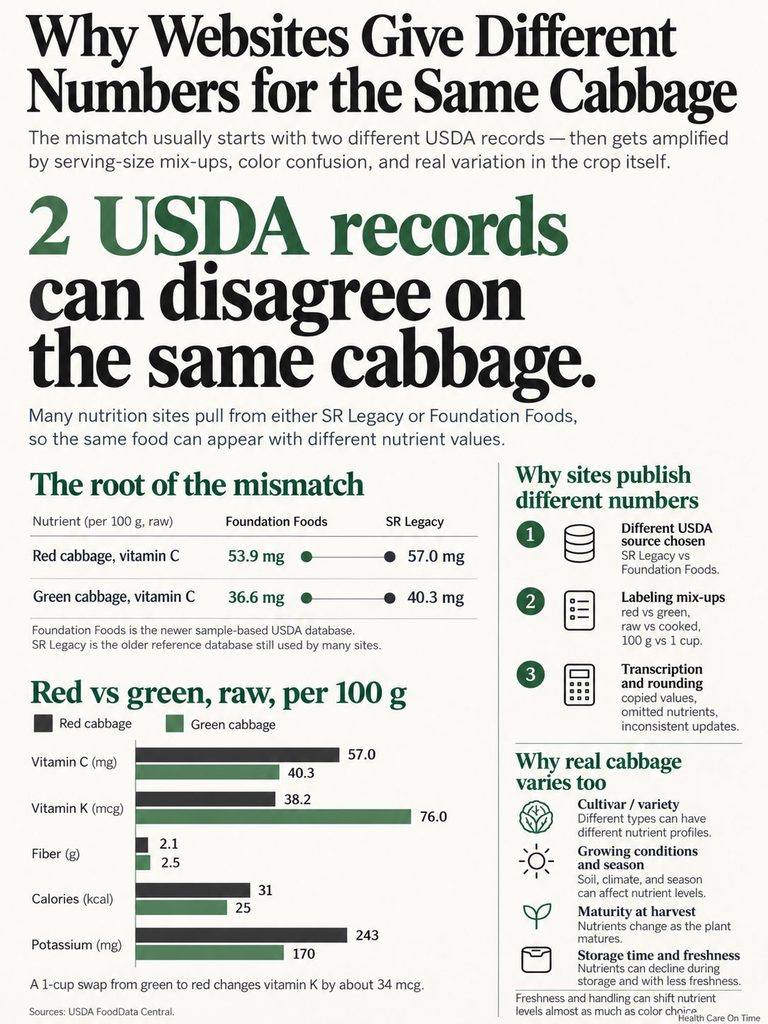
There are three causes: two USDA databases, copy errors, and natural crop variation.
Two USDA Records, Two Answers
USDA keeps an older dataset (SR Legacy) and a newer one (Foundation Foods). They came from different samples analyzed at different times, and they don’t match.
The newer Foundation record for raw red cabbage lists 53.9 mg of vitamin C, 32.3 mcg of vitamin K, and 269 mg of potassium per 100 grams. The Foundation record for raw green cabbage lists 40.3 mg of vitamin C and 59.4 mcg of vitamin K.
| Nutrient per 100 g | Green (SR Legacy) | Green (Foundation) | Red (SR Legacy) | Red (Foundation) | Gap |
| Vitamin C | 36.6 mg | 40.3 mg | 57.0 mg | 53.9 mg | Red 1.34x to 1.56x |
| Vitamin K | 76.0 mcg | 59.4 mcg | 38.2 mcg | 32.3 mcg | Green 1.84x to 1.99x |
| Potassium | 170 mg | 207 mg | 243 mg | 269 mg | Red 1.30x to 1.43x |
Source: USDA FoodData Central records 169975, 2346407, 169977, 2346408.
The direction never flips. Red always wins vitamin C and potassium, and green always wins vitamin K. Only the size of the gap moves.
Three Common Errors on Popular Pages
Error 1: The folate swap. One popular food site says green beats red on folate, then lists red at 38.2 units and green at 16. Those figures are reversed. Green has about 38 mcg per cup; red has about 16 mcg.
Error 2: Inflated vitamin A. A nutrition-label database shows red cabbage at 330 mcg of vitamin A, or 37% of the Daily Value, per 100 grams. Neither USDA record supports that. USDA lists 56 mcg RAE, roughly 6% of the Daily Value.
Error 3: Mixed serving sizes. Some pages compare red “per cup” against green “per 100 grams.” Always check the serving line before you compare.
Crop, Season, and Storage Change the Numbers
Lab results also vary by farm and variety. A Pakistani lab study measured vitamin C at about 139 mg per 100 grams in red cabbage and about 121 mg in green, far above either USDA record.
Treat any single number as an average, not a promise. Freshness, storage time, and growing region all move the figures.
The Nutrients That Matter Most, Explained
Vitamin C: Red’s Lead Is Real but Smaller Than You’ve Heard
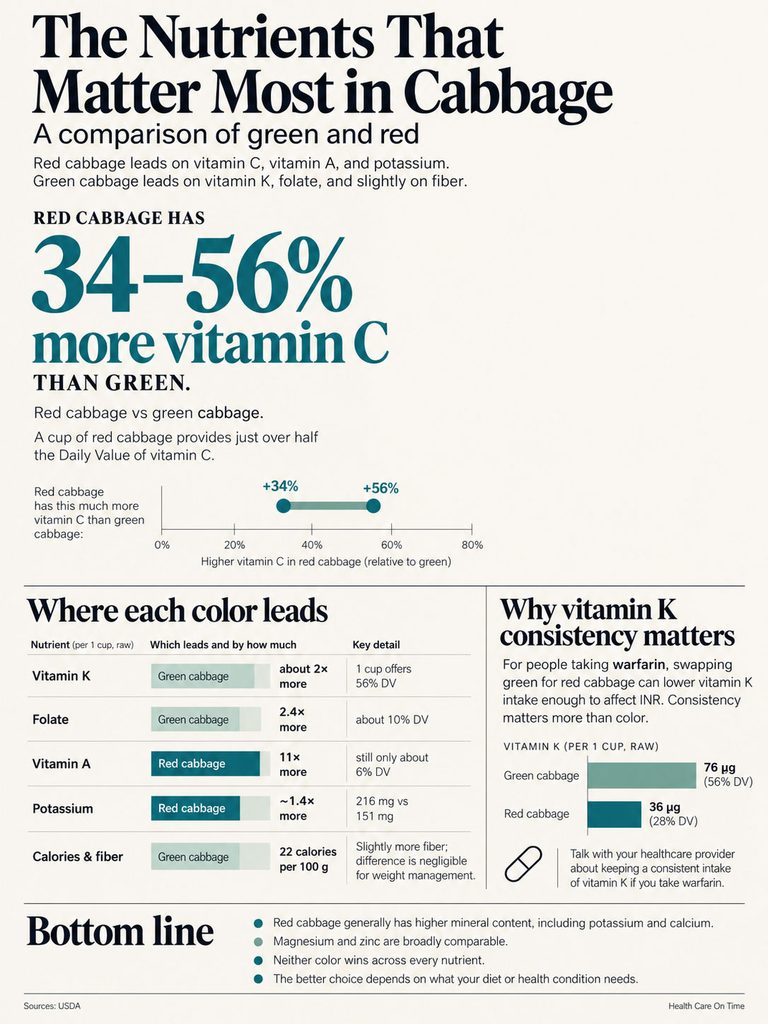
Some articles claim red cabbage has “twice” the vitamin C. USDA data show 34% to 56% more, depending on the record.
Both colors are solid sources. A cup of green gives about a third of the Daily Value, and a cup of red gives just over half. The NIH Office of Dietary Supplements notes vitamin C supports immune function and helps your body absorb iron from plants.
Vitamin K: Green’s Big Advantage (and the Warfarin Catch)
Green cabbage has about twice the vitamin K. One cup supplies about 56% of the 120 mcg Daily Value, and red supplies about 28%. Tasting Table’s per-cup red cabbage figure of 28% of daily vitamin K matches the USDA math.
Vitamin K helps blood clot, and it works against warfarin (Coumadin). People who book INR checks through our lab network often ask whether they have to give up cabbage. They don’t. The goal is a steady weekly intake, not zero.
What a Color Swap Does on Warfarin
Swapping one cup of green cabbage for red drops vitamin K by about 34 mcg. Switching a two-cup coleslaw habit cuts about 67 mcg.
That swing can nudge an INR. If you change colors or portions on a regular basis, tell your care team before your next INR test. The NIH vitamin K fact sheet covers the warfarin interaction in detail.
Vitamin A: 11x Sounds Big, but Check the Daily Value
Red cabbage has about 11 times the vitamin A of green. The ratio is real, but the starting point is tiny.
A cup of red cabbage gives about 50 mcg RAE, roughly 6% of the 900 mcg Daily Value. A medium carrot gives far more. Red cabbage is a pigment standout, not a vitamin A standout.
Folate: The Win Nobody Gives Green Credit For
Green cabbage has about 2.4 times the folate of red. One cup gives about 38 mcg, roughly 10% of the 400 mcg DFE Daily Value.
Folate matters most before and in early pregnancy, when it helps prevent neural tube defects. Green cabbage won’t replace a prenatal vitamin, but it adds more than red, per NIH folate guidance.
Potassium and Minerals
Red cabbage carries more potassium: about 216 mg per cup versus 151 mg for green. Both are small next to the 4,700 mg Daily Value.
Other mineral gaps are modest. A 2018 compositional study found red cabbage higher in most minerals, including potassium, calcium, and iron, while magnesium and zinc did not follow that pattern.
Calories, Carbs, and Fiber
Green cabbage has 22 calories per cup and red has 28. Green has slightly more fiber per 100 grams, 2.5 grams versus 2.1.
For weight management, these gaps are too small to matter. Dressing changes slaw calories far more than color does. Portion math is in our guide, How Many Calories in Cabbage?.
Anthocyanins: The Real Reason Red Cabbage Is Red
Red cabbage gets its color from anthocyanins, flavonoid pigments also found in blueberries and red grapes. Green cabbage has essentially none.
White cabbage contains only about 0.01 to 0.02 mg of anthocyanins per 100 grams. This is the one category where the gap isn’t a ratio. It’s present versus absent.
How Much Red Cabbage Contains
Published values vary widely, and each comes from a different lab. A 2013 review of red cabbage research lists a value of 322 mg per 100 grams.
Newer lab analyses report much less. One study measured about 69.86 mg per 100 grams of fresh red cabbage, and another reported 90.5 mg per 100 grams. Variety, growing conditions, and test method explain much of the spread.
How One Cup Compares With the Average American Diet
USDA researchers screened more than 100 common foods, found anthocyanins in 24 of them, and estimated average US intake at 12.5 mg per person per day.
One 89-gram cup of red cabbage supplies roughly 62 to 287 mg, depending on which lab value you use. Even at the low end, that’s about 5 times the US daily average.
What the Research Shows, and What It Doesn’t
Anthocyanins act as antioxidants in lab tests. One comparison found red cabbage higher than green in total polyphenols and flavonoids, with stronger free radical scavenging.
Human evidence is thinner. Studies of whole diets link anthocyanin-rich foods to better heart and metabolic health, but they can’t isolate red cabbage. No human trial has compared eating red versus green cabbage head to head.
Evidence Limits to Keep in Mind
- Most red-versus-green comparisons are lab studies, not human outcome trials.
- Several key composition studies come from Pakistan and Europe, where varieties and soil differ from US farms.
- Antioxidant scores in a test tube don’t prove better health in people.
Our medical reviewers treat red cabbage’s pigment lead as promising, not proven.
What Both Cabbages Share: Cruciferous Compounds
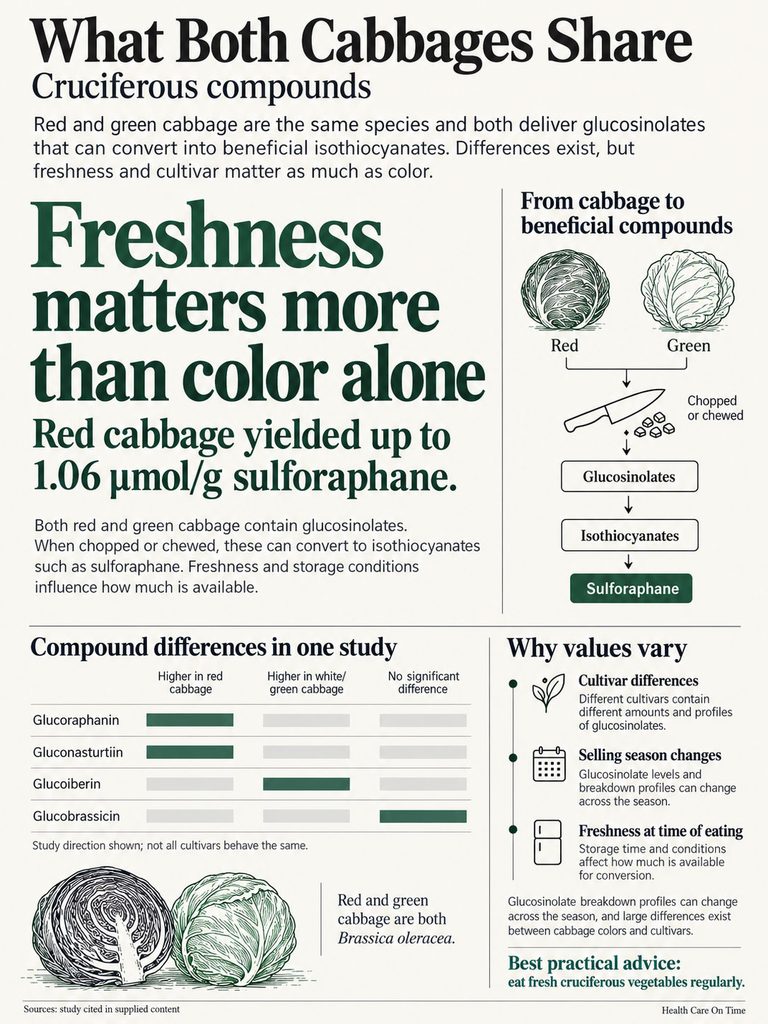
Red and green cabbage are the same species, Brassica oleracea. Both carry glucosinolates, sulfur compounds that break down into isothiocyanates such as sulforaphane when you chop or chew them.
Glucosinolates in Both Colors
Here the two colors are close. An analysis of 21 red and 6 white cabbage varieties found red cabbage significantly higher in glucoraphanin and gluconasturtiin, while white cabbage was higher in glucoiberin, with no significant difference in glucobrassicin.
Freshness matters as well. A study of retail cabbages found red cabbage supplied up to 1.06 μmol per gram of sulforaphane, though breakdown profiles shifted widely across the selling season.
Why the Shared Benefits Outweigh the Differences
The same variety study found large variation in these compounds between colors and between cultivars of the same color.
In plain terms, a fresh green head can beat a tired red one. Eating cruciferous vegetables often matters more than the color in your cart. For a related comparison, see our Cauliflower vs Broccoli guide.
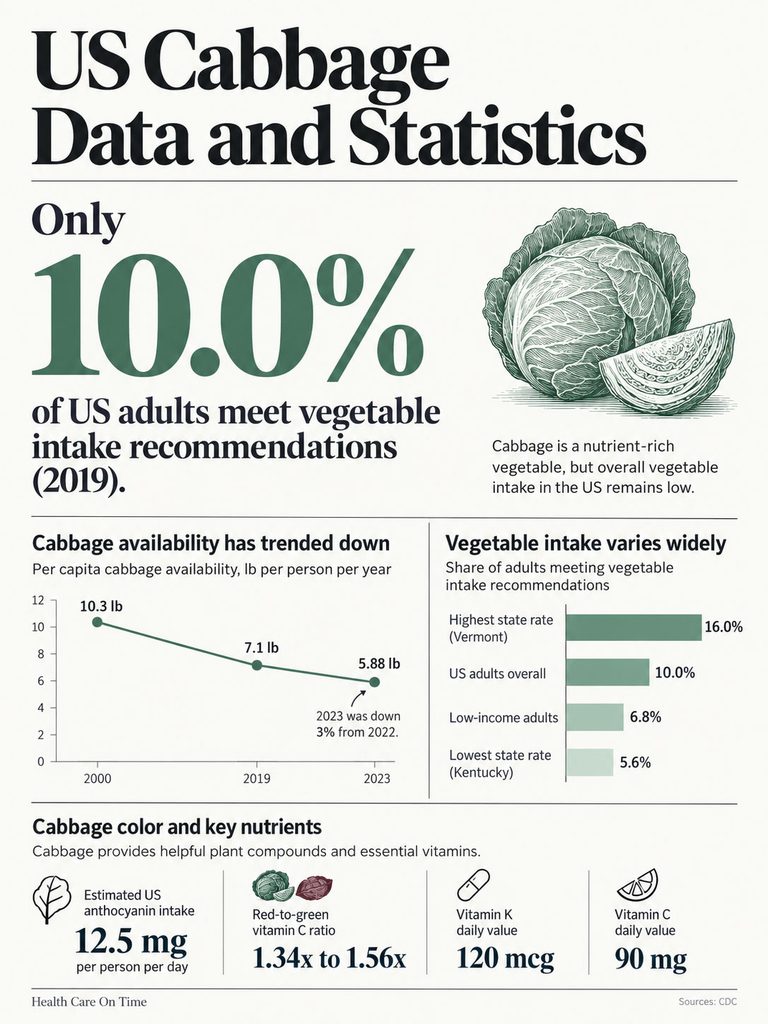
US Cabbage Data and Statistics
Cabbage is one of the longest-lasting vegetables in American grocery stores, yet Americans eat less of it than they used to.
| Statistic | Figure | Source |
| US adults meeting vegetable recommendations | 10.0% | CDC MMWR, 2019 BRFSS data |
| Fresh cabbage per capita availability, 2023 | 5.88 lb, down 3% from 2022 | USDA ERS via Produce Market Guide |
| Total cabbage per capita, 2000 vs 2019 | 10.3 lb to 7.1 lb | USDA ERS |
| Estimated US anthocyanin intake | 12.5 mg per person per day | USDA ARS, Wu et al. 2006 |
| Red-to-green vitamin C ratio | 1.34x to 1.56x | USDA FoodData Central |
| Vitamin K Daily Value | 120 mcg | FDA |
| Vitamin C Daily Value | 90 mg | FDA |
CDC data from 2019 found that only 10.0% of US adults met vegetable intake recommendations, with state rates ranging from 5.6% in Kentucky to 16.0% in Vermont. Adults living with low income had the lowest rate, at 6.8%.
USDA counted 5.88 pounds of fresh cabbage available per person in 2023, down 3% from 2022 but up 6% from 2018. Over the longer run, cabbage availability dropped from 10.3 pounds per person in 2000 to 7.1 pounds in 2019.
How Cooking Changes Green vs Red Cabbage
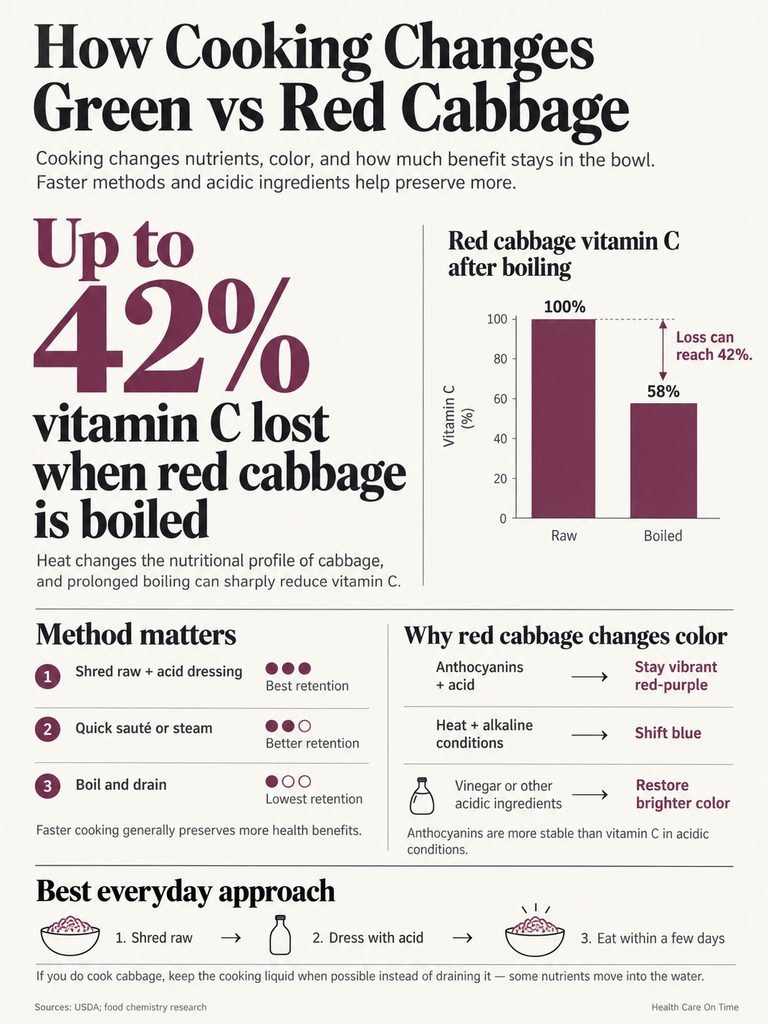
Raw and cooked cabbage aren’t the same food nutritionally. Heat and water hit vitamin C and pigments hardest, and your cooking method decides how much you lose.
Vitamin C Loss When Boiling
Vitamin C dissolves in water and breaks down with heat. USDA retention data show red cabbage can lose up to 42% of its vitamin C when boiled and drained.
If vitamin C is why you’re buying red, eat it raw or cook it fast. Long boiling can erase red’s main edge over raw green cabbage.
Why Red Cabbage Turns Blue, and How Vinegar Fixes It
Anthocyanins change color with acidity. Red cabbage often turns blue during cooking, and a splash of vinegar or acidic fruit in the pot keeps it red.
Hard or alkaline tap water and baking soda push it toward blue or green. Vinegar, lemon juice, or a tart apple pull it back to red.
Do Anthocyanins Survive Heat?
Better than vitamin C does, if the pot is acidic. One lab study found red cabbage anthocyanins were most stable at pH 1 to 4, with about 10% of the pigment degraded after 180 minutes at 212°F.
That study used extracted pigment, not whole cabbage. Real kitchens likely lose more, because anthocyanins leach into cooking water. Keep the liquid in the dish when you can.
Best Cooking Methods for Each Color
- Raw (slaw, salads, tacos): keeps the most vitamin C in both colors.
- Quick sauté or stir-fry (3 to 5 minutes): little water, short heat.
- Steaming: gentler on vitamin C than boiling.
- Braised red cabbage with vinegar: keeps the color and holds pigments in the sauce.
- Long boiling: the biggest losses; skip it if nutrition is your goal.
Among the meal-prep questions our team receives, the simplest fix is also the best: shred it raw, dress it with an acid, and eat it within a day or two.
Which Cabbage Should You Choose?
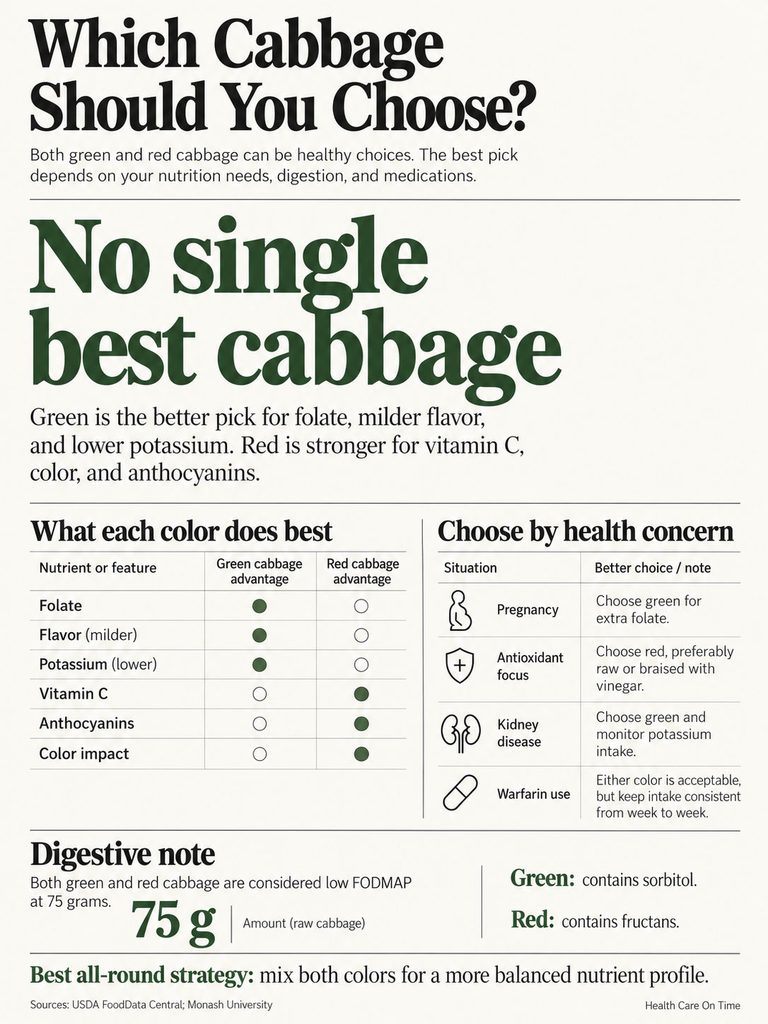
For most healthy adults, either color is a strong choice. Specific health situations tip the balance.
| Scenario | Better Pick | What to Do |
| Taking warfarin (Coumadin) | Either, kept consistent | Pick one color and a regular portion; tell your care team before switching |
| Pregnant or trying to conceive | Green | Use green for its higher folate; keep taking a prenatal vitamin |
| Want more antioxidants | Red | Eat it raw or braised with vinegar to protect pigments |
| Kidney disease with a potassium limit | Green | Green has about 65 mg less potassium per cup; confirm portions with a renal dietitian |
| IBS on a low FODMAP diet | Either, at 75 g (about 3/4 cup) | Keep to one portion per sitting; avoid traditional white sauerkraut |
| Weight loss | Either | The calorie gap is 6 kcal per cup; control the dressing instead |
| Kids or picky eaters | Green | Milder, sweeter taste; mix in a little red for color |
| Maximum vitamin C | Red, raw | Raw red gives about 51 mg per cup, just over half the Daily Value |
Green Cabbage Is the Better Pick If…
You need more folate, want the mildest flavor, or are limiting potassium. It’s also slightly lower in calories and carbs.
If you take warfarin, green isn’t “bad.” Your vitamin K intake just needs to stay steady from week to week.
Red Cabbage Is the Better Pick If…
You want the most vitamin C, the most color, and the anthocyanins green cabbage lacks. It also holds up well in pickles, braises, and slaws that sit overnight.
Mixing both colors in one slaw is a smart middle path. You get vitamin K, folate, vitamin C, and pigments in a single bowl.
A Note on FODMAPs
Both colors are low FODMAP in moderate portions, but for different sugars. Monash lists both green and red cabbage as low FODMAP at 75 grams (about 3/4 cup), with green containing sorbitol and red containing fructans.
Fermented versions differ sharply. Traditional white-cabbage sauerkraut tested high in mannitol at a 1/2-cup serving, while fermented red cabbage was low FODMAP at that size. More detail is in our guide, Is Cabbage Good for Gut Health and Digestion?.
4 Myths About Red and Green Cabbage
Myth 1: “Red Cabbage Is More Nutritious Overall”
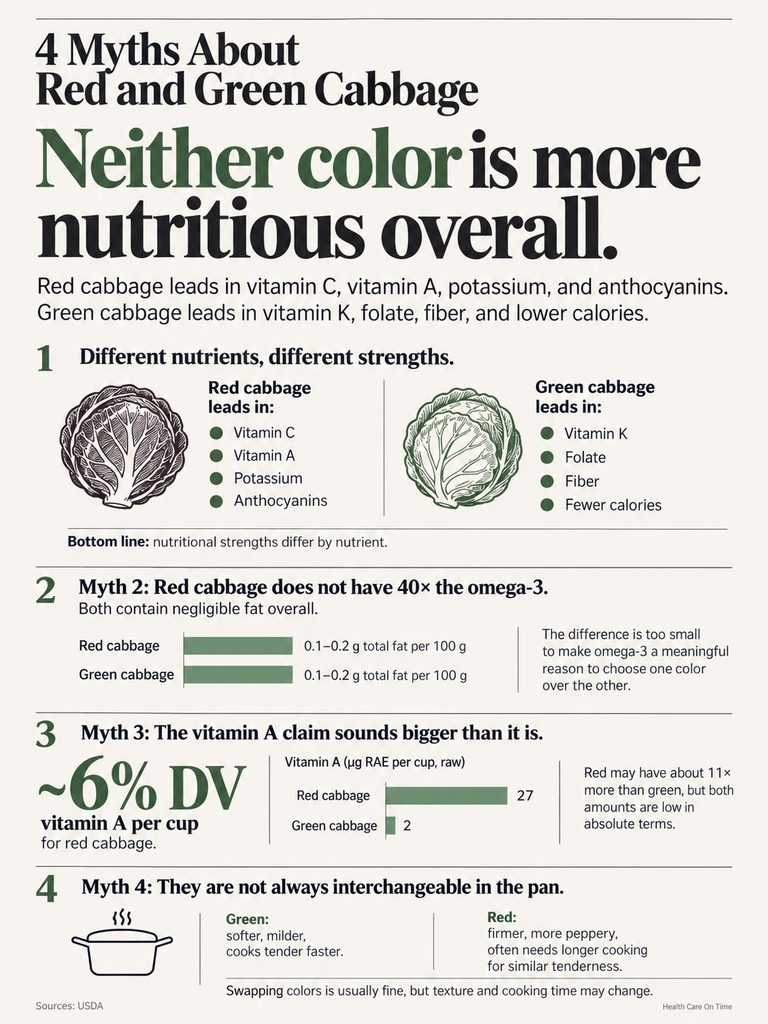
Red wins vitamin C, vitamin A, potassium, and anthocyanins. Green wins vitamin K, folate, fiber per 100 grams, and calories. “Overall” depends on which nutrients you need.
Myth 2: “Red Cabbage Has 40 Times the Omega-3”
One food site claims red cabbage has about 40 times the omega-3 of green. Even if that ratio holds, both colors contain only 0.1 to 0.2 grams of total fat per 100 grams. Cabbage isn’t an omega-3 source.
Myth 3: “Red Cabbage Is a Great Vitamin A Source”
At about 6% of the Daily Value per cup, it’s a modest source. The 11x ratio over green exists only because green has almost none.
Myth 4: “You Can’t Swap One for the Other”
You can swap them in nearly any recipe. Red is a bit firmer and more peppery, and it can stain other foods purple. Cook red a few minutes longer if you want it as tender as green.
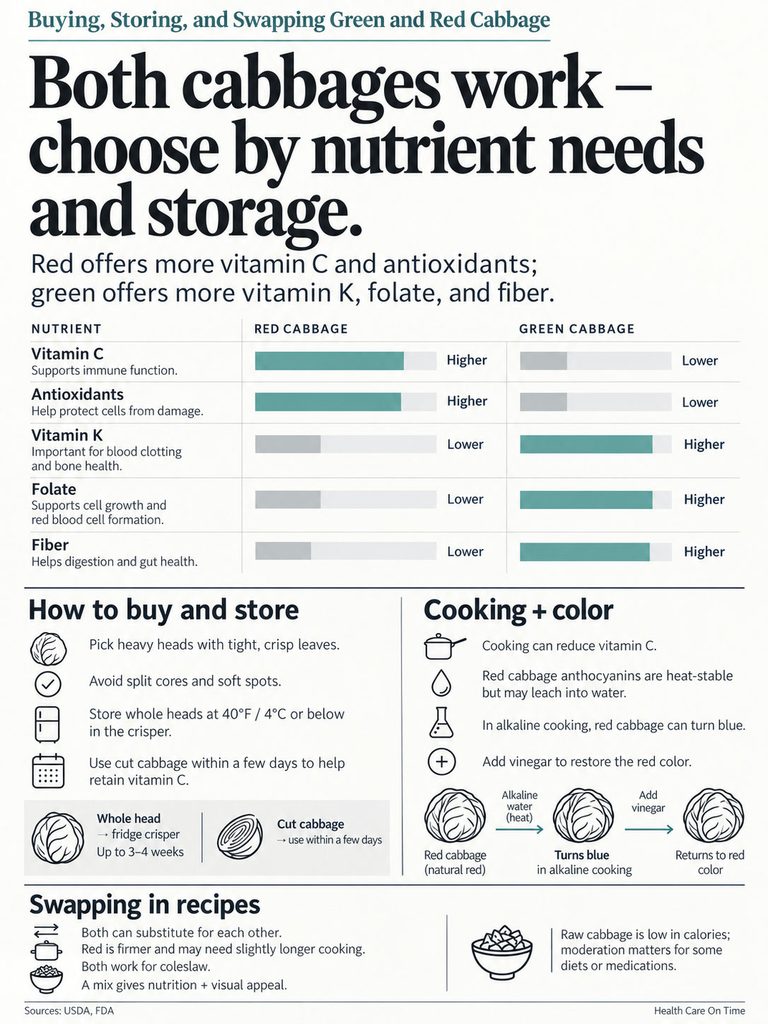
Buying, Storing, and Swapping Green and Red Cabbage
How to Pick a Good Head
Choose heads that feel heavy for their size, with tight, crisp leaves. Skip heads with split cores, soft spots, or lots of loose outer leaves. For red, look for deep, even color.
Storage Temperature and Shelf Life
Keep whole, uncut heads in the crisper drawer at 40°F or below, the fridge temperature the FDA recommends. A whole head often lasts several weeks.
Once cut, wrap the exposed side tightly and use it within a few days. Vitamin C drops the longer cut cabbage sits, so shred close to serving time.
Swapping One for the Other in Recipes
- Coleslaw: swap freely; mix both for color and nutrients.
- Stir-fries: swap freely; red may tint other vegetables.
- Cabbage rolls: green leaves are larger and bend more easily.
- Braised cabbage: red is traditional; add vinegar to keep the color.
- Soups: green keeps broth clear; red turns it purple-blue.
For more color-versus-color comparisons, see our Red vs Green Bell Pepper and Kale vs Spinach guides.
Frequently Asked Questions
Is red cabbage healthier than green cabbage?
Neither is healthier across the board. Red cabbage has more vitamin C, vitamin A, potassium, and anthocyanin antioxidants. Green cabbage has about twice the vitamin K, more folate, slightly more fiber, and fewer calories. Pick the color that matches your nutritional needs, or mix both in one dish.
Which cabbage has more vitamin C?
Red cabbage has more. USDA data show 53.9 to 57.0 mg per 100 grams for red versus 36.6 to 40.3 mg for green. That’s about 34% to 56% more, not double. One raw cup of red supplies just over half the 90 mg Daily Value.
Does red cabbage have more antioxidants than green?
Yes. Red cabbage contains anthocyanins, published at roughly 70 to 322 mg per 100 grams, while green cabbage has only trace amounts. Lab studies also show higher total polyphenols in red. Human trials comparing the two colors directly, however, haven’t been done yet.
Is purple cabbage the same as red cabbage?
Yes. Purple and red cabbage are the same vegetable. Its color looks purple in most kitchens, but it shifts toward red in acidic conditions and toward blue in alkaline ones. That color-changing pigment is anthocyanin, which is why vinegar keeps cooked red cabbage looking red.
Which cabbage is better if you take warfarin?
Either color works if you eat it consistently. Green cabbage has about twice the vitamin K of red, roughly 68 mcg versus 34 mcg per cup. Switching colors or portion sizes can shift your INR, so tell your care team before making a regular change.
Which cabbage is better for weight loss?
Both work well. Green cabbage has about 22 calories per cup and red has about 28, a gap too small to matter. Both are high in water and fiber, which help fullness. Dressing, mayonnaise, or oil will change calories far more than the cabbage color.
Does cooking destroy the nutrients in red cabbage?
Cooking reduces some nutrients. USDA retention data show boiling can cut vitamin C by up to 42%. Anthocyanins are fairly heat-stable in acidic conditions but leach into cooking water. Eating red cabbage raw, steamed, or quickly sautéed keeps more of its nutrients intact.
Why does red cabbage turn blue when cooked?
Red cabbage’s anthocyanin pigments react to acidity. Alkaline or hard tap water, baking soda, or long cooking can turn it blue or even greenish. Adding vinegar, lemon juice, or tart apples lowers the pH and brings back the red color. The color change doesn’t make it unsafe.
Can you substitute red cabbage for green cabbage?
Yes, in almost any recipe. Red cabbage is slightly firmer and more peppery, so it may need a few extra minutes of cooking. It can also tint nearby ingredients purple. For cabbage rolls, green works better because its leaves are larger and more flexible.
Is it safe to eat raw cabbage every day?
For most healthy adults, yes. Raw cabbage is low in calories and keeps the most vitamin C. Large amounts may cause gas or bloating. People taking warfarin should keep daily intake steady, and anyone on a low FODMAP diet should stay near 3/4 cup per sitting.
Is red or green cabbage better for coleslaw?
Both make excellent coleslaw. Green gives a milder, sweeter slaw that most kids accept. Red adds color, more vitamin C, and anthocyanins, and it stays crunchy overnight. A half-and-half mix gives you the nutrients of both colors and looks appealing on the plate.
Is red cabbage low FODMAP?
Yes, in moderate portions. Monash University lists red cabbage as low FODMAP at 75 grams, about 3/4 cup. Larger servings contain more fructans and may trigger IBS symptoms. Fermented red cabbage tested low FODMAP at a 1/2-cup serving, unlike traditional white-cabbage sauerkraut.
Disclaimer: This article is for general education and does not replace advice from a doctor, registered dietitian, or pharmacist. If you take warfarin or another blood thinner, have kidney disease, are pregnant, or follow a medically prescribed diet, talk with your care team before making regular changes to your vegetable intake. Nutrient values are averages and vary by variety, freshness, and preparation.
References
- USDA FoodData Central: Cabbage, raw (SR Legacy 169975) and Cabbage, red, raw (SR Legacy 169977)
- USDA FoodData Central: Cabbage, green, raw (Foundation 2346407) and Cabbage, red, raw (Foundation 2346408)
- Wu X, et al. Concentrations of Anthocyanins in Common Foods in the United States. J Agric Food Chem. 2006;54(11):4069-75 (USDA ARS)
- Draghici GA, et al. Red Cabbage, Millennium’s Functional Food. J Horticulture, Forestry and Biotechnology. 2013
- CDC MMWR: Adults Meeting Fruit and Vegetable Intake Recommendations, United States, 2019
- NIH Office of Dietary Supplements: Vitamin K Fact Sheet
- NIH Office of Dietary Supplements: Vitamin C Fact Sheet
- NIH Office of Dietary Supplements: Folate Fact Sheet
- FDA: Daily Value on the Nutrition and Supplement Facts Labels
- Hansen M, et al. Red Cabbage, a Vegetable Rich in Health-Related Glucosinolates. Acta Horticulturae 867. 2010
- Wermter NS, et al. Seasonal Variation of Glucosinolate Hydrolysis Products in Commercial White and Red Cabbages. Foods. 2020
- Ashfaq F, et al. Compositional Analysis of Pakistani Green and Red Cabbage. Pak J Agri Sci. 2018 (EPA HERO)
- Monash University FODMAP: FODMAP Stacking and Red Cabbage Serving Sizes
- USDA ERS: U.S. Supplies of Vegetables Available to Eat in 2019
- USDA ERS: Food Availability (Per Capita) Data System
- Dietary Guidelines for Americans