Two of the largest keto sites on Google publish net carb figures for cauliflower that differ by 65%. One says 1.81 grams per 100 grams. The other says 2.97. Both are correct. Neither explains why, and that single unexplained gap is why people search this question three or four times before they trust the answer.
Table of Contents
Quick Answer: Yes, cauliflower is keto friendly. One cup of raw chopped cauliflower (107 grams) has about 5.3 grams of total carbs, 2.1 grams of fiber, and 3.2 grams of net carbs, roughly 16% of a strict 20-gram keto day. Boiled cauliflower runs lower per cup. The real risk is not the vegetable. It is cauliflower-labeled packaged food, where one serving can reach 24 grams of net carbs.
At a Glance
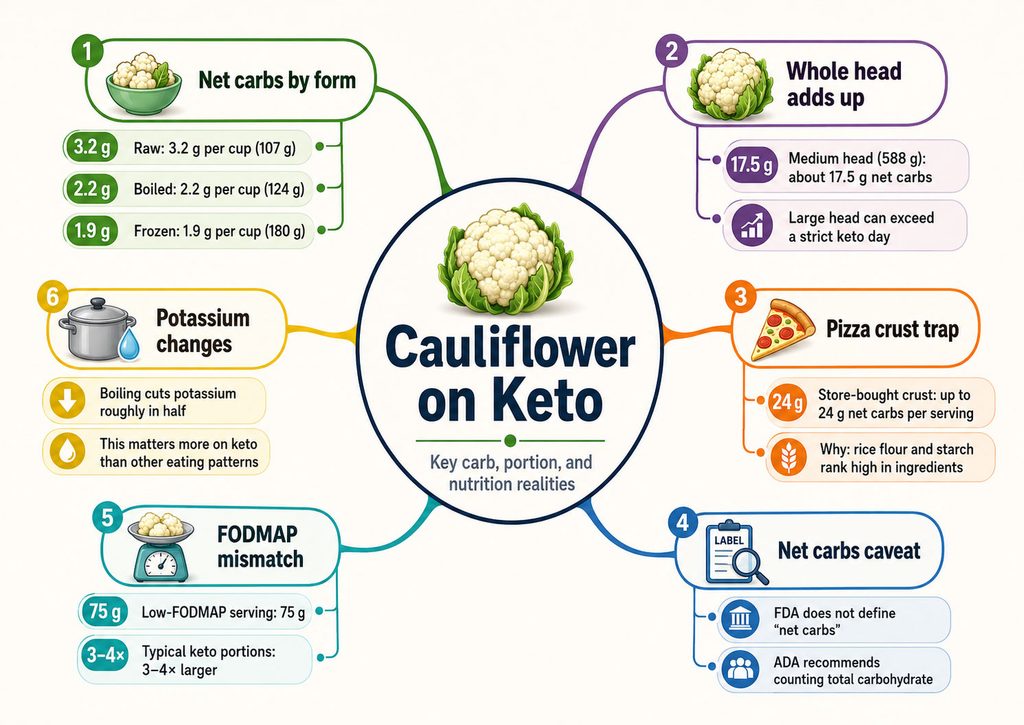
- Raw cauliflower: 3.2 g net carbs per cup (107 g). Boiled: 2.2 g per cup (124 g). Frozen: 1.9 g per cup (180 g).
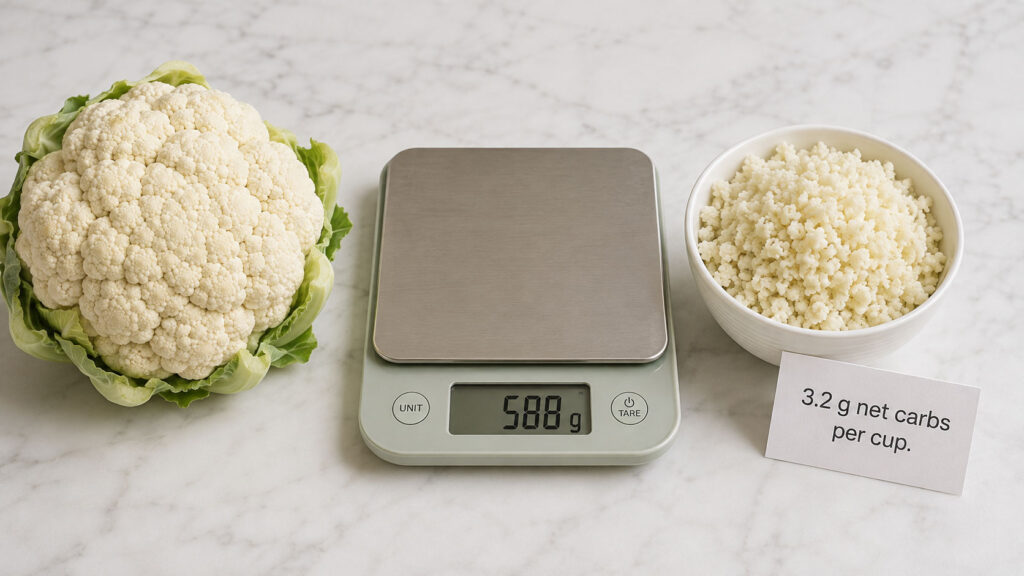
- A medium 588-gram head carries about 17.5 g net carbs. A large head crosses a strict keto day by itself.
- Store-bought cauliflower pizza crust can reach 24 g net carbs per serving because rice flour and starch sit near the top of the ingredient list.
- The FDA does not define “net carbs,” and the American Diabetes Association recommends counting total carbohydrate instead.
- Cauliflower’s low-FODMAP serving is 75 grams. Typical keto portions are three to four times that.
- Boiling cuts cauliflower’s potassium roughly in half, which matters more on keto than on any other eating pattern.
The Short Answer, and Why the Numbers on Other Sites Disagree
Cauliflower is a non-starchy vegetable. That puts it in the same tier as spinach, zucchini, and asparagus for anyone counting carbs, and it is one of the few vegetables sturdy enough to stand in for rice, potatoes, and pizza dough without falling apart.
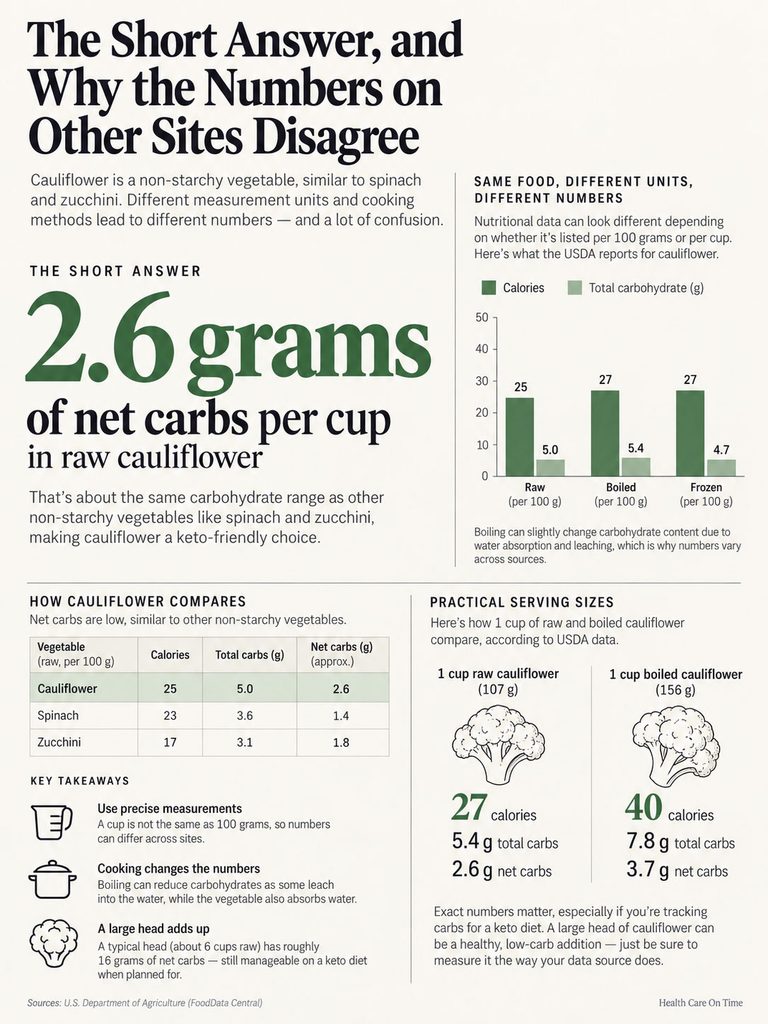
The confusion starts with the denominator. Nutrition databases publish per 100 grams. Keto blogs publish per cup. A cup of raw chopped cauliflower weighs 107 grams; a cup of boiled drained cauliflower weighs 124 grams. Same vegetable, three different measuring sticks.
What USDA data actually says
The reference values come from USDA FoodData Central. Raw cauliflower, SR Legacy entry FDC ID 169986, contains 25 calories, 4.97 grams of total carbohydrate, and 2.0 grams of fiber per 100 grams. Subtract fiber and net carbs land at 2.97 grams.
Boiled and drained cauliflower, FDC ID 170397, contains 23 calories, 4.11 grams of total carbohydrate, and 2.3 grams of fiber per 100 grams. Net carbs come to 1.81 grams.
There is the 65% gap in full. One site quoted the raw entry, the other quoted the boiled entry, and both wrote “cauliflower” above the number. Our nutrition reviewers see this pattern across food-database pages constantly, and it is the most common reason readers arrive convinced their tracking app has an error.
Raw versus boiled versus frozen
Boiling does two things at once. Water moves into the florets and dilutes everything measured per gram, and some soluble carbohydrate leaches into the cooking water and goes down the drain. The result is a lower carbohydrate figure per 100 grams than raw.
Frozen cauliflower that has been boiled and drained, FDC ID 170399, sits lower still at 19 calories and roughly 1.05 grams of net carbs per 100 grams. Commercial blanching before freezing behaves like a short boil, which explains the drop.
None of these differences will make or break ketosis on their own. They matter because people track to the decimal, and an app entry that says “cauliflower” without saying which preparation introduces error that compounds across a week of meals.
The 107-gram cup that explains most of the confusion
Here is the practical translation. A standard US measuring cup of raw chopped cauliflower holds 107 grams, so multiply the per-100-gram values by 1.07. You get 27 calories and 3.2 grams of net carbs.
A cup of boiled drained cauliflower holds 124 grams, because cooked pieces pack denser and hold water. Multiply by 1.24 and you get 29 calories and 2.2 grams of net carbs.
So the boiled cup has slightly more calories than the raw cup while carrying fewer net carbs. Both statements are true at the same time. Neither is a contradiction once the gram weight sits on the table next to the number.
Table 1: Cauliflower Net Carbs by Form and Serving
| Form and preparation | Serving | Total carbs (g) | Fiber (g) | Net carbs (g) | % of a 20 g keto day |
| Raw, chopped | 1 cup (107 g) | 5.3 | 2.1 | 3.2 | 16% |
| Raw, single floret | 1 floret (13 g) | 0.6 | 0.3 | 0.4 | 2% |
| Raw, small head | 1 head (265 g) | 13.2 | 5.3 | 7.9 | 39% |
| Raw, medium head | 1 head (588 g) | 29.2 | 11.8 | 17.5 | 87% |
| Raw, large head | 1 head (840 g) | 41.7 | 16.8 | 24.9 | 125% |
| Boiled, drained | 1 cup (124 g) | 5.1 | 2.9 | 2.2 | 11% |
| Frozen, boiled, drained | 1 cup (180 g) | 6.8 | 4.9 | 1.9 | 10% |
| Homemade cauliflower rice, raw | 1 cup (107 g) | 5.3 | 2.1 | 3.2 | 16% |
Calculated from USDA FoodData Central SR Legacy entries 169986, 170397, and 170399 using USDA standard gram weights.
The bottom rows of that table carry the most weight for anyone roasting a whole head as a side dish. A large head alone crosses a strict keto budget before a single other food is counted.
What “Net Carbs” Actually Means, and Why the FDA Does Not Recognize It
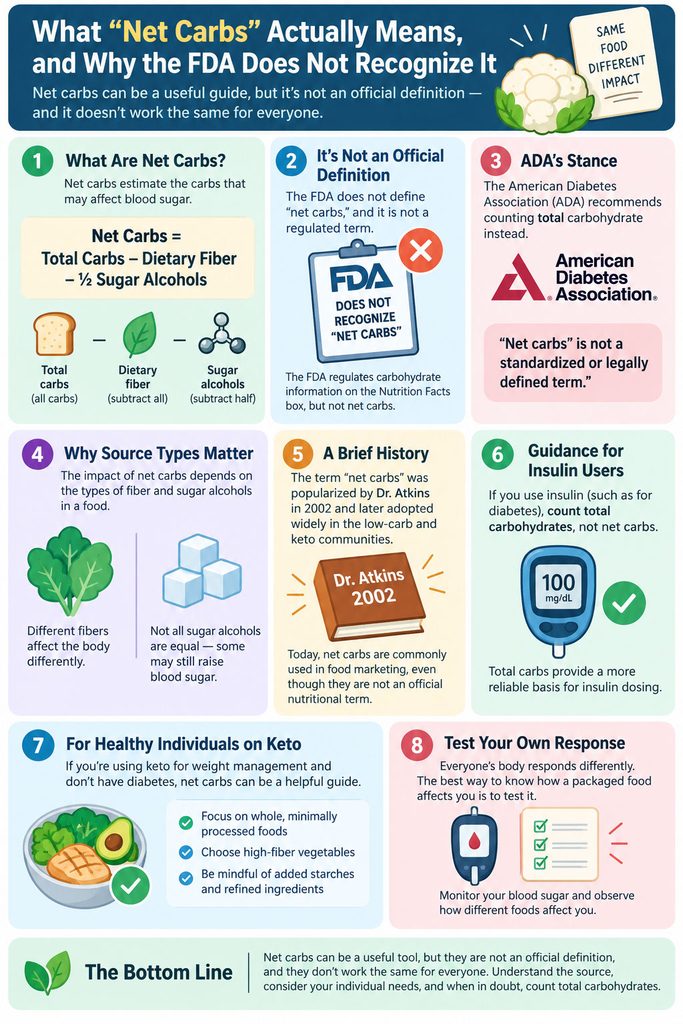
Every keto page you have read treats net carbs as a real, regulated measurement. They are not. This is the part of the answer missing from the entire first results screen, and it changes how much confidence the numbers above deserve.
The subtraction math and where it breaks down
Net carbs are calculated by taking total carbohydrate and subtracting dietary fiber, plus half the grams of any sugar alcohols present. The reasoning is that fiber and sugar alcohols pass through largely undigested and contribute little to blood glucose or insulin response.
For whole vegetables like cauliflower, that reasoning mostly holds up. The fiber in a floret is intact plant cell wall, and it behaves the way the math assumes.
For manufactured food, the reasoning gets shakier. The ADA notes that the calculation assumes fiber and sugar alcohols are neither absorbed nor metabolized, and that this is not always true, since some are partially digested and still deliver calories along with a glucose response. The label does not tell you which type of fiber or sugar alcohol is in the product, so the size of the error is unknowable from the package.
The FDA position
The only carbohydrate information the FDA regulates appears inside the Nutrition Facts box: total carbohydrate, dietary fiber, total sugars, and added sugars, under 21 CFR 101.9(c)(6). Anything printed outside that box, including a bold “2g NET CARBS” claim on the front of a package, has not been evaluated by the agency.
The term itself was popularized by Dr. Atkins’ New Diet Revolution in 2002 and adopted by manufacturers as a marketing device. No standardized formula binds any company. Two products with identical Nutrition Facts panels can advertise different net carb counts legally.
The American Diabetes Association position
The ADA states that “net carbs” has no legal definition, is not used by the FDA, and is not recognized by the association. Its recommendation is to read total carbohydrate on the Nutrition Facts label first.
Its guidance on food claims goes further, noting there is no FDA-approved definition for net carbs and that “keto,” “paleo,” and “low carb” labels do not make a food healthy, particularly for people managing diabetes.
The ADA does support carbohydrate reduction as a strategy. The Standards of Care in Diabetes 2026 lists carbohydrate-restricted eating among evidence-based patterns and, at Recommendation 5.15 with evidence grade B, suggests reducing carbohydrate intake for some adults with diabetes to improve glycemia. Non-starchy vegetables like cauliflower are named as a core component of every pattern the association endorses.
When to count total carbs instead
Patients booking HbA1c and fasting glucose panels through HealthCareOnTime frequently ask which number belongs in their food log. The practical rule: if you take insulin or a sulfonylurea, count total carbohydrate, because dosing errors are the expensive kind of mistake.
If you are otherwise healthy and using keto for weight management, net carbs from whole vegetables is a workable method. For packaged keto products, count total carbs until you have tested your own response, since packaged food is exactly where the subtraction is least trustworthy.
Why This Question Matters More Now Than It Did Five Years Ago
Low-carb eating in the United States is in an unusual phase. Interest is high, adherence is falling, and the packaged food aisle has expanded faster than the guidance around it.
Intent runs far ahead of behavior
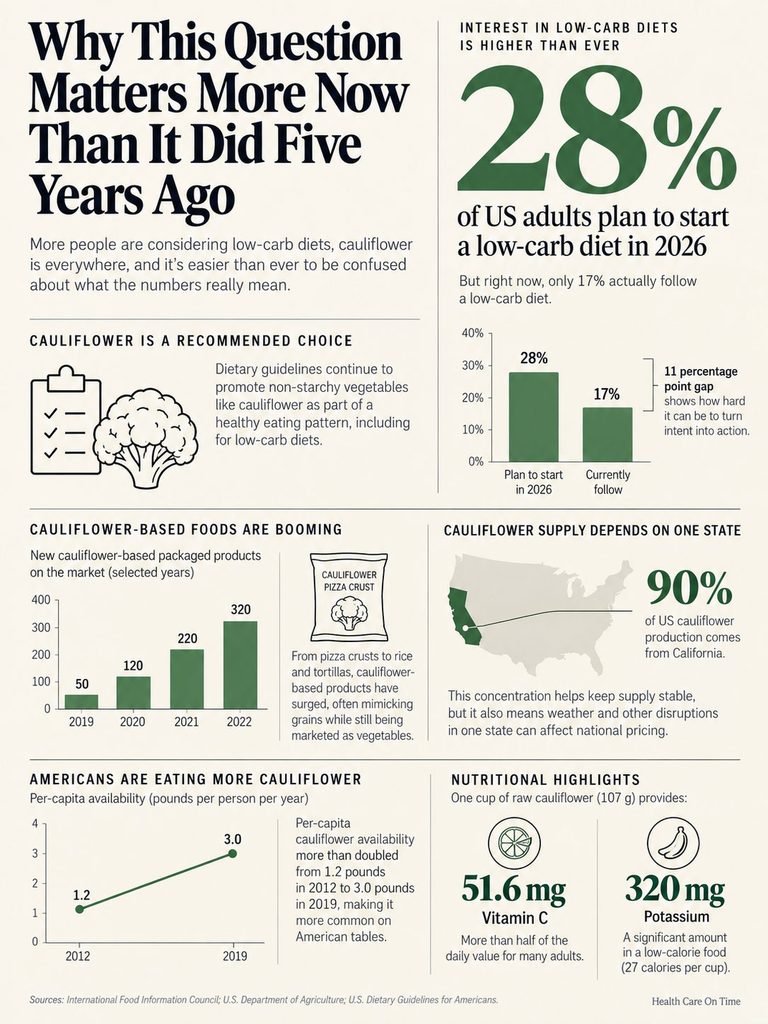
A Morning Consult poll of 2,201 US adults conducted December 2 to 3, 2025 found that 28% planned to start a low-carbohydrate diet such as keto, Atkins, or South Beach in the year ahead, while 42% planned simply to eat fewer calories.
Statista Consumer Insights put the share of US consumers currently following a low-carb or no-carb pattern at 17% in the first quarter of 2024, down from 19% a year earlier. Strict keto sits lower still, around 5% in national consumer surveys.
That gap between 28% planning and 17% doing is the attrition rate, and it is the real story. Most people who quit do not quit because the carb math failed. They quit because the food got boring, restrictive, or uncomfortable. Vegetables are the main lever against all three.
The guidelines moved, and packaged food moved faster
The Dietary Guidelines for Americans 2025 to 2030 were released January 7, 2026, and continue to classify cauliflower among the vegetables Americans should be eating more of, not less. Cauliflower is not a starchy vegetable and has never been treated as one in federal guidance.
What has changed is the shelf. Cauliflower crusts, gnocchi, tots, wraps, and sauced rice blends barely existed a decade ago. These products carry the halo of a vegetable and the carbohydrate load of a grain, and the labeling rules described above give manufacturers wide latitude in how they present it.
Supply and price context
Cauliflower is a domestic crop. California produces roughly 90% of the US supply, which is why availability holds steady year-round and why price swings track West Coast weather more than global markets.
USDA Economic Research Service data show US per-capita cauliflower availability at about 1.2 pounds in 2012, recovering to roughly 3.0 pounds by 2019 as low-carb cooking took hold. That recovery is the low-carb movement showing up in national supply figures.
Table 2: Low-Carb Eating in the United States by the Numbers
| Metric | Figure | Population or sample | Source |
| US adults planning a low-carb diet for the year ahead | 28% | 2,201 US adults, surveyed Dec 2 to 3, 2025 | Morning Consult poll for PCRM |
| US adults planning to eat fewer calories instead | 42% | Same sample | Morning Consult / PCRM |
| US consumers currently following low-carb or no-carb | 17% (down from 19% a year earlier) | 4,182 to 10,051 respondents per quarter, Q1 2024 | Statista Consumer Insights |
| US consumers following keto “always or almost always” | 5% | National online consumer survey, Sept to Oct 2023 | Packaged Facts |
| Vitamin C in one cup of raw cauliflower | 51.6 mg (57% DV) | Per 107 g cup | USDA FDC 169986 |
| Potassium in one cup of raw cauliflower | 320 mg | Per 107 g cup | USDA FDC 169986 |
How Much Cauliflower Fits in Your Daily Carb Budget
The question people actually want answered is not whether cauliflower is keto. It is how much they can eat before it stops being keto.
Three budgets, three ceilings
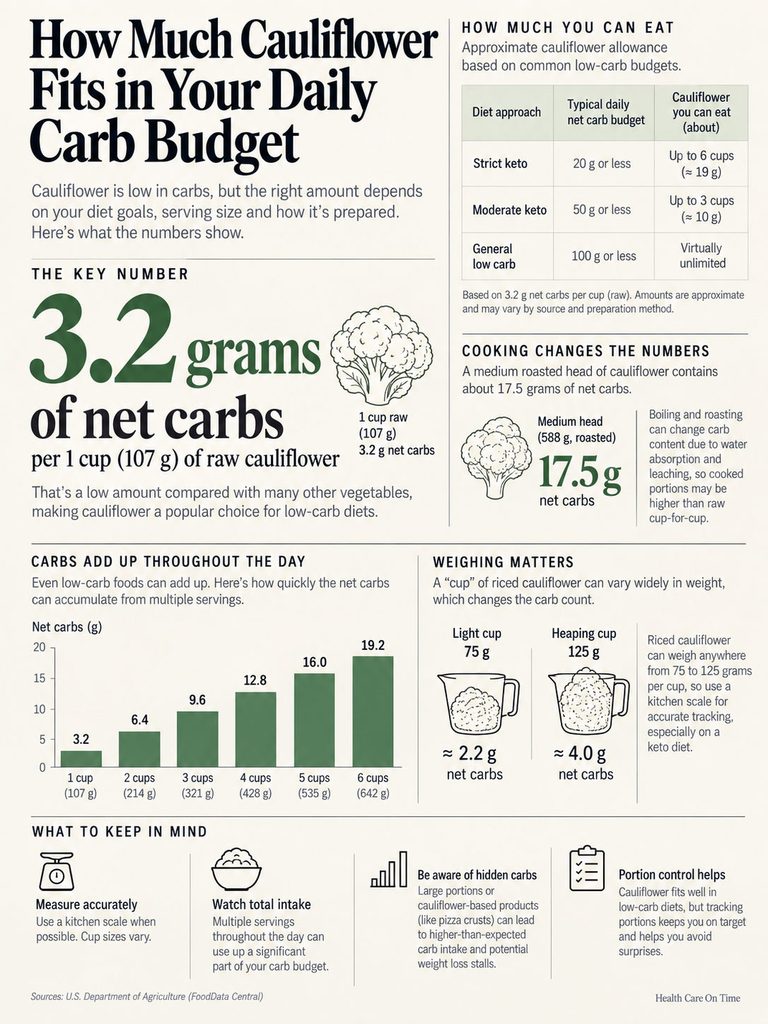
Strict or therapeutic keto usually means staying under 20 grams of net carbs per day. At 3.2 grams per raw cup, that is about six cups of cauliflower before the entire day is spent on one vegetable, with nothing left for avocado, nuts, dairy, or salad greens.
Moderate keto runs 20 to 50 grams of net carbs. Cauliflower stops being a constraint at that level. Three cups a day costs under 10 grams and leaves plenty of room.
General low carb, roughly 50 to 130 grams a day, puts cauliflower firmly in the free-food category. You would have to work at it to eat enough for the number to matter.
The whole-head problem
Roasting a whole head is the most common way people overshoot without noticing. A medium head at 588 grams delivers 17.5 grams of net carbs, which is 87% of a strict day in one side dish.
This is not an argument against cauliflower. It is an argument for weighing the head before it goes in the oven and portioning it across two or three meals. Our nutrition reviewers consider a kitchen scale the highest-value ten dollars a strict keto dieter can spend.
Cauliflower rice by the gram, not the cup
A loosely packed cup of riced cauliflower can weigh 75 grams. A firmly packed cup can reach 125 grams. That is a spread of 2.2 to 3.7 grams of net carbs for what looks like an identical portion.
If dinner is two or three cups of cauliflower rice under a stir-fry, which is a normal keto serving, that measurement error compounds inside a single meal. Weighing takes ten seconds and removes the guesswork entirely.
Stacking error
Three modest cauliflower servings across one day add up quietly. Cauliflower rice at lunch, roasted florets as a snack, and cauliflower mash at dinner can total 300 to 400 grams and 9 to 12 grams of net carbs before anything else is counted.
On a 20-gram day, that leaves 8 to 11 grams for every other food you eat. This mechanism explains most of the “cauliflower stalled my weight loss” posts on keto forums, and it has nothing to do with the vegetable hiding carbohydrate.
The Cauliflower Swaps That Work, Ranked by Carb Savings
Cauliflower earned its place in American keto kitchens because it substitutes for the exact foods that come off the plate. The savings are large enough to justify the texture compromise.
Cauliflower rice versus white rice
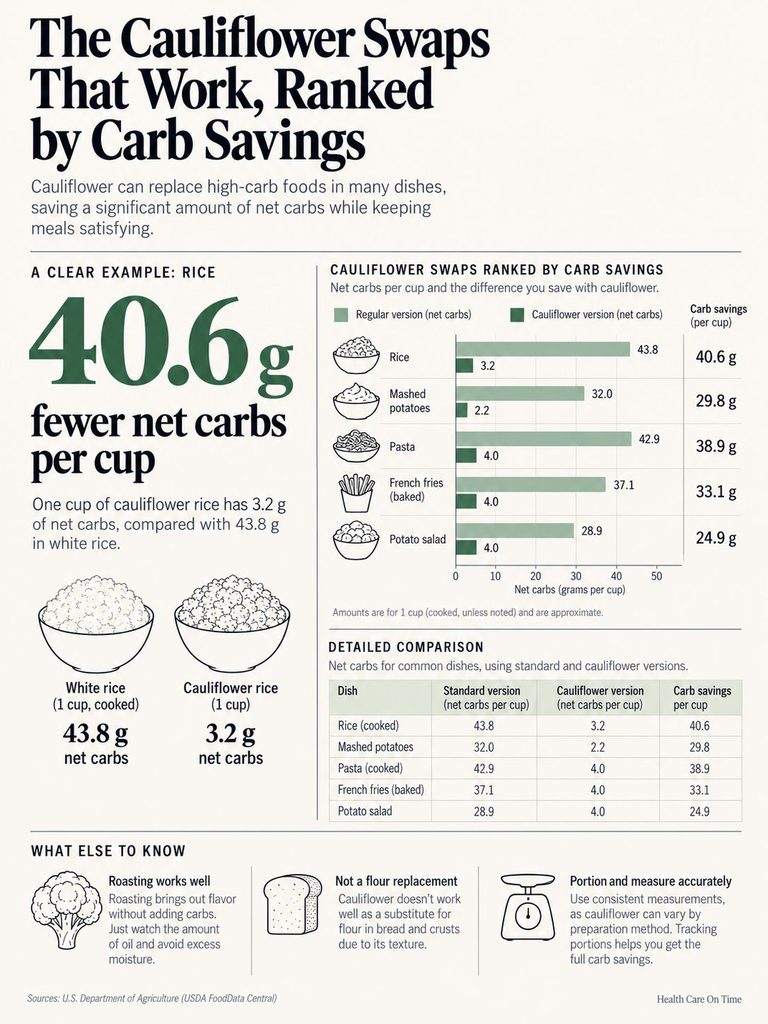
One cup of cooked white rice (158 grams) delivers roughly 43.8 grams of net carbs and 205 calories. One cup of cauliflower rice delivers 3.2 grams and 27 calories.
That is a swap of about 40 grams of net carbs in a single side. White rice alone would consume two full strict-keto days.
Cauliflower mash versus mashed potatoes
Mashed potatoes run about 32 grams of net carbs per cup. Cauliflower mash from boiled drained florets contributes around 2.2 grams from the vegetable itself, before butter and cream cheese, which add fat rather than carbohydrate.
The technique that separates good cauliflower mash from watery cauliflower mash is moisture removal. Steam rather than boil, then press the cooked florets in a clean kitchen towel and wring out the water before blending. Skipping that step is why most first attempts fail.
Roasted florets and cauliflower steak
Roasting concentrates flavor without adding carbohydrate. A thick cross-section cut through the center of a head, seared in a hot pan and finished in a 425°F oven, holds up as the anchor of a plate rather than a side.
Watch the oil rather than the carbs here. Cauliflower absorbs fat readily, which suits keto but matters if calories are part of your plan.
Where the swap fails
Cauliflower will not behave like flour. Bread, tortillas, and crusts built on cauliflower alone collapse into a wet mess, which is precisely why commercial versions add starch. That is the next section.
Table: Swap Savings per One-Cup Serving
| Dish | Standard version | Net carbs (g) | Cauliflower version | Net carbs (g) | Carbs saved (g) |
| Rice side | White rice, cooked (158 g) | 43.8 | Cauliflower rice (107 g) | 3.2 | 40.6 |
| Mash | Mashed potatoes (210 g) | 32.0 | Cauliflower mash (124 g) | 2.2 | 29.8 |
| Pasta base | Spaghetti, cooked (140 g) | 40.7 | Cauliflower florets (107 g) | 3.2 | 37.5 |
| Cold salad | Potato salad (250 g) | 25.0 | Cauliflower salad (107 g) | 3.2 | 21.8 |
| Fried side | Tater tots (10 pieces, 79 g) | 18.0 | Roasted florets (107 g) | 3.2 | 14.8 |
Standard-version figures derived from USDA composition data. Cauliflower figures from FDC 169986 and 170397.
The Hidden Traps: When “Cauliflower” on the Label Is Not Keto
This is where readers actually get caught, and it is the section every competing article replaces with a vague “check the label” and no numbers.
Cauliflower pizza crust and the rice flour problem
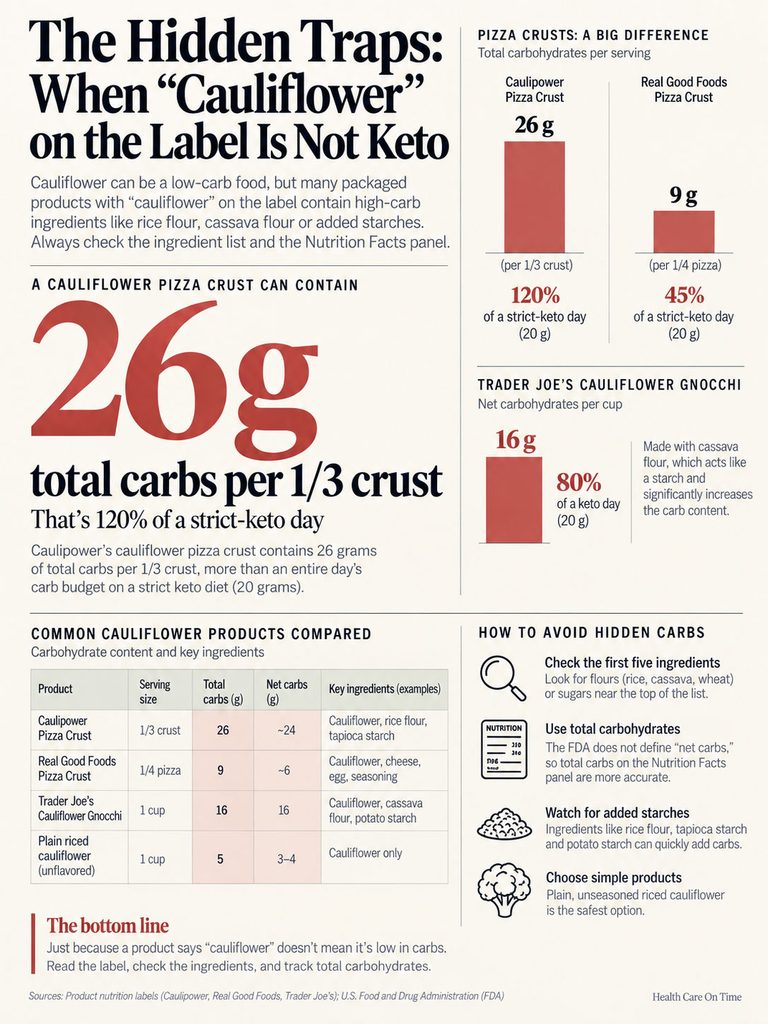
Caulipower’s frozen cauliflower pizza crust lists cauliflower first, then brown rice flour, rice flour, water, corn starch, tapioca starch, sunflower oil, egg, olive oil, and sugar. One third of a crust delivers 170 calories, 26 grams of total carbohydrate, and roughly 24 grams of net carbs.
Read that again. One third of one crust, before sauce, cheese, or a single topping, uses more than a full strict-keto day.
Not every brand is built this way. Real Good Foods’ cauliflower crust pizza uses a crust based on chicken and cheese rather than rice flour, and lands at 9 grams of total carbohydrate and 6 grams of net carbs per quarter pizza. Same shelf, same category label, a fourfold difference.
Cauliflower gnocchi and cassava flour
Trader Joe’s Cauliflower Gnocchi is roughly 75% cauliflower, with cassava flour, potato starch, olive oil, and sea salt making up the balance. One cup (140 grams) contains 140 calories, 22 grams of total carbohydrate, 6 grams of fiber, 16 grams of net carbs, and 460 milligrams of sodium.
Against potato gnocchi at more than 70 grams of carbohydrate per cup, that is a real improvement. Against a 20-gram keto day, it is 80% of the budget in a side portion.
Cassava is the reason. Cassava is a starchy root, and flour milled from it behaves like flour, not like a vegetable, no matter what the front of the bag emphasizes.
Packaged riced cauliflower
Plain frozen riced cauliflower with one ingredient on the label is a good product and often lower in net carbs per cup than fresh. The traps are the seasoned, sauced, and blended versions, where rice, peas, corn, or starch-based binders enter the mix and the carbohydrate climbs while the front of the package barely changes.
The ten-second label check
Turn the package over and read the first five ingredients. If any flour, starch, or sugar appears in that group, you are holding a starch food with cauliflower in it, not a cauliflower food.
Then read total carbohydrate on the Nutrition Facts panel rather than the net carb claim on the front. The panel is regulated. The front of the box is advertising.
Table: Cauliflower Products Against a Strict 20-Gram Keto Day
| Product | Serving | Total carbs (g) | Net carbs (g) | % of a 20 g day |
| Caulipower cauliflower pizza crust | 1/3 crust (170 kcal) | 26 | 24 | 120% |
| Trader Joe’s Cauliflower Gnocchi | 1 cup (140 g) | 22 | 16 | 80% |
| Real Good Foods cauliflower crust pizza | 1/4 pizza | 9 | 6 | 30% |
| Plain frozen riced cauliflower (single ingredient) | 1 cup (85 g label serving) | 4 | 2 | 10% |
| Homemade cauliflower rice | 1 cup (107 g) | 5.3 | 3.2 | 16% |
| Fresh cauliflower florets, roasted | 1 cup (107 g) | 5.3 | 3.2 | 16% |
Manufacturer label data as published. Formulations change, so verify against the package in your hand.
Beyond Carbs: What Cauliflower Gives a Keto Dieter That Meat Does Not
Carbohydrate is one reason cauliflower belongs on a keto plate. The other reasons matter most during the first three weeks, when most people quit.
Potassium and the early electrolyte drop
Cutting carbohydrate lowers insulin, and lower insulin prompts the kidneys to excrete more sodium and water. Potassium follows sodium out. The fatigue, headache, and muscle cramping people call keto flu is largely an electrolyte story rather than a fuel story.
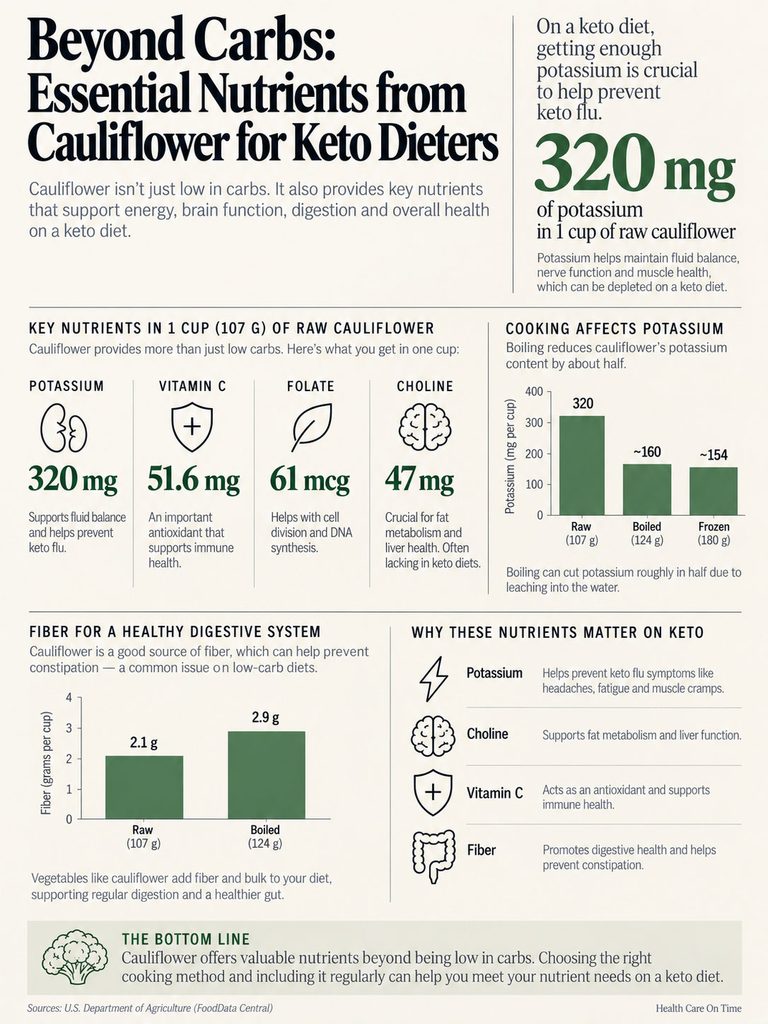
One cup of raw cauliflower supplies about 320 milligrams of potassium. That is not a large dose alone, but on a plate built from eggs, cheese, and beef, vegetables are where nearly all of the potassium is going to come from.
Cooking method changes the potassium you keep
Potassium dissolves in water, and boiling leaches it straight into the pot. Cauliflower falls from 299 milligrams per 100 grams raw to roughly 142 milligrams after boiling and draining, close to half.
Roasting, steaming, air-frying, and sautéing retain far more. Our medical review team flags this as the practical point most keto guides miss: the cooking method chosen for carb reasons is quietly an electrolyte decision too. If cramping is your problem, roast instead of boil before reaching for a supplement.
Vitamin C, folate, and choline
Keto plates run low in vitamin C, because fruit and most starchy vegetables are off the menu. A single cup of raw cauliflower supplies 51.6 milligrams, about 57% of the Daily Value.
The same cup provides roughly 61 micrograms of folate and 47 milligrams of choline. Choline matters on high-fat eating patterns because of its role in moving fat out of the liver, and US intakes fall short of the adequate intake for the large majority of adults.
Fiber and the constipation problem
Low-carb patterns frequently cut fiber sharply, and constipation is among the most common early complaints. A cup of raw cauliflower carries 2.1 grams of fiber; a cup of boiled cauliflower carries 2.9 grams.
Across the questions readers submit to our team, digestive complaints outnumber weight-stall complaints in the first month of keto by a wide margin. Vegetables are usually the fix rather than the cause.
The Downsides Nobody Warns You About
Honest coverage means naming the situations where cauliflower is the wrong choice, or the right choice in a smaller amount.
FODMAPs at keto portion sizes
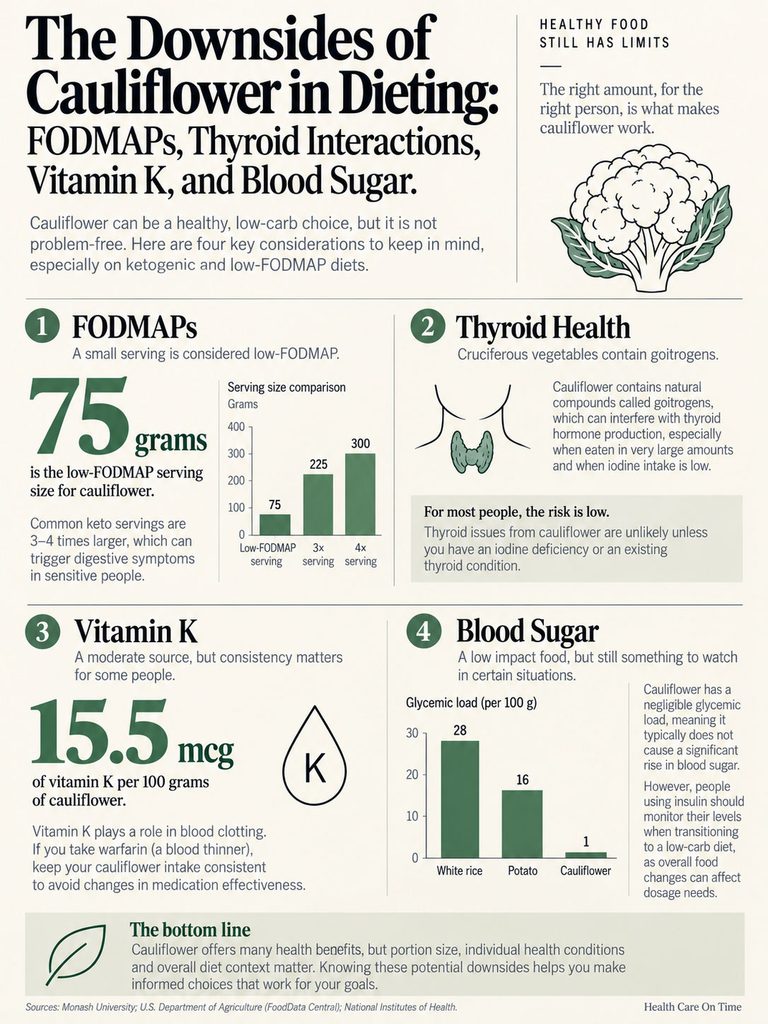
Monash University, which runs the reference FODMAP testing program, updated its cauliflower classification in May 2025, reclassifying the dominant FODMAP from mannitol to fructan. Its low-FODMAP serving size is 75 grams, slightly under three quarters of a cup.
Compare that to how keto dieters actually eat cauliflower. Two cups of cauliflower rice is 214 grams. Three cups is 321 grams. That is three to four times the low-FODMAP threshold inside a single meal.
Fructans are not digested in the small intestine. They reach the colon intact, where gut bacteria ferment them and produce gas. In someone with a sensitive gut, that produces bloating, cramping, and urgency.
If you have irritable bowel syndrome, or you developed bloating after starting keto and blamed the diet itself, test cauliflower portion size before concluding that low-carb eating disagrees with you. Cutting to 75 grams per meal for a week is a cheap experiment.
Thyroid and goitrogens
Cruciferous vegetables contain glucosinolates, which break down into compounds that can compete with iodine uptake in the thyroid gland. The biochemistry is real, and the internet version of it is badly overstated.
The interference becomes clinically meaningful at intakes well beyond ordinary eating and mainly in the setting of existing iodine deficiency, which is uncommon in the United States because table salt is iodized. Cooking reduces glucosinolate content further, particularly boiling.
People with diagnosed hypothyroidism or Hashimoto’s should raise the question with their physician rather than eliminate a vegetable on the strength of a blog post. In cases reviewed by our medical team, the far more common thyroid issue on keto is medication timing and absorption, not vegetable intake.
Vitamin K and warfarin
Cauliflower supplies about 15.5 micrograms of vitamin K per 100 grams. That is modest next to spinach or kale, but it is not zero, and vitamin K directly affects how warfarin works.
The clinical guidance is consistency rather than avoidance. Eating a steady amount week to week keeps your INR readings stable and your dose predictable. The pattern that causes trouble is a sudden change, such as tripling your vegetable intake overnight because you started a new diet.
Tell your anticoagulation clinic before you start keto, not after your next INR comes back out of range. Two weeks of steady intake gives them something to dose against.
Blood sugar and diabetes
Cauliflower is a non-starchy vegetable and produces a minimal glycemic response at normal portions. Even using a high-end glycemic index estimate, a cup carrying 3.2 grams of available carbohydrate produces a glycemic load under 1, which is negligible.
The caution belongs to the diet change rather than to the vegetable. People who start a low-carbohydrate diet while taking insulin or a sulfonylurea can drop into hypoglycemia when carbohydrate intake falls quickly. That is a medication-adjustment conversation to have before the first low-carb meal, not after the first bad reading.
Your Cauliflower Plan for Keto and Low Carb
A one-week portion framework
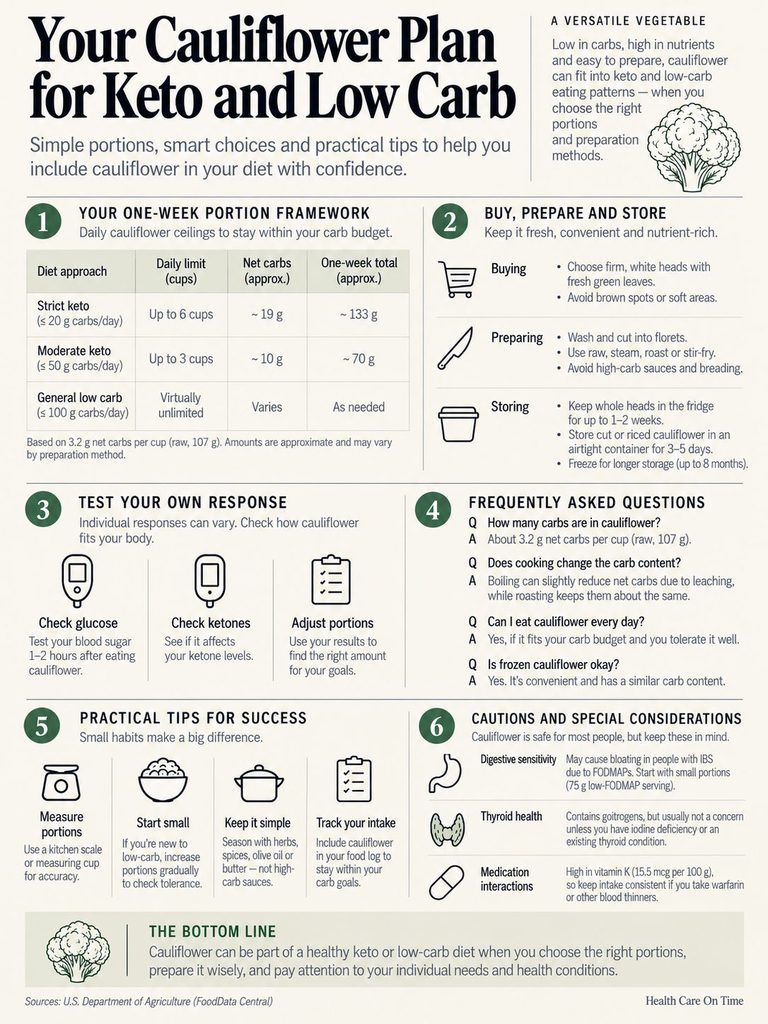
For strict keto under 20 grams, cap cauliflower at roughly two cups a day, about 6.5 grams of net carbs. That leaves 13 grams for other vegetables, nuts, and dairy, which is a workable plate.
For moderate keto at 20 to 50 grams, three to four cups a day is comfortable and still leaves room. For general low carb, no practical ceiling applies.
Split a whole head across two or three meals rather than roasting and finishing it in one sitting. Weigh the head raw so you know exactly what you are working with.
Buy, prep, and store
Choose heads that feel heavy for their size, with tight cream-colored curds and no brown spotting or soft patches. The green leaves at the base should look fresh rather than wilted, which is the fastest freshness tell.
A whole head keeps about two weeks in the refrigerator. Once riced, use it within three days or freeze it in pre-weighed portions, which also solves the measuring problem permanently.
Frozen plain cauliflower is a legitimate choice and often lower in net carbs per cup than fresh. Read the ingredient list to confirm cauliflower is the only thing in the bag.
Test your own response
Label numbers are population averages. Your response is yours, and it is easy to measure. If you use a glucose meter or a continuous monitor, eat a measured cauliflower-based meal and test at 30, 60, and 120 minutes, then repeat on a second day to confirm.
If ketone strips are your tool, test at the same time of day for two consecutive days rather than after a single meal, since ketone readings swing widely with hydration and time of day.
Patients who order metabolic panels through HealthCareOnTime often find that two days of self-testing settle a question that weeks of reading could not. Bring the numbers to your next appointment rather than the diet debate.
Table 3: Scenario to Action
| If this is you | Daily cauliflower ceiling | What to do | What to skip |
| Strict keto, under 20 g net carbs | About 2 cups (roughly 214 g, 6.5 g net) | Weigh raw. Split a head across two meals. Roast or steam rather than boil | All commercial cauliflower crusts and gnocchi |
| Moderate keto, 20 to 50 g net carbs | 3 to 4 cups (10 to 13 g net) | Use as your default vegetable. Track by gram for rice dishes | Sauced or seasoned frozen blends with added starch |
| General low carb, 50 to 130 g | No practical ceiling | Eat freely. Prioritize roasting and steaming to keep potassium | Breaded and deep-fried cauliflower sides |
| Keto plus IBS, bloating, or gas | 75 g per meal (Monash low-FODMAP serving) | Cook thoroughly, keep single servings under 75 g, spread across the day | Large single-sitting cauliflower rice portions |
| Keto plus type 2 diabetes on medication | Same as your keto tier | Count total carbohydrate, not net carbs. Review doses with your physician before starting | Any product relying on a front-of-package net carb claim |
| Keto while taking warfarin | Consistent, not restricted | Keep intake steady week to week. Notify your anticoagulation clinic before starting | Sudden large increases in cruciferous vegetables |
Frequently Asked Questions
How many net carbs are in one cup of cauliflower?
One cup of raw chopped cauliflower (107 grams) contains about 5.3 grams of total carbohydrate and 2.1 grams of fiber, giving 3.2 grams of net carbs and 27 calories. Boiled and drained cauliflower, at 124 grams per cup, comes in lower at roughly 2.2 grams of net carbs.
Will cauliflower rice kick me out of ketosis?
Not at normal portions. One cup of homemade cauliflower rice contributes 3.2 grams of net carbs, about 16% of a strict 20-gram day. Three cups in one meal approaches 10 grams, which is significant on a strict budget. Weigh the portion rather than eyeballing it.
How many carbs are in a whole head of cauliflower?
A medium head weighing 588 grams contains roughly 29 grams of total carbohydrate, 11.8 grams of fiber, and 17.5 grams of net carbs. A large 840-gram head reaches about 24.9 grams of net carbs, which exceeds an entire strict-keto day on its own.
Is store-bought riced cauliflower keto friendly?
Plain frozen riced cauliflower listing only cauliflower is keto friendly and often lower in net carbs per cup than fresh. Seasoned, sauced, and blended versions can include rice, corn, peas, or starch binders. Read the ingredient list rather than the front of the bag.
Is cauliflower pizza crust keto?
Usually not. Caulipower’s crust carries 26 grams of total carbohydrate and about 24 grams of net carbs per one-third crust, because rice flour and starch sit high in the ingredient list. Crusts built on chicken, cheese, or almond flour, such as Real Good Foods’, can fit at around 6 grams net.
Is Trader Joe’s cauliflower gnocchi keto?
One cup (140 grams) has 22 grams of total carbohydrate, 6 grams of fiber, and 16 grams of net carbs. That is 80% of a strict 20-gram keto day. It works on a moderate or general low-carb plan in a measured portion, but not on strict keto.
Should I count total carbs or net carbs on keto?
If you take insulin or a sulfonylurea, count total carbohydrate. The FDA does not define net carbs, and the American Diabetes Association recommends against relying on the term. For whole vegetables on a healthy adult’s keto plan, net carbs remains a workable method.
Does cooking cauliflower change its carb count?
Yes, modestly. Boiling adds water and leaches soluble carbohydrate, dropping net carbs from 2.97 grams per 100 grams raw to 1.81 grams boiled. Roasting removes water and concentrates everything per gram. Weigh before cooking for the most consistent tracking.
Can you eat too much cauliflower on keto?
On a strict 20-gram day, yes. Six cups would consume the entire budget. The more common problem is stacking, where cauliflower at three meals quietly totals 300 to 400 grams and 9 to 12 grams of net carbs before anything else is counted.
Why does cauliflower make me bloated on keto?
Cauliflower’s low-FODMAP serving is 75 grams, and typical keto portions run three to four times that. Fructans reach the colon undigested and ferment, producing gas. Symptoms blamed on keto adaptation are frequently portion-size effects. Cut single servings to 75 grams and reassess after a week.
Is cauliflower better than broccoli for keto?
Cauliflower is slightly lower in net carbs, at 2.97 grams per 100 grams raw against roughly 4 grams for broccoli. Broccoli carries more vitamin C, vitamin K, and glucosinolates. On a keto plan the difference is small enough that both deserve a place in your rotation.
Is cauliflower safe for keto if I have type 2 diabetes?
Cauliflower is a non-starchy vegetable, and the ADA names this group as a core part of every eating pattern it endorses. The caution belongs to the diet change rather than the vegetable. Starting keto while taking glucose-lowering medication can trigger hypoglycemia, so review doses with your physician first.
Medical Disclaimer: This article is for general information and is not a substitute for individualized medical advice, diagnosis, or treatment. Nutrient values are population averages and vary by cultivar, growing conditions, and preparation method. If you take insulin, a sulfonylurea, warfarin, or any other prescription medication, speak with your physician or a registered dietitian before starting a ketogenic or low-carbohydrate diet. People with kidney disease, thyroid disease, a history of disordered eating, or who are pregnant or breastfeeding should get individualized guidance before restricting carbohydrate intake.
References
- USDA FoodData Central, Cauliflower, raw (FDC ID 169986)
- FDA, Interactive Nutrition Facts Label: Total Carbohydrate, 21 CFR 101.9(c)(6)
- American Diabetes Association, Get to Know Carbs
- American Diabetes Association, Nutrition-Related Claims You Should Know About
- ADA Standards of Care in Diabetes 2026, Section 5
- ADA Standards of Care in Diabetes 2026, Section 3
- Physicians Committee for Responsible Medicine, Morning Consult diet poll, December 2025
- Statista Consumer Insights, Share of US consumers following a low-carb or no-carb diet
- Trader Joe’s, Cauliflower Gnocchi product page
- Monash University FODMAP Program