Almost every American woman learns the same rule in health class: you ovulate on day 14. Then researchers analyzed 612,613 tracked ovulatory cycles and found only 13% of them were even 28 days long. The textbook cycle that rule was built on describes a minority of real bodies. If you have been timing anything around day 14, the math may have been quietly working against you.
Table of Contents
Quick Answer
Ovulating means one of your ovaries has released a mature egg. A surge in luteinizing hormone (LH) triggers the follicle to rupture, usually 24 to 36 hours after the surge begins. The egg survives about 12 to 24 hours. Because sperm can live up to five days, your fertile window spans roughly six days ending on ovulation day. The exact day varies widely between women and between cycles.
At a Glance
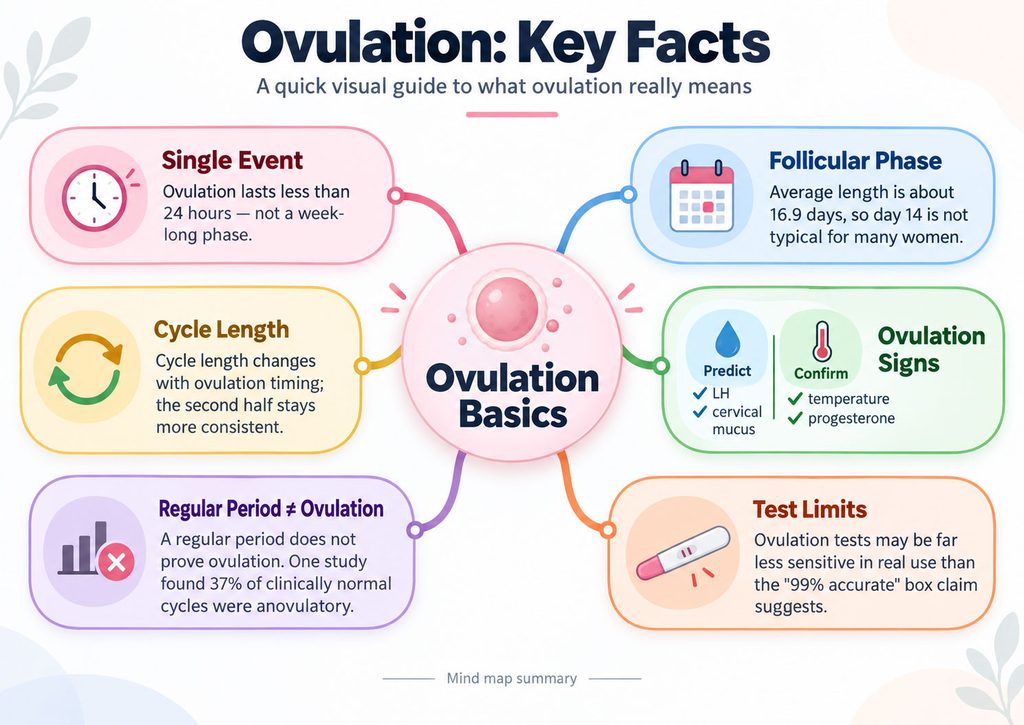
• Ovulation is a single event lasting under a day, not a phase lasting a week.
• The average follicular phase measures 16.9 days, not 14, so day 14 fits fewer women than most people assume.
• Cycle length changes when you ovulate; the second half of your cycle stays comparatively fixed.
• Signs of ovulation split into two groups: those that predict (LH, cervical mucus) and those that confirm (temperature, progesterone).
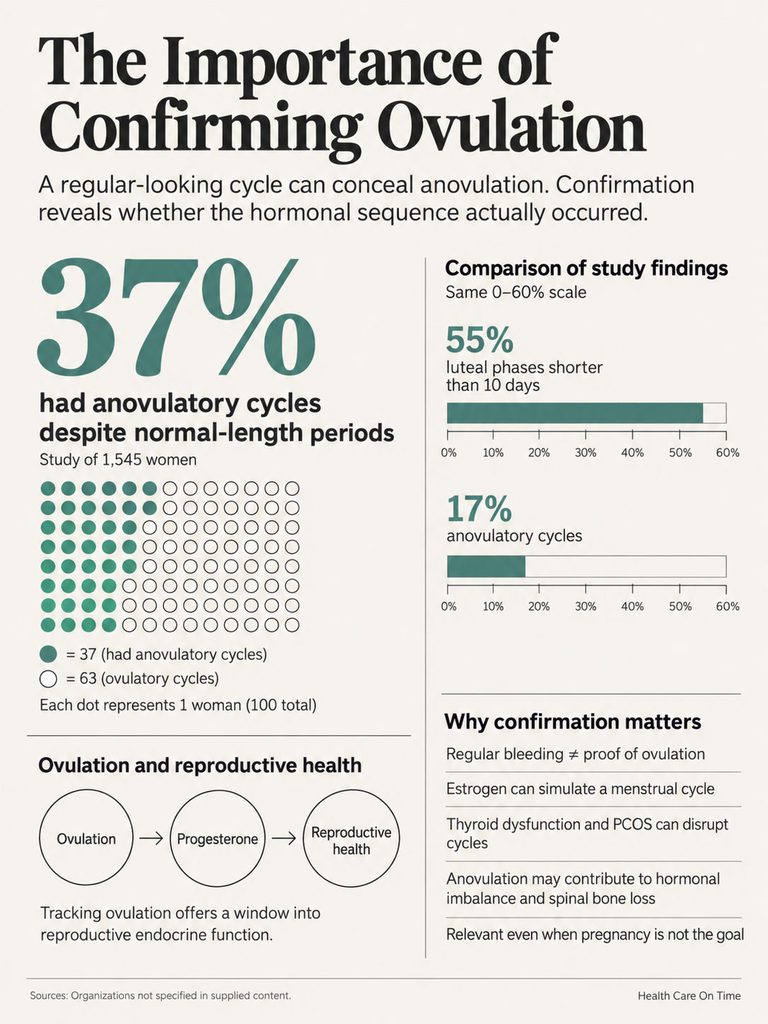
• A regular period does not prove you ovulated. In one population study, 37% of clinically normal cycles were anovulatory.
• Ovulation tests are far less sensitive in practice than the “99% accurate” claim on the box implies.
What Ovulating Actually Means
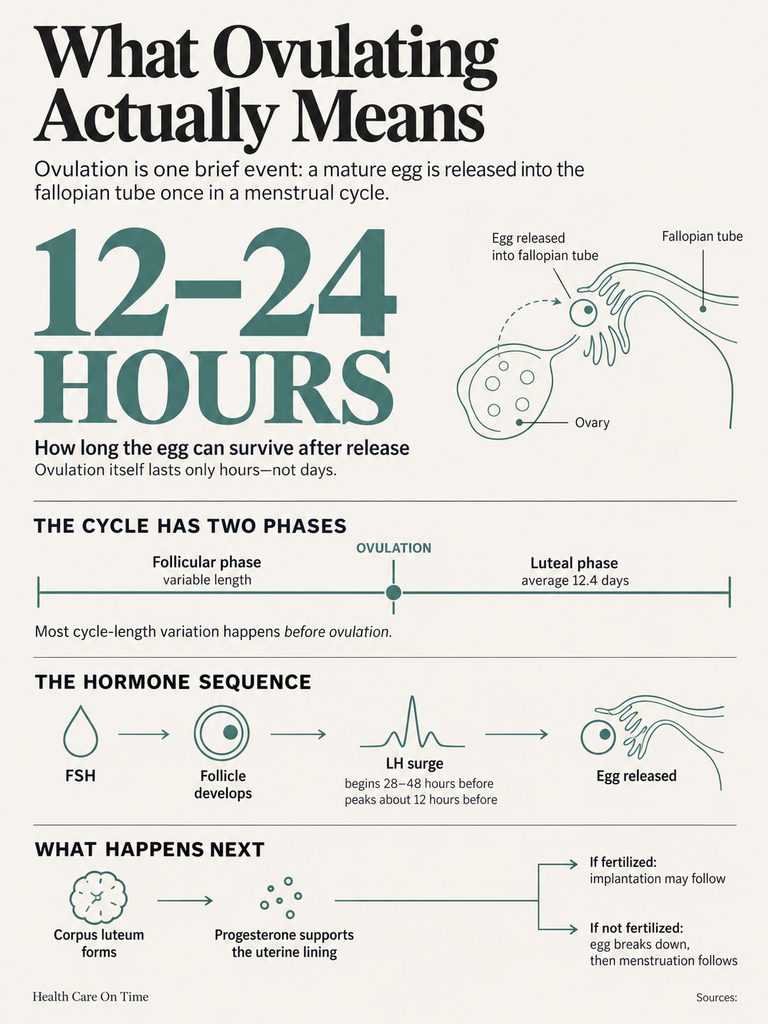
Ovulating means an ovary has released a mature egg, called an oocyte, into the fallopian tube where it becomes available for fertilization. That is the entire event. It happens once in a typical cycle and it is over within hours.
Many people picture ovulation the way they picture a period, as a stretch of days. It is closer to a single moment with a long buildup in front of it and a long aftermath behind it.
Your cycle has two halves, and only one of them moves
Doctors divide the menstrual cycle at the moment of ovulation.
The follicular phase runs from the first day of bleeding until the egg is released. This is the build-up half, and it is the part that stretches or shortens.
The luteal phase runs from ovulation to the day before your next period. This half stays comparatively stable, averaging 12.4 days.
Understanding that split explains most of what confuses people about cycle tracking. A long cycle is almost never a delayed period. It is a delayed ovulation followed by a normal second half.
The hormone sequence behind the release
Early in the cycle, follicle-stimulating hormone (FSH) recruits a group of follicles inside the ovary. One usually pulls ahead and becomes dominant, and that follicle produces rising amounts of estrogen.
When estrogen climbs past a threshold, the pituitary gland answers with a sharp release of luteinizing hormone. This LH surge is the trigger. The follicle wall breaks down and the egg is released.
The timing is tighter than most articles admit. Research summarized in the Natural Cycles cohort analysis places the start of the LH surge roughly 28 to 48 hours before the follicle actually ruptures, with peak LH reached about 12 hours beforehand.
What happens after the egg leaves
The collapsed follicle does not disappear. It reorganizes into a structure called the corpus luteum, which secretes progesterone for the rest of the cycle.
Progesterone thickens and stabilizes the uterine lining for a possible embryo. It also nudges your resting body temperature upward, which is the physical basis for temperature tracking.
The egg itself has a short life, roughly 12 to 24 hours. If no sperm reaches it, it breaks down, progesterone falls, and the lining sheds about two weeks later.
Our medical reviewers note that this is the detail readers most often get backwards. The egg’s short survival is why the fertile window sits almost entirely before ovulation, not after it.
When Ovulation Actually Happens (And Why Day 14 Misleads)
The day-14 rule comes from a clean piece of arithmetic. Assume a 28-day cycle, assume the luteal phase is always 14 days, subtract, and you land on day 14.
Both assumptions are shakier than the rule suggests.
What 612,613 real cycles show
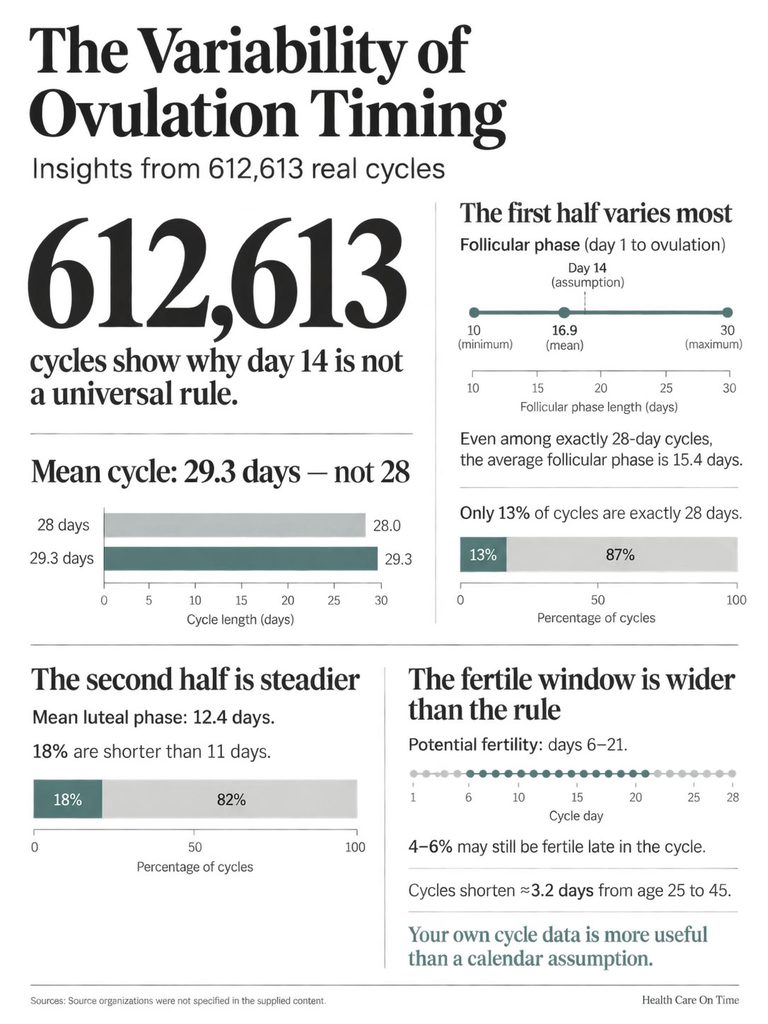
The 2019 analysis published in npj Digital Medicine examined 612,613 ovulatory cycles from 124,648 app users, with ovulation confirmed by basal body temperature plus urinary LH tests rather than by calendar assumption.
Mean cycle length came out at 29.3 days. The mean follicular phase, the stretch from day 1 to ovulation, measured 16.9 days with a 95% confidence range of 10 to 30 days.
Only 81,605 cycles, about 13%, were exactly 28 days long. Even within that subgroup, the average follicular phase ran 15.4 days rather than 14.
The luteal phase is not fixed at 14 days either
The same dataset put the mean luteal phase at 12.4 days, and found that 18% of cycles had a luteal phase shorter than 11 days.
That figure is close to what Vollman reported decades earlier, at 15%. Short luteal phases are common enough that treating 14 days as a constant introduces error in both directions.
Table 1: Textbook Assumption vs Measured Reality
| Your usual cycle length | Textbook says you ovulate on | Measured mean follicular phase | Likely fertile window (cycle days) | What to do with this |
| 15 to 20 days (very short) | Day 14 | 10.4 days | Days 5 to 10 | Start LH testing by day 5; day-14 advice arrives far too late |
| 21 to 24 days (short) | Day 14 | 12.4 days | Days 7 to 12 | Begin testing day 6 or 7 |
| 25 to 30 days (typical) | Day 14 | 15.2 days | Days 10 to 15 | Begin testing day 9 or 10, not day 12 |
| Exactly 28 days | Day 14 | 15.4 days | Days 10 to 15 | Even a textbook cycle skews about a day later than the rule |
| 31 to 35 days (long) | Day 14 | 19.5 days | Days 14 to 20 | Day-14 testing catches almost nothing; start day 13 |
| 36 to 50 days (very long) | Day 14 | 26.8 days | Days 21 to 27 | Standard 7-strip kits run out before your surge arrives |
Follicular phase values from Bull et al., npj Digital Medicine, 2019 (n = 612,613 cycles). Fertile window estimated as the five days before ovulation plus ovulation day.
Even regular cycles are unpredictable
The best-known American data on this comes from the North Carolina Early Pregnancy Study. Allen Wilcox and colleagues at the National Institute of Environmental Health Sciences tracked 221 women through 696 cycles using daily urinary hormone metabolites.
Their BMJ paper reported that the fertile window sat entirely inside cycle days 10 to 17 for only about 30% of women. On every single day from day 6 through day 21, women carried at least a 10% chance of being in their fertile window.
The authors also found that 4 to 6% of women whose periods had not yet arrived were still potentially fertile in the fifth week of their cycle. Their conclusion was blunt: fertile timing can be highly unpredictable even when cycles look regular.
How ovulation timing shifts with age
Your ovulation day is not a fixed personal trait. It drifts across your reproductive life, and the direction of that drift surprises most people.
In the same 612,613-cycle dataset, mean cycle length fell by about 0.18 days for every year of age between 25 and 45. Over that twenty-year span, cycles shortened by roughly 3.2 days on average, and almost all of that came from the follicular phase shortening by about 3.4 days. The luteal phase barely moved.
In plain terms, a woman in her early forties tends to ovulate earlier in her cycle than she did at twenty-five, not later.
Consistency changes too. Cycle-to-cycle variation narrowed steadily from the mid-twenties through the late thirties, then climbed sharply after 40, reaching its highest measured level at age 45. Teenage cycles sit at the other end of the same pattern, since ovulation is often irregular for the first two to three years after periods begin.
This is why advice built on a single remembered cycle length ages badly. If you last charted your cycles in your twenties and you are now trying to conceive at 38, the timing you memorized then is probably no longer the timing your body uses.
What this evidence can and cannot tell you
Every dataset above has limits worth naming, and no page on this topic should present them as settled truth.
The 612,613-cycle analysis drew on users of a paid tracking app, mostly in Sweden, the UK, and the USA. Only 8% were classified as obese against roughly 15% of women in the general population, and women reporting PCOS were excluded at sign-up. It also excluded 665,603 cycles where ovulation could not be detected, most for insufficient temperature data. The study was funded by the app developer.
The Wilcox findings come from 1995 and 2000. Human reproductive physiology has not changed since, and the six-day fertile window has been replicated independently, but the cohort was small and predominantly white.
The anovulation figure discussed below comes from a Norwegian population, not an American one.
None of this makes the numbers wrong. It does mean they describe patterns rather than promises, and your own cycle is the only dataset that fully applies to you.
Why Your Body Changes During Ovulation
Rising estrogen before ovulation and rising progesterone after it produce a recognizable set of physical changes. Some are reliable enough to track. Others are folklore with a thin evidence base, and it helps to know which is which.
Cervical mucus, the most useful free sign
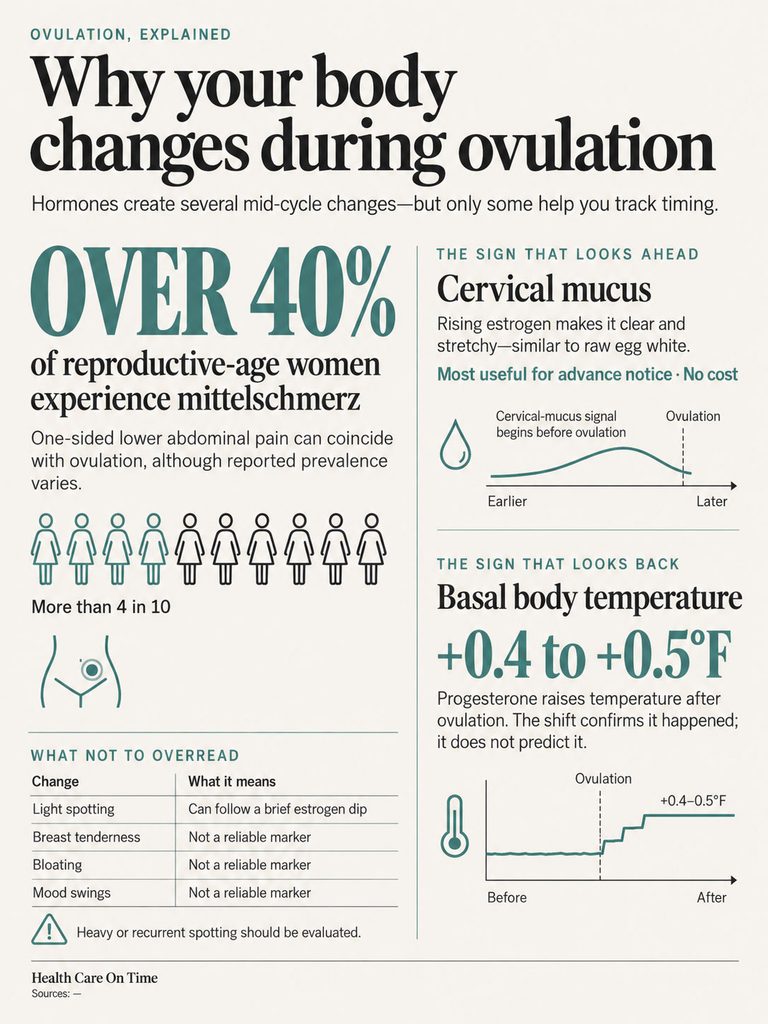
In the days before ovulation, cervical fluid shifts from sticky or absent to clear, stretchy, and slippery. The common comparison is raw egg white.
The change is functional. That fluid keeps sperm alive and helps them travel. It is also the only common sign that gives you advance notice at zero cost.
After ovulation, progesterone thickens the mucus again within a day or two and it turns cloudy or dries up.
Basal body temperature
Progesterone raises resting body temperature by roughly 0.4 to 0.5°F (about 0.2 to 0.3°C). The rise appears the day after ovulation and holds through the luteal phase.
The limitation matters more than the signal. A temperature shift tells you ovulation already happened. It cannot warn you in advance.
Ovulation pain (mittelschmerz)
Mittelschmerz is one-sided lower abdominal pain around ovulation, named from the German for middle pain. It usually lasts minutes to a day, sometimes up to 48 hours, and can switch sides between cycles.
Sources disagree sharply on how common it is. StatPearls puts it at over 40% of reproductive-age women, while several consumer health sites cite roughly 20%. Both figures circulate widely, and you deserve the range rather than a falsely precise single number.
One detail in the StatPearls entry supports everything above about timing: mittelschmerz is described as occurring anywhere between cycle days 7 and 24.
Mid-cycle spotting
A minority of women notice light pink or brown spotting around ovulation, likely tied to the brief estrogen dip that follows the LH surge. It is typically a few drops across less than a day.
Spotting heavy enough to need a pad, or spotting that recurs every cycle for months, deserves evaluation rather than reassurance. Patients booking hormone panels through HealthCareOnTime raise this question often, and the honest answer depends on volume and pattern, not on color alone.
The signs with weaker evidence
Breast tenderness, bloating, a bump in libido, heightened sense of smell, and mood shifts all appear on lists of ovulation symptoms. They are real experiences for many women, but none has been validated as a reliable ovulation marker the way mucus, temperature, and LH have.
Treat them as supporting context, not as evidence an egg was released.
How to Tell If You’re Actually Ovulating
This is where most guidance falls apart, because it blurs two very different jobs.
Predicting tells you ovulation is coming, so you can act on it. LH tests and cervical mucus do this.
Confirming tells you ovulation already happened. Temperature and progesterone do this.
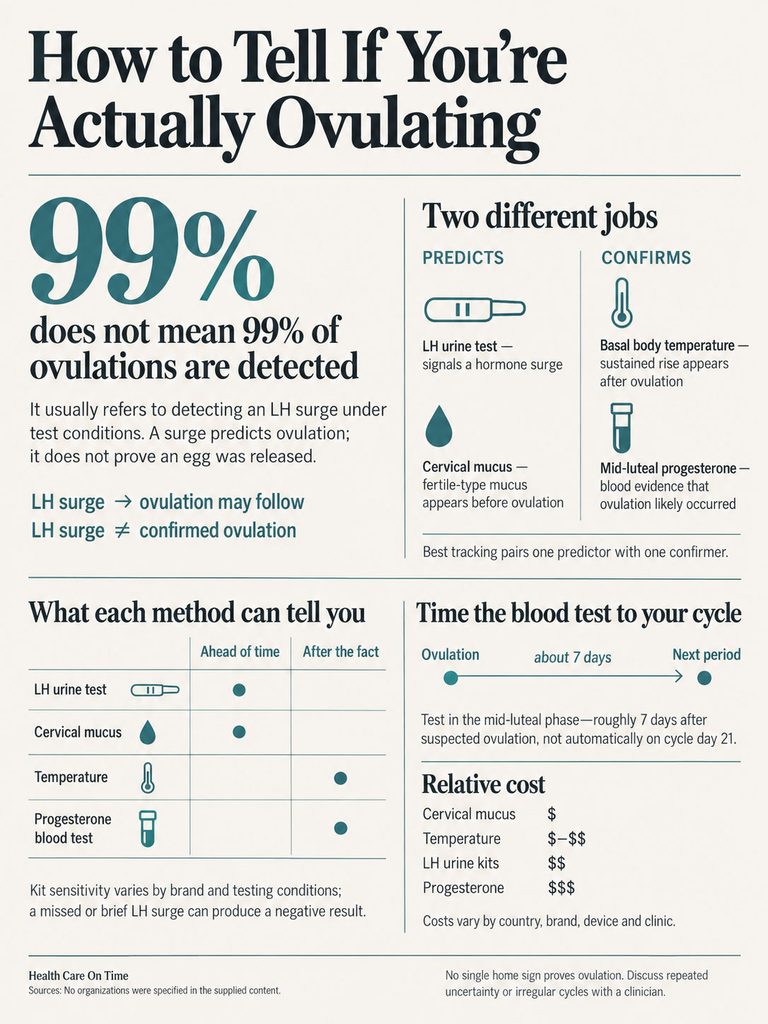
You need both. A prediction with no confirmation leaves you guessing whether an egg ever came out.
What “99% accurate” on an ovulation test box really means
Ovulation predictor kits detect LH in urine and turn positive when the level crosses a fixed threshold. The 99% figure printed on packaging and repeated across consumer sites refers to detecting LH in a sample under controlled conditions. It does not describe catching your surge in real life.
A 2024 study run through the Center for Infertility and Reproductive Surgery at Brigham and Women’s Hospital compared five widely sold single-step kits against daily blood LH measurements. Twenty-three patients completed 97 days of testing, and 13 had a documented blood LH surge.
Overall agreement with blood LH was similar across brands, between 91.75% and 96.90%. Sensitivity, meaning the share of true surges the strip actually caught, told a different story: 76.92% for Pregmate, 75.00% for Easy@Home, 69.23% for Wondfo, 61.54% for Clearblue, and 38.46% for Clinical Guard.
That is a small study with wide confidence intervals, so treat the brand ranking as directional rather than definitive. The core point survives the sample size: a single daily strip misses real surges at a rate nowhere near 1%.
Across the lab partners in our diagnostic network, the most common fixable error is testing once each morning. LH frequently surges in the late morning or early afternoon, so testing twice daily from late morning onward catches considerably more surges.
Table 2: Ovulation Tracking Methods, Measured Performance
| Method | What it measures | Predicts or confirms | Measured performance | Typical US out-of-pocket |
| LH urine strips | Urinary luteinizing hormone | Predicts (24 to 36 hrs ahead) | Sensitivity 38.5% to 76.9% across five brands vs blood LH (Fertil Steril, 2024) | $0.30 to $1.00 per strip |
| Digital LH tests | Urinary LH, reader-interpreted | Predicts | Agreement with blood LH 91.8% to 96.9% across brands (Fertil Steril, 2024) | $1.50 to $3.00 per test |
| Basal body thermometer | Post-ovulation temperature rise | Confirms only (retrospective) | Detects the 0.4 to 0.5°F progesterone shift; requires same-time daily readings (Bull, npj Digit Med, 2019) | $10 to $25 one time |
| Wearable temperature (ring or watch) | Continuous skin temperature | Confirms | FDA-cleared wrist and finger temperature inputs; 93% typical-use effectiveness in the cleared app (Natural Cycles 510(k) summary) | $200 to $400 plus subscription |
| Cervical mucus charting | Estrogen-driven fluid change | Predicts (2 to 4 days ahead) | Anticipates ovulation earlier than temperature; accuracy depends on training (Dunson, Hum Reprod, 1999) | Free |
| Calendar-only app | Past cycle lengths | Neither, it estimates | Assumes fixed day-14 ovulation, which fits about 13% of cycles (Bull, 2019) | Free to $100 per year |
| Serum progesterone | Luteal progesterone level | Confirms | A single level of 5 ng/mL or above gave 98.4% specificity and 89.6% sensitivity (Steroids, 2015) | $30 to $70 cash pay |
| Transvaginal ultrasound | Follicle growth and collapse | Both | Reference standard, but cost and scheduling limit it to treatment cycles | $150 to $500 per scan |
Costs are typical US cash-pay ranges and vary by market, insurer, and retailer.
When a progesterone blood test earns its place
A mid-luteal progesterone level is the standard laboratory confirmation that ovulation occurred. The classic cutoff is 3 ng/mL, and a 2015 multicentre analysis of 107 women across 326 cycles found that a single random level of 5 ng/mL or higher confirmed ovulation with 98.4% specificity.
There is a nuance almost no consumer page mentions. The 2023 ESHRE guideline on unexplained infertility issued a conditional recommendation against routinely measuring mid-luteal progesterone in women with regular menstrual cycles, on the grounds that it rarely changes management.
So the test genuinely earns its cost when cycles are irregular, when LH testing never turns positive, or when you want objective confirmation after months of guessing. It adds less as a routine extra for someone with textbook cycles.
Timing matters as much as the number. The familiar advice to test on “day 21” assumes a 28-day cycle. With a 34-day cycle, day 21 falls before you ovulate and the result reads falsely low. Test roughly seven days before your period is due, not on a fixed calendar day.
A Regular Period Does Not Prove You Ovulated
This section is worth reading twice.
Bleeding on schedule feels like proof the system worked. It is not. Estrogen alone can build and shed a lining, producing a bleed that looks entirely normal without an egg ever being released.
The population data
A sub-study of the HUNT3 health survey in Norway measured a single luteal-phase serum progesterone in women with spontaneous, normal-length cycles. Among the 1,545 women whose sample fell inside the luteal window, 63.3% were ovulatory and 37% were anovulatory.
These women did not differ meaningfully from the ovulatory group in age, body mass index, smoking, exercise, or self-reported health. Their cycles ran a median of 28 days.
A one-year prospective study published in Human Reproduction in 2024 followed 53 women pre-screened for normal cycle and luteal phase lengths. Even in that carefully selected group, 55% experienced at least one luteal phase shorter than 10 days across the year, and 17% had at least one fully anovulatory cycle.
Both studies rest on hormone measurement rather than self-report, which is what makes them worth citing over the unsourced percentages that circulate on fertility blogs.
Table 3: Ovulation and Fertility by the Numbers
| Statistic | Figure | Source |
| Tracked ovulatory cycles that were exactly 28 days long | 13% of 612,613 cycles | Bull et al., npj Digital Medicine, 2019 |
| Mean follicular phase length (day 1 to ovulation) | 16.9 days | Bull et al., npj Digital Medicine, 2019 |
| Cycles with a luteal phase under 11 days | 18% | Bull et al., npj Digital Medicine, 2019 |
| Women whose fertile window falls entirely within days 10 to 17 | About 30% | Wilcox et al., BMJ, 2000 |
| Clinically normal, regular-length cycles that were anovulatory | 37% (567 of 1,545) | HUNT3 cohort, PLOS ONE, 2015 |
| Probability of conception from intercourse on ovulation day | 0.33 | Wilcox et al., NEJM, 1995 |
| Probability from intercourse five days before ovulation | 0.10 | Wilcox et al., NEJM, 1995 |
| US women ages 15 to 49 with impaired fecundity | 13.4% | CDC/NCHS FastStats, NSFG 2015 to 2019 |
| US women ages 20 to 49 who have ever used a fertility service | 13.7% | NCHS, NSFG 2022 to 2023 |
| Reproductive-age women affected by ovulation pain | Over 40% | StatPearls, Mittelschmerz, 2026 |
Figures as reported by each source. Cohort populations differ; see the evidence-limits section above.
Why this matters even if you are not trying to conceive
Most ovulation content is written for people trying to get pregnant. That framing leaves out the larger reason ovulation is worth tracking.
Ovulation is the only event that produces meaningful progesterone. Without it, you get estrogen with no counterweight for the second half of the cycle, month after month.
Researchers describe normal-length cycles with anovulation or a short luteal phase as subclinical ovulatory disturbances, and a meta-analysis of prospective studies linked them to spinal bone loss averaging 0.86% per year compared with women having fewer such cycles. Spread across three decades of menstruating years, that adds up.
Repeated anovulation is also a signal rather than a standalone problem. It often points to something upstream that is worth identifying on its own terms, such as thyroid dysfunction, high prolactin, PCOS, or energy availability that has dropped too low relative to training load.
So the value of confirming ovulation is not limited to conception. It is a monthly readout on whether your reproductive endocrine system is doing what it should.
What stops ovulation from happening
Cycles skip ovulation for reasons ranging from temporary to chronic:
- Polycystic ovary syndrome (PCOS), the leading cause of chronic anovulation in the United States
- Thyroid disease, both underactive and overactive
- High prolactin, sometimes from medications, sometimes from a pituitary adenoma
- Rapid weight loss or gain, and low body fat from restriction
- Heavy endurance training without matching calorie intake
- Significant psychological or physical stress, including illness and disrupted sleep
- Perimenopause, where skipped ovulations become steadily more common from the early forties
- Hormonal contraception, which suppresses ovulation by design in combined formulations
In cases reviewed by our clinical team, thyroid dysfunction and PCOS account for a large share of irregular-cycle referrals that arrive through diagnostic testing, and both are identifiable with a basic blood panel.
Ovulation and Getting Pregnant: The Numbers
The six-day window
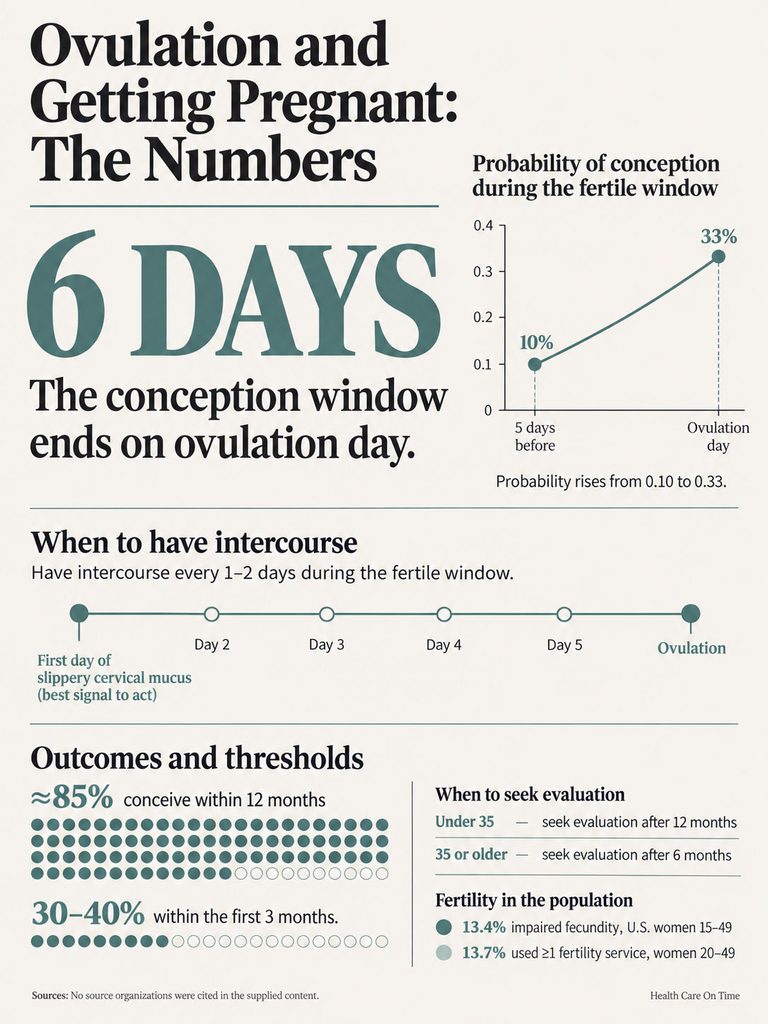
The North Carolina cohort produced the finding that reshaped fertility advice. Among healthy women trying to conceive, conception occurred only when intercourse fell within a six-day span ending on ovulation day.
Day-specific probability climbed from 0.10 five days before ovulation to 0.33 on ovulation day itself. After ovulation, it fell close to zero.
That asymmetry carries a practical consequence. Waiting for a positive ovulation test and then acting already puts you late in the window. Acting on the first day of slippery cervical mucus captures more of it.
Couples trying to conceive often ask us whether daily intercourse or every-other-day works better. The published data support every one to two days across the fertile window, which removes the pressure of pinpointing a single perfect day.
How US clinicians define a problem
StatPearls frames infertility as no pregnancy after 12 months of unprotected intercourse under age 35, or six months at 35 and older. About 85% of couples conceive within 12 months, and 30% to 40% within the first three.
The CDC’s national figures place impaired fecundity at 13.4% of US women aged 15 to 49. Fertility care is no longer a niche experience; NSFG data from 2022 to 2023 show 13.7% of women aged 20 to 49 have used at least one fertility service.
Common Ovulation Mistakes That Waste Cycles
Starting to test too late. Standard 7-strip kits assume a 28-day cycle. With a 33-day cycle, the strips are gone before the surge arrives. Use Table 1 to pick your start day.
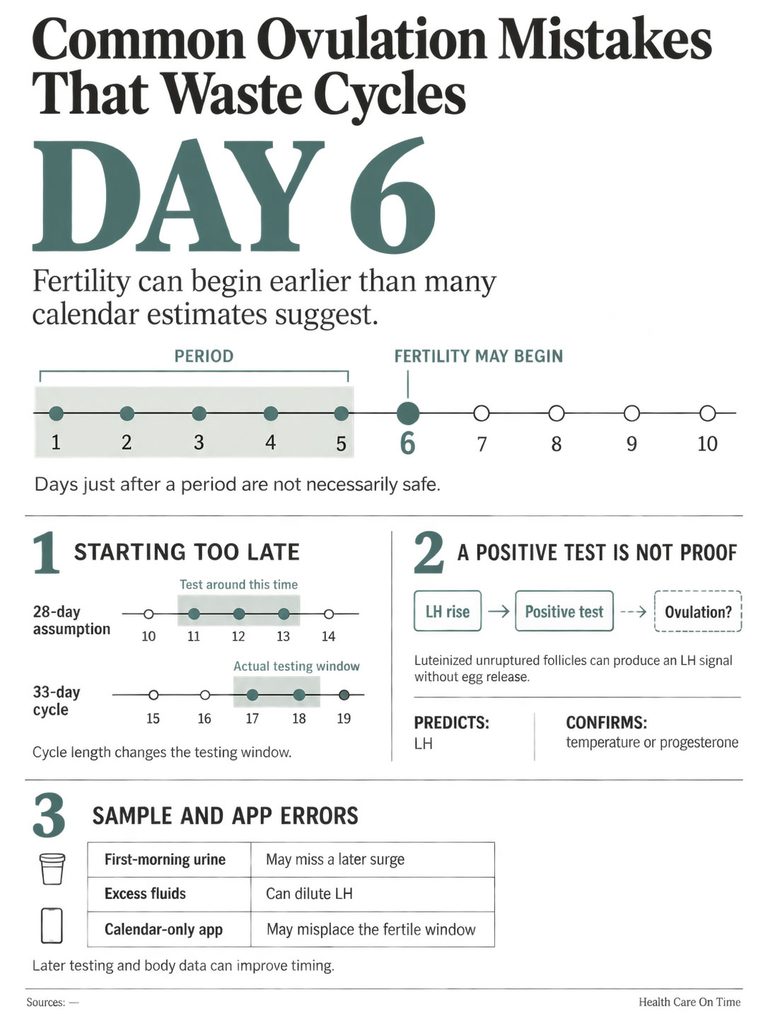
Testing only with first-morning urine. LH is often produced later in the day. Testing twice daily from late morning through evening improves surge capture substantially.
Treating a positive LH test as proof of ovulation. A surge can occur without the follicle rupturing, a pattern called luteinized unruptured follicle. PCOS can also produce chronically high LH or repeated small rises, so tests read positive month after month while no egg is released.
Trusting a calendar app that has no body data. An app that only knows your past cycle lengths runs the same day-14 arithmetic that fits 13% of cycles. Apps that ingest temperature, LH results, or mucus observations behave very differently from ones that do not.
Assuming the days right after your period are safe. Wilcox found meaningful fertility probability from day 6 onward. Short cycles combined with five-day sperm survival close that supposed gap.
Diluting the sample. Drinking heavily in the hours before testing lowers urine LH concentration and can turn a real surge into a negative strip.
What to Do Next (And When to Call a Doctor)
If you are trying to conceive
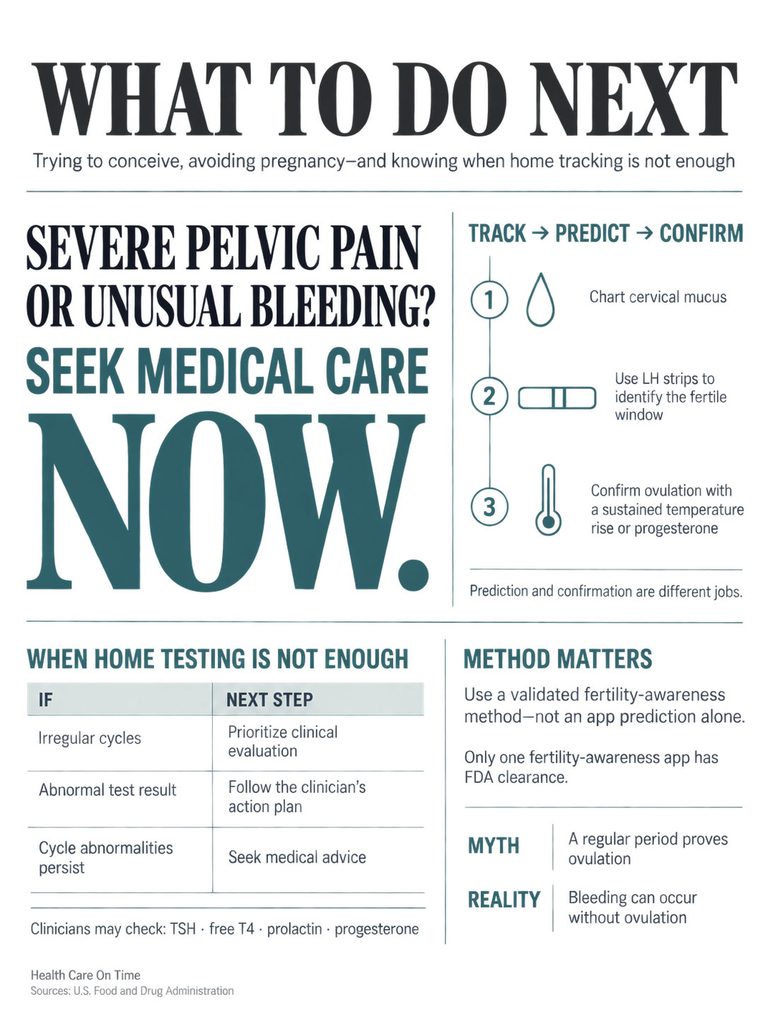
Chart cervical mucus for one cycle to learn your own pattern, then add twice-daily LH strips starting from the day suggested in Table 1. Have intercourse every one to two days across the fertile window.
Confirm at least one cycle with either a sustained temperature rise or a timed progesterone level, so you know an egg is actually being released rather than assuming it.
If you are trying to avoid pregnancy
Fertility awareness works only with a validated method and consistent daily input, and the ovulation-day variability described above is precisely why calendar-only estimates fail. Only one app currently holds FDA clearance for contraceptive use, at 93% typical-use and 98% perfect-use effectiveness.
If your cycles are irregular or absent
Do not spend six months on strips first. Cycles consistently shorter than 21 days or longer than 35 days, or three or more missed periods, call for a clinical workup rather than more home testing.
Tests a clinician may order
A first-line workup usually includes TSH and free T4, prolactin, and mid-luteal progesterone timed to your actual cycle length. Where PCOS is suspected, total and free testosterone, sex hormone binding globulin, and a pelvic ultrasound are added. Day 3 FSH, LH, and estradiol may be included when ovarian reserve is in question.
Table 4: Your Situation, Your Next Step
| What you’re seeing | What it may mean | Recommended action | Timeframe |
| Never a positive LH test across 2 to 3 cycles | Testing window missed, or cycles are anovulatory | Extend testing days using Table 1 and test twice daily; if still negative, request a timed progesterone test | After 2 to 3 cycles |
| Ovulation test positive nearly every day | Chronically elevated LH, commonly seen in PCOS | Stop relying on LH strips; ask for testosterone, SHBG, and a pelvic ultrasound | Within 1 to 2 months |
| Cycles consistently under 21 or over 35 days | Ovulatory dysfunction, thyroid disease, or PCOS | Book a clinical evaluation with thyroid and prolactin testing | Within 1 to 2 months |
| No period for 3 months or more (not pregnant, not on contraception) | Anovulation from thyroid, prolactin, weight, stress, or ovarian causes | See a clinician; this is not a wait-and-see situation | Within weeks |
| Under 35 and trying to conceive for 12 months | Meets the US definition of infertility | Fertility evaluation for both partners | Now |
| Age 35 or older and trying for 6 months | Meets the age-adjusted threshold | Fertility evaluation for both partners | Now |
| Sudden severe one-sided pelvic pain with nausea, fever, or fainting | Ovarian torsion, ruptured cyst, ectopic pregnancy, or appendicitis | Emergency care, not home monitoring | Immediately |
| Mid-cycle bleeding heavy enough to need a pad, or recurring monthly | Not typical ovulation spotting | Gynecologic evaluation | Within 2 to 4 weeks |
General guidance only. Your clinician may recommend a different pathway based on your history.
Frequently Asked Questions
What does ovulating mean in simple terms?
Ovulating means your ovary has released a mature egg. A surge of luteinizing hormone triggers the release, the egg travels into the fallopian tube, and it stays viable for about 12 to 24 hours. If sperm reaches it in that window, fertilization can occur.
How many days after my period do I ovulate?
It depends on your cycle length, not a fixed number. Measured data show a mean follicular phase of 16.9 days from day 1. With a 25 to 30 day cycle, ovulation averages around day 15; with a 31 to 35 day cycle, closer to day 19 or 20.
Can you feel yourself ovulating?
Some women can. Mittelschmerz produces one-sided lower abdominal pain lasting minutes to about 48 hours. Prevalence estimates range from roughly 20% to over 40% depending on the source. Feeling nothing at all is equally normal and does not suggest anything is wrong.
What does ovulation discharge look like?
Around ovulation, cervical mucus turns clear, slippery, and stretchy, similar to raw egg white. It stretches an inch or more between your fingers. Afterward, progesterone thickens it into a cloudy or sticky consistency, or it dries up within a day or two.
How long does ovulation last?
The release itself takes minutes to hours, and the egg survives about 12 to 24 hours. The fertile window runs longer because sperm can live up to five days, giving roughly six fertile days that end on ovulation day rather than starting there.
Does a regular period mean I’m ovulating?
Not reliably. In the HUNT3 population study, 37% of women with clinically normal, regular-length cycles were anovulatory when progesterone was measured. Estrogen alone can build and shed a lining, producing a normal-looking bleed with no egg released.
Can you ovulate twice in one cycle?
Multiple eggs can be released, but only within the same 24-hour ovulatory event, which is how fraternal twins occur. A second, separate ovulation later in the same cycle does not happen, because rising progesterone suppresses further LH surges.
Why is my ovulation test always positive?
Chronically elevated LH is a common feature of PCOS and produces repeated positives without ovulation. Some surges also plateau across several days. If strips read positive through most of your cycle, they are the wrong tool and a progesterone test will tell you more.
Do you ovulate while on birth control?
Combined hormonal contraceptives containing estrogen and progestin suppress ovulation when taken exactly as prescribed. Progestin-only pills often do not fully suppress it and work mainly by thickening cervical mucus. Missed doses reduce suppression, which is why timing consistency matters.
How soon after ovulation can I take a pregnancy test?
Implantation typically occurs six to ten days after ovulation, and hCG needs a few more days to reach detectable urine levels. Testing before nine or ten days past ovulation often produces false negatives. Waiting until your period is late gives the most reliable result.
Can stress delay ovulation?
Yes. Significant stress, illness, travel, disrupted sleep, and sudden training or calorie changes can push ovulation later or suppress it entirely. Because the luteal phase stays comparatively fixed, delayed ovulation shows up as a longer cycle rather than a late period.
Is ovulation bleeding normal?
Light pink or brown spotting lasting under a day around mid-cycle generally falls within normal range and is linked to the brief estrogen dip after the LH surge. Bleeding heavy enough to need a pad, or spotting that recurs every cycle, should be evaluated.
Medical Disclaimer
This article is for general educational purposes and does not replace advice from a licensed healthcare professional. Ovulation patterns, hormone levels, and laboratory reference ranges vary between individuals and between labs. Do not use this information to diagnose a condition, to start or stop any medication, or as a contraceptive method. If you are experiencing irregular cycles, absent periods, severe pelvic pain, or difficulty conceiving, speak with a qualified clinician about testing appropriate to your situation.
References
- Bull JR, Rowland SP, Berglund Scherwitzl E, et al. Real-world menstrual cycle characteristics of more than 600,000 menstrual cycles. npj Digital Medicine. 2019;2:83.
- Wilcox AJ, Dunson D, Baird DD. The timing of the fertile window in the menstrual cycle: day specific estimates from a prospective study. BMJ. 2000;321(7271):1259-1262.
- Wilcox AJ, Weinberg CR, Baird DD. Timing of sexual intercourse in relation to ovulation. New England Journal of Medicine. 1995;333(23):1517-1521.
- Prior JC, Naess M, Langhammer A, Forsmo S. Ovulation prevalence in women with spontaneous normal-length menstrual cycles: a population-based cohort from HUNT3, Norway. PLOS ONE. 2015;10(8):e0134473.
- Prospective 1-year assessment of within-woman variability of follicular and luteal phase lengths. Human Reproduction. 2024;39(11):2565.
- Similar accuracy and patient experience with different one-step ovulation predictor kits. Fertility and Sterility. 2024.
- Leiva R, Bouchard T, Boehringer H, et al. Random serum progesterone threshold to confirm ovulation. Steroids. 2015;101:125-129.
- ESHRE Guideline Group on Unexplained Infertility. Evidence-based guideline: unexplained infertility. Human Reproduction. 2023;38(10):1881-1890.
- Dunson DB, Baird DD, Wilcox AJ, Weinberg CR. Day-specific probabilities of clinical pregnancy based on two studies with imperfect measures of ovulation. Human Reproduction. 1999;14(7):1835-1839.
- Prior JC, Naess M, et al. Does molimina indicate ovulation? Prospective data in a hormonally documented single cycle in spontaneously menstruating women. Int J Environ Res Public Health. 2018;15(5):1016.
- Brott NR, Le JK. Mittelschmerz. StatPearls. StatPearls Publishing; 2026.
- Adebisi OY, Singh M, Tobler KJ. Female Infertility. StatPearls. StatPearls Publishing; 2026.
- CDC/National Center for Health Statistics. FastStats: Infertility.
- Cleveland Clinic. Ovulation.