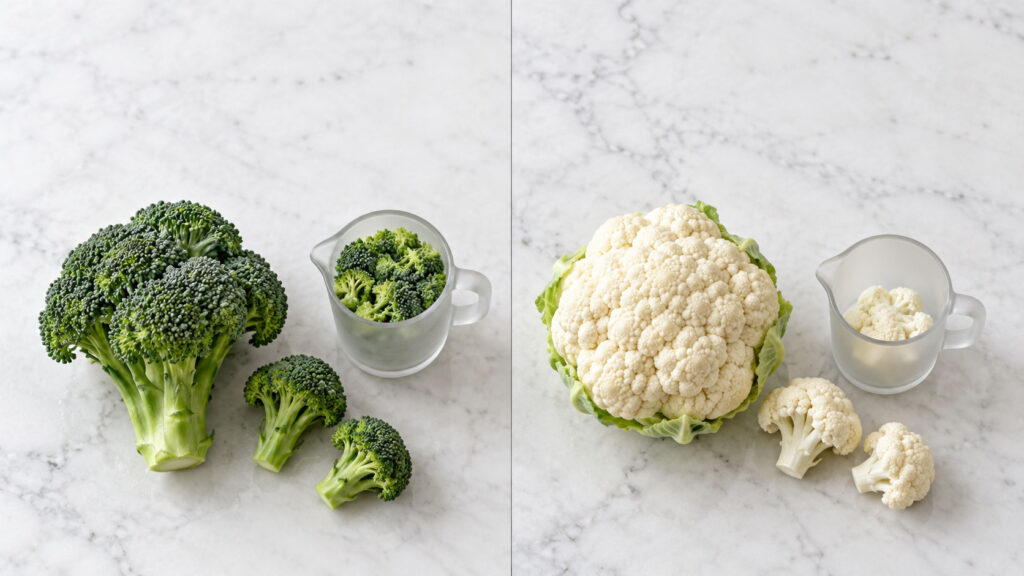
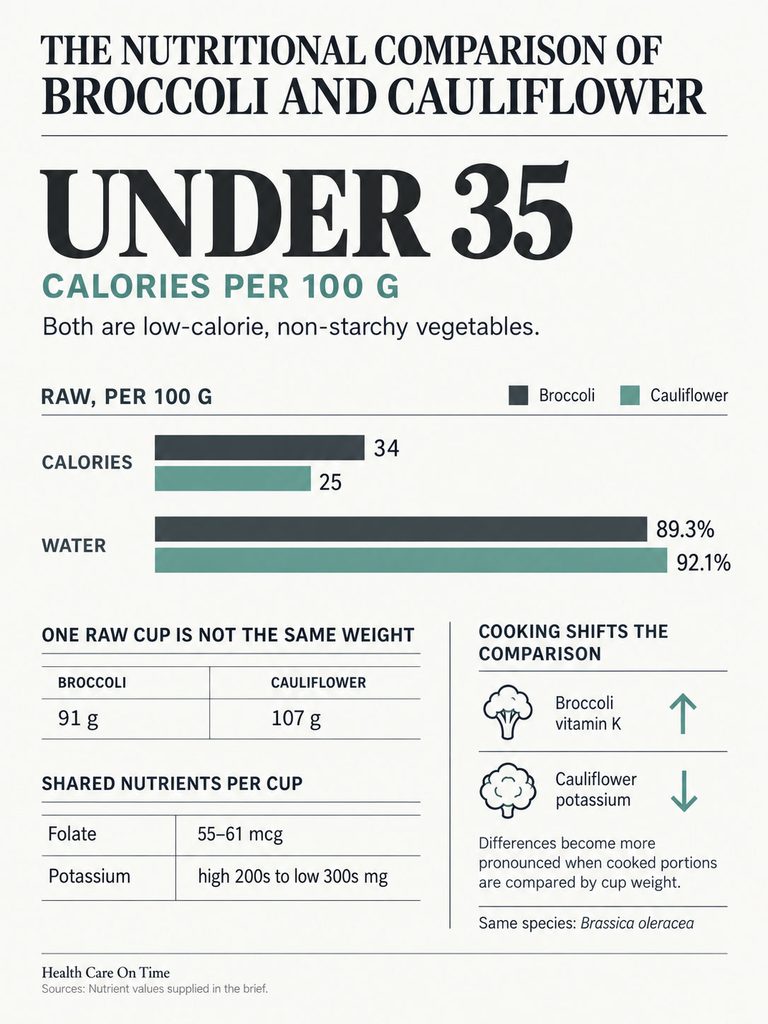
A cup of raw broccoli weighs 91 grams. A cup of raw cauliflower weighs 107 grams. Almost every cauliflower vs broccoli comparison online puts 18% more cauliflower on the scale, then announces the two vegetables are basically identical.
They are not identical. Weigh them the same way and the gaps get wide fast. A few of them are wide enough to change what goes in your cart.
Table of Contents
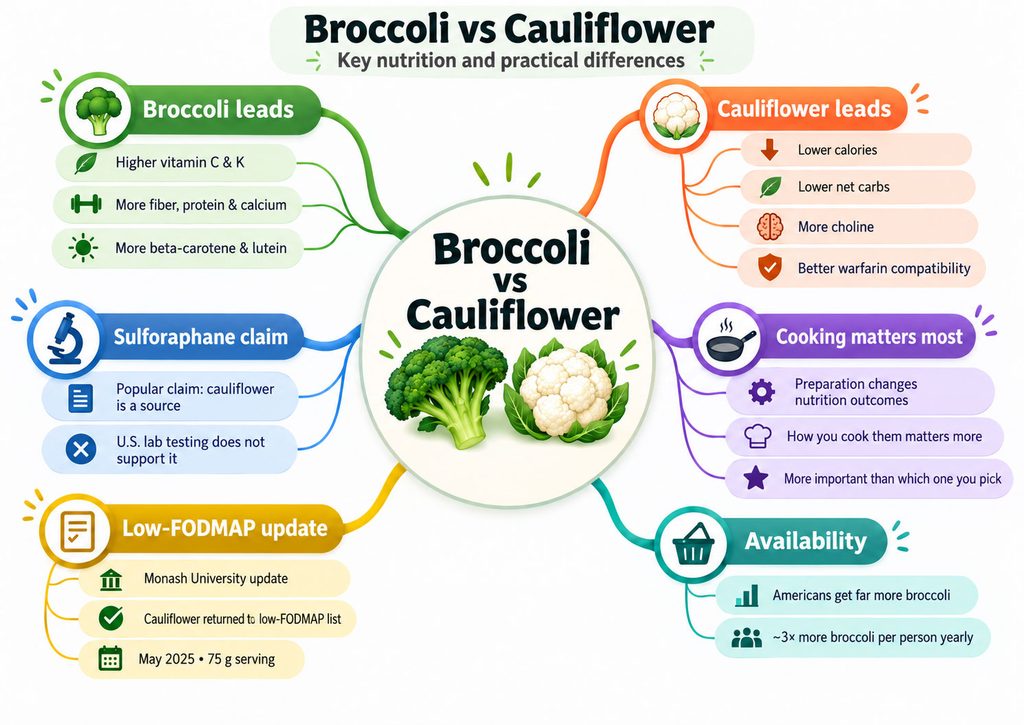
Quick Answer: Broccoli wins on most measured nutrients. Cup for cup raw, broccoli gives you about 81 mg of vitamin C versus 52 mg, and 93 mcg of vitamin K versus 17 mcg, plus more fiber, protein, and calcium. Cauliflower wins on calories, net carbs, and choline, and its very low vitamin K makes it the safer pick for people on warfarin. Both count toward the same daily vegetable target.
Winner by category, at a glance
| Category | Winner |
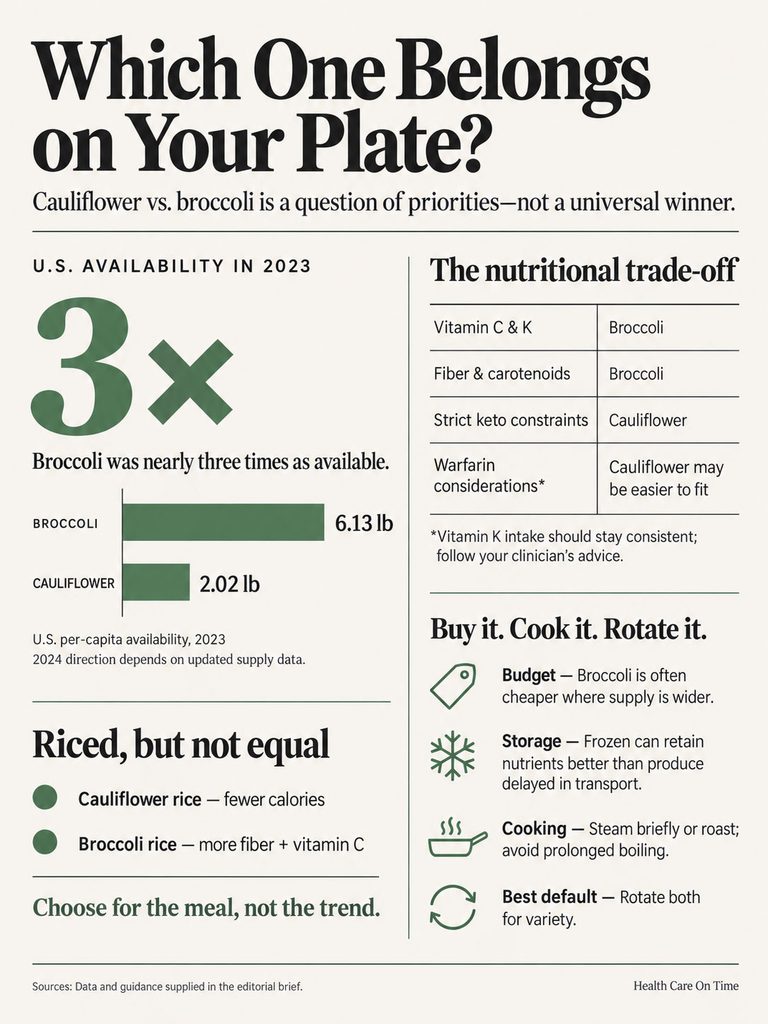
| Vitamin C, vitamin K, fiber, protein, calcium | Broccoli |
| Beta-carotene, lutein, vitamin A | Broccoli |
| Sulforaphane potential | Broccoli |
| Calories and net carbs | Cauliflower |
| Choline, vitamin B6, pantothenic acid | Cauliflower |
| Safety on warfarin | Cauliflower |
At a Glance
• Broccoli leads on vitamin C, vitamin K, fiber, protein, calcium, beta-carotene, and lutein.
• Cauliflower leads on calories, net carbs, choline, and warfarin compatibility.
• The popular claim that cauliflower is a sulforaphane source does not survive US laboratory testing.
• How you cook them changes the outcome more than which one you pick.
• Monash University moved cauliflower back onto the low-FODMAP list in May 2025 at a 75 g serving.
• Americans have access to roughly three times more broccoli than cauliflower per person each year.
The Numbers, Side by Side
Both vegetables are the same species, Brassica oleracea. Broccoli is the italica cultivar group, cauliflower the botrytis group. Centuries of selective breeding turned one wild cabbage into both.
That shared ancestry is why the macronutrient picture looks similar at a glance. The micronutrient picture does not.
What the two vegetables share
Before the differences, the overlap deserves a mention, because it is larger than the argument suggests. Both are non-starchy vegetables under 35 calories per 100 grams, both are roughly 90% water, and both sit near the bottom of the glycemic scale.
Both supply folate in the 55 to 61 mcg range per cup. Both deliver potassium in the high 200s to low 300s raw. Both carry glucosinolates, both are counted in the same dietary guidance, and both show up in the same epidemiology.
A reader choosing between them is picking between two vegetables that most Americans are not eating enough of in the first place. That framing shapes everything that follows.
Raw, cup for cup
Using USDA FoodData Central values, raw broccoli runs 34 calories per 100 grams and raw cauliflower runs 25. Water content explains most of the difference: cauliflower is 92.1% water, broccoli 89.3%.
More water means fewer calories. It also means less of everything else per gram, and that trade shows up in nearly every row of the table below.
Cooked, cup for cup
Boiling reshuffles the ranking in ways people rarely expect. Broccoli’s vitamin K climbs from 101.6 to 141 mcg per 100 grams once water leaves and the fat-soluble vitamin stays behind.
Cauliflower moves the opposite direction on minerals. Its potassium falls from 299 mg per 100 grams raw to 142 mg after boiling, more than half of it lost into the cooking water.
Why cup comparisons mislead
USDA gram weights are the fix. One cup of chopped raw broccoli is 91 g, raw cauliflower 107 g, cooked chopped broccoli 156 g, and cooked cauliflower in 1-inch pieces 124 g.
Cooked broccoli packs down hard, so a cup of it carries almost twice the food of a raw cup. Patients reviewing food logs with our team are often surprised at how much a single “cup of broccoli” swings on that one detail.
Table 1: Cauliflower vs Broccoli, Full Nutrition Comparison per Cup
| Nutrient (per 1 cup) | Broccoli, raw (91 g) | Cauliflower, raw (107 g) | Broccoli, cooked (156 g) | Cauliflower, cooked (124 g) |
| Calories | 31 kcal | 27 kcal | 55 kcal | 29 kcal |
| Protein | 2.6 g | 2.1 g | 3.7 g | 2.3 g |
| Total carbohydrate | 6.0 g | 5.3 g | 11.2 g | 5.1 g |
| Dietary fiber | 2.4 g | 2.1 g | 5.1 g | 2.9 g |
| Net carbs | 3.7 g | 3.2 g | 6.1 g | 2.2 g |
| Vitamin C | 81.2 mg (90% DV) | 51.6 mg (57% DV) | 101.2 mg (112% DV) | 54.9 mg (61% DV) |
| Vitamin K | 92.5 mcg (77% DV) | 16.6 mcg (14% DV) | 220 mcg (183% DV) | 17.1 mcg (14% DV) |
| Folate | 57 mcg | 61 mcg | 168 mcg | 55 mcg |
| Potassium | 288 mg | 320 mg | 457 mg | 176 mg |
| Calcium | 43 mg | 24 mg | 62 mg | 20 mg |
| Vitamin A (RAE) | 28 mcg | 0 mcg | 120 mcg | 0 mcg |
Calculated from USDA FoodData Central entries 170379, 169986, 169967, and 170397, using USDA gram weights per cup.
Where Broccoli Clearly Wins
Vitamin C, at nearly double
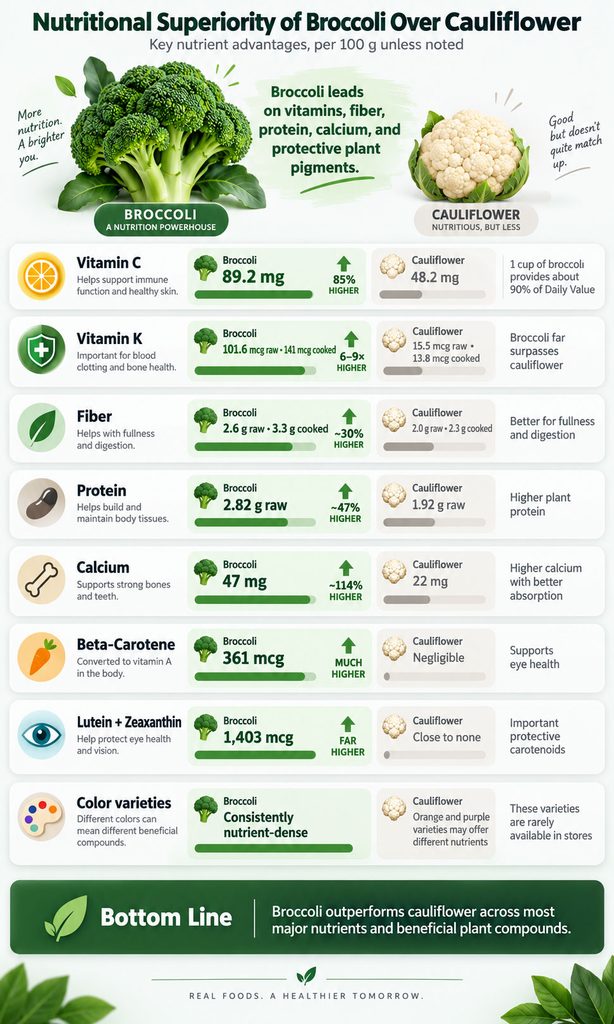
Raw broccoli carries 89.2 mg of vitamin C per 100 grams. Raw cauliflower carries 48.2 mg. One raw cup of broccoli covers 90% of the Daily Value on its own.
Both are strong sources by any reasonable standard. The gap only matters when total intake is already thin, which happens more often than people expect among patients with restrictive eating patterns.
Vitamin K, at five to ten times
This is the widest gap between the two vegetables, and it cuts both ways. Raw broccoli holds 101.6 mcg of vitamin K per 100 grams against cauliflower’s 15.5 mcg.
Cooked, the spread widens to 141 mcg versus 13.8 mcg. A single cup of cooked broccoli delivers 220 mcg, well past the Adequate Intake of 120 mcg for men and 90 mcg for women.
For most people that is a clean benefit for bone and vascular health. For anyone on warfarin it becomes a variable to manage, covered further down.
Fiber, protein, and calcium
Broccoli edges cauliflower on fiber, 2.6 g versus 2.0 g per 100 grams raw. Cooked, the gap grows to 3.3 g versus 2.3 g.
Protein follows the same pattern at 2.82 g versus 1.92 g raw. Neither vegetable is a protein food, but at similar calorie counts broccoli returns more of one.
Calcium is the quiet win. Broccoli holds 47 mg per 100 grams to cauliflower’s 22 mg, and broccoli’s calcium absorbs unusually well for a plant source because its oxalate content stays low.
The pigments cauliflower does not have
White cauliflower contains essentially no beta-carotene and no vitamin A activity. Broccoli contains 361 mcg of beta-carotene and 31 mcg RAE of vitamin A per 100 grams.
Broccoli also carries roughly 1,403 mcg of lutein and zeaxanthin per 100 grams, the carotenoid pair that concentrates in the macula. Cauliflower contributes close to nothing here.
Orange and purple cauliflower varieties change that picture, though they occupy a thin slice of what US grocery stores actually stock.
Where Cauliflower Clearly Wins
Fewer calories, fewer carbs
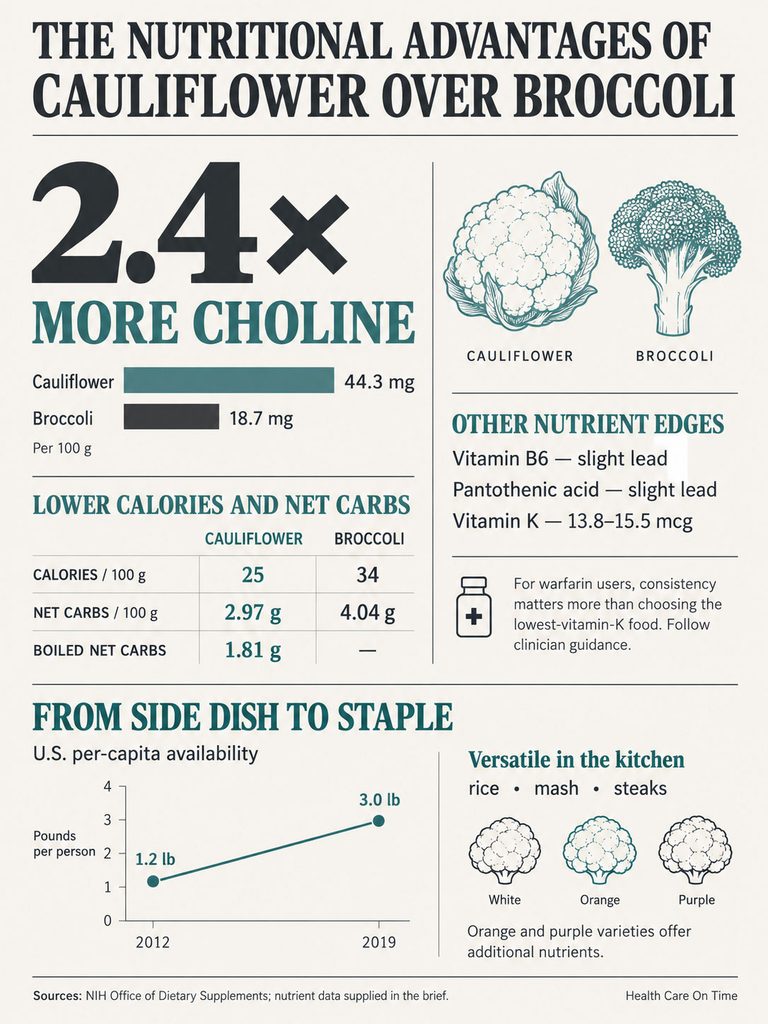
Cauliflower runs 25 calories per 100 grams against broccoli’s 34, and 2.97 g of net carbs against 4.04 g. Boiled, cauliflower drops to 1.81 g of net carbs per 100 grams.
The gap is small in absolute terms and large in practice for anyone working against a 20 g daily carbohydrate ceiling. Across the low-carb patients we serve, cauliflower is the vegetable that survives the tightest budgets.
Choline, B6, and pantothenic acid
Cauliflower carries 44.3 mg of choline per 100 grams against broccoli’s 18.7 mg, more than double. Choline supports liver function and neurotransmitter production, and US intakes sit below the Adequate Intake for most adults.
Cauliflower also takes a small lead on vitamin B6 and pantothenic acid. Modest wins, but real ones.
The low vitamin K advantage
Nobody writes about this, and it is the most clinically useful difference on the list. Cauliflower’s 13.8 to 15.5 mcg of vitamin K per 100 grams makes it one of the few filling, versatile vegetables that barely registers on a warfarin patient’s daily tally.
Our medical reviewers note that people on anticoagulants often abandon vegetables entirely out of caution. Cauliflower offers a way back in without daily arithmetic.
Orange, purple, and Romanesco varieties
The nutritional case against white cauliflower rests partly on what it lacks in pigment. Colored varieties close some of that gap, and US grocery stores now stock them more often than they did a decade ago.
Orange cauliflower, sold under names like Cheddar, carries beta-carotene from a natural mutation that accumulates the pigment in the curd. Purple cauliflower carries anthocyanins, the same family found in red cabbage and blueberries.
Romanesco, with its fractal spiral, sits closer to broccoli in flavor and color while behaving like cauliflower in the kitchen. None of these varieties has the depth of published nutrient data that white cauliflower does, so treat the numbers on colored types as approximate.
Texture versatility, and what it costs
Cauliflower rices, mashes, roasts into steaks, and blends into crusts. That flexibility explains why US per capita availability climbed from 1.2 pounds in 2012 to 3.0 pounds by 2019, according to USDA Economic Research Service data.
The catch is that processed cauliflower products often bear little nutritional resemblance to cauliflower. A cauliflower pizza crust can carry more starch from rice flour and tapioca than it does actual vegetable.
The Sulforaphane Claim, Corrected
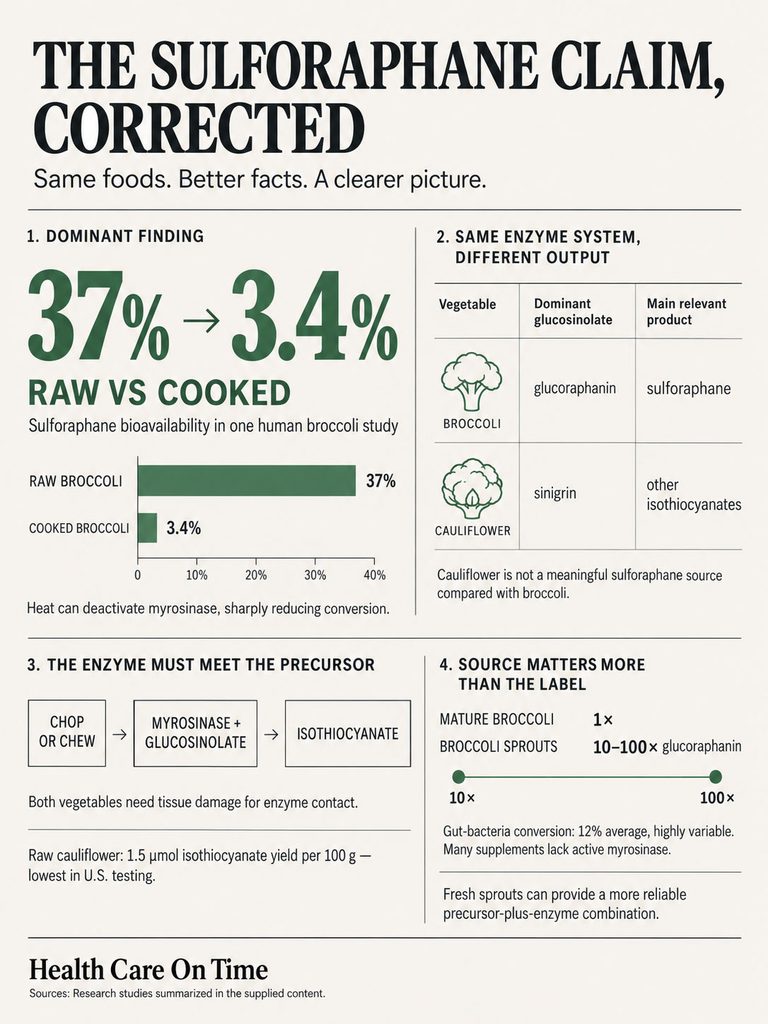
Nearly every article comparing these two vegetables states that both deliver cancer-fighting sulforaphane. That claim collapses under the actual measurements, and the correction is simple enough to state in one line: broccoli makes sulforaphane, cauliflower mostly does not.
Here is why.
Neither vegetable contains sulforaphane while it sits in your fridge
Both contain glucosinolates, sulfur compounds locked in one cellular compartment, plus an enzyme called myrosinase locked in another. Chewing or chopping breaks the walls between them.
Myrosinase then converts glucosinolates into isothiocyanates, the family that includes sulforaphane. No enzyme contact, no sulforaphane. That is the whole mechanism.
The two vegetables carry different glucosinolates
This is the part popular articles skip. Broccoli’s dominant glucosinolate is glucoraphanin, which converts to sulforaphane. Cauliflower’s dominant glucosinolate is sinigrin, which converts to allyl isothiocyanate, a different compound with a different research record.
Analysis published in the Journal of Agricultural and Food Chemistry grew 65 varieties of Brassica oleracea under matched conditions. Broccoli’s glucoraphanin varied enormously across 50 varieties. Cauliflower’s chemistry was dominated by sinigrin instead.
In plain terms: they are not carrying the same cargo, so they cannot deliver the same compound.
What US testing found when it measured the output
The most direct evidence comes from testing of 73 samples across nine raw cruciferous vegetables commonly eaten in the United States, summarized by the Linus Pauling Institute at Oregon State University.
Average isothiocyanate yield across the nine came out at 16.2 µmol per 100 g, with a 41-fold spread between the best and worst performers. Raw cauliflower finished last of all nine at 1.5. Raw mustard greens finished first at 61.3.
Total glucosinolate content tells a gentler version of the same story. A half cup of raw broccoli (44 g) supplies about 27 mg. A half cup of raw cauliflower (50 g) supplies about 22 mg from a larger portion. Brussels sprouts supply 104 mg from the same 44 g as broccoli.
Cauliflower is a good vegetable with genuine benefits. It is not a sulforaphane vegetable, and saying otherwise sets readers up for an expectation the food cannot meet.
Cooking destroys the enzyme
Myrosinase is heat sensitive. Research by Vermeulen and colleagues found that roughly 37% of a glucoraphanin dose showed up as sulforaphane metabolites when broccoli was eaten raw, against roughly 3.4% when it was cooked.
The American Institute for Cancer Research summarizes University of Illinois work showing that steaming broccoli for up to five minutes preserves myrosinase, while boiling or microwaving for even a minute destroys most of it.
Gut bacteria are an unreliable backup
Bacteria in your colon can run the conversion when the plant enzyme is gone. A feeding study in 45 healthy adults put the mean conversion rate near 12%, ranging from 1.1% to 40.7% between individuals.
That 37-fold spread between people is why sulforaphane intake stays close to unpredictable from cooked cruciferous vegetables. In cases reviewed by our medical team, this variability is exactly why we treat sulforaphane as a reason to eat vegetables rather than a reason to expect a specific dose.
Broccoli sprouts, the outlier worth knowing about
If sulforaphane is the reason you are choosing between these vegetables, neither mature head is the best tool for the job. Three-day-old broccoli sprouts contain 10 to 100 times more glucoraphanin by weight than mature broccoli plants.
Some US health food stores sell sprouts certified to at least 73 mg of glucoraphanin per one-ounce serving. A small handful on a sandwich outperforms a full plate of cooked florets on this one measure.
Supplements are less reliable. Peak sulforaphane metabolite concentrations ran roughly eight times higher in plasma after fresh sprouts than after a broccoli supplement lacking active myrosinase. The enzyme is the part most capsules leave out.
What the Human Research Actually Shows
Blood pressure
The strongest causal evidence comes from the VESSEL study, a randomized controlled crossover trial published in BMC Medicine in 2024. Adults with mildly elevated blood pressure ate about 300 g per day of cruciferous vegetable soup for two weeks, then root and squash soup for two weeks.
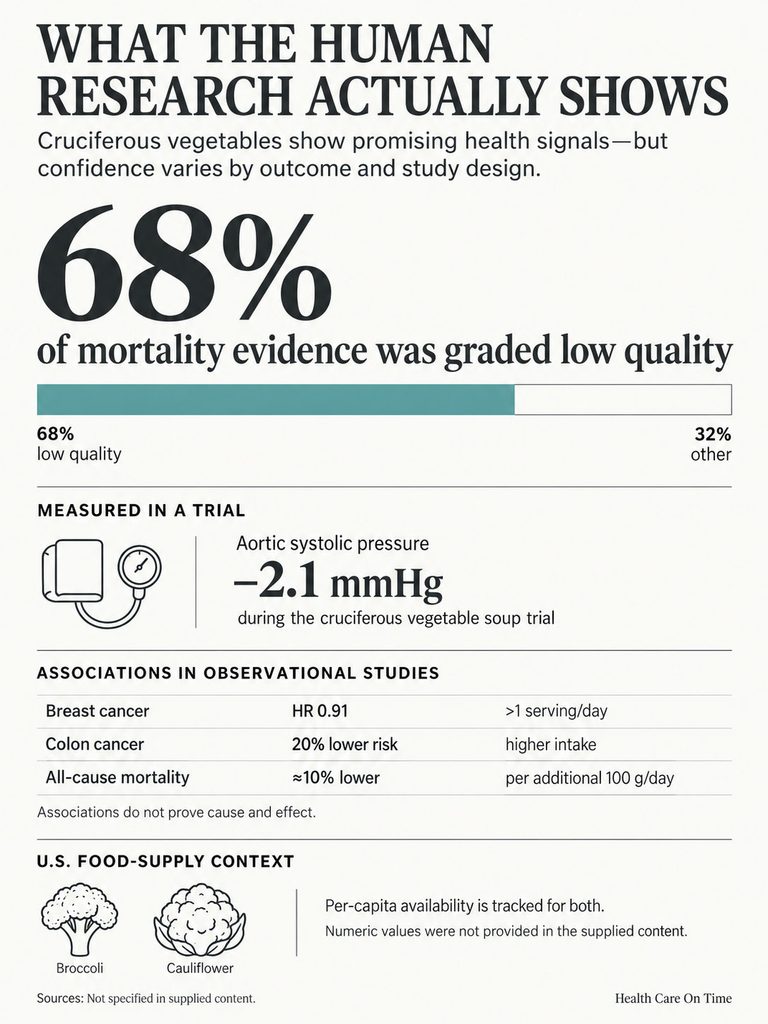
Twenty-four hour brachial systolic pressure fell during the cruciferous phase. Aortic systolic pressure dropped 2.1 mmHg across 24 hours and 3.2 mmHg during daytime hours compared with control.
One limitation deserves stating openly. The active soup was 40% broccoli, 25% cabbage, 25% cauliflower, and 10% kale, so the trial cannot tell you which vegetable did the work. A companion analysis of glycemic outcomes from the same trial carries the same constraint.
Cancer risk
An abstract presented at the 2025 San Antonio Breast Cancer Symposium and published in Clinical Cancer Research pooled two large US cohorts across 4,500,352 person-years and 11,181 invasive breast cancer cases.
Eating more than one serving a day of cruciferous vegetables, against less than one a week, associated with a hazard ratio of 0.91 (95% CI 0.84 to 0.98). After adjusting for overall diet quality, the association weakened to 0.93 and lost statistical significance.
That attenuation matters. People who eat plenty of broccoli tend to eat well across the board, and separating one vegetable from the whole pattern is genuinely hard.
For colorectal cancer, a 2025 dose-response meta-analysis in BMC Gastroenterology reported roughly 20% lower colon cancer risk among higher cruciferous consumers.
Mortality and the evidence-quality caveat
An umbrella review in Food Chemistry gathered 57 meta-analyses and systematic reviews across 24 health outcomes. Each additional 100 g per day of cruciferous vegetables associated with about 10% lower all-cause mortality.
The same review graded 68% of that evidence as low quality. Both facts are true at once, and readers deserve both rather than the flattering half.
Table 2: Cauliflower and Broccoli, US Data and Research Findings
| Finding | Number | Population or design | Source |
| US per capita availability, broccoli | 6.13 lb per person (2023) | National food supply data | USDA Economic Research Service |
| US per capita availability, cauliflower | 2.02 lb per person (2023) | National food supply data | USDA Economic Research Service |
| US adults meeting vegetable intake recommendations | 10.0% | 294,566 BRFSS respondents | CDC, MMWR 71(1), 2022 |
| 24-hour aortic systolic BP reduction on cruciferous soup | 2.1 mmHg (95% CI 0.5 to 3.7) | Randomized crossover, 300 g/day, 2 weeks | Connolly et al., BMC Medicine 2024;22:353 |
| Breast cancer hazard ratio, over 1 serving/day vs under 1/week | HR 0.91 (0.84 to 0.98), 0.93 after diet-quality adjustment | 4,500,352 person-years, 11,181 cases | Clin Cancer Res 2026;32(4 Suppl):RF1-07 |
| Isothiocyanate yield, raw cauliflower | 1.5 µmol/100 g, lowest of 9 US crucifers (average 16.2) | 73 laboratory samples | Linus Pauling Institute, Oregon State University |
| All-cause mortality per 100 g/day cruciferous intake | 10% lower risk, 68% of evidence graded low quality | Umbrella review of 57 meta-analyses | Food Chemistry, 2022 |
Digestion, Gas, FODMAPs, and Thyroid
Why both make you gassy
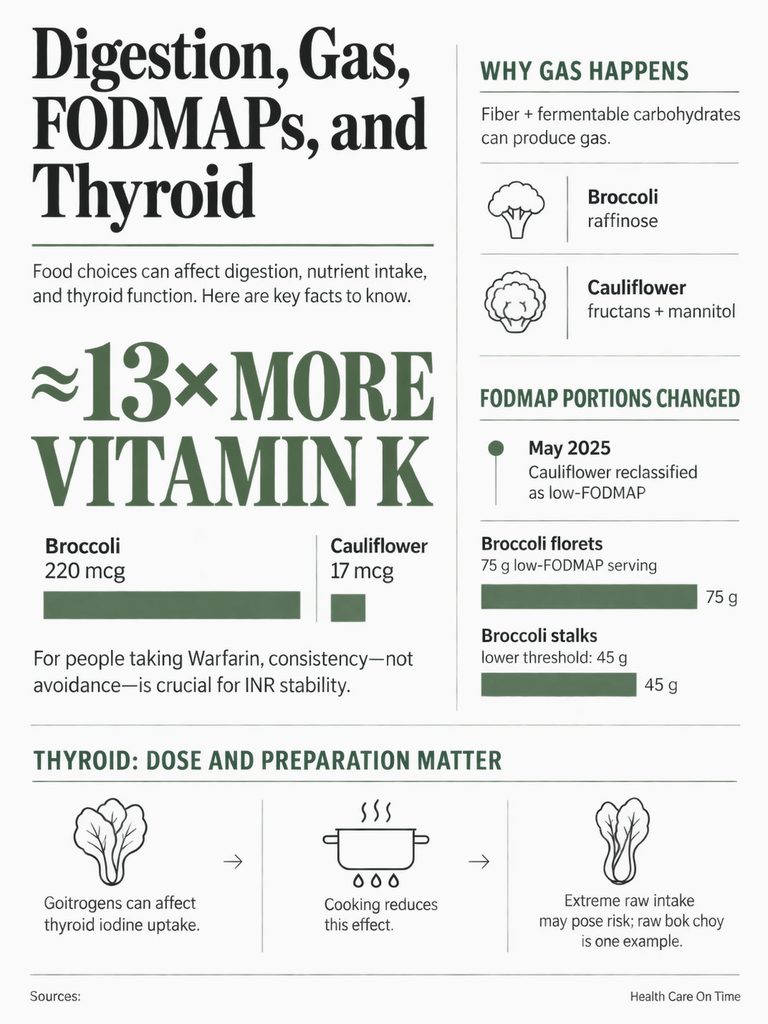
Fiber usually gets blamed. The fermentable carbohydrates deserve it. Broccoli carries raffinose, an oligosaccharide human enzymes cannot break down, so gut bacteria ferment it and produce gas.
Cauliflower carries fructans, which pull water into the intestine as well as feeding bacteria. Add the sulfur compounds both release when chewed, and the smell explains itself.
Patients commonly ask us which one is worse. The honest answer is that it varies by person, and testing your own tolerance beats any general rule.
The May 2025 FODMAP update
Cauliflower spent years on the high-FODMAP avoid list because of its mannitol content. Monash University retested it and reclassified it in May 2025.
White and purple cauliflower now qualify as low-FODMAP at a three-quarter cup serving, about 75 g, with fructans rather than mannitol as the limiting compound at larger portions.
Broccoli has its own split. Monash tested heads and stalks separately and found florets low-FODMAP at 75 g while stalks hit their ceiling sooner, near 45 g. If broccoli bothers you and cauliflower does not, the stalks may be the reason.
Goitrogens and your thyroid
Cruciferous vegetables contain compounds that can interfere with iodine uptake in the thyroid. The concern is real in principle and small in practice at normal eating volumes.
Documented human cases involve extreme intakes, on the order of a kilogram or more of raw bok choy daily. Cooking reduces goitrogenic activity substantially.
If your thyroid function already sits at the borderline, a TSH panel is a better tool than avoiding vegetables. Our lab partners see far more thyroid abnormalities tied to iodine status and autoimmunity than to diet composition.
Warfarin, INR, and the consistency rule
Warfarin works by blocking vitamin K recycling. Large swings in dietary vitamin K move your INR, which is why anticoagulation clinics ask about your diet.
The instruction is consistency, not avoidance. Harvard’s Nutrition Source and every US anticoagulation program say the same thing: eat a steady amount of vitamin K rather than none at all.
A cup of cooked broccoli at 220 mcg is a meaningful daily dose. A cup of cooked cauliflower at 17 mcg is nearly invisible. If your broccoli intake swings from zero on weekdays to two cups on Sunday, that pattern is the thing to fix, and your prescriber should hear about any planned change before you make it.
Which One Belongs on Your Plate
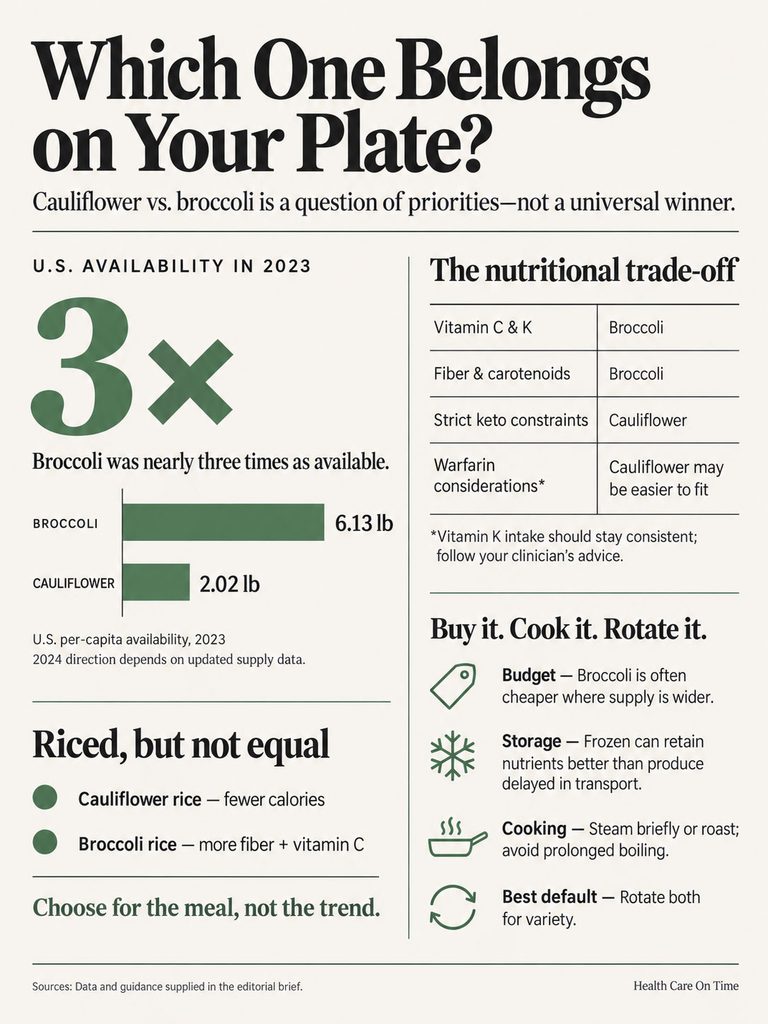
Table 3: Cauliflower vs Broccoli, Scenario and Recommended Action
| If this describes you | Better pick | Why | What to do this week |
| Taking warfarin or another vitamin K antagonist | Cauliflower | 17 mcg vitamin K per cooked cup vs 220 mcg | Keep broccoli intake steady rather than variable, and tell your clinic before changing |
| Strict keto under 20 g net carbs daily | Cauliflower | 2.2 g net carbs per cooked cup vs 6.1 g | Weigh portions in grams; a whole large head still runs about 25 g net carbs |
| Want the sulforaphane effect | Broccoli | Cauliflower yielded the lowest isothiocyanate of nine US crucifers tested | Steam florets 3 to 5 minutes, or eat some raw with dip |
| Vitamin C intake is low | Broccoli | 81 mg per raw cup vs 52 mg | One cup raw covers 90% of the Daily Value |
| IBS or frequent bloating | Either, portioned | Both low-FODMAP at 75 g since May 2025 | Start at three-quarters of a cup, cook thoroughly, skip broccoli stalks |
| Building a higher-fiber diet | Broccoli | 5.1 g per cooked cup vs 2.9 g | Swap one cauliflower side for broccoli three times a week |
| Feeding children who reject green vegetables | Cauliflower | Milder, sweeter, roasts to a caramelized texture | Roast at 425°F with olive oil, then introduce broccoli alongside it |
| Shopping on a tight budget or buying frozen | Broccoli | Wider US supply, 6.13 lb vs 2.02 lb per capita, so steadier pricing | Buy frozen florets; nutrient retention runs close to fresh |
Cauliflower rice and broccoli rice, honestly
Riced cauliflower earns its popularity. A cup replaces a cup of white rice at roughly one-eighth the calories and one-tenth the carbohydrate.
Riced broccoli exists too, and it brings more fiber and vitamin C to the same job. It also tastes distinctly like broccoli, which is precisely why cauliflower owns the category.
Read the label on frozen riced products. Some brands add rice flour, oils, or seasoning blends that quietly change the numbers you thought you were buying.
Fresh, frozen, and what the supply looks like
USDA ERS put 2023 per capita availability at 6.13 pounds of broccoli and 2.02 pounds of cauliflower. Preliminary 2024 figures showed broccoli down about 4% while cauliflower rose about 7%.
Total US vegetable and pulse availability fell to 376 pounds per person in 2024, the lowest level since 1988. Set against CDC’s finding that only 10.0% of US adults meet vegetable recommendations, choosing between these two matters far less than eating either one more often.
Frozen is a legitimate answer. Blanching before freezing costs some vitamin C, but frozen florets are harvested at peak and often test better than fresh produce that has spent a week in transit.
The verdict, stated plainly
If you want one answer: broccoli is the more nutrient-dense vegetable, and it is not close on vitamin C, vitamin K, fiber, or carotenoids. Buy broccoli by default.
Buy cauliflower when a specific constraint makes it the better fit, and there are three real ones: warfarin, a hard carbohydrate ceiling, and a household that will eat cauliflower but refuses broccoli. Any of those flips the recommendation without hesitation.
Rotating both is the least interesting answer and probably the correct one for most households. Variety across the cruciferous family is what the cohort data actually rewards, and neither vegetable carries a nutrient the other cannot be paired to cover.
How to Cook Each One Without Wasting the Nutrients
Method ranking
Steaming leads for both vegetables. It keeps water-soluble vitamins out of the drain and, for broccoli, preserves enough myrosinase to matter as long as you stay under five minutes.
Roasting comes second. Dry heat causes no leaching, and browning makes both vegetables more appealing, which counts for more than a few milligrams of vitamin C.
Microwaving with minimal water performs better than its reputation on vitamins but poorly on the enzyme. Boiling finishes last: it sends potassium, folate, and vitamin C into water most people pour down the sink.
The chop-and-wait trick
Cut broccoli, then leave it on the board for 30 to 40 minutes before applying heat. That gives myrosinase time to work while the enzyme is still alive.
If you forget, add a pinch of mustard powder, grated horseradish, wasabi, or raw arugula to the finished dish. Each carries its own active myrosinase and can restore some conversion in already-cooked broccoli.
Portion targets in US terms
The Dietary Guidelines put adult vegetable intake at 2 to 3 cup-equivalents daily. One cup of chopped raw or cooked broccoli or cauliflower counts as one cup-equivalent.
In practical terms that is two heaping handfuls of florets, or roughly 5 ounces of cooked vegetable by weight. Two cruciferous servings a week is a reasonable floor, and daily works fine for most people.
Frequently Asked Questions
Is cauliflower just white broccoli?
No. Both are the same species, Brassica oleracea, but different cultivar groups bred for different traits. Broccoli is the italica group, cauliflower the botrytis group. They differ in pigment, dominant glucosinolate, water content, and micronutrient profile, which is why their nutrition tables refuse to line up.
Which has more protein, broccoli or cauliflower?
Broccoli. Raw broccoli carries 2.82 g of protein per 100 grams against cauliflower’s 1.92 g, roughly 47% more. Per cup that works out to 2.6 g versus 2.1 g raw, or 3.7 g versus 2.3 g cooked. Neither vegetable should count as a protein source in meal planning.
Does cauliflower actually contain sulforaphane?
Barely. Cauliflower’s main glucosinolate is sinigrin, not the glucoraphanin that converts to sulforaphane. In testing of nine raw cruciferous vegetables eaten in the United States, cauliflower produced the lowest isothiocyanate yield at 1.5 µmol per 100 g against a 16.2 average. Broccoli is the sulforaphane vegetable of the pair.
Which is better for weight loss?
Cauliflower is slightly lower in calories, 25 per 100 grams against 34. Broccoli offers more fiber and protein per calorie, which supports fullness. The difference across a full day lands near 30 calories, small enough that the vegetable you will actually eat regularly is the better answer.
How much vitamin K is in each, and does it matter on warfarin?
Cooked broccoli holds 141 mcg per 100 grams, cooked cauliflower 13.8 mcg, roughly a ten-fold gap. On warfarin, the rule is steady intake rather than avoidance. Cauliflower fits easily into a low-variation diet. Discuss any planned change with your anticoagulation clinic before adjusting portions.
Which causes more gas?
It varies by person. Broccoli’s raffinose and cauliflower’s fructans both get fermented by gut bacteria, and both vegetables release sulfur compounds when chewed. Cooking thoroughly and increasing portions gradually reduces symptoms for most people more reliably than switching between the two.
Is cauliflower low FODMAP now?
Yes, at the right portion. Monash University retested cauliflower and reclassified it in May 2025. White and purple cauliflower are low-FODMAP at a three-quarter cup serving, about 75 grams. Larger portions push fructans past threshold. Broccoli florets share the same 75 g limit, while broccoli stalks cap lower.
Which is better for keto?
Cauliflower, narrowly. Boiled cauliflower runs 1.81 g of net carbs per 100 grams against boiled broccoli’s 3.88 g. Per cooked cup that is 2.2 g versus 6.1 g. On a 20 g daily ceiling, that gap lets you fit noticeably more vegetable volume into the same allowance.
Does cooking destroy the cancer-fighting compounds?
It destroys the enzyme that creates them. Research found about 37% of a glucoraphanin dose converted to sulforaphane from raw broccoli against roughly 3.4% from cooked. Steaming under five minutes preserves much of the enzyme. Gut bacteria provide partial backup, converting an average of 12% with wide variation between individuals.
Is frozen as good as fresh?
Close, and sometimes better. Blanching before freezing costs some vitamin C and folate, but freezing locks in the rest at harvest quality. Fresh produce loses vitamin C steadily during transport and storage, so a week-old fresh head can test below a frozen bag from the same field.
Which is better for blood sugar?
Both perform well, with cauliflower slightly ahead on carbohydrate load. In the VESSEL randomized trial, a cruciferous vegetable mix improved glycemic measures compared with root and squash vegetables. That mix contained both, so the trial cannot separate them. Either one displaces higher-carbohydrate sides effectively.
Can I eat either one every day?
For most people, yes. Daily cruciferous intake associates with lower all-cause mortality in pooled observational data, though the evidence quality is limited. Exceptions apply if you take warfarin, where consistency matters more than quantity, or if you have thyroid disease and eat large volumes raw.
Medical Disclaimer: This article is for general information and is not medical advice. Nutrition needs vary by individual. If you take warfarin or another anticoagulant, have thyroid disease, chronic kidney disease, or a diagnosed digestive disorder, talk with your physician or a registered dietitian before making substantial changes to your vegetable intake. Laboratory testing can help clarify your vitamin, mineral, and organ function status before you adjust your diet.
References
- USDA FoodData Central: Broccoli, raw (FDC 170379)
- USDA FoodData Central: Cauliflower, raw (FDC 169986)
- USDA FoodData Central: Broccoli, cooked, boiled, drained (FDC 169967)
- USDA FoodData Central: Cauliflower, cooked, boiled, drained (FDC 170397)
- Linus Pauling Institute, Oregon State University: Isothiocyanates
- Kushad et al., Variation of Glucosinolates in Vegetable Crops of Brassica oleracea, Journal of Agricultural and Food Chemistry
- Connolly et al., Cruciferous vegetables lower blood pressure (VESSEL study), BMC Medicine 2024;22:353
- VESSEL study glycemic control analysis, Diabetes, Obesity and Metabolism
- Romanos-Nanclares et al., Cruciferous vegetable intake and breast cancer risk, Clinical Cancer Research 2026;32(4 Suppl):RF1-07
- Lai et al., Cruciferous vegetables intake and risk of colon cancer, BMC Gastroenterology 2025
- Li et al., Cruciferous vegetable and isothiocyanate intake and multiple health outcomes, Food Chemistry
- CDC, Adults Meeting Fruit and Vegetable Intake Recommendations, MMWR 71(1)
- USDA Economic Research Service: Cauliflower’s popularity re-emerges
- USDA Economic Research Service, Vegetables and Pulses Outlook VGS-375
- Monash University FODMAP: broccoli and broccolini testing
- American Institute for Cancer Research: Broccoli, steam it to boost cancer-fighting compounds
- Harvard T.H. Chan School of Public Health, The Nutrition Source: Vitamin K
- Vermeulen M, et al., Bioavailability and kinetics of sulforaphane in humans after consumption of cooked versus raw broccoli