The antihistamine in your medicine cabinet right now is legal in all 50 states, sold without a prescription, and priced around eight dollars. Carry that same box into Tokyo Narita and a customs officer can seize it.
Most guidance on allergy medication for vacation stops at “pack extra.” That advice is correct and nearly useless. The failures that actually wreck trips are narrower: a bag that got checked, a rental car that hit 140°F in a parking lot, a pill taken nine hours late, a decongestant that was never legal at the destination.
Table of Contents
| Quick Answer: Keep all allergy medication for vacation in your carry-on, in original pharmacy-labeled packaging. Pack roughly twice what the trip requires and split it between two bags. Check destination legality for pseudoephedrine and diphenhydramine before departure, because both are restricted in several countries. Store epinephrine between 68°F and 77°F, never in a parked car. Start a nasal steroid about two weeks before you leave. |
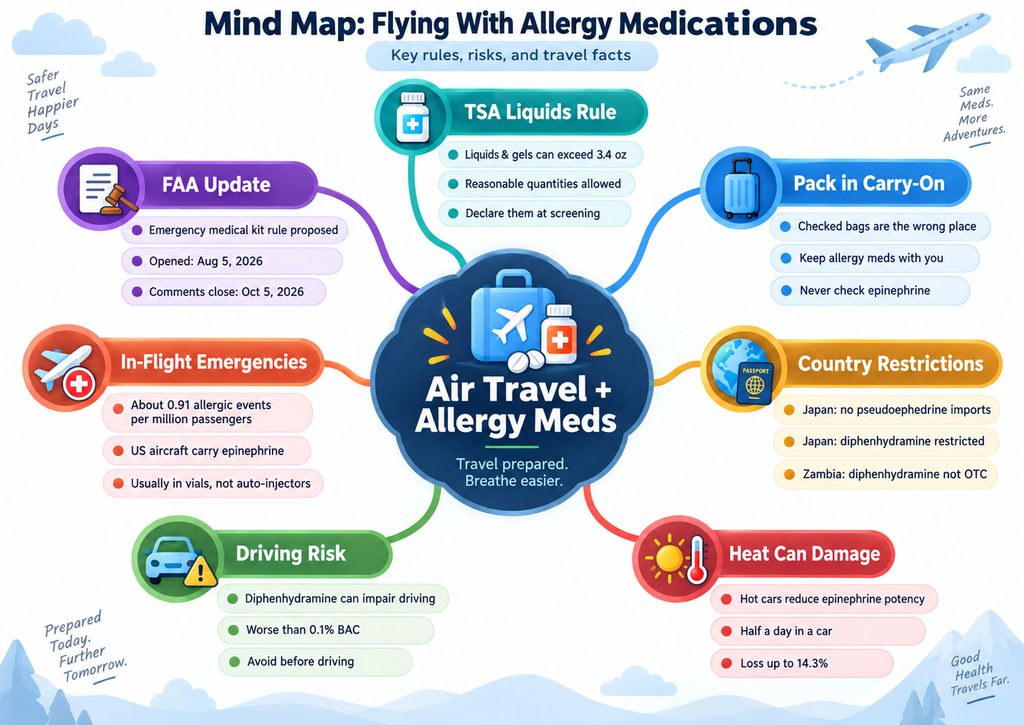
| At a Glance Liquid and gel medications are exempt from the TSA 3.4-ounce limit in reasonable quantities, but you have to declare them.Checked luggage is the wrong place for any allergy medication and a disqualifying place for epinephrine.Pseudoephedrine (Sudafed) is prohibited for import into Japan; diphenhydramine (Benadryl) is restricted in Japan and banned over the counter in Zambia.Half a day in a hot car degraded epinephrine by up to 14.3% in one analysis.Diphenhydramine impaired driving more than a 0.1% blood alcohol level in a randomized simulator trial.In-flight allergic events run about 0.91 per million passengers, and US aircraft carry epinephrine in vials, not auto-injectors.The FAA opened a proposed rule on emergency medical kits on August 5, 2026, with comments closing October 5, 2026. |
The nine rules, in one place:
- Declare liquid and gel medication at the checkpoint; it is exempt from the 3.4-ounce limit.
- Travel with original pharmacy-labeled packaging, not a pill organizer.
- Pack double the supply and split it across two bags you carry yourself.
- Keep epinephrine between 68°F and 77°F, and never leave it in a vehicle.
- Verify destination import rules for every active ingredient before departure.
- Shift once-daily antihistamine timing gradually rather than skipping a dose.
- Start an intranasal corticosteroid two weeks before the trip, not on arrival.
- Assume the aircraft has no auto-injector, and carry two of your own.
- Build a failure plan: refills, insurance, embassy contacts, nearest hospital.
Patients booking pre-travel lab work with us ask about these in almost this exact order. Here is what sits behind each one.
What Counts as Allergy Medication When You Travel
Travelers think of allergy medication as one category. Airport screeners, customs officers, and summer heat do not.
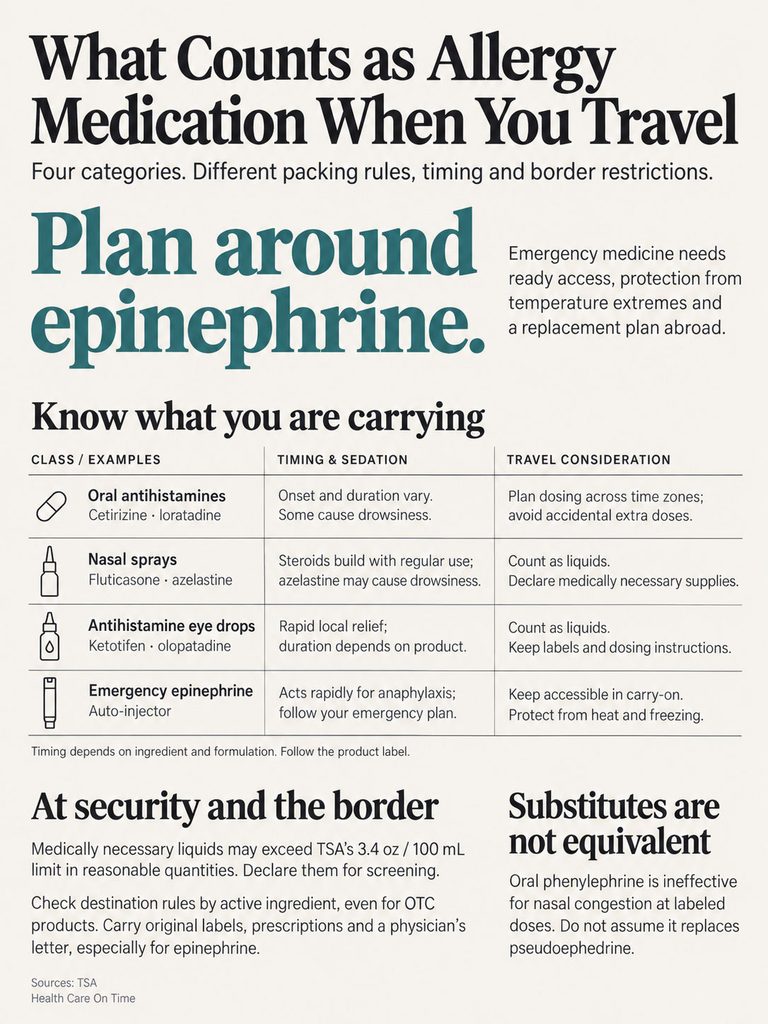
Four Categories, Four Different Failure Modes
Oral antihistamines pack easily and go wrong on timing. Nasal sprays are liquids by TSA definition and get pulled at the checkpoint. Antihistamine eye drops draw the same handling.
Emergency epinephrine is the category that is genuinely fragile, legally sensitive, and impossible to replace quickly abroad. It deserves more planning than the other three combined.
Prescription Versus Over-the-Counter Changes Meaning at a Border
Inside the United States, that distinction tells you where to buy something. Outside it, the distinction means very little. A drug sold off a shelf in Ohio can sit on a controlled-substances schedule in Singapore or the United Arab Emirates.
The practical consequence: American packaging proves nothing at a foreign customs desk. What travels well is the active ingredient name, the dose per tablet, and a physician’s letter. Brand names do not translate.
| Medication class | Common US example | Onset and duration | Sedation and driving risk | Travel-specific catch |
| Second-generation antihistamine | Cetirizine (Zyrtec), loratadine (Claritin), fexofenadine (Allegra) | 1 to 3 hours, lasts 24 hours | Low; cetirizine is the most sedating of the three | Once-daily dosing gets confusing across 6+ time zones |
| First-generation antihistamine | Diphenhydramine (Benadryl), chlorpheniramine | 15 to 60 minutes, lasts 4 to 6 hours | High; measurable next-morning impairment | Restricted in Japan and Zambia; poor choice before a rental car |
| Intranasal corticosteroid | Fluticasone (Flonase), triamcinolone (Nasacort) | Partial effect in 12 hours, full effect in 1 to 2 weeks | None | Needs a two-week head start; screened as a liquid |
| Oral decongestant | Pseudoephedrine (Sudafed) | 30 minutes, lasts 4 to 12 hours | Stimulating; can disrupt arrival-night sleep | Prohibited in Japan; purchase-limited in the US and abroad |
| Antihistamine eye drop | Ketotifen, olopatadine | 15 to 30 minutes, lasts 8 to 12 hours | None | Screened as a liquid; heat-sensitive in a beach bag |
| Epinephrine device | Auto-injector, or epinephrine nasal spray (neffy) | Seconds to minutes | None | Narrow storage range; never goes in checked baggage |
The Substitute That Does Not Work
One footnote matters for anyone planning to buy replacements abroad. The FDA proposed removing oral phenylephrine from the over-the-counter monograph for nasal decongestants on November 7, 2024, after concluding it does not work at the labeled dose.
That order is still proposed rather than final, so the products stay on shelves. Phenylephrine is also the ingredient most commonly recommended as the “just buy this instead” swap when pseudoephedrine is unavailable. Our medical reviewers flag that swap as a weak plan.
Why This Needs More Planning Than It Used To
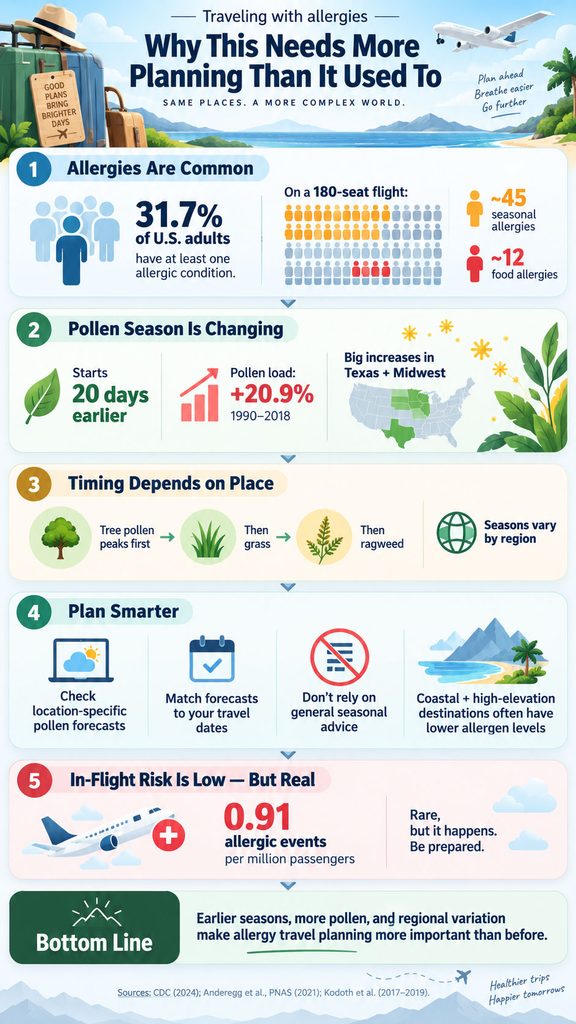
Two things shifted. Allergic disease is now common enough to show up on every plane and cruise ship. And pollen exposure at destinations has moved in ways older travel advice never accounted for.
How Common Allergy Actually Is in the US
The CDC’s National Center for Health Statistics published fresh figures on January 8, 2026 from the 2024 National Health Interview Survey. Nearly a third of American adults carry at least one diagnosed allergic condition.
On a full 180-seat domestic flight, that works out to roughly 45 passengers with a diagnosed seasonal allergy and about 12 with a diagnosed food allergy. Allergy is not a fringe travel concern.
The Pollen Statistic Nearly Every Article Gets Wrong
You have likely read that North American pollen seasons are “20 days longer.” That is a misreading of the source paper. The PNAS analysis of 60 pollen stations across 821 site-years found that season start dates advanced by about 20 days, while season length grew by about 8 days.
The difference changes trip planning. An earlier start means a March trip to Texas or the Midwest now lands inside tree pollen that used to arrive in April. The same study found a 20.9% rise in annual pollen load between 1990 and 2018, with the largest increases in Texas and the midwestern states.
Timing a Trip Around a Destination’s Season
Pollen seasons are regional, not national. Tree pollen peaks earliest, grass follows in late spring and early summer, and ragweed dominates from August into the first hard frost.
Check the destination’s forecast the way you check the weather forecast, and check it for the actual travel window rather than the season generally. Beaches and elevations above 2,500 feet carry lower dust-mite and pollen loads, which is why coastal and mountain trips tend to be easier on allergic travelers.
| Statistic | Figure | Population or period | Source |
| Adults with diagnosed seasonal allergy | 25.2% | US adults, 2024 | CDC NCHS Data Brief 545, Jan 2026 |
| Adults with diagnosed food allergy | 6.7% | US adults, 2024 | CDC NCHS Data Brief 545, Jan 2026 |
| Adults with any of three allergic conditions | 31.7% | US adults, 2024 | CDC NCHS Data Brief 545, Jan 2026 |
| Children with diagnosed seasonal allergy | 20.6% | US children ages 0 to 17, 2024 | CDC NCHS Data Brief 546, Jan 2026 |
| Pollen season start shift | About 20 days earlier | North America, 1990 to 2018 | Anderegg et al., PNAS 2021 |
| Annual pollen load increase | 20.9% | North America, 1990 to 2018 | Anderegg et al., PNAS 2021 |
| In-flight allergic events | 0.91 per million passengers | 51 airlines, 2017 to 2019 | Kodoth et al., Ann Allergy Asthma Immunol 2022 |
Rules 1 Through 3: Packing and Clearing the Airport
Rule 1: Liquid Medication Is Exempt From the 3.4-Ounce Limit
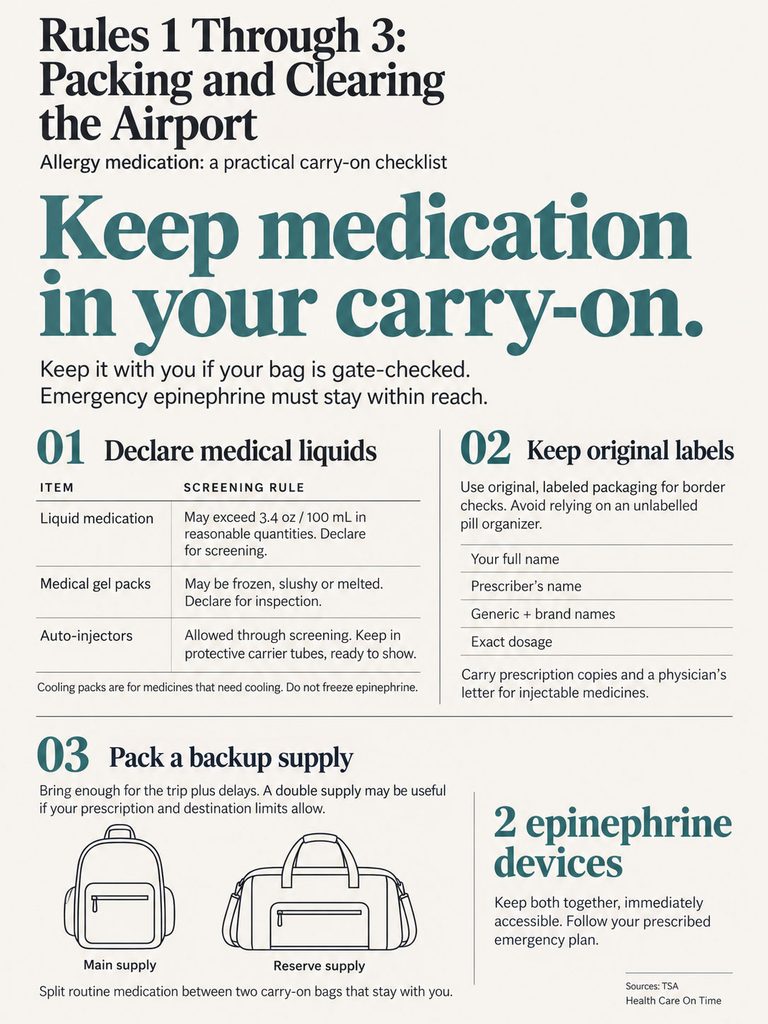
The 3-1-1 rule does not apply to medically necessary liquids. That covers liquid antihistamines, nasal sprays, eye drops, and saline rinses, in prescription and over-the-counter form alike.
The exemption carries conditions. Quantities must be reasonable for the trip length, the items must be reachable rather than buried, and you have to tell the officer before the bag enters the scanner. Expect a swab test for explosive residue, which is routine.
TSA does not legally require a prescription label or a physician’s note for the exemption. Carrying both anyway shortens the conversation considerably.
Rule 2: Original Packaging Beats a Pill Organizer
A weekly pill organizer is convenient at home and a liability at a border. Loose tablets give a customs officer nothing to verify, and some countries treat unlabeled medication as an import violation regardless of what the drug is.
Keep tablets in the pharmacy-labeled bottle or the original blister card with its carton. If the box is bulky, save the printed flap carrying the ingredient panel and lot number.
Your documentation should list your name, the prescriber’s name, the generic name, the brand name, and the exact dose. The generic name is the one that works in every language.
Rule 3: Double the Supply and Split It
The CDC’s travel guidance recommends carrying enough for the whole trip plus extra for delays. Doubling is the working number, because delays are what create the shortage.
Split that supply across two bags you carry yourself, typically a carry-on and a personal item. If you are traveling with someone, handing them half is better still.
Nothing goes in checked luggage. Bags get separated from passengers routinely, hold conditions swing, and a medication you cannot reach during a reaction is not functioning as medication.
Auto-Injectors, Needles, and Ice Packs at the Checkpoint
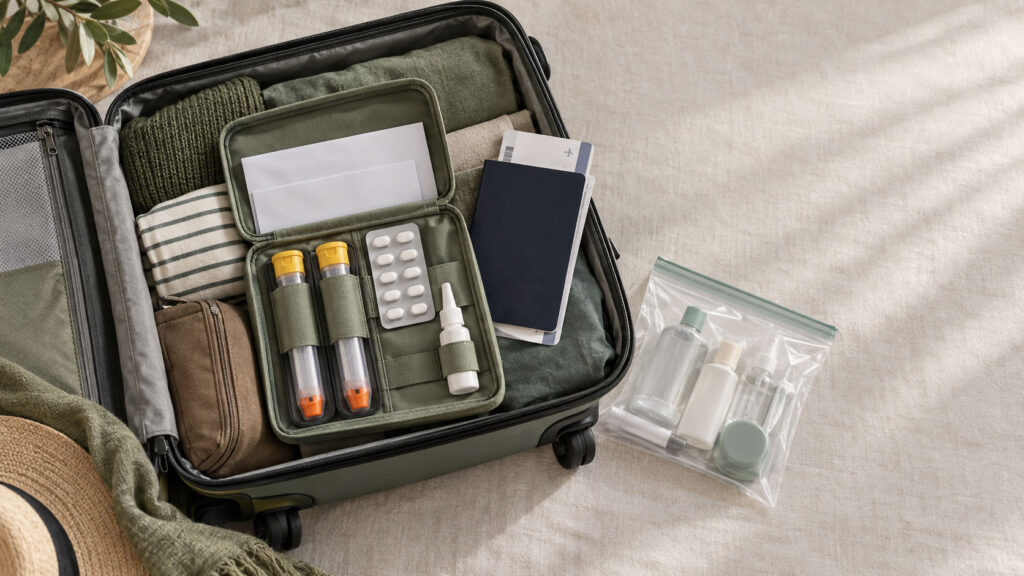
Epinephrine auto-injectors clear security without difficulty. Keep them in their carrier tubes, keep the prescription label visible, and declare them alongside your liquids.
Ice packs and gel packs are permitted for cooling medication, but they must be frozen solid at the checkpoint. Partially melted gel gets treated as a liquid. Freezer packs are a poor choice for epinephrine regardless, for reasons covered in the next section.
Anyone with a prescription for epinephrine should travel with two devices. That is the standard recommendation, not an abundance of caution.
What Belongs in a Travel Allergy Kit
- Two epinephrine devices, in carrier tubes, with prescription labels intact
- A non-sedating antihistamine at double the trip supply
- Intranasal corticosteroid, already started two weeks earlier
- Antihistamine eye drops
- Saline nasal rinse or spray
- A printed physician letter with generic names, doses, and quantities
- Printed copies of every prescription, plus offline photos on your phone
- A written allergy action plan, translated if needed
- A medical alert bracelet or necklace
- Alcohol-free wipes for tray tables, seats, and surfaces
- Chef cards or allergy translation cards for food-allergic travelers
- Insurance card, policy number, and the 24-hour assistance line
- Address and phone number of the nearest hospital to your accommodation
Rule 4: Heat and Cold Ruin Medication Before Customs Ever Sees It
What the Label Allows Versus What the Research Found
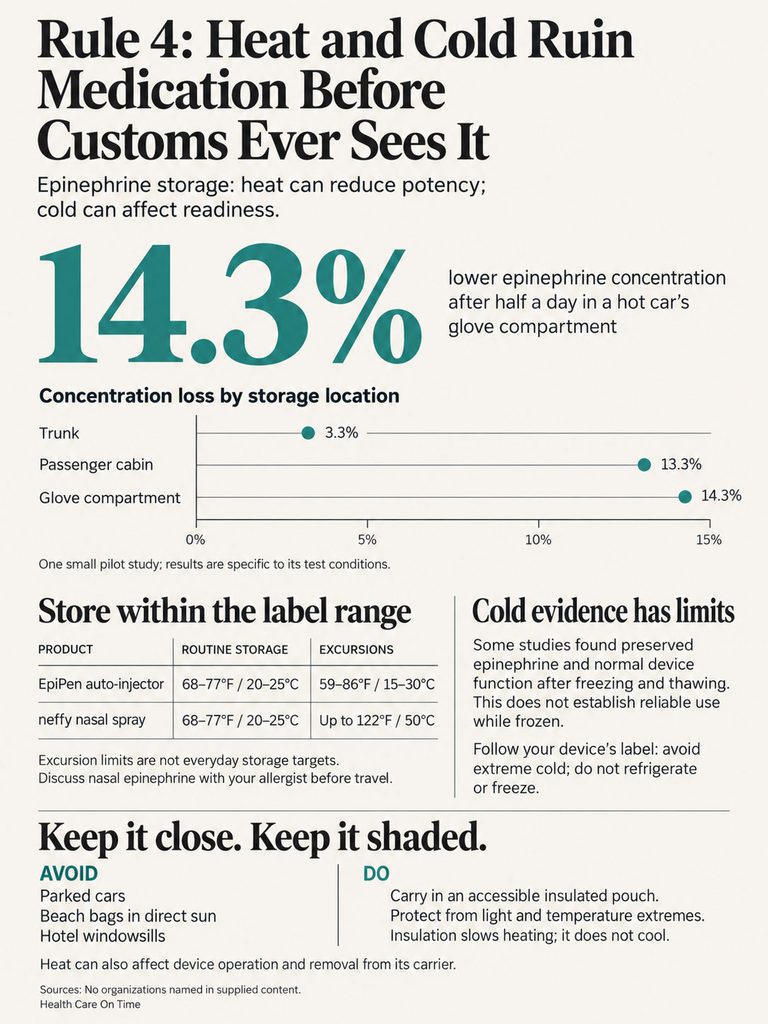
Epinephrine auto-injector labeling calls for controlled room temperature, 68°F to 77°F, with brief excursions permitted between 59°F and 86°F. Hold that range against a July afternoon in Phoenix and the problem is obvious.
A widely cited analysis placed auto-injectors in different parts of a parked car for half a day, then measured the contents. Epinephrine concentration fell 3.3% in the trunk, 13.3% in the passenger cabin, and 14.3% in the glove compartment, as summarized by the Allergy & Asthma Network.
Separate work found something worse than potency loss. After devices were heated for eight hours and cooled, most became difficult to remove from their carrier tubes, and several fired late during testing. A device that will not come out of its tube is not available in an emergency.
The Cold Side Is Less Alarming Than You Have Been Told
A systematic review in Annals of Allergy, Asthma & Immunology pooled nine studies on temperature and epinephrine. Heat degraded the drug, but only with prolonged exposure, and constant heat did more damage than fluctuating heat.
Cold behaved differently. None of the studies examining extreme cold found meaningful degradation, and all 40 auto-injectors tested across two device studies fired correctly. The authors suggested brief real-world excursions may be less damaging than previously assumed.
For travelers, the reading is straightforward. A device that spent an hour in a cold hotel room is probably fine. A device that spent an afternoon on a dashboard should be replaced.
Rental Cars, Beach Bags, and Hotel Windows
Three places reliably overheat allergy medication for vacation: a parked car, a beach bag in direct sun, and a windowsill in a room with the air conditioning off while you are out sightseeing.
Carry epinephrine on your body or in an insulated pouch, not in the vehicle. Hotel safes sit in interior walls and stay closer to room temperature than a window ledge or a balcony table.
The One Product Built Around This Problem
Epinephrine nasal spray carries different storage language. Its labeling permits temperatures up to 122°F for no more than a few days, with replacement advised if that limit is exceeded for longer.
That tolerance makes it worth raising with an allergist before a beach, desert, or long road-trip itinerary. It is a prescription product, so the conversation belongs before departure rather than at the destination.
Rule 5: Legal Here Does Not Mean Legal There
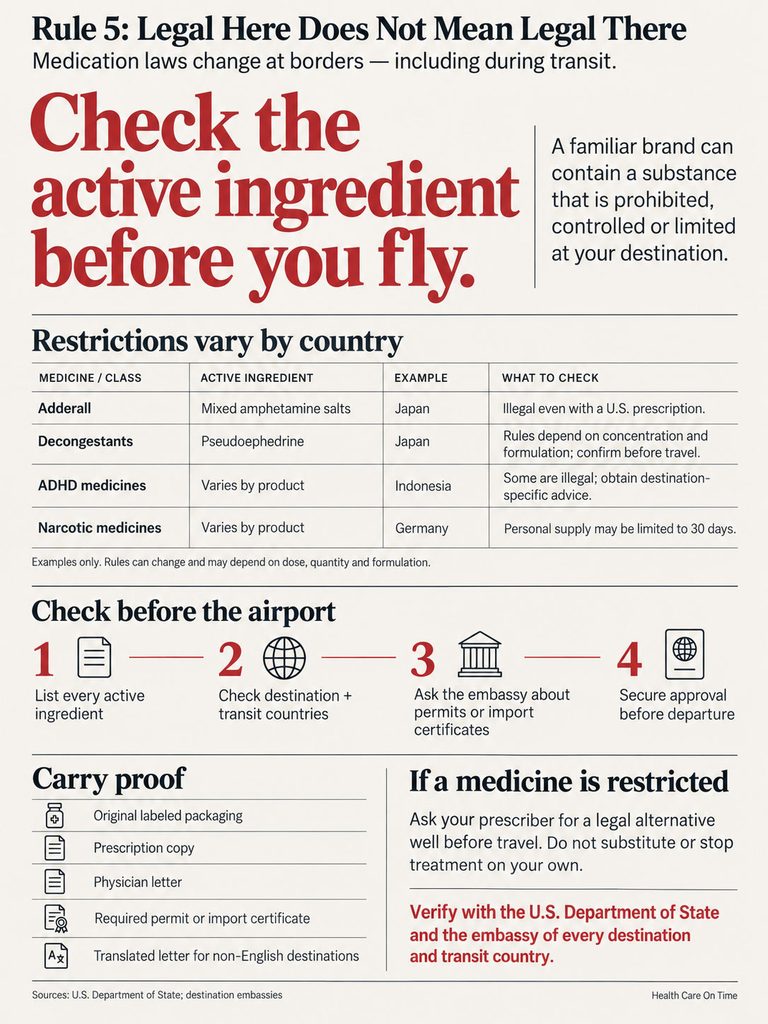
This is the gap in nearly every travel-allergy article online. Telling readers to “check whether your medication is permitted” helps nobody who does not know which medications are the problem.
Two of them are American medicine-cabinet staples.
Pseudoephedrine and Diphenhydramine
Pseudoephedrine, the active ingredient in Sudafed and several Vicks products, falls under Japan’s stimulant raw material rules and is prohibited for import, including for personal use with a prescription. It is also restricted in Mexico and sold under prescription-only status or quantity caps in parts of Europe and Australia.
Diphenhydramine, the active ingredient in Benadryl and Tylenol PM, is banned in over-the-counter products in Zambia. Japan permits it only in limited per-tablet amounts, and a standard US 25 mg tablet exceeds the 10 mg per-tablet ceiling.
Codeine cough products, dextromethorphan, and ADHD stimulants appear on similar lists in the UAE, Singapore, Greece, Indonesia, and South Korea. None of that is guessable from a US pharmacy aisle.
| US product | Active ingredient | Where it is restricted | What you need to do |
| Sudafed, Vicks inhaler | Pseudoephedrine | Japan (prohibited), Mexico, quantity limits in UK and Australia | Leave it home; discuss an intranasal alternative with your clinician |
| Benadryl, Tylenol PM | Diphenhydramine | Zambia (OTC ban), Japan (10 mg per-tablet cap), Singapore (some formulations) | Switch to cetirizine or loratadine for the trip |
| Robitussin DM | Dextromethorphan | Singapore (permit required) | Apply for a permit or leave it home |
| Codeine cough syrups | Codeine | UAE, Japan, Greece, Indonesia | Prior approval plus physician letter |
| Adderall, Ritalin | Amphetamine salts, methylphenidate | UAE, Japan, Singapore, South Korea | Import certificate; begin weeks in advance |
| Epinephrine auto-injector | Epinephrine | Widely available but not stocked everywhere | Carry two; bring a prescription copy |
Permits, Import Certificates, and Physician Letters
Japan’s import certificate process takes weeks, not days. Singapore requires authorization for several drug classes. The UAE maintains its own controlled list with penalties that go well beyond confiscation.
The reliable starting point is the State Department’s health abroad guidance plus the embassy of the country you are visiting, which is the authority on its own import rules.
Carry a physician letter listing your diagnosis, each medication by generic name, the dose, and the quantity you are importing. For non-English-speaking destinations, a translated copy is worth the small cost.
Across the travelers HealthCareOnTime serves, the most common preventable problem is not a seized medication. It is learning about the restriction at the airport, three hours before departure, with no time left to arrange a substitute.
Rules 6 and 7: Time Zones and Arrival-Day Alertness
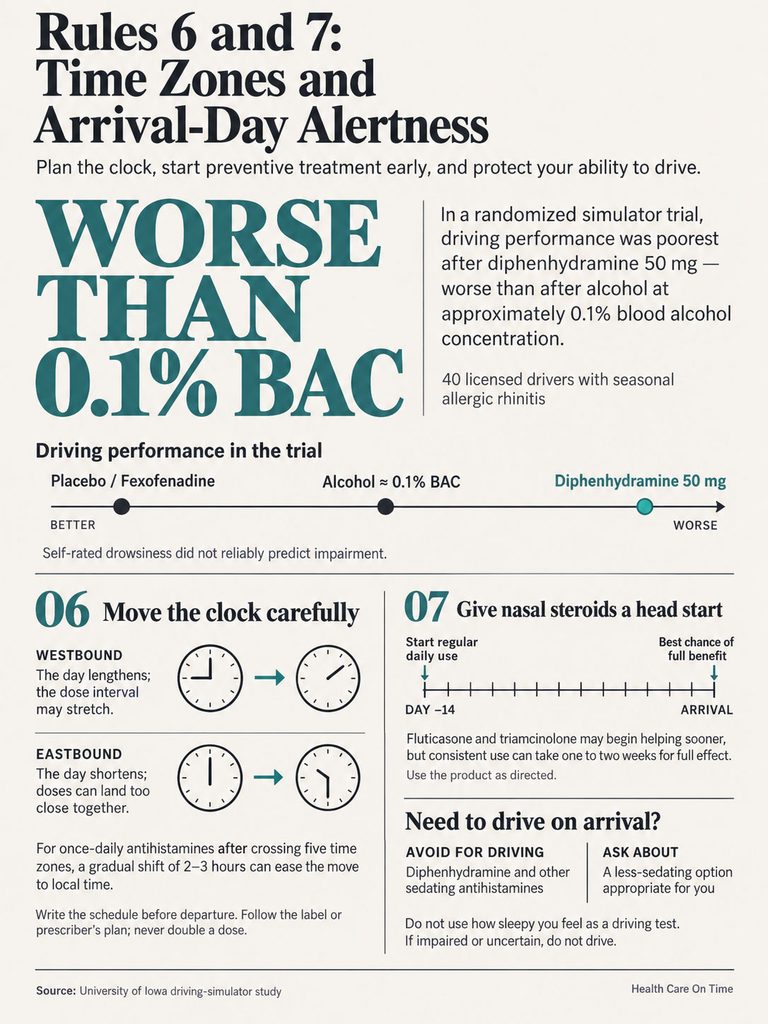
Rule 6: Once-Daily Antihistamines Across Six or More Time Zones
Cetirizine, loratadine, levocetirizine, and fexofenadine are dosed every 24 hours. Cross five time zones and the clock changes while the interval does not.
The workable approach is to hold the home-clock time for the first day, then shift the dose in 2 to 3 hour increments over the following days until it lands where you want it locally. Skipping a dose to reset leaves an unprotected gap during the exposure window.
Westbound travel stretches the day, so the interval adjusts naturally. Eastbound is harder, because the next dose arrives sooner than 24 hours. Spreading that shift over two days avoids doubling up. Prescription regimens with tighter windows belong to your prescriber rather than a general article.
Rule 7: Nasal Steroids Need a Two-Week Head Start
Intranasal corticosteroids are the most effective single class for nasal allergy symptoms and also the slowest. Some benefit shows up within the first day, but the full effect takes one to two weeks of daily use.
Starting Flonase or Nasacort the morning you land wastes most of the trip. Starting two weeks before departure means the medication is already working on arrival day.
This is the rule travelers skip most often, and the one our medical reviewers raise most frequently in pre-trip questions.
The Sedating Antihistamine Problem
Diphenhydramine gets used as a sleep aid on long flights and as a general allergy fallback. A randomized crossover trial published in the Annals of Internal Medicine tested that assumption directly.
Forty licensed drivers with seasonal allergic rhinitis drove the Iowa Driving Simulator after four treatments: fexofenadine 60 mg, diphenhydramine 50 mg, alcohol at roughly 0.1% blood alcohol concentration, and placebo.
Driving performance was worst after diphenhydramine, worse than after the alcohol dose. Fexofenadine performed like placebo. Participants could not predict their own impairment from how drowsy they felt.
If your itinerary includes a rental car counter, that finding should decide which antihistamine goes in the bag. Self-assessment is not a reliable safety check.
Rule 8: Know What Is Actually on the Plane
How Often In-Flight Allergic Reactions Happen
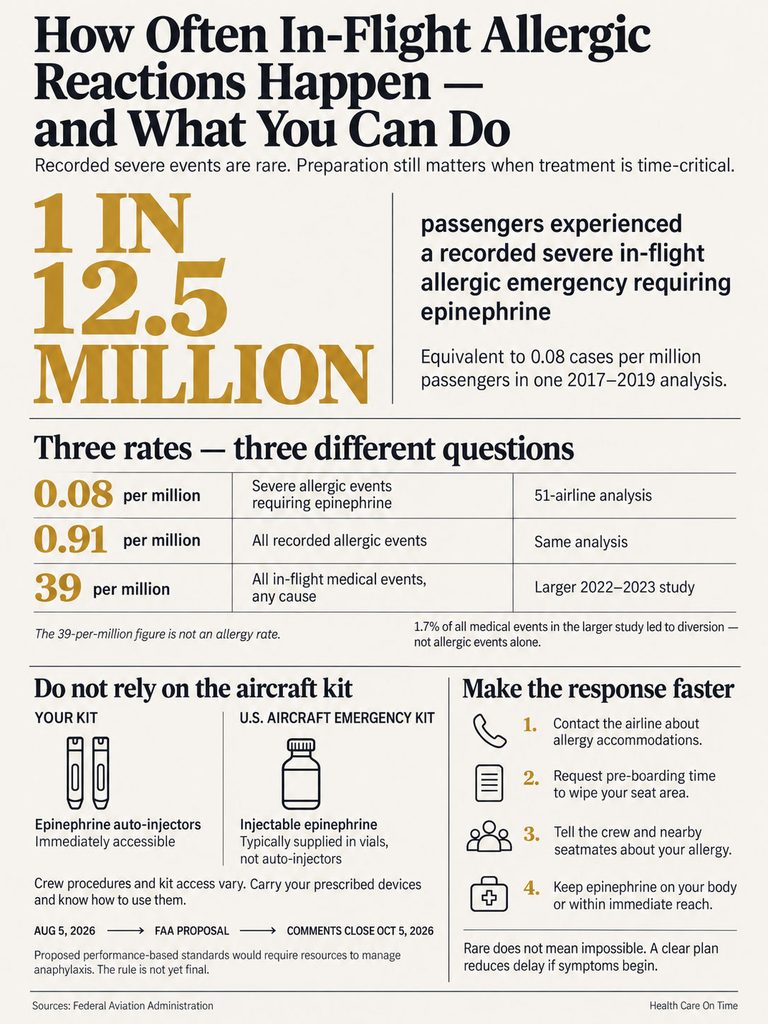
A retrospective analysis in Annals of Allergy, Asthma & Immunology reviewed a global in-flight medical database across 51 airlines and found allergic events at 0.91 cases per million passengers. Events severe enough that epinephrine was recommended ran at 0.08 per million, roughly one in every 12.5 million passengers.
A larger 2025 cohort in JAMA Network Open covering 77,790 in-flight medical events across 84 airlines put the overall event rate at 39 per million enplanements, with diversions in 1.7% of cases. Anaphylaxis carried elevated odds of diversion.
Together those numbers say two things. A reaction in the air is rare. When one happens, an aircraft is a bad place to be short a device.
What Is in the Emergency Medical Kit
US carriers stock epinephrine in emergency medical kits in vial form, not as auto-injectors. Drawing an ampule dose during turbulence is not a task most flight crews are trained for, and it generally requires a medically qualified volunteer to step forward.
Congress addressed this in the FAA Reauthorization Act of 2024, directing the agency to evaluate whether kits carry medications that can practicably be administered for anaphylaxis. The FAA published its proposed rule on August 5, 2026 under Docket FAA-2026-9178.
The proposal replaces the prescriptive contents list with a performance-based standard rather than mandating auto-injector devices. Public comment closes October 5, 2026. Until a final rule changes it, the operating assumption holds: bring your own.
Pre-Boarding, Wipe-Downs, and Telling the Crew
Contact the airline before the trip and ask what accommodations exist. Policies differ widely between carriers and none of them apply automatically.
Many airlines allow pre-boarding to wipe down a seat, tray table, and seatback pocket. Cabin air is filtered and recirculated, so surface contact is the more realistic exposure route for food-allergic passengers.
Tell the crew at boarding rather than mid-flight, and tell seatmates if food allergy is the concern. If a reaction starts, use your own device first, then alert the crew immediately and ask whether a medical professional is on board.
Road Trips, Cruises, and Everything That Is Not a Flight
Air travel dominates the advice online, but a large share of American vacations never involve a boarding pass. The risks change shape.
Road Trips: the Car Is the Hazard
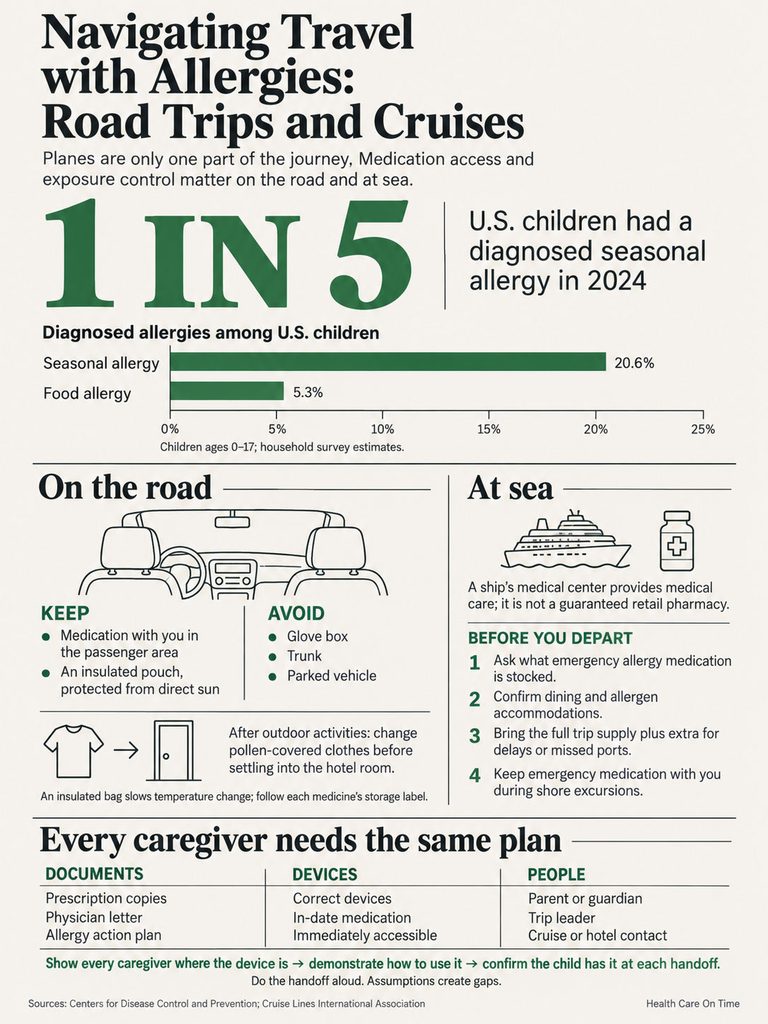
On a flight, the danger is not having your medication. On a road trip, the danger is where the medication rides. A closed vehicle in summer sun exceeds the epinephrine storage range within minutes, and the glove box performed worst in the degradation data cited earlier.
Keep the kit in an insulated bag in the cabin with the air conditioning running, and take it inside at every stop. Drive with the windows up and the air conditioner on recirculate through high-pollen stretches, and request a smoke-free rental vehicle.
Change clothes after a day outdoors before settling into the hotel room, which keeps pollen out of bedding.
Cruises: the Ship’s Infirmary Is Not a Pharmacy
Shipboard medical centers handle emergencies. They are not stocked to refill a specific prescription, and pharmacies at ports of call operate under whatever country’s rules apply there.
Ask the cruise line in advance what the medical center carries and how allergen requests are handled in dining rooms and buffets. Buffet service is the highest cross-contact setting on a ship, and dedicated plated service is usually available on request.
Bring the full supply plus the doubled buffer. A missed port day is a real possibility and there is no pharmacy at sea.
Traveling With an Allergic Child
Roughly one in five American children carries a diagnosed seasonal allergy, and about one in twenty a diagnosed food allergy. Pediatric travel adds a documentation layer, because the person carrying the medication is often not the person prescribed it.
Carry the prescription in the child’s name, a physician letter naming the accompanying adult, and a written allergy action plan. Teach every traveling adult where the device is and how to use it, and repeat that briefing on arrival.
For teenagers who self-carry, confirm the device is actually on them and not in a hotel room drawer.
Rule 9: Plan the Failure, Not Just the Trip
Getting a Refill Overseas
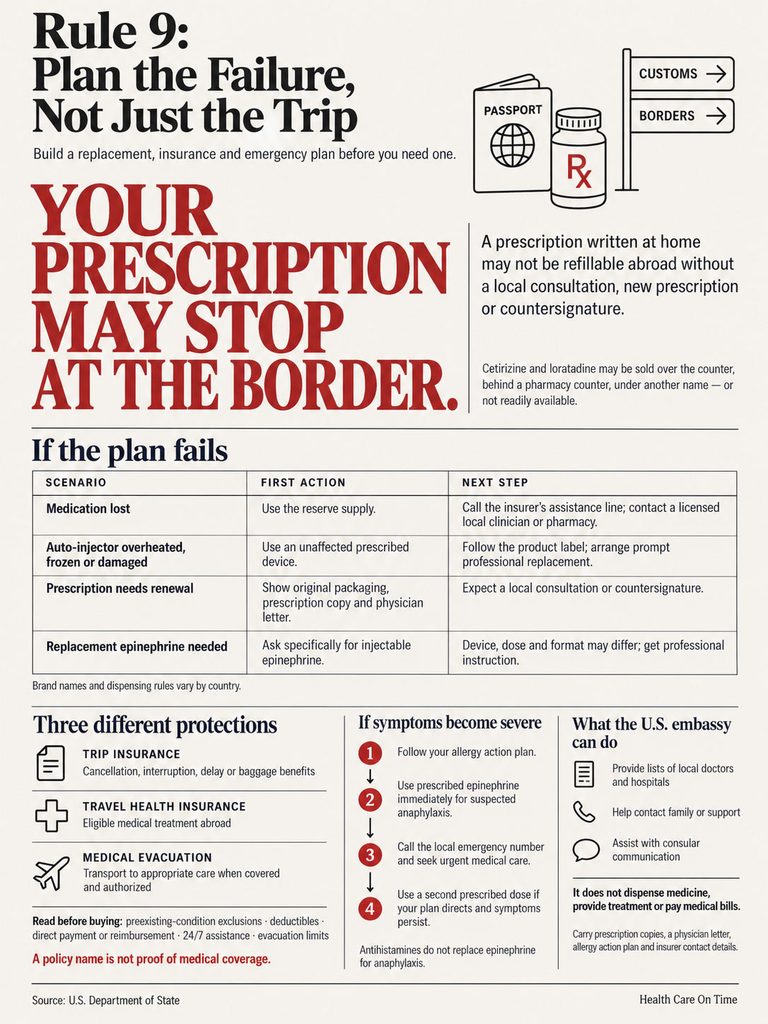
Over-the-counter antihistamines are widely stocked internationally, though brand names change. Cetirizine and loratadine are the two most reliably available generics worldwide.
Prescription refills are harder. Some destinations fill a US prescription with a local physician’s countersignature; others require a new local consultation. Travel insurance may cover the cost, and a US embassy can help locate appropriate medical services.
Injectable epinephrine is available by prescription or over the counter in many countries, but availability is not universal and the device format may be unfamiliar.
Travel Insurance and Emergency Care
Travel insurance and travel medical insurance are different products. The second covers treatment abroad; the first mostly covers trip cancellation and interruption.
Check whether your policy excludes preexisting conditions and whether it includes medical evacuation. Evacuation from a remote destination or a ship at sea can run into six figures without coverage.
| Scenario | What to do first | Timing |
| Checked bag lost with medication inside | Use the split supply from your carry-on; file the claim second | Immediately |
| Auto-injector left in a hot car all afternoon | Treat it as compromised and obtain a replacement before further travel | Same day |
| Medication seized at customs | Request written documentation; contact the US embassy for local sourcing | Within 24 hours |
| Symptoms flare at the destination | Resume the antihistamine, add saline rinse, check local pollen counts | Same day |
| Reaction begins mid-flight | Use your own epinephrine, then alert the crew immediately | Within seconds |
| Prescription runs out abroad | Call the travel insurer, then a local pharmacy with your physician letter | Within 24 to 48 hours |
| Device expiration falls during the trip | Refill before departure; devices are dated to month, not day | 2 weeks before travel |
Your Pre-Trip Timeline
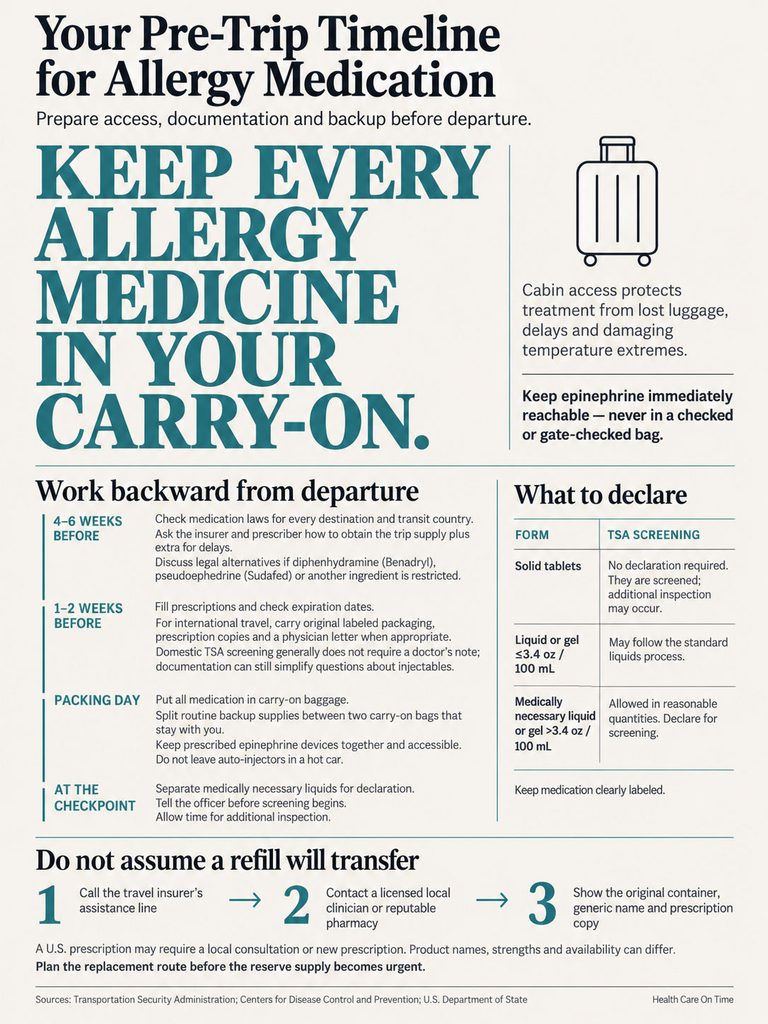
- Four weeks out. Book a visit with your clinician or a travel health specialist. Request an extended supply, a physician letter using generic drug names, and a written allergy action plan. Check destination import rules for every active ingredient in the bag.
- Two weeks out. Start the intranasal corticosteroid. Submit any required import certificate application. Confirm travel insurance covers preexisting conditions and evacuation.
- One week out. Check every expiration date and reorder anything expiring during the trip. Buy an insulated medication pouch if the destination runs hot.
- 72 hours out. Split the supply between two bags. Print the physician letter and prescription copies, translated where needed. Photograph every label and save the images offline.
- Day of travel. Declare liquids and injectables at the TSA checkpoint. Keep devices on your person. Take the antihistamine on home-clock time.
- On arrival. Check the local pollen forecast, locate the nearest hospital and pharmacy, and show travel companions where the emergency medication is and how to use it.
Frequently Asked Questions
Can I bring allergy medicine on a plane?
Yes. Tablets, capsules, nasal sprays, eye drops, and epinephrine devices are all permitted in carry-on baggage. Liquid and gel medications are exempt from the 3.4-ounce limit in reasonable quantities for your trip. Declare them to the officer before screening and keep them accessible rather than packed deep in a bag.
Do I have to declare allergy medication to TSA?
Declare liquid, gel, and aerosol medications above 3.4 ounces, plus syringes and auto-injectors. Solid tablets need no declaration. Declaring takes seconds and prevents a full bag search. Officers may swab containers for explosive residue, which is standard procedure rather than a sign of a problem.
Can I put allergy medication in checked luggage?
Technically yes for most oral medications, practically no for any of them. Checked bags get delayed, misrouted, and lost, and hold conditions fluctuate. Epinephrine should never be checked, because you cannot reach it during a reaction. Keep every item in the cabin with you.
How much allergy medication for vacation should I pack?
Plan for roughly double the trip requirement, so a 10-day trip means about 20 days of supply. Delays, cancellations, and lost bags drive that math, and CDC travel guidance recommends extra beyond the itinerary length. Split the supply across two bags so one loss never removes all of it.
Do I need a doctor’s note for allergy medication?
TSA does not require one for domestic flights. International travel is different, and a physician letter listing your diagnosis, generic drug names, doses, and quantities is worth carrying. Several countries require it for controlled or injectable medications, and a translated copy helps considerably at non-English-speaking borders.
Is Benadryl legal in every country?
No. Diphenhydramine is banned in over-the-counter products in Zambia and restricted in Japan, which caps the permitted amount per tablet below a standard US 25 mg dose. Some formulations are restricted in Singapore. Switching to cetirizine or loratadine for international trips avoids the problem entirely.
Is Sudafed banned anywhere?
Yes. Pseudoephedrine is prohibited for import into Japan under stimulant control rules, even with a prescription, and is restricted in Mexico. The UK and Australia limit over-the-counter quantities. Because it is a methamphetamine precursor, restrictions are broader and stricter than most American travelers expect.
Can I leave my EpiPen in a hot car?
No. One analysis of devices left in a parked car for half a day found epinephrine concentration fell 3.3% in the trunk, 13.3% in the cabin, and 14.3% in the glove compartment. Separate testing found heated devices became hard to remove from carrier tubes and some fired late. Carry it with you instead.
Does freezing ruin an EpiPen?
Current evidence suggests cold is less damaging than heat. A systematic review of nine studies found no meaningful degradation from extreme cold, and all 40 auto-injectors tested fired correctly. Deliberate freezing is still not advised, and a device that actually froze solid should be reviewed with your pharmacist before you rely on it.
How do I take a once-daily allergy pill across time zones?
Keep the home-clock schedule for the first day after arrival, then shift the dose by 2 to 3 hours per day until it reaches the local time you want. Do not skip a dose to reset, because that leaves an unprotected gap. Eastbound travel needs the slower adjustment.
Do airplanes carry EpiPens?
US carriers stock epinephrine in emergency medical kits, but in vial form rather than as auto-injectors, which usually requires a medically qualified volunteer to administer. The FAA’s proposed rule published August 5, 2026 does not mandate auto-injector devices. Carry two of your own.
How do I get an allergy prescription refilled overseas?
Contact your travel insurer first, then a local pharmacy with your physician letter and prescription copy. Some countries fill US prescriptions with a local countersignature; others require a new consultation. A US embassy can help locate appropriate medical services when local options are limited.
| Medical Disclaimer: This article is for general information and does not replace advice from a licensed clinician. Medication decisions, dosing changes, and travel plans involving severe allergy or anaphylaxis risk should be made with your own physician or allergist. Import rules change without notice, so verify current requirements with the destination country’s embassy before you travel. If you are experiencing symptoms of a severe allergic reaction, use your prescribed epinephrine and call 911 or local emergency services immediately. |
References
- CDC, National Center for Health Statistics, Data Brief 545: Diagnosed Allergic Conditions in Adults, United States, 2024
- CDC, National Center for Health Statistics, Data Brief 546: Diagnosed Allergic Conditions in Children, United States, 2024
- CDC Travelers’ Health: Allergies and Travel
- CDC Yellow Book: Severely Allergic Travelers
- TSA: Traveling With Medication
- US Department of State: Your Health Abroad
- FDA: Proposal to End Use of Oral Phenylephrine as an OTC Nasal Decongestant
- Federal Register: Improving Emergency Medical Kit Efficacy and Flexibility in Commercial Airline Operations, August 5, 2026
- Congress.gov: FAA Reauthorization Act of 2024, H.R. 3935
- Anderegg et al., Anthropogenic climate change is worsening North American pollen seasons, PNAS 2021
- Weiler et al., Effects of Fexofenadine, Diphenhydramine, and Alcohol on Driving Performance, Annals of Internal Medicine 2000
- Systematic review of epinephrine degradation with excessive heat or cold, Annals of Allergy, Asthma & Immunology
- Kodoth et al., Frequency and characteristics of epinephrine use during in-flight allergic events, Annals of Allergy, Asthma & Immunology 2022
- In-Flight Medical Events on Commercial Airline Flights, JAMA Network Open 2025
- Allergy & Asthma Network: Why You Shouldn’t Keep Epinephrine in a Hot Car
- AAAAI: Epinephrine Storage and Use