
Anorexia’s DNA has more in common with metabolism and cholesterol than most people expect. Its genetic signal lines up with blood sugar and lipid traits, not just mood.
Table of Contents
That finding changed how researchers think about eating disorders. It also changes the question families ask, from “Did we cause this?” to “What did we inherit, and what can we do about it?”
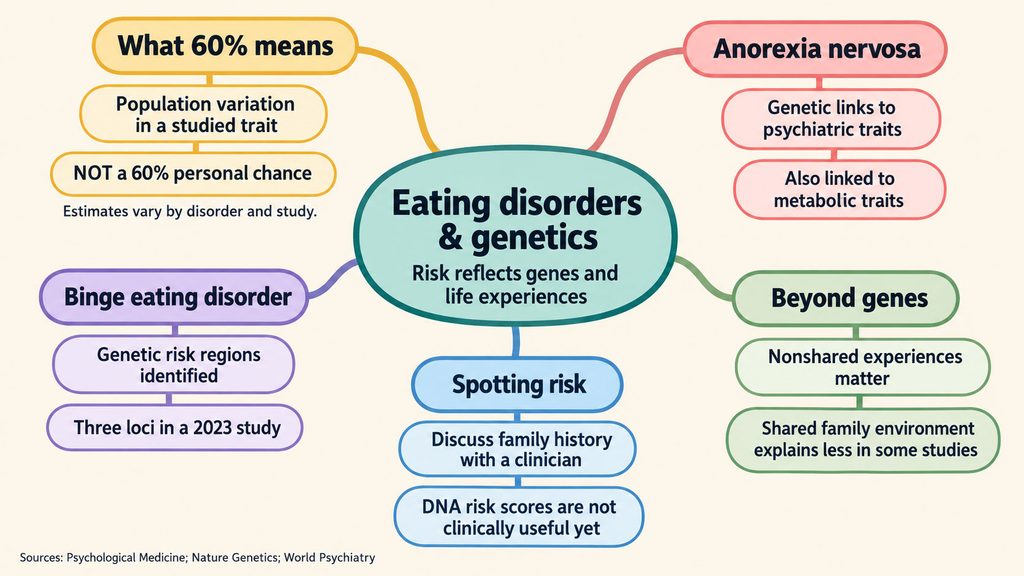
Quick Answer: Yes, partly. Twin studies suggest roughly 40% to 79% of the differences in eating disorder risk across people trace to genes, depending on the disorder. That does not mean your personal chance is 50% or 79%. Thousands of genes each add a small push, while dieting, stress, and environment shape whether illness appears. No DNA test can predict an eating disorder today, and recovery is possible with any family history.
Five facts to know first:
- Anorexia, bulimia, binge eating disorder, and ARFID are all partly heritable.
- Heritability describes differences across a population, not one person’s odds.
- Close relatives of someone with anorexia face up to about 12 times the usual risk.
- No validated genetic test for eating disorders exists in the US.
- Genes affect vulnerability, not whether treatment works.
At a Glance
• Eating disorders run in families, and genes explain a large share of that pattern.
• “60% heritable” does not mean “60% likely to get sick.”
• Anorexia’s genes overlap with metabolism, not just psychiatry.
• Binge eating disorder now has confirmed genetic risk regions, despite claims otherwise online.
• Personal experiences, not shared family life, drive most non-genetic risk.
• Family history is more useful than any DNA kit for spotting risk early.
What “Genetic” Actually Means for Eating Disorders
When a study says an illness is “60% heritable,” most people hear “60% of my risk is locked in.” That is not what the number means, and the mix-up causes a lot of needless fear.
Patients who book lab work with HealthCareOnTime often ask this exact question after a relative’s diagnosis. The honest answer starts with one definition.
Heritability Explained in Plain English
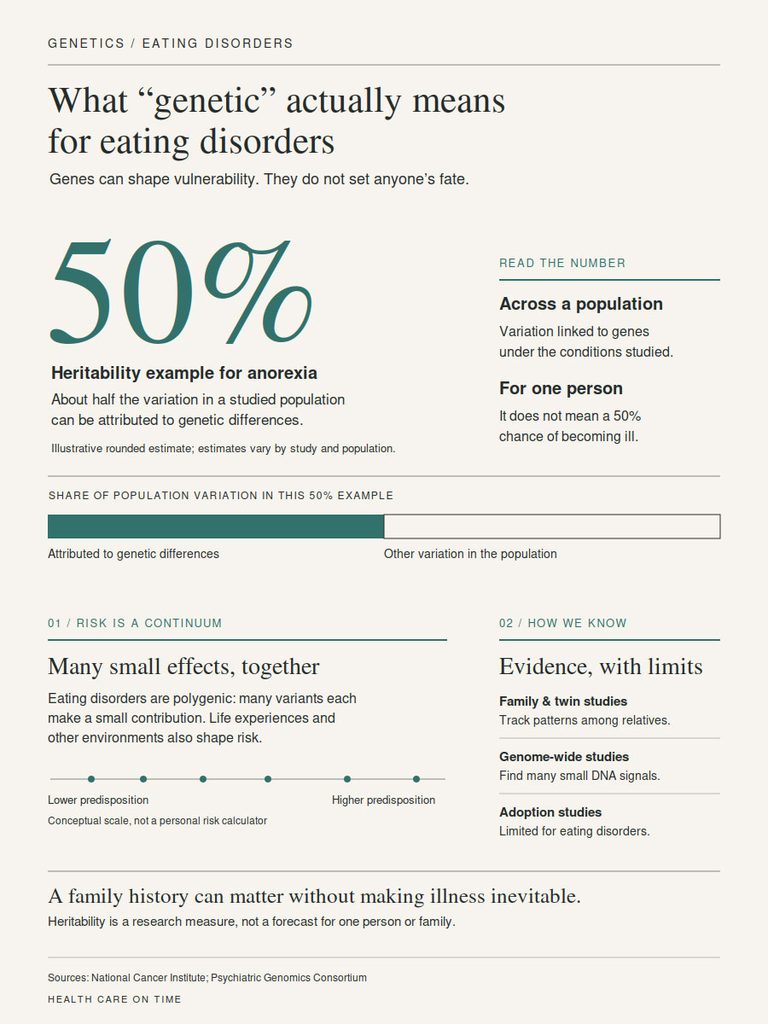
Heritability measures how much of the variation between people in a group comes from genetic differences. It describes a population, not a forecast for any one person.
Picture a classroom where test scores spread from low to high. Heritability asks how much of that spread comes from genes, and how much from sleep, teaching, stress, and luck.
Why “50% Genetic” Does Not Mean “50% Chance”
Here’s a worked example. Anorexia affects well under 5% of women, yet its heritability runs around 50%.
If heritability were personal odds, half of all women would develop anorexia. They don’t. The number only says that among people who do differ in risk, genes explain about half the difference.
Polygenic: Thousands of Small Nudges, Not One Gene
There is no single “anorexia gene” or “binge eating gene.” Eating disorders are polygenic, meaning many genetic variants each add a tiny amount of risk.
Think of risk as a dimmer switch rather than an on/off button. Genes set how easily the light can turn up. Life events, and behaviors like restrictive dieting, often do the turning.
How Scientists Measure Genetic Risk
Researchers use three main tools, and each answers a different question.
- Family studies check whether an illness clusters in relatives. They show risk runs in families but can’t separate genes from shared home life.
- Twin studies compare identical twins, who share nearly all their genes, with fraternal twins, who share about half. A bigger gap in matching rates points to stronger genetic influence.
- Genome-wide association studies (GWAS) scan the DNA of thousands of patients and controls, looking for specific spots on the genome tied to illness.
Adoption studies, which help separate genes from upbringing, are still largely missing for eating disorders. That’s one reason experts describe the evidence as strong but incomplete.
How Genetic Is Each Eating Disorder?
Each eating disorder has its own genetic profile. Some are far better studied than others.
Our medical team has reviewed the primary studies behind each figure below, since many consumer websites repeat numbers without context or dates.
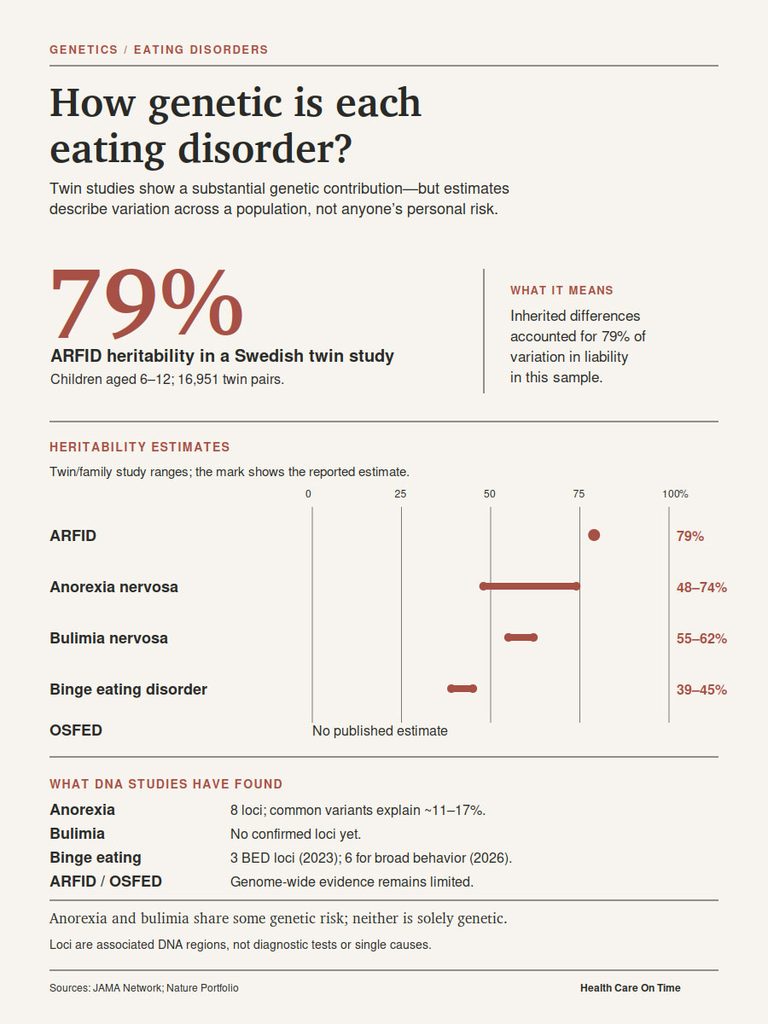
| Disorder | Twin-study heritability | DNA-based (SNP) heritability | Genetic regions identified | Risk in close relatives |
| Anorexia nervosa | 48% to 74% (Swedish clinical registry: 43%) | 11% to 17% | 8 loci (2019); 8 in the 2026 meta-analysis, 6 validated | Up to about 11 to 12 times higher |
| Bulimia nervosa | 55% to 62% (Swedish clinical registry: 41%) | No published estimate yet | 0 bulimia-specific loci confirmed | About 9 times higher |
| Binge eating disorder | 39% to 45% (twin studies) | No stable published estimate yet | 3 loci (2023 BED study); 6 loci for binge-eating behavior (2026) | No large-sample estimate published |
| ARFID | 79% (Swedish twins aged 6 to 12) | No DNA study yet | 0 | No published estimate |
| OSFED | No published estimate | No published estimate | 0 | No published estimate |
Sources: Yilmaz, Hardaway & Bulik 2015; Watson et al., Nature Genetics 2019; Psychological Medicine 2019 Swedish registry; Nature Genetics 2023; Nature Mental Health 2026; Dinkler et al., JAMA Psychiatry 2023; ACUTE at Denver Health.
Anorexia Nervosa
Anorexia is the most studied eating disorder in genetics. That is partly because it carries one of the highest death rates of any psychiatric illness.
The 2019 Study of 16,992 Patients
The landmark study compared 16,992 people with anorexia against 55,525 controls and found eight genetic regions tied to the illness. The paper is free on PubMed Central.
The same study estimated that common DNA variants explain only 11% to 17% of anorexia risk, well below twin-study figures. A later section explains why that gap matters.
Why Researchers Now Call It “Metabo-Psychiatric”
Anorexia’s genetics tracked with psychiatric disorders, physical activity, blood sugar, lipids, and body measurements, even after separating out the genes that drive body weight.
Put simply, some people may carry genes that make their bodies react unusually to low energy intake. That could help explain why weight restoration is so hard, and why relapse is common.
A 2026 Molecular Psychiatry study pushed this further. Its multi-trait analysis found 86 genetic regions, including 25 new ones such as BDNF and LPL, genes tied to both brain signaling and fat metabolism.
Bulimia Nervosa
Bulimia runs in families, but DNA studies are still catching up. The best current estimates come from a very large Swedish registry.
In 782,938 Swedish sisters and half-sisters, researchers put the heritability of clinically diagnosed anorexia at 43% and bulimia at 41%, with the rest explained by individual environmental factors.
The same study found strong genetic overlap between the two illnesses. That helps explain why some people move from one diagnosis to the other over time.
Binge Eating Disorder
Binge eating disorder is the most common eating disorder among US adults. Several popular websites still claim its genetics have barely been studied. That is out of date.
A 2023 study applied machine learning to Million Veteran Program health records and found three risk regions near the HFE, MCHR2, and LRP11 genes, pointing toward a role for iron metabolism. It was published in Nature Genetics.
In August 2026, a far larger analysis followed. It covered 39,279 people with binge-eating behavior and more than 1.2 million controls, finding six risk regions, some tied to higher body weight and impulse control. The full paper is in Nature Mental Health.
ARFID and OSFED
ARFID (avoidant/restrictive food intake disorder) is not about body image. It involves avoiding foods because of texture, fear of choking, or low appetite.
A Swedish twin study of 33,902 children estimated ARFID heritability at 79%, above the figures reported for anorexia, bulimia, and binge eating disorder. See the UNC Health summary.
OSFED (other specified feeding or eating disorder) has almost no dedicated genetic research. Any website quoting a firm heritability number for it is guessing.
Why Twin Studies and DNA Studies Disagree
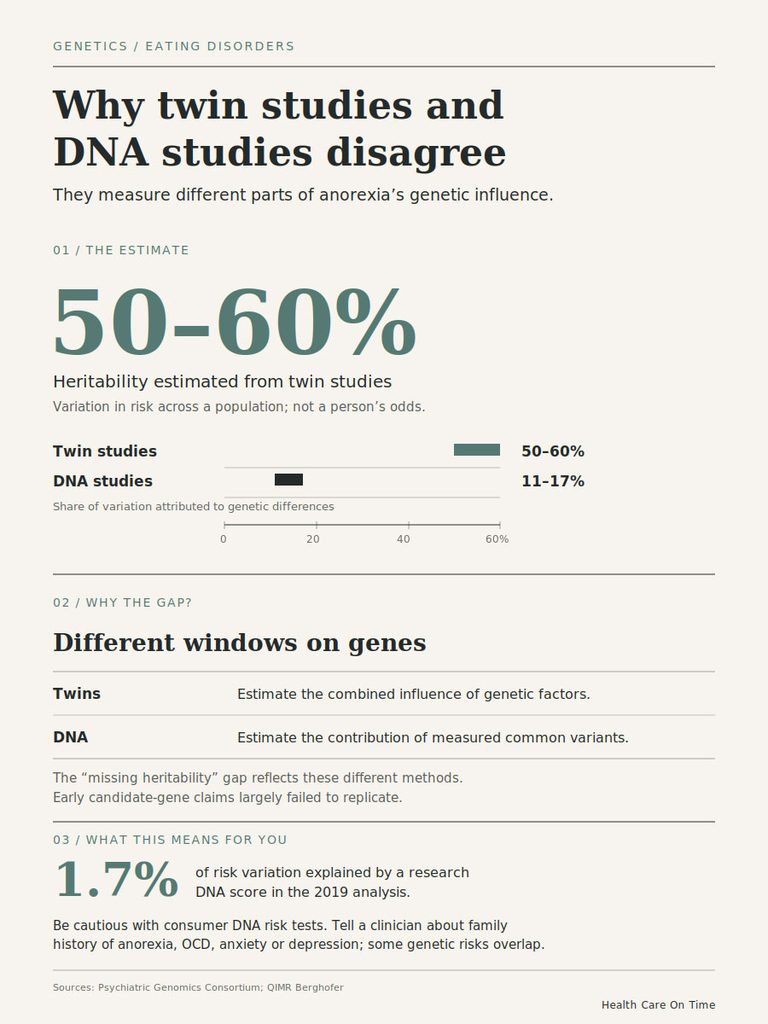
Twin studies say anorexia is roughly 50% to 60% heritable. DNA studies explain only 11% to 17%.
Both can be true at once. The gap tells you a lot about what genetic testing can and cannot do.
The “Missing Heritability” Gap
Twin studies capture all genetic influence: common variants, rare variants, and genes interacting with environment. Some researchers think this can push estimates upward.
DNA chip studies only capture common variants. Rare mutations and complex interactions slip through, so the number starts smaller and tends to grow as studies get bigger.
What That Means for a DNA Test
In the 2019 anorexia study, a polygenic risk score captured only about 1.7% of the variation in risk. That is far too weak to say who will get sick.
If a consumer DNA service claims to rate your “eating disorder risk,” be skeptical. Our medical reviewers are not aware of any validated genetic test for eating disorders available in the US.
Early “Anorexia Genes” That Didn’t Hold Up
In the early 2000s, headlines announced that specific serotonin and opioid receptor genes explained anorexia. Small studies seemed to back this up.
Across psychiatry, most candidate-gene findings from that era failed to replicate once studies grew to tens of thousands of people. Some pages ranking today still present them as settled science.
Shared Genes With Other Conditions
Eating disorders rarely travel alone, and genetics helps explain why. Anorexia shares genetic ground with OCD, anxiety, and depression.
Binge eating disorder overlaps genetically with depression, bipolar disorder, and ADHD, according to the 2023 Million Veteran Program analysis. The 2026 study also found positive genetic links between both anorexia and binge eating and other psychiatric conditions.
In practical terms, a family history of anxiety, OCD, depression, or ADHD is worth mentioning to your doctor, even if no one in the family had a diagnosed eating disorder.
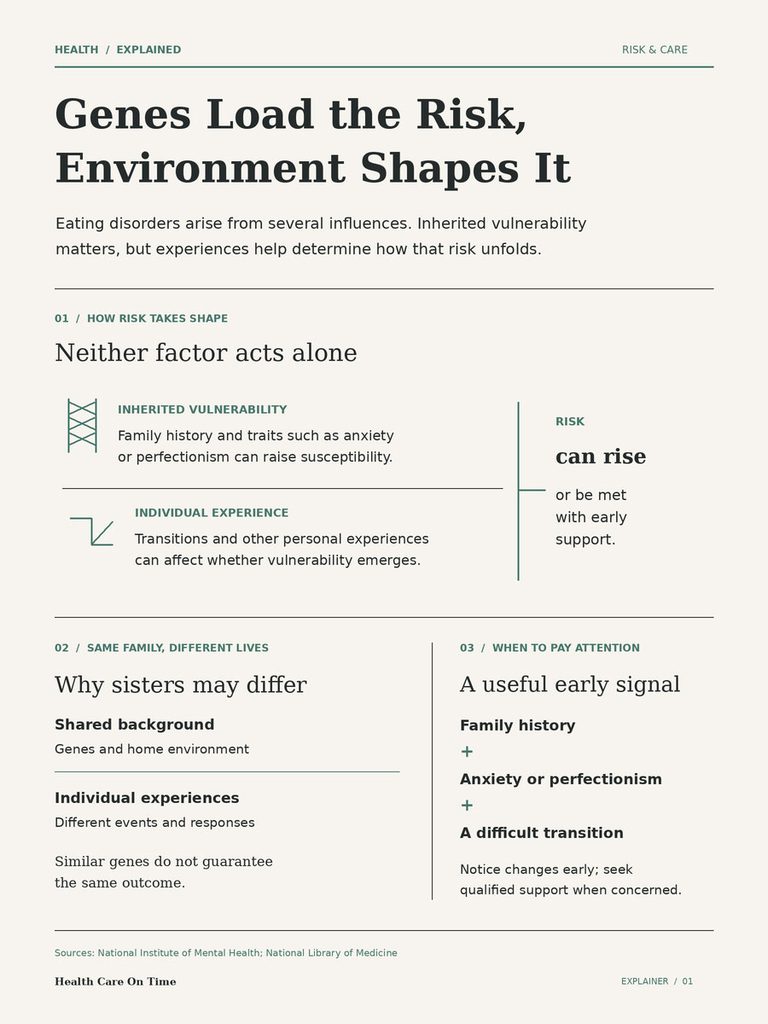
Genes Load the Risk, Environment Shapes It
Genes make some people more vulnerable. Environment helps decide whether that vulnerability becomes illness, and when.
Across patients we serve, families are often relieved to hear this. Risk can be managed, even if it can’t be erased.
Environmental Triggers Backed by Research
These factors appear again and again in eating disorder research:
- Dieting, especially during adolescence
- Puberty and its hormonal shifts
- Weight-focused comments, teasing, or weight stigma
- Sports and activities that reward low body weight
- Trauma and major stress
- Big transitions, such as starting high school, college, or a new job
No single trigger causes an eating disorder. Most people exposed to these never develop one, which is where genetic vulnerability comes in.
Why Two Sisters Can Differ
Two sisters can share half their genes and the same dinner table, yet only one develops anorexia. That surprises many families.
The Swedish sister data helps explain it. Most non-genetic risk came from individual experiences, not the shared family environment. A different sport, friend group, or life event can tip one sibling and not the other.
Personality Traits With a Genetic Link
Anxiety, perfectionism, and obsessive thinking are partly heritable, and they share genetic ground with anorexia. Our guide to anxiety covers how those traits show up day to day.
A child who is highly anxious and perfectionistic, and has a family history of eating disorders, may benefit from extra attention during high-risk transitions.
Eating Disorders in the US: The Numbers
Understanding scale helps families see they are not alone. It also shows why genetic research is getting serious attention.
| Measure | US figure | Source |
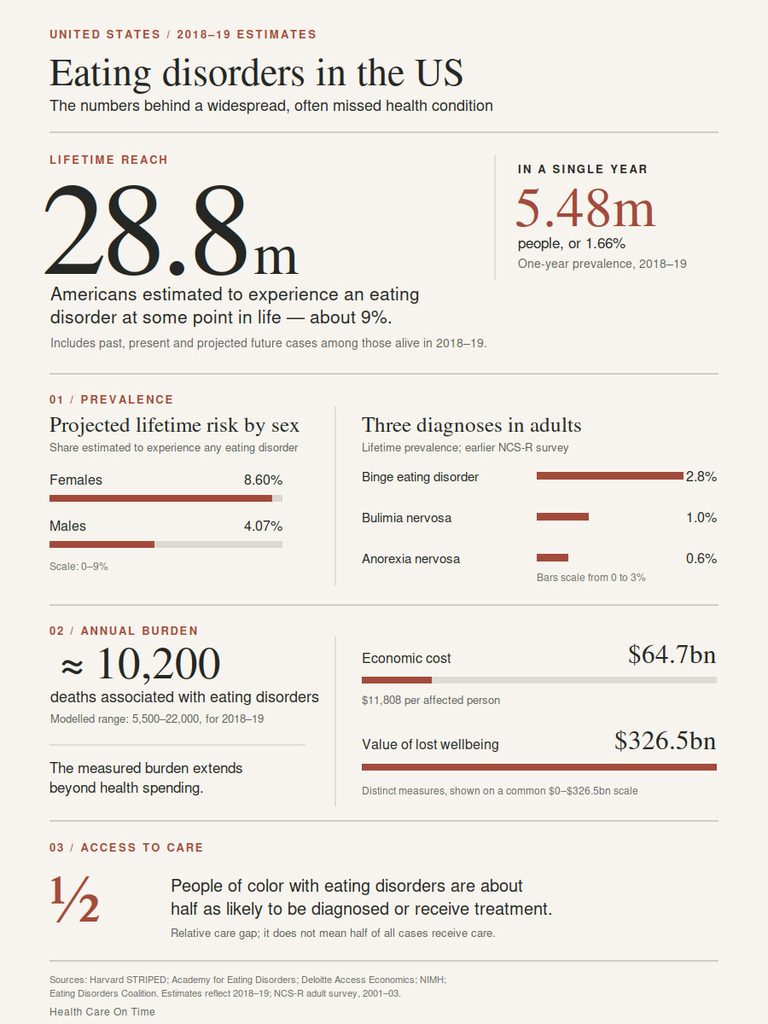
| Americans who will have an eating disorder in their lifetime | 28.8 million (about 9%) | STRIPED and Deloitte Access Economics, 2020 |
| Lifetime prevalence by sex | 8.60% of females, 4.07% of males | STRIPED and Deloitte, 2020 |
| People with an eating disorder in a single year | 5.48 million (1.66%) | STRIPED and Deloitte, 2020 |
| Deaths linked to eating disorders per year | About 10,200 (range 5,500 to 22,000) | STRIPED and Deloitte, 2020 |
| Annual economic cost | $64.7 billion ($11,808 per affected person) | Streatfeild et al., IJED 2021 |
| Lost wellbeing per year | $326.5 billion | Streatfeild et al., IJED 2021 |
| Lifetime prevalence among US adults: BED / BN / AN | 2.8% / 1.0% / 0.6% | NIMH |
The Deloitte report estimated that more than 28.8 million Americans alive today will have an eating disorder at some point, with about 5.48 million affected in any single year.
The death estimate of about 10,200 a year rests on a meta-analysis showing death rates 5.86 times higher than the general population for anorexia, and about 1.9 times higher for bulimia. See Deloitte’s summary.
Here’s a figure that surprises people. OSFED and binge eating disorder together made up about 65% of the $64.7 billion yearly cost, more than anorexia and bulimia combined.
There’s also a care gap. The same research group reports that people of color with eating disorders are about half as likely to be diagnosed or treated.
Family History: What It Means for You or Your Child
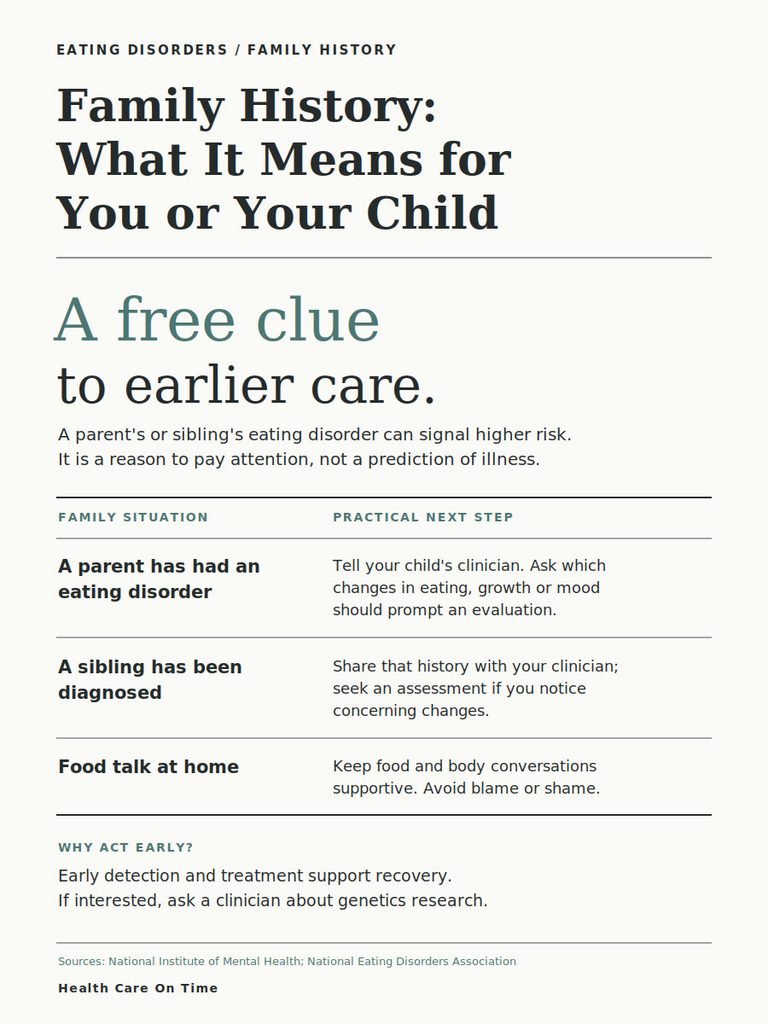
Family history is the most practical genetic information you have. It costs nothing and tells you more than any DNA kit.
In cases seen across our diagnostic network, parents often mention a relative’s eating disorder only when asked directly. That detail belongs in every pediatric and primary care chart.
If a Parent Had an Eating Disorder
A parent’s history raises a child’s risk, but it doesn’t decide it. Most children of parents with eating disorders never develop one.
What helps most is awareness. Watch for early changes in eating, mood, or exercise during puberty and big transitions, and keep diet talk out of family meals.
If a Sibling Is Diagnosed Now
Relatives of people with anorexia or bulimia face higher risk of either illness, with larger studies suggesting up to a 12-fold rise for anorexia and about nine times the risk for bulimia.
Siblings often get overlooked while the family focuses on the child in treatment. Check in with them, too, and ask whether family therapy can include them.
Shared Genes vs Shared Kitchens
Families share more than DNA. They share habits, comments about bodies, and attitudes toward food.
Home environment is the part you can change. Praising what a child’s body does, eating regular meals together, and dropping “good food/bad food” labels all lower pressure.
What to Tell Your Doctor
Share who in the family had an eating disorder, which type, and at what age it started. Mention related conditions such as anxiety, depression, OCD, ADHD, or substance use.
This context helps your doctor spot early warning signs sooner. It can also shape how they talk about weight during checkups.
Before the appointment, write down a short family list. Include each relative’s relationship to you, the condition, roughly when it started, and whether treatment helped. Two minutes of notes can save a lot of guesswork in the exam room.
| Scenario | What it means | Recommended action |
| A parent had anorexia and a teen starts dieting | Genetic vulnerability plus a known trigger | Talk with the pediatrician within 1 to 2 weeks; keep weight talk out of the home; watch for skipped meals or rigid rules |
| A sibling is in eating disorder treatment | Close relatives carry up to about 12 times the usual anorexia risk | Ask the care team about sibling support; monitor eating and mood changes |
| Considering a DNA test for eating disorder risk | Best polygenic score explains about 1.7% of risk | Skip it for this purpose; bring a written family history to your doctor instead |
| Teen athlete in a weight-class sport, plus family history | Environmental pressure on top of genetic risk | Ask coaches to avoid weigh-in pressure; request eating-habit screening at the sports physical |
| Adult with binge eating and relatives with depression | Binge eating shares genetics with mood disorders | Ask a primary care doctor to screen for both; CBT-based therapy is a first-line option |
| Wanting to help research | US study seeks 6,000 new participants toward 20,000 | Look into the Broad Institute and Harvard eating disorder genetics study |
| Noticing warning signs in yourself or a child | Earlier care is linked to better outcomes | Book a medical visit within days; request baseline labs; call ANAD at 1-888-375-7767 for referrals |
Warning Signs Worth Acting On Early
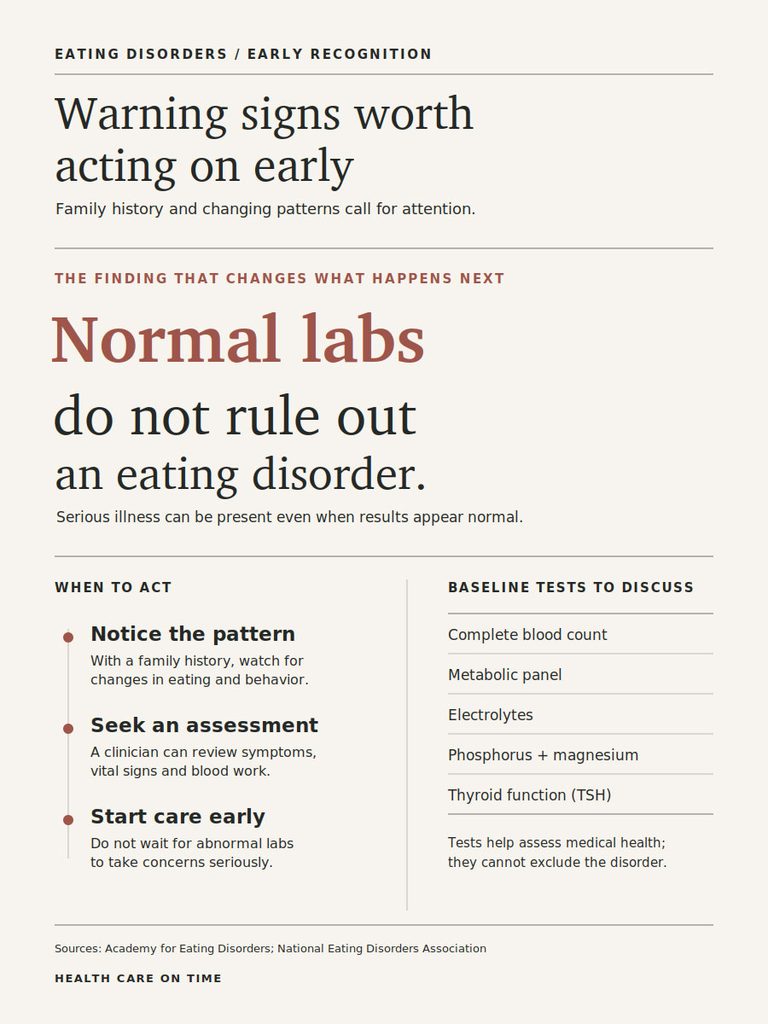
Genetic risk matters most when it leads to earlier care. Watch for patterns like these, especially in someone with a family history:
- Skipping meals, eating alone, or hiding food
- New rigid food rules, or quickly cutting out whole food groups
- Frequent bathroom trips right after meals
- Exercising through illness or injury
- Strong distress when food routines change
- Eating large amounts with a sense of lost control
- Fatigue, dizziness, feeling cold, or missed periods
- Pulling away from friends or activities that involve food
When an eating disorder is suspected, doctors often order baseline blood work. Common panels include a complete blood count, a metabolic panel, electrolytes, phosphorus, magnesium, and thyroid function (TSH).
Our lab partners report that these results can look normal even when someone is seriously ill. Normal labs never rule out an eating disorder, and they should never delay treatment.
Myths vs Facts About Eating Disorder Genetics
Genetic research has cleared up several harmful myths. Patients commonly ask us about each of these.
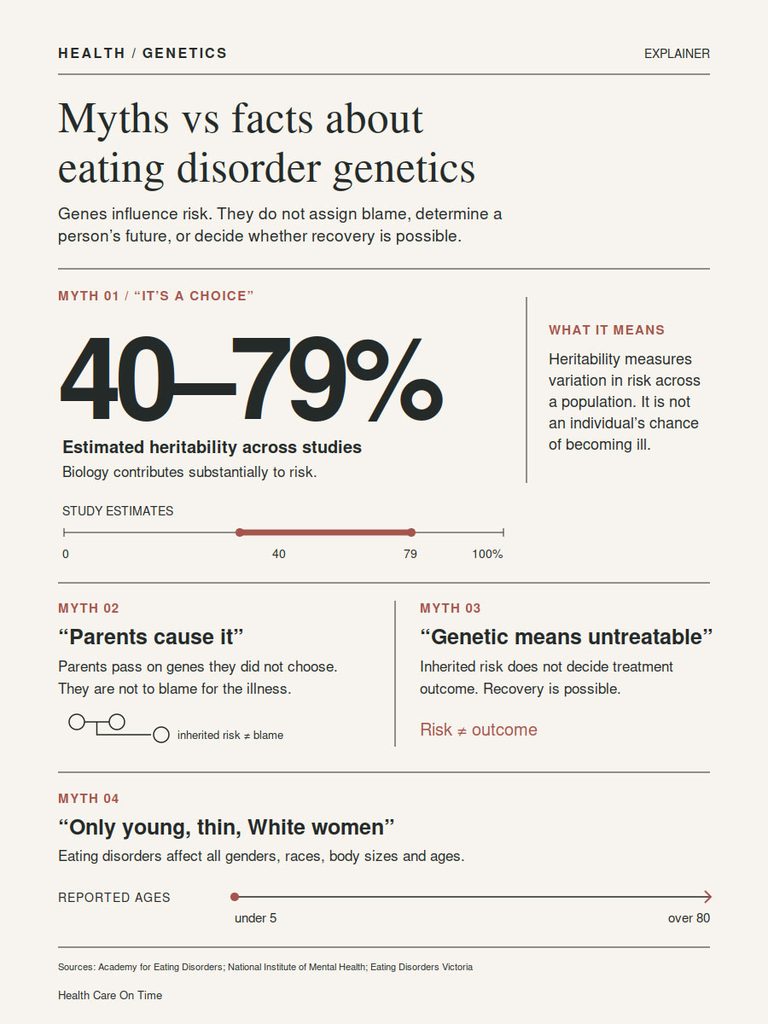
Myth: “Parents Cause Eating Disorders”
Older theories blamed controlling mothers. Genetic research has largely retired that idea.
Parents pass on genes they didn’t choose. Today, a leading treatment for teens actively brings parents onto the recovery team.
Myth: “It’s a Choice”
Nobody chooses a condition that is 40% to 79% heritable. The genetics point to biology, including appetite regulation and metabolism.
Myth: “Genetic Means Untreatable”
Carrying risk genes doesn’t predict whether treatment will work. People with strong family histories recover every day.
Myth: “Only Young, Thin, White Women Get Them”
Eating disorders affect every gender, age, race, and body size. The STRIPED report notes cases from age 5 to over 80. Many people with serious eating disorders are at an average or higher weight.
Does Genetics Change Treatment?
Genetic findings haven’t yet produced a gene-based treatment. They have already changed how clinicians talk with families, and they’re opening new research paths.
Why Biology Reduces Blame and Shame
When families learn eating disorders are partly heritable, guilt often eases. The illness becomes something that happened to someone, not something they did.
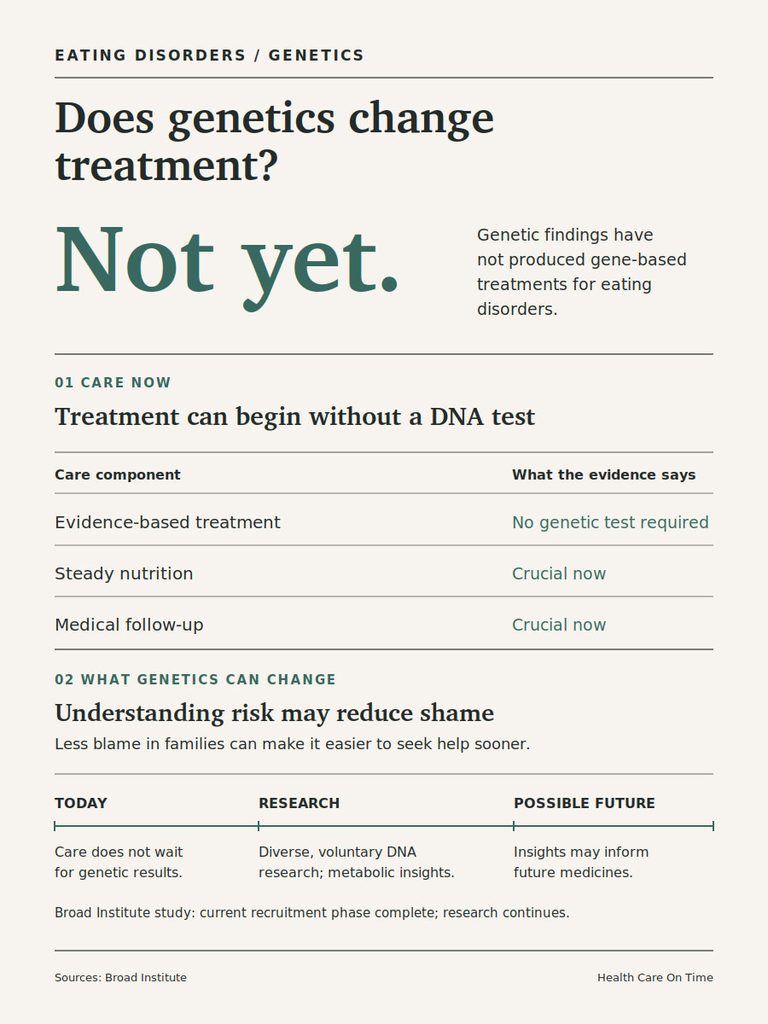
Less shame can make it easier to ask for help. That matters, since shame and secrecy are common reasons people delay care.
What Works Now
Evidence-based treatments don’t depend on genetic testing:
- Family-based treatment (FBT) for children and teens, with parents supporting meals at home
- Enhanced cognitive behavioral therapy (CBT-E) for adults
- Medical monitoring with regular vitals and lab work
- Nutrition support from a registered dietitian trained in eating disorders
- Care for co-occurring conditions such as anxiety, depression, or ADHD
The metabolic findings in anorexia may one day shape new medications. For now, they reinforce why steady nutrition and close medical follow-up matter.
Research You Can Join
US researchers want more participants, especially from diverse backgrounds. A Broad Institute study lets people anywhere in the US sign up for DNA analysis, aiming for 6,000 new volunteers toward a 20,000-person goal, half with eating disorders. See the Broad Institute announcement.
Joining is voluntary and doesn’t replace treatment. It does help future patients get better answers.
What the Research Can’t Tell You Yet
Genetic research on eating disorders is moving fast, but it has real limits. Our medical team flags three.
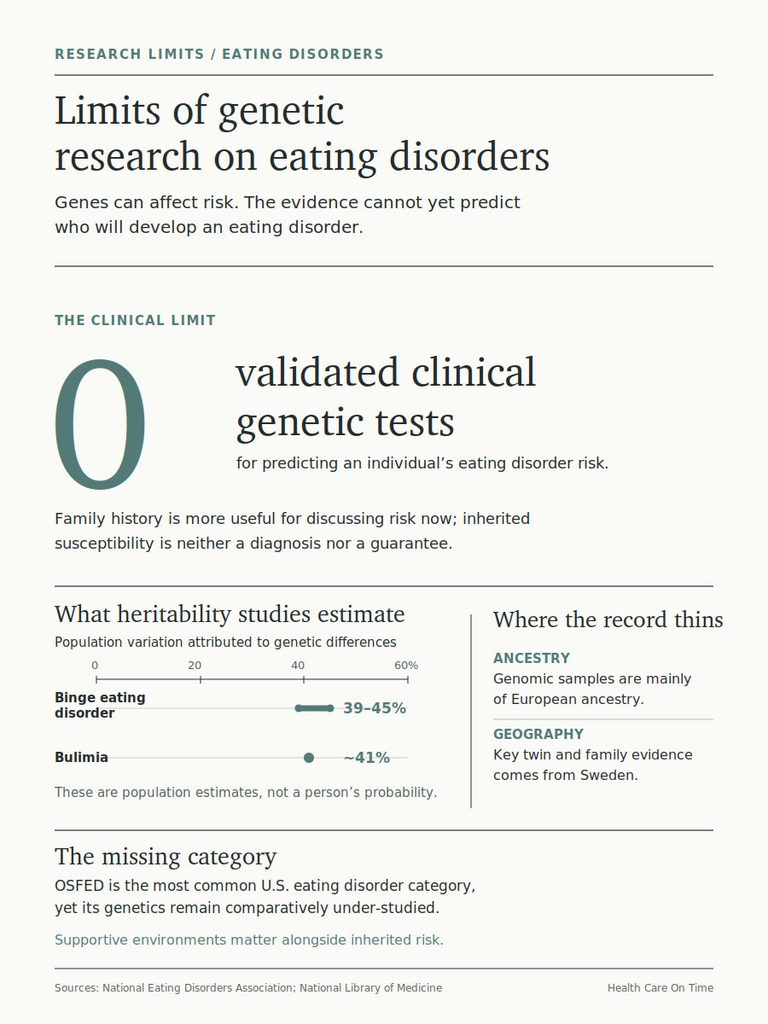
First, most DNA studies used people of European ancestry. The 2026 binge-eating study was entirely European ancestry, though anorexia risk scores did show signal in two East Asian studies.
Second, several key figures come from Sweden, including the sister registry and the ARFID twin study. Sweden’s national health records make these studies possible, and US data may differ.
Third, OSFED, the diagnosis behind the largest share of US costs, has almost no genetic research. Answers for the most common real-world presentations are still years away.
Frequently Asked Questions
Can You Inherit Anorexia From Your Parents?
You can inherit a higher risk, not anorexia itself. Twin studies suggest roughly half of the variation in anorexia risk is genetic, and close relatives face higher odds. Still, most children of parents with anorexia never develop it. Environment, stress, and dieting all shape whether illness appears.
Is Binge Eating Disorder Genetic?
Yes, partly. Twin studies estimate heritability around 39% to 45%. A 2023 study found three risk regions linked to iron metabolism, and a 2026 study of 39,279 cases found six regions tied to binge eating. Some overlap with body weight and impulse control.
Is Bulimia Genetic?
Bulimia runs in families. A large Swedish registry study estimated its heritability at 41%, and it shares much of its genetics with anorexia. DNA studies haven’t confirmed bulimia-specific risk regions yet, mainly because fewer bulimia samples have been collected.
Is There a Genetic Test for Eating Disorders?
No validated test exists. The best polygenic score for anorexia explains only about 1.7% of risk variation, too little to predict anything for one person. A detailed family history, shared with your doctor, is far more useful than any consumer DNA kit.
Do Eating Disorders Skip Generations?
They can appear to. Because risk comes from many genes plus environment, a grandparent and grandchild may both be affected while the parent is not. Eating disorders were also underdiagnosed decades ago, so earlier generations may have had undiagnosed cases.
If a Sister Has an Eating Disorder, Is a Sibling at Risk?
Yes, siblings carry higher risk than the general public, especially for anorexia and bulimia. Higher risk isn’t certainty, though. Watch for early changes in eating and mood, and ask the treatment team about sibling support and family sessions.
Are Eating Disorders Caused More by Genes or Environment?
Both matter. For anorexia and bulimia, twin studies attribute roughly 40% to 60% of variation to genes, with most of the rest coming from individual experiences. Genes create vulnerability, while dieting, stress, weight stigma, and life transitions often trigger onset.
Is ARFID Genetic?
ARFID appears highly heritable. A Swedish twin study of children aged 6 to 12 estimated 79% heritability, higher than other eating disorders and similar to ADHD and autism. No DNA studies of ARFID exist yet, so specific genes remain unknown.
Can Men Inherit Eating Disorder Risk?
Yes. Men carry and pass on genetic risk the same way women do. US estimates put lifetime eating disorder prevalence at about 4% for males. Men are often diagnosed later because symptoms like binge eating or compulsive exercise get overlooked.
Does Having the Genes Mean Someone Will Get an Eating Disorder?
No. Genes raise vulnerability but don’t guarantee illness. Many people with strong family histories never develop an eating disorder. Supportive environments, avoiding restrictive dieting, and early help when warning signs appear all lower the chance that risk becomes illness.
Is Anorexia Linked to Metabolism?
Genetic research suggests so. Anorexia’s genetics correlate with blood sugar, cholesterol, and body-measurement traits, independent of the genes that drive body weight. Researchers now call anorexia “metabo-psychiatric,” meaning both brain and body biology play a role.
Can Someone With a Genetic Risk Fully Recover?
Yes. Genetic risk doesn’t predict treatment response. Evidence-based care, such as family-based treatment for teens and CBT-E for adults, works for people with and without a family history. Getting help early gives the best chance at full recovery.
Disclaimer: This article is for educational purposes only and is not medical advice. If you or someone you know shows signs of an eating disorder, contact a healthcare provider promptly. For support and treatment referrals, call the ANAD Helpline at 1-888-375-7767 (a peer support line, not a crisis line). If you are in crisis or thinking about self-harm, call or text 988 to reach the 988 Suicide & Crisis Lifeline. For a medical emergency, call 911.
References
- Watson et al. Genome-wide association study identifies eight risk loci and implicates metabo-psychiatric origins for anorexia nervosa. Nature Genetics, 2019 (PMC)
- Genomic meta-analyses of binge-eating behavior and anorexia nervosa. Nature Mental Health, 2026
- Genome-wide analysis of a model-derived binge eating disorder phenotype. Nature Genetics, 2023
- Integrative GWAS identifies novel loci in anorexia nervosa. Molecular Psychiatry, 2026
- Genetic and environmental contributions to diagnostic fluctuation in anorexia nervosa and bulimia nervosa. Psychological Medicine, 2019
- Yilmaz, Hardaway, Bulik. Genetics and epigenetics of eating disorders. Dove Medical Press, 2015
- Bulik et al. Genetic epidemiology of eating disorders (PMC)
- UNC Health: ARFID is highly heritable, JAMA Psychiatry twin study
- ACUTE at Denver Health: Genetic factors in eating disorders
- Deloitte Access Economics: Social and economic cost of eating disorders in the US
- Streatfeild et al. Social and economic cost of eating disorders in the United States. IJED, 2021
- Harvard STRIPED economic cost infographic
- Broad Institute: New study aims to uncover the genetics of eating disorders
- NIMH: Eating disorders statistics
- ANAD treatment directory and helpline
- 988 Suicide & Crisis Lifeline