Candles start about 16 home fires in the United States every day. That number, based on the average of 5,830 home fires candles started annually in the latest National Fire Protection Association data, says more about candle safety than any argument over paraffin versus soy.
Table of Contents
Most online answers to “are candles bad for you” focus on wax and “toxins.” The more useful answer sorts the claims. Some risks are proven, some are exaggerated, and your room, wick, and scent choices matter more than the label on the jar.
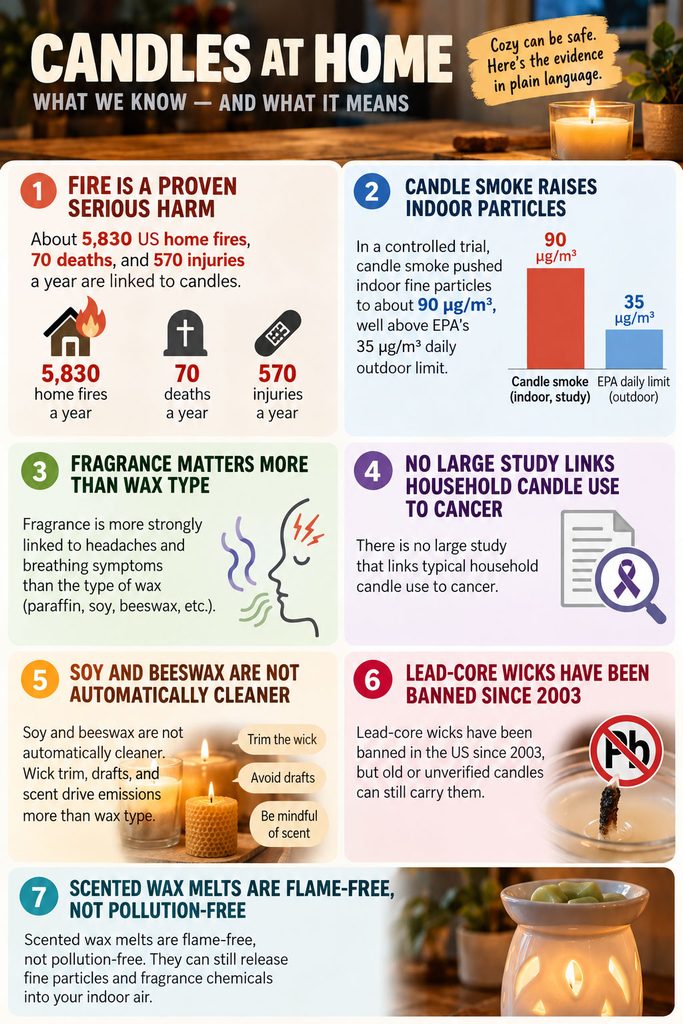
Quick Answer: For most healthy adults, burning a well-made candle for a few hours in a ventilated room is unlikely to cause lasting harm. The proven dangers are fire, about 5,830 US home fires a year, and short-term spikes in fine particles and fragrance chemicals that can trigger headaches or asthma. People with asthma, COPD, heart disease, babies, and pet birds face higher risk.
At a Glance: Here is what the evidence shows.
- Fire is the proven serious harm: about 5,830 US home fires, 70 deaths, and 570 injuries a year.
- In a controlled trial, candle smoke pushed indoor fine particles to about 90 µg/m³, well above EPA’s 35 µg/m³ daily outdoor limit.
- Fragrance matters more than wax type for headaches and breathing symptoms.
- No large study links household candle use to cancer.
- Soy and beeswax are not automatically cleaner. Wick trim, drafts, and scent drive emissions.
- Lead-core wicks have been banned since 2003, but old or unverified candles can still carry them.
- Scented wax melts are flame-free, not pollution-free.
Why Candle Safety Matters Most From October to January
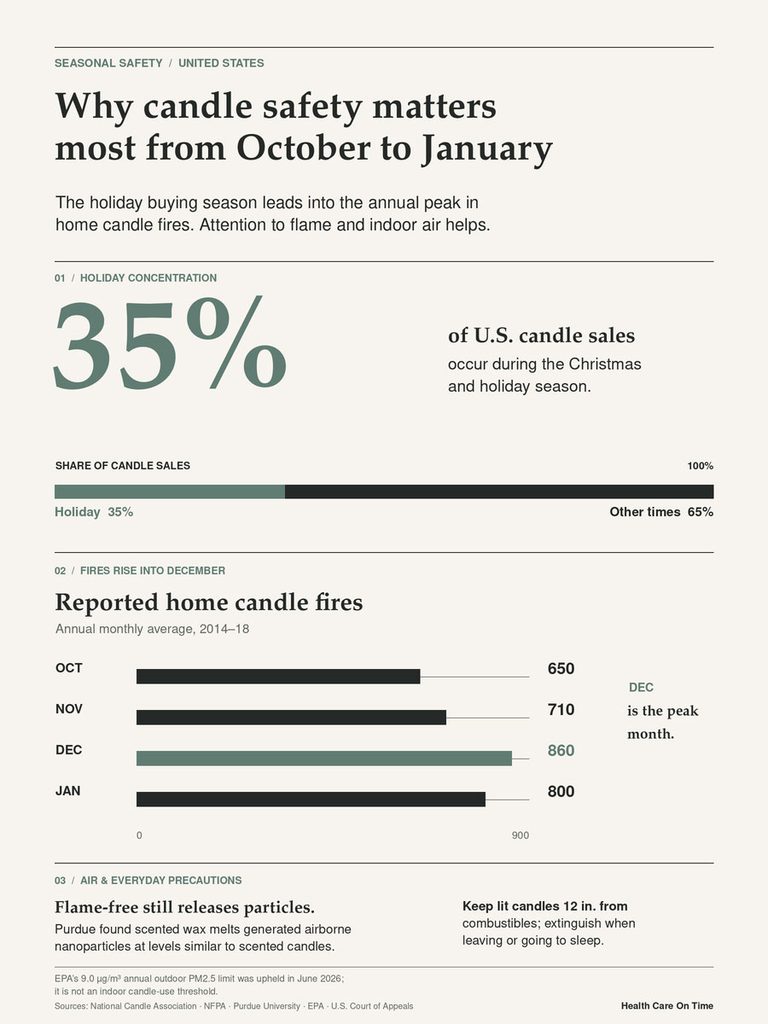
Candle use isn’t spread evenly across the year. About 35% of US candle sales happen during the Christmas and holiday season, and December is the peak month for home candle fires.
Winter changes the air inside your home, too. Windows stay shut, the furnace recirculates the same air, and gatherings often mean several candles burning at once.
The science keeps moving as well. A 2025 Purdue study found scented wax melts produce nanoparticle levels comparable to scented candles. In June 2026, a federal appeals court upheld EPA’s strict 9.0 µg/m³ annual limit on fine particles.
So, are candles bad for you this season? For most people, they’re a manageable risk once you know which parts matter.
What a Burning Candle Actually Releases
A candle is a tiny combustion system. The flame’s heat melts wax near the wick, the wick draws that liquid wax up to the flame, and there it vaporizes and reacts with air to make light and heat.
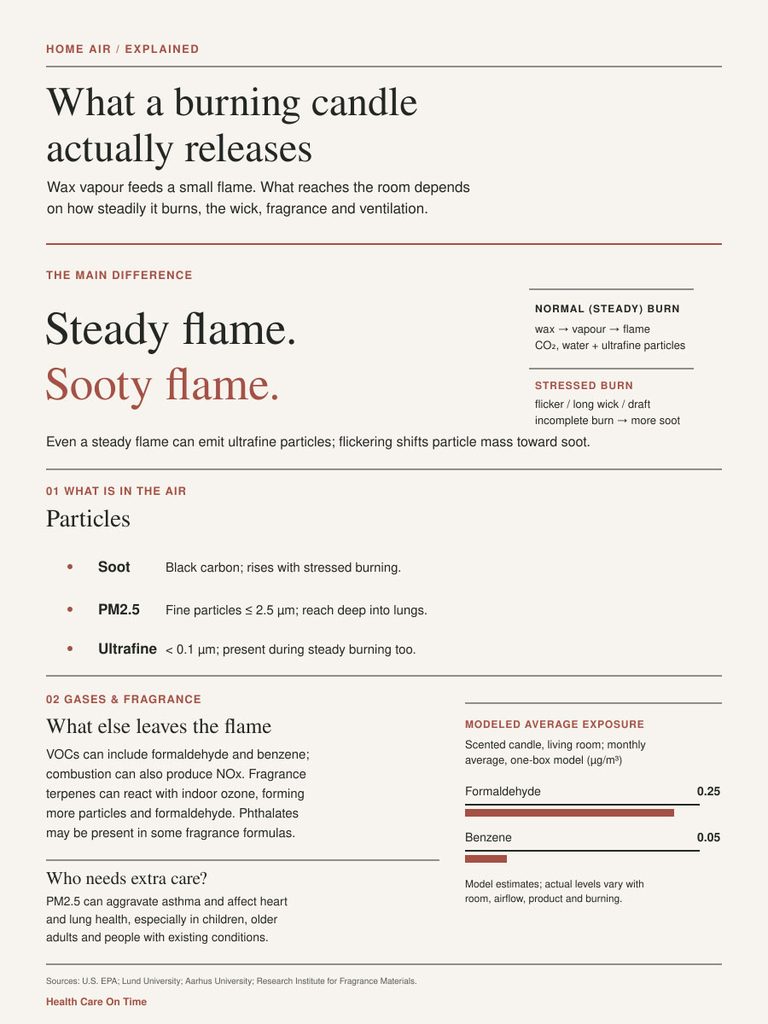
When that process runs cleanly, some emissions are harmless, like carbon dioxide and water vapor, while others can include trace amounts of volatile organic compounds (VOCs). When it runs poorly, the mix gets dirtier.
Particles: Soot, PM2.5, and Ultrafines
The visible part of candle smoke is soot, also called black carbon. The invisible part includes PM2.5 (fine particles 2.5 microns or smaller) and ultrafine particles under 0.1 micron.
PM2.5 matters because, according to EPA, long- and short-term exposures can lead to heart attacks, asthma attacks, and premature death. Children, older adults, and people with heart or lung conditions are at greatest risk.
Gases: Formaldehyde, Benzene, Toluene, and NOx
Burning paraffin can release VOCs such as acetone, toluene, and benzene. Candles can also add black carbon, formaldehyde, polycyclic aromatic hydrocarbons (PAHs), and nitrogen oxides to indoor air.
The dose is usually small. In one 2014 modeling study of scented candles, average formaldehyde exposure ranged from 2.14 to 12.28 µg/m³ depending on room type, and peak benzene stayed below the EU guideline of 5 µg/m³.
For context, the WHO indoor air guideline for formaldehyde is 100 µg/m³.
Fragrance Chemistry: Terpenes, Phthalates, and Ozone
Fragrance is one of the biggest factors in candle emissions. Synthetic fragrance oils can release additional VOCs and phthalates, which some studies link to headaches, allergic reactions, and hormone disruption.
Scent compounds called terpenes (think citrus, pine, and mint) add another step. Airborne terpenes react with ozone to form sticky compounds that clump into nanoscale particles. The scent itself can create brand-new particles in your living room.
Normal Burning vs Stressed Burning
A candle’s emissions aren’t fixed. A 2021 Scandinavian chamber study found that stressed burning likely adds significantly to indoor exposure to soot, PM2.5, particle PAHs, and nitrogen oxides. Burn duration and flame disturbance from changing air currents drove the levels.
The spread can be large. In a 2007 industry-commissioned test, well-made paraffin, soy, palm, and stearin candles released 6 to 10 µg of particles per gram of wax, and beeswax released 33. High-soot soy and paraffin candles hit 146 and 273.
Are Candles Bad for You? The Verdict on 11 Common Claims
Candles are not bad for most healthy people when burned occasionally, with a trimmed wick, in a ventilated room. They become a real health risk when they start fires, burn in small closed spaces, or carry heavy fragrance around people with asthma, heart disease, babies, or pet birds.
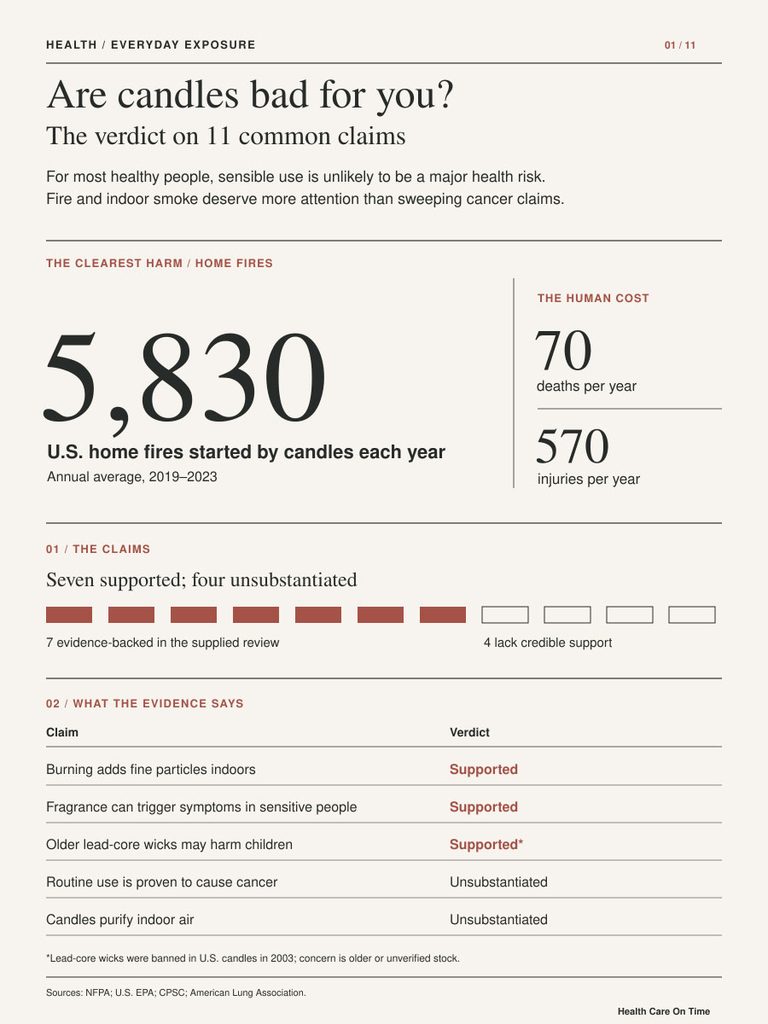
Our medical review team graded 11 common candle claims by the quality of the evidence behind each one, not by how often it gets repeated online. Seven hold up. Four don’t.
| Claim | Verdict | Key Number | Evidence Strength | Who It Matters For |
| Candles start house fires | Real | About 5,830 US home fires and 70 deaths a year | Strong (NFPA) | Everyone, especially in bedrooms |
| Candles raise indoor fine particles | Real | PM2.5 of 89.8 µg/m³ during a 5-hour exposure | Strong (randomized trial) | Small, closed rooms |
| Drafts and long wicks create soot spikes | Real | High-soot candles: 146 to 273 µg/g vs 6 to 10 µg/g | Moderate | Candles near fans, vents, open doors |
| Fragrance triggers headaches and breathing trouble | Real | 34.7% of US adults report effects from fragranced products | Moderate (national survey) | Fragrance-sensitive people |
| Candle smoke irritates asthmatic airways | Real | 64.3% of asthmatics report fragrance effects | Moderate | 26.8 million Americans with asthma |
| Scented products form nanoparticles with ozone | Real | Over 1 million particles per cubic centimeter | Moderate (new research) | Frequent scented-product users |
| Lead wicks can expose children to lead | Real but rare | Banned above 0.06% lead since 2003 | Strong (CPSC) | Homes with old or unverified candles |
| Candles cause cancer | Overblown | No household-candle cancer study exists | Weak | Anyone worried about long-term use |
| Soy and beeswax are toxin-free | Overblown | Beeswax: 33 µg/g vs 6 to 10 µg/g for other well-made candles | Moderate | Shoppers paying a premium |
| A 2009 study proved paraffin is toxic | Overblown | Qualitative, never peer reviewed | Weak | Paraffin candle buyers |
| Beeswax candles purify the air | Overblown | No published air-quality evidence | None | Beeswax buyers |
7 Real Risks of Burning Candles
These are the candle health risks with real data behind them, ranked roughly from most to least serious.
1. House Fires and Burns
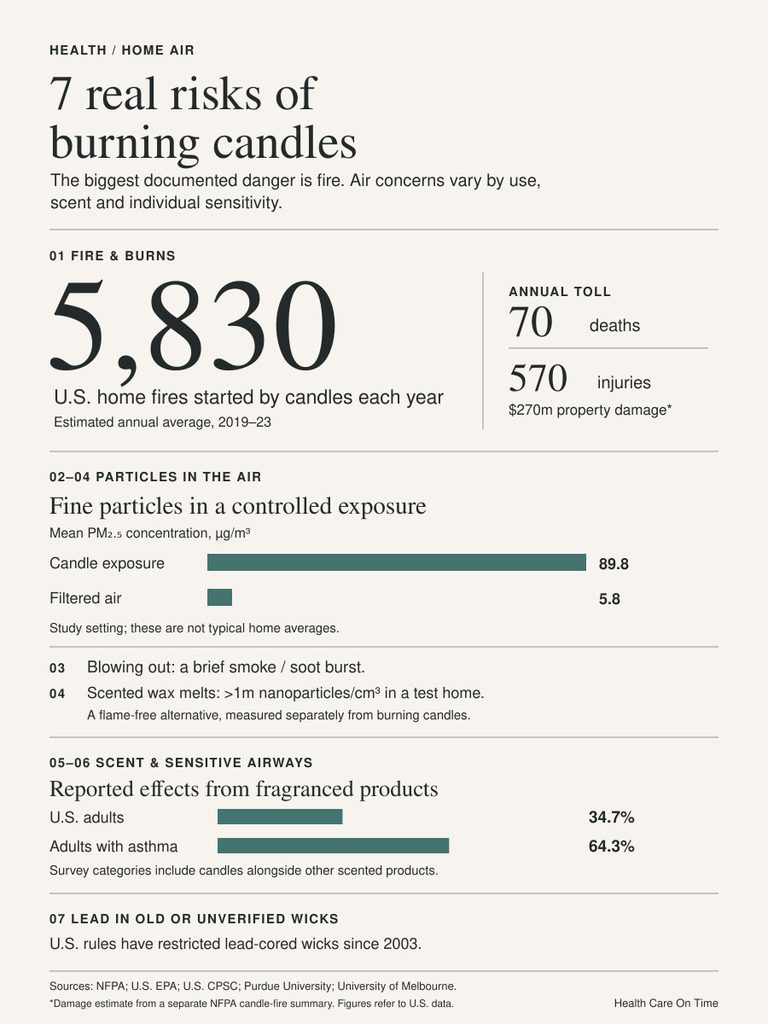
Fire is the one candle risk that kills people every year. From 2019 through 2023, candles started an average of 5,830 home fires annually. Those fires caused an average of 70 deaths, 570 injuries, and $270 million in direct property damage.
Candle fires are unusually likely to hurt someone: 90 injuries per 1,000 fires, nearly three times the rate for all home fires. Over half start when furniture, bedding, curtains, decorations, paper, or clothing sits too close to the flame.
Location matters. More than one-third (37%) of home candle fires started in the bedroom. Young children and older adults have the highest death risk from candle fires.
2. Fine Particle Spikes in Small, Closed Rooms
The best human data comes from Aarhus University in Denmark. In a randomized, double-blind crossover study, 36 young nonsmokers with asthma attended three 5-hour sessions: cooking emissions, candle emissions, and clean filtered air.
Candle emissions produced PM2.5 of 89.8 µg/m³, compared with 5.8 µg/m³ in clean air. That’s about 2.5 times EPA’s 24-hour outdoor standard of 35 µg/m³.
Two caveats keep this honest. EPA’s limits apply to outdoor air averaged over a day or a year, and no federal limit exists for indoor air. The chamber also concentrated emissions more than most living rooms would.
3. Soot Bursts From Drafts and Long Wicks
Soot doesn’t come out evenly. Measurements directly above the flame showed short-lived strong emission peaks of soot. The researchers concluded that preventing stressed burning can reduce exposure to indoor pollutants.
The moment you put a candle out matters, too. A lab study of soy, beeswax, and paraffin candles found that most of the mass emissions came during the smoldering phase right after the flame went out.
That white plume after you blow out a candle may be the dirtiest moment of the whole burn.
4. Fragrance Reactions: Headaches, Congestion, and Migraine
In a nationally representative survey of 1,136 US adults, 34.7% reported health effects from fragranced products. The effects included breathing difficulties, headaches, dizziness, rashes, congestion, and nausea.
For half of those affected, the effects were potentially disabling under the Americans with Disabilities Act.
Patients booking allergy panels through HealthCareOnTime often ask whether a favorite holiday candle could explain a stuffy nose or an afternoon headache. The timing often gives it away: symptoms start soon after lighting and fade once the room airs out.
5. Asthma and Airway Irritation
About 26.8 million Americans, or 8.2% of the population, have current asthma. In a national survey of asthmatics, 64.3% reported adverse effects from fragranced products, including respiratory problems (43.3%), migraines (28.2%), and asthma attacks (27.9%).
The Aarhus trial adds nuance. Overall, lung function, exhaled nitric oxide, and nasal volume didn’t change significantly. Participants did report more symptoms, and the results suggested mild inflammation in asthmatic men.
C-reactive protein, a common blood marker of inflammation, stayed stable. Our medical reviewers read these results as a comfort-and-flare issue for healthy young adults, not evidence of lung damage. People with poorly controlled asthma sit in a different risk group.
6. Nanoparticles From Scented Products and Ozone
In 2025, Purdue University engineers tested 15 commercial wax melts, both scented and unscented, in a full-scale research house. Terpenes from scented melts reacted with indoor ozone and pushed nanoparticle levels above one million per cubic centimeter.
That’s comparable to scented candles, gas stoves, and diesel engines. Scented wax melts made three times more nanoparticles than candles, while unscented melts produced no terpenes and no new particles.
The authors stress that more toxicology research is needed on breathing in these nanoparticles. The practical lesson for now: the scent itself, not just the flame, creates particles.
7. Lead From Old or Noncompliant Candles
The Consumer Product Safety Commission banned candles with metal-cored wicks containing more than 0.06% lead, effective October 15, 2003.
CPSC testing had found some candles emitting more than 3,000 micrograms of lead per hour. That’s about seven times the rate that could lead to elevated lead levels in a child.
The ban covers all domestic and imported candles, so a new candle from a mainstream US retailer is very unlikely to contain lead. The leftover risk sits in old stock, secondhand finds, and unbranded online imports.
How to Check a Metal-Core Wick
You can’t tell lead from zinc by looking. Most metal-core wicks today likely contain zinc, and CPSC suggests contacting the retailer if you’re unsure what a wick is made of.
Compliant metal-wick candles must ship in outer cartons marked “Conforms to 16 CFR 1500.17(a)(13),” but the retail jar you buy usually won’t carry that line.
If you can’t verify the wick, don’t burn it. That rule matters most with babies and toddlers, who can swallow lead that settles on surfaces and ends up on their hands.
4 Candle Claims That Are Overblown
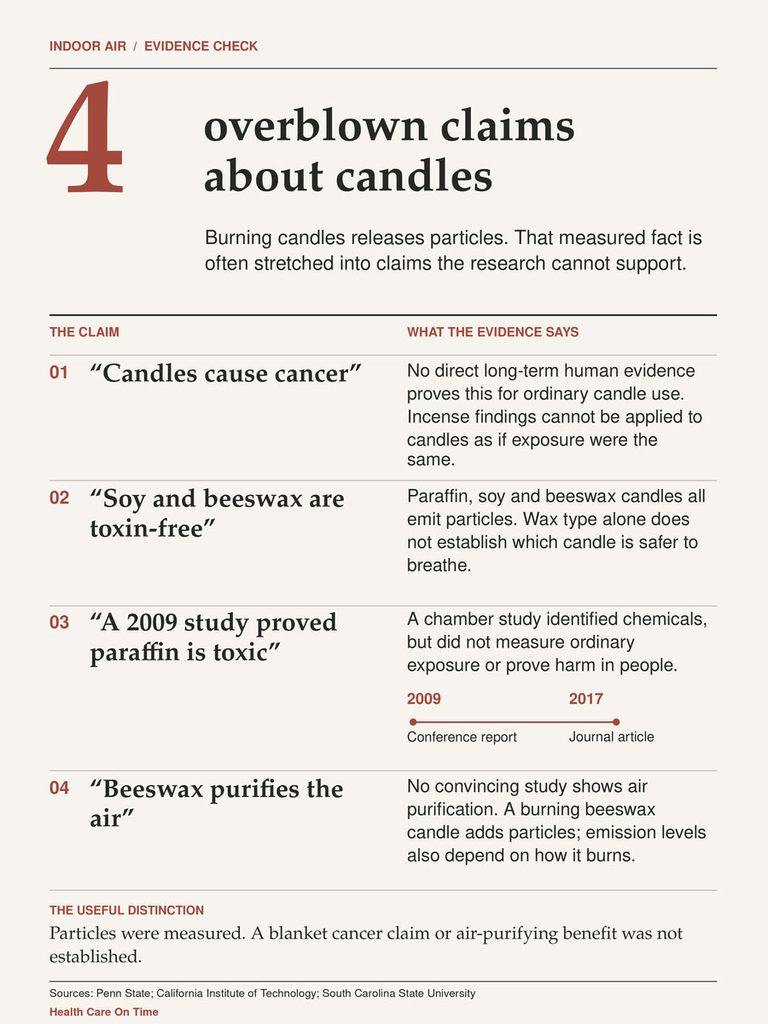
Candle fear spreads fast online, often from sellers of “clean” alternatives. These four claims go further than the evidence.
Overblown Claim 1: “Candles Cause Cancer”
No large study has followed household candle users over time to track cancer. Even physicians who study indoor air say long-term data on candle use is limited.
The cancer data people cite usually comes from incense, a much smokier habit. Among 61,320 Singapore Chinese adults, long-term incense users had 1.8 times the risk of squamous cell cancers of the respiratory tract. That doesn’t transfer to an occasional candle.
Exposure modeling of candle emissions found long-term health effects unlikely, though short peaks may aggravate symptoms in sensitive people. Claims that candle soot resembles diesel exhaust describe chemical makeup, not the dose you actually breathe.
Overblown Claim 2: “Soy and Beeswax Candles Are Toxin-Free”
Every flame makes particles. In the 2007 industry test, well-made paraffin, soy, palm, and stearin candles landed at 6 to 10 µg per gram of wax, while beeswax came in higher at 33 µg.
The evidence isn’t one-sided. A university lab study found considerable soot from paraffin candles but little or none from soy. Still, doctors reviewing the research say no study has directly shown paraffin wax is more harmful to people than other waxes.
Wick trim, drafts, and fragrance load move the needle more. A heavily scented soy candle in a small bathroom isn’t clean just because of its label.
Overblown Claim 3: “A 2009 Study Proved Paraffin Is Toxic”
This is the most-quoted candle study online. South Carolina State University researchers burned candles for up to six hours in a box measuring 8 by 8 by 26 inches. They reported toluene and benzene from paraffin but not soy.
The work was only qualitative, meaning it didn’t measure amounts, and it was funded by the USDA, which had an interest in soy-based candles. According to the candle industry, it was never published or peer reviewed.
The industry has its own conflict here. Its 2007 lab testing in Germany reported no benzene from paraffin candles.
Overblown Claim 4: “Beeswax Candles Purify Your Air”
Beeswax sellers often claim the flame releases negative ions that clean the air. Our medical review team found no peer-reviewed air-quality study showing that burning beeswax lowers indoor pollution.
Burning anything adds particles to a room. In the industry test described above, beeswax released more particle mass per gram than the other well-made candles.
Who Funded the Research on Both Sides
Candle science carries conflicts of interest in every direction, and readers should see them.
- The 2009 paraffin study was funded by the USDA, which had an interest in soy markets.
- The 2007 wax comparison was run by the candle industry.
- The 2021 stressed-burning study was run by a consortium that included the European Candle Association and several candle and wax makers.
- The 2014 exposure-risk study is featured on the European candle manufacturers’ trade group research page.
- The Purdue wax melt study was funded by the National Science Foundation, Purdue University, and ASHRAE.
- The Aarhus trial was funded by a Realdania Forskning grant.
Candle Health Risks by the Numbers
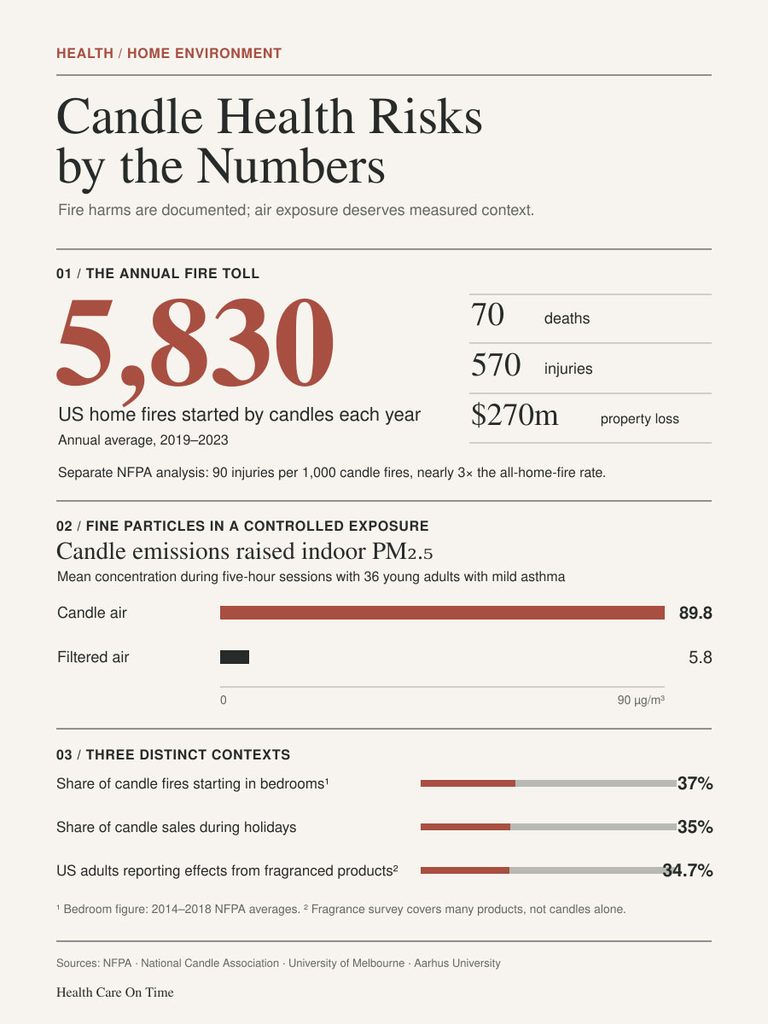
Here are the key US figures in one place.
| Metric | Figure | Source |
| Home fires started by candles each year | 5,830 | NFPA, 2019 to 2023 average |
| Deaths and injuries each year | 70 deaths, 570 injuries | NFPA, 2019 to 2023 average |
| Direct property damage each year | $270 million | NFPA, 2019 to 2023 average |
| Injuries per 1,000 candle fires | 90 (nearly 3 times all home fires) | NFPA |
| Bedroom share of home candle fires | 37% | NFPA, 2013 to 2017 |
| Share of candle sales in the holiday season | 35% | National Candle Association |
| US households that use candles | 7 in 10 | National Candle Association |
| Adults reporting health effects from fragranced products | 34.7% | Steinemann national survey, 1,136 adults |
| Asthmatics reporting fragrance effects | 64.3% | Steinemann survey, 1,137 adults |
| Americans with current asthma | 26.8 million (8.2%) | CDC, NHIS 2020 to 2022 |
| PM2.5 during 5-hour candle exposure | 89.8 µg/m³ vs 5.8 µg/m³ clean air | Aarhus randomized trial |
| EPA outdoor PM2.5 standards | 35 µg/m³ (24-hour); 9.0 µg/m³ (annual) | EPA; annual limit upheld June 26, 2026 |
| Lead released by some banned wicks | Over 3,000 µg per hour | CPSC, 2003 |
Who Should Be More Careful With Candles
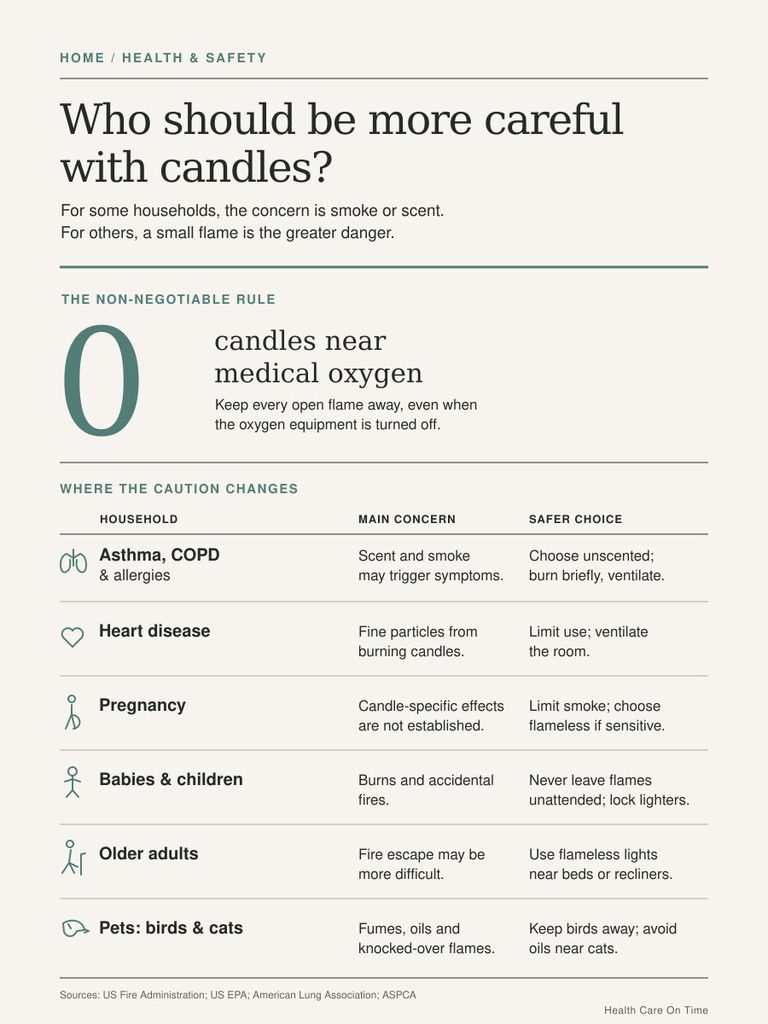
Most healthy adults can burn candles safely with a few habits. These groups need a bigger margin.
Asthma, COPD, and Allergies
For people with asthma, COPD, or allergies, candles are more likely to cause flare-ups than lasting harm. Unscented candles, short burns, and an open window lower the load.
If anyone at home uses medical oxygen, never use candles. Oxygen makes fires start more easily and burn hotter.
Heart Disease
EPA lists people with heart conditions among those most at risk from fine particle pollution. No study shows that a candle triggers a heart attack.
Still, if you have coronary artery disease or heart failure, treat candles like any other smoke source: fewer candles, shorter burns, and good ventilation.
Pregnancy
No study has measured candle use and pregnancy outcomes, so claims either way are guesswork. The sensible approach is to limit avoidable indoor smoke.
If scents trigger nausea or headaches, switch to unscented or flameless candles for now. Ventilate, and skip candles in small, closed bathrooms.
Babies and Young Children
EPA counts children among the groups most affected by particle pollution. For a baby or toddler, though, fire and burns are the bigger danger.
NFPA advises never leaving a child alone in a room with a burning candle and keeping matches and lighters up high in a locked cabinet.
Older Adults
Older adults face one of the highest death risks in candle fires. Slower reaction time, limited mobility, and medications that cause drowsiness all raise the stakes.
Flameless candles are the safer choice in bedrooms and near recliners where someone might doze off.
Pets, Especially Birds and Cats
Cats have fewer liver enzymes for breaking down toxins, which makes them more sensitive. Birds are even more vulnerable because their respiratory system is highly sensitive to inhaled toxins.
Keep birds out of any room with a burning candle, and skip essential-oil candles around cats. If a pet drools, vomits, coughs, or seems wobbly, call your veterinarian or the ASPCA Animal Poison Control Center at 888-426-4435 (a consultation fee may apply).
Paraffin vs Soy vs Beeswax vs Wax Melts: Does the Product Matter?
One of the most common questions our team hears each winter is whether soy candles are safer. Wax type gets the most attention online, but it’s only one of five factors that shape emissions. Wick size, trim length, drafts, and fragrance load often matter more.
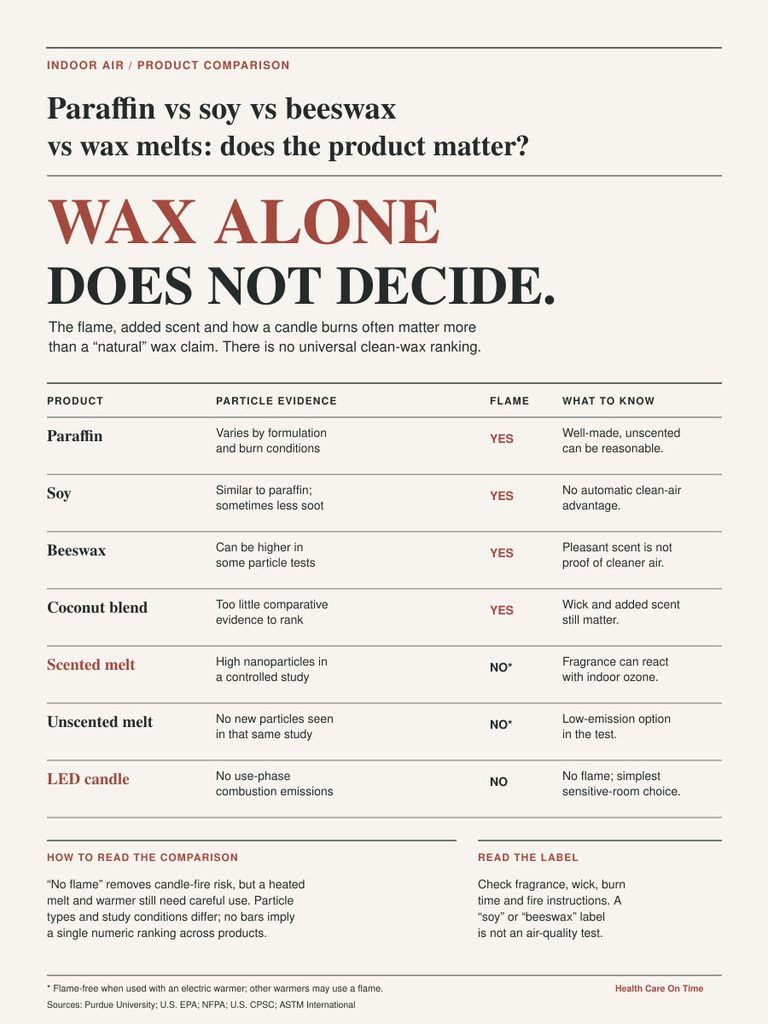
Here’s how the main options compare using the best available data.
| Product | Particle Evidence | Fire Risk | Fragrance Load | Bottom Line |
| Paraffin | 6 to 10 µg/g when well made; up to 273 µg/g when poorly made (industry test) | Open flame | Varies by scent | Acceptable when well made, trimmed, and unscented |
| Soy | 6 to 10 µg/g when well made; 146 µg/g when poorly made; less soot than paraffin in a university lab study | Open flame | Often heavily scented | Not automatically cleaner |
| Beeswax | 33 µg/g (industry test) | Open flame | Usually light or natural honey scent | Pleasant, not proven cleaner |
| Coconut and blends | Little independent data | Open flame | Often heavily scented | Unknown; judge by wick and scent |
| Scented wax melts | Over 1 million nanoparticles per cm³; about 3 times candles | No flame | High (terpenes) | Flame-free, not pollution-free |
| Unscented wax melts | No terpenes or new particles observed | No flame | None | Lowest emissions, but no scent |
| LED flameless candles | No combustion emissions | Very low | None | Safest for bedrooms, kids, pets, and oxygen users |
A well-made, unscented candle beats a “natural” but heavily scented one. For a bedroom, a child’s room, or a home with birds, flameless LED candles remove every combustion risk at once.
How to Read a Candle Label
Candle labels promise a lot, and little of it is tested. CPSC’s candle rules cover lead in metal-core wicks and cautionary labeling, alongside voluntary industry standards for fire-safety labels (ASTM F2058) and glass containers (ASTM F2179). None of these sets a limit on indoor emissions.
That means words like “clean burning” and “non-toxic” aren’t tied to any required emissions test. Use the label for what it can actually tell you:
- “100% soy” or “100% beeswax” means a single wax. Unless a candle says 100%, the wax may be a blend that includes paraffin.
- “Unscented” beats “naturally scented” if anyone is sensitive, since flame heat can alter the chemistry of essential oils too.
- A cotton or wood wick sidesteps the metal-core question entirely.
- A fire-safety warning with burn-time limits signals the maker follows the industry labeling standard.
How to Burn Candles More Safely: 10 Rules
These steps cut both fire risk and indoor pollution. Most come from NFPA and the National Candle Association.
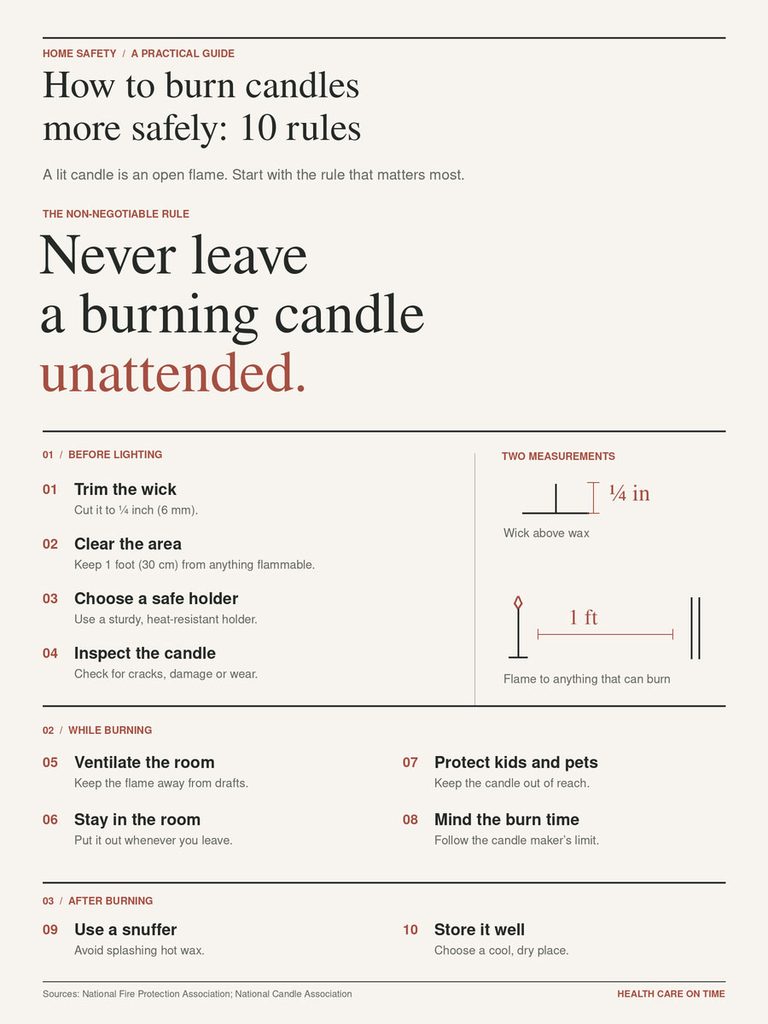
- Trim the wick to 1/4 inch before every burn. Long wicks create large, sooty flames.
- Burn no longer than 4 hours at a time. A good guide is about one hour for every inch of candle diameter, so a 3-inch candle gets about 3 hours.
- Keep at least 12 inches of clearance between the flame and anything that can burn.
- Keep candles away from drafts, vents, and fans. Flickering flames drive soot spikes.
- Use a snuffer instead of blowing. It limits the smoky plume at the end of the burn.
- Never burn a candle where you might fall asleep. Blow out all candles when you leave the room or go to bed.
- Ventilate while burning. Crack a window or run the bathroom fan, and consider an air purifier with carbon filters.
- Go unscented if anyone is sensitive, and burn one candle at a time instead of a cluster.
- Stop before the bottom. Put out taper or pillar candles within 2 inches of their holders, and stop using container candles when 1/2 inch of wax remains.
- Test your smoke alarms and consider flameless candles, which look and even smell like the real thing.
Signs Candles Are Affecting Your Health
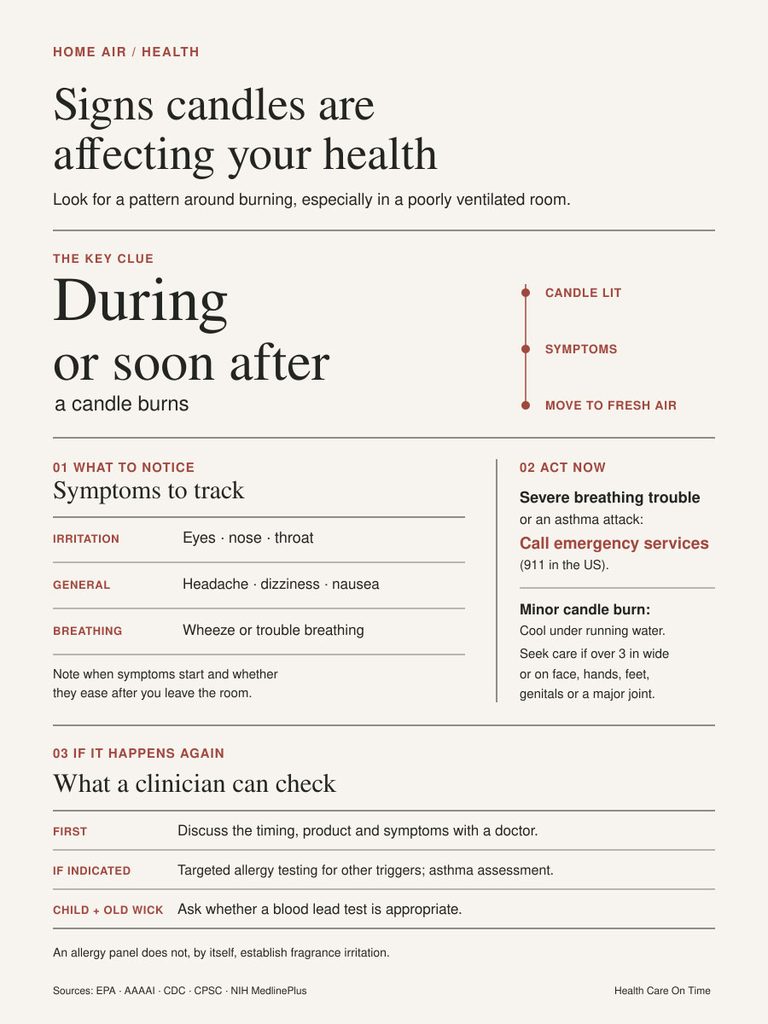
Candle-related symptoms usually show up during or shortly after burning and fade with fresh air.
Common Symptoms
In a poorly ventilated room, toluene exposure can irritate the eyes, nose, throat, and skin, and can cause headaches and dizziness. Breathing in VOCs can also cause nausea and difficulty breathing. Watch for:
- Burning or watery eyes, a runny nose, or a scratchy throat
- Headache or dizziness
- Nausea
- Coughing, wheezing, or chest tightness
- Sneezing or congestion
When to Get Care Right Away
Call 911 or go to the ER for severe trouble breathing, an asthma attack that doesn’t ease with your rescue inhaler, or smoke inhalation from a candle fire.
For a minor burn, run cool, not cold, water over the area for about 10 minutes. Get emergency help if a burn is larger than 3 inches across, looks charred or leathery, or affects the face, hands, feet, genitals, buttocks, or major joints.
Tests That Can Help
If symptoms keep coming back, testing can separate fragrance irritation from a true allergy or asthma problem. An allergy panel (total and specific IgE) can flag triggers such as dust mites or pet dander that build up in closed-up winter homes. Spirometry, ordered by your doctor, checks lung function.
If a child was around an unverified metal-wick candle, ask the pediatrician about a blood lead test. Patients often ask us which test to start with. For fragrance-linked symptoms, an allergy panel plus a doctor’s visit is the usual first step.
What to Do in Your Situation
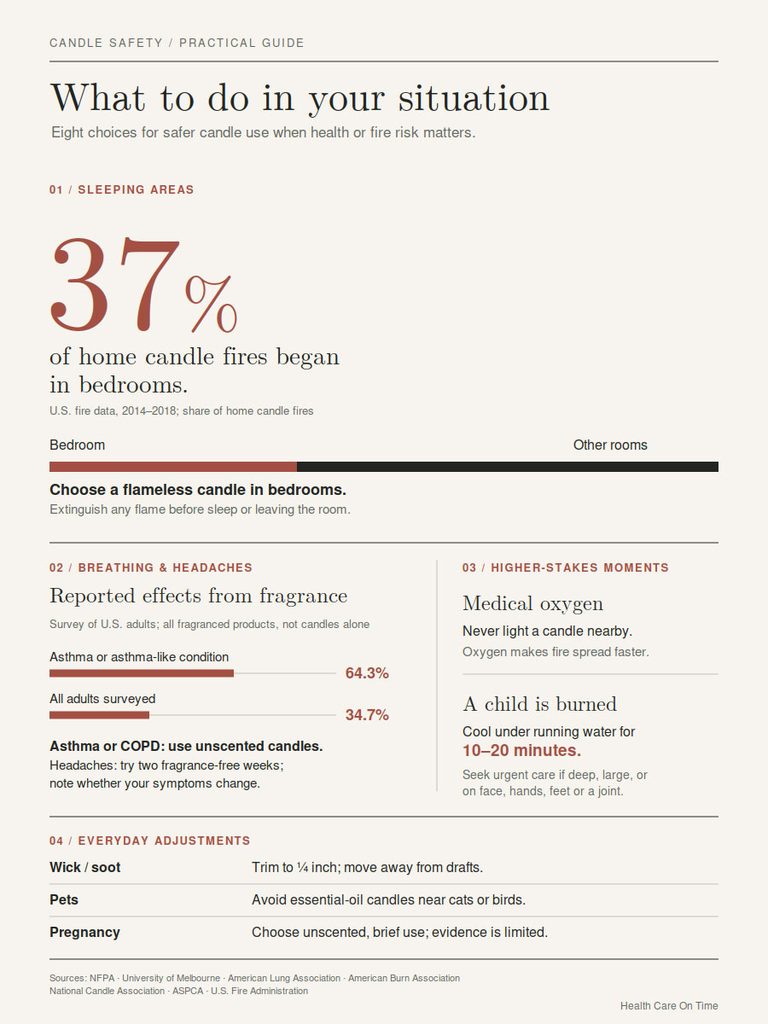
Match your situation to the action below.
| Scenario | Recommended Action | Why It Matters |
| You have asthma or COPD | Go unscented, burn under 1 hour, and ventilate; stop at the first chest tightness | 64.3% of asthmatics report effects from fragranced products |
| Someone at home uses medical oxygen | Never light a candle; use LED candles only | NFPA rule; oxygen feeds fire |
| You often doze off with a candle lit | Switch to flameless candles in the bedroom | 37% of home candle fires start in bedrooms |
| Black soot on the jar, walls, or ceiling | Trim the wick to 1/4 inch, move the candle away from vents, or replace it | Stressed burning causes soot spikes |
| Headaches every time you burn a scented candle | Try two fragrance-free weeks and track symptoms | 34.7% of adults report fragrance effects |
| Cat or bird at home | Skip essential-oil candles; keep birds out of candle rooms | Birds and cats are more sensitive to inhaled compounds |
| Pregnant with nausea or headaches | Choose unscented candles, short burns, and ventilated rooms | No candle-pregnancy data; limit avoidable smoke |
| Child touched a flame or hot wax | Cool water for about 10 minutes; ER if larger than 3 inches or on the face, hands, feet, groin, or joints | Mayo Clinic burn first-aid thresholds |
| Old, unbranded, or imported candle with a metal-core wick | Don’t burn it; ask the seller what the wick is made of | Lead and zinc wicks look identical |
| Holiday season with many candles | One room at a time, 12-inch clearance, smoke alarm check | December is the peak month for candle fires |
Frequently Asked Questions
Is it safe to burn candles every day?
For most healthy adults, burning one well-made candle a day in a ventilated room is unlikely to cause harm. Keep burns under 4 hours, trim the wick to 1/4 inch, and never leave the flame unattended. If anyone at home has asthma or fragrance sensitivity, choose unscented candles and burn them less often.
Are candles bad for your lungs?
Candles release fine particles and gases that can irritate airways, especially in small, closed rooms. In a controlled trial, candle smoke raised indoor PM2.5 to about 90 µg/m³ and caused more symptoms in people with mild asthma, but no significant change in lung function. Healthy lungs usually recover once the room airs out.
Can scented candles cause headaches?
Yes, for some people. Nearly 35 percent of adults in a national survey reported health effects from fragranced products, and migraine headaches were among them. If headaches start soon after you light a scented candle, try two fragrance-free weeks. If the headaches stop, the scent is the likely trigger.
Do candles cause cancer?
There’s no good evidence that household candles cause cancer. Candle smoke contains small amounts of benzene and formaldehyde, but exposure modeling puts typical levels below indoor air guidelines. The cancer data often cited online comes from heavy, daily incense use, which is a much smokier exposure than an occasional candle.
Are soy candles non-toxic?
No candle is truly non-toxic, because every flame makes particles. Soy candles produced less soot than paraffin in a university lab study, but well-made paraffin candles performed similarly in industry testing. Fragrance load, wick size, and drafts usually matter more than wax type. Choose unscented soy for the lowest emissions.
Are wax melts safer than candles?
Wax melts remove the fire risk, which is a real advantage. But nanoparticle exposure from scented wax melts may match that from candles and even gas stoves, while an unscented melt produced no terpenes or nanoparticles. If you use scented melts, use them sparingly and with good ventilation.
Is it safe to sleep with a candle burning?
No. NFPA advises blowing out all candles before bed and avoiding candles anywhere people may fall asleep. More than a third of home candle fires start in bedrooms, and December is the peak month for candle fires. Use a flameless LED candle if you like a soft glow at night.
Are candles safe during pregnancy?
No study has linked candle use to pregnancy complications, but no data shows candles are risk-free either. A cautious approach makes sense: burn candles in ventilated rooms, keep sessions short, and switch to unscented or flameless options if scents trigger nausea or headaches. Talk with your OB if you also have asthma.
Are scented candles bad for cats and dogs?
They can be. Cats have fewer liver enzymes for breaking down essential oils, and birds are even more sensitive to inhaled fumes. Skip essential-oil candles around cats, keep birds out of candle rooms, and call your vet or ASPCA Animal Poison Control (888-426-4435) if a pet drools, vomits, or seems wobbly.
Do candles still have lead wicks?
Not legally in the US. CPSC banned metal-core wicks with more than 0.06% lead in 2003, for both domestic and imported candles, and most metal cores today are zinc. The remaining risk comes from very old candles and unverified imports. If you can’t confirm what the wick is made of, don’t burn it.
How long should you burn a candle at one time?
The standard guidance is no more than four hours at a time. A useful rule of thumb is about one hour per inch of candle diameter, so a 3-inch candle gets roughly 3 hours. Then let it cool, trim the wick to 1/4 inch, and relight later.
What is the black soot from candles, and is it harmful?
Black soot is carbon from incomplete burning, usually caused by a long wick or a draft. It adds fine particles to your indoor air and can stain walls and ceilings. Trim the wick, move the candle away from vents and fans, and replace any candle that keeps smoking.
Disclaimer: This article is for general education and does not replace advice from a doctor. If you have asthma, COPD, heart disease, or are pregnant, talk with your healthcare provider about indoor air triggers. In a fire or breathing emergency, call 911. For pet exposures, contact your veterinarian or the ASPCA Animal Poison Control Center.
References
- NFPA: Home Structure Fires Research Report
- NFPA: Safety With Candles
- EPA: National Ambient Air Quality Standards for Particulate Matter
- EPA: PM NAAQS Fact Sheet
- Harvard Environmental and Energy Law Program: PM2.5 NAAQS Tracker
- CPSC: Ban on Candles With Lead-Cored Wicks (2003)
- CPSC: Candles Business Guidance
- Federal Register: Metal-Cored Candlewicks Containing Lead, Final Rule (2003)
- Laursen et al., Indoor Air (2021): Acute Health Effects From Cooking and Candle Particles
- Laursen et al., Particle and Fibre Toxicology (2023): Airway and Systemic Biomarkers
- Andersen et al., Indoor Air (2021): Emissions From Stressed Burning of Candles
- Patra et al., Environmental Science and Technology Letters (2025): Scented Wax Melts and Nanoparticles
- American Chemical Society: Scented Wax Melts Press Release (2025)
- Purdue Engineering: Are Wax Melts Really Non-Toxic?
- University of Melbourne: Fragranced Products National Survey (2016)
- Steinemann (2018): Fragranced Consumer Products and Asthmatics
- CDC: Most Recent National Asthma Data
- Petry et al., Regulatory Toxicology and Pharmacology (2014): Scented Candle Emissions Risk Evaluation
- Combustion Characteristics of Candles Made From Hydrogenated Soybean Oil
- National Candle Association: Summary of 2007 Wax Emissions Study
- National Candle Association: Response to South Carolina State University Claims
- NPR: Candle Study Funding and Limits (2009)
- Environmental Health Perspectives: Singapore Chinese Health Study Incense Findings
- Consumer Reports: Are Candles Bad for Your Health?
- Mayo Clinic: Burns First Aid
- ASPCA: Essential Oils and Pets