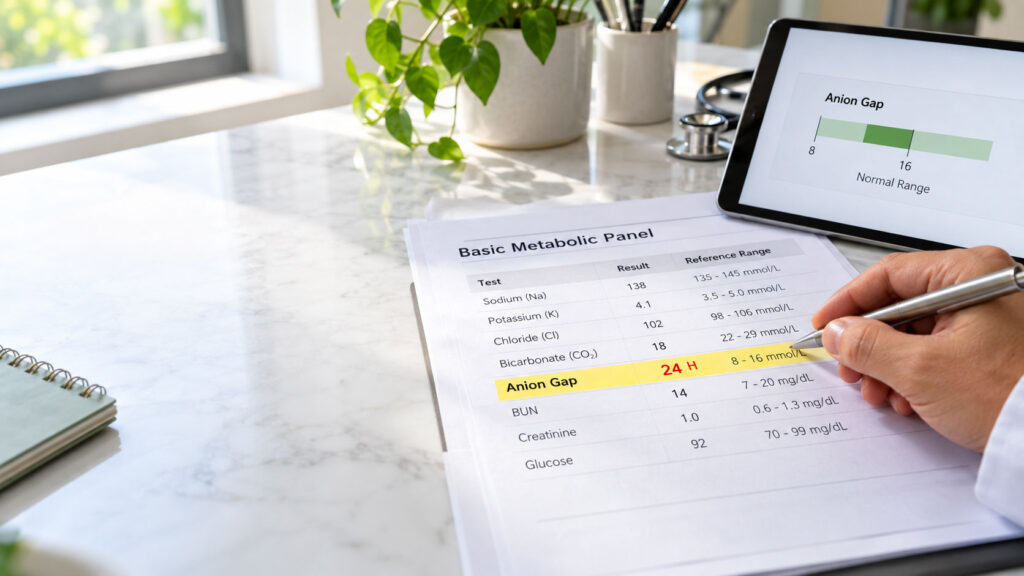
Your blood may not have changed at all. Sometimes the lab’s equipment changed. When one lab switched methods, the typical anion gap in its patients dropped from 11 to 7, with no change in anyone’s health.
Table of Contents
So if your report shows a red “H” next to anion gap, take a breath. The number matters, but so do your lab’s range, the size of the rise, and the bicarbonate result printed right next to it.
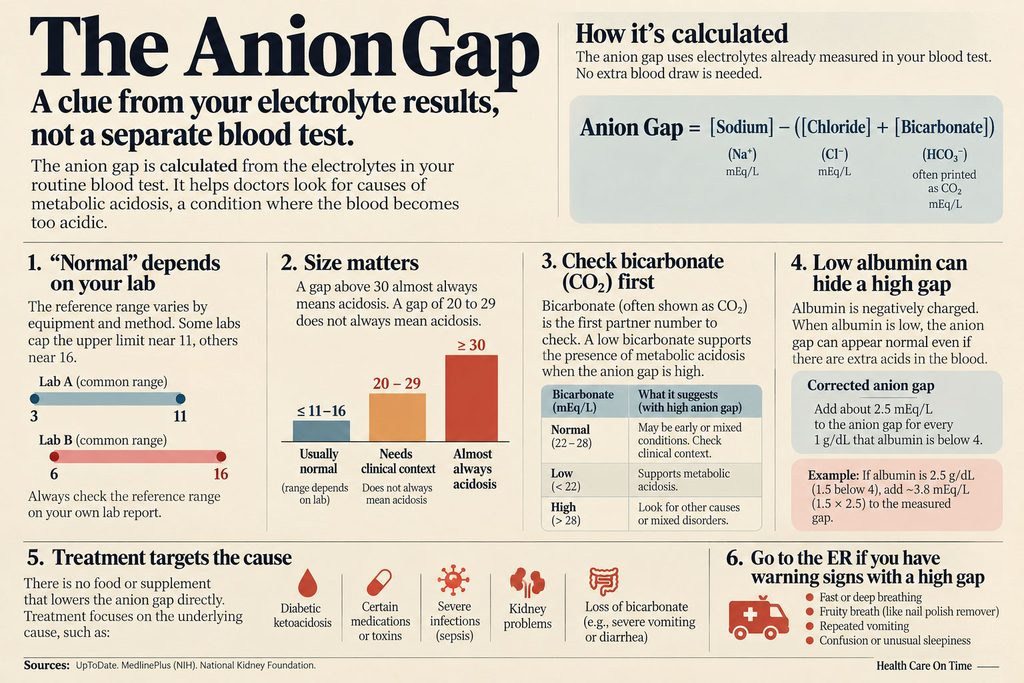
Quick Answer: A high anion gap means your blood holds more unmeasured acids than expected. The most common sources are ketones (from diabetes, fasting, or alcohol), lactic acid, kidney disease, or poisoning. Normal ranges vary by lab, so a mildly high number with normal bicarbonate is often not urgent. A gap of 20 or more, low bicarbonate, or symptoms like fast breathing, vomiting, or confusion need same-day care.
At a Glance
- The anion gap is a calculation from your electrolyte results, not a separate blood draw.
- “Normal” depends on your lab’s equipment. Some labs cap it near 11, others near 16.
- Size matters. A gap above 30 almost always means acidosis; a gap of 20 to 29 does not always.
- Bicarbonate (often printed as CO2) is the first partner number to check.
- Low albumin can hide a truly high gap, so doctors may correct for it.
- Treatment targets the cause. No food or supplement lowers the number directly.
- Fast breathing, fruity breath, vomiting, or confusion with a high gap means go to the ER.
What Is the Anion Gap?
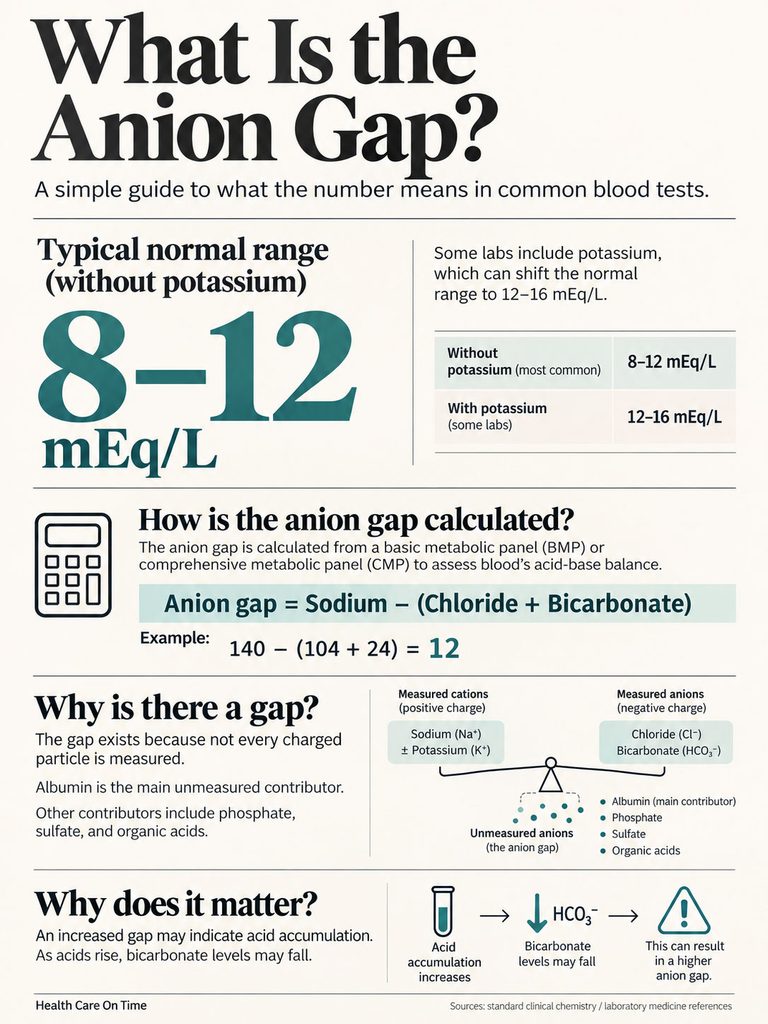
The anion gap is a number your lab calculates from a basic metabolic panel (BMP) or the larger CMP. Nothing extra is drawn. MedlinePlus explains that it uses electrolyte results to estimate your blood’s acid-base balance.
Patients booking metabolic panels through HealthCareOnTime often ask why an “anion gap” appears when they never ordered one. It comes bundled with the electrolytes, so most people see it for the first time on a routine checkup report.
The Formula, With a Worked Example
Most US labs use this version:
Anion gap = Sodium − (Chloride + Bicarbonate)
Say your results are sodium 140, chloride 104, and bicarbonate 24 (all in mEq/L). The math is 140 − (104 + 24) = 12. That 12 is the gap.
With or Without Potassium
Some labs add potassium to the sodium side, which pushes the whole range higher. Without potassium, a commonly cited normal is 8 to 12 mEq/L. With potassium, it’s about 12 to 16 mEq/L.
This is a big reason people compare their number to a website and panic. Your report footnotes usually say which formula was used.
Why a Gap Exists at All
Your blood is electrically neutral; positive and negative charges always balance. The gap appears only because the panel skips some particles.
The largest unmeasured one is albumin, a blood protein. Phosphate, sulfate, and small amounts of organic acids fill in the rest.
When an acid such as a ketone or lactic acid builds up, it uses up bicarbonate. The acid’s leftover particle isn’t measured, so the gap widens.
Why Your Lab Flagged It: The Normal Range Problem
This part explains most mild flags, and almost every online guide skips it.
The Range Moved, and Many Websites Didn’t
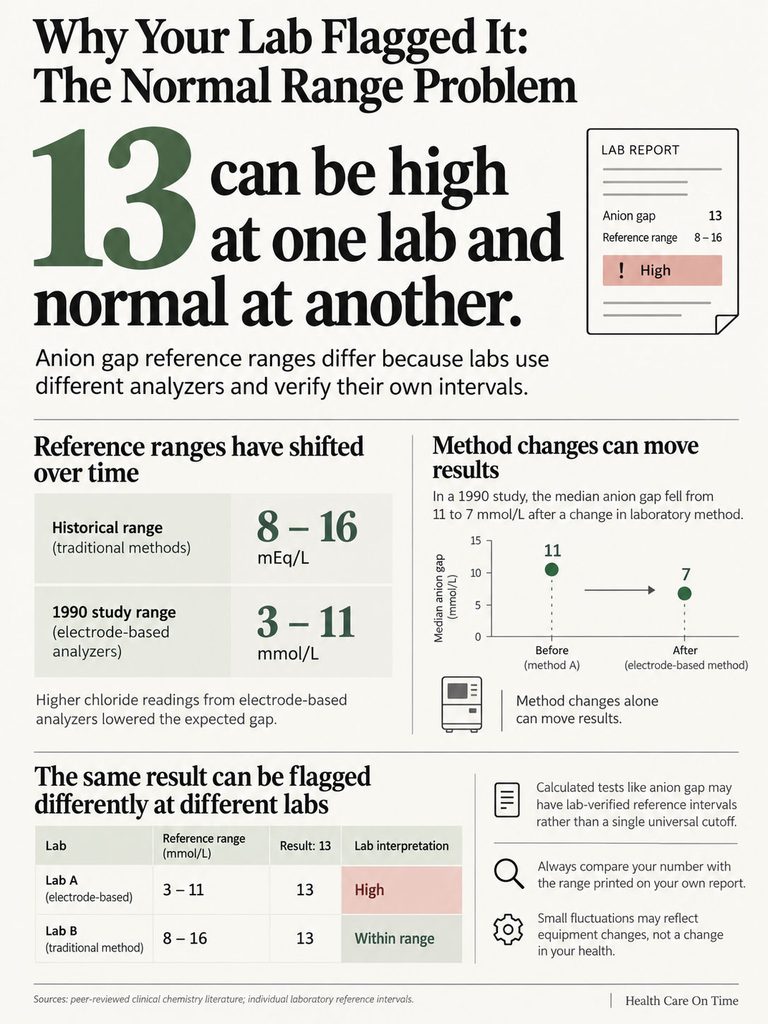
For decades, textbooks taught a normal anion gap of 8 to 16 mEq/L. Then electrode-based analyzers became standard in US labs.
A 1990 study in Archives of Internal Medicine tested those newer machines. It found the reference range had fallen to 3 to 11 mmol/L in one lab, mainly because the analyzers read chloride higher. The authors warned that the old textbook range might not fit newer equipment.
Same Blood, Different Answer
The shift keeps happening. A case in the Journal of Applied Laboratory Medicine followed one lab through a method change. The median anion gap fell from 11 mmol/L (range 5.3 to 17) to 7 mmol/L (range 3.0 to 12).
The same article points out a regulatory gap. Manufacturers must set reference intervals for measured tests but not for calculated ones like the anion gap, so each lab has to verify its own.
Our medical reviewers see this pattern often in patient questions: a gap of 13 is flagged high at a lab with an 11 cap and passes quietly at a lab with a 16 cap.
What to Do With This
Compare your number only to the range printed on your own report. If you changed labs between tests, a jump of 2 to 4 points may reflect the equipment rather than your body.
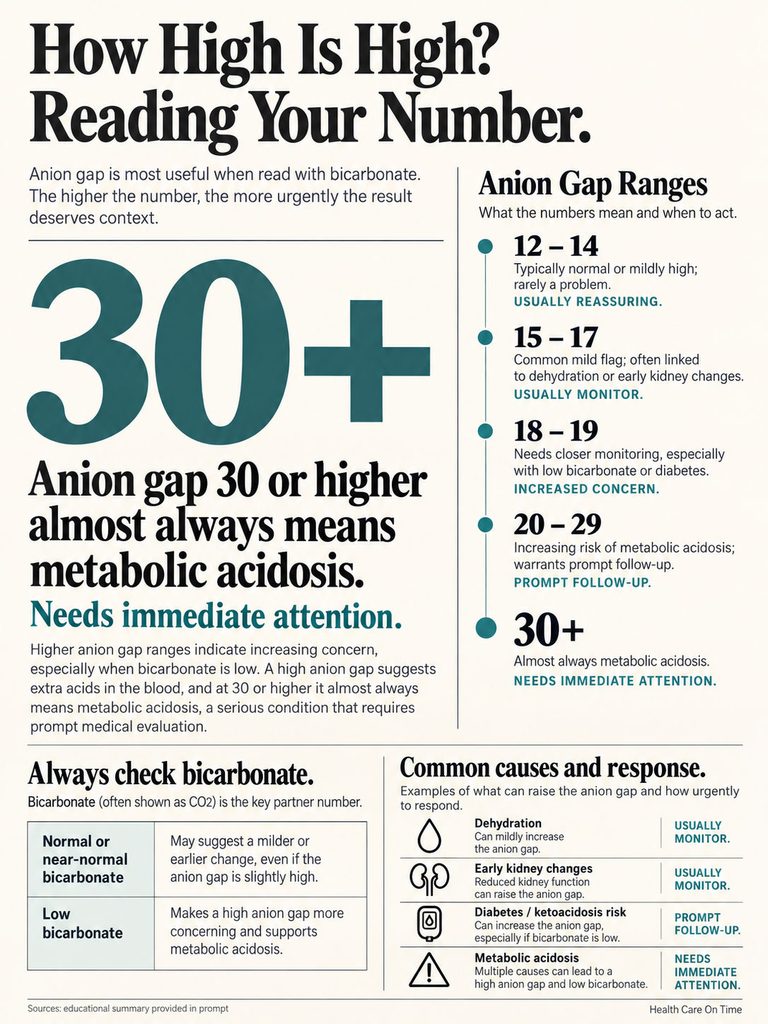
How High Is High? Reading Your Number
A gap 2 points over the limit and a gap of 32 are completely different situations.
Reading Specific Numbers
These are general patterns, not diagnoses. Always use your own lab’s range and your bicarbonate result alongside them.
Anion Gap of 12 to 14
At labs using older ranges, this is normal. At labs with an upper limit near 11, it’s mildly high. With normal bicarbonate and no symptoms, it rarely signals a problem.
Anion Gap of 15 to 17
This is a common mild flag. Dehydration, lab variation, and early kidney changes are frequent explanations. A repeat panel is the usual next step.
Anion Gap of 18 to 19
This deserves a closer look within days, especially if bicarbonate is below range, you have diabetes, or you take an SGLT2 inhibitor.
Between 20 and 29
Here the odds shift toward a real acid problem, but not completely. Acid-base teaching based on Gabow’s 1980 study in the New England Journal of Medicine holds that about one third of patients in the 20 to 29 range do not have metabolic acidosis.
So a gap of 22 calls for prompt follow-up the same day or next day, with glucose, ketones, and kidney numbers checked.
30 or Higher
At this level, metabolic acidosis is essentially always present. This is a same-day problem, usually handled in an emergency department.
In an ICU study, higher anion gaps were tied to higher death rates, and gaps above 30 carried the highest risk. Those patients were already very sick, but the finding shows why big numbers move fast.
The Bicarbonate Partner Check
Bicarbonate, printed as “CO2” or “total CO2” on many reports, is the most useful number next to the gap. Normal is roughly 22 to 29 mEq/L at most US labs.
High Gap With Normal Bicarbonate
This usually points away from active acidosis. Lab variation, dehydration, or two problems canceling each other out are the common explanations. A repeat panel still makes sense.
High Gap With Low Bicarbonate
This pairing is the classic sign of high anion gap metabolic acidosis. An acid is building up and using up your buffer. The lower the bicarbonate, the faster you should be seen.
A bicarbonate under about 15 mEq/L alongside a high gap is not something to wait on over a weekend.
| Cause | Common anion gap pattern | Key partner lab clue | Urgency | Who it usually affects |
| Diabetic ketoacidosis (DKA) | Above 12 mEq/L in moderate to severe cases | Glucose over 250 mg/dL plus ketones | ER, same day | Type 1 diabetes, adults under 45, missed insulin |
| Euglycemic DKA (SGLT2 drugs) | High, often with low bicarbonate | Glucose under 250 mg/dL but ketones high | ER, same day | Adults on empagliflozin, dapagliflozin, canagliflozin, ertugliflozin |
| Lactic acidosis | Moderate to very high | Raised blood lactate | ER, same day | Sepsis, shock, metformin with sudden kidney failure |
| Alcoholic or starvation ketoacidosis | Moderate to high | Normal or low glucose, high ketones | Same day | Heavy drinkers, prolonged fasting, pregnancy with vomiting |
| Chronic kidney disease | Usually a modest, slow rise | Low eGFR, high BUN and creatinine | Routine to prompt | Stage 4 to 5 CKD |
| Toxic alcohol (methanol, antifreeze) | Often very high | Raised osmolal gap | ER, call Poison Help | Accidental or intentional ingestion |
| Salicylate (aspirin) poisoning | Moderate to high | Raised salicylate level, fast breathing | ER, call Poison Help | Overdose, chronic high-dose use in older adults |
| Lab variation or dehydration | 1 to 4 points above lab range | Normal bicarbonate, no symptoms | Repeat test | Anyone, especially after switching labs |
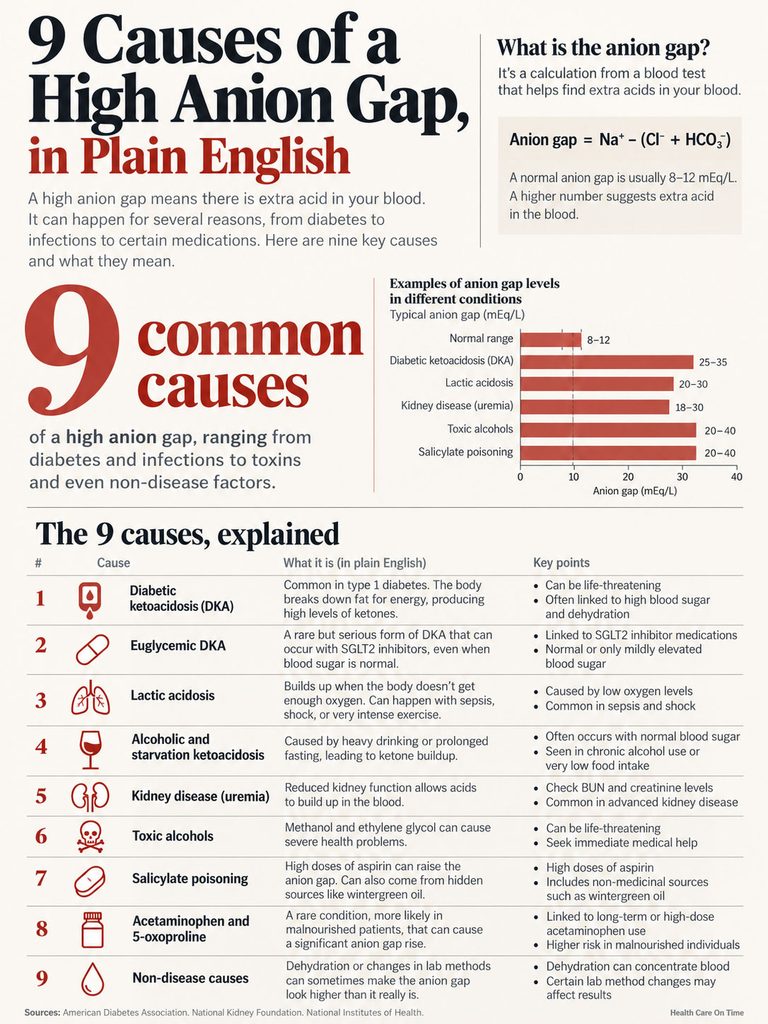
9 Causes of a High Anion Gap, in Plain English
Doctors use memory aids like MUDPILES and GOLDMARK. Here’s what those letters actually mean, ordered roughly by how often they appear in everyday care.
1. Diabetic Ketoacidosis (DKA)
Without enough insulin, the body burns fat and produces ketones, which are acids. The CDC describes DKA as a life-threatening but preventable complication marked by blood sugar over 250 mg/dL, metabolic acidosis, and raised ketones.
It’s most common in type 1 diabetes, but it also occurs in type 2.
2. Euglycemic DKA From SGLT2 Inhibitors
This is the cause most consumer guides miss. SGLT2 inhibitors (Jardiance, Farxiga, Invokana, Steglatro) lower blood sugar by sending glucose out in urine. They can trigger ketoacidosis while blood sugar looks almost normal, which delays diagnosis.
The FDA revised the labels so that canagliflozin, dapagliflozin, and empagliflozin are stopped at least three days before scheduled surgery, and ertugliflozin at least four days before. The agency also tells patients with ketoacidosis symptoms to stop the drug and seek care immediately.
These drugs are now common in heart failure and kidney disease care, so people without diabetes take them too.
3. Lactic Acidosis
Lactic acid builds up when tissues are short on oxygen. Sepsis, shock, severe heart failure, major blood loss, and grand mal seizures are classic triggers.
Metformin causes it rarely, mostly when kidney function falls suddenly. Very hard exercise raises lactate briefly; the rise usually clears within an hour or two.
4. Alcoholic and Starvation Ketoacidosis
Heavy drinking with little food, or a long fast, pushes the body into ketone production even without diabetes. Blood sugar is often normal or low.
A well-run keto diet usually produces mild ketosis, not acidosis. Fasting combined with vomiting or a drinking binge is a different story.
5. Kidney Disease (Uremia)
Healthy kidneys clear the acid your body makes each day. As kidney function falls, phosphate and sulfate build up and the gap slowly rises.
In a hospital study from Thailand, the most frequent causes of a raised anion gap were chronic kidney failure, congestive heart failure, cancer, and diabetes. Your BUN and creatinine on the same panel show whether kidneys are involved; our BUN normal range guide explains those numbers.
6. Toxic Alcohols
Methanol (windshield washer fluid, some fuels) and ethylene glycol (antifreeze) break down into strong acids. They can cause blindness, kidney failure, or death.
A second calculation, the osmolal gap, often rises early and helps doctors spot them. Any suspected ingestion means calling Poison Help at 1-800-222-1222 and heading to the ER.
7. Salicylate (Aspirin) Poisoning
A large aspirin overdose, or years of high daily doses in older adults, can cause a high gap with fast breathing and ringing in the ears. Oil of wintergreen is a hidden source.
8. Acetaminophen and 5-Oxoproline
This cause is rare and usually appears in hospitalized, malnourished, or older patients on regular acetaminophen. In one documented case, the anion gap rose from 14 to 30 mEq/L along with confusion, and urine testing showed 5-oxoproline at 58 times normal.
9. Non-Disease Causes
Not every high gap means illness. Dehydration concentrates sodium and albumin. A sample left open to air can lose bicarbonate and raise the gap.
Lab method changes, covered earlier, complete this list.
MUDPILES and GOLDMARK, Translated
| Memory aid | What the letters stand for |
| MUDPILES | Methanol, Uremia, DKA, Propylene glycol, Isoniazid or Iron, Lactic acid, Ethylene glycol, Salicylates |
| GOLDMARK | Glycols, Oxoproline, L-lactate, D-lactate, Methanol, Aspirin, Renal failure, Ketoacidosis |
Symptoms and Red Flags
The anion gap causes no symptoms itself. The acid problem behind it does, and mild elevations usually feel like nothing at all.
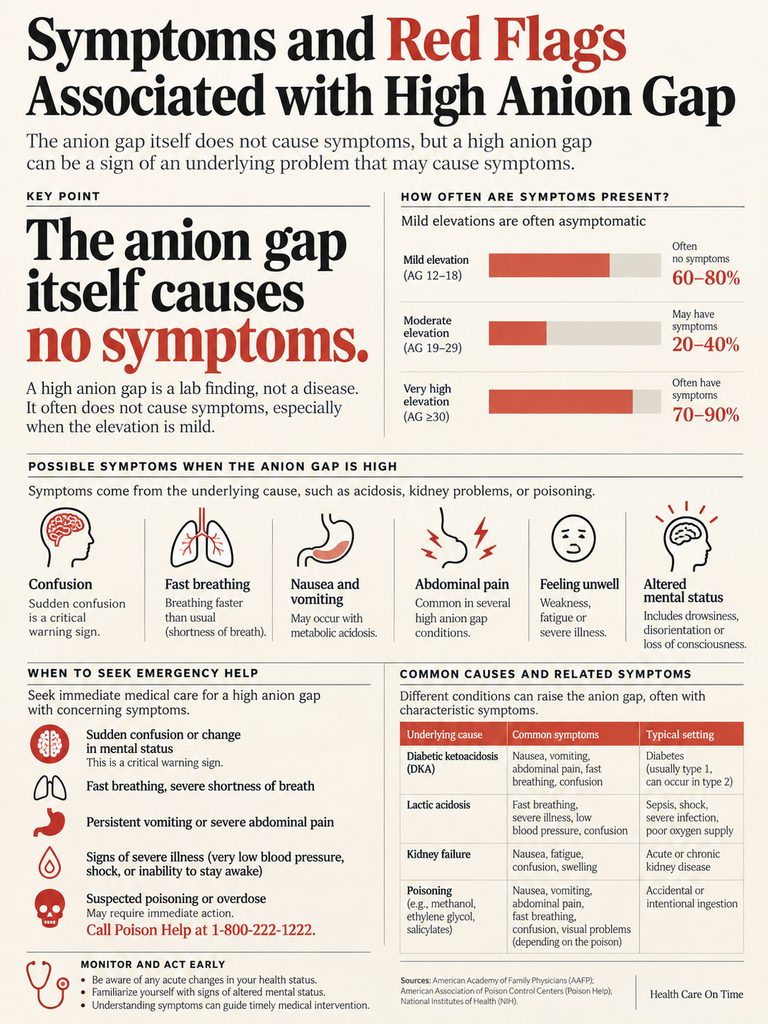
Go to the ER or call 911 if a high anion gap comes with any of these:
- Fast, deep, or labored breathing
- A fruity or nail-polish smell on the breath
- Repeated vomiting or severe belly pain
- Confusion, extreme drowsiness, or trouble waking
- Blood sugar of 250 mg/dL or higher, or positive ketones
- Feeling very unwell while taking an SGLT2 inhibitor, even with normal sugar
- Any known or possible swallowing of antifreeze, methanol, or a large aspirin dose
For a possible poisoning, call Poison Help at 1-800-222-1222 on the way. Sudden confusion has its own warning signs, covered in our altered mental status guide.
The Numbers Behind High Anion Gap Acidosis
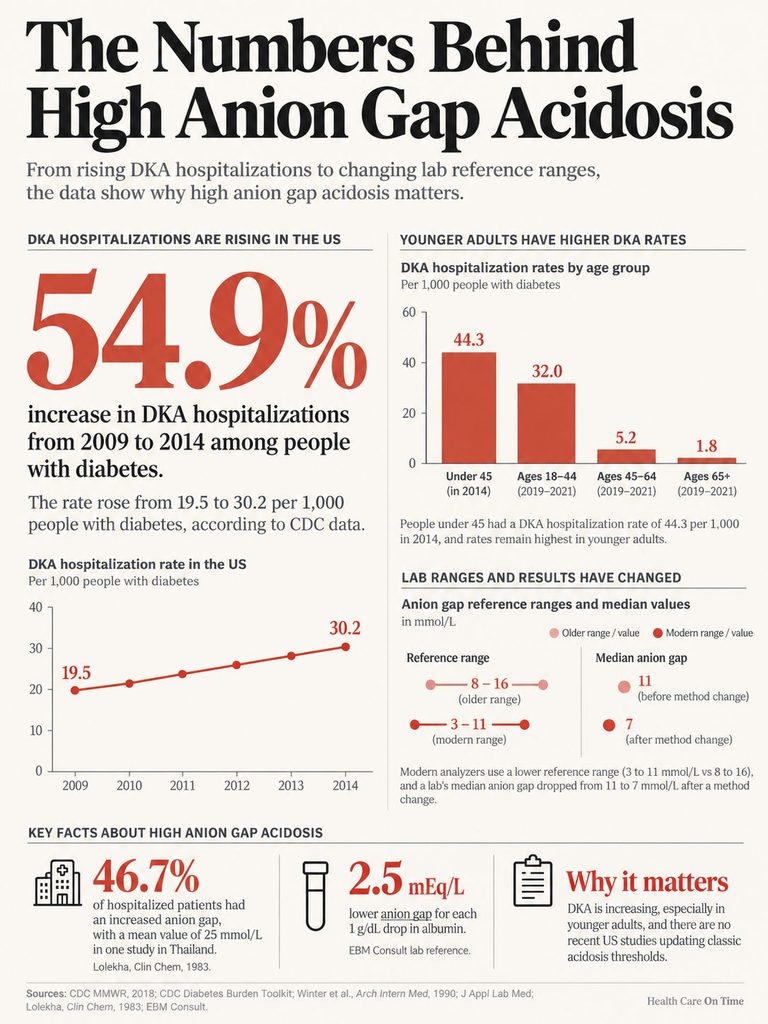
| Statistic | Figure | Source |
| Rise in US DKA hospitalizations, 2009 to 2014 | 19.5 to 30.2 per 1,000 people with diabetes (up 54.9%) | CDC MMWR, 2018 |
| DKA hospitalization rate, ages under 45 (2014) | 44.3 per 1,000 people with diabetes | CDC MMWR, 2018 |
| DKA hospitalization rate by age (2019 to 2021 data) | 32.0 (ages 18 to 44), 5.2 (45 to 64), 1.8 (65+) per 1,000 | CDC Diabetes Burden Toolkit |
| Modern analyzer reference range | 3 to 11 mmol/L vs older 8 to 16 | Winter et al., Arch Intern Med, 1990 |
| Median gap after one lab’s method change | Dropped from 11 to 7 mmol/L | J Appl Lab Med |
| Hospitalized patients with an increased gap | 46.7% (mean 25 mmol/L) | Lolekha, Clin Chem, 1983 (Thailand) |
| Albumin effect on the gap | About 2.5 mEq/L lower per 1 g/dL drop | EBMConsult lab reference |
The CDC trend matters because DKA is the cause most likely to send a younger adult with a high gap to the hospital. Between 2009 and 2014, the US rate rose 54.9%, and it was highest in people under 45.
The newer CDC Diabetes Burden Toolkit shows the same age pattern. Adults 18 to 44 had a DKA hospitalization rate of 32.0 per 1,000, compared with 5.2 for ages 45 to 64 and 1.8 for those 65 and older.
One limit is worth stating plainly. The hospital incidence figure comes from a 1983 Thai study, and the classic acidosis thresholds come from research done decades ago. They still guide practice, but no large recent US study has updated them.
How Doctors Work Up a High Anion Gap
A high anion gap is a starting point, not a diagnosis. This is the usual sequence.
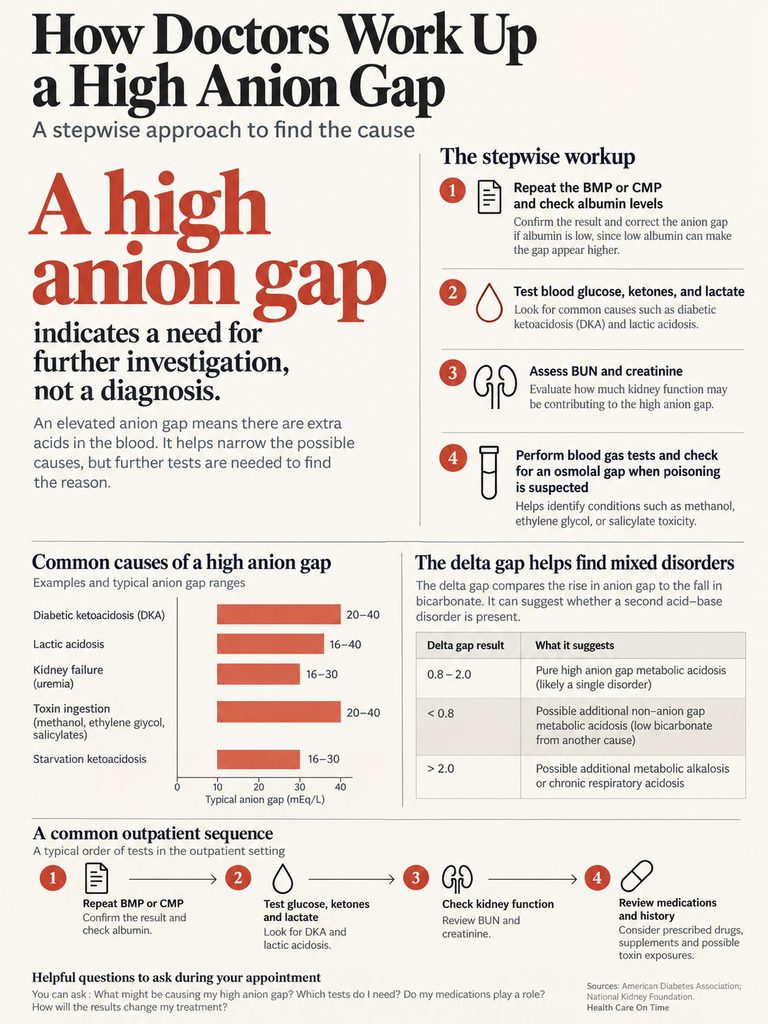
Step 1: Repeat the Panel and Check Albumin
A single mild flag often gets a repeat BMP or CMP within days to weeks. If albumin is low, doctors correct the gap, because it drops about 2.5 mEq/L for every 1 g/dL fall in albumin.
A common correction is: corrected gap = measured gap + 2.5 × (4.0 − albumin).
Example: A measured gap of 12 with albumin of 2.0 g/dL becomes 12 + 5 = 17. A “normal” result turns out to be high. This matters most in liver disease, malnutrition, and long hospital stays.
Step 2: Glucose, Ketones, and Lactate
Blood sugar and a ketone test (beta-hydroxybutyrate) separate DKA, euglycemic DKA, and starvation or alcoholic ketoacidosis. A lactate level checks for lactic acidosis.
Step 3: BUN and Creatinine
These show whether kidney function explains the gap. A slow rise in someone with stage 4 kidney disease is expected and managed with a nephrologist.
Step 4: Blood Gas and Osmolal Gap
A venous or arterial blood gas confirms blood pH. When poisoning is possible, an osmolal gap and specific drug levels (salicylate, methanol, ethylene glycol) follow.
The Delta Gap, Briefly
Doctors sometimes compare how much the gap rose with how much bicarbonate fell. A mismatch can reveal two problems at once, such as acidosis plus heavy vomiting. That’s why more tests may follow even after one cause is found.
In cases reviewed by our medical team, the most common outpatient sequence stays short: repeat panel, glucose, kidney numbers, and a medication review.
Questions to Bring to Your Appointment
- What is this lab’s normal range, and did it use potassium in the formula?
- Was the bicarbonate result normal?
- Should the gap be corrected for albumin?
- Could any current medicines play a role?
- When should the panel be repeated?
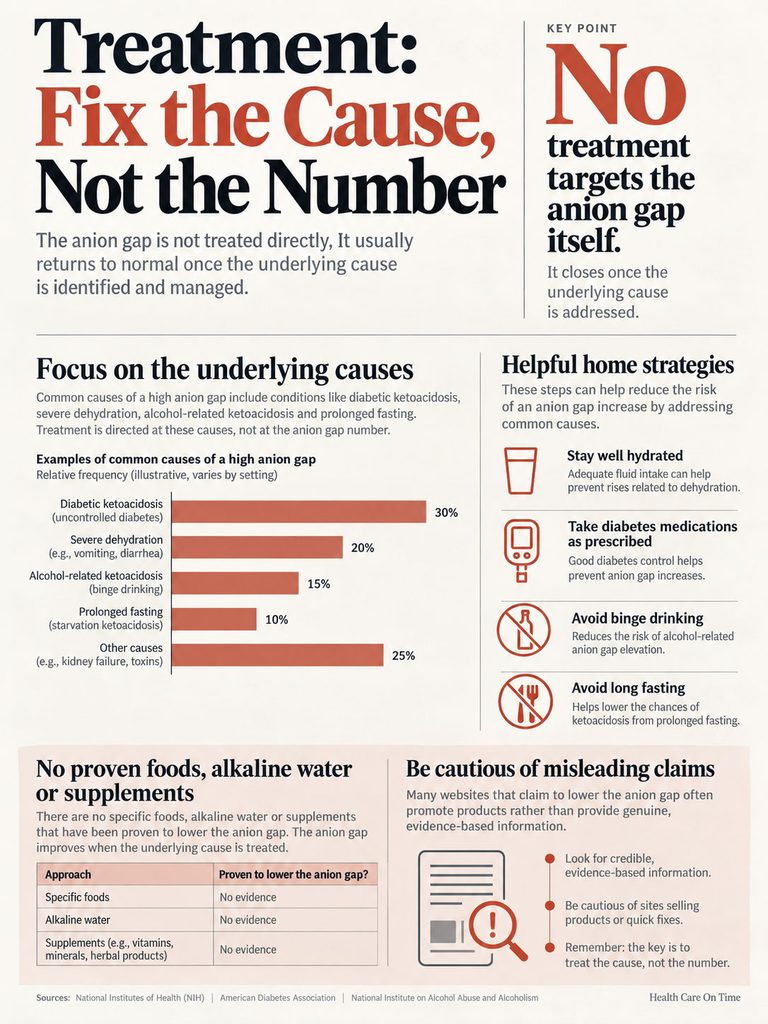
Treatment: Fix the Cause, Not the Number
No treatment aims at the anion gap itself. The gap closes when the cause is handled.
- DKA and euglycemic DKA: IV fluids, insulin, and potassium replacement, usually in a hospital. The SGLT2 drug is paused.
- Lactic acidosis: Treating infection, restoring blood pressure, or stopping a triggering drug.
- Alcoholic or starvation ketoacidosis: IV fluids with dextrose and thiamine.
- Toxic alcohols: Fomepizole, an antidote that blocks toxic breakdown, and sometimes dialysis.
- Salicylate poisoning: Bicarbonate to speed clearance, and dialysis in severe cases.
- Chronic kidney disease: Oral sodium bicarbonate or diet changes, guided by a nephrologist.
Can You Lower Your Anion Gap at Home?
Not directly. Drinking enough fluid helps if dehydration caused a mild rise. Taking diabetes medicines as prescribed, avoiding binge drinking, and skipping long fasts all lower the odds of the common causes.
No food, alkaline water, or supplement has been shown to lower the anion gap. Pages promising that are usually selling something.
Special Situations
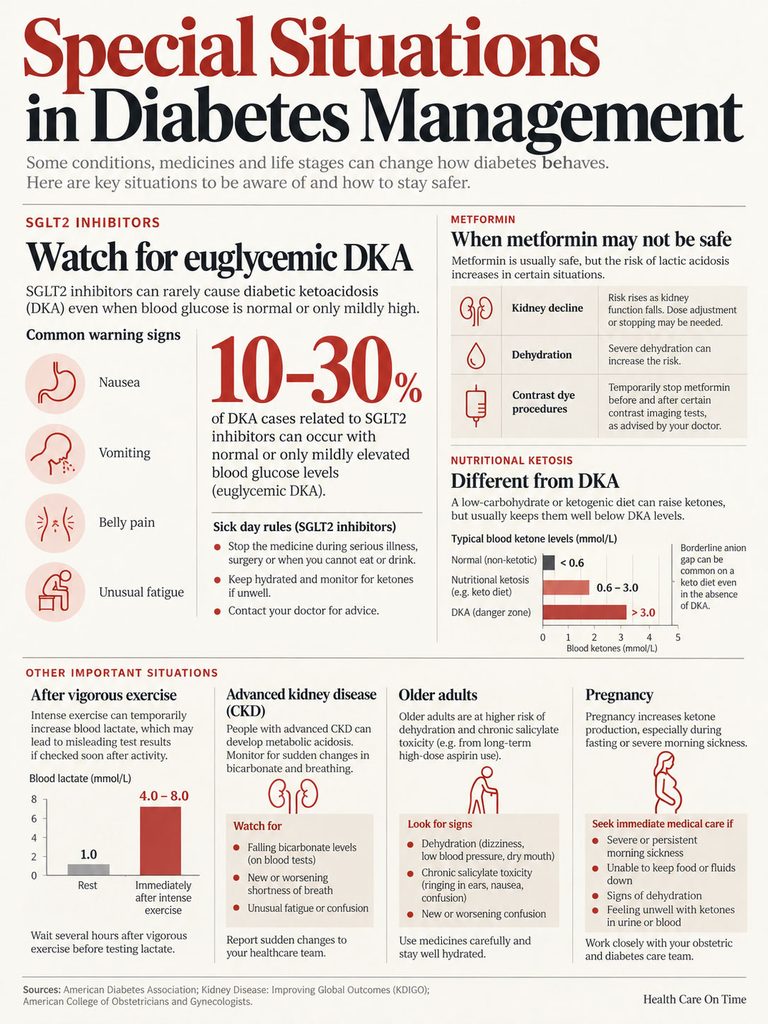
Diabetes on SGLT2 Inhibitors or Metformin
Anyone on an SGLT2 inhibitor should know the warning signs of euglycemic DKA: nausea, vomiting, belly pain, and unusual fatigue, sometimes with normal sugar. Ask your doctor for written “sick day rules,” including when to pause the drug if you can’t eat.
Metformin is safe for most people. The concern centers on sudden kidney decline, severe dehydration, or contrast dye procedures.
Keto Dieters, Fasting, and Athletes
Nutritional ketosis usually keeps ketones far below DKA levels. A borderline gap with normal bicarbonate is common on keto and rarely dangerous.
A hard workout lifts lactate briefly. If blood was drawn soon after a long run or heavy lifting, ask for a repeat on a rest day.
Kidney Disease
In advanced CKD, a modestly high gap is part of the disease. Watch for a sudden jump, falling bicarbonate, or new shortness of breath, which needs faster attention.
Older Adults
Older adults more often take daily aspirin, metformin, or acetaminophen, and they dehydrate more easily. Chronic salicylate toxicity can look like confusion or even a stroke. Our alcohol and aging guide covers how drinking adds to the risk.
Pregnancy
Pregnancy speeds up ketone production during fasting. Severe morning sickness with little food can push the gap up. Vomiting, belly pain, and a high gap during pregnancy call for a same-day call to your OB.
Next Steps by Scenario
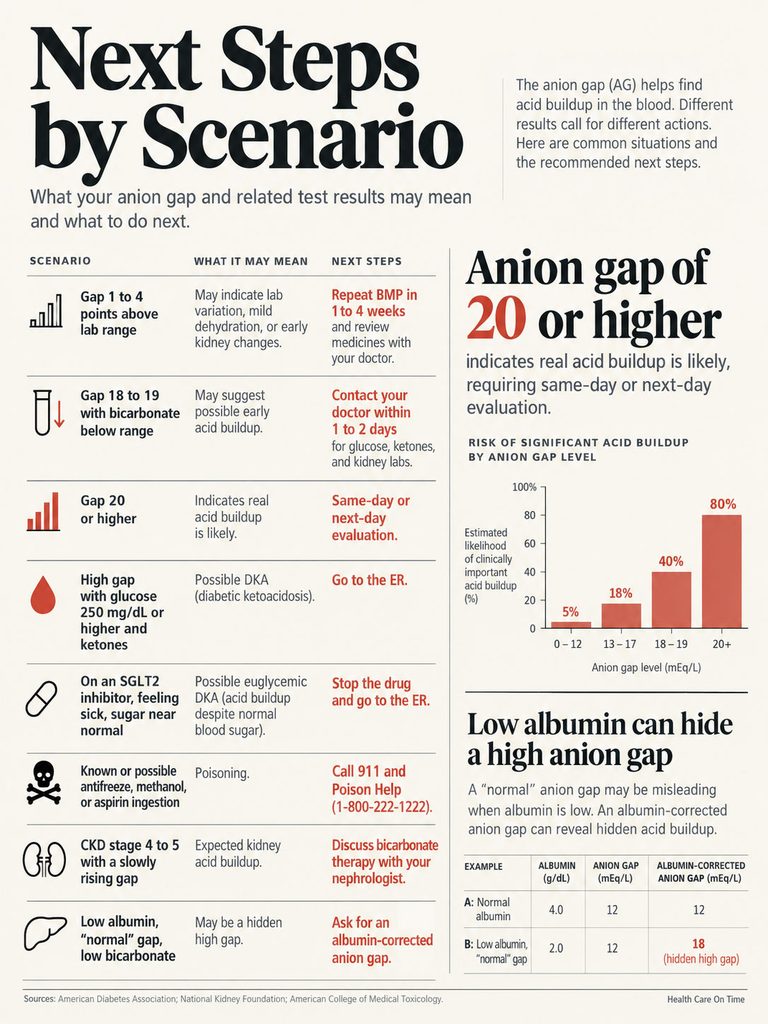
| Your scenario | What it likely means | Recommended action |
| Gap 1 to 4 points above lab range, normal bicarbonate, no symptoms | Lab variation, mild dehydration, or early kidney changes | Repeat BMP in 1 to 4 weeks; review medicines with your doctor |
| Gap 18 to 19 with bicarbonate below range | Possible early acid buildup | Doctor contact within 1 to 2 days; glucose, ketones, kidney labs |
| Gap 20 or higher | Real acid buildup likely, but not certain | Same-day or next-day evaluation |
| High gap plus glucose 250 mg/dL or higher and ketones | Possible DKA | ER now |
| On an SGLT2 inhibitor, feeling sick, sugar near normal | Possible euglycemic DKA | Stop the drug and go to the ER |
| Known or possible antifreeze, methanol, or aspirin ingestion | Poisoning | Call 911 and Poison Help (1-800-222-1222) |
| CKD stage 4 to 5 with a slowly rising gap | Expected kidney acid buildup | Discuss bicarbonate therapy with your nephrologist |
| Low albumin, “normal” gap, low bicarbonate | Hidden high gap | Ask for an albumin-corrected anion gap |
3 Myths About a High Anion Gap
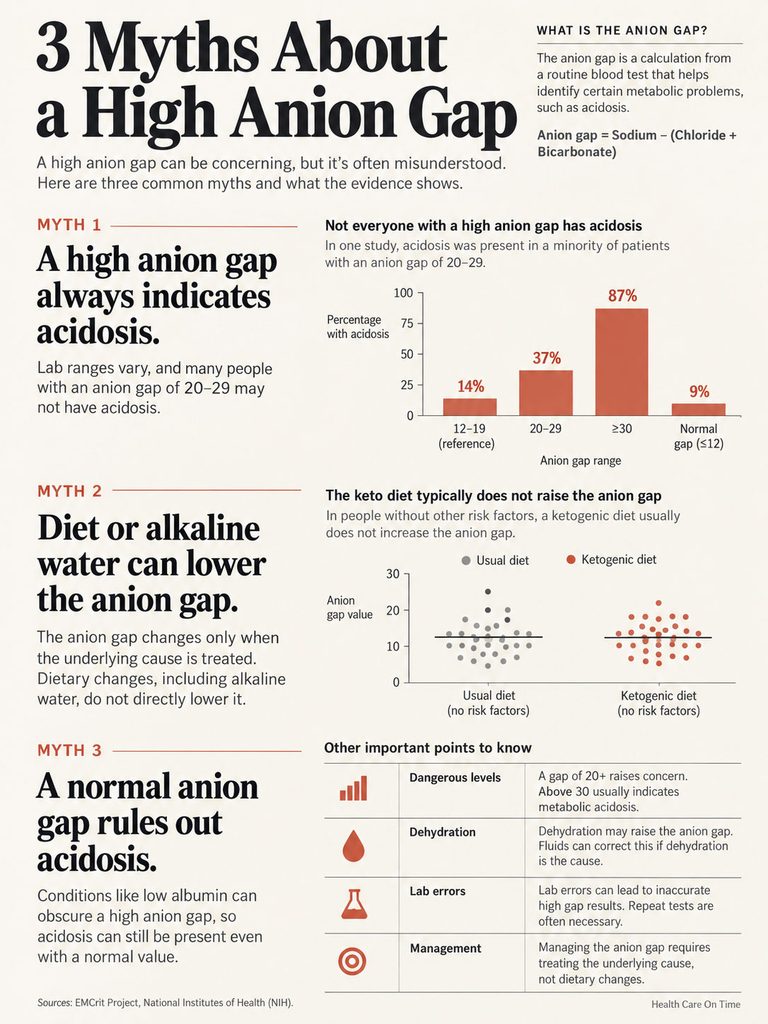
Myth 1: Anything above 12 means acidosis. Ranges depend on the lab. Even at 20 to 29, about a third of people don’t have acidosis.
Myth 2: Diet or alkaline water can lower it. The gap changes when the cause is treated. Fluids help only when dehydration was the cause.
Myth 3: A normal gap rules out acidosis. Low albumin can hide a high gap. Some acidosis types, such as those caused by severe diarrhea, keep a normal gap.
Frequently Asked Questions
What is a dangerous anion gap level?
There’s no single cutoff, but a gap of 20 or more raises concern, and above 30 almost always means metabolic acidosis. Danger also depends on bicarbonate, blood sugar, and symptoms. A gap of 22 with fast breathing and vomiting is an emergency; a gap of 13 with normal bicarbonate and no symptoms usually is not.
Is an anion gap of 14 bad?
Usually not on its own. At a lab with an upper limit of 16, it’s normal. At a lab with an upper limit of 11, it’s mildly high. With normal bicarbonate and no symptoms, most doctors simply repeat the panel. Check the range printed on your own report first.
Is an anion gap of 17 or 18 serious?
It deserves follow-up but is often not an emergency. Check bicarbonate first. If bicarbonate is normal and you feel well, a repeat panel within a week or two is typical. If bicarbonate is low, you have diabetes, or you take an SGLT2 inhibitor, contact your doctor within a day or two.
Can dehydration cause a high anion gap?
Yes. Dehydration concentrates sodium and albumin, which can push the gap up a few points. The rise is usually mild and bicarbonate stays normal. Drinking fluids and repeating the test often brings the number back into range. A large rise points to something more than dehydration.
Why is the anion gap high when bicarbonate is normal?
Common reasons include lab method differences, mild dehydration, or sample handling. Less often, two problems cancel each other, such as acidosis plus vomiting. Doctors usually repeat the test and check kidney function, glucose, and albumin before drawing conclusions about the result.
Can a lab error cause a high anion gap?
Yes. Sodium, chloride, and bicarbonate each carry small measurement errors, and the calculation adds them together. A tube left open to air can lower bicarbonate and raise the gap. A switch to a new analyzer can shift results by several points. A repeat draw settles most cases.
Does the keto diet raise the anion gap?
A well-run keto diet produces mild ketosis that usually leaves the gap and bicarbonate normal or close to it. Problems appear with keto plus heavy drinking, long fasts, illness with vomiting, or SGLT2 inhibitor use. Tell your doctor about the diet so the result is read correctly.
Can metformin cause a high anion gap?
Rarely. Metformin-related lactic acidosis happens mainly with a sudden drop in kidney function, severe dehydration, or serious illness. For most people with stable kidneys, metformin doesn’t raise the anion gap. Don’t stop it on your own; talk with your prescriber about any flagged result first.
How do you lower the anion gap?
By treating the cause. That may mean correcting dehydration, controlling blood sugar, stopping a triggering drug, or managing kidney disease. No food, supplement, or alkaline water directly lowers the anion gap, so be wary of websites selling “anion gap” remedies or detox products.
Does a high anion gap mean kidney failure?
Not necessarily. Advanced kidney disease is one cause, but so are DKA, lactic acidosis, fasting, alcohol, and lab variation. The BUN and creatinine on the same panel answer the question. A normal creatinine and eGFR make kidney failure an unlikely explanation for the gap.
Should someone go to the ER for a high anion gap?
Yes, if the high gap comes with fast breathing, vomiting, belly pain, confusion, blood sugar over 250 mg/dL, illness while on an SGLT2 inhibitor, or possible poisoning. A mild flag with no symptoms and normal bicarbonate usually calls for a doctor visit and a repeat test instead.
How often should the anion gap be rechecked?
For a mild, symptom-free flag, a repeat in one to four weeks is common. People with kidney disease or diabetes often see it at every routine metabolic panel. During hospital treatment for DKA, doctors recheck it every few hours until the gap closes.
Disclaimer: This article is for general education and does not replace advice from a licensed healthcare professional. A high anion gap must be interpreted alongside your symptoms, other lab results, medications, and medical history. If you have trouble breathing, confusion, persistent vomiting, or a possible poisoning, call 911 or Poison Help at 1-800-222-1222 right away.
References
- MedlinePlus: Anion Gap Blood Test
- Cleveland Clinic: Anion Gap Blood Test
- CDC MMWR: Trends in Diabetic Ketoacidosis Hospitalizations and In-Hospital Mortality, United States, 2000 to 2014
- CDC Diabetes Burden Toolkit: Diabetic Ketoacidosis Hospitalizations
- FDA: SGLT2 Inhibitor Label Revisions on Ketoacidosis and Surgery
- Winter SD et al. The fall of the serum anion gap. Arch Intern Med, 1990
- Journal of Applied Laboratory Medicine: Reference interval verification for calculated values
- Gabow PA et al. Diagnostic importance of an increased serum anion gap. N Engl J Med, 1980
- Brandis K. Acid-Base Physiology: The Anion Gap (LibreTexts)
- Lolekha PH. Value of the anion gap in clinical diagnosis and laboratory evaluation. Clin Chem, 1983
- EBMConsult: Lab Test, Anion Gap
- The association between initial anion gap and outcomes in medical ICU patients (PMC)
- Acetaminophen-induced anion gap metabolic acidosis and 5-oxoprolinuria (Science.gov summary)