
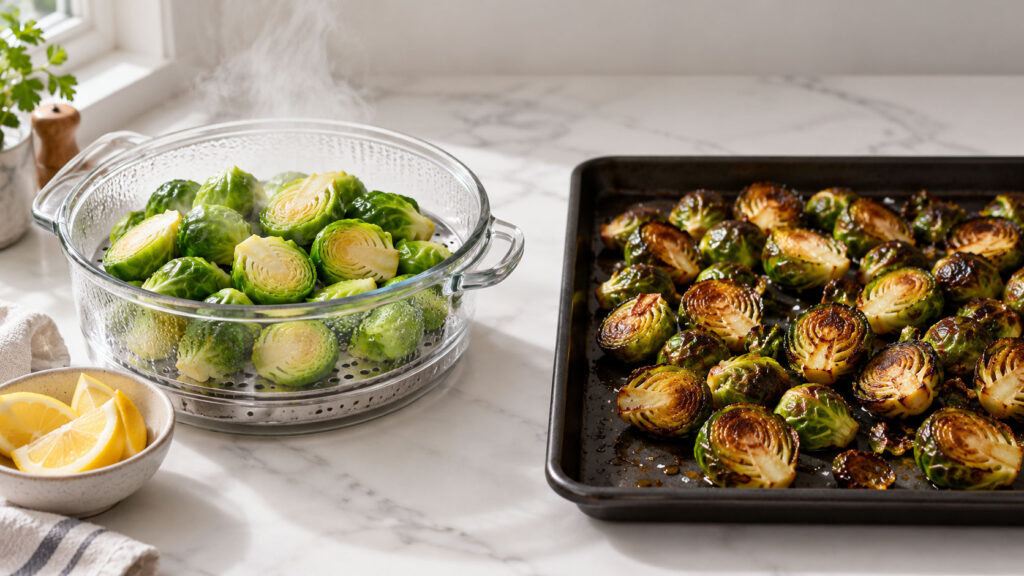
Roasted Brussels sprouts kept only about half of their most-studied compounds in lab testing. Steamed sprouts kept all of them. And yet, the browned, oven-heated sprouts still did something in the lab that caught researchers off guard.
Table of Contents
So which belongs on your plate tonight? It depends on what “healthier” means to you. Our medical review team worked through the lab studies, the USDA numbers, and the oil math to give you a straight answer.
Quick Answer: Steamed Brussels sprouts are healthier on most measures. In Newcastle University testing, steaming kept over 100% of the sprouts’ glucosinolates, while roasting kept about 54%. Steaming also adds zero oil calories. Roasting still helps: oil boosts vitamin K absorption, and many people eat more sprouts when they’re roasted. For the best of both, steam for 5 to 7 minutes, or roast hot and fast with about 1 teaspoon of oil per serving.
Brussels sprouts cooking methods, ranked by glucosinolate retention:
- Steamed (5 to 10 minutes)
- Microwaved with a splash of water
- Boiled briefly (under 6 minutes)
- Roasted at 400 to 425°F
- Boiled for a long time (30 minutes)
At a Glance
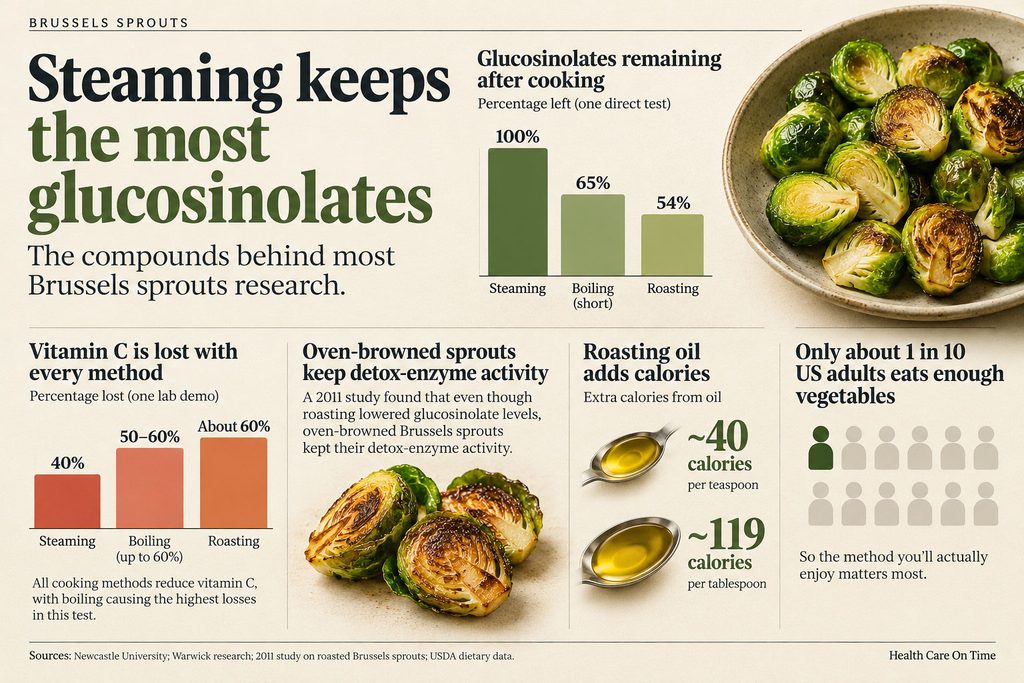
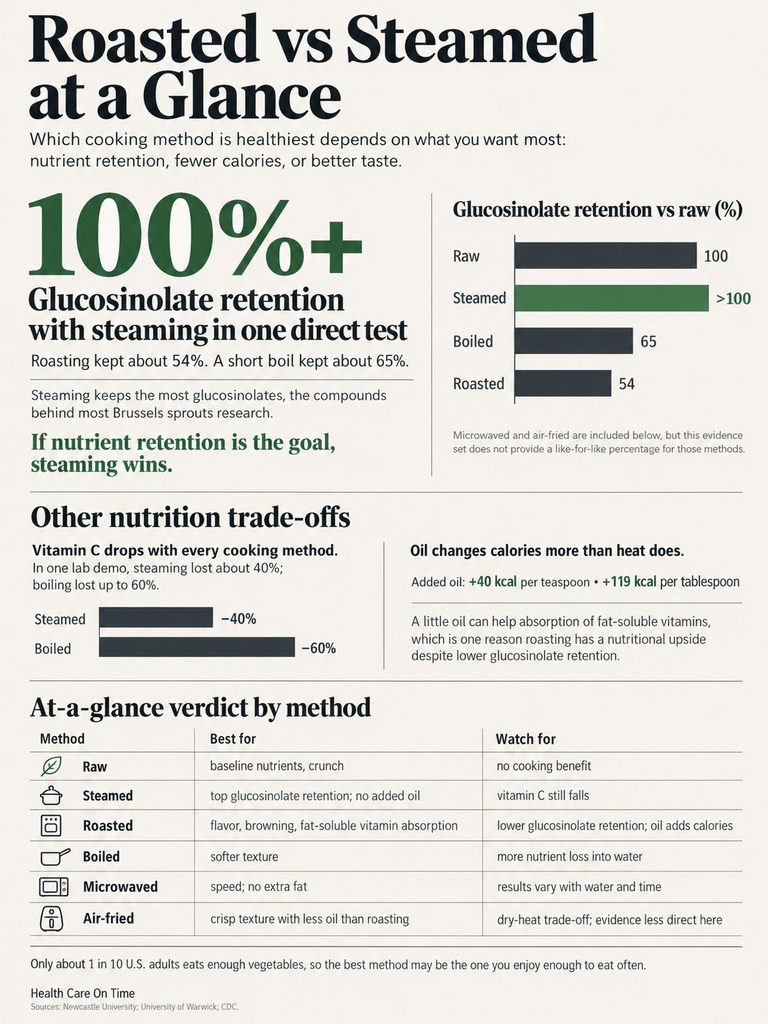
- Steaming keeps the most glucosinolates, the compounds behind most Brussels sprouts research.
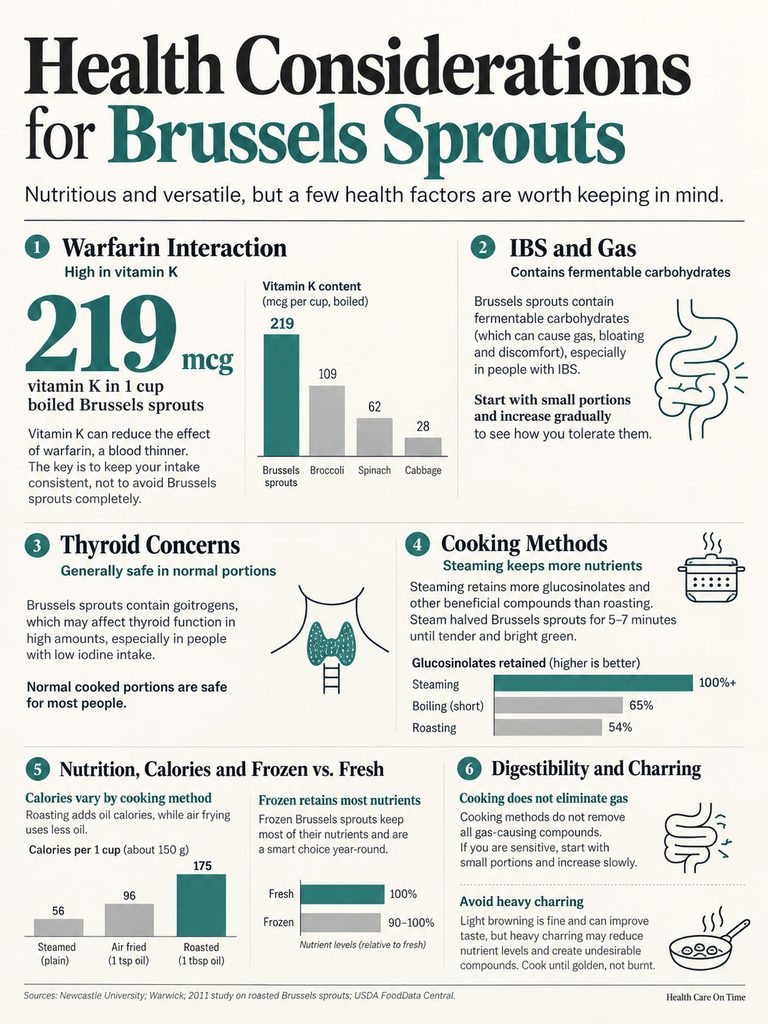
- Roasting kept about 54% of glucosinolates in one direct test, below a short boil at 65%.
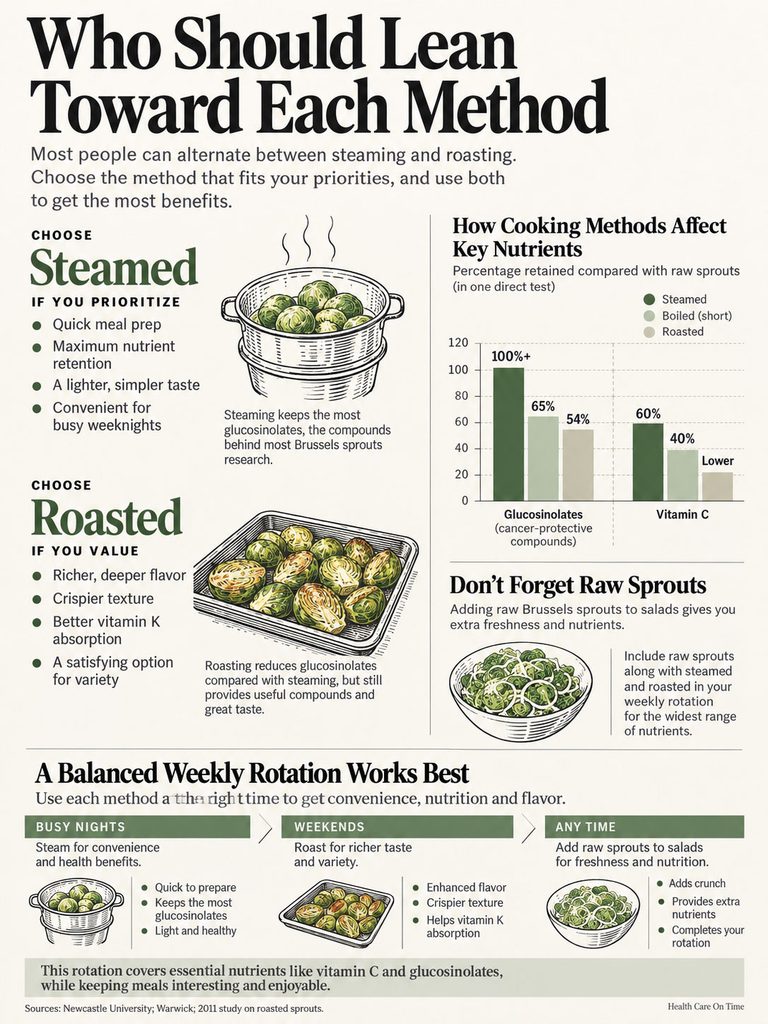
- Every method costs vitamin C. In one lab demo, steaming lost about 40% and boiling up to 60%.
- Oven-browned sprouts kept their detox-enzyme activity in a 2011 study despite low glucosinolate levels.
- Roasting oil adds about 40 calories per teaspoon and 119 per tablespoon.
- Only about 1 in 10 US adults eats enough vegetables, so the method you’ll actually enjoy matters most.
Roasted vs Steamed at a Glance: The Side-by-Side Verdict
Here’s the short version. This table compares the common home methods across the measures that matter most.
Patients who book nutrition-related lab panels with us often ask whether cooking strips the nutrients out of their vegetables. The answer is no, but some methods protect much more than others.
| Method | Glucosinolate retention | Vitamin C | Added calories (¼ lb serving) | Fat-soluble vitamin absorption | Best for |
| Raw (shaved) | 100% baseline | Highest (85 mg per 100 g, USDA) | 0 | Low unless dressed with oil | Max vitamin C, slaws |
| Steamed (5–7 min) | Over 100% of raw (Newcastle); no significant loss up to 20 min (Warwick) | About 40% loss in one lab demo | 0 | Low unless oil added after | Max glucosinolates, weight loss |
| Roasted (400–425°F) | About 54% of raw (Newcastle) | Not measured for sprouts; no water leaching, but long dry heat costs some | +40 with 1 tsp oil; +60 with a typical 2 tbsp per lb | Higher, thanks to oil | Flavor, picky eaters |
| Boiled | 65% (short boil, Newcastle); 42% after 30 min (Warwick) | Up to 60% loss | 0 | Low | Least recommended |
| Microwaved (little water) | Good retention (Italian study) | Losses with every method | 0 | Low | Speed, color, carotenoids |
| Air-fried | No sprout-specific data | No sprout-specific data | About +10 to +20 (light spray) | Moderate | Crisp texture, less oil |
Why “Healthier” Depends on What You’re Measuring
A Brussels sprout isn’t one nutrient. It’s a package of vitamin C, vitamin K, folate, fiber, and sulfur compounds called glucosinolates.
Each reacts to heat differently. Fiber barely changes, and vitamin K stays fairly stable. Vitamin C and glucosinolates are fragile, and that’s where cooking methods split apart.
So the winner depends on your goal. For glucosinolates and calories, steaming leads. For taste and fat-soluble vitamin absorption, roasting has the edge.
What Happens Inside a Brussels Sprout When You Cook It
To see why roasted and steamed Brussels sprouts end up so different, it helps to know what breaks down inside them.
Glucosinolates and Myrosinase, Explained Simply
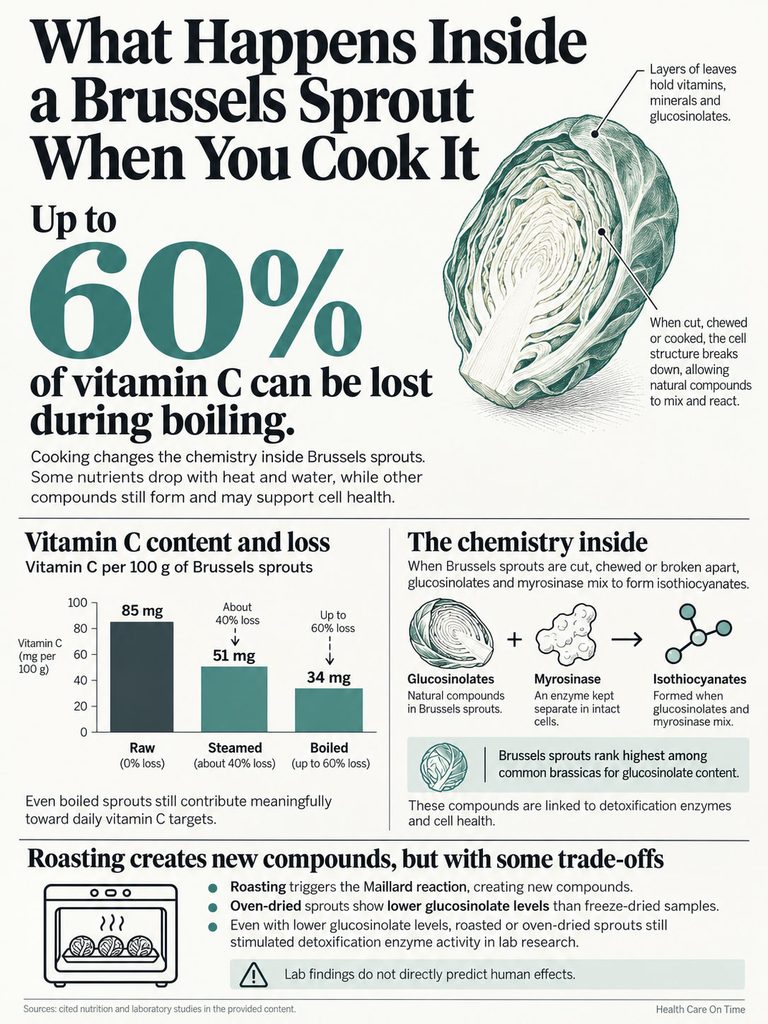
Brussels sprouts store glucosinolates in their cells. They keep an enzyme called myrosinase separately. When you chop or chew a sprout, the two mix and form isothiocyanates, including sulforaphane.
Isothiocyanates are the focus of most cruciferous vegetable research. Scientists study them for their effects on detoxification enzymes and cell health.
Brussels sprouts are unusually rich in them. A 2025 analysis in the Journal of Food Composition and Analysis ranked Brussels sprouts first for glucosinolates among seven brassicas tested, ahead of cabbage, broccoli, and kale.
Heat matters in two ways. It breaks glucosinolates down directly. It also deactivates myrosinase, so fewer isothiocyanates form when you eat cooked sprouts.
Vitamin C: The Nutrient Every Method Loses
Vitamin C dissolves in water and breaks down with heat. That makes it the most fragile nutrient in a Brussels sprout.
USDA FoodData Central lists raw sprouts at about 85 mg of vitamin C per 100 grams and boiled, drained sprouts at about 62 mg. These are separate lab analyses, not a before-and-after test, so treat the gap as a rough guide.
In a lab demonstration at the UK’s MRC Human Nutrition Research unit, steamed sprouts lost about 40% of their vitamin C, while boiled sprouts lost up to 60%. An Italian study in the Journal of Agricultural and Food Chemistry also found large vitamin C losses with every method it tested.
The good news is that you start with a lot. A cup of boiled sprouts still provides about 97 mg, above the NIH daily target of 75 mg for women and 90 mg for men.
The Maillard Twist: Why Browning Isn’t Pure Loss
This is where the roasted side gets interesting. Browning creates new compounds through the Maillard reaction, the same chemistry behind toasted bread and seared steak.
A 2011 study in the Journal of Food Science compared freeze-dried sprouts with oven-dried sprouts. The oven-dried sprouts held far fewer glucosinolates: 0.85 versus 22.14 μmol/g.
Yet in cell and animal tests, the oven-dried sprouts still switched on detoxification enzymes. The researchers suggested that Maillard reaction products formed during heating may be doing that work.
Our medical reviewers flag two limits. Oven-drying isn’t the same as home roasting, and lab results don’t prove the same effect in people. Still, it shows “roasted means ruined” is too simple.
The Case for Steamed Brussels Sprouts
For keeping glucosinolates intact, steamed Brussels sprouts have the strongest evidence.
The Newcastle Data: Above 100% Retention
The clearest roasted vs steamed Brussels sprouts comparison comes from doctoral research at Newcastle University, supervised by nutrition scientist Dr. Kirsten Brandt.
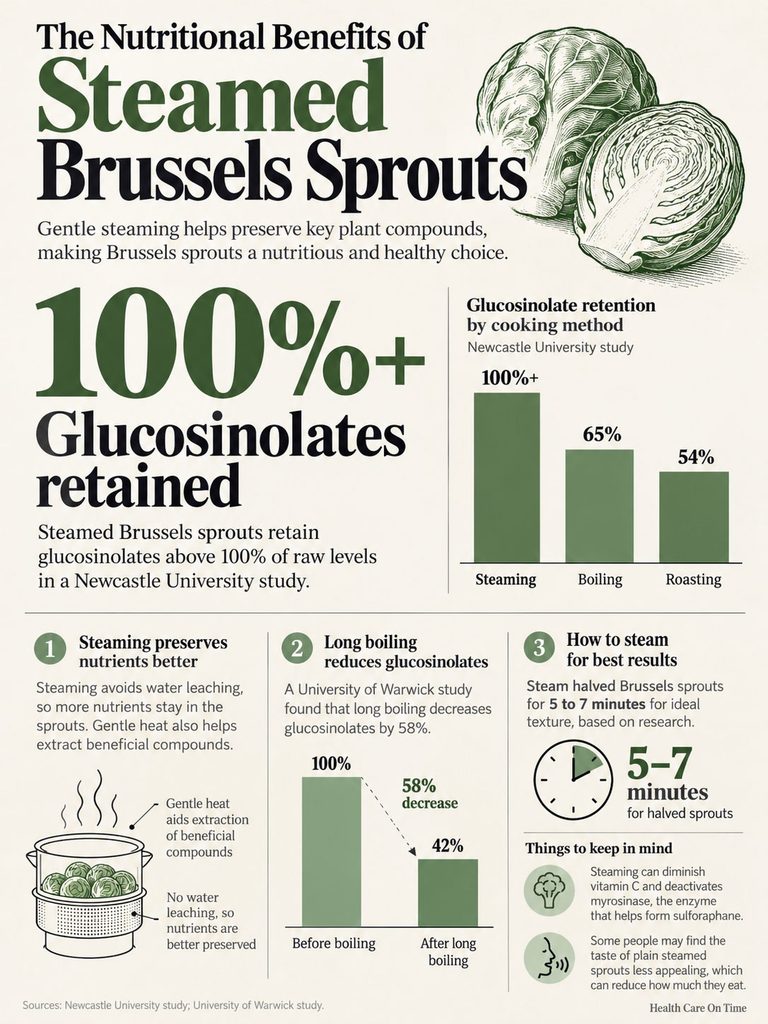
The team tested boiling, steaming, and roasting side by side. Steaming raised measured glucosinolates above 100% of raw levels. Boiling kept 65%, and roasting kept 54%.
How can steaming top 100%? Gentle heat softens plant tissue, which may release glucosinolates that were harder to measure in raw sprouts. Steaming doesn’t create new compounds; it makes existing ones easier to extract.
Brandt explained in coverage of the work that boiling pushes compounds into the water, roasting breaks them down, and steaming leaves the most in the finished sprout.
The Warwick Study: Why Time Matters More Than Steam
An older study points the same way. University of Warwick researchers, publishing in Food and Chemical Toxicology in 2007, tested four brassicas.
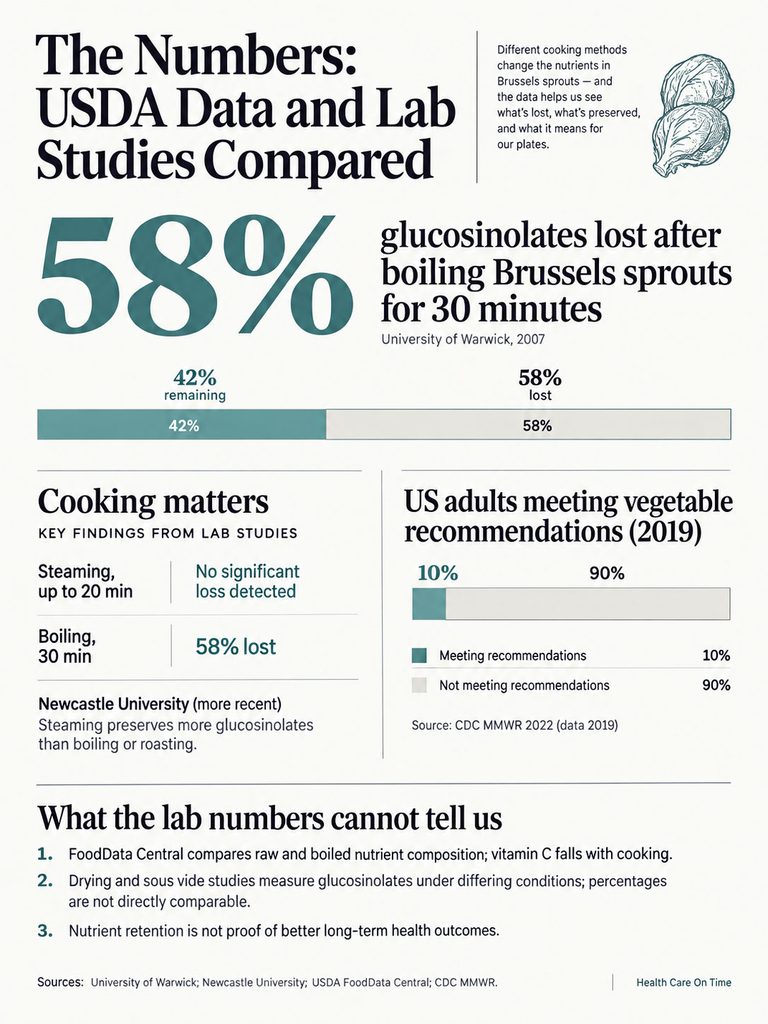
Boiling Brussels sprouts for 30 minutes cut total glucosinolates by 58%. Steaming for up to 20 minutes, microwaving for up to 3 minutes, and stir-frying for up to 5 minutes caused no significant loss.
The lesson: water and long cooking cause the most damage. Steam keeps sprouts out of the water, so their compounds don’t leach away. The 2025 Australian analysis agreed, finding glucosinolates stayed relatively stable after light steaming.
The 5 to 7 Minute Sweet Spot
For halved sprouts, 5 to 7 minutes of steaming usually gets you bright green and fork-tender. Small sprouts may need 4 minutes; large ones, about 8.
Stop when a knife slides into the core with light resistance. Past that point, sprouts turn olive-drab and develop the sulfur smell that gave them a bad reputation.
Where Steaming Falls Short
Steaming isn’t perfect. It still costs vitamin C, and heat still deactivates much of the myrosinase.
The bigger problem is taste. Plain steamed sprouts can be bland or bitter, and many people won’t eat them. Among the questions our care team fields, complaints about the taste of steamed sprouts come up far more often than any nutrient worry.
The research isn’t fully settled either. A Polish study comparing boiling and steaming found steaming favored nitriles over isothiocyanates and concluded boiling worked better in its setup. Results shift with timing, variety, and how compounds are measured.
The Case for Roasted Brussels Sprouts
Roasted Brussels sprouts lose more glucosinolates. But they bring advantages that lab numbers alone don’t capture.
Oil Helps Your Body Use Vitamin K
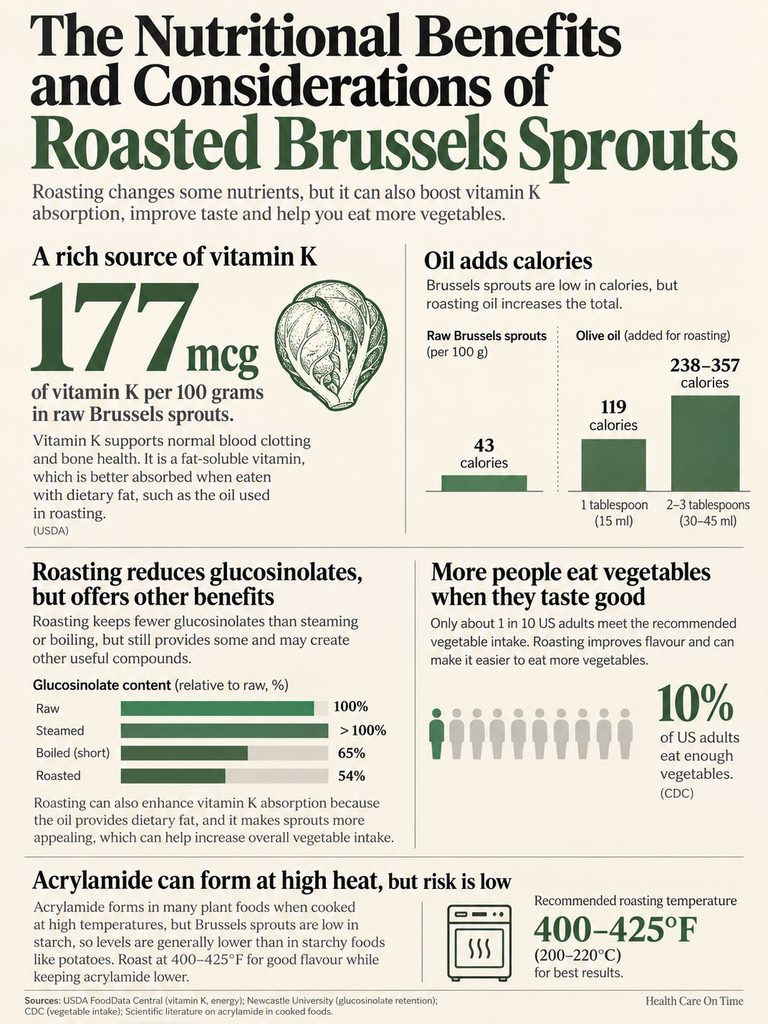
Brussels sprouts are loaded with vitamin K: about 177 mcg per 100 grams raw, per USDA data. That’s well above the NIH adequate intake of 90 mcg for women and 120 mcg for men.
Vitamin K is fat-soluble, so your body absorbs it better with some fat in the same meal. Roasting oil handles that automatically.
Steamed sprouts can match this. Toss them with a teaspoon of olive oil, or eat them with a meal that includes some fat.
The Real Calorie Cost of Roasting Oil
Almost no comparison online spells this out. Brussels sprouts are very low in calories, about 43 per 100 grams raw. The oil is where the calories come from.
A tablespoon of olive oil has about 119 calories, per USDA data. A teaspoon has about 40.
Many recipes use 2 to 3 tablespoons per pound of sprouts. That’s 240 to 360 calories of oil spread across four servings.
Teaspoon vs Tablespoon: The Math
Here’s a quarter-pound serving, made four ways:
- Steamed, plain: about 49 calories
- Roasted with 1 teaspoon oil: about 89 calories
- Roasted with a typical 2 tablespoons per pound: about 109 calories
- Roasted with bacon and a balsamic-maple glaze: often 140 or more
None of these is “unhealthy.” Olive oil adds heart-friendly fats. But if you’re counting calories, the oil makes the difference, not the cooking method.
The Strongest Argument: You’ll Actually Eat Them
This may matter most. According to the CDC, only about 10% of US adults eat enough vegetables.
A steamed sprout pushed around the plate delivers nothing. A roasted sprout you happily eat seconds of wins every time.
Dietitians increasingly agree. As one registered dietitian told reporters, the best vegetables are the ones you actually want to eat.
Acrylamide and Charring: What’s Known and What Isn’t
Acrylamide forms in some foods cooked at high heat. The FDA notes it shows up mainly in potato-based foods, cereal-based foods, and coffee.
Brussels sprouts are low in the starch that drives most acrylamide formation. Published, sprout-specific acrylamide data is scarce, so no one can give you a reliable number.
The practical rule is simple: golden-brown, not black. Trim fully charred leaves, and roast at 400 to 425°F rather than higher.
Who Should Lean Toward Each Method
Most people can rotate freely between both. But a few groups have a clear reason to favor one side.
Lean Toward Steamed If You
- Are cutting calories and want the lowest-calorie side possible
- Eat Brussels sprouts mainly for their glucosinolates and sulforaphane
- Have reflux or a sensitive stomach that reacts to oily, browned foods
- Need a fast weeknight side with almost no cleanup
Lean Toward Roasted If You
- Rarely eat vegetables and need a version you’ll actually enjoy
- Cook for kids or picky eaters who reject the steamed texture
- Want more vitamin K absorption without adding fat elsewhere in the meal
- Like batch cooking, since roasted sprouts reheat with better texture
The Best Answer for Most Households
Across the families our care team works with, the most practical approach is a weekly mix. Steam on busy nights, roast on weekends, and shave a few raw into salads.
That rotation covers vitamin C, glucosinolates, and fat-soluble vitamin absorption in one week. It also keeps sprouts interesting enough that they stay on the menu.
The Numbers: USDA Data and Lab Studies Compared
This table brings together the key data behind the roasted vs steamed Brussels sprouts question. Our nutrition review team checked each figure against its source.
| Source | Key finding | What it means for you |
| USDA FoodData Central (raw vs boiled, per 100 g) | Raw: 43 kcal, 85 mg vitamin C, 177 mcg vitamin K. Boiled: 36 kcal, 62 mg vitamin C, 140 mcg vitamin K | Separate analyses, but boiling clearly costs vitamin C |
| Newcastle University (Brandt group, 2024) | Glucosinolate retention: steamed over 100%, boiled 65%, roasted 54% | Steaming is the best-tested method for these compounds |
| University of Warwick, Food Chem Toxicol 2007 | 30-minute boil: 58% glucosinolate loss; steaming up to 20 min: no significant loss | Water and long cook times do the damage |
| Journal of Food Science, 2011 | Oven-dried sprouts: 0.85 vs 22.14 μmol/g glucosinolates, yet detox-enzyme induction kept | Browning may produce its own useful compounds |
| Foods, 2024 (Sadowska-Rociek et al.) | Sous vide lost more glucosinolates than conventional cooking; isothiocyanates and indoles similar | Gentler heat isn’t automatically better |
| MRC Human Nutrition Research (UK demo) | Vitamin C loss: steamed about 40%, boiled up to 60%, frozen about 30% before cooking | Raw or quick cooking wins for vitamin C |
| CDC MMWR 2022 | About 10% of US adults meet vegetable recommendations | Eating more matters more than method |
What This Research Can’t Tell You
Three limits are worth keeping in mind before you change how you cook.
First, most studies measure compounds in the sprout, not health outcomes in people. A 46-point gap in glucosinolates doesn’t mean roasted sprouts offer 46% less benefit.
Second, much of the data comes from European produce, small samples, and lab ovens. Your sprouts, oven, and timing will differ.
Third, the Newcastle numbers come from doctoral research, not a large published trial. Our medical reviewers treat these results as a clear direction, not a final verdict: less water, shorter time, gentler heat.
What About Microwaved, Air-Fried, Boiled, and Frozen?
Roasted and steamed aren’t your only options. Here’s how the others compare.
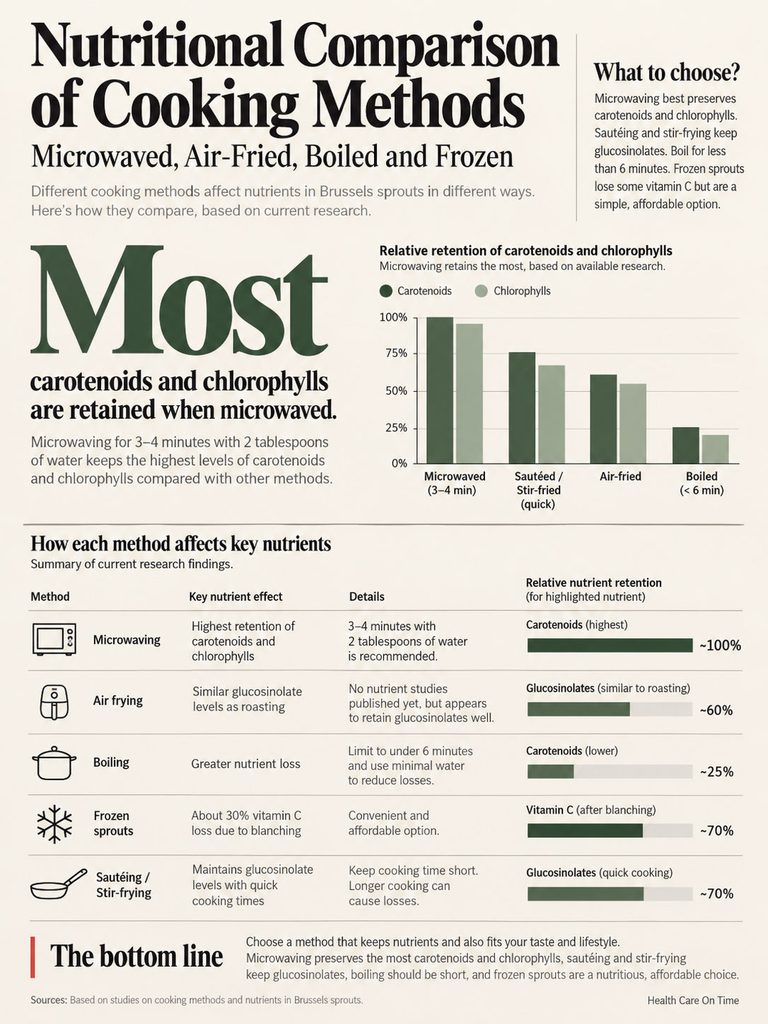
Microwaved
Microwaving with a splash of water is basically fast steaming. A 2017 lab study (PMC5758100) found microwaved sprouts held the most carotenoids and chlorophylls, ahead of steamed and raw.
The Italian study also rated microwaving best for color and good for glucosinolates. Use a covered dish, 2 tablespoons of water, and 3 to 4 minutes.
Air-Fried
Air frying is roasting in a small box with faster airflow. It usually needs just a light spray of oil.
No published study measures nutrients in air-fried sprouts yet. Expect glucosinolate results near roasting, with fewer oil calories.
Boiled
Boiling is the weakest choice. Compounds leach into the water, and longer boils cause bigger losses.
If you boil, keep it under 6 minutes and use as little water as possible. Saving the cooking water for soup recovers some of what leaches out.
Frozen
Frozen sprouts are blanched before freezing, which costs some vitamin C and deactivates myrosinase. The MRC demo measured about 30% vitamin C loss before any cooking.
They’re still a smart buy: affordable, convenient, and available year-round. Roast them straight from frozen for better texture.
Sautéed and Stir-Fried
Pan cooking sits between steaming and roasting. The Warwick team found stir-frying for up to 5 minutes caused no significant glucosinolate loss, but the 2025 Australian analysis saw losses when broccoli was stir-fried longer.
The difference is time and heat. A quick toss of shredded sprouts in a hot pan with 1 teaspoon of oil keeps more than a 20-minute sauté until deeply browned.
Buying and Storing Brussels Sprouts to Protect Nutrients
What happens before cooking matters too. Smart buying and storage protect the vitamin C and glucosinolates you’re trying to keep.
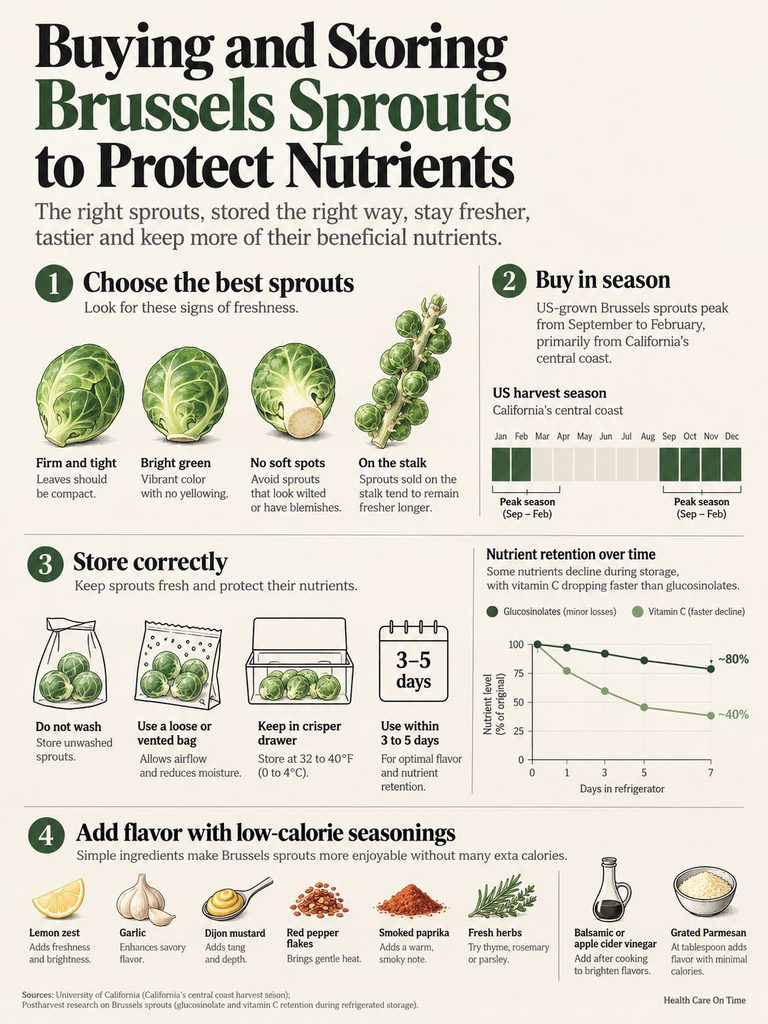
Choosing Fresh Sprouts
Look for firm, tight, bright green heads about 1 to 1.5 inches across. Yellowing leaves, soft spots, or a strong cabbage smell signal older sprouts that have already lost quality.
US-grown sprouts peak from September through February, with most coming from California’s central coast. Sprouts sold still on the stalk tend to stay fresher longer.
Storing Them at Home
Keep unwashed sprouts in a loose or vented bag in the crisper drawer, at 32 to 40°F. Use them within 3 to 5 days for the best flavor and vitamin C.
The Warwick researchers found only minor glucosinolate losses over 7 days in the refrigerator. Vitamin C fades faster, so cook sooner if that’s your priority.
Seasoning Without Extra Calories
Flavor is what turns steamed sprouts from a chore into a side you’ll repeat. Lemon zest, garlic, Dijon mustard, red pepper flakes, smoked paprika, and fresh herbs add punch with almost no calories.
A splash of balsamic or apple cider vinegar after cooking brightens either method. A tablespoon of grated Parmesan adds about 20 calories and plenty of savory depth. Our dietitian reviewers suggest adding acids after cooking, since they can dull the green color during heating.
Common Mistakes That Cost You Nutrients
Patients commonly ask us what they’re getting wrong with Brussels sprouts. These six mistakes come up most:
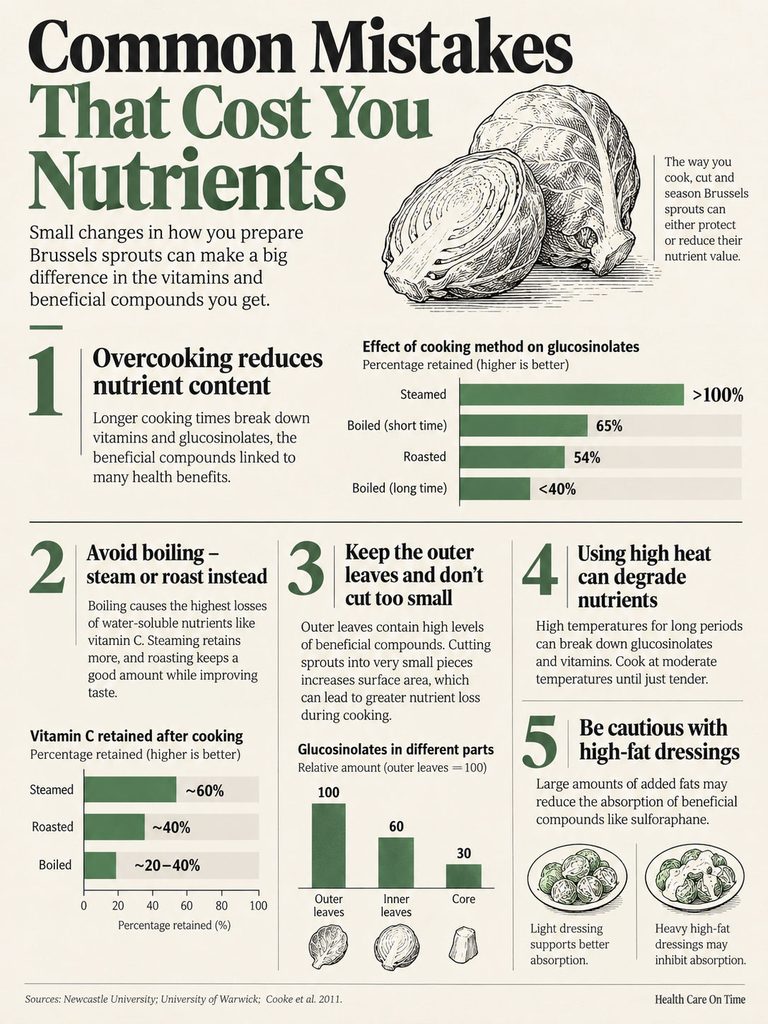
- Boiling until soft and gray. Long boils cause the biggest glucosinolate losses.
- Roasting until black. Heavy charring breaks down compounds and adds bitter flavors.
- Drowning sprouts in oil. Oil pooling on the pan adds calories, not flavor.
- Steaming past 10 minutes. Mushy, sulfurous sprouts mean you eat fewer.
- Prepping days ahead. Cut sprouts slowly lose vitamin C. Slice close to cooking time.
- Skipping fat entirely. A little fat helps you absorb vitamin K.
How to Cook Brussels Sprouts for Maximum Benefit
The healthiest way to cook Brussels sprouts balances nutrient retention with flavor you’ll enjoy. These three methods do both.
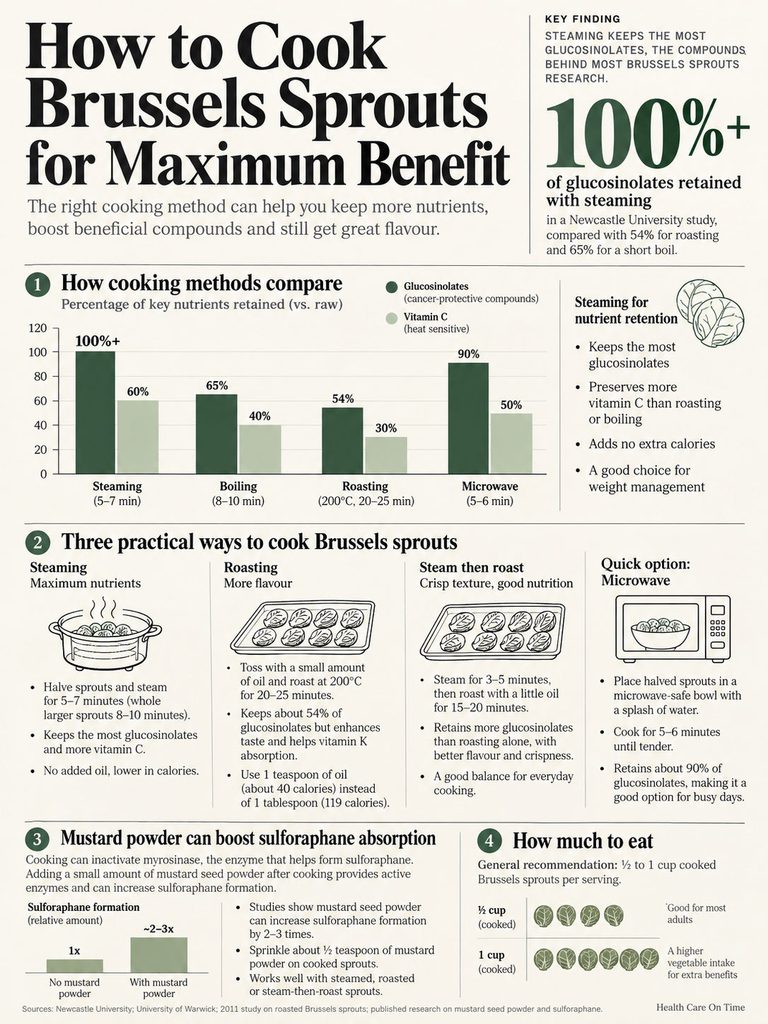
Best Steamed Method
- Trim the stem ends and halve the sprouts.
- Bring 1 inch of water to a boil under a steamer basket.
- Add sprouts, cover, and steam 5 to 7 minutes.
- Toss with 1 teaspoon olive oil, lemon juice, salt, and pepper.
Healthier Roasting Method
- Heat the oven to 400 to 425°F.
- Halve the sprouts and toss with 1 teaspoon oil per serving.
- Spread cut-side down on a sheet pan, with space between them.
- Roast 18 to 22 minutes, until golden but not black.
The Steam-Then-Roast Hybrid
Steam the halves for 3 minutes, pat them dry, then roast at 425°F for 10 to 12 minutes. You get less time in dry heat, crisp edges, and less oil.
The Mustard Powder Trick
Because heat deactivates myrosinase, cooked sprouts form less sulforaphane. Adding a source of the enzyme back can help.
A 2018 study by Okunade and colleagues in Molecular Nutrition & Food Research found that adding mustard seed powder to cooked broccoli raised sulforaphane absorption in volunteers. A small pinch on finished sprouts works on the same idea. Our article on Brussels sprouts and cancer prevention covers this in more depth.
| Your goal | Best method | How to do it |
| Lose weight or cut calories | Steam | 5–7 min; finish with lemon and herbs, max 1 tsp oil |
| Keep the most glucosinolates | Steam or microwave | Steam under 10 min, or microwave 3–4 min covered with 2 tbsp water |
| Get a picky eater to eat them | Roast or air-fry | 425°F, 1 tsp oil per serving, halved cut-side down |
| Stable INR on warfarin | Any method, same portion | Keep serving size and frequency steady week to week |
| Sensitive gut or IBS | Steam, small portion | Start with 2 sprouts per meal; increase slowly |
| Short on time | Microwave | 3–4 min covered; toss with a little olive oil |
| Max vitamin C | Raw (shaved) or quick steam | Shave into slaw with lemon dressing, or steam under 5 min |
Special Situations
Some health conditions change how you should approach Brussels sprouts, whichever way you cook them.
On Warfarin
Brussels sprouts are high in vitamin K, which affects how warfarin works. A cup of boiled sprouts has about 219 mcg.
You don’t need to avoid them. Aim for consistency: eat similar amounts each week, and tell your doctor before big diet changes. Patients scheduling INR checks with us ask about this regularly.
IBS and Gas
Brussels sprouts contain fermentable carbohydrates that can cause gas and bloating. No cooking method removes them.
If you have IBS, start with a couple of sprouts per meal. Monash University’s FODMAP app lists small servings as better tolerated than large ones; check it for current serving sizes.
Thyroid Concerns
Cruciferous vegetables contain compounds that can affect the thyroid, but mainly at very high intakes in people low in iodine. Normal portions of cooked sprouts aren’t a concern for most people, and cooking reduces these compounds further.
Frequently Asked Questions
Is it healthier to roast or steam Brussels sprouts?
Steaming is healthier on most measures. In Newcastle University testing, steamed sprouts kept over 100% of their glucosinolates, while roasted sprouts kept about 54%. Steaming also adds no oil calories. Roasting helps vitamin K absorption and taste, so it’s still a good choice if it means you’ll eat more.
Does roasting destroy sulforaphane?
Roasting reduces it. High dry heat breaks down glucosinolates and deactivates myrosinase, the enzyme that forms sulforaphane. Roasted sprouts still provide some, and a 2011 study suggests browning creates other useful compounds. A pinch of mustard powder after cooking can help restore sulforaphane formation.
How long should you steam Brussels sprouts?
Steam halved Brussels sprouts for 5 to 7 minutes, until bright green and tender when pierced with a knife. Whole large sprouts may need 8 to 10 minutes. Warwick research found no significant glucosinolate loss with steaming up to 20 minutes, but shorter times taste better.
Are roasted Brussels sprouts good for weight loss?
They can be, if you control the oil. Sprouts contain about 43 calories per 100 grams. One teaspoon of oil adds 40 calories; a tablespoon adds 119. Use 1 teaspoon per serving, skip sugary glazes and bacon, and roasted sprouts fit well into a weight-loss plan.
How much oil should you use to roast Brussels sprouts?
About 1 teaspoon per quarter-pound serving is enough to brown them and help vitamin K absorption. That’s roughly 1 to 1.5 tablespoons per pound. Toss sprouts in a bowl first so the oil coats evenly instead of pooling on the pan.
Are air fryer Brussels sprouts healthy?
Yes. Air frying works like fast roasting and usually needs only a light spray of oil, which saves calories. No published studies measure nutrient retention in air-fried sprouts specifically. Expect results close to roasting for glucosinolates, with less added fat.
Do microwaved Brussels sprouts lose nutrients?
They lose some vitamin C, like every method, but microwaving holds up well. A 2017 study found microwaved sprouts had the most carotenoids and chlorophyll, and an Italian study rated microwaving best for color and good for glucosinolates. Use a covered dish and minimal water.
Are frozen Brussels sprouts as healthy as fresh?
Nearly. Frozen sprouts are blanched before freezing, which cost about 30% of their vitamin C in one lab test and deactivates myrosinase. They still deliver fiber, vitamin K, and most glucosinolates. Frozen sprouts are a smart, affordable option, especially outside the fall and winter season.
Do roasted Brussels sprouts cause less gas?
Not reliably. Roasting and steaming don’t destroy the fermentable carbohydrates that cause gas. Some people find well-cooked sprouts easier to digest than raw ones. Smaller portions, chewing well, and increasing your intake slowly help more than switching cooking methods.
Is burnt or charred Brussels sprouts bad for you?
Light browning is fine and adds flavor. Heavy charring breaks down more nutrients and adds bitter compounds. Brussels sprouts are low in the starch that drives most acrylamide formation, but sprout-specific data is limited. Aim for golden-brown edges and trim any blackened leaves.
Can you eat Brussels sprouts on warfarin?
Yes, in consistent amounts. Brussels sprouts are high in vitamin K, which affects warfarin; a cup of boiled sprouts has about 219 mcg. Keep your weekly intake steady, avoid sudden large increases, and tell your doctor about major diet changes before your next INR check.
Are raw Brussels sprouts healthier than cooked?
Raw sprouts have the most vitamin C and fully active myrosinase. Cooked sprouts are easier to digest, and gentle steaming may make glucosinolates easier to extract. Mixing it up works best: shaved raw sprouts in slaws, and steamed or roasted sprouts as sides.