
Whole milk can fit into a diabetes eating plan for most adults. A cup has about 12 grams of carbohydrate, the same as skim, and what separates the two is saturated fat and calories, which matter more or less depending on your heart risk.
Table of Contents
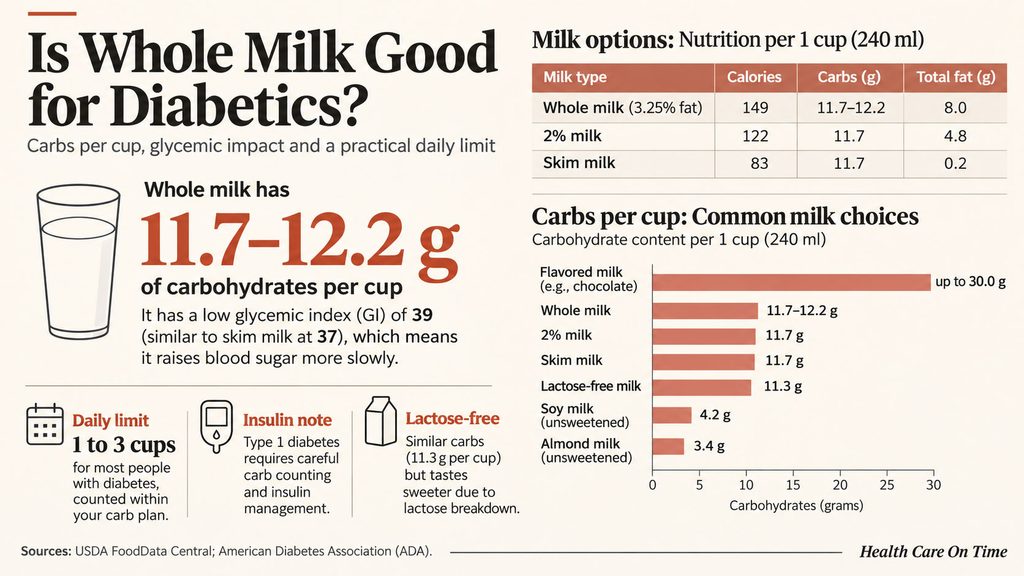
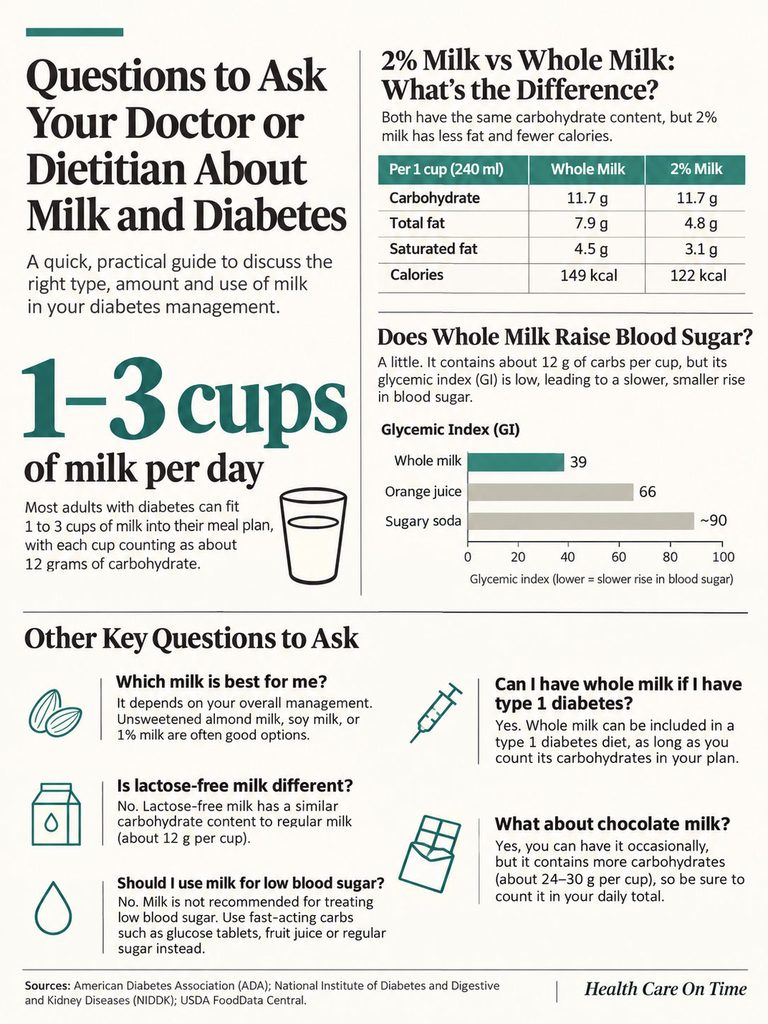
Quick answer: Yes, most people with diabetes can drink whole milk in measured portions. One cup has 11.7 grams of carbs and a low glycemic index (39), so it raises blood sugar less than juice or soda. The trade-off is 4.5 grams of saturated fat per cup. Count each cup as one carb choice, keep to 1 to 3 cups a day, and choose 1% or skim if your LDL cholesterol is high.
What Whole Milk Does to Blood Sugar
Milk raises blood sugar because it contains lactose, a natural sugar made of glucose and galactose joined together. Every plain cow’s milk carries about the same load: whole, 2%, 1% and skim all land between 11.7 and 12.2 grams of carbohydrate per cup in USDA FoodData Central. For meal planning, the CDC’s carb choice list counts 1 cup of any of them as one carbohydrate choice of 12 grams.
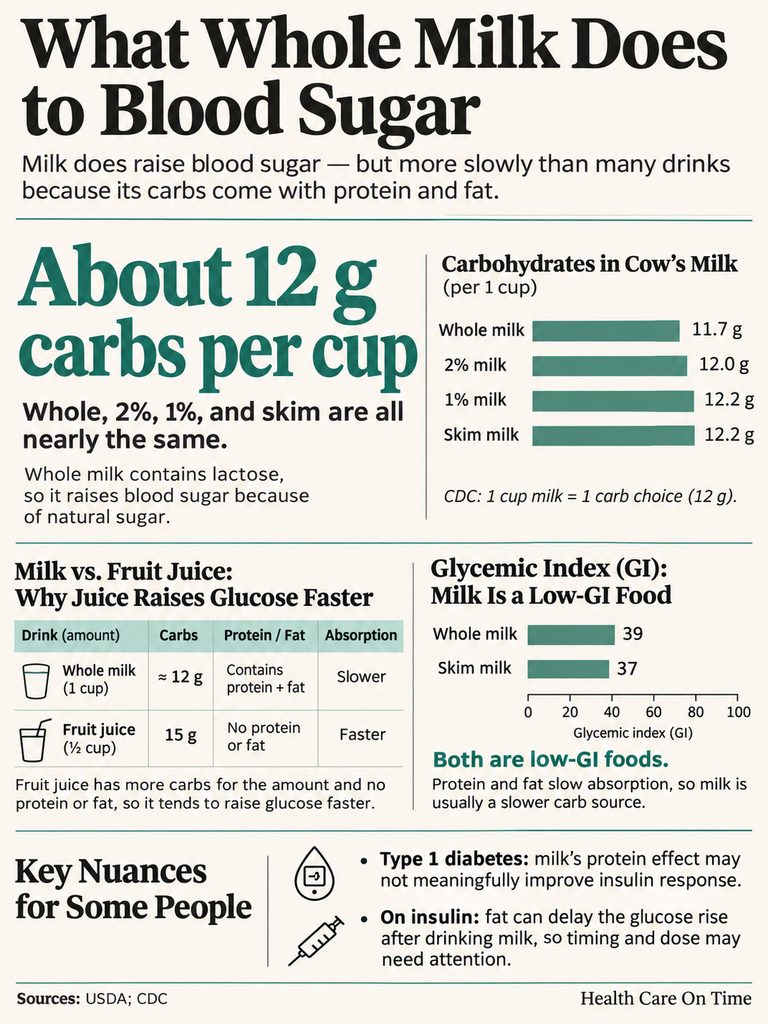
Skimming off the fat leaves the lactose in place. Milk is still one of the slower carb sources you can drink, though, even before the rest of the meal comes into play, thanks to its protein and fat.
Why milk’s glycemic index stays low
The glycemic index (GI) ranks how quickly a carb food raises blood glucose compared with pure glucose, which scores 100. Full-fat milk averages 39 and skim milk 37 in the international GI tables published in Diabetes Care. A score of 55 or less counts as low GI, so both sit well inside the low range, and the two-point gap between them is smaller than the margin of error on either number.
Three parts of milk keep that number down:
- Lactose itself. It has a GI of 46, which is low for a sugar.
- Milk proteins. Whey and casein prompt the pancreas to release more insulin, and that extra insulin pulls glucose out of the blood faster in people who still make their own.
- Fat, which slows how quickly the stomach empties into the small intestine.
People who call whole milk “better” for blood sugar usually mean that third point. The effect is real but modest, since protein and lactose do most of the work in every type of cow’s milk, skim included.
Juice behaves very differently. Just half a cup of unsweetened fruit juice counts as a full 15-gram carb choice on the CDC list, and juice has no protein or fat to slow its sugar down.
Where type 1 diabetes and insulin change the picture
The insulin boost from milk protein only helps if your pancreas can respond. In type 1 diabetes it can’t, so milk’s carbs reach the bloodstream without that built-in brake, and the injected or pumped insulin dose has to cover them.
For anyone on insulin, fat can also delay the glucose rise, so a reading that looks fine at one hour may climb later. The 2026 ADA Standards of Care recommend that most adults with type 1 diabetes learn to match mealtime insulin to fat and protein as well as carbs, which is easier to fine-tune on an insulin pump than with injections. A single cup of whole milk is a small fat load, but whole milk in a large latte or alongside a fatty breakfast can add up.
Whole vs 2% vs Skim vs Plant Milks, Cup for Cup
Each row below is one 8-ounce cup. All values come from USDA FoodData Central records (SR Legacy and FNDDS), converted to a 1-cup portion.
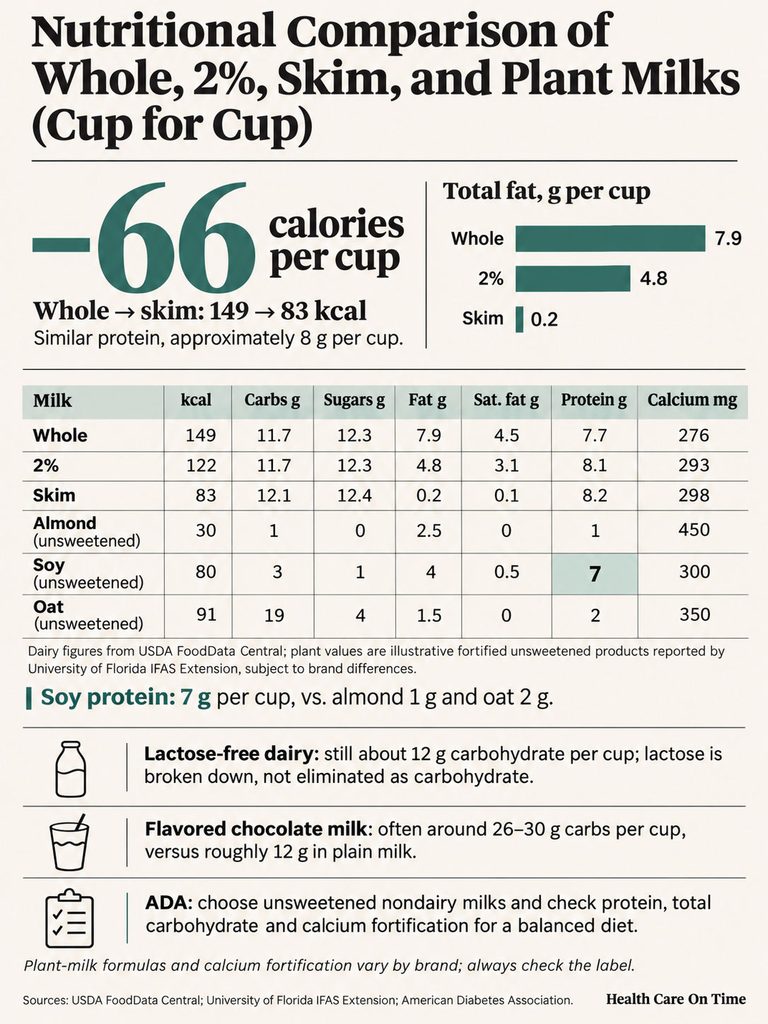
| Milk (1 cup) | Calories | Carbs (g) | Total sugar (g) | Fat (g) | Saturated fat (g) | Protein (g) | Calcium (mg) |
| Whole (3.25%) | 149 | 11.7 | 12.3 | 7.9 | 4.5 | 7.7 | 276 |
| 2% reduced fat | 122 | 11.7 | 12.4 | 4.8 | 3.1 | 8.1 | 293 |
| 1% low fat | 102 | 12.2 | 12.7 | 2.4 | 1.5 | 8.2 | 305 |
| Skim (fat free) | 83 | 12.2 | 12.5 | 0.2 | 0.1 | 8.3 | 299 |
| Lactose-free whole | 149 | 11.3 | 11.7 | 7.8 | 4.5 | 8.0 | 300 |
| Almond, unsweetened | 39 | 3.4 | 2.1 | 2.5 | 0.2 | 1.0 | 482 |
| Soy, unsweetened | 80 | 4.2 | 1.0 | 3.9 | 0.5 | 7.0 | 301 |
| Oat milk | 110 | 13.1 | 5.0 | 5.7 | 0.5 | 1.6 | 378 |
Sources: USDA FoodData Central IDs 171265, 171267, 170872, 171269, 2705392, 174832, 175215, 2705412. Sugar and carbohydrate are measured separately, so in cow’s milk the sugar figure can read slightly higher than total carbs.
The four cow’s milks are within half a gram of each other on carbs. Switching from whole to skim saves you about 66 calories and 4.4 grams of saturated fat per cup, and close to nothing on carbohydrate, so if blood sugar were the only concern, fat level would barely matter.
Protein and calcium hardly move across the four, and 2% lands closer to skim than to whole on saturated fat, which is why dietitians often suggest 1% or 2% to people who find skim too thin.
Lactose-free milk
Lactose-free milk is regular milk with the enzyme lactase added, which splits lactose into glucose and galactose before you drink it. That’s why it tastes sweeter. The carb count doesn’t go up, though: USDA lists lactose-free whole milk at 11.3 grams of carbs per cup, against 11.7 for regular whole.
A common claim holds that lactose-free milk spikes blood sugar much more than regular milk, and the research behind that is thin. In a small 2009 trial in Nutrition Journal, 26 healthy adults showed no difference in glucose response between a fat-free, lactose-free milk drink and regular fat-free milk. Nobody has tested this well in people with diabetes.
Almond, soy and oat
Unsweetened almond (3.4 grams of carbs) and unsweetened soy (4.2 grams) are the lowest-carb choices on the list. Soy keeps most of the protein of cow’s milk, at 7.0 grams per cup, while almond milk has only 1.0 gram, so it won’t slow the rise from other carbs at the meal the way dairy protein does.
Oat milk carries 13.1 grams of carbs per cup, more than whole milk, with a fifth of the protein. The ADA’s food group handout groups almond and oat drinks together as carb sources with very little protein and advises buying unsweetened versions and reading the Nutrition Facts label. Brands vary a lot, especially “barista” oat blends made with added oil and sugar.
For people who skip dairy altogether, the ADA Standards list fortified nondairy alternatives alongside milk and yogurt as carbohydrate sources in a diabetes eating pattern, and unsweetened soy is the one that comes closest to cow’s milk on protein.
Flavored milk
A cup of 2% chocolate milk has about 30 grams of carbohydrate and 24 grams of sugar in the USDA survey database, more than double plain milk, and the extra sugar comes from sweetener added to the milk. One cup easily passes the 10-gram cap on added sugars per meal in the new federal dietary guidelines.
The Saturated Fat Question
People with diabetes are usually told to watch whole milk because of their hearts rather than their glucose. Diabetes brings twice the risk of heart disease, and saturated fat raises LDL cholesterol, one of the main drivers of that risk.
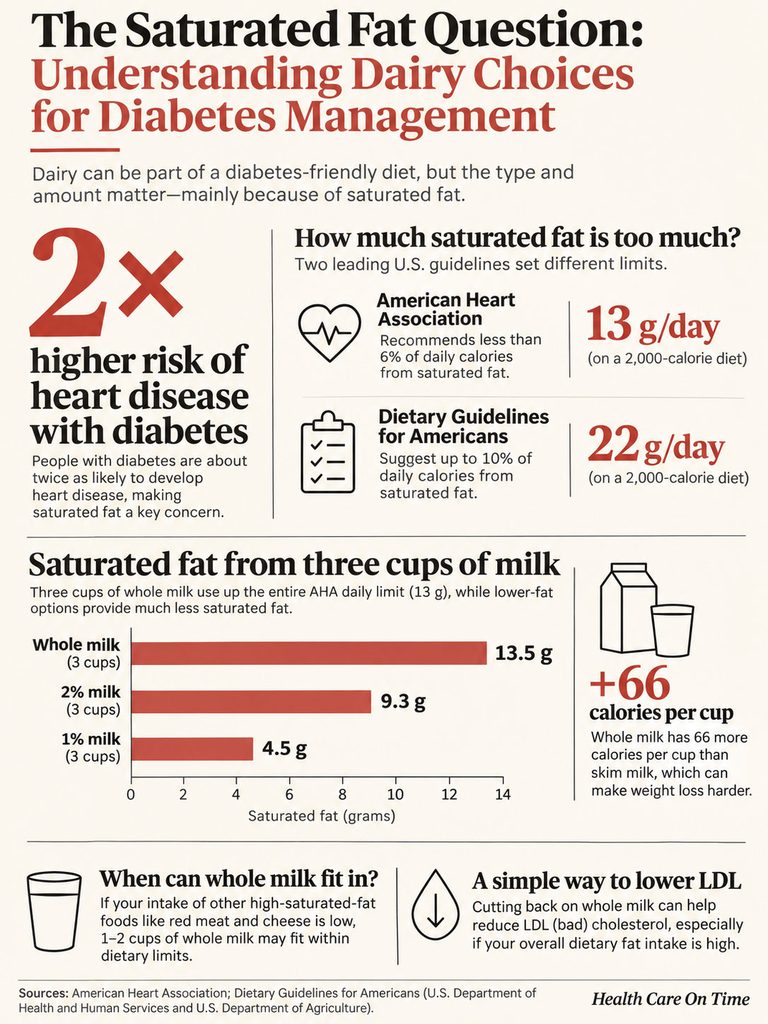
The two US limits on saturated fat aren’t the same. The American Heart Association’s limit is less than 6% of calories, about 13 grams or less a day on a 2,000-calorie diet, while the Dietary Guidelines for Americans, 2025–2030 set a looser ceiling of 10% of daily calories, which on the same 2,000 calories is 200 calories, or roughly 22 grams.
Three cups of whole milk add 13.5 grams of saturated fat, enough by itself to use up the full AHA budget for the day before you’ve eaten any cheese, meat, butter or baked goods. The same three cups fill a little over half of the federal limit. Three cups of 2% come to 9.3 grams; three cups of 1% come to 4.5 grams.
If you eat little red meat and cheese and your LDL is on target, one or two cups of whole milk a day leaves room in either budget. If your diet already includes plenty of animal fat, or your doctor has told you your LDL is above goal, whole milk is one of the easier places to cut, because 2% or 1% tastes close and keeps the protein and calcium.
Whole milk also has 66 more calories per cup than skim. Two cups a day comes to about 130 extra calories, a real amount if you’re working on weight loss, which often improves blood sugar and blood pressure in type 2 diabetes.
What the 2026 Guidelines Say, and Why They Disagree
The two biggest US documents on eating came out about a month apart, and they lean in different directions on milk fat.
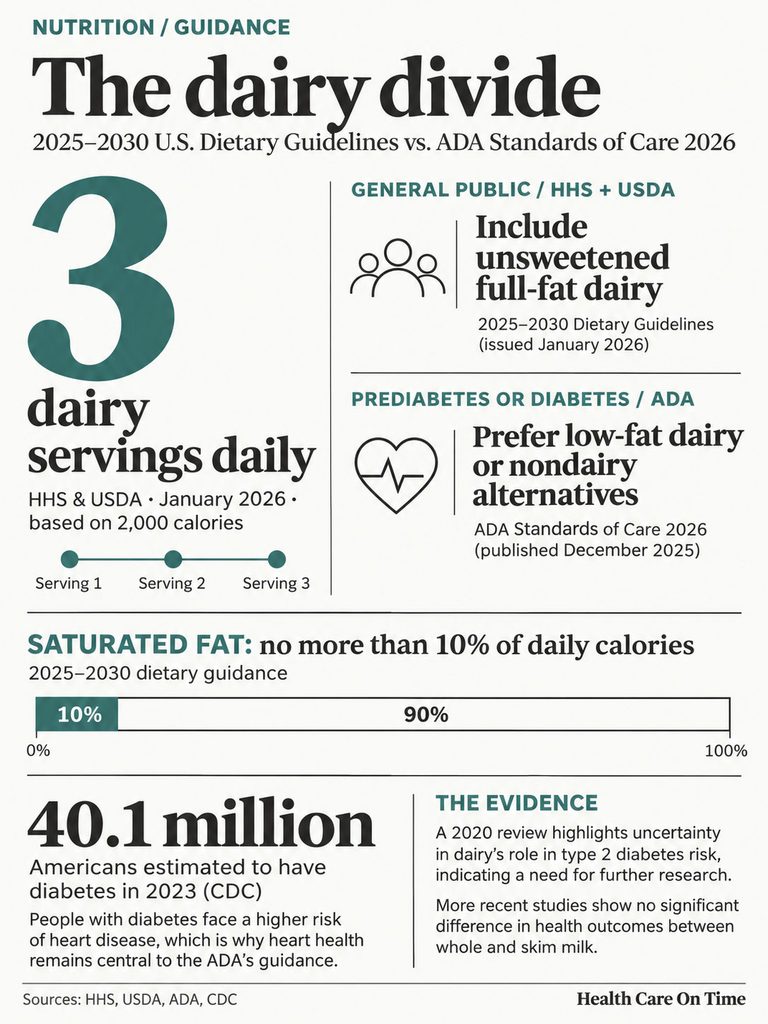
On January 7, 2026, HHS and USDA released the 2025–2030 Dietary Guidelines for Americans, which tell Americans to include full-fat dairy with no added sugars and to aim for three dairy servings a day on a 2,000-calorie pattern. The previous edition favored low-fat and fat-free dairy.
The same document keeps the 10% saturated fat cap, tells anyone with a chronic disease to talk with their health care professional, and allows that some people with chronic diseases may do better eating fewer carbohydrates.
The ADA Standards of Care 2026, the main clinical guideline doctors use for diabetes, came out in December 2025 and stayed with low-fat dairy. Recommendation 5.14 lists “low-fat dairy or nondairy alternatives” among the core parts of a healthy eating pattern for people with prediabetes and diabetes, and a separate recommendation asks clinicians to counsel people with diabetes to limit foods high in saturated fat. The ADA’s patient handout names low-fat milk and plain low-fat Greek yogurt as the best dairy options, even as a July 2026 summary for family physicians in American Family Physician passed along the federal advice of three daily servings of full-fat dairy with no added sugars.
The federal guidelines are written for the general public. The ADA document is written for people with diabetes, a group with double the heart risk, and it’s the one your endocrinologist or primary care doctor is more likely to follow. Neither bans whole milk for people with diabetes.
For scale, the first rows give the CDC’s latest diabetes counts; the rest are the findings people cite most in the full-fat debate.
| What was measured | Result | Source |
| Americans with diabetes | 40.1 million people, 12.0% of the population (2023 data) | CDC National Diabetes Statistics Report |
| Adults with diabetes who don’t know it | 27.6% (about 11.0 million) | CDC National Diabetes Statistics Report |
| US adults with prediabetes | 115.2 million | CDC National Diabetes Statistics Report |
| Heart disease risk with diabetes | Twice the risk of people without diabetes | CDC, Diabetes and Your Heart |
| Glycemic index, full-fat vs skim milk | 39 vs 37 (both low; 55 or less is low) | Atkinson et al., Diabetes Care 2008 |
| Whole milk more than twice a week vs under once a month | 19% higher type 2 diabetes risk (RR 1.19, 95% CI 1.0–1.43) | Health Professionals Follow-up Study, cited in Gudi 2020 review |
| 0.5 L whole vs skim milk daily for 3 weeks, healthy adults | No difference in fasting glucose or insulin; HDL higher on whole milk | Randomized crossover trial, European Journal of Clinical Nutrition 2018 |
| Daily saturated fat ceiling on 2,000 calories | AHA: about 13 g; federal guidelines: 10% of calories (about 22 g) | AHA; Dietary Guidelines 2025–2030 |
Most dairy and diabetes research asks a different question from the one in the title: whether milk changes the odds of getting type 2 diabetes in people who don’t have it yet. Even on that question the evidence is shaky, partly because nearly all of it comes from people recalling what they ate. A 2020 review of dairy and type 2 diabetes found that most dairy foods, whole and skim milk included, showed no statistically significant link either way, and one large US cohort found a slightly higher risk with frequent whole milk. Low-fat dairy didn’t come out cleanly ahead either: in an Australian cohort covered by the same review, people eating the most reduced-fat or low-fat dairy had about twice the odds of metabolic syndrome or type 2 diabetes compared with those eating the least (odds ratio 2.01).
The controlled trial evidence is reassuring but small. In the 2018 crossover trial, 17 healthy adults drank half a liter (a little over 2 cups) of whole milk or skim milk daily for three weeks each, and their fasting glucose, insulin and LDL didn’t differ between the two, while HDL was higher on whole milk. Everyone in it was healthy, and three weeks says little about years of whole milk in someone with type 2 diabetes and high LDL.
How Much Milk Can a Diabetic Have per Day?
There’s no single number set for everyone with diabetes, but a practical range is 1 to 3 cups a day, counted inside your carb plan. The federal guidelines’ three-serving dairy goal is the upper end, and it can include plain yogurt and cheese as well as milk.
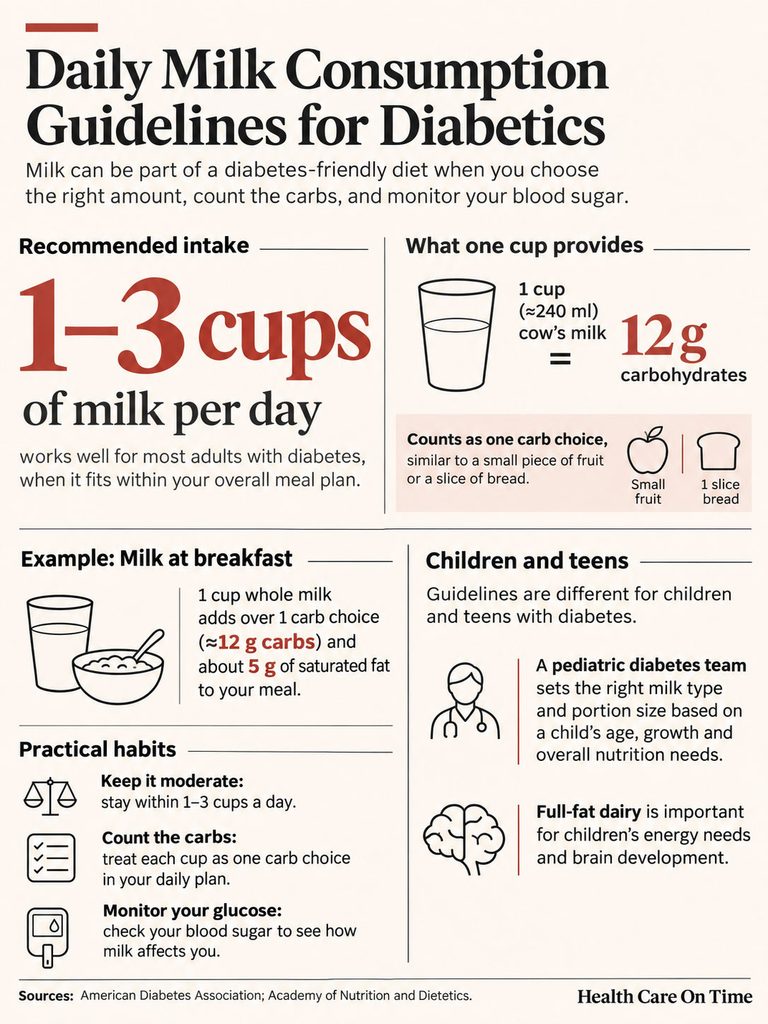
Each cup of plain cow’s milk is one carb choice of about 12 grams. If your dietitian has you aiming for a set number of carb grams or carb choices per meal, a cup of milk takes one of those slots, the same as a small piece of fruit or a slice of bread would. Forgetting to count it is an easy slip, since milk feels more like a drink than a food.
A few habits make milk easier to fit:
- Have it with a meal rather than alone between meals, so protein and fiber from the rest of the plate can blunt the rise.
- Spread cups across the day instead of drinking two or three at once.
- Use a measuring cup at first. A tall glass can hold well over a cup, which means more than one carb choice.
- Count milk in coffee drinks. A large latte can contain well over a cup of milk, while a measured splash of milk or a sugar-free creamer adds very little.
On a typical day for someone with type 2 diabetes who likes whole milk, a cup with a breakfast of eggs and whole-grain toast, a splash in afternoon coffee and nothing at dinner adds a little over one carb choice and roughly 5 grams of saturated fat. That fits most meal plans and leaves most of the AHA fat budget for the rest of the day’s food.
Checking your glucose before a meal and again at your usual after-meal time, once on a day with milk and once on a similar day without, shows how much the milk itself adds. A small difference means your portion works. A big jump is a reason to cut the portion or move the milk to a meal with more protein.
Children and teens with diabetes
Everything above is written for adults. Children have different energy needs, and the federal guidelines call full-fat dairy important for helping kids meet those needs and for supporting brain development. A child or teen with type 1 or type 2 diabetes should have milk type and portions set by the pediatric diabetes team, who will weigh growth, insulin dosing and the family’s usual meals. The carb count doesn’t change for kids, so a cup of plain milk still counts as about 12 grams.
Reading the Label on a Milk Carton
The Nutrition Facts panel on plain milk can look alarming at first. “Total Sugars” reads around 12 grams per cup, and people sometimes assume that means sugar was stirred in. In plain milk, that number is lactose. Under the federal dietary guidelines, the sugars naturally found in plain milk and fruit don’t count as added sugars, so the “Includes Added Sugars” line on a plain carton should read zero.
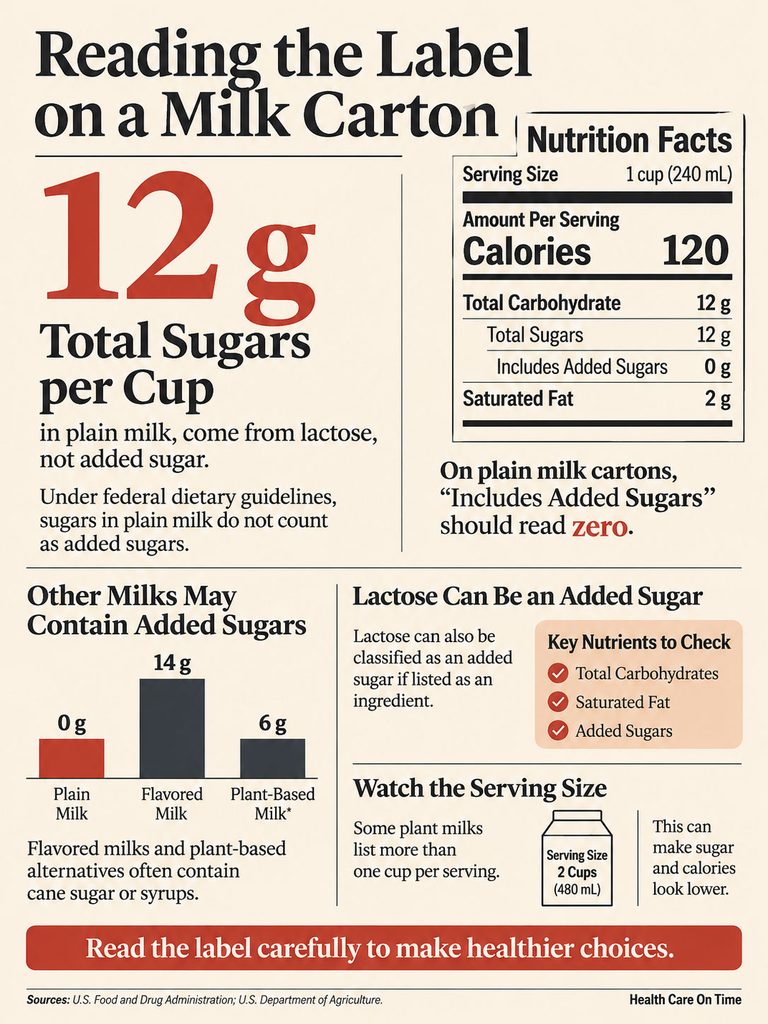
Flavored milks, coffee creamers, protein shakes and many plant milks list cane sugar, syrups or “evaporated cane juice” near the top of the ingredient list. Oddly, lactose itself can be an added sugar too. It appears on the guidelines’ list of names that added sugars go by on ingredient labels, so if you see lactose listed as an ingredient in a packaged food, it was put there on purpose.
On the panel itself, look at total carbohydrate for your carb count, saturated fat for your daily budget and added sugars, which should ideally be zero. Check the serving size as well, because some plant milk cartons and single-serve bottles list more than one cup per serving, and that changes every number on the label.
When to Be More Careful With Milk
Kidney disease, insulin use, low blood sugar and a few other situations call for a different milk plan.
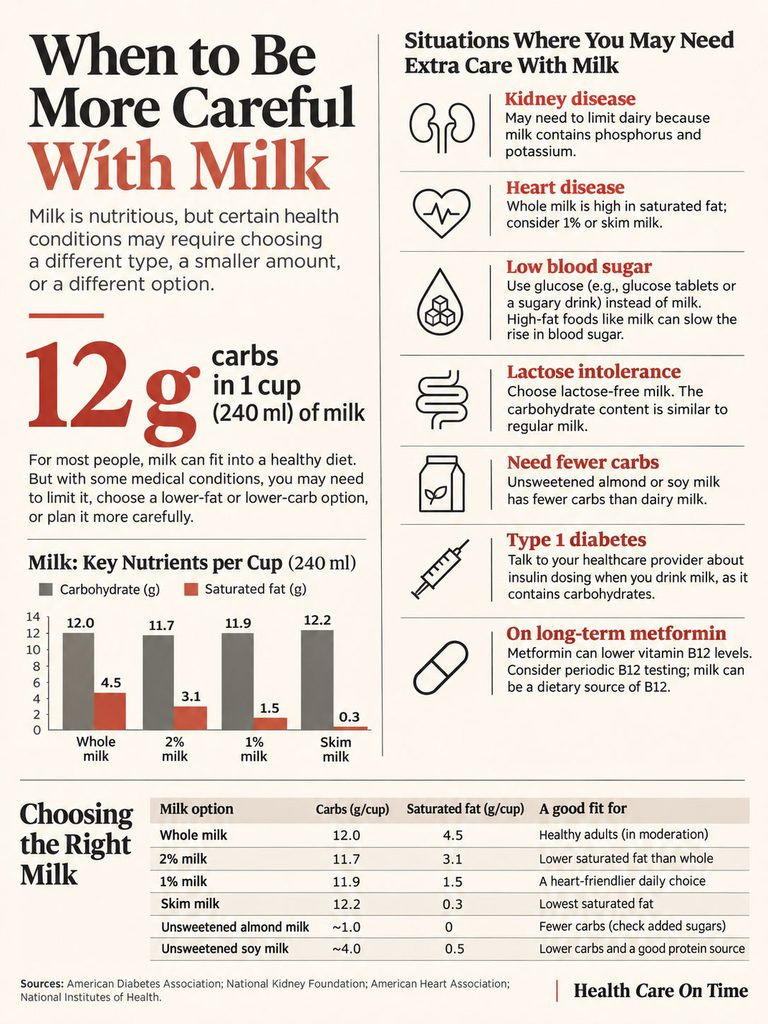
| Your situation | What to do with milk | Why |
| Type 2 diabetes, A1C and LDL on target | Whole milk fits; count 1 cup as one 12 g carb choice | Carbs are the same as skim, GI is low |
| LDL above goal or known heart disease | Switch to 1% or skim, or keep whole milk to 1 cup a day | 3 cups of whole milk = 13.5 g saturated fat, past the AHA daily limit of about 13 g |
| Blood sugar under 70 mg/dL | Don’t treat it with milk; take 15 g of fast carbs such as glucose | ADA advises against high-fat or high-protein foods for treating lows |
| Chronic kidney disease | Ask whether to limit dairy to one serving a day | Whole milk has 205 mg phosphorus and 322 mg potassium per cup |
| Lactose intolerance | Lactose-free milk; count carbs the same | 11.3 g carbs per cup, close to regular milk |
| Want the fewest carbs | Unsweetened almond or soy milk | 3.4 g and 4.2 g carbs per cup |
| Type 1 diabetes on insulin | Count milk carbs; ask about fat and protein dosing for large milky meals | ADA recommends matching insulin to fat and protein as well as carbs |
| Taking metformin long term | Milk can help with B12; ask about periodic B12 testing | Metformin is linked to low B12; 1 cup of whole milk has 1.1 mcg |
Treating low blood sugar
Milk is a poor choice once you notice the signs of low blood sugar. For a conscious person under 70 mg/dL, the ADA’s 2026 guidance on lows prefers glucose, about 15 grams of carbohydrate for most people, and steers away from foods or drinks high in fat or protein for that first treatment. Added fat can slow and then prolong the glucose response, and protein can increase insulin release.
Whole milk has plenty of both, so keep glucose tablets or regular juice within reach instead and save the milk for the snack afterward.
Kidney disease
With diabetic nephropathy or other chronic kidney disease, milk’s minerals can matter more than its fat. As kidney function falls, a dietitian may limit dairy to one serving a day because of its phosphorus and potassium. Potassium can also build up when the kidneys slow down, and high blood potassium can cause heart and muscle problems. Unsweetened almond milk has about 24 mg of phosphorus per cup against 205 mg in whole milk, though the right amount shifts with lab results and dialysis.
Metformin and vitamin B12
Long-term metformin use is linked with vitamin B12 deficiency, and the ADA Standards of Care 2026 suggest periodic B12 testing, especially in people with anemia or peripheral neuropathy. One cup of whole milk has 1.1 mcg of B12; by the National Kidney Foundation’s count, an 8-ounce glass covers the full daily requirement for most age groups.
Questions to Ask Your Doctor or Dietitian
Bring these to your next visit, along with a few days of meter or CGM readings:
- Is whole milk still okay with this LDL result, or is 2% the better switch?
- Does one cup at breakfast count as a single carb choice here?
- Are these after-breakfast spikes coming from the milk, the toast, or both?
- Should the bolus change for a big latte?
- How much dairy is safe with these kidney numbers, now that potassium is also on the high side?
- Is a B12 test due after this many years on metformin?
Frequently Asked Questions
Which is better for a diabetic, 2% milk or whole milk?
For blood sugar they’re the same, with 11.7 grams of carbs per cup in both. 2% has 3.1 grams of saturated fat against 4.5 in whole milk, plus 27 fewer calories. If your LDL is high or you drink several cups a day, 2% is the safer default. If you drink one cup and your lipids are on target, whole milk is a reasonable choice.
Does whole milk raise blood sugar levels?
A little. One cup has about 12 grams of carbs from lactose, but its glycemic index is low (39), so the rise is slower and smaller than from juice or soda with similar carbs.
How much milk can a diabetic have per day?
Most adults with diabetes can fit 1 to 3 cups a day, counting each cup as one 12-gram carb choice. With whole milk, staying near 1 to 2 cups keeps saturated fat in a reasonable range. Your dietitian can adjust this for your carb target, weight goal and cholesterol.
What is the best milk for diabetics to drink?
It depends on what you’re managing. Unsweetened almond or soy milk has the fewest carbs, and 1% or skim keeps the protein of whole milk with far less saturated fat. Whole or 2% works in measured portions when your LDL is normal and you prefer the taste. Skip sweetened and flavored versions of any of them, and be cautious with oat milk, which has more carbs than cow’s milk and little protein.
Is lactose-free milk OK for diabetes?
Lactose-free whole milk has 11.3 grams of carbs per cup, close to regular milk, so it fits the same way. Its sugars are already split, which makes it taste sweeter, but a small study in healthy adults found no difference in glucose response.
Can you drink milk to treat a low blood sugar?
It isn’t recommended. ADA guidance calls for 15 grams of fast-acting carbohydrate such as glucose tablets for a reading under 70 mg/dL and advises against high-fat or high-protein foods, because fat can delay the rise. Once you’ve recovered, a snack with protein can help keep you from dropping again, and milk can be part of that.
Is whole milk OK with type 1 diabetes?
It can be, as long as it’s counted. A cup is about 12 grams of carbs to cover with insulin. Large amounts of whole milk with a fatty meal may cause a delayed rise, so watch your readings for a few hours afterward.
Can diabetics drink chocolate milk?
Now and then, counted like any other carb. A cup of 2% chocolate milk has about 30 grams of carbs, which is two to three carb choices, and much of that is added sugar. Unsweetened cocoa stirred into plain milk gives the flavor without the extra carbs of a premixed carton.
Medical disclaimer: This article is for general information and isn’t a substitute for advice from your doctor, registered dietitian or diabetes care team. Blood sugar responses to the same food vary from person to person. Talk with your health care professional before changing your diet, especially if you take insulin, have kidney disease or have been told your cholesterol is high.
References
- USDA FoodData Central. Milk, whole, 3.25% milkfat, with added vitamin D (FDC ID 171265), and records 171267, 170872, 171269, 2705392, 174832, 175215, 2705412, 2705468. https://fdc.nal.usda.gov/
- Centers for Disease Control and Prevention. Carb Choices. Reviewed May 15, 2024. https://www.cdc.gov/diabetes/healthy-eating/carbohydrate-lists-starchy-foods.html
- Centers for Disease Control and Prevention. National Diabetes Statistics Report. Reviewed September 16, 2026. https://www.cdc.gov/diabetes/php/data-research/index.html
- Centers for Disease Control and Prevention. Diabetes and Your Heart. https://www.cdc.gov/diabetes/library/features/diabetes-and-heart.html
- Atkinson FS, Foster-Powell K, Brand-Miller JC. International Tables of Glycemic Index and Glycemic Load Values: 2008. Diabetes Care. 2008;31(12):2281–2283. https://pmc.ncbi.nlm.nih.gov/articles/PMC2584181/
- University of Sydney Glycemic Index Research Service. Milk, other dairy foods and blood glucose. May 2024. https://glycemicindex.com/2024/05/milk-other-dairy-foods-and-blood-glucose
- US Department of Health and Human Services and US Department of Agriculture. Dietary Guidelines for Americans, 2025–2030. https://cdn.realfood.gov/DGA.pdf
- American Academy of Family Physicians. Dietary Guidelines for 2025–2030: Recommendations From the USDA and HHS. Am Fam Physician. July 2026. https://aafp.org/afp/2026/0700/practice-guidelines-dietary-guidelines
- American Diabetes Association Professional Practice Committee. 5. Facilitating Positive Health Behaviors and Well-being to Improve Health Outcomes: Standards of Care in Diabetes 2026. Diabetes Care. 2026;49(Suppl 1):S89–S131. https://pmc.ncbi.nlm.nih.gov/articles/PMC12690188/
- American Diabetes Association Professional Practice Committee. 6. Glycemic Goals, Hypoglycemia, and Hyperglycemic Crises: Standards of Care in Diabetes 2026. Diabetes Care. 2026;49(Suppl 1):S132–S149. https://pmc.ncbi.nlm.nih.gov/articles/PMC12690178/
- American Diabetes Association Professional Practice Committee. 9. Pharmacologic Approaches to Glycemic Treatment: Standards of Care in Diabetes 2026. Diabetes Care. 2026;49(Suppl 1):S183–S215. https://pmc.ncbi.nlm.nih.gov/articles/PMC12690185/
- American Diabetes Association. Nutrition for Life: Food Groups and Portion Sizes. https://professional.diabetes.org/sites/dpro/files/2024-01/food_groups_and_portion_sizes.pdf
- American Heart Association. Saturated Fats. https://www.heart.org/en/healthy-living/healthy-eating/eat-smart/fats/saturated-fats
- Gudi SK. Dairy consumption and risk of type-2 diabetes: the untold story. Ann Pediatr Endocrinol Metab. 2021;26(1):14–18. https://pmc.ncbi.nlm.nih.gov/articles/PMC8026335/
- Effect of whole milk compared with skimmed milk on fasting blood lipids in healthy adults: a 3-week randomized crossover study. Eur J Clin Nutr. 2018;72(2):249–254. https://pubmed.ncbi.nlm.nih.gov/29229955/
- Lummela N, et al. Effects of a fibre-enriched milk drink on insulin and glucose levels in healthy subjects. Nutr J. 2009;8:45. https://link.springer.com/article/10.1186/1475-2891-8-45
- National Kidney Foundation. Dairy and Our Kidneys. https://www.kidney.org/kidney-topics/dairy-and-our-kidneys