Yes, too much protein can be bad for you, but for most healthy adults the trouble starts well above what they eat on a normal day. The real risks show up at very high intakes, in people whose kidneys are already damaged or who form kidney stones, and in diets where red and processed meat supply most of the protein.
Table of Contents
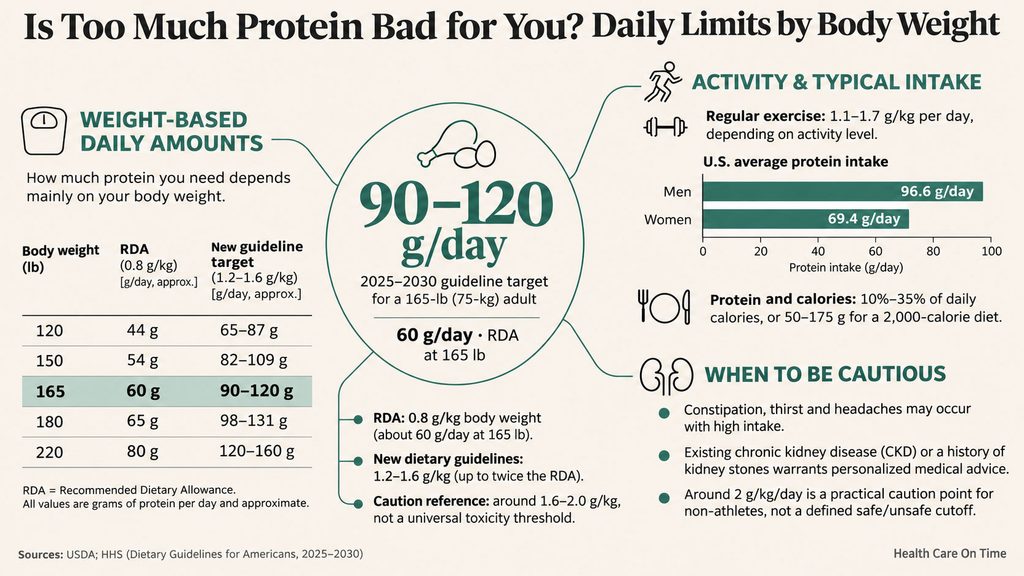
Quick Answer: For healthy adults, protein becomes “too much” at roughly 2 grams per kilogram of body weight a day (about 0.9 grams per pound), or about 136 grams for a 150-pound person. The minimum (RDA) is 0.8 g/kg, and the 2025–2030 Dietary Guidelines aim for 1.2 to 1.6 g/kg. Very high intakes are linked to kidney stones and digestive trouble. If you have kidney disease, a clinician should set your limit.
How Much Protein Is Too Much?
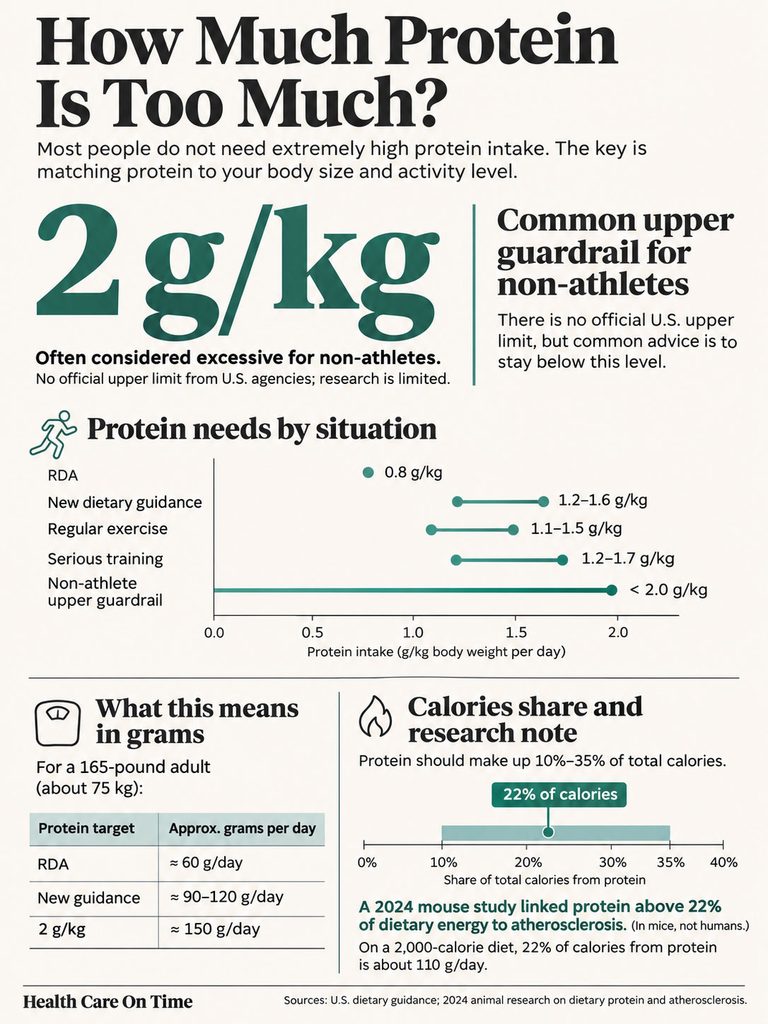
No US agency publishes a hard upper limit for protein, and the research on very high intakes is still thin.
The Recommended Dietary Allowance (RDA) of 0.8 grams per kilogram of body weight a day is the floor, the amount that covers basic needs for nearly all healthy adults, and the newest federal guidance left it unchanged. For a 165-pound adult that’s about 60 grams a day. The familiar figures of 56 grams for men and 46 grams for women come from the same math.
On January 7, 2026, USDA and HHS released the Dietary Guidelines for Americans, 2025–2030, which tell adults to put protein at every meal and aim for 1.2 to 1.6 g/kg a day. That target is 50% to 100% above the old minimum, and it drew pushback from Harvard nutrition researchers, who argued that many Americans already eat more protein than they need and that the guidelines never say which protein foods to favor.
The ceiling is less formal. For anyone who isn’t an elite athlete or serious bodybuilder, staying under 2 g/kg of ideal body weight is the usual advice, about 125 grams for a 140-pound person, and dietitians generally treat anything above that level as excessive. The exceptions run in both directions: hard-training people can usually go up to 2 g/kg safely, and a few dietitians place the cutoff slightly higher, at 1 gram per pound (2.2 g/kg). In practice, the zone from 1.6 to 2.0 g/kg is where caution begins.
Grams per day by body weight
| Body weight | RDA minimum (0.8 g/kg) | Dietary Guidelines target (1.2–1.6 g/kg) | Common “too much” line (2.0 g/kg) |
| 120 lb (54 kg) | 44 g | 65–87 g | 109 g |
| 150 lb (68 kg) | 54 g | 82–109 g | 136 g |
| 180 lb (82 kg) | 65 g | 98–131 g | 163 g |
| 210 lb (95 kg) | 76 g | 114–152 g | 191 g |
| 240 lb (109 kg) | 87 g | 131–174 g | 218 g |
All figures are rounded and use actual body weight for a healthy adult. Harvard’s 2 g/kg ceiling uses ideal body weight instead, and for people with overweight, dietitians usually calculate protein from an adjusted weight rather than the number on the scale. If you weigh 240 pounds but a healthy weight for your height is closer to 170, the 218-gram figure overstates your needs by a wide margin.
If you exercise
Regular exercise raises the target to roughly 1.1 to 1.5 g/kg, and people who lift weights regularly or train for running or cycling events may go to 1.2 to 1.7 g/kg. Worked through for a 200-pound adult, that’s somewhere from 73 to 127 grams a day, with a very active person building muscle going up to about 155 grams. Adults over 65 may need more as well.
Muscle comes from the training itself. Protein above your target mostly adds calories, and many active people already meet their number from ordinary meals, in which case a shake or a protein-fortified snack adds cost without adding much else.
The 22% figure
Protein can also be measured as a share of calories, at about 4 calories per gram. The long-standing healthy range is 10% to 35% of calories, which on a 2,000-calorie diet means 50 to 175 grams a day.
A 2024 study in Nature Metabolism added a lower number that now gets quoted everywhere: 22% of calories. In male mice, protein above about 22% of dietary energy drove atherosclerosis, the plaque buildup in arteries. In the human clinical studies that were part of the same paper, men and women ate graded amounts of protein while the researchers tracked amino acids in their blood, and there the effect appeared at the meal level instead, where only protein above roughly 25 grams in one meal switched on a signaling pathway called mTOR in immune cells known as macrophages. The researchers didn’t measure plaque or heart attacks in people.
For a 2,000-calorie eater, 22% is about 110 grams of protein; at 1,800 calories it’s about 99 grams, and at 2,500 calories about 138 grams. Those amounts already sit inside the new federal target for most body sizes. Until larger human trials test it directly, the 22% line works better as a hint about meal size and protein source than as a daily cap.
How Much Protein Americans Actually Eat
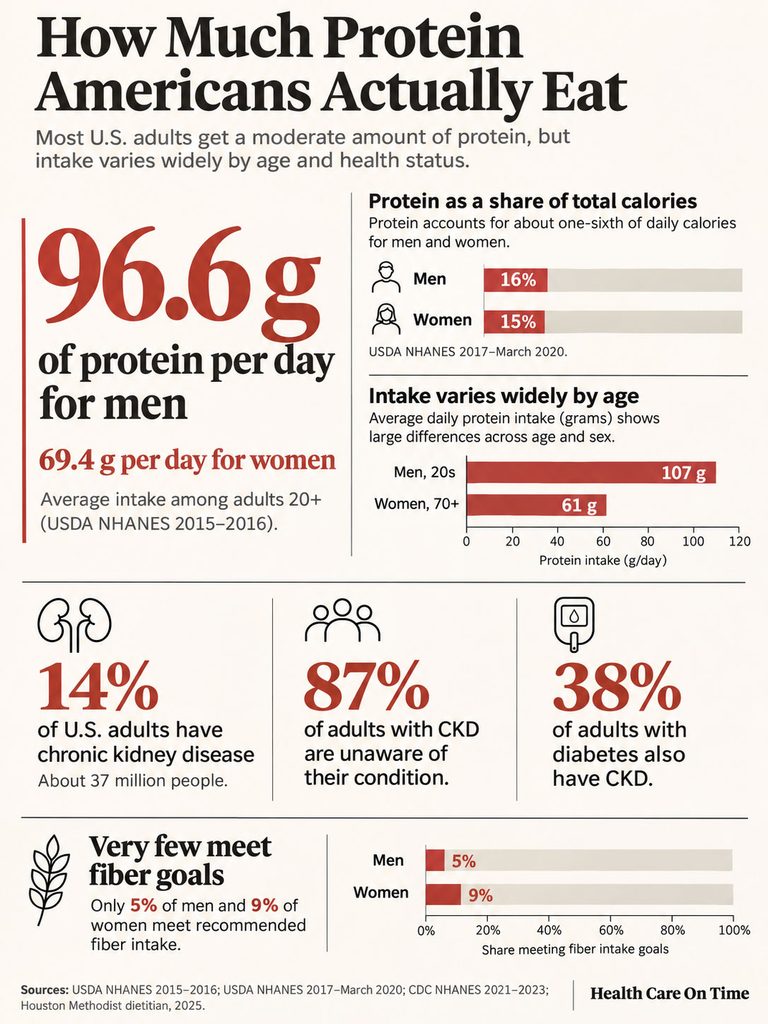
National survey data from What We Eat in America, the diet arm of NHANES, put men 20 and older at an average of 96.6 grams of protein a day and women at 69.4 grams. That works out to about 15% to 16% of adult calories, near the bottom of the 10% to 35% range and well under 22%. The spread between groups is wide, from more than 107 grams a day for men in their 20s to about 61 grams for women 70 and older, an amount that may be low for an older body trying to hold on to muscle. These averages come from a single day of recalled eating per person, so they’re estimates rather than exact intakes, but they give a fair picture of where most adults sit.
| Measure (US adults) | Figure | Source and years |
| Average protein, men 20+ | 96.6 g/day | USDA What We Eat in America, NHANES 2015–2016 |
| Average protein, women 20+ | 69.4 g/day | USDA What We Eat in America, NHANES 2015–2016 |
| Share of calories from protein | Men 16%, women 15% | USDA What We Eat in America, NHANES 2017–March 2020 |
| Adults with chronic kidney disease | 14% (about 37 million) | CDC, NHANES 2021–2023 |
| Adults with CKD who don’t know it | 87% | CDC, NHANES 2021–2023 |
| Adults with diabetes who have CKD | 38% | CDC, NHANES 2021–2023 |
| Adults meeting fiber goals | 5% of men, 9% of women | Houston Methodist dietitian, 2025 |
Fiber, far more than protein, is the usual shortfall in American diets, and a protein-heavy plan built on meat and shakes tends to widen that gap.
Because roughly 9 in 10 adults with chronic kidney disease don’t know they have it, “healthy kidneys” is an assumption for millions of people who’ve never had a blood and urine test.
What Happens When You Eat Too Much Protein
High-protein diets aren’t known to cause medical problems in healthy people, at least in the short term, while the long-term risks, especially for diets that also cut carbohydrates, are still being studied. Very restrictive versions such as the carnivore diet are a different story, since cutting out whole food groups can leave people short on fiber and other nutrients.
Your kidneys
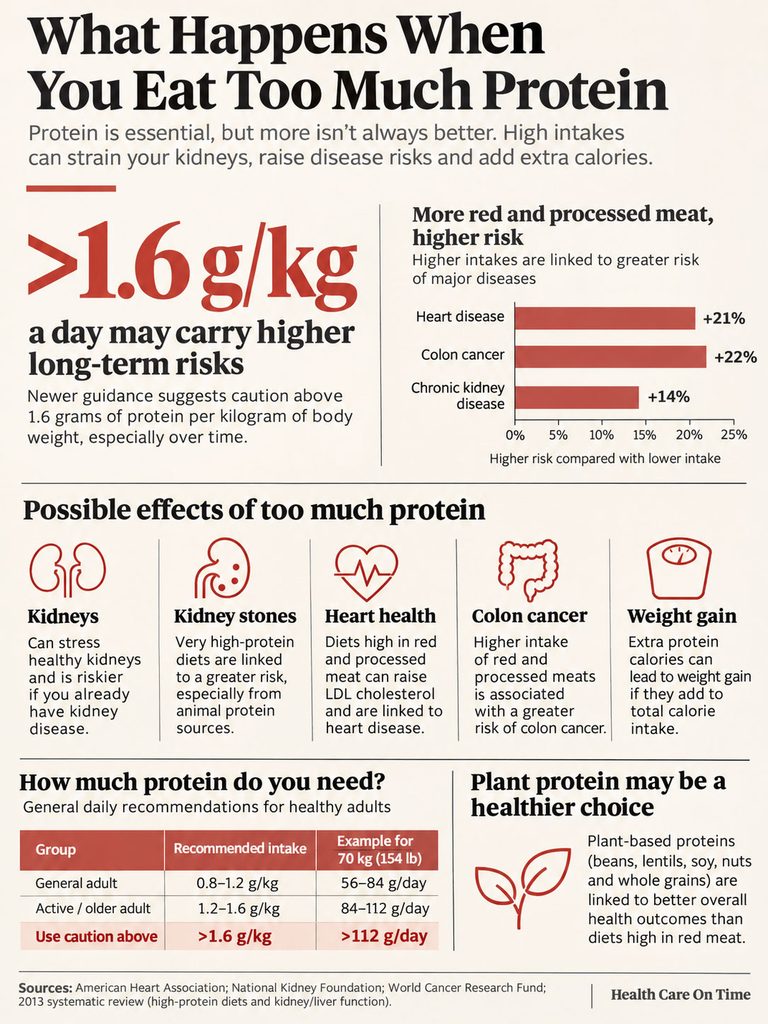
Protein breaks down into nitrogen-containing waste that the kidneys filter out. Whether a long-running surplus wears on healthy kidneys is still debated, and some dietitians warn it can stress or even damage them.
The risk is much clearer once the kidneys are already damaged. In people with kidney disease, a high-protein diet may worsen kidney function because the body may not clear all the waste products of protein breakdown.
The usual advice for CKD is to set a protein amount with a dietitian, eat less meat and dairy, choose lean meats that are lower in phosphorus and get more protein from plants, while keeping in mind that too little protein causes problems too and that people on dialysis often need more of it.
Kidney stones
Very high-protein diets are linked to a higher risk of kidney stones, and animal protein is the part that matters. In people who form calcium oxalate, calcium phosphate or uric acid stones, a clinician may suggest cutting back on beef, chicken, pork, eggs, fish, shellfish and dairy, with organ meats at the top of the list. Beans, dried peas and lentils can fill the gap and keep total protein up. Cutting sodium usually comes with the same advice, and for people with uric acid stones who carry extra weight, losing some of it matters too.
Heart and blood vessels
A 4-ounce broiled sirloin steak has about 33 grams of protein and about 5 grams of saturated fat. A cup of cooked lentils has about 18 grams of protein, 15 grams of fiber and almost no saturated fat.
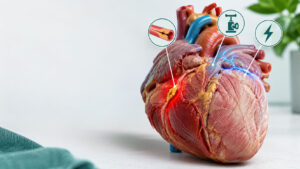
Diets built on red meat, processed meat and other high-saturated-fat foods may raise LDL (“bad”) cholesterol and heart disease risk, and red-meat-heavy, high-protein eating has also been tied to colon cancer. Plant-rich high-protein diets haven’t shown the same pattern. Frank Hu, a Harvard nutrition epidemiologist, has warned that pushing overall protein up without distinguishing between sources could have unintended long-term effects, because plant proteins and fish are linked to better outcomes than diets high in red meat.
In the Nature Metabolism experiments, leucine, an amino acid plentiful in beef, eggs and milk, was the main trigger for that mTOR signal in macrophages, the immune cells that help clear debris from artery walls. In mice, the result was more plaque.
The older case against high protein
A 2013 review in ISRN Nutrition pulled together 32 studies (21 experimental studies in humans and 11 reviews) and, looking only at healthy adults in English-language research, linked long-term high protein or high meat intake to problems with bone and calcium balance, kidney function, liver function, cancer risk and coronary artery disease. Its author found no reasonable scientific basis to recommend protein above the RDA for healthy adults and called for large randomized trials.
That conclusion clashes with the 2026 federal guidelines. Part of the gap is definitions: the review counted any intake above the RDA as “high protein” and lumped high-meat diets in with it, while the new guidance still stops at 1.6 g/kg, below the 2 g/kg level where most clinicians start to worry.
Weight gain
Protein calories count like any others. At about 4 calories per gram, an extra 50 grams of protein a day from shakes and bars adds roughly 200 calories, and excess calories from any source end up stored as fat. Protein keeps people full, which is why high-protein diets tend to help with short-term weight loss, but only when the protein replaces other calories instead of adding to them.
Too Much Protein Symptoms: A Checklist
Many of these signs come from low fiber, because a diet built around meat, shakes and bars is usually short on fruit, vegetables and whole grains. Watch for:
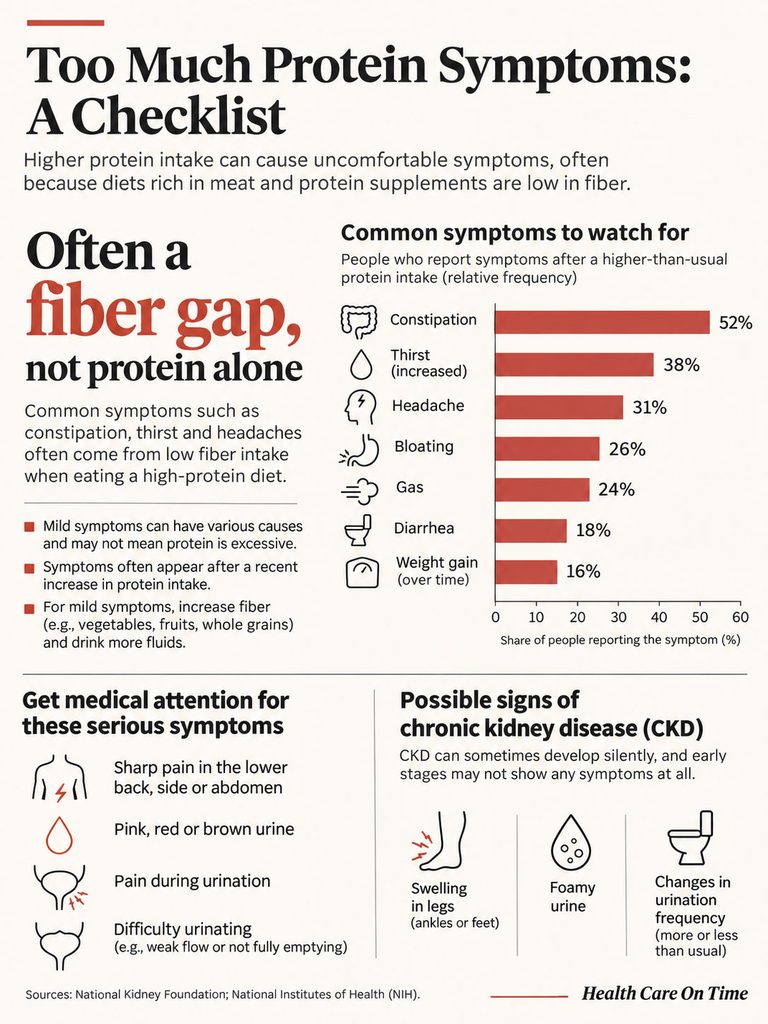
- Digestive trouble: constipation, bloating, gas, stomach pain or diarrhea, especially when protein foods have replaced fiber-rich ones
- Bad breath: often called “keto breath,” most likely on very high-protein, very low-carb diets
- Headache, more often on restrictive high-protein diets
- Thirst: clearing protein waste increases urination, so mild dehydration is common
- Weight gain, or weight loss that stalls
- Cravings for sweets and carbs once protein has pushed most carbohydrates out
- Low intake of nutrients that come mostly from plants, such as magnesium, potassium, vitamin C and folate
Most are mild. None of them proves you’re eating too much protein, since constipation, thirst and headaches have dozens of causes. If they line up with a recent jump in protein, though, bringing intake back toward your target and adding fiber and fluids is usually enough.
Some symptoms need a doctor rather than a diet change. Sharp pain in the back, side, lower abdomen or groin, pink, red or brown urine, pain while urinating, or trouble passing urine can mean a kidney stone or something more serious and should be checked right away, especially with fever, chills, nausea or vomiting. Swelling in the legs, feet or ankles, foamy urine and a change in how often you urinate can be signs of chronic kidney disease, although early CKD usually causes no symptoms at all.
Who Should Be Careful With High Protein
For a healthy adult, eating at the federal target of 1.2 to 1.6 g/kg is generally safe. People in the groups below should get a personal limit from a clinician.
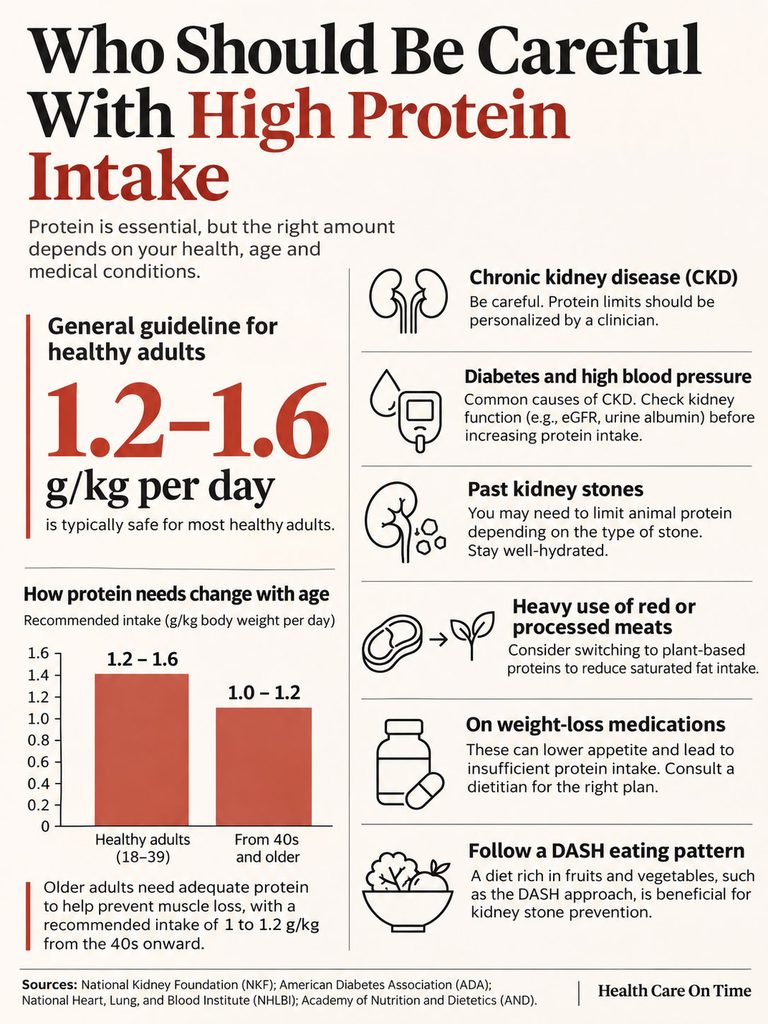
People with chronic kidney disease
No single protein number fits everyone with CKD. The stage of kidney disease, dialysis and diabetes all change the target, and a kidney dietitian can work out an amount that protects the kidneys without causing muscle loss.
Diabetes and high blood pressure are the most common causes of CKD in adults. Anyone with either condition who plans to push protein much higher should get a kidney function test first. It takes two simple tests: a blood test that estimates glomerular filtration rate (GFR), where 60 or more is considered normal, and a urine albumin-to-creatinine ratio (UACR), where 30 mg/g or less is normal. People with diabetes should be tested every year, and anyone with heart disease or a family history of kidney failure should ask how often to be checked. The same goes for any long-lasting condition: a talk with your provider before starting a high-protein weight-loss diet is the safer order of events, and for people with diabetes that talk should include these two tests.
People who’ve had kidney stones
If you’ve already had a kidney stone, its type shapes the diet. For calcium oxalate, calcium phosphate and uric acid stones, limiting animal protein is part of standard prevention, along with less sodium and enough fluid. Drinking enough liquid, mostly water, matters more than anything else, and many clinicians suggest six to eight 8-ounce glasses a day unless you have kidney failure. The DASH eating pattern, high in fruits and vegetables and low in animal protein, has also been shown to lower stone risk.
People who get most of their protein from red or processed meat
If most of your protein comes from steak, bacon, sausage, deli meat and cheese, saturated fat can climb past the federal limit of 10% of calories long before protein gets anywhere near 2 g/kg. Younger and middle-aged men are the most likely to overshoot, mostly through meat, poultry and eggs. Processed meats are the group to cut first, and Mayo Clinic suggests avoiding them outright. Strict plans like keto or carnivore make the problem worse, because they tend to drop fruit, whole grains and starchy vegetables along with the carbs.
Better everyday picks include soy foods, beans and lentils, nuts and seeds, fish, skinless chicken, lean cuts of beef and pork, low-fat dairy and egg whites.
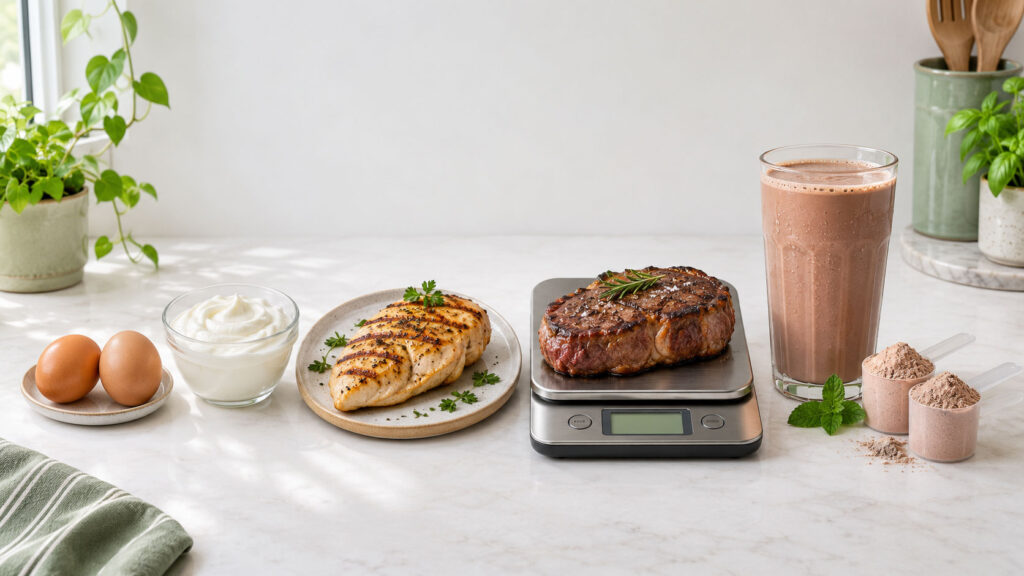
Fish, poultry, beans, lentils, tofu, nuts and seeds bring protein with less saturated fat, and plant proteins come with fiber that may lower the risk of diabetes, heart disease and obesity. Lentils, tofu, Greek yogurt and other vegetarian protein sources can replace a few meat meals a week without dropping total protein. Vegetables help less than people expect, and a gram-for-gram comparison of broccoli with eggs, chicken and steak is a useful check before counting greens as a main protein source.
Older adults and people on weight-loss medicines
Many older adults eat too little protein. To help prevent age-related muscle loss (sarcopenia), Mayo Clinic Health System suggests about 1 to 1.2 g/kg from the 40s and 50s onward, and for a healthy older adult, a higher target often makes sense unless kidney function is reduced.
Low intake is also common with undereating, very restrictive diets and weight-loss medication. Losing weight on too little protein can mean losing more muscle along with the fat, so this is one situation where a dietitian may push protein up rather than down.
Protein per Meal and Protein Shakes
For building muscle, about 25 to 35 grams of protein per meal is the most the body uses at one time, and servings above 40 grams in one sitting bring no extra benefit. A big dinner won’t hurt you, but 50 grams or more at once tends to be hard on the digestive tract, so three or four moderate servings spread through the day work better than one large one. A portion of meat about the size of a deck of cards at lunch and dinner, plus dairy at each meal, covers most people’s needs.
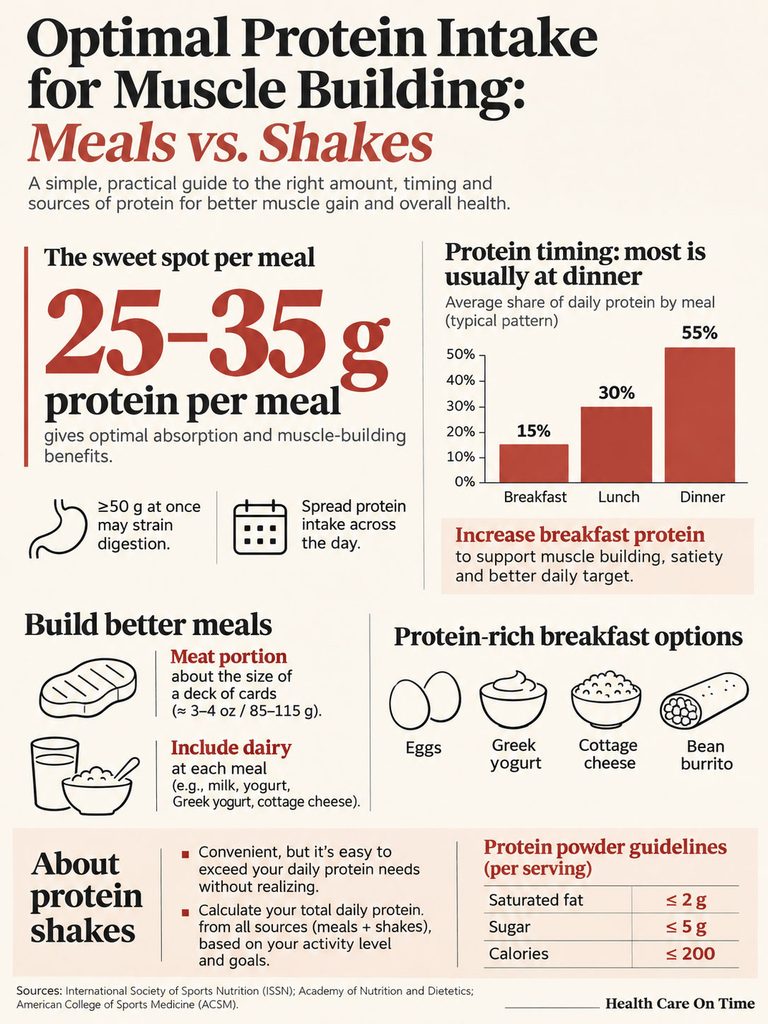
Timing also tends to be lopsided. Most people eat the most protein at dinner and the least at breakfast, and moving some of it to the morning may help with hunger and cravings later in the day, although the research on that is still limited. Some dietitians also find that a protein-containing breakfast helps people stay full and keeps blood sugar steadier through the morning. Eggs, Greek yogurt, cottage cheese or a bean burrito all count.
Shakes make it easy to overshoot without noticing. A double-scoop morning shake, a bar in the afternoon and a meat-centered dinner can push the day well past the target, which might suit a large, very active lifter and still be far past 2 g/kg for a 130-pound office worker. When choosing a powder, look for 2 grams or less of saturated fat, 5 grams or less of sugar and about 200 calories or fewer per serving, and count it toward the day’s total.
What to Do If You Think You’re Eating Too Much
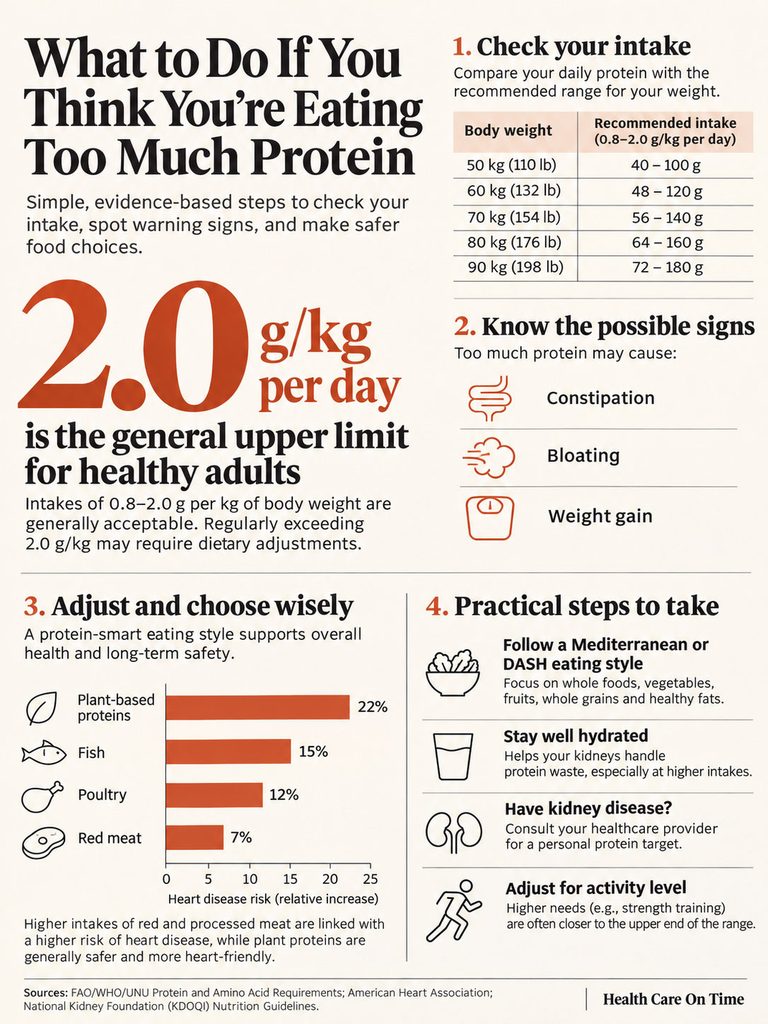
Track one or two typical days, add up the grams from food labels and a nutrition database, and compare the total with the gram table above for your weight. If you already meet your target, there’s no reason to add more, and if the count lands well above the 2 g/kg column, the extras are the first thing to trim. Restaurant food is where counts usually jump, and a loaded Chipotle bowl can carry a large share of a day’s protein and calories by itself.
| Your situation | What to do | Why |
| Healthy adult eating 0.8–1.6 g/kg | Keep going; focus on protein sources | You’re inside the federal target range |
| Healthy, very active, eating 1.6–2.0 g/kg | Fine for most; spread it across 3–4 meals of 25–35 g | Up to 2 g/kg is considered safe for active people |
| Regularly above 2.0 g/kg (e.g., 160+ g at 175 lb) | Cut back toward your target; drop extra shakes first | Past the line where most clinicians see added benefit |
| Diagnosed chronic kidney disease or on dialysis | Get a personal protein target from your nephrologist or kidney dietitian | Too much and too little both cause harm in CKD |
| Past calcium oxalate, calcium phosphate or uric acid stones | Limit animal protein, drink 6–8 cups of fluid daily, ask about DASH | Animal protein may raise stone risk |
| Diabetes or high blood pressure, planning a high-protein diet | Ask for a GFR blood test and urine albumin test first | 38% of adults with diabetes and 21% with high blood pressure have CKD |
| Most protein from red or processed meat | Swap several meals a week for fish, poultry, beans or lentils | Cuts saturated fat and adds fiber |
Check protein-fortified foods as well. Cereals, chips, cookies and coffee drinks with added protein raise the day’s total and often bring sugar, salt or saturated fat with them, and they rarely add anything that a plain egg, a cup of yogurt or a bowl of beans wouldn’t.
Shakes, bars and second servings of meat are usually the easiest things to drop. Replacing some of them with vegetables, fruit, whole grains and beans, plus more water, often clears up constipation within a week or two.
If you want a structure to follow, a Mediterranean or DASH style of eating works well. Both include fish, poultry, beans, nuts and dairy alongside plenty of vegetables, and neither relies on supplements.
Questions to ask your doctor
Bring these to the next visit, especially before a big change in diet:
- Are these eGFR and urine albumin results OK for eating more protein?
- What kind of kidney stone was it, and does that mean cutting back on meat, eggs and dairy?
- How many grams of protein a day make sense at this weight and activity level?
- Should the protein target be based on current weight or a lower, adjusted weight?
- Does a daily protein shake cause any problems with the medicines on this list?
- Is there a kidney or diabetes dietitian you’d recommend?
Frequently Asked Questions
What are the symptoms of too much protein?
Constipation, bloating, gas or diarrhea, bad breath, headache, thirst and weight gain are the usual ones, and many trace back to too little fiber rather than to protein itself. Sharp side or back pain, blood in the urine, foamy urine or new leg swelling need a doctor.
How much protein a day is too much?
For healthy adults, intake that stays above about 2 g/kg a day (roughly 0.9 grams per pound) is generally considered too much: about 136 grams at 150 pounds or 163 grams at 180 pounds. People with kidney disease need a lower, personal limit from their care team.
Can you gain weight if you eat too much protein?
Yes. Extra protein calories are stored as fat like any others.
Is 200g of protein too much?
For most people, yes. At the common 2 g/kg ceiling, 200 grams a day only fits someone who weighs about 220 pounds (100 kg) or more, or around 200 pounds by the stricter 1-gram-per-pound rule some dietitians use, and even then the extra protein won’t build muscle without strength training. For a 150-pound person, it’s well beyond anything a US guideline supports and is likely to crowd out fiber-rich foods. With kidney disease, kidney stones or diabetes, an intake this high should happen only under medical supervision, if at all.
Can your body use more than 30 grams of protein at once?
Somewhere around 25 to 35 grams per meal is the most the body puts toward muscle at one time. Bigger servings won’t harm a healthy person; they just aren’t more useful for muscle.
Do protein shakes damage your kidneys?
In people with healthy kidneys, shakes at normal amounts aren’t known to cause kidney disease. The clearer risk is for people who already have reduced kidney function and don’t know it, which is common. If you have diabetes, high blood pressure or a family history of kidney failure, get a basic kidney test before adding a daily shake.
Can too much protein cause kidney stones?
It can raise the risk, mainly through animal protein. Meat, poultry, eggs, seafood and dairy make stones more likely in people prone to calcium oxalate, calcium phosphate or uric acid stones, so anyone with a stone history should keep animal protein moderate, cut sodium and drink plenty of water. Beans, dried peas and lentils are good replacements because they keep protein up without the same effect.
Does eating a lot of protein make you dehydrated?
It can make you thirstier. Your kidneys need extra water to clear the waste from protein breakdown, so urination goes up, and people on very high-protein diets who don’t drink more can end up mildly dehydrated.
Is 1.6 grams of protein per kg too much?
No. It’s the top of the range in the 2025–2030 Dietary Guidelines for Americans and below the 2 g/kg level most clinicians consider excessive for healthy adults.
Is plant protein safer than animal protein when you eat a lot?
Probably, for heart health and kidney stones. Beans, lentils, tofu and nuts bring fiber and little saturated fat, and plant-rich high-protein diets haven’t been tied to the heart disease and colon cancer risks seen with red-meat-heavy ones. Animal protein also raises stone risk in people prone to stones, so a mix that leans on fish, poultry and plants is the safer pattern for most people.
Medical disclaimer: This article is for general information only and isn’t a substitute for advice from your doctor or a registered dietitian. Protein needs vary with age, weight, activity, pregnancy and medical conditions, especially kidney disease, kidney stones and diabetes. Talk with your health care provider before making major changes to your diet.
References
- Cleveland Clinic. Can You Eat Too Much Protein? Updated August 31, 2026. https://health.clevelandclinic.org/can-you-eat-too-much-protein
- Mayo Clinic Staff. Are high-protein diets safe for weight loss? April 25, 2025. https://www.mayoclinic.org/healthy-lifestyle/nutrition-and-healthy-eating/expert-answers/high-protein-diets/faq-20058207
- Wempen K. Are you getting enough protein? Mayo Clinic Health System, November 27, 2024. https://www.mayoclinichealthsystem.org/hometown-health/speaking-of-health/are-you-getting-too-much-protein
- Harvard Health Publishing. When it comes to protein, how much is too much? Last modified July 23, 2024. https://www.harvardhealth.org/diet-and-nutrition/when-it-comes-to-protein-how-much-is-too-much
- Harvard T.H. Chan School of Public Health, The Nutrition Source. Dietary Guidelines for Americans 2025-2030: Progress on added sugar, protein hype, saturated fat contradictions. January 9, 2026. https://nutritionsource.hsph.harvard.edu/2026/01/09/dietary-guidelines-for-americans-2025-2030-progress-on-added-sugar-protein-hype-saturated-fat-contradictions/
- Elsayed S, Nelson M. Dietary Guidelines for 2025–2030: Recommendations From the USDA and HHS. Am Fam Physician. 2026;114(1):98-100. https://aafp.org/afp/2026/0700/practice-guidelines-dietary-guidelines
- Oklahoma State University Extension. The New Dietary Guidelines for Americans (2025–2030). https://extension.okstate.edu/fact-sheets/the-new-dietary-guidelines-for-americans-2025-2030
- Houston Methodist. How Much Protein Is Too Much? A Dietitian Weighs In. September 10, 2025. https://www.houstonmethodist.org/blog/articles/2025/sep/how-much-protein-is-too-much-a-dietitian-weighs-in/
- Zhang X, Kapoor D, Jeong SJ, et al. Identification of a leucine-mediated threshold effect governing macrophage mTOR signalling and cardiovascular risk. Nat Metab. 2024;6:359-377. https://www.nature.com/articles/s42255-024-00984-2
- Delimaris I. Adverse Effects Associated with Protein Intake above the Recommended Dietary Allowance for Adults. ISRN Nutr. 2013. https://pubmed.ncbi.nlm.nih.gov/24967251/
- National Institute of Diabetes and Digestive and Kidney Diseases. Eating Right for Chronic Kidney Disease. Reviewed January 2025. https://www.niddk.nih.gov/health-information/kidney-disease/chronic-kidney-disease-ckd/eating-nutrition
- National Institute of Diabetes and Digestive and Kidney Diseases. Chronic Kidney Disease (CKD). https://www.niddk.nih.gov/health-information/kidney-disease/chronic-kidney-disease-ckd/all-content
- National Institute of Diabetes and Digestive and Kidney Diseases. Eating, Diet, & Nutrition for Kidney Stones. https://www.niddk.nih.gov/health-information/urologic-diseases/kidney-stones/eating-diet-nutrition
- National Institute of Diabetes and Digestive and Kidney Diseases. Symptoms & Causes of Kidney Stones. https://niddk.nih.gov/health-information/urologic-diseases/kidney-stones/symptoms-causes
- Centers for Disease Control and Prevention. Chronic Kidney Disease in the United States. Updated March 2026. https://www.cdc.gov/kidney-disease/php/data-research
- USDA Agricultural Research Service. What We Eat in America, NHANES 2015-2016, Table 1: Nutrient Intakes from Food and Beverages. https://www.ars.usda.gov/ARSUserFiles/80400530/pdf/1516/Table_1_NIN_MaleFemale_15.pdf
- USDA Agricultural Research Service. What We Eat in America, NHANES 2017-March 2020 Prepandemic, Table 5: Energy Intakes. https://www.ars.usda.gov/ARSUserFiles/80400530/pdf/1720/Table_5_EIN_MaleFemale_1720.pdf