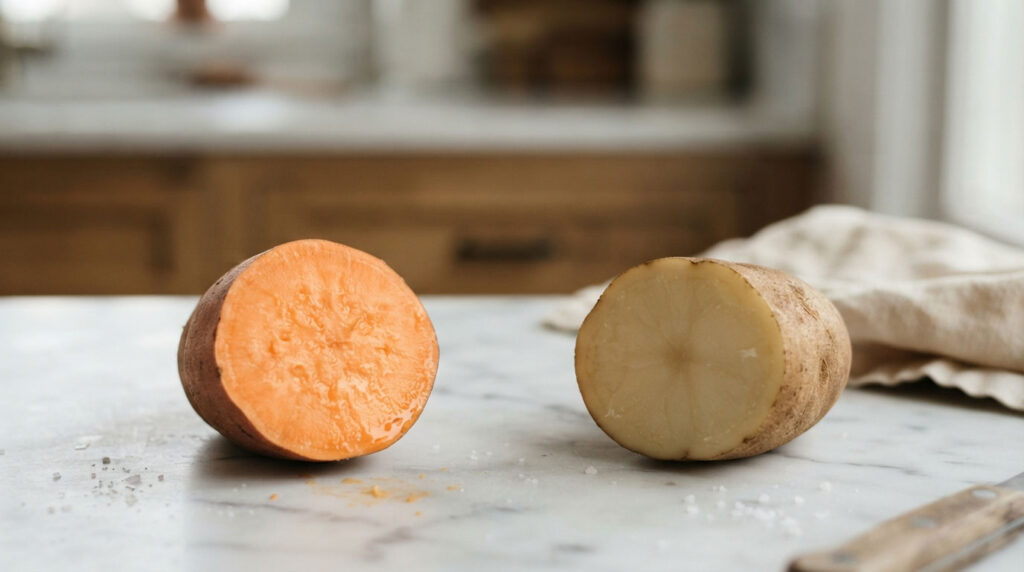
Here is the fact that breaks most people’s assumptions: a baked sweet potato can score higher on the glycemic index than a boiled white potato. Not lower. Higher.
Table of Contents
That single number undoes the tidy story where orange means healthy and white means junk. The two tubers sit far closer than the internet suggests, and the gap that does exist runs in both directions.
Quick Answer
Sweet potatoes and white potatoes have nearly identical calories, carbs, and protein per 100 grams. Sweet potatoes win decisively on vitamin A and modestly on fiber. White potatoes win on potassium and vitamin C. Neither is clearly healthier overall. How you cook the potato affects your blood sugar more than which potato you choose, and boiling beats baking for both.
At a Glance
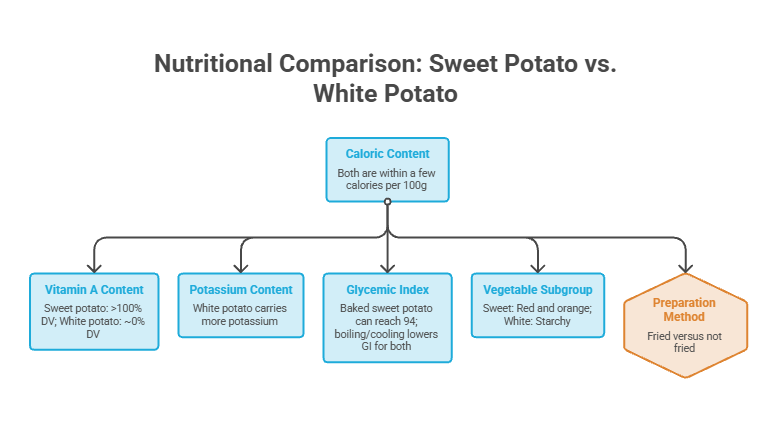
Per 100 grams cooked, the two are within a few calories of each other.
Sweet potato delivers over 100% of the Daily Value for vitamin A; white potato delivers essentially none.
White potato carries more potassium, a nutrient most Americans fall short on.
Baked sweet potato can hit a glycemic index near 94, higher than many boiled white potatoes.
Boiling, then cooling, lowers the glycemic index of both tubers substantially.
Sweet potato counts toward the red and orange vegetable subgroup; white potato counts as a starchy vegetable.
The bigger health question is not sweet versus white, it is fried versus not fried.
They Are Not Even the Same Plant
Most food comparisons pit two close relatives against each other. This one does not.
Our medical reviewers point out that the shared word “potato” causes more confusion here than almost any other pairing in the produce aisle.
Two Different Botanical Families
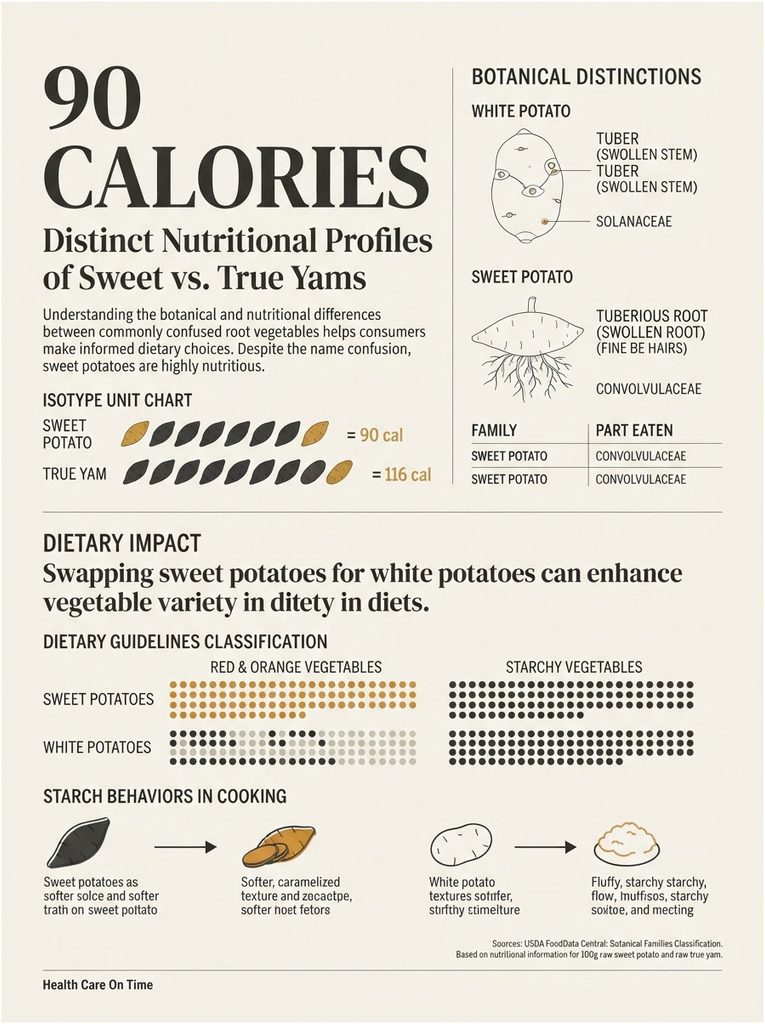
Sweet potatoes belong to the Convolvulaceae family, while white potatoes come from the Solanaceae family, making them botanically unrelated despite the shared name.
White potatoes sit in the nightshade family and sweet potatoes belong to the morning glory group, though both count as root vegetables because the edible part grows underground.
There is one more structural difference. A white potato is a swollen stem, technically a tuber. A sweet potato is a swollen root, a tuberous root. That is not trivia; it partly explains their different starch behavior in the pan.
Why “Yam” on the Label Is Almost Always Wrong
Walk into an American grocery store, find a bin labeled yams, and you are almost certainly looking at sweet potatoes.
In the United States and some other countries, sweet potatoes are often called yams even though they are different species.
The nutritional gap is real. Per 100 grams baked, sweet potato runs roughly 90 calories with an exceptional vitamin A load, while true yam runs closer to 116 calories with negligible vitamin A. Buy actual yams expecting beta-carotene and you will not get it.
How the Dietary Guidelines Classify Each One
This is where a practical, overlooked difference shows up. Federal guidance does not treat these two as interchangeable.
Vegetable intake is meant to be spread across five subgroups: dark green vegetables, red and orange vegetables, starchy vegetables, other vegetables, and pulses such as beans, peas, and lentils.
Sweet potato lands in the red and orange subgroup. White potato lands in starchy vegetables. If your week is heavy on starchy vegetables and light on red and orange, swapping in sweet potato moves you toward the target in a way a second helping of mashed potatoes never will.
Patients who ask us how to eat more vegetables without adding unfamiliar foods often find this the easiest single change available.
Head-to-Head Nutrition: What 100 Grams Actually Delivers
Sweet potato vs white potato comparisons fall apart when one side is measured raw and the other cooked, or when a “medium” sweet potato weighs 114 grams and a “medium” white potato weighs 173 grams. Fixed weight is the only honest basis.
Calories, Carbs, and Protein
The macronutrient picture is close to a dead heat.
Per 100 grams with skin, white potato provides 92 calories and sweet potato 90, both with 2 grams of protein, 0.15 grams of fat, and 21 grams of carbohydrate.
Anyone choosing sweet potato to cut calories is making a rounding-error decision. Two calories per 100 grams vanishes the instant you add a pat of butter.
Fiber and the Skin Question
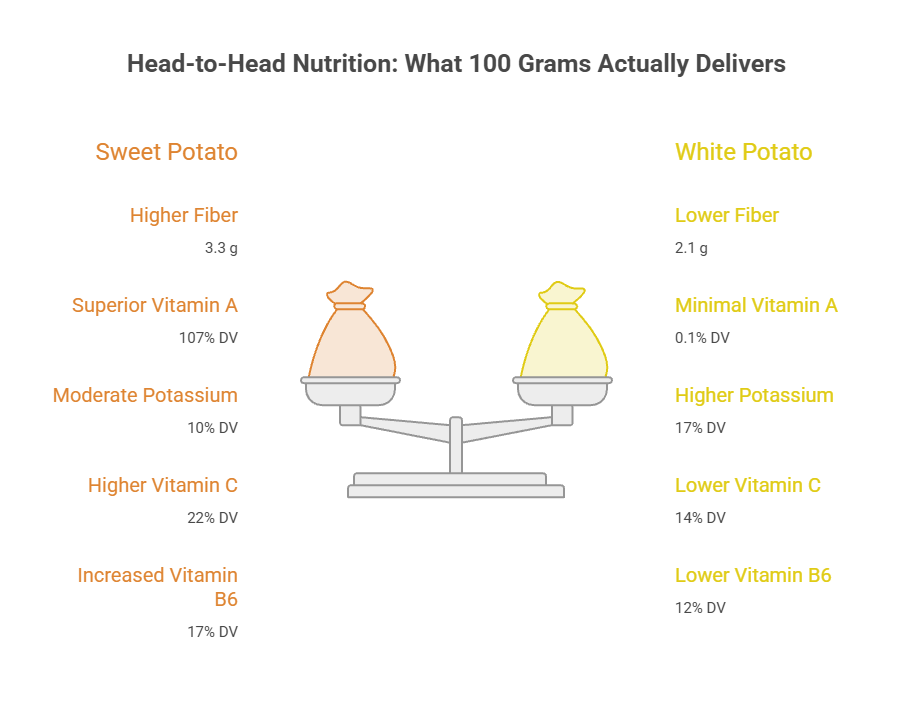
Sweet potato holds a modest, real advantage. Fiber runs 3.3 grams per 100 grams for sweet potato versus 2.1 grams for white potato.
That gap shrinks fast if you peel the sweet potato and keep the white potato skin on. Skin carries a disproportionate share of the fiber in both.
One medium sweet potato with the peel supplies about 4.5 grams of fiber, roughly 16% of the Daily Value, at a time when around 95% of Americans fall short of their fiber goal.
Vitamin A, and Why Sweet Potato Wins Outright
This is not a close call. It is the largest nutritional gap between any two foods people routinely swap for each other.
A 100-gram serving of baked sweet potato provides 961 mcg RAE of vitamin A as beta-carotene, which is 107% of the Daily Value, with orange-fleshed varieties containing the highest levels.
White potato provides 0.1% of the Daily Value for vitamin A.
One practical caveat most articles skip: beta-carotene is fat-soluble. Eating a plain, fat-free sweet potato leaves a meaningful share of that vitamin A unabsorbed. A little olive oil, butter, or avocado alongside it changes the outcome.
Potassium, and Why White Potato Wins Back
Sweet potato does not sweep the board. Potassium runs the other way.
White potato supplies 17% of the Daily Value for potassium per 100 grams compared with 10% for sweet potato.
Raw white potato with skin carries 421 mg of potassium per 100 grams alongside 19.7 mg of vitamin C and 0.295 mg of vitamin B6.
Potassium matters because most Americans do not get enough, and adequate intake tracks with healthier blood pressure. Modeling published in Frontiers in Nutrition found the recommended daily serving of white potatoes, 0.58 cup equivalents, supplies 11% of daily potassium and 6% of daily fiber, plus vitamins B6 and C, copper, magnesium, thiamin, and niacin.
Vitamin C, B6, and the Minerals Nobody Mentions
Sweet potato edges white potato on vitamin C (22% versus 14% of the Daily Value) and vitamin B6 (17% versus 12%), with both providing 6% of the Daily Value for magnesium.
Potatoes USA, the industry board, frames the split as white potatoes having more potassium and vitamin C while sweet potatoes have more fiber, vitamin A, and vitamin B6. Different databases and preparation states shuffle the vitamin C result, which is a fair reminder that these margins are small enough to flip with cooking method alone.
| Nutrient (per 100 g, with skin) | Sweet Potato | White Potato | Winner | Why It Matters |
| Calories | 90 kcal | 92 kcal | Tie | A 2-calorie gap is meaningless in practice |
| Carbohydrate | 21 g | 21 g | Tie | Identical carb load per fixed weight |
| Fiber | 3.3 g | 2.1 g | Sweet potato | 95% of Americans miss their fiber target |
| Protein | 2 g | 2 g | Tie | Neither is a meaningful protein source |
| Vitamin A | 107% DV | 0.1% DV | Sweet potato | Vision, immunity, skin; needs dietary fat to absorb |
| Vitamin C | 22% DV | 14% DV | Sweet potato | Antioxidant; boosts non-heme iron absorption |
| Potassium | 10% DV | 17% DV | White potato | Underconsumed in the US; linked to blood pressure |
| Vitamin B6 | 17% DV | 12% DV | Sweet potato | Protein metabolism and nerve function |
| Fat | 0.15 g | 0.15 g | Tie | Both are near fat-free before cooking |
Source: USDA FoodData Central values for sweet potato and white potato, flesh and skin.
The Blood Sugar Question, Where the Myth Breaks
Here is the section every other page on this topic gets wrong.
What Glycemic Index Actually Measures
Glycemic index ranks how fast a carbohydrate raises blood glucose on a 0 to 100 scale. Under 55 is low, 56 to 69 is medium, 70 and above is high.
The test uses a fixed 50 grams of available carbohydrate, usually more than anyone eats at one sitting. Hold that thought; it matters in a moment.
The Number That Surprises Everyone
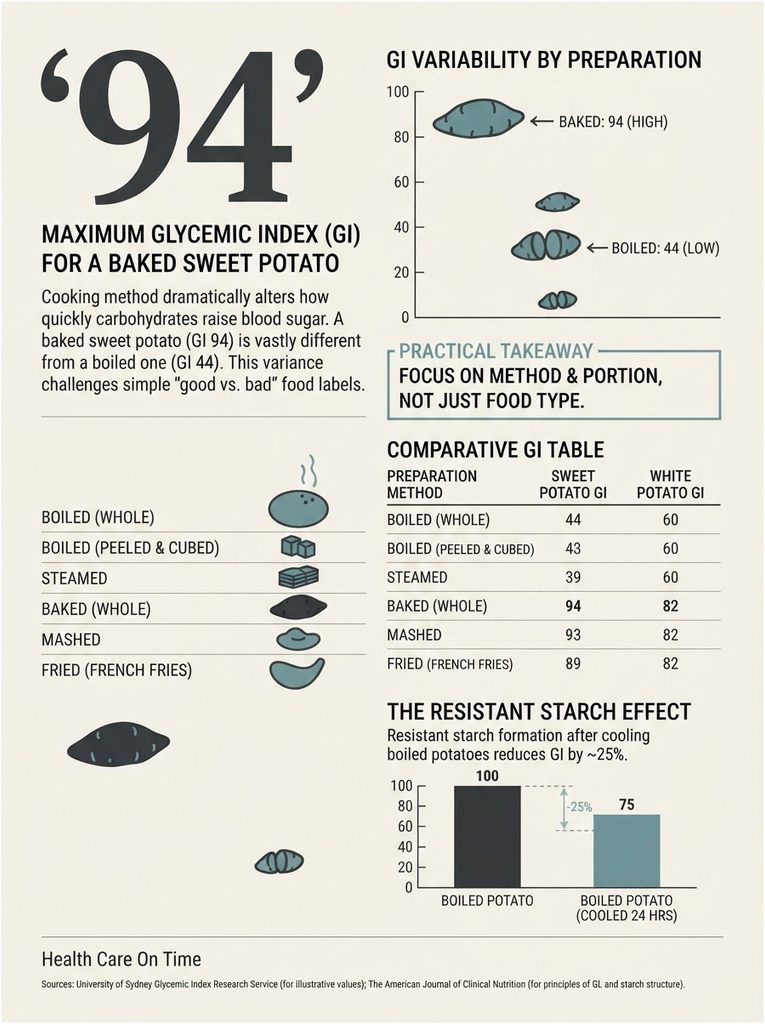
Sweet potato glycemic index ranges from 44 when boiled to 94 when baked, a spread of 50 points from cooking method alone, while white potatoes range from 56 when boiled and cooled to 111 for a baked Russet.
A boiled sweet potato at GI 44 to 61 does beat a baked white potato at GI 78 to 111 by a wide margin, but a baked sweet potato at GI 82 to 94 can score higher than a boiled new potato at GI 56 to 62.
Read that slowly. The orange tuber is not automatically the blood-sugar-friendly one. Sweet potatoes reach a low GI of 46 only when boiled, and both sweet and white potatoes average roughly 88 when baked.
Sweet potatoes peeled and baked for 45 minutes register a glycemic index of 94, comparable to white rice and instant mashed potatoes, while boiling for 30 minutes brings the value to 46 and boiling for only eight minutes lands at 61.
The takeaway: in the sweet potato vs white potato debate, the cooking method decides the blood sugar outcome, not the color of the flesh.
Why Boiling Lowers GI and Baking Raises It
The mechanism is starch structure, not sugar content.
Cell Walls, Amylose, and Amylopectin
Raw starch granules are tightly packed and largely indigestible. Cooking gelatinizes them, letting water in so enzymes can reach the glucose chains. The further gelatinization runs, the faster digestion runs.
Boiling can limit the degree of starch transformation and allows some soluble components to move into the cooking water, while baking concentrates the food and produces a soft, highly digestible structure.
Starch composition matters too. White potatoes are high in amylopectin, a fast-digesting starch, while sweet potatoes contain more amylose, which digests more slowly. That advantage is real, but forty-five minutes of dry oven heat can erase it.
The takeaway: wet heat protects starch structure. Dry heat dismantles it.
Cooling Cooked Potatoes and Resistant Starch
This is the most reliable trick in the entire comparison, and it works on both tubers.
Boiled potatoes stored at 8°C for 24 hours showed a 25% lower glycemic index than freshly boiled potatoes, because cooling retrogrades amylose into resistant starch that resists digestion and is fermented by gut bacteria into butyrate, with reheating retaining 50 to 70% of the benefit.
In a study of North American cultivars, precooked and refrigerated Russet potatoes produced a lower glucose response than same-day cooked, and glycemic index values ranged from 56 for cold boiled red potatoes to 72 for roasted California white, 77 for baked US Russet, 88 for instant mashed, and 89 for hot boiled red.
Potato salad built from cooled potatoes is, on the numbers, one of the gentler preparations for blood glucose. Almost nobody expects that.
The takeaway: cook ahead, refrigerate overnight, reheat gently. You keep most of the benefit.
Glycemic Load Is the Number That Matters at Dinner
Glycemic index uses a fixed carbohydrate dose. Glycemic load adjusts for the portion you actually eat, which is why a high-GI food in a modest portion often behaves modestly.
A medium boiled sweet potato lands around a glycemic load of 11, in the low to moderate range, despite the vegetable’s high-GI reputation. Portion size does a great deal of the work that people attribute to food choice.
Patients managing blood sugar who ask us about potatoes are usually better served by fixing portion and preparation than by switching tubers.
The takeaway: a half-cup serving of a high-GI potato often beats a large serving of a low-GI one.
| Preparation | Sweet Potato GI | White Potato GI | Practical Takeaway |
| Boiled (30 min, whole) | ~44 to 46 (low) | 56 to 89, variety-dependent | Boiling is the single best lever for both |
| Boiled (8 min, cubed) | ~61 (medium) | Varies by cultivar | Longer boiling lowers sweet potato GI further |
| Baked in skin | 82 to 94 (high) | 77 to 111 (high) | Dry heat pushes both into high territory |
| Roasted | ~82 (high) | ~72 (California white) | Roasting destroys resistant starch |
| Mashed | Data limited | ~79 to 88 (high) | Mashing maximizes starch accessibility |
| Cooked then refrigerated 24 h | Limited data | ~56 (cold boiled red) | Cooling can cut GI by roughly 25% |
| Cooked, cooled, reheated | Limited data | Retains 50 to 70% of benefit | Batch-cooking is the practical version |
| Fried | ~76 | Varies widely | Fat lowers GI but adds calories and other risks |
Sources: Atkinson et al., International Tables of Glycemic Index and Glycemic Load Values 2021, American Journal of Clinical Nutrition; Fernandes, Velangi & Wolever, Journal of the American Dietetic Association, 2005; Leeman et al., European Journal of Clinical Nutrition, 2005. Values vary considerably across studies because of variety, storage, and testing lab, so treat these as representative ranges rather than fixed constants.
Where Each One Genuinely Wins
Sweet Potato’s Real Advantages
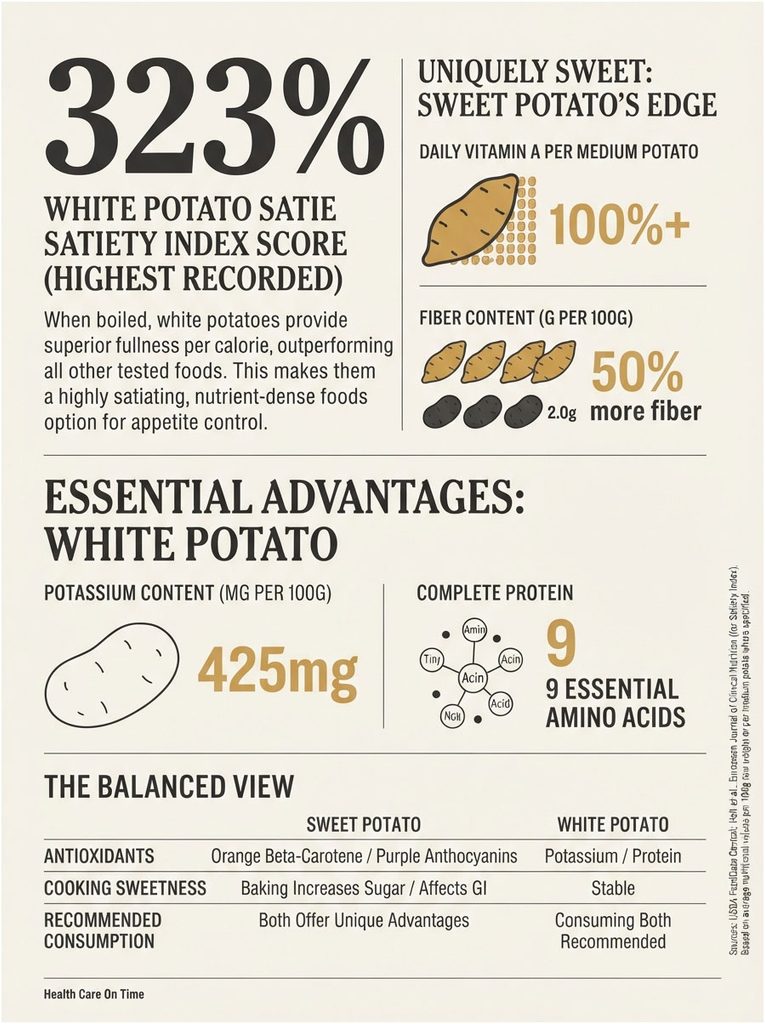
The vitamin A load is the headline and nothing else comes close. One medium sweet potato eaten with the skin on contains over 100% of the recommended daily amount of vitamin A, which plays a role in vision, bone development, and immune function, and absorption improves when paired with a food containing fat.
Fiber is the second advantage, roughly 50% more per 100 grams. The third is subgroup diversity, since sweet potato pushes you toward the red and orange vegetables most Americans underconsume.
There is a baking-specific quirk worth knowing. Baking activates beta-amylase, converting starch into maltose, with total sugars rising from about 4.5 to 8.4% in raw sweet potatoes to 15.1 to 19.1% after baking, and maltose accounting for over half the total sugars in baked samples.
That is why baked sweet potato tastes candy-sweet without any added sugar, and it is also why its glycemic index climbs so sharply. The caramelized flavor people love is the same chemistry that raises the blood sugar response.
White Potato’s Real Advantages
Potassium is the clearest one, and it is not a minor nutrient to win. Vitamin C is competitive. Protein quality is quietly excellent for a vegetable, carrying all nine essential amino acids.
White potato also delivers something sweet potato research has never matched.
The Satiety Index Result Almost Nobody Cites
In a well-known study that ranked 38 common foods by how full they made people feel per calorie, boiled white potato scored 323%, the highest of every food tested. White bread, the reference food, sat at 100%. A croissant came in at 47%.
For anyone managing appetite, that ranking deserves far more attention than it gets. A plain boiled potato is among the most filling calories available, which sits awkwardly beside its reputation as a diet wrecker.
The catch is that the finding applies to plain boiled potatoes. Add oil, cheese, and sour cream and the calorie density climbs while the fullness per calorie collapses.
The Purple and Orange Variety Question
Color signals different antioxidant families. Orange flesh means beta-carotene. Purple flesh, in either tuber, means anthocyanins.
Purple sweet potato varieties supply anthocyanins with anti-inflammatory activity that orange varieties lack. Purple-fleshed white potatoes carry them too, and small controlled trials have reported reductions in inflammatory and oxidative markers with daily purple potato intake that white-fleshed varieties did not produce.
The evidence base here is promising rather than settled, and the trials are small. Treat deeper flesh color as a sensible tiebreaker when price and availability are comparable, not as a reason to pay a premium.
What They Tie On
Calories, carbohydrate, protein, fat, and magnesium. Also versatility, cost per serving, and shelf stability.
Overall, the two types of potatoes come out close to equal nutritionally, with white potato higher in potassium and iron and sweet potato higher in vitamin C and beta-carotene, which argues for eating both rather than picking one.
How Americans Actually Eat Both, and Why It Changes the Answer
Nutrition tables describe a plain tuber. Almost nobody eats a plain tuber, and that is where the sweet potato vs white potato question quietly changes shape.
Per Capita Numbers Tell a Different Story
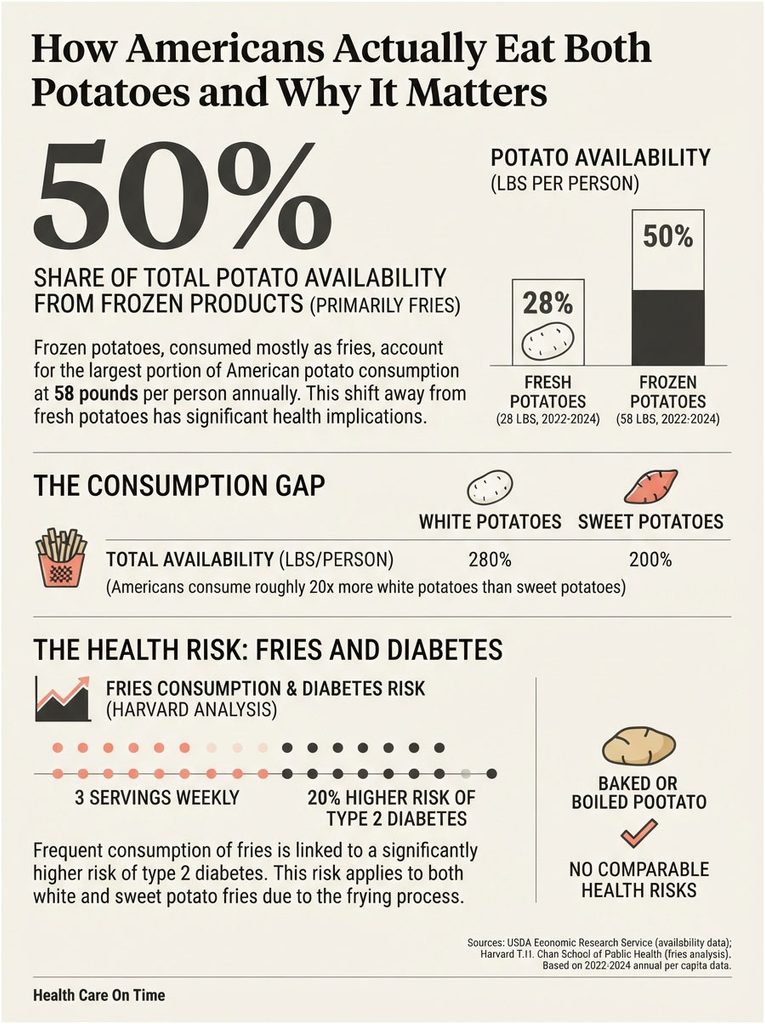
Average annual per capita availability of all combined potato categories over 2022 to 2024 was 115 pounds on a fresh farm-weight basis, with fresh potato availability falling from 46 pounds per person in 2002 to 2004 to an average of 28 pounds in 2022 to 2024.
Frozen potato products, most of which are french fries, now account for about 50% of potato per capita availability at 58 pounds per person.
Sweet potato sits at a fraction of that volume. US per capita consumption of fresh sweet potatoes was about 5.4 pounds in 2023, after climbing nearly 42% between 2000 and 2016 to reach 7.2 pounds, driven largely by promotion of the tuber’s health benefits.
So Americans eat roughly twenty times more white potato than sweet potato, and half of that white potato arrives frozen and destined for a fryer.
The Fries Problem
Here is the finding that reframes the entire comparison. A large Harvard analysis published in the BMJ in 2025, following more than 205,000 US adults across three cohorts, found that three weekly servings of french fries were associated with roughly a 20% higher risk of type 2 diabetes, while baked, boiled, and mashed preparations showed no comparable signal.
Swapping fries for whole grains was associated with about a 19% lower risk. The dividing line in that data is not sweet versus white. It is fried versus not fried.
Sweet Potato Fries Are Still Fries
The health halo travels with the color, and it should not. A sweet potato dropped in a deep fryer is a fried starchy food with added oil and, in most restaurant versions, added sugar and salt on top.
Boiling or steaming is generally recommended over deep-frying because it helps retain more nutrients.
Across the cases our medical team reviews, the person eating baked white potatoes four nights a week is in better shape than the person eating sweet potato fries four nights a week, regardless of which tuber carries more beta-carotene.
| US Statistic | Number | Scope | Source |
| Total potato per capita availability | 115 pounds per year | US, 2022 to 2024 average | USDA ERS Vegetables and Pulses Outlook |
| Fresh potato availability decline | 46 lb (2002-04) to 28 lb (2022-24) | US per capita | USDA ERS |
| Frozen potato products share | ~58 pounds, about 50% of total | US per capita, mostly fries | USDA ERS |
| Fresh sweet potato consumption | ~5.4 pounds per year | US per capita, 2023 | USDA ERS via Statista |
| Higher T2D risk from 3 weekly fries servings | ~20% | 205,000+ US adults, 3 cohorts | Mousavi et al., BMJ 2025;390:e082121 |
| Potassium from recommended white potato serving | 11% of daily potassium (0.58 cup eq) | US modeling, 2,000 kcal pattern | Richter et al., Frontiers in Nutrition 2025 |
Which One Fits Your Health Goal
If You Are Managing Blood Sugar
Choose by preparation first, tuber second. Boiled and cooled beats baked, every time, for both.
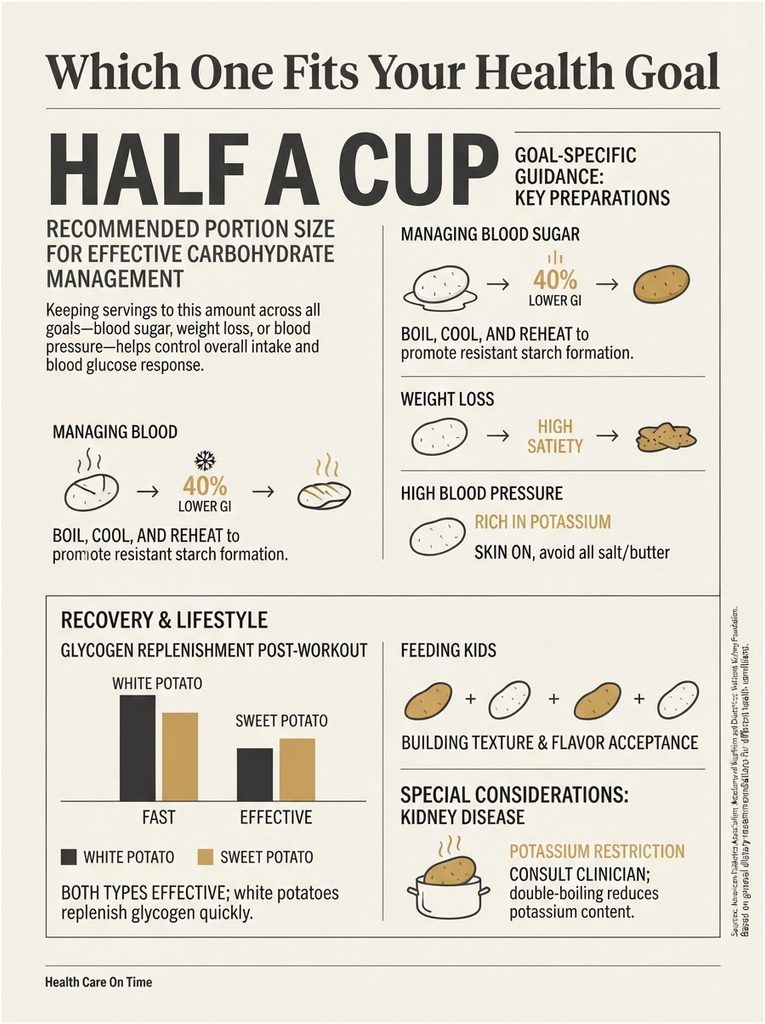
If you plan to bake, sweet potato does not protect you the way you were told. Pair either one with protein, fat, or vinegar to blunt the glucose response, and keep the portion near half a cup, which is roughly 15 grams of carbohydrate.
A continuous glucose monitor, if you use one, will tell you more about your own response than any published table can.
If You Are Trying to Lose Weight
Boiled white potato has the strongest satiety evidence of any food formally tested, which makes it a genuinely useful weight-management food. That is close to the opposite of its reputation.
Sweet potato’s higher fiber content also supports fullness, and its slightly slower-digesting starch may help some people between meals.
Either works. What does not work is either one deep-fried, or a baked potato serving as a delivery vehicle for four hundred calories of toppings. The tuber is rarely the problem.
If You Have High Blood Pressure
White potato, for the potassium. Keep the skin on, boil or bake without added salt, and skip the butter-and-salt finish that cancels the benefit.
Potassium works alongside reduced sodium, not instead of it. A potassium-rich potato served with a salty topping is a wash.
Anyone with chronic kidney disease should reverse this advice entirely and speak with their clinician, since potassium restriction may apply.
If You Train Hard or Need Recovery Carbs
Both work well. White potato’s faster-digesting amylopectin is arguably an advantage in the hour after hard training, when rapid glycogen replenishment is the goal and a high glycemic response is useful rather than harmful.
Sweet potato is the better everyday choice if your diet is otherwise light on vitamin A sources, which is common in people avoiding liver, dairy fat, and orange vegetables.
If You Are Feeding Kids
Alternate them. Sweet potato covers the red and orange subgroup and the vitamin A; white potato covers potassium and tends to be an easier sell with cautious eaters.
Rotation beats optimization here, and it removes the pressure to pick a winner at all. Serving both across a week also builds acceptance of two textures and two flavors rather than one.
| If Your Goal Is | Choose | Cook It This Way |
| Better blood sugar control | Either tuber; preparation matters more | Boil whole, cool 24 hours, reheat gently; pair with protein or fat |
| Weight management and fullness | Boiled white potato | Boil with skin, no added fat, half-cup portion, plain or with vinegar |
| Lowering blood pressure | White potato | Bake or boil with skin, no added salt; skip butter and sour cream |
| Correcting low vitamin A intake | Sweet potato | Boil or bake with skin, always with a source of fat for absorption |
| Hitting the red and orange vegetable subgroup | Sweet potato | Any non-fried method; roast with olive oil for variety |
| Post-workout glycogen refill | White potato | Boil or bake; eat within the hour alongside protein |
| Kidney disease with potassium restriction | Ask your clinician first | Double-boiling and discarding the water reduces potassium |
Downsides, Risks, and Honest Limits
Balanced coverage means naming what each tuber does poorly.
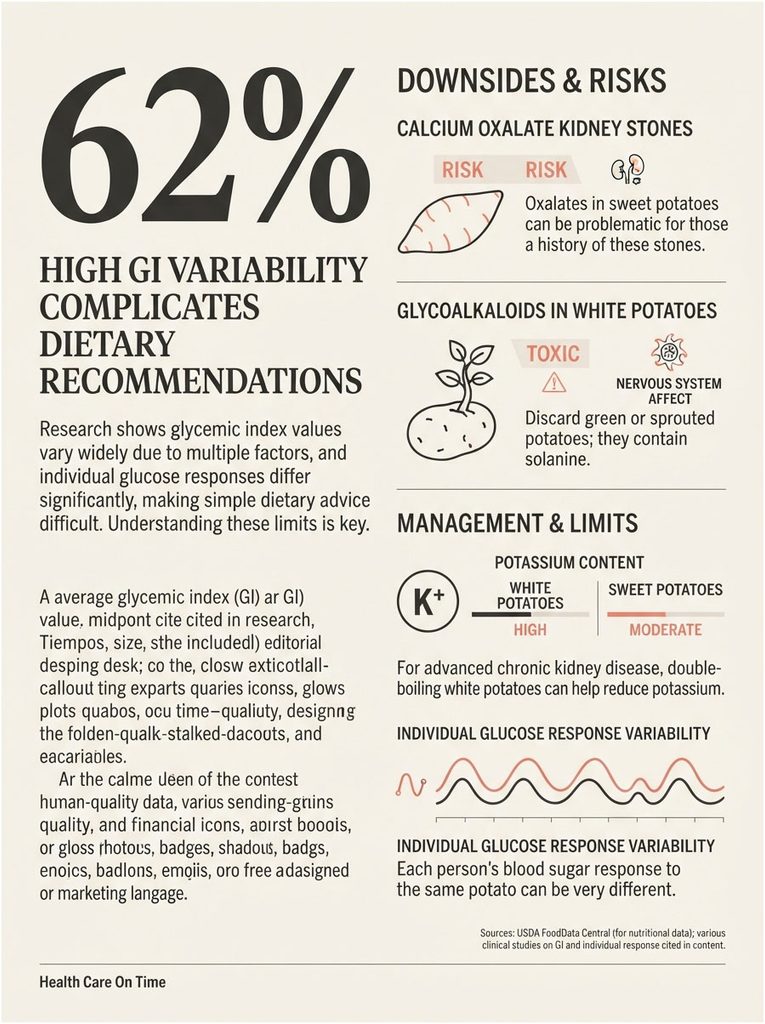
Oxalates in Sweet Potatoes and Kidney Stones
Sweet potatoes carry meaningfully more oxalate than white potatoes. For most people this is irrelevant.
For someone with a history of calcium oxalate kidney stones, daily large servings of sweet potato are worth raising with a clinician. Boiling and discarding the water reduces soluble oxalate content, which is one more argument for the boiling method.
Glycoalkaloids in Green or Sprouted White Potatoes
This is the white potato’s specific liability. Potatoes naturally produce nitrogen-containing compounds called glycoalkaloids as a defense against pests, and green spots indicate increased levels, so green, sprouting, or bruised potatoes should be discarded.
Glycoalkaloids affect the nervous system, and signs of exposure include headache, nausea, fatigue, vomiting, abdominal pain, and diarrhea.
Store potatoes in a cool, dark place. Cut away sprouts and green areas generously, or throw the potato out. Cooking does not reliably destroy these compounds, so trimming lightly is not enough.
Carotenemia, and Why It Is Harmless
Eat enough sweet potato and your palms may turn faintly orange. This is carotenemia, it is cosmetic, and it resolves when intake drops.
It is not vitamin A toxicity. Beta-carotene from whole food converts to vitamin A only as the body needs it, which is why food sources do not carry the overdose risk that high-dose supplements do.
Potassium Cautions for Kidney Disease
White potato’s potassium advantage becomes a liability in advanced chronic kidney disease. Potassium restriction is individualized and belongs with a nephrologist or renal dietitian.
Double-boiling, where you boil, drain, and boil again in fresh water, meaningfully lowers potassium content when that is the goal.
What the Research Still Cannot Tell Us
Glycemic index values swing widely between studies because of variety, growing conditions, storage time, and testing lab. Potato maturity, storage conditions, and meal preparation can matter more than whether the food is labeled white, red, or sweet.
Individual response varies too. Two people eating the same baked potato can produce different glucose curves, which is why continuous glucose monitor readings sometimes contradict published tables.
There is also very little cooled-sweet-potato data, because people rarely eat sweet potatoes cold. That gap is genuine, and it is worth naming rather than papering over.
How to Cook Either One So It Stays Healthy
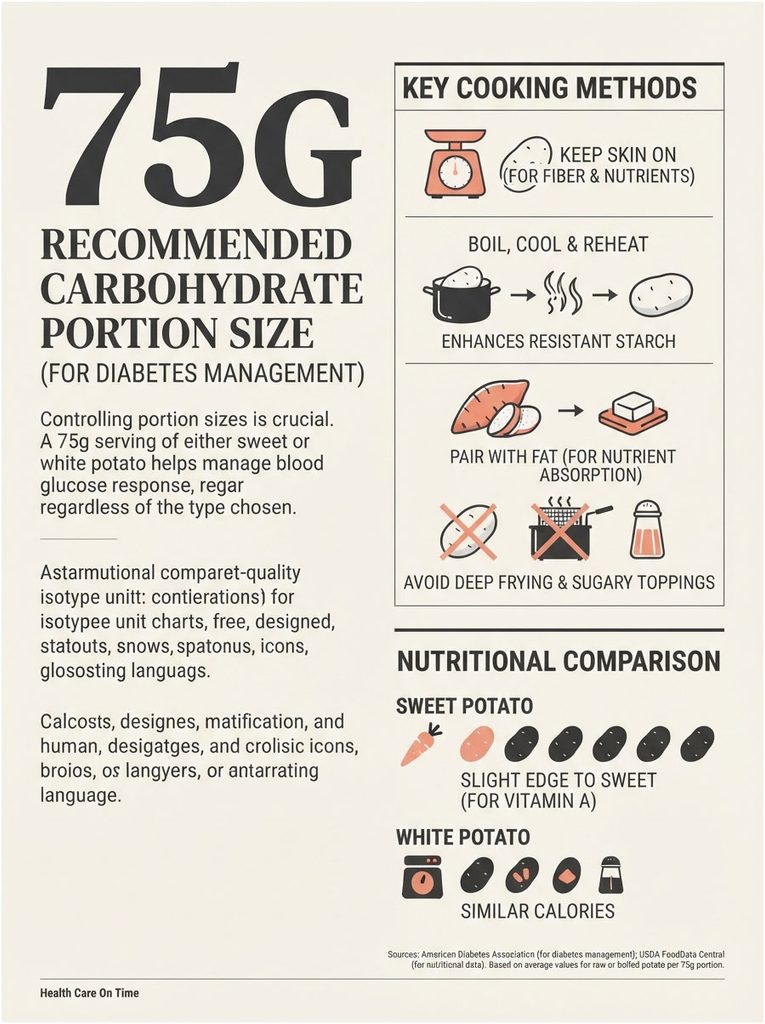
Keep the Skin On
The skin carries fiber, potassium, and polyphenols in both tubers. Peeling costs you nutrition and buys you nothing but texture.
Scrub well, cut out blemishes, and cook whole where possible. Whole cooking also limits nutrient loss into the water, since less surface area is exposed.
Boil, Then Cool, Then Reheat
The single most effective technique in this entire article. Boil on Sunday, refrigerate overnight, and eat through the week.
The resistant starch formed during cooling survives gentle reheating, so you keep most of the benefit even from a warm potato. Microwaving briefly rather than re-boiling preserves more of it.
Pair Sweet Potato With Fat
Beta-carotene absorption depends on dietary fat. A teaspoon of olive oil, a slice of avocado, or a small pat of butter turns a good vitamin A source into an excellent one.
This is one of the few cases where adding fat improves the nutritional outcome rather than undermining it.
What to Skip
Deep frying, for either tuber. Marshmallow and brown sugar casseroles, which convert a vegetable into a dessert. Instant mashed products, which sit at the high end of the glycemic range at roughly 88.
Loaded baked potatoes are not disqualified, but recognize that the toppings drive the calories, not the potato underneath them.
Portion Sizes That Actually Work
A half cup, roughly 75 grams, supplies about 15 grams of carbohydrate, which equals one carbohydrate exchange. That is a workable anchor for anyone counting.
A medium sweet potato runs about 114 grams of flesh. A medium white potato runs closer to 173 grams. Comparing “one medium” of each is not comparing equal amounts of food, which is exactly how the calorie myth got started.
Frequently Asked Questions
Is sweet potato healthier than white potato?
Not decisively. In the sweet potato vs white potato comparison, sweet potato wins on vitamin A and fiber while white potato wins on potassium. Calories, carbs, protein, and fat are nearly identical per 100 grams. Cleveland Clinic and other authorities call it close, giving sweet potato a slight edge mainly for beta-carotene.
Which has more calories, sweet potato or white potato?
They are effectively tied. Per 100 grams with skin, white potato provides 92 calories and sweet potato 90. Confusion arises because a medium sweet potato weighs less than a medium white potato, so per-potato comparisons make sweet potatoes look lower in calories than they actually are.
Do sweet potatoes have more sugar than white potatoes?
Yes, especially when baked. Baking activates beta-amylase, converting starch to maltose and raising total sugars from roughly 4.5 to 8.4% in raw sweet potatoes to 15.1 to 19.1% after baking. Boiling produces far less conversion, which is one reason boiled sweet potatoes score much lower on the glycemic index.
Which potato is better for diabetes?
Cooking method matters more than tuber choice. A boiled sweet potato at glycemic index 44 to 46 is the gentlest option, but a baked sweet potato near 94 can exceed a boiled white potato. Boil, cool, keep portions near half a cup, and pair with protein or fat regardless of which you pick.
Are sweet potato fries healthier than regular fries?
Marginally, because of the vitamin A, but they are still fries. Harvard research following more than 205,000 US adults linked three weekly servings of french fries to roughly 20% higher type 2 diabetes risk, while baked, boiled, and mashed preparations showed no comparable signal. The frying is the issue, not the color.
Which potato has more potassium?
White potato, by a clear margin. It supplies about 17% of the Daily Value per 100 grams versus roughly 10% for sweet potato. Since potassium is underconsumed across the US population and tracks with healthier blood pressure, this is a genuine advantage that most comparison articles understate or skip entirely.
Is it OK to eat potatoes every day?
For most people, yes, if the preparation is sensible. Baked, boiled, and mashed potatoes have not shown the diabetes risk signal that fries have. Daily intake warrants more caution for people with kidney disease, a calcium oxalate stone history, or whose potato consumption is mostly fried.
Are yams and sweet potatoes the same thing?
No. In US grocery stores, produce labeled yams is almost always sweet potato. True yams differ nutritionally, running about 116 calories per 100 grams baked with only trace vitamin A, compared with roughly 90 calories and over 100% of the Daily Value for vitamin A in sweet potato.
Should you eat the skin on both potatoes?
Yes, on both. The skin carries a disproportionate share of the fiber, potassium, and polyphenols. Scrub thoroughly, cut out blemishes, and cook whole where practical. The one exception is any white potato with green patches or sprouts, which should be discarded rather than lightly trimmed.
Which potato is better for weight loss?
Boiled white potato has the strongest evidence. In a study ranking 38 common foods by fullness per calorie, boiled potato scored 323%, the highest of every food tested, against white bread at 100%. Sweet potato’s higher fiber also supports satiety. Either works when it is not fried or heavily topped.
Do purple sweet potatoes offer extra benefits?
Purple varieties supply anthocyanins, pigments with anti-inflammatory activity that orange varieties lack. Purple-fleshed white potatoes carry them too. The trials are small and the evidence is promising rather than settled, so treat deeper color as a reasonable tiebreaker rather than a reason to pay more.
Why do green or sprouted potatoes need to be thrown out?
Green patches signal elevated glycoalkaloids, natural compounds potatoes produce as pest defense. These affect the nervous system and can cause headache, nausea, vomiting, abdominal pain, and diarrhea. Cooking does not reliably destroy them. Store potatoes cool and dark, and discard any that are green, sprouting, or badly bruised.
Frequently Asked Questions
Medical Disclaimer
This article is for general education and does not replace personalized medical or dietary advice. Nutrient values vary by variety, growing conditions, storage, and preparation. Anyone with diabetes, chronic kidney disease, a history of kidney stones, or who takes medication affecting potassium should discuss dietary changes with a licensed clinician or registered dietitian before making them.
References
- Sweet Potatoes vs Potatoes: Which Are Healthier? (Healthline)
- Potato or Sweet Potato: Which Is Healthier? (Cleveland Clinic)
- USDA FoodData Central
- International Tables of Glycemic Index and Glycemic Load Values 2021 (American Journal of Clinical Nutrition)
- Glycemic index of potatoes commonly consumed in North America (Fernandes, Velangi & Wolever, 2005)
- Glycemic Index of Sweet Potato as Affected by Cooking Methods (USDA Agricultural Research Service)
- Boiling vs. baking: structural transformations and starch digestion in white and sweet potatoes (ScienceDirect)
- From fresh to frozen: Potato per capita availability changes over time (USDA Economic Research Service)
- Vegetables and Pulses Outlook (USDA Economic Research Service)
- Per capita consumption of fresh sweet potatoes in the United States (USDA ERS via Statista)
- Satisfying Fruit and Vegetable Recommendations and the Five Vegetable Subgroups (USDA ERS)
- Unique nutrient contribution of white potatoes in the diet (Richter et al., Frontiers in Nutrition, 2025)
- Sweetpotato Nutrition (North Carolina SweetPotato Commission, USDA analysis)
- Setting the Record Straight: Are Sweet Potatoes More Nutritious Than White Potatoes? (Potatoes USA)
- Sweet Potatoes vs. Potatoes: Which Are Healthier? (EatingWell)
- Glycemic Index of Potatoes: Boiled, Baked and Mashed