Every 33 seconds, heart disease claims another American life, and it remains the country’s leading killer. So when two of the produce aisle’s favorite fruits face off, the stakes run deeper than a smoothie recipe.
Table of Contents
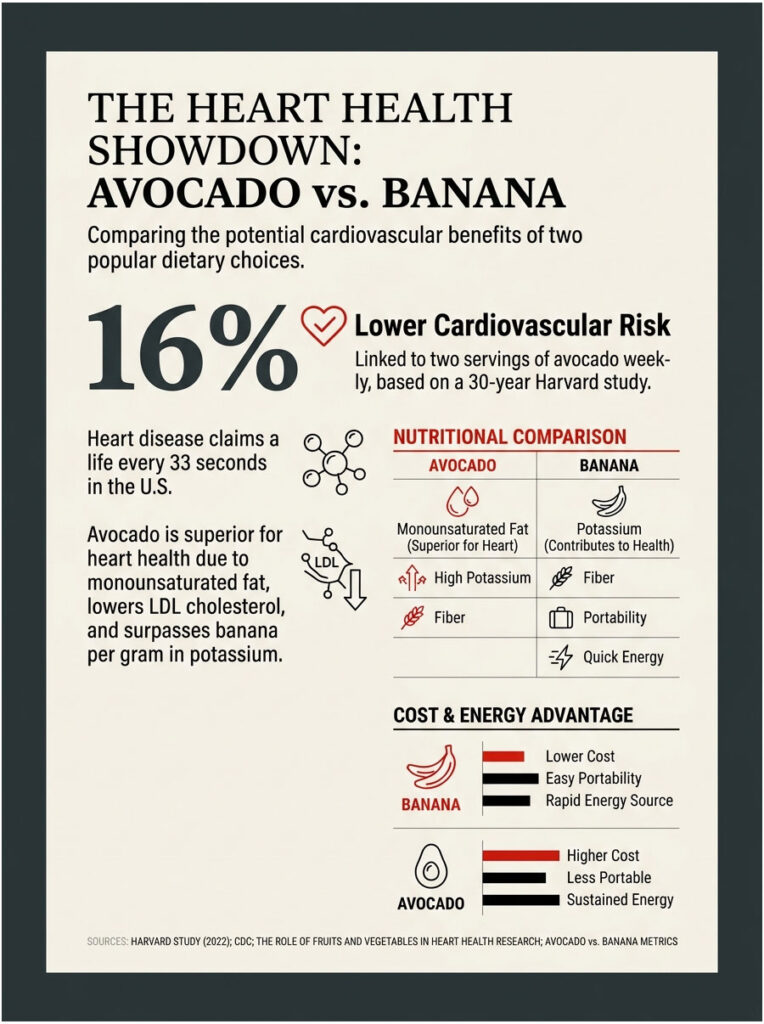
Quick Answer: Avocado is the better fruit for heart health. Its monounsaturated fat lowers LDL cholesterol, it carries more potassium per gram than banana, and a 30-year Harvard study links two weekly servings to a 16% lower cardiovascular disease risk. Banana still helps the heart through potassium and fiber, and wins on cost, portability, and quick energy.
At a Glance
- Avocado delivers heart-protective monounsaturated fat; banana is almost fat-free.
- By weight, avocado holds more potassium (485 mg per 100 g) than banana (422 mg per medium).
- A Harvard study tied regular avocado intake to a 21% lower coronary heart disease risk.
- Banana’s higher natural sugar matters for anyone managing blood glucose.
- Both fruits beat butter, cheese, and processed meats as heart-smart swaps.
- For many people, the best move is eating both, not picking one.
The Heart Health Verdict, Up Front
Want the short version? Avocado is the stronger choice for protecting your heart over time. Its fat profile works directly on cholesterol, and the research behind that claim is unusually robust for a single food.
Banana is no failure, though. It packs potassium and fiber into a low-calorie, grab-and-go form that suits nearly any budget or schedule.
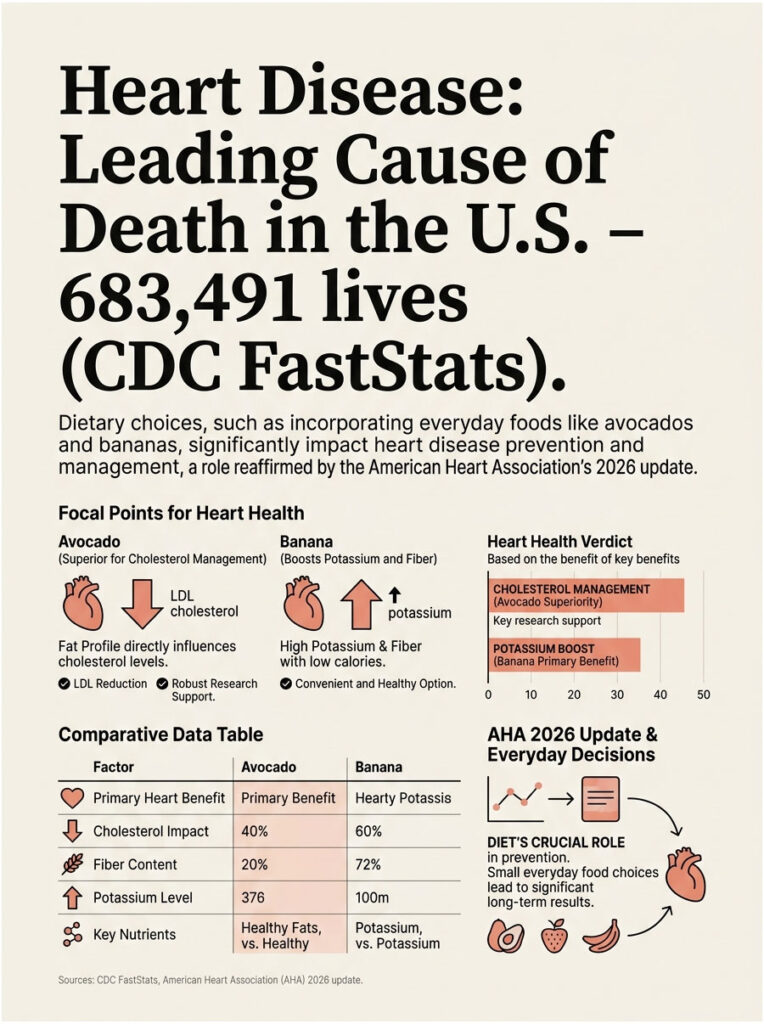
What’s genuinely better comes down to your current heart need. Lowering cholesterol leans toward avocado, while topping up potassium on a hectic morning makes banana the practical winner.
Why This Comparison Matters for USA Readers
Heart disease is not an abstract worry. It killed 683,491 Americans in the most recent national tally, outpacing every other cause, according to CDC FastStats.
The newest American Heart Association 2026 update confirms heart disease still tops U.S. mortality, with stroke now sitting at number four. Diet remains central to prevention, and patients booking lipid and blood pressure tests with us frequently ask which everyday foods actually count.
Fruit choices like these are a daily, low-effort lever almost anyone can pull. That makes the avocado-versus-banana question more useful than it first appears.
Nutrition Head-to-Head: Avocado vs Banana
On a nutrition label, these fruits look like opposites. One is a creamy, fatty fruit; the other is a sweet, starchy energy source, and that contrast shapes how each touches your heart.
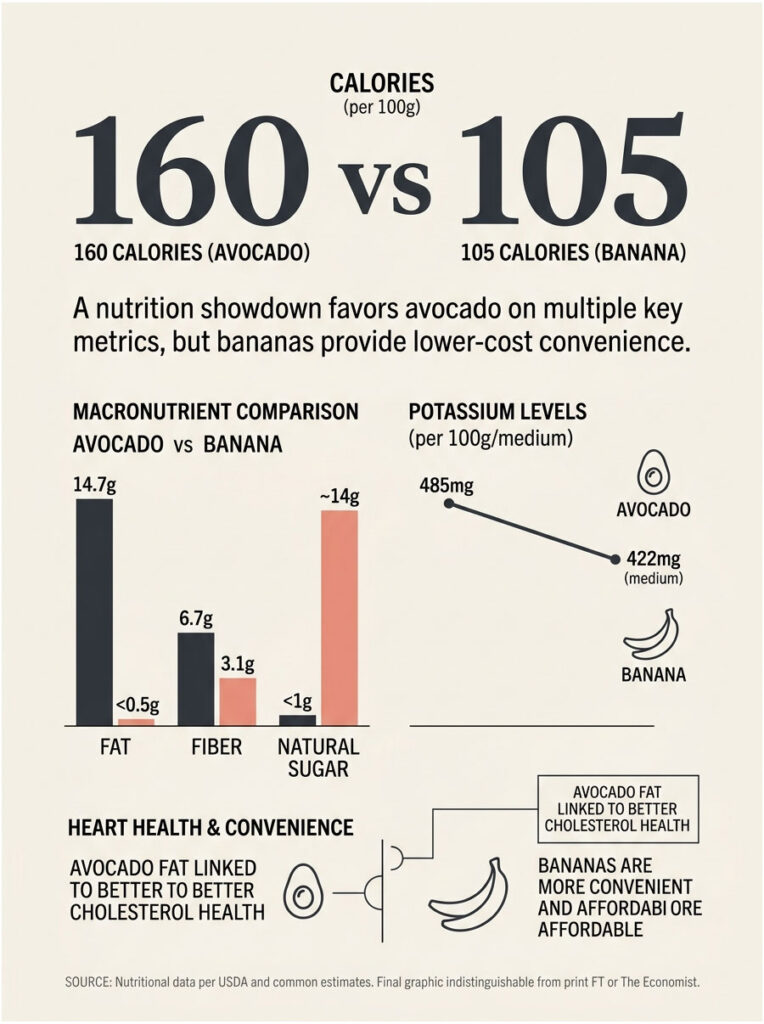
Avocado is calorie-dense thanks to its fat. Banana is lighter but sugar-rich. Neither is “bad,” yet they play different roles on a heart-healthy plate.
Calories, Fat, Fiber, and Sugar
A 100-gram serving of avocado runs roughly 160 calories, driven by about 14.7 grams of fat, per USDA FoodData Central. Close to 10 grams of that is monounsaturated oleic acid, the type linked to better cholesterol.
A medium banana (about 118 grams) carries just 105 calories and under half a gram of fat. Banana is the lighter snack by calories, though avocado’s fat is the heart-helpful kind.
Fiber tilts clearly toward avocado, at about 6.7 grams per 100 grams versus banana’s roughly 3 grams. Sugar runs the other way: avocado holds under 1 gram, while a banana carries around 14 grams of natural sugar.
The Potassium Question, Settled
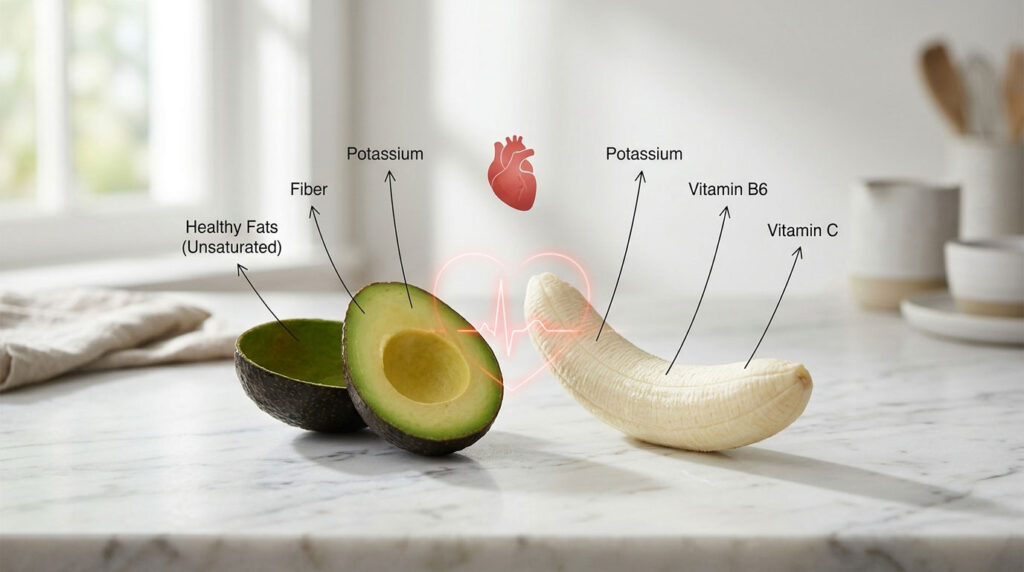
Banana built its fame on potassium, but the crown is overstated. A medium banana supplies 422 mg, only about 9% of the 4,700 mg Daily Value, per the NIH Office of Dietary Supplements.
Avocado quietly outdoes it, delivering 485 mg per 100 grams. Our medical reviewers point this out often, since most people assume banana is the undisputed potassium champion.
Potassium earns its heart reputation by counterbalancing sodium, which eases tension on blood vessel walls. Both fruits help; avocado does more per gram, while banana does it more cheaply and conveniently.
Table 1: Core Nutrient Comparison (Heart Relevance)
| Nutrient | Avocado (100 g) | Banana (medium) | Why It Matters | Winner |
| Calories | 160 | 105 | Calorie control supports healthy weight | Banana |
| Total fat | 14.7 g | 0.4 g | Avocado’s fat is heart-protective | Avocado |
| Monounsaturated fat | ~9.8 g | ~0.04 g | Lowers LDL cholesterol | Avocado |
| Fiber | 6.7 g | 3.1 g | Cuts cholesterol absorption | Avocado |
| Potassium | 485 mg | 422 mg | Regulates blood pressure | Avocado |
| Natural sugar | 0.7 g | 14.4 g | Lower sugar aids glucose control | Avocado |
| Vitamin B6 | low | 25% DV | Supports homocysteine metabolism | Banana |
| Cost / convenience | higher | low, portable | Sustainable habits protect the heart | Banana |
Source: USDA FoodData Central; NIH Office of Dietary Supplements.
Why Avocado Earns Its Heart-Health Reputation
Avocado’s heart credentials run deeper than potassium. Its fat composition is what cardiologists keep highlighting, and the supporting evidence has strengthened in recent years.
Many people are surprised that a high-fat fruit lands on the heart-healthy list. The fat type explains everything, and across the patients our diagnostic network serves, that single fact reframes the whole conversation.
Monounsaturated Fat and LDL Cholesterol
The fat in avocado is mostly oleic acid, the same monounsaturated fat that makes olive oil a Mediterranean-diet cornerstone. This fat helps lower LDL, the cholesterol that builds artery-clogging plaque. The Dietary Guidelines for Americans urge swapping saturated fats for unsaturated ones.
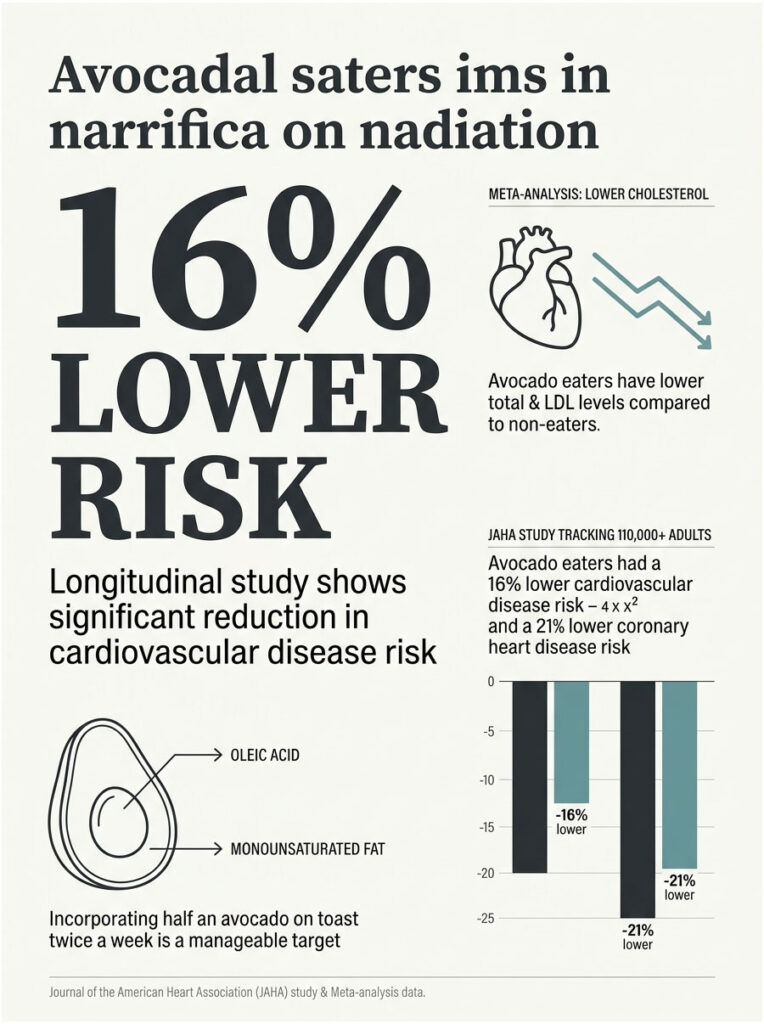
A meta-analysis of multiple trials found avocado eaters showing lower total and LDL cholesterol than non-eaters. That cholesterol shift forms one of the clearest pathways from avocado to a healthier heart.
The Harvard Study, Explained
The strongest evidence appears in the Journal of the American Heart Association, where researchers tracked more than 110,000 U.S. adults across three decades.
Participants eating at least two servings of avocado weekly had a 16% lower cardiovascular disease risk and a 21% lower coronary heart disease risk than those who rarely ate it. That’s a striking gap from one food habit.
Equally telling, swapping half a daily serving of butter, margarine, egg, cheese, yogurt, or processed meat for avocado was linked to a 16% to 22% lower cardiovascular risk. The substitution, not mere addition, drives much of the payoff.
What “Two Servings a Week” Really Means
In that study, a serving meant half an avocado, or about half a cup cubed. Two servings weekly comes to roughly one whole avocado spread across seven days.
That target is realistic for most Americans. Half an avocado on toast twice a week, or tossed into a salad, gets you there without overhauling your diet.
One caveat matters: replacing healthy plant oils, nuts, or olive oil with avocado showed no extra benefit. Avocado shines most when it displaces the saturated fats already crowding the typical American plate.
Where Banana Holds Its Own
Banana is far from outclassed. It earns its place through a different mix of strengths, and writing it off would be a mistake for most hearts.
In cases reviewed by our medical team, banana frequently proves the more realistic daily habit. A fruit you actually eat every day beats a pricier one you keep skipping.
Potassium, Blood Pressure, and the Sodium Seesaw
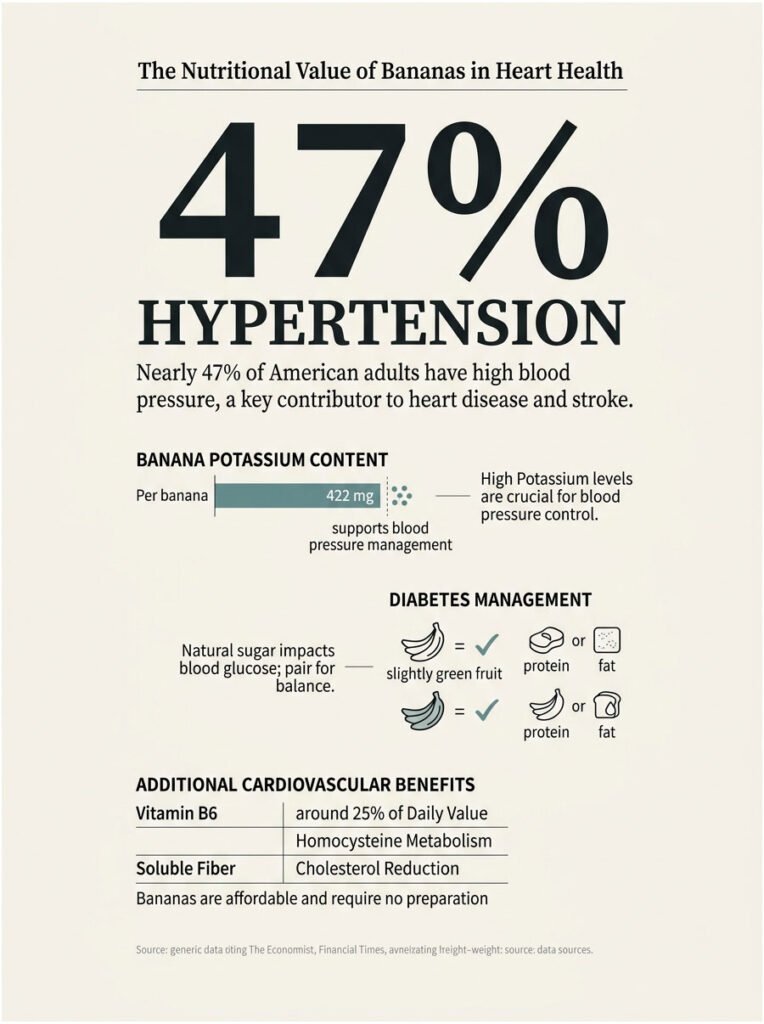
Although banana isn’t the potassium king, 422 mg per fruit is a respectable contribution. Potassium acts like the opposite end of a seesaw against sodium, helping relax blood vessels and ease blood pressure.
High blood pressure affects nearly half of American adults and ranks among the biggest drivers of heart disease and stroke. Adding potassium-rich foods is one of the simplest ways to push back.
Bananas make that effortless because they’re cheap, portable, and need no prep. For anyone managing hypertension on a tight budget, that accessibility is a real cardiovascular edge.
Fiber, Vitamin B6, and Quick Energy
Banana provides soluble fiber, which helps trim cholesterol and steady digestion. Less-ripe green bananas also contain resistant starch that behaves much like fiber and supports gut health.
Its standout nutrient is actually vitamin B6, around 25% of the Daily Value. B6 helps metabolize homocysteine, an amino acid tied to higher cardiovascular risk when elevated.
Bananas also deliver fast, clean carbohydrate energy, the reason athletes reach for them. For active people fueling the very workouts that strengthen the heart, that quick energy carries genuine value.
The Sugar and Glycemic Caveat
Here lies the detail most search results skip. A banana’s roughly 14 grams of natural sugar can raise blood glucose faster than avocado’s near-zero sugar.
For people with diabetes or insulin resistance, that’s significant, since blood sugar swings are themselves a heart risk factor. The answer isn’t banning bananas; it’s pairing them with protein or fat and minding portion size.
Riper bananas hit blood sugar harder than firmer ones. Patients commonly ask us about this, and our practical guidance is to favor slightly green fruit and keep servings to one at a time.
Table 2: USA Heart Health and Fruit Data
| Metric | Figure | Source |
| Annual U.S. heart disease deaths | 683,491 | CDC FastStats, 2024 |
| Americans dying from CVD | 1 every 33 seconds | CDC |
| Lower CVD risk with 2 avocado servings/week | 16% | JAHA, 2022 |
| Lower coronary heart disease risk | 21% | JAHA, 2022 |
| U.S. adults with high blood pressure | ~47% | AHA, 2025 |
| Potassium Daily Value met by 1 banana | ~9% | NIH ODS |
Source: CDC; American Heart Association; Journal of the American Heart Association; NIH Office of Dietary Supplements.
Which Fruit Fits Your Heart Situation?
There’s no universal winner. The better fruit depends on the specific heart concern you’re managing, and our lab partners report this is exactly where people get tangled up.
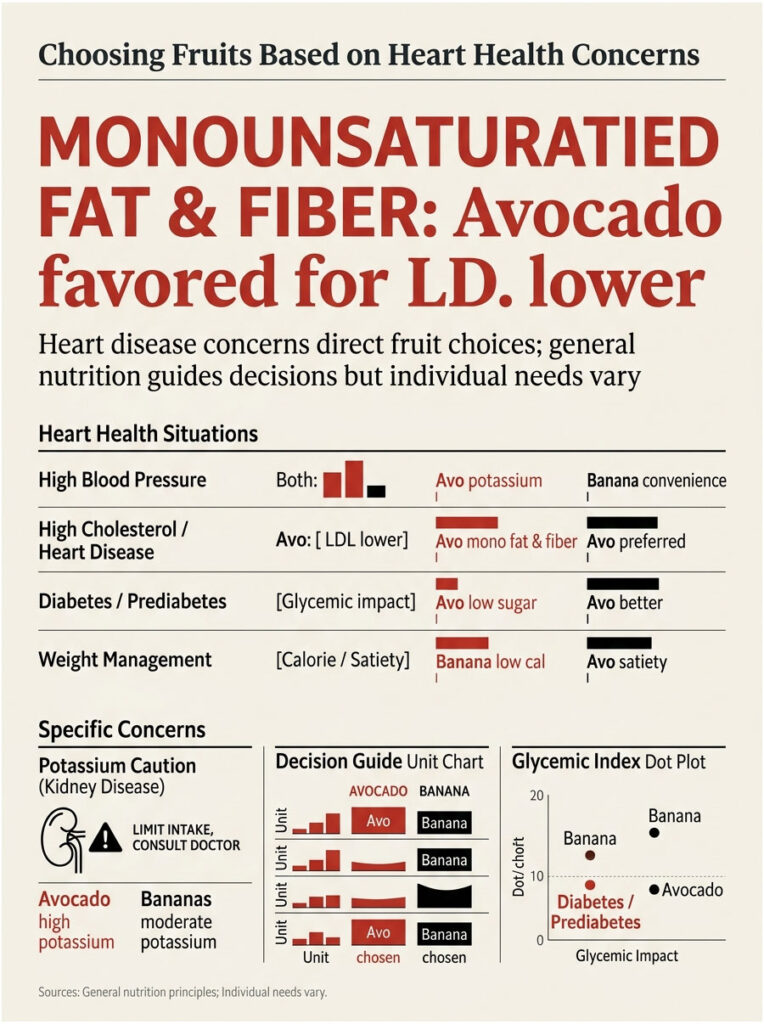
Below is the practical breakdown our medical reviewers use with patients. Match your situation to the better pick.
High Blood Pressure
Both fruits help, courtesy of potassium. Avocado offers a bit more per gram, yet banana’s everyday convenience often makes it the more sustainable blood pressure ally.
If you can fit both, alternate them. The goal is total daily potassium, and rotating the two keeps the habit from getting dull.
High Cholesterol or Existing Heart Disease
Avocado is the clear choice. Its monounsaturated fat and fiber act directly on LDL cholesterol, the strongest lever for anyone managing cardiovascular disease.
Use avocado to replace saturated-fat spreads like butter or full-fat cheese. That swap, rather than piling avocado on top of your usual diet, is what the research rewards.
Diabetes or Prediabetes
Avocado wins on glycemic grounds. With under 1 gram of sugar plus generous fat and fiber, it barely nudges blood glucose.
Banana stays acceptable in moderation, ideally firmer fruit paired with protein. But for tighter glucose control alongside heart protection, avocado is the safer everyday default.
Weight Management
This call is nuanced. Banana’s lower calories help a calorie deficit, while avocado’s fat and fiber create lasting fullness that can curb later overeating.
For most people, a portion-controlled half avocado satisfies longer than a banana. Watch total calories either way, since excess weight strains the heart.
Kidney Disease (Potassium Caution)
Here the logic flips. People with chronic kidney disease often must limit potassium, and both fruits are potassium-rich, with avocado the higher source.
If you have kidney disease, do not increase either fruit without your doctor’s guidance. What protects a healthy heart can overload compromised kidneys.
Table 3: Decision Guide, Avocado vs Banana by Scenario
| Your Situation | Better Pick | Why |
| Managing high LDL cholesterol | Avocado | Monounsaturated fat lowers LDL |
| Watching blood sugar (diabetes) | Avocado | Near-zero sugar, low glycemic impact |
| Tight on budget or time | Banana | Cheap, portable, no prep |
| Fueling a workout | Banana | Fast, clean carbohydrate energy |
| Existing heart disease | Avocado | Strongest cardiovascular evidence |
| High blood pressure | Either (rotate) | Both add potassium |
| Chronic kidney disease | Neither without MD advice | Both are high in potassium |
Guidance reflects general nutrition principles; individual needs vary.
How to Eat Both for Maximum Heart Benefit
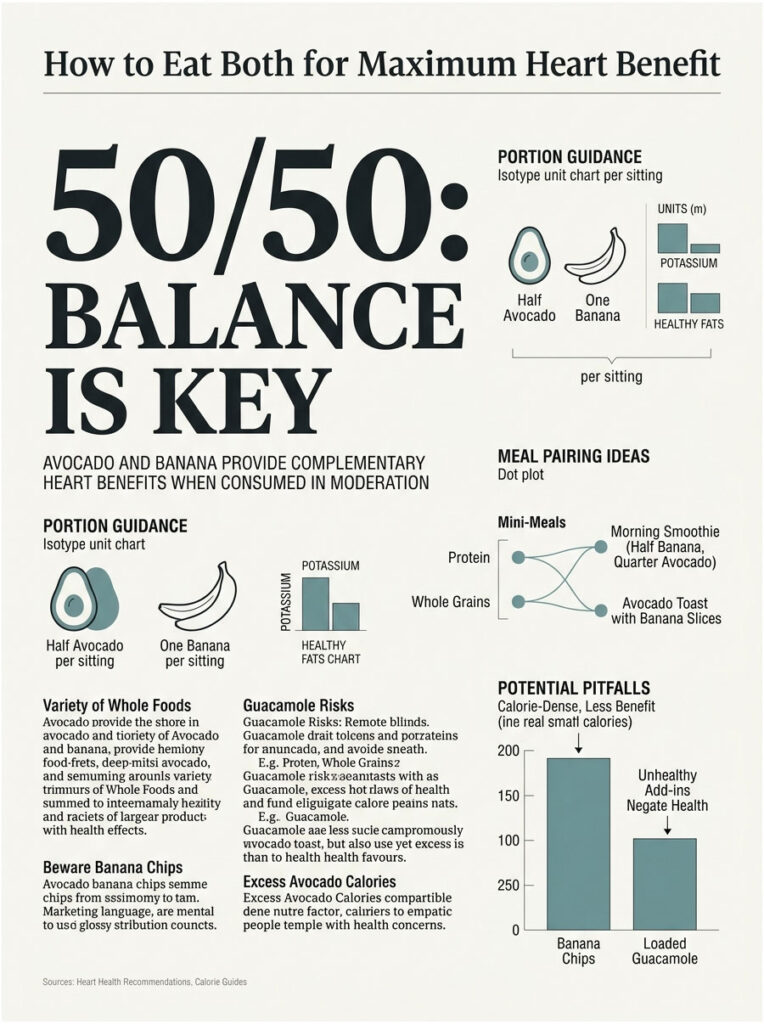
You don’t actually have to pick a side. The strongest heart strategy treats avocado and banana as teammates, each covering the other’s gaps.
In tests booked through HealthCareOnTime, patients with the best lipid and pressure numbers tend to eat a wide variety of whole foods rather than fixating on one “superfruit.”
Smart Pairings and Portion Sizes
A morning smoothie blending half a banana with a quarter avocado packs potassium, healthy fat, and creaminess into one glass. The avocado’s fat also slows the banana’s sugar absorption.
Keep portions sensible: half an avocado and one banana per sitting is plenty. More fruit isn’t automatically better, particularly given avocado’s calorie density.
Pair either fruit with protein or whole grains. Avocado on whole-grain toast, or banana with Greek yogurt, turns a snack into a balanced, heart-supportive mini-meal.
Mistakes That Cancel the Benefit
Banana chips are the classic trap. Fried in oil and often sugar-coated, they reach around 519 calories per 100 grams and shed much of the fresh fruit’s value.
Loaded guacamole can backfire too, once salty chips, processed cheese, or sour cream join in. The avocado stays healthy; the company it keeps does not.
Overdoing portions undoes the math. Two whole avocados daily adds heavy calories, and surplus calories raise weight, which raises heart risk regardless of fat quality.
The Bottom Line: Avocado vs Banana
For pure heart protection, avocado is the stronger fruit. Its monounsaturated fat lowers LDL cholesterol, it holds more potassium per gram, and a 30-year Harvard study links it to measurably lower cardiovascular risk.
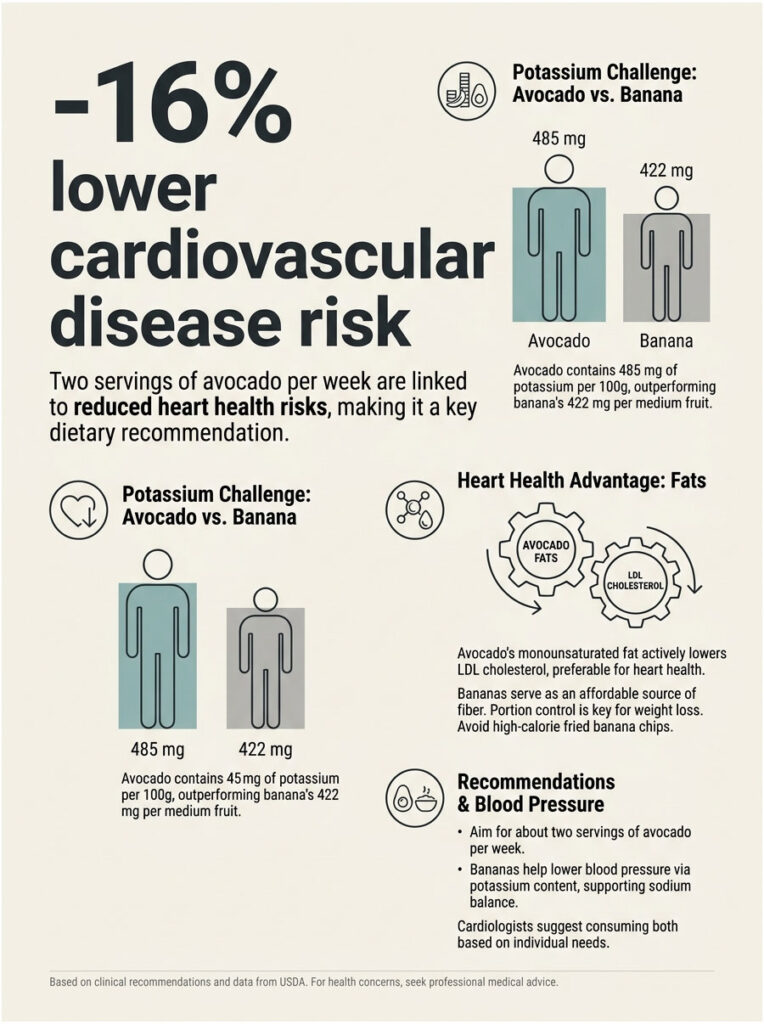
Banana keeps real worth, though. It’s an affordable, portable source of potassium and fiber that fits everyday life, and a fruit you eat daily beats a premium one you abandon.
The honest takeaway most cardiologists endorse: eat both, lean on avocado when cholesterol or blood sugar is the concern, and grab banana when convenience and quick energy win the day.
Frequently Asked Questions
Which has more potassium, avocado or banana?
Avocado wins by weight, with 485 mg per 100 grams against a banana’s 422 mg per medium fruit. Banana earned the potassium reputation, yet it isn’t the leader. Both contribute meaningfully toward the 4,700 mg daily target while supporting healthy blood pressure through the potassium-sodium balance.
Is avocado better than banana for cholesterol?
Yes. Avocado’s monounsaturated fat and fiber actively lower LDL cholesterol, while banana has almost no fat to affect cholesterol directly. Research links regular avocado intake to lower total and LDL cholesterol, making it the stronger pick when managing high cholesterol or established heart disease.
Can I eat banana with high blood pressure?
Yes, bananas can help. Their potassium offsets sodium’s pressure-raising effect, supporting healthier readings. A medium banana provides roughly 422 mg of potassium. Combine it with an overall low-sodium diet for best results, and skip banana chips, which add salt and erase the benefit.
How many avocados should I eat per week for heart health?
Aim for about two servings weekly, with one serving being half an avocado. That equals roughly one whole avocado across the week, the amount tied to a 16% lower cardiovascular disease risk in a large Harvard study. Use avocado to replace saturated fats for the biggest gain.
Are bananas bad for your heart?
No, bananas are generally heart-friendly. They supply potassium, fiber, and vitamin B6 that support cardiovascular health. The main caution is their natural sugar, relevant mostly for people with diabetes. Eaten in normal portions, bananas remain a healthy, budget-conscious fruit for most hearts.
Is avocado too high in fat for the heart?
No. Avocado’s fat is mainly monounsaturated, the heart-protective type that lowers LDL cholesterol. National guidelines favor these fats over saturated ones. The only watch point is calories, since avocado is calorie-dense. Sticking to about half an avocado per serving captures the benefits without overdoing energy intake.
Which fruit is better for diabetics’ hearts?
Avocado is usually better for people with diabetes. With under 1 gram of sugar plus ample fat and fiber, it barely affects blood glucose. Bananas remain acceptable in moderation, ideally firmer fruit paired with protein to blunt the blood sugar response and protect the heart.
Can eating avocado lower blood pressure?
Avocado can support healthier blood pressure, largely through its potassium, which offsets sodium. Some research suggests avocado compounds may also influence blood pressure regulation. It’s no replacement for prescribed medication, but adding avocado to a balanced, low-sodium diet is a sensible supportive step for many people.
Should heart patients avoid bananas at night?
There’s no strong evidence that heart patients must skip bananas at night. Timing matters far less than total daily intake and overall diet quality. People with kidney disease or those on potassium-affecting medications should follow their doctor’s advice, since potassium balance grows more sensitive in those situations.
Is it okay to eat avocado and banana together?
Yes, and it’s a smart pairing. The avocado’s fat and fiber slow the banana’s sugar absorption, steadying blood glucose. Together they offer potassium, healthy fat, fiber, and quick energy. A smoothie with half a banana and a quarter avocado is an easy, heart-friendly choice.
Which is better for weight loss and heart health?
Banana is lower in calories, aiding a deficit, while avocado’s fat and fiber keep you fuller and may cut later snacking. For weight loss with heart benefit, portion control matters most. A measured half avocado often satisfies better than a banana for many people.
Do banana chips have the same heart benefits?
No. Banana chips are usually fried and sugar-coated, hitting around 519 calories per 100 grams. That processing strips much of the fresh fruit’s value while adding unhealthy fat and sugar. For heart health, choose fresh bananas, or plain freeze-dried slices, over fried chips.
Disclaimer: This article is for general educational purposes and does not replace professional medical advice. Nutritional needs vary, especially for people with diabetes, kidney disease, or those on medications affecting potassium. Always consult a qualified healthcare provider before making significant dietary changes.
References
- CDC FastStats: Leading Causes of Death
- American Heart Association: 2026 Heart Disease and Stroke Statistics Update
- Journal of the American Heart Association: Avocado Consumption and Risk of Cardiovascular Disease
- Harvard Health: Eating Avocado May Lower Heart Disease Risk
- USDA FoodData Central
- NIH Office of Dietary Supplements: Potassium
- Dietary Guidelines for Americans