Picture a glossy golden sachet sold beside the register at a gas station, promising “all-natural” power and energy. Now picture a federal lab cracking that same sachet open and finding the active drug inside Viagra.
Table of Contents
That isn’t a hypothetical. It’s the documented reality behind much of the royal honey sold across the United States, and it changes how any careful shopper should read the label. Let’s separate the marketing from the medicine, one layer at a time.
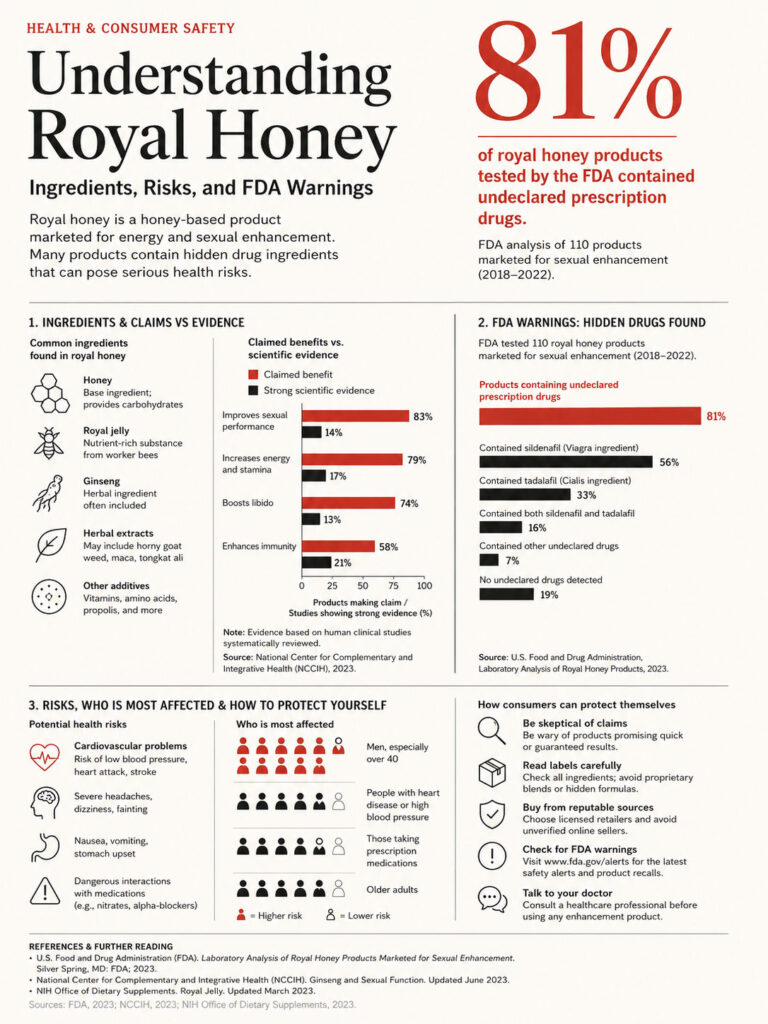
Quick Answer: Royal honey is a honey-based product, often blended with royal jelly and herbs like ginseng, marketed for energy, stamina, and sexual enhancement and usually sold in single-dose sachets. It is not the same thing as royal jelly, the natural bee secretion. The U.S. Food and Drug Administration has repeatedly found undeclared prescription drugs, including sildenafil and tadalafil, hidden inside many royal honey products sold in the United States.
At a Glance
- Royal honey is a marketed product; royal jelly is the actual substance bees make. They are not the same.
- It is sold mainly for sexual performance, energy, and “vitality.”
- The FDA has issued repeated public warnings after finding hidden prescription ED drugs inside these products.
- The biggest danger is for men taking nitrates or living with heart disease, diabetes, or high blood pressure.
- Royal jelly has early lab research behind it, but no quality human trials support the sexual-enhancement claims.
- Safer, proven options exist, and ongoing symptoms deserve a real medical workup.
What Is Royal Honey, Exactly?
Royal honey is a sweet paste sold in small foil packets, usually 10 to 20 grams each. Brands describe it as honey enriched with royal jelly, bee pollen, and herbal extracts, then promote it for libido, stamina, and “male vitality.”
You’ll spot it behind the counter at convenience stores, smoke shops, and gas stations, and listed on Amazon, eBay, and Etsy. The marketing leans hard on one word, “natural,” and that word is doing more work than it should.
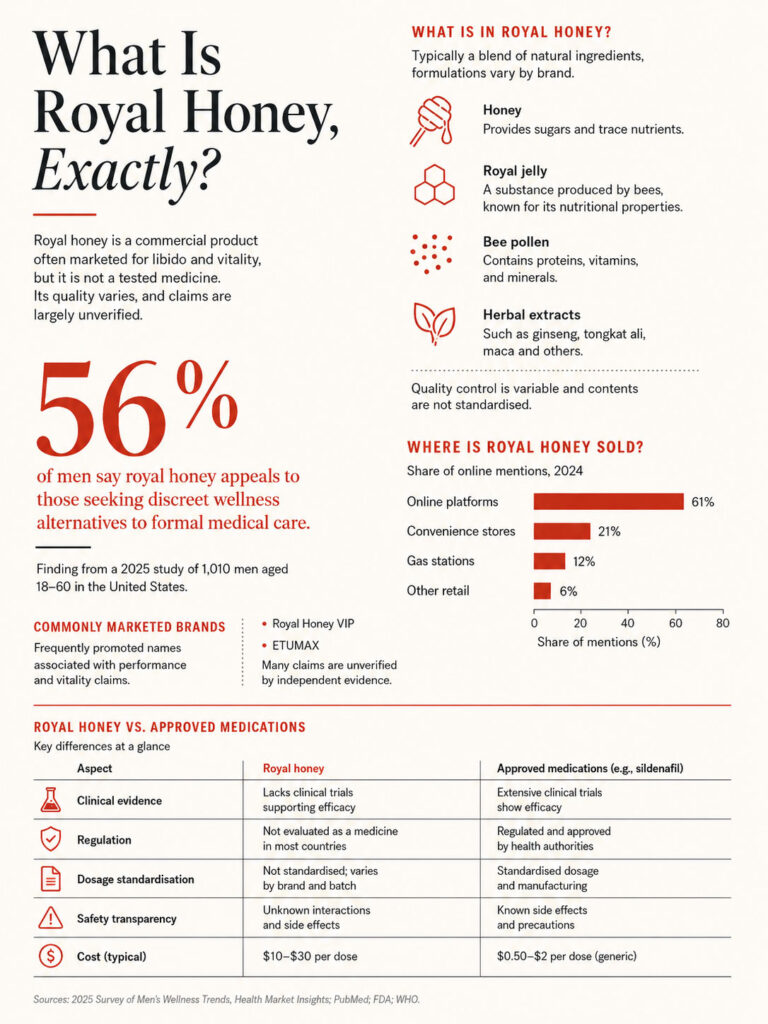
Strip away the packaging and the picture is simpler. Royal honey is a loosely regulated, supplement-style product rather than a tested medicine, and what’s printed on the wrapper does not always match what’s inside the sachet.
Royal Honey vs. Royal Jelly (Clearing the Biggest Confusion)
Of every question our medical reviewers field on this topic, this is the one people get tangled in most, so let’s settle it before anything else. Royal jelly is a real biological substance. Royal honey is a commercial product that sometimes contains it.
Royal jelly is a milky secretion that nurse honeybees produce to feed larvae and the queen bee. Scientists have catalogued its proteins, called major royal jelly proteins, alongside vitamins, minerals, and polyphenols that give it genuine biological activity in the lab.
Royal honey, by contrast, is a branded blend assembled for retail sale. The royal jelly content varies between brands, the herbal mix varies, and the quality controls are thin. One is studied by researchers; the other is sold for performance.
Getting this distinction right protects you twice. It keeps you from assuming a marketed sachet carries royal jelly’s studied properties, and it keeps you from dismissing legitimate royal jelly research because of a product’s bad reputation.
How It’s Marketed and Where It’s Sold
Most royal honey is positioned as a discreet “wellness” alternative to seeing a doctor, which is a big part of its pull. A 2025 analysis in the International Journal of Impotence Research described these packets as offering privacy, normalcy, and a sense of control to men who feel exposed by formal care.
That psychology explains the demand without validating the product. The journal’s authors were careful to say the appeal of these packets does not establish that they work.
The shoppers who book diagnostic tests with us frequently mention they first heard about royal honey from a checkout display or a short social-media clip, never from a clinician. That gap, hype on one side and evidence on the other, runs through this entire subject.
Common Brand Names You’ll Encounter
The category cycles through a rotating cast of names, which makes the problem hard to track at a glance. Knowing the recurring labels helps you connect a product on the shelf to what regulators have actually flagged.
Frequently seen names include Royal Honey VIP, Kingdom Honey Royal Honey VIP, ETUMAX VIP Royal Honey for Him, Vital Honey, Dose Vital VIP Vital Honey, and “for her” variants. The manufacturer often cited is Etumax Corporation S.A.S, with U.S. distribution under names such as Royal Honey America.
Here’s how royal honey compares against the three things people most often confuse it with.
| Feature | Royal Honey (Marketed Product) | Royal Jelly | Prescription ED Medication |
| What it is | Retail honey blend sold for sexual enhancement | Natural secretion bees feed to the queen | FDA-approved drug (sildenafil, tadalafil) |
| Key compounds | Honey, royal jelly, herbs, plus sometimes hidden drugs | Proteins (MRJPs), vitamins, minerals, polyphenols | Single, measured PDE5-inhibitor dose |
| Evidence for sexual benefit | No quality human trials support the claims | None for sexual performance | Strong clinical-trial evidence |
| FDA status | Not approved; repeatedly flagged for hidden drugs | Sold as a supplement; not a drug | Approved, prescription only |
| Where you get it | Gas stations, convenience stores, online | Health-food stores, supplement aisles | Pharmacy, with a prescription |
What’s Actually in Royal Honey? (Ingredients)
The ingredient story splits into two halves: what the label claims, and what laboratories keep finding. Both deserve attention, and the second half is where the danger lives.
The Label Ingredients
Royal honey wrappers usually list a familiar lineup of “natural” components, with the pitch that they work together to boost performance and energy. On the surface, it reads like a health-food product.
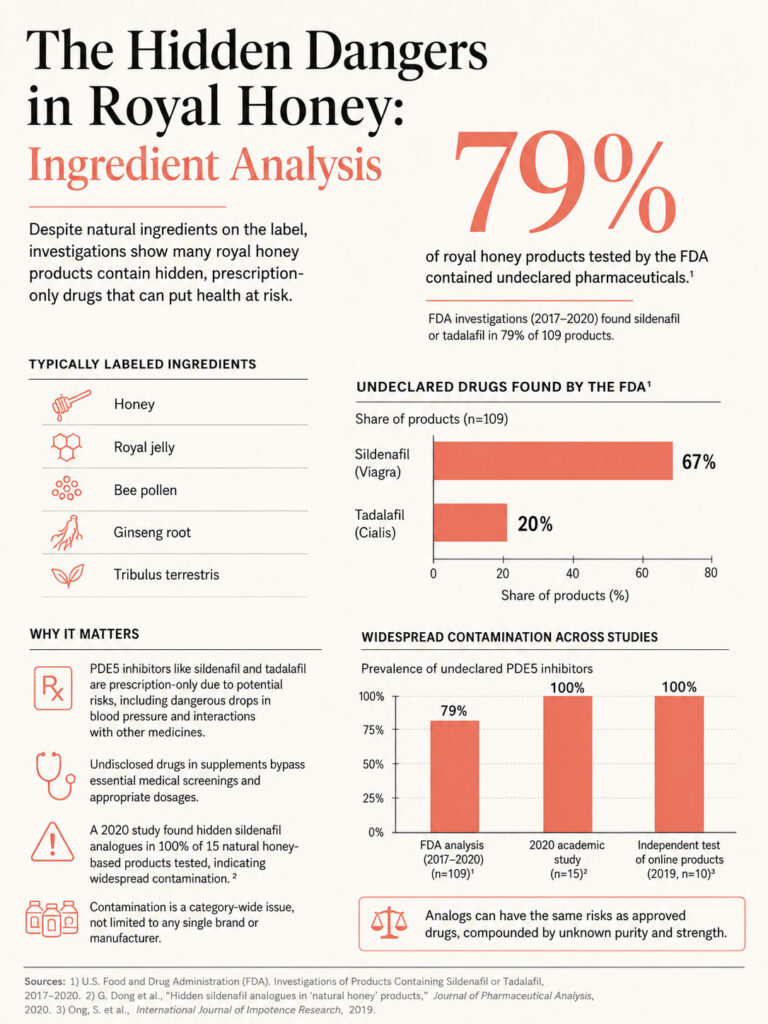
Typical listed ingredients include honey, royal jelly, bee pollen, ginseng root, and Tribulus terrestris, a leafy plant long marketed for libido. Not one of these is a prescription drug.
The trouble is that these labeled ingredients rarely explain the strong, fast results that users report. That mismatch between a gentle label and a powerful effect is exactly what pulled regulators in.
The Undeclared Ingredients the FDA Keeps Finding
Here sits the heart of the matter. Across repeated investigations, FDA laboratory analysis has confirmed undeclared pharmaceuticals inside royal honey products sold to Americans.
The drugs identified include sildenafil (the active ingredient in Viagra), tadalafil (the active ingredient in Cialis), and, in at least one 2025 case, the anti-inflammatory drug diclofenac. None appeared anywhere on the labels.
In the view of the team at HealthCareOnTime, an undisclosed prescription drug is the most dangerous thing a so-called supplement can hold, because the buyer has no way to dose it safely or check it against the other medications they take.
What PDE5 Inhibitors Are and Why “Prescription Only” Matters
Sildenafil and tadalafil belong to a drug class called PDE5 inhibitors. They relax blood vessels and improve blood flow, which is precisely why they treat erectile dysfunction so effectively.
These drugs are prescription-only for sound reasons. A clinician screens for heart conditions and drug interactions before writing the prescription, because the same medicine that helps one person can endanger another.
A honey sachet skips every one of those safeguards. The user receives the active drug without the screening, the controlled dose, or the medical oversight that makes a PDE5 inhibitor safe to take.
The Research on Hidden Ingredients
Independent science reinforces the FDA’s findings rather than standing apart from them. A 2020 mass-spectrometry investigation by Zhang and colleagues, published in a peer-reviewed toxicology journal, uncovered hidden sildenafil analogues in numerous “natural” honey-based sexual enhancers.
Analogues are slightly altered versions of approved drugs, sometimes synthesized with no quality control. They can carry the same risks as the original compound, plus the added hazard of unknown purity and strength.
That study matters because it shows the contamination is both widespread and sometimes chemically disguised. This is a pattern across the category, not a single brand’s manufacturing slip.
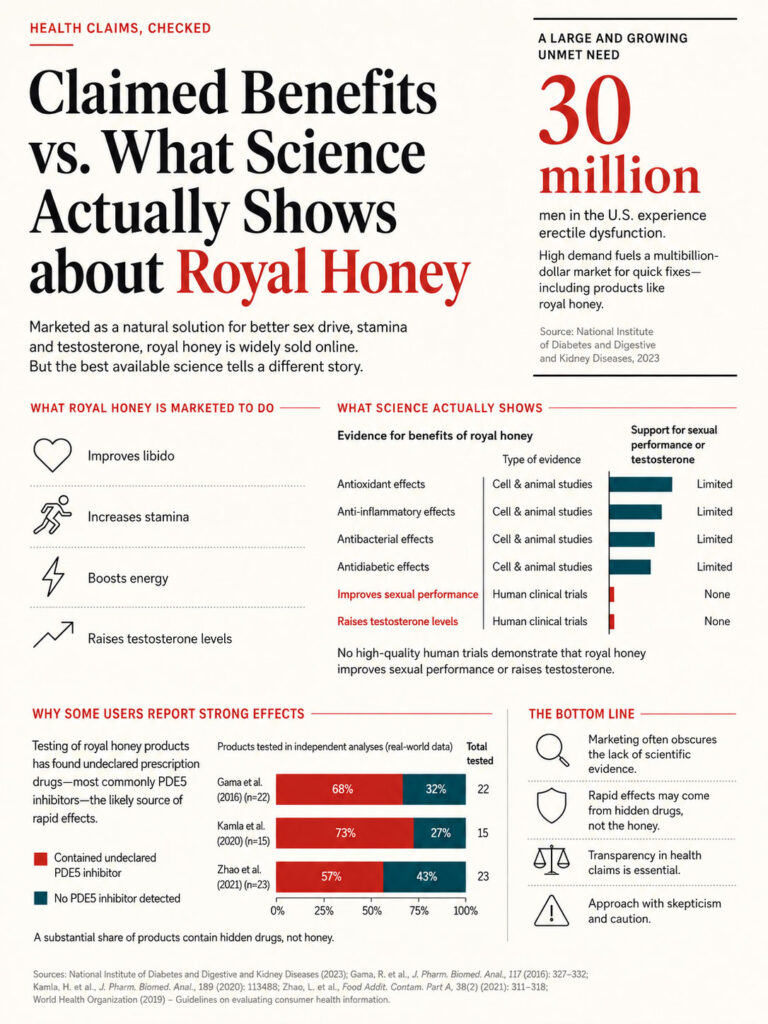
Claimed Benefits vs. What Science Actually Shows
Asking whether there’s any genuine benefit here is fair. The marketing makes large promises, so each one deserves a side-by-side look at the evidence.
The Marketed Claims
Royal honey ads typically promise sharper libido, longer stamina, more daily energy, and even higher “testosterone.” Some packaging hints at near-instant results inside a single day.
These claims sell because they speak to a real and widespread concern. Erectile dysfunction affects roughly 30 million men in the United States, according to the National Institute of Diabetes and Digestive and Kidney Diseases, so the appetite for a quick fix is enormous.
Heavy demand, though, says nothing about whether a product works. It mostly explains why this category keeps expanding despite a decade of warnings.
What Royal Jelly Research Supports
Royal jelly, the natural component, does carry a research base, though mostly in cell and animal studies rather than large human trials. Scientific reviews describe antioxidant, anti-inflammatory, antibacterial, and antidiabetic activity linked to its proteins and polyphenols.
Some early work has even explored royal jelly’s effects on immune response and metabolic markers. Those findings are interesting and worth continued study.
What they are not is proof that a retail honey sachet improves sexual performance in people. Our medical reviewers flag a recurring caveat here: activity in a petri dish often fails to translate into a measurable benefit once it’s tested in real human bodies.
The Honest Evidence Gap
This is the part the marketing quietly skips over. No high-quality, controlled human trials show that royal honey’s natural ingredients meaningfully treat erectile dysfunction or raise testosterone.
When users do feel a strong, drug-like effect, the most plausible explanation is an undeclared PDE5 inhibitor rather than honey, ginseng, or royal jelly. That conclusion is sobering, because it means the “natural” benefit people pay for is frequently a hidden pharmaceutical.
The patients who ask our team whether the energy boost is “real” deserve a straight answer. Any dramatic, fast result from one of these products should trigger suspicion, not confidence.
The FDA Warnings: A Documented Pattern
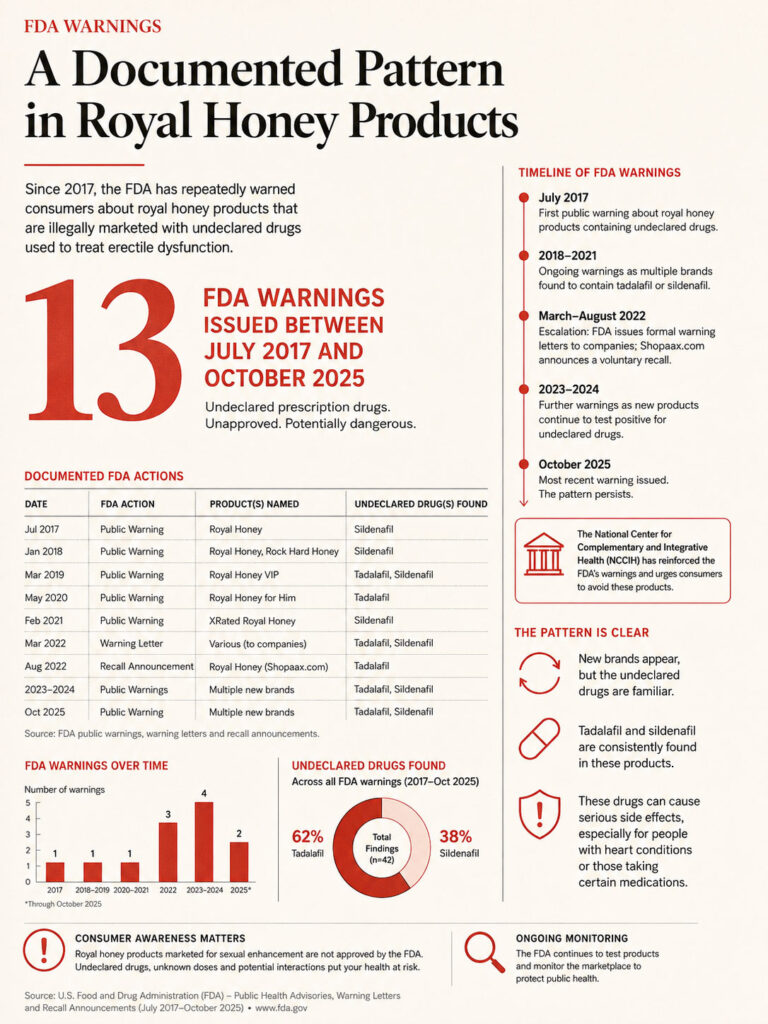
This is not one recall or a single bad batch that slipped through. The FDA has circled back to royal honey again and again across nearly a decade, and that repetition is what makes the record so revealing.
A Timeline of Federal Action
The warnings reach back years. In July 2017, the FDA advised consumers not to use Royal Honey VIP after lab analysis confirmed it contained tadalafil.
In December 2020, the agency flagged Royal Honey purchased from eBay, once again finding tadalafil hidden inside. By then the pattern was already taking shape.
The 2022 findings multiplied quickly. The FDA confirmed both sildenafil and tadalafil in ETUMAX VIP Royal Honey for Him, and sildenafil in Kingdom Honey Royal Honey VIP.
The 2022 Warning Letters and Recall
That summer, the agency escalated from notices to formal letters. The FDA issued warning letters to four companies selling honey-based sexual enhancers: Thirstyrun LLC (also known as US Royal Honey LLC), MKS Enterprise LLC, Shopaax.com, and 1am USA Incorporated.
Soon after, Shopaax.com issued a voluntary recall of all lots of Kingdom Honey Royal Honey VIP because it contained undeclared sildenafil. Consumers were told to stop using it, and the product could be returned for a refund.
The National Center for Complementary and Integrative Health, part of the NIH, reinforced the FDA’s warnings, giving the alerts weight from a second federal authority rather than a single agency.
The Pattern Continues Into 2025
The story did not close in 2022. In October 2025, the FDA warned against Black Thai Honey, a male sexual enhancement product, after finding sildenafil, tadalafil, and diclofenac, none of which were listed on the label.
That recent alert shows the issue is live, not filed away in history. New brand names keep surfacing, and the same hidden drugs keep turning up in fresh testing.
Across cases seen in our diagnostic network, the recurring theme is grim consistency: a different brand each time, the same undeclared drugs, and the same avoidable danger. The table below lays out that documented record.
| FDA Action Date | Product Named (FDA Notification) | Undeclared Drug(s) Found via FDA Lab Analysis |
| July 2017 | Royal Honey VIP | Tadalafil (Cialis); source: FDA |
| December 2020 | Royal Honey (sold via eBay) | Tadalafil (Cialis); source: FDA |
| April 2022 | ETUMAX VIP Royal Honey for Him | Sildenafil + Tadalafil; source: FDA |
| 2022 (recalled July 2022) | Kingdom Honey Royal Honey VIP | Sildenafil (Viagra); source: FDA |
| October 2025 | Black Thai Honey | Sildenafil, Tadalafil, Diclofenac; source: FDA |
Real Risks and Who’s Most in Danger
Hidden drugs are not a labeling technicality. They create concrete medical dangers, and for certain people those dangers turn life-threatening fast.
The Nitrate Interaction (the Most Serious Risk)
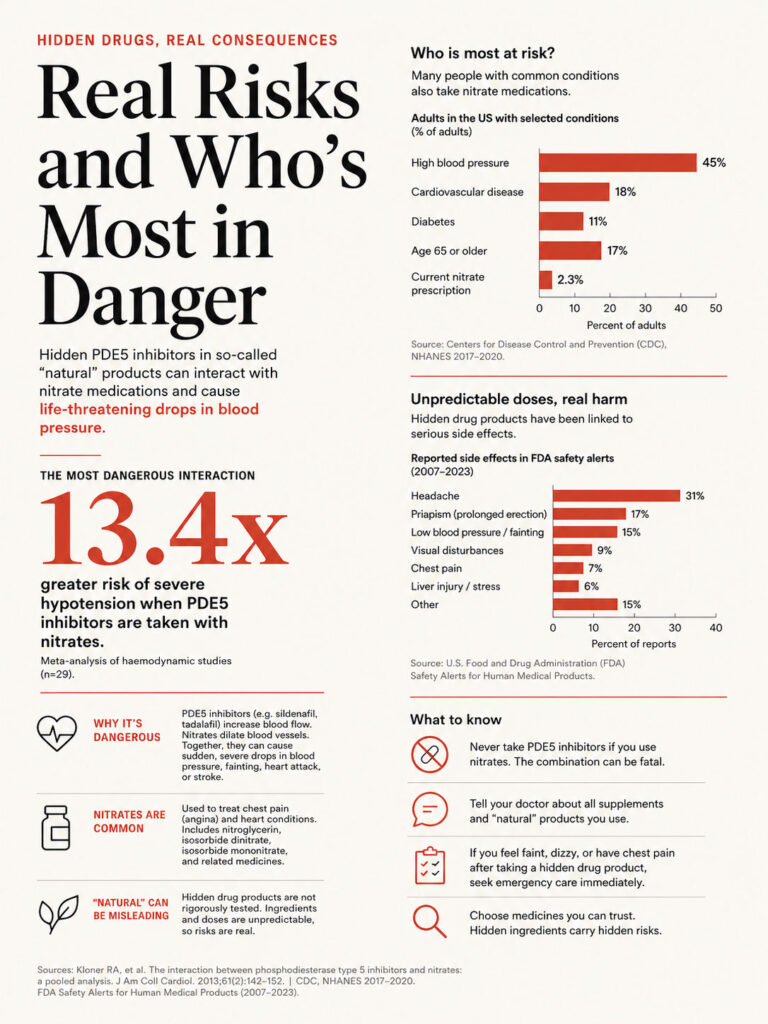
This is the warning the FDA repeats in nearly every notice, so it deserves your full attention. PDE5 inhibitors like sildenafil and tadalafil can interact dangerously with nitrate medications.
Nitrates, including nitroglycerin, are prescribed for chest pain and various heart conditions. Taken alongside a hidden PDE5 inhibitor, they can drive blood pressure down to dangerous, even life-threatening levels.
The cruel overlap is hard to miss. Men with diabetes, high blood pressure, high cholesterol, or heart disease often take nitrates, and that’s the same group most likely to reach for a sexual-enhancement product in the first place.
Side Effects Beyond the Interaction
Even with no nitrates in the picture, an unknown dose of a genuine drug brings genuine side effects. Because the amount swings from sachet to sachet, the user simply can’t predict how their body will respond.
Effects tied to these products and their hidden ingredients include headaches, facial flushing, dizziness, nausea, and vision changes. More severe risks include priapism, a painful and prolonged erection that counts as a medical emergency, plus added stress on the liver.
Unpredictable dosing magnifies all of it. One packet might hold a fraction of a normal dose, while the next holds far more of the drug than anyone should take without supervision.
Who Faces the Highest Risk
Some groups should treat these products as flatly off-limits, because for them the hazard is immediate rather than theoretical. The overlap with common chronic conditions is what makes this so concerning.
The highest-risk groups include men taking nitrates or other heart medications, anyone with cardiovascular disease, people managing diabetes or high blood pressure, and those on drugs that interact with PDE5 inhibitors. Older adults, who more often carry these conditions, face stacked and compounding risk.
Why “Natural” Labeling Creates False Safety
That single word, “natural,” does a lot of quiet harm. It signals harmlessness, so buyers drop the caution they’d automatically apply to a real medicine.
Supplement-style products are not held to the same testing and approval standards as prescription drugs. The FDA itself notes that it cannot test every product on the market, which is how adulterated items reach store shelves and online carts.
The team at HealthCareOnTime hears the “natural means safe” assumption constantly. With this category, that instinct is exactly backward, and acting on it is precisely what puts people at risk.
How to Protect Yourself
Awareness only helps if it turns into action. So here’s how to recognize a problem product and what to choose instead.
How to Spot a Potentially Tainted Product
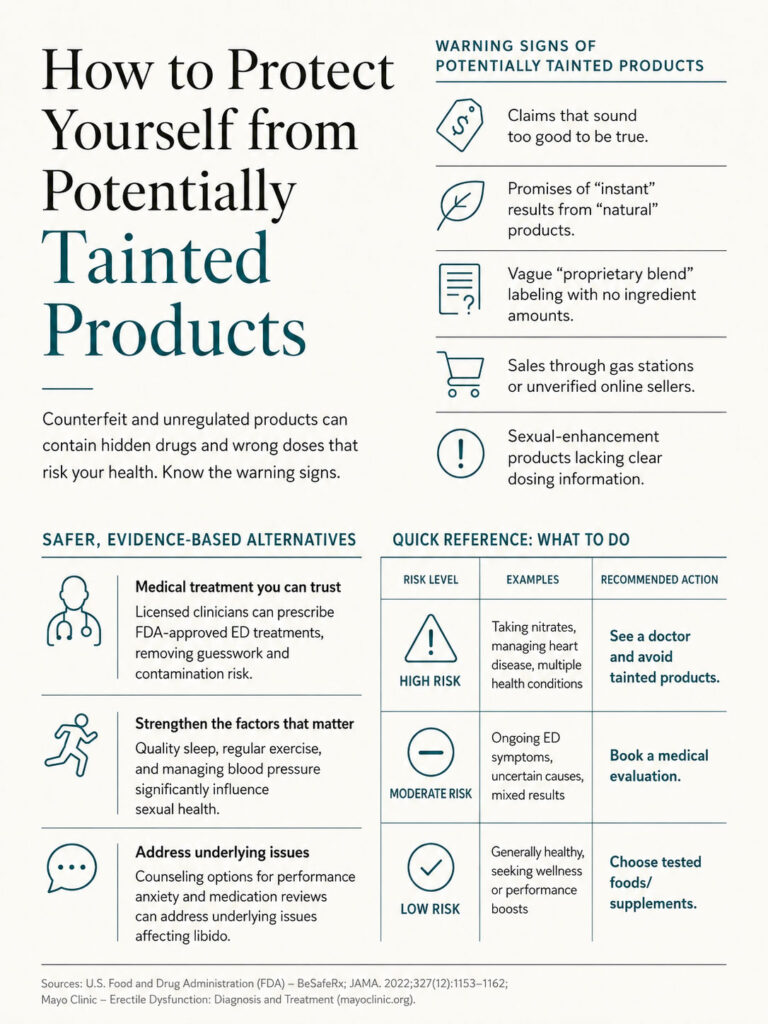
A handful of red flags signal risk reliably. No single one proves a product is dangerous, but stacked together they’re more than enough reason to walk away.
Warning signs include claims that sound too good to be true, promises of “instant” or “Viagra-like” results from a “natural” product, vague “proprietary blend” labeling with no ingredient amounts, sales through gas stations or unverified online sellers, and any sexual-enhancement honey lacking clear dosing information. The FDA’s own guidance is blunt here: be skeptical of dramatic claims, and talk to a clinician before trying anything in these categories.
Safer, Evidence-Based Alternatives
If the real concern is sexual performance or flagging energy, better roads exist, and they begin with a conversation rather than a sachet. The aim is the same result without the hidden-drug gamble.
A licensed clinician can prescribe FDA-approved ED treatments at a measured, monitored dose, often after a brief evaluation. That single step removes both the guesswork and the contamination risk that define royal honey.
Lifestyle factors carry real weight too. Quality sleep, regular exercise, managing blood pressure and blood sugar, limiting alcohol, and addressing chronic stress all shape sexual health, and none of them carries the danger of an adulterated product.
It’s also worth knowing that several legitimate options sit between “do nothing” and “prescription.” A clinician can talk through counseling for performance anxiety, relationship factors, and medication reviews, since some everyday prescriptions affect libido on their own.
Why ED Can Signal Something Worth Checking
There’s a deeper reason to see a professional instead of self-treating with a packet. Erectile dysfunction is sometimes an early warning sign of cardiovascular disease or diabetes, not just a standalone nuisance.
Masking that symptom with royal honey can delay the diagnosis of a condition that genuinely needs care. That delay, not only the drug interaction, is a quiet hazard in its own right.
For readers weighing their next move, the quick-reference table below maps common situations to a sensible action.
| Your Situation | Risk Level | Recommended Action |
| You take nitrates/nitroglycerin or have heart disease | High and potentially life-threatening | Do not use royal honey; see a doctor about safe options |
| You manage diabetes, high blood pressure, or high cholesterol | High | Avoid these products; ask a clinician about monitored treatment |
| You bought a “performance” honey sachet online or in a store | Moderate to high | Stop use; check current FDA alerts; report problems to MedWatch |
| You have ongoing ED symptoms | Moderate | Book a medical evaluation to rule out underlying causes |
| You want a natural energy or wellness boost | Low to moderate | Choose tested foods/supplements; skip products making sexual claims |
When ongoing symptoms point toward something worth investigating, a basic workup, covering heart-health markers, blood sugar, and hormone levels, gives you real answers instead of a roll of the dice inside a foil wrapper. That’s the kind of clarity the team at HealthCareOnTime would rather see patients reach for.
Frequently Asked Questions
What is royal honey used for?
Royal honey is marketed mainly for sexual enhancement, libido, stamina, and energy in men, with “for her” variants aimed at women. It’s sold as a “natural” wellness product, yet the FDA has repeatedly found hidden prescription ED drugs inside many of these items.
Does royal honey actually work for ED?
No quality human trials show that royal honey’s natural ingredients treat ED. When users report strong, fast effects, the likely cause is an undeclared drug like sildenafil or tadalafil rather than honey or herbs, meaning the “natural” benefit is often a hidden pharmaceutical.
Is royal honey FDA approved?
No. Royal honey is not an FDA-approved drug. The agency has issued repeated public notifications warning consumers against specific royal honey products after lab analysis confirmed undeclared prescription medications that never appeared on the label.
What are the side effects of royal honey?
Because dosing is unpredictable, side effects tied to these products and their hidden drugs include headaches, flushing, dizziness, nausea, and vision changes. Serious risks include dangerously low blood pressure when combined with nitrates, priapism (a prolonged painful erection), and added liver stress.
Can royal honey cause heart problems?
It can be dangerous for people with heart conditions. The hidden PDE5 inhibitors found in many products can interact with nitrate heart medications and push blood pressure to life-threatening lows, which is the FDA’s most consistent warning about royal honey.
Is royal honey the same as royal jelly?
No. Royal jelly is a natural secretion bees produce to feed the queen, studied for antioxidant and anti-inflammatory properties. Royal honey is a commercial product that may contain some royal jelly but is blended and sold for sexual enhancement, often with undisclosed drugs.
How long does royal honey take to work?
Marketers often claim effects within an hour or two. Any rapid, drug-like effect should raise concern, since it points to a hidden PDE5 inhibitor rather than a natural ingredient. Genuine royal jelly has no proven fast-acting effect on sexual performance.
Who should not take royal honey?
Anyone taking nitrates or heart medications, plus people with cardiovascular disease, diabetes, high blood pressure, or high cholesterol, faces the greatest danger. Given the documented contamination, most clinicians would advise avoiding these products entirely and seeking monitored treatment instead.
Is royal honey safe for women?
“For her” royal honey variants raise the same core problems: undisclosed ingredients and no quality evidence of benefit. Women who are pregnant, nursing, or managing health conditions should be especially cautious and consult a clinician before using any sexual-enhancement product.
Where is royal honey sold?
Royal honey is sold at gas stations, convenience stores, smoke shops, and online through marketplaces like Amazon, eBay, and Etsy, plus assorted standalone websites. Wide availability does not mean a product has been tested or cleared as safe.
What ingredients are in royal honey?
Labels typically list honey, royal jelly, bee pollen, ginseng, and Tribulus terrestris. The FDA has separately found undeclared drugs, including sildenafil, tadalafil, and in one 2025 case diclofenac, that were never printed on the packaging at all.
What are safer alternatives to royal honey?
The safest path is a clinician-prescribed, FDA-approved ED treatment at a controlled dose, paired with lifestyle steps like exercise, better sleep, and managing blood pressure and blood sugar. These options sidestep the hidden-drug risk that makes royal honey hazardous.
Disclaimer: This article is for general education and is not medical advice. It does not diagnose, treat, or replace care from a licensed clinician. Talk to a qualified healthcare professional before starting or stopping any product or treatment. If you experience chest pain, fainting, vision loss, or a prolonged erection, seek emergency care. Suspected problems with a supplement can be reported to the FDA’s MedWatch program.
References
- U.S. FDA: Public Notification: Royal Honey contains hidden drug ingredient
- U.S. FDA: Public Notification: Royal Honey VIP contains hidden drug ingredient
- U.S. FDA: Public Notification: Kingdom Honey Royal Honey VIP contains hidden drug ingredient
- U.S. FDA: Public Notification: ETUMAX VIP Royal Honey for Him contains hidden drug ingredients
- U.S. FDA: Black Thai Honey may be harmful due to hidden drug ingredient
- U.S. FDA: Shopaax.com Voluntary Recall of Kingdom Honey Royal Honey VIP (undeclared sildenafil)
- NIH NCCIH: Royal Honey VIP Contains Hidden Drug Ingredient
- NIH NIDDK: Definition & Facts for Erectile Dysfunction
- National Library of Medicine (PMC): Royal Jelly: Beneficial Properties and Bioactivity
- Zhang et al. (2020), PubMed: Hidden sildenafil analogues in honey-based sexual enhancers
- International Journal of Impotence Research (2025): Royal honey packs and erectile dysfunction