
Here’s something that catches most people off guard: the most commonly reported STI in the United States usually causes no symptoms at all. Millions of Americans carry it without a clue, and that silence is exactly what lets it pass quietly from one person to the next.
Table of Contents
That quiet nature is also why chlamydia is worth understanding properly. Caught early, it’s simple and cheap to cure. Missed for months, it can quietly damage fertility and cause lasting harm.
So let’s walk through it clearly: what chlamydia is, how to recognize it, how it spreads, and what to do if you’ve been exposed.
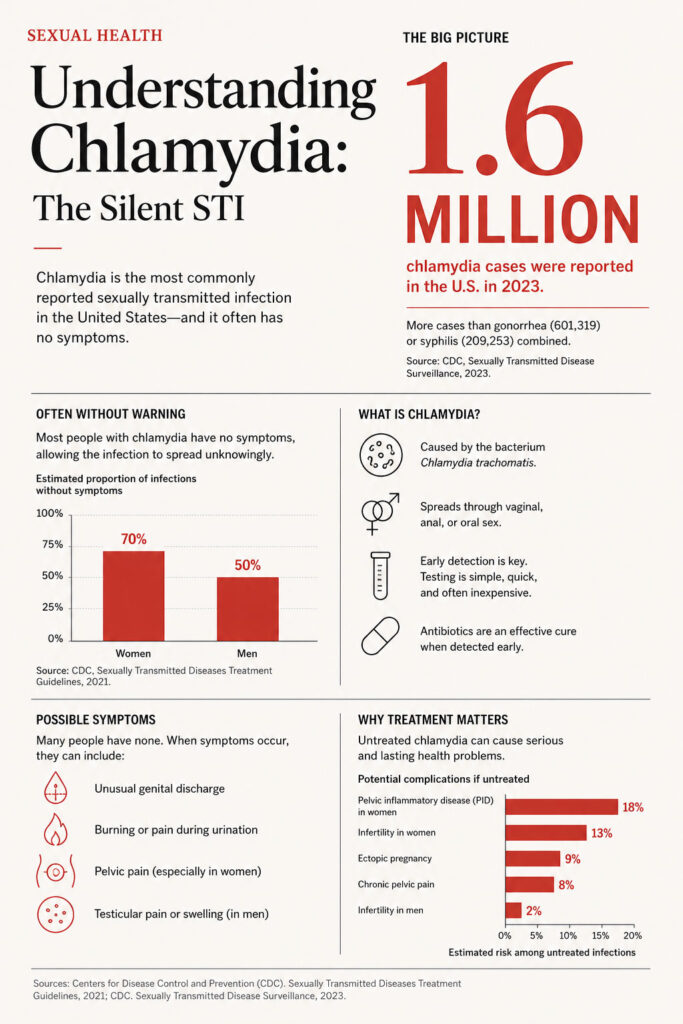
Quick Answer: Chlamydia is a common, curable bacterial sexually transmitted infection (STI) caused by the bacterium Chlamydia trachomatis. It spreads through vaginal, anal, or oral sex and often causes no symptoms. When symptoms do appear, they include unusual genital discharge, burning during urination, and pelvic pain. Antibiotics cure it completely, but untreated chlamydia can lead to infertility and other serious problems.
At a Glance
- Chlamydia is the most frequently reported STI in the United States, with over 1.6 million cases reported in a single recent year.
- Most people who have it notice no symptoms, which is why routine screening matters so much.
- It spreads through sexual contact, not through casual contact like hugging, sharing food, or toilet seats.
- The current first-line treatment is a 7-day course of the antibiotic doxycycline.
- Left untreated, it can cause pelvic inflammatory disease, infertility, and ectopic pregnancy.
- It’s curable, and testing is quick, private, and often as simple as a urine sample.
What Is Chlamydia?
Chlamydia is a bacterial infection passed from person to person through sexual contact. It’s one of the most common STIs in the country, and it affects people of every gender, age, and background.
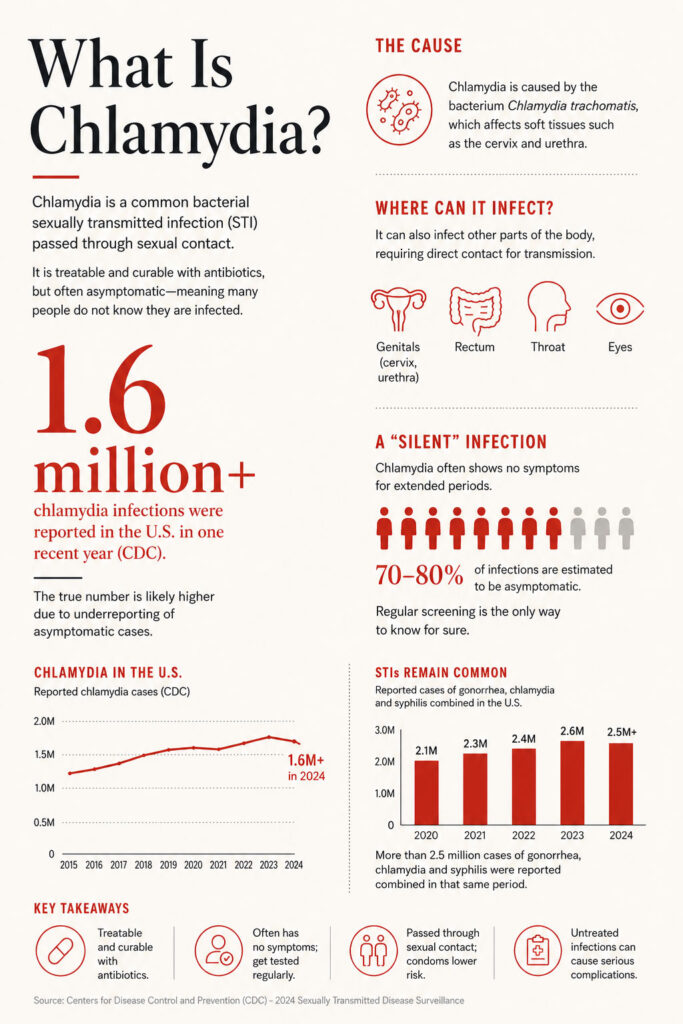
The infection is treatable and fully curable with antibiotics. The challenge is that it frequently hides, producing no obvious signs while it quietly does its work. That single fact shapes almost everything about how chlamydia behaves.
Because so many cases go unnoticed, people pass it along without meaning to. Routine screening is the main way public health experts try to slow its spread, and it’s the reason “get tested” is the advice you’ll hear again and again.
The Bacteria Behind It
The culprit is a bacterium called Chlamydia trachomatis. It infects the soft, moist tissues of the body, most often the cervix in women and the urethra in men.
It can also take hold in the rectum, the throat, and the eyes, depending on the type of contact involved. The bacteria don’t survive on dry surfaces or in the air, which is why the infection needs close, direct contact to move between people.
Different strains of the bacterium exist. A few rarer strains cause a more aggressive infection called lymphogranuloma venereum (LGV), though the everyday genital infection most Americans encounter is the common urogenital type.
Why It’s Called a Silent Infection
Chlamydia earns its “silent” reputation because it so often skips the warning signs. A person can carry it for weeks, months, or even longer without feeling anything wrong.
That stealth is biological, not a fluke. The infection can sit on the cervix or in the urethra without triggering the kind of irritation that sends someone to a doctor, all while remaining transmissible.
The result is a steady, mostly invisible chain of transmission. Across the STI panels booked through HealthCareOnTime, a notable share of positive chlamydia results come from people who only tested because of a new partner or a routine checkup, not because they felt sick.
How Common It Is in the United States
Chlamydia is not a rare or fringe problem. It’s the most reported STI in the country by a wide margin, and the real number of infections is almost certainly higher than what gets counted, since so many cases never produce symptoms.
In one recent year, more than 1.6 million chlamydia infections were reported to the Centers for Disease Control and Prevention. That figure reflects only diagnosed and reported cases, so the true total is thought to be considerably larger.
Zoom out and the picture grows. More than 2.5 million cases of gonorrhea, chlamydia, and syphilis combined were reported to the CDC in that same period. Our lab partners report that chlamydia is consistently among the most common positive results on the STI panels we serve.
Chlamydia Symptoms (and Why You Might Have None)
When people picture an STI, they usually imagine obvious, hard-to-miss symptoms. Chlamydia rarely works that way, and that mismatch trips up a lot of people who assume they’d “just know.”
Understanding the symptom picture means starting with the most common scenario of all, which is no symptoms whatsoever. From there, the signs differ somewhat between women and men, and by where the infection sits.
The Asymptomatic Reality
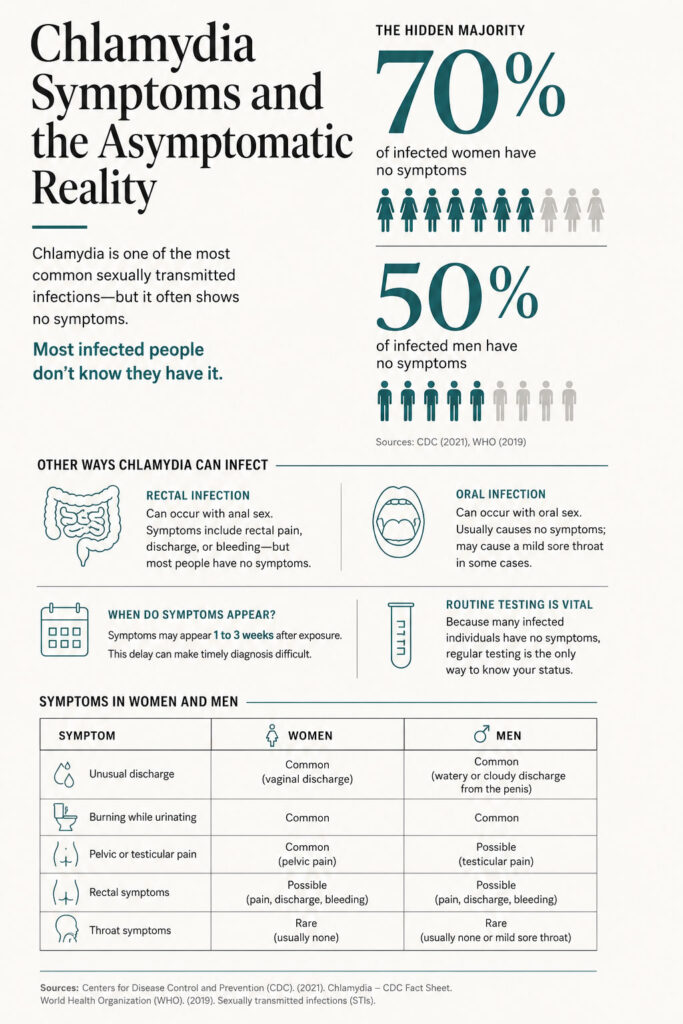
Most people with chlamydia feel completely fine. Because chlamydia often doesn’t cause symptoms, many people who have it don’t know it and unknowingly infect others.
Estimates commonly cited by health authorities suggest roughly 7 in 10 infected women and about half of infected men have no noticeable symptoms. That’s a large share of cases moving through the population undetected.
This is why “I feel fine” is not proof you’re in the clear. Our medical reviewers note that the absence of symptoms is one of the biggest reasons chlamydia keeps circulating, and it’s the entire argument for routine testing if you’re sexually active.
Symptoms in Women
When women do develop symptoms, they often show up subtly and get mistaken for something else, like a urinary tract infection or a yeast infection. That confusion tends to delay diagnosis and treatment.
Common signs in women include unusual vaginal discharge, a burning feeling during urination, and pain in the lower abdomen or pelvis. Some women notice bleeding between periods or bleeding after sex.
Pain during sex can also occur. When the infection climbs into the reproductive organs, it can signal a more serious complication, which is why any new pelvic pain deserves prompt medical attention rather than a wait-and-see approach.
Symptoms in Men
Men who develop symptoms tend to notice them around the urethra, the tube that carries urine out of the body. The signs can be mild enough to brush off, which is precisely the risk.
Typical symptoms in men include a watery or cloudy discharge from the penis and a burning sensation while urinating. Some men feel pain, tenderness, or swelling in one or both testicles.
That testicular pain matters more than it might seem. It can point to epididymitis, an inflammation that, left unchecked, may affect fertility. Patients booking tests with us sometimes assume mild discharge will clear on its own, but waiting only gives the infection more time to spread.
Rectal, Throat, and Eye Symptoms
Chlamydia isn’t limited to the genitals. Anal sex can lead to a rectal infection, which may cause rectal pain, discharge, or bleeding, though it too is frequently silent.
Oral sex can carry the bacteria to the throat, where it usually causes no symptoms or, at most, a mild sore throat. The bacteria can also reach the eyes through contact with infected fluids, leading to redness, irritation, and discharge that resembles conjunctivitis.
These less obvious sites are easy to overlook. They’re also a reason clinicians may swab more than one area when someone’s history suggests exposure beyond vaginal sex.
When Symptoms Appear
If symptoms do develop, they don’t appear instantly. Chlamydia symptoms may appear 1 to 3 weeks after unprotected sexual contact, and sometimes later than that.
That delay is part of the problem. A person can be infected and contagious for weeks before noticing anything, which is plenty of time to pass it to a partner unknowingly. The table below breaks down how symptoms tend to differ between women and men.
| Symptom or Sign | In Women | In Men | When It Typically Appears |
| Abnormal genital discharge | Unusual vaginal discharge | Watery or cloudy penile discharge | 1 to 3 weeks after exposure |
| Painful urination (burning) | Common | Common | 1 to 3 weeks after exposure |
| Pelvic or lower abdominal pain | Possible, may signal spread to reproductive organs | Less common | Weeks to months if untreated |
| Genital pain or bleeding | Bleeding between periods or after sex | Testicular pain or swelling | Varies |
| No symptoms at all | Up to roughly 70% of cases | Up to roughly 50% of cases | Often never noticed |
What Causes Chlamydia and How It Spreads
Chlamydia has one cause: the bacterium Chlamydia trachomatis, passed through sexual contact with someone who carries it. Knowing exactly how it moves, and how it doesn’t, clears up a lot of needless worry.
The bacteria live in genital fluids and on infected tissues. Transmission happens when those fluids or tissues make contact with a partner’s mucous membranes during sex.
How You Get It
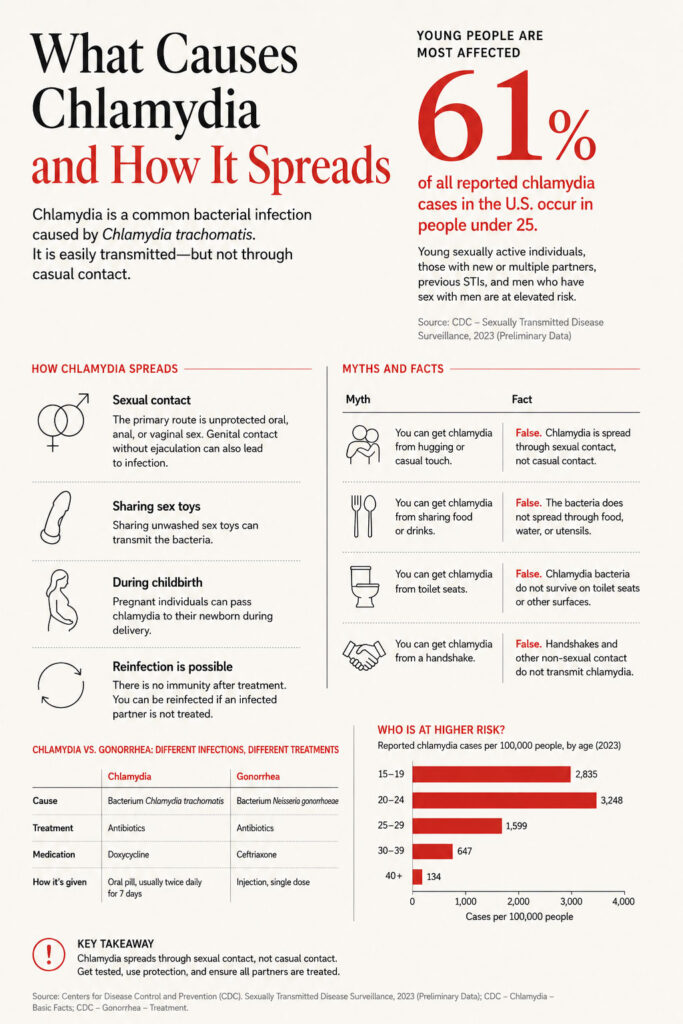
The main route is unprotected sex. A person can acquire chlamydia through unprotected oral, anal, or vaginal sex or through genital contact, even without ejaculation.
You can also get it from sharing sex toys that haven’t been washed or covered with a fresh condom between uses. A pregnant person with chlamydia can pass it to their baby during childbirth, which can cause eye infections or pneumonia in the newborn.
One point that surprises people: you can catch chlamydia again after being cured. Past infection grants no immunity, so re-exposure means reinfection unless the partner is treated too.
How You Don’t Get It
Plenty of myths circulate about STIs, and chlamydia attracts its share. The bacteria are fragile and can’t spread through everyday contact.
You can’t get chlamydia from sharing food or drinks, hugging, holding hands, or using a toilet after someone else. It also doesn’t spread through coughing, sneezing, or swimming in the same pool.
Patients booking tests with us often ask whether casual household contact puts them at risk. It doesn’t, and that reassurance matters as much as the warnings, since misplaced fear can distract from the contact that actually counts.
Chlamydia vs. Gonorrhea: A Quick Clarification
Chlamydia and gonorrhea get confused constantly, and for good reason. They’re both common bacterial STIs, they share many of the same symptoms, and they often turn up together.
The differences come down to the bacteria and the treatment. Chlamydia is caused by Chlamydia trachomatis and treated with doxycycline, while gonorrhea is caused by a different bacterium and treated with a ceftriaxone injection.
Because co-infection is common, clinicians sometimes treat for both at once or test for both from a single sample. If you’re testing for one, it’s sensible to test for the other at the same time.
Who Is Most at Risk
Anyone who’s sexually active can get chlamydia, but some groups face higher odds. Age is one of the strongest factors of all.
Young people are most affected. Sexually active people under 25 carry the highest risk, along with anyone who has new or multiple partners, doesn’t use condoms consistently, or has had an STI before.
Men who have sex with men also face elevated risk for rectal and throat infections. None of this is about judgment; it’s simply about knowing when screening should be part of your routine.
How Chlamydia Is Diagnosed
You can’t diagnose chlamydia by how you feel, since most cases are silent. The only reliable way to know is to get tested, and the good news is that testing is quick and low-stress.
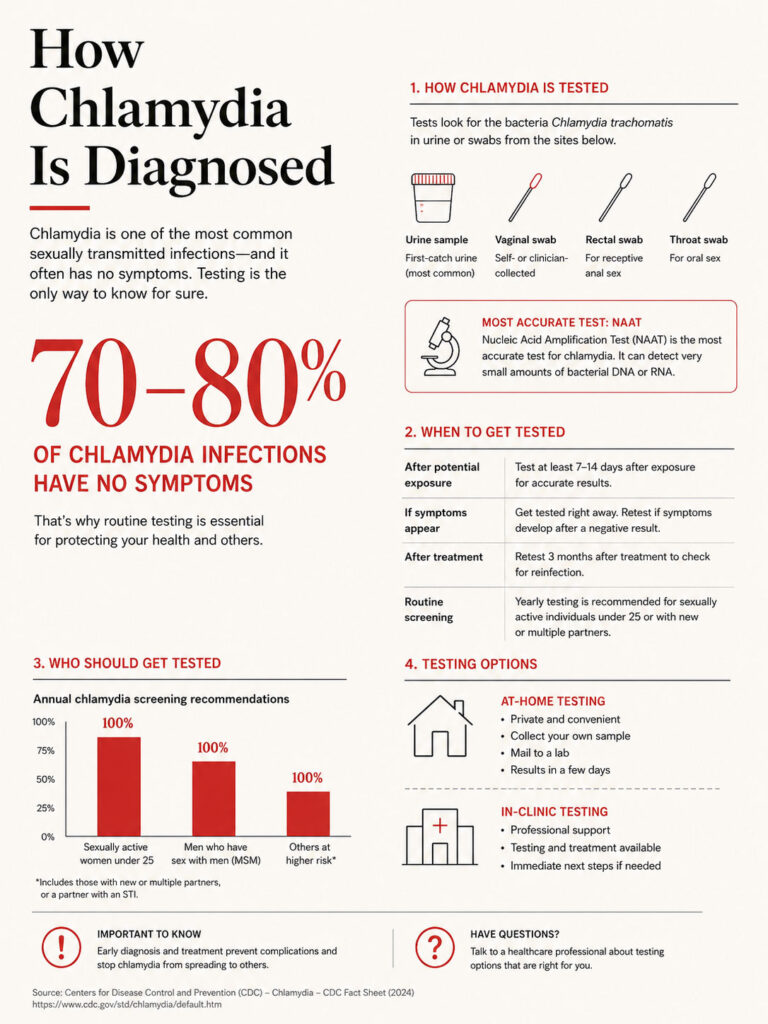
A diagnosis also opens the door to treatment that stops the infection before it can cause lasting harm. That early catch is the whole point of screening.
The Test Itself
Modern chlamydia testing is simple. To diagnose chlamydia, a clinician may take either a urine sample or a swab sample from the penis, cervix, urethra, throat, or rectum.
For many people, that means simply peeing into a cup. The lab uses a method called a nucleic acid amplification test (NAAT), which looks for the bacteria’s genetic material and is highly accurate.
There’s no need to dread it. The process is fast, painless in most cases, and results typically come back within a few days.
Understanding the Window Period
Timing affects accuracy. Testing too soon after exposure can produce a false negative, because the bacteria may not yet be detectable.
Many clinicians suggest testing around one to two weeks after a possible exposure, and retesting later if symptoms develop or concern remains. If you test very early and the result is negative, a follow-up test can confirm it.
This window is worth keeping in mind before you assume a single early negative means you’re definitely clear. When in doubt, a brief conversation with a provider settles the right timing.
Who Should Get Screened and How Often
National guidelines spell out who benefits most from routine screening. The U.S. Preventive Services Task Force recommends screening for chlamydia in all sexually active women 24 years or younger and in women 25 or older who are at increased risk.
Sexually active men in higher-risk groups, including men who have sex with men, should also be screened regularly. Pregnant people are routinely tested as part of prenatal care.
A practical rule is to test at least once a year if you’re sexually active and under 25, or whenever you have a new partner. Our medical reviewers note that yearly screening catches the silent cases that symptoms would otherwise miss entirely.
At-Home vs In-Clinic Testing
You have options for where and how to test. In-clinic testing through a doctor’s office, a sexual health clinic, or a lab gives you professional support and immediate next steps if you test positive.
At-home test kits have grown popular for their privacy and convenience. You collect a sample yourself and mail it to a lab, then receive results digitally, usually within days.
Both approaches use the same accurate lab methods, so neither is “less real” than the other. If privacy concerns have been keeping you from testing, a discreet at-home option or a confidential lab booking removes that barrier. HealthCareOnTime users frequently choose a lab-based STI panel for exactly that reason.
Chlamydia Treatment
Here’s the reassuring part: chlamydia is curable, and treatment is usually quick and effective. Antibiotics clear the infection in the large majority of cases.
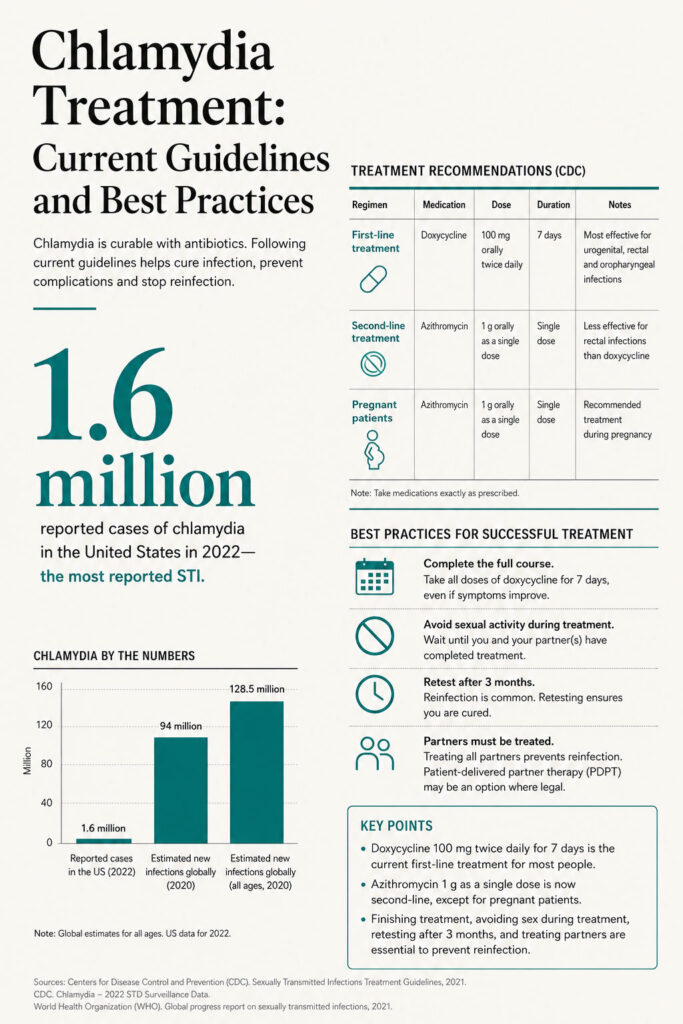
What’s changed recently is which antibiotic doctors reach for first. Getting this detail right matters, because a fair amount of older information still floating around online is now out of date.
The Current First-Line Treatment
The recommended treatment has shifted in recent years. The CDC currently recommends doxycycline 100 mg twice daily for 7 days for the treatment of chlamydia, and the previous recommendation, azithromycin 1 g orally once, is now a second-line treatment.
The reason behind the change is specific. The update was related to treatment failure of rectal chlamydia with azithromycin rather than to antibiotic resistance, since doxycycline proved more reliable at clearing rectal infections.
Finishing the full course is non-negotiable. Even though any symptoms fade fast, stopping early can leave bacteria behind. In cases reviewed by our medical team, incomplete treatment is a common reason an infection appears to “come back” when it was never fully cleared.
What to Expect From Doxycycline
Knowing the practical side of the medication helps people stick with it. Doxycycline is generally well tolerated, but it has a few quirks worth planning around.
It can cause stomach upset, so it’s often taken with food and a full glass of water, and you should avoid lying down right after a dose. It can also increase sun sensitivity, making sunburn more likely, so sunscreen and shade help during the week of treatment.
Taking both daily doses on schedule is what makes the 7-day course work. Patients commonly ask us whether they can stop once they feel fine; the honest answer is no, because the bacteria can linger after symptoms disappear.
Treatment During Pregnancy
Pregnancy calls for a different approach, because doxycycline isn’t safe to use then. The standard switches to a single-dose alternative.
During pregnancy, the recommended treatment is azithromycin 1 g orally as a single dose, because doxycycline is avoided due to risks to the developing baby. A clinician will confirm the right option and arrange follow-up testing.
Treating chlamydia during pregnancy protects the newborn too. It lowers the chance of the infection passing during delivery and causing eye infections or pneumonia in the baby.
What to Do After Treatment
Treatment doesn’t end the moment you take the antibiotics. A few follow-up steps protect you and your partners from a repeat round.
First, avoid sex while the infection clears. If you have a single-dose treatment, it’s advised that you not have sex for seven days, or until you finish a multi-day course and any symptoms are gone.
Second, plan to retest. Retesting about three months after completing treatment is recommended to make sure the infection is gone and to catch any reinfection. Patients commonly ask us why a retest is needed after a cure; it’s because reinfection from an untreated partner is far more common than treatment failure.
Why Partners Must Be Treated Too
Treating yourself while skipping your partner is a recipe for catching chlamydia all over again. The bacteria simply bounce back and forth between you.
Anyone you’ve had sex with recently should be tested and treated, even if they feel fine. Some states allow a practice called patient-delivered partner therapy, where your clinician provides a prescription or medication for your partner without a separate visit.
The table below gathers the key US numbers that frame why prompt testing and treatment matter so much.
| Statistic | Figure | Source |
| Reported US chlamydia cases (recent year) | More than 1.6 million | CDC |
| Rank among reported STIs in the US | Most reported STI (#1) | CDC |
| Combined chlamydia, gonorrhea, syphilis cases (recent year) | More than 2.5 million | CDC |
| New chlamydia infections worldwide (recent estimate) | About 128.5 million | WHO |
| Current first-line treatment | Doxycycline, 7-day course | CDC STI Treatment Guidelines |
What Happens If Chlamydia Is Left Untreated
A silent infection feels easy to ignore, but untreated chlamydia is where the real danger lives. The bacteria don’t stay put; over time they can travel and cause damage that’s much harder to reverse.
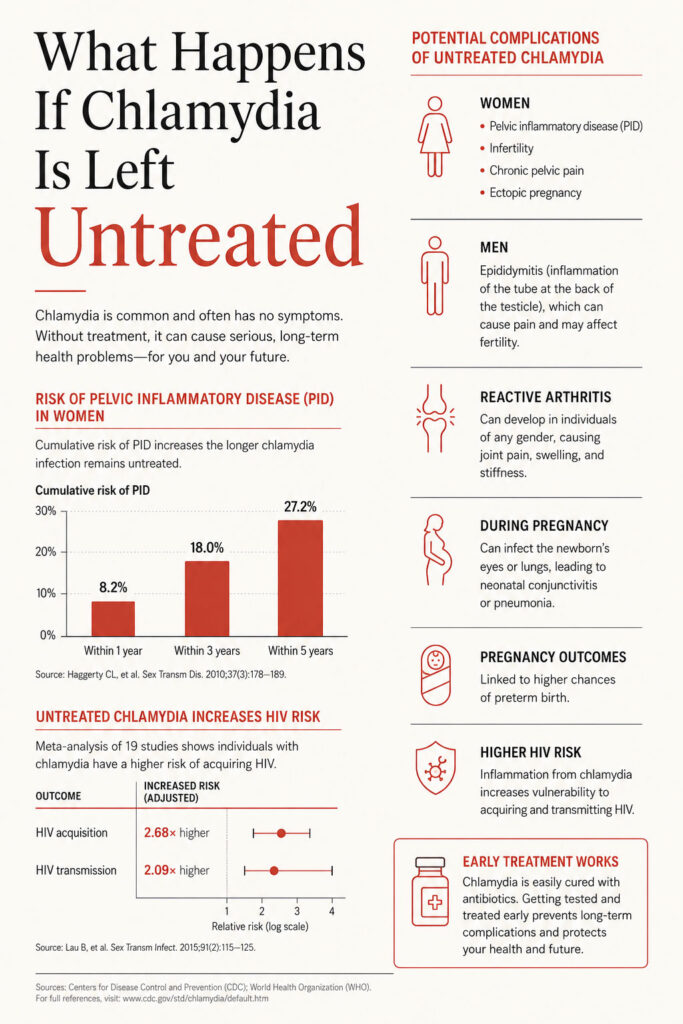
This is the part that turns a minor, curable infection into a serious health problem. The risks differ between women and men, and pregnancy adds its own concerns on top.
Complications in Women
In women, the biggest threat is the infection spreading upward into the reproductive organs. That leads to pelvic inflammatory disease (PID). Pelvic inflammatory disease can occur when an untreated STI damages reproductive organs, and it can lead to infertility, chronic pelvic pain, and blocked fallopian tubes that cause ectopic pregnancy. An ectopic pregnancy, where the embryo implants outside the uterus, is a medical emergency.
These outcomes are largely preventable. They’re the reason screening guidelines focus so heavily on young women, where catching the silent cases early avoids the most serious harm.
Complications in Men
Men are less likely to face long-term damage, but they’re not immune to complications. The most common is epididymitis, inflammation of the tube at the back of the testicle.
Untreated, this can cause pain, swelling, and in some cases effects on fertility. Some people, of any gender, develop reactive arthritis, a joint inflammation that can follow the infection.
The takeaway is the same across the board. A short course of antibiotics now prevents problems that are far more difficult and costly to treat later.
Pregnancy and Newborn Risks
Chlamydia during pregnancy carries added stakes because it can affect the baby. Passed during delivery, the bacteria can infect a newborn’s eyes or lungs.
This can cause neonatal conjunctivitis (an eye infection) or pneumonia in the infant. Routine prenatal screening exists specifically to catch and treat chlamydia before delivery.
Untreated infection has also been linked to higher chances of preterm birth. Treating it early removes that risk and protects both parent and child.
The HIV Connection
There’s a less obvious reason to take chlamydia seriously. An untreated STI can make it easier to acquire or transmit HIV.
Without treatment, chlamydia can cause serious problems and may facilitate the transmission and acquisition of HIV and other STIs. The inflammation it causes makes tissues more vulnerable to other infections.
That ripple effect is one more argument for testing and treating promptly. Clearing one infection lowers your overall risk.
How to Prevent Chlamydia
Prevention isn’t complicated, and it doesn’t require giving up your sex life. It comes down to a few consistent habits paired with regular testing.
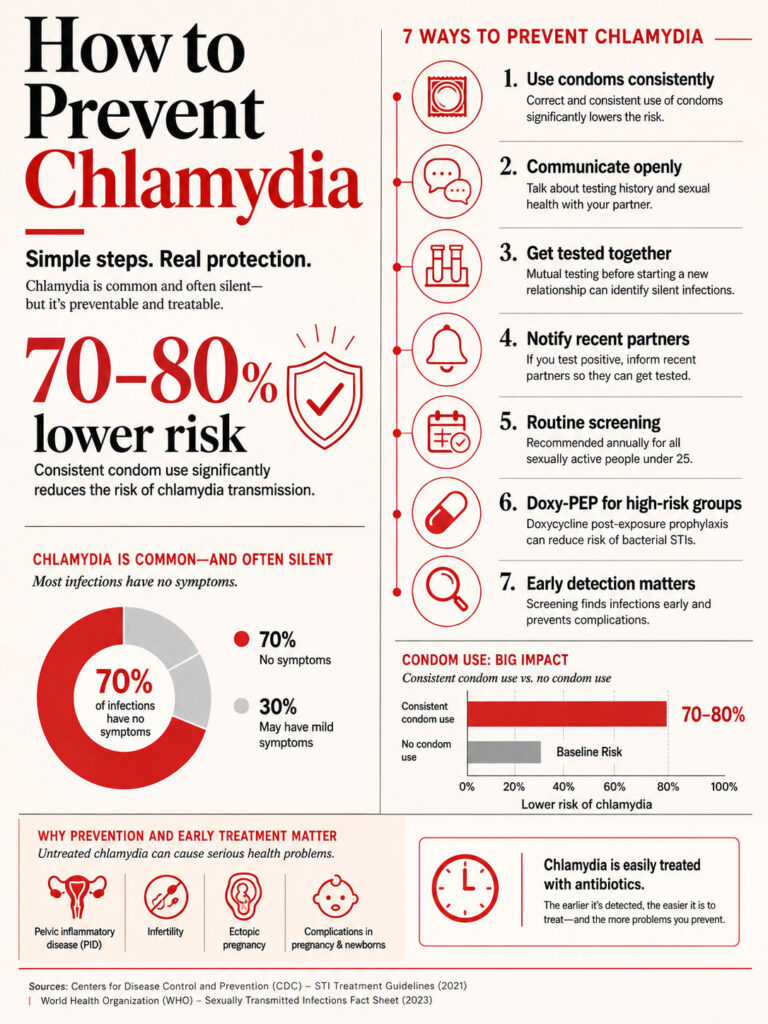
The goal is to reduce exposure and to catch any infection early, before it can spread or cause harm. Here’s what actually works in practice.
Condoms, Testing, and Communication
Condoms are the frontline tool. Used correctly and consistently, they sharply lower the risk of passing chlamydia and many other STIs.
Open conversations with partners matter just as much. Talking about testing history before sex can feel awkward, but it’s far easier than managing an untreated infection later.
Mutual testing before starting a new sexual relationship is a smart default. Our medical reviewers note that couples who test together often catch silent infections that neither partner suspected.
How to Talk to a Partner
If you test positive, telling recent partners is one of the hardest but most important steps. It’s also an act of care, since it lets them get treated and avoid complications.
Keep it factual and direct: let them know they may have been exposed and should get tested. The conversation tends to go better when it’s framed around health rather than blame.
If a face-to-face talk feels impossible, many health departments offer anonymous partner notification services. The aim is simply to break the chain of transmission so the infection doesn’t keep circling back.
Routine Screening as Prevention
Screening isn’t only for diagnosis; it’s a prevention strategy in its own right. Catching a silent infection early means it gets treated before it can be passed on or cause complications.
If you’re sexually active and under 25, an annual test should be as routine as a dental cleaning. Add a test whenever you change partners or notice anything unusual.
This is where a straightforward lab booking pays off. HealthCareOnTime users often fold an STI panel into their regular health checks so testing never slips through the cracks.
Doxy-PEP: A Newer Prevention Option
A newer prevention tool has entered the picture for certain higher-risk groups. It’s called doxy-PEP, short for doxycycline post-exposure prophylaxis.
The 2024 CDC guidelines recommend doxycycline post-exposure prophylaxis (doxy-PEP) to help prevent chlamydia, syphilis, and gonorrhea among gay and bisexual men and transgender women with a history of a bacterial STI in the past 12 months. It involves taking a dose of doxycycline after sex.
This isn’t for everyone, and it should be discussed with a clinician first. For the specific groups it targets, though, it’s a meaningful addition to condoms and screening. The table below maps common situations to a sensible next step.
| If This Describes You | Recommended Action | Why It Matters |
| Sexually active woman 24 or younger | Get screened at least once a year, even without symptoms | Most cases have no symptoms and would otherwise go undetected |
| Burning urination or unusual discharge | See a clinician and get tested promptly | Early treatment prevents complications like PID and infertility |
| Tested positive for chlamydia | Finish the full antibiotic course and tell recent partners | Stops reinfection and prevents passing it on |
| Pregnant with possible exposure | Ask your provider about azithromycin-based treatment | Doxycycline isn’t used in pregnancy, and treatment protects the baby |
| Just finished treatment | Retest in about three months; avoid sex for 7 days | Confirms the cure and catches any reinfection early |
Frequently Asked Questions
What are the first signs of chlamydia?
The first signs, when they appear, often include unusual genital discharge, a burning feeling during urination, and pelvic or testicular pain. Many people notice nothing at all. Because early chlamydia is usually silent, testing is the only reliable way to know for sure.
How do you get chlamydia?
Chlamydia spreads through unprotected vaginal, anal, or oral sex, or through genital contact with an infected person. It can also pass through shared sex toys and from a pregnant person to their baby during birth. It does not spread through casual contact like hugging or sharing food.
Can chlamydia go away on its own?
No. Chlamydia will not clear without antibiotic treatment, and assuming it’ll resolve on its own is risky. While symptoms may fade, the bacteria stay active and can spread or cause complications. Only a proper course of antibiotics actually cures the infection.
How is chlamydia treated?
Chlamydia is treated with antibiotics. The current first-line treatment is doxycycline, 100 mg twice daily for 7 days. A single dose of azithromycin is a second-line option, and azithromycin is preferred during pregnancy. Finishing the full course is essential for a complete cure.
How long does chlamydia take to show up?
If symptoms appear at all, they usually develop 1 to 3 weeks after exposure, and sometimes later. Many infections never produce symptoms. A test can detect the infection within days to a couple of weeks after exposure, depending on the situation and timing.
Can you get chlamydia from kissing or a toilet seat?
No. Chlamydia does not spread through kissing, toilet seats, hugging, sharing food or drinks, or swimming pools. The bacteria need direct sexual contact to spread and can’t survive on surfaces. This is a common myth that causes a lot of unnecessary worry.
Is chlamydia curable?
Yes. Chlamydia is completely curable with the right antibiotics, and most people are cured after one full course. The key is finishing all the medication, treating sexual partners, and retesting later to confirm the infection is gone and hasn’t returned.
What happens if chlamydia is left untreated?
Untreated chlamydia can cause serious harm. In women it can lead to pelvic inflammatory disease, infertility, chronic pelvic pain, and ectopic pregnancy. In men it can cause epididymitis. It can also raise the risk of acquiring HIV and harm newborns during birth.
Can you get chlamydia more than once?
Yes. A past infection gives no immunity, so you can catch chlamydia again, especially if a partner wasn’t treated. Reinfection is actually more common than treatment failure, which is why retesting and partner treatment are so strongly recommended after a cure.
How do I get tested for chlamydia?
Testing is simple and usually involves a urine sample or a swab. You can test at a clinic, a doctor’s office, a lab, or with an at-home kit you mail in. Sexually active people under 25 should test at least once a year.
Can chlamydia affect fertility?
Yes. Untreated chlamydia is a leading preventable cause of infertility, mainly in women, where it can scar and block the fallopian tubes through pelvic inflammatory disease. In men, complications like epididymitis can affect fertility too. Early treatment prevents almost all of this.
How soon after treatment can I have sex?
Wait at least seven days after a single-dose treatment, or until you finish a multi-day course and any symptoms are gone, whichever is later. Make sure your partner has been treated too, or you risk passing the infection back and forth.
Disclaimer: This article is for general education and is not medical advice. It does not diagnose or treat any condition and is not a substitute for care from a licensed clinician. If you think you may have chlamydia or another STI, get tested and treated through a qualified healthcare provider. Take any prescribed medication exactly as directed.
References
- CDC: Sexually Transmitted Infections Surveillance, National Overview
- CDC: Chlamydial Infections, STI Treatment Guidelines
- Cleveland Clinic: Chlamydia: Causes, Symptoms, Treatment & Prevention
- HealthPartners: Chlamydia symptoms, causes, prevention and treatment
- Medical News Today: Chlamydia: Symptoms, treatment, and causes
- World Health Organization: Chlamydia fact sheet
- National Library of Medicine (PMC): Clinical Updates in Sexually Transmitted Infections, 2024
- National Library of Medicine (PMC): Impact of Doxy-PEP on Chlamydia and Gonorrhea Positivity