You’re four days from your expected period, and you’ve started keeping a private tally. A wave of exhaustion at 2 p.m. A bra that feels tighter than it did last week. A sudden inability to stand the smell of coffee. So you wonder: is this the beginning of something, or is your mind sprinting ahead of your body?
Table of Contents
Here’s the part almost nobody explains clearly. The earliest sensations you notice are driven by a hormone that a pregnancy test can’t even detect yet.
That single fact reshapes how you should read your own body during these days. It’s also why this article exists.
Quick answer: The earliest possible symptoms (fatigue, mild cramping, light spotting, tender breasts, bloating, nausea, and mood shifts) can appear before a test reads positive. That’s because progesterone rises right after ovulation while hCG, the hormone tests measure, stays too low to register. Implantation usually happens 6 to 12 days after ovulation, and these signs closely mimic PMS, so on their own they confirm nothing.
This guide has been prepared and reviewed by the HealthCareOnTime medical content team and reflects current guidance from US sources including Mayo Clinic, Cleveland Clinic, and the Office on Women’s Health. Patients in the two-week wait often ask us why their body feels different days before any test agrees, and the answer comes down to hormone timing.
At a glance:
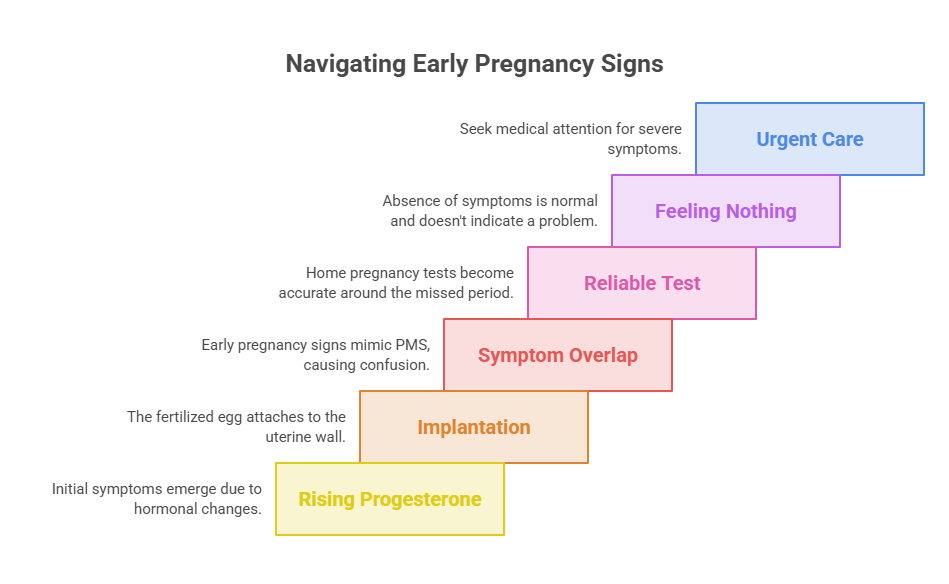
- The first symptoms come from rising progesterone, not the hCG a test measures.
- Implantation typically occurs 6 to 12 days after ovulation, most often around day 8 to 10.
- Early pregnancy signs and PMS overlap heavily, so timing and small details matter more than the symptoms themselves.
- A home test usually becomes reliable around the first day of a missed period.
- Feeling nothing at all is common and still consistent with a healthy pregnancy.
- One-sided pain, heavy bleeding, dizziness, or fever needs urgent medical care.
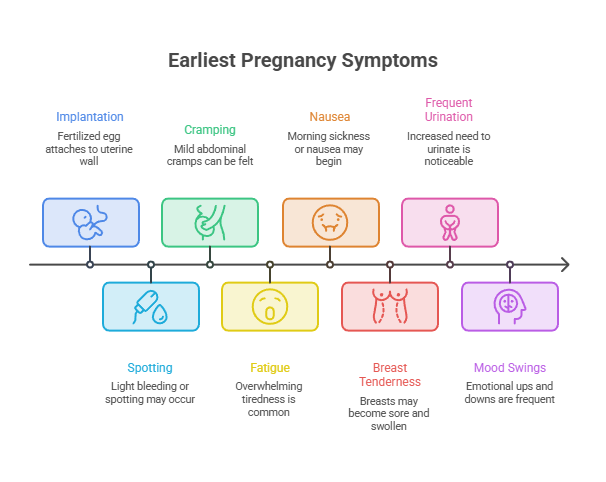
If you want the short version of the earliest signs to watch for, before any test will cooperate, here they are.
- Unusual, heavy fatigue
- Light pink or brown spotting
- Mild cramping or a pulling sensation
- Tender, full, or heavier breasts
- Bloating
- Early nausea or food and smell sensitivity
- Mood swings
Now, the full picture, because the timing and the why matter just as much as the list.
What’s Actually Happening in Your Body Right After Conception
To make sense of early symptoms, it helps to picture the real sequence. Conception isn’t one moment that flips a switch. It’s a chain of events spread across roughly two weeks.
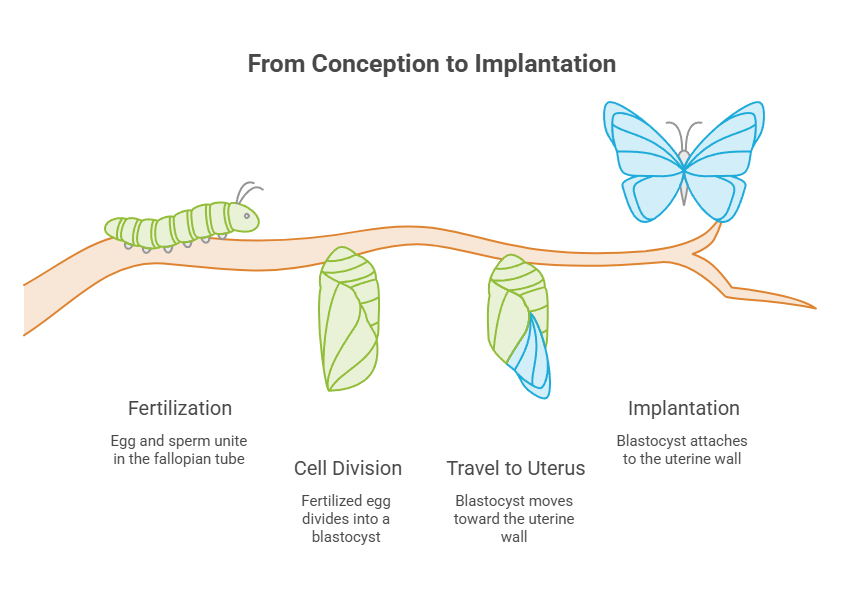
Fertilization happens in the fallopian tube, usually within about a day of ovulation. From there, the fertilized egg travels toward the uterus while dividing into a tiny cluster of cells called a blastocyst.
Only when that cluster attaches to the uterine wall does your body begin the hormonal work that a test can eventually detect. Everything you might feel before that attachment is the work of a different hormone entirely.
The Conception-to-Implantation Timeline (Days 0 to 12)
That journey takes time. According to WebMD, the fertilized egg attaches to the uterine wall roughly 6 to 12 days after the egg is fertilized, a process called implantation.
Most implantations land in a narrower window, around day 8 to 10 past ovulation. Until that attachment happens, your body hasn’t started producing the pregnancy hormone tests look for.
Mayo Clinic notes that light spotting from implantation tends to occur about 10 to 14 days after conception, right around the time a period would be due. That timing is exactly why so many women mistake it for an early or unusually light period.
The variability here is the whole story. A woman who ovulates late, or whose embryo implants on day 12 rather than day 7, will produce detectable hormone days later than someone on the early end. That’s why no two timelines match.
Two Hormones, Two Timelines: Progesterone vs hCG
Here’s the distinction that clears up almost everything. Two hormones are at work, and they run on completely different clocks.
Progesterone rises immediately after ovulation, whether or not conception happens. It’s responsible for that early heavy fatigue and breast tenderness. Cleveland Clinic ties early-pregnancy tiredness directly to climbing progesterone levels.
Human chorionic gonadotropin, or hCG, is the hormone home tests actually detect. It only starts being produced after implantation, then climbs fast.
Think of progesterone as the early warm-up and hCG as the main event that arrives later. A pregnancy test is built to spot the main event, not the warm-up.
Why You Can Feel “Pregnant” Before a Test Knows
So you can feel progesterone-driven changes days before hCG builds up enough to trigger a positive line. The feelings are real; the test simply isn’t measuring them.
Our medical reviewers note that this single mismatch explains the most common frustration we hear: clear symptoms paired with a stubbornly negative test. It isn’t that your body is lying. It’s that the test is asking a different question than your symptoms are answering.
The table below maps each early sign to when it can start, what’s behind it, and whether PMS produces the same thing.
| Symptom | Earliest Onset (DPO) | What It Feels Like | What’s Driving It | Also a PMS Sign? |
| Fatigue | 7 to 10 | Sudden, heavy tiredness despite rest | Rising progesterone | Yes |
| Implantation spotting | 6 to 12 | Pink or brown spots, lighter than a period | Embryo attaching to uterine lining | Rarely |
| Mild cramping or pulling | 6 to 12 | Light tugging low in the pelvis | Implantation and uterine changes | Yes |
| Breast tenderness | 7 to 14 | Sore, full, heavy; darker areolas | Progesterone and estrogen | Yes |
| Nausea or food aversion | 11 to 20 | Queasiness, sensitivity to smells | Rising hCG | Sometimes |
| Bloating | 7 to 14 | Tight, full abdomen | Progesterone slowing digestion | Yes |
| Frequent urination | 14+ | More bathroom trips than usual | hCG and rising blood volume | No |
| Mood swings | 7 to 14 | Weepy, irritable, on edge | Hormone shifts | Yes |
| Metallic taste or sharp smell | 7 to 14 | Odd taste, strong reactions to odors | Estrogen and hCG | Rarely |
(DPO means days past ovulation.) If you’re tracking these against a possible hCG blood test, remember that onset varies widely from person to person, and the ranges above are typical windows, not deadlines.
The Earliest Symptoms You Might Feel Before Any Test Works
No two pregnancies announce themselves the same way. Some women notice changes within a week of conception; others feel nothing until weeks later. Both patterns are normal.
These are the signs that tend to show up first, in rough order of how early and how often people report them. As you read, keep one rule in mind: every symptom below has an innocent explanation too.
Fatigue, Often the First and Most Noticeable Sign
For many women, exhaustion arrives before anything else. It’s not ordinary end-of-day tiredness. It’s the kind of heaviness that makes a normal afternoon feel like you’ve run a marathon on no sleep.
The cause is that early progesterone surge. Your body is also starting the metabolic work of supporting a pregnancy, including building toward a placenta, and that burns energy fast.
That said, fatigue is the least specific symptom on the list. Stress, poor sleep, a coming illness, intense exercise, and ordinary hormone swings all produce it, so tiredness alone proves nothing.
What sometimes makes pregnancy fatigue stand out is its timing and persistence: it lands in the second half of your cycle and doesn’t lift with a good night’s rest. Even then, it’s a clue, not a verdict.
Implantation Spotting and Light Cramping
When the embryo burrows into the uterine lining, it can disturb tiny blood vessels. The result is implantation bleeding, one of the earliest physical clues.
Cleveland Clinic reports that about 1 in 4 pregnant women notice this spotting, and it usually appears within 10 to 14 days of ovulation. So three out of four women don’t see it at all, and its absence means nothing.
Some women feel a faint cramp, pressure, or pulling sensation low in the pelvis around the same time. It’s typically milder and briefer than period cramps, and it may come and go over a day or two.
How to Tell Implantation Bleeding From a Period
This is the question our team fields more than almost any other. A few details usually separate the two.
Implantation spotting tends to be pink or light brown rather than bright or dark red. It’s light enough to show up only when you wipe, and it usually lasts a day or two at most, not a full flow.
A true period starts light, then gets heavier and redder over a day or so, often with clots. If bleeding builds into a normal flow, it’s far more likely a period than implantation.
The honest limitation: plenty of women can’t tell the difference in the moment, and that’s normal. Timing relative to your expected period is often the most useful clue you have.
Breast Tenderness, Heaviness, and Darkening Areolas
Sore, swollen, or unusually heavy breasts are among the earliest hormone-driven changes. The discomfort comes from rising progesterone and estrogen preparing the body for pregnancy.
Some women also notice the area around the nipple, the areola, starting to darken or the small bumps on it becoming more prominent. These shifts can begin a week or two after conception.
The catch, again, is overlap. Tender breasts are also a classic sign of PMS, so this symptom rarely settles the question on its own. What can differ is intensity and duration: pregnancy-related tenderness often persists rather than easing as a period would normally bring.
Nausea and Heightened Smell or Food Sensitivity
Morning sickness has a misleading name. It can strike at any hour, and for some women a sudden aversion to certain smells or foods shows up before any queasiness does.
Nausea is largely tied to rising hCG, which is why it usually starts a bit later than fatigue or breast changes. A prospective cohort published in BMC Pregnancy and Childbirth found that 67% of women experienced nausea within 11 to 20 days of ovulation, earlier than older estimates suggested.
A heightened sense of smell often leads the way. Coffee, meat, garbage, cigarette smoke, or perfume can suddenly feel overwhelming. Across the early-pregnancy questions our team reviews, smell sensitivity is one of the most frequently described first clues.
If you find yourself gagging at an odor that never bothered you before, your nose may be picking up on a hormonal shift before your conscious mind catches up. It’s a striking symptom, though still not a stand-alone confirmation.
The Quieter Signs
Beyond the headliners, a cluster of smaller symptoms can appear. Any one of them is easy to miss or attribute to something else entirely.
Mayo Clinic lists several: mild cramping, constipation from a slowing digestive system, food aversions, and nasal congestion as blood flow to mucous membranes increases.
Bloating is common as progesterone relaxes the digestive tract. A bloated, full feeling days before your period is due can feel like early pregnancy or simply premenstrual water retention.
Mood swings, light-headedness, a metallic taste in the mouth, mild headaches, and a basal body temperature that stays elevated past 18 to 20 days post-ovulation can all factor in. Frequent urination usually arrives a little later, as hCG and a rising blood volume increase how much your kidneys filter.
None of these, alone or stacked together, confirms anything without a test. They build a case; they don’t close it.
Here’s how the timing actually plays out across larger groups of women. A study reported through SSM Health found that 59% of women experienced symptom onset by their fifth or sixth week, 71% by the end of week six, and 89% by week eight.
That means a meaningful share of women feel nothing in the earliest days, then symptoms cluster once hCG climbs into a higher range.
Early Pregnancy Symptoms vs PMS: How to Tell Them Apart
This is the crux of the two-week wait, and the truth is uncomfortable. The earliest pregnancy symptoms and premenstrual symptoms are nearly indistinguishable, because both are driven by progesterone.
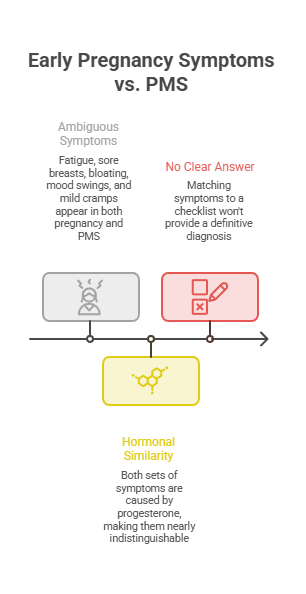
Fatigue, sore breasts, bloating, mood swings, and mild cramps appear in both. So matching your symptoms to a checklist won’t give you a clean answer, no matter how badly you want one.
The Symptoms That Overlap, and Why
Progesterone rises in the second half of every cycle, pregnant or not. That’s the biological reason PMS and early pregnancy feel so similar in the first place.
In a non-pregnant cycle, progesterone drops just before your period, and symptoms ease as bleeding starts. In pregnancy, progesterone keeps climbing, so the symptoms persist instead of fading. Persistence past your expected period is often the first real hint.
The Few Real Differentiators
A handful of details lean more toward pregnancy than PMS. None is definitive, but together they shift the odds.
Spotting that’s pink or brown, very light, and a day or two before your period is due points more toward implantation than menstruation. A metallic taste and strong smell sensitivity are reported more often in early pregnancy than in PMS.
A basal body temperature that stays elevated well past when your period should start can be a clue, though it requires months of charting to read reliably. And nausea, especially with smell triggers, is more characteristic of pregnancy than typical PMS.
The data below puts numbers behind the patterns our diagnostic partners and the wider research literature see in early pregnancy.
| What the Data Shows | Figure | Source |
| Women reporting symptom onset by week 5 to 6 | 59% | Journal of Clinical Epidemiology (via SSM Health) |
| Symptom onset by the end of week 6 | 71% | Journal of Clinical Epidemiology (via SSM Health) |
| Symptom onset by week 8 | 89% | Journal of Clinical Epidemiology (via SSM Health) |
| hCG rise within 8 to 10 days of ovulation | 88% | BMC Pregnancy and Childbirth (256-woman cohort) |
| Nausea onset within 11 to 20 days of ovulation | 67% | BMC Pregnancy and Childbirth |
| Women with nausea during the first trimester | About 70 to 85% | Flo Health / clinical reviews |
| Pregnancies with noticeable implantation bleeding | About 1 in 4 (25%) | Cleveland Clinic |
| Home test accuracy after a missed period, used correctly | About 99% | Office on Women’s Health / Cleveland Clinic |
The honest takeaway: symptoms narrow the possibilities but never close the case. A test does that, and only after enough time has passed.
Why Some Women Feel Everything and Others Feel Nothing
If your sister described vivid symptoms at four weeks and you feel completely normal, don’t read anything into it. Symptom intensity varies enormously between women, and even between pregnancies in the same woman.
Hormone sensitivity differs from person to person. Two women with identical hCG levels can have wildly different experiences, one floored by nausea, the other untouched.
Normal Variation Between Bodies and Pregnancies
A woman who had severe morning sickness in one pregnancy may sail through the next with almost none. The same hormones, a different response. This is biology, not a warning sign.
Body composition, baseline hormone levels, stress, sleep, and individual nerve sensitivity all shape how loudly your body signals a pregnancy. There’s no “right” amount of symptoms.
“No Symptoms” Can Still Mean a Perfectly Healthy Pregnancy
Plenty of women feel nothing in the early weeks and go on to have entirely healthy pregnancies. The BMC Pregnancy and Childbirth cohort found that 88% of women had hCG rise within 8 to 10 days of ovulation, yet noticeable nausea clustered later and didn’t reach everyone.
In other words, your hormones can be doing exactly what they should while you feel completely ordinary. Readers who reach out to HealthCareOnTime worried about a lack of symptoms are often reassured to learn that an absence of symptoms is common and not a red flag by itself.
The only way to move from guessing to knowing is to let hCG build and then test. Symptoms, or the lack of them, can’t do that job.
Surviving the Two-Week Wait Without Losing Your Mind
The stretch between possible conception and a reliable test is famously hard. Every twinge gets analyzed, and the urge to test early is strong. A little structure helps.
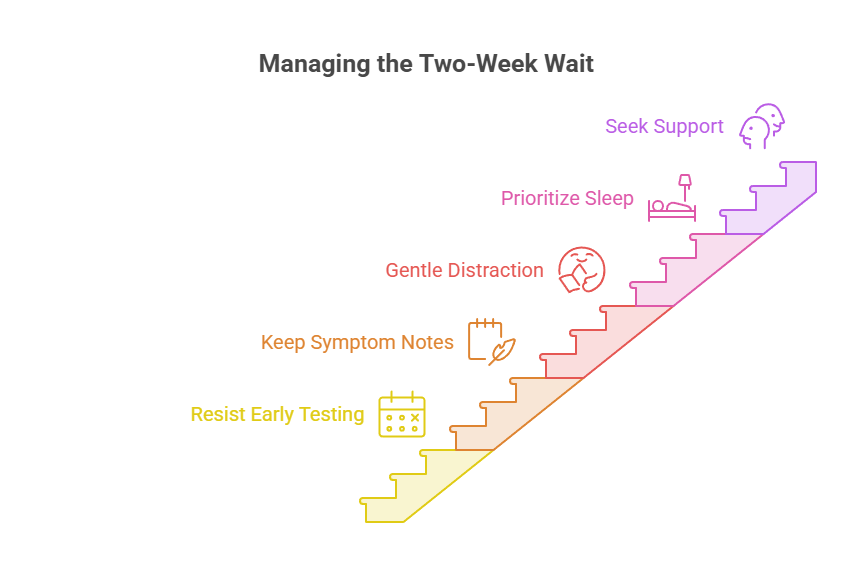
Resist testing before your period is due, since an early negative usually reflects timing rather than a true result and only adds stress. Pick a test date in advance and try to hold to it.
Keep a light symptom note if it helps you feel in control, but don’t let it become an hourly checklist. Gentle distraction, normal routines, sleep, and movement tend to do more for your state of mind than re-reading symptom lists.
If the anxiety feels heavy, that’s worth taking seriously too. Talking with a partner, a friend, or your provider can make the wait more bearable, whatever the outcome turns out to be.
When Can a Test Actually Detect a Pregnancy?
This is where the biology becomes practical. A test can’t read your symptoms; it reads hCG. So the timing of hCG production decides when a test becomes trustworthy.
Understanding that threshold saves you from the gut-punch of a false negative when you’re testing too soon.
Why hCG Timing Decides Everything
After implantation, hCG appears and then climbs quickly. Mayo Clinic explains that hCG roughly doubles every two to three days in early pregnancy.
So waiting even a day or two makes a real difference in whether a test can find the hormone. The earlier you test, the harder it is to detect, and the higher the odds of a misleading negative.
Blood Test vs Urine Test vs Symptoms
Three things can signal pregnancy, and they work on different timelines. Symptoms come first but prove nothing. A blood test, run through a provider or lab, can detect hCG earliest, roughly 11 days after ovulation.
A urine home test usually becomes reliable around 14 days after ovulation, near the first day of a missed period. Our lab partners who process hCG blood panels see this gap regularly: a blood test can confirm a pregnancy days before a home test would.
If timing is urgent for medical reasons, a quantitative blood test through your provider is the most precise early option, and it can also measure the exact hCG level.
How Early Is Too Early?
Testing before your period is due is the leading cause of false negatives. The hormone simply hasn’t built up enough to cross the test’s detection threshold.
Most home tests detect hCG in a similar range, but “early result” tests use more sensitive thresholds to read a few days sooner. Even those aren’t fully reliable before a period is due, because implantation timing varies so much.
If you see a faint line, take it seriously. WebMD notes that a faint line usually still means you’re pregnant, often reflecting low early hCG, so it’s worth confirming rather than dismissing.
How to Test for the Most Accurate Result
A few simple habits sharpen accuracy. Test on or after the first day of a missed period for the most reliable reading.
Use your first morning urine, when hCG is most concentrated, as Office on Women’s Health advises. Avoid drinking large amounts of fluid beforehand, which dilutes the sample and can mask a real positive.
If a test reads negative but your period doesn’t arrive, the American Pregnancy Association recommends retesting in two to three days. Used correctly after a missed period, home tests are about 99% accurate, so a confirmed result at the right time is highly trustworthy.
What to Do Right Now If You Think You Just Conceived
Waiting is hard, but the days between suspecting and confirming are a good time to start protective habits. None of this requires a positive test first.
These steps protect a possible pregnancy at the most sensitive stage of early development, when the building blocks are forming.
Start a Prenatal Vitamin With Folic Acid
Folic acid matters most in the earliest weeks, often before a pregnancy is confirmed. It supports healthy neural-tube development during the period when many women don’t yet know they’re pregnant.
Starting a daily prenatal vitamin while you wait is a low-risk, high-value move. A standard over-the-counter prenatal with folic acid is appropriate for most people, and your provider can recommend specifics.
Pause Alcohol, Smoking, and Certain Medications
If conception is possible, treating yourself as potentially pregnant is the cautious choice. That means pausing alcohol and smoking and checking any regular medications with a pharmacist or provider.
Some common over-the-counter and prescription medications aren’t recommended in early pregnancy, so a quick check is worth it before you have confirmation. Don’t stop a prescribed medication on your own, though; ask first.
When to Test and When to Book a Provider
Hold off on testing until the first day of a missed period for a clean result. Once you get a positive, or a faint line you suspect is positive, schedule a prenatal visit to confirm and begin care.
The table below turns the most common situations into clear next steps.
| Your Situation | What It Likely Means | Recommended Next Step |
| Symptoms, but your period isn’t due for several days | Too early; signs are likely progesterone-driven | Wait and test on the first day of a missed period using first-morning urine |
| Negative test, but your period hasn’t arrived | hCG may still be below the detection threshold | Retest in 2 to 3 days; if still negative with no period, call a provider |
| Light pink or brown spotting near your expected period | Possible implantation bleeding or a light period | Note the timing and flow; test after your period’s due date |
| A faint positive line | Usually a real positive with low early hCG | Treat it as positive, retest in 2 days, and book a provider |
| Severe one-sided pelvic pain with bleeding or dizziness | Possible ectopic pregnancy, a medical emergency | Seek urgent medical care immediately |
| No symptoms, but your period is late | Often normal; many healthy pregnancies have no early signs | Take a test and confirm with a provider if positive |
| A confirmed positive test | Pregnancy is likely | Start prenatal vitamins and schedule your first prenatal visit |
Red Flags: When Early Symptoms Need a Doctor Now
Most early symptoms are normal and manageable at home. A few are not, and recognizing them quickly matters.
In cases reviewed by our medical team, the warning signs below are the ones that warrant immediate attention rather than watchful waiting.
One-Sided Pain, Heavy Bleeding, Dizziness, or Fever
Sharp pain concentrated on one side of the pelvis, especially with bleeding or dizziness, can signal an ectopic pregnancy, where the embryo implants outside the uterus. This is an emergency and needs urgent care.
Heavy bleeding that soaks through protection, severe cramping, fainting, shoulder-tip pain, or a fever all fall into the seek-help-now category. These are not typical early-pregnancy symptoms and shouldn’t be brushed off.
When to Call Versus When to Wait
Light spotting, mild cramps, fatigue, and tender breasts generally don’t need urgent evaluation. They’re consistent with normal early pregnancy or a coming period.
When pain is severe, bleeding is heavy, or you feel faint, don’t wait it out. A quick call to a provider or a trip to urgent care is the safe choice, and trusting your instinct here is reasonable.
Frequently Asked Questions
How soon after conception can you feel pregnancy symptoms?
Some women notice changes as early as one to two weeks after conception, driven by rising progesterone. Others feel nothing for several more weeks. Because implantation and hCG timing vary, early symptoms aren’t a reliable clock, and their absence is just as normal as their presence.
Can you feel pregnant one week after conception?
Yes, some women report fatigue, mild cramping, or tender breasts around a week after conception. These come from progesterone, not the hCG a test detects. The feelings are real, but they overlap so heavily with PMS that they can’t confirm pregnancy on their own this early.
What does implantation actually feel like?
For many women, implantation feels like nothing at all. Those who notice it describe a light pulling or mild cramp low in the pelvis, sometimes with brief pink or brown spotting. It usually happens 6 to 12 days after ovulation and is much lighter than a period.
How do I know if it’s implantation bleeding or my period?
Implantation spotting is typically pink or light brown, very light, and lasts only a day or two, showing up mainly when you wipe. A period starts light then gets heavier and redder, often with clots. If the flow builds into a normal period, it’s almost certainly menstruation.
Can early pregnancy symptoms come and go?
Yes. Early symptoms often fluctuate from day to day, especially in the first weeks as hormone levels rise unevenly. Fatigue or nausea can ease for a day, then return. Symptoms fading isn’t necessarily a problem, though sudden loss of all symptoms with heavy bleeding deserves a provider’s check.
Why do I have pregnancy symptoms but a negative test?
This is common and usually a timing issue. Early symptoms come from progesterone, while tests measure hCG, which builds later. If you tested before hCG rose enough, you can get a false negative. Retest in two to three days, or after a missed period, for a reliable result.
What does early pregnancy fatigue feel like?
It’s a heavy, sudden tiredness that rest doesn’t fully fix, often described as feeling drained by ordinary tasks. Rising progesterone is the main driver. Because stress, poor sleep, and illness cause similar fatigue, it’s one of the least specific early signs when it stands alone.
Can you have no symptoms and still be pregnant?
Absolutely. Many women feel completely normal in the early weeks and go on to have healthy pregnancies. Hormone sensitivity varies widely, so a quiet body and a developing pregnancy often coexist. A lack of symptoms is not a red flag by itself, only a reason to test rather than guess.
How many days past ovulation should I wait to test?
For the most reliable urine test, wait until about 14 days past ovulation, near the first day of a missed period. A blood test through a provider can detect hCG earlier, around 11 days past ovulation. Testing sooner raises the odds of a false negative result.
Do early pregnancy cramps feel different from period cramps?
Often they’re lighter and briefer than period cramps, more of a mild tugging or pressure than a strong ache. But the overlap is significant, and some women find them similar. Cramp quality alone can’t reliably distinguish early pregnancy from a period that’s about to start.
Is bloating an early sign of pregnancy?
It can be. Rising progesterone relaxes and slows the digestive tract, which causes bloating and a full, tight feeling in the abdomen. The same hormone shift causes premenstrual bloating, though, so this symptom is another that early pregnancy and PMS share very closely.
What should I avoid if I think I just conceived?
Treat yourself as possibly pregnant. Pause alcohol and smoking, check any regular medications with a pharmacist or provider, and start a prenatal vitamin with folic acid. Avoid testing too early to spare yourself a false negative, and seek care for severe pain, heavy bleeding, or dizziness.
Disclaimer: This article is for general education and is not medical advice. Early symptoms cannot confirm or rule out pregnancy, and individual situations vary. For diagnosis, testing, and personalized guidance, consult a licensed healthcare provider. If you have severe pain, heavy bleeding, dizziness, or fever, seek medical care promptly.
References
- Mayo Clinic: Symptoms of pregnancy, what happens first
- Mayo Clinic: Home pregnancy tests, can you trust the results?
- Cleveland Clinic: Am I Pregnant? Early pregnancy symptoms and when to test
- Cleveland Clinic: Implantation bleeding
- Office on Women’s Health: Pregnancy tests
- American Pregnancy Association: Pregnancy tests, types and accuracy
- WebMD: Pregnancy tests and faint lines
- SSM Health: 12 early signs of pregnancy (Journal of Clinical Epidemiology data)
- BMC Pregnancy and Childbirth: The onset of nausea and vomiting of pregnancy
- Flo Health: Very early signs of pregnancy