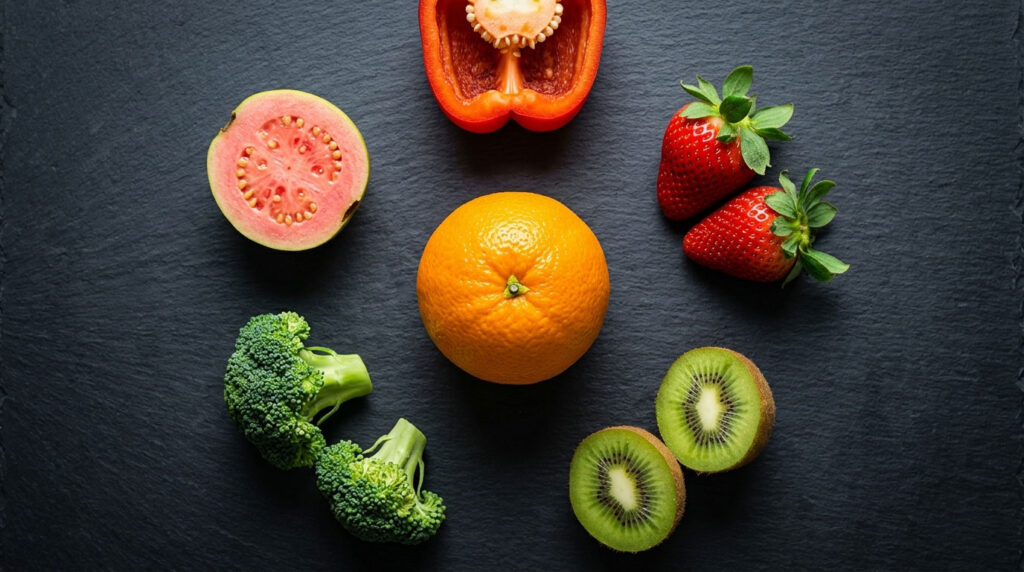
You’ve probably heard it your whole life: eat an orange, get your vitamin C. It’s the fruit’s claim to fame, the reason it shows up in lunchboxes and cold-and-flu advice everywhere.
Table of Contents
Here’s the twist. One orange covering all your vitamin C is true for some people on some days, and not quite true for others. A small orange and a big navel aren’t the same, and your target isn’t the same as your neighbor’s.
So let’s settle the actual number, what it means against the Daily Value, and whether one orange a day really does the job for you.
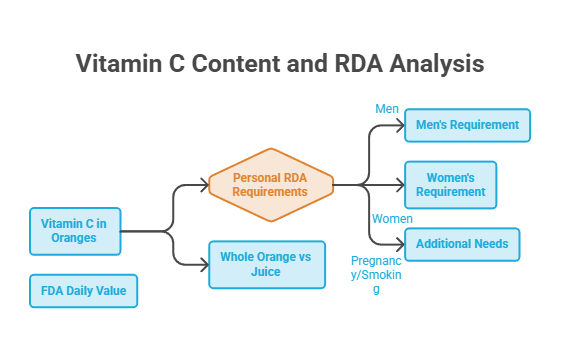
Quick Answer: One medium orange contains about 70 mg of vitamin C, roughly 78% of the 90 mg Daily Value used on US nutrition labels. That single orange fully covers the recommended daily amount for adult women (75 mg) and nearly covers it for men (90 mg). The exact amount shifts with size and variety, from around 51 mg in a small orange to nearly 98 mg in a large one. For most adults, one orange a day is plenty.
At a Glance
- A medium orange has about 70 mg of vitamin C (around 78% of the Daily Value).
- The FDA Daily Value for vitamin C is 90 mg, a single flat number used on labels.
- Your personal RDA varies: 90 mg for men, 75 mg for women, more if pregnant or smoking.
- One orange meets a woman’s full daily target and most of a man’s.
- A small orange has roughly 51 mg; a large one nears 98 mg.
- Whole oranges beat juice on fiber, with about the same sugar.
How Much Vitamin C Is in One Orange?
This is the number you came for, so let’s lead with it. The catch is that one orange isn’t a fixed unit, so the honest answer is a range built on a solid average.
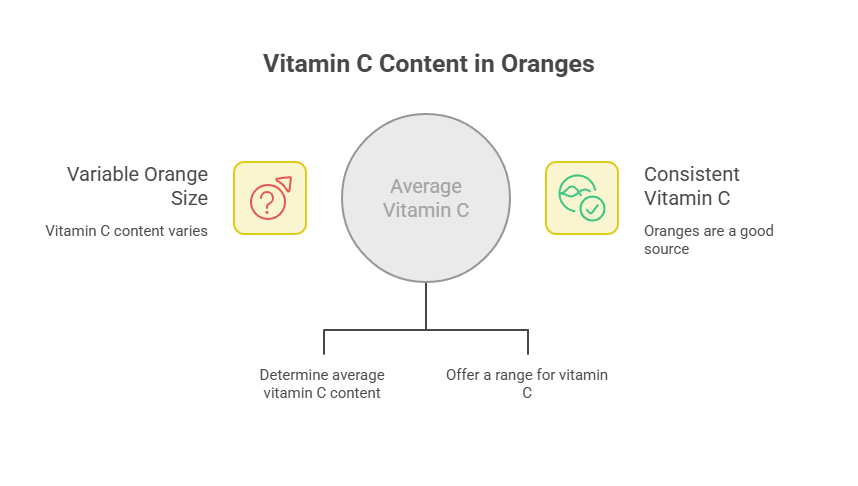
The good news is that even the low end puts an orange near the top tier of common fruits for vitamin C. You’re getting real value no matter which one you grab.
The Short Answer
A medium orange delivers about 70 mg of vitamin C. That figure comes from US Department of Agriculture nutrient data and is the number most dietitians reach for.
To put it in context, a medium navel orange contains roughly 70 mg of vitamin C, which covers the full daily requirement for women and gets close for men, delivering about 78% of the 90 mg target.
Across patients we serve, that’s usually enough to surprise people in a good way. One ordinary orange does most of the daily job on its own.
Why the Number Isn’t Fixed
Three things move the needle: size, variety, and ripeness. A petite clementine-sized fruit can’t match a fist-sized navel, and the math reflects that.
A medium orange about 2.5 inches across and roughly 130 grams gives you nearly 70 mg of vitamin C, while a bigger 3-inch orange weighing about 185 grams delivers almost 100 mg. Variety matters too. Navel oranges run higher, around 82 mg per medium fruit, while Valencia oranges land closer to 59 mg.
Ripeness and freshness play a role as well, since vitamin C degrades over time. Our medical reviewers note that a fresh, fully ripe orange tends to hold more vitamin C than one that’s been sitting in the fruit bowl for a week.
One more curiosity: the peel holds even more vitamin C than the flesh. A whole orange measured with its peel can top 110 mg. Most people won’t eat the peel plain, but a little grated zest in recipes captures a bit of that bonus.
Even where the orange was grown and how it was stored after harvest can nudge the number. That’s why nutrition databases give a range, and why two oranges from the same bag can differ slightly.
| Orange (size or type) | Approx. Weight | Vitamin C (mg) | % Daily Value (90 mg) |
| Small | ~96 g | 51 mg | 57% |
| Medium | ~131 g | 70 mg | 78% |
| Large | ~184 g | 98 mg | 109% |
| Navel (medium) | ~140 g | 83 mg | 92% |
| Valencia (medium) | ~121 g | 59 mg | 66% |
| 1 cup orange sections | ~180 g | 96 mg | 107% |
Source: USDA FoodData Central values. The takeaway is simple. A small orange covers more than half your day, a medium covers most of it, and a large one can tip you past 100% of the Daily Value all by itself.
Daily Value vs RDA: What 90 mg Really Means
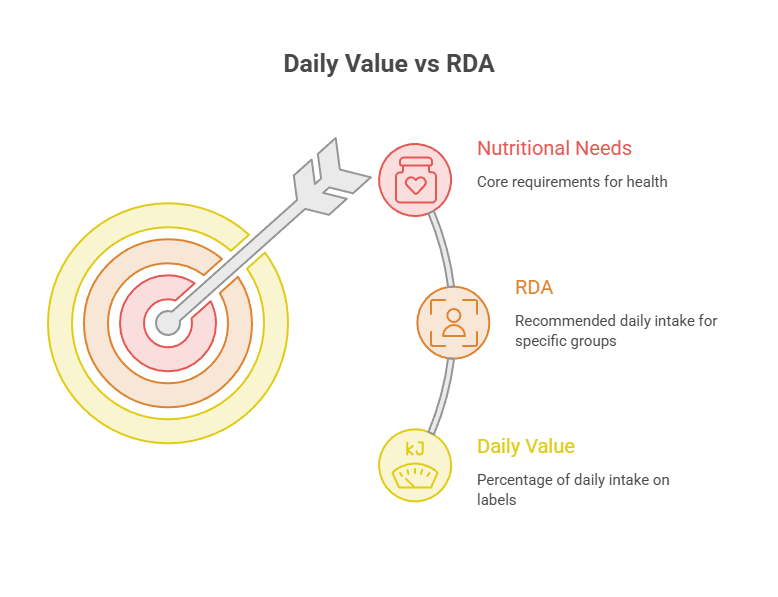
Here’s where a lot of confusion creeps in. You’ll see 90 mg and percent Daily Value on labels, but you’ll also see different numbers for men, women, and pregnancy. Both are right; they just answer different questions.
Sorting this out is the key to reading that orange’s contribution correctly. One number is for label math, the other is for your body.
The Daily Value on Food Labels
The Daily Value (DV) is the single reference number printed on Nutrition Facts labels. It’s designed for quick label comparisons, not personalized targets.
The FDA sets vitamin C at 90 mg on Nutrition Facts labels, so a product showing 100% Daily Value for vitamin C is pointing to 90 mg per serving. That’s why we use 90 mg as the percent DV anchor throughout this guide.
So when our table says a medium orange is 78% of the DV, it means 70 mg out of that 90 mg label standard. Clean and consistent.
This 90 mg figure reflects the updated Nutrition Facts label standard. If you spot a different number on a very old product, the current reference is 90 mg for adults and children age 4 and up.
The RDA That Changes With You
The Recommended Dietary Allowance (RDA) is the personalized version, set by the National Academies and used by the NIH. It shifts based on who you are.
The RDA for vitamin C is 90 mg per day for adult men and 75 mg for adult women, a difference tied to women’s smaller average lean body mass. It rises during certain life stages. Pregnancy raises the target to 85 mg, and breastfeeding pushes it to 120 mg.
Smokers need more across the board. Because smoking increases oxidative stress and how fast the body uses vitamin C, the requirement for smokers is increased by 35 mg per day. Patients commonly ask us why their target differs from a family member’s, and this personal-versus-label distinction is usually the answer.
Vitamin C Needs by Age and Life Stage
Children need less than adults, and the target climbs as they grow. This is the part parents tend to look for, so it’s worth spelling out.
The RDA is 15 mg for ages 1 to 3, 25 mg for ages 4 to 8, and 45 mg for ages 9 to 13, then rises to 75 mg for teen boys and 65 mg for teen girls. From age 19, adults reach the familiar 90 mg for men and 75 mg for women.
For a child, even half a small orange can cover the day. One orange easily meets the target for any school-age kid, which is part of why it’s such a reliable lunchbox staple.
How Much Is Too Much?
Vitamin C is water-soluble, so your body flushes the excess rather than storing it. Still, megadosing isn’t free of consequences.
The Office of Dietary Supplements advises avoiding more than 2,000 mg of vitamin C per day, since high amounts can cause gas, cramping, diarrhea, and bloating. You won’t get anywhere near that from oranges alone. For perspective, the bare minimum to prevent scurvy is only about 10 mg per day, so even a small orange puts you far above the danger zone.
Is One Orange Enough Vitamin C for a Day?
This is the practical question behind the numbers. The answer depends entirely on which target applies to you, so here’s how it shakes out person by person.
For a large share of adults, the answer is a reassuring yes. For a few groups, one orange is a strong start but not the finish line.
For Most Adults, Yes
If you’re an average adult who doesn’t smoke, one medium orange does most or all of the work. A woman hitting 75 mg is fully covered by a medium orange.
Even for men, one orange delivers about 78% of the 90 mg target, and the rest is easily covered by other foods you eat throughout the day. Grab a slightly larger orange or a navel, and a man can clear 90 mg from the fruit alone.
In cases reviewed by our medical team, the people who comfortably meet their needs are usually those eating a varied diet with a daily piece of fruit. One orange rarely has to carry the whole load by itself.
It also helps that vitamin C from food arrives in small, frequent doses your body handles well. You don’t need to hit the exact number every single day; intake averaged over time is what counts for staying in good shape.
When One Orange Falls Short
A few groups have higher targets that a single orange won’t fully reach. Smokers top that list.
Smokers add 35 mg to the baseline, bringing the target to 110 mg for women and 125 mg for men who smoke, so one orange alone probably falls short. Pregnancy (85 mg) and especially breastfeeding (120 mg) also raise the bar beyond what one medium orange provides.
The fix is easy and delicious: pair the orange with another vitamin C food, which the next section makes simple.
A few other groups run low more often, including people with very limited diets, certain digestive conditions that reduce absorption, and some older adults. For them, vitamin C-rich foods spread through the day matter more than any single orange.
| Who You Are | Daily Target | Does One Medium Orange (70 mg) Cover It? |
| Adult woman (non-smoker) | 75 mg | Yes, fully |
| Adult man (non-smoker) | 90 mg | Mostly (about 78%) |
| Pregnant adult | 85 mg | Most of it; add a little more |
| Breastfeeding adult | 120 mg | No; pair with another source |
| Smoker (woman) | 110 mg | No; needs additional vitamin C |
| Smoker (man) | 125 mg | No; needs additional vitamin C |
How Many Oranges Should You Eat a Day?
For vitamin C alone, one orange a day is enough for most people, and two comfortably cover even the higher targets. There’s rarely a reason to eat more than a couple just for the vitamin.
Oranges also bring natural sugar and fiber, so balance matters. A few oranges across the week, rotated with other fruits and vegetables, give you variety and steadier nutrition than leaning on one food for everything.
Orange vs Other Vitamin C Foods
Oranges earned their reputation, but they’re not actually the champion. Several everyday fruits and vegetables pack more vitamin C per serving, which is handy when you want to top up.
This matters most for the higher-target groups above. Knowing the alternatives makes hitting any number painless.
Foods With More Vitamin C Than an Orange
Some of the biggest surprises are vegetables, not fruits. Bell peppers, in particular, blow oranges out of the water.
A red bell pepper provides about 342 mg of vitamin C in a serving, more than twice the amount in a green pepper. Fruit competitors run high too. Guava packs around 125 mg in a single fruit, and a half-cup of acerola cherries delivers a staggering 825 mg.
Even familiar produce beats the orange. Our lab partners and dietitians often point people toward strawberries, kiwi, and broccoli when they need an easy boost without supplements.
| Food | Serving | Vitamin C (mg) | % Daily Value (90 mg) |
| Red bell pepper | 1 cup chopped | ~190 mg | 211% |
| Guava | 1 fruit | ~125 mg | 139% |
| Strawberries | 1 cup | ~98 mg | 109% |
| Grapefruit | 1 medium | ~96 mg | 107% |
| Broccoli | 1 cup raw | ~81 mg | 90% |
| Orange | 1 medium | ~70 mg | 78% |
Source: USDA FoodData Central and Cleveland Clinic values. The orange holds its own, but it’s clear that the vitamin C fruit has plenty of company, much of it even richer.
Among citrus cousins, oranges generally beat tangerines and mandarins, which carry less vitamin C per fruit, while grapefruit is roughly comparable. So among the easy-to-grab citrus options, an orange is one of the stronger picks.
Whole Orange vs Orange Juice
A lot of people get their orange vitamin C from a glass instead of the fruit. Juice does deliver vitamin C, sometimes even more per serving, but you trade away something valuable.
A whole orange provides about 3 to 4 grams of dietary fiber, while a cup of orange juice delivers less than 1 gram, and the sugar content is roughly the same either way. That fiber slows sugar absorption, which is a real advantage for the whole fruit.
There may be an absorption edge too. Eating the whole fruit, with its natural citrus compounds, likely gives a meaningful advantage over isolated vitamin C, though human data is still limited. In tests booked through HealthCareOnTime, the people with the steadiest nutrition tend to favor whole fruit over juice most of the time.
Why Vitamin C Matters, and What the Numbers Say
Before writing oranges off as just a snack, it helps to know why this vitamin earns daily attention. It does a lot of quiet, essential work.
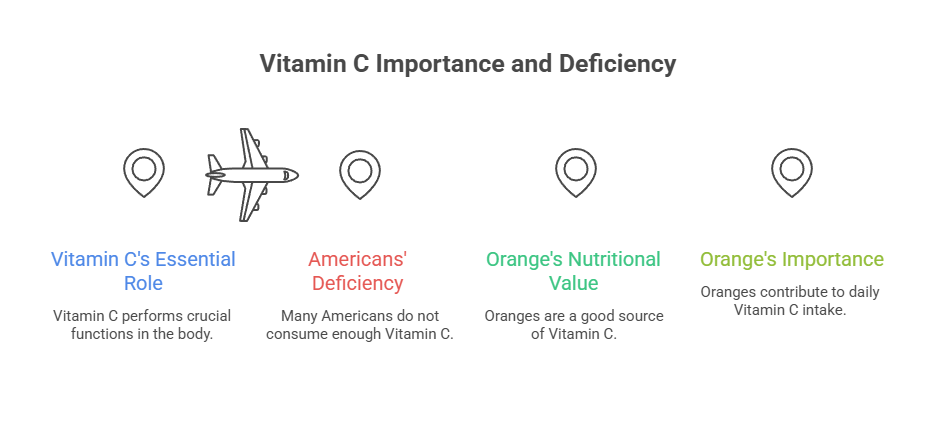
The data also shows that plenty of Americans aren’t getting enough, which makes that daily orange more useful than it looks.
What Vitamin C Does in Your Body
Vitamin C is a multitasker. It’s best known for immune support, but its job description runs much longer.
The body needs vitamin C to make collagen, a protein required for wound healing, and it acts as an antioxidant that helps protect cells from free radical damage. It also has a teamwork role. Vitamin C improves the absorption of iron from plant-based foods and helps the immune system protect the body from disease.
That iron connection is a practical tip in itself. Squeezing orange over a spinach salad, or eating the fruit alongside beans, helps your body pull more iron from those plant foods.
It also helps keep blood vessels, gums, and skin healthy, which is why bleeding gums and slow healing are classic signs of running low. Vitamin C even supports the body’s production of certain neurotransmitters.
Because it’s water-soluble and not stored, you need a fresh supply daily. That’s exactly what a piece of fruit like an orange is good at providing.
Does Vitamin C Prevent Colds?
This is the belief that made oranges famous, and it deserves a clear-eyed answer. The evidence is more modest than the reputation.
For most people, regular vitamin C doesn’t prevent the common cold. Research suggests it may slightly shorten how long a cold lasts, but loading up only after symptoms start does little. A steady daily intake from food is the sensible approach, not megadoses at the first sniffle.
Are Americans Getting Enough?
The honest answer is that many aren’t, even though deficiency disease is rare. There’s a wide gap between not scurvy and optimal.
About 42% of US adults are insufficient in vitamin C based on blood test results, and roughly 118 million American adults fail to consume adequate amounts from their diets. Average intakes tell a similar story. Mean intakes are about 105 mg per day for adult men and 84 mg per day for adult women, which meets the RDA for most nonsmoking adults but leaves little margin.
The shortfall isn’t spread evenly. Smokers, people who eat few fruits and vegetables, and those on very restrictive diets are the most likely to come up short, which is exactly where a simple daily orange earns its keep.
| Vitamin C Statistic | Figure | Source |
| US adults insufficient in vitamin C (blood tests) | About 42% | mindbodygreen / research |
| American adults with inadequate dietary intake | About 118 million | National research |
| Mean daily intake, adult men | ~105 mg | NIH ODS / NHANES |
| Mean daily intake, adult women | ~84 mg | NIH ODS / NHANES |
| Minimum to prevent scurvy | ~10 mg/day | NIH ODS |
| Tolerable Upper Limit (adults) | 2,000 mg/day | NIH ODS |
The pattern is clear. A daily orange is a low-effort way to stay comfortably on the right side of these numbers, especially for the many people who hover near the lower bound.
Getting the Most Vitamin C From Your Orange
Vitamin C is a bit fragile. How you store and prepare your oranges can quietly shrink the amount you actually get.
A few simple habits protect that 70 mg and keep your orange working at full strength.
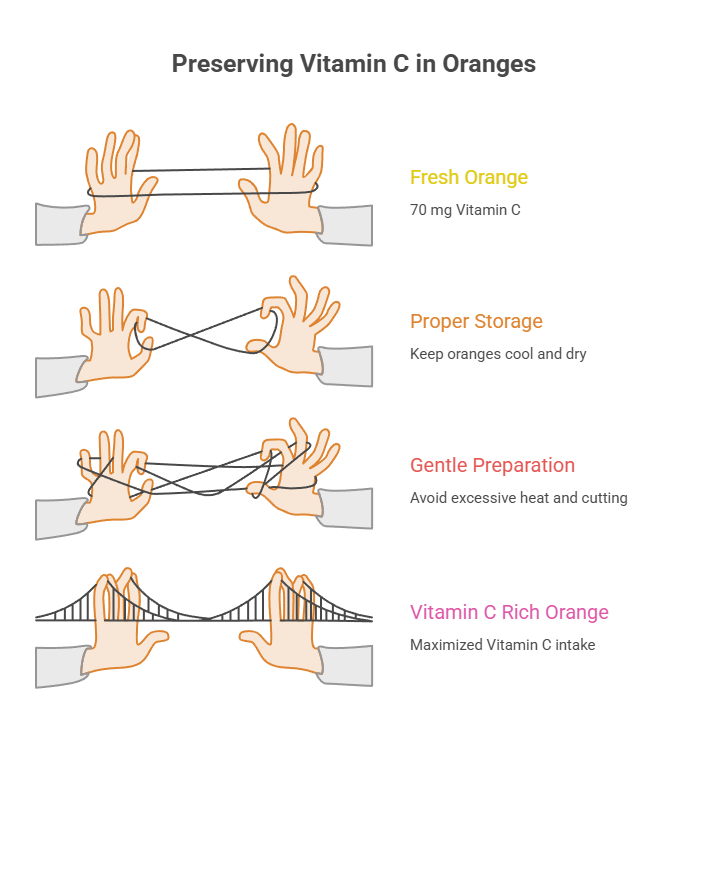
Eat It Fresh and Whole
Whole, fresh, and soon-after-buying is the winning formula. The fiber stays intact, and the vitamin C hasn’t had time to fade.
Eating the orange rather than juicing it keeps the fiber that juice loses. It also avoids the vitamin C losses that come with processing and long storage of commercial juices.
Timing helps too. An orange eaten as a snack, or sliced into breakfast, spreads your vitamin C across the day, which suits a nutrient your body can’t store and steadily uses up.
Storage and Prep That Protect Vitamin C
Heat, light, air, and time are vitamin C’s enemies. The vitamin C content of food can be reduced by prolonged storage and by cooking, though steaming or microwaving lessens cooking losses.
Oranges are usually eaten raw, which already protects their vitamin C. For the vitamin C vegetables on your plate, the same rules apply.
Pre-cut fruit cups and bottled juices that have sat on a shelf for weeks tend to carry less vitamin C than a fresh whole orange, since steady exposure to air and light wears it down. Fresh and recently bought wins.
- Buy oranges fresh and eat them within a week or so for peak vitamin C.
- Store them in the refrigerator to slow nutrient loss, especially in warm kitchens.
- Cut oranges just before eating rather than letting slices sit out exposed to air.
- Choose the whole fruit over juice when you can, to keep the fiber.
- For vitamin C vegetables, steam or microwave instead of boiling to limit losses.
Signs You Might Be Low on Vitamin C
Full-blown deficiency is uncommon in the US, but running low is more common than people think. The early signs are easy to miss because they’re vague.
Knowing what to watch for, and when a simple test makes sense, puts you in control.
Common Symptoms of Low Vitamin C
Because vitamin C touches collagen, immunity, and healing, a shortfall shows up in those areas first. Being vitamin C depleted is surprisingly common and can lead to symptoms such as fatigue, low mood, and slow wound healing.
Other classic signs of a deeper deficiency include easy bruising, bleeding or swollen gums, and rough or bumpy skin. These warrant a conversation with a healthcare provider rather than guesswork.
The tricky part is that these symptoms overlap with plenty of other everyday causes, from poor sleep to stress, so vitamin C is easy to overlook as the culprit. That’s part of why a quick check can be worthwhile when symptoms linger.
When to Consider Getting Tested
If you have ongoing symptoms, a limited diet, or risk factors like smoking, a vitamin C status check can clear things up. A simple blood test measures your level directly.
In cases seen across our diagnostic network, testing turns a vague worry into a clear answer, which is far more useful than self-diagnosing from a symptom list. A provider can interpret the result alongside your diet and overall health and suggest whether food changes or other steps make sense.
If a test does show you’re low, the fix is usually straightforward. Most people improve within days to weeks of getting enough vitamin C, whether through food changes or a provider-recommended supplement, since the body responds quickly once supply catches up.
Frequently Asked Questions
How much vitamin C is in one orange?
One medium orange contains about 70 mg of vitamin C, based on USDA data, which is roughly 78% of the 90 mg Daily Value. The amount ranges from around 51 mg in a small orange to nearly 98 mg in a large one, depending on size, variety, and ripeness.
Does one orange meet your daily vitamin C needs?
For most adults, yes or nearly. A medium orange’s 70 mg fully covers the 75 mg target for women and most of the 90 mg target for men. Smokers, pregnant, and breastfeeding people have higher needs and should pair it with another vitamin C source.
How much vitamin C is in a navel orange?
A medium navel orange contains roughly 82 to 83 mg of vitamin C, which is on the higher end for oranges. That’s about 92% of the 90 mg Daily Value, so a single navel orange nearly covers the full daily amount for almost any adult on its own.
What is the daily value for vitamin C?
The FDA Daily Value for vitamin C is 90 mg, the single reference number printed on US Nutrition Facts labels. A product listing 100% Daily Value provides 90 mg. The Daily Value is meant for label comparisons, while your personal RDA may be higher or lower.
Is the vitamin C in orange juice the same as a whole orange?
The vitamin C is similar, and juice can even have slightly more per serving. The big difference is fiber. A whole orange has about 3 to 4 grams of fiber, while a cup of juice has less than 1 gram, with about the same sugar, so whole fruit is generally the better choice.
Which has more vitamin C, an orange or a lemon?
An orange has more total vitamin C than a lemon, mostly because oranges are larger and you eat more of them. A medium orange offers about 70 mg, while a typical lemon provides far less per fruit. Both are good citrus sources, but oranges deliver a bigger single dose.
Can you get too much vitamin C from oranges?
Not realistically from oranges alone. The tolerable upper limit is 2,000 mg per day, and you’d need to eat dozens of oranges to approach it. Excess vitamin C is flushed out in urine, though very high supplement doses can cause stomach upset and diarrhea.
How much vitamin C do smokers need?
Smokers need an extra 35 mg of vitamin C per day because smoking speeds up how fast the body uses it. That brings the target to 110 mg for women and 125 mg for men who smoke. One orange alone usually won’t cover it, so additional vitamin C foods help.
Does cooking or storing oranges reduce vitamin C?
Yes. Vitamin C is sensitive to heat, light, air, and time, so prolonged storage and cooking reduce it. Oranges are usually eaten raw, which protects their content. Eating fresh oranges soon after purchase and refrigerating them helps preserve the most vitamin C.
What fruit has the most vitamin C?
Among common fruits, guava is a standout with about 125 mg in one fruit. Exotic options like Kakadu plum and acerola cherry are far higher. Strawberries, kiwi, and citrus all beat or rival oranges, but oranges remain one of the most convenient everyday sources.
How much vitamin C does a pregnant woman need?
Pregnancy raises the vitamin C target to 85 mg per day, and breastfeeding raises it to 120 mg per day. A medium orange covers most of the pregnancy target on its own. Anyone who is pregnant or nursing should follow their provider’s specific nutrition guidance.
Is it better to get vitamin C from food or supplements?
For most people, food is the better default. Whole foods like oranges deliver vitamin C alongside fiber and other beneficial compounds, and the body absorbs them well. Supplements help when intake is low or needs are high, but a varied diet usually meets the RDA without pills.
Medical Disclaimer: This article is for general informational purposes only and is not a substitute for professional medical advice, diagnosis, or treatment. Nutrient needs vary by individual, and you should consult a qualified healthcare provider or registered dietitian about your specific vitamin C intake, supplements, or any symptoms you’re experiencing.
References
- NIH Office of Dietary Supplements, Vitamin C Fact Sheet
- NIH Office of Dietary Supplements, Vitamin C for Consumers
- FDA, Daily Value on the Nutrition and Supplement Facts Labels
- National Academies, Dietary Reference Intakes for Vitamin C
- MedlinePlus, Vitamin C
- Healthline, 20 Foods That Are High in Vitamin C