
A high AST is a smoke alarm, not the fire itself. It tells you that cells somewhere in your body are leaking an enzyme into your blood. It doesn’t tell you which room is burning, how big the flames are, or whether you even need to grab the extinguisher yet.
Table of Contents
That gap between “something’s off” and “here’s what’s wrong” is where most people spiral. You get a number flagged in red on a lab portal, you type it into a search bar at 11 p.m., and every result seems to point at your liver. The real story has more moving parts, and most of them are far less frightening than that first jolt suggests.
A high AST blood test is common, and the reasons behind it range from a workout two days ago to conditions that genuinely need treatment. Sorting one from the other is the whole point of this page.
| Quick Answer: A high AST (aspartate aminotransferase) means cells that contain this enzyme have been injured and released it into your bloodstream. The liver is the most common source, but muscle, heart, and red blood cells carry AST too. A single high AST blood test rarely confirms a disease. Your AST/ALT pattern, the size of the increase, and your symptoms together decide what it actually means. |
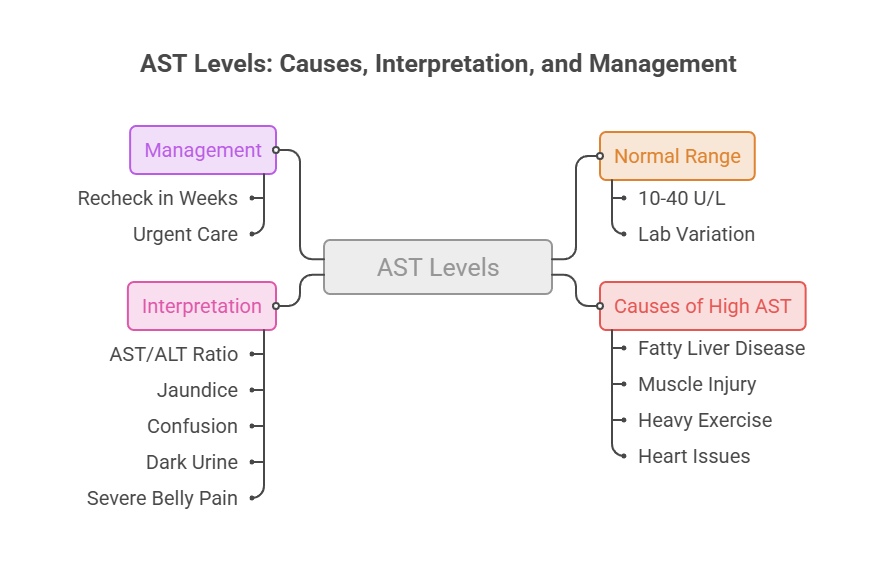
| At a Glance Normal AST usually runs about 10 to 40 U/L, though labs vary by sex and method.Fatty liver disease is the leading cause of a mildly high AST among American adults.AST isn’t liver-specific; muscle injury, heavy exercise, and heart issues can raise it too.The AST/ALT (De Ritis) ratio only carries meaning when both enzymes sit above normal.Intense exercise before a blood draw can push AST up for several days.Jaundice, confusion, dark urine, or severe belly pain with a high AST needs urgent care.Most mild elevations get rechecked in a few weeks rather than treated on the spot. |
What AST Actually Measures
AST is an enzyme, a protein that speeds up chemical reactions inside your cells. It helps shuttle amino acids from one molecule to another as part of normal metabolism. Under healthy conditions, almost all of it stays locked inside cells where it belongs.
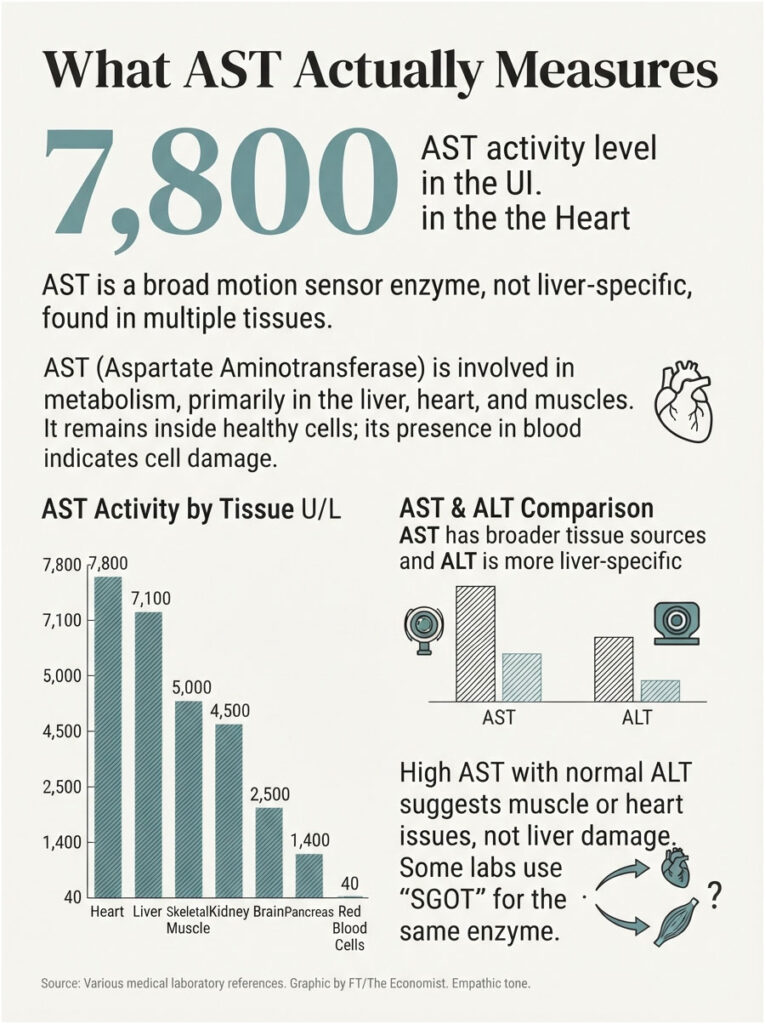
When cells that hold AST get stressed or damaged, they spill it into the bloodstream. A blood test then picks up the higher level. According to MedlinePlus, aspartate aminotransferase is found mainly in the liver but also in the heart, muscles, and other tissues, which is why it’s usually ordered alongside other liver markers rather than on its own.
Patients booking liver panels through HealthCareOnTime often ask why a “liver enzyme” would ever come from somewhere else. The answer is plain biology: AST never read the memo that it’s supposed to be liver-only, and that single fact explains most of the confusion around a high result.
AST vs ALT: Why One Is More Liver-Specific
Your lab report almost always shows AST next to ALT (alanine aminotransferase). Both rise when liver cells are injured, but they aren’t interchangeable. ALT is concentrated heavily in the liver, so a high ALT points more directly at hepatic trouble.
AST is spread across many tissues. That makes it a sensitive alarm but a vague one. As Cleveland Clinic explains, a higher-than-normal ALT tends to be a more specific indicator of liver conditions than a higher AST, though clinicians review both together.
Think of ALT as a security camera aimed only at the liver and AST as a motion sensor covering the whole house. Both can trip. Only one tells you exactly where the movement happened.
Where AST Lives in Your Body
The reason a “high AST, normal ALT” result confuses people becomes clear once you see where the enzyme concentrates. Research catalogued in the National Library of Medicine ranks AST activity across tissues, and the heart and muscle carry nearly as much as the liver does.
| Tissue | Relative AST Activity |
| Heart | 7,800 |
| Liver | 7,100 |
| Skeletal muscle | 5,000 |
| Kidney | 4,500 |
| Brain | 2,500 |
| Pancreas | 1,400 |
| Red blood cells | 40 |
Our medical reviewers note that this distribution is the single most useful fact for calming a false alarm. If your ALT is normal and only AST is up, the extra enzyme may be leaking from muscle or heart tissue, not a damaged liver.
SGOT: The Old Name You Might See
Some labs still print “SGOT” instead of AST. It stands for serum glutamic-oxaloacetic transaminase, an older term for the exact same enzyme. If your paperwork says SGOT, read it as AST and interpret it the same way. The name changed; the biology didn’t.
What Counts as a High AST Level
Numbers on a lab report only mean something against a reference range. That range shifts a little between LabCorp, Quest, and hospital labs, and it can differ by sex. This is why two people with identical results can see one flagged and one not.
Normal AST Range and the Upper Limit
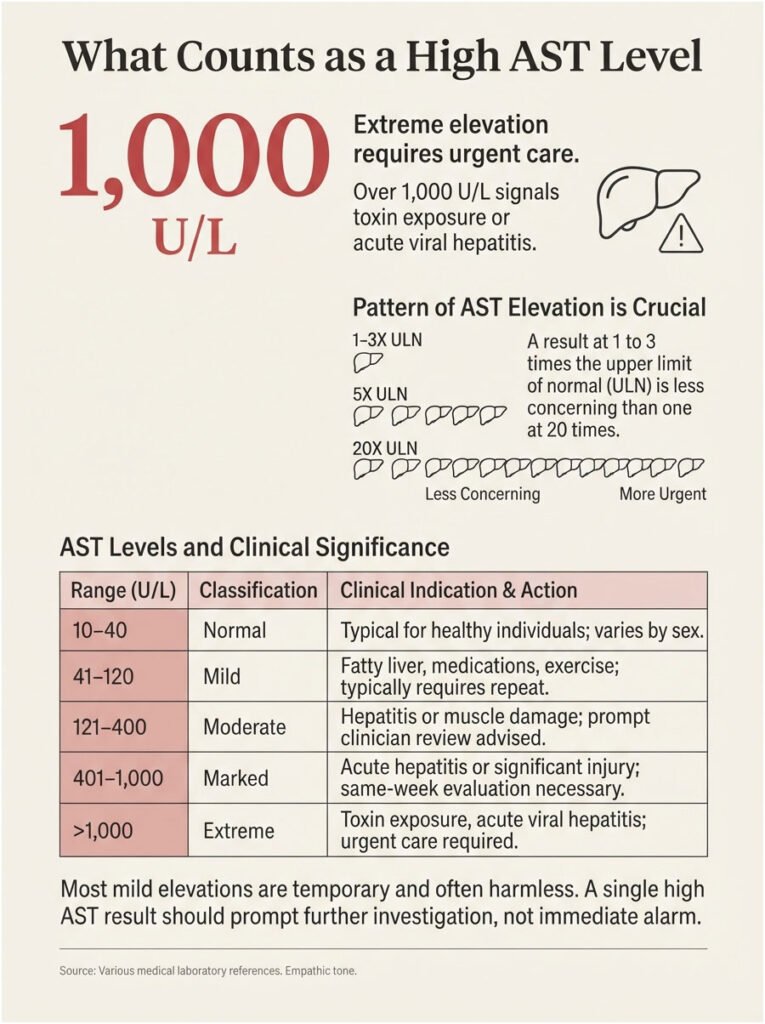
Most US labs set the normal AST range at roughly 10 to 40 U/L for both sexes, with some using 10 to 35 U/L for women. Mild elevation generally means about two to three times the top of normal. Marked elevation climbs into the hundreds or thousands.
The table below breaks down what different ranges tend to signal. Treat it as a map, not a diagnosis, since your clinician reads these numbers against your full history and symptoms.
| AST Range (U/L) | Elevation Category | What It Often Suggests | Typical Next Step |
| 10 to 40 | Normal | Routine result | No action needed |
| 41 to 120 | Mild (about 1 to 3x) | Fatty liver, medications, exercise, alcohol | Repeat test in a few weeks |
| 121 to 400 | Moderate (about 3 to 10x) | Hepatitis, active liver injury, muscle damage | Prompt clinician review, further labs |
| 401 to 1,000 | Marked (about 10 to 20x) | Acute hepatitis, significant injury | Same-week evaluation, imaging |
| Over 1,000 | Extreme | Toxin exposure, ischemic (shock) liver, acute viral hepatitis | Urgent or emergency care |
Mild, Moderate, and Marked Elevation
Doctors often describe AST by how many times it exceeds the upper limit of normal (ULN). A result at 1 to 3 times ULN reads very differently from one at 20 times. The pattern matters as much as the peak number.
Mild, symptom-free elevations are extremely common and frequently temporary. Mayo Clinic points out that in the vast majority of people with mild to moderate enzyme elevation and no other symptoms, the liver is not failing. Mild elevation often signals some inflammation rather than serious damage.
Understanding Your Specific AST Number
People rarely search for “high AST” in the abstract. They search because a specific figure got flagged, and they want to know where it lands. A result of 55 U/L and a result of 900 U/L belong to two different conversations.
For a mild reading in the 41 to 120 range with no symptoms, the odds strongly favor a benign or reversible cause. Cleveland Clinic notes that roughly 1 in 20 healthy people will have an AST result outside the normal range with nothing actually wrong.
In lab results reviewed across our diagnostic network, a slightly high AST with everything else normal is one of the most frequent reasons people panic without cause. The number that scares you may simply be your body’s version of static. A single high AST blood test is a prompt to look closer, not a verdict to act on alone.
The Most Common Causes of a High AST
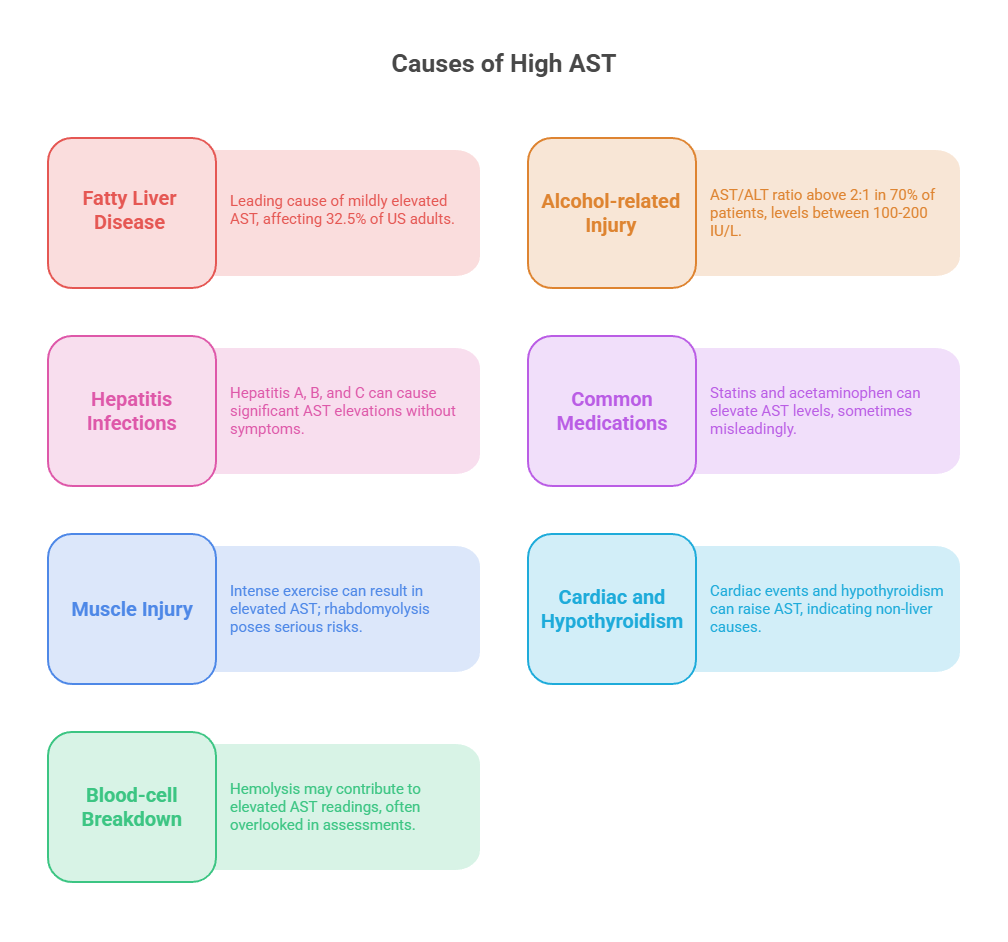
Once you accept that AST is a general alarm, the next question is where it’s coming from. Here’s how the common causes stack up, starting with the one that accounts for most mild elevations in the United States.
Fatty Liver Disease (MASLD): The Leading Cause
The most common driver of a mildly high AST in America is metabolic dysfunction-associated steatotic liver disease, or MASLD, formerly called non-alcoholic fatty liver disease. It’s fat buildup inside liver cells tied to weight, insulin resistance, and metabolic health.
The scale is striking, though the trend has shifted recently. National survey data analyzed in this NHANES study found MASLD prevalence among US adults declined from 37.6% to 32.5% between the 2017 to 2020 and 2021 to 2023 periods. Even at the lower figure, that’s roughly one in three adults.
Among people with type 2 diabetes the rate runs far higher, historically in the 55 to 70% range per the American Diabetes Association. MASLD often shows up as ALT slightly above AST early on, with no symptoms at all. The encouraging part is that it responds to lifestyle change, which we cover further down.
Alcohol-Related Liver Injury (and the 2:1 Ratio Clue)
Alcohol is a classic cause of elevated AST, and it leaves a recognizable fingerprint. In alcohol-related liver injury, AST typically rises more than ALT, pushing the AST/ALT ratio above 2 to 1.
Cleveland Clinic’s hepatology guidance notes that in acute alcoholic hepatitis, AST usually sits in the 100 to 200 IU/L range, and the ratio exceeds 2 to 1 in about 70% of patients. A ratio above 3 points strongly toward alcohol.
One important catch: an AST above 500 isn’t likely explained by alcoholic hepatitis alone, even in someone who drinks heavily. Very high numbers push the search toward another cause entirely, so context still rules.
Viral Hepatitis (A, B, and C)
Hepatitis viruses inflame liver cells and can send AST and ALT climbing, sometimes into the hundreds or thousands during an acute infection. Hepatitis B and C often run quietly for years, which is why testing is standard in any unexplained enzyme workup.
Patients we serve are frequently surprised that hepatitis screening gets ordered when they feel completely fine. Both infections are common across the US and frequently silent, so bloodwork catches what symptoms don’t. Catching them early changes the entire treatment path.
Medications and Supplements
Plenty of everyday medications nudge AST upward, usually without causing real harm. Statins for cholesterol can produce transient bumps. The tuberculosis drug isoniazid commonly raises enzymes that often settle even while treatment continues.
Acetaminophen (Tylenol) deserves special respect. At normal doses it’s fine for most people, but overdose is a leading cause of acute liver injury with sky-high AST. Herbal products, weight-loss aids, and bodybuilding supplements can also stress the liver in ways people don’t expect.
Never stop a prescription on your own because of a lab result. Our medical reviewers stress that the safer move is to bring the full list, including over-the-counter drugs and herbal products, to whoever ordered the test. A harmless statin bump and real drug injury look different on repeat testing.
Muscle Injury and Intense Exercise
Because skeletal muscle carries nearly as much AST as the liver, anything that damages muscle can raise the number. A hard workout, a fall, a car accident, or a crush injury all release AST into the blood.
This trips up a lot of gym-goers. A study noted by ScienceInsights found that after intense weightlifting, every participant had AST above the normal range for at least five days, with levels still elevated at seven days. The effect is strongest in people who don’t train that way regularly.
Rhabdomyolysis: When Muscle Breakdown Spikes AST
At the severe end, rhabdomyolysis (extensive muscle breakdown) can drive AST dramatically high alongside muscle pain, weakness, and dark, cola-colored urine. It’s a medical emergency that needs immediate care. A creatine kinase (CK) test usually confirms muscle as the source, since CK spikes with muscle damage but stays normal in liver disease.
Heart, Thyroid, and Blood-Cell Causes
A heart attack releases AST from injured cardiac muscle, which is why AST was once used as a cardiac marker. Doctors now rely on more specific tests like troponin, but the enzyme still rises in that setting. An underactive thyroid (hypothyroidism) is a lesser-known cause that can push liver enzymes up.
Blood-cell breakdown, called hemolysis, adds AST from ruptured red blood cells. Even a difficult blood draw that damages cells in the tube can nudge the reading. Less common culprits include celiac disease, where enzyme elevations sometimes appear before digestive symptoms, and hemochromatosis, an inherited iron-overload condition.
The team at HealthCareOnTime regularly sees these non-liver causes overlooked when attention locks onto the liver alone. That’s exactly why the AST/ALT pattern deserves a close look before anyone assumes the worst.
High AST, Normal ALT? Reading the Pattern
If your AST is up but your ALT sits comfortably in range, that mismatch is a clue rather than a contradiction. It usually steers the search away from the liver and toward muscle, heart, or blood.
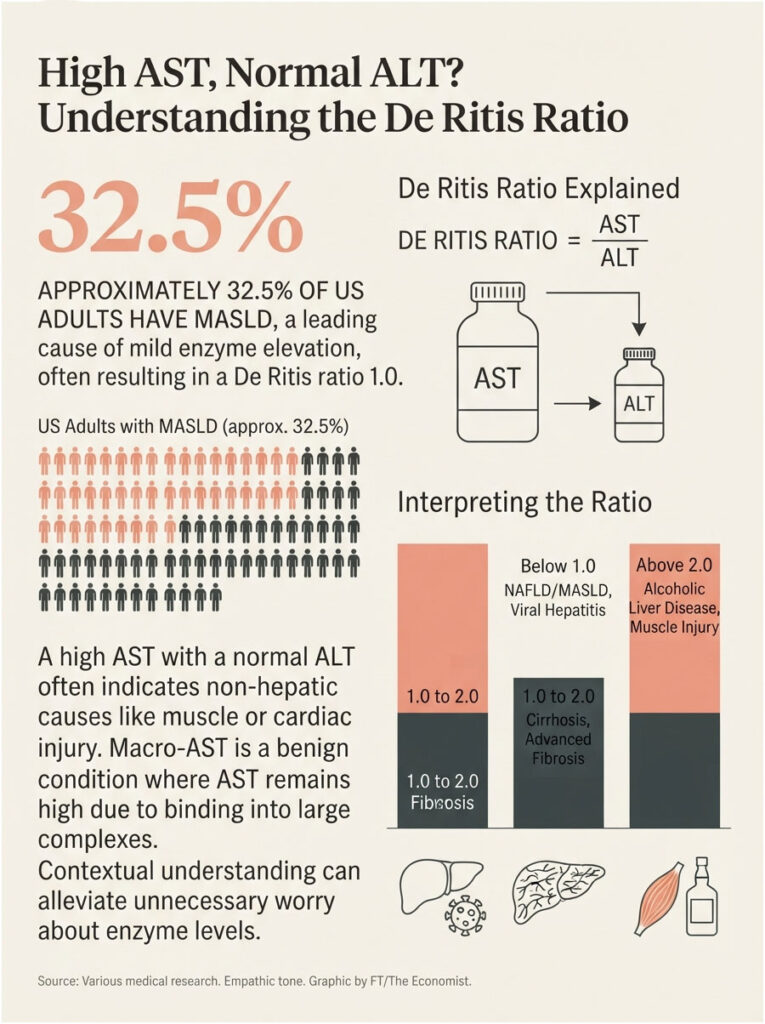
The AST/ALT (De Ritis) Ratio Explained
The AST/ALT ratio, also called the De Ritis ratio, is simply your AST divided by your ALT. It’s a pattern tool, not a directly measured value, and it helps narrow down the cause of enzyme elevation more precisely than either number alone.
The table below pairs ratio patterns with likely meaning and adds current US context, with sources attributed in each row.
| Metric / Pattern | Value or Range | What It Indicates | Source |
| AST/ALT ratio < 1 | Below 1.0 | Most common; NAFLD/MASLD, viral hepatitis, acute injury | HealthMatters.io |
| AST/ALT ratio 1 to 2 | 1.0 to 2.0 | Cirrhosis, advanced fibrosis, NASH | HealthMatters.io |
| AST/ALT ratio > 2 | Above 2.0 | Classic alcoholic liver disease, muscle injury | Cleveland Clinic |
| MASLD in US adults | About 32.5% (2021 to 2023) | Leading cause of mild enzyme elevation | NHANES |
| DASH diet effect | AST down ~5.8 U/L in 12 weeks | Diet can measurably lower AST | Clinical study |
A guardrail worth repeating loudly: the ratio only means something when both AST and ALT sit above normal. Online calculators love to spit out alarming ratios from perfectly normal values, and those numbers signal nothing at all. A ratio of 1.6 built from an AST of 18 and an ALT of 11, both normal, is noise.
When the Ratio Points Away From the Liver
When AST is elevated three times above normal with a normal ALT, the likely causes are often non-hepatic, especially muscle injury, cardiac injury, hemolysis, or alcohol. This is where a CK test earns its keep, since CK jumps with muscle damage but stays flat in liver disease.
Our lab partners report that this exact pattern, a high AST with a normal ALT, is one of the most common triggers for unnecessary worry. Context usually resolves it within a single follow-up.
Macro-AST: A Benign Reason for Persistently High AST
Occasionally AST stays high for no clear reason, and repeat tests keep flagging it while every other result looks fine. One overlooked explanation is macro-AST, where AST binds into large complexes that the kidneys clear slowly, so it lingers in the blood.
Described in the National Library of Medicine, macro-AST is uncommon and harmless, but awareness of it can spare someone from rounds of invasive testing. Specialized lab methods can confirm it when the pattern doesn’t fit anything else.
Benign and Temporary Triggers People Miss
Some of the most frequent reasons for a high AST have nothing to do with disease. Knowing them can save you a week of dread and a stack of unnecessary follow-up tests.
Exercise Before Your Blood Draw
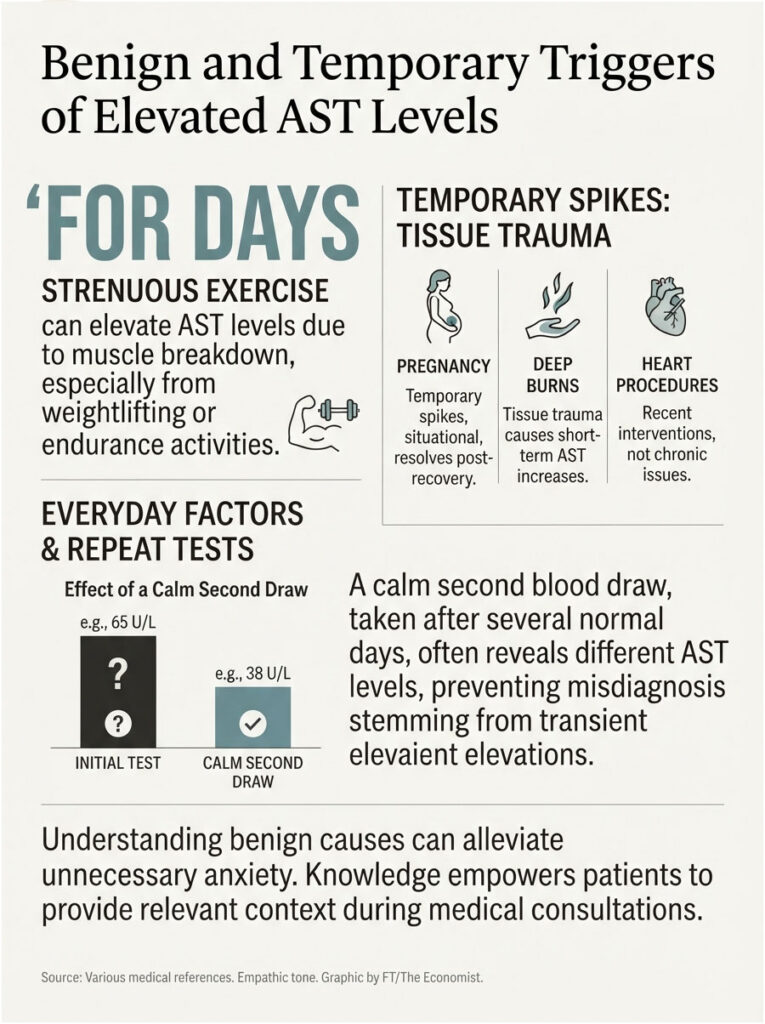
This one catches people constantly. Strenuous exercise in the days before a test, especially weightlifting or endurance work, breaks down muscle fibers and releases AST. Levels can stay up for the better part of a week afterward.
If you crushed a workout the day before your blood draw, that alone can explain a surprising result. Patients booking tests with us are routinely reminded to mention recent hard exercise, because a number read in the wrong context sends people down the wrong path.
Pregnancy, Burns, and Recent Procedures
AST can rise temporarily during pregnancy. Deep burns, recent heart procedures, and other tissue trauma can bump it too, per Cleveland Clinic. These are situational spikes, not signs of chronic liver trouble, and they tend to fade as the body recovers.
How Timing and Prep Affect Your Result
Because so many everyday factors move AST, timing matters more than people assume. A result drawn after a rough workout, a stomach bug, or a heavy weekend can read higher than your true baseline. A recent viral illness like mono can raise it as well.
That variability is a big reason clinicians repeat the test before acting. A calm second reading, taken after a few normal days, often tells a very different story than the first.
When a High AST Is an Emergency
Most high AST results can wait for a scheduled visit. A specific set of warning signs cannot. Learning that line is the single most useful thing you can take from this page.
Red-Flag Symptoms
Seek urgent care if a high AST comes with any of these: yellowing of the skin or eyes (jaundice), dark urine, pale stools, severe abdominal pain, persistent vomiting, confusion, or fever with belly pain. These can signal serious liver problems that need fast attention.
Cleveland Clinic flags confusion or unusual drowsiness alongside abnormal liver tests as especially concerning, since it can point to advanced disease. Confusion paired with severely elevated enzymes and no prior liver history is treated as a medical emergency.
Extremely High AST (Over 1,000 U/L)
Numbers in the thousands change the urgency entirely. Very high transaminases can indicate acute viral hepatitis, acetaminophen toxicity, or ischemic liver injury, sometimes called “shock liver,” from a sudden loss of blood flow to the organ.
These situations need same-day evaluation. They’re uncommon, but they’re the reason a jaw-dropping AST number should never be sat on until Monday.
Acetaminophen Overdose and Poison Control
If a high AST follows a suspected acetaminophen overdose or any toxic ingestion, treat it as an emergency. Call Poison Control at 1-800-222-1222 or go to an emergency room. Early treatment for acetaminophen toxicity dramatically improves outcomes, and the window to act is narrow.
What to Do After a High AST Result
A flagged AST is a starting point, not a diagnosis. The path forward is usually orderly, and it rarely jumps straight to invasive testing. Here’s the sequence clinicians tend to follow.
The table below maps common scenarios to what they likely mean and the reasonable next move. Use it to frame the conversation with your provider, not to replace it.
| Your Situation | Likely Interpretation | Recommended Action |
| Mildly high AST, no symptoms | Common and often temporary | Recheck in 2 to 8 weeks |
| High AST after a hard workout | Muscle-source elevation | Retest after resting several days |
| AST higher than ALT, regular drinking | Possible alcohol-related injury | Cut alcohol, see a clinician |
| Very high AST with jaundice or confusion | Possible acute liver injury | Seek urgent or emergency care |
| Persistent mild elevation over months | Fatty liver or other cause | Full workup: labs, imaging, review |
Step 1: Repeat the Test
For mild, symptom-free elevations, many clinicians simply repeat the blood test in a few weeks. A single reading gets thrown off by exercise, a virus, or ordinary lab variation, so confirmation comes first. A large share of first-time flags never repeat.
Step 2: Review Medications, Alcohol, and Workouts
Your provider will ask about alcohol intake, every medication and supplement you take, recent intense exercise, and any new symptoms. Honest answers speed everything up. As our reviewers put it, the goal is to explain the number, not to judge the habits behind it, so hold nothing back.
Step 3: Additional Labs and Imaging
If the elevation holds, further blood tests help clarify the picture: ALT for liver specificity, GGT for bile ducts and alcohol, bilirubin for how well the liver processes waste, plus screens for viral hepatitis, iron overload, or autoimmune causes. An abdominal ultrasound is often the first imaging step and can spot fatty liver or structural issues.
How to Support Lower AST Naturally
When fatty liver drives the elevation, lifestyle change does real work. Even modest weight loss can meaningfully cut liver fat and enzyme levels. Reducing or stopping alcohol often improves numbers within weeks.
Diet quality counts too. A study cited by liver-health researchers found the DASH diet lowered AST by about 5.79 U/L over 12 weeks. The liver heals well when the source of injury is removed, which is why early, steady action beats waiting and worrying.
Frequently Asked Questions
What is a normal AST level?
Most US labs list a normal AST range of about 10 to 40 U/L, with some using 10 to 35 U/L for women. Ranges vary by lab and method, so read your result against the reference range printed on your own report rather than a general figure online.
Is a slightly high AST dangerous?
Usually not. Mild, symptom-free elevations are common and often temporary, tied to exercise, medications, or early fatty liver. They still deserve a follow-up. Most clinicians simply repeat the test in a few weeks rather than starting any treatment right away.
What’s the most common cause of high AST?
In American adults, fatty liver disease (MASLD) is the leading cause of mildly elevated liver enzymes. It affects roughly a third of US adults and links to weight, insulin resistance, and metabolic health, often producing no symptoms at all in its early stages.
Does a high AST always mean liver damage?
No. AST also lives in your heart, muscles, and red blood cells, so a high result can stem from muscle injury, intense exercise, a heart problem, or blood-cell breakdown. Doctors read AST alongside ALT to judge whether the liver is the likely source.
What does high AST but normal ALT mean?
That pattern often points away from the liver, since ALT is more liver-specific. Muscle injury, hard exercise, heart issues, or red-cell breakdown are common explanations. A creatine kinase (CK) test can confirm muscle as the source, since CK rises with muscle damage but not liver disease.
Can exercise cause a high AST?
Yes, and it’s frequently missed. Strenuous exercise, especially weightlifting, breaks down muscle and releases AST. One study found every participant had elevated AST for at least five days after intense lifting. Tell your provider if you worked out hard before your blood draw.
What AST number is considered dangerous?
There’s no single cutoff, but values over roughly 1,000 U/L are treated urgently and can point to acute hepatitis, acetaminophen toxicity, or lost blood flow to the liver. Moderate elevations still warrant review, especially with symptoms like jaundice or severe pain.
What’s the difference between AST and ALT?
Both are liver enzymes that rise when liver cells are injured, but ALT is concentrated mostly in the liver, making it more specific. AST is spread across many tissues. Comparing the two, and their ratio, helps pinpoint whether the liver or another organ is involved.
Can medications raise AST levels?
Yes. Statins, the TB drug isoniazid, and acetaminophen at high doses can all raise AST, along with some supplements and herbal products. Most bumps are mild and reversible. Don’t stop any prescription on your own; bring your full medication list to your provider instead.
How can I lower my AST naturally?
If fatty liver is the cause, modest weight loss, cutting alcohol, and a better diet help. The DASH diet lowered AST by roughly 5.8 U/L over 12 weeks in one study. The liver recovers well once the underlying source of injury is addressed and removed.
Why is my AST high if I don’t drink alcohol?
Alcohol is just one cause. Fatty liver tied to metabolism, viral hepatitis, medications, muscle injury, thyroid issues, and even a recent workout can all raise AST. Many people with high enzymes drink little or nothing, which is why a full evaluation looks well beyond alcohol.
How long does it take for AST to return to normal?
It depends on the cause. Exercise-related spikes settle within days once you rest. Medication or alcohol-related elevations often improve within a few weeks after the trigger is removed. Persistent elevations need a workup to find and treat the underlying reason.
| Medical Disclaimer: This article is for general information only and does not replace professional medical advice, diagnosis, or treatment. Lab values must be interpreted by a qualified clinician who knows your full history. Always talk with your healthcare provider about your results and any symptoms. If you have red-flag symptoms such as jaundice, confusion, or severe abdominal pain, seek urgent care right away. |
References
- Aspartate Transferase (AST) Blood Test, Cleveland Clinic
- AST Test, MedlinePlus (NIH)
- Elevated Liver Enzymes, Cleveland Clinic
- Liver Test Interpretation, Cleveland Clinic Hepatology
- My Liver Enzymes Are Elevated, Now What?, Mayo Clinic Press
- Markedly Elevated AST from Non-Hepatic Causes, National Library of Medicine
- Macro-AST: A Benign Cause of Abnormal Findings, National Library of Medicine
- MASLD Prevalence Trends in US Adults (NHANES), National Library of Medicine
- Understanding the Burden of NAFLD, American Diabetes Association