You booked the annual Pap you have had every year since college. At check-in, the nurse mentions the office does something different now, hands you a pamphlet, and moves on to the next patient.
Table of Contents
Between December 2025 and mid-2026, three major American organizations rewrote cervical cancer screening guidance. A fourth has not finished. Here is what that means for your next appointment.
Quick Answer: Updated cervical cancer screening guidelines now name primary HPV testing every 5 years as the preferred method for ages 30 to 65, replacing the annual Pap for most people. Self-collected HPV samples are newly accepted, with repeat testing in 3 years rather than 5. Most insurance plans must cover follow-up testing needed to complete screening, without cost sharing, starting January 1, 2027.
At a Glance
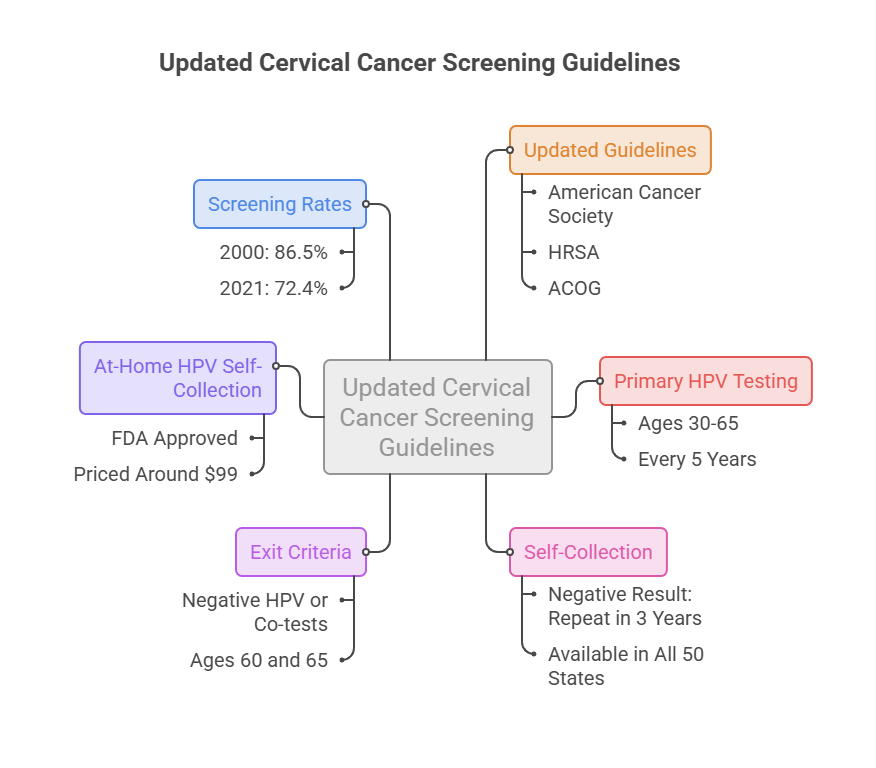
• The American Cancer Society updated its guideline December 4, 2025. HRSA adopted an updated federal guideline January 5, 2026. ACOG published its updated statement in 2026.
• The USPSTF has not finalized its update. Its draft posted in December 2024, and the 2018 recommendation is still the one on the books.
• Primary HPV testing every 5 years is now the preferred strategy for ages 30 to 65 across the updated guidelines.
• Self-collection is accepted, but a negative self-collected result means repeat in 3 years, not 5.
• The ACS added new exit criteria: negative HPV or co-tests at both age 60 and age 65 before stopping.
• At-home HPV self-collection is FDA approved, available in all 50 states, and priced around $99 with insurance.
• Screening rates fell from 86.5 percent of eligible women in 2000 to 72.4 percent in 2021, which is the problem these updates are built to solve.
What Actually Changed, in Plain Terms
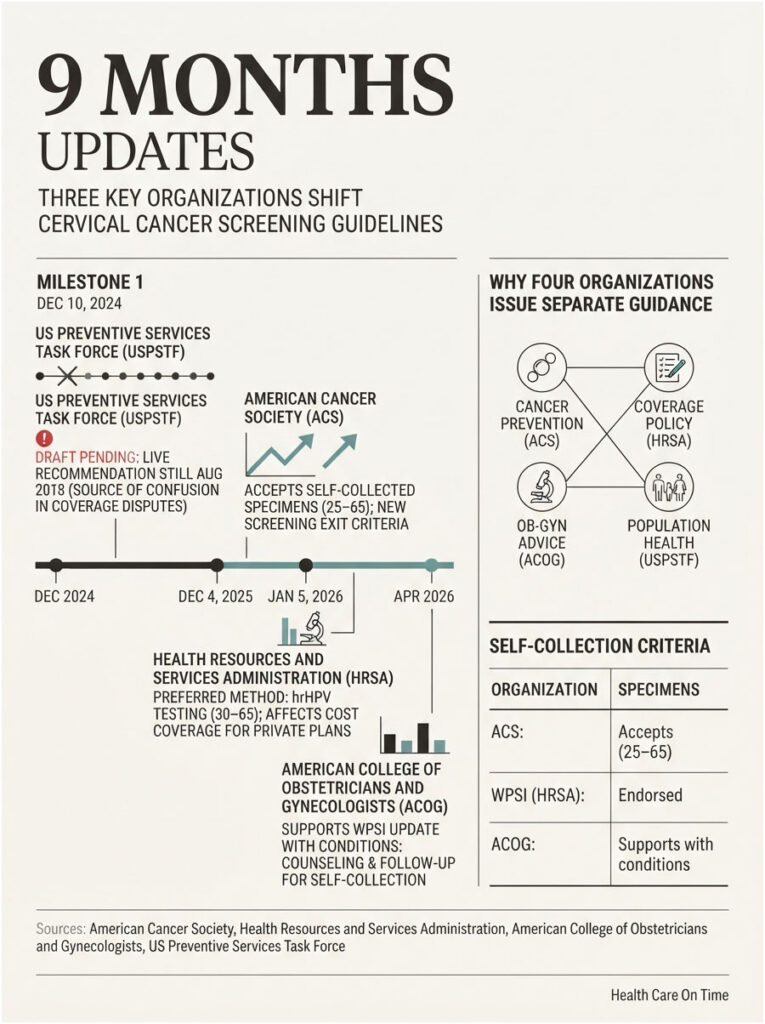
Three updates landed inside nine months. Each came from a different body, each carries different weight, and none of them cancels the others.
Patients booking screening through HealthCareOnTime keep asking a version of the same question: which one is the real rule? The honest answer is that they all are, for different purposes.
The Three Updates That Landed in Nine Months
American Cancer Society, December 2025
The ACS published its update on December 4, 2025, in CA: A Cancer Journal for Clinicians. Two changes carry real weight.
Self-collected vaginal specimens are now acceptable for average-risk people aged 25 to 65, though clinician-collected samples remain preferred. And the ACS added new screening exit criteria, because too many people were stopping without meeting the old ones.
HRSA and the Women’s Preventive Services Initiative, January 2026
This is the one that touches your wallet. On January 5, 2026, the Health Resources and Services Administration adopted the updated WPSI guideline into the federal Women’s Preventive Services Guidelines.
HRSA guidelines determine what most private plans must cover without cost sharing. The update names hrHPV testing, whether collected by you or a clinician, as the preferred method for average-risk women aged 30 to 65.
ACOG, 2026
The American College of Obstetricians and Gynecologists issued a qualified endorsement of the WPSI update, announced in April 2026.
“Qualified” is doing work in that sentence. ACOG agrees with the direction but attaches conditions around counseling and follow-up infrastructure, particularly for self-collection.
The One Body That Has Not Finished Yet
The US Preventive Services Task Force posted a draft update on December 10, 2024. The public comment period closed January 13, 2025.
As of now, no final statement has been published. The live USPSTF recommendation is still dated August 21, 2018, and the page carries an “Update in Progress” banner.
That matters because USPSTF grades drive a separate set of coverage requirements under the Affordable Care Act. Our medical reviewers flag this as the most common source of confusion in current coverage disputes, and it is the single fact most consumer coverage of these updates omits.
Why Four Organizations Issue Separate Guidance
Each body has a different job. The ACS writes clinical guidelines for cancer prevention. HRSA sets federally required preventive coverage for women. ACOG advises practicing ob-gyns. The USPSTF grades evidence for the broader coverage mandate.
They read the same studies and usually land in the same place. When they diverge, it is almost always on start age or interval length, not on whether screening works.
The Three Tests, and How They Differ
Before the age bands make sense, the tests have to. Most of the confusion around these updates traces back to people using “Pap” as shorthand for every cervical test.
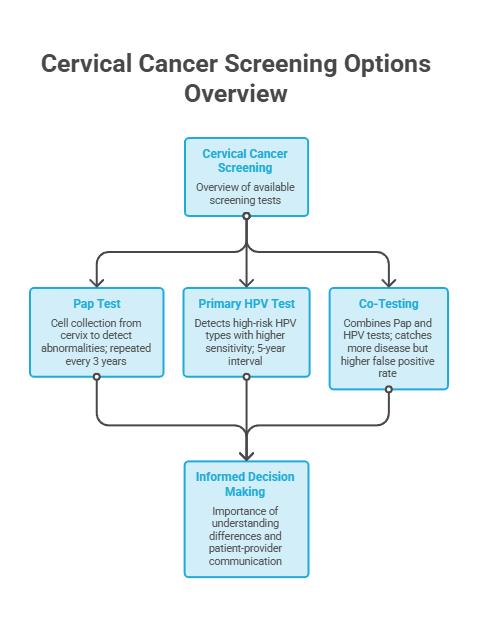
The Pap Test (Cervical Cytology)
A clinician collects cells from the surface of the cervix and a lab examines them under a microscope for abnormal changes. It looks for the damage, not the cause.
The Pap has driven a more than 50 percent decline in cervical cancer deaths since the 1970s. Its limitation is sensitivity: it can miss precancerous change in a single round, which is why it needs repeating every 3 years.
The Primary HPV Test
Instead of looking for abnormal cells, this test looks for the high-risk HPV types that cause nearly all cervical cancer. It detects the cause years before cells change.
Randomized trials across Italy, Canada, Finland, and Australia consistently found HPV testing detects more CIN3+ than cytology in the first screening round. Higher sensitivity is precisely why a 5-year interval is safe.
Co-Testing
Both tests run on the same sample at the same time. It catches slightly more disease than either alone, at the cost of more false positives and more follow-up procedures.
Co-testing remains acceptable every 5 years for ages 30 to 65. It is not a lesser option, just a different balance of benefit and burden.
Why This Distinction Matters to You
If your provider says “we are doing an HPV test instead of a Pap,” that is an upgrade in sensitivity, not a shortcut. Across the panels our lab partners process, this is the explanation patients most often say they wish someone had given them at the appointment rather than afterward.
Who Says What Right Now
Look past the headlines and the agreement is broader than the disagreement.
Where All Four Agree
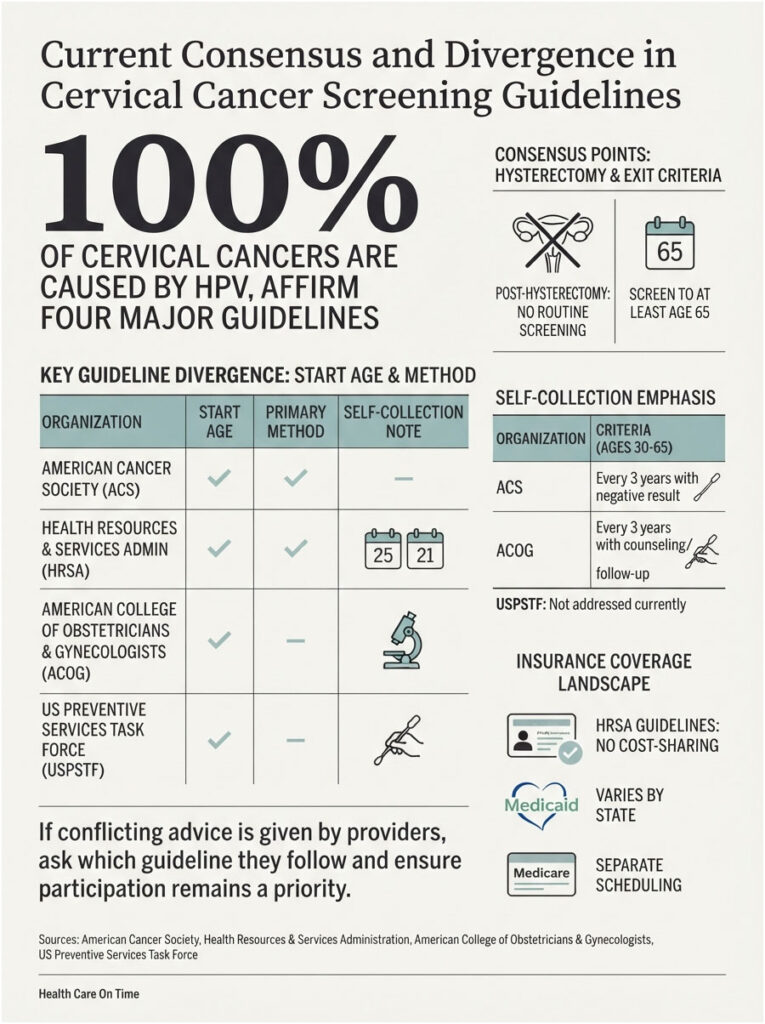
Every body agrees that HPV causes nearly all cervical cancer, that HPV testing is more sensitive than cytology, and that screening should continue to at least age 65 for people who have been screened regularly.
All four also agree that routine screening is not recommended after a hysterectomy with cervix removal, absent a history of high-grade lesions or cervical cancer. And all four apply their recommendations regardless of HPV vaccination status.
Where They Diverge
Start age is the clearest split. The ACS begins at 25. HRSA and ACOG keep cytology every 3 years for ages 21 to 29, then switch to HPV testing at 30.
Self-collection interval is the second split, though it is more a matter of emphasis than conflict. ACOG specifies patient-collected primary hrHPV every 3 years for ages 30 to 65. The ACS endorses the same 3-year repeat after a negative self-collected result.
The third divergence is procedural rather than clinical. The USPSTF’s live language does not address self-collection at all, because it predates the FDA approvals that made it possible.
Which One Your Insurance Actually Follows
For most people with private insurance, the HRSA Women’s Preventive Services Guidelines are the operative document. That is the list your plan is legally required to cover without cost sharing.
If your plan denies or applies cost sharing to a screening choice that HRSA lists, the guideline itself is the citation to bring to an appeal. Medicaid coverage varies by state, and Medicare has its own schedule for cervical cancer screening.
How to Handle Conflicting Advice
If your ob-gyn recommends something different from what you read here, that is usually a defensible reading of a different guideline rather than an error. Ask which guideline they follow and why.
Participation matters far more than which accepted strategy you pick. Every one of these bodies has said so explicitly.
Table 1: What Each US Organization Recommends Right Now
| Organization | Start Age | Preferred Test, Ages 30 to 65 | Self-Collection Stance and Interval | When You Can Stop |
| American Cancer Society (Dec 2025) | 25 | Primary HPV testing every 5 years | Acceptable for ages 25 to 65; clinician-collected preferred; repeat in 3 years if negative | Negative HPV or co-tests at both age 60 and age 65 |
| HRSA / WPSI (Jan 2026) | 21 (cytology every 3 years) | hrHPV testing every 5 years, patient- or clinician-collected | Patient-collected formally included as an appropriate option, ages 30 to 65 | Age 65 with adequate prior screening |
| ACOG (2026) | 21 (cytology every 3 years) | Clinician-collected primary hrHPV every 5 years | Patient-collected primary hrHPV every 3 years, FDA-approved tests only | Age 65 with adequate prior screening; continue if inadequate |
| USPSTF (2018, still the live version) | 21 (cytology every 3 years) | Cytology every 3 years, hrHPV every 5 years, or co-testing every 5 years | Not addressed; the 2024 draft would add it but has not been finalized | Over 65 with adequate prior screening (Grade D) |
| ASCCP (Oct 2025 advisory) | Not a screening guideline | Defers to primary HPV screening guidance | Only for asymptomatic routine screening; not for surveillance or post-treatment follow-up | Not applicable |
Screening by Age: Your Plan
The guidelines read as policy documents. Here is the same information organized the way you actually need it.
Under 21
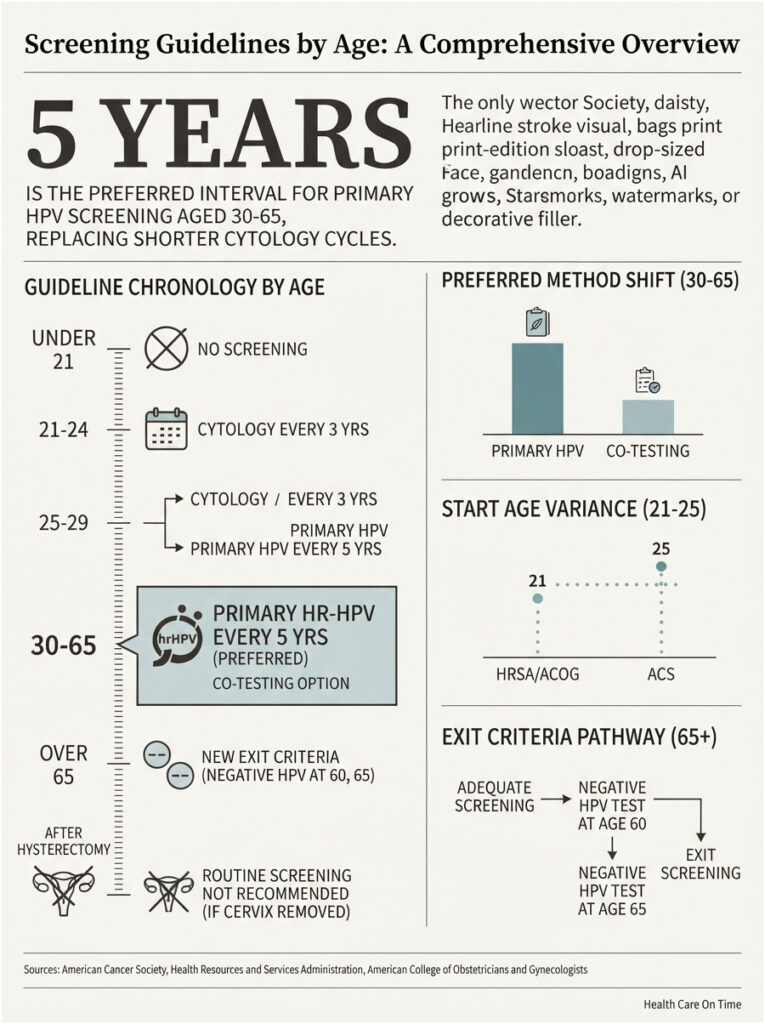
No screening. Cervical cancer is rare in this age group, HPV infections clear on their own at high rates, and treating lesions that would have resolved carries real harm, including risk to future pregnancies.
This has been consistent guidance for over a decade and none of the updates changed it.
Ages 21 to 24
Here is where the guidelines split. HRSA and ACOG recommend cytology alone every 3 years. The ACS does not recommend starting until 25.
If you are 22 and your ob-gyn offers a Pap, that is guideline-concordant care under the federal guideline. If your provider suggests waiting until 25, that is guideline-concordant under ACS. Neither is wrong.
Ages 25 to 29
Cytology every 3 years under HRSA and ACOG. Under the ACS, this is where screening begins, with primary HPV testing every 5 years.
Why ACS Starts at 25 and HRSA Starts at 21
Transient HPV infection is extremely common in the early twenties and clears without intervention in most cases. Screening earlier catches infections that were never going to matter, which produces colposcopies and anxiety without preventing cancer.
The ACS weighted that harm more heavily. HRSA and ACOG weighted the small number of early cancers more heavily. Both readings are defensible from the same evidence base.
Ages 30 to 65
This is the age band where the update genuinely changes practice.
Primary HPV Testing, the New Default
Primary hrHPV testing every 5 years is now the preferred strategy across the updated guidelines. One test, one sample, one result, repeated every five years if negative.
For many people this means fewer appointments, not fewer safeguards. That trade is only possible because the test itself improved.
When Co-Testing Still Makes Sense
Co-testing with hrHPV and cytology every 5 years remains acceptable when primary HPV testing is not available, or when a patient chooses it after counseling.
Some practices have not yet switched platforms. If yours has not, co-testing is a legitimate option rather than a downgrade.
Over 65 and the New Exit Criteria
The ACS change here is the most underreported piece of the entire update. Previously, stopping required a records review showing several years of negative results, which was difficult in practice and frequently skipped.
The ACS now recommends negative primary HPV testing or co-testing at both age 60 and age 65 before exiting. If you have been screening with self-collected samples every 3 years, you can stop at 65 if your last two tests were normal, with the final normal test at age 65 or later.
ACOG adds an important caveat: patients over 65 who never received adequate prior screening should keep screening. Across the patients our diagnostic network serves, that never-adequately-screened group is where preventable cancers cluster.
After a Hysterectomy
If your cervix was removed and you have no history of high-grade precancerous lesions or cervical cancer, routine screening is not recommended.
Confirm with your surgical records that the cervix was actually removed. A supracervical hysterectomy leaves it in place, and screening should continue.
Self-Collection: What It Is and Whether It Is Right for You
This is the change that generated the headlines, and the one most often misunderstood.
How Self-Collection Actually Works
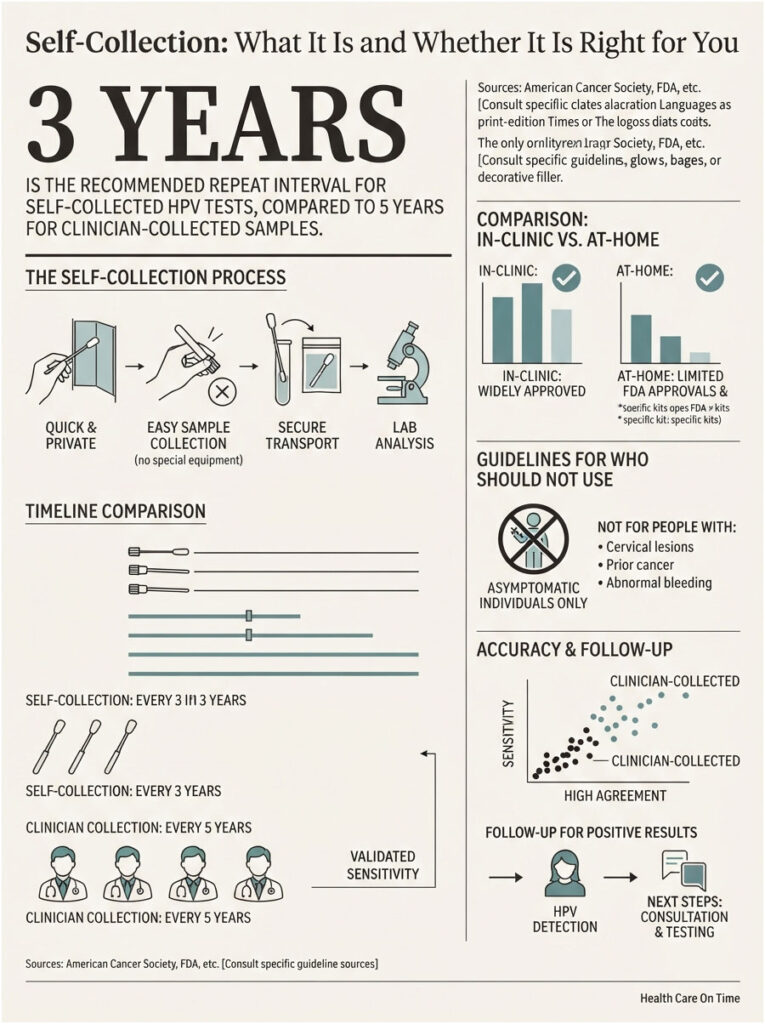
You insert a swab or brush into the vagina, rotate it briefly, and place it in a transport tube. No speculum. No stirrups. It takes under a minute.
The sample is vaginal, not cervical. That distinction is the reason for the shortened repeat interval, and it is worth understanding rather than glossing over.
In-Clinic Versus At-Home Collection
The FDA first approved self-collection in May 2024 for use inside a health care setting, on the BD Onclarity and Roche cobas platforms. You collect the sample yourself, in a private room at the clinic.
At-home collection arrived in May 2025, when the FDA approved the Teal Wand, currently the only at-home self-collection device authorized in the United States. It is a prescription device for average-risk people aged 25 to 65, and it runs the same Roche cobas HPV test used in clinics.
Is It as Accurate as a Clinician-Collected Sample
Close, but not identical, and the honest framing matters.
What the Pooled Evidence Shows
The evidence review commissioned for the USPSTF draft examined 14 studies on agreement between self-collected and clinician-collected samples and 6 on test accuracy. Agreement was high, with similar proportions screening positive.
Pooled absolute sensitivity of self-collected samples for detecting CIN2+ was 0.86. In the SELF-CERV study supporting the at-home approval, involving more than 600 participants across 16 US sites, self-collection detected cervical precancer 96 percent of the time, matching clinician collection.
Roughly 94 percent of SELF-CERV participants said they preferred self-collection to an in-office visit.
Why the Repeat Interval Is 3 Years, Not 5
A vaginal sample is slightly less sensitive than one taken directly from the cervix. The guideline bodies closed that small gap by shortening the interval rather than by rejecting the method.
Three years of self-collection delivers protection comparable to five years of clinician collection. Our medical reviewers consider this the most important practical detail for anyone choosing self-collection, and the one most often left out of news coverage.
Who Should Not Use Self-Collection
Self-collection is for asymptomatic people in a routine screening situation. The ASCCP practice advisory is explicit that it is not appropriate for surveillance testing or follow-up after treatment of precancer.
Do not collect during your period, and avoid vaginal products beforehand. If you have symptoms such as abnormal bleeding, pelvic pain, or unusual discharge, you need an examination rather than a screening test.
What Happens If Your Result Is Positive
A positive HPV result is not a cancer diagnosis. It means a high-risk HPV type was detected and further evaluation is needed.
Next steps typically involve a clinician-collected sample for cytology, and depending on the HPV type and cytology result, colposcopy. Most positive HPV results never lead to a cancer diagnosis.
Cost, Coverage, and the 2027 Deadline
The financial picture is in transition, and where you land depends partly on timing.
What Is Covered Today
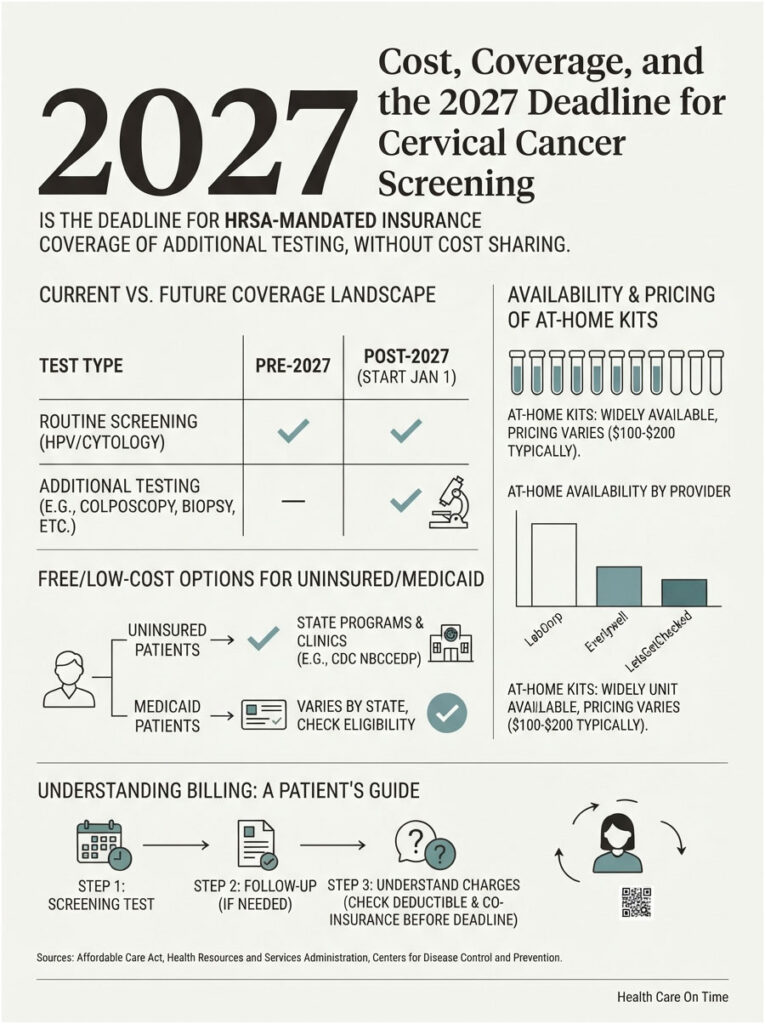
Cervical cancer screening itself is a covered preventive service under most plans with no cost sharing. That has been true since the Affordable Care Act preventive mandate took effect and did not change with these updates.
The gap has always been what happens next. Additional testing needed to complete the screening process was frequently billed as diagnostic, which meant deductibles, copays, and surprise bills for people who did nothing more than follow the recommendation.
What Changes January 1, 2027
The HRSA update includes new language requiring most insurance plans to cover the additional testing needed to complete the screening process, without cost sharing, beginning January 1, 2027.
That is a meaningful change. Reflex cytology after a positive HPV result, and other testing needed to finish the screening episode, moves from potentially billable to covered.
If You Are Screening Before Then
Until January 2027, coverage of follow-up testing varies by plan. Ask two specific questions before your appointment: how reflex testing is billed, and whether colposcopy would be treated as diagnostic.
In our experience helping patients prepare for testing, the five minutes spent on that phone call prevents the overwhelming majority of billing surprises. Get the answer in writing through your plan’s portal if you can.
At-Home Kit Pricing Right Now
At-home kits are available in all 50 states and priced at roughly $99 with insurance or $249 without, and they are HSA and FSA eligible.
In-clinic self-collection availability is still limited, because practices are adopting the collection devices and lab platforms unevenly. Availability in your area may lag the guideline by a year or more.
If You Are Uninsured or on Medicaid
The CDC’s National Breast and Cervical Cancer Early Detection Program provides free or low-cost screening to eligible people who are uninsured or underinsured. Eligibility runs through your state health department.
The SELF-CERV data underscores why this matters. Among participants who had delayed or avoided screening, 43 percent of the uninsured and 43 percent of those with marketplace plans reported delays, alongside 30 percent on Medicaid and 37 percent on Medicare.
Table 2: US Cervical Cancer and Screening Data
| Metric | Figure | Period | Source |
| Cervical cancer incidence rate | 7.7 per 100,000 women per year | 2019 to 2023 | NCI SEER Cancer Stat Facts |
| Cervical cancer death rate | 2.1 per 100,000 women per year | 2020 to 2024 | NCI SEER Cancer Stat Facts |
| Women living with cervical cancer in the US | 305,284 | 2023 | NCI SEER Cancer Stat Facts |
| Share of diagnoses occurring before age 50 | 47 percent | 2026 projection | ACS, Cancer Statistics 2026 |
| Eligible women up to date on screening | 86.5 percent, falling to 72.4 percent | 2000 to 2021 | National Health Interview Survey |
| Death rate compared with White women | About 55 percent higher for Black women; about 80 percent higher for Native American women | Current | American Cancer Society |
| Self-collected sample sensitivity for CIN2+ | Pooled absolute sensitivity 0.86 | 2024 evidence review | USPSTF draft evidence review |
| Participants who had delayed or avoided screening | 33 percent | 2025 | SELF-CERV study |
Why the Guidelines Changed Now
Guideline committees do not rewrite recommendations for the sake of novelty. Four forces converged at roughly the same time.
Screening Rates Went the Wrong Direction
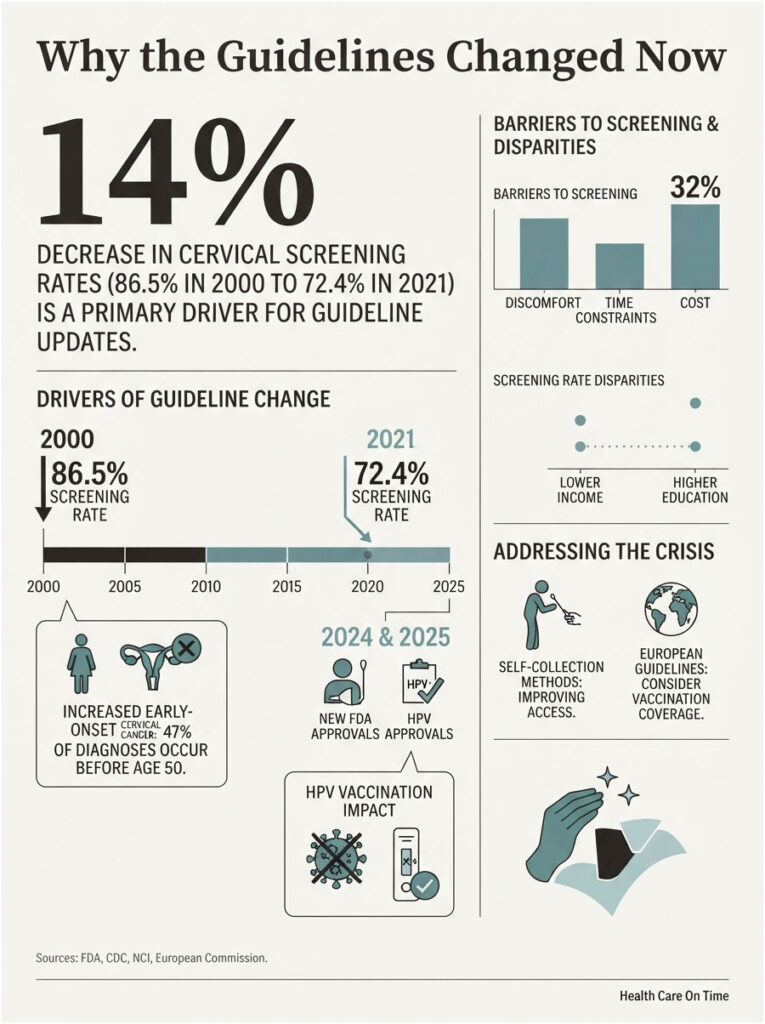
The share of eligible women up to date on screening fell from 86.5 percent in 2000 to 72.4 percent in 2021. Rates dropped further among people with lower income, less education, and among non-Hispanic Black and Hispanic women.
The ACS Cancer Prevention and Early Detection report notes that cervical screening is the only one of the three major cancer screenings that has not rebounded to pre-pandemic levels.
The Cancer Is Hitting Younger Than People Assume
Cancer Statistics 2026 puts 47 percent of cervical cancer diagnoses before age 50, the highest early-onset share of any major cancer. For comparison, the figure is 2 percent for lung cancer and 17 percent for breast cancer.
That distribution is why the debate over start age and interval carries real stakes rather than being academic.
FDA Approvals Opened the Door
Guidelines cannot recommend a method that does not legally exist. The 2024 in-clinic approvals and the 2025 at-home approval created the regulatory foundation for everything that followed.
The ASCCP advisory notes three FDA-approved tests for primary HPV screening, each tied to its own approved collection device and lab platform. They are not interchangeable, which is why availability varies by practice.
The Access Argument
Among people who had delayed screening in the SELF-CERV data, 32 percent cited discomfort with the exam, 32 percent cited lack of time, and 32 percent cited cost.
Self-collection addresses two of those three directly. That is the entire policy case for including it, and it is a strong one.
What HPV Vaccination Is Doing to the Math
Vaccination is reducing the prevalence of the HPV types the tests look for, which over time changes the predictive value of a positive result.
European recommendations released in March 2026 introduced de-intensified screening for birth cohorts with vaccination coverage above 50 percent. US guidelines have not gone there yet, and none of them exempt vaccinated people from screening.
Common Misunderstandings About the New Guidelines
“The Pap Smear Is Being Eliminated”
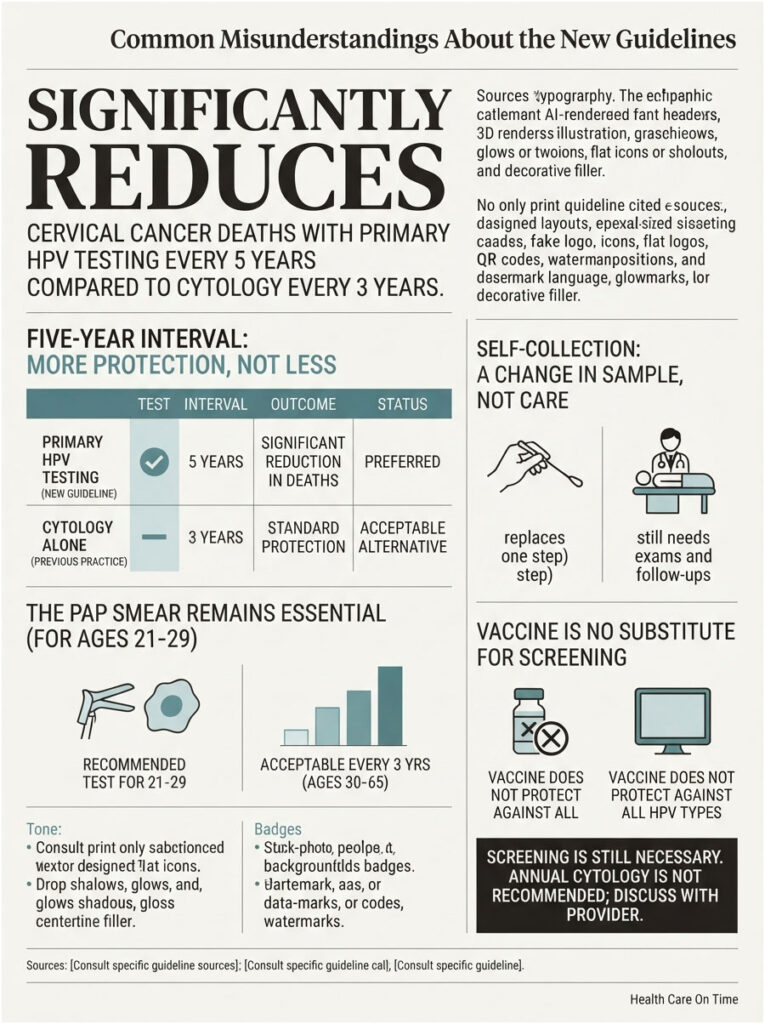
It is not. Cytology remains the recommended test for ages 21 to 29 under HRSA and ACOG, stays acceptable every 3 years for ages 30 to 65, and is still used to triage positive HPV results.
What changed is that it is no longer the preferred first-line test after 30. Patients commonly ask us whether they should refuse a Pap on that basis, and the answer is no.
“Self-Collection Means I Never See a Doctor Again”
Self-collection replaces one sample-collection step. It does not replace pelvic exams, contraception management, symptom evaluation, or the in-person follow-up required if your result is positive.
ACOG’s endorsement is explicitly conditional on adequate counseling and follow-up infrastructure being in place.
“A 5-Year Interval Means Less Protection”
Modeling done for the USPSTF found that switching from cytology to primary HPV testing every 5 years at age 30 reduces projected cervical cancer deaths from 8.34 to 0.29 per 1,000 women compared with no screening, against 0.76 for cytology every 3 years.
Longer interval, better test, more protection. The interval stretched because the test got stronger.
“I Had the HPV Vaccine, So I Can Skip Screening”
The vaccine protects against the HPV types causing about 90 percent of cervical cancers, not all of them, and many adults were vaccinated after exposure had already occurred.
This is the most consequential misconception in the topic, and it is worth checking your own assumptions against it.
“My Doctor Still Does Annual Paps, So the Guidelines Must Not Apply”
Practice adoption lags guideline publication, often by years. Annual cytology has not been recommended for anyone in over a decade.
Bring it up. A reasonable provider will either explain their reasoning or update the plan.
What to Do This Month
- Find out when your last cervical cancer screening was and which test was used, since interval depends entirely on the test type.
- Confirm your age band against Table 1 and identify which guideline your insurer follows.
- Call your ob-gyn or primary care office and ask whether they offer primary HPV testing and whether self-collection is available.
- If you are between 30 and 65 and due, ask specifically for primary hrHPV testing rather than accepting a default Pap.
- Ask how reflex testing and follow-up will be billed, since the no-cost-sharing requirement does not start until January 1, 2027.
- If your practice does not yet offer self-collection and you want it, ask about an FDA-authorized at-home option.
- If you are approaching 65, confirm you meet the new exit criteria before assuming you are finished.
- If you have symptoms, book an evaluation rather than a screening test.
Table 3: Your Situation and What to Do
| Your Situation | What the Updated Guidelines Say | What to Do Next | Timing |
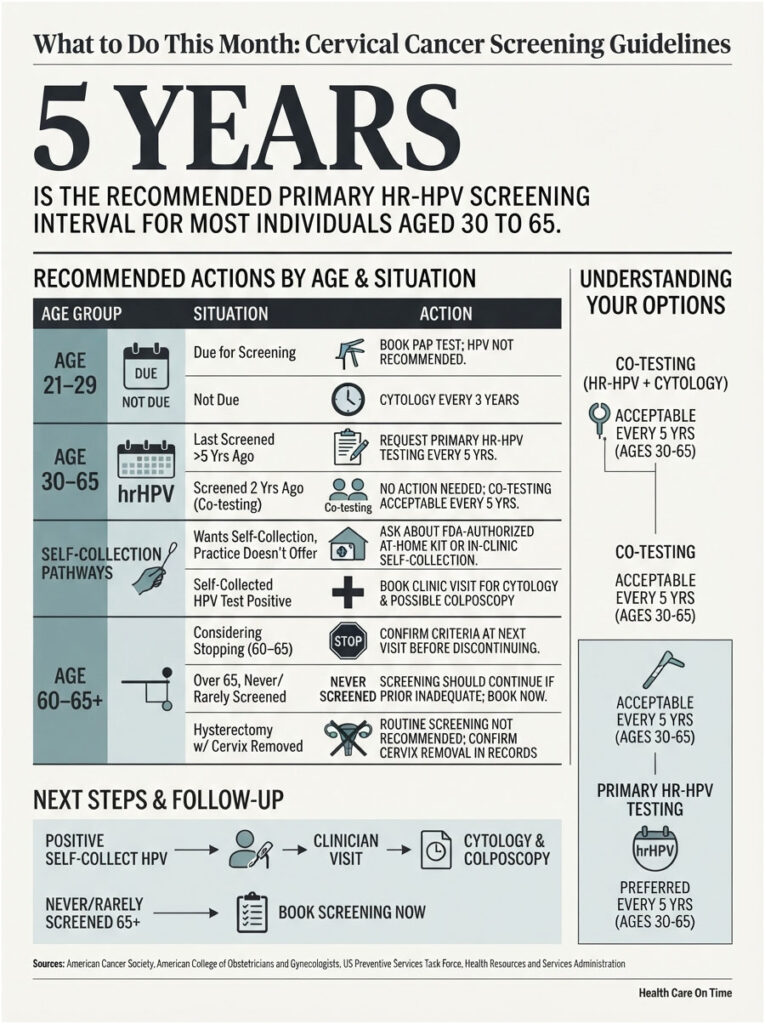
| Age 21 to 29, due for screening | Cytology alone every 3 years under HRSA and ACOG | Book a Pap test; HPV testing is not recommended in this band | Within 3 years of your last |
| Age 30 to 65, last screened over 5 years ago | Primary hrHPV testing every 5 years is preferred | Request primary HPV testing, clinician- or self-collected | Book now |
| Age 30 to 65, screened 2 years ago with co-testing | Co-testing every 5 years remains acceptable | No action needed; note when your 5-year mark falls | In 3 years |
| Wants self-collection, practice does not offer it | Patient-collected hrHPV every 3 years is an accepted option | Ask about an FDA-authorized at-home kit or a practice offering in-clinic self-collection | Within a month |
| Self-collected HPV test came back positive | Positive self-collected results require in-person follow-up | Book a clinician visit for cytology and possible colposcopy | Within 2 to 4 weeks |
| Age 60 to 65, considering stopping | Negative HPV or co-tests at both age 60 and 65 before exiting | Confirm you meet the criteria before discontinuing | At your next visit |
| Over 65, never or rarely screened | Screening should continue when prior screening was inadequate | Book screening; do not assume age exempts you | Book now |
| Hysterectomy with cervix removed, no lesion history | Routine screening not recommended | Confirm cervix removal in surgical records, then stop | One-time confirmation |
Questions Worth Asking at Your Next Visit
Ask which test is being ordered and why, whether self-collection is available, how follow-up testing will be billed before January 2027, and when your next screening is due based on today’s result.
Those four questions cover nearly everything that matters. Write them down, because appointments move fast.
If Your Practice Does Not Offer Self-Collection Yet
Adoption is uneven and that is normal at this stage. A clinician-collected HPV test today is far better than waiting a year for a preferred collection method.
Getting screened matters more than which of the accepted methods you use. Every guideline body in Table 1 has said so in one form or another.
Frequently Asked Questions
Are Pap smears being phased out?
No. Cytology remains the recommended test for ages 21 to 29 under HRSA and ACOG, stays acceptable every 3 years for ages 30 to 65, and is still used to triage positive HPV results. It is no longer the preferred first-line test after age 30, which is a different thing from being eliminated.
What age should you start cervical cancer screening?
It depends on which guideline your provider follows. HRSA and ACOG recommend starting at 21 with cytology every 3 years. The American Cancer Society recommends starting at 25 with primary HPV testing. Both are current, evidence-based positions, and neither is a mistake.
Can I do an HPV test at home?
Yes. The FDA approved the first at-home self-collection device in May 2025 for average-risk people aged 25 to 65. It is a prescription device ordered through a telehealth visit, and the sample is mailed to a certified lab. Kits are available in all 50 states.
Is at-home HPV testing as accurate as a Pap smear?
It performs comparably for its purpose. In the SELF-CERV study, self-collection detected cervical precancer 96 percent of the time, matching clinician collection. Pooled evidence across studies put absolute sensitivity for CIN2+ at 0.86. The guidelines account for the small gap by shortening the repeat interval.
Why is the self-collection interval 3 years instead of 5?
A self-collected sample is vaginal rather than cervical, making it slightly less sensitive than a sample taken directly from the cervix. Rather than reject the method, guideline committees shortened the repeat interval to 3 years so overall protection matches 5-year clinician-collected screening.
Does insurance cover at-home HPV testing?
Coverage is expanding. Most plans must cover the additional testing needed to complete cervical cancer screening, without cost sharing, starting January 1, 2027. At-home kits currently run roughly $99 with insurance or $249 without, and they are HSA and FSA eligible. Check your specific plan first.
When can you stop cervical cancer screening?
The American Cancer Society now recommends negative primary HPV tests or negative co-tests at both age 60 and age 65 before exiting. If you screened with self-collection every 3 years, you can stop at 65 if your last two tests were normal, with the final one at age 65 or later.
Do I need a Pap if I had the HPV vaccine?
Yes. The vaccine protects against the HPV types causing about 90 percent of cervical cancers, not all of them, and many adults were vaccinated after exposure had already occurred. Every current US guideline applies regardless of vaccination status.
Do I need screening after a hysterectomy?
If your cervix was removed and you have no history of high-grade precancerous lesions or cervical cancer, routine screening is not recommended. Confirm through surgical records that the cervix was actually removed, since a supracervical hysterectomy leaves it in place and screening should continue.
What happens if my self-collected HPV test is positive?
A positive result means a high-risk HPV type was detected, not that you have cancer. You will need an in-person visit for a clinician-collected sample and cytology. Depending on the HPV type and cytology result, colposcopy may follow. Most positive HPV results do not lead to a cancer diagnosis.
Why do different organizations recommend different things?
Each body has a different mandate. The ACS writes cancer prevention guidelines, HRSA sets federally required preventive coverage, ACOG advises practicing ob-gyns, and the USPSTF grades evidence for the broader coverage mandate. They read the same studies and differ mainly on start age and interval.
Do transgender men and nonbinary people with a cervix need screening?
Yes. Screening recommendations apply to anyone with a cervix, regardless of gender identity or sexual history. Testosterone use can affect sample quality on cytology, which makes HPV-based testing a practical advantage. Discuss collection options with a provider experienced in this care.
Medical Disclaimer: This article provides general health information and does not replace evaluation by a licensed healthcare professional. Screening recommendations vary by individual risk, and this guidance applies only to people at average risk. If you have a history of high-grade precancerous lesions, cervical cancer, in utero diethylstilbestrol exposure, HIV, or a compromised immune system, your screening schedule differs and must be set by your clinician. Contact a provider promptly for abnormal bleeding, pelvic pain, or unusual discharge, since those require evaluation rather than routine screening.
References
- Perkins RB et al. Self-collected vaginal specimens for HPV testing and guidance on screening exit: an update to the American Cancer Society cervical cancer screening guideline, CA: A Cancer Journal for Clinicians
- American Cancer Society Updates Cervical Cancer Screening Guideline, ACS Pressroom
- Cervical Cancer Screening Guidelines, American Cancer Society
- New Cervical Cancer Screening Guidelines Strengthen Women’s Preventive Health, HRSA
- Screening for Cervical Cancer, ACOG Committee Statement
- ACOG Publishes Updated Cervical Cancer Screening Guidance, ACOG News Release
- ASCCP Practice Advisory: Self-Collection for Cervical Cancer Screening
- Cervical Cancer: Screening, USPSTF Final Recommendation Statement (2018, currently in update)
- Cervical Cancer: Screening, USPSTF Draft Recommendation
- SEER Cancer Stat Facts: Cervical Cancer, National Cancer Institute
- Siegel RL et al. Cancer Statistics 2026, CA: A Cancer Journal for Clinicians
- Cervical Cancer Statistics, Centers for Disease Control and Prevention
- Acceptability of Vaginal HPV Self-Collection Among Colposcopy Clinic Attendees, PMC
- FDA Approves At-Home Self-Collection Device for Cervical Cancer Screening, The ASCO Post