
The question almost every parent asks first is the one that helps least: what’s the normal age? There isn’t one. What exists instead is a wide, well-documented range of typical development, a set of national numbers that have moved in a reassuring direction for three decades, and a short list of specific signals that mean something is genuinely wrong.
Table of Contents
Sorting those three things apart is most of the work. A parent who can tell developmental variation from a warning sign will spend far less energy worrying and far more of it where it counts.
Quick Answer: There is no single “normal” age for adolescent sexual activity. US survey data show cumulative probability rising gradually across the teen years, with about 1 in 5 young people having had intercourse by age 15 and roughly half by age 17. Overall teen sexual activity has declined sharply since 1991. What matters clinically is not the calendar age but whether the timing, the partner, and the circumstances fit healthy development.
At a Glance
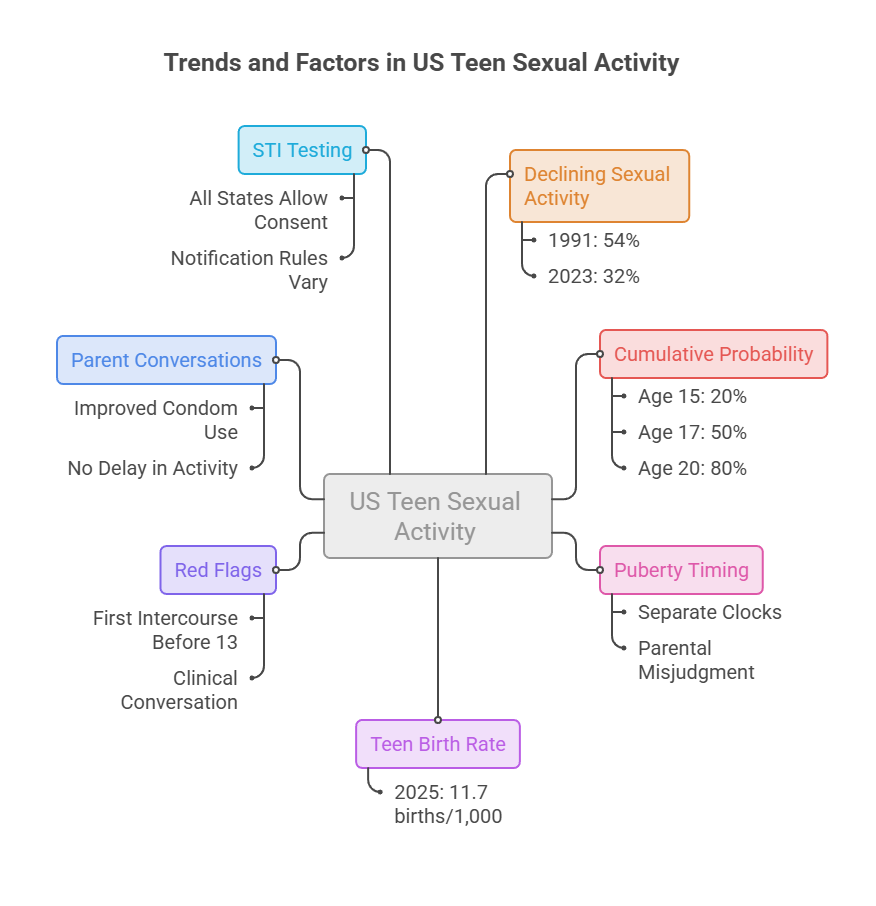
The share of US high schoolers who have ever had sexual intercourse fell from 54 percent in 1991 to 32 percent in 2023.
Cumulative probability by age is the more useful figure: roughly 20 percent by 15, around half by 17, close to 80 percent by 20.
Puberty timing and sexual behavior run on separate clocks, and confusing them causes most parental misjudgment.
The teen birth rate hit another record low in 2025 at 11.7 births per 1,000 females aged 15 to 19.
First intercourse before age 13 is the clearest evidence-backed red flag and warrants a clinical conversation, not a punishment.
Randomized trials show parent conversations improve condom use but do not delay sexual activity.
Every state and DC allows minors to consent to STI testing, though notification rules vary.
What “Normal” Means in Adolescent Sexual Development
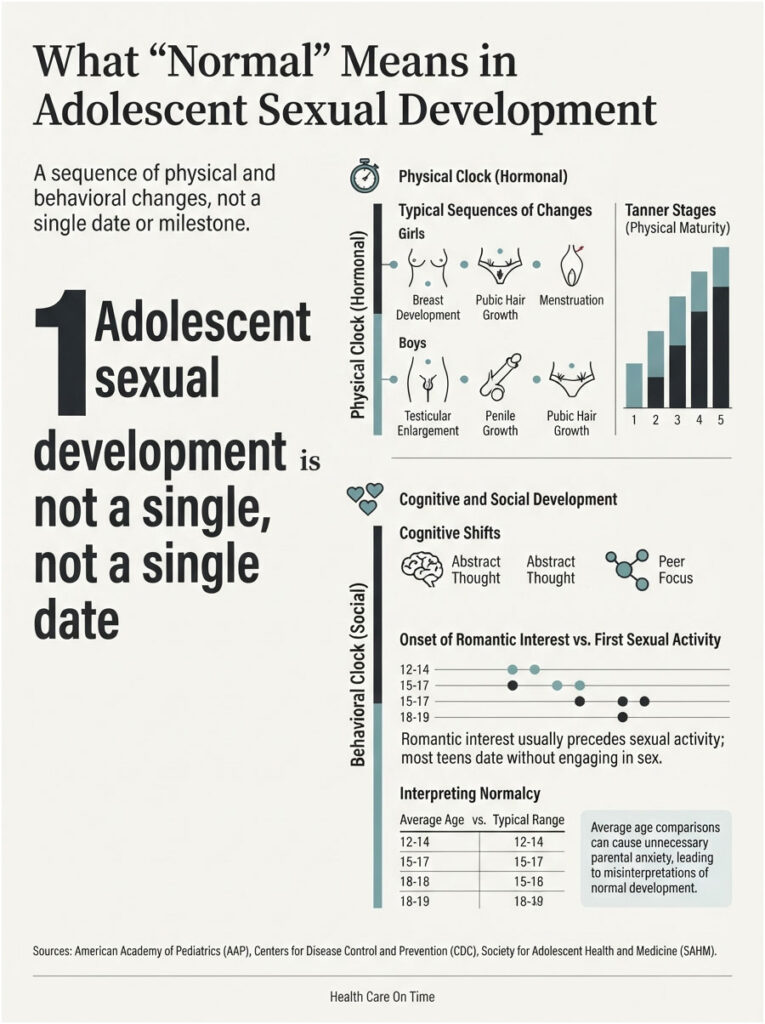
Parents search for a benchmark age because it feels like a measuring stick. It is not one. Adolescent sexual development is a sequence, not a date, and the sequence carries far more information than any single milestone.
Two Clocks, Not One
The first clock is physical. Hormones drive a predictable series of body changes on a schedule set largely by genetics.
The second clock is behavioral. Romantic interest, dating, and sexual activity are shaped by peers, family, opportunity, culture, and the slow maturation of judgment.
These clocks are only loosely coupled. A 12-year-old can be physically mature and socially uninterested. A 17-year-old can be finished with puberty and emotionally nowhere near ready.
Our medical reviewers see this mismatch constantly in adolescent panels, and it drives most of the parental alarm that turns out to be unfounded. A parent reacting to a body is often reacting to the wrong clock entirely.
The Physical Clock: Sexual Maturity Ratings
Clinicians describe pubertal progress using sexual maturity ratings, still widely known as Tanner stages. Stage 1 is prepubertal and stage 5 is adult.
Puberty typically begins between ages 8 and 13 in females and 9 and 14 in males. That five-year window is not sloppiness in the research. It reflects genuine biological variation, and a girl who starts at 9 and a girl who starts at 12 are both developing normally.
Typical Sequence in Girls
Breast budding usually comes first, followed by pubic hair, a growth spurt, then menstruation. According to the Merck Manual, menarche generally occurs about two years after breast development begins, and most US girls start their periods at 12 or 13.
The same source notes that menarche tends to arrive after peak height velocity has passed, which is why a girl’s fastest growing usually happens before her first period rather than after.
Typical Sequence in Boys
Boys start with testicular and scrotal enlargement, then penile growth, then pubic hair. Axillary and facial hair appear roughly two years after pubic hair, and the growth spurt usually begins about a year after the testes start enlarging.
Boys generally start six to twelve months later than girls and finish later. That lag explains why a room of 13-year-olds looks so wildly uneven, and why boys are frequently the ones convinced something is wrong with them.
When Timing Itself Is the Concern
Order matters more than speed. When the sequence of sexual changes is disturbed, growth may be abnormal, and a physician should consider pathologic causes.
Signs of puberty before age 8 in girls or 9 in boys, or no signs by 13 in girls or 14 in boys, are reasons to ask a pediatrician about a referral. Those thresholds are about endocrine evaluation, not behavior.
The Behavioral Clock
The American Academy of Pediatrics describes middle adolescence as the point where many teens become interested in romantic and sexual relationships and may question and explore their sexual identity. The same guidance names self-stimulation as a typical part of that exploration for teens of all genders.
Romantic interest usually precedes sexual behavior by a long stretch. Most teens who date are not having sex, a point the national numbers make plainly.
Why “Average Age” Is the Wrong Question
An average describes a population. It says nothing about whether one specific 15-year-old is on track.
Benchmark ages also create pressure in both directions. Parents relax when a teen is “behind” and panic when a teen is “ahead,” when neither reaction usually fits the situation in front of them.
Patients booking adolescent testing through HealthCareOnTime frequently arrive because of an age comparison rather than an actual risk factor. The comparison is what generated the anxiety, and the anxiety is what generated the appointment.
| Age Band | Physical Development (SMR) | Cognitive and Brain Development | Typical Romantic and Sexual Milestones | What Parents Should Focus On |
| 9 to 11 | Stage 1 to 2; breast budding or testicular enlargement may begin | Concrete thinking; rules-based morality | Curiosity about bodies; crushes; little to no dating | Correct anatomical language; body-change preparation; privacy norms |
| 11 to 13 | Stage 2 to 3; growth spurt in girls; menarche possible | Beginning abstract thought; strong peer orientation | Relationships that are largely social; group dating | Consent vocabulary; digital boundaries; open-door questions |
| 13 to 15 | Stage 3 to 4; menarche in most girls; voice change in boys | Abstract reasoning improving; weak in-the-moment impulse control | Dating begins in earnest; kissing and physical intimacy common | Contraception knowledge before it is needed; first solo time with a clinician |
| 15 to 17 | Stage 4 to 5; near-adult in most | Better long-range thinking; still peer-weighted decisions | Roughly half have had intercourse by 17 | STI screening if sexually active; partner age and relationship dynamics |
| 17 to 19 | Stage 5; complete | Frontal lobe still maturing into the twenties | About 4 in 5 have had intercourse by 20 | Transition to independent care; annual screening; contraception continuity |
What the National Data Actually Shows
Most parent-facing articles on adolescent sexual development contain no statistics at all. That is a strange omission, because the data are public, current, and mostly encouraging.
The Long Decline in Teen Sexual Activity
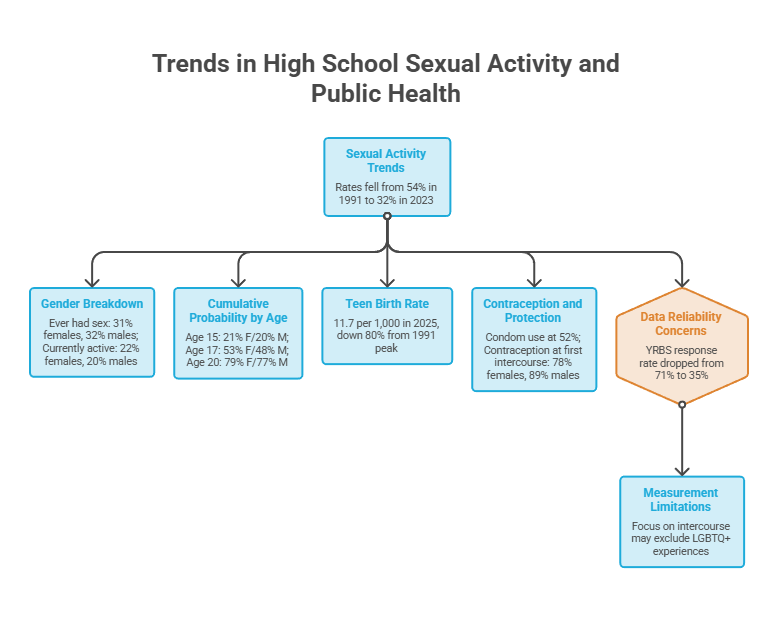
The CDC’s Youth Risk Behavior Survey has tracked this since 1991. Analysis from Child Trends reports that 32 percent of high schoolers said they had ever had sexual intercourse in 2023, down from 54 percent in 1991 and 47 percent in 2013.
The 2023 split by sex was nearly even. Female and male students reported similar rates of ever having had sex at 31 and 32 percent, with 22 percent of females and 20 percent of males currently sexually active.
There is a countertrend worth knowing. The CDC’s 2013 to 2023 trend report documents that adolescent sexual activity declined over the decade, alongside concerning decreases in condom use, STD testing, and HIV testing.
Fewer teens are having sex. The ones who are appear less protected and less tested than their predecessors, which is the whole argument for the screening section further down.
Cumulative Probability by Age
This is the figure parents actually want, and it comes from the National Survey of Family Growth rather than the YRBS. NCHS Data Brief 366 reports that by age 15, 21 percent of young females and 20 percent of young males had ever had sexual intercourse; by 17 this rose to 53 percent and 48 percent; by 20 it reached 79 percent and 77 percent.
Read that as a slope, not a threshold. Nothing switches on at a particular birthday, and the male and female curves are close enough to be treated as one line.
The same data brief found that 78 percent of females and 89 percent of males aged 15 to 24 who first had intercourse before age 20 used a contraceptive method at that first encounter. Most American teens do not have unprotected first sex, which is a fact worth carrying into the conversation.
Teen Births at a Record Low
The NCHS provisional 2025 birth data show the birth rate for teenagers aged 15 to 19 down 7 percent in 2025 to 11.7 births per 1,000, another record low, with the rate for younger teens aged 15 to 17 falling 11 percent.
Against the 1991 peak of 61.8 per 1,000, that is a decline of more than 80 percent and one of the more durable public health improvements of the past thirty years.
The Caveat Almost Nobody Reports
Our editorial team treats surveillance data with falling response rates carefully, and this dataset earns the caution. A 2025 analysis in Sexuality Research and Social Policy found YRBS overall response rates fell from 71 percent in 2011 to 35 percent in 2023, missing data on the “ever had sex” item rose from 7.0 percent to 29.5 percent in 2019 before easing to 19.8 percent in 2023, and statistical decomposition attributed 50 percent of the 2019 to 2021 change among female students to a shift in the sample’s age structure rather than to behavior.
The authors conclude that post-2019 trends should be treated with real caution. The long-run direction since 1991 remains clear; the exact size of the most recent drop does not.
There is also a measurement limit. The YRBS asks only about intercourse, so it may not capture the full picture of what young people are doing sexually, which matters particularly for LGBTQ+ teens whose experiences the question may not describe.
| Metric | Most Recent US Figure | Prior Comparison Point | Source |
| High schoolers who ever had sexual intercourse | 32% (2023) | 54% (1991); 47% (2013) | CDC YRBS |
| Currently sexually active high schoolers | 22% female, 20% male (2023) | 30% overall ever-had-sex in 2021 | CDC YRBS |
| Cumulative probability by age 15 | 21% female, 20% male | 2015 to 2017 NSFG cycle | NCHS Data Brief 366 |
| Cumulative probability by age 17 | 53% female, 48% male | 2015 to 2017 NSFG cycle | NCHS Data Brief 366 |
| Cumulative probability by age 20 | 79% female, 77% male | 2015 to 2017 NSFG cycle | NCHS Data Brief 366 |
| Teen birth rate, ages 15 to 19 | 11.7 per 1,000 (2025 provisional) | 12.6 (2024); 61.8 (1991 peak) | NCHS Vital Statistics Rapid Release |
| Condom use at last intercourse | 52% (2023) | 63% (2005); 54% (2011) | CDC YRBS |
| YRBS overall response rate | 35% (2023) | 71% (2011) | Sexuality Research and Social Policy, 2025 |
Physical Readiness Is Not Emotional or Cognitive Readiness
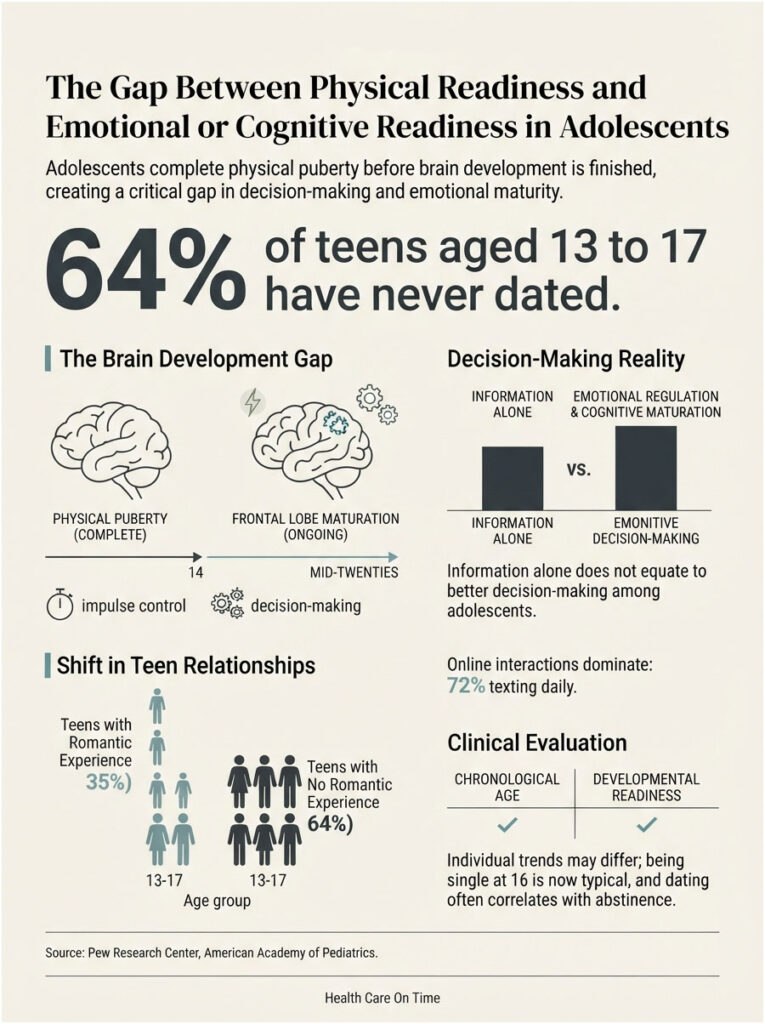
A body finishes puberty years before the brain finishes the parts that govern risk. That gap is the central fact of adolescent sexual health.
Why the Frontal Lobe Timeline Matters
The AAP states it directly: the frontal lobes are the last brain areas to mature, and development is not complete until a person is well into their twenties. Those lobes handle complex decision-making, impulse control, and the ability to weigh multiple options and consequences.
The same guidance adds that middle adolescents can think abstractly and consider the big picture but still may lack the ability to apply it in the moment.
That distance between knowing and doing explains how a well-informed teenager still makes a poor decision on a Friday night. It is not an information failure, so more information alone will not fix it.
What Clinicians Actually Assess
When an adolescent medicine clinician evaluates readiness, calendar age is a minor input. The working questions look more like this.
- Can the teen state clearly what they want and do not want?
- Is the relationship free of pressure, threats, or dependency?
- Is the age and power gap small?
- Do they know how to obtain and correctly use contraception?
- Would they tell a trusted adult if something went wrong?
A 17-year-old who fails most of those carries more risk than a 16-year-old who passes them all. Age is a poor proxy for every item on the list.
The Gen Z Shift
Fewer teens are in relationships at all. Pew Research Center found that 35 percent of teens aged 13 to 17 had any romantic relationship experience while 64 percent had never been in one, and among teens who had dated, 30 percent had ever had sex while 66 percent had not.
Generational figures sharpen the picture. Survey Center on American Life data show 56 percent of Gen Z adults were in a romantic relationship during their teen years, against 78 percent of Baby Boomers and 76 percent of Gen Xers, with 44 percent of Gen Z men reporting no teen relationship experience at all.
The Digital Dimension
Relationships form offline and run online. Pew found that only 8 percent of teens have met a romantic partner online, while texting is by far the most frequent way teens interact with a partner, with 72 percent of teen daters texting daily.
That pattern has two implications. A partner who exists only online deserves a closer look, because it is not the norm. And the relationship’s actual content, including pressure and coercion, lives in messages rather than in anything a parent will observe at the dinner table.
Judging One Specific Teenager
Population trends do not diagnose individuals, but they do reset expectations. A teen who is not dating at 16 is now firmly typical. A teen who is dating is statistically more likely than not to be abstaining from intercourse.
Both facts should lower the temperature on a great many household conversations before they start.
Red Flags: When Timing Signals Something Other Than Development
This is the section most competing articles skip entirely, and it is the one that matters most.
Sexual Activity Before Age 13
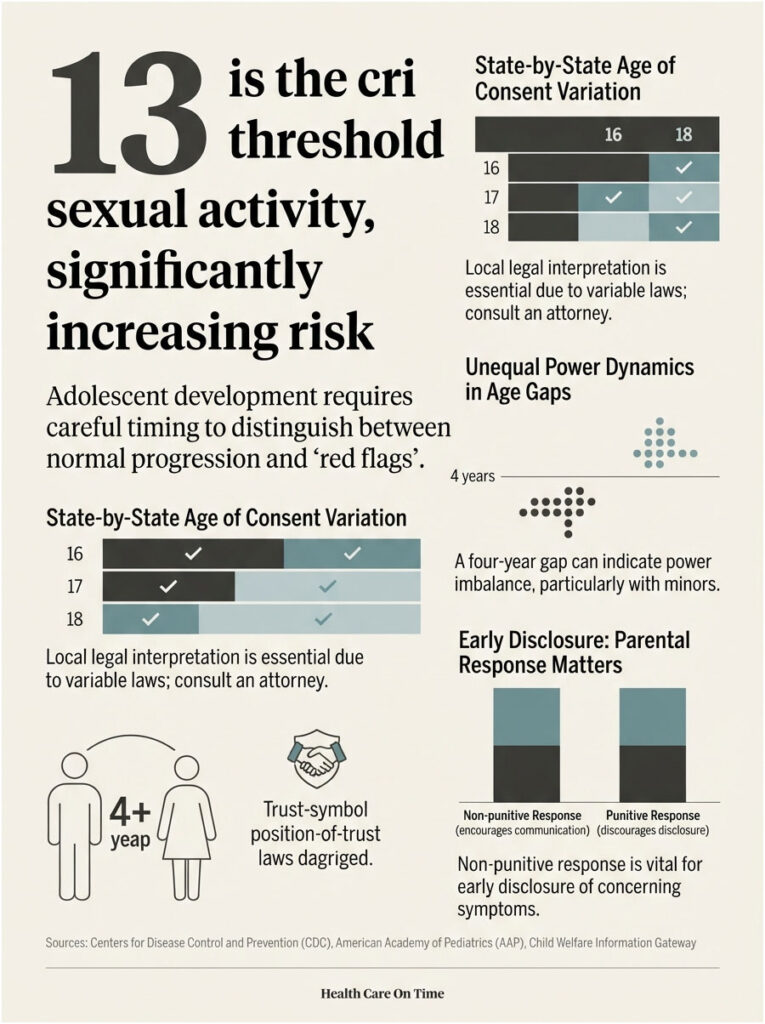
Research using YRBS data found that even after controlling for forced sexual intercourse and race or ethnicity, students whose first intercourse occurred before age 13 were substantially more likely than those initiating at 16 or older to report four or more lifetime partners, with adjusted prevalence ratios of 4.55 for girls and 5.82 for boys, and more likely to report no condom use at last intercourse.
Related work found early sexual debut associated with sexual risk taking, substance use, violent victimization, and suicidal thoughts and attempts, with the pattern holding across sexual minority and non-minority students alike.
Very early sexual activity is frequently a symptom rather than a choice. Childhood sexual abuse is a recognized risk factor for early debut, though researchers are careful to note that age 14 functions as a working benchmark rather than a bright line, and that many children who experience abuse do not go on to early sexual debut.
The correct response to a disclosure from a 12- or 13-year-old is a pediatric appointment, not a punishment. Punishment ends the disclosures and leaves the cause in place.
Age Gaps and Positions of Trust
A four-year gap between a 22-year-old and a 26-year-old is unremarkable. The same gap between a 14-year-old and an 18-year-old is a different situation legally and developmentally.
Age gaps correlate with unequal decision-making power, which is the mechanism that turns a relationship coercive without anyone using force.
Over 40 states and DC have position-of-trust statutes criminalizing sexual contact between an adult with authority over a young person and that young person, regardless of the younger person’s age. Coaches, teachers, tutors, youth pastors, employers, and program leaders all fall inside those rules.
Signs That Warrant a Same-Week Appointment
None of these proves anything alone. A cluster carries far more weight than any single item.
- Sexual knowledge or preoccupation clearly beyond the child’s age
- A partner who is significantly older, controls contact, or remains unknown to you
- New secrecy paired with unexplained money, gifts, a second phone, or a new account
- Abrupt withdrawal from friends, sports, grades, or activities they used to care about
- Genital or pelvic pain, unusual discharge, testicular pain, or unexplained bleeding
- Any disclosure of pressure, coercion, or an act the teen did not want
- Messages from an adult that frame the relationship as secret or special
In cases reviewed by our medical team, adolescents report physical symptoms to a parent late rather than early. That delay is why a calm, non-punitive response to the first mention matters more than almost anything else a parent controls.
The Legal Layer
How Thresholds Group Across States
Age of consent in the US falls at 16, 17, or 18 depending on the state. Widely cited compilations place roughly 32 states plus DC at 16, about 7 states at 17, and about 11 states at 18, though counts differ slightly between sources because statutes change and some states set different thresholds for different acts.
Two recent changes show that these are not fixed. New York moved from 16 to 17 in 2019 under the Rape Is Rape Act, and Wyoming and New Mexico raised their thresholds from 16 to 17 in the same period.
Why “Romeo and Juliet” Laws Do Not Mean “Legal”
Close-in-age exemptions reduce or remove criminal liability when two young people are near each other in age. Texas enacted the first explicitly named Romeo and Juliet law in 2007, providing a three-year exemption for teens aged 14 to 17.
The caveat matters. An exemption often reduces a charge rather than decriminalizing the conduct, and some states, including California and Arizona, have no close-in-age exemption at all.
Treat any specific situation as a question for a local attorney rather than for an article. State law here is genuinely variable and the consequences are permanent.
What Parents Can Actually Do
Here the evidence is unusually clear, and part of what it shows is that the most popular parental goal does not work.
What the Trials Show Works
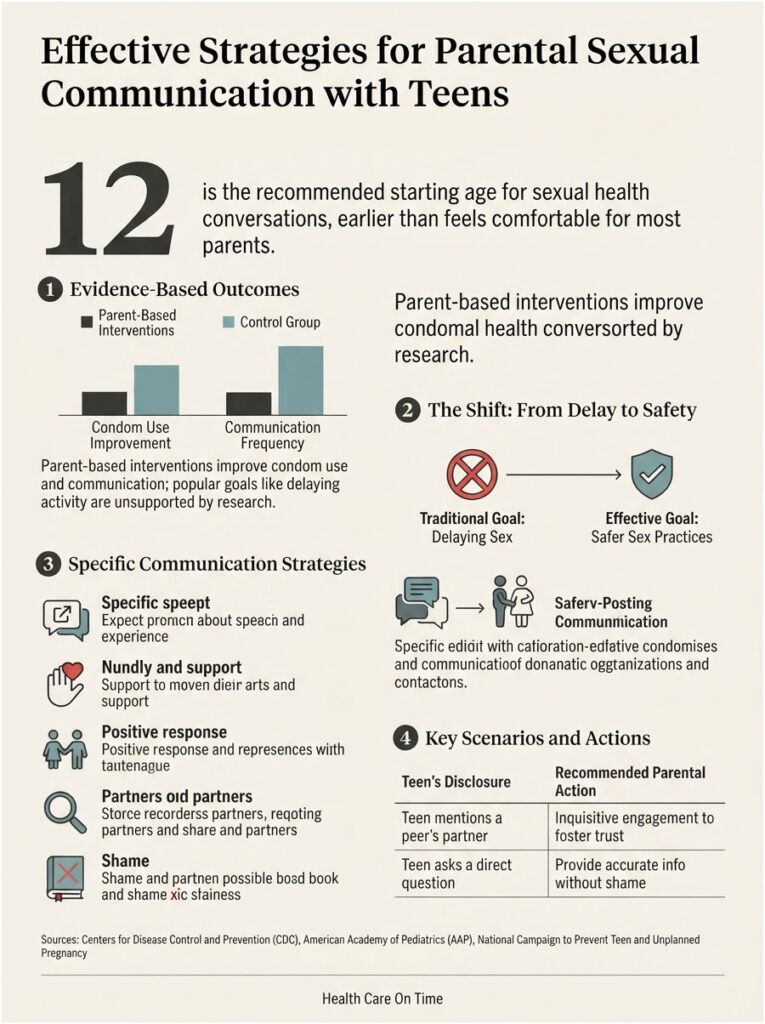
A meta-analysis published in JAMA Pediatrics synthesized 31 randomized clinical trials covering 12,464 adolescents with a mean age of 12.3 years. Parent-based sexual health interventions significantly improved condom use (d = 0.32) and parent-child sexual communication (d = 0.27) compared with control conditions.
An earlier meta-analysis of 52 studies covering 25,314 adolescents found parent-adolescent sexual communication linked to safer sex behavior, with effects consistent across longitudinal and cross-sectional study designs.
The CDC’s parent guidance identifies the mechanism, noting that teens report their parents have the greatest influence over their decisions about sex, more than friends, siblings, or media.
What the Trials Show Does Not Work
The same JAMA Pediatrics analysis found no significant difference between parent-based interventions and control programs for delaying sexual activity (d = -0.06).
That null result deserves to change how parents allocate effort. Conversations reliably make sex safer. They do not reliably make it later.
A parent optimizing for delay is pursuing an outcome the randomized evidence does not support. A parent optimizing for protection is pursuing one it does. The second parent gets better outcomes and a better relationship.
What This Sounds Like in Practice
Abstract advice about “open communication” is where most guidance stops. Actual wording is more useful.
Opening without an interrogation. Anchor to something external rather than to your teen. “That storyline on the show got handled badly. What did you think about how she was pressured into it?”
Making the offer explicit. “You don’t have to tell me anything. But if you ever need a test, a ride, or a doctor, I will get it done and I will not make it a thing.”
Responding to a disclosure. Lead with the relationship, not the content. “Thank you for telling me. That took something. Let’s figure out the practical parts together.”
Handling the age gap. Ask questions rather than issuing verdicts. “How did the two of you meet? What do you do together? I’d like to meet him.”
Correcting without shaming. “Pulling out isn’t birth control and it doesn’t stop infections. Let’s get you something that actually works.”
Our patient support team hears the same reaction from parents repeatedly: the conversation went better than expected, and the delay in having it was the real cost.
Timing
Start earlier than feels comfortable. The mean participant age in those 31 randomized trials was 12.3 years, which tells you where the research locates the useful window.
Trying to have a first conversation at 16 means competing with several years of information the teen has already assembled from other sources.
| Scenario | What It Usually Means | Recommended Action | Timeframe |
| Teen has a new serious partner | Normal middle-adolescent development | Ask about the partner by name; offer solo time with a clinician | Within 1 month |
| You find contraception | Planning ahead, which is a protective sign | Acknowledge without confrontation; confirm they know correct use | Same week |
| Teen is 12 or 13 with marked sexual preoccupation | Possible exposure or victimization | Pediatric appointment; ask the clinician to take a private history | Within days |
| Partner is 4 or more years older | Elevated coercion and legal risk | Meet the partner; consult a local attorney if a minor is involved | Immediately |
| Teen discloses they are sexually active | Trust, and a screening trigger | Thank them; arrange STI screening and contraception counseling | Within 2 weeks |
| Discharge, pelvic pain, or testicular pain | Possible STI or other pathology | Clinical exam plus STI testing | Within 48 hours |
| Teen refuses all discussion | Common, and not necessarily concerning | Keep the door open; route information through a clinician instead | Ongoing |
Screening, Testing, and the Adolescent Well Visit
For a sexually active teenager, screening is not extra caution. It is standard care, and most of what it catches is invisible without a test.
Who Should Be Tested and How Often
The US Preventive Services Task Force recommends annual chlamydia and gonorrhea screening for all sexually active women aged 25 or younger.
Guidance for males is narrower. CDC guidance notes that routine chlamydia screening of sexually active young men is not broadly recommended, but should be considered in clinical settings with high prevalence such as adolescent clinics or correctional facilities. Annual screening is recommended for men who have sex with men, more frequently when risk behaviors persist.
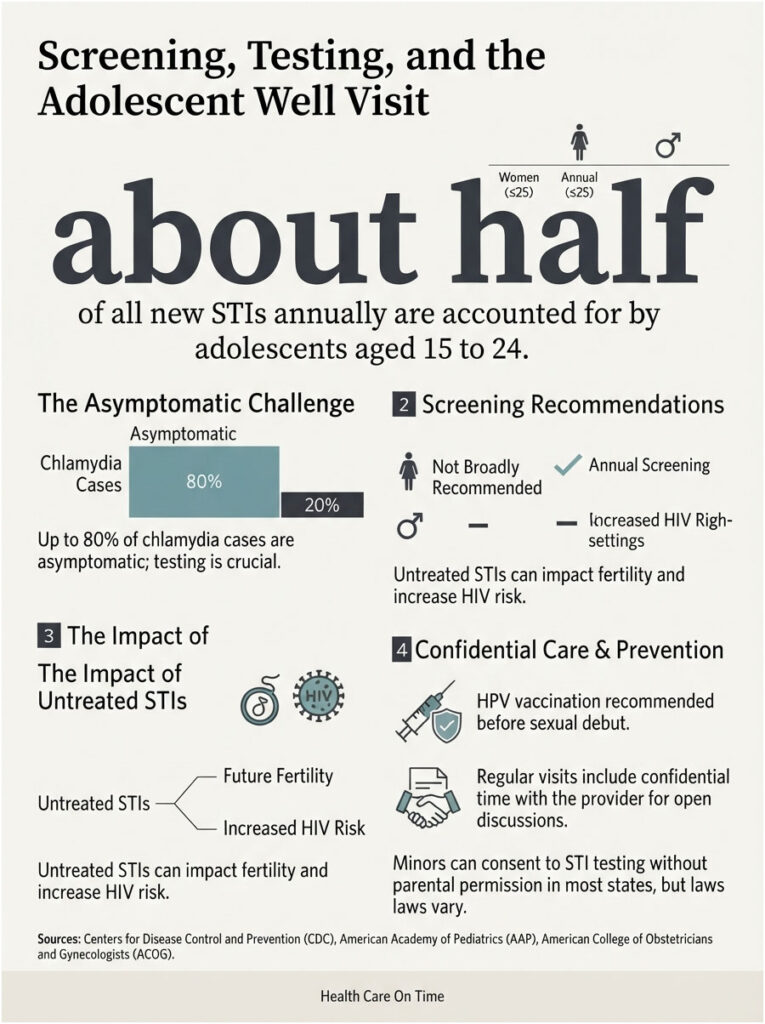
The case for testing asymptomatic teens rests on one fact: chlamydia is asymptomatic in up to 80 percent of cases. Waiting for symptoms means missing four out of five infections.
The Scale of the Problem
Published estimates hold that people aged 15 to 24 acquire about half of all new STIs each year, and roughly 1 in 4 sexually active adolescent females in the US has an STI.
The CDC’s parent-facing materials spell out the stakes: untreated chlamydia and gonorrhea can make it difficult or impossible for a woman to become pregnant later in life, and an untreated STI raises the chance of acquiring HIV.
The USPSTF adds context on why age drives the recommendation: age is a strong predictor of risk, with the highest infection rates in women occurring between 15 and 24.
What a Sexually Active Teen’s Panel Usually Includes
Exact panels vary by history and anatomy, but the common components are consistent.
- Chlamydia and gonorrhea, by urine sample or self-collected swab
- HIV, recommended at least once and more often with ongoing risk
- Syphilis, based on risk and local prevalence
- Trichomoniasis in some settings
- Pregnancy testing where relevant
- Testing at each site of exposure, not only genital
Self-collected swabs matter more than they sound. They remove the pelvic exam as a barrier, and for many teens the exam is the reason testing gets refused.
Patients booking adolescent panels through HealthCareOnTime most often ask whether one negative result settles the question. It does not. Screening is periodic because exposure is ongoing.
HPV Vaccination
Routine HPV vaccination is recommended well before sexual debut, which is exactly why it sits in the pre-teen schedule rather than the teen one.
If your child missed the series, ask about catch-up at the next visit. Waiting for a milestone defeats the purpose of a vaccine designed to precede exposure.
Confidentiality and Minor Consent
ACOG states that although laws vary by state, all minors have a right to some confidential health care, and all states and DC allow minors to consent to STI testing and treatment without parental permission.
The nuances are real. Guttmacher Institute tracking notes that 16 states have parental notification provisions that either allow providers to inform parents about STI testing or treatment or require it in specific circumstances, and Idaho enacted a law in 2024 requiring parental consent for health care generally.
Some states also set a minimum age, generally 12 or 14, before a minor can consent independently.
The Guttmacher Institute also documents why these protections exist: considerable evidence shows many young people would forgo contraceptive and STI services if they could not obtain such care confidentially.
One practical trap defeats the law entirely. An explanation-of-benefits statement mailed to the policyholder can expose a confidential visit even in states that protect it. Ask the clinic how billing is handled before the appointment rather than after.
The Confidential Visit
The CDC’s recommendation to parents is direct: take your teen to regular preventive care appointments and allow time alone with the provider, so the teen can talk confidentially about STIs, HIV, and pregnancy. Be prepared to suggest stepping out of the room, since not every provider will ask.
Volunteering to leave is the move. It signals trust, and it gives your teen a medical adult they can use on the days they will not use you.
Questions to Ask at the Next Appointment
- Will you spend time alone with my teen as part of this visit?
- What is your confidentiality policy, and what triggers an exception?
- Which STI tests do you recommend at this age, and how often?
- Is the HPV series complete, and if not, what is the catch-up schedule?
- How will this visit appear on insurance paperwork?
Our lab partners report that the most common gap is not refusal of testing but never having been offered it. That puts the burden on the parent to ask the question.
Frequently Asked Questions
What is the average age teens first have sex in the US?
There is no single meaningful average, and cumulative probability is more useful. NSFG data show about 20 percent of young people have had intercourse by 15, roughly half by 17, and close to 80 percent by 20. Treat that as a gradual slope rather than a target age.
Is a 13-year-old’s interest in sex normal?
Interest and curiosity at 13 are typical and expected during middle adolescence. Interest is not the same as behavior. What warrants attention is sexual knowledge or preoccupation clearly beyond the child’s age, which can signal exposure or victimization and deserves a pediatric conversation.
Are teens really having less sex than previous generations?
Yes, with a measurement caveat. YRBS data show a drop from 54 percent in 1991 to 32 percent in 2023. Recent analysis flags falling response rates and missing data as reasons to treat post-2019 trends carefully. The long-run direction remains clearly downward.
How can you tell if a teenager is sexually active?
There is no reliable checklist, and surveillance tends to damage the trust you need. A new serious relationship, greater privacy, or found contraception may suggest it. The dependable route is a non-punitive conversation plus confidential time with a clinician who can ask directly.
Will talking about sex make a teen more likely to have it?
No. A meta-analysis of 31 randomized trials found parent-based interventions improved condom use and parent-child communication, with no significant effect in either direction on the timing of sexual activity. Conversations make sex safer without making it earlier.
Can a teen get STI testing without parental consent?
In every state and DC, minors can consent to STI testing and treatment, though some states set a minimum age of 12 or 14. Sixteen states have provisions allowing or requiring provider notification of parents in certain circumstances. Verify your state’s current rules.
What age should a daughter first see a gynecologist?
Most adolescent gynecologic care happens with a pediatrician or family physician, and a first specialist visit is commonly suggested in the early-to-mid teens. It usually involves conversation rather than a pelvic exam. Menstrual problems or sexual activity move that timeline earlier.
What tests should a sexually active teen get, and how often?
USPSTF recommends annual chlamydia and gonorrhea screening for sexually active women 25 and under. HIV testing is recommended at least once, and more often with ongoing risk. Screening for young men is targeted by setting and risk rather than universal.
What if a teen’s partner is much older?
Treat a gap of four or more years as a warning sign, particularly when a minor is involved. Age gaps correlate with coercion and unequal decision-making power. Meet the partner, document what you know, and consult a local attorney about your state’s consent and reporting rules.
Is early puberty linked to earlier sexual activity?
There is an association, but it is modest and heavily mediated by social factors rather than hormones alone. Early physical maturation shifts peer group and adult treatment, which carries more weight than biology. Early puberty alone is not a reason to expect early sexual activity.
Should parents read their teen’s messages?
Covert monitoring usually costs more in trust than it returns in information, and teens who lose trust stop disclosing. Transparent expectations about devices work better. If you suspect exploitation or grooming, that calculation changes and safety takes priority.
What is the legal age of consent?
It is 16, 17, or 18 depending on the state, with roughly 32 states plus DC at 16. Close-in-age exemptions exist in many states but often reduce rather than eliminate liability, and California and Arizona have none. Verify your state’s current statute.
Medical and Legal Disclaimer
This article is educational and does not constitute medical or legal advice. Adolescent health decisions should involve a pediatrician, family physician, or adolescent medicine specialist who knows your child. State laws on consent, confidentiality, age of consent, and mandatory reporting vary and change; consult a licensed attorney in your state for legal questions. If you suspect a child is being abused or exploited, contact the Childhelp National Child Abuse Hotline at 1-800-422-4453, available 24 hours a day.
References
- CDC Youth Risk Behavior Survey Data Summary and Trends Report, 2013 to 2023
- Child Trends: Fewer High Schoolers Say They’ve Had Sex
- NCHS Data Brief No. 366: Sexual Activity and Contraceptive Use Among Teenagers Aged 15 to 19
- National Health Statistics Reports No. 196: Teenagers in the United States
- NCHS: US Births Down 1 Percent in 2025
- Sexuality Research and Social Policy: Age Bias, Missing Data, and Declining Response Rates in the National YRBS
- American Academy of Pediatrics: Stages of Adolescence
- Merck Manual: Physical Growth and Sexual Maturation of Adolescents
- StatPearls: Physiology, Puberty
- Pew Research Center: Basics of Teen Romantic Relationships
- Pew Research Center: 6 Facts About Teen Romance in the Digital Age
- JAMA Pediatrics: Parent-Based Interventions and Adolescent Sexual Health, Meta-Analysis
- JAMA Pediatrics: Parent-Adolescent Sexual Communication and Safer Sex Behavior
- Effect of Forced Sexual Intercourse on Associations Between Early Sexual Debut and Other Health Risk Behaviors
- Early Sexual Debut and Associated Risk Behaviors Among Sexual Minority Youth
- USPSTF: Chlamydia and Gonorrhea Screening Recommendation
- CDC STI Treatment Guidelines: Chlamydial Infections
- CDC: Talking With Your Teens About Sex
- CDC: STI Testing, Parent Resources
- ACOG: Confidentiality in Adolescent Health Care
- Guttmacher Institute: Minors’ Access to STI Services
- Guttmacher Institute: Ensuring Adolescents’ Ability to Obtain Confidential Family Planning Services